Thursday, July 24, 2025

Blair was warned George Bush had 'Manichean' mindset over Iraq, archives reveal

Britain's ambassador said US president saw his mission as 'ridding the world of evildoers' in lead up to invasion

Article thumbnail image
Britain’s ambassador to the US warned that George W Bush “sees his mission as ridding [the world] of evil-doers” (Photo: Mario Tama/AFP/Getty Images)
bookmark

Tony Blair was warned by Britain’s ambassador to the US that George W Bush was bent on the overthrow of Iraqi dictator Saddam Hussein as part of a “mission” to rid the world of “evil-doers”, newly-released government files show.

In January 2003 – two months before US and UK forces launched their fateful invasion – the-then Prime Minister Blair to flew to Camp David to urge the US President to allow more time for diplomacy to work.

However, files released to the National Archives at Kew, show that Sir Christopher Meyer warned it had become “politically impossible” to draw back from war unless Hussein surrendered.

In a cable sent to the prime minister’s office in December 2002, Sir Christopher said that much of the impulse for deposing Hussein was coming from the president, a born-again Christian, who was scornful of what he saw as the “self-serving” reservations of the Europeans.

“Much of the impulse for deposing Saddam Hussein comes from Bush himself. More than anything else, he fears another catastrophic terrorist attack on the homeland, especially one with an Iraqi connection,” the ambassador wrote.

“His view of the world is Manichean. He sees his mission as ridding it of evildoers. He believes American values should be universal values.

“He finds the Europeans’ differentiation between Osama bin Laden and Saddam Hussein self-serving. He is strongly allergic to Europeans collectively.

“Anyone who has sat round a dinner table with low-church Southerners will find these sentiments instantly recognisable.”

FILE PHOTO: Saddam Hussein is filmed after his capture in this file footage released December 14, 2003. Iraqi Interim President Ghazi al-Yawar said June 15, 2004 that toppled Iraqi president Saddam Hussein would be handed over to the new government once procedures were in place to protect his life and give him a fair trial. Handout via REUTERS/File Photo THIS IMAGE HAS BEEN SUPPLIED BY A THIRD PARTY.
‘Much of the impulse for deposing Saddam Hussein comes from Bush himself’ Sir Christopher wrote (Photo Handout via Reuters)

At the time, British officials were still hoping that the the United Nations Security Council would agree a new resolution specifically authorising the use of military force against Iraq.

Blair’s foreign policy adviser, Sir David Manning, said that when he met the president he should make the point that a new resolution was “politically essential for the UK, and almost certainly legally essential as well”.

However, the Americans were becoming increasingly impatient with the unwillingness of France and Russia – which both had a veto on the council – to agree a resolution so long as UN inspectors were unable to find any evidence of Hussein’s weapons of mass destruction, the supposed justification for war.

Following Bush’s annual State of the Union address to Congress, shortly before Blair’s visit, he warned that the options for a peaceful solution had effectively run out.

“It is politically impossible for Bush to back down from going to war in Iraq this spring, absent Saddam’s surrender or disappearance from the scene” he wrote.

“If Bush had any room for manoeuvre beforehand this was closed off by his State of the Union speech.

“In the high-flown prose to which Bush is drawn on these set-piece occasions, he said in effect that destroying Saddam is a crusade against evil to be undertaken by God’s chosen people.”

In the event, the US and UK abandoned their efforts to get agreement on a new Security Council resolution, claiming French president Jacques Chirac had made it clear he would never agree.

The for-profit companies behind Israeli-U.S. nonprofit Gaza aid plan

Now the primary vehicle for food distribution inside Gaza, the controversial U.S.- and Israeli-backed operation is an issue in ongoing ceasefire negotiations.


July 21, 2025 
By Karen DeYoung and Cate Brown
WASHINGTON POST

LONG READ

Inside the four hastily constructed warehouses in southern Gaza where food is handed out to desperate and starving Palestinians, it is relatively calm. Ration boxes stamped with the name and logo of the Gaza Humanitarian Foundation are distributed by local volunteers in red vests, under the watchful gaze of beefy, armed American security contractors.

It is just outside the warehouses where most of the trouble happens. Outside is where hundreds of civilians desperately crowding toward the distribution sites have been shot and killed — many of them allegedly by Israeli soldiers positioned nearby — and where at least 20 Palestinians died Wednesday in a stampede that the GHF says was initiated by gun-toting Hamas militants.

Humanitarian aid has been one of the most controversial aspects of the war between Israel and Hamas, which is now approaching its second anniversary. In recent weeks, it has emerged as a final sticking point in negotiations over a ceasefire, placing the Israeli- and U.S.-backed GHF squarely in the crosshairs of the latest talks.

Hamas is demanding a return to the U.N.-coordinated system of aid delivery that operated in Gaza for decades. Israel charges that Hamas has corrupted that system. It wants to maintain strict controls on assistance to Gazans, using the newly created GHF as the primary mechanism for food distribution.

Critics, including the United Nations and most of the international humanitarian aid community, say the GHF is designed to further Israeli war aims by selectively and inadequately providing assistance, and by forcing Gazans to put their lives in danger for a box of provisions. In a statement released Monday, 21 European countries and others including Canada and Australia issued a joint statement saying that “the suffering of civilians in Gaza has reached new depths” and condemning “the drip feeding of aid and the inhumane killing of civilians, including children, seeking to meet their most basic needs of water and food.”

“The Israeli government’s aid delivery model,” it said, “is dangerous, fuels instability and deprives Gazans of human dignity.”

Like much of what happens inside Gaza, where Israel has banned international reporters except on brief tours led by the Israel Defense Forces, the origins and operations of the GHF remain obscure. Even more opaque is its funding. The foundation says it received about $100 million in start-up money from a government it has declined to identify. In late June, the Trump administration said it would supply $30 million to GHF operations.

A major donation initially expected from the United Arab Emirates, according to internal planning documents seen by The Washington Post, has not materialized.

The government of Israeli Prime Minister Benjamin Netanyahu, which has been deeply involved in the aid program, has publicly denied paying for it.

But behind the foundation, which is a registered nonprofit, is a web of interconnected U.S. and Israeli individuals, and private U.S. companies — including some that hope to eventually make money on the relief effort, according to public and private documents reviewed by The Post and interviews with more than a dozen U.S. and Israeli government officials, business representatives and others involved, who spoke on the condition of anonymity about the controversial initiative.

Among those positioned to profit from GHF-linked contracts are a Chicago-based private equity firm, McNally Capital, whose subsidiary Orbis Operations helped set up the foundation; and Safe Reach Solutions, the primary contractor overseeing GHF operations inside Gaza, which was created late last year for that purpose. SRS is owned by a Wyoming-based trust whose beneficiary is McNally Capital.

Boston Consulting Group was also engaged in the effort to stand up the GHF, on what it has said was a pro bono basis. In March, it signed a two-month contract for more than $1 million with McNally to continue assisting SRS, with later extensions in May, an arrangement first reported by the Financial Times. BCG later withdrew from the project amid controversy, and a BCG spokeswoman, Nidhi Sinha, said no payment was accepted.

The GHF has continued to deliver food to hungry Gazans: since late May, according to the foundation’s count, more than 80 million meals in boxes that are calibrated to feed 5.5 people for 3.5 days. But dwindling resources have limited the number of trucks available to bring food into the enclave to about 70 to 80 per day, compared with early plans for more than 300, according to people familiar with GHF operations. Construction of additional distribution sites has also been indefinitely put off because of a lack of financing, ongoing Israeli military operations and the need to remove unexploded ordnance throughout Gaza.

Money problems, and the unknown outcome of ceasefire negotiations, have also put on hold GHF plans for a more holistic — and controversial — proposal to relocate Gazans, summarized in a 19-page slide deck distributed at the U.S. Embassy in Tel Aviv in January, several people said. In addition to the food distribution, the slides included plans for GHF construction of large-scale residential compounds inside and potentially outside Gaza where “the population” could reside while the enclave was “demilitarized and rebuilt.”

The slide deck suggested that approach would allow the GHF to gain trust with Gazans — a currency that could be leveraged to “facilitate President Trump’s vision” for the battle-scarred enclave.

Aid ‘in a non-U.N. way’


The GHF concept was born as part of a larger effort by a group of Israeli military officials, Israeli businesspeople and foreign partners to support Israel’s war effort and plan for Gaza’s future. They began meeting shortly after the conflict began with Hamas’s Oct. 7, 2023, surprise attack in southern Israel, which killed about 1,200 people and saw at least 250 hostages taken back to Gaza.

As Israel responded to the attack, pounding Gaza with airstrikes and ground troops, it cut off the daily assistance that the 141-square-mile enclave had depended on for decades. Netanyahu’s government — long distrustful of the U.N., which coordinated deliveries of food, fuel and medical supplies — justified the blockade by claiming that Hamas controlled and profited from the aid distribution.

Under pressure from the Biden administration and humanitarian organizations that said depriving noncombatants of food was a potential war crime, Israel eventually allowed limited relief to resume. But the Israelis kept a tight hold on the spigot of assistance, generating friction between Netanyahu and the U.S. government, Israel’s main source of weaponry and diplomatic backing.

“There was a need to get humanitarian aid into Gaza,” an Israeli familiar with the group’s efforts said, but it needed to be done “in a non-U.N. way.”

In January 2024, the fledgling Gaza aid working group sought advice from Michael Vickers, a former Green Beret, CIA veteran and undersecretary of defense for intelligence during the Obama administration. Vickers was on the board of Orbis Operations, a consulting company based in McLean, Virginia, that was founded by former national security, military and intelligence specialists and which McNally purchased in 2021.

Vickers told the planners, “I’m not the guy, but I know the guy who can talk to you,” according to a person familiar with the approach. The man they wanted, Vickers said, was then-Orbis Vice President Philip Reilly, a former senior CIA operations officer with extensive experience in private security operations.

Reilly quickly gained the trust of the IDF and the Gaza planning group, and spent much of 2024 immersing himself in the details of the Gaza conflict.

Neither Vickers nor Reilly responded to queries about their involvement in the Gaza initiative.

The Biden administration was well aware that the Israeli government and private-sector Israelis and Americans were working with the government on a plan to impose a new aid delivery system. While some in the administration were supportive, most were skeptical. But they did not directly interfere in the project.

“They were all talking — they being the Israeli government, the prime minister’s office, the IDF — sort of throwing spaghetti against the wall to find some magic formula to take the responsibility off their shoulders” to care for Gaza’s civilians, a former Biden official involved in Israel policy said.

Ambitions and incorporations

By the fall, the outline of a plan was laid out in a lengthy feasibility study compiled by Silat Technologies, an Orbis subsidiary, envisioning the creation of a nonprofit entity, the Gaza Humanitarian Foundation, “to safely deliver humanitarian aid to Gaza.”

Planning documents distributed over the next several months said that the foundation’s leadership would include respected humanitarian figures such as David Beasley, former head of the World Food Program, and Tony Blair, the former British prime minister who now runs an institute to advise change-making political leaders. Although the U.N. and major nongovernmental aid organizations already operating in Gaza were described as an integral part, their proposed role was unclear. An elaborate social media presence and public relations program would include outreach to select journalists to promote a positive image of the GHF.

The foundation would hire a “prime” contractor to organize and supervise construction of the sites and the aid operation inside Gaza. That firm would then subcontract a private security company — ideally U.S.-based — to be the boots and guns on the ground, guarding the aid as it was transported to distribution sites and protecting the sites themselves.

The private companies lined up to service the planned foundation also included BCG, where both Reilly and Vickers were senior advisers. BCG, which later said its initial services were offered pro bono, projected $2 billion in initial operating costs for the GHF.

On Nov. 21, a new limited liability company, Safe Reach Solutions, was registered in Jackson, Wyoming, and placed in a trust administered by a local company, Two Ocean Trust. While no information in the registration documents indicated what the new company did, who ran it or whom it employed, the beneficiary of the trust and any money it made, according to three people familiar with the arrangement, was McNally Capital, the private equity firm that owns Orbis. SRS, with Reilly as its chief executive, would later become the primary GHF contractor.

Spokespeople for Two Ocean Trust and SRS declined to comment.

In a statement to The Post, McNally Capital said it “did not invest in SRS or actively manage the company,” but said it has an “economic interest” in the firm.

“Given our long-established relationship with Phil Reilly … our strong belief in the importance of humanitarian aid, and the U.S. government’s appeal for innovative solutions,” the statement said, McNally was “pleased to have supported the establishment of SRS as an important step toward meeting the full scope of humanitarian need in Gaza.”


Founded in 2008 by Ward McNally, of the Rand McNally publishing family, the firm specializes in the acquisition of aerospace, defense and technology companies.


“Obviously, McNally is a business. They’re in the business of making money,” a person familiar with the financial aspects of the project said. But “I think it’s very ambiguous whether this ends up being profitable.”

Displaced Palestinians cross the Netzarim Corridor as they make their way to the northern parts of the Gaza Strip on Feb. 9. (Omar Al-Qattaa/AFP/Getty Images)

A checkpoint test run


As the new year approached, progress toward the food aid program planning was interrupted by the prospect of a Gaza ceasefire and partial hostage release.

Israel had agreed to move its troops out of portions of Gaza at least temporarily — allowing citizens to return to what remained of their homes in the largely destroyed northern portion of the enclave. But Israeli officials insisted on a vehicle checkpoint — run by non-IDF security — on the Netzarim Corridor, a dividing line between northern and southern Gaza, to ensure weapons were not carried back to areas the IDF said it had earlier cleared of Hamas militants.

With nine days’ notice, U.S. and Arab mediators turned to the newly created SRS to organize the checkpoint. Reilly subcontracted UG Solutions, a small security firm based in North Carolina, to staff the ground operation.

Headed by former Green Beret Jameson Govoni, UG had previously worked in Ukraine and Haiti, among other hot spots, and could move quickly because it had few of the classified contracts with the United States or other governments that proved to be complications for bigger security companies. The ceasefire mediators — the United States and Qatar — administered payments to SRS, the prime contractor, according to people familiar with the operation.


The ceasefire began Jan. 19, the day before Donald Trump’s second-term inauguration. Although the truce lasted only until mid-March, when Israel launched another ground invasion of northern Gaza, the checkpoint was deemed a success, with no major incidents reported.

The Netzarim operation came to be considered a test run for the food distribution operation, and SRS and UG were well positioned to take it over for GHF. On Feb. 2, the foundation was registered as a humanitarian nonprofit in Switzerland and Delaware.

The Netanyahu government had every reason to believe that Trump would support the initiative. He vowed to quickly end the war and proposed that the United States “take over” and “own” Gaza, developing it as a high-end Mediterranean resort. Food distribution by the GHF, planning documents indicated, was just the first step in a larger redevelopment plan.

A rocky launch

When the ceasefire collapsed on March 18 and the IDF resumed ground operations and airstrikes, Israel again stopped all humanitarian aid from entering Gaza. As the days and weeks ticked on, thousands of tons of food and goods piled up in warehouses outside its borders; WFP and other humanitarian actors began to tally reports of starvation inside.

By early May, Israel was under mounting international pressure to end its aid blockade, and Trump was looking for progress on his promise to end the war as he prepared for a trip to the Persian Gulf.

At a May 9 news conference in Tel Aviv, U.S. Ambassador to Israel Mike Huckabee claimed the GHF as a Trump “initiative.” U.S. representatives, including Aryeh Lightstone, an official who now works with Trump’s special envoy Steve Witkoff and formerly served as an aide to David Friedman when he was U.S. ambassador to Israel, courted U.N. and humanitarian partners to sign on to the plan.

But opposition to the plan had grown. The United Nations and most aid partners refused, publicly denouncing the proposal as immoral and designed to further Israel’s war plans against Hamas by “militarizing” assistance to more than a million civilians corralled into ever-shrinking “safe zones” demarcated by the IDF in southern Gaza. Neither Beasley nor Blair agreed to sign on.

On May 22, newly named GHF executive director Jake Wood, a U.S. Marine veteran and co-founding board chair of Team Rubicon, a humanitarian organization that operated in disaster zones, released a letter he had sent to COGAT, the Israeli government coordinator for Gaza and the occupied West Bank. Its purpose, he wrote, was to confirm “our understandings of agreements” — including an understanding that aid agencies would also be permitted to distribute food and medical assistance under “existing” humanitarian mechanisms, outside the GHF program.

“GHF acknowledges that we do not possess the technical capacity or field infrastructure to manage such distributions independently,” he wrote, suggesting that the new aid mechanism should complement, but not replace, Gaza’s existing aid sector.

The night before the scheduled May 26 launch, Wood unsuccessfully sought to persuade the IDF to delay the start date by at least a week amid unanswered questions about funding, the participation of other agencies and the nearby positioning of Israeli troops. Wood resigned, and the next day, UG contractors accompanied the first convoys of GHF food into Gaza.

Some of the plans, he said in a statement, were not consistent with “humanitarian principles of humanity, neutrality, impartiality and independence.” David Burke, a fellow Marine veteran and former Team Rubicon colleague who had been named GHF chief operating officer, also resigned. Burke and Wood did not respond to inquiries from The Post.

The GHF promoted John Acree, a former official with the U.S. Agency for International Development originally named head of the GHF operations inside Gaza, to interim executive director of the foundation.

The opening of the sites brought new problems, with tens of thousands of despairing Gazans surging toward promised food. In the first week of GHF’s operations, witnesses said that Israeli troops shot in the direction of Palestinians queuing outside the fenced distribution sites at least three times. UG contractors voiced concerns about the rules of engagement of nearby IDF troops and the safety of the Palestinians, according to several people familiar with the site operations.

Meanwhile, paid Palestinian volunteers working at the GHF sites were receiving death threats from Hamas for participating in the Israeli-backed plan. Volunteers were afraid to travel back to their families at night, but the financial planners had not budgeted to provide them with housing, running water or other supplies to stay on-site, one person said.

“There were number crunchers at every stage, asking why do we have to do this stuff,” said another person familiar with the conversations between BCG financial consultants and SRS planners. Contractors purchased some provisions for the workers out of their own pockets, the person said.

The limited number of trucks that passed through the Kerem Shalom crossing into Gaza each day to the sites after Israeli inspection meant that supplies ran out too early, leaving thousands empty-handed, angry and disbelieving there was no more food to be had.

During the first week of June, BCG abruptly withdrew from the project. Amid what several people familiar with the situation said was internal criticism of perceived anti-Palestinian initiatives, the company said that members of its team had undertaken “unauthorized” efforts on postwar planning. Two senior partners, it said in a statement, had been “exited ... from the firm” and BCG “has not and will not be paid for any of their work.”

The end game

Despite ongoing problems and frequent reports of gunfire nearby, the GHF food program achieved a rhythm of sorts after a few weeks. News releases provided a daily accounting of tens of thousands of boxes of pasta, lentils, cooking oil and other commodities it distributed.

But the killing of civilians in the vicinity of GHF sites has continued. Last month, eight Palestinian volunteers were shot and killed, allegedly by Hamas, aboard a bus returning them to GHF sites after visiting their families. Early this month, this IDF said “terrorists” had tossed grenades into a distribution site, injuring two American contractors. Then came the deaths in Wednesday’s stampede.

“We came to Gaza to help feed people, not to fight a narrative war,” GHF spokesman Chapin Fay told reporters hours after the stampede deaths, publicly accusing Hamas of causing the carnage by showing up at the site with guns. Aid organizations said it was the predicted result of Israeli militarization of what should be a neutral endeavor.

On Sunday, at least 79 Palestinians were killed when food-seeking crowds mobbed a U.N. aid convoy in the northern part of the enclave and were fired on by Israeli troops, according to Gaza health authorities and witnesses. The IDF said it was “aware of the claim” and that details of the event were “being examined.”

Acree, the GHF interim executive director, repeated appeals to the United Nations and other aid organizations to cooperate with the foundation. “The demand for food is relentless, and so is our commitment,” he said in a statement. “We’re adjusting our operations in real time to keep people safe and informed, and we stand ready to partner with other organizations to scale up and deliver more meals to the people of Gaza.”

GHF contracts expire at the end of August, unless a ceasefire comes first. If and when the fighting stops, it remains unclear how much aid will be allowed into Gaza and who will distribute it. Since late June, Trump has said repeatedly that negotiations were going well and that a truce was imminent.


By Karen DeYoungKaren DeYoung is associate editor and senior national security correspondent for The Post. In more than three decades at the paper, she has served as bureau chief in Latin America and in London and as correspondent covering the White House, U.S. foreign policy and the intelligence community. follow on X@karendeyoung1

By Cate BrownCate Brown is a researche
Taylor Swift INC.  and Drake INC.   music giant files to sell shares in US


Osmond Chia
Business reporter, BBC News
Reporting fromSingapore
JULY 21, 2025
Getty Images


Universal Music Group's (UMG) - which is the world's biggest music group and owner of the record labels behind mega stars Taylor Swift, Drake and Lady Gaga - has filed to sell its shares in the US.

The company, which is already listed in the Netherlands, has a stock market valuation there of almost €50bn ($43.3bn; $58.5bn).

The music powerhouse's line-up of international superstars also includes Billie Eilish, Ariana Grande and Harry Styles.

The move comes as two major US share indexes - the S&P 500 and Nasdaq Composite - closed at fresh record highs on Monday as share markets continue to rebound after a brief slump over concerns triggered by President Donald Trump's tariff policies.

UMG said in its statement that it has filed a confidential statement with the US financial markets regulator, Securities and Exchange Commission (SEC).

The potential public offering remains subject to review by the SEC, it added.

The company did not reveal the size of the planned US offering or how much it could raise.

Confidential filings allow firms to keep information private while engaging with regulators and assessing investor appetite for a share sale before disclosing details publicly.

Billionaire investor Bill Ackman's hedge fund Pershing Square, which is one of the biggest shareholders of UMG, has previously pushed the firm to list in the US.

In January, Mr Ackman posted on X that a listing in the US would push up UMG's value.

"We also believe the US listing will greatly improve trading liquidity for the shares," he said.

The global music conglomerate owns major record labels, including Motown Records, which was home to Marvin Gaye and Michael Jackson.

It also owns Capitol Music Group, which counts the Beatles and Katy Perry amongst its artists.

In 2024, UMG was involved in a dispute with TikTok over royalties.

The row saw UMG's music being muted or removed from the social media platform until both firms reached an agreement in May that year.
‘Sustainable Development Goals Not Dream, but Plan’, UN Secretary-General Tells Political Forum


21 July 2025

The following are UN Secretary-General António Guterres’ remarks to the ministerial segment of the high-level political forum on sustainable development, in New York today:

This year’s high-level political forum arrives at a time of profound challenge — but also real possibility. Despite enormous headwinds, we have seen just in the last two months what can be achieved when countries come together with conviction and focus.

We saw it in Geneva, where the World Health Assembly adopted the Pandemic Agreement — a vital step toward a safer, more equitable global health architecture. We saw it in Nice at the third UN Ocean Conference, where Governments committed to expand marine protected areas and tackle plastic pollution and illegal fishing.

And we saw it in Sevilla at the fourth International Financing for Development Conference, where countries agreed on a new vision for global finance — one that expands fiscal space, lowers the cost of capital, and ensures developing countries have a stronger voice and participation in the organizations that shape their future.

These are not isolated wins. They are signs of momentum. Signs that multilateralism can deliver. Signs that transformation is not only necessary — it is possible. And that is the spirit we bring to this high-level political forum.

This forum is about renewing our common promise — to end poverty, protect the planet, and ensure prosperity for all. We also recognize the deep linkages between development and peace.

We meet against the backdrop of global conflicts that are pushing the Sustainable Development Goals (SDGs) further out of reach. That’s why we must keep working for peace in the Middle East.

Over the weekend in Gaza, we saw yet more mass shootings and killings of people seeking UN aid for their families — an atrocious and inhumane act which I utterly condemn.

We need an immediate ceasefire in Gaza, the immediate release of all hostages, and unimpeded humanitarian access as a first step to achieve the two-State solution. We need the ceasefire between Iran and Israel to hold. We need a just and lasting peace in Ukraine based on the UN Charter, international law and UN resolutions.

We need an end to the horror and bloodshed in Sudan. And the list goes on, from the Democratic Republic of the Congo to Somalia, from the Sahel to Myanmar.

At every step, we know sustainable peace requires sustainable development. The Sustainable Development Goals are not a dream. They are a plan. A plan to keep our promises — to the most vulnerable people, to each other, and to future generations. People win when we channel our energy into development.

Since 2015, millions more people have access to electricity, clean cooking, and the internet. Social protection now reaches over half the world’s population — up from just a quarter a decade ago. More girls are completing school. Child marriage is declining. Women’s representation is growing — from the boardrooms of business to the halls of political power.

But we must face a tough reality: Only 35 per cent of SDG targets are on track or making moderate progress. Nearly half are moving too slowly. And 18 per cent are going backwards.

Meanwhile, the global economy is slowing. Trade tensions are rising. Inequalities are growing. Aid budgets are being decimated while military spending soars. And mistrust, division and outright conflicts are placing the international problem-solving system under unprecedented strain. We cannot sugarcoat these facts. But we must not surrender to them either.

The SDGs are still within reach — if we act with urgency and ambition. This year’s forum focuses on five critical Goals: health, gender equality, decent work, life below water, and global partnerships. All are essential. All are interconnected. All can spur change across other goals.

On health, COVID-19 exposed and deepened inequalities — and today, far too many people still lack access to basic care. We know what works. We must boost investment in universal health coverage, rooted in strong primary care and prevention, reaching those furthest behind first.

On gender equality, gaps remain wide. Women and girls face systemic barriers — from violence and discrimination to unpaid care and limited political voice.

But we also see growing momentum: from grassroots movements to national reforms. Now is the time to turn that momentum into transformation — with rights-based policies, accountability, and real financing into programmes that support inclusion and equality for women and girls.

On decent work, the global economy is leaving billions behind. Over 2 billion people are in informal jobs Youth unemployment is stubbornly high. But we have tools to change this.

The Global Accelerator on Jobs and Social Protection is helping countries invest in expanded social protection initiatives, skills training, and the creation of sustainable livelihoods — including in growing industries like clean energy.

Tomorrow, I will deliver an address on the enormous opportunities of the renewables revolution. The upcoming World Summit on Social Development can help spur further progress.

On life below water, our ocean and the communities that count on it are paying the price of overfishing, pollution, and climate change. We must deliver on the commitments of the Nice Ocean Conference — to protect marine ecosystems and support the millions who depend on them. And, finally, on global partnerships — SDG 17 — we need to strengthen all the elements that can support progress.

This means investing in science, data, and local capacity. And harnessing digital innovation — including artificial intelligence — to accelerate progress, not deepen divides.

Throughout, we must recognize the need to reform the unfair global financial system, which no longer represents today’s world or the challenges faced by developing countries.

We must ensure a reform for developing countries to have a stronger voice and greater participation to help advance the Sustainable Development Goals on the ground.

The Sevilla Commitment that emerged from the Conference on Financing for Development includes important steps: Through new domestic and global commitments that can channel public and private finance to the areas of greatest need.

By increasing the capacity of Governments to substantially mobilize domestic resources, including through tax reform. And by establishing a more effective framework for debt relief and tripling the lending capacity of multilateral development banks to the benefit of developing countries.

In the coming year, we must keep building. We must strengthen and scale up partnerships that deliver — including with the private sector and civil society organizations and local authorities.

We must embed long-term thinking into every decision, as we committed in the Declaration on Future Generations. And we must continue to learn from each other.

Voluntary national reviews — the backbone of this forum — are more than reports. They are acts of accountability. They are journeys of self-discovery as countries develop and build. And they are templates for other countries to follow and learn from.

By the end of this high-level political forum, we will have surpassed 400 reviews — with over 150 countries presenting more than once. That is a powerful signal of commitment. A clear demonstration that solutions exist and can be replicated and expanded.

With five years left, it’s time to transform these sparks of transformation into a blaze of progress — for all countries. Let us act with determination, justice and direction. And let’s deliver on development — for people and for planet.
NIGERIA

Diaspora remittances surpassed FDI in 2024 – NiDCOM


Nigerians in Diaspora Commission (NIDCOM)


ByDalhatu Liman
Tue, 22 Jul 2025 

Nigerians in the diaspora remitted over $20bn to the country in 2024, surpassing foreign direct investment (FDI) and affirming their role as a critical economic lifeline, according to the Chairman/CEO of the Nigerians in Diaspora Commission (NiDCOM), Hon. Abike Dabiri-Erewa.

Speaking at an international press conference in Abuja ahead of the National Diaspora Day (NDD) and the National Diaspora Merit Awards (NDMA), scheduled for July 25–26, Erewa said this year’s theme: “Optimising Formidable Diaspora Potentials for National Development and Growth” — reflects an urgent national call to deepen collaboration with Nigeria’s diaspora population.

She stressed the growing influence of Nigerians abroad in key sectors including medicine, education, innovation, business, and governance, describing them as “among Nigeria’s greatest exports.

“In 2024 alone, remittances from Nigerians abroad exceeded $20 billion, surpassing foreign direct investment. “But beyond figures
 lies an armoury of knowledge, skills, networks, and goodwill,” she said.

Dabiri-Erewa also emphasised that financial remittances represent only a fraction of diaspora contributions, urging a shift from statistics to structured engagement.

“It is a national imperative. We must harness the full value of our over 20 million diaspora community globally.”

Reviewing strides made by NiDCOM, she cited initiatives such as the deployment of State Diaspora Focal Point Officers, the implementation of the National Diaspora Policy, the annual Nigeria Diaspora Investment Summit, and the Data Mapping Project as practical tools for effective diaspora integration into national planning.

“This year’s celebration is about building a Nigeria where our diaspora community is not just celebrated occasionally, but embedded structurally,” she said.

The 2025 NDD will feature hybrid participation, welcoming delegates both physically at the State Conference Centre, Presidential Villa, Abuja, and virtually from across the globe.

The programme will include thematic sessions, strategic dialogues, youth mentorship, and the NDMA ceremony, honouring distinguished diaspora Nigerians for their contributions.

Registration for the event is ongoing at www.nidcom.gov.ng/diasporaday, with Dabiri-Erewa affirming that Nigerians in diaspora—from Lagos to Lisbon—are “seen, valued and celebrated.”

She extended appreciation to President Bola Ahmed Tinubu for his consistent support for diaspora engagement and called on all stakeholders to be part of “a collective national effort to reconnect, reimagine and rebuild.”

“Let this event be remembered not for its banners, but for the bridges it builds and the futures it unlocks,” she added.
As US wildfires rage, Trump staff cuts force firefighters to clean toilets, critics say


The Dragon Bravo Fire burns on the northern rim as seen from Grandeur Point on the southern rim of Grand Canyon, Arizona, US July 14, 2025.
PHOTO: Reuters file

July 21, 2025 

The US Forest Service faced criticism from current and former employees who say federal workforce reductions under the Trump administration have left fire teams understaffed, as the country grapples with decade-high US wildfire numbers this year.

The agency, which oversees the nation's largest wildland firefighting force, rejected those claims, saying it has sufficient resources.

However, more than a dozen active and retired US Forest Service employees told Reuters the agency is struggling to fill critical roles after approximately 5,000 employees — roughly 15 per cent of its workforce — quit in the past five months.

Accounts from firefighters in Oregon and New Mexico, as well as a fire chief recruiting support staff in the Pacific Northwest, said the vacancies have led to personnel held back from supporting frontline firefighting because of administrative duties.

The crew leader on an Oregon blaze said her team went hungry for several days, ran short of medical supplies, and had to scrounge for chainsaw fuel after support staff quit the agency during two rounds of "fork in the road" buyouts.

"I had guys who were going to bed hungry after working 16 hours," said the crew leader on the Alder Springs Fire, who asked not to be named for fear of losing her job.

National and local USFS officials say, however, the force is ready for what is expected to be a worse-than-average fire year in California, the Pacific Northwest, and the northern Rockies, according to National Interagency Fire Centre forecasts.

"Our fire staff feels very confident in our staffing levels going into this fire season," said USFS public affairs officer Isabella Isaksen, who represents USFS operations in central Oregon.

Isaksen said food problems on the Alder Springs Fire were due to a new caterer and were quickly resolved. She said medical, chainsaw, and other supplies were available on the 3,400-acre blaze that triggered evacuations in two counties.

'They are ready'

The Trump administration pledged not to cut firefighting positions and other public safety jobs in firings, voluntary resignations, and early retirements meant to raise efficiency at the USFS, which manages 193 million acres of land (78 million hectares), roughly the size of Texas.

USFS employees that Reuters interviewed for this story said the loss of thousands of foresters, biologists, trail builders, and campground managers was having a knock-on effect on firefighters.

Not only are firefighters having to cover empty positions at ranger stations, but they also have lost hundreds of peers who each year switched from regular jobs to take on firefighting support roles during the fire season, which typically runs from spring to fall, these people said.

USFS Chief Tom Schultz on Wednesday told agency managers to make all of these fire-qualified, so-called "red-carded" staff available for what he called an "extremely challenging" fire year, according to a memo seen by Reuters.

Year to date, wildland firefighters have been called to nearly 41,000 blazes, by far the highest number in federal data going back to at least 2015. Wildfires have burned 2.9 million acres year to date, below the 10-year average of 3.3 million acres.

Last month, Schultz told a US Senate committee he was trying to temporarily hire back some 1,400 fire-qualified, "red-carded" support staff who took buyouts.

"I do believe they are ready," Schultz said when asked about preparedness for the 2025 fire year.

Firefighters mow lawns

Agriculture Secretary Brooke Rollins, who oversees the USFS, said in June at a meeting of Western state governors in New Mexico that the agency was on target to hire 11,300 firefighters by mid-July, outpacing hiring over the past three years.

As of June 29, 11,236 or 99 per cent of that number had been hired, slightly below last year's level, according to the most recent USDA data.

The USDA disputed claims that staff shortages are endangering communities, forests, and firefighters.

"Any suggestion that firefighting responsibilities are being delayed or deprioritized is simply incorrect," a USDA spokesperson said. "This is not a secondary mission — it is the core of our public safety work, and every decision reflects that urgency."

New Mexico US Senator Martin Heinrich has criticised the Trump administration's firing and rehiring of 3,400 USFS probationary staff, three-quarters of whom were red-carded, as well as what he called its indiscriminate, agency-wide staff buyouts.

"Wildfire season is well underway, and thanks to Doge and Donald Trump, the US Forest Service is being gutted, leaving communities ill equipped to fight deadly wildfires," Heinrich said in an emailed statement on July 11.

The Forest Service says it does not have enough wildland firefighters for the country's "wildfire crisis" and relies on red-carded staff to "boost wildland firefighting capacity."

Not everyone close to the Forest Service sees problems.

Steve Ellis, chairman of the National Association of Forest Service Retirees, said his checks with fire staff in Oregon turned up no reports of firefighters going hungry or other support issues.

But Riva Duncan, a fire duty officer on a New Mexico blaze, said even firefighters were being used to plug gaps left by job losses, exacerbating longstanding shortages of personnel to operate fire engines.

"They're answering phones at the front desk, or cleaning toilets at campgrounds or mowing the lawn at administrative sites," said Duncan, a retired USFS fire chief who reenlists during fire season and helps run Grassroots Wildland Firefighters, a federal firefighter advocacy group.

The fire staff officer in the Pacific Northwest said support staff had been told by managers they had to meet the Trump administration's increased timber sales and oil and gas production targets, with fewer employees, before helping firefighters.

"They can claim we get all the support we need, but in reality, it isn't even close," said the fire chief, who asked not to be named for fear of retaliation.

French court jails three for human trafficking in champagne industry

The decision comes as the Champagne wine-making region is under scrutiny over the 2023 harvest, marked by exceptional heat and the death of four grape pickers.


Le Monde with AFP

July 21, 2025, 

A French court on Monday, July 21 sentenced an employer and two others to jail over human trafficking in the champagne industry, exploiting seasonal workers and housing them in appalling conditions during the 2023 harvest. The decision comes as the Champagne wine-making region is under scrutiny, with another enquiry into the employment of Ukrainian harvesters during the same 2023 harvest, which was marked by exceptional heat and the death of four grape pickers.

The lawyer for the victims – 50 mostly undocumented migrant harvesters from Mali, Mauritania, Ivory Coast and Senegal – welcomed what he called a "historic" decision. The court sentenced the director of a vine-growing servicing company called Anavim, a Kyrgyz woman in her 40s, to two years behind bars, as well as another two suspended. She had denied she was responsible for the housing conditions, and had blamed the two other defendants suspected of recruiting the harvesters.

The court sentenced the two other people, both men in their 30s, to one year behind bars, as well as two and one suspended. All three were found guilty of human trafficking – defined under French law as "recruiting, transporting, transferring, housing or receiving a person to exploit them," by means of coerced employment, abusing a position of authority, abusing a vulnerable situation or in exchange of payment or benefits.

The court in the town of Chalons-en-Champagne dissolved the servicing company and ordered a wine-making cooperative it worked with to pay a €75,000 fine. It ordered the three found guilty to pay €4,000 each to each victim.

Attorney Maxime Cessieux, who represented the victims, said the ruling was "exemplary." This year's grape harvest "will be closely scrutinized and no one will be able to say 'I didn't know, I didn't understand, I didn't know who these people in my vineyards were,'" he said.

Every year, around 120,000 seasonal workers are recruited to handpick the grapes grown across 34,000 hectares in the Champagne region to make the iconic bubbly. In 2023, four grape harvesters died, possibly the result of sunstroke after working in scorching heat.

Russian TV shows teenagers at 'world's biggest drone factory' making arms to hit Ukraine


An armoured truck transports Russia's Geran unmanned comabt aerial vehicles before a military parade on Victory Day, marking the 80th anniversary of the victory over Nazi Germany in World War Two, in Moscow, Russia, May 9, 2025.
PHOTO: Reuters file

July 21, 2025 

MOSCOW — A Russian factory, described by its director as the world's biggest maker of strike drones, has been shown on the Russian army's TV channel with teenagers helping make kamikaze drones to attack Ukraine.

The footage, in a documentary film broadcast by the Zvezda channel on Sunday (July 20), showed hundreds of large black completed Geran-2 suicide drones in rows inside the secretive facility, which has been targeted by Ukrainian long-range drones.

Ukraine says Russia has used the Geran drones to terrorise and kill civilians in locations including the capital Kyiv, where residents often shelter in metro stations during attacks.

Russia says its drone and missile strikes target only military or military-related targets and denies deliberately targeting civilians, more than 13,000 of whom have been killed in Ukraine since the war began in 2022, the United Nations says.

Zvezda said the Alabuga factory, in Russia's Tatarstan region, invited school pupils to study at a college the factory runs nearby once they had completed ninth grade (aged 14-15) so that they could study drone manufacturing there and then work at the factory when they had finished college.

Young workers, including teenagers, were shown with their faces blurred out, studying computer screens or making and testing individual components, or assembling drones.

Timur Shagivaleyev, the factory's general director, did not disclose detailed production figures. But he told Zvezda the initial plan had been to produce "several thousand Geran-2 drones" and that the factory was now producing nine times more than that. He did not say what period the figures referred to.

A Russian think tank close to the government last month suggested Russia's drone production had jumped by 16.9 per cent in May compared to the previous month after President Vladimir Putin called for output to be stepped up.

Putin said in April that more than 1.5 million drones of various types had been produced last year, but that Russian troops fighting on the front line in Ukraine needed more.
Huge-scale use of drones

Both sides have deployed drones on a huge scale, using them to spot and hit targets not only on the battlefield but way beyond the front lines.

Zvezda said the Alabuga factory had its own drone testing ground and showed rows of parked US RAM pickup trucks carrying Geran-2 drones.

It also showed one of them launching a drone.

In May, Russia paraded combat drones that its forces use in the war in Ukraine on Moscow's Red Square in what state TV said was a first.

The design of the Geran-2, which has a known range of at least 1,500km, originated in Iran where an earlier version was made. They have been used to target Ukrainian energy infrastructure.

Zvezda set the documentary to upbeat music, part of its mission to keep Russians interested in and supportive of the war.

The factory is part of the so-called Alabuga Special Economic Zone, which is near the town of Yelabuga, which is over 1,000km from the border with Ukraine.
Brazil's top court threatens Bolsonaro with arrest, demands explanation for order breach

Published : July 22, 2025 - 

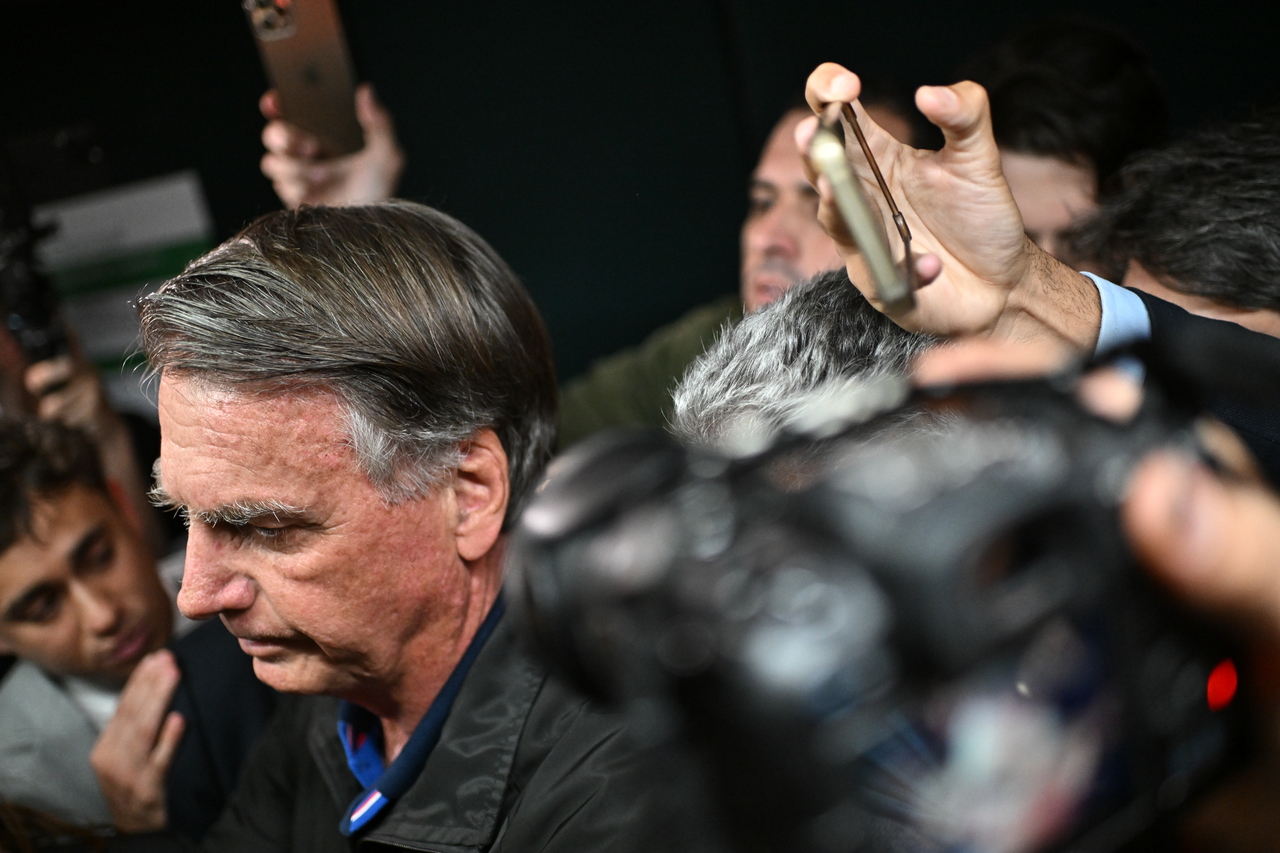
Former Brazilian President Jair Bolsonaro walks out of a meeting with opposition congress members at the National Congress in Brasilia, Brazil, Monday. (EPA-Yonhap)

SAO PAULO (Reuters) -- Brazil's Supreme Court threatened to order former President Jair Bolsonaro's arrest unless his lawyers explain within 24 hours why he breached restrictions on his use of social media, a decision showed on Monday evening.

The order summoning Bolsonaro's lawyers was issued by Justice Alexandre de Moraes, who oversees the case in which Bolsonaro is accused of plotting a coup.

Bolsonaro's lawyers did not immediately respond to a request for comment outside normal business hours.

Moraes had on Friday ordered Bolsonaro to wear an ankle bracelet and banned him from using social media, among other measures -- which were later upheld by a court panel -- over allegations he courted the interference of US President Donald Trump, who tied steep new tariffs on Brazilian goods to what he called a "witch hunt" against Bolsonaro.

In an interview with Reuters on Friday, Bolsonaro described Moraes' decision to prohibit his social media use as "cowardice," and said he intended to continue engaging with the press to ensure his voice was heard.

On Monday, Moraes said Bolsonaro breached the Supreme Court order when speaking with journalists earlier in the day, following a meeting with allies in the Brazilian Congress.

The moment, which marked the first time Bolsonaro publicly showed his ankle bracelet, came hours after Moraes issued a clarification of Friday's ruling, which stated that Bolsonaro's use of social media included use through third parties.

Moraes in his decision attached screenshots of several posts on social media, including on news outlets, that showed Bolsonaro "displaying the electronic monitoring device, delivering a speech to be displayed on digital platforms." US Secretary of State Marco Rubio last week called Moraes' court orders a "political witch hunt," responding on Friday with immediate visa revocations for "Moraes and his allies on the court, as well as their immediate family members." The court's crackdown on Bolsonaro adds to evidence that Trump's tactics are backfiring in Brazil, compounding trouble for his ideological ally and rallying public support behind a defiant leftist government.

Hours before summoning Bolsonaro's lawyers, Moraes had issued a ruling that raised questions about whether the right-wing leader was allowed to talk to journalists.

"Obviously, the broadcasting, re-broadcasting, or dissemination of audio, video, or transcripts of interviews on any third-party social media platform is prohibited," the judge said, in a clarification of Friday's ruling.

The measure sparked debate in Brazil regarding the ruling's range.

Bolsonaro on Monday canceled an interview with a news outlet that would have been broadcast live on social media.

"The prohibition is that he communicates on social media; it is not a prohibition against third parties speaking about him, whether to praise or criticize," said Ivar Hartmann, a law professor at Sao Paulo business school Insper.

He added that, in his view, interviews are permissible, provided they are not intended to circumvent the legal limitations, such as giving an interview to a supporter.

But Vera Chemim, a Sao Paulo-based constitutional lawyer, said she believed the former leader is on shaky ground, noting that interviews, while not explicitly mentioned in the court order, could still be used to justify Bolsonaro's arrest.

"Bolsonaro is now completely silenced," she said. "Any misstep could lead to a preventive arrest." The Supreme Court declined to comment or elaborate on the specifics of that decision.

A spokesperson for Bolsonaro also declined to comment, but the former president has always denied any wrongdoing.
Harvard fights Trump administration in court over $2.6 billion funding cut


Harvard University challenged the US government in federal court Monday over its decision to withhold $2.6 billion in funding. The Trump administration has imposed sanctions on the elite school for months, accusing it of fostering liberalism and anti-Semitism while pushing stricter oversight of the Ivy League institution.


Issued on: 22/07/2025 -
By: FRANCE 24
Video by:Charlotte HUGHES

Demonstrators supporting Harvard University gather outside a court in Boston, Massachusetts, July 21, 2025. © Brian Snyder, Reuters
01:50


Harvard University appeared in federal court Monday in a pivotal case in its battle with the Trump administration, as the storied institution argued the government illegally cut $2.6 billion in federal funding.

President Donald Trump's administration has battered the nation's oldest and wealthiest university with sanctions for months as it presses a series of demands on the Ivy League school, which it decries as a hotbed of liberalism and antisemitism.

Harvard has resisted, and the lawsuit over the cuts to its research grants represents the primary challenge to the administration in a standoff that is being widely watched across higher education and beyond.

A lawyer for Harvard, Steven Lehotsky, said at Monday's hearing the case is about the government trying to control the “inner workings” of Harvard. The funding cuts, if not reversed, could lead to the loss of research, damaged careers and the closing of labs, he said.

“It’s not about Harvard’s conduct,” he said. “It’s about the government’s conduct toward Harvard.”

The case is before US District Judge Allison Burroughs, who is presiding over lawsuits brought by Harvard against the administration's efforts to keep it from hosting international students. In that case, she temporarily blocked the administration's efforts.

At Monday's hearing, Harvard asked her to reverse a series of funding freezes. Such a ruling, if it stands, would revive Harvard’s sprawling scientific and medical research operation and hundreds of projects that lost federal money.

A lawyer for the government, Michael Velchik, said the Trump administration has authority to cancel the grants after concluding the funding did not align with its priorities, namely Trump's executive order combating antisemitism.

He argued Harvard allowed antisemitism to flourish at the university following the Oct. 7, 2023, Hamas-led attacks on Israel, including protesters camped out on campus chanting antisemitic slogans as well attacks on Jewish students.

“Harvard claims the government is anti-Harvard. I reject that,” said Velchik, a Harvard alumnus. “The government is pro-Jewish students at Harvard. The government is pro-Jewish faculty at Harvard.”

Burroughs pushed back, questioning how the government could make “ad-hoc” decisions to cancel grants and do so without offering evidence that any of the research is antisemitic. At one point, she called the government's assertions “mind-boggling.”

She also argued the government had provided “no documentation, no procedure” to “suss out” whether Harvard administrators “have taken enough steps or haven’t” to combat antisemitism.

“The consequences of that in terms of constitutional law are staggering,” she said. "I don’t think you can justify a contract action based on impermissible suppression of speech. Where do I have that wrong?”

Velchik said the case comes down to the government’s choosing how best to spend billions of dollars in research funding.

Harvard’s lawsuit accuses the Trump administration of waging a retaliation campaign against the university after it rejected a series of demands from a federal antisemitism task force in April. A second lawsuit over the cuts filed by the American Association of University Professors and its Harvard faculty chapter has been consolidated with the university’s.

The task force's demands included sweeping changes related to campus protests, academics and admissions. For example, Harvardwas told to audit the viewpoints of students and faculty and admit more students or hire new professors if the campus was found to lack diverse points of view.

Harvard President Alan Garber says the university has made changes to combat antisemitism but said no government “should dictate what private universities can teach, whom they can admit and hire, and which areas of study and inquiry they can pursue.”

Monday's hearing ended without Burroughs issuing a ruling from the bench. A ruling is expected later in writing.

Several dozen alumni from Harvard joined students and faculty to decry the effort to cut the federal funds, holding up signs reading “Hands Off Harvard,” “Strong USA Needs Strong Harvard” and “Our Liberty Is Not For Sale.”

Anurima Bhargava, who wrote the amicus brief on behalf of more than 12,000 fellow Harvard alumni in the case, said the graduates spoke up because “they understand what is at stake here and what the end goal of the government is, to take away our ability to pursue the mission, the freedom and the values that have been the cornerstone of higher education."

Three Harvard researchers who lost their federal funding spoke about disruptions to the long-term impact of funding on cancer, cardiovascular diseases and other health conditions. They said the cuts could force researchers to go overseas to work.

“Unfortunately, the termination of this research work would mean the end of this progress and the implications are serious for the well-being of Americans and our children into the future,” said Walter Willett, a Harvard professor of epidemiology and nutrition who lost grants that funded long-term studies of men's and women’s health.

“This is just one example of the arbitrary and capricious weaponization of taxpayer money that is undermining the health of Americans,” he said.

The same day Harvard rejected the government's demands, Trump officials moved to freeze $2.2 billion in research grants. Education Secretary Linda McMahon declared in May that Harvard would no longer be eligible for new grants, and weeks later the administration began canceling contracts with Harvard.

As Harvard fought the funding freeze in court, individual agencies began sending letters announcing the frozen research grants were being terminated. They cited a clause that allows grants to be scrapped if they no longer align with government policies.

Harvard, which has the nation's largest endowment at $53 billion, has moved to self-fund some of its research, but warned it can’t absorb the full cost of the federal cuts.

In court filings, the school said the government “fails to explain how the termination of funding for research to treat cancer, support veterans, and improve national security addresses antisemitism.”

The Trump administration denies the cuts were made in retaliation and argues the government has wide discretion to cancel contracts for policy reasons.

The research funding is only one front in Harvard’s fight with the government. The Trump administration also has sought to prevent the school from hosting foreign students, and Trump has threatened to revoke Harvard's tax-exempt status.

Finally, last month, the Trump administration formally issued a finding that the school tolerated antisemitism — a step that eventually could jeopardize all of Harvard’s federal funding, including federal student loans or grants. The penalty is typically referred to as a “death sentence.”

After Monday's hearing, Trump took to his social media platform, Truth Social, to attack Burroughs, calling her a “TOTAL DISASTER.” Burroughs was appointed by former President Barack Obama.

“Harvard has $52 Billion Dollars sitting in the Bank, and yet they are anti-Semitic, anti-Christian, and anti-America,” he wrote. “Much of this money comes from the U.S.A., all to the detriment of other Schools, Colleges, and Institutions, and we are not going to allow this unfair situation to happen any longer.”

(FRANCE 24 with AP)