Sunday, August 03, 2025

 CHILE

Three of five trapped workers at Codelco's El Teniente mine found dead


03 August 2025 

REUTERS

By Daina Beth Solomon


Workers at the El Teniente copper mine complex where several miners have been reported missing at the Andesita unit after a seismic incident, in Maitenes, Chile, August 1, 2025.
Image: Pablo Sanhueza


Three of five trapped workers at Codelco's El Teniente copper mine in Chile have been found dead, the company said, as rescue teams work to clear underground passages that collapsed in a strong tremor last week.

One person also died at the time of the incident on Thursday evening, bringing the total death toll to four. Codelco discovered the first trapped worker on Saturday and another two early on Sunday.

“We deeply regret the discovery of two other colleagues who were found deceased,” the miner said in a statement. “We stand with the families and the entire community in the anguish this situation causes.”

By Sunday morning, rescue teams had cleared 24 metres of blocked passages, out of 90 metres that Codelco officials previously said could be necessary to reach the trapped workers, in the new Andesita section of the mine. The collapse occurred on Thursday at about 5:30pm local time, caused by one of the largest tremors ever recorded at El Teniente with the impact of a 4.2 magnitude quake.

Codelco is investigating whether the cause was mining activity or natural tectonic shifts in the earthquake-prone country.

Reuters


Codelco confirms death of one trapped El Teniente miner
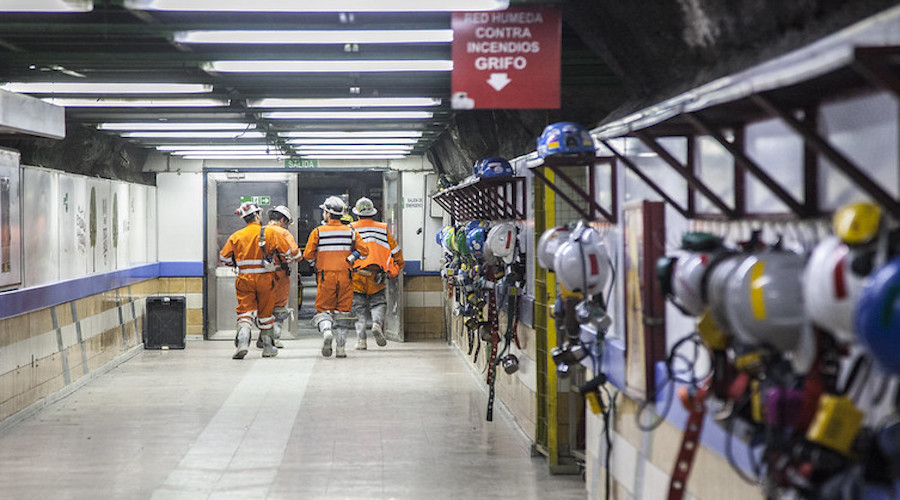

The mine accident Thursday, followed a magnitude 4.2 earthquake — one of the strongest ever recorded at El Teniente.


Search efforts continue. (Image courtesy of Codelco.)

Chilean copper giant Codelco has confirmed the discovery of a second body at its El Teniente mine, where five workers have been trapped since a collapse triggered by a powerful tremor on Thursday.

The company announced Saturday that the victim’s identity has not yet been confirmed by authorities. One miner was previously reported dead at the time of the accident, which occurred in the Andesita section of the mine, about 75 kilometres southeast of Santiago.

“This discovery fills us with sadness, but it also tells us that we are in the right place, that the strategy we followed led us to them,” general manager of El Teniente, Andres Music, said in a statement.

He added that the search will continue “with strength and hope,” though the pace will slow as crews proceed with greater caution.

Rescue operations have faced delays due to ongoing aftershocks. As of Saturday, Codelco had cleared just over 20 per cent of the blocked underground tunnels but had not yet made contact with the remaining trapped miners.

The mine accident occurred around 5:30 p.m. local time on Thursday, following a magnitude 4.2 earthquake — one of the strongest ever recorded at El Teniente.

Minister Aurora Williams announced on Friday afternoon the government was suspending all activities at the mine.

Codelco is investigating whether the deadly incident was caused solely by seismic activity or if mining operations played a role.

El Teniente, in operation since 1905, produced 356,000 metric tonnes of copper in 2024. The massive complex stretches over 4,500 km of tunnels and underground galleries in the Andes Mountains, about 75 km southeast of Chile’s capital, Santiago.

 

Evergreen Boxship Suffers Stack Collapse off South America

Evergreen
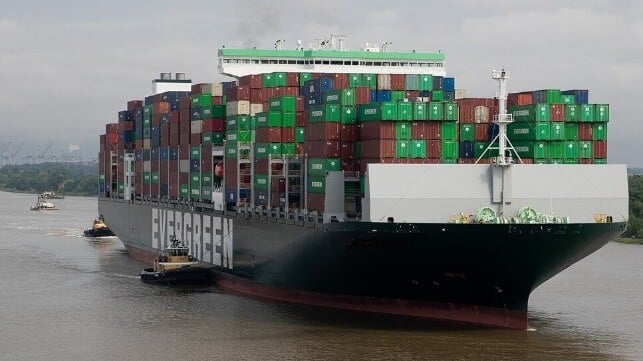
An Evergreen F-class container ship, sister ship of Ever Feat (CBP file image)

Published Jul 30, 2025 9:20 PM by The Maritime Executive


The container ship Ever Feat has arrived at the port of Montevideo, Uruguay with a collapsed stack of containers, according to local reports. 

Videos from the scene show two 40-foot containers hanging over the side, with a jumble of collapsed boxes just behind them. Aerial photos suggest that at least two bays were affected. Spanish outlet El Pais reports that Ever Feat encountered rough weather on a voyage south from Navegantes, Brazil, causing about 30-40 containers to topple over. 

Uruguay's National Port Administration and its coast guard are conducting a damage assessment and making plans to remove the affected cargo safely. Some of the boxes contain fertilizer, El Pais reported, and local freight forward Swan Logistics suggests that some may have toxic cargo. 

Ever Feat is a modern Neopanamax boxship flagged in Liberia and operated by Evergreen. She was one of 12 F-class hulls built by Imabari in 2021-22, and she has a capacity of about 12,000 TEU. Sister ships include Ever Forward, which grounded near Baltimore in 2022, and Ever Fortune, the largest boxship ever to call Boston. 


Sanctions Impact Expands from Tankers to Containerships

sanctioned containership
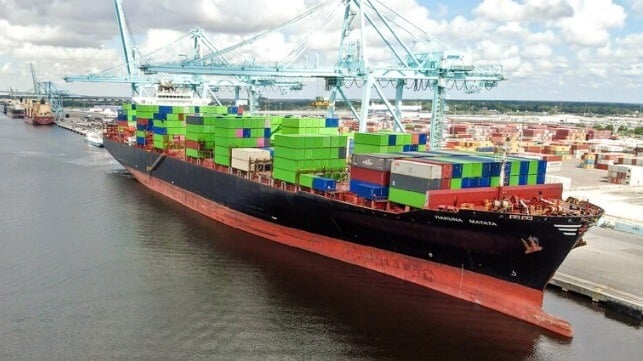
Hakuna Matata, one of the listed containerships, during an earlier port call (JAXPORT photo)

Published Aug 1, 2025 12:31 PM by The Maritime Executive


The recent efforts by the European Union and the UK to target more tankers linked to Russia’s oil trade and the United States’ large sanctions action this week against an Iranian trading network are beginning to impact across the shipping industry. As the efforts are now reaching beyond tankers to also include containerships, analysts expect the sanctions will continue to reshape shipping.

Tankers were the first target of the sanction packages, and reports that individual ships have been idled became common as the sanctions grew. However, the impact seems to be growing as the U.S. and now the EU have begun to go after refineries and products refined from Russian oil. Donald Trump has said he would target more buyers of Russian oil if his deadline for a Ukrainian ceasefire is not met.

The United States, already this year as part of its “maximum pressure” campaign against Iran, sanctioned several smaller Chinese so-called “teapot” refineries, and in July, the EU, in its efforts to clamp down on the Russian oil trade, closed loopholes on refined products. It specifically listed the Indian refiner Nayara Energy due to its investments from the Russian oil giant Rosneft. 

After a report by Reuters on July 31 that India’s state refineries were suspending imports of Russian oil due to fears over the sanctions, at least four tankers are reported now to be idling off India, according to Bloomberg’s tracking. The report highlights that more than a third of India’s oil comes from Russia, and the vessels holding offshore all appear to have loaded in late June from Russia’s terminals in Primorsk and Ust-Luga.

Three other tankers inbound toward India, which were included in the U.S.’s widened net of sanctions against Iran, are also reported to be diverting, according to an exclusive report from Reuters. The ships are carrying Russian oil and were listed by the U.S. as part of the network run by Iranian Mohammad Hossein Shamkhani, the son of Ali Shamkhani, a top political advisor to the Supreme Leader of Iran, and a former commander of the Islamic Revolutionary Guard Corps Navy.

The U.S. sanctions, however, did not stop at tankers as it listed more than 50 vessels, including 22 containerships that it said were also used by Hossein’s network also carrying cargo both to and from Iran, among other locations. The containerships the U.S. Treasury asserts are using similar obfuscation tactics to the tankers, including turning off automatic identification system (AIS) transponders and misrepresenting cargo information in bills of lading.  

One of the companies snared with the inclusion of containerships in the sanction regimes is Singapore-based SeaLead, an emerging carrier with a charter fleet of vessels. The company issued a statement on July 31 saying it had been made aware that multiple vessels, chartered by the company for commercial purposes, had been added to the U.S. sanctions list.

“SeaLead confirms the termination of all charterparties and contracts related to the sanctioned vessels and entities. The company maintains full compliance with applicable sanctions laws and regulatory requirements,” it writes in the statement.

A total of 16 vessels listed by the U.S. are linked to SeaLead, which reports say could represent as much as a third of the company’s fleet. The company, in previous statements, says it operates over 55 vessels with a total capacity of just over 200,000 TEU. SeaLead says that this places it in 13th place in Alphaliner’s league of carriers.

Concurrent with the listing of the containerships, the U.S. Department of the Treasury's Office of Foreign Assets Control (OFAC) issued a “General License” which authorizes limited safety and environmental transactions and the offloading of cargo involving certain persons or vessels blocked on July 30. The 22 containerships, including the 16 linked to SeaLead, have till midnight on October 1 to offload cargo that was already aboard except at ports in Iran or Russia. They, however, are also barred from entering into new commercial contracts.


Russian-Chinese Naval Exercise Starts in Tsunami Zone

Chinese vessel
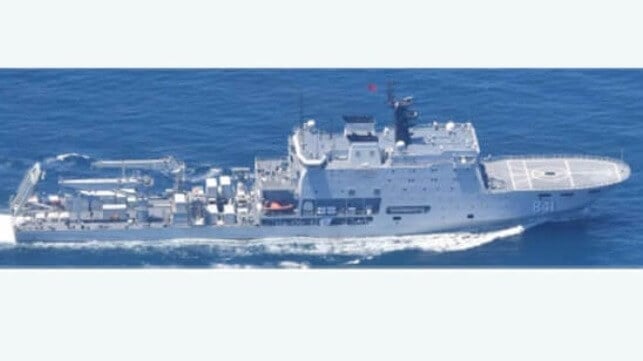
Submarine rescue vessel CNS Xihu (841) heading northeast through the Tsushima Strait on July 24 (Japan Maritime Self-Defense Force)

Published Aug 1, 2025 1:07 PM by The Maritime Executive


The Russians and Chinese have commenced a joint naval exercise in the Pacific Far East area. While the large exercise was getting underway, on July 30, it also encountered one of recent history’s largest undersea earthquakes.

Exercise Maritime Interdiction 2025 officially starts today, August 1, and is scheduled to conclude on August 5. A Russian Pacific Fleet press statement suggested that exercise serials will include coastal operations, search and rescue, anti-submarine, air defense, and combined fire support operations involving the use of the Pacific Fleet’s training ranges. Diesel-electric vessels and aircraft from both nations will take part in the exercise, to be directed from the Pacific Fleet’s headquarters in Vladivostok. The exercise will start with a command post phase in Vladivostok. The exercise follows on from a global exercise held last week by the Russian Navy involving over 150 ships and 15,000 personnel across the Pacific, Arctic, Baltic, and Caspian seas.

The lead Russian ship on Exercise Maritime Interdiction 2025 will be the Udaloy Class anti-submarine destroyer Admiral Tributs (D564), while the Type 052D destroyer CNS Shaoxing (D134) will lead the Chinese contingent. 


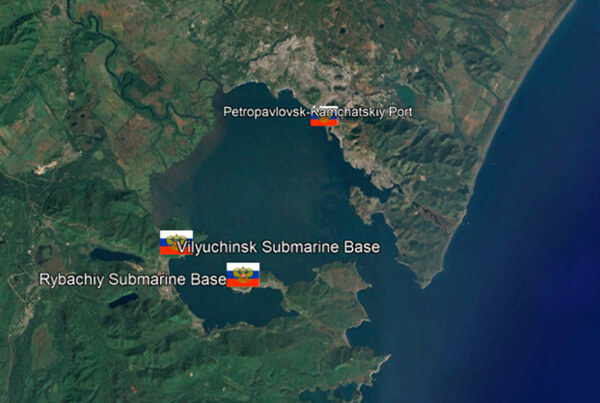
The sheltered Russian submarine bases (Google Earth/CJRC)


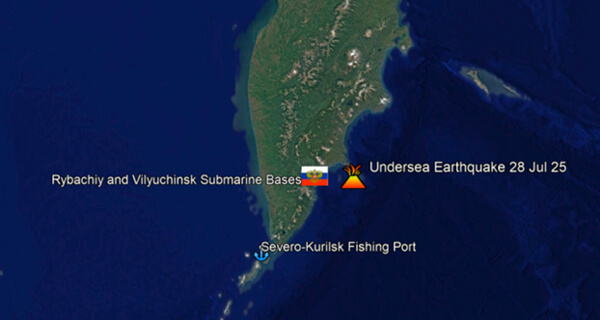
The Russian submarine bases due west of the earthquake epicentre (Google Earth/CJRC)


Seen in the East China Sea heading towards the exercise area by the Japan Maritime Self-Defense Force (JMSDF) on July 24 was the PLA Navy’s Type 926 Dakai Class submarine rescue vessel CNS Xihu (841). CNS Xihu is believed to be on its first operational deployment since being launched. The Xihu was following in the wake of a lead group of ships also spotted by the JMSDF made up of CNS Shaoxing and fleet oiler CNS Qiandaohu (886), as well as Type 052D destroyer CNS Urumqi (118), which last year was the lead vessel in the 45th Naval Escort Group deployed to Djibouti. These movements had been preceded by increased maritime surveillance of the Sea of Japan area by Russian Ilyushin IL-20M patrol aircraft.

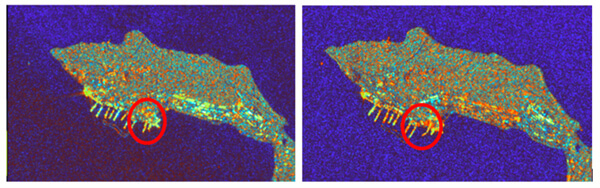
The launch of the exercise as planned suggests that the Pacific Fleet has not been seriously impacted by the undersea earthquake on July 30. The US Geological Survey measured the quake as being of 8.8 MMS magnitude, occurring at a depth of 12.86 miles and 80 miles southeast of Petropavlovsk-Kamchatsky on the Kamchatka Peninsula. The tsunami generated by the earthquake appears to have manifested as a series of flood surges rather than by massive waves. Flooding of the fishing village of Severo-Kurilisk, some 195 miles away on the Kamchatka peninsula, was seen in social media. But there appears to have been little damage suffered by the two important Russian nuclear and ballistic missile submarine bases at Rybachiy and Vilyuchinsk, which are only about 65 miles from the epicenter, save for damage to a pier at Rybachiy evident in radar imagery.


 Radar imagery comparison on July 23 and 31, showing damaged pier post earthquake (Sentinel-2/CJRC)


Given the submarine focus of Exercise Maritime Interdiction 2025, vessels from the two bases are likely to be involved in sea phases of the exercise. But both bases may have been protected by their sheltered location within the Petropavlovsk-Kamchatskiy bay, to which there is only a narrow sea opening. The Vladivostok area, home to the Pacific Fleet headquarters, some 1,280 miles from the epicenter, was effectively screened by the land mass of the Japanese islands.


Malaysia Closes Anchorage to Curtail Illegal Anchoring and STS Activity

tanker oil transfer
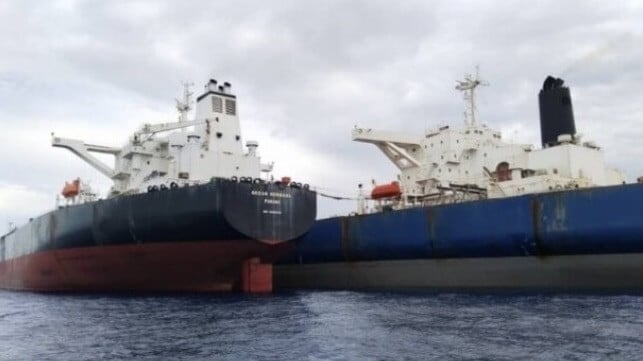
Malaysian authorities in 2023 reported catching shadow tankers involved in an illegal STS operation (MMEA)

Published Aug 1, 2025 4:05 PM by The Maritime Executive


Malaysia’s maritime authorities are taking several new steps to strengthen enforcement in an attempt to stop the illegal anchoring and ship-to-ship transfers taking place in its waters. Because of its location near the busy Singapore Strait, Malaysia is one of the areas cited as a hotbed of activity with reports of frequent enforcement activities.

Effective as of the end of July, the Malaysian Marine Department has imposed new rules. It is reiterating the requirement for vessels to keep their AIS transmission on at all times. It reports that it will be regularly monitoring for vessels that go dark (ie, turn off their signals). 

Vessels also now have a dual permit requirement before they can anchor in key eastern water areas known to be frequently used for illegal activities. They are required to submit an anchoring plan, which must be approved by the Malaysian Marine Department. This covers the area near the eastern entrance of the Singapore Strait.

“We anticipate that the authorities will adopt a strict approach to monitor vessels in Malaysian waters,” warns a notice posted by the Britannia P&I Club on July 31.  It warns, “They will act strictly against vessels found conducting operations without their approval. The process of releasing a detained vessel can be stressful and may take several weeks.”

The Malaysian Maritime Enforcement Agency, which is already known for its strict enforcement and frequent efforts at enforcement, has been instructed to further increase its vigilance. The notices warn that vessels will be immediately detained if they are found not to have the proper approvals for anchoring or other activities in Malaysian waters.

The waters east of the peninsula have been known to be a frequent stopping point for shadow tankers and those coming from either Iran or Russia seeking to disguise their cargoes. The illegal activity is also carried out by smaller vessels making transfers. 

On July 11, for example, the MMEA reports it came across two tankers alongside each other at 0400. One vessel was crewed by four individuals, including the captain and another from Indonesia, and two Indian nationals. The second vessel was crewed with one Indonesian and one Myanmar citizen, and two Vietnamese citizens. The MMEA reported that the Myanmar crew and two Vietnamese crew failed to produce valid identification documents. In addition, it seized 169,600 liters of diesel oil.

At the end of July, the MMEA reported that a tanker registered in Barbados was detained for illegally anchoring in Batu Pahat waters. The ship they reported was operated by a crew of 18, including the captain, who were Indian nationals. The tanker had departed from Dubai and entered the Tanjung Bruas Port, Melaka, to load a cargo of 6,894 metric tonnes of tar on its way to Vietnam.

The Singapore Shipping Association issued a confirming note. It warns that Malaysia “intended to strengthen enforcement against unauthorized ship-to-ship oil transfers.” It is advising members to closely follow the regulations and work with port agents to secure the necessary approvals before entering Malaysian waters.


NATO Maritime Task Force Sails into Arctic and High North

NATO sailing in Barents Sea
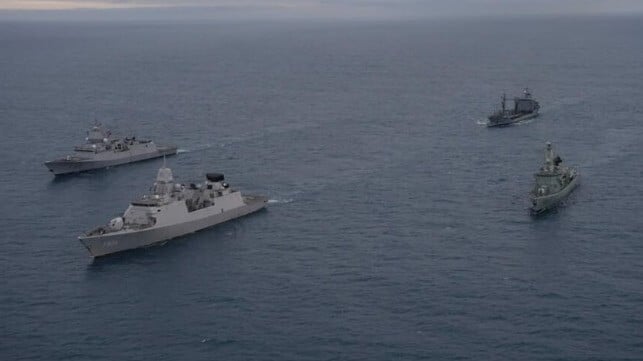
Ships assigned to Standing NATO Maritime Group One in formation for a photo exercise in the Barents Sea during their deployment to the High North and Arctic. (NATO)

Published Aug 1, 2025 5:59 PM by The Maritime Executive


NATO is reporting that a task force of ships is currently operating in the Arctic and High North in an effort to strengthen its maritime presence and practice operations in the region. NATO joins the rush to the region, which has also seen a Chinese research vessel, the yearly visit by the US Coast Guard’s icebreaker Healy, and recent Russian-Chinese naval exercises.

The alliance highlights that seven of its nations, Canada, Denmark, Finland, Iceland, Norway, Sweden, and the United States, have territory within the Arctic Circle and play a key role in supporting the Alliance’s cooperative and inclusive approach to Arctic security. The task force was sent to the region to reaffirm the Alliance’s commitment to collective security in this increasingly strategic region.

NATO’s maritime presence in the region, the organization says, reflects growing international focus on the Arctic. It notes that melting sea ice is opening new shipping lanes and access to natural resources is being created. At the same time, the Alliance is enhancing its maritime domain awareness across the region to understand the environment and increase readiness to respond to contingencies. By maintaining a routine and resilient maritime presence, the Alliance states that it is ensuring this strategically vital region remains secure, accessible, and peaceful for all nations.

“Our operations in the Arctic and High North reflect the Alliance’s enduring commitment to peace, stability, and freedom of navigation,” says a NATO spokesperson. “Operating in this region demands resilience, adaptability, and seamless cooperation – qualities NATO forces continue to demonstrate every day.”

The current operation brings together ships and aircraft assigned to Standing NATO Maritime Group 1 (SNMG1) to conduct maritime presence operations throughout the region. Defense News identifies the ships it believes are in the task force as including the flagship vessel De Ruyter from the Netherlands, the Thor Heyerdahl from Norway, the Bartolomeu Dias from Portugal, and the Rhön from Germany.

NATO says its maritime forces are committed to the challenges of learning how to operate in a dynamic and changing maritime environment in the Arctic and High North. As maritime traffic increases, NATO forces continue to work closely with regional Allies and partners to preserve safe sea lanes, gain operational experience in the region, and deter potential destabilising activities.


New Lock Opens Access for Larger Ships at North Sea Ports

New lock at North Sea Netherlands
New lock at Terneuzen was dedicated in October with the largest ship ever to sail to Ghent (Nieuwe Sluis Terneuzen)

Published Aug 1, 2025 6:50 PM by The Maritime Executive


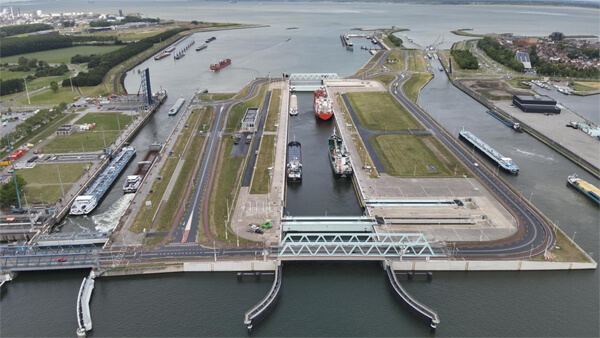
The new lock at Terneuzen in the Netherlands officially opened to traffic today, August 1, marking a critical expansion in capacity for shipping heading to the port of Ghent and connecting between the Netherlands, Belgium, and France. It is part of an effort to expand inland shipping and meet the need to handle larger vessels.

Construction of the new lock took seven years and had a cost of approximately €1.2 billion ($1.4 billion). Officials for the North Sea Ports highlight the critical need to accommodate larger ships, noting that two-thirds of the Ghent port area is only accessible via the canal, and the old locks were becoming too small for modern shipping. 

The two original locks date to 1968, one with a length of 280 meters (919 feet) and the other with a length of 290 meters (951 feet), mostly suited for smaller ocean-going ships and inland vessels. The new lock is 427 meters in length and 55 meters wide (1,400 x 180 feet). Because of its design and position, it also serves as a primary flood barrier, and because it is higher than the rest of the complex, it is prepared for the expected rise in sea level.

For the first time, the new lock can accommodate vessels with a draft of up to 12.5 meters (41 feet) regardless of tidal conditions. In the past, deeper vessels could only be handled at high tide.

The lock was dedicated by King Willem-Alexander of the Netherlands and King Philippe of Belgium on October 11, 2024. As part of the ceremony, the bulker Bregaglia (89,772 dwt), registered in Switzerland, made the ceremonial first passage. At 240 meters in length and with a 38-meter beam (787 x 125 feet), she became the largest vessel to ever sail on the Ghent-Terneuzen Canal and the largest ship ever to sail to Ghent.


Test locking before the new lock (center) officially opened on August 1 increasing shipping capacity to Ghent (Nieuwe Sluis Terneuzen)


Since the ceremonies, final work has been completed on the bridges, and they addressed an unexpected mix of salt and fresh water seen during the first locking. Starting in May, transits began as part of an effort to complete training for the operators and vessel crews.

The lock has a maximum depth of 16.44 meters (54 feet), but shipping is limited by a roadway tunnel that passes under the canal. Also, the canal requires further dredging. Currently, its capacity will be limited to vessels of a maximum of 366 meters in length and with a beam of 49 meters or less (1,200 x 160 feet).

The Belgian news agency reports discussions are underway between Flanders and the Netherlands about further modifications to the canal to support additional shipping.


Workhorse Bulker Casts Off for Last Time as a Liverpool Record Holder

bulker of final departure
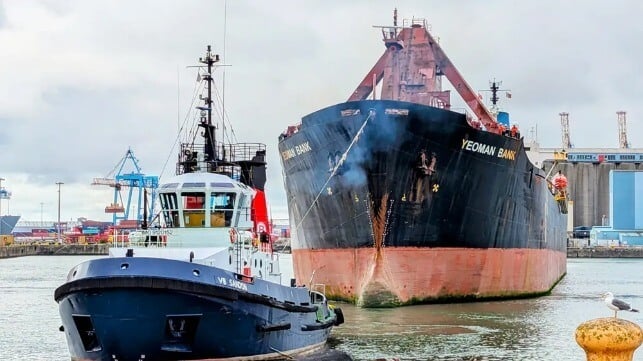
After more than 30 years of service, the bulker cast off for the final time as a record holder (Holcim UK)

Published Aug 1, 2025 9:01 PM by The Maritime Executive


To look at her, the Yeoman Bank, a self-discharging bulk carrier, looks fairly ordinary. However, after more than 30 years of service, she is sailing off as a record holder. 

Holcim UK, a manufacturer and supplier of sustainable construction and building materials, reports it is retiring the vessel. Built in 1982, she is one of the last Greek-built ships coming from the Eleusis Shipyard, but her record comes as the longest-standing vessel serving the Port of Liverpool, and as the ship to have delivered the most cargo there in history.

Marking its 195th voyage, the Yeoman Bank cast off from Liverpool for the last time this week and is sailing to Wilhelmshaven, where she is due to arrive on August 3. The company reports that since arriving on the River Mersey and at Liverpool in 1991, the vessel has transported nearly seven million tonnes of aggregates delivered to the port. She served the Port of Liverpool as part of a long-term strategic partnership between Holcim UK and the terminal operated by Peel Ports.

Phil Hall, Port Director for Mersey Ports at Peel Group, told the Liverpool Business News her final departure was really the end of an era. He noted she had been a workhorse and constant presence at the Port of Liverpool. 

“The Yeoman Bank has been more than just a vessel; it has played a vital role in our supply chain for over three decades,” said Simon Turk, Holcim UK Marine Logistics Director Its consistent service into the Port of Liverpool, along with our long-term, strategic partnership with Peel Ports Group, has supported the delivery of construction materials to some of the UK’s most significant infrastructure projects.


Yeoman Bank transported more than 36 million tonnes of aggregates and holds the record as the longest service vessel to the Port of Liverpool (Holcim UK)


Yeoman Bank is 38,995 dwt and sails under the flag of Liberia. She is 205 meters (672 feet) in length.

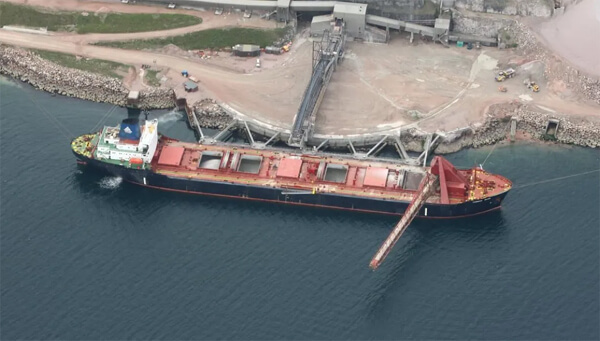
She sailed for nearly a decade for her original owners before being sold and rebuilt in Norway in 1990 for a company called Foster Yeoman, one of Europe’s largest independent quarrying and asphalt companies. The bulker started service calling at the Glensanda super-quarry in Scotland in January 1991. There she was loading specialist aggregate materials, transported by sea to support everything from road construction to the new runway at Manchester airport.

In addition to supplying the UK from Glensanda, the vessel was also key to Holcim’s wider European supply chain to the UK. This included transporting over nine million tonnes of rock gypsum from Garrucha and Carbonneras in Southeast Spain to the Royal Portbury Dock, Avonmouth.

Holcim UK calculates that she has transported around 36.4 million tonnes of aggregates and has completed 1,918 voyages during its time in the fleet. The company, which acquired Foster Yeoman in 2006, says the vessel played a central role in the successful development of the super-quarry’s supply chain, which exports millions of tonnes of specialist aggregate materials to key projects.


Dali’s Owner/Operator Sue Hyundai Claiming Manufacturing Defect

Dali Baltimore wreckage
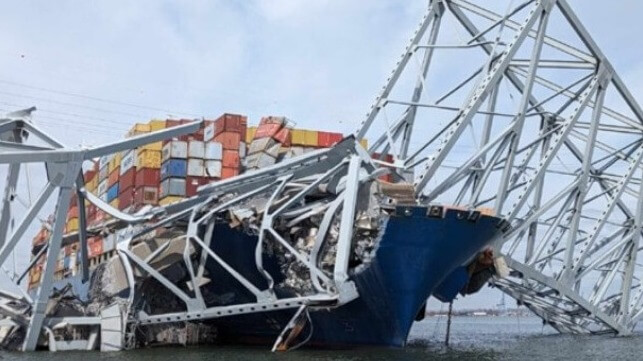
New suit alleges a manufacturing defect in the wiring caused the blackout on the Dali (USACE photo)

Published Aug 1, 2025 8:15 PM by The Maritime Executive


As a federal court in Baltimore continues to hear pre-trial motions and collect evidence for the claims pending related to the containership Dali’s March 2024 incident destroyed the Francis Scott Key Bridge, the owner and operator of the vessel are now suing the builders of the vessel alleging negligence or gross negligence in the design, construction, and/or manufacture of the critical switchboard which has become the focus of the investigations into the cause of the blackout aboard the vessel.

The National Transportation Safety Board and the teams from the U.S. Coast Guard and other agencies investigating the cause of the allision with the bridge quickly centered in on the power supply, critical circuit breakers, and the switchboard for the ship’s electrical systems. It has long been recognized that something caused the vessel’s breakers to trip, shutting off the power to the motor and critical systems, including the hydraulics to control the rudder.

As early as June 2024, it came out that the NTSB had found "an interruption in the control circuit” linked to the main breakers. A subsequent report revealed that a check of the wiring on the transformer and a relay found a “cable was loosely connected,” a condition which representatives from the shipbuilder Hyundai informed could create an open circuit and interrupt the 110VDC power on the HV side of the board. According to the report, the engineers said it would trigger an under-voltage release trip, which would result in a 440V blackout, and they later demonstrated it in tests.

In a suit filed on July 31 in U.S. District Court, Eastern District of Pennsylvania, the owners of the Dali, Grace Ocean, and the operators of the vessel, Synergy Marine, allege, “HHI (Hyundai Heavy Industries) defectively designed the switchboard in such a manner that wiring connections were not secure, could not be verified as secure, and could lose connection during normal operation, such that the signal wire was not designed to remain securely connected to the terminal block, which design defect caused the switchboard and the vessel to be unreasonably dangerous and in a defective condition when it left HHI’s control.”

The court filing reveals that a UVR coil for the circuit breaker was not receiving control voltage, and that it was discovered that one of the control signal wires in the UVR control circuit was not securely connected to its terminal block. They go on to say that because the signal wire was not securely connected, the insufficient contact created an open circuit.

The suit alleges the wire was not securely connected because the “labeling band identifying the wire was installed too close to the ferrule crimped on the end of the wire.” It goes on to assert, “As a result of this and other defects, the signal wire could not be inserted fully into the terminal block’s spring clamp
gate.”

The law regarding maritime products liability claims, they state, requires that a manufacturer sold or manufactured the product, and it was unreasonably dangerous or was in a defective condition when it left the defendant’s control. 

Construction on the Dali started in July 2014 and was delivered by Hyundai Heavy Industries in March 2015. HHI they allege “defectively manufactured the switchboard and vessel by failing to ensure that all wires were securely connected to their terminal blocks when installed and unable to loosen during normal operation.”

The companies are seeking the cost of damage to the vessel and resulting repair costs as well as contribution and/or indemnity as it relates to the 45 claims ranging from property damage to economic damages, clean-up costs, personal injury, wrongful death, survival, workers’ compensation reimbursement, and cargo and general average in the Maryland civil case. The court is set next year to hear the first of two phases in that case centered on Grace Ocean and Synergy Marine’s limitation of liability claim, and based on that outcome, the potential size of the liability.

The Dali, of course, was in service for nine years after its delivery before the allision with the bridge. There have been multiple reports about power problems and failures on the vessel before that night, including at the dock in Baltimore. The NTSB, in its reports, has also highlighted the maintenance of the vessel, citing examples of wear and makeshift repairs. The U.S. has claimed the vessel was not seaworthy, and Maryland and Baltimore, in their claims, cite the training and maintenance of the vessel.

Hyundai Heavy Industries has been served in the product liability case and will file its response in due course. This will start the parallel case seeking to place blame for the defects found on the vessel.


USCG: Rotten Wood, Poor Inspection Caused Historic Maine Schooner Demasting

schooner
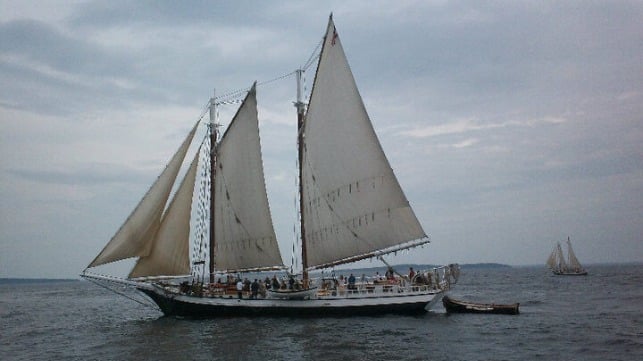
Grace Bailey is a 144-year-old schooner operating cruises in Maine (Sail Grace Bailey/Facebook)

Published Aug 1, 2025 7:46 PM by The Maritime Executive


The U.S. Coast Guard (USCG) has released a critical report on the demasting of a historic schooner, blaming the catastrophic incident on rotten wood that had gone unnoticed for years due to poor inspections.

About three years after the mainmast of the 144-year-old schooner Grace Bailey broke during a routine voyage, causing the death of one passenger and leaving five others injured, a detailed investigation has established that the structural integrity of the mainmast had long been compromised by rot.

Although the vessel underwent numerous inspections, both by the USCG and third-party inspectors, the inspections lacked depth, resulting in a failure to detect deterioration of the mainmast.

Built in 1882, Grace Bailey is a 118-foot schooner operating excursions in Maine. The vessel experienced the catastrophic demasting during a four-day excursion around Penobscot Bay in Maine on October 9, 2023. On the day of the incident, the schooner had 33 people on board, including 26 passengers and seven crew members. The vessel that was owned by the Grace Bailey Navigation Company had been operating cruises on the Maine coast since the 1990s.

In its 95-page report, the USCG Office of Investigations and Casualty Analysis gives a detailed account of the incident from the moment the Grace Bailey set out for the excursion. While the first three days were uneventful, the situation took a tragic twist on Monday, October 9, when she arrived at Penobscot Bay at approximately 8:30 am.

Things started to unfold about an hour later when a single passenger standing port side abreast of the mainmast heard a noise from aloft but dismissed the noise as normal for a wooden vessel and did not discuss the sounds with any other passenger or crewmember. At 10:11 am, another passenger heard a noise aloft that was later described as a “rope being stretched to its limit.” The passenger visually scanned the sails and rigging, determining that everything seemed normal.

Just a minute later, a third noise reported from aloft was recognized by multiple passengers and crewmembers, prompting the captain and mate to scan the rig. They observed the mainmast bending at a point approximately 75 percent up the mast. Although the captain quickly ordered everyone to get down, it was too late because at that point the mainmast collapsed, twisting and falling to starboard.\\

 Five passengers, including the deceased Dr. Emily Mecklenburg, age 40, were struck and injured by the falling rigging. Another passenger fell down a ladderway into the vessel's galley while rolling out of the path of falling rigging, resulting in injury.

In its investigation, the USCG established that since she began offering cruise services, the Grace Bailey had a history of bending the rules when it came to her mast installation and material specifications.

A case in point was in July 1990, during the final stages of an extensive drydock and rebuild project, the schooner’s previous owner identified rot in the lower portion of the foremast and went ahead to perform repairs without prior notification to and oversight by the Coast Guard. Despite not being alerted, the Coast Guard undertook an inspection that revealed cosmetic deterioration of the repair but no signs of rot and allowed the vessel to continue operating.

Another repair, still because of rot, was carried out in 2014 on the vessel’s mainmast and foremast, with the works being carried out by local shipwrights and overseen by Coast Guard inspectors.

Over the period between 2014, when the masts were unstepped, to 2023, the Grace Bailey underwent a total of 18 inspections, with eight including data entries reflecting completion of a mast inspection. In one of the inspections in 2022, just before Grace Bailey Navigation Company purchased the vessel, rot was detected on the starboard side of the foremast under the boom saddle, with repairs being carried out the following year.

The USCG investigation team was able to identify a series of factors that caused the demasting, key of which was severe internal rot of the mainmast due to fungal growth. The rot significantly weakened the structural integrity of the mast, making it prone to failure under stress, they concluded.

Notably, Grace Bailey’s Douglas fir masts had almost all sapwood removed during lathing, and the remaining sapwood at the upper portion of the mast had been removed during final shaping. And while a properly treated sapwood shell is essential for preventing decay in grown Douglas fir masts, the owner and operator of the schooner had failed to implement effective preservative treatment.

Grace Bailey’s masts did not undergo anti-fungal treatment, leaving heartwood unprotected from fungal colonization,” states the report, adding that checks, ideally limited to a treated sapwood shell, penetrated unprotected heartwood, allowing continual moisture intrusion into the mast interior.

The report also criticizes the inspection methods on the schooner, concluding that they lacked depth due to safety constraints. They report that they primarily relied on visual inspections from deck level. Alternative methods like lift cranes were not used.

Following the release of the report, the USCG has issued nine recommendations to prevent mast collapses in the future. Among them is broad collaboration between the agency and the sailing industry to identify wooden mast material characteristics and conditions that can precede, influence, or contribute to fungal decay.

The Grace Bailey was restored and certified by the USCG. She has returned to the seas for her summer cruises.