Russia: Old Catholic Priest Fined For Anti-War Sermons – Analysis
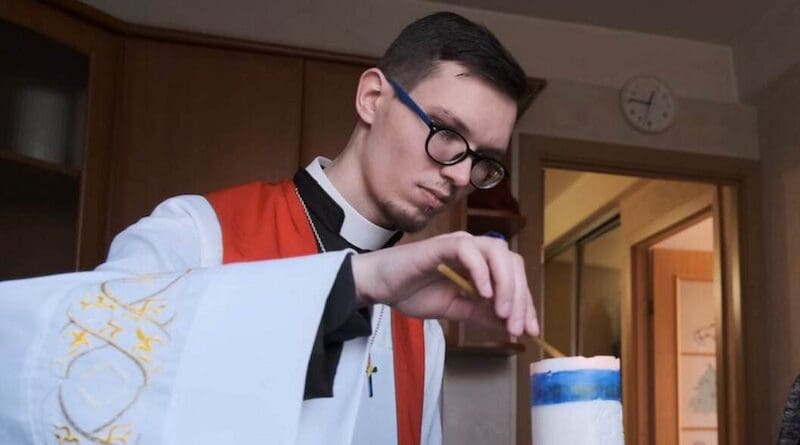
Aleksandr Khmelyov lights Easter candle, St Petersburg, April 2021 Photo Credit: Artem Leshko (RFE/RL Current Time)
By F18News
By Victoria Arnold
An Old Catholic priest has become the latest religious figure to be prosecuted for preaching against Russia’s war in Ukraine. A St Petersburg court found Fr Aleksandr Khmelyov guilty of “discrediting” the Russian Armed Forces in a sermon he gave over three years ago and posted on his church’s YouTube channel. Fr Aleksandr left Russia on 11 July 2025, the same day as the closed court hearing, after Telegram channels thought to be linked to state security services claimed that investigators were preparing further administrative and criminal cases against him.
Fr Aleksandr founded the Mother of Solidarity community in 2017 for LGBT+ Christians. He has frequently faced administrative prosecution over the last decade for his participation in rallies supporting the LGBT+ community and political prisoners. He has also faced prosecution for protests against the Russian occupation of Crimea, and latterly, the Russian invasion of Ukraine. The Justice Ministry added him to its register of “foreign agents” on 20 June 2025, shortly after police drew up the protocol of his alleged “discreditation” offence (see below).
The security-service-linked Telegram channels suggested that Fr Aleksandr could be prosecuted for “creation of an extremist community” (Criminal Code Article 282.1) and “LGBT propaganda” (Administrative Code Article 6.21) (see below).
Fr Aleksandr’s lawyer plans to appeal against his conviction under Administrative Code Article 20.3.3, Part 1 (“Public actions aimed at discrediting the use of the Armed Forces of the Russian Federation”) on his behalf. It is unknown whether police or other investigative agencies will pursue any other charges now that he is outside the country (see below).
Darya Lebedeva of the St Petersburg court system’s press service told Forum 18 that Fr Aleksandr was fined for an offence which had not existed when he allegedly committed it because the video remained accessible online after the new offence of “discrediting” the Armed Forces was signed into law (see below).
Lebedeva ignored Forum 18’s questions about why Fr Aleksandr’s actions were considered “discreditation” of the Armed Forces, but said that the court decision would not be made publicly available (see below).
Criminal trials of anti-war figures continue
The first two full hearings in the trial of Protestant pastor Nikolay Romanyuk took place on 28 and 29 July at Balashikha District Court in Moscow Region. The next is due to be held on 4 August, his daughter Svetlana Zhukova noted on her Telegram channel.
Pastor Romanyuk stands accused of “Public calls to implement activities directed against the security of the Russian Federation, or to obstruct the exercise by government bodies and their officials of their powers to ensure the security of the Russian Federation with the use of mass media, or electronic, or information and telecommunication networks, including the internet” (Article 280.4, Part 2, Paragraph v), for calling on believers not to go and fight in Ukraine.
Moscow’s Preobrazhensky District Court sentenced Buddhist leader Ilya Vasilyev to 8 years’ imprisonment on 25 June. He remains in detention in the capital’s Matrosskaya Tishina prison.
The judge convicted Vasilyev of “Public dissemination of knowingly false information about the use of the Armed Forces of the Russian Federation, for reasons of political, ideological, racial, national or religious hatred or enmity, or for reasons of hatred or enmity against any social group” (Criminal Code Article 207.3, Part 2, Paragraph e) for a Facebook post about a Russian rocket attack on Kherson.
The judge has only just provided copies of the verdict to the defence and prosecution,
Vasilyev’s lawyer Gevorg Aleksanyan told Forum 18 on 29 July, “so we are now preparing the appeal”.
Independent Christian preacher Eduard Charov made his fourth appearance at Central District Military Court in Yekaterinburg on 25 July. He faces charges of “Public actions aimed at discrediting the use of the Armed Forces of the Russian Federation” more than once in a year (Criminal Code Article 280.3, Part 1) and “Public calls to commit terrorist activities, public justification of terrorism or propaganda of terrorism, using the internet” (Criminal Code Article 205.2, Part 2). It is unknown when his next hearing will take place.
Charges and punishments
Soon after Russia launched its renewed invasion of Ukraine in February 2022, President Vladimir Putin introduced new offences in order to prosecute those opposing the war for any reason, including on religious grounds.
These included – but were not limited to – Administrative Code Article 20.3.3 and the associated Criminal Code Article 280.3 introduced on 4 March 2022 to punish alleged “discreditation” of the Armed Forces. Amendments to the law on 25 March 2022 expanded the definition of this offence to include “discreditation” of “the execution by state bodies of the Russian Federation of their powers for the specified purposes”, ie. protecting Russian interests and “maintaining international peace and security”.
The government has used a range of tactics to pressure religious leaders into supporting the renewed invasion of Ukraine. These tactics include warnings to senior and local religious leaders, and prosecuting and fining religious believers and clergy who have publicly opposed the war. Similar warnings and prosecutions have been used against many Russians who express opposition to the war for any reason.
Fined for anti-war sermon
Aleksandr Vladimirovich Khmelyov is an Old Catholic priest and leader of the LGBT+ friendly Mother of Solidarity community. On 11 July 2025, St Petersburg’s Lenin District Court found him guilty of “discrediting” the Russian Armed Forces in an anti-war sermon he had given more than three years earlier. Judge Yelena Samsonova fined him 30,000 Roubles under Administrative Code Article 20.3.3, Part 1. This represents more than a week’s average local wage.
Fr Aleksandr intends to appeal through his lawyer as soon as the latter has received the court’s written decision, he told Forum 18 from outside Russia on 22 July.
Police had found the video of the sermon on the Mother of Solidarity YouTube channel, on which the church streamed and uploaded its services, Fr Aleksandr explained to Forum 18. On Sunday 27 February 2022, he was released from detention for allegedly violating St Petersburg’s coronavirus restrictions by attending a protest against Russia’s full-scale invasion of Ukraine (a common punishment for protesters at the time and even now). At that day’s service, he preached on the Parable of the Mote and the Beam from the Gospel of Matthew, in which Jesus says “Why do you see the speck [mote] in your brother’s eye, but do not notice the log [beam] in your own eye?”
“I don’t know where Putin saw a speck there in Ukraine, but unfortunately, now we don’t see specks in Ukraine, but rather unexploded shells sticking out of the asphalt on the road,” Fr Aleksandr said in his sermon. “But the most important thing is that it’s unclear why Russian soldiers are shooting women and children.”
It is unclear whether police included any other material in their evidence against Fr Aleksandr, since, according to human rights media outlet Slovo Zashchite’s 26 July account of the case, he also criticised the war in subsequent worship services. It was the 27 February 2022 video, however, which was played before the judge at the hearing on 11 July, Slovo Zashchite noted. Almost all videos have now been deleted from the Mother of Solidarity YouTube channel.
(Russia’s censorship body Roskomnadzor blocked access to Slovo Zashchite’s website in February 2025.)
Forum 18 asked the St Petersburg court system’s press service on 28 July why the judge had found Fr Aleksandr guilty of an offence which had not existed when he allegedly committed it (Administrative Code Article 20.3.3 was adopted on 4 March 2022). Press service director Darya Lebedeva explained that this was because the video remained accessible online after the new offence of “discrediting” the Armed Forces was signed into law.
Lebedeva ignored Forum 18’s questions about why Fr Aleksandr’s actions were considered “discreditation” of the Armed Forces, but said that the court decision would not be made publicly available.
Leaving Russia amid threat of further prosecution
Fr Aleksandr’s 11 July court hearing was closed – at the request of the defence, according to court spokesperson Lebedeva. Despite this, a number of Telegram channels obtained details almost immediately, including some believed to be connected to Russian security and police bodies, human rights monitor OVD-Info noted the same day.
Mash na Moyke and Operativniye Svodki both claimed on 11 July that “According to our information, the question of initiating several criminal and administrative cases against the LGBT activist is being considered: for creating an extremist community and public propaganda of non-traditional ideology”.
Mash na Moyke also accuses Fr Aleksandr of having “convinced his ‘parishioners’ to adhere to extremist views and support the Ukrainian authorities”. Both channels note that Fr Aleksandr performs marriages for LGBT+ people and supports female ordination, and imply that he is not a real priest.
On seeing the posts, “I was outraged, of course”, Fr Aleksandr told the Current Time news website on 16 July. “But then my lawyer, to whom I showed it, and I realised that the point was not so much in the tone, but in [the message] at the end that, according to their information, criminal and administrative cases were being prepared against me. After which it was decided that it was necessary to pack up and leave.”
Fr Aleksandr’s lawyer, Vladimir Vasilenko, confirmed on his Telegram channel on 12 July that his client had left Russia after “threats of persecution by the security services from anonymous Telegram channels”, and “is now safe”.
“Since the channels which wrote about administrative and criminal cases being prepared against me are connected to the security services [siloviki], it would be stupid to deny that this is a direct warning,” Fr Aleksandr told Forum 18 on 23 July. He added that his ministry in St Petersburg “has been transferred to another person, and I will organise everything from scratch in another country”.
Two possible charges
The two charges Fr Aleksandr might have faced had he remained in Russia appear to be Criminal Code Article 282.1, Part 1 (“The creation of an extremist community, that is, an organised group of persons for the preparation or commission of crimes of an extremist nature”) and Administrative Code Article 6.21 (“Propaganda of non-traditional sexual relations and (or) preferences, gender reassignment, refusal to have children”).
Criminal Code Article 282.1n Part 1 carries the following possible punishments: a fine of 400,000 to 800,000 Roubles, or 6 to 10 years’ imprisonment plus 1 to 2 years’ restrictions on freedom and “deprivation of the right to hold certain positions or engage in certain activities” for up to 10 years.
Administrative Code Article 6.21 has eight Parts covering various permutations of the offence. Fr Aleksandr would likely have been charged under Part 1 (“propaganda” by a Russian citizen, not among minors, without use of the internet), which carries a fine of 50,000 to 100,000 Roubles for individuals or 100,000 to 200,000 Roubles for persons in an official position (800,000 to 1 million Roubles or 90 days’ suspension of activities for legal entities) – or Part 3 (“propaganda” with use of the internet), which carries a fine of 100,000 to 200,000 Roubles for individuals or 200,000 to 400,000 Roubles for persons in an official position (1 million to 4 million Roubles or 90 days’ suspension of activities for legal entities).
In November 2024 in Moscow, a Russian member of the Scottish Episcopal Church was fined under Administrative Code Article 6.21, Part 3 for social media posts about Anglican and Catholic views of homosexuality, and praising the appointment to an Edinburgh church of a priest who had married his same-sex partner as soon as the Scottish Episcopal Church adopted equal marriage in 2017.
Administrative Code Article 6.21 (commonly known as the “gay propaganda” law) was introduced on 30 June 2013 and was originally aimed at allegedly “protecting minors from propaganda of homosexualism”.
Amendments of 5 December 2022 broadened Article 6.21’s scope to “Propaganda of non-traditional sexual relations and (or) preferences or gender reassignment” (moving “propaganda” among minors to a separate Part 2). The possible punishments also greatly increased. On 23 November 2024, the Article was amended yet again to include “propaganda of refusing to have children”.
On 30 November 2023, Russia’s Supreme Court upheld the Justice Ministry’s request to have the so-called “international social movement LGBT” banned as “extremist”, thus making anyone considered to be “continuing its activities” liable to prosecution under Criminal Code Article 282.2, and rendering the rainbow flag an “extremist” symbol, the display of which can incur charges under Administrative Article 20.3.
“Foreign agent”
The Justice Ministry added Fr Aleksandr to the register of “foreign agents” on 20 June 2025, about a week after police drew up the protocol against him under Administrative Code Article 20.3.3 (“Public actions aimed at discrediting the use of the Armed Forces of the Russian Federation”).
The Justice Ministry declared in a press release (blocked outside Russia): “A. V. Khmelyov participated in the creation of messages and materials of a foreign agent for an unlimited number of people, [and] distributed messages and materials of foreign agents, as well as organisations included in the list of foreign and international organisations whose activities are recognised as undesirable on the territory of the Russian Federation, to an unlimited number of people. He disseminated false information about decisions made by public authorities of the Russian Federation and the policies they pursue.”
Fr Aleksandr is among at least nine religious leaders and activists known to have been placed on the “foreign agents” register.
Russia has used increasingly strict legislation on “foreign agents” (a term which has connotations of spying) and “undesirable organisations” to curtail, complicate, or prohibit the activities of organisations which promote human rights and monitor their violation, including that of freedom of religion and belief.
Background
)Fr Aleksandr Khmelyov founded the Mother of Solidarity Congregation, now renamed Mother of the Unbroken, in St Petersburg in 2017. The community describes itself as Old Catholic and as being “under the jurisdiction of the Association of Christian Eucharistic Communities within the Celtic Church of Germany”.
The Old Catholic Church began in the Netherlands with those Catholics who were excommunicated from the Roman Catholic Church over their rejection of papal infallibility after the First Vatican Council in 1870. They later pursued a position of full communion with the Anglican and Swedish Lutheran Churches, optional clerical celibacy (from 1874), the ordination of women (from 1994), and equal marriage (from 2020).
The Association of Christian Eucharistic Communities was founded in 2014 as an “alternative Orthodox movement”. It is unregistered in Russia. According to its website, it follows a “radically ecumenical and liberal doctrine, forming our Church as a free union of self-governing communities”.
In its founding document of 2015, quoted on the Mother of Solidarity website, the ACEC states that it is “open to prayerful and Eucharistic communion with representatives of other Christian churches”, that “we believe that no one in Christ can be excluded, oppressed or have privileges on the basis of their origin, social status, race, gender or sexual orientation”, and that “We respect any manifestation of love between people as a great gift from God and reject the interference of other people in personal life, especially under the guise of religion”. It accepts the ordination of women and both married and celibate clergy.
Fr Aleksandr grew up in the Russian Orthodox Church (Moscow Patriarchate), but in 2012 joined the True Orthodox Church, in which he was ordained as a deacon and then a priest. After he came out as gay, he joined the Association of Christian Eucharistic Communities in 2015 and moved to St Petersburg, where he initially led worship for LGBT+ Christians at Nuntiare et Recreare, a multi-faith group which provided support and resources for LGBT+ believers (Roskomnadzor blocked its website in 2022). Fr Aleksandr then founded his own community.
“LGBT people often suffer from religious fundamentalism. In various religious associations, they are offered nothing but practices for healing from ‘homosexualism’ – that’s what they call homosexuality”, he commented to Radio Liberty in 2023. “LGBT people with Christian views have nowhere to go. They are sure that any Church hates them. I think that’s why it’s important for LGBT people in a homophobic country to have a Christian religious community that accepts them and is willing to support them.”
Until he left Russia, Fr Aleksandr worked as a nurse with dementia patients. He regularly participated in Pride marches(up to 2017), the March Against Hatred (which called attention to neo-Nazism and racist violence), and protests in support of the LGBT+ community and political prisoners, against the occupation of Crimea, and calling for the repeal of the Criminal Code Article 148, which punishes “insulting the feelings of believers”. For this, he faced prosecution several times under Administrative Code Article 20.2 (Violation of the Demonstrations Law).
F18News
Forum 18 believes that religious freedom is a fundamental human right, which is essential for the dignity of humanity and for true freedom.