Tuesday, August 05, 2025

Ion Iliescu: democratic Romania's first president

Bucharest (AFP) – Romania's former president Ion Iliescu, who died aged 95 on Tuesday, was long hailed as Romania's "little father" but faced charges over his role in the eastern European nation's chaotic transition from communism to democracy.

Issued on: 05/08/2025 - 

Ion Iliescu was last seen in public in 2017 © GRIGORE POPESCU / AFP

The influential politician was last seen in public in 2017 when he was questioned by prosecutors.

That probe related to his role in the violence during the fall of communism which led to more than 850 deaths and saw him face charges of crimes against humanity.
Fallout with Ceausescu regime

A communist party apparatchik born on March 3, 1930, Iliescu served as former dictator Nicolae Ceausescu's minister for youth. But in the 1970s he fell into disgrace and was marginalised.


He rose to power during the December 1989 anti-communist uprising that toppled Ceausescu, under circumstances that remain unclear, becoming the self-appointed leader of the National Salvation Front, an interim governing body.

Iliescu then won a landslide victory in the country's first democratic elections in May 1990.

He was reelected for a four-year term in 1992, but was defeated at the polls in 1996, only to return to power in 2000 for a third term -- the most allowed by the Constitution.

During this last term Romania joined NATO in 2004 and signed the European Union accession treaty, with membership becoming effective in 2007.

The former Moscow University graduate was elected to Romania's Senate in 2004 but did not run in subsequent elections, arguing that a secondary role in politics was more appropriate for a man his age.

He nonetheless continued to be revered by many Romanians, especially in impoverished rural regions.

His advice still counted when his Social Democratic Party -- -- a successor to the National Salvation Front -- was faced with major decisions.

"Iliescu was a man of dialogue and not a bit confrontational. He would rather try to convince people than give orders," sociologist Vasile Dancu, a fellow Social Democrat who knew Iliescu well, told AFP.

He said "consensus" was one of the former president's favourite words.
'Canny politician'

"He was an affable, well-read man, who knew how to flatter people but who could also be manipulative," a former French ambassador to Romania, Henri Paul, told AFP.

"A canny politician through and through."

Iliescu never disavowed his hardline leftist views and blasted the "bloodsucking" western countries and international financial institutions.

Over the past two decades, Iliescu had faced charges of crimes against humanity over the violence during the fall of communism.

In a separate case, he was also indicted over the decision to call in miners to crush student protests after his election in 1990. The crackdown brought widespread international condemnation.

But due to legal wranglings, Iliescu has not stood trial in either case.

Iliescu has denied any wrongdoing, at one point describing it as "a disgrace for Romania to indict the head of state who played a major part in its democratisation".

Though he was one of the few top-ranking Romanian politicians not to be suspected of illicit enrichment, high-level corruption flourished during his terms in office and analysts said the independence of the judiciary was often trampled on.

"I'd rather be poor but honest than rich and a thief," he used to say.

Iliescu, who spoke fluent English, French and Russian, was married with no children. His wife Nina was only seen in public when the couple went to the polls, once every four years.

The government announced his death in a statement on Tuesday, after he was hospitalised with lung cancer in early June.

It declared August 7 a day of national mourning in his memory.

mr-ani-jza-kym/rlp

© 2025 AFP
SHEPARDS RETURN

'Human presence': French volunteers protect sheep from wolves

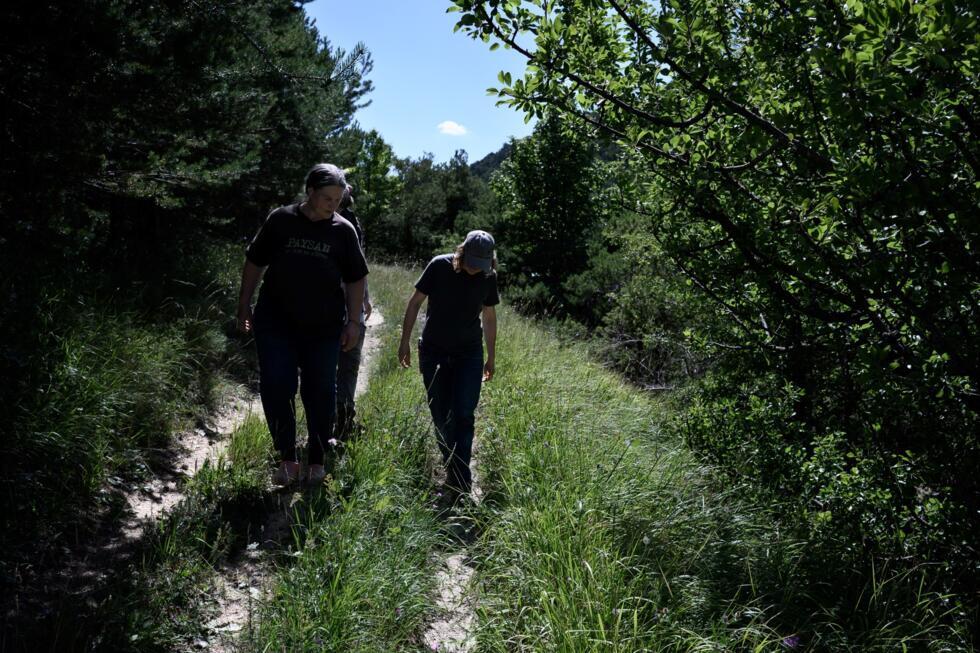
Villebois-Les-Pins (France) (AFP) – Carrying staffs like shepherds, Sophie Morice-Couteau and Geoffroy Galliot inspect the nets of a sheepfold on a steep slope in the Baronnies massif, part of their daily mission to keep wolves away.


Issued on: 05/08/2025 -

With the return of wolves in Europe, sheep are in more danger 
© JEAN-PHILIPPE KSIAZEK / AFP


The two Bretons are volunteers who signed up to protect the flock belonging to farmer Nathalie Welker in the Drome Provencal, in France's southeast, from wolf attacks -- which have become so common that she feels under "pressure" from the predators.

"The wolves are here, there's nothing to be done about that, so we need to find a response," said Welker, 57, wearing a T-shirt that reads: "I'm a farmer and proud of it" as she looked across her sun-drenched valley.

Wolves have made a comeback in Europe, multiplying attacks on livestock and causing angry reactions from farmers, some of whom say the predators should be shot on sight.


Farmers can call on volunteers to help keep wolves away 
© JEAN-PHILIPPE KSIAZEK / AFP


The European Union recently downgraded wolves from "strictly protected" to "protected", making such killings easier.


The French government has authorised 192 wolves to be shot this year, out of the country's total wolf population of 1,013.

But some say the killings do little to stop wolf attacks.

The best prevention is "a human presence", said Welker, adding that she had lived alongside wolves for 20 years.

But she cannot afford to pay a full-time shepherd to look after her two flocks, and instead turned to an organisation of volunteers, Pastoraloup, three years ago for help.
'I support wolves'

Pastoraloup is run by the Ferus association, dedicated to the defence of large predators. It trains volunteers and sends them out to farmers who need assistance.

Welker says she can now "sleep at night and be much less stressed". Meeting people and educating them about farming are a bonus of working with the volunteers.

Around 35 farmers in the French Alps, the Jura and Brittany are taking part in the scheme this year, up from around 20 two years ago.

Morice-Couteau, 45, and Galliot, 48, are among 63 new volunteers who trained last year.

"I support wolves, but I also support farmers," said Morice-Couteau, adding that the presence of the predator could become "one problem too many" for farmers.

Welker fears that "major attacks" are coming, notably in the autumn, when young wolves learn how to hunt.
'Here to help'

In October 2023, 17 of Welker's animals were killed after a volunteer left suddenly, leaving the flock without protection.

At sundown, her two new volunteers herd around 50 sheep -- all meticulously accounted for -- into their night shelter, protected by a 1.4-metre (4.6-foot) high electric fence.


Wolf droppings are the best indicators for the presence of the predators © JEAN-PHILIPPE KSIAZEK / AFP


Morice-Couteau makes a last round in the dark, equipped with a headlamp, before going to bed in a tipi a few metres away, aware that wolves can strike at any time "if they see an opportunity".

Morice-Couteau, who works in the cinema industry, said that she believed farmers and wolves could co-exist, but that her volunteering experience had also made her "understand the violent feelings that some farmers harbour towards wolves".

Tensions have for years been building between farmers and environmentalists over the issue of wolf conservation in France as numbers of the predators have grown.

Welker said there is "very strong social pressure" on farmers who use Pastoraloup which discourages others from benefiting from the programme because it is "labelled environmentalist".

"We're not here for a debate," said Morice-Couteau. "We're here to help."

© 2025 AFP

Ralph Wolf And Sam Sheepdog In "Winter Hungerland"

Czech driverless train hits open track

Kopidlno (Czech Republic) (AFP) – A rail line linking two northern Czech towns is testing Europe's first driverless train operating in an open environment, its developer told AFP on Tuesday.

Issued on: 05/08/2025 - 

No driver is needed -- except by legislation to supervise its operation, at least for now © Jan FLEMR / AFP

The train named Edita has been running since April on a local railway used as a testing track by the Prague-based private AZD company producing transport control and signalling systems.

"The train runs autonomously, it is equipped with systems that enable us to control its traction, brakes, and speed," said AZD's railway developer Michal Novak.

"It is also equipped with a device that detects objects and recognises... obstacles and reacts accordingly," he added.

AZD has been running the train sparingly since its launch as its staff often test new equipment on it.

The driverless train connects two small towns on a 24-kilometre (15-mile) track © Jan FLEMR / AFP


Edita connects two small towns on a 24-kilometre (15-mile) track that was abandoned in 2010 before AZD bought it six years later.

AZD has invested 320 million Czech koruna ($15 million) in the project, using EU funding for about one-third of the amount.

The autonomous train, which has so far driven some 1,700 kilometres (1,060 miles) with passengers, relies on cameras, lasers, satellite navigation and an integrated digital map for information on its whereabouts.

Under the current legislation, it still needs a driver to at least supervise its operation.

While the train runs autonomously, operators can intervene from a control room © Jan FLEMR / AFP


The early Tuesday train's crew also included a conductor and experts checking data.

When a hare ran onto the track, Edita duly slowed down and informed the crew about the obstacle.

Novak said the train once had to stop because of a herd of sheep in the way, but he added incidents like this were rare.

He added Edita was the first driverless train in Europe in an open environment with level crossings and where animals might get in the way.

"There are systems where autonomous vehicles operate, but these are mostly on special tracks that are closed off... such as underground or transfers between airport terminals," he said.
The driverless train has been carrying passengers © Jan FLEMR / AFP


"These have been in place for quite some time and work well in Europe, but I only know of one project in Australia that operates in such an open landscape," added Novak.

Watching the track ahead of the train on a screen in the carriage, passenger Radka Globanova told AFP autonomous trains "definitely have a future".

"I think the progress will be really fast as artificial intelligence is being developed. There are autonomous trains, autonomous cars, why not?"

© 2025 AFP
Bangladesh's Yunus calls for reform on revolution anniversary

Dhaka (AFP) – Bangladesh's interim leader marked one year since the overthrow of Sheikh Hasina's autocratic regime by calling on Tuesday for people to seize the "opportunity" for reform.


Issued on: 05/08/2025 - 

Bangladesh on Tuesday marked the first anniversary since a student-led revolt ousted then-prime minister Sheikh Hasina © Munir UZ ZAMAN / AFP

Nobel Peace Prize winner Muhammad Yunus, the 85-year-old leading the caretaker government as its chief adviser until elections, announced the polls would be held in February.

He also warned against forces he said sought to roll back the democratic gains made.

"Today marks an unforgettable chapter in the history of Bangladesh," Yunus said, describing it as "liberating our beloved nation from the grip of long-standing fascist rule".

The South Asian nation of around 170 million people has been in political turmoil since a student-led revolt ousted then-prime minister Sheikh Hasina on August 5, 2024, ending her 15-year rule.

Yunus later addressed crowds of thousands outside parliament, standing in the rain to issue a "proclamation" alongside leaders of key political parties. The document will be added to the country's constitution.

"The trust of the people... as expressed by the mass uprising for addressing the political and constitutional crisis in Bangladesh is justified, legitimate and internationally recognised," he read from the document.

"The people of Bangladesh express their desire for ensuring good governance and fair elections, rule of law and economic and social justice, and for introducing lawfully democratic reforms for all state and constitutional institutions."

The crowd, some wearing headbands made from the national flag, and including families of those killed in the crackdown on the protests, applauded Yunus's reading.

Fariha Tamanna, 25, who travelled to Dhaka on a government-sponsored train, said it was "deeply satisfying" to hear the government "acknowledge the uprising".

"There's still a long road ahead, so many wrongs continue," she added. "But I still hold on to hope."

Kazi Solaiman, 47, a teacher in an Islamic school, said it was a day of celebration.

"An oppressor was forced to flee by the people's uprising," he told AFP. "I hope Bangladesh never again becomes a land of tyranny."
'Stand united'

Political parties had been demanding Yunus set a date for elections, and on Tuesday, he said he would write to the election commission asking for polls to he held before the Muslim holy month of Ramadan begins in late February.

"I urge you all to pray for us so that we can hold a fair and smooth election, enabling all citizens to move forward successfully in building a 'New Bangladesh'", he said.

Hasina's rule saw widespread human rights abuses, including the mass detention and extrajudicial killing of her political opponents, and Yunus has pledged to overhaul democratic institutions.

"The sacrifice of thousands has gifted us this rare opportunity for national reform, and we must protect it at any cost," Yunus said in letter issued to mark the anniversary.

"The fallen autocrats and their self-serving allies remain active, conspiring to derail our progress."

But he said that while the interim government had made "extensive reform efforts", a deal on measures to prevent a return to authoritarian rule remained elusive.

Political parties are jostling for power ahead of elections.

"Dialogue continues with political parties and stakeholders on necessary reforms, including the political and electoral systems," he added.

He called for people to remember the sacrifices made last year and to work together.

"Let us stand united beyond all divisions to confront and defeat these threats," he added. "Together, we will build a Bangladesh where tyranny will never rise again."

Protests began on July 1, 2024, with university students calling for reforms to a quota system for public sector jobs.

They culminated on August 5, 2024, when thousands stormed Hasina's palace as she escaped by helicopter.

Hasina, 77, remains in India, where she has defied court orders to attend her ongoing trial on charges amounting to crimes against humanity.

© 2025 AFP
India's top court to hear Kashmir statehood plea


New Delhi (AFP) – India's top court will hear a plea for the restoration of Kashmir's federal statehood later this week, court officials said Tuesday, as the region marked six years under direct rule from New Delhi.


Issued on: 05/08/2025 - 


Protesters in Srinagar call for the restoration of state-hood for Kashmir, which has been under direct rule from New Delhi for six years © Tauseef MUSTAFA / AFP

The hearing, scheduled for August 8 in the Supreme Court, follows an application filed by two residents of the Muslim-majority territory, where a separatist insurgency has raged for years.

Prime Minister Narendra Modi's Hindu nationalist government in August 2019 revoked Kashmir's limited autonomy and brought it directly under federal control.

The move was accompanied by mass arrests and a communications blackout that ran for months as India bolstered its armed forces in the region to contain protests.

The removal of Article 370 of the constitution, which enshrined the Indian-administered region's special status, was challenged by Kashmir's pro-India political parties, the local Bar Association and individual litigants.


The Supreme Court in December 2023 upheld removing the region's autonomy but called for Jammu and Kashmir, as the Delhi-administered area is known, to be restored to statehood and put on a par with any other Indian federal state "at the earliest and as soon as possible".

"We have moved an application seeking a definitive timeline for the restoration of statehood," said the petitioners' lawyer, Soayib Qureshi.

"It has been quite some time since the court asked for it and elections have also been successfully held."

Last November, Kashmir elected its first government since it was brought under New Delhi's direct control, as voters backed opposition parties to lead its regional assembly.

But the local government has limited powers and the territory continues to be for all practical purposes governed by a New Delhi-appointed administrator.

Kashmir has been divided between India and Pakistan since the neighbours were granted independence from British rule and partitioned in 1947.

Indian security forces were deployed in force in the Himalayan territory on Tuesday, eyeing protests demanding the restoration of its special status.

© 2025 AFP
Death of a delta: Pakistan's Indus sinks and shrinks

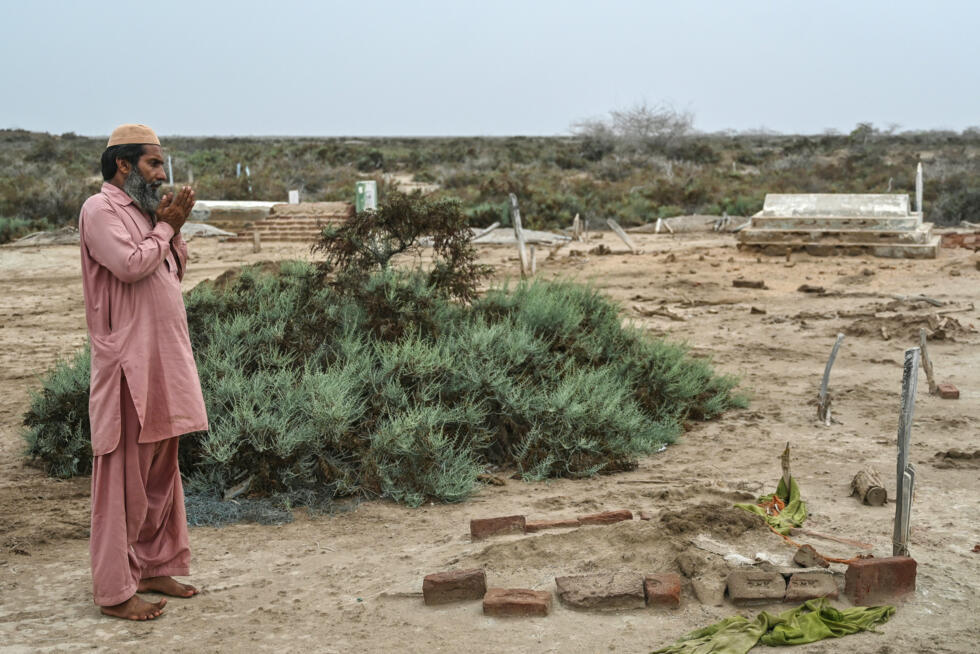
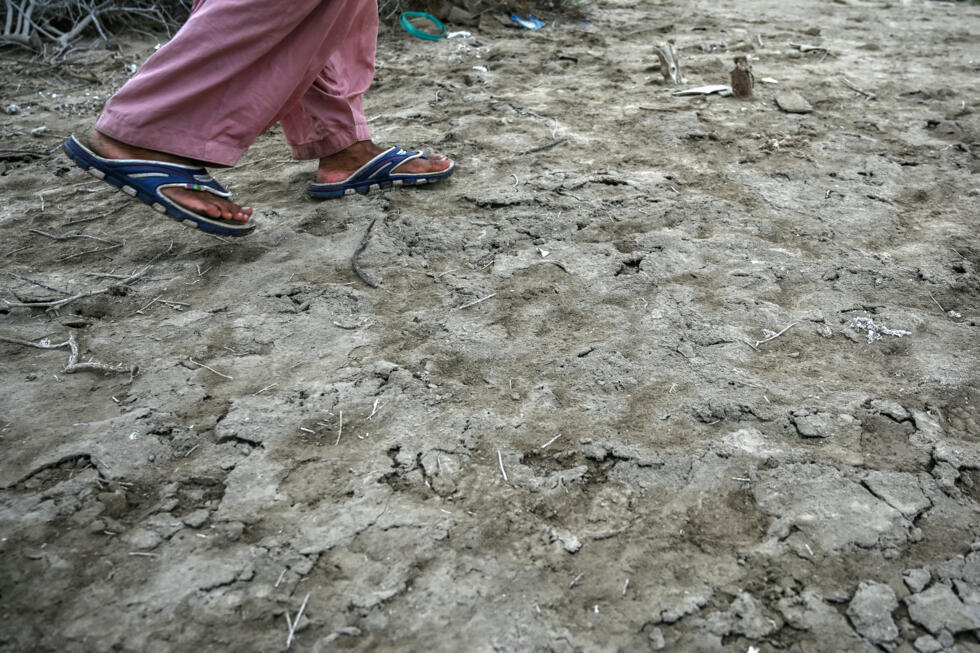
Kharo Chan (Pakistan) (AFP) – Salt crusts crackle underfoot as Habibullah Khatti walks to his mother's grave to say a final goodbye before he abandons his parched island village on Pakistan's Indus delta.

Issued on: 05/08/2025 -

PHOTO ESSAY


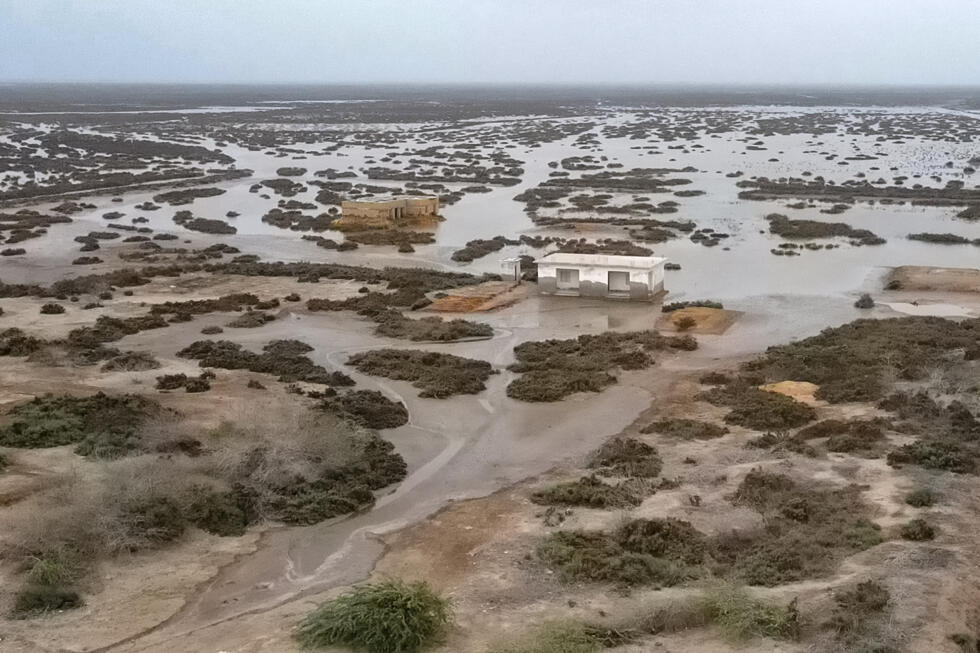
Seawater intrusion into the delta, where the Indus River meets the Arabian Sea in Pakistan, has triggered the collapse of farming and fishing communities 
© Israr AHMED KHAN / AFP

Seawater intrusion into the delta, where the Indus River meets the Arabian Sea in the south of the country, has triggered the collapse of farming and fishing communities.

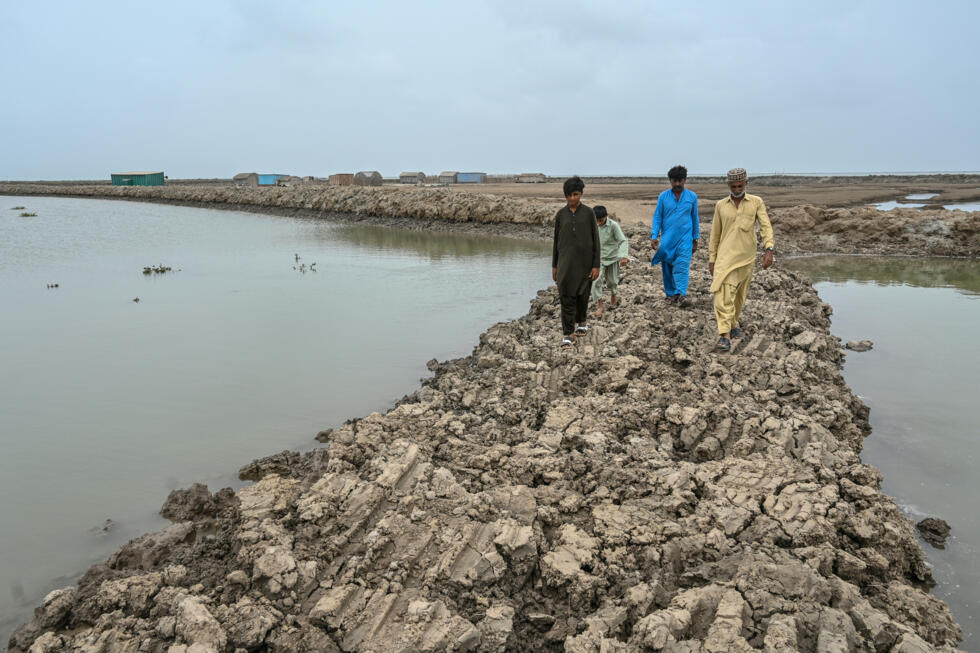
"The saline water has surrounded us from all four sides," Khatti told AFP from Abdullah Mirbahar village in the town of Kharo Chan, around 15 kilometres (9 miles) from where the river empties into the sea.

As fish stocks fell, the 54-year-old turned to tailoring until that too became impossible with only four of the 150 households remaining.

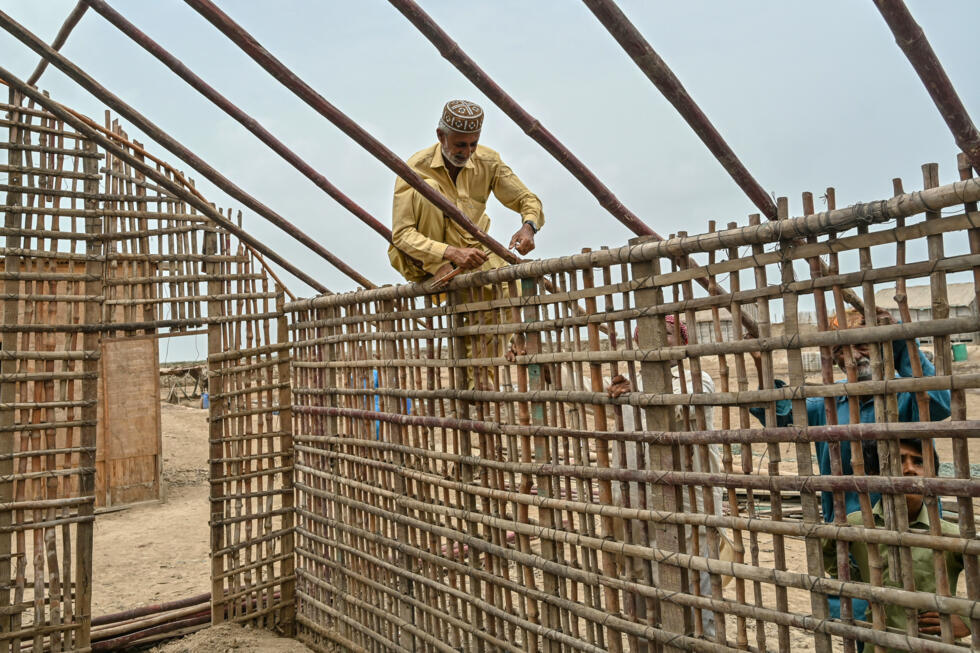
"In the evening, an eerie silence takes over the area," he said, as stray dogs wandered through the deserted wooden and bamboo houses.

Habibullah Khatti bids a final goodbye to his mother's grave before he abandons his parched island village on Pakistan's Indus delta © Asif HASSAN / AFP


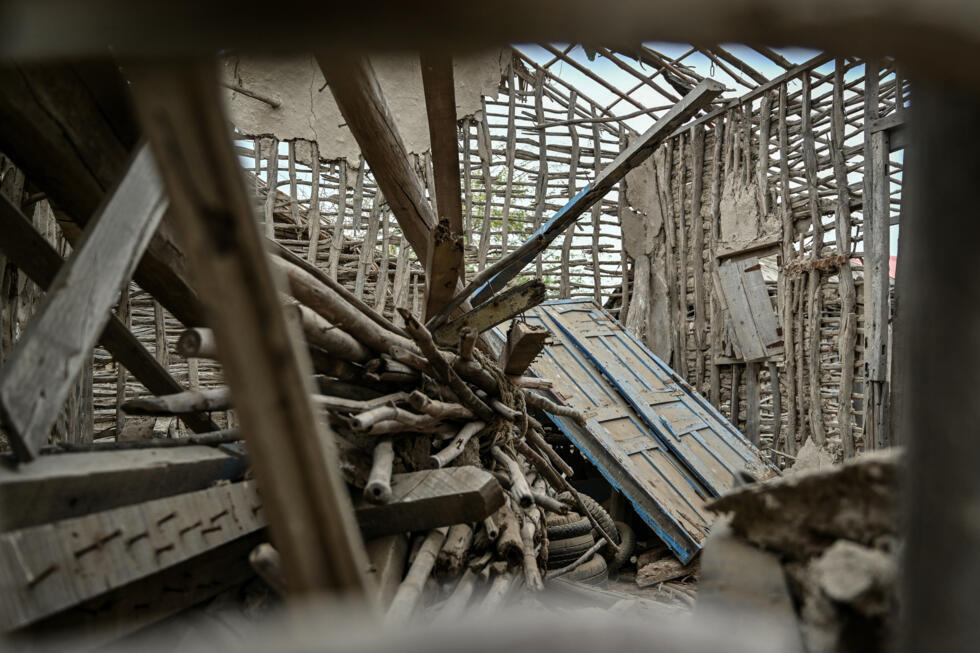
Kharo Chan once comprised around 40 villages, but most have disappeared under rising seawater.

The town's population fell from 26,000 in 1981 to 11,000 in 2023, according to census data.

Khatti is preparing to move his family to nearby Karachi, Pakistan's largest city, and one swelling with economic migrants, including from the Indus delta.

The Pakistan Fisherfolk Forum, which advocates for fishing communities, estimates that tens of thousands of people have been displaced from the delta's coastal districts.

Kharo Chan once comprised around 40 villages, but most have disappeared under rising seawater © Israr AHMED KHAN / AFP


However, more than 1.2 million people have been displaced from the overall Indus delta region in the last two decades, according to a study published in March by the Jinnah Institute, a think tank led by a former climate change minister.

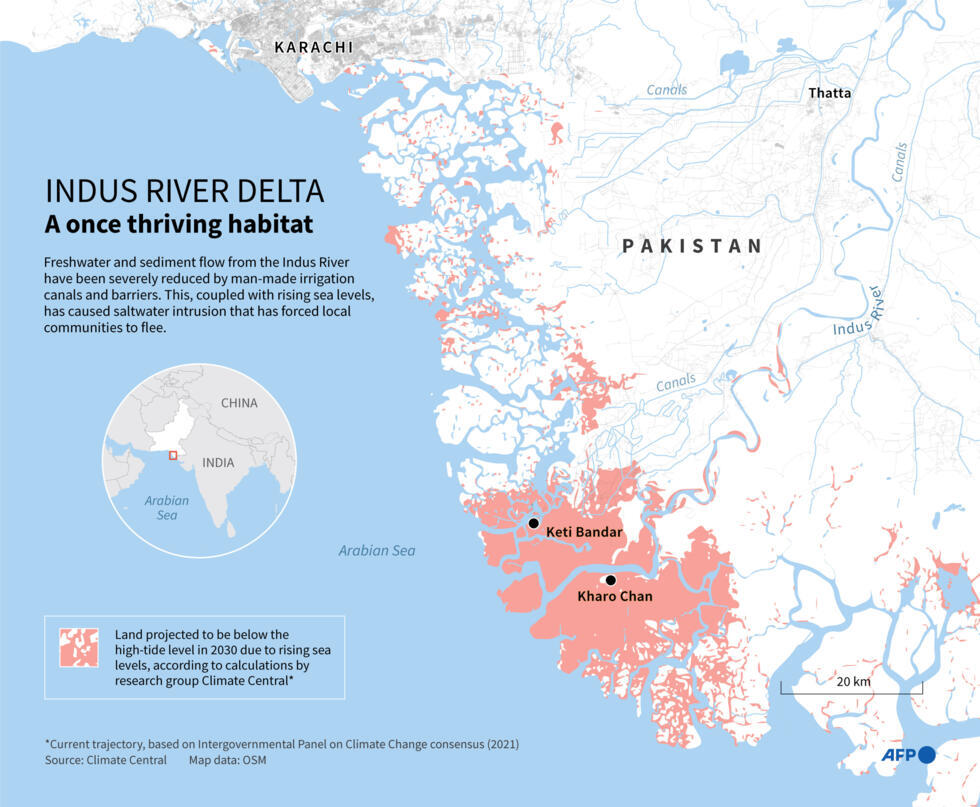
The downstream flow of water into the delta has decreased by 80 percent since the 1950s as a result of irrigation canals, hydropower dams and the impacts of climate change on glacial and snow melt, according to a 2018 study by the US-Pakistan Center for Advanced Studies in Water.

Indus River Delta © Nicholas SHEARMAN / AFP


That has led to devastating seawater intrusion.

The salinity of the water has risen by around 70 percent since 1990, making it impossible to grow crops and severely affecting the shrimp and crab populations.

"The delta is both sinking and shrinking," said Muhammad Ali Anjum, a local WWF conservationist.


'No other choice'

Beginning in Tibet, the Indus River flows through disputed Kashmir before traversing the entire length of Pakistan.


An abandoned house is pictured in one of the villages of Kharo Chan, where the town's population fell from 26,000 in 1981 to 11,000 in 2023 © Asif HASSAN / AFP

The river and its tributaries irrigate about 80 percent of the country's farmland, supporting millions of livelihoods.

The delta, formed by rich sediment deposited by the river as it meets the sea, was once ideal for farming, fishing, mangroves and wildlife.

But more than 16 percent of fertile land has become unproductive due to encroaching seawater, a government water agency study in 2019 found.

In the town of Keti Bandar, which spreads inland from the water's edge, a white layer of salt crystals covers the ground.


In the town of Keti Bandar, which spreads inland from the water's edge, a white layer of salt crystals covers the ground © Asif HASSAN / AFP


Boats carry in drinkable water from miles away and villagers cart it home via donkeys.

"Who leaves their homeland willingly?" said Haji Karam Jat, whose house was swallowed by the rising water level.

He rebuilt farther inland, anticipating more families would join him.

"A person only leaves their motherland when they have no other choice," he told AFP.
Way of life


Haji Karam Jat, whose house was swallowed by the rising water level, rebuilt his new hom farther inland © Asif HASSAN / AFP


British colonial rulers were the first to alter the course of the Indus River with canals and dams, followed more recently by dozens of hydropower projects.

Earlier this year, several military-led canal projects on the Indus River were halted when farmers in the low-lying riverine areas of Sindh province protested.

To combat the degradation of the Indus River Basin, the government and the United Nations launched the 'Living Indus Initiative' in 2021.

One intervention focuses on restoring the delta by addressing soil salinity and protecting local agriculture and ecosystems.

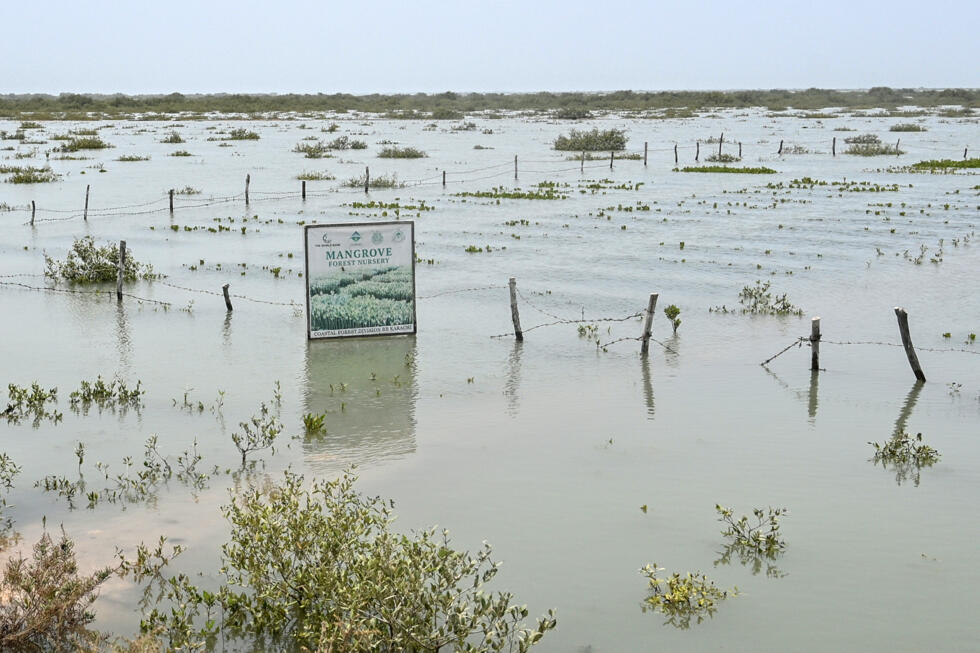
Even as mangroves are restored in some parts of the coastline, land grabbing and residential development projects drive clearing in other areas © Asif HASSAN / AFP


The Sindh government is currently running its own mangrove restoration project, aiming to revive forests that serve as a natural barrier against saltwater intrusion.

Even as mangroves are restored in some parts of the coastline, land grabbing and residential development projects drive clearing in other areas.

Neighbouring India meanwhile poses a looming threat to the river and its delta, after revoking a 1960 water treaty with Pakistan which divides control over the Indus basin rivers.

Habibullah Khatti, a local resident, walks over the salt crusts deposited in Kharo Chan town © Asif HASSAN / AFP


It has threatened to never reinstate the treaty and build dams upstream, squeezing the flow of water to Pakistan, which has called it "an act of war".

Alongside their homes, the communities have lost a way of life tightly bound up in the delta, said climate activist Fatima Majeed, who works with the Pakistan Fisherfolk Forum.

Women, in particular, who for generations have stitched nets and packed the day's catches, struggle to find work when they migrate to cities, said Majeed, whose grandfather relocated the family from Kharo Chan to the outskirts of Karachi.

"We haven't just lost our land, we've lost our culture."

© 2025 AFP
Summer 2025 already a cavalcade of climate extremes

Paris (AFP) – Record heat, massive fires, deadly floods... August has barely begun, but the summer of 2025 is already marked by a cascade of destructive and deadly weather in the northern hemisphere.


Issued on: 05/08/2025 

Higher temperatures increase evaporation, so that more water is stored in the atmosphere, in turn increasing the risk of heavy rainfall and flooding © Akram SHAHID / AFP/File

"Extreme temperatures and precipitation have become more intense and more frequent on a global scale," says Sonia Seneviratne, a professor at ETH Zurich and member of the UN-mandated climate science advisory panel, the IPCC.

"We are in the midst of climate change," Fred Hattermann, a scientist at the Potsdam Institute for Climate Impact Research (PIK), told AFP.

"The risk of extreme events has increased significantly," he said, noting that 2024 was the first year in which the planet's average surface temperature was 1.6 degrees Celsius above the preindustrial benchmark.

That deceptively small jump makes a huge difference.

Higher temperatures increase evaporation, so that more water is stored in the atmosphere. This, in turn, increases the risk of heavy rainfall and flooding.

"with every increment of temperature rise the risk of more and stronger extremes increases," Hattermann added.


50C in the Gulf, Turkey


Already in May, temperatures exceeded 50C in the United Arab Emirates. On August 1, the thermometer hit 51.8C, just under the all-time record of 52C.

The entire Gulf region is suffocating: the Saudi capital Riyadh recorded temperatures of 44°C, while Kuwait frequently hit 50C.

As did Iraq, where air conditioning has become vulnerable to chronic power cuts, and water reserves are at their lowest level in years.

Canada is experiencing one of the worst forest fire seasons on record, amplified by drought and above-normal temperatures © HANDOUT / Manitoba Government/AFP/File

Turkey saw the 50C threshold exceeded for the first time: the town of Silopi on the border with Iraq and Syria reached 50.5C on July 26.

The country has experienced thousands of fires this summer amidst a severe drought.

In Asia, meanwhile, Japan broke its all-time temperature record on Tuesday with 41.8C in the city of Isesaki, northwest of Tokyo. The country's iconic cherry trees, emblematic of the archipelago, are blooming earlier than ever due to the heat.

Torrential rains in Hong Kong

On Tuesday, Hong Kong saw the highest rainfall total for August in more than 140 years of record-keeping: 35.5 centimetres (14 inches) in a single day.

On mainland China, a week earlier, severe weather killed at least 44 people and left nine missing in rural districts north of Beijing.

Pakistan floods, Finland heat

266 people, nearly half of them children, have already lost their lives in Pakistan due to torrential rains sweeping across the country.

The 2025 monsoon, which started early, was described as "unusual" by authorities. Punjab, Pakistan's most populous province, recorded 73 percent more rainfall in July than in 2024.

The entire Gulf region is suffocating: the Saudi capital Riyadh recorded temperatures of 44°C © HAZEM BADER / AFP/File


People come to Scandinavia to seek cooler climes, but since July Norway, Sweden and Finland have experienced sustained temperatures more typical of the Mediterranean.

August 3 marked the end of a 22-day period with temperatures above 30°C in Finland: a record.

In Rovaniemi, a Finnish city north of the Arctic Circle, temperatures reached 30C, higher than in southern Europe at the same time.

Mega-fires in Canada


Canada is experiencing one of the worst forest fire seasons on record, amplified by drought and above-normal temperatures.

On mainland China, severe weather killed at least 44 people and left nine missing in rural districts north of Beijing © ADEK BERRY / AFP/File

Other parts of the world are also burning, from Scotland to Arizona and Greece.

According to the European Union's Copernicus weather and climate observatory, total smoke and greenhouse gas emissions since the beginning of summer in the northern hemisphere are among the highest ever recorded.

© 2025 AFP
Great Barrier Reef suffers most widespread bleaching on record

Sydney (AFP) – Australia's famed Great Barrier Reef has suffered its most widespread coral bleaching on record, according to a government report released Wednesday that warns the natural wonder is in dire health.


Issued on: 05/08/2025 -

Scientists documented the "most spatially extensive" bleaching of the Great Barrier Reef since records began, driven by sweltering ocean temperatures in 2024 © Violeta J Brosig / Minderoo Foundation/AFP/File

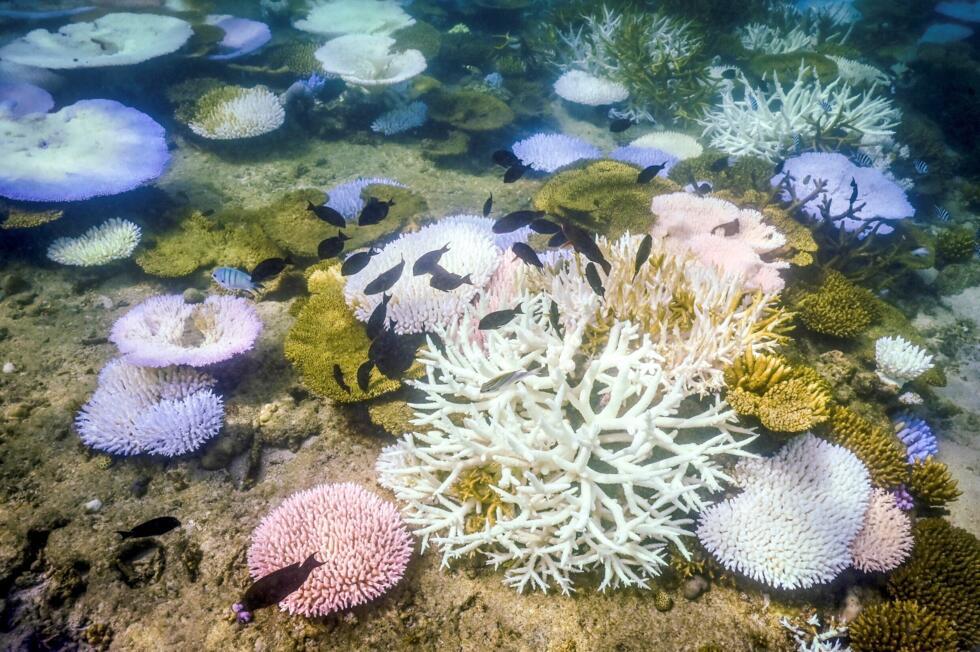
Scientists documented the "most spatially extensive" bleaching since records began almost 40 years ago, driven by sweltering ocean temperatures in 2024 that triggered "unprecedented levels of heat stress".

The Australian Institute of Marine Science surveyed the health of 124 coral reefs between August 2024 and May 2025.

Northern and southern branches of the sprawling reef had seen the "largest annual decline in coral cover" ever recorded, the government agency found.

Reefs had been battered by tropical cyclones and infestations of crown-of-thorns starfish that feast on coral.

But the "number one cause is climate change," said the institute's research lead Mike Emslie.

"There is no doubt about that," he told AFP.

Often dubbed the world's largest living structure, the Great Barrier Reef is a 2,300 kilometre (1,400-mile) expanse of tropical corals that houses a stunning array of biodiversity.

But repeated bleaching events have threatened to rob the tourist drawcard of its wonder, turning banks of once-vibrant coral a sickly white.

The Australian Institute of Marine Science said there was no doubt the number one driver of the reef bleaching was climate change © David Gray / AFP/File

Unusually warm tropical waters triggered widespread coral bleaching on the Great Barrier Reef in 2024 and in the first few months of 2025 -- the sixth such event in the past nine years.

"The (Great Barrier Reef) experienced unprecedented levels of heat stress, which caused the most spatially extensive and severe bleaching recorded to date," the report found.

Over the past two years a mass global bleaching event has drained the life from more than 80 percent of the world's coral reefs.

Bleaching occurs when water temperatures rise forcing coral to expel the colourful microscopic algae, known as zooxanthellae, embedded in their tissues.

If high temperatures persist, the coral can eventually turn white and die.

Emslie said past coral growth would help cushion the record losses and that the Great Barrier Reef was still an "amazing place".
'Worth fighting for'

"It is still worth fighting for. We can't throw our arms up and give up," he said.

The report found a rapidly growing type of coral -- known as acropora -- had suffered the most.

This coral is quick to grow, but is also one of the first to bleach.

The report found that any recovery of the reef could take years and was dependent on future coral reproduction and minimal environmental disturbance.

Richard Leck from the World Wildlife Fund compared the fluctuating health of the Great Barrier Reef to a "rollercoaster".

"That is a sign of an ecosystem under incredible stress and what reef scientists are hugely concerned about is when the reef does not keep bouncing back the way it has," he told AFP.

Bleaching occurs when water temperatures rise forcing coral to expel the colourful microscopic algae, known as zooxanthellae, embedded in their tissues © Glenn NICHOLLS / AFP

Leck said some coral reefs around the world were already beyond recovery, warning the Great Barrier Reef could suffer the same fate without ambitious and rapid climate action.

The average sea surface temperature around Australia was the "highest on record" in 2024, according to Australian National University.

Australia is currently developing its next round of emissions reduction targets, a key obligation under the landmark Paris climate agreement.

The mining superpower remains one of the world's biggest coal exporters and continues to heavily subsidise its fossil fuel sectors.

© 2025 AFP
UN experts call for GHF to be dismantled

Geneva (AFP) – United Nations special rapporteurs called Tuesday for the Israel- and US-backed Gaza Humanitarian Foundation to be immediately dismantled, saying aid was being "exploited for covert military and geopolitical agendas".

Issued on: 05/08/2025 - 

UN experts have called for the US and Israeli-backed Gaza Humanitarian Foundation (GHF), that has distributed aid in the Palestinian territory, to be closed down © Eyad BABA / AFP
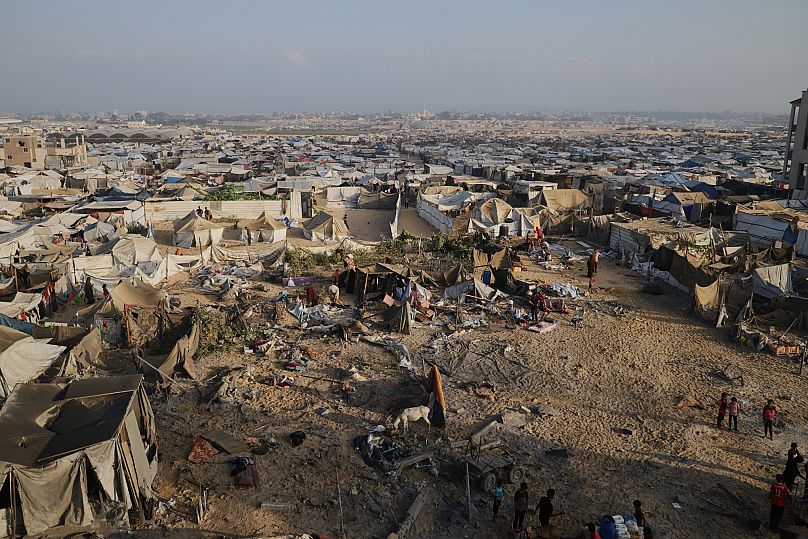
An exceptionally-large group of the UN-mandated experts voiced grave concerns over the GHF's operations.

The private organisation began distributing food in Gaza Strip in May as Israel began easing a more than two-month aid blockade on the Palestinian territory that had exacerbated existing shortages.

"The GHF ... is an utterly disturbing example of how humanitarian relief can be exploited for covert military and geopolitical agendas in serious breach of international law," the experts said in a joint statement.

"The entanglement of Israeli intelligence, US contractors and ambiguous non-governmental entities underlines the urgent need for robust international oversight and action under UN auspices.


"Calling it 'humanitarian' adds on to Israel's humanitarian camouflage and is an insult to the humanitarian enterprise and standards."

On July 22, the UN rights office said Israeli forces had killed more than 1,000 Palestinians trying to get food aid in Gaza since the GHF started operations -- nearly three-quarters of them in the vicinity of GHF sites.

"Without clear accountability, the very idea of humanitarian relief may ultimately become a casualty of modern hybrid warfare," the special rapporteurs said.

"The credibility and effectiveness of humanitarian assistance must be restored by dismantling the GHF, holding it and its executives accountable, and allowing experienced and humanitarian actors from the UN and civil society alike to take back the reins of managing and distributing lifesaving aid."

The joint statement was signed by Francesca Albanese, the UN's special rapporteur on the rights situation in the Palestinian territories occupied since 1967.

Israel accuses her of having an "obsessive, hate-driven agenda to delegitimise the state of Israel".

The statement was also signed by 18 other special rapporteurs, plus other UN experts and members of UN working groups -- a notably large number for such statements.

Special rapporteurs are independent experts mandated by the UN Human Rights Council to report their findings. They do not, therefore, speak for the United Nations itself.

More than two million people live in the Gaza Strip.

GHF says it has distributed more than 1.76 million boxes of foodstuffs to date.

"We continue to improve our operations," GHF executive director John Acree said Monday.

"We urge the international humanitarian community to join us -- we have the scale and capacity to deliver more aid to the people of Gaza."

© 2025 AFP

Israel reopens Gaza private goods trade

Israel will gradually reopen private sector trade with Gaza to reduce its reliance on humanitarian aid, the defense ministry civil affairs agency for the Palestinian territories said on Tuesday. It comes as foreign countries continue to drop aid into the Strip.


Is the US 'complicit in the war crimes being carried out by Israel in Gaza'?


Issued on: 05/08/2025 - 


Israeli Prime Minister Benjamin Netanyahu is working on a complete military takeover of Gaza for the first time in two decades. Mediation between Israel and Palestinian militant group Hamas has collapsed despite intense international pressure for a ceasefire amid appalling conditions. For in-depth analysis and a deeper perspective on the harrowing plight of the more than two million civilians in war-torn Gaza, FRANCE 24's Stuart Norval welcomes Arwa Damon, former CNN Senior International Correspondent and founder of the International Network for Aid, Relief, and Assistance (INARA).


War-torn Gaza resident and humanitarian worker recounts harrowing plight of civilians under siege

Issued on: 05/08/2025 - 

In the face of international pressure, Israel has allowed airdrops of food aid, but the amounts delivered are a drop in the ocean compared to the scale of the humanitarian emergency. Thousands of aid trucks continue to sit outside the enclave. Bahaa Zaqout, a Gaza resident in Deir al-Balah, joins FRANCE 24's Delano D'Souza to offer an intimate and upfront account from the ground of Gaza's humanitarian crisis and the harrowing plight of civilians. Mr. Zaqout is a humanitarian responder with the Agricultural Development Association (PARC).

Video by: Delano D'SOUZA


Amid desperation in war-torn Gaza, 'environment of fear, intimidation and worry in West Bank'

Issued on: 05/08/2025 - 

Israel's blockade and military offensive have made it nearly impossible to safely deliver aid, contributing to the territory's slide toward famine nearly 22 months into the war with Hamas. Aid groups say Israel's week-old measures to allow more aid are far from sufficient. Families of hostages in Gaza fear starvation affects them too, but blame Hamas. For in-depth analysis and a deeper perspective, FRANCE 24's Eve Irvine welcomes Dr. Hadeel Qazzaz, Oxfam International spokesperson and MENA Regional Gender Coordinator.

Video by:  Eve IRVINE


S.Africa urges more countries to stand up to Israel's 'genocidal activities'


Pretoria (AFP) – More countries must recognise a Palestinian state and stand up to Israel to stop its "genocidal activities", South Africa's Foreign Minister Ronald Lamola told AFP in an interview Tuesday.


Issued on: 05/08/2025 -

South African Foreign Minister Ronald Lamola said recognising a Palestinian state would help bring about a Gaza ceasefire © MARCO LONGARI / AFP

Pretoria has been a leading critic of Israel's actions in Gaza, bringing a case before the UN's top court in December 2023 arguing that its war in the Palestinian territory amounted to genocide.

As some of Israel's allies "are now also saying, no, this can't continue, it means that it is bringing us closer and closer to the Israel regime (stopping) the genocidal activities", Lamola said.

South Africa's case before the International Court of Justice argues that the war in Gaza, which began with the militant group Hamas's October 7, 2023 attack on Israel, breached the 1948 United Nations Genocide Convention. Israel has strongly denied that accusation.

Several nations have added their weight to the proceedings, including Spain, Bolivia, Colombia, Mexico, Turkey, Chile and Libya.

The leaders of France, the United Kingdom and Canada have meanwhile said they plan to recognise a Palestinian state in September, and urged other nations to do so.

"We call for more countries to continue to recognise Palestine," Lamola told AFP.

"This will put the pressure so that we can end up with a ceasefire."

After 22 months of combat sparked by the October 7, 2023 attacks by Hamas that killed 1,219 people and saw hundreds kidnapped, the Israeli army has devastated large parts of the Palestinian territory.

More than 60,933 Palestinians have been killed, according to figures from Hamas-run Gaza's health ministry, and humanitarian agencies have warned that the territory's 2.4 million people are slipping into a catastrophic famine.

Lamola said that had the world acted when South Africa made its case at the ICJ, "we would not be where we are".

"It's clear starvation is emerging, famine, and all these are things we warned about in our ICJ case -- that this will lead to famine, will lead to complete cleansing of the population," he said.

"It's rather late, yes, but it's better than never. So let them act, let them support, let them put the pressure."
Relations at 'a low'

South Africa-US relations have "reached a low" with Washington attempting to interfere in domestic issues, the minister said.

The two nations have been at odds over a range of domestic and international policies, including Pretoria's ICJ case and debunked claims by US President Donald Trump that white South Africans face discrimination.

Tariffs of 30 percent -- the highest on any sub-Saharan African country -- are set to hit certain South African exports Friday in the absence of a trade deal.

"In the past we have not had this situation where another government would want to interfere on a domestic issue like it is now," Lamola said.

"Since the last 30 years, there have been disagreements with the US administration on a number of issues, but the diplomatic lines of engagement have always been open," he said.

South Africa's failure to reach a new trade deal has been criticised at home, including by parties in the coalition government which have accused President Cyril Ramaphosa and his team of diplomatic missteps.

But Lamola told AFP that Pretoria had done "everything possible under the sun" to reach a deal.

Political disagreements had not come up in trade talks with the United States, he said.
Trump 'welcome' at G20

"The situation with the US for any country, not just for South Africa, is unpredictable," he said.

Equally uncertain is US participation in the G20 summit hosted in November in Johannesburg, which Trump last week said he "probably won't" attend.

"He's welcome to come to South Africa and participate," Lamola said, "but it's his decision."

The minister reiterated Pretoria's intent to promote its theme of "Solidarity, Equality, Sustainability" at the high-level summit.

"The period of unilateralism has passed. We will no longer ever go back there," he said.

"The world must accept it is now the period where we are all interconnected, we all have to act together to find solutions for climate change, inequality, artificial intelligence. We all have to work as one global community."

© 2025 AFP

Genocide is taking place in Gaza and Europe is duty bound to stop it, Israeli scholar says


Copyright AP Photo

LONG READ


By Sophie Claudet
Published on 01/08/2025


Rising voices accuse Israel of genocide in Gaza, accusations Israel denies. Holocaust and genocide scholar Omer Bartov points to the intent to destroy Palestinians in an interview with Euronews.


Voices describing Israel’s actions in Gaza as genocide are rising: an increasing number of politicians, rights-defenders, historians and legal experts say there is a clear will on the part of the Jewish state to destroy the Palestinians as a group and render life in Gaza impossible.

The accusations have been growing since South Africa launched a case at the UN’s top court of justice in December 2023 alleging Israel is committing genocide, an accusation Israel rejected as "baseless".

Euronews spoke to Omer Bartov, Dean’s Professor of Holocaust and Genocide Studies at Brown University, an Ivy League US institution, who argues that what is unfolding in Gaza amounts to genocide.

Separately, we sought the expert legal opinion of Stefan Talmon, an international law professor at the University of Bonn and currently a visiting research fellow at Oxford University, who contends there is no genocide. You can read Talmon’s interview here.

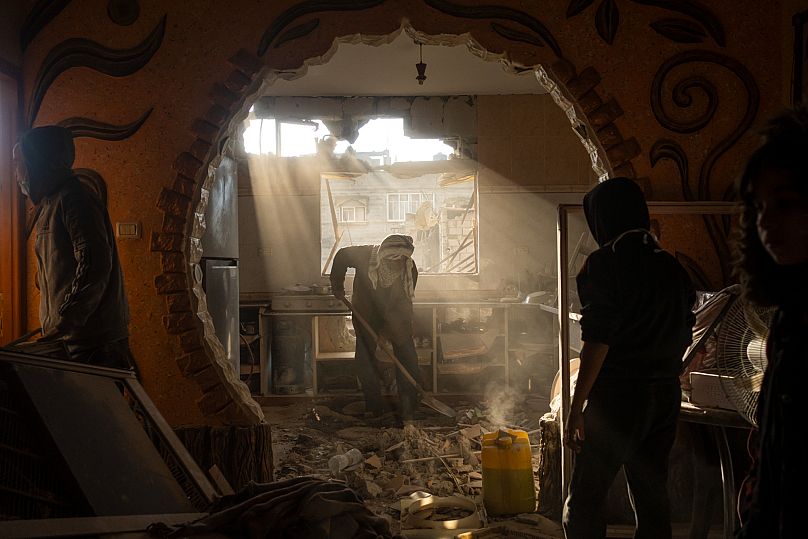
Palestinians look at their neighbour's damaged house following an Israeli strike in Rafah, 27 January, 2024 AP Photo


Proving genocidal intent


Bartov, a genocide and Holocaust scholar, first described Israel’s response to the 7 October terrorist attacks by Hamas as “disproportionate” and even constituting “war crimes and crimes against humanity”.

However, by May 2024 he changed his evaluation of Israel’s military campaign, labelling it genocide, as he believes there is mounting evidence showing intent behind Israel's actions.

Back then, the Israeli army had ordered Palestinians out of Rafah, in the southern tip of the Gaza Strip, and moved them to Mawasi – a coastal area with almost no shelter. The army proceeded to flatten Rafah.

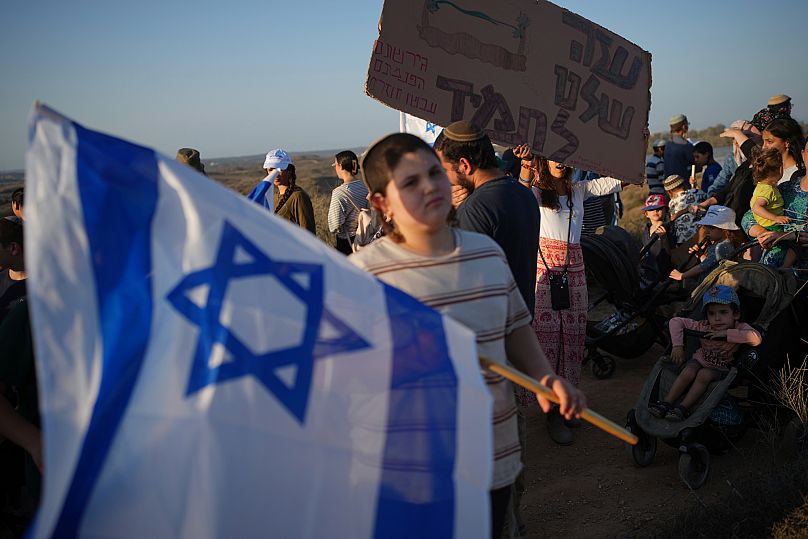
Israeli right-wing activists, one holding a sign ""Gaza is ours forever," attend a rally calling for the establishment of Jewish settlements in the Gaza Strip, 30 July, 2025 
AP Photo

Statements by Prime Minister Benjamin Netanyahu and members of his government constitute proof of their intent to destroy the Palestinians and to make Gaza uninhabitable,” Bartov told Euronews.

Israeli officials have, for example, referred to Palestinians as “human animals,” also saying they would reduce Gaza to “rubble”.

As per the 1948 Convention on the Prevention and Punishment of the Crime of Genocide, genocide can be established when there is an “intent to destroy, in whole or in part, a national, ethnical, racial or religious group.”

Prosecuting those responsible for genocide remains a complicated and complex matter, with cases in front of international courts taking as long as 14 years, as was the case in verdicts on the Bosnian genocide in Srebrenica.

While some experts see genocide as "crime of all crimes", others argue that genocide is a legal category that should not be observed as more important than war crimes or crimes against humanity, cautioning against prolonged court cases in pursuit of justice.

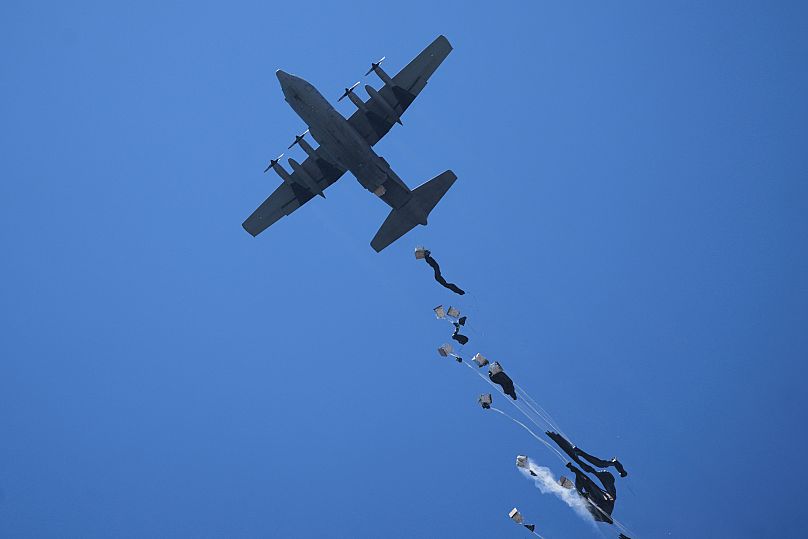
Humanitarian aid is airdropped to Palestinians over Zawaida in central Gaza, 31 July, 2025 AP Photo

To prove a genocide, you also have to show that the intent is being implemented and that there are no other motives than wanting to destroy the group, Bartov explained.

He further pointed to systematic Israeli military operations aimed at demolishing “hospitals, mosques, museums and the goal is then to force the population to leave,” despite the fact that “people won’t and can’t leave and have no place to go to.”

Israel has repeatedly rejected accusations of conducting a genocidal campaign, stating its operation is solely geared towards disempowering and eradicating Hamas. Also, Israel has stated it never intentionally targeted civilians, in turn accusing Hamas of using them as human shields.

What distinguishes Israel’s operation in Gaza from ethnic cleansing and confirms the will to destroy Palestinians, according to Bartov, is that “you make it impossible for that group to reconstitute itself and it is section D of the Genocide Convention, it’s about imposing measures intended to prevent births within the group.”

He points to a recent 65-page report by Israeli NGO Physicians for Human Rights that says Israel's actions in Gaza amount to genocide.


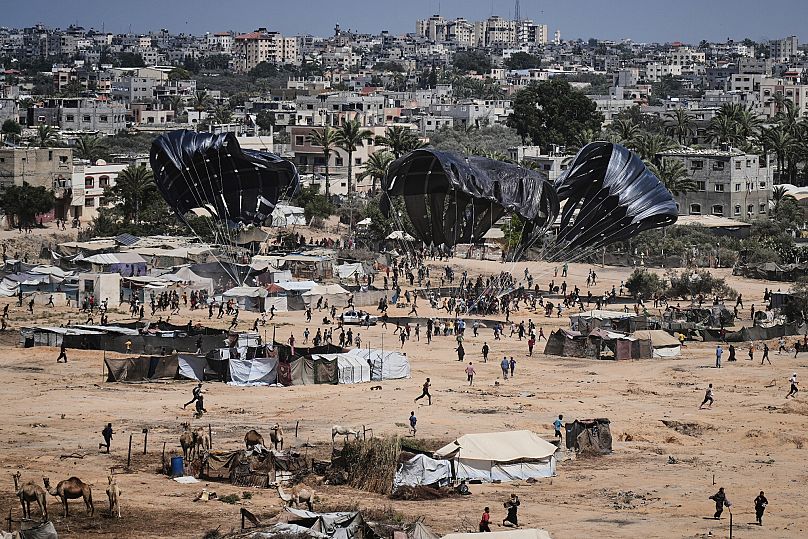
Palestinians rush to collect humanitarian aid airdropped into Zawaida in central Gaza Strip, 31 July, 2025 AP Photo

The report documents the staggering number of miscarriages among Gazan women, the number of children who are born underweight or premature and maternal mortality amid famine due to lack of healthcare.

Bartov believes Israel's operation in Gaza is set to go on, not to finish Hamas, which it is still fighting almost two years into the war, but to empty Gaza of Palestinians, as Israel no longer accepts the idea of a Palestinian state.

Section A of the same convention says killing members of the group with the overall intent to destroy it also constitutes genocide. Section B mentions causing serious bodily or mental harm to members of the group. Bartov says both apply in the case of Israel’s operation in Gaza.

“That is clear, we are talking about between 60,000 and 100,000 dead,” said Bartov, also mentioning 140,000 wounded, the chronically ill who died because hospitals no longer function, and Palestinians debilitated by hunger.

Related
More than 350 stars condemn Gaza ‘genocide’ in open letter in time for Cannes opening
Pope calls for probe into whether Israel's attacks in Gaza amount to genocide

Bartov rejects the argument that the number of casualties released by the Hamas-controlled health ministry, which does not distinguish between civilians and combatants, may be inaccurate or, as Israel claims, grossly exaggerated.

He, like the Israeli NGO B’Tselem, which also labels Israel’s actions in Gaza genocide, believes the Hamas figures are “reliable”, “well documented” and even “conservative”, as thousands of bodies are still trapped under the rubble.

“Let the IDF (Israeli Defence Forces) provide its own figures, they should allow the foreign press in, the burden of proof is on the IDF,” Bartov insisted, adding that the number of victims actually does not matter to prove genocide.

“The convention is about killing people and members of the group, it is not about killing all members of the group," he emphasised.
Easing humanitarian crisis 'irrelevant' to genocide accusation

Past ceasefires agreed to by Israel and the recent easing of the food blockade amid reports of starvation in Gaza do not change Bartov’s genocide accusation.

The ceasefires were imposed on Israel, he argues instead.

“The last ceasefire was imposed by President Trump as he came in, and in March, Israel unilaterally broke the ceasefire, within a few minutes it killed a few hundred," he explained. “This is has nothing to do with the main intent (of genocide) ... it is not at all something that is done willingly."

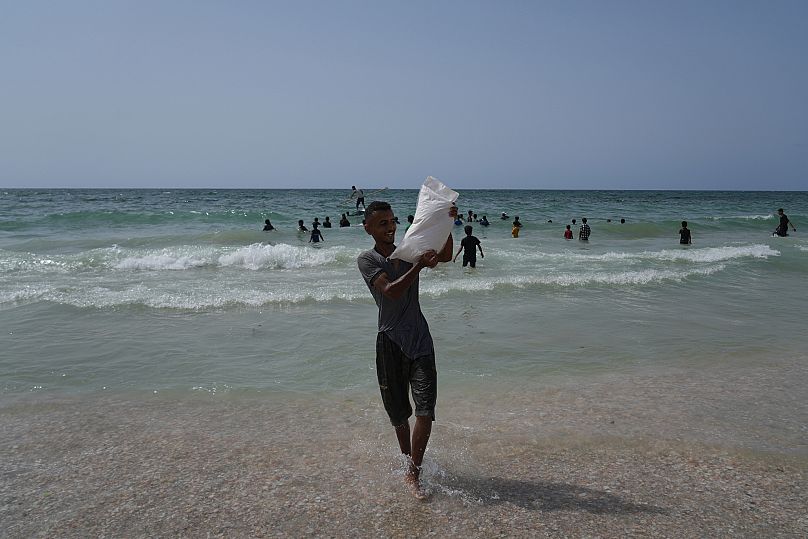
Palestinians collect aid that landed in the Mediterranean Sea after being airdropped over central Gaza, 29 July, 2025 AP Photo

Bartov claims that the Israeli government and Netanyahu openly tell the Israeli public that they are agreeing to “the so-called humanitarian pause”, notably under pressure from Trump, because “these are measures that will make it possible for Israel to continue its operations.”

In Gaza, Palestinians continue to be killed in the meantime, he says.

Most Israelis 'in denial' of what is happening in Gaza


When they released their reports on Monday, Israeli NGOs B’Tselem and Physicians for Human Rights also issued a common appeal, calling on “Israelis and the international community to take immediate action to stop the genocide, using all legal tools available under international law.”

We put the question of Israel’s public opinion to Bartov, himself an Israeli citizen who served in the army.

Related
'Worst-case scenario of famine' unfolding in Gaza, says UN-backed hunger monitor
Exclusive: Cross-party EU lawmakers call for sanctions on Israel over Gaza ‘atrocities’

"Of course they are aware, you cannot not be aware, but most Israelis don’t want to know," he said.

“Yesterday, there was an extraordinary report on Kan 11, the public TV, which also showed for the first time some images of starving children in Gaza but then said all this is fake news and showed footage of people selling fruits and vegetables at a market in Gaza.”

Euronews verified the Kan 11 footage but also found that Israeli media claim that some of the photos depicting starving Palestinian children were reportedly manipulated.
US and Europe 'duty-bound' to stop war in Gaza

To Bartov, it is important to recognise what Israel is doing in Gaza as genocide “because all signatory states of the Genocide Convention include all the European countries and the United States (which) are duty bound to do something” -- to prevent, stop and punish those responsible.

Instead, according to him, the US and Europe remain “complicit” in what is happening in Gaza.

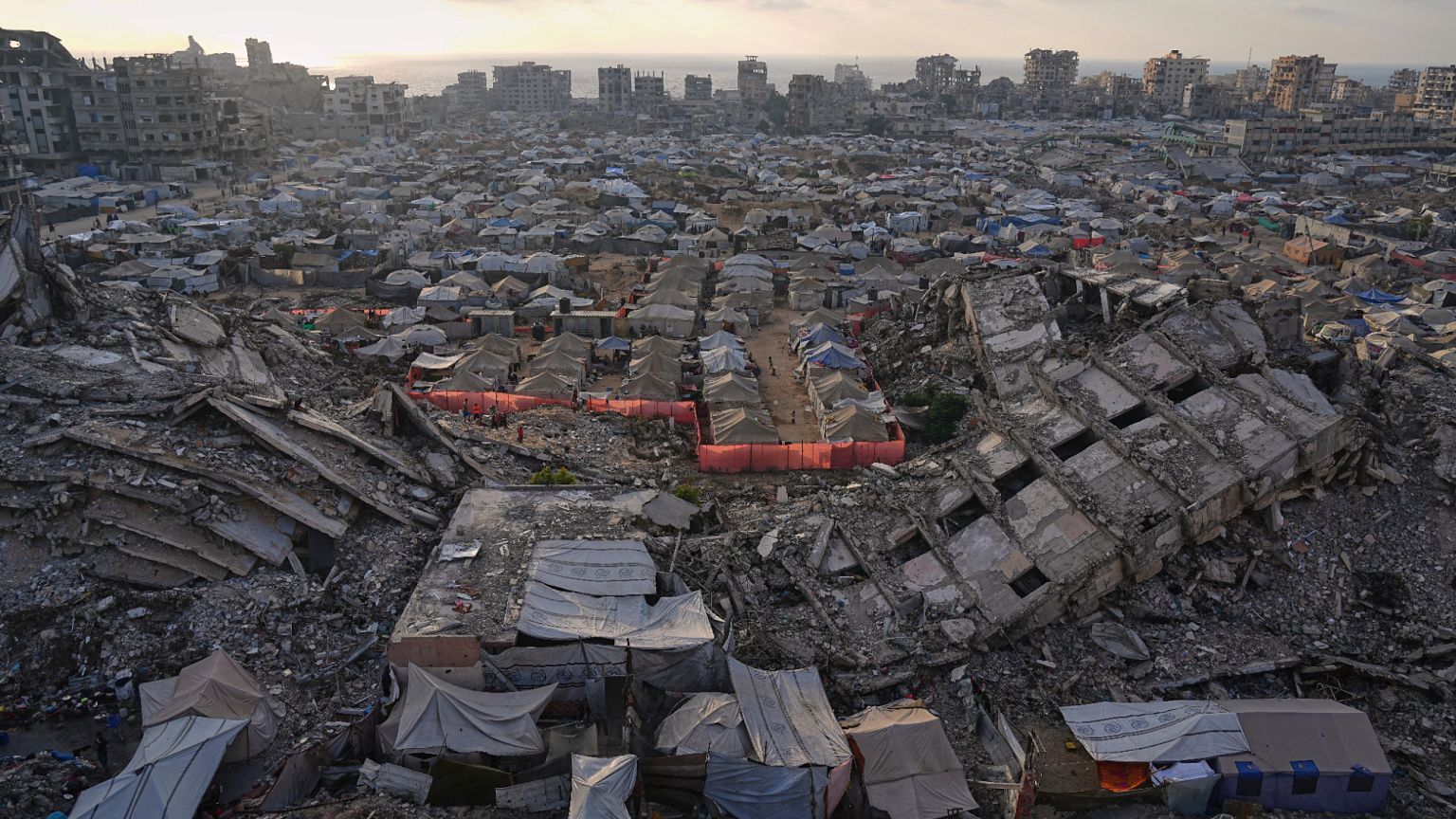
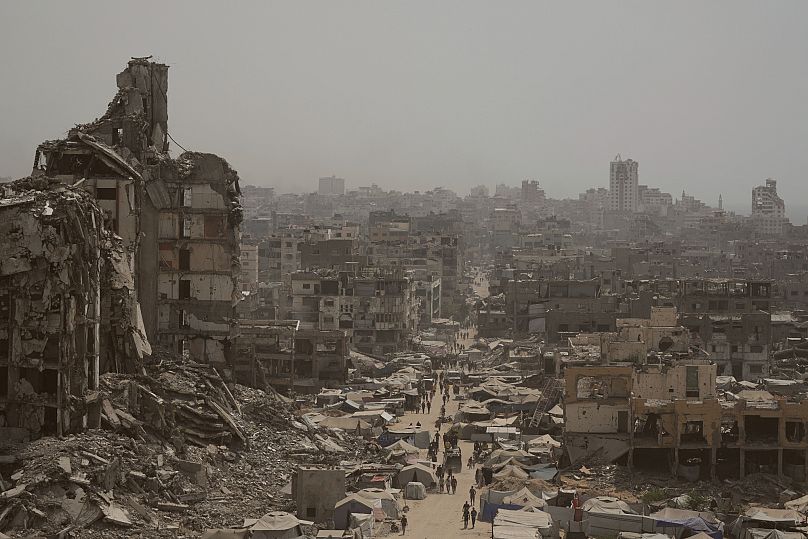
People walk along a street lined with destroyed buildings following Israeli bombardments during the Israel-Hamas war in the Gaza Strip, 29 July, 2025 AP Photo

“In the case of Germany it’s especially appalling not only because it is the major European power, the major supplier (of weapons) to Israel, but also because it does it in the name of the Holocaust (...) the Staatraison.”

Germany, he says, in feeling responsible for the Holocaust, should prevent crimes against humanity and genocide but not protect a country “that is the successor state of the Holocaust while it is itself carrying out a genocide."

"That is a complete distortion of the lessons of World War II, Nazism and the Holocaust," Bartov argued.


Fear of mounting antisemitism


While Bartov says urgent action is needed to stop the violence in Gaza, one of the long-term repercussions, he fears, is that “Israel will become a pariah state (...) if it is allowed to get away with it."

"If one has an interest in protecting Israel, helping it become a decent place, it has to impose measures on it now that would stop not only the killing of Palestinians but also the rapid erosion of democracy,” he implored.

Bartov also expressed further concerns about the effect of Israel being a pariah state on Jewish communities around the world, which he says would be “severe,” pointing to the rise of antisemitism.

Palestinians inspect the site struck by an Israeli bombardment in Muwasi, 28 July, 2025 AP Photo

Bartov, who focused a great deal of his research on Nazi crimes, also deplores that institutions set up to commemorate the Holocaust, be they memorial centres or museums, have been silent on Gaza.

Their mandate is not only to remind the public of the horrors of the Holocaust but also to prevent future atrocities by promoting education and remembrance.

Their failure to speak up, he says, will dent their credibility. “They will no longer be able to present themselves as anything but institutions that are only concerned with what could be done to the Jews by the Nazis. Anything else is not their business.”
Could Hamas' 7 October attacks be labelled genocide?

Asked whether the terrorist attacks perpetrated by Hamas on 7 October 2023, that left close to 1,200 Israelis dead, could also be qualified as genocide, Bartov says: “obviously, it was a war crime. Obviously, it was a crime against humanity because of the large numbers of civilians killed."

"One would need to adjudicate that but it could be, if it is connected to the Hamas charter of the late 1980s which is an antisemitic, genocidal document, it could be seen as genocidal act.”

“I'm a little sceptical about that, but certainly I think one could make that argument. I'm sceptical because Hamas actually issued different documents later," Bartov concluded.