Nawrocki sworn in as Poland's president, setting up showdown with Tusk government
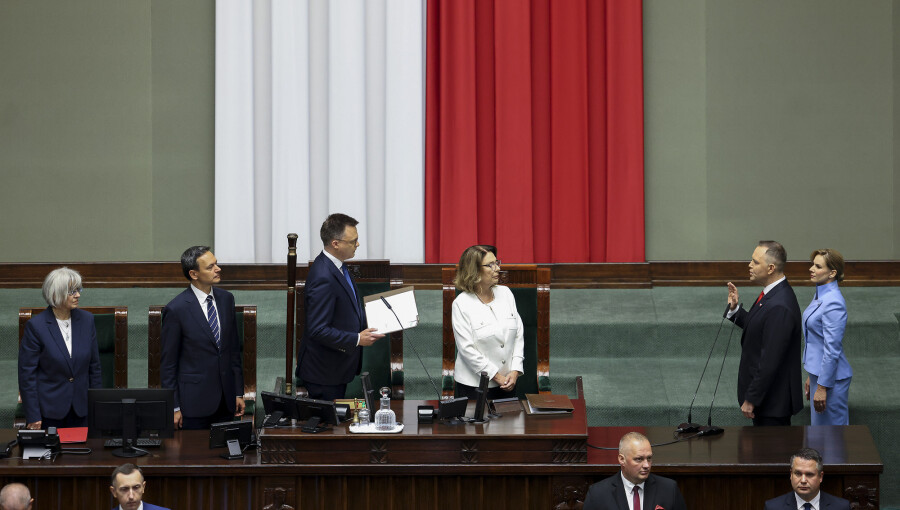
Karol Nawrocki was sworn in as Poland’s new president on August 6, marking the start of what is expected to be a prolonged political standoff with Prime Minister Donald Tusk’s coalition government.
Nawrocki, a historian backed by the right-wing Law and Justice (PiS) party and a newbie in top politics, used his inaugural address to deliver a scathing critique of the government.
“It is impossible to continue governing in this manner, and Poland should not look like it does today,” Nawrocki said.
The 42-year-old won the June 1 presidential runoff by a narrow margin — 50.89% to 49.11% — defeating Warsaw Mayor Rafał Trzaskowski, the candidate backed by Tusk’s ruling coalition. The result dealt a major blow to Tusk, who had hoped to secure alignment between the presidency and government to push through delayed reforms.
Instead, Tusk now faces another term under a head of state that can be expected to oppose his efforts, replacing former president Andrzej Duda, a staunch ally of PiS.
Nawrocki is expected to veto key legislation from the government, which lacks the parliamentary majority required to override presidential rejections. Both sides are preparing to use this gridlock to their advantage ahead of the next general election in 2027, each aiming to blame the other for inaction.
“I have worked with three presidents as prime minister so far. What will it be like with the fourth? We’ll manage,” Tusk said on social media.
Tusk also called Nawrocki's inauguration day "sad and disappointing". "We all believed that honesty, goodness, and love would prevail. What has happened puts our faith to a serious test," Tusk said in a video message.
In his first speech as president, Nawrocki pledged to block Poland’s adoption of the euro, saying he would support cooperation within the EU but “never agree to the European Union taking away Poland’s powers, especially in matters that are not enshrined in the European treaties.”
Nawrocki also pledged to oppose attempts by the government to roll back PiS’s judiciary reforms, which cost Poland a delay in accessing EU funds before 2023.
The president restated his campaign pledges to resist any increase in the retirement age, oppose illegal immigration and preserve the Polish złoty. Nawrocki also called for more housing investment.
Nawrocki indicated he would revive some policies dropped by the current government, including a plan to double the tax-free income threshold. That measure is no longer on the government’s agenda due to fiscal concerns.
What the cooperation between Nawrocki and the Tusk-led ruling majority will look like might become clearer within days, when parliament sends Nawrocki a bill combining electricity price caps for households — a policy Nawrocki has backed — with measures liberalising onshore wind development, which he and his voter base may oppose.
The only area where Nawrocki and Tusk may find common ground is defence.
Poland spends the highest share of GDP on defence in Nato and plays a central role in supporting Ukraine.
“I will support all efforts to modernise the Polish army to make it the largest Nato land force within the European Union,” Nawrocki said, adding that he would “engage closely with the US” and “lead in building a resilient and responsible security architecture on Nato’s eastern flank”
Poland’s new president brings hard line on refugees, abortion and rule of law
Karol Nawrocki’s inauguration as Poland’s new president on Wednesday has set the stage for a turbulent power struggle with Prime Minister Donald Tusk’s pro-European government and raised fears among Poland’s Ukrainian community.
Issued on: 06/08/2025 - RFI

The historian and author used his swearing-in speech to parliament to make his position clear: “No to illegal immigration, no to the euro.”
Nawrocki’s election campaign was marked by a rise in nationalist rhetoric and repeated criticism of Ukrainian refugees living in Poland. His victory has unsettled many at home and abroad.
His rhetoric is making it easier for people to express anti-Ukrainian views, warned Oleksandr Pestrykov of the Ukrainian House Foundation in Warsaw – calling it a form of social segregation.
“Seeing Nawrocki speak in this way, someone who doesn't like Ukrainians but would have been ashamed to say so, can now say it openly,” Pestrykov said.
On the campaign trail, Nawrocki described Ukrainian refugees as “ungrateful” and a “burden on society”. His slogan “Poland First, Poles First” came with pledges to give citizens priority in healthcare and education, cut pensions for Ukrainians and restrict benefits to Poles only.

Supreme Court confirms validity of Poland's presidential election
Calls for unity mask deep divides
Despite his hardline message, Nawrocki has also tried to appear as a unifier. In a video released before the inauguration, he urged Poles to “unite” and spoke of “a new chapter in the history of our beloved Poland”.
He said he would be an “active president” from the outset, ready to propose laws and push government action.
But cooperation with Tusk’s government may prove difficult. The prime minister has already expressed doubts about Nawrocki’s intentions. “I have no doubt that Mr Nawrocki will do everything to annoy us,” Tusk said. He also warned that he would not let the president “demolish” his government.
Nawrocki, who has no prior experience in elected office, narrowly defeated liberal candidate Rafal Trzaskowski in the 1 June election. The close result revealed deep divisions in Polish politics.
Although the president does not run the government, the role comes with real power – including veto rights and a say in foreign and defence policy.
Nawrocki had the backing of former US president Donald Trump during his campaign. But analysts say he lacks international experience. With Ukraine a key issue, this could become a source of friction.
From Washington to Warsaw: how MAGA influence is reshaping Europe’s far right
Foreign policy split
Nawrocki’s support for Ukraine appears conditional, said Jean-Yves Potel, a historian and political scientist. “Nawrocki seems to want to impose conditions on the Ukrainians, particularly regarding Ukraine’s entry into NATO and the European Union. He wants to exert pressure on this issue,” Potel told RFI.
Still, he said Tusk remains Poland’s key foreign policy actor. “He is not going to follow Nawrocki,” he said.
Ukrainian President Volodymyr Zelensky congratulated Nawrocki after his win and expressed hope for continued cooperation.
Following a phone call between the two, Zelensky said they had agreed to exchange visits and work together on practical matters. He said he was “thankful for the readiness to work together”.
Even so, Nawrocki’s remarks about Kyiv’s “lack of gratitude” and his opposition to NATO membership for Ukraine suggest a cooler relationship than under former president Andrzej Duda. The shift could affect Poland’s role in the regional response to Russia’s war.
Polish nationalists stage anti-immigration demonstration ahead of polls
Abortion deadlock
Tensions are also expected to continue in the lead-up to Poland’s next parliamentary elections in 2027. Nawrocki has openly attacked the Tusk government, calling it “the worst in the history of democratic Poland”.
One major fault line is abortion. In predominantly Catholic Poland, the procedure is only allowed in cases of severe foetal abnormalities or when the mother’s life is at risk. Tusk wants to relax the law. Nawrocki has said he will block any such move.
“He promises to block any law in this direction,” said Potel. “But on the other hand, within Tusk’s coalition, there are Christian Democratic currents that refuse to liberalise abortion.” As a result, no major change may be possible, despite public pressure.
Not all observers think the situation will spiral into open conflict. Piotr Trudnowski, from the Klub Jagiellonski think tank, said “both parties should realise that engaging in intense confrontation is obviously not the way forward.”
The months ahead will show whether compromise is possible – or whether Poland’s political divide grows deeper under Nawrocki’s presidency.
.