Monday, August 25, 2025

China willing to supply Ukraine peacekeepers if there is a UN mandate

China willing to supply Ukraine peacekeepers if there is a UN mandate
Beijing has said that it open to the idea of sending peacekeepers to Ukraine if a ceasefire is called, but only if its underpinned by a UN mandate. / bne IntelliNews
By Ben Aris in Berlin August 24, 2025

China has indicated its readiness to send troops to Ukraine as part of a peacekeeping mission, but only if such a deployment is authorised by the United Nations, Welt am Sonntag reported on August 24, citing European Union diplomats.

Beijing has been seeking to position itself as a potential mediator in the conflict, while carefully limiting any military involvement to a framework sanctioned by international law. According to the diplomats, Chinese officials made clear that participation would be contingent on a UN mandate, rather than on bilateral or regional arrangements.

“China has signalled readiness to send troops to Ukraine as part of a peacekeeping mission, but only under a UN mandate,” the German newspaper quoted EU diplomats as saying.

The move, if pursued, would represent Beijing’s most direct role in the conflict since Russia’s full-scale invasion began in 2022. China has so far balanced its stance between maintaining close ties with Moscow and promoting itself as a neutral actor advocating for negotiations.

Beijing has consistently called for an end to the war. While it has backed Russia and continues to provide an economic backstop, providing Russia with a myriad of goods and dual use technology, it has shied away from throwing its full weight behind Russia. In all the UN voting to condemn Russia’s unprovoked invasion of Ukraine, China has consistently abstained rather than join the handful of nations that have voted in support of Russia’s actions. Likewise, Beijing presented a 12-point peace plan on the anniversary of the start of the war, which is very similar to the terms that US President Donald Trump is proposing now.

Western governments remain cautious over Beijing’s intentions, noting that China has deepened trade and energy cooperation with Russia while opposing sanctions imposed by the EU and the United States. At the same time recently Beijing’s support seems to have gone up a notch after a new Chinese-made decoy drone was found on the battlefield and most of the tech in Russia’s missiles is now of Chinese origin. A Chinese troop presence in Ukraine under UN auspices would require approval from the Security Council, where Beijing holds veto power alongside Moscow.

“China’s position is framed entirely within a UN context,” one EU diplomat told Welt am Sonntag, underscoring that no independent Chinese mission is under consideration.

The idea of peacekeepers, now downgraded to a “reassurance force”, was originally floated by French President Emmanuel Macron, but the idea was abandoned in March as unworkable. However, as talks on providing Ukraine with real security guarantees started following the Alaska summit on August 15 and then the White House summit on August 18 ahead of a mooted meeting between Ukrainian President Volodymyr Zelenskiy and Russian President Vladimir Putin the idea has been revived.

Russian Foreign Minister Sergei Lavrov has adamantly and repeatedly said placing Nato-backed troops in Ukraine is unacceptable to the Kremlin and would have “unpredictable” consequences. However, the Kremlin may be open to non-Nato peacekeepers in Ukraine, especially if it was backed by a UN resolution and was made up of forces provided by its fellow BRICS partners.

Ramaphosa, Macron step up talks on Ukraine as South Africa joins push for peace

South Africa's President Cyril Ramaphosa is stepping up his diplomacy, engaging President Emmanuel Macron and other European leaders in a renewed drive for peace efforts in Ukraine


Issued on: 24/08/2025 - RFI


France's President Emmanuel Macron shakes hands with South Africa's President Cyril Ramaphosa on the sidelines of the G20 summit in Rio de Janeiro, Brazil, on 19 November 2024. AFP - LUDOVIC MARIN

South African President Cyril Ramaphosa has placed himself more firmly on the diplomatic stage, holding a conversation with French President Emmanuel Macron on Saturday that touched on the war in Ukraine, the Middle East and other pressing global crises.

Posting on X, Macron said their discussion covered “the war of aggression waged by Russia against Ukraine in the context of Monday’s meeting in Washington, as well as the situation in the Great Lakes region”.

The two leaders agreed to meet again in September on the margins of the United Nations General Assembly in New York.

The exchange with Macron underlines Ramaphosa’s growing role as a mediator as he seeks to rally support from both the Global South and Europe.

Pretoria later confirmed that Ramaphosa, who currently chairs the G20, also spoke with Finnish President Alexander Stubb and will reach out to other European leaders in the weeks ahead.

'Oil and vinegar'

At the heart of his message is a call for a direct meeting between Kyiv and Moscow.

Earlier on Saturday, Ramaphosa held a phone call with Ukrainian President Volodymyr Zelensky in which he pressed the urgency of “bilateral and trilateral meetings between the leaders of Russia, Ukraine and the United States as key to signal a firm commitment to ending the war”.

Zelensky reiterated his openness to “any format of meeting with the head of Russia”.

Yet he voiced frustration that Moscow was “once again trying to drag everything out even further”, urging the Global South to apply pressure to steer the Kremlin towards peace.

On Sunday – as Ukrainians celebrated Independence Day – Zelensky struck a defiant note, declaring that his country would “never surrender”.

The intervention comes as momentum for a Russia–Ukraine summit appears to be stalling. US President Donald Trump, who earlier in the week suggested that Vladimir Putin and Zelensky had agreed to meet face-to-face, has since compared the pair to “oil and vinegar”.

On Friday, Russian Foreign Minister Sergei Lavrov bluntly stated that “no meeting” was on the cards.

Balancing act

Despite his warm personal ties with Putin – whom he called a “dear ally” and “valued friend” at last year’s BRICS summit – Ramaphosa has gradually shifted South Africa’s stance.

For the first time since the war began, Pretoria this year voted in favour of a United Nations resolution describing Russia’s actions as a full-scale invasion of Ukraine.

That balancing act – keeping dialogue open with Moscow while engaging with Western partners such as France – has made Ramaphosa an increasingly interesting figure in international diplomacy.

His latest round of calls suggests he intends to use his G20 presidency to keep the pressure on for talks, even as trust between Kyiv and Moscow remains scarce.

Ukraine now has its own weapons to strike deep into Russia without US approval, Zelenskyy says

Matthew Loh
Sun 24 August 2025 
 Business Insider


Kyiv's long-range missiles mean it can now decide for itself to strike deep into Russia, Zelenskyy said.


That would be a major change from when Kyiv relied on Western approval for strikes over the border.


His comment comes after a new report said the Pentagon had blocked ATACMS strikes against Russia.


Ukraine can now strike deep into Russia without needing coordination with the US, Ukrainian President Volodymyr Zelenskyy said on Sunday.

"As of today, we are using our domestically produced long-range weapons. And to be honest, we haven't been discussing such matters with the US lately," Zelenskyy said at a joint press conference with Canadian Prime Minister Mark Carney.

"There was a time when there were different signals regarding our retaliatory strikes after their attacks on our energy system," Zelenskyy said, referring to Russia's strikes on Ukrainian infrastructure. "That was already a very long time ago. Today, we don't even mention it."

The Ukrainian leader's statement signals a massive change in what had, for years, been a status quo in Kyiv's deep strike capability. Ukraine, reliant for much of the war on long-range Western systems such as the US-made Army Tactical Missile Systems, typically needed approval from Washington and its allies for strikes into Russia.

The ATACMS in particular requires US-provided satellite data and targeting for successful precision strikes, affording the Pentagon greater authority over what the weapons can be used for.

NATO countries, fearing escalation with Moscow, withheld permission for Kyiv to launch attacks into Russia for months, limiting strikes to targets in Ukrainian territory.

Ukrainian officials repeatedly voiced frustration at the restriction, saying they were kneecapped and unable to strike the Kremlin's forces massing on the border.

In November, after an extended period of indecision, the Biden administration and US allies began permitting selected attacks on Russian soil with munitions such as ATACMS and Storm Shadow missiles.

But that arrangement may be in question. The Wall Street Journal reported on Saturday, citing two unnamed US officials, that the Pentagon had blocked Ukraine from firing its ATACMS into Russia and had denied at least one request.

Karoline Leavitt, the White House press secretary, said to WSJ that there had been "no change in military posture in Russia-Ukraine at this time."

The report comes as the Trump administration has tried to entice Russian President Vladimir Putin to the negotiating table, hoping to mediate a peace deal.

President Donald Trump also raised the topic in a Thursday TruthSocial post while criticizing his predecessor, former President Joe Biden.

"It is very hard, if not impossible, to win a war without attacking an invader's country. It's like a great team in sports that has a fantastic defense, but is not allowed to play offense. There is no chance of winning! It is like that with Ukraine and Russia," Trump wrote.

Notably, he told Time Magazine in December that he had disagreed "very vehemently" with Ukraine's ATACMS strikes on Russia the month before.

But Ukraine has, in the last few years, developed its own long-range missiles and systems, which would allow Kyiv more leeway to independently launch precision strikes on Russian targets.

One example is the Neptune, a truck-launched subsonic cruise missile meant to hit naval targets.

The Neptune was in development before the full-scale invasion, but Ukraine has more recently unveiled a new ground-launched munition.

On August 18, its defense minister said the country was now serially producing the Flamingo, a domestically manufactured missile touted to have a range of 1,800 miles.

That distance would allow Ukraine to possibly threaten Russia's key military production facilities in faraway areas such as the Urals.

Zelenskyy said on Friday that the Flamingo could enter mass production by February.

"The missile has undergone successful tests. It is currently our most successful missile," he told reporters.

These precision munitions aside, Ukraine has also been regularly launching deep strikes against Russian energy facilities and weapons production plants with fixed-wing drones, which are far slower.


US blocks Ukraine firing long-range missiles into Russia

Niamh Robinson
Sun 24 August 2025 


Volodymyr Zelenskyy and his wife, Olena Zelenska were joined in Kyiv by Mark Carney, Canada’s prime minister, as they laid wreaths at a memorial wall to mark Ukraine’s independence day - Sean Kilpatrick/AP


Donald Trump is preventing Ukraine from firing long-range missiles into Russia in an effort to get Vladimir Putin to engage in peace talks.

The Pentagon introduced a review mechanism in the spring that is effectively preventing Kyiv from striking targets in Russian territory, US officials revealed.

The policy has meant that Ukraine has not been able to fire the US-made Army Tactical Missile System (Atacms) at Russian supply lines feeding Moscow’s grinding advance in eastern Ukraine.

The review system has also effectively barred Ukraine from cross-border strikes using the British-produced Storm Shadow, which is reliant on US targeting data.

The reports came ahead of a meeting on Monday of the coalition of the willing, intended to harden plans for a Europe-led peacekeeping force in Ukraine in the event a ceasefire is struck.

On Sunday, Volodymyr Zelensky, the Ukrainian president, insisted that Kyiv no longer had to rely on US approval to strike deep inside Russia, and had its own arsenal of long-range weapons.

“We haven’t been discussing such matters with the US lately,” he said at a joint press conference with Mark Carney, Canada’s prime minister, on Ukraine’s independence day in Kyiv. “At the moment, we are using our long-range domestically produced weapons.”


Russia said it had shot down Ukrainian drones over St Petersburg on Saturday night, while a huge fire broke out at a fuel terminal in the Ust-Luga port in the Gulf of Finland after it was targeted by at least ten drones.

According to the Wall Street Journal, Elbridge Colby, the Pentagon’s undersecretary for defence, introduced the review system granting final approval for any Atacms strike to Pete Hegseth, the defence secretary.

At least one request to use the Atacms has been rejected, US officials said. Ministry of Defence officials refused to comment on whether the UK government supported the US approach.

Mr Trump signalled earlier this week that he could revisit the decision amid signs of growing frustration at the apparent failure of his latest push for a peace deal. In a social media post on Thursday, he said that Ukraine’s fighting ability had been constrained by its inability to “attack” Russian territory.

“It’s like a great team in sports that has a fantastic defence, but is not allowed to play offence,” he wrote on Truth Social. “There is no chance of winning!”

The US president added: “Crooked and grossly incompetent Joe Biden would not let Ukraine FIGHT BACK, only DEFEND. How did that work out?”


The Trump administration reversed Joe Biden’s decision late last year to allow strikes deep inside Russia as it sought to lure the Kremlin into peace talks.

High-profile strikes with Western weapons could have derailed that process, it was feared.

US officials told the WSJ that Mr Trump’s statement did not call the Pentagon’s approval process into question, but said it could imply increased US support for expanded offensive operations against Russia.

On Monday, Sir Tony Radakin, Britain’s chief of the defence staff, will co-host the meeting of 30 countries from the so-called coalition of the willing.

Along with his French counterpart, he will brief them on his meeting in Washington with US defence officials.

These talks, last Wednesday, were described as “candid”. At the meeting, European leaders will discuss ways to urge Mr Trump not to give in to Putin’s demand for concessions.

Credit: Telegram/Exilenova_plus

Speaking in Kyiv, Mr Carney said he would not rule out putting Canadian boots on the ground to protect a peace deal.

“In Canada’s judgment, it is not realistic that the only security guarantee could be the strength of the Ukrainian Armed Forces ... that needs to be buttressed and reinforced,” Mr Carney said.

A firm series of commitments could persuade Mr Zelensky to eventually agree to a peace deal and bolster Mr Trump’s promise of providing US support.

However, talks have been hampered by a lack of concrete detail on the size and nature of each member of the coalition of the willing’s proposed contribution.

On Saturday, Paris summoned Italy’s ambassador over “unacceptable” comments made by deputy prime minister Matteo Salvini against Emmanuel Macron.

“Italian soldiers in Ukraine? Absolutely not. If Emmanuel Macron wants it, let him go himself. Put on a helmet, take a rifle, and go to Ukraine yourself,” the populist politician said last week.

Johann Wadepul, Germany’s foreign minister, has also said that the country’s army was likely too stretched to send any troops to Ukraine


Ukraine war briefing: Zelenskyy vows to ‘push Russia to peace’ as Ukrainians mark independence day

The Guardian
Sun 24 August 2025 


Volodymyr Zelenskyy arrives to greet Canadian PM Mark Carney at an independence day ceremony in Sophia Square in Kyiv, Ukraine, on Sunday.Photograph: Canadian Press/Shutterstock


Volodymyr Zelenskyy insisted that a meeting with Vladimir Putin remained “the most effective way forward” as the two sides exchanged prisoners and Ukraine marked 34 years since the country gained independence from the Soviet Union. Peace hopes dimmed on Friday when Russia ruled out any immediate meeting between the Russian and Ukrainian presidents but Zelenskyy said on Sunday that the “format of talks between leaders is the most effective way forward”, renewing calls for a bilateral summit, as sought by US president Donald Trump. Russian foreign minister Sergei Lavrov earlier criticised Zelenskyy for “demanding an immediate meeting at all costs” but the Ukrainian president, speaking at a ceremony attended by western officials including US envoy Keith Kellogg, vowed “to push Russia to peace”.


US vice-president JD Vance claimed Putin had made “significant concessions” towards a negotiated settlement, expressing confidence that progress was being made despite the lack of clear signs. Vance told NBC the Russian concessions included that Ukraine would receive security guarantees protecting against future Russian aggression. “They’ve recognised that they’re not going to be able to install a puppet regime in Kyiv,” he said. “That was, of course, a major demand at the beginning. And importantly, they’ve acknowledged that there is going to be some security guarantee to the territorial integrity of Ukraine.”


Canadian prime minister Mark Carney has told Zelenskyy he backs Ukraine’s calls for robust security guarantees as part of any peace deal, saying Canada would not rule out sending troops under such a framework. Carney backed Ukraine’s calls for potential international participation, telling a joint press conference in Kyiv on Sunday: “In Canada’s judgment, it is not realistic that the only security guarantee could be the strength of the Ukrainian armed forces ... that needs to be buttressed and reinforced.” The two leaders also signed an agreement on drone co-production.


Zelenskyy was asked at the press conference about a Wall Street Journal report that said the Pentagon had for months been quietly blocking Ukraine’s use of the US-supplied Atacms missiles to hit targets deep inside in Russia. In response he said Kyiv had of late been using its own domestically produced long-range weapons to hit targets inside Russia, which are not cleared with Washington. “Lately we have not been discussing this issue with the United States.”


Russia said on Sunday that its forces had captured a new settlement in Ukraine’s Dnipropetrovsk region but Ukraine’s top commander said Kyiv’s troops had made gains elsewhere, recapturing three villages in eastern Donetsk region. The Russian defence ministry said it had taken Filia village in Dnipropetrovsk, while Ukraine made no acknowledgement that Filia had changed hands. Moscow says it has been making inroads into Dnipropetrovsk while Ukrainian forces have been pressing to recapture villages in the Donetsk region – the focal point of the Russian advance – and to prevent any further movement into Dnipropetrovsk. Gen Oleksandr Syrskyi, Ukraine’s top commander, said on Telegram that Kyiv’s forces had retaken the Donetsk villages of Mykhailivka, Zelenyi Hai and Volodymyrivka. The battlefield reports could not be independently verified.


Moscow has accused Kyiv of launching dozens of drone attacks – including one that sparked a fire at a nuclear power plant – as Ukrainians marked independence day, reports Angelique Chrisafis. The drone attack on the Kursk plant in western Russia, 37 miles (60km) from the Ukraine border, caused damage to an auxiliary transformer and forced a 50% reduction in the operating capacity of a reactor, Russian authorities said. Ukraine did not immediately comment on the alleged attack. The fire sparked by the drone, which was shot down, had been extinguished and there were no casualties or increased radiation levels, the plant said on Sunday.


Ukraine and Russia said on Sunday they had each sent back 146 prisoners of war and civilians in the latest of a series of swaps. Press freedom group Reporters Without Borders (RSF) welcomed the release of two Ukrainian journalists, Dmytro Khyliuk and Mark Kaliush, denouncing “their abductions and the abuse they suffered in detention”.


A Russian artillery strike killed a woman and wounded two residents in the town of Kupiansk in Ukraine’s north-eastern Kharkiv region. In the eastern region of Dnipropetrovsk, a Russian drone strike killed a woman, the governor said.


Norway's leader is the latest to visit Ukraine as Trump weighs peace options

ILLIA NOVIKOV
Mon 25 August 2025 

In this photo taken from video distributed by Russian Defense Ministry Press Service on Monday, Aug. 25, 2025, a Russian Army BM-21 "Grad" self-propelled multiple rocket launcher fires towards Ukrainian position in an undisclosed location in Ukraine. (Russian Defense Ministry Press Service via AP)


KYIV, Ukraine (AP) — Norway’s multibillion-dollar military and civilian support for Ukraine’s fight to defeat Russia’s invasion will stretch into next year, Norwegian Prime Minister Jonas Gahr Store said Monday during a visit to Kyiv, as uncertainty surrounds U.S.-led efforts to secure a peace settlement.

Store, whose country borders Russia, told a news conference with Ukrainian President Volodymyr Zelenskyy that Ukraine is “defending a critical principle on the European level” by refusing to accept Russia’s seizure of territory.

A stream of high-ranking visitors to Kyiv in recent days reflects concerns around the U.S.-led peace drive, as President Donald Trump weighs how to proceed with no sign of a breakthrough.

U.S. special envoy Keith Kellogg attended Independence Day celebrations in Kyiv on Sunday. Zelenskyy said he would meet with Kellogg later Monday and hold talks by the end of the week with other senior U.S. officials.

Canadian Prime Minister Mark Carney visited Kyiv on Sunday for meetings with Zelenskyy, pledging 2 billion Canadian dollars in aid, and NATO Secretary General Mark Rutte was in the Ukrainian capital on Friday. Germany’s vice chancellor and finance minister, Lars Klingbeil, arrived in Kyiv on Monday to discuss “how Germany can best support Ukraine in a possible peace process.”

A week ago, Trump said he had set in motion arrangements for direct peace talks between Russian President Vladimir Putin and Zelenskyy. But Russian officials have signaled that such a summit won’t happen any time soon.

Trump said Friday he expects to decide on next steps in two weeks if direct talks aren’t scheduled.

Analysts say Putin thinks he can outlast Western governments’ commitment to Ukraine and use his bigger army to capture more Ukrainian land while peace efforts are under discussion.

Norway on Sunday pledged about 7 billion kroner ($695 million) toward air defense systems for Ukraine. Norway and Germany are jointly funding two U.S.-made Patriot anti-missile systems, including missiles, with Norway also helping procure air defense radar, Store said.


Drone strikes continue

Ukraine’s Air Force said Russia launched 104 strike and decoy drones overnight, targeting the country's north and east. There were no immediate reports of damage or casualties.

Ukraine has continued long-range drone attacks on Russia, hitting oil refineries, armories and transport hubs and causing commercial flight disruption during the summer vacation period.

On Sunday, an Egyptian plane carrying Russian tourists from Sharm El Sheikh to St. Petersburg diverted to Tallinn because the Russian city’s international airport had temporarily closed due to a drone attack, the Estonian daily Postimees reported.

Meanwhile, the Russian Defense Ministry reported intercepting 23 Ukrainian drones overnight and Monday morning over seven Russian regions, both on or near the border with Ukraine and deeper inside Russia.

___


Russia says Europe’s leaders don’t want peace in Ukraine as Vance says US will keep trying

Richard Luscombe
THE GUARDIAN
Sun 24 August 2025


Russia's foreign minister, Sergei Lavrov: ‘We want peace in Ukraine. He wants, President Trump wants, peace in Ukraine.’Photograph: Alexander Zemlianichenko/Reuters

Russia accused western European leaders on Sunday of not wanting peace in Ukraine, as Moscow’s most senior diplomat praised efforts by Donald Trump to end the war, while Vice-President JD Vance said the US would “keep on trying” to broker talks in the absence of a deal.

Sergei Lavrov, the Russian foreign minister, made the comments during a sometimes contentious interview on NBC on Sunday morning, during which he denied his country had bombed civilian targets in Ukraine.

Trump, he said, had set himself above European leaders who accompanied Ukraine’s president Volodymyr Zelenskyy for talks at the White House last week, immediately after the summit between the US president and his Russian counterpart Vladimir Putin in Anchorage, Alaska, on 15 August.

“We want peace in Ukraine. He wants, President Trump wants, peace in Ukraine. The reaction to [the] Anchorage meeting, the gathering in Washington of these European representatives and what they were doing after Washington, indicates that they don’t want peace,” Lavrov said.

The Alaska talks produced neither a ceasefire nor an agreement for Zelenskyy and Putin to meet, and was widely considered to be a public relations triumph for the Russian leader.

Lavrov brushed aside Trump’s apparent frustration at the outcome and the US warning of “massive sanctions or massive tariffs or both” against Moscow. He said “yes” when asked if Putin wanted peace and said Putin and Trump respected each other, while assailing the alliance of leaders such as France’s Emmanuel Macron, Germany’s Friedrich Merz, Britain’s Keir Starmer and European Union president Ursula von der Leyen who came to the White House last week to bolster Zelenskyy’s visit.

European leaders in recent days have pledged to support security guarantees as part of a peace agreement, although Russia has flatly rejected the prospect of troops from countries in Europe being positioned in Ukraine.

Trump has ruled out sending the US military, and on Friday it was reported that his administration had blocked Ukraine’s use of US-supplied long-range missiles to attack Russia.

Meanwhile, Canadian prime minister Mark Carney told Zelenskyy on Sunday that he backed Ukraine’s calls for robust security guarantees and that Canada would not rule out sending troops.

Earlier, Lavrov became defensive when NBC asked him if Putin was “stringing along” Trump by appearing conciliatory to his peace overtures but continuing to bomb Ukraine, attacks which last week included an airstrike on an American electronics manufacturing company in the west of the country.

“It is not for the lawmakers or for any media outlet to decide what President Trump is motivated by. We respect President Trump because President Trump defends American national interests. And I have reason to believe that President Trump respects President Putin because he defends Russian national interests,” he said.

Critics, including some conservative voices, are alarmed by what they see as Putin manipulating Trump over Ukraine and US elections.

Related: At home and abroad US policy chaos has one constant: Trump’s self-interest

Lavrov meanwhile denied that Russia attacks civilian targets including schools, hospitals and churches, hinting at Russia’s extraordinary claims throughout the war that Ukraine is attacking its own people.

“Our intelligence has very good information, and we target only military enterprises, military sites or industrial enterprises directly involved in producing military equipment for [the] Ukrainian army,” he said.

Vance appeared separately in the same Sunday morning program and insisted Russia deserved credit for indicating it was ready to end a conflict that Trump has said more than 50 times he would solve “in one day”, while in contrast the vice-president warned of a longer process.

“I think the Russians have made significant concessions to President Trump for the first time in three and a half years of this conflict,” Vance said.

“They’ve recognized that they’re not going to be able to install a puppet regime in Kyiv. That was, of course, a major demand at the beginning. And importantly, they’ve acknowledged that there is going to be some security guarantee to the territorial integrity of Ukraine.”

Vance said historically that peace negotiations go “in fits and starts” and warned that he did not think ending the war was “going to happen overnight”.

Vance said of Russia, in a comment that was not further clarified: “Should they have started the war? Of course, they haven’t. But we’re making progress”. Trump in February blamed Ukraine, saying, “you never should have started it.”

Any sanctions against Russia, Vance said, would be on a “case by case basis”, but he remained hopeful that US efforts could bring Zelenskyy and Putin together.

“It’s complicated, but we’re going to keep on trying to convince these parties to talk to each other and continue to play the game of diplomacy, because that’s the only way to get this thing wrapped up.”

Lavrov remained adamant that Russia also wanted peace, and acknowledged “Ukraine has the right to exist”. But he said it “must let people go”, referring to Putin’s demand that it give up Crimea, the Ukrainian peninsula seized by Russia in 2014, as well as southern and eastern parts, such as the Donbas, captured since 2022, as part of a peace agreement.

“In Crimea [they] decided that they belong to the Russian culture,” he said, citing a disputed 2014 referendum condemned by most of the world as illegal.

On Friday, Senator Chris Coons, a Democrat of Connecticut, said on CNN that stronger US action was needed because “Putin is not going to stop until we stop him.”

The Ukrainian special forces unit that crushed Putin’s surprise advance

AUDREY MACALPINE
Sat 23 August 2025
THE TELEGRAPH


Ukrainian soldiers have pushed back a Russian offensive in the Donetsk region - Kostyantyn Liberov/Libkos/Getty


On Aug 11, Russian soldiers breached Ukraine’s front-line defences and penetrated at least six miles behind enemy lines.

Battlefield maps, kept studiously up to date by open-source intelligence groups, showed a red tendril reaching north into Ukraine’s territory through several villages in the contested eastern Donetsk region coveted by Vladimir Putin, the Russian president.

The advance set off alarm bells among Kyiv’s supporters, who feared it marked the start of an offensive aimed at the stronghold city of Kostiantynivka or the logistical hub of Pokrovsk, both of which could provide Russia with a foothold in Ukraine’s fortress belt.

What Russian soldiers did not know was that Ukrainian forces had discovered the attack before the mission even began. In response, on Aug 12, Ukrainian forces began what Ukraine’s General Staff euphemistically referred to as “active measures”.

Within days of the offensive, Russian soldiers found themselves surrounded by the Azov Corps, one of Ukraine’s elite forces. The incursion, one of the deepest since the shift to attritional warfare, quickly became a costly and deadly failure.

By Aug 14, Ukraine’s military said the situation had been stabilised. According to the Azov Corps, Russian forces were pushed out of six of the villages they had captured.

Ukrainian soldiers told The Telegraph this week that the incursion was no longer cause for concern after Azov troops eliminated many of the Russian soldiers.

But as Moscow continues to send soldiers to their deaths in the name of seizing more Ukrainian land, Russia’s mission on Aug 11 offers a glimpse of what is to come on the battlefield. As with many soldiers on similar missions before them, it’s possible that these Russians knew they were going to die before the attack even began.

This grim Russian tactic has become a feature of the war as Moscow probes for weaknesses in Ukraine’s defences. Small groups of Russian soldiers are sent forward on motorcycles, dirt bikes and electric scooters without support to break through Ukrainian lines at speed

Shaun Pinner, a former British marine who served with the Azov Corps, calls these Russian tactics “suicide missions”.


Shaun Pinner, a British man who served with the Azov Corps, described the front line as an ‘iron curtain of drones’ - AFP via Getty Images

Small groups of two or three soldiers push forward, slipping into cellars, houses and ruined buildings, where they wait to be reinforced by other units, all the while trying to stay hidden from Ukraine’s ever-present eyes in the sky. This, Mr Pinner said, is almost impossible.

“There isn’t one area of the front line that isn’t on a TV screen,” he said, describing a wall of surveillance. He added: “It’s almost an impenetrable ‘iron curtain’ of drones.”

Ukrainian soldiers in the area believe Russian troops managed to slip through despite this constant surveillance because of a lack of manpower, with Ukrainian forces in the middle of a rotation at the time.

Monitoring Ukraine’s extensive front line has been difficult, especially with the new threat of Russian guerrilla groups. Videos released by the 93rd Mechanised Brigade show Ukrainian FPV pilots operating drones remotely to hunt down soldiers near Dobropillia on motorcycles and on foot.


Credit: UA Land Forces / Telegram

But the situation remains fluid. Ukrainian soldiers say Russian forces are using heavy bomber drones capable of carrying up to 44lb of supplies to sustain pocketed positions and southern portions of the corridor. Some even claim that Russian troops have clawed back lost ground within the past 48 hours.

The numbers suggest the fighting was fierce. The Azov Corps reported Russian losses of 385 soldiers, 37 vehicles, one armoured fighting vehicle and a tank, suggesting the assault combined small guerrilla-style units with co-ordinated attacks.

The failed advance brought Russian positions to within six miles of Dobropillia – once a safe haven for those fleeing the embattled towns and villages of the Donbas, but now at risk of siege.

The immediate target of Moscow’s assault was clear: the Dobropillia-Kramatorsk highway, one of the most important supply routes in the Donetsk region. The road connects Dobropillia to the embattled city of Kramatorsk, serving as a logistical artery for Ukrainian reinforcements and supplies.

Control of even a short stretch would have given Moscow a chance to choke Ukraine’s movements in Donetsk and complicate Kyiv’s ability to defend its remaining strongholds in the east, while strengthening Putin’s negotiating position in talks with the US.

That Azov turned up in Dobropillia at all is noteworthy. The brigade has historically operated near Kharkiv, but its deployment here to eliminate a Russian incursion suggests the new corps structure is giving it greater flexibility.

Ukraine, it appears, is ready to send its most capable soldiers to meet Russian troops head-on, if they breach the first lines of defence.


Credit: Courtesy of 5th Separate Mechanized Brigade via Reuters


In April, the regiment was elevated to corps level and became “1st Corps of the National Guard Azov”. Ukraine’s previous structure, a Soviet legacy, left brigades operating independently even on the same front. Transitioning to a corps system allows Azov to expand its ranks, strengthen command and control, and make brigade operations more effective.

It also enables the group “to come in and sweep up the mess”, according to Mr Pinner.

One soldier stationed in the area said it was not the first time Ukraine sent in special forces for such an operation. He cited last month as another example.

“When the DRG [Russian Diversion and Reconnaissance Groups] were running around Pokrovsk, SSO [the Ukrainian Special Operations Forces] was going around at night neutralising them,” he said. “It’s good that Azov stopped them here, it would’ve been really bad if they took Dobropillia, then Pokrovsk would be lost.”


He said that more defensive pushes like this were needed. “Rodynske is the city we really need [back],” he added, referring to the city near Pokrovsk.


Engineers at an Azov Corps drone laboratory in eastern Ukraine - Maria Senovilla/EPA/Shutterstock

The timing of this most recent push from Russian forces came days before a meeting between Putin and Donald Trump, the US president, in which the Kremlin demanded that Ukraine gave up the Donbas region.

Russia occupies about 88 per cent of the Donbas, and as its summer offensive grinds on it has been making small gains.

Mr Pinner said: “While these talks are going on and there’s a chance of peace, this violence is just going to get worse.”

While small groups of soldiers carried out guerrilla-style advances in the Donbas, further south near Zaporizhzhia – another region Russia has staked out in its maximalist demands – Russia has redeployed troops for a new push, according to Gen Oleksandr Syrsky, the commander-in-chief of Ukraine’s armed forces.

He said: “The occupiers are also trying to deliver a powerful blow, which was initially planned a year ago.

“The goal is to break through our defences and advance deep into our territory. Their goal, of course, is to occupy the entire region.”

Despite these new offensives, Ukrainian soldiers told The Telegraph that such a push was not an immediate cause for concern. One said: “Things are actually cooling down in Pokrovsk.”


Ukraine’s defence industry could triple its capacity, if Europe provides the contracts


By bne IntelliNews August 24, 2025

Ukraine’s defence factories could triple their current output tomorrow. The technology is ready, the workers are trained, the production lines are in place. What is missing is money.

“It’s painful to have the capability, to see that what you can produce is urgently needed at the front, but lack contracts and funding to produce it,” said Oleksandr Kamyshin, Ukraine’s former defence minister and now President Volodymyr Zelenskiy’s strategic adviser, in an interview with Euromaidan Press.

Kamyshin, who increased defence production sixfold during his tenure as minister, now focuses on integrating Ukraine’s industry into Europe’s procurement system. He has spearheaded the Manufacturing Freedom initiative, under which contracts from European states fund Ukrainian arms production. “These are not grants, these are contracts for production of our weapons and free transfer of these weapons to our armed forces,” he explained. Denmark pioneered the model, delivering 18 Bohdana artillery systems within two months of its order, an efficiency Kamyshin argues is unmatched globally.

Leadership is key. “Nordics, Baltics, Germany, Czech Republic are the most active,” Kamyshin said. “It always depends on leadership. That’s why I will always be grateful to Denmark’s Prime Minister Mette Frederiksen and her team for being the first to believe, the first to implement this story, and then other countries follow her.”

In general, as the US pulls back from supporting Ukraine directly with arms and money this year, Europe has switched tactics as it increasingly takes over the burden from supplying materiel from its dwindling stockpile to investing in Ukraine domestic defence sector. The plan has always been to turn Ukraine into a military production hub, first floated at conference in October 2023, but the idea has accelerated now. Ukrainian President Volodymyr Zelenskiy boasted early this year that from a standing start, Ukraine now produces between 40% and 50% of all its military needs and has even overtaken Russia in drone manufacturing. The most recent advance is Kyiv has just gone into serial production of its new Flamingo cruise missile that can target military and industrial assets deep inside Russia's territory.

Yet despite Ukraine’s rapid innovation cycle, one gap remains. “We still need the drone swarm solution, coordinated solution,” Kamyshin told the GLOBSEC security forum in Prague. He described how artificial intelligence is already being integrated into drones, with autonomous targeting now operational for strike and kamikaze systems. “The last thing we are still waiting on the front line in scale is the swarm of drones, and that’s something that will give us even bigger change on the front line.”

Recent battlefield successes underscore the urgency. The spectacular Operation Spiderweb, conducted in June 2025, destroyed or damaged more than 40 Russian strategic bombers. “Ukrainian long-range weapons are the best investment in European security,” Kamyshin argued. “Operation Spiderweb is probably the most successful operation to strengthen European security by destroying a third of Russia’s strategic aviation fleet.” Cheap FPV drones costing less than $3,000 were used to eliminate aircraft worth $250mn each. “If that’s an FPV drone over 2,000 kilometres from the front line, it’s fine. We’re fine with that.”

Kamyshin rejects the claim that Ukraine lags behind Russia in long-range drones. “This is a myth that we don’t produce Shaheds. Shahed is a type of long-range drone that we produce and produce in significant quantities. We hit military targets, they terrorise cities.”

Still, he insists that Ukraine cannot prevail alone. “Additional support is needed from both Europe and the USA. This is a big war. Russia is not fighting alone—it receives substantial support from North Korea, from China, and from Iran. Against this background, Ukraine alone, or Ukraine only with Europe, will be difficult. The free world, which America definitely belongs to, must stand against all these evils.”

Currently, investment in drone production is limited by export restrictions, say drone manufacturers. The state ordered some $2bn worth of drones, but the companies say their could massively expand production if they had more investment. However, investment is limited by the export restrictions and if those were lifted the drone manufactures say they could produce some $10bn-$20bn worth of drones a year. The prospects of a drone export deal with the US is currently one of the items on Zelenskiy agenda, who offered US President Donald Trump a mega drones-for-weapons deal last month worth $50bn.

Looking ahead, Kamyshin emphasised the need for permanent deterrence. “We must have strategic deterrence weapons, in sufficient quantity, of sufficiently high quality. This must be regardless of when we end our war with our victory. We must have enough of this always.”

For Kamyshin, the message is clear: Ukraine has already shifted from aid recipient to strategic partner. What it now requires is Europe’s willingness to match its political rhetoric with contracts.

Taiwan to invest in military drones, drawing 'major lesson' from war in Ukraine

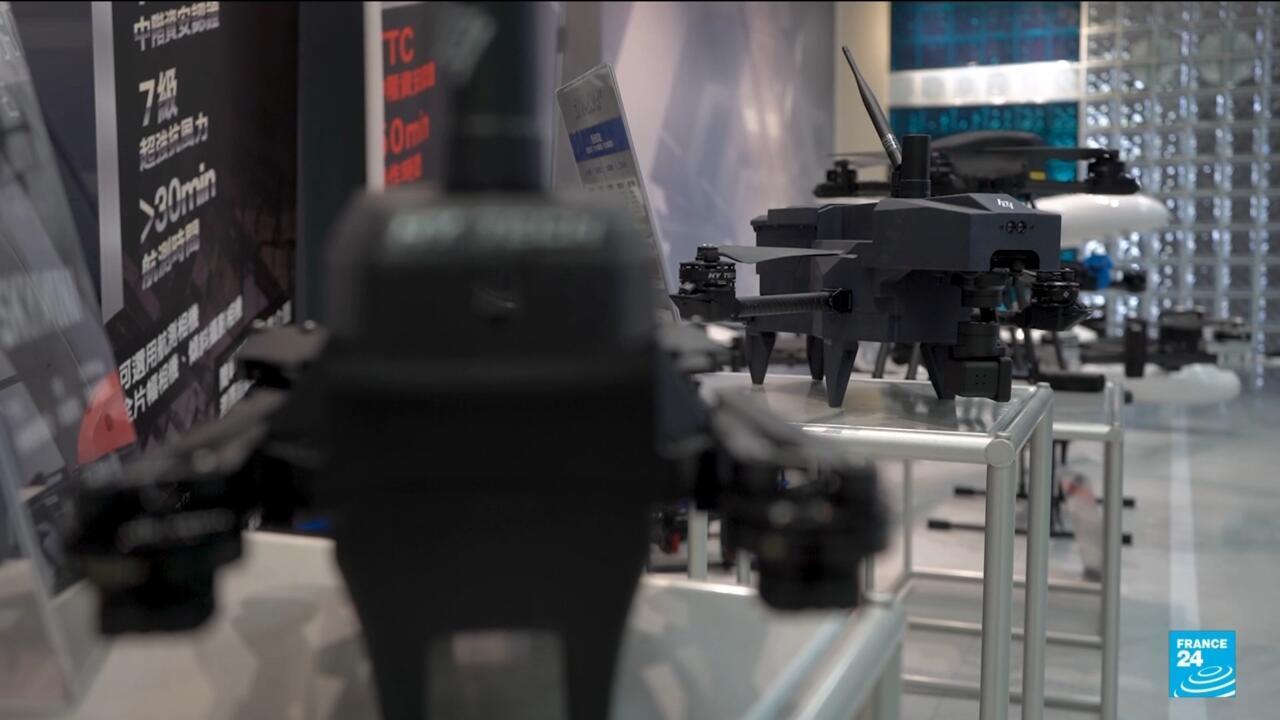
Drawing lessons from the ongoing war in Ukraine, where the use of drones is widespread, Taiwan said it plans to invest in 50,000 drones over the course of the next two years. The decision comes as the island faces mounting pressure from China, which it claims as its own territory.


Issued on: 24/08/2025 

FRANCE24

By:Jan CAMENZIND BROOMBY

Video by:Jan CAMENZIND BROOMBY


For almost two years, Chen Ting-Wei fought the Russian army as a member of the Ukrainian Foreign Legion.

Now, he has traded the front lines of the war in Ukraine for a classroom in Taiwan, where he shares his experiences on the battlefield with his students. An important lesson he is eager to impart is the rising use of drones.

“More than 80 percent of infantry movements are detected by drones before they even begin,” Ting-Wei says. “It has made combat operations much more difficult.”

Security officials in Taipei are also drawing lessons from the war in Ukraine. Drone exercises were added to Taiwan’s basic military training programme for the first time ever this month.

The Taiwanese government has also announced plans to invest in some 50,000 drones over the course of the next two years, in the face of mounting threats by an increasingly assertive Beijing.


02:07


LA REVUE GAUCHE - Left Comment: Search results for PERMANENT ARMS ECONOMY

Drones, armoured vehicles part of Canada's $2B military aid package for Ukraine

Craig Lord
Sun, August 24, 2025 


The Canadian Press

WARSAW — Drones, armoured vehicles and other munitions are headed to Ukraine as part of a $2-billion military aid package, Prime Minister Mark Carney said on Sunday.

Carney first announced the funds in June at the G7 summit in Alberta but outlined the details of where that money will be spent during a surprise visit to Kyiv to mark Ukraine's national Independence Day.

The package includes $835 million to procure urgently needed supplies for Ukraine's war against Russia, including vehicles, arms and medical equipment.

Roughly $680 million will support purchases from a list of items prioritized by NATO, including U.S. equipment, munitions and air defence capabilities.

Canada will also contribute $220 million to buy drone, counter-drone and electronic warfare capabilities as part of a joint venture between Ukrainian and Canadian industry.

Remaining military funding will go to bolster Ukrainian defence capabilities and sourcing ammunition and explosives.

The federal government says Canada’s support so far in the conflict includes $22 billion in financial support for Ukraine, largely in the form of loans.

Carney is in Kyiv today for Ukraine's Independence Day, where he also outlined $31 million in humanitarian aid and other support for the war-torn nation's reconstruction in coming years.

These include projects to help counter disinformation and to foster citizen trust in Ukraine's democracy, in part by strengthening its digital resilience.

Canada on Sunday also signed a customs mutual assistance agreement for Canada Border Services Agency to share information with Ukraine.

Ottawa said the agreement will help Canada co-ordinate more effectively with Ukraine to probe customs violations, smuggling and other trade-related crimes.

This report by The Canadian Press was first published Aug. 24, 2025.


Contributing to war and peace: Canada's role in Ukraine explained

Dylan Robertson
Sat, August 23, 2025 
The Canadian Press


OTTAWA — Ottawa is watching closely as U.S. President Donald Trump attempts to play peacemaker in the war in Ukraine.

Canada has volunteered to play a role in helping maintain peace in Ukraine, if a ceasefire deal can be reached between Russian President Vladimir Putin and Ukrainian President Volodymyr Zelenskyy to end the fighting that Moscow started in 2014.

The way the war ends could reverberate for decades.

"It has an impact and ramifications on global security, on peace around the world," said Marcus Kolga, a senior fellow with the Macdonald-Laurier Institute.

Here's a look at what's at stake for Canada, and how Ottawa might be called on to help.

What's going on in the talks?

On Aug. 15, U.S. President Donald Trump welcomed Putin to a high-profile summit in Alaska, ending years of western isolation for Russia and its leader. Several days later Trump also hosted Ukrainian President Volodymyr Zelenskyy and European leaders at the White House.

Ukraine said it needs "security guarantees" from other countries that can ensure Russia won’t mount another invasion, while Moscow has called for Ukraine to be barred from membership in groups like NATO or the European Union.

Canada has been part of talks for more than two years on how to help secure any sort of peace deal in Ukraine. Those talks morphed last fall into the Coalition of the Willing, a group of nations who have offered to help fund or staff a peacekeeping force on Ukrainian territory.

In addition to Canada the group includes most European nations as well as Japan and Australia. Canada's top soldier has also been part of NATO talks to co-ordinate possible military contributions.

Trump has said the U.S. won't send troops into Ukraine, but might provide air support to maintain peace.

How did this conflict start?

Russia invaded Ukraine in 2014, annexing Crimea and fighting for other territories for eight years, before launching the February 2022 full-scale invasion of Ukraine.


Trump has erroneously suggested Ukraine started the conflict.

Ukraine says its 2014 democratic uprising against a Russia-backed, autocratic president threatened Moscow's control over the country, as Kyiv inched closer toward the European Union. Kyiv says it wants to chart a democratic, western path as a multi-ethnic country, in contrast to Moscow's nationalist narrative that leans heavily on traditional Orthodox viewpoints.

Ukrainians say they've been victims of Russian imperialism over centuries, citing repeated suppression of Ukrainian language and identity, the 1932 Holodomor famine, and evidence of Russia soldiers torturing and mutilating Ukrainians during the current war.


Ukraine gave up its nuclear weapons in 1994 on the agreement that Moscow, Washington and London would guarantee Ukraine's security.

Russia says it is trying to prevent a Western invasion and protect speakers of the Russian language — but these claims don't align with reality.

Moscow claims Ukraine is an American puppet state that is run by a Nazi regime, despite the current president and former prime minister being Jewish.


Russia has taken examples of real and imagined examples of discrimination against minorities in Ukraine and restrictions on the Russian language, as grounds to say Kyiv has a terrorist government that must be toppled with territories absorbed into Russia.

Moscow claims NATO's expansion to former Soviet countries bordering Russia shows the West trying to destabilize Russia. The Kremlin has openly mulled reconstituting the Soviet Union, which was succeeded by Russia and 14 sovereign countries.

The countries who chose to join NATO say they need western backing to hold back Moscow after its invasions into Georgia and Ukraine and cyberattacks on Estonia.


How does our support stack up against others?

The Kiel Institute, which measures global contributions to Ukraine, pegs Canada as the fifth most generous in raw dollars, and 11th in rank based on gross domestic product.

The top donor in raw dollars is the U.S., followed by Germany, the U.K. and Japan. Those giving the highest share of support proportionate to economic size include the Netherlands, most Scandinavian countries and the Baltics.

The tracker says Canada has committed more than $19.7 billion in support for Ukraine, while Ottawa tallies this at $22 billion, including military, humanitarian and financial aid. That is more per capita and by dollar than France and Italy.


A large chunk of Ottawa's support is loans, which underwrite the Ukrainian government so it is able to finance operations and take on debt.

Canada has an outsized role in humanitarian initiatives, such as work to resettle Ukrainian children abducted by Russia, maintain maternal health services and the detection and removal of landmines.

Will we send troops to Ukraine? What could we be called on to do to help secure a ceasefire?

Prime Minister Mark Carney would not specify Friday how Canada could help, but noted Ukraine will needs support on land, air and sea.


"It's a fluid situation; it's a delicate situation, so I'm not going to describe specifics," he told reporters.

"Any security guarantee starts with a robust Ukrainian army. And that means weapons, that means training, that means viability."

Carleton University professor Stephen Saideman said Canada is limited in how much military support it could offer. "We don't really have a whole lot on the shelves to send them," he said.

It's not clear if Canadian soldiers will be on the ground in Ukraine, given that there is no ceasefire agreed upon, and Putin says he won't accept NATO troops being stationed in Ukraine.


Even if it were possible, Canada would need to redeploy hundreds of its troops from an ongoing NATO mission in Latvia, with troops stationed near the Russian border to deter Moscow from invading.

"If you want to have a real combat-capable force, you'd have to basically take what's in Latvia and move it to Ukraine, and the Latvians would not be that thrilled about that," Saideman said.

Canada has led a training mission for Ukrainian troops since 2015, and could likely continue this training for both Ukraine and any countries sending peacekeepers.


"If there's a ceasefire, then we can train them in Ukraine. So that would be a couple hundred troops doing that," Saideman said, adding that some special-operations forces might also help Ukraine.

He said Canada does not have much air-patrol capacity or ships that would help secure the Black Sea or skies over Ukraine.

Kolga said Ottawa could also ramp up its financial efforts against Russia, such as beefing up efforts to forfeit Russian holdings in foreign banks to finance Ukraine's war effort, or sanctioning states supporting Russia's war economy.


Why is it in our interest to help Ukraine?

Kolga said there is a real threat for Canada's Arctic if Putin is given the message that it can win territory and respect for annexing land.

"He will rearm himself. He will reconstitute his forces — which are significant already," he said. "He could try this again elsewhere. All of the signals are there."

Kolga notes Russia has refurbished or newly built dozens of military bases in the Arctic. Moscow has made "maximalist claims" on Arctic waters that overlap with areas claimed by Ottawa.


"We can put the brakes on all this by ensuring that Ukraine wins."

Kolga argues western countries should have scaled up their arms for Ukraine with fewer limits earlier in the conflict, to defeat Russia instead of providing "drips and drabs" that prolonged the war.

"We wouldn't be in the predicament that we are today," he said.

Western countries expressed fear of provoking direct confrontation with Russia, which has nuclear weapons. Russia has since reoriented its economy to a focus on weaponry and trade with countries that haven't sanctioned Moscow such as China, India and Brazil.

Victory for Ukraine "will act as a severe blow" to Putin and Russia's "neo-imperialism" in the Arctic and Russia, Kolga said.

This report by The Canadian Press was first published Aug. 23, 2025.

Dylan Robertson, The Canadian Press


MAGA SNOWFLAKES

French mural of Statue of Liberty covering her eyes in shame angers Trump supporters

A mural depicting the Statue of Liberty covering her eyes in the northern French city of Roubaix has sparked a flurry of comments on social media over its intended swipe at US President Donald Trump's crackdown on migrants. Dutch artist Judith de Leeuw has described her work in Roubaix, which has a large immigrant community, as “a quiet reminder of what freedom should be”.


Issued on: 18/07/2025 
By: FRANCE 24

A mural by Dutch artist Judith de Leeuw shows the Statue of the Liberty covering her eyes in Roubaix, northern France. © @jdlstreetart, Judith de Leeuw via AP

As statements go, it's a big one.

A towering mural in France of the Statue of Liberty covering her eyes is racking up millions of views online with its swipe at US President Donald Trump 's immigration and deportation policies.

Amsterdam-based street artist Judith de Leeuw described her giant work in the northern French town of Roubaix, which has a large immigrant community, as “a quiet reminder of what freedom should be.”

She said “freedom feels out of reach” for migrants and “those pushed to the margins, silenced, or unseen.”

“I painted her covering her eyes because the weight of the world has become too heavy to witness. What was once a shining symbol of liberty now carries the sorrow of lost meaning,” de Leeuw wrote in a July 4 post on Facebook, when Americans were celebrating Independence Day.

Her depiction of the Statue of Liberty, a gift from the French people in the late 1800s, has inspired some sharp criticism.


House representative Tim Burchett, a Republican lawmaker from Tennessee, wrote in an angry post on X that the work “disgusts me.” He said he had an uncle who fought and died in France, where US forces saw combat in both World War I and World War II.

In an interview with The Associated Press, de Leeuw was unapologetic.

“I’m not offended to be hated by the Donald Trump movement. I am not sorry. This is the right thing to do," she said.

The town stood by the work, with its deputy mayor in charge of cultural affairs, Frédéric Lefebvre, telling broadcaster France 3 that “it's a very strong and powerful political message.”

Since returning to the White House amid anti-immigration sentiment, Trump has launched an unprecedented campaign that has pushed the limits of executive power and clashed with federal judges trying to restrain him. People from various countries have been deported to remote and unrelated places like South Sudan and the small African nation of Eswatini.

Polling by Gallup released last week showed an increasing number of Americans who said immigration is a “good thing” and decreasing support for the type of mass deportations Trump has championed since before he was elected.

The mural in Roubaix is part of an urban street culture festival backed by the town. Roubaix is one of the poorest towns in France. It was economically devastated by the collapse since the 1970s of its once-flourishing textile industry that used to attract migrant workers from elsewhere in Europe, north Africa and beyond.

(FRANCE 24 with AP)

Trump lashes out at NBC, ABC, threatens licenses over ‘biased’ coverage

Ambar Warrick
Sun, August 24, 2025 

Investing.com-- U.S. President Donald Trump on Sunday evening lashed out against news networks ABC and NBC and called on the FCC (BME:FCC) to revoke their broadcast licenses over allegedly biased coverage against him.

Trump in a Truth.Social post called ABC and NBC “FAKE NEWS… two of the worst and most biased networks in history,” claiming that they gave him “97% bad stories.”


“THEY ARE SIMPLY AN ARM OF THE DEMOCRAT PARTY AND SHOULD, ACCORDING TO MANY, HAVE THEIR LICENSES REVOKED BY THE FCC,” Trump said.

Trump claimed that the two networks did not pay “Millions of Dollars a year in LICENSE FEES,” and should “at a minimum, pay up BIG for having the privilege of using the most valuable airwaves anywhere at anytime!!!”

Trump has constantly railed against news networks which he claim display him in a bad light, and has also engaged in high-profile legal disputes over the matter.

The U.S. President recently signed a $16 million settlement with CBS News over a lawsuit alleging the network’s coverage was biased against him. He had earlier also reached a $15 million defamation settlement with ABC.

But Trump’s call for the Federal Communications Commission to reconsider broadcasting licenses marks an escalation in his criticism of news networks, although it’s unclear whether the president has any legal authority to pursue such an action.

ABC belongs to Walt Disney Company (NYSE:DIS), while NBC is a unit of Comcast Corp (NASDAQ:CMCSA).
‘I would not feel safe’: Americans on the sorrow – and relief – of leaving Trump’s US for Europe

Ashifa Kassam, 
European Community affairs correspondent
THE GUARDIAN
Sun 24 August 2025 


Benjamin Gorman, Monica Byrne and Deborah Harkness.
Composite: supplied

The scramble began in November as news broke that Donald Trump had been re-elected. Benjamin and Chrys Gorman had long said they would leave the US before seeing Trump inaugurated again, giving them exactly 76 days to sell their home, cars and most of their belongings and move four people, three dogs and two cats to Barcelona.

“I was saying: we’ve got more time than that, it won’t go that fast,” said Gorman. “My wife said no, we need to be out of here – not just on inauguration day, but a few days before. And she was so right.”

Within hours of taking office, Trump signed an executive order defining sex as only male or female. The change was to be reflected on official documents, sowing confusion over what it meant for Americans with the non-binary identification of “X” in their passports.

Relief gripped the Gormans as they watched it play out from afar. “Our kid’s passport has an X gender marker,” said Gorman. “So we managed to escape just in time.”

Since Trump’s return to power, relocation firms from London to Lisbon and Madrid to Milan say they’ve seen a surge in inquiries from Americans. Undaunted by the gains made by the far right across the continent, many Americans cite a desire to escape the US’s increasingly polarised climate and an administration whose wide range of targets has included immigrants, diversity measures and political opponents.

Statistics suggest that the barrage of interest is translating into action; in the first two months of the year, US applications for Irish passports were at their highest level in a decade – up 60% from the same period last year. In the first three months of the year, France reported a rise in the number of long-stay visa requests from Americans, while in March, the number of Americans who had solicited British citizenship in the 12 months before surged to its highest since record-keeping began in 2004.

While the figures remain relatively small given the size of the US population, the movement has been galvanised by a steady drip of celebrity announcements. Rosie O’Donnell said in March that she had moved to Ireland, describing it as “heartbreaking to see what’s happening politically” in the US, while Ellen DeGeneres recently cited Trump’s re-election to explain why she and her wife, Portia de Rossi, had moved to the Cotswolds in 2024. Earlier this month, Jimmy Kimmel revealed that he had acquired Italian citizenship, saying that the US under Trump was “just unbelievable”.

Across Europe, governments and institutions have sought to capitalise on the exodus, launching programmes aimed at attracting stateside talent or, in the case of one enterprising Italian village, seeking to bolster its population with disgruntled Americans.

Among the first was France’s Aix-Marseille University, which in March put out an offer of “scientific asylum” for researchers reeling from Trump’s crackdown on academia. Three months later, the university said it had received more than 500 inquiries for the 20 spots.

Those selected included Lisa, a biological anthropologist who was preparing to move her husband, a school teacher, and two children across the Atlantic. “When Trump was re-elected, the feeling was: ‘We gotta go,’” she told the Guardian earlier this summer. She asked that her last name not be used to protect her university in the US from reprisals.

The sentiment had strengthened as she watched the Trump administration take aim at universities, dismantle research funding and undermine science. “We’re months into this presidency, and a lot has already happened. I can’t imagine what’s going to happen in another three and a half years.”

The opportunity to swap the northern US for southern France was welcome, but not without its drawbacks. “It is a big pay cut,” she said. “My kids are super gung-ho. My husband is just worried that he won’t find a job. Which is my worry too, because I don’t think I’ll be able to afford four of us on my salary.”

In January, as thousands of Trump faithful turned up in Washington DC for a televised viewing of his inauguration, Deborah Harkness knew the time had come to act on her longstanding dream of moving to southern Spain. “As soon as he was inaugurated, I started making plans,” she said.

Months later she was in Málaga, watching as Trump’s administration sought to drastically reshape the judiciary, public broadcasting, higher education and immigration. “What frightens me most is how normalised it’s all become,” she said. “The chaos, the cruelty, the disinformation – that’s how authoritarianism takes hold.”

The view was echoed by Monica Byrne, who in 2023 left North Carolina for Cork, Ireland. Trump was a factor in her decision, but only in that she saw his rise to power as a symptom of the bigger issues facing the US. “I didn’t know whether Trump specifically was going to come back, but I knew fascism was,” she said. “So it was more about the abject failure of the Democrats and knowing they weren’t going to protect us from fascism generally.”

Trump’s re-election cemented her decision to remain abroad and enrol in a master’s programme in Ireland. “I get frustrated when people say: ‘You’re very lucky or you must be happy you’re not there,’” she said. “There is some degree of that, but 90% of the people I care about and love are in the States and are affected.”

In Barcelona, Gorman and his family have been slowly settling into the rhythms of the city. “So many things have just been shockingly better,” he said. “For example, my wife was saying that the other day she was walking along La Rambla and a car backfired. And she was the only person who ducked.”

While they were thrilled to have left behind the gun violence and shooter drills of the US, the challenge was now in explaining to their loved ones that they were unlikely to return home once Trump’s term ends. “I don’t foresee this movement ending with the end of the Trump administration … I think that the rot is much deeper,” said Gorman.

“If he wouldn’t have a huge base of support, Trump is just, you know, your crazy uncle yelling things on a porch. That base of support needs to be addressed. Why was there support for this kind of fascism?” he added. “And that’s a much deeper question. I would not personally feel safe going back to a country that doesn’t fully reckon with its fascist impulses.”