Friday, August 29, 2025

PALEONTOLOGY

New fossils show how “bizarre” armoured dinosaur, Spicomellus afer, had 1 metre spikes sticking out from its neck


Research fossils show that the famous tail weapons of ankylosaurs evolved much earlier than previously thought


University of Birmingham

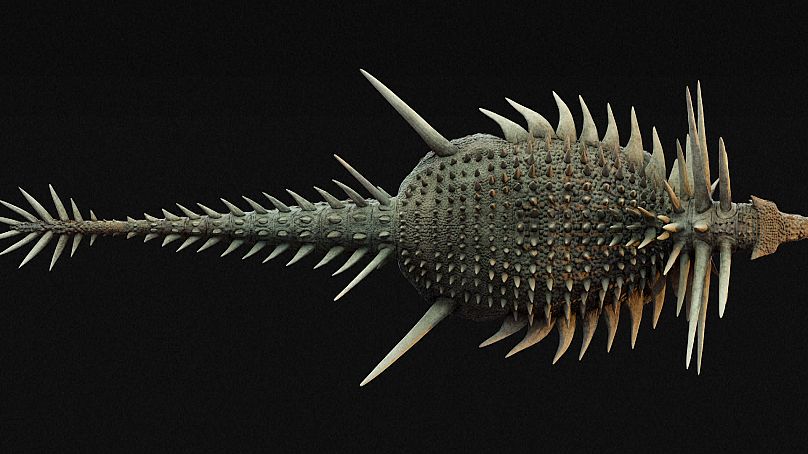
A life reconstruction of Spicomellus afer 

image: 

An artistic reconstruction of the Spicomellus after, whose skeleton was covered in spikes, some fused to the animal’s skeleton, measuring as much as a metre long

view more 

Credit: Matthew Dempsey


The world’s most unusual dinosaur is even stranger than first realised...

Today, research published in Nature [link] reports that Spicomellus afer had a tail weapon more than 30 million years before any other ankylosaur, as well as a unique bony collar ringed with metre-long spikes sticking out from either side of its neck.

Spicomellus is the world’s oldest ankylosaur, having lived more than 165 million years ago in the Middle Jurassic near what is now the Moroccan town of Boulemane. It was the first ankylosaur to be found on the African continent.

New remains of Spicomellus found by a team of palaeontologists have helped to build upon the original description of the unusual animal. The initial description of the species was published in 2021 and was based on one rib bone. The team now know that the animal had bony spikes fused onto and projecting from all of its ribs, a feature not seen in any other vertebrate species living or extinct. It had long spikes, measuring 87 centimetres, which authors believe would have been even longer during the animal’s life, that emerged from a bony collar that sat around its neck.

Prof Susannah Maidment of Natural History Museum, London, and the University of Birmingham, who co-led the team of researchers said, To find such elaborate armour in an early ankylosaur changes our understanding of how these dinosaurs evolved. It shows just how significant Africa’s dinosaurs are, and how important it is to improve our understanding of them.”

Spicomellus had a diversity of plates and spikes extending from all over its body, including metre-long neck spikes, huge upwards-projecting spikes over the hips, and a whole range of long, blade-like spikes, pieces of armour made up of two long spikes, and plates down the shoulder. We’ve never seen anything like this in any animal before”

“It’s particularly strange as this is the oldest known ankylosaur, so we might expect that a later species might have inherited similar features, but they haven’t.”

Project co-lead, Professor Richard Butler of the University of Birmingham, said, “Seeing and studying the Spicomellus fossils for the first time was spine-tingling. We just couldn’t believe how weird it was and how unlike any other dinosaur, or indeed any other animal we know of alive or extinct. It turns much of what we thought we knew about ankylosaurs and their evolution on its head and demonstrates just how much there still is to learn about dinosaurs”. 

Authors postulate that this array of spikes would have been used for attracting mates and showing off to rivals. Interestingly, similar display armour has not yet been found in any other ankylosaur, with later species possessing armour that probably functioned more for defence.   

One explanation for this is that as larger predatory dinosaurs evolved in the Cretaceous, as well as bigger carnivorous mammals, crocodiles and snakes, the rising risk of predation could have driven ankylosaur armour to become simpler and more defensive.

One feature of early ankylosaurs that may have survived, however, is their tail weaponry. While the end of Spicomellus’ tail hasn’t been found, the bones that do survive suggest that it had a club or a similar tail weapon.

Some of the tail vertebrae are fused together to form a structure known as a handle, which has only been found in ankylosaurs with a tail club. However, all these animals lived millions of years later in the Cretaceous.

Authors of the study believe that the combination of a tail weapon and an armoured shield that protected the hips suggest that many of the ankylosaurs’ key adaptations already existed by the time of Spicomellus.

The discovery reinforces the importance of the fossil record in solving evolutionary puzzles and deepening our understanding of the geographic distribution of dinosaurs. It also helps to spark public imagination in dinosaurs as we learn more about the baffling characteristics of species like Spicomellus.

Professor Driss Ouarhache, lead of the Moroccan team from the Université Sidi Mohamed Ben Abdellah who co-developed the research, says, “This study is helping to drive forward Moroccan science. We’ve never seen dinosaurs like this before, and there’s still a lot more this region has to offer.”

The Spicomellus afer remains that form the basis of this study were cleaned and prepared at the Department of Geology of the Dhar El Mahraz Faculty of Sciences in Fez, Morocco, using scientific equipment provided by the University of Birmingham’s Research England International Strategy and Partnership Fund. The fossils are now catalogued and stored on this site.

The paper ‘Extreme armour in the world’s oldest ankylosaur’ is available now in Nature.

This research is part of the Natural History Museum’s Evolution of Life Research Theme that seeks to reveal the causes and consequences of evolutionary and environmental change, which is central to understanding life on Earth. It is also a contribution from the Earth Heritage Network at the University of Birmingham, which seeks to develop new ways to use palaeontological resources for the benefit of society.

 Oil Industry of Serbia (NIS)

US grants Serbia’s NIS sixth sanctions waiver

US grants Serbia’s NIS sixth sanctions waiver
/ NIS
By bne IntelliNews August 27, 2025

The United States has extended a sanctions waiver for the Oil Industry of Serbia (NIS) until September 26, the Serbian government said on August 27.

This is the sixth postponement of restrictions against the company. The waiver, issued by the US Treasury’s Office of Foreign Assets Control (OFAC), allows NIS to continue operating despite sanctions targeting Russia’s energy sector. Gazprom and its subsidiary Gazprom Neft together hold a majority stake in the Serbian oil firm.

The delay follows recent US-Russia talks in Alaska, which may have influenced Washington’s decision.

As bne IntelliNews has argued, the rapprochement between Washington and Moscow means it is unlikely that US President Donald Trump will move forward with sanctions affecting Russia’s energy partners such as Serbia.

Energy Minister Dubravka Dedovic Handanovic said NIS would continue to secure stable fuel supplies. “The ultimate goal is to remove NIS from the sanctions list... We hope that high-level talks between the US and Russia will contribute to progress,” she told state broadcaster RTS.

NIS formally requested removal from OFAC’s Specially Designated Nationals (SDN) list in March, but the process is expected to take time. The US imposed sanctions on Russia’s oil sector in January to curb Moscow’s revenue from the war in Ukraine.

Dusan Bajatovic, head of state-owned gas company Srbijagas, said on August 26 that NIS operations remained stable and that Serbia had fuel reserves for six to eight months. He ruled out immediate risks of shortages or price spikes


Drone flyover finds no sign of life in search for Russian climber stranded on Kyrgyzstan’s highest mountain

Drone flyover finds no sign of life in search for Russian climber stranded on Kyrgyzstan’s highest mountain
Natalia Nagovitsyna became stranded after breaking her leg while descending the mountain. / Natalia Nagovitsyna, social media page
By bne IntelliNews August 27, 2025

Officials in Kyrgyzstan on August 27 said no signs of life were found by a thermal-imaging drone flyover mounted as part of the search for Russian climber Natalia Nagovitsyna, stranded near the top of the country’s highest mountain for more than two weeks with a broken leg.

In a statement, Kyrgyzstan's state security agency said: "Based on analysis of the data obtained and taking into account a combination of factors, including extreme weather conditions and the specifics of the area, no signs of life were found at Nagovitsyna's location."

Previous drone footage obtained on August 19 showed that, while Nagovitsyna was still alive, the small orange tent of the 47-year-old mountaineer had been torn apart by icy, gusting winds.

bne IntelliNews reported late on August 26 that the race to save Nagovitsyna from the icy summit of Jengish Chokusu, or Victory Peak, a mountain near the border with China with a height of 7,439 metres (24,406 feet), was still on.

Russia’s chief investigator Alexander Bastrykin, responding to an appeal from Nagovitsyna’s son Mikhail, ordered urgent coordination with Kyrgyz emergency officials to organise an attempt at rescuing the climber.

The effort to save Nagovitsyna has been made all the more poignant by the fact that four years ago her husband, Sergei Nagovitsyn, perished after he became paralysed and incapacitated during an expedition on the mountain of Khan-Tengri, located on the Kazakhstan-Kyrgyzstan-China tri-point. Also, on August 15 Italian mountaineer Luca Sinigaglia died during an attempt to evacuate Nagovitsyna.

Bastrykin’s August 25 order to his staff to pursue “comprehensive measures” with Russia’s Emergency Situations Ministry was reported by The Moscow Times on August 26.

Jengish Chokusu is widely regarded as one of the 10 most difficult mountains to climb in the world, with around a third of people who attempt the feat dying in the process

During repeated attempts to save Nagovitsyna, a helicopter was forced into a hard landing, with several aboard suffering injuries as a result.

Both Jengish Chokusu and Khan-Tengri are members of the so-called Snow Leopard group of mountains, five 7,000-ft-plus peaks found across the former Soviet Union. Only around 700 people, including 30 women, have accomplished the feat of climbing all five.


Kyrgyzstan starts underground gold mining at nationalised Kumtor deposit

Kyrgyzstan starts underground gold mining at nationalised Kumtor deposit
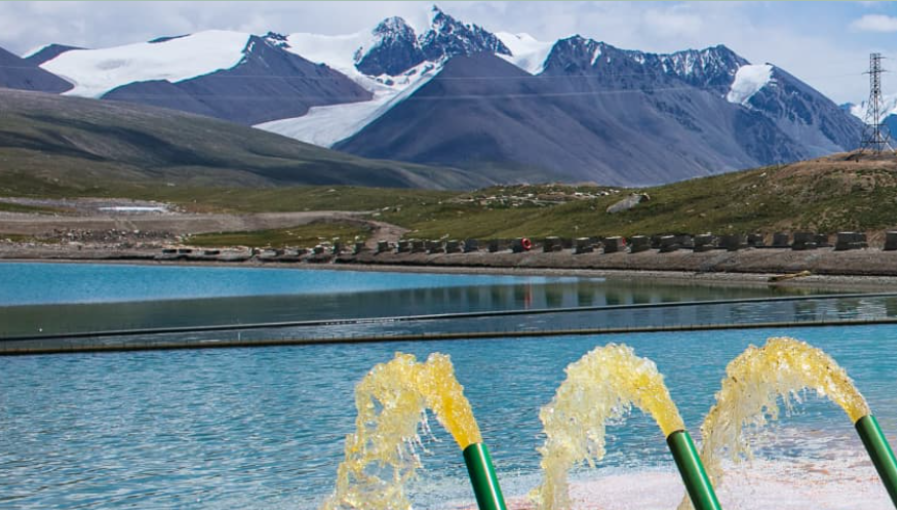
There are environmental and transparency issues when it comes to gold mining at the nationalised Kumtor deposit set high up in the Tian Shan mountains of Kyrgyzstan near the Chinese border. / Centerra Gold sustainability reportFacebookBy bne IntelliNews August 27, 2025


Kyrgyzstan on August 27 launched underground gold mining at its high-altitude Kumtor deposit. Announcing the move, government officials added geological reserves of 147 tonnes of gold to the state balance sheet.

In 2021, the newly installed populist-nationalist Japarov presidency controversially seized the then solely open-pit mining operation from Canada’s Centerra Gold. Establishing state control over the mine had for many years been a political goal of Kyrgyzstan’s leader Sadyr Japarov, prior to the late 2020 revolution that opened his path to the presidency.`

In a statement, the presidential press office said around 1,600 metres of tunnels had so far been dug at Kumtor – located at 13,000 feet (almost 4,000 metres) near the Chinese border in the Tian Shan mountains. Kumtor is very important to the economy of Kyrgyzstan, Central Asia’s second poorest country. In recent years, it has produced around 10% of its GDP.

The underground project is expected to operate for 17 years, the presidency added.

The world gold price has lately been setting records above $3,000 a troy ounce.

Kyrgyzstan also proposes to start processing the Kumtor pond of tailings, leftovers from ground mining for gold. The government says the pond could contain more than 100 tonnes of gold, though experts question how much of this can be recovered, given the technology available.

Centerra Gold began mining at Kumtor in 1997.

After the state seizure of the mine, an agreement for the transfer of the mine to the government was eventually struck with Centerra, but not before, in late 2021, the company raised anxieties that the mine under the new government-appointed management, was falling into operational difficulties. One claim was that glacial water was flowing uncontrolled into a mine pit. The government denied there were any such problems.

A difficulty with the Kumtor deposit is that a substantial amount of its gold is situated under glaciers, which environmentalists do not want to see disturbed.

Radio Azattyk on August 27 quoted Japarov as saying: "Well, Kumtor has a future ahead of it, it will continue to work for the benefit of the country and the people for another 40-50 years. What I mean by the benefit of the people is that in the last three years you have witnessed the delivery of state mortgage houses to ordinary people. You should know that all the money spent on those constructions comes from Kumtor.

“The money from Kumtor is being spent on roads being built, schools, kindergartens, increasing salaries, pensions and benefits, purchasing military and other modern equipment, and all the good things that are happening in the country."

Kumtor has produced 54 tonnes of gold and generated $3.45bn in revenue since May 2021, with $891.6mn received in taxes and other payments, according to the presidency.

Some MPs have claimed transparency on Kumtor gold sales and profits has deteriorated since the government took over the mine via state company Kyrgyzaltyn.

Lawmaker Iskhak Masaliev, told Radio Azattyk: “We [Kyrgyzstan] make a good profit from selling gold. Now details on this is classified information, so unless you specifically request it, they won't release it publicly.

He added: “The MPs are still monitoring things, and they've stopped asking where the money came from and where it went.”


Council of Europe expert body calls for repeal of Georgia’s ‘foreign agents’ law

Council of Europe expert body calls for repeal of Georgia’s ‘foreign agents’ law
/ archikl via Pixabay

By bne IntelliNews August 28, 2025

The Expert Council on NGO Law, a body of the Conference of INGOs of the Council of Europe, has issued an opinion warning that Georgia’s controversial Foreign Agents Registration Act (FARA) would cause “grave and unjustified” harm to civil society if implemented, and calling for its repeal.

The law, adopted by the ruling Georgian Dream party and taking effect in May 2024, requires organisations and media outlets receiving more than 20% of their funding from abroad to register as “agents of foreign influence”.

Georgian authorities have already begun implementing the law. The country’s Anti-Corruption Bureau has sent inspection notices to seven civil society groups, suggesting their work could constitute “political activity” and demanding explanations for their refusal to register under the Act. The bureau also warned of criminal liability.

The affected organisations insist the law does not apply to them and have refused to register. In its August 25, opinion, the Expert Council said that “the implementation of the Act will cause grave and unjustified damage to civil society in Georgia, will be inconsistent with a wide range of commitments that this member state of the Council of Europe has undertaken and will thus be entirely inappropriate.”

The opinion found that Georgian Dream’s FARA fails to meet the conditions under the European Convention on Human Rights (ECHR) that would allow restrictions on fundamental rights. It noted that the law would affect freedoms of association, expression, and respect for private life, all of which can only be limited if restrictions are prescribed by law, have a legitimate aim, and are necessary in a democratic society. The council concluded that the Georgian legislation failed to meet any of these conditions.

According to the opinion, “the requirements imposed by it cannot be regarded as sufficiently prescribed by law.” At the same time, “there are serious doubts as to whether the adoption of at least some of the provisions in the Act can be regarded as having a legitimate aim.” Furthermore, “the implementation of the Act cannot be regarded as necessary in a democratic society.”

The council also rejected the Georgian government’s defence that the law is based on the United States’ 1938 FARA, noting that the fact it is “an analogue of the US FARA is not in itself a reason to regard its provisions as necessary in a democratic society, not least since it has not been evaluated for compliance with the rights guaranteed by the ECHR.”

The opinion criticised the Georgian law’s scope, saying it could apply to civil society organisations with no actual but only supposed ties to foreign principals. Receiving foreign funding or using outside expertise, it argued, does not mean groups are acting on behalf of foreign powers, adding that many governments themselves receive such foreign assistance.

It further warned that the law’s broad definition of “foreign political party” could inhibit national minorities from maintaining peaceful cross-border contacts or participating in international NGOs. The demand for detailed reporting of “each activity (including political activity)” was deemed an unjustified restriction on freedom of expression and interference with private life.

On requirements to disclose extensive personal data of directors, managers, and employees, the opinion said these were “beyond what is necessary in a democratic society” and excessive compared with the goal of countering foreign interference. It also condemned the obligation for CSOs to keep records for three years after ceasing to operate as “agents,” and for directors to remain responsible for filings even after an organisation is dissolved, describing this as “unduly burdensome.”

The council raised concern that, even though the law does not formally label organisations as “foreign agents,” being subjected to it effectively brands them as such, signalling that they carry out work on behalf of foreign principals. It also warned against “excessive penalties” for non-compliance.

"Having regard to the inevitable effect of the Act’s provisions in precluding NGOs from seeking access to foreign support for the pursuit of objectives entirely consistent with European standards, the excessive obligations to disclose personal data, the unrestricted scope of the demands for supplementary information that can be made, the burdensome record-keeping required and excessive nature of the penalties that can be imposed, the measures contained in the Act cannot be considered necessary in a democratic society," it concluded. The opinion urged the Georgian government to repeal the law.

The controversy comes amid mounting concerns about Georgia’s democratic trajectory. The International Society for Fair Elections and Democracy (ISFED), Georgia’s most prominent election watchdog, has announced it will not observe the upcoming October 4 local elections “with a standard observation mission”, citing the lack of conditions for free, fair, and competitive polls. ISFED pointed to the same three principles outlined by the Venice Commission’s Code of Good Practice in Electoral Matters — respect for fundamental rights, stability of electoral law, and procedural guarantees — which it said had “largely not been met”.

Opposition parties have also announced boycotts of the municipal elections, saying participation would legitimise Georgian Dream’s rule amid ongoing anti-government protests and state repression. With the OSCE/ODIHR not invited to monitor the vote, the elections are likely to proceed without full-scale international oversight.

MURDEROUS MISOGYNY

Murder-suicide attempt in Tajikistan draws attention to domestic violence, mental health issues

Murder-suicide attempt in Tajikistan draws attention to domestic violence, mental health issues
The last dramatic suicide attempt by a young woman in southern Tajikistan has once again brought attention to the plight of women in the country’s conservative society. Tajik women are pictured here in traditional dress in Dushanbe, Tajikistan, on June 11, 2014. / Juris Paiders/Wikimedia/Creative Commons
By Alexander Thompson for Eurasianet August 29, 2025

Since the beginning of the year, at least two young mothers in rural Tajikistan have taken their own lives by drowning themselves.

In a third case, 27-year-old Madina Halimova from the country’s far south allegedly drowned her four children in the Vakhsh River in late June, then attempted to drown herself. Her husband says she snuck out of the house while he slept. Authorities pulled Halimova from the river, saving her life. But she now faces murder charges stemming from the deaths of her children.

Halimova’s husband and his family have said she suffered from untreated mental health issues, while her lawyer has stated she believed her husband was cheating on her, the Tajik media outlet Asia-Plus reported.

Halimova’s case has garnered widespread attention in Tajikistan, Central Asia’s poorest state with a predominantly Muslim population of about 11mn, once again placing a spotlight on women’s rights and their place in society. 

“These cases have had a very big resonance,” Marhabo Olimi, a Tajik expert on gender issues, told Eurasianet. “Women’s low awareness of their rights and their economic dependence very often mean that women don’t have a way out, or don’t see a way out, and they simply take their lives.”

Women also take their children’s lives because they fear their children will suffer as they have, Olimi added.

Tajikistan has a relatively low suicide rate compared to other countries, but about once a year over the past decade a particularly dramatic, and often similar, story of a young mother taking her own life and those of her children generates headlines, according to Radio Ozodi, Radio Free Europe/Radio Liberty’s Tajik service.

The suicides underline that, despite many advances in recent years, women in Central Asia continue to face high rates of domestic violence, unequal treatment and misogyny.

The 2024 trial and conviction of former Kazakh Economy Minister Kuandyk Bishimbayev for his brutal treatment and murder of his wife Saltanat Nukenova brought international attention to the issue, prompting calls for reform by regional officials.

Yet, how much change has occurred remains an open question.

The problem of suicide is not isolated to Tajikistan. In December 2023, Radio AzattykRFE/RL’s Kyrgyz service, reported on a wave of suicides by 10 women in one village in Kyrgyzstan’s rural Batken province.

Elsewhere in the region, cases of domestic violence in Uzbekistan more than doubled to 48,303 during the first half of this year, per figures from the country’s Committee for Family and Women and reported on August 14 by Current Time TV, an RFE/RL affiliate.

Activists suggest that just about the only change in existing patterns is the preferred method of suicide, from self-immolation to jumping off bridges.

The problem of suicides among young women in Tajikistan stretches back decades. In 1985, authorities in the then-Soviet republic of Tajikistan set up a committee to study the issue in response to a series of self-immolations.

During the first half of this year, 102 women and girls took their lives in Tajikistan, Bunafsha Fayziddinzoda, the head of the country’s Committee on Women and Family Affairs, told reporters earlier this month. That is a touch lower than the number over the same period of last year, but instances of suicide among minors increased, according to Fayziddinzoda.

About 90% of suicides in Tajikistan involve women, according to the Republican Center for Clinical Psychology cited by the Cabar news agency in 2021. Untreated mental health issues, poverty, domestic violence and child marriage are often contributing factors, Nargis Saidova, the director of the Tajik NGO Gender and Development, told Eurasianet in an interview.

Women lack access to qualified psychologists in rural areas, Saidova said. The problem is especially acute for young mothers as post-partum depression is poorly understood and rarely addressed, she added.

About 50% of women in Tajikistan reportedly suffer from domestic violence, which is overlooked and not criminalised in Tajikistan, Eurasianet has reported. Roughly 14% of girls under 18 are married either informally through a religious ceremony or legally via exceptions to the country’s ban on child marriage, which judges reportedly grant liberally, according to a 2024 report by the UN Convention on the Elimination of All Forms of Discrimination Against Women.

Conflicts between women and their mothers-in-law are frequently invoked in the Tajik media when discussing suicides. Due to the high rate of labour migration among Tajik men, their wives often live with their husband’s family for years. Relations with relatives do sometimes play a role in suicides, but the underlying issue is the deeply rooted gender stereotypes of women’s role in society, Saidova said. 

The government has conducted several effective mental health campaigns, but what is needed more is stricter enforcement of laws against child marriage and domestic violence, Saidova said. Mental health centres and women’s shelters are also needed, she added.

Closing gaps has become more difficult in recent months since the Trump administration shuttered the US Agency for International Development (USAID) and the US State Department slashed international assistance, Saidova added. Her NGO lost a grant and another NGO closed in the wake of the cuts. But she is not giving up.

“We can’t throw our hands up,” she said.

This article first appeared on Eurasianet here.

Alexander Thompson is a journalist based in Bishkek, Kyrgyzstan, reporting on current events across Central Asia. He previously worked for American newspapers, including the Charleston, S.C., Post and Courier and The Boston Globe.


A look at the Indian industries hardest hit by US tariffs

A look at the Indian industries hardest hit by US tariffs
/ Stijn Dijkstra - Pexels
By bno - Mumbai bureau August 29, 2025

India has emerged as one of the hardest hit nations under fresh tariff measures imposed by the United States, with Indian exports to its largest single market now facing duties of up to 50%. Of this, a punitive 25% is directly tied to Washington’s objection to New Delhi’s continued purchase of Russian oil.

Nearly two-thirds of India’s shipments to the US, amounting to around $60bn, will come under the ambit of these tariffs, NDTV reported. The tariffs came into effect on August 27.

The impact of the higher duties will be felt most acutely in sectors such as seafood, textiles, gems and jewellery, auto components, handicrafts, leather goods, and carpets. India’s status as a competitive supplier across labour-intensive export industries now faces severe disruption, with competing nations poised to replace Indian goods in the US market.

As per the NDTV report, the seafood sector could experience the severest damage. India shipped $2.4bn worth of shrimps to the US in FY2025, making up 32.4% of cumulative shrimp exports. The US is the largest destination for India’s farmed shrimp, particularly peeled, deveined, cooked, and breaded varieties. A steep rise in import costs threatens to wipe out India’s advantage, pushing buyers towards Latin American and Southeast Asian suppliers.

The gems and jewellery industry faces an even greater challenge. With $10bn worth of exports to the US - 40% of India’s total global shipments in the sector - tariffs are set to jump from 2.1% to 52.1%. The increase risks large-scale job losses in hubs such as Surat, Mumbai, and Jaipur, which together employ millions in cutting, polishing, and manufacturing.

The textile and apparel industry, another of India’s largest export earners, will also be hit hard. India’s exports to the US were valued at $10.8bn in FY2025, with apparel alone accounting for $5.4bn. Under the new regime, duties will rise from 13.9% to 63.9%, effectively eliminating any price advantage Indian suppliers hold. Export clusters in Tiruppur, Noida-Gurugram, Bengaluru, Ludhiana, and Jaipur are bracing for severe order losses, as countries such as Bangladesh, Vietnam, Mexico, and those under the CAFTA-DR pact are expected to take over.

Carpets, another traditional stronghold, accounted for $1.2bn in exports to the US in FY2025, with Washington buying 58.6% of India’s global shipments. Tariffs will rise from 2.9% to 52.9%, threatening artisanal livelihoods in Bhadohi, Mirzapur, and Srinagar. Industry watchers say Turkey, Pakistan, Nepal, and China stand to gain at India’s expense, according to NDTV.

Handicrafts, which earned $1.6bn from the US last year, will also be hit as Washington accounts for 40% of India’s exports in this category. Clusters in Jodhpur, Jaipur, Moradabad, and Saharanpur are staring at possible factory closures, while Vietnam, China, Turkey, and Mexico are likely replacements.

Leather goods and footwear, worth $1.2bn in exports to the US, will face the full 50% tariff. Indian exporters fear a sharp loss of market share to competitors in Vietnam, China, Indonesia, and Mexico, dealing a blow to clusters in Agra, Kanpur, and Tamil Nadu’s Ambur-Ranipet region.

Agriculture and processed food products, including basmati rice, tea, and spices worth $6bn, will also be subjected to the full 50% tariff. Analysts believe Pakistan, Thailand, Vietnam, Kenya, and Sri Lanka will move swiftly to capture India’s lost demand.

Goods exempt from tariffs

Not all sectors are affected. Around 30.2% of Indian exports, valued at $27.6bn, will continue to enter the US market duty-free, according to NDTV. The largest beneficiaries are pharmaceuticals and active pharmaceutical ingredients (APIs), which account for 56% of tariff-exempt exports. Electronics have also been exempt, covering smartphones, network switching and routing equipment, integrated circuits, unmounted chips, diode wafers, and solid-state storage devices.

Russian oil

According to Hindustan Times, India sees the tariff move as a direct targeting for its Russian oil imports. In a statement on August 7, the Ministry of External Affairs said New Delhi’s oil purchases are driven by market realities and the overarching need to safeguard the energy security of 1.4bn citizens. India argued that several other countries continue to buy Russian oil and described Washington’s penalties as “extremely unfortunate.”

The government has also labelled the measures “unjustified and unreasonable,” accusing both the US and the European Union of unfairly singling out New Delhi for its trade with Moscow. For India, the tariffs not only jeopardise tens of billions in exports but also threaten to unravel the employment fabric of regions across the country that are deeply dependent on labour-intensive industries.

India set to boost Russian oil imports despite US tariffs

India set to boost Russian oil imports despite US tariffs
/ Ian Simmonds - Unsplash
By bne IntelliNews August 29, 2025

Indian imports of Russian oil are expected to increase in September as New Delhi presses ahead with purchases despite new US punitive tariffs, Reuters reported on August 28.

India has emerged as the largest buyer of Russian crude since Western sanctions disrupted traditional trade flows after Moscow’s 2022 invasion of Ukraine. The discounted barrels have helped Indian refiners secure cheaper supplies, but the purchases have drawn criticism from Washington. On August 27, the US government under President Donald Trump raised tariffs on Indian imports to 50%, a move that New Delhi says it is addressing through dialogue while at the same time boosting diplomatic outreach, including discussions with Russian President Vladimir Putin, Reuters noted.

Traders told Reuters that Indian refiners plan to increase Russian crude imports in September by 10–20% from August levels, equivalent to an additional 150,000–300,000 barrels per day. The rise comes as Russian exporters have more crude available due to refinery outages and Ukrainian attacks on processing facilities that have sidelined up to 17% of Russia’s refining capacity.

India imported about 1.5mn barrels per day of Russian crude in the first 20 days of August, steady from July but below the January–June average of 1.6mn bpd, according to Vortexa data. The volumes equal roughly 1.5% of global supply, with Russian crude covering about 40% of India’s oil needs. Reliance Industries and Nayara Energy, the two biggest Indian buyers, did not immediately comment.

Russian Urals crude for September loading is being sold at a discount of $2–$3 a barrel to dated Brent, deeper than the August discount of $1.50, traders said. Analysts suggest India is unlikely to scale back imports significantly unless economics change sharply or a global ban is enforced. Brokerage CLSA warned that halting Indian purchases could cut global supply by 1mn bpd and briefly drive oil prices towards $100 a barrel.

Meanwhile, the European Union has tightened its price cap on Russian crude to $47.60 per barrel from September 2, restricting Western services for cargoes sold above that threshold. The combined effect of US tariffs and EU restrictions is expected to filter into Indian imports by October, when cargoes booked in the coming days begin arriving.


EU commits to huge increase in energy imports from US - Statista

EU commits to huge increase in energy imports from US - Statista
One of the key components of the trade deal between the EU and Trump is a massive ramp up in energy supplies worth $750bn over the next three years. But some critics have pointed out that Europe has broken its dependency on Russia, only to replace it with the same dependency on the US. And that Trum / bne IntelliNews
By Felix Richter of Statistia August 27, 2025

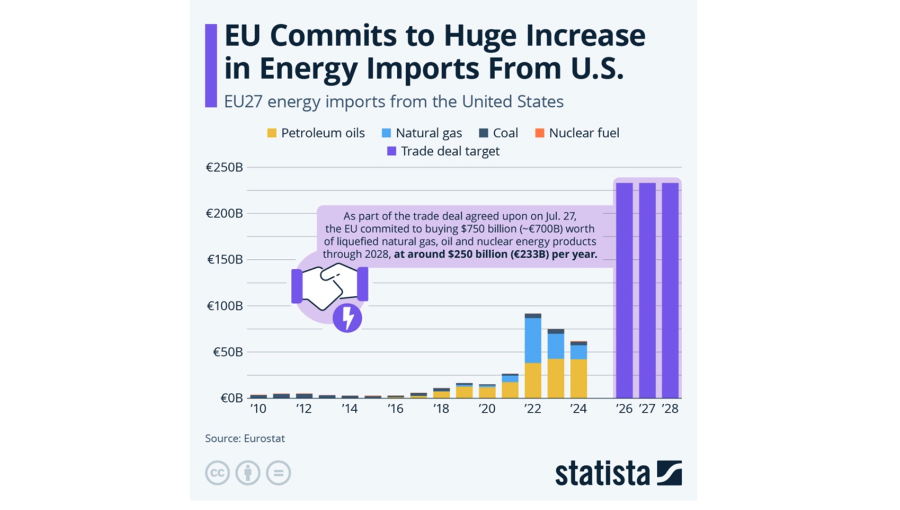
One of the key components of the trade deal that the European Union and the US agreed upon on July 27 is the EU’s commitment to massively ramp up energy imports from the United States, Statista reports.

As part of a joint effort to ensure “secure, reliable and diversified energy supplies”, the EU commits to buy US liquefied gas, oil and nuclear energy products worth $750bn (around €700bn) over the next three years – a goal that many experts deem unrealistically high.

In 2024, EU member states imported €375.9bn worth of energy products from outside the bloc, including petroleum oils, natural gas (both liquefied and in gaseous state) as well as solid fuels (coal, lignite, peat and coke). And while the US was already the EU’s main supplier of oil and liquefied natural gas, accounting for 16.1 and 45.3% of extra-EU imports last year, all energy imports from the US – including nuclear fuel, which is also part of the trade deal – only added up to just over €60bn, or less than a third of the annual total committed to in the trade deal.

In a statement announcing the trade deal, European Commission President Ursula von der Leyen said that the agreement would help the EU diversify its sources of supply and contribute to Europe’s energy security. Critics argue the opposite: that the scale of the planned purchases would make the bloc too dependent on US energy after just having successfully reduced its dependency on Russian oil and gas. The deal would also help Europe replace its remaining energy imports from Russia, President von der Leyen, argued, but even fully replacing them with energy sourced from the US would only add around €25bn to the annual total.

Even if the EU were to try to actually achieve the stated target, which is difficult considering the fact that it’s not the EU but its member states and companies buying the energy, experts argue that it would face insurmountable hurdles on both the demand and the supply side. On the demand side, European energy importers are bound to long-term contracts with other suppliers, making a massive shift towards imports from the US unfeasible over such a short period of time. The same is true for the supply side, where the US would struggle to build the additional infrastructure needed to ramp up exports so quickly and at this scale.

Considering all these factors, the $750bn figure should be seen as more of a pledge rather than a binding commitment. During Trump’s first presidency, he made a similar deal with China, under which China agreed to massively increase imports from the US In the end, the target was never met and everybody moved on regardless.

Thursday, August 28, 2025

Caterpillar lifts 2025 tariff hit estimate to as much as $1.8 billion

Story by Reuters


FILE PHOTO: The Caterpillar logo is seen in this illustration taken August 3, 2025. REUTERS/Dado Ruvic/Illustration/File Photo© Thomson Reuters

(Reuters) -Caterpillar on Thursday raised its estimate of tariff-related costs for 2025, citing additional levies and clarifications, sending its shares down 3% in extended trading.

Sweeping tariffs have raised costs across Caterpillar's supply chain, as the company imports key components such as sensors, even as manufacturers race to localize production.

The Trump administration's latest tariffs, announced on July 31, target imports from dozens of countries, including major trading partners such as Canada, the European Union, Japan, India and several Southeast Asian nations.

"While the company continues to take initial mitigating actions to reduce this impact, trade and tariff negotiations continue to be fluid," Caterpillar said in a regulatory filing on Thursday.

Caterpillar now expects a tariff hit of $1.5 billion to $1.8 billion this year, up from its prior forecast of up to $1.5 billion.

The company had issued its previous expectations along with its second-quarter earnings results earlier this month.

On Thursday, it said the higher costs will push its adjusted operating profit margin toward the bottom of its target range, though it left its full-year sales and revenue outlook unchanged.

Industrial machinery makers are grappling with higher costs from Trump's expansive tariffs on imports, while weak demand and elevated interest rates limit their ability to pass on the burden to customers.

The heavy equipment maker also raised its estimate for third-quarter tariff costs to as much as $600 million, from a prior forecast of up to $500 million.

(Reporting by Shivansh Tiwary in Bengaluru; Editing by Maju Samuel and Alan Barona)