Monday, September 01, 2025


Trump's Attack on EPA Workers Is an Attack on You

Silencing our union members, working on the front line of environmental protection, is beyond dangerous. It strips away a critical check against political interference in science. And that can only mean more threats on the horizon to the air you breathe and the water you drink.
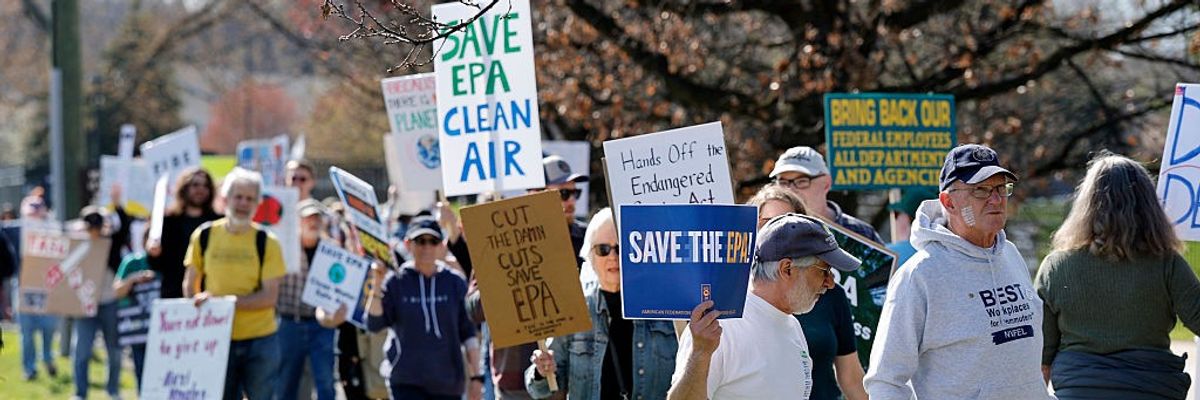

Demonstrators march during a "Hands off the EPA" rally outside the EPA offices in Ann Arbor, Michigan, on Earth Day, April 22, 2025.
(Photo by Jeff Kowalsky / AFP via Getty Images)

Justin Chen
Sep 01, 2025
Common Dreams


Labor Day is a time to honor the workers who keep our country safe, strong and healthy. But this year, while families fire up their grills and celebrate the dignity of work, the Trump administration is continuing its brazen assault against the very workers who protect the air you breathe and the water you drink.

On August 8th, the Trump administration issued an executive order banning AFGE Council 238, our union representing more than 8,000 Environmental Protection Agency (EPA) workers nationwide. The executive order categorized the EPA as a “national security” agency, an absurd and illegal misrepresentation of EPA’s historic mission to protect human health and the environment.

We are under no illusions: this move has nothing to do with national security. This action was about silencing the scientists and staff at the EPA and clearing the way for corporate polluters to have free rein.

This Labor Day, don’t just thank workers. Stand with EPA workers and make your voice heard too. Because protecting our rights is protecting your right to clean air and safe drinking water.

Here’s why banning our union matters. First, it means that science is on the chopping block. Practicing sound science is critical to protecting human health, and EPA scientists are your first line of defense against toxic chemicals, smog and hazardous waste.

For years, our union fought to secure ‘scientific integrity’ protections into our union contract so scientists wouldn’t be punished for telling the truth. Last summer, this became a reality in our most recent contract, which prohibited retaliation against EPA scientists who follow sound scientific principles.

The fight solidified the importance of sound science to EPA’s mission to protect human health and the environment, and it underscored our union’s role as one of the public’s strongest safeguards against political infringement on EPA’s work to protect clean water and air.

Now, with Trump illegally terminating our contract, that safeguard protecting EPA’s scientific integrity is gone. Trump’s political appointees and corporate lobbyists will have a freer hand to rewrite science and weaken safeguards against environmental hazards like air pollution, toxic chemicals, and hazardous waste.

Second, it means transparency at the agency is out the window. Our union no longer has the protections to hold the agency accountable to its mission to protect your air, your land and your water.

In 2019, the Minnesota Pollution Control Agency tried to hide flaws in a very controversial water permit proposal submitted by PolyMet Mining by asking that they not be documented and instead have EPA merely read the critical information over the phone. Our union blew the whistle and released communications showing that the two agencies colluded to keep the critical comments away from the public. After our union’s disclosure, MPCA’s permit action was overturned, thereby protecting the St. Louis River and Lake Superior.

Without our union, that cover-up might never have seen the light of day.

That is why silencing our union is so dangerous. It strips away a critical check against political interference in science. And that can only mean more threats on the horizon to the air you breathe and the water you drink.

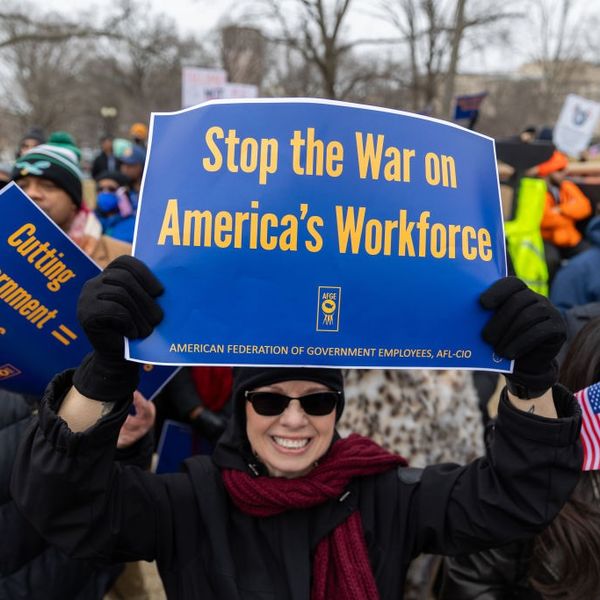
That’s why federal unions, including ours, are actively working to push Congress to pass H.R. 2550, the Protect America's Workforce Act. This bill would restore collective bargaining rights and stop Trump’s illegal executive order in its tracks. As Congress returnsfrom recess on September 2, we need your voice too: call or email your representatives, demand they support the bill and that they sign a discharge petition to bring the bill to the House floor.

This Labor Day, don’t just thank workers. Stand with EPA workers and make your voice heard too. Because protecting our rights is protecting your right to clean air and safe drinking water.

AFGE Council 238 will continue to fight the Trump administration’s illegal executive order. We will not be silenced, and we won’t stop defending the air you breathe, the water you drink, and the planet we all call home.


Our work is licensed under Creative Commons (CC BY-NC-ND 3.0). Feel free to republish and share widely.


Justin Chen is president of AFGE Council 238, the union of more than 8,000 EPA workers nationwide.
Full Bio >
Immigrant or US-Born, We’re All in the Same Boat

Politicians divide us, but all workers share the same struggles. Only together can we demand dignity and safety at work.


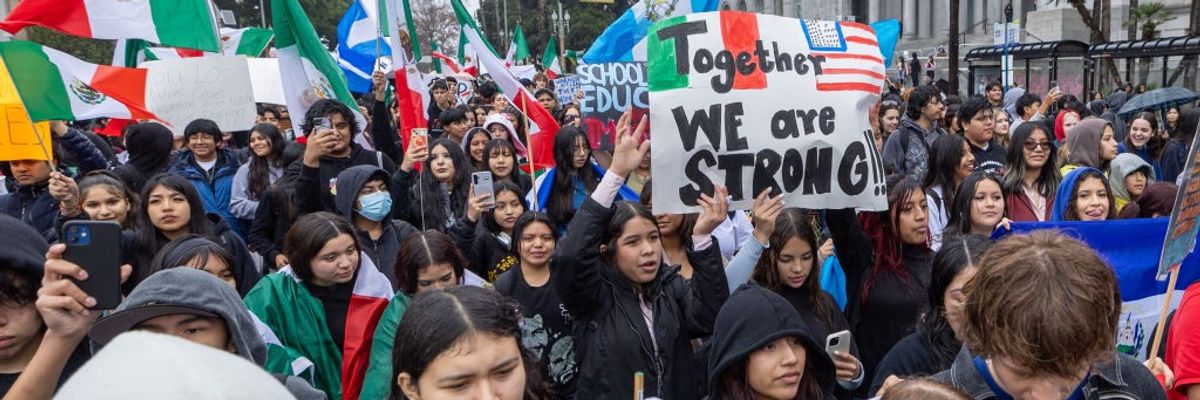
Hundreds of mostly young protestors rally outside Los Angeles City Hall and march in the streets to protest US President Donald Trump's illegal immigration policy for the fourth day in a row in Los Angeles on Wednesday, February 5, 2025.
(Photo by Allen J. Schaben / Los Angeles Times via Getty Images)


Mariana M.
Sep 01, 2025
Common Dreams


Every morning, my dad laces up his work boots knowing there’s a chance he won’t come home. A skilled carpenter, he has worked in Los Angeles’ construction industry since our family moved to the US when I was 3. Through years of backbreaking labor, his boss praised his skill, reliability, and loyalty. He not only built this city but also a life for our family in LA. Now, that life is in jeopardy—because like so many undocumented workers, when my dad needed protection from Immigration and Customs Enforcement, he was treated like he didn’t matter.

After 15 years of loyalty, my dad asked for a few days off at the height of the LA ICE raids out of concern for his safety. In response, his boss gave him an ultimatum: Show up to work and risk being taken by ICE or stay home. His employer threatened to replace him with someone “willing to do the job.”

His concern was not unfounded. Since then, ICE has raided my dad’s job site twice as part of the surge in raids across LA and the country. Our family lives in fear of the third time.

Behind these attacks is deliberate policy. The construction industry has become an easy target for the administration’s mass abduction efforts—according to a Stateline analysis this industry employs the most immigrant laborers. And Stephen Miller, a senior White House aide and the architect behind much of ICE’s siege on our cities, explicitly ordered ICE to conduct raids against working families, demanding at least 3,000 people be disappeared a day.

And the administration isn’t stopping there. With the Big Ugly Bill now signed into law, immigration enforcement will receive an unprecedented $170 billion surge to ramp up these mass abductions. This money is being taken directly from our taxpayer wallets and cut from the things we all rely on, like healthcare and education. Whether you migrated here or were born here, we are all being attacked by deadly policies meant to keep us in a cycle of suffering.

While my dad is irreplaceable to my family, it has never been more clear to me that his life, and the lives of all working people, are viewed as disposable in this country. Workers like my dad power this country. But for far too long, politicians have benefited from keeping working people divided, selling the lie that immigrants and US-born workers are on different sides—when in truth, we’ve always been in the same boat.

If you’re a vulnerable worker like my dad and don’t come to work because ICE is there, they’ll replace you. If you’re a US-born worker demanding better pay, they’ll fire you and exploit an undocumented person instead to do the job for even less than they paid you. All workers lose, while massive companies walk away making a buck no matter what.

Now, as we stare down the barrel of a bill that will usher in the largest transfer of wealth to the ultra rich, working families face a choice: Do we come together to build unified labor power or do we let greedy billionaires and politicians divide us?

The path forward is clear. It’s time for workers to band together. We must break the cycle that has long used immigrants like my dad as a cudgel to keep us divided and see that by joining forces, we can unite our demands and grow our power. From demanding no ICE on construction sites to demanding safer working conditions for all employees, it has always been working people who hold the power, not them.


Labor Day, Chicago, and Presidential Despotism Then and Now

Trump is poised to commemorate Labor Day this week by reenacting on the streets of Chicago one of the most dictatorial and violent acts of federal repression in U.S. history.


The men of Company D of the Illinois National Guard poses for a group portrait while stationed in the Pullman Yards, during the Pullman strike, Chicago, 1894.
(Photo by Chicago History Museum/Getty Images)

Jeffrey C. Isaac
Sep 01, 2025
Common Dreams


On June 28, 1894, President Grover Cleveland signed legislation making Labor Day a federal holiday.

Five days later, on July 3, 1894, Cleveland dispatched two thousand U.S. Army troops to Chicago, Illinois to suppress the Pullman strike, over the objections of the city’s mayor and the state’s governor.


Much separates that situation from the very situation facing Chicago, and the entire country, today in the face of Donald Trump’s threats to militarize our cities. Yet the parallels are striking. And so, this Labor Day, it is worth revisiting that earlier ignominious episode, to be reminded that conflict, violence, and repression are central features of U.S. history, and to remember that there have always been Americans willing to stand up to the repression, even at the risk of their jobs, their liberties, and their very lives.

The strike, which had begun in May 1894 as a wildcat action by workers at the Pullman Company’s Chicago factory, had within weeks snowballed into an enormous boycott, organized by the newly formed American Railway Union (ARU), that involved approximately 250,000 workers spread across over twenty states. The boycott brought interstate rail transport to a standstill. At the instigation of Attorney General Richard Olney, working in tandem with Pullman managers and allies, the federal government responded by obtaining a federal court injunction against the union and its boycott, and then mobilizing federal troops, along with thousands of other U.S. marshals and state militia, to enforce the injunction. Within weeks the strike was broken, the union offices ransacked, and upwards of a dozen people were killed and over fifty wounded by the violent escalation caused by the military deployment. In addition, six union leaders, most famously ARU President Eugene V. Debs, were arrested; convicted of violating the Sherman Antitrust Act; and sentenced to prison terms of up to six months for their role in organizing the boycott.

The suppression of the strike, a major episode in U.S. history, is inextricably linked to the history of the federal Labor Day holiday that Americans celebrate every year.

“As Americans, we have boasted of our liberties and continue to boast of them. They were once the nation’s glory, and, if some have vanished, it may be well to remember that a remnant still remains.” —Eugene V. Debs

It was also a turning point in the evolution of Debs, who emerged from prison radicalized both as a labor leader and as an increasingly vocal public figure, who went on to be a founder and unrivalled leader of the Socialist Party of America, and who eventually ran for U.S. president five times as that party’s candidate. Debs’s speech, “Liberty,” given on November 22, 1895 upon his release from Woodstock Jail, is one of the great speeches in American history. It is a speech that ought to be revisited every Labor Day, but it has a special resonance this year, in the face of Donald Trump’s very public plans to once again deploy armed federal forces on the streets of Chicago, Boston, and other cities.

Debs began his speech by invoking America’s revolutionary origins:
Manifestly the spirit of ’76 still survives. The fires of liberty and noble aspirations are not yet extinguished. I greet you tonight as lovers of liberty and as despisers of despotism. I comprehend the significance of this demonstration and appreciate the honor that makes it possible for me to be your guest on such an occasion. The vindication and glorification of American principles of government, as proclaimed to the world in the Declaration of Independence, is the high purpose of this convocation.

He then proceeded to describe the government’s suppression of the Pullman strike as a “flagrant violation of the Constitution, the total abrogation of law and the usurpation of judicial and despotic power” that stripped the ARU leadership, and by extension all strikers, of their “constitutional rights . . . [and] the most sacred prerogatives of American citizenship.” He then outlined the more general significance of the repression in ways that have clear current relevance:
. . .[T]he defeat of the American Railway Union involved questions of law, constitution and government which, all things considered, are without a parallel in court and governmental proceedings under the Constitution of the Republic. And it is this judicial and administrative usurpation of power to override the rights of states and strike down the liberties of the people that has conferred upon the incidents connected with the Pullman strike such commanding importance as to attract the attention of men of the highest attainments in constitutional law and of statesmen who, like Jefferson, view with alarm the processes by which the Republic is being wrecked and a despotism reared upon its ruins. . .

The ways that the suppression of the strike influenced Debs have been analyzed in a number of classic biographies, and they deserve sustained attention.

But here I want to shift the focus from Debs to another protagonist of the Pullman drama, the man that Debs admired and eulogized as “the Liberator”: John Peter Atgeld, the liberal Democratic Governor of Illinois who strongly opposed Grover Cleveland’s deployment of federal troops, and remained an outspoken critic of the deployment and what it represented. As Debs put it:
In the railroad strikes in 1894 he expanded to his true proportions. There he proved to be the fearless champion of the people. He stood upon the boundary line of Illinois and protested against the military usurpation of the President, and though overwhelmed, he proudly vindicated his high honor, and he, more than any other man, retired Grover Cleveland and his pirate crew from American politics.

Atgeld, to be clear, was no labor activist, as Debs well knew. In his capacity as Governor, he had on occasion deployed state troopers to quell strike-related violence, and had unabashedly justified such deployments, in circumstances that warranted them, as part of his job as Governor and chief law enforcement officer of the state. But the way that he approached his executive authority, and publicly articulated his commitment to upholding the law, made him, for Debs, “in the highest sense a statesman.”

When the strike broke out, Atgeld publicly criticized the exploitative conditions at Pullman that had precipitated the strike. And as Pullman and its allies began accusing the striking workers of stopping rail traffic by force, laying the grounds for the strike’s violent suppression weeks later, Atgeld insisted that the vast majority of the strikers were law-abiding citizens; that the primary reason rail traffic was halted was an insufficient number of workers willing to cross a picket line; and that the best way for rail traffic to be restored was for the workers’ demands to be heard.

Atgeld was ignored, overridden by President Cleveland’s military deployment, and eventually defeated in his bid for re-election. But he was unbowed.

In 1896, he gave a speech at Cooper Union in New York City entitled “Federal Interference in the Chicago Strike” (the most important primary documents related to the strike are collected in an extraordinary book edited and introduced by Colston E. Warne, entitled The Pullman Boycott of 1894: The Problem of Federal Intervention, and published in 1955 by D.C. Heath). The speech presented a withering critique of Grover Cleveland’s deployment of federal troops that centered on respect for the rule of law and the “spirit of the laws” in a democracy.

Atgeld began by observing that as Governor he had always adhered to a simple rule—if local law enforcement officers requested assistance, he would offer it, within the limits of the law. This policy had on his account proven quite successful. Until June of 1894 in Chicago, when “five days in advance of any trouble,” Olney and Cleveland “decided to reverse the policy and practice of the government and take an entirely new departure by setting a precedent of having the President interfere at pleasure and having the . . . United States government take the corporations directly under their wings . . . in order to have the American people submit to the violation of the Constitution and the laws of the land as well as of every principle of self-government. . . the trouble at Chicago was, by systematic effort and deliberate misrepresentation, so magnified as to make it seem that we were bordering on anarchy, and that consequently federal interference was necessary.”

In his speech, Atgeld quoted from his direct appeal to President Cleveland on July 5 to withdraw the troops, in which he reiterated that there was little serious disorder in Chicago, and that the state was ready and able to keep the peace, and needed no federal intervention. Atgeld observed in the appeal that “the newspaper accounts have in many cases been pure fabrications, and in others wild exaggeration,” and insisted that there was no national emergency that could possibly justify deploying the U.S. army in an American city, and that “local self-government is a fundamental principle of our Constitution.”

Atgeld’s letter to Cleveland minced no words: “As Governor of the State of Illinois, I protest against this, and ask the immediate withdrawal of the federal troops from active duty in this state.”

Cleveland rebuffed Atgeld in a terse reply, to which Atgeld then responded with a long, point by point rebuttal, reproduced in his speech. Its central argument was clearly stated. If the President:
has the legal right to order Federal troops into any community of the United States . . . whenever there is the slightest disturbance . . . without regard to the question as to whether that community is able to and ready to enforce the law itself . . at his pleasure, and can keep them [the troops] there as long as he chooses . . [then] the principle of self-government either never did exist in this country, or else has been destroyed, for no community can be said to possess local self-government, if the executive can, at his pleasure, send military forces to patrol its streets under pretense of enforcing some law. The kind of local self-government that could exist under these circumstances can be found in any of the monarchies of Europe, and it is not in harmony with the spirit of our institutions.

In short, two years after the fact, Atgeld was saying quite clearly that President Cleveland’s decision to ignore the most reliable accounts of the facts on the ground, and to supersede the explicit appeal of the Governor, represented nothing less than a tyrannical violation of the U.S. Constitution that threatened not simply the striking workers or the city of Chicago but every citizen in the entire country.

That was then, and this is now.

As this year’s “No Kings!” demonstrations emphasized, in the half-year since assuming office, President Trump has every day acted more and more like a monarch or a dictator. In recent weeks the Trump administration has federalized the National Guard, and deployed U.S. military personnel, in Los Angeles and in Washington, DC, overriding the objections of California Governor Gavin Newsom, Los Angeles Mayor Karen Bass, and DC Mayor Muriel Bowser. Last week, Trump signed an executive order creating “specialized” National Guard units under the direct command of Defense Secretary Pete Hegseth, to be deployed “to deal with public order issues” in a range of American cities.

And by all accounts, Trump plans in the coming week to deploy such federal armed forces on the streets of Chicago, over the strong objections of Illinois Governor J.B. Pritzker and Chicago Mayor Brandon Johnson, who has now signed an executive order denouncing the militarization of his city; calling on Trump to “stand down”; pledging that city police will not cooperate with the deployed federal forces; and directing all city officials to “pursue all available legal and legislative avenues to resist coordinated efforts from the federal government” that violate the rights of Chicagoans.

Last week, Trump issued a Labor Day “Proclamation” calling upon “all public officials and people of the United States to observe this day with appropriate programs, ceremonies, and activities that honor the contributions and resilience of working Americans.” He surely knows little if anything about the working class history that he invokes, just as he cares little about the public and private sector workers whose unions he seeks to weaken and destroy, including the millions of immigrant workers he seeks to harass, detain, and deport. But on the basis of what Atgeld called “pure fabrications” and “wild exaggerations,” i.e., lies, Trump is poised to commemorate Labor Day this week by reenacting on the streets of Chicago one of the most dictatorial and violent acts of federal repression in U.S. history.

In his 1895 “Liberty” speech, Debs noted that: “As Americans, we have boasted of our liberties and continue to boast of them. They were once the nation’s glory, and, if some have vanished, it may be well to remember that a remnant still remains.” That remnant, which at key moments in the 20th century seemed to expand, seems now to be shrinking by the day. Whether it will survive the next few years is an open question.


Our work is licensed under Creative Commons (CC BY-NC-ND 3.0). Feel free to republish and share widely.


Jeffrey C. Isaac is James H. Rudy Professor of Political Science at Indiana University, Bloomington. His books include: "Democracy in Dark Times"(1998); "The Poverty of Progressivism: The Future of American Democracy in a Time of Liberal Decline" (2003), and "Arendt, Camus, and Modern Rebellion" (1994).
Full Bio >


A Compact for American Workers to Share This Labor Day


Most of the long-overdue planks on this Domestic Compact for America are supported by both liberal and conservative families who live, work, and raise their children here.


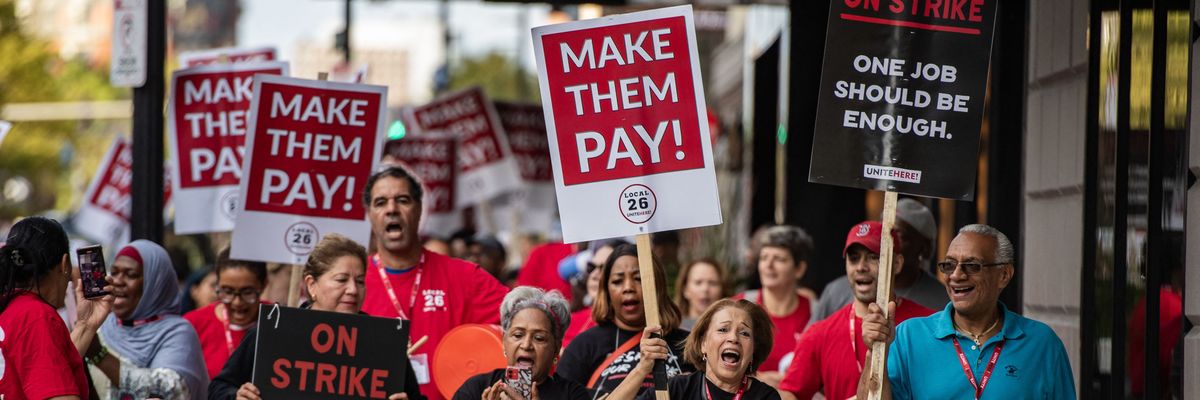
US hotel workers demonstrate as they strike over the Labor Day holiday weekend outside of the Boston Park Plaza Hotel in Boston, Massachusetts, on September 2, 2024.
(Photo by Joseph Prezioso / AFP via Getty Images)

Ralph Nader
Sep 01, 2025
Common Dreams


Running on the following Domestic Compact for America is a winning election strategy for candidates at the local, state, and national levels.

Most of these long-overdue programs are supported by both liberal and conservative families who live, work, and raise their children, facing unaddressed necessities of life and livelihoods.

Labor Day celebrations should be about more than department store sales and clambakes. America’s labor unions, at both the national and local levels, should circulate this agenda widely on Labor Day, because it is also a Compact for American Workers.

This agenda is being sent to Liz Shuler, president of the AFL-CIO (see the letter sent to her on August 27, 2024), and to the presidents of other major unions, including those representing postal workers, flight attendants, electrical workers, autoworkers, steelworkers, service workers, nurses, textile workers, and agricultural workers.

You might ask yourself: How many of these protections and benefits is US President Donald Trump opposing? These are good yardsticks by which to compare his deceptive rhetoric with his misdeeds.

The basic question is, whose side are you on? The key elements of the Compact are:Raising the federal minimum wage from $7.25 per hour to at least $15 per hour, benefiting 25 million workers.
Raising all the Social Security benefits, frozen for over 45 years, paying for it by increasing the Social Security tax on the wealthy, benefiting over 60 million elderly. This was supported by about 200 House Democrats in 2022 but was blocked by the Democratic Speaker from going to the floor. Rep. John Larson (D-Conn.), the bill’s champion, can provide further explanation.
Restoring taxes on the very under-taxed super rich and corporations (85% approval).
Establishing a children’s tax credit, cutting child poverty in half, with over 60 million children benefiting. Very popular with parents regardless of their political party affiliations.
Instituting Medicare for All, safer, more efficient, and much less stressful than our current approach to healthcare.
Cracking down on corporate crooks stealing consumer dollars, wages, and worker pensions.
Adopting social safety nets long available in Western Europe and Canada.
Passing labor law reforms put forth decades ago. (See my column on Taft Hartley at Nader.org)
Investing in crumbling public services and infrastructures.
Paying for the above by restoring taxes on the very under-taxed super rich and large corporations and by ending huge corporate welfare giveaways and debloating the runaway, unaudited military budget.

Why has the Democratic Party declined to lead with such an agenda, which has been proposed for years by various citizen groups? (See winningamerica.net.)

One reason is special interest campaign money. Another is that the Democratic Party contracts out many of its campaigns to corporate-conflicted consulting firms that have long pushed weak messaging that leads voters to keep wondering what the party stands for. These consulting firms know the answer—have the party do what is necessary to outraise the GOP in campaign contributions from corporate PACs, the super wealthy, and Wall Street titans.

When the labor union chiefs just write campaign checks to the Democratic Party without demanding an authentic, publicly visible agenda for workers, the pressure is off the party’s leadership to cease being a corporate party or to recruit younger leaders to provide needed energy from the Democratic National Committee down to the grassroots. Without this energy, there is no serious effort to mobilize informed voters who demand these changes and overdue redirections. (See Roots Action, founded by Jeff Cohen and Norman Solomon.)

Here is to a more vibrant, respectful LABOR DAY.

For more information about what workers can do to advance their interests, see my book Civic Self-Respect—Chapter 2: “I, the Worker.”

'Brazenly Anti-Worker': Labor Day Reports Highlight Trump Attacks on Unions


"This is a government that is by, and for, the CEOs and billionaires," said AFL-CIO president Liz Shuler.


BUT NOT IF YOU ARE A PERSON OF COLOUR, 
A WOMEN, OR GAY WORKER
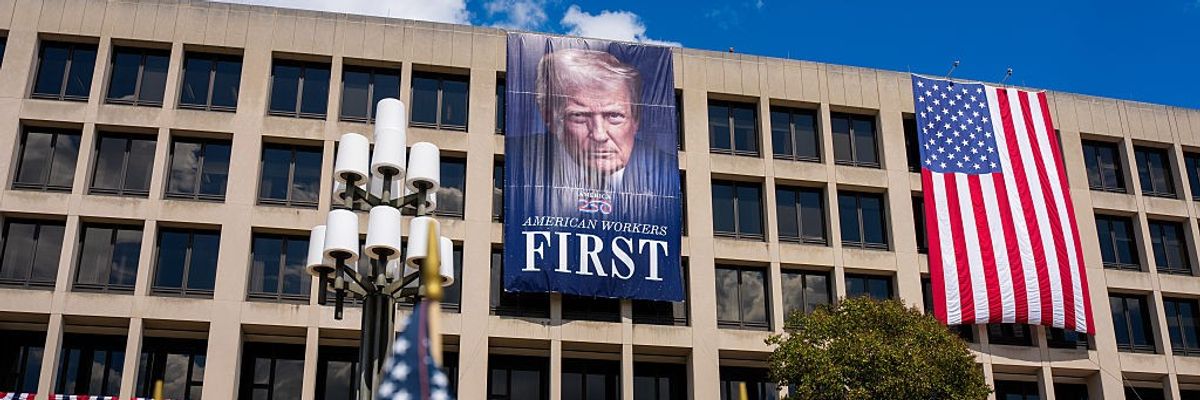
Hundreds of small American flags stick out of the lawn and a photo of UUS President Donald Trump is displayed on the side of the U.S. Department of Labor on August 29, 2025 in Washington, DC.
(Photo by Andrew Harnik/Getty Images)


Brad Reed
Sep 01, 2025
COMMON DREAMS

Although US President Donald Trump's administration likes to boast that he puts "American workers first," several news reports published on Monday document the president's attacks on the rights of working people and labor unions.

As longtime labor reporter Steven Greenhouse explained in The Guardian, Trump throughout his second term has "taken dozens of actions that hurt workers, often by cutting their pay or making their jobs more dangerous."


Our Summer Campaign is falling short. Will you pitch in?


The only way our people-powered media model can survive is with the support of readers like you. Will you donate $27 to keep nonprofit journalism alive?


Among other things, Greenhouse cited Trump's decision to halt a regulation intended to protect coal miners from lung disease, as well as his decision to strip a million federal workers of their collective bargaining rights.

Liz Shuler, president of the AFL-CIO, told Greenhouse that Trump's actions amount to a "big betrayal" of his promises to look out for US workers during the 2024 presidential campaign.

"His attacks on unions are coming fast and furious," she said. "He talks a good game of being for working people, but he's doing the absolute opposite. This is a government that is by, and for, the CEOs and billionaires."

Heidi Shierholz, president of the Economic Policy Institute, similarly told Greenhouse that Trump has been "absolutely, brazenly anti-worker," and she cited him ripping away an increase in the minimum wage for federal contractors that had been enacted by former President Joe Biden as a prime example.

"The minimum wage is incredibly popular," she said. "He just took away the minimum wage from hundreds of thousands of workers. That blew my mind."

NPR published its own Labor Day report that zeroed in on how the president is "decimating" federal employee unions by issuing March and August executive orders stripping them of the power to collectively bargain for better working conditions.


So far, nine federal agencies have canceled their union contracts as a result of the orders, which are based on a provision in federal law that gives the president the power to terminate collective bargaining at agencies that are primarily involved with national security.

The Trump administration has embraced a maximalist interpretation of this power and has demanded the end of collective bargaining at departments that aren't primarily known as national security agencies, including the Environmental Protection Agency and the National Weather Service.

However, Trump's attacks on organized labor haven't completely intimidated government workers from joining unions. As the Los Angeles Times reported, the Trump administration's cuts to the National Park Service earlier this year inspired hundreds of workers at the California-based Yosemite, Sequoia, and Kings Canyon national parks to unionize.

Although labor organizers had been trying unsuccessfully for years to get park workers to sign on, that changed when the Trump administration took a hatchet to parks' budgets and enacted mass layoffs.

"More than 97% of employees at Yosemite and Sequoia and Kings Canyon national parks who cast ballots voted to unionize, with results certified last week," wrote the Los Angeles Times. "More than 600 staffers—including interpretive park rangers, biologists, firefighters, and fee collectors—are now represented by the National Federation of Federal Employees."

Even so, many workers who succeed in forming unions may no longer get their grievances heard given the state of the National Labor Relations Board (NLRB).

As documented by Timothy Noah in The New Republic, the NLRB is now "hanging by a thread" in the wake of a court ruling that declared the board's structure to be unconstitutional because it barred the president from being able to fire NLRB administrative judges at will.

"The ruling doesn't shut down the NLRB entirely because it applies only to cases in Louisiana, Mississippi, and Texas, where the 5th Circuit has jurisdiction," Noah explained. "But Jennifer Abruzzo, who was President Joe Biden's NLRB general counsel, told me that the decision will 'open the floodgates for employers to forum-shop and seek to get injunctions' in those three states."

Noah noted that this lawsuit was brought in part by SpaceX owner and one-time Trump ally Elon Musk, and he accused the Trump NLRB of waging a "half-hearted" fight against Musk's attack on workers' rights.

Thanks to Trump and Musk's actions, Noah concluded, American oligarchs "can toast the NLRB's imminent destruction."

Trump's Labor Day Assault on American Workers


This self-anointed man of the working people has waged an all-out attack on the unions that make workers’ lives better, thrashing away at workers’ rights and unions’ ability to organize.


Then the Republican presidential nominee, Donald Trump works behind the counter making french fries during a campaign event at McDonald's restaurant on October 20, 2024 in Feasterville-Trevose, Pennsylvania.
(Photo by Doug Mills-Pool/Getty Images)
THE ONLY HONEST DAY'S WORK HE HAS EVER DONE!
Common Dreams

The man in the McDonald’s suit insists unceasingly that he’s for working people, and huge portions believe him—but what do the facts of President Trump’s actual policies show? What does it mean to be for workers?

You’d think being “pro-worker” would mean things like lowering consumer prices and boosting wages. But the facts show the man in the McDonald’s suit isn’t doing either of those things—in fact, despite the president’s false protestations, he is doing the opposite

Despite Trump’s profoundly Orwellian lies, prices are, in fact, UP from last year for most categories of daily life, according to the Trump administration’s own Bureau of Labor Statistics. Prices for food are up nearly 3 percent since this time last year. Workers’ grocery bills are spiking higher as supermarkets pass along Trump’s tariffs to consumers, as all critics predicted.

You’d think that being for workers would mean supporting higher wages, particularly for working-class and lower-income workers. But again, the man donning the McDonald’s outfit is in fact doing the opposite. As Economic Policy Institute reported, Trump “rescinded an executive order that raised the minimum wage for federal contractors,” effectively slashing these workers’ wages by 25% to 60%. This means that millions of federally contracted workers, some of whom make poverty wages, no longer get minimum wage protections because of Trump.

All of this pain and harm Trump is causing for workers is part of the plan, right out of the Heritage Foundation’s Project 2025—promoting the profit and wealth interests of the rich and corporations over working people’s needs and survival.

Compounding all this harm, on Labor Day the Trump administration “will advance plans to eliminate federal minimum wage protections for millions of child care and home care providers,” the Center for American Progress reports. Think about that. Millions of low-paid domestic care workers will now lose federal minimum wage protections because of the man masquerading as a McDonald’s worker and man of the people.

With the help of a Trump-appointed judge in Texas, Republicans rescinded a Biden rule aimed at expanding overtime pay for millions of working Americans. That rule would have given overtime pay protections to 4 million workers. Seriously, does that sound pro-worker to you?

You might expect a “pro-worker” president to support middle-class jobs—wrong again. Is it “pro-worker” to fire and lay off hundreds of thousands of government workers, all to pay for tax cuts that almost entirely benefit the rich? This is precisely what Trump is doing. New government projections show Trump will have eliminated about 300,000 federal workers by the end of this year. Think about that, 300,000 people made unemployed by Trump. That is an entire city of middle-class workers, fired and laid off, now desperately scrambling to pay bills, buy groceries, and survive. Many will lose their homes if they don’t quickly find another middle-class job. Doesn’t sound very “pro-worker,” now does it?

Would a “pro-worker” president eviscerate worker safety and health protections on the job? That’s exactly what Trump is doing. His horrendous, harmful bill gutted the Occupational Health and Safety Administration, slashing staff and workplace inspections, the lifeblood of maintaining worker safety and health. More than 140,000 U.S. workers died from hazardous job conditions in 2023, according to the AFL-CIO’s annual “Death on the Job” report. That’s 383 Americans dying every day from dangerous working conditions that can be prevented by stronger regulations and enforcement—but the guy in the McDonald’s outfit is doing the opposite, erasing a stunning 30 percent of inspections while radically reducing penalties for endangering workers.

Deepening this harm, Trump eliminated nearly all workers at the National Institute for Occupational Safety and Health (NIOSH), a small but important agency that produces critical research on work hazards, including maintaining a firefighter cancer registry and a lab that certifies respirators for many industries. The cuts are “a very pointed attack on workers in this country,” Micah Niemeier-Walsh, vice president of the NIOSH workers union told the Associated Press.

This same alleged “champion” of working people is deploying heavily militarized battalions of ICE (Immigration and Customs Enforcement) to round up suspected undocumented immigrants—engaging in racial profiling, violating Constitutional due process, tearing apart families, deporting legal residents and some U.S. citizens, raiding farms and warehouses and day labor sites, putting millions of hard-working immigrant (and non-immigrant) families in danger and terror.

This self-anointed man of the working people has waged an all-out attack on the unions that make workers’ lives better, thrashing away at workers’ rights and unions’ ability to organize. On the Thursday before Labor Day, Trump spat out yet another anti-worker executive order aimed at erasing collective-bargaining rights from workers at the National Weather Service, the National Aeronautics and Space Administration and other federal agencies, Huffington Post reported.

All of this pain and harm Trump is causing for workers is part of the plan, right out of the Heritage Foundation’s Project 2025—promoting the profit and wealth interests of the rich and corporations over working people’s needs and survival. According to the nonpartisan Congressional Budget Office, Trump’s tax plan enriches the rich while taking from the poor, while adding trillions to the national debt. Those tax cuts primarily going to the rich are paid for in part by Trump’s gutting and slashing of workers’ rights and protections on the job.

Writing for The Nation this week, Robert L. Borosage and Sara Steffens summarized Trump’s wholesale assault on workers compellingly:
Employers are being empowered to act lawlessly toward their workers. Unions are being stripped of the legal structure that protected their existence. Immigrant workers are abused, hunted, and deported. Women and minorities will suffer from discrimination at rates not seen since the civil rights revolution. Workers’ families are shouldering higher costs for food, healthcare, and energy.

On Labor Day and beyond, when the guy the goody grin in the McDonald’s suit says he’s helping working people and making their lives “great again,” remember—all the facts show the opposite. The facts show the Trump administration is undermining workers, making their lives harder, exposing them to more life-threatening hazards, robbing millions of overtime pay, eliminating minimum wage protections for millions more, and attacking the unions that improve workers’ pay and rights and safety on the job.

Don’t buy Trump’s false “happy Labor Day” hype—it’s all lies with those fatty, greasy fries.


Workers Are Paying the Price for Intel Mismanagement...

And taxpayers are footing the bill.


Lip-Bu Tan, chief executive officer of Intel, appears at an event organized by the company on April 29, 2025 in San Jose, California.
(Photo by Andrej Sokolow/picture alliance via Getty Images)


Rand Wilson
Aug 29, 2025
Common Dreams


It’s not every day that the president of the United States calls for the head of a major company to be fired. But that’s what happened this August, when US President Trump accused Lip-Bu Tan, the new CEO of Intel, of being too cozy with China.

Then in typical fashion, Trump reversed himself and proposed converting Intel’s $10.8 billion CHIPS Act subsidy into an equity stake. Intel accepted the deal, and now the federal government owns nearly a 10% stake in the company.

While much has been written about Intel’s financial and technical challenges, very little has been said about the impact of management’s cost cutting on the company’s employees.

In October 2024, Intel announced its plan to cut 15% of its global workforce, eliminating approximately 15,000 positions. Then shortly afterwards, the company gave its fired CEO Pat Gelsinger a $7,853,450 severance package.

With the government’s huge taxpayer-financed stake in Intel, Intel communities have an opportunity to hold the company accountable for the impact of these job cuts on workers and their communities.

Thus far it has already laid off more than 7,500 workers across four states. But Intel's new CEO, Lip-Bu Tan isn’t suffering any pain. He’s getting $1 million a year and is eligible for bonuses of up to $2 million. His long-term stock options are valued at $66 million.


Studies on the impact of job loss have documented that layoffs increase the risk of suicide, substance use disorders, poor physical and mental health, divorce, and homelessness. The impact extends to the communities where workers live: Local businesses lose revenue, demand for social services increases, and local governments can see their tax base crater.

With the government’s huge taxpayer-financed stake in Intel, Intel communities have an opportunity to hold the company accountable for the impact of these job cuts on workers and their communities. A powerful grassroots movement might go even further and follow up on Intel’s promise to create 10,000 new jobs in exchange for taxpayer funding.

To help build that movement, a dozen labor and environmental groups came together to form CHIPS Communities United (CCU). The coalition aims to hold semiconductor companies accountable for the billions of dollars they’ve received in public funds and tax credits.

This Labor Day, CCU is launching Intel-Layoffs.org to track the extent of job losses at Intel and invite workers to join our campaign for good jobs in the semiconductor industry. The tracker will be a reliable resource and virtual gathering place.

Layoffs provide a teachable moment regarding the benefits of collective bargaining and the value of a union contract. Typical job security provisions provide an orderly process for reductions in staff. And just as importantly, most agreements spell out in writing a fair process for bringing back qualified laid-off employees by seniority.

As Intel works through its technical and marketing challenges, we must not lose sight of the human costs of its crisis and the company’s obligations to workers and their communities.


Our work is licensed under Creative Commons (CC BY-NC-ND 3.0). Feel free to republish and share widely.


Rand Wilson
Rand Wilson is a long-time union organizer and strategic advisor to the CHIPS Communities United coalition.
Full Bio >
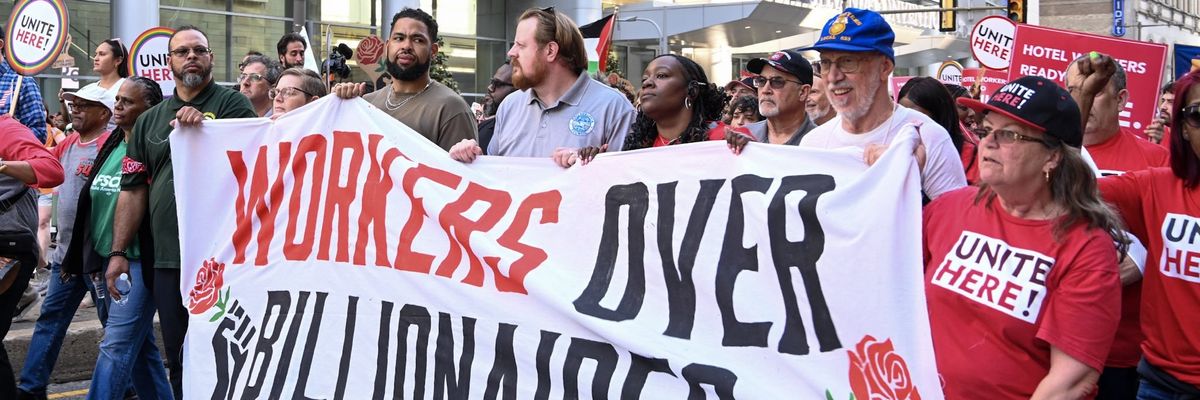
Americans Take to the Streets for 1,000+ 'Workers Over Billionaires' Labor Day Rallies

"Workers are fighting for a society where public schools take precedence over private profits, healthcare is prioritized over hedge funds, and affordable housing is valued more than homelessness," said May Day Strong.


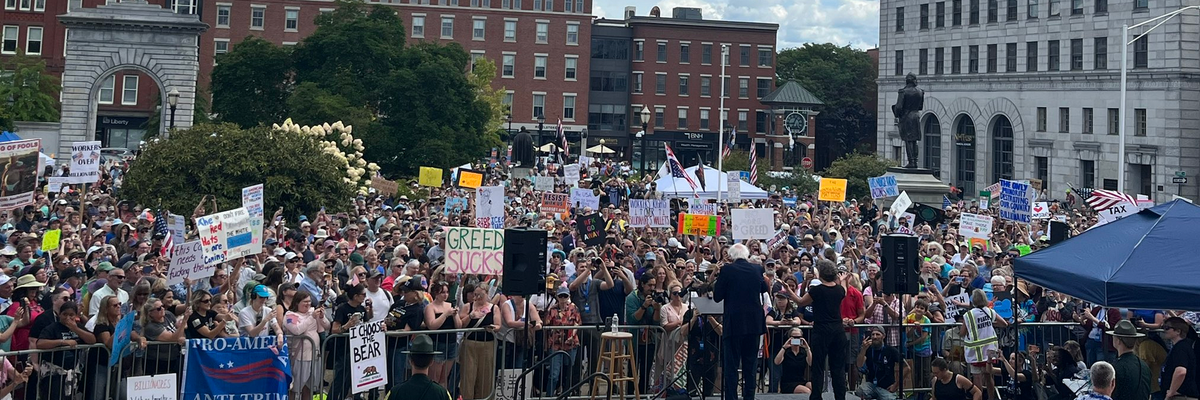
US Sen. Bernie Sanders (I-Vt.) speaks at a "Workers Over Billionaire" Labor Day rally in Concord, New Hampshire on September 1, 2025.
(Photo: Anna Bahr/X)


Brett Wilkins
Sep 01, 2025
COMMON DREAMS


This is a developing story... Please check back for possible updates.

Americans turned out across the United States on Monday for more than 1,000 demonstrations against President Donald Trump and other oligarchs "to reclaim worker power against billionaires who hoard unprecedented wealth and power."


The "Workers Over Billionaires" protests are being led by the May Day Strong Coalition, which is made up of dozens of organizations including the AFL-CIO, American Federation of Teachers, National Union of Healthcare Workers, and advocacy groups like Americans for Tax Fairness, Indivisible, Our Revolution, and Public Citizen.

Demonstrations took place or are set to happen in big cities, small towns, and communities in between all across the nation. Sen. Bernie Sanders (I-Vt.) spoke at a rally in Concord, New Hampshire, where he vowed that "together, we will create an economy and government that work for all, not just the 1%."

May Day Strong said Monday's mobilizations aim "to build collective action against billionaires taking over the US government."

"Building upon momentum from May Day, Good Trouble Lives On, No Kings, and key impromptu actions in the streets and the workplace, Workers Over Billionaires will reach communities nationwide, tapping rural and city workers to stop the billionaire agenda that continues to burden everyone," the coalition said. "As the federal government continues to enable the ultrarich, working people are stepping onto pavement to stop their greed and protect their families."

"Working families want to live in a country that puts workers over billionaires," the coalition added. "Workers are fighting for a society where public schools take precedence over private profits, healthcare is prioritized over hedge funds, and affordable housing is valued more than homelessness."

In New York, actions included a rally outside Trump Tower in Manhattan, where demonstrators demanded a $30 an hour minimum wage. Members of groups including One Fair Wage (OFW) staged a "Restaurant in the Street" demonstration "designed to highlight the struggle of working people and launch the New York Living Wage for All campaign."


"The action coincides with the release of a new OFW report, Making America Affordable Now: The Case for a Living Wage for All, which finds that nearly half of US workers—67 million people—earn less than $25 an hour," One Fair Wage said. "In New York, 41% of workers fall below that threshold.

OFW said that the demand for a living wage is the "next generation of the Fight for $15," warning that "past wage gains have been erased by historic inflation, skyrocketing rents, and cuts to Medicaid and SNAP," the federal Supplemental Nutrition Assistance Program.

"It also highlights how gimmicks like Trump's 'No Tax on Tips' proposal do little to address workers' needs, since two-thirds of tipped workers earn too little to benefit," OFW added.


AFL-CIO president Liz Shuler said ahead of the protests: "Every single thing working people have won for ourselves in this country's history—it's not because we asked those in power. It's not because they were handed to us. It's because we fought for them relentlessly."

Saqib Bhatti, executive director of Action Center on Race and the Economy (ACRE), told USA Today that "it's important to show that there is opposition to the Trump-billionaire agenda in every community, big and small; it's not just cities that are united against what's happening... it's all towns, it's small towns that voted overwhelmingly for Trump."

Monday also saw the launch of the Department of Class Solidarity (DOCS), "a permanent national war room tracking nearly 1,000 US billionaires, their wealth, corporate holdings, and political contributions."

"This Labor Day weekend, we are not resting," DOCS said on social media. "The oligarchs are snatching away our healthcare, our livelihoods, and our rights. Now is the time to act."


DOCS and allied groups rallied for a "Hamptons Billionaire Shutdown" on Long Island.


"The Hamptons is where right-wing billionaires like Bill Ackman and Dan Loeb plot and plan in their hundred-million-dollar mansions, ensconced from the workers they exploit," DOCS said. "Time to give them a taste of their own medicine."

Nearly 1,000 'Workers Over Billionaires' Protests Planned Across US for Labor Day


"This is about workers showing up and demanding what workers deserve all across the country," said Randi Weingarten, president of the American Federation of Teachers.


Thousands of labor union members and activists march in Philadelphia for May Day, on May 1, 2025.
(Photo by the Philadelphia Democratic Socialists of America)


Stephen Prager
Aug 29, 2025
COMMON DREAMS

Unions and progressive organizations are planning nearly 1,000 "Workers Over Billionaires" demonstrations across the United States this Labor Day to protest President Donald Trump's assault on workers' rights.

The day of national action has been organized by the May Day Strong coalition, which includes labor organizations like the AFL-CIO, American Federation of Teachers, and National Union of Healthcare Workers, as well as advocacy groups like Americans for Tax Fairness, Indivisible, Our Revolution, and Public Citizen.


Support for Labor Unions Near Historic High as Trump Trashes Working Class


Trump Order Ramps Up Assault on Union Rights of Federal Workers

"Labor and community are planning more than a barbecue on Labor Day this year because we have to stop the billionaire takeover," the coalition says. "Billionaires are stealing from working families, destroying our democracy, and building private armies to attack our towns and cities."


Since coming into office, the Trump administration has waged war on workers' rights. Among many other actions, his administration has stripped over a million federal workers of their right to collectively bargain in what has been called the largest act of union busting in American history and dramatically cut their wages.

He has also weakened workplace safety enforcement, eliminated rules that protected workers against wage theft, and proposed eliminating the federal minimum wage for more than 3.7 million childcare and home workers.

Despite Trump's efforts, Americans still believe in the power of collective action. According to a Gallup poll published Thursday, 68% of Americans say they approve of labor unions, the highest level of support since the mid-1960s.

"Just like any bad boss, the way we stop the takeover is with collective action," the coalition says on its website.

The May Day Strong coalition previously organized hundreds of thousands of workers to take to the streets for International Workers Day, more commonly known as "May Day." On Monday, rallies are once again expected across all 50 states.

Four months later, their list of grievances has grown even longer, with Republicans having since passed a tax cut expected to facilitate perhaps the largest upward transfer of wealth in US history, featuring massive tax breaks for the wealthy paid for with historic cuts to the social safety net.


"There are nearly 1,000 billionaires in the country with a whopping $6 trillion, and that is still not enough for them," said Saqib Bhattie, executive director of the Action Center on Race and the Economy, another group participating in the protests. "They are pushing elected officials to slash Medicaid, [Supplemental Nutrition Assistance Program] benefits, and special education funding for schools in order to fund their tax breaks. We need to claw back money from the billionaire. We need to push legislation to tax billionaires at the state and local levels. We need to organize to build the people power necessary to overcome their money."

The group also plans to respond to Trump's lawless attacks on immigrants and his militarized takeovers of American cities.

"This Labor Day," said Lisa Gilbert, co-president of Public Citizen, "we continue the fight for our democracy, the fight for the soul of our nation, the fight against the vindictive authoritarian moves Trump and the billionaire class aimed at stealing from working people and concentrating power."

"This is about workers showing up and demanding what workers deserve all across the country," said Randi Weingarten, president of the American Federation of Teachers. "This Labor Day is really different, because it's not just labor unions, as important as we may be to the workers we represent. It has to be all workers and all working families saying enough. Workers and working families deserve the bounty of the country."

May Day Strong will host a national "mass call" online on Saturday. The locations of the hundreds of protests on Monday can be found using the map on May Day Strong's website.

States Should Step Up to Protect Their Workers and Economies From Extreme Heat

With federal rulemaking now in limbo, it is more imperative than ever for states to act quickly to protect workers from the growing danger of heat exposure.


A worker adjusts his helmet on a construction site under the sun as southern California faces a heatwave, in Los Angeles, on July 3 2024.
(Photo by Etienne Laurent/AFP via Getty Images)
Emma Cohn
Aug 29, 2025
EPI Blog

The start of this summer brought dangerous heatwaves to the US that killed at least two people, including a letter carrier in Dallas (the second letter carrier death due to extreme heat in three years).

Labor unions and public health advocates have long been pushing the federal government to enact a standard to protect workers against extreme heat exposure. These efforts led to progress in 2024 when the Occupational Safety and Health Administration (OSHA) formally proposed a new heat standard based on years of intensive research.

This summer, OSHA held informal hearings on the proposal, but whether and in what form the Trump administration might move forward with adopting a final version of the heat standard rule remains uncertain. In the meantime, states have every reason to move forward with enacting their own strong standards to protect workers from preventable heat illness and death on the job.

The Human and Economic Costs of Extreme Heat

Heat is the leading cause of death among all weather-related fatalities, killing 177 people last year alone and at least 211 workers between 2017 and 2022. We know that existing data on heat-related workplace fatalities significantly understate their true incidence and that, as climate change leads to more frequent and intense heatwaves, these numbers will only rise. Despite this, 43 states and DC have yet to take action to prevent heat deaths. With federal rulemaking now in limbo, it is more imperative than ever for states to act quickly to protect workers from the growing danger of heat exposure.

Like workplace deaths and injuries in general—and due to occupational segregation and geographical factors—the ­­impacts of extreme heat are distributed unevenly based on income, race or ethnicity, and immigration status. The lowest-paid 20% of workers suffer five times as many heat-related injuries as the highest-paid 20%. And Black, Hispanic, and immigrant workers face higher exposure to extreme heat because they are more likely to work in high-risk industries like construction and agriculture.

While workplace deaths are the most urgent consequence of extreme heat, heat is also responsible for thousands of illnesses and injuries every year that result in unexpected healthcare costs, missed workdays, lost wages, and productivity declines that cost both workers and their employers. Overall economic costs are staggering: Short-term heat-induced lost labor productivity costs the US approximately $100 billion annually and these costs will only increase as climate change worsens. Without emissions reductions or sufficient heat adaptations, labor productivity losses may double to nearly $200 billion by 2030 and reach $500 billion by 2050.

Federal OSHA estimated that savings to employers are projected to outweigh any implementation costs by $1.4 billion each year.

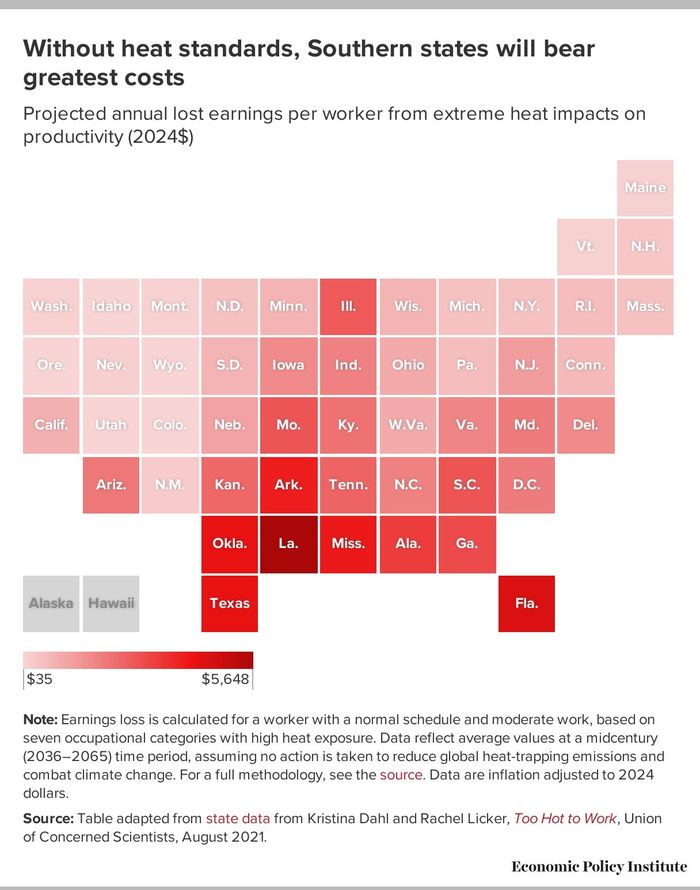
If no action is taken to mitigate the growing risks of extreme heat exposure, the hottest states will suffer the gravest economic consequences. Researchers at the Union of Concerned Scientists estimated annual earnings at risk for workers in each state across seven of the most heat exposed occupations. Southern states make up 9 of the 10 states where workers stand to lose the highest average annual earnings (see Figure A). Texas will be one of the hardest hit; it’s projected to lose a cumulative $110 billion in labor productivity by 2050.

Despite these economic risks, some Southern states are standing in the way of protecting their own workers and businesses. Texas and Florida—which accounted for almost half of all heat-related severe injuries in the construction industry between 2015 and 2023—have failed to adopt statewide heat standards and banned cities and counties from passing local heat standards.


Even though the economic harms of heat-related injuries, illnesses, and deaths are well documented, new heat standard proposals regularly face significant opposition from industry interests who claim, with little evidence, that protections will be too costly to implement. While exaggerated claims and fearmongering are consistent with a long history of industry resistance each time OSHA has proposed new standards, suggestions that a heat standard would disrupt business aren’t backed by available evidence. In its own regulatory impact analysis of the proposed heat standard, federal OSHA estimated that savings to employers are projected to outweigh any implementation costs by $1.4 billion each year.

Existing Models Provide Roadmap for States to Adopt or Strengthen Their Own Heat Standards

Years of research and experience have produced clear guidelines for evidence-based, effective standards that states can now adopt quickly and with confidence. The strength and effectiveness of existing heat standards varies across states with respect to which workers are covered and what steps employers must take to prevent extreme heat exposure. All state heat standards (except for Nevada’s) set a temperature threshold above which employers are required to provide workers with water and shade. Most states also set a high-heat threshold above which additional precautions must be taken to protect workers. Many states also mandate an acclimatization period for workers to adjust to working in high temperatures, but the length of that period varies across states. All states with heat standards mandate that employers train workers on heat illness prevention, monitor workers for signs of heat illness, and have a plan to respond to heat illness emergencies.

A strong state standard should, at a minimum:Cover all indoor and outdoor workers;
Include temperature thresholds to mandate precautions like water, rest, and shade;
Guarantee an acclimatization period;
Designate a high-heat temperature threshold at which additional precautions apply; and
Impose no new costs on workers, meaning that workers should be paid for rest breaks and time spent acclimatizing.

Seven states have already implemented heat standards: California, Colorado, Maryland, Minnesota, Nevada, Oregon, and Washington. While California, Washington, and Minnesota were early adopters of heat standards, advocates have built tremendous momentum toward the adoption of new standards in additional states in the past two years. In 2024, Colorado, Maryland, and Nevada all passed new heat standard laws and California expanded its existing heat standard (originally covering only outdoor work) to cover indoor workers. This year, 18 state legislatures proposed new heat standards, including bills in states like Illinois and New Jersey, that outline elements of comprehensive, evidence-based standards that other states can use as models.

States with existing standards should review checklists for a strong heat standard as well as model legislation in states like Illinois and New Jersey to audit their regulations and strengthen them if needed. States without standards should build comprehensive, effective standards that follow these evidence-based recommendations, cover as many workers as possible, and include clear, enforceable measures.

States Should Act Now to Limit Harms to Workers, Businesses, and State Economies While Federal Rulemaking Is in Limbo

The fate of the proposed federal heat standard now under consideration could eventually reshape the heat standard policymaking landscape, but in the meantime, there is no downside to states taking action. The current proposed federal standard is fairly strong, a testament to years of research, advocacy, and community mobilization. However, given the Trump administration’s hostility toward workers and industry lobbying groups’ strong opposition to the proposed standard, possible outcomes include the adoption of a weakened standard or long delays in formalizing the proposed rule to effectively block its implementation.

Some industry representatives opposed to the current proposed federal standard have indicated that, instead of continuing to block the federal rule, they may support the passage of a weak standard in order to stave off future rulemaking. Some have speculated that industry interests may support modeling a weak federal standard on Nevada’s months-old, untested state standard, which has no temperature threshold and has been characterized as “almost as bad as no heat standard” by worker advocates.

There are three possible outcomes of the federal heat standard rulemaking process:The Trump administration finalizes the proposed, strong federal heat standard. If a strong rule is formalized, states should (and must) adopt it. A strong federal rule protecting all workers from the effects of extreme heat is the best-case scenario. Under this scenario, states where employers and workers have already gained experience with strong state heat standards will be better prepared to implement the federal rule.

The Trump administration abandons or indefinitely delays action on the current proposed federal heat standard. If no federal rule is implemented, states will retain latitude to continue enacting their own heat standards. Under this scenario, states with strong, effective standards will help workers and employers immediately reap important safety and economic gains as climate change continues to increase risks of human and economic damage from extreme heat.

The Trump administration finalizes a weakened version of the federal proposal. In this scenario, states under federal OSHA jurisdiction would be required to follow the new federal standard and states with OSHA “state plans” could continue to enact or enforce stronger heat standards. It is also likely that any new federal standard could face legal challenge (delaying its implementation), so having a strong track record of effective state standards in place would remain critical for building additional legal and political pressure to eventually enact a stronger federal standard. Likewise, given likely legal delays, even under this scenario, states under federal OSHA’s jurisdiction would be able to continue to enforce their own standards until any new federal rule were upheld in court and any stronger state law had been blocked by a federal court order.

In short, states have every reason to enact strong, effective heat standards and no reason to wait on uncertain federal action. There is zero risk for states who act now and great dangers associated with waiting while workers and businesses alike continue to suffer.
Amid Federal Backsliding, State Lawmakers Can Act to Protect Workers From Deadly Heat

Over 144 lives have already been lost to heat-related hazards since federal rulemaking began four years ago to establish a long-overdue federal OSHA heat standard. Given the possibility that the Trump administration could block or delay the proposed federal standard—or worse, weaken it to try to preempt more effective state and local standards—state lawmakers should move quickly to implement strong heat standards of their own, prevent more deaths and illnesses, and bolster their state’s economy against the damaging effects of extreme heat.


© 2023 Economic Policy Institute


Nina Mast
Nina Mast (she/they) joined EPI in 2022 as an economic analyst on the State Policy and Research team. Mast’s research at EPI includes a focus on child labor standards. Mast is a graduate of the Master of Public Policy program at UC Berkeley's Goldman School, where she served as a researcher for the UC Berkeley Labor Center and represented academic student employees as a union steward with UAW-2865.

Full Bio >
Emma Cohn
Emma Cohn (she/her) joined the Economic Policy Institute in 2024 as a research assistant with the Economic Analysis and Research Network (EARN) team. As a research assistant, she collects, analyzes, and presents economic data, creates data visualizations, and assists with writing reports and blog posts.
Full Bio >