Monday, September 01, 2025

Rock music and Scarlett Johansson are helping to protect cattle from wolves

QUIT GRAZING CATTLE ON PUBLIC LANDS


Once hunted nearly to extinction, grey wolves have made a comeback in the US, but their growing population has meant ranchers have had to resort to new ways to protect their livestock from attack by the apex predator. The latest technique involves using drones to blast hard rock music and human voices to scare wolves away from cattle.


Issued on: 31/08/2025 - 
By: FRANCE 24

A wolf from the Snake River Pack passes by a remote camera in eastern Wallowa County, Oregon, in 2014, in a photo released by the Oregon Department of Fish and Wildlife, © AP file photo

For millennia humans have tried to scare wolves away from their livestock. Most of them didn’t have drones.

But a team of biologists working near the California-Oregon border do, and they’re using them to blast AC/DC’s “Thunderstruck", movie clips and live human voices at the apex predators to shoo them away from cattle in an ongoing experiment.

“I am not putting up with this anymore!” actor Scarlett Johansson yells in one clip, from the 2019 film “Marriage Story.”

“With what? I can’t talk to people?” co-star Adam Driver shouts back.

Grey wolves were hunted nearly to extinction throughout the US West by the first half of the 20th century. Since their reintroduction in Idaho and at Yellowstone National Park in the mid-1990s, they’ve proliferated to the point that a population in the Northern Rockies has been removed from the endangered species list.

Read moreProtections drop for wolves in most of Europe

There are now hundreds of wolves in Washington and Oregon, dozens more in northern California, and thousands roaming near the Great Lakes.

The recovering population has meant increasing conflict with ranchers – and increasingly creative efforts by the latter to protect livestock. They’ve turned to electrified fencing, wolf alarms, guard dogs, horseback patrols, trapping and relocating, and now drones. In some areas where nonlethal efforts have failed, officials routinely approve killing wolves, including last week in Washington state.

Gray wolves killed some 800 domesticated animals across 10 states in 2022, a previous Associated Press review of data from state and federal agencies found.

Scientists with the USDA Animal and Plant Health Inspection Service developed the techniques for hazing wolves by drone while monitoring them using thermal imaging cameras at night, when the predators are most active. A preliminary study released in 2022 demonstrated that adding human voices through a loudspeaker rigged onto a drone can freak them out.

The team documented successful interruptions of wolf hunts. When Dustin Ranglack, the USDA’s lead researcher on the project, saw one for the first time, he smiled from ear to ear.

“If we could reduce those negative impacts of wolves, that is going to be more likely to lead to a situation where we have co-existence,” Ranglack said.

The preloaded clips include recordings of music, gunshots, fireworks and voices. A drone pilot starts by playing three clips chosen at random, such as the “Marriage Story” scene or “Thunderstruck,” with its screams and hair-raising electric guitar licks.

If those don’t work, the operator can improvise by yelling through a microphone or playing a different clip that’s not among the randomised presets. One favorite is the heavy metal band Five Finger Death Punch ‘s cover of “Blue on Black,” which might blast the lyric “You turned and you ran” as the wolves flee.

USDA drone pilots have continued cattle protection patrols this summer while researching wolf responses at ranches with high conflict levels along the Oregon-California border. Patrols extended south to the Sierra Valley in August for the first time, according to the California Department of Fish and Wildlife.

It’s unclear whether the wolves might become accustomed to the drones. Herders and wolf hunters in Europe have long deterred them with long lines hung with flapping cloth, but the wolves can eventually learn that the flags are not a threat.
Superpredator: Can humans and wolves coexist?
The return of the wolf is a rewilding triumph, but a challenge to reconcile with human activities. © P. Massit
12:25

Environmental advocates are optimistic about drones, though, because they allow for scaring wolves in different ways, in different places.

“Wolves are frightened of novel things,” said Amaroq Weiss, a wolf advocate with the Center for Biological Diversity. “I know that in the human imagination, people think of wolves as big, scary critters that are scared of nothing.”

There are also drawbacks to the technology. A drone with night vision and a loudspeaker costs around $20,000, requires professional training and doesn’t work well in wooded areas, making it impractical for many ranchers.

Ranchers in Northern California who have hosted USDA drone patrols agree that they have reduced livestock deaths so far.

“I’m very appreciative of what they did. But I don’t think it’s a long-term solution,” said Mary Rickert, the owner of a cattle ranch north of Mount Shasta. “What I’m afraid of is that after some period of time, that all of a sudden they go, ‘Wow, this isn’t going to hurt me. It just makes a lot of noise.’”

Ranchers are compensated if they can prove that a wolf killed their livestock. But there are uncompensated costs of having stressed-out cows, such as lower birth rates and tougher meat.

Rickert said if the drones don’t work over the long term, she might have to close the business, which she’s been involved in since at least the 1980s. She wants permission to shoot wolves if they’re attacking her animals or if they come onto her property after a certain number of attacks.

If the technology proves effective and costs come down, someday ranchers might merely have to ask the wolves to go away.

Oregon-based Paul Wolf – yes, Wolf – is the USDA’s southwest district supervisor and the main Five Finger Death Punch fan among the drone pilots. He recalled an early encounter during which a wolf at first merely seemed curious at the sight of a drone, until the pilot talked to it through the speaker.

“He said, ‘Hey wolf – get out of here,’” Wolf said. “The wolf immediately lets go of the cattle and runs away.”

(FRANCE 24 with AP)


Financial crisis in privately owned media puts Senegal’s press freedom at risk

Senegal’s press is facing a worsening financial crisis, impacted by cuts to public subsidies and the collapse of advertising revenue. At its centre is the restructuring of Youssou N'Dour's Futurs Médias group, but other privately owned companies are now facing similar challenges and asking for government support.


Issued on: 01/09/2025 - RFI

A Senegalese woman reads the headlines of the newspapers on sale in a street in Dakar during the political crisis, February, 2024. © SEYLLOU / AFP

By:Melissa Chemam with RFI

The Futurs Médias group (GFM) – which owns leading Senegalese media outlets including newspaper L'Observateur, radio station RFM and television channel TFM – says it is experiencing an "unprecedented" crisis.

With advertising revenue plummeting, print sales falling, rising costs and tax adjustments, the group has not paid some employees for three months.

For its management there is only one option left: restructuring the company.

The group was founded in 2003 by the internationally renowned musician and former culture minister, Youssou N’Dour, to provide an independent media platform that could offer diverse perspectives, countering the dominance of state-controlled media.

The group became a dominant force in Senegal's media landscape; L'Observateur is now the most read daily paper in the country.

But since 2024, amid the national economic crisis and recent political change, GFM has been struggling.

Amid a reduction in public subsidies, the group's profits have fallen. So to reduce its expenses, it is looking to save on salaries. Dozens of positions are now under threat, among the group's 400 permanent employees.

Staff representatives have reacted angrily to the plan, as Mamadou Fall, general secretary of the Syndicate of Information and Communication Professionals of Senegal (SYNPICS), GFM section, told RFI.

"The release of a press release to announce a recovery plan took us by surprise," he said. "For us, it's brutal, it's difficult. We don't want any lay-offs at GFM and we want to try to save as many jobs as possible, because this could create a social tragedy in Senegal."

Workers affiliated with SYNPICS agreed last week to file a notice to strike.

Media blackout in Senegal as publishers denounce government threats

People pass by a newspaper kiosque in Dakar, Senegal. AFP - SEYLLOU DIALLO

Plurality under threat


The issues at GFM, which has correspondents across Senegal, pose a real threat to the plurality of the press sector in the country, according to Sadibou Marong, director of the Reporters Without Borders (RSF) office in Dakar.

"The crisis probably means that the territorial coverage, the strength of the group... could be fundamentally damaged, and that would impact the pluralism of news," Marong told RFI.

"News is not something that is needed or happening only in Dakar, it happens throughout the country – the regions and departments where there were correspondents. So, that is the first issue."

But the situation at GFM is not an isolated case. The Senegalese press has been hit hard by the country's economic crisis over the past year, and many journalists have already lost their jobs.

Other groups are going through a financial crisis, such as the Sud Communication group, which owns the daily Sud Quotidien, and has been forced to raise funds via crowdfunding.

The Walfadjri group, or WALF, another private media group, is also facing cash flow difficulties.

"This means that good journalists might lose their job and move on to communications positions," Marong said, "and that will impact the quality of news."

'Risk of extinction'

According to the head of the Coordination of Press Associations of Senegal, Ibrahima Lissa Faye, the survival of the press in Senegal is in question.

"For more than 17 months, media companies have been in a cash deficit because of a series of inappropriate measures taken by the state that are weakening the survival of media companies and putting them in an extremely complicated situation," he told RFI.

"And today, all private media companies are living with salary arrears, rental arrears and outdated equipment that has not been properly maintained. Therefore, there is a risk of extinction for some media outlets."

Senegal has been suffering from an economic crisis since 2024, facing a budget deficit of 14 percent and an outstanding public debt representing 119 percent of GDP.

When President Bassirou Diomaye Faye came to power in April 2024, he pledged to support a free press and a diversified media landscape. Under Senegal's previous president, Macky Sall, 60 journalists were arrested, assaulted, questioned or detained between 2021 and 2024, according to an RSF report.

But among the measures to cut public spending out in place by the government of his Prime Minister Ousmane Sonko, were a pause on the Press Support and Development Fund (FADP) and a reduction in publicly-funded advertising campaigns.

And according to Lissa Faye, these are among the root causes of the current financial crisis in the media industry.

A regional beacon

Press associations and trade unions have denounced the lack of support from the government.

A general meeting took place at GFM on 26 August to discuss the job losses, and the Syndicate of Information and SYNPICS has also announced a rally, to be held as soon as possible.

Senegal's media is considered vital for press freedom across West Africa, as the country boasts the most dynamic press in a region where journalists are under huge constraints. Neighbouring economies, for instance in Niger and Mali, are also much weaker. This means Senegal's media covers wider regional issues and is read and watched beyond its borders.

In addition, said Lissa Faye, referring to the wider region's jihadist rebellions and military coups: "We are in a very threatened region, with instability that could, in any case, take over our media or come up with another offer that may not be to our liking."

Sahel countries navigate uncertainty following split from Ecowas bloc

For Marong, who contributed to an RSF report on reforms needed for the press sector to survive, released in April 2025, private media has also relied on public support and adverts from public sector organisations for too long.

The government has introduced media reform aimed at bringing more transparency to the landscape, he explained, and at encouraging the diversification in revenues.

These reforms include the registration of media outlets on a dedicated platform, as well as the updating of advertising laws to strengthen regulation, according to RSF.

But the primary challenge remains the economic survival of media outlets.

"The Press Support Fund wasn't paid in 2024 and 2025, it's true, and with the lack in advert revenues, this creates a bit of a shortfall," Marong said.

"But it also shows that, for a long time, the media relied on public subsidies and didn't have the ability to reinvent themselves, to invest in digital, to invest in other promising niches, for example, mobile money. Le Soleil did it, and it was successful. Unfortunately, not all media outlets have done that yet."
Wrestling FOR REAL

'You have to embody the status': Meet Modou Lô, king of Senegal's wrestling scene

For nearly six years, wrestler Modou Lô has reigned as the undisputed “king of the arena” in Senegal – a title that carries more weight than any footballing accolade in the country.
 Ahead of his blockbuster bout with Sa Thiès in April next year, he talks to RFI about mysticism, MMA, politics and who he believes will inherit his crown.


Issued on: 31/08/2025  RFI

Modou Lô has reigned over Senegalese wrestling for the last six years. 
© Cheikh M. Seck


INTERVIEW


RFI: Modou Lô, you’ve been Senegal’s “king of the arena” since July 2019. How important is this title in Senegal?

Modou Lô: You need to understand that wrestling is Senegal’s most popular sport – ahead of football, even if there’s no big event like the AFCON or the World Cup. When you’re king of the arena, you’re champion of all wrestlers.

Our discipline is wrestling with strikes – a very tough sport for diambars (warriors) that demands strength, discipline and courage. Being the best in the field is a huge source of pride. But being a champion doesn’t mean you can do whatever you like, just because you’ve beaten everyone. You have to embody the status – in the way you speak, behave and carry yourself. It comes with great responsibility.

RFI: So it comes with a lot of pressure…

Less than you might think. You don’t become king overnight. The journey to get there is a form of training in itself – it builds you mentally so that by the time you reach the top you’re ready to handle it naturally.

RFI: When did you first start dreaming of the crown?

I dreamed of the title from the moment I began wrestling. From my very first fights in the mbapatt [small traditional tournaments held in working-class neighbourhoods], I had that ambition. Mbapatt is like a school – it’s where I tested myself against tough opponents and convinced myself I could make a real career in the arena.

The turning point came in a tournament sponsored by Dakar City Hall. I won the title in the second edition after losing the final in the first. After that tournament, Birahim Ndiaye – a former wrestling champion, coach and TV pundit – drove me home to talk to my parents. He told my father I had real talent and that with a bit of support, I could make a living from wrestling and improve life for the whole family. That really gave me a boost.

It wasn’t easy for my parents though. For my father, who had never had a wrestler in the family, the idea of seeing me in the arena was unimaginable. My mother was less shocked because my grandfather, whom I never met, had wrestled. So, even if it was far back, I still had wrestling blood in me. I took it as a sign of destiny.

RFI: You’ve recently become more active on social media, made more public appearances and started working with the agency Off the Pitch. Is this another way of embodying the king of the arena status?

Yes, it’s good to get closer to the fans and people who follow wrestling. I’ve had a long journey to get here – not an easy one – so sometimes it’s good to share that, to inspire young people. To show them nothing happens overnight; you need to make sacrifices, work hard.

Right now [21 August], I’m in Paris at the invitation of Next Sénégal – a diaspora platform – to talk about my career as a sportsman and entrepreneur. It’s a great initiative and I’m delighted to take part.
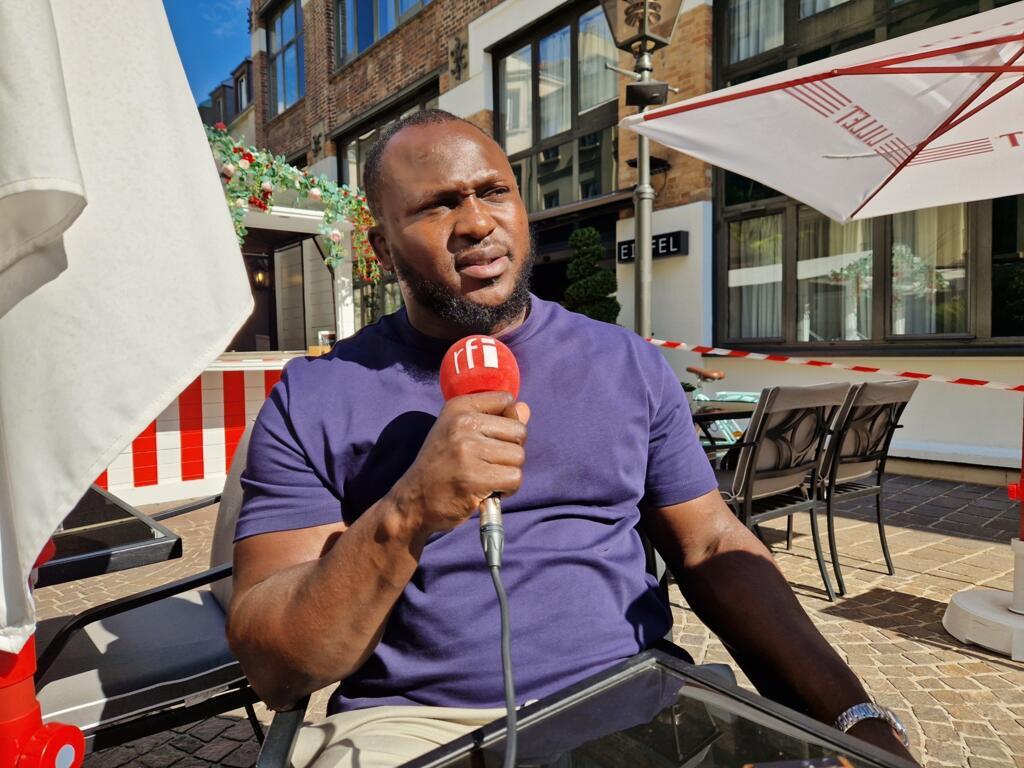
Modou Lô talks to RFI in Paris, 21 August, 2025. © ©RFI/Ndiassé SAMBE

RFI: Does being king of the arena mean getting involved in politics?

I think when it comes to politics, everyone has the right to an opinion – to share it, to discuss it – because no one knows everything. I feel I have that right, but not necessarily by joining a party or asking people to support a particular politician. I’m not in that position yet, but I won’t hold back from giving my view on affairs concerning working-class neighbourhoods.

As someone from Parcelles Assainies [a suburb of Dakar] who wants the best for my neighbourhood, I wouldn’t rule out local involvement after retiring from sport. If politics gives me an opportunity to develop Parcelles and improve people’s lives, I wouldn't hesitate.

RFI: At 39, how much longer do you see yourself in the arena, given that the age limit has been raised from 45 to 48?

Honestly, I don’t think I’ll go that far – not even 45. I have a lot of projects lined up. I’ll do a few more fights and then leave the stage to my younger brothers. They’re very talented: Franc, Gora Sock, Petit Lô, Calva, Seydina... the list goes on. They have great potential, and with the right guidance they can achieve great things.

Women step into the ring at west African wrestling tournament

RFI: You seem very close to Franc, the new sensation who’s beaten Bombardier, Ama Baldé and Eumeu Sène in succession. How do you know one another?

We're both from Parcelles Assainies. He lives in Unit 7, I’m in Unit 10. We share the same “curse”: a love of wrestling. He’s young and building a great career. We got close because I needed sparring partners and he came highly recommended. Along with others like Gora Sock, he helped me to progress. He’s been by my side for years, always there for my fight preparations, very loyal. Now he’s making his own way. He’s an incredible talent, really strong, and making waves in the arena. We all believe he’ll go far.

RFI: Do you see him as your successor?

Of course. He’s already done something unique: 15 fights, 15 wins. That’s a huge achievement. He’s young but experienced – he’s put in the miles, travelling across the country to compete in tournaments, train and develop his skills. We’re here to support him and help him reach the very top.

RFI: You’ve fought 26 bouts since starting in February 2006. Which fight stands out the most?

My first fight against Eumeu Sène in 2014 [Modou Lô also won the rematch in July 2019 to claim the crown]. That was a major moment – a battle that lasted nearly 30 minutes, full of strikes and pure wrestling. It was brutal, and by God’s grace, I won. It was the longest and toughest fight I've ever had.


RFI: Many Senegalese athletes – especially footballers – have to go abroad to earn a decent living. Does wrestling pay in Senegal?

Absolutely! Wrestling has grown massively in recent years. Even before us, there were stars like Falaye Baldé, Double Less and Mbaye who made a living from it. Then Tyson and Yékini took it to the next level, bringing huge excitement and big money. Now, our generation – mine and Balla Gaye 2’s – is pushing it further. So yes, you can make a very good living from wrestling in Senegal, support your family and even help people you don’t know.

That said, your sporting career is short – you can wrestle until about 45, which is still young. Sport, wrestling, opens doors to other opportunities. I’m also an entrepreneur now. The money I earn from wrestling allows me to invest in other areas, create jobs and share the benefits with many others.

No pain, no gain: Chinese pro wrestlers fight for recognition

RFI: Many wrestlers have moved into MMA in recent years. Is that an option for you?

No, honestly, MMA is for my younger brothers. One of them, Petit Lô, is already involved, along with other hopefuls from Parcelles. I have no desire to fight in MMA – I just want to finish my wrestling career quietly and then retire. But it’s true MMA is a great opportunity for Senegalese wrestling. Not everyone gets fights every year, so it gives wrestlers a reason to keep training.

RFI: We can’t talk about Senegalese wrestling without mentioning mysticism. It's seen as essential to winning, beyond strength and technique. Wrestlers use ritual baths and charms to ensure victory. You were once considered one of the most mystical wrestlers, but in your last three winning fights you wore no charms, which worried your fans. Why?

For me, mysticism isn’t as important as people think. First and foremost, this is a sport. I see mysticism as part of wrestling culture – like the pre-fight dances – a bit of folklore for the fans that helps keep wrestling alive. Sporting competitions happen all over the world, but only in Senegal do we mix mysticism and sport, thinking it can influence the result.

It’s true I once believed in it, but over time I realised mysticism wasn’t what made me win. Victory comes through giving everything you've got – 100 percent effort in training.

Grease, sweat and tears for Turkey's Ottoman oil wrestlers

RFI: The big news is your next fight against Sa Thiès on 5 April, 2026. What do you think about the hype around it?

It’s true – it’ll be a huge fight. I can even say this was a demand from society; everyone wanted it. I’ve always said that as king, I’d give young wrestlers their chance – I did it with Ama Baldé, Boy Niang and Siteu, and I’m still on that path. Sa Thiès has had some great fights lately, but he’s never had the chance to fight for the crown. People talked about a bout with Tapha Tine, but the fans chose Sa Thiès. And it’s only right to give them what they want.

RFI: Sa Thiès is the younger brother of Balla Gaye 2, who beat you twice in your three career defeats. Is this a proxy revenge fight?

Not at all! Sa Thiès is Balla Gaye 2’s younger brother but this isn’t about revenge. They’re brothers, but they fight differently. It’s simply the logic of wrestling – he’s on my path, so I’ll move him aside and continue on mine.

RFI: Can fans still hope for a rematch against Balla Gaye 2?

It could have happened, but it didn’t. And I really don’t think it ever will.

How singing has shaped human history, from rituals to resistance

From religious worship to battle songs, singing has always been at the heart of human tradition. It is a form of expression, solidarity, memory and resistance. Songs tell the story of societies across the world.


Issued on: 31/08/2025 - RFI

Catholic nuns sing during a Requiem Mass in honour of Pope Francis at the Holy Family Basilica in Nairobi, 25 April, 2025. AFP - LUIS TATO

"If we consider that singing is vocalising with breath, then humans have always sung," said Nathalie Henrich Bernardoni of the French National Centre for Scientific Research (CNRS), who specialises in vocal sciences.

"I think that they even started before they spoke, because ultimately it's easier to vocalise before structuring syllables and words – that's what babies do."

The first songs are impossible to date, but the earliest traces appear in Antiquity once writing developed to record them. Egyptian civilisation used song in rituals.

The oldest known piece comes from Mesopotamia: The hymn to Nikkal, dedicated to the deity of the same name. It is written almost in its entirety in cuneiform script, a writing system that developed in Mesopotamia around 3000 BC, on tablets dating from 1400 BC.

From this period onwards, singing had a religious dimension – in Mesopotamia, then Greece and the Roman Empire – a tradition seen today in church hymns, Hindu bhajans and Islamic nasheeds.

"In all forms of spiritual practice, the singing voice is omnipresent. It is also a characteristic that shows that singing has powerful virtues and accompanies the development of the self, by seeking what is deepest within," said Bernardoni.

How France's songs keep world dreaming of French freedom and glamour

More generally, vocal expression plays a crucial role in the cohesion of human groups – and therefore also plays a part on a political level.

Pierre Loiret, an author and expert in Gregorian chanting, gives this example: "For Charlemagne, who spread Gregorian chant throughout his empire, it was a way of unifying through song."

Bernardoni adds: "Singing is both an intimate discovery of oneself and a source of identity. It allows you to explore the possibilities of your own instrument, but also to connect with a community."

Fans sing as they watch British band New Order at the Clockenflap music festival in Hong Kong, 29 November, 2015. AFP - ANTHONY WALLACE

Transmission of traditions

Many regimes have feared this unifying and mobilising effect, and have sought to censor voices raised in song.

In 1985, American singer Stevie Wonder had his music banned in South Africa after he criticised the apartheid regime in his song It's Wrong (Apartheid) and dedicated the Oscar he won the same year (for I Just Called to Say I Love You) to Nelson Mandela, who was a political prisoner at the time.

In Canada’s residential schools, which removed indigenous children from their families for nearly a century, traditional songs were banned. Authorities saw them as an obstacle to “civilising” First Nations children and breaking their ties with ancestral culture.

Cameroon's indigenous Baka sing to save their vanishing forest home

Canadian influencer Shinanova, who is of Inuk descent, is among those reclaiming this part of her heritage. She shares traditional Inuit vocal practices on TikTok.

"For many of us Indigenous people, throat singing was forbidden. Christian priests considered it a sin. We almost lost this tradition, but today we are stronger and we sing for those who couldn't," she says.

Singing is an essential vehicle for cultural transmission between generations, particularly in oral societies. In West Africa, this is embodied by the figure of the griot.

As storytellers, historians, poets and musicians, they are local authority figures and play a central role in preserving traditions, particularly through song.


A man of the Samburu tribe sings during the Marsabit Lake Turkana Culture Festival in Loiyangalani, Kenya, which aims to promote tourism and build better relationship between tribes, 28 June, 2018. AFP - YASUYOSHI CHIBA


Interpretation of song is also an important marker of local culture.

"We specialise in the sung use of our [voice] according to the aesthetics we are immersed in, according to the culture in which we evolve," points out Bernardoni.

Yodelling in the Alps or among Central African Pygmies, beatboxing, Mediterranean polyphony – all show the range of what the voice can do. Some traditions demand years of training.

Some of these vocal traditions require rigorous training and expertise that is passed down from generation to generation.

"What's fascinating is that in traditions that are geographically very distant, such as Mongolian overtone singing and the deep voices of Sardinian singing, we find the same fundamental vocal gestures," added Bernardoni.

With singing bringing together people who share the same culture and creating cohesion, it can also play an important role in the face of adversity, as with war songs.

They serve as much to galvanise troops as to impress and intimidate, such as Lakota war songs – traditional songs sung by the Lakota people to accompany various stages of warfare, from recruiting and departure to battle and victory. In this sense, singing becomes a weapon in the arsenal.
Liverpool fans raise their scarves and sing at the English League Cup final between Liverpool and Newcastle United at Wembley Stadium in London, 16 March, 2025. 


Connecting with nature

This idea of a song imbued with power is also found in many shamanic traditions. Power songs are used in rituals to invoke various forces. In the Amazon, shamans use icaros, songs sung during ayahuasca ceremonies.

They are also found in Inuit, Siberian and Aboriginal practices, where the vocal organ becomes a medium of communication between humans and the invisible world, or the natural world.

This link between vocal expression and nature is fundamental in many traditional societies. For many indigenous peoples, singing is a way of connecting with the earth, ancestors and animals.

Many indigenous songs follow natural cycles, from the seasons to animal migrations. They mark rain, harvests, births and hunts. Some imitate birds or other creatures to connect with the natural world.

Beyond its cultural, spiritual and identity-related dimensions, singing also has profound physiological and psychological benefits.

"Singing activates a different type of breathing than speech, one that is fuller and more dynamic, which may explain the feeling of wellbeing it provides," explains Bernardoni. This deeper breathing has a calming, meditative effect. Singing can also help to limit cognitive and physical decline in people with neurodegenerative diseases.

All the more reason, she concludes, to "fight for a world where people dare to sing more".

This article was adapted from the original version in French.

SOLIDARITY FOREVER 1970 LEONARD COHEN

A CLEAR AND PRESENT DANGER!

Firing Trump's most lunatic lackey is now a matter of life and death

Ray Hartmann
August 29, 2025 
ALTERNET


Bear with me on this one.

I know that to 99 percent of readers, headlines reading “CDC Director Fired” fall squarely into the daily category of “Trump stupidity that I don’t want to hear about.” Fair enough. Especially if it reads, “Susan Monarez Won’t Quit” and no one knows who Monarez is.

This one’s a little different.

Monarez was confirmed as Centers for Disease Control and Prevention (CDC) director on Trump’s enthusiastic nomination just 29 days ago, on a straight party-line vote of the U.S. Senate. Nothing unusual there.

But here’s the rub: The 47 Democratic “no” votes were tied to Monarez’s refusal to distance herself from the rantings of Robert F. Kennedy Jr. — the twisted soul dubbed Secretary of Health and Human Services by Trump. Conversely, being Trump’s pick was the only possible consideration of 51 Republican senators.

Then an unusual thing happened. Shortly after Monarez received the keys to her office door, she started feuding with Boss Bananas because he (RFK Jr.) is, after all, not playing with anything resembling a deck of 52 when it comes to the public health. Or much of anything.

Here’s how it played out, according to New York Times reporting.
Kennedy Jr. summoned Susan Monarez, the director of the Centers for Disease Control and Prevention, to his office in Washington earlier this week to deliver an ultimatum.

She needed to fire career agency officials and commit to backing his advisers if they recommended restricting access to proven vaccines — or risk being fired herself, according to people familiar with the events.

So what does Monarez do? She immediately starts doing precisely what all the Democrats demanded, which was to push back against RFK Jr.’s natural instincts to Make America A Dark Ages Pit of Death Again. (That’s MAADAPODA if you’re looking to put it on a T-shirt.)

RFK Jr. demanded her resignation on the spot, not surprisingly. Initially, the White House said nothing, briefly leaving a question as to whether an initial refusal to resign would matter. It didn’t.

Trump fired Monarez, five weeks to the day he had said this about her:
“As an incredible mother and dedicated public servant, Dr. Monarez understands the importance of protecting our children, our communities, and our future. Americans have lost confidence in the CDC due to political bias and disastrous mismanagement.”

Four top CDC officials resigned in protest within four hours of RFK Jr.’s attempt to evict Monarez. Mind you, they — and Monarez — were presumably part of Trump’s MAHA braintrust until, say, 15 minutes ago.

And the two who spoke out most vocally weren’t especially shy:
“People of dubious intent and more dubious scientific rigor (are now) in charge of recommending vaccine policy. Their desire to please a political base will result in death and disability of vulnerable children and adults.” — Dr. Demetre Daskalakis, director of the National Center for Immunization and Respiratory Diseases.“Recently, the overstating of risks and the rise of misinformation have cost lives…If [Monarez] leaves, we don’t have scientific leadership anymore” — Dr. Debra Houry, CDC Chief Medical Officer.

As a footnote, the typically reticent American Public Health Association apparently snapped, calling Kennedy’s leadership “reckless mismanagement” and flatly stating: “RFK Jr. must be removed from his position.”

Unfortunately, that sort of condemnation from rational people with vast medical and scientific credentials might be precisely what Kennedy needs to survive. But it does seem to me that people who care about the collective health of our country — regardless of tribe or ideology — really ought to be speaking out.

As best as I can tell, Sen. Patty Murray, (D-Wa), has been the only Democrat willing to call for Kennedy’s firing. Where’d everyone else in her party go?

As Drs. Daskalakis and Houry told us, Kennedy’s derangement is a matter of life and death. We have no idea where this is headed.

But the nation will require a healthy dose of luck for this story to wind up as just more Trump noise.


'Endangering Every American's Health': 9 Former CDC Chiefs Sound Alarm on RFK Jr.

Their "astonishing, powerful op-ed," said one professor, "drives home what we are losing and what's already been lost."


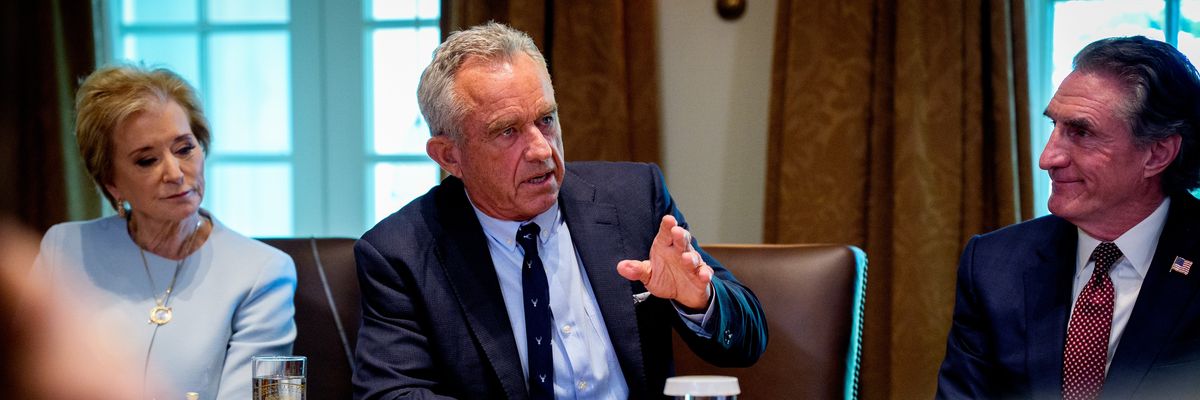
US Health and Human Services Secretary Robert F. Kennedy Jr. speaks during a Cabinet meeting at the White House on April 30, 2025 in Washington, DC.
(Photo by Andrew Harnik/Getty Images)

Jessica Corbett
Sep 01, 2025
COMMON DREAMS

Nearly every living former director or acting director of the US Centers for Disease Control and Prevention from the past half-century took to the pages of The New York Times on Monday to jointly argue that Health and Human Services Secretary Robert F. Kennedy Jr. "is endangering every American's health."

"Collectively, we spent more than 100 years working at the CDC, the world's preeminent public health agency. We served under multiple Republican and Democratic administrations," Drs. William Foege, William Roper, David Satcher, Jeffrey Koplan, Richard Besser, Tom Frieden, Anne Schuchat, Rochelle Walensky, and Mandy Cohen highlighted.

What RFK Jr. "has done to the CDC and to our nation's public health system over the past several months—culminating in his decision to fire Dr. Susan Monarez as CDC director days ago—is unlike anything we have ever seen at the agency, and unlike anything our country has ever experienced," the nine former agency leaders wrote.

Known for spreading misinformation about vaccines and a series of scandals, Kennedy was a controversial figure long before President Donald Trump chose him to lead HHS—a decision that Senate Republicans affirmed in February. However, in the wake of Monarez's ouster, fresh calls for him to resign or be fired have mounted.


As the ex-directors detailed:
Secretary Kennedy has fired thousands of federal health workers and severely weakened programs designed to protect Americans from cancer, heart attacks, strokes, lead poisoning, injury, violence, and more. Amid the largest measles outbreak in the United States in a generation, he's focused on unproven "treatments" while downplaying vaccines. He canceled investments in promising medical research that will leave us ill-prepared for future health emergencies. He replaced experts on federal health advisory committees with unqualified individuals who share his dangerous and unscientific views. He announced the end of US support for global vaccination programs that protect millions of children and keep Americans safe, citing flawed research and making inaccurate statements. And he championed federal legislation that will cause millions of people with health insurance through Medicaid to lose their coverage. Firing Dr. Monarez—which led to the resignations of top CDC officials—adds considerable fuel to this raging fire.

Monarez was nominated by Trump, and was confirmed by Senate Republicans in late July. As the op-ed authors noted, she was forced out by RFK Jr. just weeks later, after she reportedly refused "to rubber-stamp his dangerous and unfounded vaccine recommendations or heed his demand to fire senior CDC staff members."

"These are not typical requests from a health secretary to a CDC director," they wrote. "Not even close. None of us would have agreed to the secretary's demands, and we applaud Dr. Monarez for standing up for the agency and the health of our communities."

After Monarez's exit, Trump tapped Jim O'Neill, an RFK Jr. aide and biotech investor, as the CDC's interim director. Critics including Robert Steinbrook, director of Public Citizen's health research group, warn that "unlike Susan Monarez, O'Neill is likely to rubber-stamp dangerous vaccine recommendations from HHS Secretary Kennedy's handpicked appointees to the Advisory Committee on Immunization Practices and obey orders to fire CDC public health experts with scientific integrity."

The agency's former directors didn't address O'Neill, but they wrote: "To those on the CDC staff who continue to perform their jobs heroically in the face of the excruciating circumstances, we offer our sincere thanks and appreciation. Their ongoing dedication is a model for all of us. But it's clear that the agency is hurting badly."

"We have a message for the rest of the nation as well: This is a time to rally to protect the health of every American," they continued. The experts called on Congress to "exercise its oversight authority over HHS," and state and local governments to "fill funding gaps where they can." They also urged philanthropy, the private sector, medical groups, and physicians to boost investments, "continue to stand up for science and truth," and support patients "with sound guidance and empathy."

Doctors, researchers, journalists, and others called their "must-read" piece "extraordinary" and "important."

"Just an astonishing, powerful op-ed that drives home what we are losing and what's already been lost," said University of Michigan Law School professor Leah Litman. "We are so incredibly fortunate to live with the advances [of] modern medicine and health science. Destroying and stymying it is just unforgivable."


'Crazy': Top Trump advisor mocked after claiming RFK Jr. is a 'public health expert'

U.S. Health and Human Services (HHS) Secretary Robert F. Kennedy, Jr., attends a cabinet meeting with President Donald Trump, at the White House in Washington, D.C., U.S., August 26, 2025. REUTERS/Jonathan Ernst

August 29, 2025 
 ALTERNET

Secretary of Health and Human Services Robert F. Kennedy Jr. — an environmental lawyer, former leader of a children’s anti-vaccine organization, and a promoter of conspiracy theories — is being praised by White House Deputy Chief of Staff Stephen Miller as a “foremost” global health expert and a “crown jewel” of the Trump administration.

Kennedy has no medical degree or formal training, nor does he hold any degrees in public health.

Secretary Kennedy’s challenges this week include his attempt to fire the newly confirmed Director of the Centers for Disease Control and Prevention, and announcing that most Americans will not be eligible to receive COVID vaccines without a doctor’s prescription and at least one underlying health condition. (Future CDC advisory panel regulations may alter that landscape.)

Kennedy was assailed by medical experts this week when he declared that, while walking through an airport, he could see the “mitochondrial” illness and inflammation of children, which he claimed he could detect “from their faces, from their body movements and from their lack of social connection.”

Miller, who also holds no medical degree, told reporters on Friday (video below) that “the CDC’s credibility was shattered during the COVID era.”

“CDC used to be, of course, seen widely around the world as a premier health agency, and much of the world discovered in the last few years, that CDC was actually staffed by a lot of very partisan, and very political bureaucrats who weren’t at all concerned about public health and weren’t actually very knowledgeable about public health,” he baselessly alleged.

“And we are working hard, and more importantly, Secretary Kennedy — one of the world’s foremost voices, advocates, and experts on public health — is working hard to restore the credibility and the integrity of CDC as a scientific organization committed to the scientific method, and getting to the root causes of the public health epidemic in this country,” Miller continued.

Asked if there are any concerns about Secretary Kennedy’s leadership, and despite the resignations this week of top CDC scientists in response to the President’s firing of the CDC Director, Miller declared, “Secretary Kennedy has been a crown jewel of this administration who’s working tirelessly to improve public health for all Americans.”

Critics blasted Miller.

“Calling RFK Jr. ‘one of the world’s foremost experts on public health’ with a straight face is crazy,” wrote The Lincoln Project.

“I’m a an MD, PhD, physician toxicologist and drug developer. This is the biggest pile of horse-s– I have seen in months of horses–,” declared Peter H Proctor MD, PhD.

Watch the video below or at this link.


'Stood up to fascist forces': CDC official blasts 'cowardice' of Trump 'and his minions'


FILE PHOTO: U.S. President Donald Trump looks on as he meets South African President Cyril Ramaphosa in the Oval Office of the White House in Washington, D.C., U.S., May 21, 2025. REUTERS/Kevin Lamarque/File Photo
August 27, 2025 
ALTERNET

One top official at the Centers for Disease Control and Prevention (CDC) recently submitted his resignation letter to President Donald Trump's administration, and lobbed several parting shots at both Trump and the MAGA movement.

In a lengthy 1,200-word post to his official X account on Wednesday, Dr. Demetre C. Daskalakis — who was the CDC's Director of National Center for Immunization and Respiratory Diseases — publicly laid out his reasons for resigning from the CDC, where he's been since 2020. Daskalakis strongly rebuked Department of Health and Human Services Secretary (HHS) Robert F. Kennedy Jr.'s crusade against vaccines, and told his followers that despite multiple ongoing threats to public health like the spread of measles and the avian flu, he had never personally been briefed on HHS' policies on the response to those outbreaks since RFK Jr. was confirmed.

"The intentional eroding of trust in low-risk vaccines favoring natural infection and unproven remedies will bring us to a pre-vaccine era where only the strong will survive and many if not all will suffer," Daskalakis wrote. "I believe in nutrition and exercise. I believe in making our food supply healthier, and I also believe in using vaccines to prevent death and disability. Eugenics plays prominently in the rhetoric being generated and is derivative of a legacy that good medicine and science should continue to shun."

The outgoing CDC official also noted that his resignation was not in response to the shooting at the CDC's Atlanta office earlier this month, in which a lone gunman fired hundreds of shots at the agency's building. Daskalakis said his decision to leave the agency was out of a sense of duty he felt to his grandfather (and his namesake), who he said died fighting fascism.

"My grandfather, who I am named after, stood up to fascist forces in Greece and lost his life doing so. I am resigning to make him and his legacy proud," he wrote. "I am resigning because of the cowardice of a leader that cannot admit that HIS and his minions’ words over decades created an environment where violence like this can occur. I reject his and his colleagues’ thoughts and prayers, and advise they direct those to people that they have not actively harmed."

As a longtime gay activist, Daskalakis criticized the Trump administration's "recklessness" in its efforts to "erase transgender populations, cease critical domestic and international HIV programming and terminate key research to support equity." He also emphasized: "The nation’s health security is at risk and is in the hands of people focusing on ideological self-interest."

Daskalakis' resignation was part of a series of high-profile resignations at the CDC on Wednesday evening. The Washington Post initially reported that CDC director Susan Monarez — who was confirmed by the U.S. Senate less than a month ago — had been fired, though in a statement issued by her attorneys, Monarez maintained that she had not been given any notice of her dismissal by the White House and that she did not plan to resign from her role. Monarez's statement also accused the Trump administration of compromising public health to serve a "political agenda."


Click here to read Daskalakis' full resignation letter.


'Should frighten every American': Health experts sound alarm over 'total implosion' of CDC


Robert F. Kennedy Jr. and Republican President-Elect Donald Trump greet each other at a campaign event sponsored by conservative group Turning Point USA, in Duluth, Georgia, U.S., October 23, 2024. REUTERS/Carlos Barria/File Photo/File Photo

August 28, 2025
ALTERNET


Medical, legal, and political experts are sounding alarms amid the Trump administration’s attempt to fire the newly confirmed Director of the Centers for Disease Control and Prevention, which triggered a mass exodus of top CDC officials resigning in protest, including one with a damning public resignation letter that went viral.

“The White House said late Wednesday that it had fired Susan Monarez, the new director of the Centers for Disease Control and Prevention, after a tense confrontation in which Health Secretary Robert F. Kennedy Jr. tried to remove her from her position,” The New York Times reported. “A lawyer for Dr. Monarez said in response that she was refusing to step down.”

Attorneys for Dr. Monarez, a microbiologist and public health official, said that only the President can fire her.

But in response to her attempted ouster, four top CDC officials resigned:


Dr. Debra Houry, Chief Medical Officer and Deputy Director for Program and Science
Dr. Daniel Jernigan, Director of the National Center for Emerging and Zoonotic Infectious Diseases
Dr. Jennifer Layden, Director of the Office of Public Health Data, Science, and Technology
Dr. Demetre Daskalakis, Director of the National Center for Immunization and Respiratory Diseases

In his scathing letter of resignation, Dr. Daskalakis wrote in part that Health and Human Services Secretary Robert F. Kennedy Jr.’s views “challenge my ability to continue in my current role at the agency and in the service of the health of the American people. Enough is enough.”

“I am unable to serve in an environment that treats CDC as a tool to generate policies and materials that do not reflect scientific reality and are designed to hurt rather than to improve the public’s health.”

He pointed to this week’s changes to the adult and children’s immunization schedule that “threaten the lives of the youngest Americans and pregnant people.”

In a much-circulated excerpt, Dr. Daskalakis wrote that the “data analyses that supported” the decision to change the immunization schedule “have never been shared with CDC despite my respectful requests to HHS and other leadership. This lack of meaningful engagement was further compounded by a ‘frequently asked questions’ document written to support the Secretary’s directive that was circulated by HHS without input from CDC subject matter experts and that cited studies that did not support the conclusions that were attributed to these authors.”

He added: “Eugenics plays prominently in the rhetoric being generated and is derivative of a legacy that good medicine and science should continue to shun.”

Dr. Daskalakis warned that “Their desire to please a political base will result in death and disability of vulnerable children and adults. Their base should be the people they serve not a political voting bloc.”

EXPERTS RESPOND

“There is a [wholesale] destruction of leadership at the CDC,” warned Dr. Ashish K. Jha, a top medical scholar who served as the White House Coronavirus Response Coordinator in the Biden administration. “The newly confirmed Director is out. Most of the top leaders who run key centers have resigned en masse. Total implosion. All because of @SecKennedy leadership.”

“What a complete disaster,” he added.

Lawrence Gostin is a professor of medicine and public health, and a co-faculty director of the O’Neill Institute for National and Global Health Law.

“Monarez by law can only be fired by the president who has been silent. RFK fired her & she refuses to go. The sheer chaos is notable in addition to the lawlessness & thinly veiled attack on science & the CDC. Once the shining crown of federal agencies, CDC is now gutted,” Professor Gostin wrote. He added that Monarez’s firing “shows clearly that science is now a matter of political orthodoxy and blind political loyalty, rather than evidence-based. Make no mistake. Monarez lost her job because she wouldn’t fall in line with RFK’s anti-vaccine agenda.”


U.S. Rep. Ami Bera (D-CA), a medical doctor, called Daskalakis’ letter “chilling,” and warned, “RFK Jr. is driving out dedicated public health experts because they refuse to rubber-stamp his dangerous views on vaccines.”

“Their resignations make clear that they are no longer being allowed to do their jobs to protect the health and safety of the American people.”

MSNBC anchor Lawrence O’Donnell, a former congressional staffer, called Daskalakis’s statement “nothing less than the most important federal government resignation letter in history.”

U.S. Senator Patty Murray (D-WA), a top Democrat on the Health Committee, called for Secretary Kennedy’s termination: “We cannot let RFK Jr. burn what’s left of the CDC and our other critical health agencies to the ground—he must be fired.”

Dr. Craig Spencer, a globally recognized public health expert, emergency medicine physician, and Associate Professor of the Practice of Health Services, Policy, and Practice, wrote:

“What’s happening at the CDC should frighten every American. Regardless of whether you are MAGA, MAHA, neither, or don’t give a damn about labels or politics. It’s unclear whether the CDC director—confirmed just weeks ago—has been fired or not. Absolute s–. And incredible career professionals resigned tonight, sounding a massive alarm. This is pure chaos that leaves the country unprepared.”

“Imagine cases of Ebola in the U.S. right now?” added Dr. Spencer, who once contracted the disease. “We would be an absolute mess. It’s easy to tune this all out, to celebrate what you might see as ‘cleaning house’, or just not care what’s happening. But I promise you, when confronted with the next serious health threat, we will quickly see everything we’ve lost. We will regret this. I promise, we will regret this.”


Trump Taps 'Manifestly Unqualified' Peter Thiel Protégé as Acting CDC Director After RFK's Purge

A health researcher for Public Citizen said Trump's interim CDC director has "no medical or public health background and extremist libertarian views."

STRAIGHT OUT OF CENTRAL CASTING AS J EDGAR HOOVER FBI GUY

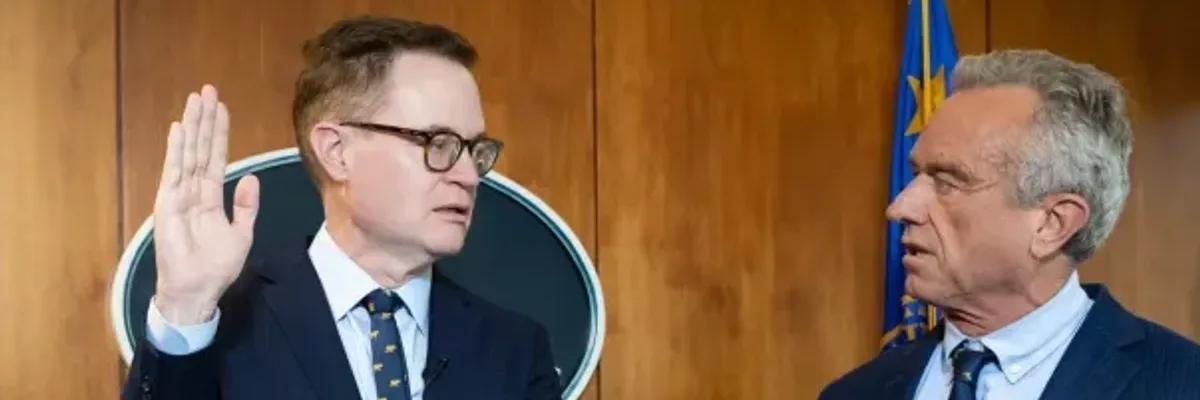
Jim O'Neill, now the interim director of the Centers for Disease Control and Prevention (CDC), is shown being sworn in as the deputy secretary of health and human services by Secretary Robert F. Kennedy Jr. on June 9, 2025.
(Photo by the US Department of Health and Human Services)

Stephen Prager
Aug 29, 2025
COMMON DREAMS

After pushing out his own handpicked Centers for Disease Control and Prevention (CDC) director, infectious disease expert Susan Monarez, fueling a wave of outraged resignations this week, US President Donald Trump has appointed a loyal acolyte to replace her at Health and Human Services Secretary Robert F. Kennedy Jr.'s side.

On Thursday, the president tapped one of RFK's top aides as interim CDC director: biotech investor Jim O'Neill, a man with no medical experience but extensive experience profiting from healthcare while working at billionaire GOP megadonor Peter Thiel's venture capital firm, Mithril Capital.

RECOMMENDED...


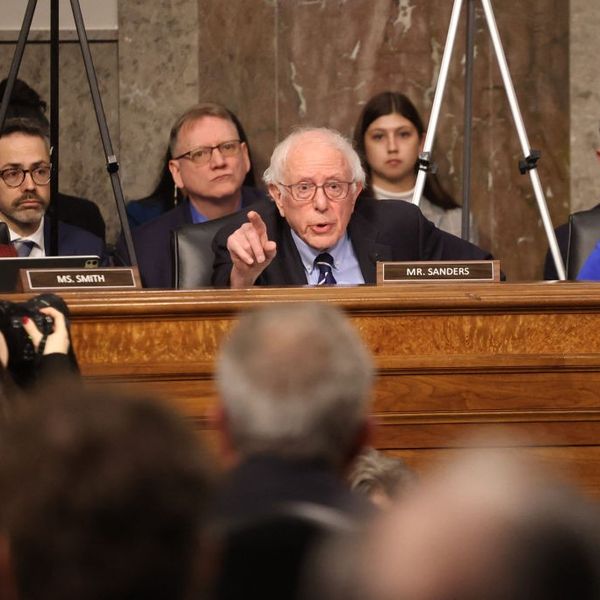
Sanders Demands Congress 'Immediately' Investigate Firing of CDC Director


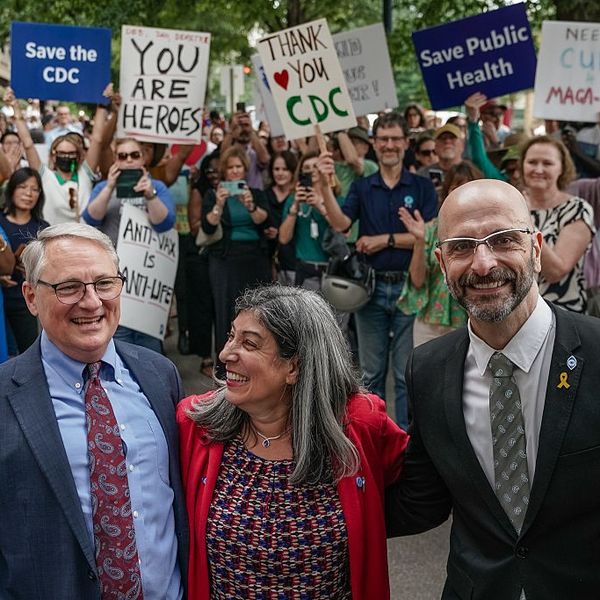
'You Are Heroes': CDC Staff Stage Mass Walkout in Support of Officials Who Resigned in Protest

Unlike his predecessor, whose ouster came as she tried to push back against RFK's anti-vaccine agenda, O'Neill fits snugly into the secretary's efforts to restrict access to the Covid-19 vaccine, and potentially ban it outright, as the Daily Beast reported earlier this week.

"A tech investor with no medical or public health background and extremist libertarian views, Jim O'Neill was unfit for the number two position at HHS and manifestly unqualified to lead the CDC," said Dr. Robert Steinbrook, director of Public Citizen's health research group, on Friday.

Just as Kennedy did during his confirmation hearings, O'Neill insisted he was "pro-vaccine," noting that he was "an adviser to a vaccine company." However, this is belied by his record on the subject.

He has championed unproven cures like ivermectin, hydroxychloroquine, and vitamin D supplements to protect against Covid-19, and has accused the CDC under the administration of former President Joe Biden of downplaying the vaccine's dangers while railing against mandates.

O'Neill has also praised Kennedy's response to the measles outbreak that swept across the US earlier this year, during which the secretary downplayed the severity and cast unfounded doubt on the effectiveness and safety of the measles vaccine that had virtually eradicated the disease before vaccination rates began to decline.

"Unlike Susan Monarez," Steinbrook said, "O'Neill is likely to rubber-stamp dangerous vaccine recommendations from HHS Secretary Kennedy's handpicked appointees to the Advisory Committee on Immunization Practices and obey orders to fire CDC public health experts with scientific integrity."

O'Neill melds medical crankery with a Thielite strain of anarcho-libertarianism. He has served on the board of the Seasteading Institute, an organization founded by Patri Friedman, the grandson of the right-wing economist Milton Friedman, who advocates for corporations like Apple and Google to form their own floating cities at sea, which would be governed as corporate "dictatorships" free from the constraints of democratic governance.


That anti-government ethos extends to his views on the healthcare system, which O'Neill says is flawed not because of the rampant profiteering of the private companies that run it, but because it is supposedly not "free market" enough.

In 2014, he advocated for the Food and Drug Administration (FDA) to begin approving drugs for the market without conducting clinical trials to determine their effectiveness. "Let people start using them, at their own risk," he argued, "Let's prove efficacy after they've been legalized."

He has also argued for the government to allow people to sell their own internal organs. This process often results in deteriorating health for the disproportionately poor people who partake.

While working at HHS under the administration of former President George W. Bush, O'Neill also opposed the FDA regulation of companies that use algorithms to perform laboratory tests.

At the time, he was focused on DNA testing products like 23andMe, but a report from the consumer watchdog group Public Citizen says that "a decade after he made this remark, it's clear how dangerous such a concept is," noting that "with the development and proliferation of artificial intelligence, algorithms are omnipresent in the practice of medicine, including in diagnostic tools, medical devices, AI assistants to doctors, and personalized medicine."

In addition to Thiel's ideology, he reportedly brings several conflicts of interest to the CDC director job from his time working at Thiel's venture capital firm.

Accountable.US reported Friday that O'Neill "took money from, helped incubate, or was otherwise linked to at least eight medical industry startups with direct business before the department he could help run."

These include firms he advised, like the pharmaceutical company ADvantage Therapeutics or the National Institutes of Health grantee Rational Vaccines, which manufactures herpes drugs.

It also includes four companies seeded by his Thiel-affiliated venture capital firm Breakout Labs, some of which have received government funding or have products awaiting FDA approval.

Though O'Neill agreed to divest from some of these companies and abstain from involvement in decision-making with them as part of his ethics agreement, the report notes that "he did not promise to abstain from decisions involving these companies for the duration of his term, or to abstain from doing business with them after departing HHS."

"O'Neill would be in a prime position to ensure favorable outcomes for several medical industry startups he's been financially linked to that have direct business before HHS and the CDC," said Accountable.US executive director Tony Carrk. "How can American patients be sure that proper vetting of these companies would take place on O'Neill's watch and that public health will be a higher priority over the profits of his former clients?"

Though Steinbrook describes O'Neill as "manifestly unqualified" for the position, he said, "No credible public health authority is likely to work for Kennedy, who is dictating the agency's decisions based on whim, not science."

"The only path forward," Steinbrook said, "is for Kennedy to go, which Congress, professional organizations, medical journals, and the public should demand."

'Children in this country are in the most dangerous position ever': Doctor issues warning

Sarah K. Burris
August 28, 2025 
Senior Editor
RAW STORY


Doctor vaccinates child patient. (Arlette Lopez/Shutterstock.)

Dr. Susan Monarez was forced out of President Donald Trump’s administration after she refused to endorse purported junk science promoted by Health and Human Services Secretary Robert F. Kennedy Jr. and his allies. Several other top experts at the Centers for Disease Control and Prevention (CDC) and at HHS also resigned in protest, similarly refusing to approve the allegedly false medical information.

This exodus of experts at the nation’s top public health agencies is putting U.S. children at risk for the return of once-eradicated diseases. The Johns Hopkins Bloomberg School of Public Health reports that measles cases have reached their highest levels since the disease was declared eliminated in the United States in 2000.

Dr. Paul Offit, Director of the Vaccine Education Center at the Children’s Hospital of Philadelphia, told MSNBC that completely healthy young children have died due to the resurgence of measles in the past 33 years.

"For the first child deaths in this country since 2003, that's more than 20 years ago. And what has Robert F. Kennedy Jr. done about that? He's gone on national television and said falsely [that the] measles vaccine kills people. Measles vaccine causes blindness and deafness, and measles — that natural measles — can prevent cancer and heart disease and autoimmune disease, which is just completely wrong."

Meanwhile, Kennedy is asserting there are “deep problems in the CDC,” sowing further public confusion.

"See, the problem is, Robert F. Kennedy Jr. believes that by choosing vaccination in this country, we have merely replaced infectious diseases with chronic diseases. He says that over and over again," explained Dr. Offit. "He thinks that no vaccine is safe and effective. He thinks that the covid vaccine is the deadliest vaccine ever made. So, it's not surprising that he would be upset that the CDC lists vaccines as one of our greatest public health achievements, even though it is."

Dr. Offit called Kennedy "a frightening man" for giving such junk science legitimacy.

"And I feel like for the first time, really with him as head of Health and Human Services, that children in this country are in the most dangerous position they ever have been," he warned.

See the clip below or at the link here.


Sarah Burris is a long-time veteran of political campaigns, having worked as a fundraiser and media director across the United States. She transitioned into reporting while working for Rock the Vote, Future Majority and Wiretap Magazine, covering the Millennial Generation's perspective during the presidential elections. As a political writer, Burris has had bylines at CNN, Salon.com, BNR, and AlterNet and serves as a senior digital editor for RawStory.com.
Women in Media Center
See Full Bio


Trump’s 'steep cuts' are putting national parks on an 'unsustainable and dangerous path'

September 01, 2025
TRUTH OUT

Although President Donald Trump's "big, beautiful bill" includes $75 billion in additional funding for U.S. Immigration and Customs Enforcement (ICE), many other federal government agencies are being aggressively defunded by the second Trump Administration — from the U.S. Social Security Administration (SSA) to the Internal Revenue Service (IRS) to the National Weather Service (NWS) to the U.S. Department of Veterans Affairs (VA). And Trump has flirted with the idea of eliminating the Federal Emergency Management Agency (FEMA) altogether.

Another agency that is experiencing mass layoffs is the National Parks Service.

In an article published on Labor Day 2025, The New York Times' Eileen Sullivan reports that "at least one-fifth of the country's 433 parks have been significantly strained and understaffed because of steep cuts mandated by the Trump Administration, according to internal government data obtained by The New York Times."

"Staffing at the National Park Service had been steadily shrinking in the past decade because of tightened budgets," Sullivan explains. "But it has lost 24 percent of its permanent employees since President Trump took office, according to data compiled by the nonprofit National Parks Conservation Association. Among those who left: more than 1800 park workers who accepted the (Trump) Administration's resignation initiatives, devised to quickly reduce the size of government."


Sullivan notes that although the Trump Administration directed all national parks to remain open, "internal" data from the U.S. Interior Department shows that "more than 90 national parks reported problems between April and the end of July stemming from departures, cuts and a hiring freeze."

"Routine tasks like cleaning and stocking the bathrooms have gone undone," Sullivan reports. "Fewer rangers have given tours and lectures. Visitor centers have reduced hours. And parks have lost millions of dollars because they are unable to staff entrances and collect visitor fees."

Phil Francis, chairman of the Coalition to Protect America's National Parks, fears that the worst is yet to come for the National Parks Service.

Francis told the Times, "Budget cuts and staff reductions have set our national parks on an unsustainable and dangerous path. Some of the impacts of the staff cuts are visible to the public, but many are not yet. And all of this is only going to get worse."

Read Eileen Sullivan's full New York Times article at this link (subscription required).