Saturday, September 06, 2025

UK

Angela Rayner’s treatment shows the double standards that punish the ambition of working class women


Photo: HCLG/Flickr

On 28 March 1980, a girl was born into a working-class family in Stockport. Raised in poverty on a council estate, she defied the odds to become Deputy Prime Minister of the United Kingdom. Her name is Angela Rayner — and her resignation this week is more than a political moment. It is a stark reminder of the snobbery and double standards that still shape Britain’s relationship with class.

Rayner’s journey has always been a lightning rod for prejudice. Her accent, her appearance, her unapologetic pride in her roots — these have been weaponised against her by a media and political class that claim to represent ordinary people, yet recoil when one of them rises to power. To many, her departure feels like a cruel message: that no matter how high you climb, class contempt follows close behind.

Her resignation, prompted by her mistakenly underpaying stamp duty and thus breaching the ministerial code, was handled with integrity, and was the correct thing to do. She self-reported, cooperated fully, and stepped down — restoring a sense of ministerial responsibility absent for over a decade. Compare this with the evasions and cover-ups of Conservative ministers, and the contrast is stark. But the bigger story is how Rayner has been treated throughout her time in public office.

When she was photographed vaping on a boat, she was mocked relentlessly. When she danced behind DJ decks in Ibiza, she was branded irresponsible. When she wore designer clothes — purchased with her own money — she was vilified. Yet Nigel Farage smokes cigars on magazine covers and is praised for his “authenticity.” The message is unmistakable — working people shouldn’t aspire, shouldn’t enjoy success, shouldn’t step beyond the limits imposed on them.

The hypocrisy is glaring. The Guardian reports that Farage channels income from GB News through a private company, paying corporation tax rather than higher income tax. He has previously been linked to a trust fund in the Isle of Man to reduce his inheritance tax. Reform UK’s deputy leader Richard Tice has historically funnelled millions into the tax haven of Jersey. And the Conservatives have their own record, from Nadhim Zahawi’s murky settlement with HMRC to countless loophole-laden arrangements. These are not minor oversights; they are deliberate strategies to avoid paying their fair share.

Reform UK likes to brand itself the party of patriotism. But what could be less patriotic than tax avoidance? Millionaires lecture the public on thrift while dodging their obligations to the state. Their deputy leader, Lee Anderson, once claimed meals could be cooked for 30p — a soundbite that trivialises poverty and insults those living through it. Yet these are the self-styled champions of the working man.

Few politicians in recent memory have been subjected to such sustained personal attacks as Rayner. That she withstood them as long as she did is testament to her resilience — and to the popularity that made her such a threat to the right. After news broke of the investigation, her property in Hove was vandalised with graffiti. Online abuse directed at her, and worse, at her family, has risen sharply in recent days — emboldened by right-wing politicians seeking cheap political points. The contempt is laid bare.

Of course, Labour must do more and do it faster. Working people are still waiting for the transformative change they were promised. Rayner’s departure should be a moment for the party to ask itself how it protects working-class voices within its own ranks, and how it ensures social mobility is not just celebrated for a single figure but made real for millions. That means serious investment in education and skills, genuine action on housing, fixing the economy and implementing a tax system that ensures the wealthiest pay their fair share.

You only need to listen to Farage’s Party Conference speech this year to understand who he is seeking to protect. A key claim he made around how ‘rich people are leaving the country’ demonstrates Reform’s priorities. They aren’t seeking to help normal working people. They simply need their votes to protect the rich elite who they exist to serve. 

Angela Rayner represents everything that Nigel Farage and his ilk despise – a woman who worked her way from a council estate to the Cabinet table, carrying her politics with her. For the Labour movement, her rise remains a source of pride — and a reminder of the kind of social mobility we should be striving to make possible for the next generation.

To every young working class woman out there who sees Angela Rayner as a role model – do not let the hate and bile deter you from this. Because across our country, there are millions of young people with huge potential but are being held back by a broken society that works against them. Angela’s story is one of hope and hard work, and regardless of the circumstances behind her departure from Government, her story stands strong.

If Britain is to become a fairer society, we must confront the double standards that punish working-class ambition and shield elite entitlement. Angela Rayner’s story is not just about one politician. It is a mirror held up to a nation still deeply uncomfortable with the idea that power might come with a Stockport accent. Her absence from government will be felt — but her example endures as a challenge to Labour, and to the country, to prove that social mobility can be more than a story of one exceptional woman.


‘A proud trade unionist and a tireless advocate for working people’: Tributes paid to Angela Rayner after resignation

YESTERDAY
Left Foot Forward

'Angela Rayner has achieved more in the last year than most politicians achieve in a lifetime - a trailblazer for working class kids from backgrounds like ours.'


Tributes are being paid to Angela Rayner after she resigned from the government after the prime minister’s ethics adviser found she had breached the ministerial code over her underpayment of stamp duty on her £800,000 seaside flat.

Rayner has resigned as deputy prime minister and housing secretary as well as deputy leader of the Labour Party. The Prime Minister’s ethics adviser Sir Laurie Magnus said Rayner had “acted with integrity” but concluded that she had breached the ministerial code.

Sir Magnus said that although Rayner had sought legal advice when buying the property, she failed to seek further expert tax advice as recommended.

Writing to the PM, Rayner said she accepted she “did not meet the highest standards” when purchasing her property. “I deeply regret my decision to not seek additional specialist tax advice given both my position as housing secretary and my complex family arrangements”, she said.

News of her resignation has prompted a number of senior Labour Party MPs to pay tribute to Rayner, including the Prime Minister who wrote a handwritten letter, saying he is “very sad” to see her go.

The Prime Minister also said that Rayner would “remain a major figure in our party” and would “continue to fight for the causes you care so passionately about”, adding: “I have nothing but admiration for you and huge respect for your achievement in politics. I know that many people of all political persuasions admire that someone as talented as you is the living embodiment of social mobility.”

Wes Streeting also paid tribute to Rayner, writing on X: “Angela Rayner has achieved more in the last year than most politicians achieve in a lifetime – a trailblazer for working class kids from backgrounds like ours.

“When those kids have a council house, when their mums and dads have better rights and pay, they’ll have her to thank.”

Ed Miliband wrote: “Angela Rayner is one of the great British political figures of our time.

“Generations will grow up with stronger rights at work and in new homes because of her vision and leadership.

“I know she will continue to stand at the front of the fight for social justice in this country.”

Darren Jones, Chief Secretary to the Prime Minister added: “Angela Rayner achieved a huge amount for the country this past year – record investment in council housing and better pay and rights at work.

“For our Labour movement Angela is the embodiment of social mobility and an inspiration to those of us from working class backgrounds.”

Emily Thornberry also praised Rayner for her work on workers’ rights, adding: “She has made a real difference and improved the lives of millions of people.

“That is something to which we should all aspire.”

Labour Unions posted on X: “Our solidarity and thanks to Angela Rayner – a proud trade unionist and a tireless advocate for working people.

“In Government, she has championed workers’ rights by driving through the Employment Rights Bill, when the usual suspects lined up to block it. She’s put collective rights front and centre, to give power back to working people.

“We look forward to continuing to work with Angela to stand up for working people and their families, and to continuing to work with the Labour Government to deliver the New Deal for Working People in full.”

Basit Mahmood is editor of Left Foot Forward


Angela Rayner resigns from government and as deputy leader over tax scandal


Angela Rayner. Photo: Ministry of Housing, Communities and Local Government.

Angela Rayner has resigned from the government over a scandal involving her tax affairs.

It comes after the deputy Labour leader referred herself to the Standards Advisor after admitting she did not pay enough tax on a second home.

Rayner had claimed she had paid the right amount of stamp duty on the apartment in Hove following legal advice, but referred herself to the Sir Laurie Magnus after a senior barrister found she should have paid a £40,000 surcharge on the property.

However, following an investigation by Sir Laurie, the deputy Labour leader today resigned from her roles as Deputy Prime Minister, Housing Secretary, and deputy leader of the Labour party.

Subscribe here to our daily newsletter roundup of Labour news, analysis and comment– and follow us on BlueskyWhatsAppX and Facebook.

Her departure has triggered a reshuffle, and there will now have to be an election for deputy leader of the Labour party too.

It is understood the NEC will be meeting shortly to set a timetable and procedural guidelines for the election.

In a letter published to X, Rayner thanked Keir Starmer for his “personal and public support”.

“I deeply regret my decision to not seek additional specialist tax advice given both my position as Housing Secretary and my complex family arrangements. I take full responsibility for this error.

“I would like to take this opportunity to repeat that it was never my intention to do anything other than pay the right amount.”

However, she said she had decided to resign due to “the findings, and the impact on my family”.

In a handwritten response letter, Starmer said he was “very sad” her time in government had ended this way.

“Although I believe you have reached the right decision, it is a decision which I know is very painful for you. You have given your all to making the Labour government a success, and you have been a central part of our plan to make Britain thrive for working families.”

A supportive backbench MP told LabourList: “We all knew she was doing a good job in the housing brief. What’s happened seems to owe more to carelessness (than) to avarice.
“I’m sure she will play a big role in politics in the future”.
Luke Akehurst MP said the news was “very sad”.
“My heart goes out to Angela and her family. Nothing can take away her achievements in the Labour Party, in getting us back into power, and in delivering for working people in government.”

Alex Charilaou, Momentum Co-Chair, said: “This is an opportunity for a well overdue debate about the change of direction the country and Labour so desperately need.

“We need a full contest, per the Party rulebook, to debate vital points like a wealth tax, an end to the privatisation of our services and action to halt the genocide in Gaza.”

While campaign group Compass said her resignation was “an issue of technicality not morality”

“If the Prime Minister wanted to put his arm round her and keep her then he could have.

“With Labour tanking in the polls and shedding members in their droves Keir Starmer has the opportunity to reset his administration in a way that reflects all wings of Labour and changes not just the top team but the direction of the government.

“While some might call for the post of Deputy Leader to be scrapped, the need for debate, democracy and accountability in the party has never been greater.”

UK


Could electoral reform rein in the right?


SEPTEMBER 3, 2025

A new report from Compass says that proportional representation helps tame the populist right, while first past the post leads to their ideas being adopted wholesale. Mike Phipps considers the arguments.

One of the most potent arguments often used against electoral reform – proportional representation in particular – is that it would allow far right parties like Reform UK, which currently win only a handful of seats under first past the post, to win scores, perhaps hundreds, of seats and wield real influence over the governmental process. A new report from Compass, The Temper Trap: How Proportional Representation Tames the Populist-Right, aims to tackle that argument head-on.

Compromise versus explosion

Across Europe, in countries that use PR, populist right movements have not only surged in support but have entered government. Britain under first past the post has been spared this fate. But for the report’s author Stuart Donald, the picture is not so clearcut. He believes that proportionality, with its insistence on  political compromise, moderates populist right party participation in coalition governments – and subverts their ability to posture as anti-establishment outsiders.

“PR tempers populist voices, forcing compromise and limiting damage,” he argues. “By repressing their representation, FPTP acts like a pressure cooker, generating resentment that then erupts in massive political ruptures away from the two-party duopoly.”

Worse, we now face the prospect, if polls are accurate, of a Reform UK majority in Parliament based on just a third of the votes cast. But even if that does not happen, considerable damage has already been done.

The UK, suggests Donald, “has delivered some of the most extreme policy outcomes in Europe on immigration, asylum, EU relations, social justice and climate – not through fringe parties, but via its ‘centre-right’, the Conservative Party. Despite never having a parliamentary majority, Reform UK and its spiritual predecessor UKIP have transformed the political landscape under FPTP. They never needed seats to have power. Instead, the last 15 years have shown how they have forced the Conservatives, and now Labour, to continually bank to the right for fear they lose vote share.”

He adds: “The electoral dynamics of FPTP appear to compel Labour in the same direction, offering a tepid, triangulated version of Tory and Reform policies not out of conviction but out of political paranoia.”

The Netherlands provides the core case study in Donald’s report. In 2023, Geert Wilders’ PVV (Party for Freedom) won the most votes but had to surrender its most extreme policies to enter government. Eventually the coalition collapsed when it refused further compromise. Finland, Austria, and Sweden tell a similar story.  

“Even in Italy, where Populist-Right voices are in the majority in cabinet, PR has slowed and softened their agenda,” Donald contends. “But in the UK, supposedly protected from extreme politics by their lack of representation, FPTP has delivered a hard Brexit, Europe’s most brutal deportation policy, rampant austerity, reckless deregulation, and some of the most aggressive net zero rollbacks enacted in Europe to date – all at the hands of a party that is still labelled both by itself and the UK political establishment as a ‘centre-right’, mainstream voice. Arguably too much of this agenda has continued under a centre-left Labour government.”

Is this really so?

As a supporter of proportional representation, I wanted to be persuaded by these arguments. But they are not flawless. PR in the countries Donald cites may have tempered the extremism of populist right parties but it has also given them legitimacy. It could further be argued that it was PR elections to the European Parliament that gave legitimacy to UKIP – Farage’s original incarnation – and more importantly, financial resources too.

Equally, while Donald is right to say that first past the post discourages moderation and produces more extreme choices, that also makes it harder for the populist right to claim that the entire political establishment is identical – a key feature of their campaign against consensus politics across Europe.

Donald’s argument that FPTP has forced the Conservatives – and now Labour – to adopt the agenda of the populist right is also problematic. While it is indisputable that this drift has happened, it is by no means clear that this is a consequence of FPTP. New Labour’s lurch to the right in the 1990s was a political choice. It was not the case that a more left wing programme would have risked political defeat, as Donald suggests. In reality, public opinion was consistently to the left of what Tony Blair was offering in 1997.

As I have previously pointed out: “Over 70% of voters in May 1997 wanted an income tax increase to fund better education and public services. 74% wanted no further privatisations. 58% wanted wealth redistribution. Blair would disappoint on all these fronts.”

Similarly, the Tory lurch rightwards this century was a political choice, starting with the Cameron government’s lazy miscalculation that it could win a referendum on continued EU membership, and continuing through the May-Johnson years. The Tories’ need to move rightwards because of the rise of UKIP on their right can be overstated: Farage’s party picked up only one seat in the 2015 general election.

Equally, the continued rightward trajectory of the Conservative Party was not guaranteed  in advance.  The quest for an ever-harder Brexit  was less about UKIP calling the shots and more to do with Boris Johnson’s determination to seize the Tory Party leadership.

The limits of this ‘moving right show’ were underlined by the disastrous Truss government and the decisive rejection of the Tories at the 2024 general election. Reform UK;s surge was important – but their continued popularity has much to do with the complete failure of the Starmer government to map out a popular and engaging vision of reconstruction. This vacuum has allowed the nationalist right to dominate the headlines.

If Labour is now borrowing from the populist right playbook in the hope of puncturing Farage’s popularity, that too is a political choice – and a doomed one. Anti-migrant exclusionary nationalist ideas will not be defeated by adopting them but by challenging the entire narrative that drives them.

This helps explain why Labour is doing so poorly in the polls, just fifteen months into its term. On key economic issues, like public ownership, austerity and welfare, the public is to the left of Starmer – in fact, more aligned with current Green Party and Your Party thinking. But to move in this direction would be unthinkable to the likes of Morgan McSweeney and others around Starmer, whose primary political passion is a desire to smash any remnants of Corbynite thinking – even if the consequences are electorally toxic. And this too is a conscious political choice, not some inevitable outgrowth of first past the post.

The fact that Donald’s argument falls short does not exonerate our current voting system. Proportional representation is fairer on many counts, but for socialists, a central question must be agency and engagement. A closed party list system, even if strictly proportional, would be useless from this standpoint, if it allowed party leaders to appoint their hardcore loyalists to all the most winnable positions. That would be no better than a first past the post system where democratic selection is increasingly supplanted by the parachuting into safe seats of leadership favourites, as is increasingly the case.

We need a proportional system with a constituency link which not only improves democratic accountability for voters but also enhances democratic selection of candidates too. Open primaries should be considered, alongside other reforms to improve participation and engagement.

Ultimately, you cannot leave the business of dealing with the far right to any electoral system. If you want to defeat them, you have to defeat their ideas and persuade people not to vote for them. There are many good reasons to have PR, but this report’s argument that a fairer voting system can neutralise the populist right – at the price of giving them legitimacy – is not persuasive.

The Temper Trap: How Proportional Representation Tames the Populist-Right is available here, by Stuart Donald, published by Compass is available here.


Mike Phipps’ book Don’t Stop Thinking About Tomorrow: The Labour Party after Jeremy Corbyn (OR Books, 2022) can be ordered here.

UK

Why we oppose ‘rent convergence’


SEPTEMBER 4, 2O25

The government is consulting on “How to implement social rent convergence”. The Labour Campaign for Council Housing explains what convergence is and why we are opposed to it.

Rent convergence was a policy introduced by John Prescott in 2002. Council housing and housing association rents were to be brought into alignment over ten years. As the House of Commons Library explains, “A rent formula was established with actual rents moving towards a national formula rent which took account of property values and local earnings relative to national earnings.”

It’s a complicated formula (see Note below). It set annual rent increases at the level of the Retail Price Index + 0.5% + up to £2 a week, the latter being the ‘catch-up’ element. The policy was justified on the spurious grounds of overcoming ‘confusion’ over the difference between council and housing association rents and giving tenants greater choice.

In fact council rents were historically around 20% lower than housing association rents, for a reason well known. Councils could borrow money more cheaply from the government’s Public Works Loans Board, whereas housing associations had to borrow money at higher interest rates from commercial sources.

In practice, convergence meant driving council rents up to housing association levels. It was designed to facilitate ‘stock transfer’ of council housing to housing associations. The government set a target of transferring 200,000 homes a year. Chancellor Gordon Brown saw it as a means of removing council housing debt from the Public Sector Borrowing Requirement. He was even prepared to write off council housing debt if tenants voted ‘the right way’, for transfer.

Convergence was also designed to undermine the resistance of tenants to ‘stock transfer’. If council and housing association rents were the same, council tenants would have less reason to oppose transfer, it was thought. The Green Paper, Quality and Choice: A Decent Home for All, which proposed convergence, gave the game away when it said: “A coherent approach for rent setting in the two tenures would be more equitable and could make it easier for stock transfers.”

As a result of this policy, rent increases outpaced inflation. In England, the average council rent was £41.17 in 1997. As a result of this policy, by 2010 it had risen to £67.83, 64.7% higher, compared to inflation of 38.8% (ONS).

The Coalition government revised the convergence date to 2015/16. In 2013 they announced that they would change the rent formula to CPI+1%. They subsequently ended convergence and introduced a 1% rent cut, for four years, essentially to cut the housing benefit bill as part of their austerity programme. In 2020 they reintroduced CPI+1% for five years.

The current government consulted on continuing with the Tories CPI+1% for at least five years. (See our submission to the consultation opposing above-inflation rent increases. Government rent consultation: NO to above inflation rent increases – Labour Campaign for Council Housing). As a result of pressure from landlords, they have decided on CPI+1% for 10 years, and the reintroduction of rent convergence. The consultation is on “How to implement social rent convergence” not if to implement it. It poses two possibilities, £1 or £2 a week, and asks for preferences on how many years convergence should be applied.

Rent arrears have doubled

In the 23 years since convergence was first introduced,tenants have had above inflation rent increases in 19 of them. It’s no wonder that since 2015-16 rent arrears in England have nearly doubled from £203 million to £397 in 2023/4.

The English Housing Survey 2023/24 showed 59% of social housing households have at least one member in long-term ill-health or disabled. Some of these will lose money from the cut to the Universal Credit health element. The scale of poverty is reflected in their estimate of 73% households having no savings, making them especially vulnerable to the smallest change of circumstances. The phenomenon of tenants faced with the choice of ‘eating or heating’ increasingly impacts on more tenants. CPI+1% and rent convergence will surely drive up arrears and will increase the housing benefit bill for the government. Their impact assessment says that a £2 a week convergence increase will cost the exchequer £4 billion in increased social security spending.

The gap between actual rents and formula rent does not appear to be that great – an average of £5.74 in England (though £9.14 in London). Yet when tenants are struggling to get by financially, month by month, even relatively small increases can push them over the edge. Combined with CPI+1%, convergence will hit hard those people whose rent is not covered by housing benefit or the housing component of Universal Credit. Pensioners will be heavily impacted. The impact assessment estimates that pensioners who receive no housing support will see their rent increase to 26.6% of income nationally, and 36.9% in London.

How long would convergence take? Of 179 local authorities for which data is available, 167 of them have an average rent below the formula rent level. With the £2 a week option, just 14% of them would converge in the first year of the policy, while 17 would take five or more years.

Even when rents reach the formula, its connection to house values is likely to push them further upwards (similar to ‘affordable rent’ which is linked to 80% of market rent). Council housing is not part of the market and rent should not be linked to the market through house prices.

Housing Revenue Account funding crisis

These policies are a substitute – to the detriment of tenants – for adequately funding Housing Revenue Accounts. They will not resolve their funding crisis. The councils that signed Securing the Future of Council Housing warned that Housing Revenue Accounts are unsustainable without more support from central government. They have estimated that they need £12 billion extra over the next five years just to enable councils to improve all the stock to Energy Performance Certificate C. They estimated at least £23 billion would be needed to decarbonise existing homes. Without funding on this scale the condition of existing council homes is likely to deteriorate.

The impact assessment reports that: “In aggregate across all 162 council landlords with Housing Revenue Accounts, spending has exceeded turnover in four of the past five years, leading to a corresponding decrease in aggregate reserves as they are used to cover the shortfall in the ring-fenced account.”

A recent survey by Southwark Council, responded to by 76 councils, found 9 in 10 council housing budgets under financial stress, taking or expecting to need to take substantial action or use emergency funds to balance their books by 2029. For example, 61% of councils have already cancelled, paused or delayed housebuilding projects and more than one third have cut back on repairs and maintenance of council homes.

The scale of the funding crisis of Housing Revenue Accounts is reflected in the proposal of the Chartered Institute of Housing, suggesting that a debt write-down of £17 billion would be necessary to make them sustainable. We have suggested going further, explaining why there is a good case for cancelling council housing debt.

We believe there needs to be a campaign for adequate funding for HRAs and an end to above-inflation rent increases rather than trying to increase funding by making rents increasingly unaffordable for those who don’t have it all covered by housing benefit. As the Chartered Institute of Housing has observed: “In theory, it would be possible to change rent policy to allow rents to increase faster and to a higher level – but there would be extra costs in terms of increased benefits payments and risks in terms of social rents beginning to approach or exceed market rents if this was pursued over an extended period.”

In fact rents are now high enough that it has become more common for tenants on the waiting lists to be turned down for a tenancy because they are judged to be unable to afford the rent. If they cannot afford a council or housing association rent, what can they afford?

The declared objective of the government in implementing ten years of above-inflation rent increases and rent convergence is “to provide private registered providers and local authority registered providers with the rental income and stability they need to be able to borrow and invest in both new and existing homes, while ensuring there are appropriate protections for both existing and future social housing tenants and taking account of the impact on the government’s fiscal rules.”

In reality this means that the fiscal rules preclude the government from investing beyond its current parsimonious level. “The scale of investment pales by comparison to the scale of housing need…” This is a political choice, of course. They are making tenants pay more for investment in their own and new homes, though at the cost to the Exchequer of up to £4 billion because rents will become increasingly unaffordable to more tenants.

Housing Revenue Accounts have little scope for more borrowing. They pay more than £1 billion a year on debt servicing. In addition, because of the government’s borrowing policy (determined by the Bank of England) interest rates for Public Works Loans Board loans are exorbitantly high at 5.95% for a thirty-year maturity loan (payment of the loan at the end of the loan period). Even with a 0.6% reduction for council housing, they are still well over 5%. In the case of housing associations they are already loaded up heavily with debt. Last year, for the first time since 2009, debt servicing cost more than their income.

Like most consultations, the government has already decided what it will do. The only open question is whether landlords will be able to increase rents above CPI+1% by £1 a week or £2. Most landlords are likely to call for the £2 option. It seems likely that the government will accede to them.

These policies need overturning. Funding councils and housing associations by further impoverishing already poor tenants is no solution to the crisis. The social consequences are unacceptable.

Tenants should not be forced to pay unaffordable rents to substitute for insufficient funding of Housing Revenue Accounts or to subsidise a commercialised housing association sector. Rather than support above inflation rent increases, councils should be seeking the support of tenants to press the government for the funding needed to improve the quality of existing homes, decarbonise them and build/acquire the new homes necessary to bring down the numbers on the waiting list and in temporary accommodation.

A Note on ‘formula rent’

Social rent is set by local councils in line with a formula set by central government. It is a complicated and frankly, bizarre system. The same formula applies to housing association properties.

The basis for the calculation of formula rent is:

  • 30% of a property’s rent is based on relative property values
  • 70% of a property’s rent is based on relative local earnings
  • a bedroom factor is applied so that, other things being equal, smaller properties have lower rents

Weekly formula rent is equal to: 70% of the national average rent, multiplied by relative county earnings, multiplied by the bedroom weight, plus 30% of the national average rent, multiplied by relative property value. However, that is the national (England) average rent from way back in April 2000!

Relative county earnings means the average manual earnings for the county in which the property is located, divided by national average manual earnings, both at 1999 levels!

Relative property value means an individual property’s value divided by the national (England) average property value, at January 1999 prices. These figures are set out in Appendices produced by the Ministry.

Having set the formula rent for 2000-01 for a property it then has to be uprated, for each year thereafter, based on the annual inflation figure. The national average rent to be used in the calculation, is £54.60 for April 2000. The national average property value from January 1999, is £49,750. There is a table for county earnings from 1999 which has to be applied, the average being £316.40.

Example

The Ministry provided an example of a calculation using this formula based on a three-bed property in Leicestershire, for which the capital value for January 1999 was £55,000. The figures on which to apply the formula are:

  • Average rent at April 2000 £54.62
  • Average earnings in Leicestershire £303.10
  • National average earnings £316.40
  • Bedroom weight 1.10
  • National average property value in January 1999 £49,750.

Putting these figures into the formula we have

70% of the average rent 70% x £54.62£38.23
Multiplied by relative county earnings x £303.10 / £316.40£36.62
Multiplied by bedroom weight x 1.10Sub-total £40.29
Subtotal 30% of the average rent 30% x £54.62£16.39
Multiplied by relative property value x £55,000 / £49,750Sub-total £18.12
Adding together the sub-totals £40.29 + £18.12 £16.39 £18.12Total £58.41

The Labour Campaign for Council Housing is calling for support for a statement on rent convergence, available here.

UK

New independent anti-racist reporting and monitoring organisation set up

SEPTEMBER 5. 2025

Former Tribune editor and award-winning writer Taj Ali has set up an independent anti-racist reporting and monitoring organisation to document racist attacks, support victims, pressure authorities to act, and amplify the voices of smaller, more isolated Black and Asian communities across Britain.

“Far too often, racism is either unreported or dismissed as anti-social behaviour,” he writes.  “Our platform will gather verified reports and push to ensure they’re taken seriously by the media and public institutions. Share, report, support.”

RADAR (Reporting and Documenting Acts of Racism) outlines it mission as:

  • Develop and maintain a professional website for reporting and engagement
  • Provide editorial support to ensure accuracy and reach
  • Collect and analyse data to strengthen advocacy and reporting
  • Expand communications and outreach
  • Purchase equipment to enhance coverage
  • Travel to areas where support and documentation are needed most

Last summer marked the worst instance of racist violence in over a century,” says its new website. “Across Britain, more than a dozen towns and cities were impacted, with smaller, more geographically isolated Black and Asian communities particularly vulnerable.

“Since then there has been further violence. In January this year, seven London mosques were daubed with anti-Muslim graffiti. In the following months, others were attacked in Luton, Aberdeen and Sheffield. In April, Muslim graves in Watford were vandalised. In June, worshippers were evacuated from the Belfast Islamic Centre when its windows were smashed and a bomb was thrown inside.

“Most racist attacks against individuals go unreported. When they are reported, they are often dismissed as low level anti-social behaviour and receive scant attention from out political and media class.

“We say enough is enough.”

The organisation aims togather accurate and verified accounts of racist incidents and work to ensure they receive attention from both the media and public institutions. It seeks to provide practical tools and guidance for supporters to contact local MPs, engage the media, and advocate for meaningful responses to racist attacks.

It also aims to ensure victims of racism are linked with supportive networks, organisations, and resources to ensure they are not left to face these challenges alone.

“As a point of principle, we will never accept state funding,” Taj Ali writes on X.  “We are an autonomous independent organisation. And we intend to hold state institutions to account on racism too.”

The left needs more than enthusiasm – we need a real plan


SEPTEMBER 5, 2O25

Gordon Maloney looks forward to The World Transformed 2025.

Keir Starmer’s first year in government has been nothing short of a disaster.

Despite an enormous mandate at the last election, the past year has seen him fall to becoming one of the most unpopular political figures in the UK. Despite repeatedly trying to ingratiate himself with far-right voters for Reform or the Tories, including bizarre attempts to show everyone how much he loves the English flag, this has won over no voters from these parties. At the same time, his repeated betrayals of workers, renters, migrants, and perhaps most consequentially the Palestinian people, have cost him dearly in support from progressives.

Starmer famously quipped that if leftists didn’t like the direction of his new party, “the door is open and you can leave.” It seems like many have. 

And the polling speaks for itself. Labour now routinely trails double digits behind Nigel Farage’s Reform. Starmer’s personal approval ratings, along with those of his cabinet members, are in free fall. Unless something truly enormous happens, Starmer will be handing over the keys to Number 10 straight to Nigel Farage at the next election.

Meanwhile, after a wave of far-right street violence last summer, anti-migrant mobs are once again terrorising Britain’s communities. Rather than confronting their bigotry or addressing the genuine grievances these movements prey on, Starmer’s Labour have offered them political and ideological cover. The contrast with the way Starmer and the police have attacked and criminalised Palestine solidarity activists is yet another example of his revolting hypocrisy.

Starmer’s strategy is not working, and there is a clear and desperate need for a different direction. We cannot continue like this. And that demand for a different direction has been made very explicit in the last few weeks. Eight hundred thousand people have flocked to Jeremy Corbyn and Zarah Sultana’s new party, and eco-socialist Zack Polanski has won a landslide victory in the Green Party leadership election. Across the UK, hundreds of thousands of people are clamouring for something genuinely different – not Reform’s snake oil. People understand what’s at stake, and they know what will happen if Starmer stays on this path.

But enthusiasm alone is not enough. If we want to stop Farage from winning the next election, if we want to stop the far-right thugs emboldened by his politics, if we want to stop militarism, if we want to stop landlords, bosses, and warmongers, the left in the UK needs strategy. We need deep coordination. We need to learn from movements across the world. And we need to plan meticulously for the months and years ahead.

That is exactly what The World Transformed is for. This October, over the course of four days, The World Transformed 2025 will bring together individuals, organisations, and movements from every corner of Britain and beyond to share, to learn, to debate, and most importantly, to plan. Sessions will cover everything from our response to two years of genocide in Palestine, enthusiastically backed by the British government, to the housing struggles that have ignited an unprecedented wave of tenant organising across the UK, and from the rise of militarism to confronting the far-right both directly and by tearing away the poverty and desperation they prey on.

The World Transformed will be a vital place to cut through the impasse and to begin, in earnest, our collective response to the failures not just of Starmer, but of the entire political class since the economic collapse of 2008.

The conference will also, and crucially, be a place for the full movement of the British left to shape these crucial discussions. Delegations from organisations across the UK will be taking part, from trade unions to Black Lives Matter, tenant groups, and international allies such as the Democratic Socialists of America. Because this is not just about conversation, it’s about building the capacity and shared strategies that our movement needs to be able to win. 

The stakes could not be higher. How the left responds to Reform, to Labour, to genocide, will not only determine the electoral fortunes of the next five years and beyond – it will determine life and death for thousands of people both at home and abroad. 

We cannot afford to get this wrong. Join the movement at The World Transformed 2025 to help forge the path forward. 

Gordon Maloney is a member and activist of Living Rent, Scotland’s Tenants’ Union.

QUESTION PERIOD

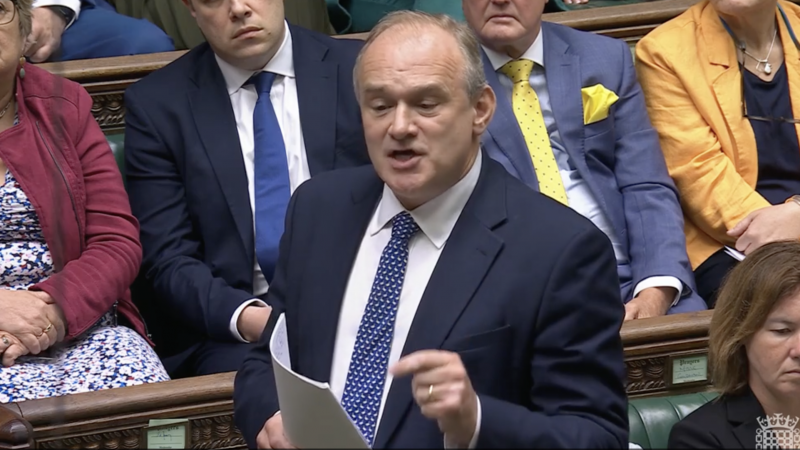
PMQs: Ed Davey slams Reform and Tories for wanting to pull out of the ECHR

3 September, 2025 
Left Foot Forward


The European Convention on Human Rights "protects all our basic rights and freedoms"


The Lib Dem leader Sir Ed Davey condemned Reform UK and the Tories for calling for the UK to withdraw from the European Convention on Human Rights at PMQs today.

In one of his questions to the prime minister, Davey slammed Nigel Farage and Kemi Badenoch for wanting to join Russia and Vladimir Putin by withdrawing from the convention.

Farage and Badenoch want to pull the UK out of the ECHR and other international human rights treaties, as they claim this will make it easier to deport people arriving on small boats.

The Lib Dem leader highlighted that the ECHR protects all of our basic rights and freedoms, including the rights of children, disabled people, domestic abuse survivors and “victims of horrific crimes”.

“It protects care home residents from abuse and families from being spied on by councils,” Davey added.

He asked Keir Starmer “will the prime minister categorically rule out withdrawing from the ECHR or suspending it or watering down our rights in any way.”

The PM said his government will not pull out of the ECHR, however he said “we do need to make sure the convention and other instruments are fit for the circumstances we face at the moment.”

“Therefore, we have been looking at the interpretation of some of those provisions.”

Starmer went on to say “it would be a profound mistake to remove from these instruments”, warning that the first thing other countries who adhere to the convention would do is end their agreements with the UK.

“That would be catastrophic for dealing with the problem we’re actually dealing with,” Starmer added.

Olivia Barber is a reporter at Left Foot Forward
UK

Asylum seekers living in hotels: ‘The narrative that is being painted is not the truth’
Yesterday
Left Foot Forward


Left Foot Forward speaks with refugees about right-wing protests, narratives about asylum seekers and the hotels


Stacey explains that before she came to the UK and was placed in an asylum hotel in Bristol, she Googled asylum seekers’ experiences. “It was like a jail for them and the conditions were really bad,” some people had said online. Stacey didn’t know what awaited her, but when she arrived, she was surprised to find lots of organisations set up to help her and said, “the majority of people were so welcoming and helpful”.

The welcoming atmosphere that Stacey describes has shifted over this summer. Echoing the fevered atmosphere that culminated in the Southport Riots last summer, there has been a rise in protests outside hotels housing refugees. Protests started at the Bell Hotel in Epping, Essex on 13 July, after a resident was charged with sexually assaulting a young girl. Reform and far-right groups have jumped on this case and used it to claim that small boat crossings are making British women and girls unsafe. Since then dozens of protests have taken place in other towns and cities, including Manchester, Dover, Portsmouth, Cardiff, Liverpool and Bristol.

Narratives are circulating that asylum seekers are living in luxury hotels, while Reform’s Richard Tice claimed this week that UK governments “focus more on humans from overseas than British humans”.
The protests

Just before Stacey arrived in Bristol, she heard there had been a protest outside the hotel. A couple of weeks ago, people from an anti-migrant group pitched up outside the hotel and started filming residents.

“There were a couple of people with phones, and they even posted it on YouTube”, she said.

Multiple right-wing, anti-migrant YouTube accounts, including one that posted about Stacey’s hotel, have been circulating videos from asylum hotels, claiming that residents enjoy four-star luxury, receive NHS care on-site, and take part in activities like bike lessons.

Stacey explains as she is fleeing persecution in her country, people videoing residents at the hotel is “frightening”.

“People are looking to kill my family and I, so when I’m in a hotel and I’m coming and going out and people are filming and putting it on social media, they put my life and my family’s life at risk because they’re publicising the name of the hotel,” she says.

Yonas* (not his real name) had to flee worn-torn Eritrea. He moved into a hotel in Bristol in July. He explains that there have been protests outside the hotel twice since he moved in. He says the police came to protect residents, but that the anti-migrant protestors were the minority.

There were around 30 to 40 anti-immigrant protestors compared to over 100 counter protestors.

Yonas says “the majority of people are just welcoming people, they can say hi, they have no problem with you.”

However, he adds: “There are some small groups of people and they just hate to see you.”

He explains that it can make him feel on edge as some people “just insult you or they just look at you in a bad way like they’re looking for trouble”.
Asylum hotels ‘not a luxury’

Yonas, (not his real name), a refugee from Eritrea, says that while people who are against asylum hotels focus on the idea that residents are living in luxury, it’s not the reality.

He tells Left Foot Forward: “In the hotel, it’s just basic things that you can get, you can have a bed and a meal three times a day, just a regular meal.

“It’s not like the way they’re quoting like a fancy place or fancy food. It’s just like regular things, basic things.”

Stacey says: “In one of the videos they mention that we’re having the time of our lives because we have access to a pool, spa and gym, but we have absolutely no access to the gym, pool and spa. None of that is available to us.”

“The residents in the hotel, they are being demonised, and we’re just a product of the system.”

Stacey and Yonas receive £8 a week from the Home Office. Asylum seekers living in a shared house get around £48 per week.

Yonas says, “At least for basic things you can manage with that, but it is not luxury.”
‘Staying in a hotel is not our choice’

Both Stacey and Yonas explain that they would like to be able to work, but as asylum seekers they can’t, which means they have to rely on government support.

“Staying in a hotel is not our choice. They don’t let us work. If they let us work, maybe you fund yourself and your taxes will help the country, but they don’t let us work,” Yonas says.

“A lot of us want to work, want to take care of ourselves, it’s not like we want to depend on the government,” Stacey says, adding “it’s not like you’re getting a decision [on an asylum application] today or in a couple of months”. On average, it currently takes between six months to a year to receive an asylum application decision.
Reform’s linking of asylum seekers and crime

The right is trying to make a link between asylum seekers and crime, in order to push their anti-migrant agenda.

Yonas acknowledges that some asylum seekers may get into trouble, but stresses that this is not representative. “There are really kind people. Most of us are fleeing persecution, torture, and war,” he says. “So because of those small peoples that they don’t need to generalise all,” he adds.

Data from the Centre of Expertise on Child Sexual Abuse shows that in the year to December 2023, where the ethnicity of defendants was recorded (69% of cases), nine in ten were from white backgrounds. White British men were over-represented compared with the general population of England and Wales, and 99% of defendants were men.

Yonas adds: “Whoever did that we condemn it. The majority of this abuse is not only [being committed by] asylum seekers. It’s men in general.”

He says that instead of focusing on the real problems, these narratives “are just scapegoating asylum seekers or those who cannot defend themselves”.
The narrative is wrong

Both Yonas and Stacey say that to some extent they understand the frustration of the British public.

Stacey says that she can see why people would be angry if they’re receiving a negative narrative about immigration.

She says: “If I was getting that narrative just like the British people are getting, I understand why they would be angry, why they would feel like they’re paying taxes just to feed us and so we can live a life they’re not even living.

“But I just want it to be clarified that the life and narrative that is being painted is not the truth within hotels.”

She adds: “We are not here and just receiving benefits, living in a hotel and living a wonderful life as the narrative has been propagated.”

Yonas says: “I understand them somehow [anti-migrant protestors], they are furious, there are a lot of things going on here, but maybe they lose a tree for a forest.”

“I understand their concern but that’s not the main issue. Issues with housing and the NHS are not caused by asylum seekers. Maybe the government’s not funding it. Instead of focusing on the main problem, they need a scapegoat,” he says.

Olivia Barber is a reporter at Left Foot Forward


Opinion

How successive UK governments have created a new rentier economy


Yesterday
 Left Foot Forward.

Governments appease corporations and the super-rich by following the old policies which benefit a few.


A new rentier economy has been constructed and the UK remains trapped in low economic growth. The government must adopt alternative policies.

An often-told story is that Albert Einstein once set an exam paper for his graduate class, and one of his colleagues noticed that the questions were exactly the same as the ones on the last year’s exam paper. How could he set the same exam again, s/he asked? Einstein smiled and admitted that the questions were the same, and added “but the answers have changed”.

Thomas Kuhn in his The Structure of Scientific Revolutions explained that normal science advances by assessing the usefulness of theories in solving puzzles. Unresolved anomalies pave the way for emergence of rival paradigms with better ability to understand and address puzzles.

In contrast, politics isn’t a rational science and is driven by power, appeasement and subservience. The recurring questions about economic stagnation, low investment, faltering public services and poverty are answered with privatisation, arbitrary fiscal rules, real cuts to wages and benefits, and unchecked profiteering as governments feel comfortable with defunct theories.

Here are a few examples of the defunct thinking.

The Private Finance Initiative (PFI) was launched by the Conservative government in 1992 and greatly expanded by the Labour administration of Tony Blair and Gordon Brown. Under PFI, the government contracts with the private sector to design, build, finance and maintain long-life public assets, such as schools, hospitals, roads, prisons, office buildings bridges and tunnels. Since its inception, around £60bn of private money has gone into 700 PFI projects. In return, the government will pay £306bn. For just £13bn of investment, the National Health Service (NHS) has been landed with an £80bn bill. The escalating costs eat into the NHS budget and leave less for frontline services. Around 6.23m people in England are waiting for 7.37m hospital appointments.

It is always cheaper for governments to borrow and build, but they chose the PFI route which ultimately required even more borrowing. Undeterred, the government has revived PFI in guise of Public Private Partnerships (PPPs). This will guarantee corporate profits, constrain the ability of future governments to borrow and put public services under strain.

Privatisation of utilities and public services was supposed to unleash investment and lower bills for customers. That hasn’t been the case. In 1989, water industry in England and Wales was privatised at a price of around £7.6bn. The government wrote-off its debt of £5bn and handed a dowry of £1.5bn to new corporate owners. Thereafter, shareholders invested little in productive assets. Instead, capital has been raised from customers through inflation-busting rise in bills with a promise of investment in infrastructure. No new reservoirs have been built. Over a trillion litres of water a year is lost to leaks. In 2024, raw sewage was dumped in rivers, seas and lakes for 3.61m hours. Since privatisation, companies have paid around £85.2bn in dividends, and have financial liabilities of around £91bn. The government is still looking for a ‘market-based solution’ for an industry with captive customers, no substitute products, no competition and over 1,135 criminal convictions.

Energy is another sector at the heart of the rentier economy. Gas, oil, electricity and the national grid were privatised in the decade to 1990, leading to exploitation. In the 1960s and 1970s, the UK found large quantities of oil and gas in the North Sea. Soon they were privatised and production was subjected to comparatively low rates of tax. Norway also found oil and gas deposits at around the same time but did not privatise. It retained majority equity stake in most oil/gas fields. Since the 1970s, due to privatisation, lower royalty and tax rates, the UK government has collected around $11 a barrel. Norway collected $30 a barrel. Norway ring-fenced the oil/gas revenues whilst the UK squandered them in tax cuts for corporations and the rich. Today, Norway has a sovereign fund of nearly $2 trillion, which funds government spending, whilst the UK faces a public finance crisis and real cuts in public services.

Relatively few companies dominate the UK energy sector. Since the pandemic electricity generation companies have increased their profit margins by 198%, and electricity and gas supply companies have increased their margins by 363%. The fossil fuel industry receives £17.5bn in subsidy and support a year. Since 2002, the government has provided some £22bn of support for electricity produced from biomass. Since 2020, twenty biggest energy companies have made operating profits of over £514bn, a major source of inflation and poverty. The UK has the most expensive household electricity in the world.

To soothe public anxieties, companies promise to spend on infrastructure but then quietly renege. Companies responsible for Britain’s electricity and gas infrastructure have spent £490m a year less than promised on replacing and refurbishing existing assets. The creaking infrastructure is unfit for purpose.

During periods of high wind, the government pays companies up to £180,000 an hour to switch-off wind turbines. At the same time gas plants are paid extra sums to produce more electricity to balance the system and meet demand. For the period September 2021 to April 2025, the cost of balancing the electricity grid came to £11.8bn, and is expected to hit £8bn a year by 2030. Since privatisation, National Grid has returned £27.8bn to shareholders in dividends and another £600m in share buybacks.

Social care has been privatised since the 1980s. On average, 61% of local authority budgets are spent on social care. Private sector, mostly corporations, controls 96.5% of the adult social care market and over 85% of children’s homes. Profitability among the largest care home chains ranges from 11% to 42% of revenues. A 2022 report by the Competition and Markets Authority found the 15 largest children’s home providers made average annual profit of 23% per year. Between 2011 and 2023, 804 out of 816 adult care homes forcibly closed by regulators were run for profit. In the period 2014-2023, 48 of the 53 children’s homes forcibly closed were operated by corporations.

Corporate sector gets easy ride elsewhere too. The NHS is doling out cataract surgery contracts to the private sector, operating on profit margins of between 32% and 43%. Cash extraction reduces resources for other NHS services, and endangers people’s lives. Governments could expand the NHS capacity by building new facilities or by buying out private sector clinics, but they haven’t. They could support local authorities and not-for-profit organisations to take over social care, but haven’t. The government has promised to “develop a business case for the use of Public Private Partnership (PPP) for Neighbourhood Health Centres” i.e. further parts of the NHS will be handed to the private sector with guaranteed profits. Cash extraction would ensure that money buys less.

Exploitation and lack of investment isn’t confined to monopolies, oligopolies and the privatised sector. BHS was a major high street clothing, home furnishings and electrical goods retailer. In 2005, its parent company paid a dividend of £1.3bn, equivalent to next five year’s profits. The necessary distributable reserves were manufactured through a series of intragroup transactions. £1.2bn went to the CEO’s wife and was funded by borrowing of about £1bn. As a result, the company was unable to make sufficient investment. In 2015, BHS was sold for £1, and collapsed in 2016. It owed around £1.3bn to creditors. Its pension scheme had a deficit of £571m. The company always received a clean bill of health from its auditors PricewaterhouseCoopers. For the 2015 audit, the firm had programmed its audit partner to spend just two hours on the audit of BHS and its parent company. No government wants to upset giant corporations and the City of London by imposing meaningful reform of company law, corporate governance, or auditing requirements.

A major reason for low economic growth is that a large proportion of the population lacks money to buy goods and services. This is compounded by transfer of what was once pubic debt to household debt. Unlike many other European countries, England charges university tuition fees and there are no general maintenance grants. At the end of March 2025 students and their families were hobbled by debt of £267bn, depleting the spending power of households.

Governments ritually transfer wealth from poor to the rich. Successive governments manage inflation by hiking interest rates, which forces people to handover a larger portion of their money to banks. This boosts bank profits, enriches shareholders and widens inequalities. Millions struggle to pay mortgages, rents and other bills, and cut consumption. Faced with lower demand many businesses reduce investment in productive assets, the very thing that governments lament. An alternative would be to remove cash through selective higher taxes from those with bulging wallets. But governments continue with failed policies, and the UK economy continues to stutter.

The above are a handful of examples to show that major political parties are locked in a silo of neoliberal policies. Regardless of the crisis and circumstances, same dose of policy prescriptions is repeated; privatisation, PFI, unchecked profiteering and reduction is purchasing power of the masses. This has not delivered investment or economic rejuvenation. A new rentier economy has been constructed and the UK remains trapped in low economic growth, deepening inequalities and rising public discontent. Rival paradigms exist but governments appease corporations and the super-rich by following the old policies which benefit a few.

Image credit: Lauren Hurley / Number 10 – Creative Commons


Prem Sikka is an Emeritus Professor of Accounting at the University of Essex and the University of Sheffield, a Labour member of the House of Lords, and Contributing Editor at Left Foot Forward.