It’s possible that I shall make an ass of myself. But in that case one can always get out of it with a little dialectic. I have, of course, so worded my proposition as to be right either way (K.Marx, Letter to F.Engels on the Indian Mutiny)
Monday, September 29, 2025
Northern Dynasty receives $12M royalty payment as government talks continue
The Pebble project (Image courtesy of Northern Dynasty Minerals)
Northern Dynasty Minerals (TSX: NDM) (NYSE-A: NAK) says it has received another $12 million payment from its royalty investor while it continues to have talks with the US government on the approval of the company’s flagship Pebble project in Alaska.
The payment is part of a royalty financing agreement signed with an unnamed investor in July 2022 for Pebble, touted as one of the world’s largest copper-gold-molybdenum resources. However, the proposed mine has faced stern local opposition and undergone a protracted period of review due to its location near the Bristol Bay watershed, where some of the world’s largest sockeye salmon fisheries reside.
Under the royalty agreement, the investor can make five payments to the company totalling $60 million. The latest payment represents the fourth tranche, bringing the total royalty investment to date to $48 million. The maximum payment would give the investor the right to purchase 10% of the payable gold production and 30% of payable silver production from the Pebble project.
“We appreciate the continued support from our royalty investor and are pleased to see the fourth payment of $12 million completed,” said Ron Thiessen, Northern Dynasty’s president and CEO, in a press release.
“This $12 million investment, when combined with the several million dollars of inflow from the exercise of stock options and warrants this summer, and when added to our second quarter closing cash balance of C$25.2 million ($18.5 million), gives us a strong treasury position as we move the project forward.”
Project status
The status of the Pebble project, as it stands, remains uncertain after the US Environmental Protection Agency in 2023 blocked the company’s Alaskan subsidiary from storing mine waste in the area, essentially killing the project.
In a bid to overturn that decision, Northern Dynasty filed actions against the EPA with the federal courts and is currently in talks with the Agency regarding a potential settlement. On the company’s part, it must provide an updated mine proposal to the EPA, but to date, it has yet to make a submission despite encouragement from government officials.
While it is unclear what changes to the project could appease EPA officials, any modification to the handling of mining waste could help address concerns raised since President Donald Trump’s first term in office.
“We continue to have discussions with the government about withdrawing the veto and remain optimistic for a positive outcome,” Thiessen stated in a press release on Friday. “Withdrawal of the illegal veto will be a step towards developing this very large new source of copper and rhenium, as well as significant amounts of gold, molybdenum and silver.”
If built, the Pebble mine would be the largest copper, gold and molybdenum extraction site in North America. A 2023 economic study estimated that it would produce 6.4 billion lb. of copper, 7.4 million oz. of gold and 300 million lb. of molybdenum, plus 37 million oz. of silver and 200,000 kg of rhenium, over 20 years.
Shares of Northern Dynasty closed the Friday session 5.3% higher at C$1.59 apiece, its highest in two months. The stock had plunged in mid-July following reports of insider selling and a potential stalemate with the EPA. The company’s market capitalization currently stands at C$877.3 million ($629 million).
(Article originally published in July/Aug 2025 edition.)
The first six months of the year were a rollercoaster of ups and downs and backs and forths as the markets seesawed between highs and lows. The lows came in mid-April, shortly after April 2 – so-called "Liberation Day" – when Trump unleashed a wave of threatened tariffs on the world. The highs came both before and after Liberation Day but mainly after as all three indices set new records.
It was a nonstop blast, all right. For the record, the Nasdaq and S&P 500 were up over five percent for the six months while the Dow rose nearly four percent. Not earthshaking, but better than the alternative, especially in view of all the doomsday scenarios that rose up in response to a seeming unending series of crises.
"Nothing ever happens" is the new meme on Wall Street.
Despite wars, tariffs, spending bills, inflation, trade deficits, tax cuts – you name it – none of it seems to matter. Consumers and investors alike just shrug it off. The markets keep going up. So sit back and relax. Not to worry. In the end, it's all good.
Here's how Randy Forsyth put it in a recent Barron's piece:
But mainly, the first half gave rise to the investment meme of "Nothing ever happens," insofar as the stock market is concerned. Trade wars and the uncertain impact of tariffs on the economy; fiscal fights over the Big, Beautiful tax bill that resulted in the U.S. losing its last triple-A credit rating; and conflicts in the Middle East, including the U.S. bombing of Iranian nuclear sites on June 22. After all of that, the S&P 500 and the Nasdaq Composite are ending the first half at record highs.
And he's optimistic about the second half of the year:
Forget about the proverbial "wall of worry" that bull markets supposedly ascend. The new belief, "Nothing ever happens," is actually relevant to stocks and helped induce individual investors to buy the steep dip in April and May, putting a lie to all the hand-wringing. By halftime, the mood had swung back to FOMO, or fear of missing out.
CRYPTO & GOLD
The seemingly blasé approach of investors in the equity markets is mirrored by crypto investors, but even more so, as they seem to have a blind faith in the coins' ability to go up. Take Bitcoin, for example. It was up about 15 percent in the first half of the year. Last year it rose a whopping 121 percent! It's currently trading around $120,000.
Why bother with the equity markets when you can make money like that in crypto?
And it will only get better as the Trump Administration legitimizes cryptocurrencies of all kinds and they begin trading on real exchanges. Well, they're already trading on real exchanges and being offered by blue-chip investment houses. You can even buy a Bitcoin ETF and brag to your friends that you're now "into crypto."
Excuse me while I buy some more Coinbase (which, incidentally, is up more than 50 percent this year) and Robinhood (up 160 percent!).
The real winner of the first six months was not stocks or crypto but, amazingly, gold. That stodgiest of investments was up 25 percent – on top of a 29 percent increase in 2024 – and is currently trading at around $3,300 an ounce, an all-time record. Since when do both gold and crypto outpace equities?
Oh, and you can also buy gold as an ETF, and you don't have to tell anybody. Just keep it to yourself (like cash under the mattress, except in this case the cash is getting more valuable).
So there seem to be two different things going on here – an appetite for risk (crypto) and an desire for safety (gold). That's at the extremes, and it's okay to do both, especially since they're outpacing traditional investments. In the middle are all the rest of us, plodding along in stocks and bonds.
But that's where I want to be. I'll take my five percent in the first six months of the year – and another five percent between now and year-end – and live happily ever after.
SHIPPING STOCKS
So let's take a look at the wonderful world of maritime and see how some of these stocks did.
Not so good, actually. And not unlike most of the market, for that matter. It's been a very narrow rally, really, limited largely to Big Tech and AI. The rest of the market, including shipping stocks, has moved in a limited range.
And for good reason. Too much uncertainty, especially surrounding tariffs and trade, which directly affect shipping. If global trading volumes decline, as they will if some of the threatened tariffs go into effect, that will directly impact shipping.
So don't look for any good news regarding the container, tanker, ro-ro and bulker trades. They will likely continue to stagnate. Offshore too, despite the "drill, baby, drill" mantra, as the price of oil remains stuck in the mid-$60s and offshore wind flounders. "Nothing ever happens" has traditional shipping markets on edge – with one exception. Cruising.
Given all the strife in the world today, people are looking for an escape, and cruise lines are the beneficiary. Two in particular – Viking and Royal Caribbean – are big winners. Let's start with Viking (VIK).
The darling of Baby Boomers and the brainchild of Torstein Hagen, Viking's stock is up an impressive 30 percent so far this year and currently trades around $57. It's more than doubled from its IPO price of $24/share back in May 2024 and continues to generate solid earnings from its loyal base of affluent clients.
As you cruisers out there well know, the company pioneered river cruising in Europe, starting more than 25 years ago, and has since expanded into small ship and ocean cruising worldwide. With a fleet of nearly 100 vessels, it's consistently voted #1 in its various categories (river, ocean, expedition) by upscale publications like Travel+Leisure and Condé Nast Traveler and has won numerous awards for excellence.
It's a cruise line "For the Thinking Person" and features "Experiences created for curious travelers." It's famously noted for its TV advertising on programs like "Masterpiece Theatre" and "Downton Abbey" and was one of the first cruise lines of any type to advertise on TV.
Royal Caribbean (RCL), #2 among cruise lines in terms of size, did even better. Its stock is up more than 50 percent this year and has doubled over the last 12 months, currently trading around $315. Can it go any higher? That's the big question.
Many analysts think so and have price targets ranging as high as $400, and there are good reasons to be optimistic. It reported earnings recently and blew past estimates, earning more than $1 billion on revenues of $4.5 billion.
"The strong demand we are seeing across our new ships and land-based destinations reinforces that our strategy is working and resonating with today's traveler," noted Jason Liberty, President & CEO, in the company's earnings release. "As consumer preferences continue to evolve – toward more frequent vacations, closer-in vacation planning, and a greater focus on meaningful, experience-driven travel – our experiences are designed to meet these evolving expectations. These trends, combined with our pipeline of bold, guest-centric initiatives, position us not only to create value for our shareholders, but to continue winning share of the growing $2 trillion global vacation market."
Sounds pretty upbeat to me! RCL even pays a dividend – a small one, I'll admit (75 cents/share) – but it's the only company among the major players to do so, and it's certainly a sign of confidence.
NOTHING EVER HAPPENS
So sit back, relax. Ignore all the ups and downs of tariffs, trade, wars and ceasefires, inflation and jobs reports. The market keeps going up.
Nothing ever happens.
The opinions expressed herein are the author's and not necessarily those of The Maritime Executive.
Vietnam traders say gold reforms to help dong, curb price gap
Golden Bridge on Ba Na Hills, Danang, Vietnam. Stock image.
Vietnam’s plans to loosen the state’s grip and reform the gold market will help reduce currency volatility and narrow an outsized gap between domestic and global prices, according to the nation’s gold association.
“The policy move will better regulate the gold market, limit smuggling and help stabilize the dong,” Huynh Trung Khanh, vice chairman of the Vietnam Gold Traders Association, said in an interview in Ho Chi Minh City.
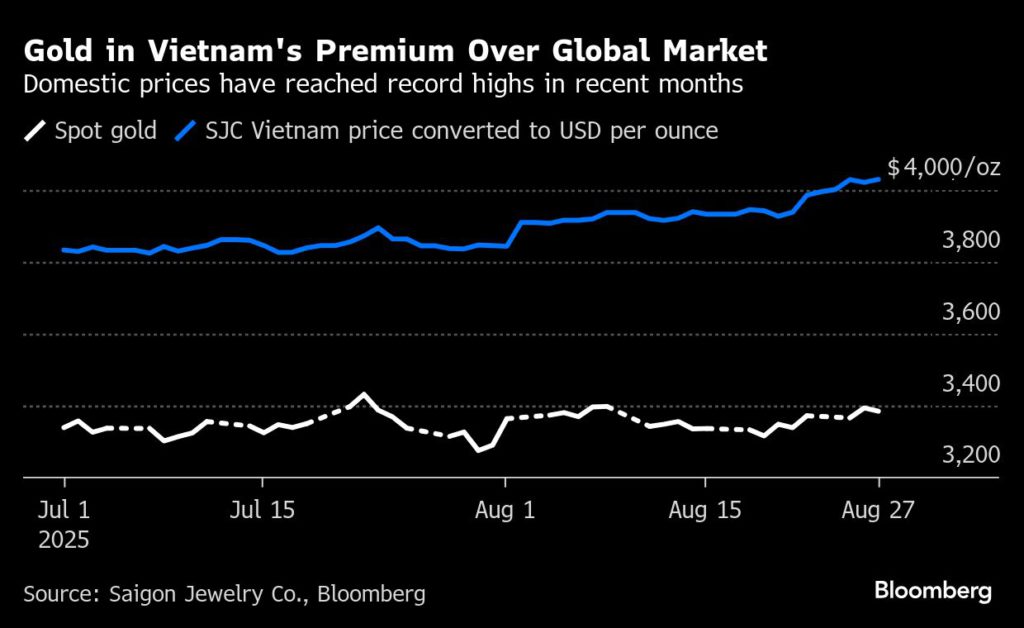
The government has outlined plans to end its monopoly on imports and exports of raw bullion, let some companies and banks obtain licenses, and allow trading on a state-run exchange. The moves come because prices in Vietnam’s existing gold market have become distorted, with the local premium over offshore prices leading to smuggling and pressure on the dong.
“The Vietnamese government is proceeding with the opening of its market in a careful and controlled manner, given that more than half of the eight approved banks are state-owned,” said Lee Liang Le, a Singapore-based analyst from Kallanish Index Services. “Nonetheless, this is welcome progress for both Vietnam and its regional counterparts, particularly the easing of restrictions on gold imports.”
The changes have been described as representing a “pivotal shift” for Vietnam, and encapsulate the country’s broader move away from state control to private enterprise.
They also come as investor and central bank demand have helped gold become one of the world’s best-performing commodities this year. But Vietnam’s prices have often run ahead of global rates, despite government efforts to reduce the difference.
The price gap surged to as much as 20 million dong ($758) per tael last month before easing to about 14 million dong, or a 10% premium to offshore prices, according to Khanh. The government aims to narrow the spread to just 2–3%, he added.
Still, investors are awaiting detailed guidelines from the central bank. The decree on gold market changes formally takes effect Oct. 10, and the central bank is preparing a circular with details.
“Some dealers see it as a good business opportunity to sell gold to Vietnam, but they are waiting for more details on rules around gold imports,” Kallanish’s Lee said.
Vietnamese authorities have said they plan to impose a personal income tax on gold trading to curb speculation in the metal. They are also weighing a requirement for gold transactions to be conducted via bank transfers, to improve market transparency.
That comes after neighboring Thailand said it’s considering a tax on baht-denominated gold trades, amid concern at the market’s impact on the Thai currency.
Khanh said the reforms could have a broader impact than just the gold market.
“Vietnam has the skills and low labor costs to build a world-class jewelry industry,” Khanh said. “With the right policies, we could export billions of dollars’ worth of jewelry, just like our neighboring countries, and we can import gold from the US to process and re-export to China, helping balance trade with both countries.”
Based on import licenses issued in the past, Vietnamese households could be sitting on at least 500 tons of gold, according to Khanh. With the country having seen multiple conflicts in the past century, many people hoard their gold at home, away from the banking system.
“That’s a huge volume of gold sitting idle,” he said. “Bringing it into circulation would spur business activity, curb hoarding and speculation, and ease pressure on the dong.”
(By Francesca Stevens and Nguyen Dieu Tu Uyen)
Congo seeks to tap more gold with new mines amid soaring prices
Barrick’s Kibali mine, Democratic Republic of Congo. Image from Rangold Resources.
Democratic Republic of Congo says it loses 60 tons of gold a year to smuggling. The new mines minister wants the country to build new sites to recapture that wealth.
Louis Watum, who became minister last month, previously developed Africa’s biggest gold mine at Kibali, now owned by Barrick Mining Corp. He sees more projects like it on the horizon.
“There’s a lot of talks in the pipeline and a few deals might be announced in the near future,” Watum told Bloomberg in an interview in New York Wednesday. “We are talking with not only existing big mining houses like Barrick. We open again space for newcomers as well.”
Despite the success of Kibali, Congo has struggled to develop gold assets in its conflict-ridden east. Traffickers and armed groups dominate the trade, much of which transits through neighboring Uganda and Rwanda to the United Arab Emirates. With the gold price near record highs, 60 tons of gold could be worth more than $7 billion, a transformative revenue source for a poor country.
Watum, who also developed Ivanhoe Mines Ltd.’s copper and zinc projects in Congo, is in talks with the US over a forthcoming minerals, infrastructure and security deal, which he said are “quite advanced.”
“Once we’ve agreed on that framework, it’s going to be a lot more” business-to-business discussions with US companies, he said. “We’re trying to put as much as we can on the table for them.”
He said he is also looking to resolve longstanding disputes with some of the country’s biggest copper and cobalt miners, including Glencore Plc., Eurasian Resources Group and China’s CMOC Group Ltd.
Earlier this month Watum flew to Kazakhstan with Congolese President Felix Tshisekedi and held talks with ERG, which was in danger of losing at least one of its several projects in the country.
“I don’t think expropriating assets from their operators is a right signal to send to the world,” he said. “They also need to discharge on their obligations, and if they don’t, then we’re going to have also again a conversation to see how we take things forward.”
Watum has also talked to Glencore’s management about outstanding payments, he said.
In response to questions, a Glencore spokesperson said, “We continue to engage with the government.”
Cyrille Mutombo, Barrick’s Congo country manager, said in a message Thursday the company “is ready to invest in future growth in both the north eastern DRC and the copper belt.”
ERG did not immediately respond to messages requesting comment.
Watum said he also has started discussions with CMOC — the world’s biggest cobalt producer — over a new cobalt export quota, and is pushing for development of Congo’s lithium assets with other interested miners.
China’s Zijin Mining Group Co., Australia’s AVZ Minerals Ltd. and the US mining explorer KoBold Metals Co. are all hoping to develop projects in the country.
“When you have an economically viable deposit,” Watum said. “it doesn’t matter who’s going to mine it. It’s going to be mined sooner or later.”
(By Michael J. Kavanagh)
Hedge fund Waratah snaps up gold stocks as rally powers ahead
One of Canada’s largest hedge fund managers is piling into gold stocks in anticipation that bullion’s record-setting rally is only just beginning.
Waratah Capital Advisors has invested in mid-size Canadian producers including Equinox Gold Corp. and Centerra Gold Inc. as well as exploration and development companies including Artemis Gold Inc. in its funds, said chief investment officer Brad Dunkley. He and Blair Levinsky founded Toronto-based Waratah in 2010.
“Gold’s been in the bull market with some ramp-ups and then some periods where it gives back — but if you zoom out, gold’s been very strong,” Dunkley said in an interview. “It’s just getting started.”
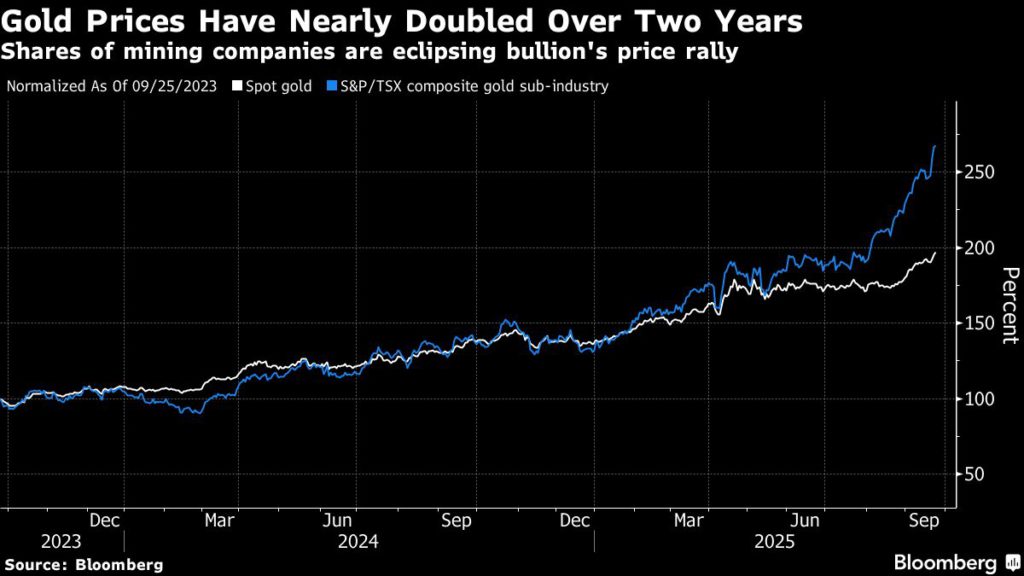
Bullion prices have almost doubled over the past two years and hit fresh records above $3,790 an ounce this week. Gold has been among this year’s best performing commodities due to a broad confluence of factors including an easing of Federal Reserve policy, central bank buying and lingering geopolitical tensions that fuel investor appetite for the safe-haven asset.
Gold equities are back in vogue after investors shunned the sector for years due to poor returns. Money typically flows in when commodities rally, with higher prices translating into greater revenue for gold producers since it usually brings improved margins and cash flows.
Stocks of gold companies have now become “compelling investments” thanks to the unprecedented bullion rally, said Dunkley, whose firm manages C$3.64 billion ($2.6 billion). He said mining companies now have “astounding” margins and are piling up cash, with cash flows and profit comparable to software companies.
Mid-size mining companies with low-grade ore and higher operating costs are starting to benefit from rising bullion prices, according to Dunkley, who cited Equinox and Centerra as examples. Shares of Vancouver-based Equinox have more than doubled this year, while Toronto-based Centerra has gained about 67%.
Waratah also is investing in firms it sees as potential takeover targets and early-stage exploration companies. The fund manager sees Artemis and Snowline Gold Corp. as companies likely to be acquired by bigger firms amid dealmaking momentum that typically happens during a commodity price rally.
The firm’s Waratah Special Opportunities Fund is the most exposed to gold. Returns for the C$88 million strategy rose almost 29% for the first eight months of this year, according to an investor letter seen by Bloomberg. The fund has produced average annual returns of almost 13% since inception in 2013. Waratah Performance, a C$817 million fund, is the second-most exposed to gold. Returns climbed 12% during the eight-month period.
Home bias
Waratah is also eyeing companies that stand to benefit from what it expects will be a boom in exploration activity for precious metals and critical minerals. It’s pursuing Canadian companies that can build mines within the country, Dunkley said. A new mine with a long reserve life and “very high margins” would be an ideal candidate for investors wanting to deploy money in Canada.
“One of our themes is jurisdiction matters,” he said. “Canada’s a great place to build and operate a mine, and it’s a safe political jurisdiction.”
One company that fits the bill is Goliath Resources Ltd., according to Dunkley. Goliath’s stock has more than tripled since the start of the year. The Toronto-based firm is exploring a large high-grade gold deposit in British Columbia.
Waratah also likes copper and counts Hudbay Minerals Inc. as an industry favorite given its prospects of being able to take advantage of US President Donald Trump’s push to revive America’s copper industry.
“They have this thing called Copper World in Arizona,” Waratah’s investment analyst, Grant McAdam, said in the interview. “The US administration has made it very apparent that they want domestic production and this is one of the ones that’s fully permitted, ready to go.”
Silver has rallied 55% so far this year. Stock image.
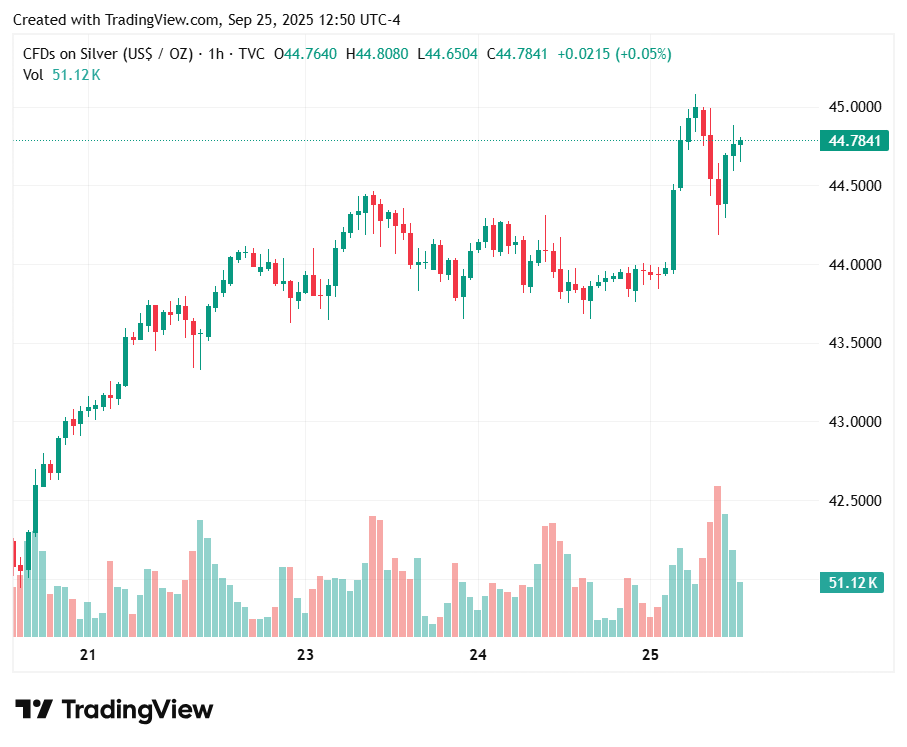
Silver prices rose above $45 an ounce for the first time since 2011 on Thursday, bolstered by an increased risk-off sentiment in equity markets amid worries about the trajectory of the US economy.
Spot gold hit an intraday high of $45.07 — its highest in over 14 years — before pulling back to around $44.70 per ounce, for a 1.8% rise.
The move takes silver’s year-to-date gains up to over 55%, surpassing that of its more expensive sister metal gold, which has seen multiple record highs this year. The bullish drivers include a weakening US dollar, relentless central bank buying and rising geopolitical risks.
Surging demand for gold exchange-traded funds this month is also signalling a growing clamor for safe-haven assets. Inflows into global gold ETFs surged to a record $10.5 billion so far in September, with year-to-date inflows exceeding $50 billion, according to Citigroup.
“ETF has outshined all other gold demand sectors this year and is the single most important contributor to the gold price rally in our view,” the bank’s analysts said in an emailed note.
In recent weeks, precious metals have been gaining momentum as markets anticipated the beginning the Federal Reserve’s rate cut cycle. Since its first 25-basis-point cut last week, US stock markets have come under pressure amid stretched asset valuations.
The second-quarter GDP data on Thursday clouded the Federal Reserve’s policy path, as a surprise economic lift may have dampened expectations of further cuts.
Looking ahead, traders will focus on the US personal consumption expenditures price index due Friday. The Fed’s preferred measure of underlying inflation likely grew at a slower pace last month, which would boost the argument for rate cuts.
“Softer inflation could strengthen the case for Fed rate cuts, supporting bullion, with markets pricing two cuts this year,” Kaynat Chainwala, analyst at Kotak Securities, said in a note on Thursday.
(With files from Bloomberg)
Supertanker Rates Hit Three-Year High on Rising Crude Flows
In recent weeks, VLCC rates on the benchmark Middle East-to-China route hit the threshold of $100,000 per day.
Tanker owners and shipbrokers expect the strength in the supertanker market to spill over to smaller-sized vessels such as Aframaxes and Suezmaxes.
As OPEC+ continues to raise production, shipments out of the world’s key exporting region, the Middle East, are on the rise.
Rising crude supply from OPEC+ and South America and a marked increase in longer-haul routes have hiked freight rates for supertankers, the so-called very large crude carriers (VLCCs) capable of transporting up to 2 million barrels of oil, to levels last seen nearly three years ago.
Tanker owners and shipbrokers expect the strength in the supertanker market to spill over to smaller-sized vessels such as Aframaxes and Suezmaxes and continue into the fourth quarter of the year.
In recent weeks, VLCC rates on the benchmark Middle East-to-China route hit the threshold of $100,000 per day. That was the highest in almost three years and well above the previous 2025 high during the Israel-Iran conflict in June, when fears of disruption to supply or trade flows sent charter rates soaring.
The last time VLCC rates were at the current high levels was in 2022, on the back of the Russian invasion of Ukraine and the massive crude oil releases from the U.S. Strategic Petroleum Reserves, U.S.-based brokers Poten & Partners said.
This time, the spike in freight rates is not the result of another geopolitical upheaval. It reflects fundamentals that are currently favorable for tanker owners and operators—rising supply from the Middle East and the Americas and stronger flows to Asia.
As OPEC+ continues to raise production, shipments out of the world’s key exporting region, the Middle East, are on the rise. Additionally, Saudi Arabia has slashed the prices of its crude loading for Asia next month, further incentivizing crude flows to the top oil-importing region.
Moreover, Middle Eastern producers are set to ship more crude after the end of the scorching summer, during which many countries in the region use direct crude burn for electricity.
The global tanker fleet is now split between tankers and tanker owners complying with the sanctions on Iran and Russia and the price caps on Russian crude, and those that do not and enter the shadow fleet. This further squeezes supply for tankers to move crude around the world.
As a result of all these factors, the spot rate for a VLCC on the Middle East to China route has jumped to at least $6.6 million, the highest level since November 2022, with daily rates on several chartered tankers hitting $100,000.
Oil supply increases from the Americas and strong demand for long-distance shipments everywhere are supporting tanker rates, Lars Barstad, CEO at Norway’s tanker giant Frontline, told Bloomberg earlier this month.
“We've had a seasonally strong summer market, which again kind of confirms this positive demand growth as we see it,” Barstad said on the Q2 earnings call at the end of August.
“OPEC cut reversals are expected to yield increased exports from the Middle East as we approach winter,” the executive added.
Additional sanctions on the three major sanctioned producers – Russia, Iran, and Venezuela – could further benefit compliant tanker owners and operators, analysts say.
“As an ever larger portion of the tanker fleet is being sanctioned, mainstream tanker owners should benefit from increased ton-mile demand, not only for Aframaxes and Suezmaxes, but other segments too,” Poten & Partners said in a note carried by Seatrade Maritime News.
Yet, the soaring freight rates could become victims of their own success as high shipping costs have already started to narrow the U.S.-Asia arbitrage, potentially removing a major long-haul tanker route, at least for a few weeks.
The arbitrage window for U.S. crude sold in Asia is shrinking amid higher tanker rates and rising WTI premiums. The additional cost for carrying crude from the U.S. Gulf Coast to Asia has now reached $1.75 per barrel, a trade source told Reuters this week.
“That alone would close the arb,” the source said.
While the downside to VLCC rates appears firmly capped, “the sky is not without clouds,” brokers Fearnleys said in a weekly report this week.
“The surge in shipping costs and WTI premiums has all but shut the US-Asia oil arbitrage putting a damper on the Atlantic market.”
By Tsvetana Paraskova for Oilprice.com
Seaspan Invests $140 Million in Outfitting Pier to Speed Up Construction
Seaspan is seeking to secure its competitive advantage in Canada’s shipbuilding following the completion of an outfitting pier at its Vancouver shipyards. The pier provides the company with extra capacity, giving it the required muscle to battle for large navy and coast guard vessels contracts that Canada is implementing through its National Shipbuilding Strategy (NSS).
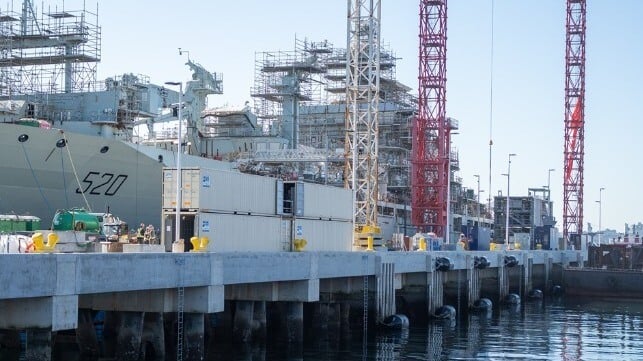
Constructed in partnership with design and engineering firm Stantec, the new pier measures 890 feet by 60 feet. The steel and concrete facility is designed with heavy load capacity and environmental safeguards, and it replaces a timber pier that has been in existence for six decades.
Of critical importance is the fact that the facility is engineered to support the demands of heavy outfitting operations and is resilient to future sea level rise considerations, extreme storm surge events, and seismic hazards in one of Canada’s highest seismic zones.
Utilization of the new pier has already begun, with Royal Canadian Navy (RCN) joint support ship (JSS) HMCS Protecteur currently being outfitted at the facility. Protecteur is the largest of two JSS vessels that are being built under the NSS and will replace the auxiliary oiler replenishment vessels that have reached the end of their operational lives.
Delivery of the ship has been delayed by six months from the end of this year to 2026 due to what has been described as “requiring more production effort”. With a length of 173.7 meters, Protecteur is the longest naval vessel to ever be built in Canada. Construction of the second ship, Preserver, remains on schedule with delivery planned for 2027.
Seaspan highlights that to support key ship outfitting and maintenance operations, the new pier is designed to accommodate integrated tower cranes, civil utilities/drainage, vehicle traffic, service towers, and specialized shipyard equipment with high live and dynamic loads.
The facility is also designed to address potential future needs with crane pockets that can be configured in different ways to support outfitting and production, as well as different shore power capabilities to support different ship requirements.
The pier is part of the over $140 million that Seaspan has invested in recent years in shipyard modernization, development of a skilled workforce and state-of-the-art, purpose-built infrastructure to deliver large, complex vessels. Implementation of the project commenced in 2020 with the environmental review permitting process, with construction starting in 2023.
“The new outfitting pier reflects our continued investment in the future and longevity of shipbuilding in British Columbia,” said Julianne Nezgoda, Director – Facilities, Seaspan Shipyards. “With the new pier already in use, Seaspan continues to show it has the facilities and infrastructure to design, build and deliver ships effectively and efficiently on Canada’s West Coast, ensuring the RCN and Coast Guard have the ships they need to protect Canada’s security and sovereignty.”
Seaspan is among yards selected as non-combat shipbuilders under the NSS and continues to bid for major contracts. So far under the NSS, the company has built and launched five ships. More than 20 large vessels, including the Coast Guard’s new heavy polar icebreaker, are currently under construction by the company.
NATO Moves Frigate to Copenhagen to Counter Mysterious Drone Threat
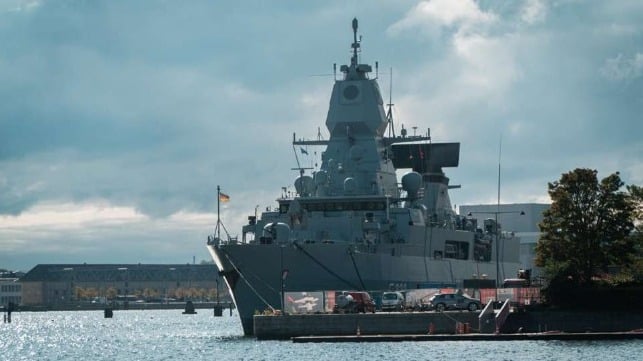
Frigate Hamburg in Copenhagen's harbor (NATO Maritime Command)
The German Navy has deployed a frigate to Copenhagen to contribute to regional air defense during a European Union summit on funding for Ukraine. Denmark's armed forces have reported concerning levels of drone activity over military bases and critical infrastructure since September 22, when a small swarm of drones buzzed Copenhagen's main airport and grounded dozens of flights.
The German frigate Hamburg was on patrol in the central Baltic as part of the NATO maritime security operation Baltic Sentry, itself a response to suspicious "gray zone" activity at sea. Last week, the warship diverted from its operating area and headed for Denmark, and she is now berthed at a pier in the Langelinie district of Copenhagen's central harbor, next to the historic Kastellet fortress.
Hamburg is a Sachsen-class air defense frigate, and is equipped to carry SM-2 and Sea Sparrow surface-to-air missiles, plus the short-range Rolling Airframe Missile (RAM) for threats within five miles. The SM-2 loadout gives Hamburg the ability to project an air defense umbrella as far as 90 nautical miles in any direction, limited by the number of missiles in her VLS cells. The main airport is only six nautical miles away to the south, well within range for her complement of Sea Sparrow missiles.
In addition to the redeployment of the Hamburg, the German military is providing Denmark with certain shoreside counter-drone systems (as-yet-unspecified) during the EU meeting.
To ease identification of hostile targets and clear the airspace, the Danish government has ordered a weeklong ban on all civilian drone operations anywhere in Danish airspace from September 29 through October 3. Violators face up to two years in prison or a fine for breaches of the decree. "We cannot accept that foreign drones create uncertainty and disturbances in society, as we have experienced recently. At the same time, Denmark will host EU leaders in the coming week, where we will have extra focus on security," said transport minister Thomas Danielsen in a statement Sunday.
Denmark's military confirmed even more new drone sightings over military bases on Sunday, the day that the decree entered effect. Danish authorities believe the drone raids are directed by a sophisticated and well-resourced operator, and while they have so far declined to name suspects, they have also declined to rule out Russia.
The Russian military is one of the world's most sophisticated operators of drone technology, having honed its capabilities on the battlefront in Ukraine, and has repeatedly violated the eastern outskirts of NATO airspace with apparent probing operations in recent weeks. The EU meeting in Copenhagen this week will have direct bearing on Moscow's interests: it will include a discussion of how to respond to Russian airspace violations, as well as a conversation about how to finance Ukraine's ongoing defense against Russian air and ground operations.
There are circumstantial hints of a Russian connection in the Copenhagen raid: the three vessels suspected of serving as drone launchpads during the attack all have ties to Russia, some more than others. According to investigative journalism outfit Danwatch, one of the vessels - the Norwegian-owned Oslo Carrier 3 - has links to Russian paramilitary outfit RSB Group. The operator maintains a division in the Russian Baltic exclave of Kaliningrad, and the director of that division appears to have a close working relationship with RSB's owner, according to Danwatch. RSB is believed to be closely aligned with the Kremlin's military establishment, like other Russian paramilitary groups.
Ukrainian President Volodymyr Zelensky warned Sunday that the Russia-serving "shadow fleet" of under-regulated tankers could serve as a launch pad for malign covert operations in Europe. "This [drone raid in Copenhagen] is further evidence that the Baltic Sea and other seas should be closed to Russian tankers, at least for the shadow fleet," Zelensky said.
Quality Over Quantity
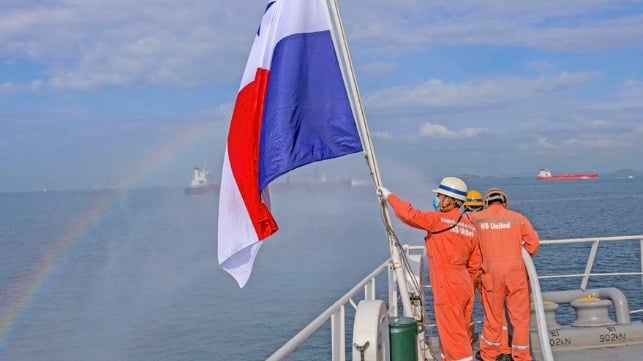
New leadership at the Panama Ship Registry, the world’s largest by number of vessels, has dramatically improved compliance, purged sanctioned vessels and improved its image.
(Article originally published in July/Aug 2025 edition.)
It's the story of the year among flag states. Once seen as a sanctionable fleet, the Panama Ship Registry is now among the world's best in terms of compliance rates and has deleted hundreds of ships in the process.
"We made a 180-degree turn," says Ramón Franco, a year after being appointed General Director by Panama's President, José Mulino. "We were perceived as a registry with a sanctionable fleet, so we chose to delete tonnage and lose ships and thereby demonstrate to the world that we are a responsible and transparent registry."
The transformation, still ongoing, has been a huge success. After all, it's a 100+-year-old registry, founded in 1917, and basically wrote the rules of the game. It's most important asset – like every organization and especially government agencies – is its reputation. "We've improved our image," Franco adds, "and we continue to invest in our quality improvement programs."
It's still the biggest flag state with approximately 15 percent of the global fleet, but the vision has changed. "We're reinventing ourselves," says Franco. "We don't want to be seen as the biggest registry only, but as the best registry in terms of excellence. We're emphasizing quality over quantity."
There's one remaining hurdle – the Paris MOU's White List. Panama currently sits on the Grey List – in the middle in terms of ratings, which are issued on a rolling three-year basis – and is determined to make the leap. It's already on Tokyo's White List, and Franco is confident: "It's a technical issue, and our numbers have improved."
ORGANIZATION
The Panama Ship Registry is actually part of the Panama Maritime Authority (PMA), the agency responsible for the regulation and promotion of the maritime industry in Panama. It's one of four so-called Directorates – Ports, Seafarers, Public Registry and Merchant Marine. The registry falls under the Merchant Marine rubric, and Franco's actual title is a long one – General Director of Merchant Marine, Panama Maritime Authority.
"It basically means the Director General of the Merchant Marine is the head of the Panama Ship Registry," he explains.
The Ports Directorate is responsible for – you guessed it – the nation's bustling ports. It's also involved with things like tariffs and port fees and, of course, the all-important issue of navigation and safety in national ports.
The Seafarers Directorate is responsible for – you guessed it again! – the training and certification of Panama's 600,000+ seafarers, a huge number for a small country. And the Public Registry handles ship mortgages, titles of ownership and liens/encumbrances.
The PMA is not to be confused with the Panama Canal Authority, which regulates traffic and rates through the 48-mile-long "path between the seas." They are separate government entities, both committed to promoting Panama's position as a global maritime and logistics hub.
HISTORY & MISSION
Founded three years after the opening of the Panama Canal in 1914, the Panama Ship Registry was originally intended for Panamanian-owned and operated ships only.
In the years that followed, it went through many different iterations and name changes, eventually becoming an open registry with ships from all over the world. It offered numerous advantages – competitive fees, a global network of offices, the backing of the Panamanian government as well as commercial and technical benefits.
Its mission: "Provide nationality and jurisdiction to ships through legal certainty and high quality standards."
By 1993 it had become the world's largest ship registry. It's also become an important source of revenue for the Panamanian government – as is the Panama Canal Authority – although revenues from the canal far exceeded those from the registry.
Today there are more than 8,500 vessels in the registry, ranging from large ore, bulk and tank carriers to container ships, cruise ships, car carriers, fishing vessels and offshore workboats – all attracted by the numerous benefits offered by the Panamanian flag.
Maintaining high standards when you're the world's biggest registry is not an easy thing, and that was the challenge facing Franco when he took over last year. Standards had begun to slip, enforcement was lax – there was too much emphasis on growth and too little on quality control. A cultural change was needed.
He was the perfect person for the job. Experienced but still young, full of energy and enthusiasm, descended from a long line of lawyers and eager to serve his country. He was also President of the Panamanian Maritime Law Association and a distinguished private sector lawyer, so he brought a lot of credibility to the table.
He also brought his own plan of action, consisting of the three new pillars of organizational transformation, improving the customer experience and – most important – ensuring a safe and reliable, sanction-free fleet. He's accomplishing all three.
He says the transition from the private to the public sector was challenging – "It's like playing soccer and now you're playing basketball." But he navigated it successfully, learning a lot along the way, and currently supervises a staff of roughly 200, divided into four areas – commercial, support (quality management), compliance and technical. He's proud of his team. They stand by him and he stands by them: "There's nothing I'd ask them to do that I wouldn't do myself."
And that's the mark of a true leader.
"NUMBERS CHANGE, QUALITY REMAINS"
So the road ahead is clear. While much has been accomplished, there's always more to be done. And Franco is an early bird. He's at his desk before 8:00 am each day, having risen three hours earlier. He doesn't get home to his wife and young children till 8:00 pm at night. He loves coming into the office, being with his team and facing new challenges.
Asked what his biggest challenge is right now, Franco says there are really two challenges. One is the compliance challenge, which has been effectively remedied and is improving every day, and the other is the technical challenge of returning to the Paris MOU's White List. He'll get there, no doubt, and he'll do it while growing the registry at the same time.
"The numbers always change, but the quality remains," he observes. And that's a maxim to live by.
TONY MUNOZ is Founder, Publisher & Editor-in-Chief of The Maritime Executive.
The opinions expressed herein are the author's and not necessarily those of The Maritime Executive.