Saturday, October 11, 2025

Amid Global Calls to End Capital Punishment, US Set to Execute 7 Men This Month

“We won’t give up until the death penalty is abolished everywhere,” said Amnesty International on World Day Against the Death Penalty. “Change is possible.”


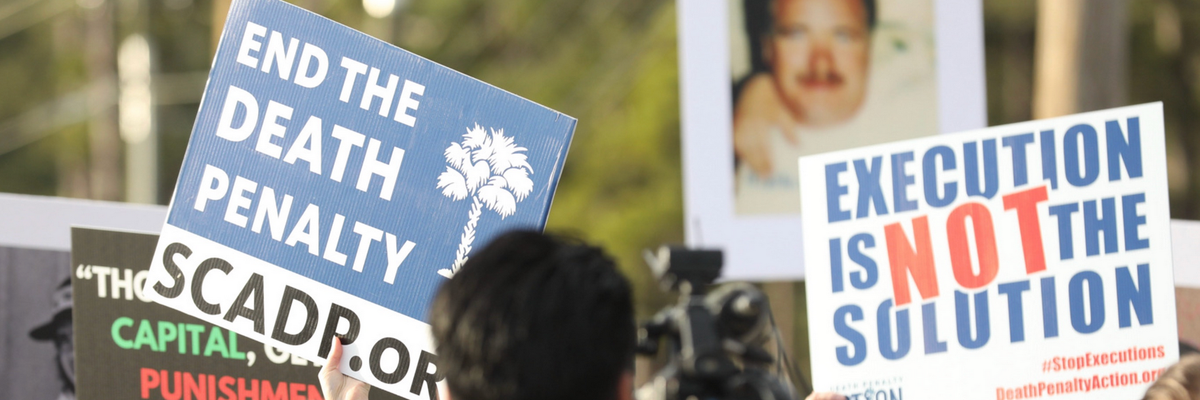
People protest South Carolina's execution of Brad Sigmon by firing squad on March 7, 2025 in Columbia.
(Photo: Death Penalty Action)

Brett Wilkins
Oct 10, 2025
COMMON DREAMS

Human rights defenders marked World Day Against the Death Penalty on Friday by renewing pleas to end capital punishment—calls that came amid a surge in US executions and the Trump administration’s extrajudicial high-seas massacres of alleged drug traffickers.


“The death penalty does little to deter crime or serve victims,” the United Nations said on social media. “It has no place in the 21st century.”

Noting that two-thirds of the world’s countries have abolished capital punishment, the UN human rights office asserted that “it’s time to end it—everywhere, for everyone.”

“You can free a prisoner. You can clear a conviction. But you can’t correct an execution,” the office said. “Innocent people are sentenced to death, in many regions of the world. And those who are executed are rarely the powerful. It’s the poor, the marginalized, those with the fewest means to defend themselves.”

“The death penalty doesn’t prevent crime,” it added. “It doesn’t deliver justice. It only repeats violence, in the name of the law.”


Amnesty International said on social media, “Over the past year, executions have significantly increased in countries such as Singapore, Kuwait, Iran, and the USA, while people continue to be executed at an alarming rate in Saudi Arabia.”

“Among these rises, some governments have shown renewed determination to use this cruel punishment as a tool of repression and control,” Amnesty continued. “They continue to ignore international human rights law.

The group noted on a hopeful note that ”the number of countries resorting to the death penalty is decreasing.”

“We won’t give up until the death penalty is abolished everywhere,” Amnesty added. “Change is possible.”

European Parliament Human Rights Subcommittee Chair Mounir Satouri reaffirmed lawmakers’ “absolute opposition to the death penalty, under all circumstances and without exception.”

“The death penalty constitutes a cruel punishment that fundamentally denies human dignity and is incompatible with the right to life and with the prohibition of torture,” he said.

“Today, more than two-thirds of all countries have either abolished the death penalty in law or no longer implement it in practice. 113 countries had abolished the death penalty in law by the end of 2024,“ Satouri noted. ”I urge the remaining 55 states that continue to impose or carry out death sentences to establish a moratorium as an initial step toward its complete abolition.“

“It has been proven that the death penalty does not deter crime and that its imposition disproportionately affects vulnerable groups,” he added. “Moreover, in today’s more authoritarian global environment, the death penalty and assassinations sponsored by authoritarian regimes are used as a political tool against political opponents, independent journalists, and human rights defenders.”

Those remarks came as US President Donald Trump faces condemnation at home and abroad for ordering a series of extrajudicial assassinations of what his administration claims are drug traffickers transporting narcotics in small boats in the Caribbean Sea off the Venezuelan coast.

Trump—who oversaw a resurgence of federal executions during his first term—signed an executive order on his first day back in the White House affirming capital punishment as “an essential tool for deterring and punishing those who would commit the most heinous crimes,” despite study after study showing it does not deter criminal activity.

Capital punishment abolitionists earlier this year denounced US Attorney General Pam Bondi’s decision to seek the death penalty for Luigi Mangione, the 26-year-old man accused of killing UnitedHealthcare CEO Brian Thompson in December 2024. More recently, Bondi has also ominously threatened to take the “same approach” to anti-fascist protesters as the administration has taken against drug cartels.


However, human rights defenders are currently most alarmed by a surge in executions in Republican-controlled states, where Indiana death row inmate Roy Lee Ward—who was killed by lethal injection on Friday—was the first of five scheduled executions in the coming week.

Next Tuesday, Lance Shockley in Missouri and Samuel Lee Smithers in Florida are set to be executed. Smithers would be the 14th person to be killed this year under the direction of Republican Florida Gov. Ron DeSantis, whose expansion of the state’s capital punishment regime has raised constitutional concerns.

On Wednesday, Charles Ray Crawford is scheduled to be executed in Mississippi, while Arizona is set to put Richard Djerf to death on October 17.

In a rare reprieve, the Texas Court of Criminal Appeals on Thursday blocked next week’s scheduled execution of Robert Roberson—who was convicted of murdering his 2-year-old daughter on the basis of scientifically debunked “shaken baby syndrome”—by sending his case back to court.


Two more executions—Anthony Todd Boyd in Alabama and Norman Mearle Grim in Florida—are planned for later this month.

There have been 35 executions in the United States so far this year, up from 25 in 2024 and the most since 2017, according to the Death Penalty Information Center.

Noting that October is “Respect Life Month” in the United States, Catholic Mobilizing Network executive director Krisanne Vaillancourt Murphy told Vatican News Friday that “it’s a stark contrast to honoring all human life that we see such an affront to the dignity of the human person.“

”We need to value the dignity of every human person,“ Vaillancourt added. ”That includes people who are sitting on death row. So we will not give up this fight. And the progress that we’ve made has been hard-won. We will move forward and continue in order to end the death penalty in the United States.”


Federal Worker Unions File Emergency Request to Block Trump-Vought Shutdown Layoffs

“These mass firings are illegal and will have devastating effects on the services millions of Americans rely on every day,” warned one labor leader.


Russell Vought, director of the Office of Management and Budget, speaks with reporters outside of the West Wing of the White House in Washington, DC on July 17, 2025.
(Photo by Anna Moneymaker/Getty Images)


Jessica Corbett
Oct 10, 2025
COMMON DREAMS

Unions that are already suing President Donald Trump‘s administration to protect federal workers from mass firings during the government shutdown filed an emergency request for relief from a district court after a top official announced Friday morning that reductions in force were underway.

“The RIFs have begun,” Office of Management and Budget (OMB) Director Russell Vought posted on the social media platform X.


Unions Sue to Protect Federal Workers From Mass Firings During Government Shutdown

‘Put Working People First,’ Says AFL-CIO Angered by Trump Agenda and Government Shutdown

According to the filing from the American Federation of Government Employees (AFGE) and American Federation of State, County, and Municipal Employees (AFSCME), “This corroborates credible information plaintiffs began receiving earlier this morning from multiple sources that OMB has directed federal agencies government-wide to begin issuing RIF notices today.”

The unions are asking US District Judge Susan Illston, an appointee of former President Bill Clinton, to issue an immediate temporary restraining order “halting OMB from ordering agencies to implement RIFs, and halting the issuance of any RIF notices by any defendant pending the court’s already-scheduled October 16, 2025 hearing.”


The unions had sued OMB, Vought, the Office of Personnel Management, and OPM Director Scott Kupor late last month amid threats that the Trump administration would use the then-looming government shutdown to pursue mass layoffs.

Government Executive on Friday evening reported layoffs at the Environmental Protection Agency as well as the departments of Education, Health and Human Services, Homeland Security, Housing and Urban Development, and Treasury.

After Friday’s emergency filing, AFGE national president Everett Kelley said in a statement: “It is disgraceful that the Trump administration has used the government shutdown as an excuse to illegally fire thousands of workers who provide critical services to communities across the country. These workers show up every day to serve the American people, and for the past nine months have been met with nothing but cruelty and viciousness from President Trump. Every single American citizen should be outraged.”

“Federal workers are tired of being used as pawns for the political and personal gains of the elected and unelected leaders. It’s time for Congress to do their jobs and negotiate an end to this shutdown immediately,” he continued. “In AFGE’s 93 years of existence under several presidential administrations—including during Trump’s first term—no president has ever decided to fire thousands of furloughed workers during a government shutdown.”

“AFGE is currently challenging President Trump’s illegal, unprecedented, abuse of power, and we will not stop fighting until every reduction-in-force notice is rescinded,“ he pledged.

AFSCME president Lee Saunders was similarly determined, saying that ”these mass firings are illegal and will have devastating effects on the services millions of Americans rely on every day. Whether it’s food inspectors, public safety workers, or the countless other public service workers who keep America running, federal employees should not be bargaining chips in this administration’s political games.“

”By illegally firing these workers, the administration isn’t just targeting federal employees, it’s hurting their families and the communities they serve every day,“ he added. ”We will pursue every available legal avenue to stop this administration’s unlawful attacks on public service workers’ freedoms and jobs.“

Both AFSCME and AFGE are affiliates of the American Federation of Labor and Congress of Industrial Organizations. AFL-CIO president Liz Shuler has called out the White House over the shutdown—the result of congressional Republicans refusing to reverse their devastating cuts to healthcare—and continued to do so on Friday.

Donald Trump shut down the government, choosing to lock workers out of their jobs instead of doing his,“ she said. ”As millions of workers miss paychecks and Americans open letters saying their healthcare costs are skyrocketing, the Trump administration is creating even more pain and chaos by moving to illegally fire thousands of federal workers today. We won’t stand for this administration using hardworking Americans as pawns in a political game.“

Congressional Democrats and other critics also fired back at Vought—including Senate Minority Leader Chuck Schumer (D-NY), who wrote on X that ”Republicans would rather see thousands of Americans lose their jobs than sit down and negotiate with Democrats to reopen the government.“

”Republicans own this shutdown—every job lost, every family hurt, every service gutted is because of their decisions,“ he added.


Congressman Jerry Nadler (D-NY) pointed out that ”nearly 700,000 of our public servants are veterans. Donald Trump is threatening to fire them as punishment for doing their jobs because he failed to do his. Behind many of these veterans are families who depend on that paycheck, families who pay their taxes, serve their communities, and make this country work.“

”Trump and Vought should be ashamed of themselves,“ he asserted. ”They don’t have to do this, they want to do this.“

Senate Appropriations Committee Vice Chair Patty Murray (D-Wash.) agreed with that last point.

”Once again: If President Trump and Russ Vought decide to do more mass firings, they are CHOOSING to inflict more pain on people,“ she wrote. ”’Reductions in force’ are not a new power these bozos get in a shutdown. We can’t be intimidated by these crooks.“

Rep. Angie Craig (D-Minn.) called Vought’s post ”your daily reminder that Donald Trump doesn’t give a shit about working people.“

Warren Gunnels—staff director for Senate Health, Education, Labor, and Pensions Committee Ranking Member Bernie Sanders (I-Vt.)—argued that ”the RIF that should be going out is for Russ Vought, President Trump’s authoritarian budget director, who has been illegally firing federal workers with impunity and denying funds that Congress appropriated and the president signed into law-in violation of the US Constitution.“

”Hey Russell: You want to fire someone? Fire yourself for breaking the law and violating the Constitution, not hardworking veterans and other public servants who put their lives on the line defending our country each and every day,“ Gunnels told the OMB director. ”They deserve our respect, not contempt.“


Trump admin reveals number of federal workers hit by Trump's new mass purge

Daniel Hampton
October 10, 2025 
RAW STORY

U.S. President Donald Trump listens during an announcement about lowering U.S. drug prices, at the White House in Washington, D.C., U.S., October 10, 2025. REUTERS/Kent Nishimura

Thousands of federal workers were hit by layoffs on Friday as the government shutdown entered its 10th day, according to newly released court filings.

More than 4,100 positions will be axed, the government told a court Friday night, according to The Washington Post. The number comes after White House budget director Russell Vought posted on X earlier in the day, “The RIFs have begun,” using an acronym for reductions in force.

The Trump administration told a federal judge in California that notices were sent in the Commerce, Education, Energy, Health and Human Services, Housing and Urban Development, Homeland Security and Treasury departments. Furthermore, government attorneys said the Environmental Protection Agency told up to 30 workers they too could be laid off in the future, the Post reported.

Other agencies are “actively considering whether to conduct additional RIFs related to the ongoing lapse in appropriations,” according to the court filing.

President Donald Trump on Friday said his team intentionally moved to oust "people that the Democrats want."

At least two Republican senators have already spoken out against the layoffs.


Fed Governor Warns ‘Job Growth Has Probably Been Negative’ as US Labor Market Stalls

One market analyst said the US jobs market is going through “bed rot.”


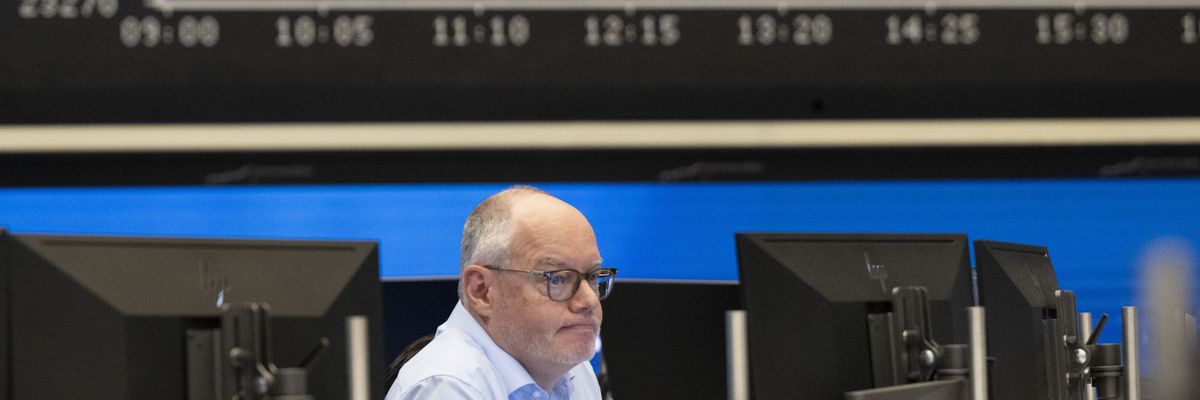
As US President Trump announced massive tariffs on goods from the EU, Germany’s leading index, the DAX, plummeted.
(Photo by Boris Roessler/picture alliance via Getty Images)


Brad Reed
Oct 10, 2025
COMMON DREAMS

Christopher Waller, a Federal Reserve governor, warned on Friday that the US labor market at the moment is in poor shape and showing little sign of improvement.

In an interview on CNBC, Waller said that the data released by processing firm ADP earlier this month showing that the economy lost 32,000 jobs in September was “consistent with what we’re starting to see with [Bureau of Labor Statistics] data.”

“Job growth has probably been negative the last few months,” he explained. “It doesn’t look like it’s doing much better. Anecdotally... I don’t hear anybody with big hiring plans. All I ever hear is, ‘We’re not backfilling, we’re not firing, we’re holding off any job things.’ That’s the anecdotal evidence.”
Waller’s analysis was shared by Ed Al-Hussainy, rates strategist with Columbia Threadneedle investments, who told Axios on Friday that the job market was “bed rotting,” with employers reluctant to make any major hiring commitments in the face of economic uncertainty.

Al-Hussainy also warned that the current problems with the job market could “continue to get worse, until they reach a tipping point where consumption starts to degrade, and then you have another recession scare.”

Earlier in the week, Fortune reported that Mark Zandi, chief economist at Moody’s Analytics, estimated that there was “essentially no job growth” in the last month, while pointing to the Conference Board’s recent report showing that US consumers haven’t been this pessimistic about the labor market since the end of the Covid-19 pandemic.

“There’s no better predictor of changes in unemployment, which thus likely rose again in September,” he added.

Abby McCloskey, a columnist at Bloomberg and a former economist at the conservative American Enterprise Institute, argued in a Friday column that the US economy had now slowed down so much that even supporters of President Donald Trump were rating it unfavorably.

“Only 44% of Republicans think the economy is excellent or good, according to new data from the Pew Research Center,” McCloskey explained. “Compare this to the soaring approval of GOP voters in Trump’s first term before Covid hit—when 81% thought the economy was good.”

She then noted that, despite a record-breaking stock market and stabilized inflation, voters’ concerns about the economy appeared to be justified.

“Despite enormous tax cuts in this summer’s reconciliation bill and sweeping reductions to the federal workforce—things Republicans would typically cheer—tariffs and political uncertainty are taking a toll,” she argued. “When a voter balances the tax cuts from the One Big Beautiful Bill Act against tariffs raising prices on everything from groceries to clothes, it feels like running just to stay in place.”


President Trump begins mass layoffs of federal workers amid government shutdown

Joey Garrison, USA TODAY
Fri, October 10, 2025 at 11:18 AM MDT

WASHINGTON ‒ President Donald Trump on Friday followed through on his long-standing threat to fire federal workers during the government shutdown, taking aggressive action to downsize the government in a dramatic break from past shutdowns.

“The RIFs have begun,” Russell Vought, director of the White House Office of Management and Budget said in a post on X, referring to “reductions in force," or RIFs, of federal departments and agencies.

An OMB spokeswoman would not say how many federal workers are affected, or which agencies were targeted, but described the layoffs as "substantial."

The Trump administration later said about 4,000 federal workers had so far received RIF notices. The figure was detailed in a court document the Justice Department submitted in response to a lawsuit from unions representing government workers. But additional layoffs are coming, a senior administration official told USA TODAY.

The initial wave of layoffs spanned seven federal departments: 315 workers in the Commerce Department; 466 in the Education Department; 187 in the Energy Department; between 1,100 and 1,200 in the Department of Health and Human Services; 442 in the Department of Housing and Urban Development; 176 in the Department Homeland Security; and 1,446 in the Treasury Department.


People wait in line to enter the Federal Building in Los Angeles, California on October 1, 2025, where services are experiencing significant disruptions due to the federal government shutdown, as essential workers continue working without pay and non-essential federal workers are furloughed.


The United States Park Service place a notice on the visitors entry door notifying of the closing of the Washington Monument to visitors on the first day of the federal government shutdown on October 1, 2025 after President Donald Trump and congressional leaders failed to reach a funding compromise.

People look up at the Washington Monument ticket office window with a notice of closure following the United States Park Service placing a note on the ticket office window notifying of the closing of the Washington Monument to visitors on the first day of the federal government shutdown on October 1, 2025.

With the government out of money after President Donald Trump and lawmakers failed to agree on a deal to keep the lights on, many federal departments and agencies have been closed since midnight. See what remains open and what has closed.More

White House officials have argued the layoffs are needed to ensure essential government services have funding. But many legal experts and unions have raised legal objections, accusing Trump of using the shutdown to advance his political agenda and to punish Democrats.

Two unions, the American Federation of Government Employees and the American Federation of State, County and Municipal Employees, preemptively sued the Trump administration on Sept. 30 over the president's repeated threats of layoffs. The suit argues firing workers during the shutdown is an abuse of power that strips federal employees of back-pay rights and violate agencies’ statutory duties

Shortly after Vought's announcement, attorneys representing the unions filed a motion in federal court seeking a temporary restraining order to immediately halt the layoffs.

“It is disgraceful that the Trump administration has used the government shutdown as an excuse to illegally fire thousands of workers who provide critical services to communities across the country," AFGE National President Everett Kelley said in a statement.

More: President Trump says some furloughed federal workers ‘don’t deserve’ back pay

President Donald Trump gestures as he walks to Marine One on the South Lawn of the White House in Washington, DC, on October 10, 2025, on his way to Walter Reed National Military Medical Center to receive a medical checkup.More
Layoffs not carried out in past shutdowns

Historically, nonessential federal workers are placed on furloughs that pause their pay during government shutdowns, but they are not part of widespread federal workforce layoffs. About 750,000 federal workers have been furloughed during the shutdown.

The Trump administration this year has already fired tens of thousands of federal workers as part of Trump's Department of Government Efficiency's efforts to drastically cut the size of the federal government.

For days, Trump warned Democrats he may pursue mass layoffs of workers and shutter government programs if the shutdown, which began on Oct. 1, drags on. The White House held off on reductions for more than a week after initially saying layoffs were "imminent" and coming in "a day or two."

Democrats in Congress have demanded that reversing recent Medicaid cuts and extending expiring Affordable Health Care Act subsidies be included in any funding bill to reopen the government. But Republicans say they won't entertain any changes to health care policy until the shutdown is over.

More: White House says mass layoffs of federal workers have begun. Shutdown live updates.


Director of the Office of Management and Budget (OMB) Russell Vought speaks to reporters outside the West Wing of the White House in Washington, D.C., U.S., July 17, 2025.

The standoff has resulted in the Senate voting eight times to defeat dueling bills to reopen the government.

In addition to mass firings of federal workers, Trump has also threatened to block back pay of federal workers and to cut "Democrat programs" from the government if Democrats don't join Republicans to end the shutdown.

“We're going to be cutting some very popular Democrat programs that aren't popular with Republicans, frankly, because that's the way this works," Trump said on Oct. 9. "They wanted to do this, so we'll give them a little taste of their own medicine."

Reach Joey Garrison on X @joeygarrison.

This article originally appeared on USA TODAY: Trump begins mass layoffs of federal workers amid government shutdown
After Hyundai ICE Raid, Even South Korea’s Capitalists Question US Relations

Can the US and South Korea’s tenuous alliance survive Trump’s tariffs and ICE’s raid on a Hyundai-LG plant in Georgia?

October 9, 2025
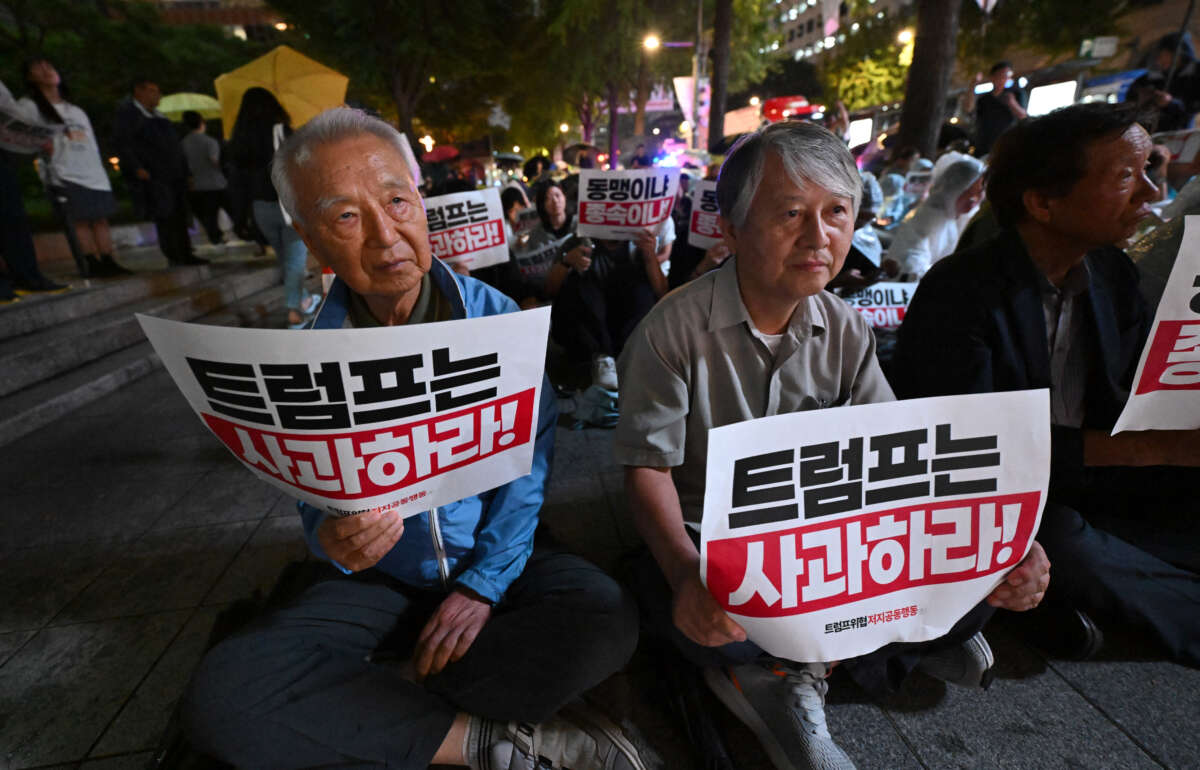
South Korean protesters hold signs reading "Trump, apologize!" during an anti-U.S. rally against detention of South Korean workers after a U.S. immigration raid in Georgia, near the U.S. embassy in Seoul, South Korea, on September 12, 2025.JUNG YEON-JE / AFP via Getty Images

Zip ties. Helicopters. Crowded cells. Guns trained on bewildered workers. Foul water. Forced vaccinations. An unconscious detainee left on the floor by negligent guards. A pregnant woman in handcuffs. A detainee being called “Rocket Man” (Donald Trump’s nickname for Kim Jong Un) by sneering federal agents. A menstruating woman forced to attend to her period with only toilet paper.

These are the details of 316 South Korean nationals’ experiences in Immigration and Customs Enforcement (ICE) detention that have flooded the country’s media in the weeks after the September 4 raid on a Hyundai-LG electric vehicle battery plant in Ellabell, Georgia. A wave of fury is now pouring forth from across South Korean society — and the political consequences are only just beginning.

There is far more at stake than a single factory in Georgia, which by itself represented 8,500 jobs and $4.3 billion in investment, and is just one of 23 plants being built across the U.S. by Korean conglomerates. Since the raid, the U.S. and South Korea have announced that Korean workers will be able to use B-1 visas and ESTA visa waivers to continue working in the U.S. A new bill in Congress, the Partner with Korea Act, also seeks to extend 15,000 professional E-4 visas to South Koreans for the first time.

But U.S. flexibility on immigration is not all that matters. Seoul and Washington have yet to finalize their trade deal instigated by Trump’s threat to impose a 25 percent blanket tariff on South Korean goods. At the current stage of negotiations, South Korea has agreed to accept a 15 percent tariff on its exports and provide tremendous investments and other financial agreements: $350 billion in state-backed short-term investment, $150 billion in private sector contracts with U.S. corporations, and a guarantee to purchase $100 billion in U.S. liquid natural gas. Despite so much on the table, a written agreement has yet to be produced, and negotiations are proving tense as the Trump administration presses for Seoul to provide the lion’s share of its $350 billion commitment in cash. While some of the shock over the ICE raid has died down, Washington’s conduct over the course of months of negotiations has also raised deeper questions in South Korea about the real nature of the alliance — and whether this is a relationship that can last.


The Art of the Steal


The anger unleashed by ICE’s abuse of Korean workers has been building for some time. Trump’s tariff threats, announced in March, hit South Korea at a difficult time, when the impeachment of former President Yoon Suk Yeol was unresolved, and the country was reeling from years of flagging economic performance.

Related Story

Under a New South Korean President, Can Peace Activists Push US Troops Out?
A pro-peace presidential candidate offers a historic opening to transform the front line of a new Cold War. By Christine Ahn , Truthout June 2, 2025

The issue was not only a matter of timing. The Biden administration’s CHIPS Act and Inflation Reduction Act also used similar (though less onerous) tariff threats to force South Korean conglomerates to transfer production and make large investments in the U.S. — which is how the Hyundai-LG plant made its way to Georgia in the first place. Having already complied with the previous administration, South Korea nevertheless now finds itself facing an even graver economic threat that could lead to recession: not just a 25 percent tariff on all exports (since reduced to 15 percent), but sector-based tariffs impacting most of South Korea’s key industries as well.

Trump’s tariffs are just the latest in a string of U.S. policies that have sought to deny South Korea its economic sovereignty, open its markets to foreign takeover, and degrade the rights and dignity of its working people.

While much of the anger on either side of the Pacific has focused on the current administration in Washington, Trump’s tariffs are just the latest in a string of U.S. policies that have sought to deny South Korea its economic sovereignty, open its markets to foreign takeover, and degrade the rights and dignity of its working people.

The 1997 International Monetary Fund crisis is the most notorious of these, and led to the “irregularization” of nearly half the workforce as employers moved to subcontracting and other forms of indirect employment to dodge existing labor law and deny rights to their workers. The 2007 U.S.-South Korea Free Trade Agreement further empowered U.S. multinationals, devastated local agriculture, and weakened the power of workers. With Joe Biden, and now Trump, the U.S. has moved to maintain its privileges under the agreement while subjecting South Korea to unequal burdens and penalties.

As with prior rounds of U.S. economic warfare, South Korea’s workers and other affected sectors of society responded to the tariffs with force. Farmers reacted with rancor to demands to open up the rice and beef markets to U.S. imports; civic groups staged protests at the U.S. embassy; peace groups highlighted the military demands attached to the tariff threats; and unions educated their workforces and, in some cases, moved to partial strike action — as with the case of General Motors Korea.

Like most governments, South Korea opted to appease the U.S. in exchange for a lower tariff rate of 15 percent, with no corresponding tariff on U.S. goods in the Korean market. So far, Seoul has offered to inject a cumulative $600 billion into the U.S. economy. This is a dizzying figure for any country, no less for South Korea with an annual GDP of roughly $1.7 trillion in 2023, and an annual budget of roughly $500 billion in 2024.

According to the Export-Import Bank of Korea, the $350 billion in short-term state-backed investments offered by South Korea is more than the total direct investments it made worldwide over the five-year period from 2020-2024. Beyond extracting such an enormous tribute, Washington has cast a covetous eye toward South Korea’s most valuable and strategic industries, seeking to either smother them through tariffs or transfer their most lucrative parts of the production chain to the U.S.: in shipbuilding, automobiles, steel, and more.

While South Korean President Lee Jae Myung attempted to spin the deal as a victory, the domestic labor movement and many progressives swiftly rejected this. The minority Progressive Party, which holds seats in the National Assembly, denounced Trump’s tariff maneuvers as “an act of plunder.” The Korean Confederation of Trade Unions, a massive umbrella union representing over a million workers, described the “unilateral” negotiations as “humiliating,” and criticized the government’s declaration of victory as an attempt to confuse the public, since the 15 percent tariff is still ultimately an increase that will burden Korean industry and workers.
Fraying Bonds?

At the outset of Trump’s tariff threats, labor, farmers, and progressive civil society organizations spearheaded vocal opposition. South Korea’s conglomerates (or chaebol) opted to hedge against further potential losses by adopting conciliatory rhetoric and offering handsome investment packages before the details of a deal were worked out at the state level. This was reflected in Lee’s first summit with Trump in August, which was noted for its convivial atmosphere and his lavish praise of Trump. Pressure to transfer production to the U.S. was no doubt uncomfortable for South Korea’s capitalists, but for a moment, an illusion endured that profits might be sustained in the long term. Then came the ICE raid in Georgia — not only raising questions about the safety of the workforce, but also raising questions about investments.


The ICE raid in Georgia … precipitated a sharp change in tone among traditionally pro-U.S. elements in South Korea.

This precipitated a sharp change in tone among traditionally pro-U.S. elements in South Korea. Right-wing papers and business media outlets released a barrage of editorials in the wake of the raid. The Chosun Ilbo, South Korea’s conservative paper of record, said the raid “raises fundamental questions about what the United States truly means by ‘alliance.’” Even the People Power Party, whose former leader, ex-President Yoon, now sits in jail, spoke out against the incident.

Some even went as far as to speculate whether the ICE raid might have had something to do with the unsettled tariff negotiations. The Korea Economic Daily, one of South Korea’s most important business papers, left little room for subtlety in its editorial: “If the US attempts to leverage this incident in trade negotiations, such as the $350 billion US investment fund and the further liberalization of agricultural and livestock products, it would be a betrayal of the trust of the alliance.” While this statement falls short of an outright accusation in print, one wonders what might have been said in more private settings among the elite.

Despite the pivot in South Korean public opinion, Washington has since only doubled down. Since the announcement of the trade deal in July, the U.S. and South Korea’s governments have been at odds over how South Korea’s investments will be decided. Trump has long claimed that he will personally determine the allocation of South Korea’s investments, and Secretary of Commerce Howard Lutnick previously tweeted that “90 percent” of the profits will go to “the American people” — a point that continues to rankle South Koreans.

According to the Wall Street Journal, Lutnick is also applying additional pressure to get Seoul to further raise its investments. Trump has no doubt taken confidence in his success in getting Japan to agree to similar terms, under which its $550 billion tariff tribute will be distributed according to the decisions of a U.S. committee — with Japanese input relegated to only a consultative position. If this all sounds bizarre and corrupt, that’s because it is. While Trump has touted his tariff deals as the prelude to a U.S. manufacturing renaissance, a better way to see them may be as just another handout for Wall Street — this time subsidized by taxpayers worldwide.

Now, the Trump administration is demanding that the majority of Seoul’s $350 billion investment be made “up front” in cash. Though an arrangement based on some credit is more likely, if handed over in full, the $350 billion would represent 83 percent of South Korea’s foreign reserves, threatening to trigger a currency crisis for the Korean won. Lee’s government has rejected this demand and countered with an offer for an unlimited currency swap to protect the value of his country’s currency, but the Trump administration has so far refused.

As negotiations drag on, Lee faces growing pressure to adopt a more assertive stance — including from within his own Democratic Party. For a moment, Lee put up more combative rhetoric, telling the Korean press he would not accept “any irrational or unfair negotiations,” and noted that, “We did not go to the US to gain anything, but to defend ourselves against the US’ unilateral tariff increases.” In a separate statement, Lee’s office indicated it would be willing to accept a 25 percent tariff to the U.S. market if the alternative were overly detrimental to South Korea. And in a much-circulated Facebook post, Lee called for a “self-reliant” South Korean military while castigating the “submissive mindset of some who think that self-defense is impossible without foreign troops” — a statement widely interpreted as made in reference to U.S. Forces Korea, which stations over 28,000 permanent U.S. troops in South Korea in more than 60 military bases.

Lee’s rhetoric is certainly sharpening, but his administration isn’t done with the U.S., or Trump, just yet. There are real obstacles preventing a sudden strategic shift from Washington. Lee’s economic program pegs South Korea’s future competitiveness to massive investments in AI and associated hardware, and recent deals with BlackRock and Open AI would provide the capital for the necessary data infrastructure and chip production.

More immediately, South Korea needs to diversify its trade partners to soften the blows of the U.S. tariff cudgel. Exports rallied to a new monthly record high in September, buoyed by a sharp rise in trade with the Association of Southeast Asian Nations and the European Union, and more modest gains in trade with China. Beyond the economic dimension, the U.S. also holds operational wartime control of South Korea’s military — something Lee has vowed to recover more than 20 years since Washington first agreed to a process for transferring military control.


Beyond the economic dimension, the U.S. also holds operational wartime control of South Korea’s military.

A disadvantageous deal for South Korea may yet be in the offing, but a victory on trade may prove pyrrhic for Washington. For its part, the Korean Confederation of Trade Unions has unambiguously called for Seoul’s investment pledges to be withdrawn. Should a potential deal fail to spark public ire immediately, ample opportunities will remain. Trump’s demands go far beyond economic matters. The U.S. is also calling for South Korea to raise its defense spending to 3.5 percent of its GDP (Lee has already taken steps towards this, increasing defense spending by 8.2 percent in next year’s budget); raise its annual military “cost-sharing” payments to the U.S. to $10 billion a year; and consent to changes in U.S. Forces Korea’s mission that would permit U.S. troops and weapons in South Korea to be deployed throughout the region.

Out of all these demands, the proposed change in the mission of U.S. Forces Korea poses the gravest threat to South Korea. By redefining the mission of the U.S. occupation of Korea, South Korea would essentially lose any ability to avoid a U.S.-China war, since its territory would become part of a battlefield of Washington’s making. Lee has consistently maintained that South Korea should stay out of a potential conflict in the Taiwan Strait, which Washington has not been shy about as its rationale for pursuing “strategic flexibility” in Korea. As U.S. Forces Korea Commander Gen. Xavier Brunson put it, to the U.S. military in the New Cold War, South Korea is akin to a “fixed aircraft carrier” whose geographical position makes it indispensable to dominating the region.

The ICE raid and trade wars alone will not undo the U.S.-Republic of Korea alliance, but they will likely persist as an open wound marring the relationship for years to come. As Washington presses on with its efforts to economically cannibalize Seoul and impose its military exigencies in preparation for wars few Koreans or Americans want, something will have to give. Whether that will be the alliance and the U.S. empire of bases, or whatever vestiges of democracy that remain in both countries, only time will tell.

This article is licensed under Creative Commons (CC BY-NC-ND 4.0), and you are free to share and republish under the terms of the license.

Ju-Hyun Park is an organizer with Nodutdol for Korean Community Development and the campaign lead for US Out of Korea. They are also the web editor at BreakThrough News.



23 Unions Plan to Strike Together If Kaiser Fails to Address Workplace Crises


Overworked and understaffed, over 45,000 health care workers at Kaiser Permanente are poised to strike.
October 10, 2025

A Kaiser Permanente building in San Francisco, California, on September 18, 2025.Smith Collection / Gado / Getty Images

“Our patients deserve the best, not mediocrity.”

This phrase has been emblazoned across graphics on the social media feeds of the Oregon Federation of Nurses and Health Professionals (OFNHP), an American Federation of Teachers affiliate, Local 5017. The roughly 6,000 health care professionals of the OFNHP are locked in a contract fight with their employer, Kaiser Permanente, the sprawling health care consortium. The mediocrity in question is not that of the staffers themselves; instead, it warns of the impending consequences for staff and patients alike of the workplace stressors to which Kaiser’s tens of thousands of doctors, nurses, technicians, and others are systematically subjected.

In what has become an extended set of pitched battles with Kaiser management, the OFNHP has set out to address some of the most severe crises in nursing and health care — at Kaiser and elsewhere. Pressure from the rank-and-file to confront chronic understaffing, stagnating pay rates, and a loss of control over their schedules and work arrangements has driven the union to place these demands at the forefront in their return to contract bargaining this year.

But their struggle is not a lonely one, and it’s far from confined to Kaiser’s Northwest branch. The OFNHP is one of the 23 unions that together make up the Alliance of Health Care Unions (AHU), a labor federation that comprises over 60,000 Kaiser workers across California, Hawaii, Oregon, Washington, Maryland, Colorado, Georgia, and Washington, D.C. A significant portion of the Alliance membership is bargaining as a single unit, simultaneously negotiating for better wages and conditions at national and local levels. Strike action has been authorized, and the countdown has begun: If management does not return to the table by October 14, Kaiser Permanente will witness an enormous nationwide walkout of more than 40,000 employees.

The amassing strains on staff, exacerbated by the obstinate bargaining position staked out by management, have led the AHU to play its final card. Should the strike go forward, the number of participants alone would make this one of the single largest labor actions of the year. It’s telling that this year has seen a groundswell of nurses’ strikes and other health care actions — a symptom of the widespread, deeply rooted and ever-worsening issues facing U.S. hospital staff, both at Kaiser and in countless medical facilities across the nation.


Health Care Understaffing Is Deadly — That’s Why Kaiser Workers May Strike
Saddling an overworked staff with inadequate pay and resources ​​threatens employees and patients alike.  By Tyler Walicek , Truthout   
November 2, 2021


Blood From a Stone

The gouging-out of the U.S. frontline health care workforce — in large part attributable to a combination of low pay, punishing hours, burnout, and exhaustion, along with the stresses and risks of COVID-19 — have led to severe strain on remaining employees — which in turn intensifies turnover, perpetuating the cycle. At Kaiser Permanente, several of these unfortunate trends have amplified each other, and in this way have become mutually reinforcing.

Back in 2021, to address similar grievances, the AHU had also voted to authorize a strike; membership came to the brink of a walkout but called it off the night before when management came back to the table. A new contract was won, establishing a staffing committee to address shortages and stemming some of the most immediate concerns by securing a wage increase and blocking management’s attempt to implement a “two-tier” system. But the structural issues remained unresolved, and wage gains that were won four years ago have been diluted by inflation. Now, as that contract is expiring, some Kaiser staff have asserted that, compared to 2021, the pressures on the workforce and the adversarial stance of management have significantly worsened.

Kaiser has a largely unionized workforce, represented by the AHU as well as overlapping memberships like the Coalition of Kaiser Permanente Unions. The health care titan has operated for nearly three decades under a version of a labor-management partnership. Initially implemented as a compromise to avoid a strike in the late 1990s, the Kaiser conglomerate’s unique partnership provides notable concessions to labor, codifying organizing rights and benefits and securing unions a seat at the bargaining table. The central compromise on the part of labor is that, by alleviating these pressures, worker militancy and possible strike action is averted, neutralized before it can take root. In theory, this works to the benefit of all involved.

Broadly, this arrangement is still in place — but sources say that the process has become decidedly less cooperative. Over many protestations, Kaiser administrators have continued to maintain practices that hospital employees have come to feel are absolutely untenable. That they’ve gone so far as to call for a strike, the strongest possible measure, testifies to their feelings as to the absence of alternatives.

Brenda Rowe is a histology technician at Kaiser and an OFNHP member in the technical bargaining unit, which comprises 33 different roles — surgical and laboratory technicians, respiratory therapists, and so on. Her unit members have not yet seen their own particular contract expire and are therefore ineligible to join this strike. (One of their tertiary demands is to remedy this contract-timing misalignment so that all contracts are signed simultaneously.) Still, Rowe and her unit are actively involved in negotiations to settle terms for their renewal next year.

Speaking to Truthout, Rowe emphatically shared that Kaiser technicians are proud to stand in solidarity with the strikers in their local counterpart bargaining units and with the multi-state AHU as a whole. Bargaining units are subdivisions of union membership: in the OFNHP, they include groups for workers with advanced degrees (the “Pro” unit), nurses at various tiers, Rowe’s fellow technical staff, registered dental hygienists, and several others.

Rowe explained how chronic staffing shortages wreak havoc on the complex operations of a hospital. “All of our work is interconnected,” she told Truthout. “It’s all intertwined.… When the nurses can’t step in and cover as much, then that puts more pressure on lab techs, who are dealing with staffing shortages themselves. It’s a no-win situation.”

In response to the union’s charges of staffing shortages, Kaiser Permanente replied in a statement to Truthout:

“Kaiser Permanente meets—and often exceeds—mandated nurse-to-patient ratios and staffing standards. We continue to hire, adding over 6,300 new employees in 2024, including nearly 4,700 in care delivery and more than 1,600 in Alliance-represented roles. “

Neoma Palmer is a physical therapist with a sports-clinic specialty who has been employed at Kaiser for 12 years, largely in outpatient physical therapy. She’s also an OFNHP shop steward, a labor partner (a liaison and support role unique to Kaiser), and, like Rowe, a volunteer on her respective bargaining team. On a call with Truthout, Palmer explained that, “There’s short staffing everywhere, and it’s just been getting worse. We’re seeing, ever since the end of June, that management started to not replace open positions.” Palmer said that as many as “hundreds of jobs” might remain unfilled.

The void of new hiring, along with the first-year attrition rates, are at the same time both symptoms and catalysts of the understaffing crisis. This is also the case for the increasing workloads and stagnant wages that tend to disincline new job seekers, to say nothing of top talent. A large AHU survey of the workforce found that a full 95 percent of respondents felt “Kaiser’s staffing crisis is affecting patient care and access,” while over 90 percent worked in short-staffed departments. According to Palmer, “In the past two decades, we’ve increased our membership in the Northwest by 400 percent.” And yet, in many areas — for example, she says, at the outpatient rehab — the level of staffing “has stayed exactly the same. When you have to be 400 percent more productive … it’s just not possible.”

Kaiser staff have also been constrained in their ability to participate in the creation of their work schedules (often called “schedule templates”). Management has backed away from what was once a more collaborative process. A new inflexible practice of top-down scheduling, said Rowe, doesn’t “allow for adequate charting, adequate break time, being able to leave when you’re supposed to be off work. It’s very disorganized … That’s a very, very big point of contention.”

Like Rowe’s technical unit, the OFNHP’s Pro bargaining unit encompasses staff in around 30 separate disciplines; Palmer is among them. As has been the case for so many other units in AHU locals, Palmer and her colleagues have arrived at unnavigable impasse: Management has seemingly decided to advance no further towards compromise.

“In theory, the partnership works great,” Palmer went on. “But in reality, I don’t think we’ve been working well together for at least the last five to 10 years. Part of that is because we have different management now, and they don’t buy into the partnership as much.” Onetime opportunities for staff input and joint problem-solving, she says, have dried up — replaced by “a more of a traditional top-down approach” from newer managers. “Often, they’ve never worked in health care.”

A likely motivator for this newly uncooperative, profit-focused management is the perverse incentives introduced to health care entities by financialization, especially after the intrusion of private equity firms — as has been apparent time and again at modern institutions like universities and hospitals (Kaiser among them). Many venerable institutions, handwaving away the lofty and noble aims of their founding charters, have moved to prioritize profit, often by leveraging their assets to reap returns for investors. But the intrusion of profit mechanisms reliably distorts institutional motives. Financialization of this type seems to inevitably compromise the original service — for instance, teaching medical students, or treating patients. The consequences of a profit-focused orientation for hospital patients can range from inconvenience to death — as credible research has shown, finding clear causal links between private equity acquisition of hospitals and the actual fatality rates in emergency rooms. At Kaiser, the stakes are no less severe.


“More and more, the managers and directors that are coming in are bean counters that have no experience in health care.”

“More and more, the managers and directors that are coming in are bean counters that have no experience in health care, but they feel like they can make things more efficient,” said Palmer. “And that’s just not the way it works.”

For many Kaiser employees, it’s becoming nearly impossible to ignore the sense that the incentives of profit and control are the prime reason behind these changes — more than patient care, more than staff welfare. (It’s also both alarming and revealing that Kaiser has proven ready to retaliate against those who blow the whistle on internal understaffing and patient safety concerns.)

Many have also been dismayed to see Kaiser’s reputation and metrics dwindle. “We know our access and staffing is really bad,” Palmer said, “because it’s incredibly difficult to get just basic appointments.” Indeed, earlier this year, Kaiser was issued a $4 million fine from California’s Department of Managed Health Care for its failure to address recurrent major mental health care delays — which had become so bad that they were actually illegal. The department, finding dismal standards that have gone unaddressed, has cited Kaiser multiple on multiple occasions over the years. According to the charges in a National Union of Healthcare Workers report, Kaiser has also, in some cases, resorted to falsifying records of patient schedules to avoid citation by regulators.

Extended wait times are rampant, even in critical treatment areas. As Palmer said with chagrin, “Your cancer screening appointments are only available three, four months past the time when you’re due” to have them. Needless to say, delays of this kind will also inevitably cost patients their lives. Statistically, it’s a near-certainty that they already have.

Kaiser leadership disputed those claims. “The Alliance’s campaign uses strong language, pickets, and strike threats to rally support,” they told Truthout in a statement. “They say their goal is to protect patients by ensuring better care and staffing, but the real issue is wages… Their claims about Kaiser Permanente’s quality and staffing don’t reflect the facts.”


Uncompetitive Compensation


Perhaps the central concern for labor in the negotiations is that Kaiser’s pay has failed to keep up with inflation. In general, Kaiser’s pay runs low compared to other hospital systems, particularly in the Northwest, though pay rates can vary, and are reportedly more reasonable in areas of California.


“Your cancer screening appointments are only available three, four months past the time when you’re due.”

“One of our main goals in bargaining was to be paid fairly, and to be paid for all hours worked,” Palmer said. (She described how at Kaiser, it’s the norm to consistently get in early, stay late, and/or take on extra work, often multiple hours per week. This is done to keep up with workloads and licensing, but also very often out of a desire to provide patients with more attentive care.)

On wage increases, she says, “We had lots of different ideas … and management had no interest in continuing to bargain with us on that topic.” Asked if she felt that Kaiser was abusing the knowledge that its employees would devote extra unpaid hours to make up shortfalls, Palmer replied without hesitation: “100 percent.”

The AHU negotiates for wage rates that apply to all employees, referred to as “across-the-boards” (ATBs). The AHU is asking that over the four-year contract, ATB raises increase incrementally to 25 percent. Management’s current counteroffer grants 6.5-percent upticks for two years, and reaches 20 percent over four. Over time, this represents a considerable difference: tens of thousands of dollars at some rates.

As if to ensure that their reluctance at the bargaining table feels maximally galling, Kaiser Permanente has continued to grant CEO Gregory Adams millions of dollars in compensation per year, leading to his reliable appearance among the top three highest-paid chief nonprofit executives in the nation. And further congratulations may also be (bitterly) due, as the company itself has also recently attained record multibillion-dollar profits.

Nevertheless, Kaiser negotiators have not budged an inch on wages. Ultimately, despite the painstaking negotiations, Palmer felt that “nothing has been touched when it comes to those really large issues about workloads, templates, and being paid for all hours worked, as well as the local wage increases … At national there has really been no movement as well,” she said. “It’s different this time around than in 2021. I feel like in 2021, Kaiser was still coming to the table and offering different things. They’re not doing that.”

Kaiser disputed the characterization that its pay runs below market, noting that it had offered to boost wages by 21.5 percent over four years. In a statement, Kaiser wrote: “Taking the current economic environment into consideration, our across-the-board 4-year wage increases would normally have averaged 14 percent in total, to be consistent with estimated annual wage inflation. Our offer is significantly higher than that because from the beginning of the negotiations process, the union asked that contract raises consider their lower increases during the pandemic. Our strong offer boosts above-market pay, benefits, and career growth, and raises wages by 21.5 percent over four years.”


Traveling Blues


While it is true that management does regularly act to ease staffing shortages by recruiting extra help, they do so by bringing on travel nurses — akin to temps, or maybe gig workers or freelancers. They’re paid fairly well, and Kaiser outlays considerable funds to make use of them.

Yet how could this major expenditure possibly be of any benefit, even from the vantage of pure self-interest? One possibility is that travel nurses, if not cheap, are less empowered and more expendable. Palmer agreed with this assessment. “I think that they see hiring more union workers as too difficult to deal with,” she said, “whereas they see hiring travelers or externalizing us as a really easy fix, instead of having to deal with bargaining in good faith with us.”

Madeline Litts is a registered nurse at Kaiser, as well as a shop steward who’s also involved in a bargaining unit and the negotiations. As a one-time travel nurse herself, Litts made it clear that criticizing this state of affairs does not imply any personal antipathy toward other individual nurses, travel or otherwise. No matter how skilled and compassionate, travel nurses are just inevitably less familiar with the hospital and procedures than a full employee. Some research has found a correlation with their use and poorer patient outcomes. When they’re used in lieu of permanent staff, Litts feels, there’s a lesser degree “of shared interest, of a commitment there … I’m not anti-travel nurse. I just don’t understand why a business wants to pay more to someone to be less committed.”

Litts says that in bargaining, management made it clear that they “would like to be able to [hire travelers] at-will, without any labor participation.” To help guard against bad hires, Litts and her colleagues asked management for at least a chance to give feedback on resumes. “And they said no. They don’t want us to be able to vet each other.”


“I think the daily frustrations that have built up … there’s a boiling point.”

Litts herself expressed uncertainty that management is careless enough to place profit over patient welfare. Of course, things are more complex than that. Still, whatever the good intentions of individual administrators — and there are surely many — it appears evident that impersonal, structural pressures are acting upon all involved, with or without their willing complicity.

As of now, it would seem that, if management remains intransigent through October 14, a system-wide strike remains the only recourse for the Kaiser staff of the AHU’s member unions, both to protect their own livelihood and to stem some of the deleterious effects that pressure tactics and profiteering have inflicted on the Kaiser system.

Litts aptly summed up the state of mind of Kaiser staffers. As she told Truthout, “I think the daily frustrations that have built up … there’s a boiling point. When you’re feeling disrespected day to day, publicly disrespected, there’s only so much any of us can take. We take pride in the work we do. We take pride in who we work with. So for it not to feel reciprocated — we don’t want to make things easy for them when they’re not trying to make things easy for us. We’re going to keep showing up at the table and bargaining in good faith, because that’s who we are.”


This article is licensed under Creative Commons (CC BY-NC-ND 4.0), and you are free to share and republish under the terms of the license.

Tyler Walicek is a freelance writer and journalist in Portland, Oregon.
Union tells CBS News staff to snub new Trump-backed editor in chief: report


Daniel Hampton
October 10, 2025 
RAW STORY


The Free Press's co-founders, Suzy Weiss, Bari Weiss, and Nellie Bowles, pose in this handout picture. Daniel Paik/Paramount/Handout via REUTERS

The union representing many employees at CBS News told the workers to ignore an email from new editor-in-chief Bari Weiss, warning any reply could lead to their ouster.

Weiss, a conservative, was appointed editor-in-chief of CBS News earlier this month following Paramount’s $150 million purchase of The Free Press, a digital outlet she co-founded. The move led to widespread backlash, including from several MAGA influencers.

Weiss told her new staffers Friday she was eager “to understand how you spend your working hours — and ideally, what you’ve made (or are making) that you are most proud of,” Variety reported.

All employees in the news division were asked to reply with the details by Tuesday, as well as "your views on what’s working; what’s broken or substandard; and how we can be better." She insisted the responses would be "held in the strictest of confidence."

But the Writers Guild of America had other ideas, telling its members, "We are aware that Bari Weiss sent an email asking CBS employees to provide information about their jobs and feedback about CBS News. Many of you have expressed concern to us about the purpose of the email, and we share those concerns.”

The union added: “That is why we sent the company an immediate demand to provide information about the email by Monday. We suggest that you refrain from responding until we are able to share the information that we receive so that you can make an informed decision by the Tuesday deadline.”


How our media became so vulnerable to Trump — and what we can do about it

Robert Reich
October 9, 2025 
RAW STORY


Bari Weiss, center, is the new editor-in-chief of CBS News. Daniel Paik/Paramount/Handout via REUTERS

Jimmy Kimmel returned to the airwaves just two weeks and two days ago (although in Trump time, it seems far longer).


Disney’s decision to allow Kimmel back on was a victory for freedom of the press and a setback for Trump’s authoritarianism.

Nonetheless, today’s media ecosystem is far more vulnerable to authoritarianism than it was decades ago.


Today I want to explore three structural changes in our political economy that have made it so, and suggest what must be done to strengthen media independence.

1. Media concentration has facilitated censorship


After Paramount’s CBS settled Trump’s frivolous $16 million lawsuit against them and canceled Stephen Colbert, much to Trump’s delight, the FCC swiftly approved Paramount’s merger with Skydance.


The result: a newly consolidated media giant now run by David Ellison — son of Larry Ellison, the world’s third-richest man and a major Trump donor.

Now, Ellison has announced Paramount’s acquisition of The Free Press and installed its anti-“woke” founder, Bari Weiss, as editor-in-chief of CBS News.

This is the same billionaire-led conglomerate that wants to absorb Warner Bros. Discovery — an even bigger step toward the concentration of the power to shape public opinion.


The proposed merger would hand control of CNN, CBS News, HBO, MTV, Comedy Central, BET, HGTV, TNT, and more to a single mega-corporation — with Trump’s allies at the helm.

When the media is under the control of a handful of people, it’s far easier for an authoritarian in the White House to intimidate that handful — and force them to do his bidding — than when the media is less concentrated.

In 1983, the U.S. media was dominated by 50 companies. Today, that number has shrunk to just six giant media conglomerates.

2. Ultra-wealthy individuals are now controlling major media. These are people likely to be biased against the public’s right to know.

The second trend has been a shift in control over those media corporations to a relative handful of ultra-wealthy moguls.

As noted, the Ellison family is rapidly taking over a large swath of media.


Elon Musk, the world’s richest person, bought X (then Twitter) for $42 billion. He then turned it into a right-wing cesspool.

Jeff Bezos, the second richest, owns Amazon and The Washington Post.

Rupert Murdoch, another billionaire, owns Fox News, The Wall Street Journal, and The New York Post.


Why are the ultra-rich buying up so much of the media? Vanity may play a part, but there’s a more pragmatic — some might say sinister — reason.

As vast wealth concentrates in the hands of a few, this small group of the ultra-wealthy may rationally fear that majorities of voters could confiscate their wealth through, for example, a wealth tax or the elimination of the “stepped-up basis at death” rule, which would tax all capital gains.

If you’re a billionaire, in other words, you may view democracy as a potential threat to your net worth.


Control over a significant share of the dwindling number of media outlets enables you to effectively hedge against democracy by subtly (or not so subtly) suppressing criticism of you and other plutocrats.

Seen in this light, Jeff Bezos’s decree that The Washington Post’s opinion section support “personal liberties and free markets” isn’t just a means of ingratiating himself with Trump. It also reduces the risk that movers and shakers in the nation’s capital might be seduced into raising taxes on people like Bezos.
3. The shift from stakeholder to shareholder capitalism.

Behind these maneuvers lies a third underlying shift — from the stakeholder capitalism of the first three decades after World War II to the shareholder capitalism that began in the 1980s — along with the rise, starting in the 1990s, of CEO pay packages consisting of large amounts of shares of stock and options to purchase additional shares.


Paramount (CBS) surrendered to Trump, and Disney (ABC) initially did so, because they determined that fighting him would have cost those firms’ CEOs and shareholders far more.

Disney then discovered — when its customers threatened to boycott all Disney products and services — that the actual cost of surrender was far higher than it had counted on. Hence, its decision to reinstate Kimmel.

I’m old enough to remember when CBS News would never have surrendered to a demagogic president. But that was when CBS News — the home of Edward R. Murrow and Walter Cronkite — was independent of the rest of CBS, and when the top management of CBS had independent responsibilities to the American public.


The New York Times, by contrast, decided to fight Trump from the moment he initiated a lawsuit against it. That may be because the Times is owned and controlled by the Ochs-Sulzberger family through a trust that holds a majority of special, high-voting shares in the company. The Times is not dedicated to maximizing shareholder value; it’s dedicated to the public’s right to know.
***

Trump and his stooges are engaged in blatant political censorship that runs afoul of the First Amendment.

But the three underlying trends I’ve just outlined — the consolidation of media into a handful of outlets, the increasing control of the media by the ultra-rich, and the growing primacy of shareholder interests — have made it far easier for Trump and his lackeys to do their dirty work.

When and if We the People are ever back in charge, not only do we have to protect freedom of speech from demagoguery, but we must also reverse these three underlying trends that have made it far too easy for a demagogue to undermine such freedom.

This will require:conditioning media ownership on a proven commitment to the public’s right to know,
using antitrust laws to prevent or break up media monopolies and giant media conglomerates, and
raising taxes on the ultra-wealthy so they have less power to undermine our democracy.

Easier said than done, obviously, but key prerequisites for restoring American democracy.

***
Here’s CBS News’s Edward R. Murrow in 1954, criticizing Senator Joe McCarthy — and criticizing America for allowing McCarthy’s witch hunt. Would today’s CBS News have allowed Murrow to say this on the air?


Robert Reich is an emeritus professor of public policy at Berkeley and former secretary of labor. His writings can be found at https://robertreich.substack.com/

Robert Reich's new memoir, Coming Up Short, can be found wherever you buy books. You can also support local bookstores nationally by ordering the book at bookshop.org


Pope hails role of news agencies in ‘post-truth’, AI world


By AFP
October 9, 2025


'The world needs free, rigorous and objective information,' said Pope Leo - Copyright AFP Filippo MONTEFORTE

Pope Leo XIV Thursday hailed the work of news agencies as a bulwark in an increasingly “post-truth” world, and warned of the dangers of relying on artificial intelligence for information.

“The world needs free, rigorous and objective information,” he told an audience at the Vatican involving members of the MINDS International network of news agencies, which includes AFP.

“With your patient and rigorous work, you can act as a barrier against those who, through the ancient art of lying, seek to create divisions in order to rule by dividing,” he added.

“You can also be a bulwark of civility against the quicksand of approximation and post-truth.”

Careful, ethically-driven reporting was “an antidote to the proliferation of ‘junk’ information,” he said.

Leo noted the crisis facing news and media agencies, which have seen their traditional model of selling advertising to fund their work decimated since the advent of the internet, and AI chatbots now dramatically reducing the number of people accessing their websites.

“Artificial intelligence is changing the way we receive information and communicate, but who directs it and for what purposes?” the pope asked.

“We must be vigilant in order to ensure that technology does not replace human beings, and that the information and algorithms that govern it today are not in the hands of a few.”

Many people increasingly get their news from social media, but major online platforms Meta and X are scaling back their content verification tools.

A survey of 7,000 users published in June found harmful content including hate speech has surged across Meta’s platforms since the company ended third-party fact-checking in the US and eased moderation policies.

AFP currently works in 26 languages with Meta’s fact-checking program, including in Asia, Latin America, and the European Union.

– Journalists killed –

Leo, the first US head of the Catholic Church, has himself been a victim of “deep fake” videos online, which show him appearing to make speeches pieced together using AI.

He had previously called for journalists jailed around the world to be released, and repeated Thursday that their work “can never be considered a crime”.

Leo also paid tribute to the journalists killed while working, calling them “victims of war and of the ideology of war, which seeks to prevent journalists from being there at all”.

“We must not forget them! If today we know what is happening in Gaza, Ukraine, and every other land bloodied by bombs, we largely owe it to them,” he said.

Pope Leo urged citizens to “value and support professionals and agencies that demonstrate seriousness and true freedom in their work”.

“Free access to information is a pillar that upholds the edifice of our societies, and for this reason, we are called to defend and guarantee it,” he said.

According to the Committee to Protect Journalists and Reporters Without Borders, around 200 journalists have been killed in Gaza since the start of the war, while 22 journalists have died in Ukraine since Russia’s invasion in February 2022.