Monday, October 13, 2025


U.S. Aluminum Prices Remain High After Novelis Fire Hit Supply Chain

  • A fire at Novelis’ Oswego facility knocked out 40% of U.S. auto-grade aluminum sheet capacity, forcing the company to declare force majeure.

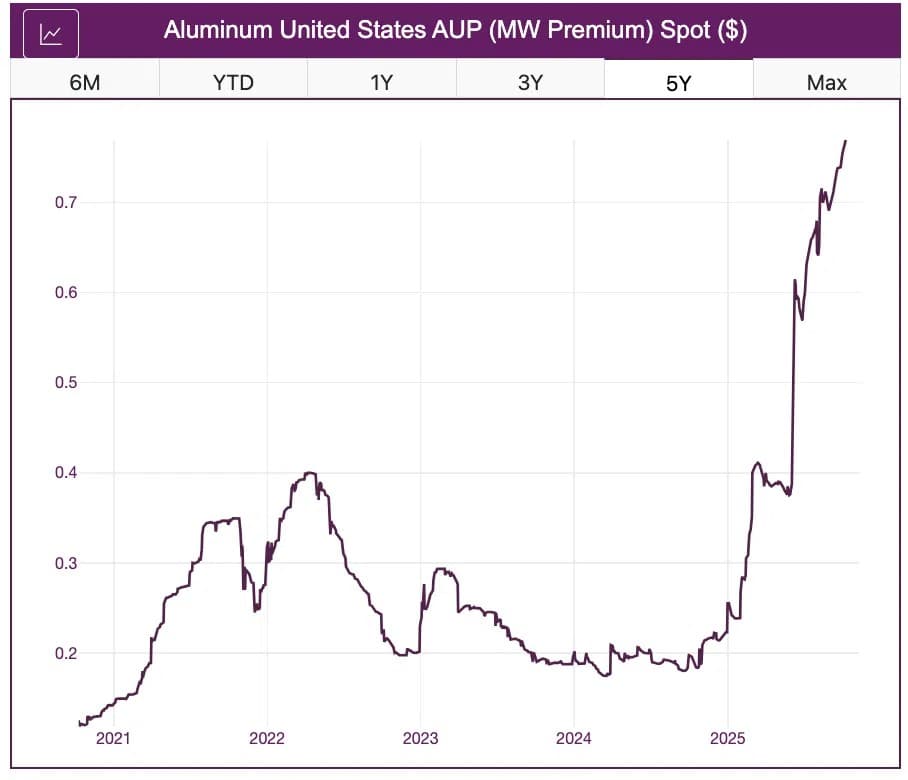
  • The disruption, combined with 50% import duties, pushed the Midwest Premium to a record $0.77/lb and intensified domestic price pressures.

  • Despite short-term bullish sentiment, weak demand and rising inventories could limit aluminum’s uptrend in the months ahead.

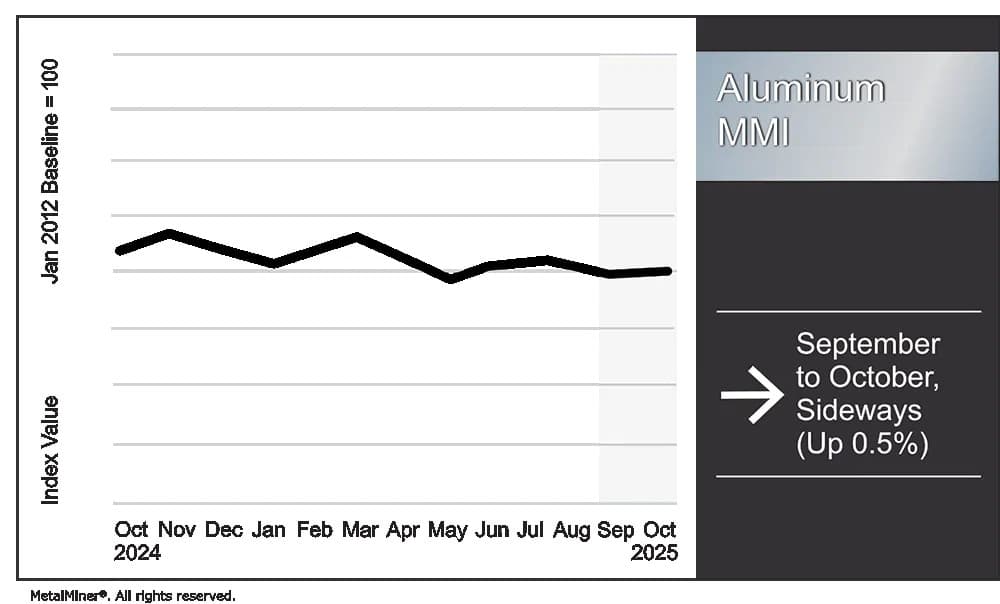
The Aluminum Monthly Metals Index (MMI) remained sideways, rising by a modest 0.5% from September to October. Meanwhile, the price of aluminum remains in an uptrend, supported by a growing number of factors.
Aluminum

Novelis Oswego Fire Challenges U.S. Supply

A massive fire at Novelis’ Oswego facility took a significant cut out of U.S. aluminum capacity. The September 16 event caused extensive damage throughout the facility, rendering its hot mill unusable until early 2026. The company also declared a force majeure on automotive, beverage and container stock shipments.

Most consequential to the U.S. market is the fact that the plant produces roughly 40% of the aluminum sheet used by the auto industry, totaling around 350,000 metric tons. While Novelis is currently working to minimize supply disruptions for its major customers, Ford’s shares dropped in the immediate aftermath of the fire.

Novelis’ parent company, Hindalco Industries, owns rolling plants in Europe, Brazil and South Korea. These will offer alternate sourcing options until Oswego returns. However, as offshore imports are now subject to a 50% duty, securing that material will come at an additional cost.

U.S. Aluminum Prices Rise Following Fire

The Oswego fire also shifted the overall outlook for U.S. aluminum prices. Prior to the event, the market was preparing for the end-of-year slow season. As such, market conditions appeared relatively stable to slightly softer, and certain service centers expected the Midwest Premium to moderate as a result.
Aluminum
Source: MetalMiner 
Insights

But in the wake of the Oswego outage, service centers noted that conversion costs rose across U.S. mills. Meanwhile, the Midwest Premium climbed to a new all-time high, hitting $0.77/lb as of October 6. The premium now exceeds the levels most market participants predicted following the implementation of U.S. tariffs.

Those same tariffs have made U.S. supply disruptions significantly more consequential. Outages, be they planned or unplanned, do not typically have a meaningful impact on the price of aluminum. While this was in part due to the heavy supplier concentration for auto sheet, Oswego’s outage absolutely did. 

Tariffs Make U.S. Disruptions More Consequential

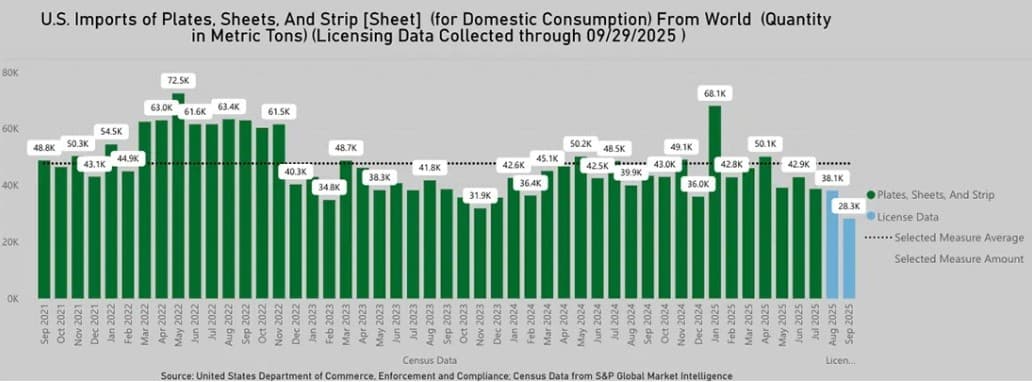
Outside of a sharp spike in January due to buyers looking to beat tariffs, aluminum imports have trended lower throughout 2025, tightening domestic supply. Data from the Department of Commerce shows aluminum sheet imports from February to August fell 3.69% compared to the same period in 2024.

The decline is even more significant across aluminum in general, with total imports falling 10.17% during the same period. The slowdown in imports echoes sentiments among brokers and master distributors who have noted hesitancy toward long-term offshore contracting in recent months.
Wrld

Even with lower import levels, the U.S. remains a net importer of aluminum, meaning the market requires offshore supply to meet demand. However, tariffs have seen buyers increasingly search for domestic producers to secure materials. While some of this behavior stems from tariff cost pressures, numerous supply shocks in recent years have led many procurement organizations to prioritize supply security and risk mitigation.

The sharp irony of these collective efforts means that supply disruptions in the U.S. are now much more consequential to market conditions. This, in turn, presents an ongoing volatility risk to the price of aluminum.

Can the Aluminum Price Uptrend Last?

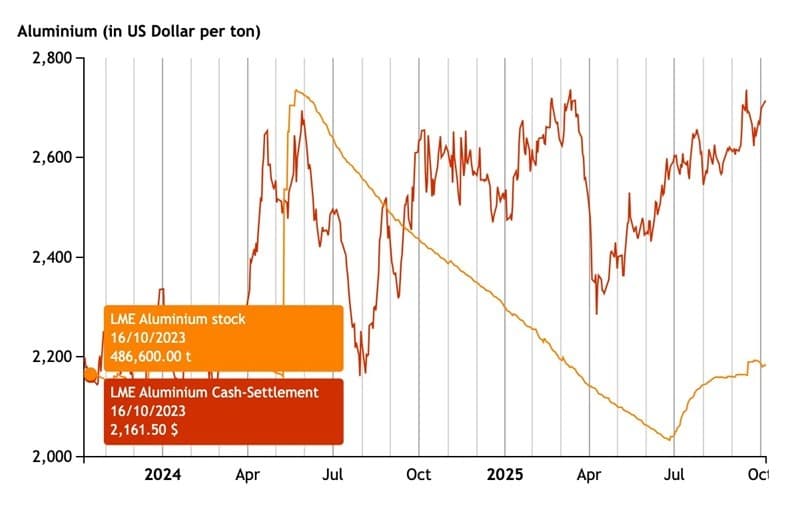
Alongside a rise in domestic premiums, exchange prices remain strong. For example, LME three-month aluminum prices appreciated by an additional 2.61% last month, reaching their highest level since March during the first week of October. This ascent echoes the upside price action seen among other base metals, as copper, zinc and tin have also reached multi-month highs in recent days. 

Like other base metals, the Fed’s recent rate cut saw the U.S. dollar index soften, leading commodities that trade inversely to it, like metals, to rise as a result. However, ongoing inflationary pressures are likely to see the Fed take a more tempered approach in the coming year.
LME

Meanwhile, exchange stocks are on the rise despite China’s aluminum output cap. Data from Westmetall showed LME aluminum inventories rebounded to their highest level since March by early October. Supply concerns have largely aided the aluminum price trend over the past few months, inspiring a bullish bias among investors. However, global demand conditions remain soft. According to data from the Aluminum Association, consumption in the U.S. and Canada fell 4.4% during H1. 

While the price of aluminum continues to show an upside bias for now, absent a more significant shift in market conditions, this positive trend may be difficult to maintain in the months ahead.

The Price of Aluminum: Biggest Moves

  • European 5083 aluminum plate prices witnessed the largest increase of the overall index, rising 3.79% to $4,654 per metric ton as of October 1.
  • European 1050 aluminum sheet prices increased 3.74% to $3,414 per metric ton.
  • LME primary three-month aluminum prices moved sideways, with a 2.61% rise to $2,678 per metric ton.
  • The 3003 coil premium over 1050 Korean aluminum dropped 2.23% to $3.99 per kilogram.
  • Korean commercial 1050 sheet prices declined by 2.25% to $3.95 per kilogram.

By Metal Miner

Carney says renegotiating CUSMA likely won’t resolve all trade issues with U.S.

By The Canadian Press
October 10, 2025 

Prime Minister Mark Carney and U.S. President Donald Trump hold a press conference at the White House in Washington, D.C., Tuesday, Oct. 7, 2025. THE CANADIAN PRESS/Adrian Wyld

Prime Minister Mark Carney says it’s clear the U.S. will keep targeting certain sectors with tariffs even after the renegotiation of the Canada-U.S.-Mexico Agreement on trade.

Talks to update the agreement, known in Canada as CUSMA, are set to start next year but Carney says those talks are unlikely to resolve all outstanding issues.

He says that is why Canada is trying to strike deals in the meantime, on sector specific tariffs like steel, aluminum, autos and softwood lumber.

Canada-U.S. Trade Minister Dominic LeBlanc returned from Washington today, saying discussions will continue with U.S. officials to press for tariff relief.

During a meeting between U.S. President Donald Trump and Carney at the White House on Tuesday, Trump told reporters there will still be tariffs on Canada going forward and he doesn’t care if CUSMA is renegotiated or replaced with different deals.


The vast majority of Canadian trade with the U.S. is exempted from tariffs because of the trade deal, but Trump has targeted the steel, aluminum, auto, energy and lumber sectors with tariffs.

This report by The Canadian Press was first published Oct. 10, 2025.

With files from Kelly Geraldine Malone in Washington, D.C.
Trade War

‘Why would we buy U.S. wines?’ Ontario vintners reap benefits of trade dispute

By John Vennavally-Rao
October 11, 2025 

Bryce Morgan, Hidden Bench Assistant Vineyard Manager, shows the pinot noir grapes being harvested. (CTV News)

Heading into the Thanksgiving weekend, winemakers in Ontario’s Niagara region had plenty to be thankful for.

The grape harvest is well underway and sales of local wines are booming, thanks in part to the province’s ongoing boycott of U.S. wines and spirits.

At Hidden Bench Vineyard under sunny skies, crews have been busy picking the grapes for pinot noir. Using clippers, they snip the fruit off the vine and fill bright yellow bins. The grapes are then hand sorted to ensure only the best fruit is getting into the tanks that make their wines.

Owner Harald Thiel says the weather has been good, though a drought in July means the overall yield is somewhere between average to below average.

Still, he says it’s been an “excellent year.”


“We’re seeing the quality is just impeccable in terms of the fruit we’re bringing in,” said Thiel.

It’s also been an excellent year based on sales at Ontario’s government-run LCBO stores. Thiel says he’s selling twice as many bottles compared to last year.

“Sales have been up a tremendous amount, to the point where we have to be careful that we don’t run out of wine,” said Thiel.

Carolyn Hurst is President & CEO of Westcott Vineyards in Jordan Station, Ontario. It’s considered a small operation producing 120,000 bottles a year. (CTV News)

Sales soaring at LCBO


According to the LCBO, sales of Ontario VQA wines – which are made entirely from local grapes – are up 67 per cent year over year, while red wines have jumped 80 per cent.

At Westcott Vineyards in Lincoln, Ont., the story is similar. Co-owner Carolyn Hurst says the boycott has allowed her to get more attention from consumers.

“With those U.S. wines coming off, we’ve had some really significant, great growth,” said Hurst. “All kinds of new customers are finding us and discovering that our wines are as good, if not better, than anything that was taken off the shelves.”

Hurst says she’s also seen a doubling of sales at the LCBO and believes once the boycott ends, she’ll keep many of those new customers.

“People now that they’ve discovered us, and they’ve made the switch, I think we’re going to have a great continuation of that.”

Antonia Mantonakis is a wine marketing expert at Brock University. (Brock University)


Shedding an old reputation

Antonia Mantonakis, a marketing professor at Brock University who calls herself “The Wine Psychologist,” says the shift in purchasing habits and the buy Canadian movement is a huge opportunity for the domestic wine industry, which hasn’t always been held in high regard.

She says half-a-century ago, wine makers in Ontario didn’t grow the right grapes to make good quality wine. While that has long since been fixed, the reputation still lingered.

“For millennial consumers who grew up witnessing their parents not choosing Canadian wine, there was maybe a little bit of hesitation,” said Mantonakis.

But she says those previously hesitant consumers are now trying Ontario wine amid the patriotic push, and finding out it’s really good. According to Mantonakis, it shouldn’t be surprising.

“Ontario is on the same latitude as other world-famous cool climate wine regions: Tuscany, California, Oregon,” she said.

As for what will happen when the boycott ends, Mantonakis thinks some consumers have become accustomed to buying Canadian product and will likely stick with it.

“These patterns of behaviour are going to stay,” she said.

Thiel says he’s also optimistic that what began as a trade spat could have a lasting upside for local growers.

“Once Canadians taste these wines, they go, ‘Why would we buy U.S. wines going forward?’”


John Vennavally-

Senior Correspondent, CTV National News
'Conflict of interest’: Experts share concerns of U.S. stakes in Canadian miners

By The Canadian Press
October 10, 2025

The Gates of the Arctic National Park and Preserve, where the Ambler Road project would pass through, is visible from Ambler, Alaska, Sunday, Sept. 28, 2025. (AP Photo/Annika Hammerschlag)

The U.S. government is increasingly taking stakes in publicly traded companies, including Intel and Canadian-based miners Trilogy Metals and Lithium Americas, giving rise to concerns over the potential for conflict of interest issues to surface.

Richard Leblanc, a professor of governance, law and ethics at York University, said it’s unusual to see a foreign government take a stake in a Canadian company.

“It is uncommon for a government to have a stake in a domestic company, but it’s even more uncommon for a foreign government,” he said.

Vancouver-based metal exploration company Trilogy Metals Inc. announced on Monday that the U.S. government would acquire a 10 per cent stake for US$35.6 million, with an option for more in the future. It also has the right to appoint a member to the company’s board. Trilogy has mining interests in Alaska that Washington wants to see developed.

On the same day, U.S. President Donald Trump signed an executive order directing a road to be built in Alaska, allowing access to the Ambler mining district, an area rich in copper where Trilogy has an interest through a joint venture.


Leblanc questioned the efficacy of a company having a major shareholder that also has the authority to make crucial decisions that could change the investment landscape for it through regulations or other policy decisions.

“To have an outside investor who can have regulatory approval, is that a conflict of interest? It absolutely is a conflict of interest,” he said.

“(Other) shareholders do not have the power to have regulatory approvals, so what this creates is a super shareholder.”

The Trilogy news came on the heels of another Canadian company being added to Washington’s portfolio.

Last week, the U.S. government said it was taking a minority stake in Lithium Americas, another Canadian-headquartered company that is developing one of the world’s largest lithium mines in Nevada.

As the move regarding the U.S. administration acting as both investor and regulator faces criticism, some observers noted it seems to be part of a trend. Mounting geopolitical competition for minerals key to priorities like a carbon neutral economy, AI hardware and defence means governments are watching the mining sector more closely.

Sara Ghebremusse, an assistant professor at the Allard School of Law at the University of British Columbia, said she “absolutely” thinks there are conflict of interest concerns stemming from the U.S. government’s most recent stakes in Canadian miners.

“But I don’t think that’s a concern of the Trump administration right now. Appearances of conflict of interest, and even real incidents of conflict of interest, I don’t think the U.S. administration is currently concerned about that right now,” she said.

Leblanc said it is important to have separation to guard against instances where the interests of a company may not align with those of the U.S. government as shareholder or regulator.

“It introduces the capacity for unequal treatment of Canadian shareholders vis-a-vis an American shareholder who’s also a regulator,” he said.

In the case of Trilogy Metals, Leblanc noted the U.S.’s stake would make it one of its largest investors, which could have implications for its board.


“A large shareholder like the U.S. government could influence the board, either directly or indirectly. And directly would be to nominate someone onto the board,” Leblanc said.

“If or when that happens, the discussions in the boardroom change because you now have a shareholder-nominated director. For all intents and purposes, the U.S. government could be regarded as an activist shareholder.”

Despite the risk of influence, Ghebremusse said she doesn’t expect transactions of this kind to be a significant concern for the Canadian government.

“A 10 per cent stake in a Canadian mining company by the U.S. government is not outside the bounds of what would be acceptable foreign ownership in Canada,” she said.

Meanwhile, Leblanc said the Canadian government should scrutinize the Trilogy Metals transaction “with great care,” given the renewed importance of critical minerals to economic security.

“This could be a test case for what the Canadian government is prepared to accept. If we find that this is acceptable, then I wouldn’t rule out investments by the U.S. government in other critical Canadian companies,” he said.

“That would also have implications for Canadian sovereignty, for Canadian defence, for our ability to govern our own Canadian companies.”

The U.S.’s investments in the Canadian mining industry come after it took a 10 per cent stake in American tech giant Intel in August and a roughly 15 per cent stake in rare earth miner MP Materials in July.

Adam Fremeth, an associate professor at the Ivey Business School, said there is a growing trend over the past decade of countries investing in private firms as part of industrial policy.

“One of the things that allows to happen is the de-risking of investment. That government ownership can bring with it the ability to lower cost of capital. To lower downside risks that a firm may be facing,” he said.

“And we see some of that discussion going on right now with regards to the infrastructure projects that are being pitched at both a federal level and a provincial level in Canada.”

While direct state intervention in resource companies has historically been uncommon in Canada and the U.S., Ghebremusse pointed to examples of state-owned companies in China. She also highlighted instances of states acquiring stakes in foreign-owned mining projects in Africa and Latin America.

She said the fresh enthusiasm for critical minerals is “almost akin to the gold rush” with companies, sometimes supported by countries, trying to stake their claim.

“You see right now, a lot of Western countries looking to at least catch up and be in a position to compete with China for access to critical minerals,” she said.

This report by The Canadian Press was first published Oct. 10, 2025.

Daniel Johnson, The Canadian Press
AI sovereignty in the spotlight as Microsoft Canada gets new president

By The Canadian Press
October 13, 2025 

Microsoft Canada president Matt Milton at the company's offices in Calgary, Alta., Monday, Oct. 6, 2025. THE CANADIAN PRESS/Jeff McIntosh

TORONTO — If the new president of Microsoft Canada is concerned that a trade war with the United States will diminish his employer’s stature north of the border, he’s not showing it.

Instead, Matt Milton addresses most questions about the challenges facing his company with Microsoft’s resumé — 40 years in Canada and millions in annual investments in the Canadian economy.

The achievements have made him “completely confident” Microsoft is the “the right Canadian organization” to be in the mix as the country considers the future of AI, he said in his first interview since taking on the top job six weeks ago.

The trouble? These days Canada’s taking a more critical look at sovereignty and while Microsoft has been in the country since 1985, it’s ultimately an American company.

That might not have bothered Canada when its tight relationship with the U.S. seemed eternal, but now that President Donald Trump is its chief aggressor, the country is on the brink of a reckoning around how far it will take its patriotism.


Its first test in the world of tech could be the country’s artificial intelligence strategy, which is being crafted now for release by the end of the year, or the sovereign cloud Prime Minister Mark Carney casually mentioned wanting to build at a September press conference on major projects.

Sovereign clouds give users greater control over their data’s residency and privacy by dictating where information is kept, who can access it and, most important to Microsoft, which technology will safeguard it. The most stringent sovereign clouds store information in servers physically within a country’s borders and are powered with infrastructure developed in that nation, so data is protected from outside governments and companies.

The federal government has said its forthcoming strategy is meant to “position Canada at the forefront” of the AI revolution. It has solicited feedback on commercialization, research, talent, infrastructure and security to help it craft the policy.

In Microsoft’s best-case scenarios, the country’s AI strategy does little to hamper its AI tools like chatbot Copilot and any sovereign cloud it builds leaves room for the company’s computing platform Azure to keep growing. In the worst scenarios, Microsoft’s wants are punted to the back of the line, if they’re considered at all, and Canada starts fuelling domestic competitors.

Regardless of where Canada lands, it’s justified to be having these discussions, said Milton, who is Ottawa-born but spent the last 25 years at U.S. tech companies Kyndryl and IBM.

“This is no different than the questions we asked when we entered the internet age, or when we entered the cloud age,” he said.

But when Canada faced those technological changes, the mood was different.

It celebrated every time a U.S. tech giant opened another facility in Canada and gave the people running them plenty of facetime with politicians who didn’t open their schedules as wide to homegrown firms, said Neil Desai, a senior fellow at the Centre for International Governance Innovation and one-time manager of strategic planning for former prime minister Stephen Harper.

Those ways have been shifting as the tariff war has suddenly made everyone into an “economic nationalist,” Desai said.

Now, conversations about how to tackle AI are more seriously considering what can be done to advance Canada’s place in the industry and taking on an urgent tone because AI is rapidly upending how we work, live and play.

“It moves so quickly that what was fact two weeks ago is fiction today,” Milton said.


He senses Canada doesn’t want to just keep up; it wants to lead and he’s determined for his company’s infrastructure to play a role in that push.

Microsoft has 5,300 employees in the country and 17,400 partners using its technology. It estimates it contributes $60 billion to Canada’s GDP each year and since 2023, has invested more than $828 million to expand its Azure public cloud and AI infrastructure in Québec alone.

“We’ve been here 40 years. We’ve made a lot of big investments,” he said. “We’re not planning to jeopardize any of those, and we plan to continue to make significant investments here.”

Guillaume Beaumier, an assistant professor of political science and international studies at l’École nationale d’administration publique in Quebec, sees this kind of chatter as a lobbying tactic aimed at reframing the debate about sovereignty “in a way that still allows them to operate in the Canadian ecosystem.”

It will likely work because governments largely see tech firms like Microsoft as “too big to abandon.”

“They’ve been so entrenched in our system that the likelihood of the government really trying to push them aside or abandon them is very low,” he said.

While there’s no homegrown behemoth quite like Microsoft, Desai said there are many domestic companies that can slot into the country’s AI future.

He suggested Ranovus, an Ottawa tech firm, could supply the chips and Toronto-based ThinkOn the data storage. ThinkOn announced Wednesday that it was part of a group of Canadian tech companies that launched a “sovereign AI-ready” cloud for governments.

But Desai also said Canada has to realize sovereignty is a spectrum — quickly.

“It’s not necessary that we have an Azure cloud facility with OpenAI algorithms and chips from Nvidia and that would be foreign and then, some other thing that was built by a bunch of Canadians from ground up that would be sovereign and Canadian,” he said.

“It is possible that they can be part of it, but we shouldn’t consider this a binary because we’ll just twiddle our thumbs for decades and all the while, we’ll see another major technology trend pass us by.”

This report by The Canadian Press was first published Oct. 13, 2025.

Tara Deschamps, The Canadian Press


Illinois Chat is launched for campus community


National Center for Supercomputing Applications


What began as a student project in 2023 will now serve a whole university community.

Illinois Chat, an official artificial intelligence (AI) software tool of the University of Illinois Urbana-Champaign, has launched for the Fall 2025 semester and is available for anyone on campus. In partnership with the Office of the Chief Information Officer (CIO) and Illinois Computes, NCSA developed Illinois Chat to offer large language model (LLM) abilities to the entire campus community.

This campus-developed tool allows users to create personalized LLM-based chatbots – similar to commercial options like ChatGPT – but with more control over their functions and content, meaning more security and less risk. By utilizing their own data focused on their intended audience, users can implement Illinois Chat to act as a 24/7 teaching assistant for professors, scrape campus websites to find needed resources or help organize research data.

And more.

“The Office of the CIO is excited to partner with NCSA, Illinois Computes and the Center for Innovation in Teaching & Learning to turn the idea for a potential revolutionary tool into a reality,” said Associate Director for Strategic Initiatives and Partnerships Nick Vance. “With Illinois Chat, the campus community can access the same capabilities as commercial options but with the added control and assurance of a locally controlled environment.”


NCSA Helps Turn Ideas into Outcomes
The development process for Illinois Chat began more than two years ago when student researchers Kastan Day, Rohan Marwaha and Asmita Dabholkar at the Center for Artificial Intelligence Innovation (CAII) set to work on creating their own chatbot platform to serve as an AI-based teaching assistant for computer engineering classes.

However, the team quickly realized that the platform could be used for much more. As new applications emerged, new functionality was added. The small team of three quickly grew to a dozen, incorporating contributions from many other students working in CAII, including Joshua Min, Ruixin Han, Max Lindsey, Neha Sheth, Heather Broome, Vira Kasprova, Akylai Kasymkulova, Jack Bai and Aryan Sachdev. While the initial development of Illinois Chat was primarily supported by CAII, other campus partners and programs started contributing to its development, including the CIO, AIFARMS, Gies College of Business, Illinois Computes, NCSA’s Healthcare Innovation Program Office and the Strategic Instructional Innovations Program in the Grainger College of Engineering.

“The project began as an effort to automate a task that had traditionally been difficult to achieve: replicating the role of a human teaching assistant,” said Volodymyr Kindratenko, director of CAII and research associate professor in the Siebel School of Computing and Data Science. “Initially, we thought we could train an LLM on course materials, such as textbooks and lecture notes, so it could answer student questions. However, this approach proved too complex and not easily scalable for every course that might want an AI-based teaching assistant.

“Instead, we turned to a relatively new technique called Retrieval-Augmented Generation (RAG), which works with LLMs to deliver content-specific chatbot responses. Our first product (uiuc.chat) quickly became popular among researchers and teachers exploring generative AI in the classroom and beyond. We’ve been refining the platform ever since.”

As the user base and potential applications began to grow, members of NCSA’s software team led by Luigi Marini were looped in to re-engineer the platform’s infrastructure components and user interface to make it more performant and robust, and give it the University of Illinois look and feel. In 2025, Technology Services and Illinois Computes embarked on making the platform into a campus-wide service.

Marwaha, now a research software engineer at NCSA and the lead developer of Illinois Chat, reflected on the long journey of building this tool for the campus community.

“Two years ago, we were building chatbots for individual courses and quickly saw the same need across teaching, research and operations,” Marwaha said. “Instead of another general chat app, we built a platform so people can create personalized assistants with campus security and answers grounded in their sources. Then they can share them with their audience. I believe this will revolutionize education and research at Illinois.

“We engineered Illinois Chat so anyone can assemble a capable AI assistant in minutes. You choose the sources, the tone and the audience. It is your AI, for your work.”


Adding to Illinois Computes Resource List
Of course, Illinois Chat is one of many resources NCSA offers to university researchers and the campus community as a whole. Illinois Computes provides computing and data storage resources, technical expertise and support services to researchers from all domains across the Illinois campus, while removing barriers for all researchers to access NCSA’s growing assemblage of research computing tools and world-class staff, furthering their innovative and novel work.

NCSA strives to play a leading role in developing AI platforms for the campus, relying on the potent blend of administration and development support through Illinois Computes.

“The partnership between NCSA and Technology Services on Illinois Chat shows what we can accomplish for campus when we combine cutting-edge research and development skills at NCSA with Tech Services’ expertise and experience in running campus-wide services,” said Director of Illinois Computes Chuck Thompson. “We believe this is only the beginning of what we can deliver for our campus.”


Immediate Impact
CAII and the Healthcare Innovation Program Office at NCSA have also partnered with Vyriad to implement Illinois Chat into the platform, providing broader access than Vyriad can currently mobilize to enable the review of relevant virus-related or virus-adjacent literature. Donald B. Gillies Professor in Computer Science Vikram Adve and his team have also utilized Illinois Chat effectively at AIFARMS.

Kindratenko and Illinois Chat have already been honored with an Innovative Tool Award by Instructure, the maker of Canvas LMS. The Academic Excellence Awards recognize exceptional educators and programs worldwide for remarkable achievements in teaching, learning and innovation.

“I have been using the platform in my ECE 408 courses since we launched its first prototype in Fall 2023,” Kindratenko said. “Over the four semesters it has been in use, students have asked more than 22,000 questions. In recent semesters, many colleagues across different departments have also adopted the platform and provided valuable feedback to make it more practical for both faculty and students. Other current applications include serving as a technical assistant for NCSA’s Delta and DeltaAI supercomputers and enabling researchers to interact with the entire open-access PubMed repository of biomedical articles, among others.”


ABOUT NCSA
The National Center for Supercomputing Applications at the University of Illinois Urbana-Champaign provides supercomputing, expertise and advanced digital resources for the nation’s science enterprise. At NCSA, University of Illinois faculty, staff, students and collaborators from around the globe use innovative resources to address research challenges for the benefit of science and society. NCSA has been assisting many of the world’s industry giants for over 35 years by bringing industry, researchers and students together to solve grand challenges at rapid speed and scale.

ABOUT ILLINOIS COMPUTES
Illinois Computes offers computing and data storage resources, technical expertise and support services to researchers from all domains across the University of Illinois Urbana-Champaign campus. Through the campus-funded program, NCSA will learn what additional assets are needed to fulfill the computing demands of the university and adjust the cyberinfrastructure strategy while continuing to make access to systems, interdisciplinary and technical knowledge, and support infrastructure easy to obtain. Illinois Computes removes barriers for all Illinois researchers – especially those typically underserved – to access NCSA’s growing assemblage of research computing tools and world-class staff, furthering their innovative and novel work while ensuring NCSA is a leader in the global research community.

Check out the Illinois Computes website and sign up for the monthly newsletter for more information.


Social media use trajectories and cognitive performance in adolescents


JAMA Network


About The Study: 

This analysis found that both low and high increases in social media use throughout early adolescence were significantly associated with lower performance in specific aspects of cognitive function, supporting a prior finding that greater screen time was negatively but weakly associated with adolescent cognitive performance.


Corresponding Author: To contact the corresponding author, Jason M. Nagata, MD, MSc, email jason.nagata@ucsf.edu.

To access the embargoed study: Visit our For The Media website at this link https://media.jamanetwork.com/

(doi:10.1001/jama.2025.16613)

Editor’s Note: Please see the article for additional information, including other authors, author contributions and affiliations, conflict of interest and financial disclosures, and funding and support.

#  #  #

Embed this link to provide your readers free access to the full-text article 

 https://jamanetwork.com/journals/jama/fullarticle/10.1001/jama.2025.16613?guestAccessKey=c8bce59a-f799-4c36-817e-dd2c05cf6ae4&utm_source=for_the_media&utm_medium=referral&utm_campaign=ftm_links&utm_content=tfl&utm_term=101325

Your plumber has a new favorite tool: ChatGPT

By CNN
October 10, 2025 

Blue-collar industries, such as plumbing and HVAC, are increasingly adopting AI. 
(Credit: Sefa Ozel/iStockphoto/Getty Images via CNN Newsource)

The roughly 20 plumbers of Oak Creek Plumbing & Remodeling in the Milwaukee, Wisconsin area don’t just bring toolkits with wrenches, pliers and Teflon tape to customers’ homes these days. They also bring a tablet equipped with the latest version of ChatGPT.

The technology helps those workers automatically create invoices, work proposals and even brainstorm how to address complicated plumbing problems, company president Dan Callies told CNN. All they have to do is take photos of a broken water heater, for example, or write their observations in a prompt, and ChatGPT spits out a list of recommendations.

“It’s definitely been worth the investment,” Callies said. “Some of our older guys have learned to ask ChatGPT the right questions, and they’re kind of amazed with some of answers it comes up with.”

From office work to on-the-ground troubleshooting, blue-collar businesses are increasingly embracing AI to boost productivity, cut down costs and even replace administrative support roles. Some use popular AI software such as ChatGPT and Microsoft Copilot, while others use platforms tailored specifically for the trades with AI capabilities, such as ServiceTitan and Housecall Pro.

“It’s affecting both sides of our company, out in the field and internally within our office,” Callies said.

The growing appeal of AI

No humans are involved from when a customer requests services from Gulfshore Air Conditioning & Heating in Niceville, Florida to when a technician arrives at their home, thanks to AI.

And once the technician arrives, they use AI to diagnose the issue and pull up technical information within seconds — a task that used to require sifting through as many as five 60-page manuals, said Krista Landen, the company’s marketing and IT manager.

A survey of more than 400 tradespeople across North America by Housecall Pro earlier this year found that more than 70 per cent of respondents said they have tried AI tools and about 40 per cent said they actively use them. Younger professionals are leading the charge, the survey showed, though older workers are testing the waters, too.

AI’s integration and impact varies by industry, according to the survey; Plumbers were the most likely to say AI has helped their business grow; cleaners were the “biggest adopters of AI”; while electricians had “the highest satisfaction rates” with the technology.

Schools have also taken notice: Jason Altmire, president and CEO of Career Education Colleges and Universities, a trade association that represents more than 800 private vocational schools across the country, said several institutions are weaving AI into their curriculum in collaboration with employers.

“They want their graduates ready for jobs that are going to be available in the future, not jobs that were here five years ago,” Altmire said.

Still, some tradespeople are skeptical about how the new technology works and how it can be applied to physical tasks.

“There’s some hesitancy, so I wouldn’t say they’re all in,” said Edward McFarlane, chair of the board of directors at the Air Conditioning Contractors of America. “But the tide is definitely coming in.”

The implications of the technology

AI is slowly reshaping the economics of blue-collar America.

Businesses in the trades implementing AI are becoming more productive, allowing them to take on more projects or improve the quality of their services, said Laura Ullrich, an economist at job site Indeed.

“People go into the trades because they like doing the hands-on work itself, and if some of the administrative tasks can be automated, then that should help those workers lean into the parts of the job they like and do smarter work,” she said.

AI has already made a measurable impact on Gulfshore, which saw a US$370,000 increase in revenue 30 days after upgrading to an AI marketing feature that automates campaigns.

The company said it also saw an increase of US$150 in revenue per average ticket after implementing AI tools that helped technicians get through administrative tasks more quickly and allowed them to sell customers additional services or accessories. Landen said the higher revenue, if sustained, should eventually translate into higher compensation for technicians.

“We’ve been using these AI products since June, so we should start to see more of a benefit in order to roll out new compensation packages (for technicians) within the next six months,” she added.

Callies of Oak Plumbing & Remodeling said ChatGPT has allowed the company to “lower our overhead and provide better services or better value.”

AI’s growing adoption in the trades could mean businesses may not need to hire as many office workers for marketing and taking customer calls, economists and business owners tell CNN. That presents those businesses the opportunity to cut down on those costs.

For now, there’s broad agreement that AI is nowhere near taking away the jobs of technicians, at least not until robotic technology significantly advances. It’s mostly proving to be a useful tool for tradespeople.

“All of our technicians are running more efficiently, and they’re less stressed,” Landen said. “I feel like I am a real life Jetson living in the future.”