Monday, October 13, 2025

Source: Jacobin

Bloomberg News describes Paul Kagame, president of Rwanda for the last quarter century, as “the West’s favorite autocrat.” According to Bill Clinton, Kagame is a “brilliant man,” one of the “greatest leaders of our time,” no less.

Former British prime minister Tony Blair likewise hails Kagame as “a visionary leader.” Blair’s Institute for Global Change has worked closely with Rwanda, and Blair has personally argued against any moves to sanction Rwanda for its violent looting of the Democratic Republic of Congo (DRC).

It is not merely retired politicians like Clinton and Blair who have chosen to truck with Kagame. The European Union has negotiated a deal with his government to facilitate the extraction of minerals, despite clear evidence that this is encouraging the pillage of the Congo.

Kagame’s Rise

The central African country that Kagame rules is tiny — about the size of Maryland. Its population consists of two main ethnic groups: the Hutu, who historically accounted for approximately 85 percent of the population, and the Tutsi, who accounted for most of the remaining 15 percent (statistics on ethnic identity are no longer officially collected).

German and Belgian colonial administrations made use of a certain Tutsi stratum as a ruling group. The run-up to independence in 1962 saw a reversal of the colonial order as a Hutu elite seized control and incited a series of pogroms against the Tutsi population, with tens of thousands killed and many more forced into exile.

Those Tutsi exiles, many of whom grew up in Ugandan refugee camps, became the core of a rebel movement, the Rwandan Patriotic Front (RPF),that invaded Rwanda in 1990. They demanded the right to return to the land from which they or their parents had been expelled. Paul Kagame, one of the Ugandan exiles, became the leader of the RPF in the course of a subsequent four-year civil war.

In April 1994, a missile shot down the plane of Rwandan president Juvénal Habyarimana, killing Habyarimana and his Burundian counterpart, President Cyprien Ntaryamira. The question of who was responsible for the missile strike remains a matter of controversy: there is a strong, if not fully proven, case that the RPF was culpable.

In the aftermath of Habyarimana’s death, the government army and affiliated militias, with backing from France, initiated a genocide of the Tutsi and the mass killing of political enemies. Between April and July, approximately eight hundred thousand people were slaughtered.

The RPF militarily defeated the government forces in July 1994, committing massacres of their own along the way, and prioritizing military victory over rescue of the civilian Tutsi population. Kagame was subsequently but misleadingly hailed as a hero for supposedly having ended the genocide. He became the country’s de facto leader until 2000 when he formally assumed the presidency, a position he has held ever since.

From the Ashes

Many international observers consider post-genocide Rwanda to be a miracle of ethnic reconciliation and economic recovery. Blair talks of Rwanda’s “remarkable path of development,” while Anthony Blinken described the country in 2022 as having risen “from the ashes of genocide to become a global destination for innovation, for investment, for tourism.”

On a personal note, when I was an aid worker in Rwanda in 1994–95, I was generally impressed by Kagame’s RPF. They were competent, seemed genuinely committed to national reconstruction, and evidenced little or no corruption. I also largely accepted the narrative that they had ended the genocide. However, the overwhelming accumulation of evidence since that time has caused me and most others to become highly critical of RPF rule.

We now point to Kagame’s implausible election victories, allegedly gaining over 99 percent of the vote in the most recent presidential election of 2024, and his practice of severe repressionincluding the imprisonment and assassination of political opponents, independent journalists and anyone else who challenges the regime.

Kagame also presides over a highly unequal economy whose gains predominantly accrue to a narrow circle of regime insiders, although it must be acknowledged that progress in the fields of education and health is real enough. Rwanda is deeply dependent on external aid as well as resources stolen from other countries.

The country from which the Rwandan elite has stolen the most is the neighbouring DRC. Rwanda first invaded the DRC (then named Zaire) in 1996, pursuing the remnants of the previous genocidal regime whose forces had fled there.

The DRC soon became the site of a conflict known as the Second Congo War that involved several African states, with Rwanda and Uganda ranged against DRC President Laurent Kabila (initially installed with Rwandan backing) while Angola, Namibia, and Zimbabwe sent troops to support him. The war claimed an estimated five million lives, including those who fell victim to hunger and disease. It dragged on after Kabila’s assassination in 2001, formally ending in July 2003, though often intense violence between various factions has persisted since then.

Through all this, Rwanda has been plundering and devastating the DRC. The International Crisis Group has described Rwandan actions over three decades as a pattern of “long-term territorial expansion including grabbing mineral-rich regions.”

Plundering Congo

Earlier this year, there was considerable media focus on the advance of a militia group called M23 across the DRC’s east. This advance led to an estimated three thousand deaths (mostly civilians), mass displacement, human rights abuses, and humanitarian crisis. The RPF-led Rwandan Defence Force (RDF) has consistently supported M23, with four thousand RDF troops on the ground in early February.

Rwanda, in turn, enjoys external support, including from the European Union. This was exemplified by a 2024 Memorandum of Understanding (MOU) designed to ensure that Rwanda supplies the EU with designated “critical” raw materials, including tantalum/coltan (used in a range of electronic devices), tungsten, and gold. The EU has allocated over €900 million to Rwanda to support resource extraction.

However, it is well documented that a large proportion of “Rwandan” resource extraction involves the systematic theft of DRC minerals and other raw materials, both directly and through the medium of militias like M23. The gap between Rwanda’s own production and its exports of those materials has long been glaring. For example, even though domestic production of gold is limited, Rwanda is estimated to have exported a staggering $654 million worth in 2022.

As Jason Stearns, a former UN investigator, noted earlier this year, the figures have continued to grow:

Mineral exports from Rwanda are now over a billion dollars a year. That’s about double what they were two years ago. And we don’t know how much, but a fair chunk of that is from the DRC.

The European Parliament has voted overwhelmingly for the EU to suspend the MOU. Belgian MEP Marc Botenga made the case for suspension:

This MOU needs to be suspended. In fact, it should have never been signed. We know there are Rwandan soldiers on Congolese soil and that is done to steal, to pillage certain natural resources. In fact, this MOU with Rwanda encourages these troops.

Yet the European Commission has claimed that suspension “could be self-defeating” and that it would remove “an incentive to ensure responsible mineral production and trade by Rwanda.” It is hard to see what is “responsible” about the current situation.

Of course, the EU is not alone in placing access to vital natural resources ahead of human rights concerns. The Trump administration sponsored a much-trumpeted peace deal signed in June 2025 between Rwanda and the DRC. But violence on the part of M23 and other actors has continued. The best that can be said is that some of the warring parties have paused their attacks — for now.

Nor will the plunder be stopped: a coalition of eighty Congolese civil society organizations has described the agreement as “a framework to normalize the current illicit resource and power grabs underway” by Rwanda and its allies, “including Western powers that covet the DRC’s minerals and support Rwanda with financial aid.” The United States, like the EU, is seeking to access Congolese raw materials in an example of what is euphemistically termed “peace-for-resources” diplomacy.

Rwanda, Mozambique, and the EU

Donald Trump’s attempts to gain access to the natural resources of other countries (evident also in relation to Ukraine) are certainly crude. But Europe has no claim to the moral high ground given its own approach to the DRC. Another African country in which both Europe and Rwanda are involved underlines the point.

civil war has raged in northern Mozambique since 2017 between the government and Islamist-associated rebels. In 2019, French oil and gas company Total announced a €19 billion investment in the mining of offshore gas deposits, but rebel activity threatened this project. In response, the EU has launched a support program for the Mozambican military, backed up by Rwandan forces that the EU has subsidized.

Some of the same Rwandan business interests involved in the looting of DRC resources are also involved in Mozambique, again seeking to exploit lucrative mining and other opportunities. A senior Rwandan military commander previously implicated in attacks in the DRC was identified in 2024 as being in charge of the Rwandan forces in Mozambique. As in the case of the DRC, MEPs have called for a halt to this support to the Rwandan military, which is channelled through the laughably named European Peace Facility, again to no effect.

The extraction of resource revenues has largely excluded poor Mozambicans, though they bear the costs. As Rehad Desai explains:

The only beneficiaries are the politically connected elites who receive the crumbs left on the table by the international corporations. The local populace is left to watch as their agricultural and fishing livelihoods are adversely affected.

It is precisely those costs to locals that have fuelled rebellion. While the EU says it is combating Islamist terrorism, Corporate Europe Observatory researcher Kenneth Haar more accurately characterizes the real stakes as “access to gas supplies and the defence of European-French investments.”

Rwanda’s role here as a partner to Western power points to one reason for its positive reputation in many quarters and its status as a Western “donor darling.” Kagame’s willingness to accept deported refugees from the UK (albeit in a scheme now abandoned) and from the United States is another factor.

Also germane is its significant contribution to UN peacekeeping missions, though hardly for altruistic reasons. As in the case of Mozambique, Rwandan businesses typically follow closely behind such deployments, usually under the umbrella of Crystal Ventures Limited, an RPF-owned holding company that dominates the Rwandan economy and pioneers the pursuit of RPF economic interests abroad.

Projecting Power

Rwanda is no passive player or Western puppet. It is a skilled and manipulative actor in its own right, as demonstrated by its projection of concerted military-commercial power, and its sponsorship of global sporting clubs and events in order to enhance its profile and reputation.

Kagame has also expressed strategic appreciation for Chinese interventions in Africa, implicitly warning Western powers that Rwanda could move closer to China if the West were to restrict its backing. There have, at times, been some such restrictions from various countries, including Belgium, the UK, and the United States, but they have been temporary and partial.

A further strategy Rwanda deploys to legitimize its abuses will be familiar to critics of Israel. It is notable that Rwanda has earned a reputation as “one of Israel’s best friends in Africa,” and cooperation between the two countries has continued since the latest onslaught on Gaza began. Israel commits genocide in Gaza while claiming to be hunting terrorists; Rwanda devastates and loots the DRC while claiming to be hunting the supporters of the 1994 genocide.

Just as Israel seeks to deflect criticism of its actions by accusing all and sundry of antisemitism, Rwanda accuses its critics (both internal and external) of engaging in “genocide denial,” or even support for genocide, as the RPF regime enjoys what Filip Reyntjens terms a “genocide credit.” In 2008, Kagame passed a law that criminalized any reference to crimes committed by the RPF as constituting “genocide ideology,” and numerous political opponents have been jailed under its terms.

That I was supportive of the RPF back in 1995 was a mistake. The fact that people are still supportive of the regime after three decades of tyranny and crimes against humanity is something else again. Yet with backers like Clinton, Blair, and the European Commission, Kagame’s dictatorship is still going strong and shows no signs of moderating its barbarism — at home or abroad.Email

Andy Storey is a lecturer in political economy at University College Dublin.

Why It’s Time to Retire ‘Global North’ and ‘Global South’


The term “Global South” gained popularity in the 1990s as a neutral alternative to “Third World,” which had become outdated and derogatory. Paired with the terms “Global North,” these labels were intended to describe economic divides: the “North” referring to wealthier, industrialized nations such as the U.S., Canada, Europe, and parts of East Asia, and the “South” to poorer nations in Africa, Latin America, and Asia. While intended to highlight disparities, these terms are deeply problematic. They are geographically inaccurate, homogenize diverse regions, and perpetuate colonial legacies that shape our understanding of global power and inequality.

Western art reveals how colonial narratives were constructed. John Vanderlyn’s The Landing of Columbus (1842), displayed in the U.S. Capitol, depicts Columbus as a heroic conqueror, masking the violence of colonization. Benjamin West’s The Treaty of Penn with the Indians (1771–72) idealizes harmony between settlers and Indigenous people while concealing dispossession. By contrast, J.M.W. Turner’s The Slave Ship (1840) confronts colonial brutality by depicting enslaved people thrown into stormy seas. Just as these works shaped historical perceptions, terms like “Global North” and “Global South” continue to shape modern narratives, reinforcing hierarchies that echo colonial exploitation. Moving beyond these legacies requires evolving our language.

The term “Global South” was coined in 1969 by activist Carl Oglesby and gained traction in the 1970s in debates about development and inequality. It was popularized by the 1980 Brandt Report, which introduced the “Brandt Line,” an imaginary divide separating wealthy northern nations from poorer southern ones. Since then, these terms have become standard in academia, politics, and international institutions. Leaders from the United Nations, the World Bank, and the G7 routinely utilize them, and reports such as UNCTAD’s Forging a Path Beyond Borders: The Global South (2018) reinforce their legitimacy. Yet despite popularity, these labels oversimplify, distort, and entrench harmful assumptions.

The most obvious flaw is geographic. Not all wealthy nations are in the North, and not all poorer nations are in the South. Australia and New Zealand are prosperous yet in the Southern Hemisphere. Conversely, India, Mexico, and much of Eastern Europe—often categorized as “South”—are in the Northern Hemisphere. Even the concept of north and south is arbitrary: from space, the Earth has no top or bottom; maps merely impose orientation. Equating geography with prosperity is misleading. Social scientist Dimiter Toshkov calls this “wrong and demotivational,” while economists Daron Acemoglu and James Robinson argue in their book Why Nations Fail (2012) that institutions, rather than geography, determine prosperity. Countries with inclusive institutions flourish regardless of latitude.

These terms also flatten vast differences, treating countries with divergent histories and economies as a single bloc. Comfort Ero of the International Crisis Group warns that this risks “simplifying or ignoring countries’ individual concerns.” Brazil and Indonesia share little in common with Sierra Leone or Timor-Leste, yet they are all grouped under the term “Global South.” The labels carry political baggage, framing global issues as a binary struggle between two camps. This erases nuance and reinforces stereotypes of dependency, where “South” nations are seen as problems needing solutions from the “North.”

Colonial legacies underpin this framing. Many countries labeled as part of the “Global South” were colonized by European powers. Using the label risks sustaining a hierarchy in which formerly colonized nations remain cast as inferior. It implies that progress requires following the “North’s” model, despite industrialized nations causing many of today’s crises, particularly climate change. The 2022 IPCC report recognized colonialism as both a historical and ongoing driver of the climate crisis. Western exploitation of resources and people set the stage for today’s ecological emergencies. Scholar Hadeel Assali highlights how extractive practices rooted in colonial mindsets prioritize limitless resource use, often with devastating consequences for local communities and ecosystems. Indigenous societies, frequently marginalized within both “North” and “South,” have long demonstrated sustainable stewardship. Steve Nitah, lead negotiator for the Łutsël K’é Dene First Nation in establishing the Thaidene Nëné Indigenous Protected Area, emphasizes how Indigenous governance sustains biodiversity and demonstrates reciprocal relationships with the land—insights critical for addressing climate and ecological challenges.

Global governance structures mirror these colonial dynamics. Wealthy nations dominate institutions such as the IMF, World Bank, and WTO. Voting power is tied to financial contributions, granting the U.S. and Europe outsized influence, while Africa, with 18 percent of the world’s population, holds just 6.5 percent of IMF votes. Loan conditions often impose austerity, prioritizing the interests of creditors. The United Nations, especially the Security Council with its five permanent members, similarly reflects imbalances. Clubs like the G7 and OECD privilege wealthy nations while marginalizing the voices of poorer countries. Policies thus frequently reflect the interests of the powerful, perpetuating global inequality.

The “Global South” label also reduces complex economies to a simplistic “poor” category, overlooking diversity and dynamism. While Bangladesh and Ethiopia face significant poverty, they experience lower rates of obesity and certain lifestyle-related health conditions than the United States, highlighting that economic wealth does not always correlate with better health outcomes. Meanwhile, Chile and Argentina are highly developed despite being located in the “South.” Toshkov argues that the North–South divide is “no better than the alternatives it replaced,” such as the “Third World,” suggesting that geography dictates development when evidence contradicts this notion.

Related terms, such as “developed” and “developing,” are equally flawed. Plan International’s Kerri Whelan observes that there are no clear benchmarks defining “developing,” and the hierarchy implies nations must follow Western models. Even the wealthiest countries lag in areas such as healthcare and environmental sustainability. Terms like “emerging markets” assume GDP growth defines success—a fixation that has fueled ecological destruction. Economists Paul Hawken, Amory Lovins, and Hunter Lovins argue in Natural Capitalism (2000) that capitalism undervalues natural and human capital, treating ecosystems as disposable inputs. In reality, ecosystem services—such as clean air, water, and climate regulation—are invaluable yet often excluded from economic metrics.

While no single replacement for “Global South” exists, more precise language is possible. Instead of vague categories, we should describe countries based on specific qualities, such as “low-income,” “resource-rich,” “former colonial powers,” or “countries with high biodiversity.” Toshkov advises, “Be specific about what the term is referring to. If you mean the 20 poorest countries, say that. If you mean technologically less advanced countries, say that. It takes a few more words, but it is more accurate and less misleading.” Decolonizing our worldview requires decolonizing our language. Tim Winton, in his 2017 book Island Home, reflects that fostering liberation and social renewal requires building new alliances, embracing creativity, and cultivating deeper empathy across communities—a mindset that extends to how we describe nations and their people.

The terms “Global North” and “Global South” were intended to capture inequality but obscure it. They are geographically inaccurate, flatten cultural and political diversity, and echo colonial legacies of domination and dependency. Worse, they simplify global power structures into binaries that sustain the very hierarchies they were meant to critique. Creating a just and sustainable future demands abandoning these terms and adopting language that acknowledges complexity without perpetuating stereotypes. The world cannot be divided neatly into two halves; it is time for our words to reflect that truth.


This article is licensed by the author under the Creative Commons Attribution-NonCommercial-ShareAlike 4.0 International License (CC BY-NC-SA 4.0).


Martina Moneke writes about art, fashion, culture, and politics. In 2022, she received the Los Angeles Press Club’s First Place Award for Election Editorials at the 65th Annual Southern California Journalism Awards. She is based in Los Angeles and New York.


Von der Leyen to confront Hungary’s EU Commissioner over reported espionage attempts in EU institutions

Von der Leyen to confront Hungary’s EU Commissioner over reported espionage attempts in EU institutions
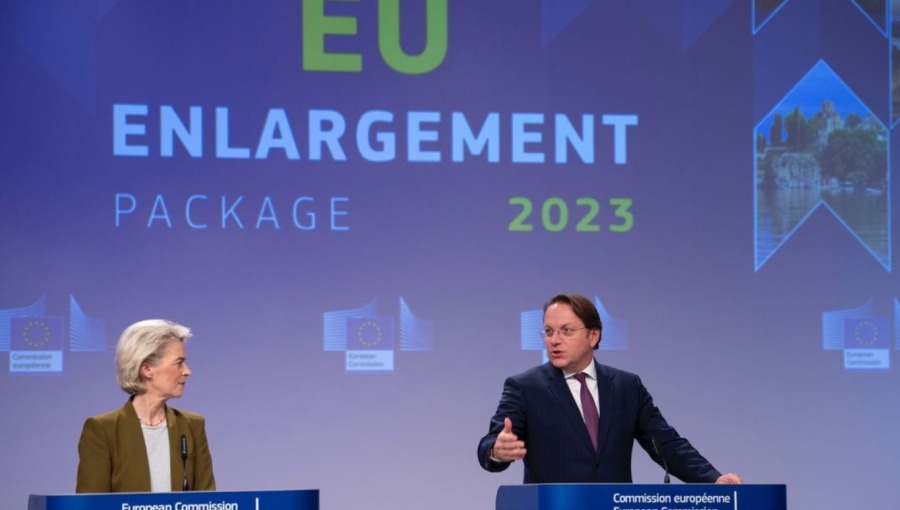
EC President Ursula von der Leyen, and Hungarian EU Commissioner Oliver Várhelyi. / Oliver Varhelyi - FB
By bne IntelliNews October 13, 2025

European Commission President Ursula von der Leyen intends to personally discuss espionage allegations with Hungarian Commissioner Oliver Várhelyi, Commission spokeswoman Paula Pinho said at a press briefing in Brussels on October 10, according to AFP, after reports that Budapest tried to recruit informers within EU institutions when Várhelyi was Hungary's ambassador to Brussels.

Pinho said the meeting would take place "at the earliest convenience."

The announcement comes after investigative outlet Direkt36 reported that during the 2010s, the Hungarian government reportedly attempted to recruit Hungarian diplomats working in Brussels institutions through intelligence officers operating under diplomatic cover at the country's Permanent Representation.

According to the report, as disputes deepened between the Orbán government and the European Commission over media freedom, rule of law, and judicial independence, the Prime Minister's Office grew increasingly interested in inside information about EU decisions that could affect Hungary's interests. Hungarian operatives reportedly reviewed the backgrounds of Hungarian nationals working at EU bodies and attempted to recruit some of them through intelligence officers operating under diplomatic cover.

"The EU gradually became a target. As government rhetoric began to focus on Brussels, the Brussels bureaucracy also gradually became a target of the Information Office, Hungary's civil intelligence service," recalled a former high-ranking Hungarian intelligence officer to the outlet.

Direkt36 recounted failed recruitment attempts by Hungarian officials working at EU institutions. In one case, a diplomat was asked to appear at the HQ of the Foreign Ministry for consultation. Shortly before the meeting, the venue was changed to a café in a Buda shopping mall, where the intelligence official, presenting himself as a ministry employee without a formal position, asked the EU diplomat to provide internal, non-public Commission documents, appealing to "patriotic duty."

The intelligence operations by Hungary reportedly became more aggressive during the 2015–2019, when Varhelyi was Hungary's ambassador to the European Union.

Várhelyi, known for his strong loyalty to Prime Minister Viktor Orbán and his direct management style, was officially the superior of intelligence officers operating under diplomatic cover at the Hungarian Permanent Representation.

Although Várhelyi did not directly participate in the secret intelligence operations in Brussels, given his position as Hungary's EU ambassador from 2015 to 2019, he was likely aware of the espionage activities at the embassy and which diplomats were involved.

Moreover, since the Information Office reports were prepared for political decision-makers, Várhelyi himself was also a recipient of the intelligence gathered.

Direkt36 notes that espionage activity is not unusual in Brussels as it is Europe's main intelligence hub and home to many international organisations, it is highly uncommon for an EU member state to engage in such operations. Intelligence gathering of this nature is typically associated with Russian, Chinese, Iranian and Middle Eastern agencies.

The Hungarian operatives were allegedly careless, leading to the exposure and compromise of the entire network by 2017.

Belgium's intelligence services reportedly viewed Hungary's past espionage failures in Brussels as a sensitive matter, even though the alleged operations targeted European Union institutions rather than Belgium itself, investigative sources said.

Belgian counter-intelligence is tasked with protecting EU bodies from foreign espionage and influence attempts.

Despite the incident, Belgian authorities are said to remain generally satisfied with their cooperation with Hungarian intelligence partners, including the IH. Officially, Belgium continues to classify Hungary as a "blue country," meaning a cooperative ally, in contrast to "red countries" such as Russia or China, considered hostile.

However, intelligence circles have increasingly begun to view Hungary as a "purple country," reflecting growing doubts about its reliability as an ally, a perception driven not by the earlier Brussels spy case, but by the Orbán government's pro-Russian foreign policy stance.

On October 10, anti-graft watchdog Transparency International called on the European Parliament, "as the EU's only directly elected body", to set up its own enquiry into the matter. "If true, these disgraceful allegations that Hungary sought to spy on the EU itself further demonstrate Viktor Orbán's flagrant disregard for the rule of law across the Union," said the group's EU director Nick Aiossa.

Unwavering support for Ukraine

Saturday 11 October 2025, by Fred Leplat

Article: Nestor Makhno in the Culture of Remembrance of Modern Ukraine – AnarchistStudies.Blog


Ukraine is still resisting heroically Russia’s imperialist war of annexation. Hopes had been placed on the Trump-Putin summit in Alaska for a ceasefire. But in the run-up to the summit and since , Russia escalated its attacks on Ukraine with more drones and missiles targeting civilian housing and infrastructure while making only limited progress on the ground. Russia has now also sent drones over Poland and Romania.

The escalation of attacks on civilians in August prompted Trump to threaten harder sanctions on Russia if it did not agree to a ceasefire and enter into negotiations. The summit in Alaska turned out to be a big success for Putin. He conceded nothing while Trump gave him international legitimacy despite having arrest warrants against him issued by International Criminal Court for war crimes and genocide.

Trump turned against Ukraine by suggesting that it should exchange territories with Russia for peace deal, which means Ukraine accepting Russian annexation of the Donbass and Crimea. Trump now leaves it up to European countries to buy arms from the US for Ukraine’s war effort. Tariffs of 50% by the US on countries such as India that are buying Russian oil is more about Trump’s protectionism and his attempts to split the pro-Russia alliance of countries such as China than support for Ukraine. Having got no concessions from Putin, Trump now says that he is angry and has been “played” by him. But these words have not frightened Putin.

Putin has made it clear that his war objectives remain unchanged: recognition by Ukraine of the occupied territories; the removal of Zelensky; a veto on Ukraine’s membership of NATO; and drastically reducing the size of Ukraine’s armed forces. Putin has rejected any ceasefire as a pre-condition for peace talks. In fact, he does not want peace talks as he hopes to slowly grind down Ukrainian resistance. He even proposed that Zelensky should travel to Moscow for peace talks. Apart from being a huge threat to Zelensky’s safety, it would be seen as a capitulation by Ukraine.

Russia believes that it can win the war with its bigger resources and it knows that the West is reluctant to wholeheartedly support Ukraine. The West is divided between countries that would like a rapid end to the war to normalise trade relations with Russia and those that want a longer war to weaken Russia. That’s why Ukraine has not been receiving the military and other aid fast enough and in sufficient quantities.

The US is probably the country the keenest to normalise relations with Russia, not just because Trump admires Putin as a “strong leader” on the far right like him, but for the interests of US capital. Indeed, US envoy Kellogg recently visited Belarus, a key ally of Russia, to meet its authoritarian president Lukashenko. The outcome was the freeing of some political prisoners in exchange for the US allowing Boeing to supply spare parts for Belarus’ airline.

After over three years of war, it is not surprising that many Ukrainians would like to negotiate a peace agreement, but Putin is not interested. The Ukrainians have no choice but to carry on resisting Russia’s invasion, and while they do want peace they also don’t want to capitulate to Russia. The fact that after more than three years of war Russia has not been able to achieve its original war aims, which it had hoped would occur within a few weeks, demonstrates that the Ukrainian population is still supporting the war effort.
Neoliberal attacks

But the people of Ukraine are not just resisting Russia’s war of annexation, they are also resisting Zelensky’s neoliberal attacks.

In May, the Rada of Ukraine voted for an agreement with the US for the extraction and supply of rare earth minerals, which gives the US new levers of influence over Ukraine’s economic and political situation. The Zelensky government is attracting risky foreign capital rather than nationalising strategic industries, introducing a progressive tax and fighting against the shadow economy.

In June, demonstrators protested at the Trade Union House being seized by the private company KAMparitet, and demanded that it be returned to its rightful owner, the Federation of Trade Unions of Ukraine.

In July, mass protests erupted around the country against the Zelensky government rushing a law through the Rada that deprived the anti-corruption units National Anti-Corruption Bureau (NABU) and the Specialised Anti-Corruption Prosecutor’s Office (SAPO) of their independence. The protests were sustained until Zelensky was forced to retreat by introducing a new law which restored the independence of NABU and SAPO.

On 5 September, hundreds of demonstrators gathered in Kyiv’s Independence Square to protest at parliamentary bills that would impose tougher criminal penalties on soldiers for disobedience. However, the experience of recent years proves the opposite: punitive measures not only do not solve problems, but also create new ones. Again, in the face of protests, the government backed down and removed some of the harshest measures.

The fact that these demonstrations and protests could and did take place in Ukraine, despite the fact that the country is at war, shows how different the situation is in Ukraine from the situation in the Russian Federation, where protests against the government are not tolerated.

In stark contrast to Russia and despite the conditions of war, there is a lively civil society in Ukraine. There is self-organisation providing mutual aid and support to other citizens when the state is absent, but there are also independent socialist, trade-union and feminist organisations providing an alternative to Zelensky’s neoliberalism. Trade unionists and the youth are defending their wages, rights and working conditions against neoliberal reforms, corruption and oligarchs, while ensuring the defence of their homeland both on and behind the front line. The Ukrainians are not pawns of Western imperialism, despite its obvious cynical self-interest in backing Ukraine.

Western imperialism obviously wants a capitalist neoliberal reconstruction of Ukraine. That’s why amongst other things, it is not cancelling Ukraine’s debt. There are some immediate steps that Britain and other countries could take in support of Ukraine such as seizing Russian frozen assets; reversing cuts to foreign aid; imposing stronger sanctions against the Russian regime; punishing companies, such as UK-based Seapeak, that are evading existing sanctions; extending protection to Ukrainian refugees beyond 2026; and giving asylum to Russian and Belarusian opponents of the war. The latter may become increasingly necessary if Russian and Belarusian opponents of Putin who are currently living in the USA face threats of deportation.

The West is seizing the opportunity of war in Ukraine to push through a remilitarisation of Europe with the EU’s ReArmEurope and the UK Defence Review. While Ukraine should receive all the arms and aid necessary to resist Russia, this does not have to entail a massive increase in military budgets. Arms sales should be immediately stopped to countries such as the brutal Saudi regime or the genocidal Israeli government. Opposing militarism and imperialist wars does not mean pacifism as countries should have the right to defend themselves against occupation and annexation including by military means.

The post-World War Two order is changing as we are entering a new multipolar world where US imperialism confronts Russia and China increasingly directly. Some people – even on the left – celebrate these developments. They are rightfully critical of the history of western imperialism but they see the rise of Russia and China as economic and military powers as a progressive development. They operate on the mistaken principle that the enemy of my enemy is my friend. Instead, the left has to root itself in internationalism and anti-imperialism, backing working class and democratic struggles globally. The priority has to be putting people first instead of reducing politics to geopolitical manoeuvres between governments.

Ukraine must receive all it needs to win a just peace

Sign the international petition here and share on social media
Donate to fund a vehicle for rapid response operations defending against Russian drone and missile strikes in the Sumy region.
Follow solidarity news with Ukraine at the European Network for Solidarity with Ukraine and the Ukraine Solidarity Campaign (Britain).

20 September 2025

Source: Anti*capitalist Resistance.

P.S.


If you like this article or have found it useful, please consider donating towards the work of International Viewpoint. Simply follow this link: Donate then enter an amount of your choice. One-off donations are very welcome. But regular donations by standing order are also vital to our continuing functioning. See the last paragraph of this article for our bank account details and take out a standing order. Thanks.

Attached documentsunwavering-support-for-ukraine_a9212.pdf (PDF - 914.5 KiB)
Extraction PDF [->article9212]

Ukraine
War of drones or war of nerves
Return from Ukraine
Message of Sotsialnyi Rukh (Social Movement) to Freedom Flotilla
Visiting a secret anarchist warehouse in Ukraine
Union president to get married

Fred Leplat


Fred Leplat is a leading member of Socialist Resistance, which collaborates with the Fourth International.


International Viewpoint is published under the responsibility of the Bureau of the Fourth International. Signed articles do not necessarily reflect editorial policy. Articles can be reprinted with acknowledgement, and a live link if possible.