Monday, October 13, 2025

Source: Originally published by Z. Feel free to share widely.

Daniel Noboa’s government in Ecuador is characterized by the implementation of neoliberal austerity policies dictated by the IMF, the violent repression of social protests, and a series of legal reforms aimed at increasing state authoritarianism, and aligning the country with U.S. foreign policy. All this is taking place amid an unprecedented security crisis.

The Security Crisis

During the first half of 2025, Ecuador recorded 4,619 homicides, setting a new historical record and representing a 47 percent increase over the same period in 2024. This figure makes the country the most violent on the continent. No one knows what the Phoenix Plan, implemented by the Noboa government since 2024, consists of, and it has not produced positive results. On the contrary, citizen insecurity has worsened. The constant states of emergency that have militarized the country have also failed to reverse the situation.

Austerity Policies

Re-elected in April 2025, Daniel Noboa has implemented a far-right program aligned with the demands of the IMF. In June, he dismissed 5,000 civil servants and merged four ministries. In the most serious case, environmental responsibilities were transferred to the Ministry of Natural Resources and Hydrocarbons, highlighting the government’s extractivist orientation. These measures represent the path toward the minimal state advocated by neoliberalism and respond to the conditions of the latest IMF loan.

On 12 September, Noboa withdrew the subsidy on diesel, whose price rose from $1.80 to $2.80 per gallon until December. Subsequently, the price would depend on a band system tied to international market prices. This measure triggered a national transport strike on 13 September, with transport workers quickly reaching an agreement with the government in exchange for subsidies, and subsequently the national strike called by the Confederation of Indigenous Nationalities of Ecuador (CONAIE) on 18 September, demanding the repeal of the measure, a reduction in the VAT from 15 percent to 12 percent, no mining, respect for prior consultation, and more investment in education and health. It should be noted that public hospitals are in precarious conditions, without medicines or supplies. The media reports that patients who required dialysis treatment died because they did not receive it.

Submission to the United States and Constitutional Reforms

On 03 June, the National Assembly, where the government has a majority, approved an amendment to Article 5 of the Constitution allowing foreign military bases. This amendment required the approval of the Constitutional Court and subsequently a referendum. On 05 September, the Constitutional Court rejected four of the eight questions that Noboa had sent for popular consultation and referendum, including this issue.

Authoritarian Laws and the Constitutional Court as the Last Bastion

In June 2025, the government managed to pass three new laws that were sent as economically urgent without actually being so: on Intelligence, National Solidarity, and Public Integrity. The progressive camp filed 23 constitutional challenges with the Constitutional Court because they violate rights related to children and adolescents, freedom of expression, intimacy, and privacy, among others. The Court provisionally suspended 16 articles of these laws, prompting a smear campaign organized by the government, which accused the Court of leaving the country defenseless against crime.

The National Solidarity Law sought to institutionalize the concept of “internal armed conflict” that Noboa used in a decree in January 2024. This implied: free use of the military in police operations; prior pardon for security personnel for potential crimes and human rights violations; criminalization of opposition organizations by classifying them as armed groups; and treatment of areas, movable and immovable property presumed to belong to criminal groups as military targets.

The Intelligence Law sought to intercept any communication without a court order, require information within two days without a court order, access personal data without a court order, reinstate confidential expenses (non-transparent discretionary funds), and incinerate documents rather than keep them on file.

On 27 September, the Constitutional Court definitively rejected two of the laws, the National Security Law and the Public Integrity Law, as flagrantly unconstitutional.

The Constitutional Court is the only state body that the Noboa government does not control. The National Court of Justice and the Attorney General’s Office have supported the government by implementing lawfare against the opposition, especially Rafael Correa’s Citizen Revolution party, while failing to investigate any of the signs of corruption in the current government. These include million-dollar contracts with companies owned by Noboa’s relatives, new mining concessions that also lead to his relatives, 48 generators purchased to provide electricity, of which 30 are not compatible with the Ecuadorian system, and the scandal of the contract with Progen for the electrical system, for which $149 million was paid without results, leaving open the possibility that last year’s 14-hour daily blackouts will be repeated.

Abuses, Protests, and Repression

On 16 September, in Cuenca, the country’s third largest city with 800,000 inhabitants, the largest environmental march in the country’s history took place: 100,000 people marched against the Loma Larga mining project in the Quimsacocha area, which would put water sources for agricultural and human use at risk. The project had been suspended by a local court for failing to comply with prior consultation and environmental requirements.

On 19 September, Noboa ordered the National Electoral Council, by decree, to organize a National Constituent Assembly without seeking the opinion of the Constitutional Court, which constitutes a violation of the Constitution and was interpreted as an attempted coup d’état. The Court admitted five constitutional challenges and the execution of the decree was blocked, although the CNE quickly launched the call for elections for the Constituent Assembly.

At the time of publication of this article, the national strike called by CONAIE continued after 20 days, with support in several cities, especially from students. Roadblocks, protests, and shutdowns are spreading throughout the country, but are strongest in the Sierra, where the indigenous movement is the main actor in the popular camp.

Tanks and military vehicles repressed the protests in the province of Imbabura, even firing on unarmed indigenous communities. The Minister of Government, Zaida Rovira, said that it was a humanitarian convoy ‘ambushed by terrorist structures.’ The convoy arrived without prior warning while all internet communication was interrupted, and there is no terrorist group linked to the incident. Efraín Fuérez was killed by the military in a nearby area. A Spanish journalist reporting from the area, Lautaro Bernat, was deported.

At least 100 people have been detained and 10 are missing. On 26 September, twelve detainees were sent to one of the maximum security prisons where a prison massacre had taken place the day before, killing 17 people. These massacres have been repeated even with prisons under military control since 2024. These people were falsely accused of terrorism and of having criminal records. The government has frozen the bank accounts of popular leaders and organizations without a court order, claiming without evidence that the strike is being financed by the Venezuelan drug trafficking organization, “Tren de Aragua”.

The former president of CONAIE, Leonidas Iza, leader of the 2019 and 2022 uprisings, suffered an attempt on his life by agents of the National Intelligence Directorate on 18 August 2025. Four children from a suburb of Guayaquil were tortured and extrajudicially executed by the military in December 2024. The level of authoritarianism is such that the U.S. State Department itself denounces it in a report that points to serious human rights violations in Ecuador between 2024 and 2025. International reports show that since 2024 there has been an increase in crimes of abuse of power in the execution of official duties, torture, forced disappearances, and extrajudicial executions.

Noboa’s response to the Constitutional Court’s rejection of the two laws was, on 30 September, to send a new urgent economic law to facilitate donations to the National Police and the Armed Forces.

There are no negotiations with the actors on strike. Faced with demands for more democracy and state investment, the government responds with austerity, increased repression, and a communication strategy that seeks to establish the false narrative that all protesters are criminals and/or terrorists. In line with this, on 08 October, the presidential guard, after attacking an indigenous demonstration in the province of Cañar, broke the windows of the presidential motorcade’s vehicles and then claimed that it was an attempt to assassinate the president. This would be the first time that an attempt has been made to assassinate a president by throwing stones at the presidential motorcade, which is protected by the military, police, and private security, who had been warned about the protest by the mayor days earlier.Email

Pilar Troya Fernández is an Ecuadorian anthropologist with a master’s degree in gender studies and a researcher at the Tricontinental: Institute for Social Research. She was an advisor to the National Secretariat for Planning, an advisor to the National Secretariat for Higher Education, Science, Technology, and Innovation, and Deputy Secretary General for Higher Education in Ecuador. She currently resides in Brazil.

Venezuela's Maduro calls Nobel Peace laureate Machado a 'demonic witch'

Venezuelan President Nicolas Maduro on Sunday called opposition leader Maria Corina Machado a “demonic witch", two days after she won the Nobel Peace Prize for promoting democracy. The Nobel Committee praised Machado’s “tireless work” for human rights in Venezuela, long at odds with Washington since the Trump administration deployed warships nearby.


Issued on: 13/10/2025
By: 
FRANCE 24

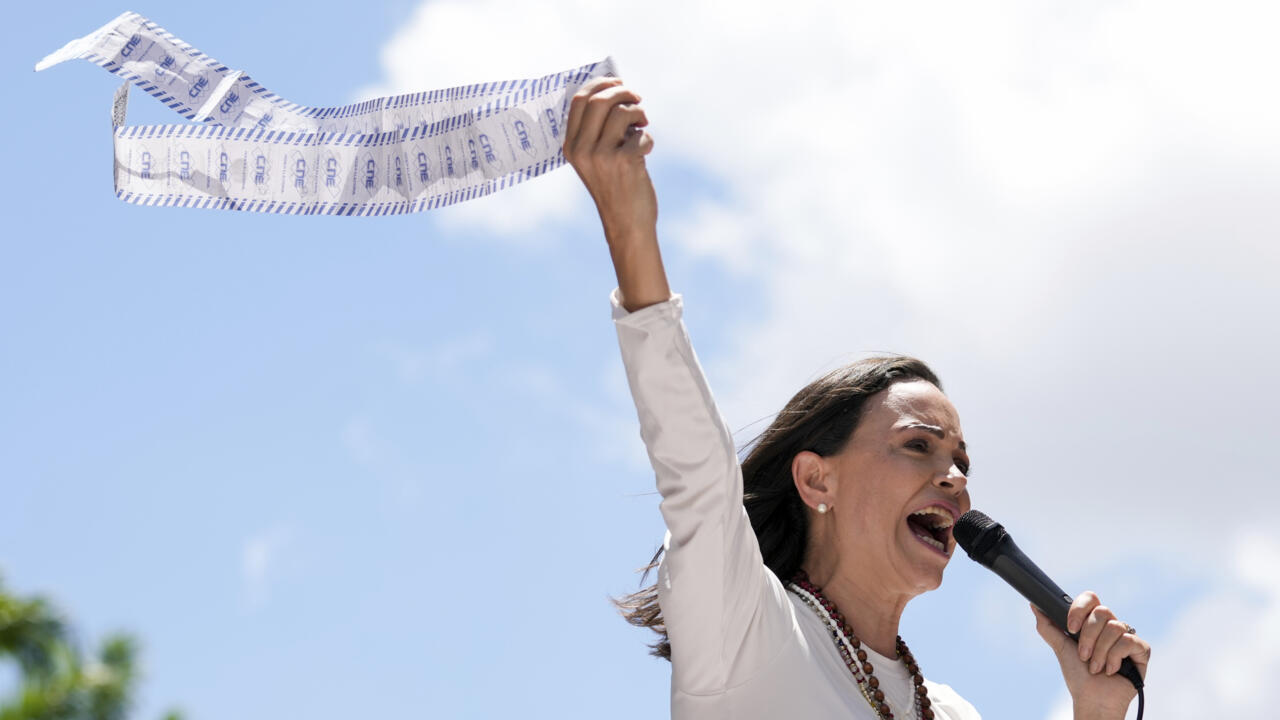
Opposition leader Maria Corina Machado holds up tally sheets during a protest against the reelection of President Nicolás Maduro, August 28, 2024. © Ariana Cubillos, AFP

Venezuelan President Nicolas Maduro on Sunday branded opposition leader Maria Corina Machado a "demonic witch", two days after she won the Nobel Peace Prize.

The Norwegian Nobel Committee had named Machado as the winner, citing the 58-year-old's "tireless work promoting democratic rights for the people of Venezuela and for her struggle to achieve a just and peaceful transition from dictatorship to democracy".

The United States has long opposed the leftist Venezuelan leader's rule, and under President Donald Trump has deployed warships in Caribbean waters off Venezuela.

Maduro has accused Machado of calling for a foreign invasion.

"Ninety percent of the population rejects the demonic witch," Maduro said, without directly mentioning Machado or commenting on his political rival being awarded the prestigious prize.

La lideresa opositora María Corina Machado se dirige a sus seguidores durante una protesta contra el presidente Nicolás Maduro, el día antes de su inauguración para un tercer mandato en Caracas, Venezuela, el jueves 9 de enero de 2025. AP - Matias Delacroix
08:26

The government often refers to her as "la sayona", a word that evokes a spirit in Venezuelan folklore who, like the opposition leader, has white skin and straight black hair.

"We want peace, and we will have peace, but peace with freedom, with sovereignty," Maduro said at an event commemorating the discovery of the Americas, celebrated in Venezuela as "Indigenous Resistance Day."

Machado supports US military maneuvers in nearby waters. She dedicated her Nobel prize "to the suffering people of Venezuela" and to Trump, who also was nominated for the award.

During an appearance Saturday on Fox News, Machado hailed Trump.

He "deserves" the award, she said, "because not only has he been involved in resolving eight wars in just a few months, but his actions have been decisive in bringing Venezuela to the threshold of freedom".

(FRANCE 24 with AFP)

'Hand it back to the president': Top Trump aide asks Nobel winner to cede prize

David Edwards
October 13, 2025 

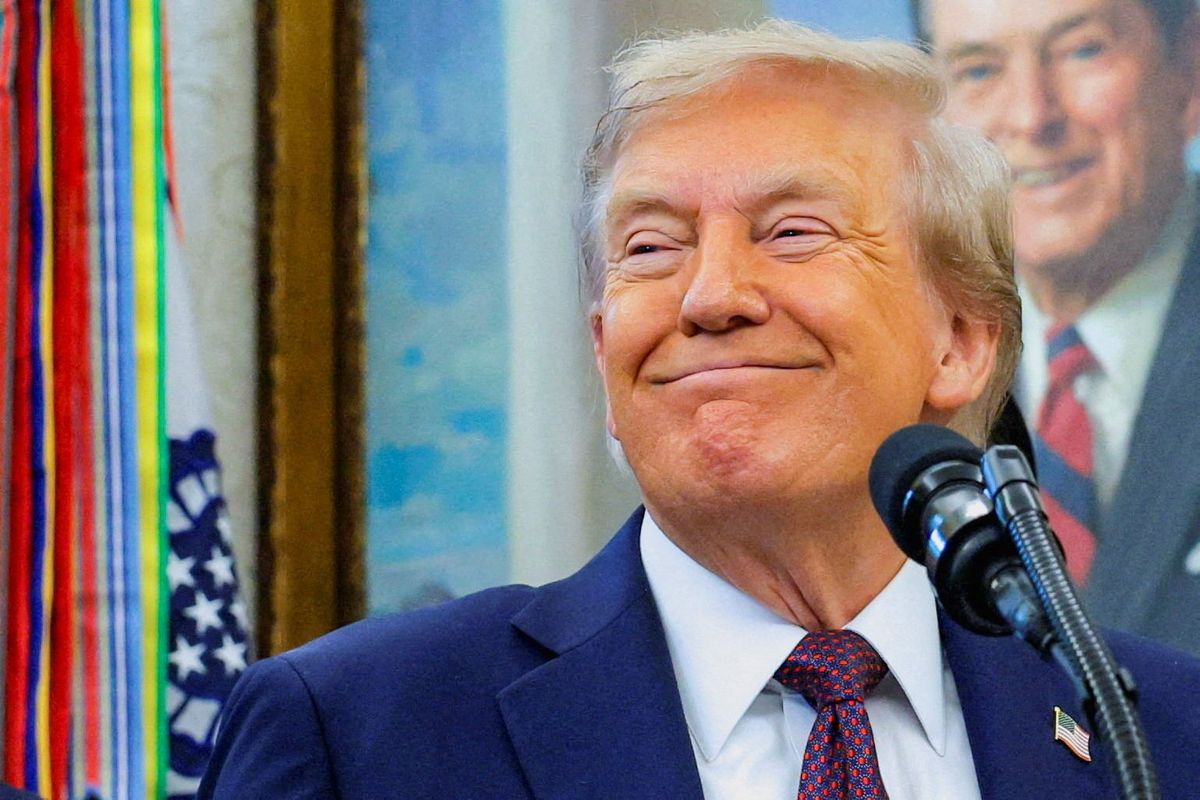
U.S. President Donald Trump smiles as he attends an event to announce that Space Force Command will move from Colorado to Alabama, in the Oval Office at the White House in Washington, D.C., U.S., September 2, 2025. REUTERS/Brian Snyder REFILE - QUALITY REPEAT


Roger Stone, a longtime adviser to Donald Trump, called on Nobel Peace Prize winner Maria Corina Machado to relinquish the award to the president.

Following a ceasefire deal between Israel and Gaza, Stone told Real America's Voice host Jack Posobiec that he was "not happy that the Norwegian-based Nobel Peace Prize Committee elected to give their award to Maria Corina Machado."

"The right thing to do would be for her to ask or maybe have Marco Rubio ask her if President Trump can give her the award," he insisted. "And then she should hand it back to the president."

"He deserves this award, even though I thought those elitist globalist freaks at the Nobel Peace Prize Committee would likely not give it to him."

Stone suggested that former President Barack Obama should not have received the award.

"I really think the president deserves this award," he remarked. "And I would hope that Maria Corina Machado would consider accepting it and giving it to the president, bestowing it to the president."

"Yeah, Roger, that's an incredible idea," Posobiec agreed. "So she'll get it there and then I suppose you'd have to bring it to, he could invite her to the White House perhaps and have the ceremony there and invite the Nobel Committee as well."

Madagascar’s President Andry Rajoelina has left the country, French radio reports

Madagascar's President Andry Rajoelina left the country on Sunday evening after factions of the army rallied behind the protesters who have been staging weeks of demonstrations, FRANCE 24 sister station Radio France Internationale (RFI) reported on Monday.


Issued on: 13/10/2025 
By: FRANCE 24

Malagasy President Andry Rajoelina during the Independence Day celebrations in Antananarivo, June 26, 2021. © AFP

After a stopover on France's Reunion Island, Rajoelina reportedly arrived in Dubai on Monday morning.

Madagascar has been engulfed in a political crisis since late last month as Gen Z protesters led mass demonstrations against the crippling water and electricity outages in the country. Rajoelina's sacking of the country's energy minister and later the entire government in late September did little to quell the unrest.

Groups of Madagascar soldiers joined the youth-led movement in the capital over the weekend and said that they would refuse orders to shoot.

FRANCE 24's Madagascar correspondent Gaëlle Borgia provided details of the president's escape.

Rajoelina "left in his helicopter from the presidential palace to the island of Sainte-Marie, in the east of the country, where a French military aircraft was waiting for him", Borgia said, citing information obtained from Madagascar Aviation, a Facebook group for aviation enthusiasts that tracks flight itineraries.

"The transfer lasted a few minutes at the very end of the runway. No one saw the president board the military aircraft, and thanks to the French army, he was able to reach the island of Réunion. There, another plane was waiting for him," Borgia said.

"A private jet from the German company Vistajet took the president to Dubai, where he arrived this Monday morning," she added.

France evacuates Madagascar president amid protests and army revolt

Madagascar’s president Andry Rajoelina has been evacuated from the country by a French military plane as protests and a military mutiny threaten to topple his government, RFI has confirmed.


Issued on: 13/10/2025 - RFI
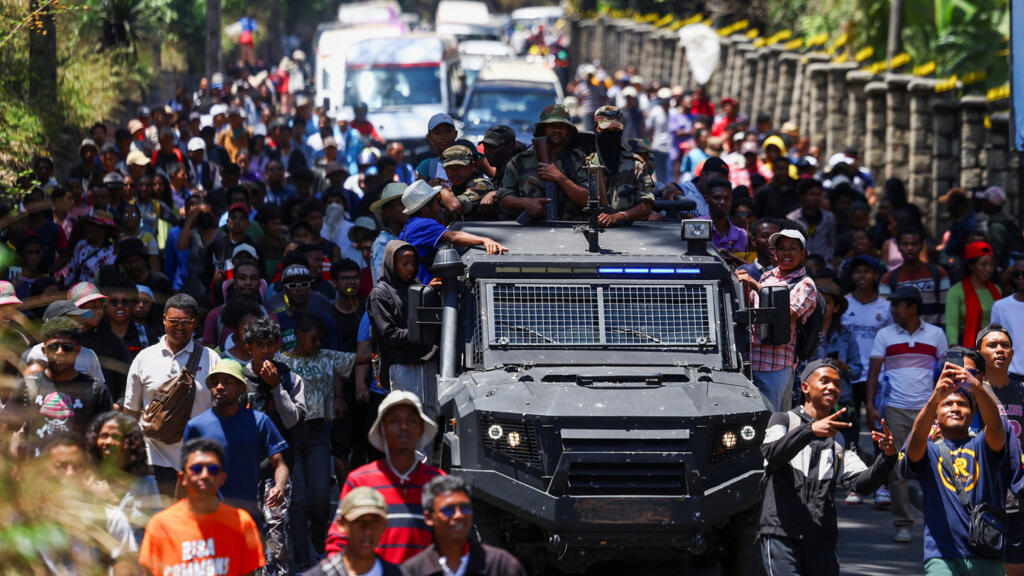
Protesters in Antananarivo, Madagascar, embrace a military vehicle, 13 October 2025.
© Siphiwe Sibeko/Reuters


The evacuation followed an agreement with French president Emmanuel Macron. French authorities said they are not intervening in Madagascar’s internal crisis, which has rocked the country since 25 September.

The unrest began over widespread water and electricity cuts but has grown into a nationwide movement demanding Rajoelina’s resignation.

Security forces have used force to disperse demonstrations, while officers backing the protesters have taken control of the paramilitary gendarmerie.

Whereabouts unclear

Rajoelina was expected to address the nation on Monday evening, but his location was unclear before his evacuation was confirmed.

“The President will address the Malagasy people today at 7pm (4pm GMT),” the presidency announced on its official Facebook page.

He has not spoken publicly since the officers supporting the protests said they had taken control of the gendarmerie.

On Sunday the presidency warned of an attempted coup by members of Capsat, an elite unit that helped Rajoelina seize power during a 2009 coup.

Former prime minister Christian Ntsay and businessman Mamy Ravatomanga, a close ally of the president, flew to Mauritius on a private jet on Saturday night, according to local reports.

Rajoelina was also absent from a ceremony the same day to install General Nonos Mbina Mamelison as head of the gendarmerie.

The event was attended by Armed Forces Minister General Deramasinjaka Rakotoarivelo and General Demosthène Pikulas, whom Capsat has named as chief of the army.

Around a thousand people gathered on Sunday in Antananarivo’s symbolic Place du 13 Mai, in front of city hall, to celebrate the Capsat troops.

By midday, three armoured vehicles made their way through the cheering crowd, carrying soldiers who waved and smiled, weapons in hand, as demonstrators waved Malagasy flags.

(with newswires)


Source: Jacobin

Bloomberg News describes Paul Kagame, president of Rwanda for the last quarter century, as “the West’s favorite autocrat.” According to Bill Clinton, Kagame is a “brilliant man,” one of the “greatest leaders of our time,” no less.

Former British prime minister Tony Blair likewise hails Kagame as “a visionary leader.” Blair’s Institute for Global Change has worked closely with Rwanda, and Blair has personally argued against any moves to sanction Rwanda for its violent looting of the Democratic Republic of Congo (DRC).

It is not merely retired politicians like Clinton and Blair who have chosen to truck with Kagame. The European Union has negotiated a deal with his government to facilitate the extraction of minerals, despite clear evidence that this is encouraging the pillage of the Congo.

Kagame’s Rise

The central African country that Kagame rules is tiny — about the size of Maryland. Its population consists of two main ethnic groups: the Hutu, who historically accounted for approximately 85 percent of the population, and the Tutsi, who accounted for most of the remaining 15 percent (statistics on ethnic identity are no longer officially collected).

German and Belgian colonial administrations made use of a certain Tutsi stratum as a ruling group. The run-up to independence in 1962 saw a reversal of the colonial order as a Hutu elite seized control and incited a series of pogroms against the Tutsi population, with tens of thousands killed and many more forced into exile.

Those Tutsi exiles, many of whom grew up in Ugandan refugee camps, became the core of a rebel movement, the Rwandan Patriotic Front (RPF),that invaded Rwanda in 1990. They demanded the right to return to the land from which they or their parents had been expelled. Paul Kagame, one of the Ugandan exiles, became the leader of the RPF in the course of a subsequent four-year civil war.

In April 1994, a missile shot down the plane of Rwandan president Juvénal Habyarimana, killing Habyarimana and his Burundian counterpart, President Cyprien Ntaryamira. The question of who was responsible for the missile strike remains a matter of controversy: there is a strong, if not fully proven, case that the RPF was culpable.

In the aftermath of Habyarimana’s death, the government army and affiliated militias, with backing from France, initiated a genocide of the Tutsi and the mass killing of political enemies. Between April and July, approximately eight hundred thousand people were slaughtered.

The RPF militarily defeated the government forces in July 1994, committing massacres of their own along the way, and prioritizing military victory over rescue of the civilian Tutsi population. Kagame was subsequently but misleadingly hailed as a hero for supposedly having ended the genocide. He became the country’s de facto leader until 2000 when he formally assumed the presidency, a position he has held ever since.

From the Ashes

Many international observers consider post-genocide Rwanda to be a miracle of ethnic reconciliation and economic recovery. Blair talks of Rwanda’s “remarkable path of development,” while Anthony Blinken described the country in 2022 as having risen “from the ashes of genocide to become a global destination for innovation, for investment, for tourism.”

On a personal note, when I was an aid worker in Rwanda in 1994–95, I was generally impressed by Kagame’s RPF. They were competent, seemed genuinely committed to national reconstruction, and evidenced little or no corruption. I also largely accepted the narrative that they had ended the genocide. However, the overwhelming accumulation of evidence since that time has caused me and most others to become highly critical of RPF rule.

We now point to Kagame’s implausible election victories, allegedly gaining over 99 percent of the vote in the most recent presidential election of 2024, and his practice of severe repressionincluding the imprisonment and assassination of political opponents, independent journalists and anyone else who challenges the regime.

Kagame also presides over a highly unequal economy whose gains predominantly accrue to a narrow circle of regime insiders, although it must be acknowledged that progress in the fields of education and health is real enough. Rwanda is deeply dependent on external aid as well as resources stolen from other countries.

The country from which the Rwandan elite has stolen the most is the neighbouring DRC. Rwanda first invaded the DRC (then named Zaire) in 1996, pursuing the remnants of the previous genocidal regime whose forces had fled there.

The DRC soon became the site of a conflict known as the Second Congo War that involved several African states, with Rwanda and Uganda ranged against DRC President Laurent Kabila (initially installed with Rwandan backing) while Angola, Namibia, and Zimbabwe sent troops to support him. The war claimed an estimated five million lives, including those who fell victim to hunger and disease. It dragged on after Kabila’s assassination in 2001, formally ending in July 2003, though often intense violence between various factions has persisted since then.

Through all this, Rwanda has been plundering and devastating the DRC. The International Crisis Group has described Rwandan actions over three decades as a pattern of “long-term territorial expansion including grabbing mineral-rich regions.”

Plundering Congo

Earlier this year, there was considerable media focus on the advance of a militia group called M23 across the DRC’s east. This advance led to an estimated three thousand deaths (mostly civilians), mass displacement, human rights abuses, and humanitarian crisis. The RPF-led Rwandan Defence Force (RDF) has consistently supported M23, with four thousand RDF troops on the ground in early February.

Rwanda, in turn, enjoys external support, including from the European Union. This was exemplified by a 2024 Memorandum of Understanding (MOU) designed to ensure that Rwanda supplies the EU with designated “critical” raw materials, including tantalum/coltan (used in a range of electronic devices), tungsten, and gold. The EU has allocated over €900 million to Rwanda to support resource extraction.

However, it is well documented that a large proportion of “Rwandan” resource extraction involves the systematic theft of DRC minerals and other raw materials, both directly and through the medium of militias like M23. The gap between Rwanda’s own production and its exports of those materials has long been glaring. For example, even though domestic production of gold is limited, Rwanda is estimated to have exported a staggering $654 million worth in 2022.

As Jason Stearns, a former UN investigator, noted earlier this year, the figures have continued to grow:

Mineral exports from Rwanda are now over a billion dollars a year. That’s about double what they were two years ago. And we don’t know how much, but a fair chunk of that is from the DRC.

The European Parliament has voted overwhelmingly for the EU to suspend the MOU. Belgian MEP Marc Botenga made the case for suspension:

This MOU needs to be suspended. In fact, it should have never been signed. We know there are Rwandan soldiers on Congolese soil and that is done to steal, to pillage certain natural resources. In fact, this MOU with Rwanda encourages these troops.

Yet the European Commission has claimed that suspension “could be self-defeating” and that it would remove “an incentive to ensure responsible mineral production and trade by Rwanda.” It is hard to see what is “responsible” about the current situation.

Of course, the EU is not alone in placing access to vital natural resources ahead of human rights concerns. The Trump administration sponsored a much-trumpeted peace deal signed in June 2025 between Rwanda and the DRC. But violence on the part of M23 and other actors has continued. The best that can be said is that some of the warring parties have paused their attacks — for now.

Nor will the plunder be stopped: a coalition of eighty Congolese civil society organizations has described the agreement as “a framework to normalize the current illicit resource and power grabs underway” by Rwanda and its allies, “including Western powers that covet the DRC’s minerals and support Rwanda with financial aid.” The United States, like the EU, is seeking to access Congolese raw materials in an example of what is euphemistically termed “peace-for-resources” diplomacy.

Rwanda, Mozambique, and the EU

Donald Trump’s attempts to gain access to the natural resources of other countries (evident also in relation to Ukraine) are certainly crude. But Europe has no claim to the moral high ground given its own approach to the DRC. Another African country in which both Europe and Rwanda are involved underlines the point.

civil war has raged in northern Mozambique since 2017 between the government and Islamist-associated rebels. In 2019, French oil and gas company Total announced a €19 billion investment in the mining of offshore gas deposits, but rebel activity threatened this project. In response, the EU has launched a support program for the Mozambican military, backed up by Rwandan forces that the EU has subsidized.

Some of the same Rwandan business interests involved in the looting of DRC resources are also involved in Mozambique, again seeking to exploit lucrative mining and other opportunities. A senior Rwandan military commander previously implicated in attacks in the DRC was identified in 2024 as being in charge of the Rwandan forces in Mozambique. As in the case of the DRC, MEPs have called for a halt to this support to the Rwandan military, which is channelled through the laughably named European Peace Facility, again to no effect.

The extraction of resource revenues has largely excluded poor Mozambicans, though they bear the costs. As Rehad Desai explains:

The only beneficiaries are the politically connected elites who receive the crumbs left on the table by the international corporations. The local populace is left to watch as their agricultural and fishing livelihoods are adversely affected.

It is precisely those costs to locals that have fuelled rebellion. While the EU says it is combating Islamist terrorism, Corporate Europe Observatory researcher Kenneth Haar more accurately characterizes the real stakes as “access to gas supplies and the defence of European-French investments.”

Rwanda’s role here as a partner to Western power points to one reason for its positive reputation in many quarters and its status as a Western “donor darling.” Kagame’s willingness to accept deported refugees from the UK (albeit in a scheme now abandoned) and from the United States is another factor.

Also germane is its significant contribution to UN peacekeeping missions, though hardly for altruistic reasons. As in the case of Mozambique, Rwandan businesses typically follow closely behind such deployments, usually under the umbrella of Crystal Ventures Limited, an RPF-owned holding company that dominates the Rwandan economy and pioneers the pursuit of RPF economic interests abroad.

Projecting Power

Rwanda is no passive player or Western puppet. It is a skilled and manipulative actor in its own right, as demonstrated by its projection of concerted military-commercial power, and its sponsorship of global sporting clubs and events in order to enhance its profile and reputation.

Kagame has also expressed strategic appreciation for Chinese interventions in Africa, implicitly warning Western powers that Rwanda could move closer to China if the West were to restrict its backing. There have, at times, been some such restrictions from various countries, including Belgium, the UK, and the United States, but they have been temporary and partial.

A further strategy Rwanda deploys to legitimize its abuses will be familiar to critics of Israel. It is notable that Rwanda has earned a reputation as “one of Israel’s best friends in Africa,” and cooperation between the two countries has continued since the latest onslaught on Gaza began. Israel commits genocide in Gaza while claiming to be hunting terrorists; Rwanda devastates and loots the DRC while claiming to be hunting the supporters of the 1994 genocide.

Just as Israel seeks to deflect criticism of its actions by accusing all and sundry of antisemitism, Rwanda accuses its critics (both internal and external) of engaging in “genocide denial,” or even support for genocide, as the RPF regime enjoys what Filip Reyntjens terms a “genocide credit.” In 2008, Kagame passed a law that criminalized any reference to crimes committed by the RPF as constituting “genocide ideology,” and numerous political opponents have been jailed under its terms.

That I was supportive of the RPF back in 1995 was a mistake. The fact that people are still supportive of the regime after three decades of tyranny and crimes against humanity is something else again. Yet with backers like Clinton, Blair, and the European Commission, Kagame’s dictatorship is still going strong and shows no signs of moderating its barbarism — at home or abroad.Email

Andy Storey is a lecturer in political economy at University College Dublin.