Monday, October 13, 2025


Kiwis could help manage chronic constipation


THE FRUIT NOT THE ISLANDERS


King's College London


Kiwifruits, rye bread and high mineral-content water could all help alleviate chronic constipation.

That’s according to the first ever evidence-based dietary guidelines for adults with chronic constipation, led by researchers at King’s College London.

The new guidelines also show that taking psyllium fibre supplements, certain probiotic strains and magnesium oxide supplements can help to improve constipation.

In contrast, other widely recommended approaches, including generic “high-fibre diets,” and senna supplements (a type of laxative) were found to lack strong evidence of effectiveness.

The guidelines, jointly published in two international journals, the Journal of Human Nutrition & Dietetics and Neurogastroenterology & Motility, are endorsed by the British Dietetic Association (BDA) and aim to transform the way this common condition is managed by doctors, nurses and dietitians in clinical practice. The guidelines could also allow better self-management of symptoms, particularly through foods and drinks.

Constipation is a long-term condition that significantly impacts quality of life and places a considerable financial burden on both patients and healthcare systems. Until now, clinical guidelines have offered only limited and sometimes outdated dietary recommendations, typically increasing dietary fibre and fluid intake.

Unlike previous guidelines, the new recommendations are based on numerous rigorous systematic reviews and meta-analyses, and applying the GRADE framework to assess the quality of the evidence. A multidisciplinary panel of experts, including dietitians, and a nutritionist, gastroenterologist, gut physiologist, and GP, reviewed over 75 clinical trials to create 59 recommendation statements and identify 12 research priorities.

Dr Eirini Dimidi, Reader in Nutritional Sciences at King’s College London and lead author, said: “Chronic constipation can have a huge impact on someone’s day-to-day life. For the first time, we’ve provided direction on what dietary approaches could genuinely help, and which diet advice lacks evidence. Being able to improve this condition through dietary changes would allow people to self-manage their symptoms more and, hopefully, improve their quality of life.”

The recommendations also focus on constipation outcomes such as stool frequency, stool consistency, straining and quality of life, making them more practical for personalised care based on the specific symptoms each individual experiences. A clinician-friendly tool has also been developed to support the adoption of these guidelines in everyday practice across the world.

The evidence review revealed that, while some foods and supplements are effective, the overall quality of existing studies is low. Most trials focused narrowly on single interventions rather than whole diet approaches, highlighting the urgent need for better nutrition research in constipation management.

Dr Dimidi added: “Eating a high fibre diet offers many benefits to overall health and has been a go-to recommendation for constipation. However, our guidelines found that there simply isn’t enough evidence to suggest it actually works in constipation specifically. Instead, our research reveals some new dietary strategies that could indeed help patients. At the same time, we urgently need more high-quality trials to strengthen the evidence on what works and what doesn’t.”

Professor Kevin Whelan, senior author and Professor of Dietetics at King’s College London, said: “This new guidance marks a promising step towards empowering health professionals and their patients to manage constipation through diet. This means that from now on that people suffering from constipation across the world can now receive up-to-date advice based upon the best available evidence in order to improve their symptoms and wellbeing. With continued research, it holds real potential to drive lasting improvements in quality of life.”

World Nuclear News


Regulator approves OPG to operate new waste facility

Canada's nuclear regulator has authorised Ontario Power Generation to begin operating a new building, which will store used steam generators, at its Western Waste Management Facility.
 

The Western Waste Management Facility site (Image: OPG)

The Canadian Nuclear Safety Commission (CNSC) said the commissioning report on Ontario Power Generation's (OPG) new Multi-Purpose Storage Building at the Western Waste Management Facility confirms that the building meets design specifications and is fit for purpose.

OPG is the licensee of the Western Waste Management Facility, which handles low- and intermediate-level waste from the Darlington, Pickering, and Bruce Power nuclear stations, as well as storing all the used fuel from Bruce Power's operations. The new MPSB is a steel-framed structure that will store 64 steam generators from Bruce Power’s Major Component Replacement project.

"The Commission accepts OPG's Commissioning Report for the Multi-Purpose Storage Building (MPSB) at the WWMF," the regulator said in a Commission Decision signed by CNSC President Pierre Tremblay on 9 October. "OPG is authorised to begin the operation of the MPSB."

The review did not require a public hearing under the Nuclear Safety and Control Act as no licensing decision was involved, the CNSC said.

Bruce Power's Major Component Replacement - or MCR - began in 2020 and will see the refurbishment of Bruce units 3-8, including the replacement of key reactor components including steam generators, pressure tubes, calandria tubes and feeder tubes. It will add about 30-35 years of operational life for each unit. The first unit to undergo the process, Bruce unit 6, returned to commercial service in September 2024 after the completion of its MCR ahead of time and on budget. Units 3 and 4 are currently undergoing their MCR outages, and will be followed by units 5, 7 and 8 in overlapping MCR outages until 2033.

OPG is currently refurbishing four Candu units at its Darlington site with completion expected in 2026, and is planning to begin the refurbishment of Pickering units 5-8.


Fuel supply contracts signed for Sizewell C


Sizewell C has signed a six-year uranium enrichment services supply contract with Urenco and a long-term fuel fabrication contract with Framatome for fuel for the planned Sizewell C nuclear power plant in the UK.
 
(Image: Sizewell C)

The supply contract with Urenco for enriched uranium services will support the first six years of the two-unit plant's operation, establishing a secure front-end fuel supply. The enrichment services will be provided at Urenco's enrichment site at Capenhurst, near Chester in the north-west of England.

"The importance of Sizewell C in the UK's energy future cannot be underestimated, and Urenco is proud to have been selected as a supplier of choice," said Urenco CEO Boris Schucht. "This will support the millions in economic contributions we make to the UK every year through the enrichment site we have in Cheshire, one of four such sites we have globally, as well as helping to grow skills in the nuclear industry, create jobs and strengthen supply chains."

Sizewell C has also signed a long-term fuel fabrication agreement with Framatome for the first cores and a number of subsequent reloads. The fuel will first be fabricated using the enriched uranium at Framatome's factory in Romans, France, until its new UK facility is available. Sizewell C said the UK factory will create new jobs and reduce reliance on fuel imports, strengthening the security of fuel supply in the UK.

Framatome has previously announced multi-billion pound contracts with Sizewell C, including the delivery of the two nuclear heat production systems for the project.

"Framatome is proud to extend its partnership with Sizewell C through this fuel supply contract," said Lionel Gaiffe, Senior Executive Vice President, Fuel Business Unit at Framatome. "We remain deeply committed to helping the country meet its net zero targets and contribute to strengthen security of fuel supply through a diverse and resilient supply chain."

The plan is for Sizewell C to feature two EPR reactors producing 3.2 GW of electricity, enough to power the equivalent of around six million homes for at least 60 years. It would be a similar design to the two-unit plant being built at Hinkley Point C in Somerset, with the aim of building it more quickly and at lower cost as a result of the experience gained from what is the first new nuclear construction project in the UK for about three decades. A final investment decision for the Sizewell C project was taken in July this year.

Julia Pyke and Nigel Cann, Joint Managing Directors of Sizewell C, said: "These two contracts represent a major moment for Sizewell C and for energy security in the UK – this is about delivering the fuel supply for a project that will power 7% of the UK's energy needs.

"This is also another big moment for nuclear jobs in the UK. The fuel that will go in our reactors will be low-carbon and predominantly sourced from the UK, produced by skilled British workers. We've already pledged to deliver 70% of the project's construction value to UK businesses, and investing in fuel fabrication here in the UK will help us increase that to around 90% across the lifetime of the project. This is what we mean by doing infrastructure differently – and it puts the UK's energy security and our nuclear supply chain in a much stronger place."

Earlier this month, Sizewell C announced it had awarded Arabelle Solutions a contract for the supply and installation of two complete turbine islands for the planned Sizewell C plant. The EDF subsidiary is already supplying turbines for the sister project, Hinkley Point C.

Fuel loading under way at second Zhangzhou unit


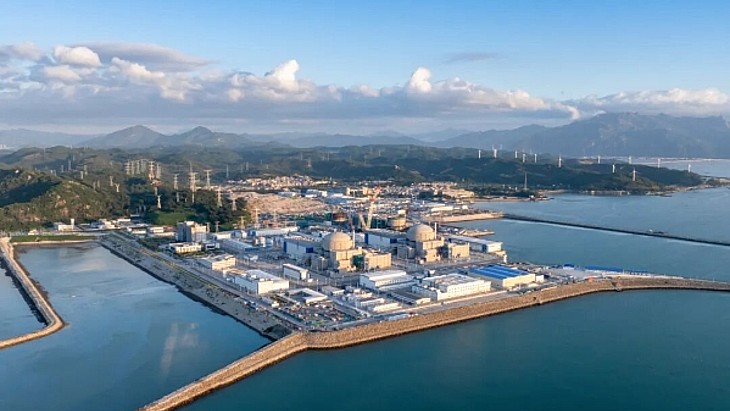
The process of loading 177 fuel assemblies into the core of unit 2 at China's Zhangzhou nuclear power plant has begun, China National Nuclear Corporation announced. The unit is the second of four Hualong One (HPR1000) reactors under construction at the site.
 
Fuel being loaded into Zhangzhou 2 (Image: CNNC)

China's Ministry of Ecology and Environment issued an operating licence for Zhangzhou Nuclear Power Unit 2 on 11 October. Dong Baotong, Vice Minister of Ecology and Environment and Director of the National Nuclear Safety Administration, issued a licence to Zhangzhou Energy, and Zhang Kai, member of the Party Group and Deputy General Manager of China National Nuclear Corporation (CNNC), attended the event. At 16:13 on the same day, workers began to load the first reactor nuclear fuel into Zhangzhou 2.

CNNC said the milestone marked "that the unit has entered the stage of commissioning the main system with nuclear power, laying a solid foundation for the subsequent unit criticality and grid-connected power generation". It noted the unit was scheduled to be put into operation in the fourth quarter of 2025.

China's Ministry of Ecology and Environment issued construction licences for Zhangzhou units 1 and 2 on 9 October 2019 to CNNC-Guodian Zhangzhou Energy Company, the owner of the Zhangzhou nuclear power project, which was created by CNNC (51%) and China Guodian Corporation (49%) in 2011. Construction of unit 1 began one week after the issuance of the construction licence, with that of unit 2 starting in September 2020.


Zhangzhou units 1 and 2 (Image: CNNC)

In September 2022, China's State Council approved the construction of two further Hualong One units as Phase II of the Zhangzhou plant. First concrete for the nuclear island of unit 3 was poured in February last year, with that for unit 4 following in September.

Six Hualong One units are planned for the Zhangzhou site, in China's Fujian province.

IsoEnergy to acquire Toro, creating diversified uranium company

Canada-based IsoEnergy Ltd has announced it is to acquire Australian company Toro Energy to create a development-ready platform with a diversified uranium resource base with resources in Australia and North America.
 
Drilling activities at Wiluna (Image: Toro Energy presentation)

The deal is worth around AUD75 million (CAD68.1 million, USD49 million), and is expected to close in the first half of 2026, subject to satisfaction of all conditions, including receipt of all necessary approvals. Shares in the merged company will continue trading on the Toronto and New York stock markets: Toro will be removed from the official list of the Australian Securities Exchange.

Toro is the 100% owner of Wiluna uranium project in Western Australia, and the combination with IsoEnergy's past-producing mines in the USA, the ultra-high-grade Hurricane deposit in Canada’s Athabasca Basin, and multiple development/exploration assets across Canada, the USA and Australia with Toro’s flagship Wiluna Uranium Project in Western Australia, creates a development-ready platform with significant near-term production potential in stable, mining-friendly jurisdictions, the companies said.

IsoEnergy CEO Philip Williams said the acquisition of Toro Energy is part of IsoEnergy’s strategy to build a globally diversified, development-ready uranium platform. "The Wiluna Uranium Project strengthens our portfolio with a large, previously permitted asset in a top-tier jurisdiction at a time when global nuclear demand is accelerating. This transaction positions IsoEnergy to deliver meaningful scale, optionality, and sustained value creation for shareholders. We look forward to welcoming the Toro team, who have done an admirable job stewarding the company and its projects through often challenging markets, to IsoEnergy and advancing the project together," he said.

Last year, IsoEnergy announced plans to acquire Anfield Energy - owner of the licensed and permitted Shootaring Canyon uranium mill in Utah - but that plan was subsequently terminated in January.

Toro Executive Chairman Richard Homsany said the transaction provides Toro shareholders with the opportunity to be part of a "larger, leading uranium company listed on the TSX and NYSE" with exposure to a "diverse uranium portfolio that has strong growth potential and is located in favourable regulatory jurisdictions, and the ability to attract enhanced access to funding including for the Wiluna Uranium Project".

The pro forma company will hold 55.2 million pounds U3O8 (21,233 tU) of current NI 43-101 compliant uranium resources in the measured and indicated categories, and 4.9 million pounds U3O8 in the inferred category, as well as historic measured and indicated resources of 154.3 million pounds U3O8 and 88.2 million pounds inferred.

Toro's 12.7% owner Mega Uranium Ltd and its associate Mega Redport Pty Ltd have indicated that they intend to vote in favour of the Scheme, subject to no superior proposal emerging and provided that the scheme continues to be "in the best interests" of Toro shareholders.

IsoEnergy owned about 4.99% of Toro's shares as of 12 October.

El Dabaa reactor support ring arrives, reactor vessel shipped


The 20-tonne reactor support ring will be installed at a height of 11 metres in the reactor shaft and will support the weight of the reactor vessel which could reach 1000 tonnes when combined with equipment and fluids.
 

(Image: NPPA)

Egypt’s Nuclear Power Plants Authority (NPPA) said the ring, made of high-strength steel alloys resistant to thermal and mechanical stress, was a "key and vital component ... it transfers the entire weight of the vessel, including its equipment, nuclear fuel, and operating fluids, to the concrete base in a balanced and safe manner. It also ensures the reactor's stability during operation and contributes to load distribution and resistance to the effects of internal pressures and earthquakes".

Sherif Helmy, Chairman of Egypt's Nuclear Power Plants Authority, said: "What is happening today … is not merely a technical implementation, but rather a practical expression of Egypt's national vision to build its own strategic capabilities and enhance its leading role regionally and globally in the field of peaceful uses of nuclear energy."

Alexey Kononenko, Vice President of JSC ASE - Director of the El Dabaa NPP, said: "This event is the result of the coordinated work of an international team and a symbol of progressive progress. Every step brings us closer to the moment when Egypt will have its own nuclear power plant for the first time in its history. We are proud to be creating a facility that will become the foundation of the country's energy independence and an example of effective cooperation between Russia and Egypt."

Reactor pressure vessel

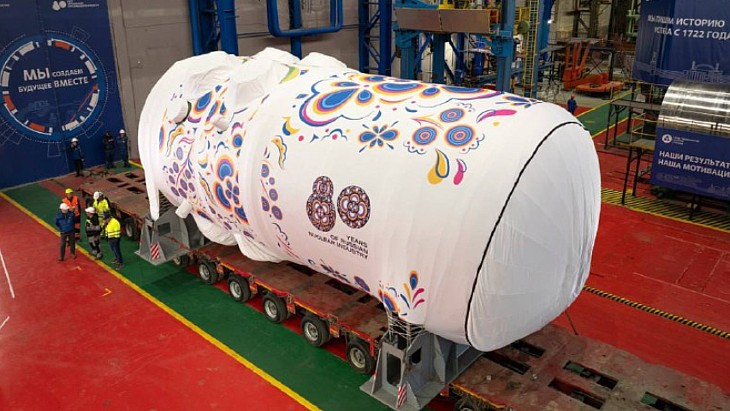
Meanwhile the reactor pressure vessel for unit 1 has been shipped from St Petersburg - it is scheduled to arrive at the site in Egypt in  November.


(Image: Rosatom)

Manufacturing of the pressure vessel took 41 months and Helmy said preparations were taking place at El Dabaa’s port to allow for a safe unloading and transport process.

The reactor vessel is about 13 metres long and 4.5 meters in diameter, with a weight of 320 tonnes. The service life is for an initial 60 years, with the possible extension to 80 years.

The ceremony to mark its shipping took place on 26 September at World Atomic Week in Moscow, and coincided with the shipping of the reactor vessel for Turkey's Akkuyu Nuclear Power Plant's fourth unit.

Igor Kotov, head of Rosatom's engineering division, said at that event: "The shipment of the 'heart' of the first power unit of the El Dabaa NPP in Egypt opens a new chapter of our long-term cooperation."

Background

El Dabaa will be Egypt's first nuclear power plant, and the first in Africa since South Africa's Koeberg was built nearly 40 years ago. The Rosatom-led project, about 320 kilometres north-west of Cairo, will comprise four VVER-1200 units, like those already in operation at the Leningrad and Novovoronezh nuclear power plants in Russia, and the Ostrovets plant in Belarus.

Under the 2017 contracts, Rosatom will not only build the plant, but will also supply Russian nuclear fuel for its entire life cycle, including building a storage facility and supplying containers for storing used nuclear fuel. It will also assist Egyptian partners in training personnel and plant maintenance for the first 10 years of its operation. Rosatom said last month that it is aiming for a future service life of 100 years for nuclear power plants.

The four units are being built almost concurrently, with first concrete at unit 1 in July 2022, followed in turn by the others, concluding with first concrete at unit 4 in January 2024. Egypt's aim is for 9% of electricity to be generated by nuclear by 2030, which would be achieved by the commercial operation of the first two units by that time, directly displacing oil and gas.

Consider waste in advanced nuclear initiative, says Deep Isolation

US radioactive waste disposal technology developer Deep Isolation has called for nuclear waste disposal to be included in the National Association of State Energy Officials' Advanced Nuclear First Movers Orderbook Strategy.
 
(Image: NASEO)

The National Association of State Energy Officials (NASEO) launched the Advanced Nuclear First Mover Initiative in February this year to support states to explore ways to bring down project costs and meet rapidly growing power needs in the USA. The initiative is co-chaired by the states of New York, Indiana, Kentucky, Tennessee, and Wyoming. Louisiana, Maryland, Pennsylvania, Utah, Virginia, and West Virginia are also participating states. The Strategy outlines how the eleven 'First Mover States' are collaborating to accelerate the deployment of advanced nuclear power through an integrated orderbook supported by collaborative pathways for financing, siting, workforce, and supply chains.

Last month, NASEO issued a Request for Information (RFI) in support of the initiative. It said the RFI will "provide the First Mover states and NASEO with information on a potential structure for an advanced nuclear project orderbook strategy, status and use cases for different nuclear technologies, and investment and coordination models". 

Deep Isolation announced it has submitted a response to the RIF, noting: "To date, the Strategy makes no mention of the spent nuclear fuel and radioactive waste that will result - though the lack of a safe, permanent waste solution remains one of Americans' top concerns about nuclear power."

Deep Isolation's response sets out how this "missing piece" of the Orderbook Strategy can be filled. It calls for the US Nuclear Industry Council's (USNIC's) recommendations to be integrated into the Orderbook Strategy: working collaboratively with communities to accelerate innovative disposal technologies, launching near-term demonstrations, and mobilising private investment through public-private partnerships and legislative reform. "Together, these efforts strengthen the viability of the orderbook strategy by embedding disposal into the advanced nuclear lifecycle," the company said.

The submission highlights three specific calls to action for participating states. Firstly, they should join the Deep Borehole Demonstration Center, the non-profit at Cameron, Texas where Deep Isolation plans to deliver the world's first full-scale non-radioactive deep borehole disposal pilot with initial canister emplacement, targeted for 2027. In addition, they should support early borehole demonstrations in their states and advocate in Congress for legislative reforms that unlock innovation and public-private partnerships for radioactive waste disposal.

"By embedding disposal into their Orderbook Strategy, First Mover States can reduce financial risk, increase investor confidence, and build public trust that advanced nuclear comes with a complete lifecycle solution," said Deep Isolation CEO Rod Baltzer. "Deep Isolation's technology can play a key role in this. We combine state-of-the-art drilling technology from our suppliers in the oil and gas sector with our proprietary, universal, disposal-ready canister system to provide the first genuinely scalable, flexible, and near-term solution for spent fuel and high-level waste. We stand ready to help First Mover States lead the way in solving the waste challenge at the same time as they pioneer new reactor deployment."

NASEO is an association for energy officials from all US states and territories. State energy officials are appointed by state governors: NASEO aims to facilitate peer learning among state energy officials, as well as providing a resource for and about State Energy Offices, and advocating the interests of the State Energy Offices to Congress and federal agencies. The initiative extends NASEO's existing work with states in support of advanced nuclear energy projects.

The Hidden Cost of Electrification in the United States

  • The U.S. is expanding electric vehicles, data centers, and heat pumps—yet the power feeding them increasingly comes from fossil fuels.

  • Policymakers are approving new natural gas plants and extending coal operations.
  • The U.S. is building out power capacity for electrification—but without meaningful carbon cuts, leading to a future of “clean tech” powered by dirty energy.

One of the biggest mistakes we made about electrification is that we assumed that the new technologies embracing electricity, like electric vehicles for example, would embrace decarbonization at the same time. We were wrong. In fact, in the US today, exactly the opposite has occurred. The paradox of electrification without decarbonization is simple. Take, for example, two convenient symbols of electrification, an electric car and a heat pump. Both displace fossil fuel usage, but both technologies also rely on electricity. We, and others, assumed that the large base load fossil-fired power generating stations favored by utilities would, due to growing public pressure, eventually be replaced by something more environmentally benign, like small modular reactors or extensive solar plus batteries. Instead, policymakers have decided to ignore environmental concerns and embrace more base load fossil fuel usage. In practical terms, this means permission to build new natural gas-fired power plants, while coal-fired power stations will be permitted or even encouraged to remain open.

Because power plants last forty years or more, due to inflation, a new plant always costs lots more than the unit it’s replacing. One of the frequent criticisms of renewable energy technologies like offshore wind or solar plus batteries is that they are very expensive. This is certainly true compared to the fully depreciated facility they are replacing. The simple fact is that all new power-generating facilities, regardless of technology, are far more costly than the units they replace. These are called capital expenses because the assets financed are expected to be in service for decades. But renewables have one outstanding advantage over fossil-fueled power generation. They have almost no big operating expenses like fuel. Unlike coal or gas-fired power plants, renewables only “consume” free stuff like wind or sunlight. Over a thirty or forty year lifetime operating period, the expense differentials are enormous. But in our intensely ideological times, these differences are often overlooked for partisan political purposes. And yes, we know they’re intermittent.

This idea of electrification without decarbonization has been adopted by technology executives such as Google’s former CEO, Eric Schmidt. Speaking at an AI conference last October, he pointed out that for him, and presumably other executives, attaining environmental goals like decarbonization is much less important than a vastly expanded network of data centers. His basic point was, "Forget about your climate targets, you won’t achieve them anyway.” Also he suggested that perhaps all these new data centers would actually solve the climate crisis. But as a former CEO, he also seemed to be asserting one very old corporate prerogative: the unlimited right of a corporation to pollute without interference from the government. As an aside, what’s so interesting to us is that no serious political figure has given such full-throated support for this view, probably since the McKinley era. But here we are.

People like Mr Schmidt and his former employer, Google, are among those leading the charge for much more rapid growth in domestic power generation resources, and they’ve stated quite plainly that they couldn’t care less about CO2 emissions and their adverse environmental implications. More fossil-fired power plants are just fine with them so long as the bulk electricity is affordable and available. Their “only” requirement is for an enormous increment to the existing generating fleet at a cost of at least several hundred billion dollars. These investments will either be “inside the fence” and paid for by the data centers themselves or they will be borne by local utilities with the large incremental expense passed along to consumers in the form of higher prices.

The question for us as analysts is to ask whether this view has become mainstream among senior policymakers in Washington and, if so, what are the implications? What would a pollution-indifferent buildout of the US power grid look like? In two words, more gas. There have been no new coal-fired power-generating plants built in the US in decades because their economics were undercut by domestically sourced natural gas. So a pollution-tolerant administration in Washington, for example, does not reverse the unattractive power plant economics of new coal. But the interesting thing for us is that even with a utility-friendly administration in Washington, the prospects for future gas-fired plants haven’t deviated much from long term historical trends. The US EIA expects about 18.7 gigawatts of new gas fired capacity to be added between now and 2028, with 2028 showing a big uplift relative to prior years. But the EIA’s historical data also show us what a big commitment to new gas-fired power generation truly looks like. In the five year period, 2000 to 2005, the US added over 160 gigawatts of new gas-fired power generation, with almost 50 gigawatts of new generation added in the year 2000 alone. The EIA data shows the US expecting to add about 11 gigawatts in 2028, a supposed breakout year. Like the man said, those are rookie numbers.

All we can conclude at this point is that policymakers in Washington have created an administrative permission structure for more pollution from fossil-fired power-generating stations. Whether this will lead to a vast increase in new fossil-fired power plant development remains to be seen. Despite what we and many others expected, the present goal seems to be more electrification, especially for AI, and without decarbonization.

By Leonard Hyman and William Tilles for Oilprice.com

Disparities in Canada’s wealthiest based on age not policies: expert

By Joshua Santos
Updated: October 09, 2025 


The Fraser Institute reports residents 60 to 64 had a net worth peaking at $1.17 million in 2019 while people under 30, had less than $150,000. (AndreyPopov/Getty Images)

Differences in wealth inequality are primarily due to age rather than policy and talent according to a new study published Thursday.

A Fraser Institute report said there has been little change in wealth disparity in the past five decades. According to Statistics Canada data, 77 per cent of households in the top 20 percentile of wealth consisted of Canadians 50 years of age or over while 64.8 per cent of households in the bottom 20 percentile were under 50 years of age.

“It’s a natural phenomenon,” said Christopher Sarlo, professor of economics at Nipissing University, senior at the Fraser Institute and author of the study. “Younger people accumulate debt, begin paying it down as they enter the workforce, then begin to accumulate wealth over time.”

The institute said the primary source for information about the assets and debts of Canadians is the Survey of Financial Security (SFS) conducted every three or four years by Statistics Canada.

The age pattern of average wealth holdings is found to be hill-shaped, the report states as older residents had decades to save and invest their funds. Residents 60 to 64 had a net worth peaking at $1.17 million in 2019 while people under 30 years of age had less than $150,000, accounting for gaps in net worth.


The institute however notes age, while a primary factor, does not explain everything. Demographic characteristics, such as dual-earning households and an aging population influences inequality over time.

The increase in the proportion of families that have two earners, almost doubled since the mid-1970s. Combined, the rise of dual-earner families is likely to increase wealth inequality.

“Wealth inequality is largely the outcome of millions of voluntary transactions in society, and for the vast majority of Canadians, wealth accumulates systematically over a lifetime,” said Sarlo.

The median age in Canada was 26 in 1971, while in 2024, it was 40. Over that period, the proportion of the population over 65 years of age has more than doubled.

Researchers state Statistics Canada’s data excludes other kinds of wealth such as the present value of public retirement programs, such as pensions that, if included, are likely to show wealth inequality declining.

As a result, they said it is not possible to conclude anything definitively about the level or change in wealth inequality in Canada.

Researchers argue much controversy about wealth inequality stems from failure to distinguish between illegitimate and legitimate sources of wealth, particularly differences between ill-gotten gains from theft, fraud, corruption, cronyism and wealth produced from goods and services demanded by consumers.


Joshua SantosOpens in new window


Journalist, BNNBloomberg.ca

 SPACE/COSMOS

Key ExoMars Rover part ships from Aberystwyth


Aberystwyth
Dr Helen Miles and Dr Matt Gunn 

image: 

Dr Helen Miles and Dr Matt Gunn

view more 

Credit: Aberystwyth University


The search for life on Mars takes a leap forward today, as a key instrument for a major space mission begins its journey from Aberystwyth University to Italy for testing.

The infrared spectrometer, named Enfys, will be a part of the suite of remote sensing instruments onboard the ExoMars Rosalind Franklin Rover.

The Rosalind Franklin Rover is part of the European Space Agency’s ExoMars programme and Europe’s first Mars rover.

Designed to be operated remotely across the planet’s rugged terrain, it will drill up to two metres beneath the surface to analyse samples for organic compounds and biomarkers - potential signs of past or present life.

Enfys will work in tandem with PanCam - a camera system led by UCL’s Mullard Space Science Laboratory - to pinpoint mineral targets. These insights will enable the rover to select optimal drilling sites on the Martian surface, with samples analysed by other onboard instruments.

The instrument being shipped today will be installed on the rover’s ‘Earth twin’ known as the Ground Test Model located at the Aerospace Logistics Technology Engineering Company in Turin.

This model resides in a Mars terrain simulator, allowing scientists to thoroughly test systems and scenarios while the real rover remains in a sterile environment.

Dr Matt Gunn from the Department of Physics at Aberystwyth University is the Principal Investigator on Enfys.  He said:

“This milestone marks a proud moment for Welsh science, placing Aberystwyth at the heart of one of the most advanced planetary exploration projects in history.  Once Enfys has been installed on the Ground Test Model Rover in Turin, it will allow us to rigorously test and refine our systems ahead of launch.

“The team here in Aberystwyth, along with our partners, has worked tirelessly to reach this point, drawing on years of experience in space instrumentation development to push the boundaries of what’s possible.”

Dr Helen Miles from the Department of Computer Science at Aberystwyth University is the Operations Software Lead for Enfys.  She added:

“Although several rovers have explored Mars, Rosalind Franklin will be the first to drill two metres below the sun-baked surface, where the chances of finding preserved evidence of life are highest.  It’s really exciting to contribute to a mission that could help unlock the secrets of life on Mars.”

Following this milestone, the Aberystwyth-led team will shortly turn its focus to constructing the flight model of Enfys, which will be fitted to the Rosalind Franklin Rover ahead of its journey to the red planet.

The development and testing of Enfys is led by Aberystwyth University, with support from Mullard Space Science Laboratory (MSSL) at UCL, STFC Rutherford Appleton Laboratory and Qioptiq Ltd.

Aberystwyth University was given greater responsibility for the mission after the cancellation of collaboration with Russia’s Roscosmos following the invasion of Ukraine in 2022.

Enfys’ development was made possible by an additional £10.7 million from the UK Space Agency


ENFYS

Credit

Aberystwyth University