Wednesday, October 15, 2025


In China, climate litigation starts with the state

By AFP
October 14, 2025


China is the world's biggest greenhouse gas emitter, and will determine the planet's climate change trajectory - Copyright AFP/File Noel Celis


Sam DAVIES

With thousands of dedicated courts and more than a million recent cases, environmental and climate litigation is booming in China, but it often looks different to the trend seen elsewhere.

Instead of a movement led by activists and NGOs, in China climate litigation is dominated by state prosecutors seeking to enforce existing regulations, rather than encourage government climate ambition.

Globally, domestic and international courts have become a new arena in the fight to pressure governments on climate.

Perhaps their most high-profile win came in July at the International Court of Justice, where countries were told they had a legal duty to tackle climate change.

In China though, cases tend to focus on regulatory enforcement and NGOs and activists are largely shut out.

“Courts in China use climate change provisions scattered across various laws and regulations to implement climate policy, rather than bring about policy changes,” said Zhu Mingzhe, a legal scholar at the University of Glasgow.

Though many cases “are conducive to climate change mitigation… they don’t deal with climate change directly”.

China is the world’s biggest greenhouse gas emitter, and will determine the planet’s climate change trajectory.

Ahead of the COP30 climate talks next month, President Xi Jinping outlined China’s first-ever emission targets, pledging to reduce greenhouse gases by 7-10 percent within a decade.


– ‘The law grows teeth’ –


Those figures fall short of what experts say is needed, but there is little chance they will be challenged in court.

Instead, “the courts and prosecutors make sure the law grows teeth”, Boya Jiang, a climate lawyer at ClientEarth in Beijing, told AFP.

A decade ago, local authorities might have escaped sanction for skirting environmental obligations if they achieved economic growth.

Now, “they will be brought to court and there will be severe punishments”, said Jiang.

“Companies also have to really consider environmental impacts.”

Between 2019 and 2023, courts resolved more than a million cases, according to Chinese state media, up almost 20 percent from the previous five-year period.

China probably has the most comprehensive and “systematically established mechanism” for environmental justice, said Jiang.

And support for bringing cases is widespread, with the central government empowering prosecutors and public opinion in favour, said Lu Xu, a legal scholar at Lancaster University.

“If there is anything that is ‘politically correct’ for all audiences in China, this is it,” he told AFP.

In 2020, for example, prosecutors in Huzhou, eastern China, won a public interest case against a company that had used Freon, a banned ozone-depleting substance and potent greenhouse gas. It was ordered to pay compensation.

Lawsuits on such substances are officially designated “climate change cases”, making it the “first public interest litigation on climate change initiated by prosecutors”, according to ClientEarth.

And last year, a court concluded that a power generation company’s failure to meet carbon trading obligations violated China’s climate mitigation goals and people’s environmental rights.


– NGOs largely sidelined –


More than 95 percent of potential cases are settled before reaching court though, with the mere threat of litigation an effective enforcement mechanism.

NGOs meanwhile are only bit players, who cannot sue the government or officials.

They can however challenge private and state-owned firms, and in 2017 one of China’s oldest environmental NGOs, Friends of Nature, accused state-owned companies of unnecessarily curtailing wind and solar power in favour of more polluting output.

One case was settled in 2023, with the state grid promising to invest in increasing renewable energy on the grid. The second is yet to conclude.

One environmental lawyer serving at an NGO concedes state prosecutors wield more power, but said other actors still play an important role.

Prosecutors will sometimes “consider some local economic interests and pressures, so they don’t want to sue”, the lawyer, who wished to remain anonymous due to the potential risk to their organisation, told AFP.

NGOs “may be more detached, so we can bring the case”.

China’s new Ecological and Environmental Code, expected to come into force in 2026, and climate law in the works for nearly a decade, could open the way for broader ambition cases, said Jiang, though it might not pass for up to five more years.
Award-winning Nigerian agronomist dreams of a cassava ‘revolution’


By AFP
October 15, 2025


Nigerian agronomist Mercy Diebiru-Ojo has big plans for her country's agricultural production - Copyright AFP OLYMPIA DE MAISMONT


Leslie FAUVEL

Mercy Diebiru-Ojo’s ambitions are straightforward — increase Nigerian yam and cassava yields by 500 percent, fight hunger and raise her country’s position on the agricultural value chain from a mere grower to a processor.

The first steps, at least, are already underway for the 44-year-old agronomist, who was awarded this year’s prestigious Africa Food Prize for her research on yams and cassava, both major food staples in Africa.

Traditionally, farmers in Nigeria — which produces 70 percent of the world’s yams — replant chunks of yams and cassava from the previous year’s harvest, to grow this year’s crop.

Gradually, the plants lose their resistance to diseases — a serious problem for food security in a country where 30 million people are not getting enough to eat, according to the United Nations’ World Food Programme.

Diebiru-Ojo’s research involves growing the plants hydroponically in greenhouses, where they are protected from disease.

Then, as they sprout, a portion is cut and planted in potted mineral-rich soil in the greenhouse.

Only later is it replanted in the fields outside.

“So your materials are going to grow very vigorously in terms of vegetative growth,.. even the root formation and all of that,” Diebiru-Ojo told AFP in an interview on the sprawling campus of the International Institute of Tropical Agriculture (IITA), in the southwestern city of Ibadan.

The result — 30 tonnes of yams and cassava per hectare, compared to the typical five.

Diebiru-Ojo worked with US agro-research firm Sahtechno, which developed what it calls “semi-autotrophic hydroponics” (SAH) some two decades ago, to adapt the technique to Nigerian agriculture.

Her techniques, if widely adapted, could be welcome news for the country’s farmers.


– Huge potential –


Despite being the world’s top cassava producer, “when it comes to the yield, actual yield potentials and all of that, we are still way behind”, Diebiru-Ojo said.

As is the case in many African countries, skilled farmers, with generations of knowledge, face a host of challenges.

They must rely on seasonal rains for irrigation, soils are declining in health, financing costs are high and governments have limited budgets for extension services.

Despite producing roughly 20 percent of the world’s cassava each year, Africa’s most populous country still imports some $600 million in cassava products, according to the Central Bank of Nigeria.

Yams are also a prized ingredient in Nigerian cuisine — fried, boiled, mashed or turned into flour.

But there’s also a huge — if largely unrealised — potential for their use in bioplastics and biofuels, as well as cosmetics, pharmaceuticals and textiles, thanks to their starch.

Moving up the so-called “value chain” — switching from producing raw materials to transforming them into finished products — is a key step in any country’s economic development, economists say.

Diebiru-Ojo, who was named an Africa Food Prize Laureate last month alongside Kenya’s Mary Abukutsa-Onyango, is quick to talk of a “revolution of the cassava sector” in Nigeria.

It’s an ambition shared by the government — at least rhetorically — in a country where critics say a focus on oil has long sidelined investments in agriculture.


– Cassava a ‘strategic asset’ –


“Cassava is one of the most strategic assets in our agricultural portfolio,” Vice President Kashim Shettima said in July.

He specifically mentioned IITA’s research, and the need to do more processing and food transformation locally.

The promise of increased yields also comes at a time when rural farms are under pressure from various armed groups — jihadists in the northeast, armed gangs in the northwest and farmer-herder conflicts in the Middle Belt.

The country’s myriad conflicts are adding to existing pressures on hunger and food inflation.

But with better techniques, even in “a very small space, maybe just a garden behind your house, you can produce a lot”, Diebiru-Ojo said.

Take-off will require help from the private sector to market the seeds and train farmers on SAH.

Already, IITA collaborates with public institutions and private companies in 15 countries on the continent.

The objective is “helping a food-secure Africa, not only Nigeria”, Diebiru-Ojo said.

An added bonus, she said, would be for her win to serve as an “inspiration to a whole lot of others coming, especially for the women in agriculture”.
Brazil, other nations agree to quadruple sustainable fuels

By AFP
October 15, 2025


Brazil, India, Italy and Japan have vowed to dramatically increase production and consumption of renewable fuels ahead of the UN's planned climate summit in Belem, Brazil - Copyright AFP Sergio Lima

Brazil, India, Italy and Japan vowed Tuesday to quadruple their production and consumption of renewable fuels, hoping other countries will join the pledge during UN climate talks in November.

“We hope to have a good number of signatories” by COP30, Brazilian foreign ministry official Joao Marcos Paes Leme told reporters in the capital Brasilia.

“Other European countries are also interested,” he added.

Paes Leme was speaking on the sidelines of a meeting of representatives from 67 countries in the run up to COP30 climate talks in the Amazon city of Belem next month.

The pledge involves quadrupling the production of sustainable fuels such as biofuels, hydrogen and some synthetic fuels by 2035, compared to 2024 levels.

Paes Leme noted that these fuels can be used to replace planet-harming fossil fuels in sectors such as aviation, maritime transport, or the cement and steel industries.

“These are sectors where decarbonization is difficult,” because electrical energy has not yet succeeded in replacing fossil fuels.

Sustainable fuels are already used in these industries “but they are not produced in sufficient quantities,” he said.

The massive use of coal, oil, and fossil gas for energy since the industrial revolution is the primary driver of human-induced global warming.

The commitment to sustainable fuels “is something we love to hear,” said Francesco La Camera, director-general of the International Renewable Energy Agency (IRENA).

However, he warned that some biofuels can be harmful due to the vast expanses of land required to produce raw materials such as sugarcane, soy, or corn.

“We have to be serious about what we say: sustainable fuel also means sustainable from the perspective of land use.”

For the first time, the world pledged to “transition away” from fossil fuels at COP28 in Dubai in 2023.

However many of the largest fossil-fuel producing nations — including Brazil — are planning to increase production in the coming years.
Nationwide Backlash Brewing Against Big Tech’s Energy-Devouring AI Data Centers

“For any Democrat who wants to think politically, what an opportunity,” said Faiz Shakir, a longtime adviser to US Sen. Bernie Sanders. “The people are way ahead of the politicians.”


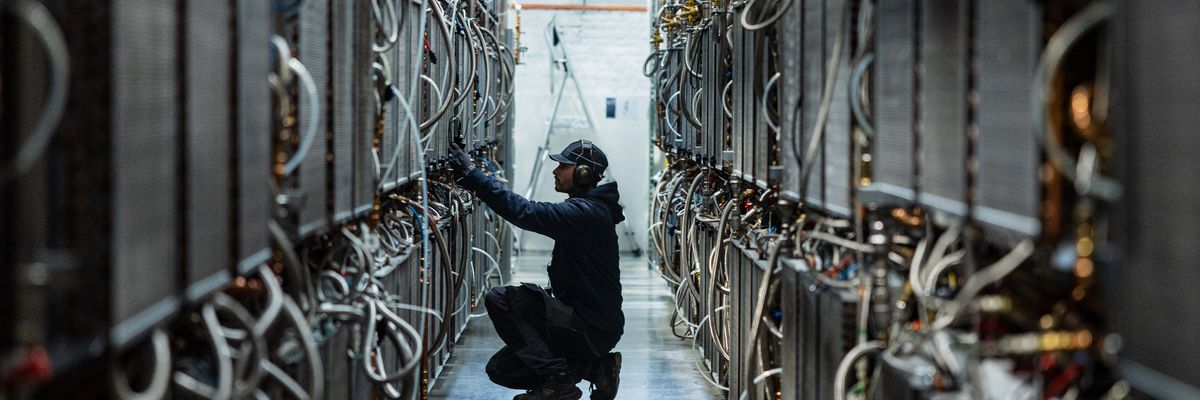
An operator works at the data centre of French company OVHcloud in Roubaix, northern France on April 3, 2025.
(Photo by Sameer Al-Doumy/AFP via Getty Images)

Brad Reed
Oct 14, 2025
COMMON DREAMS

America’s biggest tech firms are facing an increasing backlash over the energy-devouring data centers they are building to power artificial intelligence.

Semafor reported on Monday that opposition to data center construction has been bubbling up in communities across the US, as both Republican and Democratic local officials have been campaigning on promises to clamp down on Silicon Valley’s most expensive and ambitious projects.

RECOMMENDED...


Trump-Starmer AI Deal Slammed for Putting ‘Interests of US Tech Bros’ Ahead of the Common Good


As Big Tech Oligarchs Wage War on Workers, Sanders Warns AI Could Kill Nearly 100 Million US Jobs

In Virginia’s 30th House of Delegates district, for example, both Republican incumbent Geary Higgins and Democratic challenger John McAuliff have been battling over which one of them is most opposed to AI data center construction in their region.

In an interview with Semafor, McAuliff said that opposition to data centers in the district has swelled up organically, as voters recoil at both the massive amount of resources they consume and the impact that consumption is having on both the environment and their electric bills.

“We’re dealing with the biggest companies on the planet,” he explained. “So we need to make sure Virginians are benefiting off of what they do here, not just paying for it.”

NPR on Tuesday similarly reported that fights over data center construction are happening nationwide, as residents who live near proposed construction sites have expressed concerns about the amount of water and electricity they will consume at the expense of local communities.

“A typical AI data center uses as much electricity as 100,000 households, and the largest under development will consume 20 times more,” NPR explained, citing a report from the International Energy Agency. “They also suck up billions of gallons of water for systems to keep all that computer hardware cool.”

Data centers’ massive water use has been a consistent concern across the US. The Philadelphia Inquirer reported on Monday that residents of the township of East Vincent, Pennsylvania have seen their wells dry up recently, and they are worried that a proposed data center would significantly exacerbate water shortages.

This is what has been happening in Mansfield, Georgia, a community that for years has experienced problems with its water supply ever since tech giant Meta began building a data center there in 2018.

As BBC reported back in August, residents in Mansfield have resorted to buying bottled water because their wells have been delivering murky water, which they said wasn’t a problem before the Meta data center came online. Although Meta has commissioned a study that claims to show its data center hasn’t affected local groundwater quality, Mansfield resident Beverly Morris told BBC she isn’t buying the company’s findings.

“My everyday life, everything has been affected,” she said, in reference to the presence of the data center. “I’ve lived through this for eight years. This is not just today, but it is affecting me from now on.”

Anxieties about massive power consumption are also spurring the backlash against data centers, and recent research shows these fears could be well founded.

Mike Jacobs, a senior energy manager at the Union of Concerned Scientists, last month released an analysis estimating that data centers had added billions of dollars to Americans’ electric bills across seven different states in recent years. In Virginia alone, for instance, Jacobs found that household electric bills had subsidized data center transmission costs to the tune of $1.9 billion in 2024.

“The big tech companies rushing to build out massive data centers are worth trillions of dollars, yet they’re successfully exploiting an outdated regulatory process to pawn billions of dollars of costs off on families who may never even use their products,” Jacobs explained. “People deserve to understand the full extent of how data centers in their communities may affect their lives and wallets. This is a clear case of the public unknowingly subsidizing private companies’ profits.”

While the backlash to data centers hasn’t yet become a national issue, Faiz Shakir, a longtime adviser to US Sen. Bernie Sanders (I-Vt.), predicted in an interview with Semafor that opposition to their construction would be a winning political issue for any politician savvy enough to get ahead of it.

“For any Democrat who wants to think politically, what an opportunity,” he said. “The people are way ahead of the politicians.”


Smartphone-powered AI predicts avocado ripeness


Oregon State University

Avocado pressure test 

image: 

Luyao Ma, an assistant professor at Oregon State University, uses a texture analyzer to measure the firmness of an avocado. 

view more 

Credit: Brian Horne, Oregon State University


CORVALLIS, Ore. – Researchers have developed a smartphone-based artificial intelligence system that accurately predicts the ripeness and internal quality of avocados.

“Avocados are among the most wasted fruits globally due to overripeness,” said Luyao Ma, an assistant professor at Oregon State University. “Our goal was to create a tool that helps consumers and retailers make smarter decisions about when to use or sell avocados.”

The research team, comprising scientists from Oregon State and Florida State University, trained AI models using more than 1,400 iPhone images of Hass avocados. The system predicted firmness, a key indicator of ripeness, with nearly 92% accuracy, and internal quality (fresh vs. rotten) with over 84% accuracy.

The researchers believe these accuracy rates can be improved as more images are added to the model. They also note that the technology has the potential to assess the ripeness and quality of other types of food.

They hope to further develop the technology so that consumers can use it at home to determine the optimal time to eat an avocado, avoiding the disappointment of cutting into one only to find dreaded brown spots.

The team also sees potential applications in avocado processing facilities, where the technology could be used to better sort and grade the fruit. For example, if the system detects that a batch is more ripe, it could be shipped to a nearby retailer instead of one further away. Retailers could similarly use the technology to determine which avocados should be sold first based on ripeness.

These findings build on previous research that used images and machine learning techniques to assess food quality. However, earlier studies relied on manual feature selection [SN1] and traditional machine learning algorithms, which limited prediction performance, said In-Hwan Lee, a doctoral student working with Ma on the project.

“To overcome these limitations, we used deep learning approaches that automatically capture a broader range of information, including shape, texture, and spatial patterns to enhance the accuracy and robustness of avocado quality predictions,” Lee said.

Ma chose to focus on avocados due to their high market value and high waste rate. She also noted a personal motivation: as a frequent consumer of avocado toast, she was often frustrated by not knowing when avocados were perfectly ripe and cutting into overripe ones.

The research addresses a major global challenge: food waste. About 30% of the world’s food production is wasted. In response to this challenge, the U.S. Department of Agriculture and the Environmental Protection Agency have set a national goal to reduce food waste by 50% by 2030.

“Avocados are just the beginning,” Ma said. “This technology could be applied much more broadly, helping consumers, retailers, and distributors make smarter decisions and reduce waste.”

The findings were recently published in Current Research in Food Science. Zhengao Lee of Florida State University is also a co-author of the paper. Ma and Lee are in the Department of Food Science and Technology in Oregon State’s College of Agricultural Sciences. Ma is also affiliated with the Department of Biological and Ecological Engineering.

Will artificial intelligence ever replace human cognition?


By Dr. Tim Sandle
SCIENCE EDITOR
DIGITAL JOURNAL
October 13, 2025


OpenAI is working to put its artificial intelligence technology to work for countries around the world, entrenching it in systems before rivals such as DeepSeek can get footholds - Copyright AFP Kirill KUDRYAVTSEV

Imagination, ingenuity and curiosity are among the traits that current machines cannot mimic. But will they one day? Unlikely says Akli Adjaoute, who is the author of a new book titled Inside AI.

In the book, Adjaoute explores the reality compared with the science fiction behind AI and he additionally explains why machines cannot (and should not) replace human creativity.

AI plays a transformative role across a wide range of industries by streamlining processes, improving decision-making and enhancing productivity, yet these may well be the limits observes Adjaoute.

As he tells Digital Journal: “The world was built by people who took risks and wanted to create something new. I grew up extremely poor. I had no chance to succeed had I not had an imagination and the hardworking curiosity I needed to be different — to succeed. That’s what I’m trying to share with people.”

Adjaoute has more than three decades of experience in the development and deployment of mission-critical AI systems. In April 2000, he founded his second company, Brighterion, which uses AI to tackle payment fraud, a problem that plagues many industries and accounts for billions of dollars in yearly losses.

More than 2,000 clients globally use Brighterion-powered software, including 74 of the 100 largest U.S. banks, and over 150 billion transactions are processed through Brighterion software annually. Adjaoute eventually sold Brighterion to MasterCard.

These days Adjaoute distils his educational and professional expertise, including via his new book. In the text Adjaoute says he is seeking to provides a clear-headed, jargon-free overview of the fascinating world of AI.

Will AI surpass us?

Adjaoute devotes a chapter to answering a question in the minds of many: “Can machines match or surpass human creativity?”

From those new to the field to seasoned enthusiasts, Adjaoute aims to equip readers with a comprehensive understanding of what AI truly is and what it can and cannot achieve. This includes:Understanding diverse AI techniques and methodologies
Drawing lessons from both successful and failed AI applications
Identifying the capabilities and limitations of AI systems
Grasping the successful and unsuccessful uses of AI in business
Recognising areas where human cognition still surpasses AI
Dispelling common myths, such as AI’s threat to jobs and civilization
Effectively managing AI projects

These topics infer that, currently, AI has no actual intelligence, data mining is filled with errors, many AI system development efforts have failed, and AI systems are no match for the human brain or worker now or in the foreseeable future.

“As we progress, we’ll also address ethical questions surrounding bias, fairness, privacy and accountability,” Adjaoute adds. “Drawing from my three decades of experience in developing and deploying mission-critical AI systems, I will outline the characteristics that, in my perspective, will define the next generation of AI platforms.”
Google to invest $15 bn in India, build largest AI hub outside US


By AFP
October 14, 2025


Google says its data centre will make India's Visakhapatnam a 'global connectivity hub' - Copyright AFP Sergei GAPON

Bhuvan BAGGA

Google said Tuesday it will invest $15 billion in India over the next five years, as it announced a giant data centre and artificial intelligence base in the country.

“It is the largest AI hub that we are investing in anywhere outside of the US,” Google Cloud CEO Thomas Kurian said at a ceremony in New Delhi.

Demand for AI tools and solutions is surging among businesses and individuals in India, which is projected to have more than 900 million internet users by year’s end.

Kurian announced “capital investment of $15 billion” over the five years and a “gigawatt-scale AI hub in Visakhapatnam”, a port city in the southeastern state of Andhra Pradesh.

Google plans for the centre to scale to multiple gigawatts, he added, comparing the project to “a digital backbone connecting different parts of India together”.

Globally, data centres are an area of phenomenal growth, fuelled by the need to store massive amounts of digital data, and to train and run energy-intensive AI tools.

Google chief Sundar Pichai said on X that he had spoken to Prime Minister Narendra Modi about the “landmark development”.

“This hub combines gigawatt-scale compute capacity, a new international subsea gateway, and large-scale energy infrastructure,” he wrote.

“Through it we will bring our industry-leading technology to enterprises and users in India, accelerating AI innovation and driving growth across the country.”

– ‘Data is the new oil’ –

India’s Information Technology Minister, Ashwini Vaishnaw, thanked Google for the investment.

“This digital infrastructure will go a long way in meeting the goals of our India AI vision,” he said.

Andhra Pradesh Chief Minister Chandrababu Naidu called it a “very happy day”. The state’s Technology Minister Nara Lokesh said on X that the deal followed “a year of intense discussions and relentless effort”.

Lokesh, speaking at the announcement, said that “data is the new oil and data centres are the new refineries”.

“This is about India playing an important role on the global landscape,” he added.

Recently top American AI firms looking to court users in the world’s fifth-largest economy have made a flurry of announcements about expanding into the country.

This month US startup Anthropic said it plans to open an office in India next year, with its chief executive Dario Amodei meeting Prime Minister Modi.

Modi, in a post on X, told Amodei that “India’s vibrant tech ecosystem and talented youth are driving AI innovation”, adding that he wanted to “harness AI for growth”.

OpenAI has said it will open an India office later this year, with its chief Sam Altman noting that ChatGPT usage in the country had grown fourfold over the past year.

AI firm Perplexity also announced a major partnership in July with Indian telecom giant Airtel, offering the company’s 360 million customers a free one-year Perplexity Pro subscription.
Why is the US tech sector cutting so many jobs?


By Dr. Tim Sandle
SCIENCE EDITOR
DIGITAL JOURNAL
October 14, 2025


Silicon Valley chip maker Intel says it cut about 15 percent of its 'core workforce' in the recently ended quarter - Copyright GETTY IMAGES NORTH AMERICA/AFP JUSTIN SULLIVAN

With the U.S. government shutdown already into its second week, crucial jobs market data has been delayed. Despite this, analysts believe that layoffs in the technology sector are continuing at a high rate.

Several tech giants have recently cut hundreds of jobs in the San Francisco Bay Area, while hiring remains low amid trade wars, tariff policies, and increased business costs.

With tens of thousands of jobs slashed this year in the U.S. tech industry alone, September 2025 unemployment is expected to reach a four-year high. The Chicago Fed expects the unemployment rate for the month to reach 4.34%, while unemployment claims rose to 224,269 in the last week of September, according to a Reuters report, citing estimates from Haver Analytics.

To determine which companies are leading the latest wave of job cuts, analysts at RationalFX compiled layoff data from multiple verified sources, including U.S. WARN notices, TrueUp, TechCrunch, and the Layoffs.fyi tracker, covering announcements made since the start of 2025.

According to the latest aggregated figures, at least 181,457 employees in the global tech industry have lost their jobs so far this year, while 66.44% of these layoffs or 120,569 job cuts have been at U.S.-based companies. In the first days of October, around 1,400 employees in the sector have lost their jobs. The largest cuts were announced by American tech giants Intel (33,900) and Microsoft (19,215), as well as at India’s Tata Consultancy Services (12,000).

Tech companies with the most significant mass layoffs

Intel – 33,900 layoffs

Intel is planning to reduce its workforce by approximately 25-30% by the end of 2025, in an effort to streamline operations. The company is primarily cutting roles in its Foundry division and scaling back certain international expansion projects.

Microsoft – 19,215 layoffs

Since the start of the year, Microsoft has laid off roughly 19,215 employees across its engineering, management, and international teams. These reductions are part of a strategic pivot towards artificial intelligence and cloud services.

TCS – 12,000 layoffs

IT, consulting, and business solutions services provider TCS is reducing its workforce by 12,000 employees, focusing primarily on mid- and senior-level roles. The company attributes these layoffs to a slowdown in demand and the need to adapt to AI and automation trends.

Accenture – 11,000 layoffs

The Ireland-based IT services provider Accenture spearheaded the latest wave of layoffs, cutting more than 11,000 positions in the process. The redundancies primarily affected employees deemed unable to be retrained to work with AI agents. This move forms part of a broader $865 million restructuring plan designed to align the workforce with the company’s AI-driven strategy.

Panasonic – 10,000 layoffs

Japanese technology conglomerate Panasonic has led one of the largest layoff waves in Asia, shedding more than 10,000 employees across its various business locations. The company has stated that it is restructuring to focus on core areas and enhance operational efficiency.

IBM – 9,000 layoffs

IBM is reducing its workforce by 9,000 employees, with cuts spanning both hardware and software divisions. The company is focusing on areas with higher growth potential, such as cloud computing and AI services.

Salesforce – 5,000 layoffs

Silicon Valley-based cloud software company Salesforce has laid off up to 5,000 employees in 2025, including over 4,000 customer service roles. The company cited AI-driven efficiency improvements, with AI agents now handling more than half of customer interactions, as part of a broader restructuring focused on AI initiatives, despite reporting strong financial results.

STMicro – 5,000 layoffs

European semiconductor manufacturer STMicroelectronics announced it will be cutting 5,000 jobs over the next three years. This will reportedly include 2,800 direct job cuts as well as 2,000 employees who are likely to leave the company within this timeframe.

Amazon – 4,055 layoffs

Amazon is laying off at least 4,055 employees across various departments, including operations and corporate functions. Most recently, Amazon laid off 150 delivery drivers at the Queens station in New York at the end of September 2025, followed by 555 positions slashed in Los Angeles and Orange counties in early October.

Meta – 3,720 layoffs

Facebook’s parent company, Meta, has reduced its workforce by at least 3,720 employees throughout 2025 as part of its ongoing efficiency initiatives. CEO Mark Zuckerberg emphasized that the layoffs were performance-based, targeting employees deemed “low performers” as part of an effort to improve team quality and accelerate innovation.

As of October 9th, 2025, a minimum of 181,457 employees in the tech sector have been laid off globally, with Intel, Microsoft, and TCS slashing the most jobs overall. Roughly 1,400 of these job cuts were announced within the first week of October. Of these, an estimated 50,184 job cuts were directly linked to the adoption of AI and automation technologies.
AI tools ‘exploited’ for racist European city videos


By AFP
October 13, 2025


An AI-generated video of London in decline, shared on the social media site X account of British far-right activist Tommy Robinson, is viewed on a smart phone in London. — © AFP HENRY NICHOLLS


Anna MALPAS

Daubed in Arabic-looking graffiti, London’s Big Ben is shown smouldering above piles of rubbish and crowds dressed in traditional Islamic garb in an AI-generated, dystopian vision of the British capital.

Far-right leaders and politicians are seizing on such clips of reimagined European cities changed by migration to promote racist views, falsely suggesting AI is objectively predicting the future.

The videos — which show immigrants “replacing” white people — can be made quickly using popular chatbots, despite guardrails intended to block harmful content, experts told AFP.

“AI tools are being exploited to visualise and spread extremist narratives,” the CEO of the Center for Countering Digital Hate watchdog, Imran Ahmed, told AFP.

British far-right leader Tommy Robinson in June re-posted the video of “London in 2050” on X, gaining over half a million views.

“Europe in general is doomed,” one viewer responded.

Robinson — who has posted similar AI videos of New York, Milan and Brussels — led the largest far-right march in central London for many years in September, when up to 150,000 people demonstrated against the influx of migrants.

“Moderation systems are consistently failing across all platforms to prevent this content from being created and shared,” said Ahmed of the Center for Countering Digital Hate.

He singled out X, owned by tech billionaire Elon Musk, as “very powerful for amplifying hate and disinformation”.

TikTok has banned the creator account behind the videos posted by Robinson. According to the platform, it bans accounts that repeatedly promote hateful ideology, including conspiracy theories.

But such videos have gained millions of views across social media and have been reposted by Austrian radical nationalist Martin Sellner and Belgian right-wing parliamentarian Sam van Rooy.

Italian MEP Silvia Sardone from rightwing populist party Lega in April posted a dystopian video of Milan on Facebook, asking whether “we really want this future.”

Dutch far-right leader Geert Wilders’ Party for Freedom released an AI video of women in Muslim headscarves for the October elections titled “Netherlands in 2050.”

He has predicted that Islam will be the Netherlands’ largest religion by that time, despite just six percent of the population identifying as Muslim.

Such videos amplify “harmful stereotypes… that can fuel violence”, said Beatriz Lopes Buarque, an academic at the London School of Economics researching digital politics and conspiracy theories.

“Mass radicalisation facilitated by AI is getting worse,” she told AFP.

– ‘Hate is profitable’ –

Using a pseudonym, the creator of the videos reposted by Robinson offers paid courses to teach people how to make their own AI clips, suggesting “conspiracy theories” make a “great” topic to attract clicks.

“The problem is that now we live in a society in which hate is very profitable,” Buarque said.

Racist video creators appear to be based in various countries including Greece and Britain, although they hide their locations.

Their videos are a “visual representation of the great replacement conspiracy theory,” Buarque said.

Popularised by a French writer, this claims Western elites are complicit in eradicating the local population and “replacing” them with immigrants.

“This particular conspiracy theory has often been mentioned as a justification for terrorist attacks,” said Buarque.

Round dates such as 2050 also crop up in a similar “white genocide” conspiracy theory, which has anti-Semitic elements, she added.

AFP digital reporters in Europe asked ChatGPT, GROK, Gemini and VEO 3 to show London and other cities in 2050, but found this generally generated positive images.

Experts, however, said chatbots could be easily guided to create racist images.

None has moderation that “is 100 percent accurate”, said Salvatore Romano, head of research at AI Forensics.

“This… leaves the space for malicious actors to exploit chatbots to produce images like the ones on migrants.”

Marc Owen Jones, an academic specialising in disinformation at Northwestern University’s Qatar campus, found ChatGPT refused to show ethnic groups “in degrading, stereotypical, or dehumanising ways”.

But it agreed to visualise “a bleak, diverse, survivalist London” and then make it “more inclusive, with mosques too”.

The final image shows bearded, ragged men rowing on a rubbish-strewn River Thames, with mosques dominating the skyline.

AFP, along with more than 100 other fact-checking organisations, is paid by TikTok and Facebook parent Meta to verify videos that potentially contain false information.
Mass-produced AI podcasts disrupt a fragile industry


By AFP
October 13, 2025


Artificial intelligence is ushering in mass-made podcasts, a world without studios and microphones where virtual hosts are doing the talking - Copyright AFP/File Ozan KOSE
Thomas URBAIN

Artificial intelligence now makes it possible to mass-produce podcasts with completely virtual hosts, a development that is disrupting an industry still finding its footing and operating on a fragile business model.

Since Google launched Audio Overview, the first mass-market podcast generator that creates shows from documents and other inputs, just over a year ago, a wave of startups has rushed in, from ElevenLabs to Wondercraft.

No studio, no humans at the microphone, not even a recording — yet out comes a lively podcast, banter and all. Whether based on a legal document or a school handout, AI tools can deliver a state-of-the-art podcast at the click of a mouse.

A pioneer in this movement is Inception Point AI, which was launched in 2023 and releases about 3,000 podcasts per week with a team of just eight people.

The immediate goal is to play the volume game, said Jeanine Wright, Inception’s founder and the former number two at leading audio studio Wondery.

With each episode costing one dollar to produce, a mere 20 listens is enough to turn a profit. Automation has lowered the threshold for selling advertising space — previously set at several thousand downloads.

Wright gives the example of a “hyper-niche” program about pollen counts in a specific city, heard by a few dozen people that can attract antihistamine advertisers.

With the rise of generative AI, many worry about synthetic content of poor quality — often called “AI slop” — flooding the internet, particularly social media.

Inception mentions AI’s role in every episode, a disclosure that generates “very little drop-off” among listeners, Wright told AFP.

“We find that if people like the (AI) host and the content, then they don’t care that it’s AI-generated or they’ve accepted it.”

– Finding an audience –

Martin Spinelli, a podcast professor at Britain’s University of Sussex, decried a flood of content that will make it “harder for independent podcasters to get noticed and to develop a following” without the promotional budgets on the scale of Google or Apple.

The expected surge in programming will also cut into the advertising revenue of non-AI podcasts.

“If someone can make 17 cents per episode, and then suddenly they make 100,000 episodes, that 17 cents is going to add up,” warned Nate DiMeo, creator of “The Memory Palace,” a pioneering podcast for history buffs.

The industry veteran, whose program began in 2008, said he’s skeptical about the mass adoption of AI podcasts.

But even if listener tastes don’t change significantly, a glut of AI podcasts can “still impact the art form,” independent podcasting where most programs are barely managing to stay afloat.

Currently, the three major platforms — Apple Podcasts, Spotify and YouTube — don’t require creators to disclose when a podcast was created by AI.

“I would pay money for an AI tool that helps me cut through that noise,” said Spinelli, who finds the streaming giants ineffective at connecting niche content with its target audience.

Wright argues it’s pointless to draw a dividing line between AI and non-AI content because “everything will be made with AI,” to one degree or another.

She does believe, however, that AI-generated podcasts with synthetic voices will emerge as a distinct genre — somewhat like live-action films and animation, which have proven their storytelling potential and appeal over time.

“People dismissing all AI-generated content as slop right now are being thoughtless, because there’s a lot of great, compelling AI content that deserves their interest.”

DiMeo doesn’t see it that way.

He compares podcasting to reading a novel or listening to a song.

You simply want to connect “with some other human consciousness,” he said. “Without that, I find there’s less reason to listen.”