It’s possible that I shall make an ass of myself. But in that case one can always get out of it with a little dialectic. I have, of course, so worded my proposition as to be right either way (K.Marx, Letter to F.Engels on the Indian Mutiny)
Sunday, October 19, 2025
HSBC expects gold’s ‘bull wave’ to hit $5,000 in 2026
HSBC on Friday forecast that gold’s bull rally would drive prices as high as $5,000 an ounce in 2026, supported by elevated risks and the impact of new entrants into the market.
Spot gold breached the $4,300 level on Thursday and was headed for its strongest week since December 2008.
The advance has been fueled by geopolitical tensions, robust central bank buying, rising exchange-traded-fund inflows, expectations of US rate cuts and tariff-related economic uncertainties.
“The bull market is likely to continue to press prices higher for 1H’26 and we could very well reach a high of $5,000/oz some time in 1H 2026,” HSBC said in a research note.
HSBC also raised its 2025 average gold price forecast to $3,455 per ounce from $3,355 previously. It increased its 2026 average gold price forecast to $4,600, up from its previous estimate of $3,950.
The bank cited geopolitical risks, economic policy uncertainty and rising public debt as factors supporting the price.
HSBC said that, given the sharp rise in prices during the second half of 2025 and heightened risks from new market entrants, it expects gold prices to remain elevated and potentially spike further through early 2026.
But the bank also expects significant volatility and some price moderation in the second half of 2026.
“Unlike previous rallies we believe many of these new buyers are likely stay in the gold space – even after the rally ends – not so much for appreciation necessarily as for gold’s diversification and ‘safe haven’ qualities,” the bank said.
HSBC joins analysts at the Bank of America and Societe Generale, who earlier in the week forecast that gold could reach $5,000 an ounce in 2026.
(By Anushree Mukherjee and Sherin Elizabeth Varghese; Editing by Barbara Lewis and Jane Merriman)
Gold’s historic rally comes with a bonus for emerging markets
A relentless surge in the price of gold is delivering windfalls across emerging markets, boosting investor confidence in countries that mine and buy the metal.
In South Africa, home to the world’s deepest gold mines, stocks are on track for the best year in two decades, with shares of miners like Sibanye Stillwater Ltd., AngloGold Ashanti Plc and Gold Fields Ltd. tripling in value. The credit rating of Ghana, Africa’s top gold producer, has been upgraded by Moody’s Ratings. Emerging-market countries rank among the biggest buyers of bullion, boosting national coffers.
For money managers in emerging markets, gold’s surge is giving them another reason to stay bullish. By fanning a wealth effect for bullion-producers and buyers alike, valuable gold holdings are giving investors more conviction to buy. In a report earlier this month, Goldman Sachs Group Inc. strategists listed South Africa’s mining strength as a top reason it sees gains ahead for the country’s bonds and stocks.
“The rally in gold is beneficial for a small group of countries in emerging markets such as Uzbekistan, Ghana and South Africa,” said Daniel Wood, a portfolio manager at William Blair Investment Management. “The wider story of the rising gold price is that investors are increasingly looking for alternative investments away from the more traditional developed market currencies, particularly the US dollar.”
Wood said he’s bullish on Uzbekistan’s currency because the country is both a major bullion producer and holds substantial reserves. He added that soaring metal prices are part of the reason why South Africa’s markets are having such a historic year.
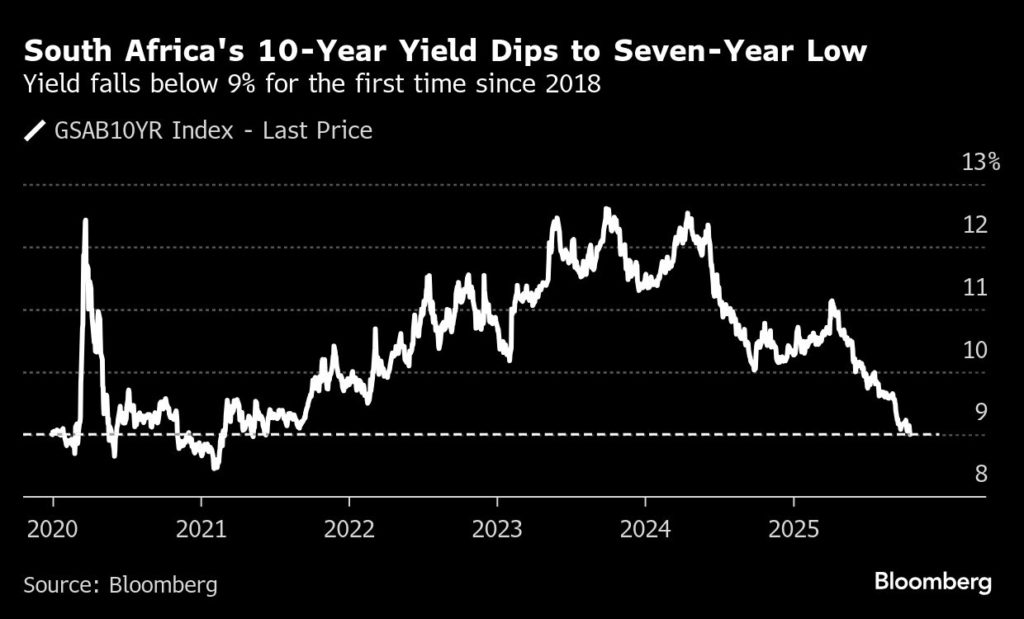
South Africa’s FTSE/JSE Africa All Shares Index has gained more than 30% in 2025. The rand is near a one-year high, and the 10-year government bond yield recently fell below 9% for the first time in more than seven years. Slowing inflation that’s allowed the country’s central bank to cut interest rates is also boosting market sentiment.
All in all, it’s a dramatic turnaround for a country that has struggled to attract investors for years because of political turmoil and power shortages that sapped economic growth.
Another country that’s benefiting from the gold rally is Ghana. After enduring an economic crisis in 2022 that caused it to default on its debt, the nation has been on a path to recovery under new President John Mahama. The cedi has strengthened about 38% this year, the biggest increase globally.
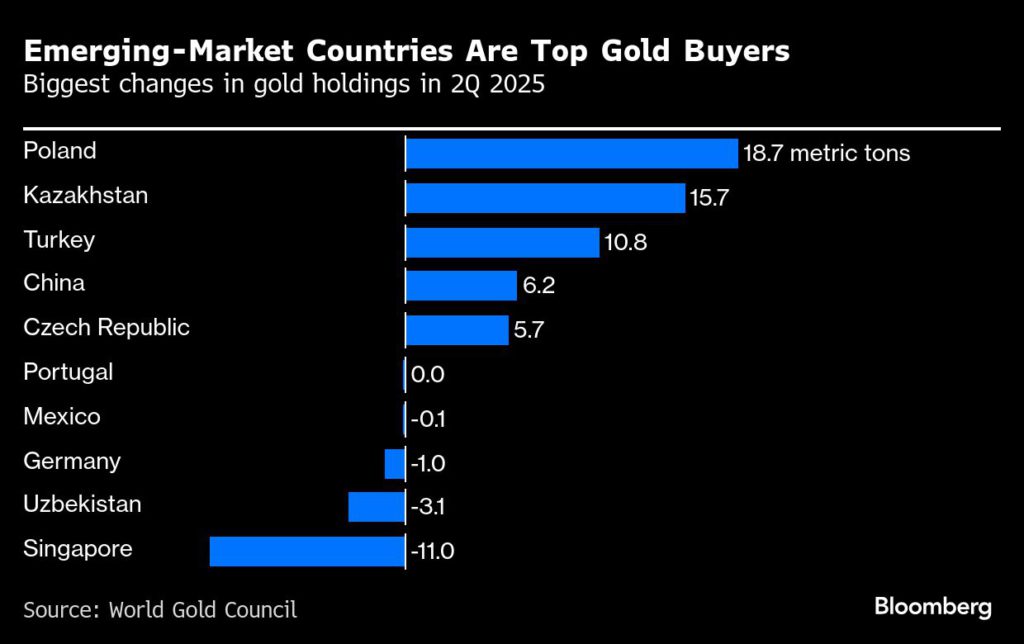
Other investors said they’re watching countries like Poland, Turkey and Kazakhstan, which have all been adding to their gold reserves. Alexis de Mones, a fixed-income portfolio manager at Ashmore Group Plc, said that while the trend is generally positive, investors shouldn’t read too much into it.
“Those countries that have a greater share of gold in their reserves will also look better, but one should not necessarily look at pricing effects as a source of credit strength,” he said.
The bigger driver for emerging markets is the fact that higher gold prices are coming at a time when the dollar is weak and financial conditions are broadly easing, de Mones added. That’s a view echoed by Ning Sun, a senior emerging-markets strategist at State Street Markets in Boston.
She said rising gold prices are usually part of a broad move that drags down anything risky. But in this case, given dollar weakness and nervousness about US economic policy, that relationship has flipped. And now, emerging markets are turning out to be a winner.
“The rally does benefit emerging markets more than developed markets,” she said. “Emerging markets not only produce gold, they also hoard the metal.”
(By Selcuk Gokoluk)
A stock trader’s guide to navigating China’s curb on rare earths
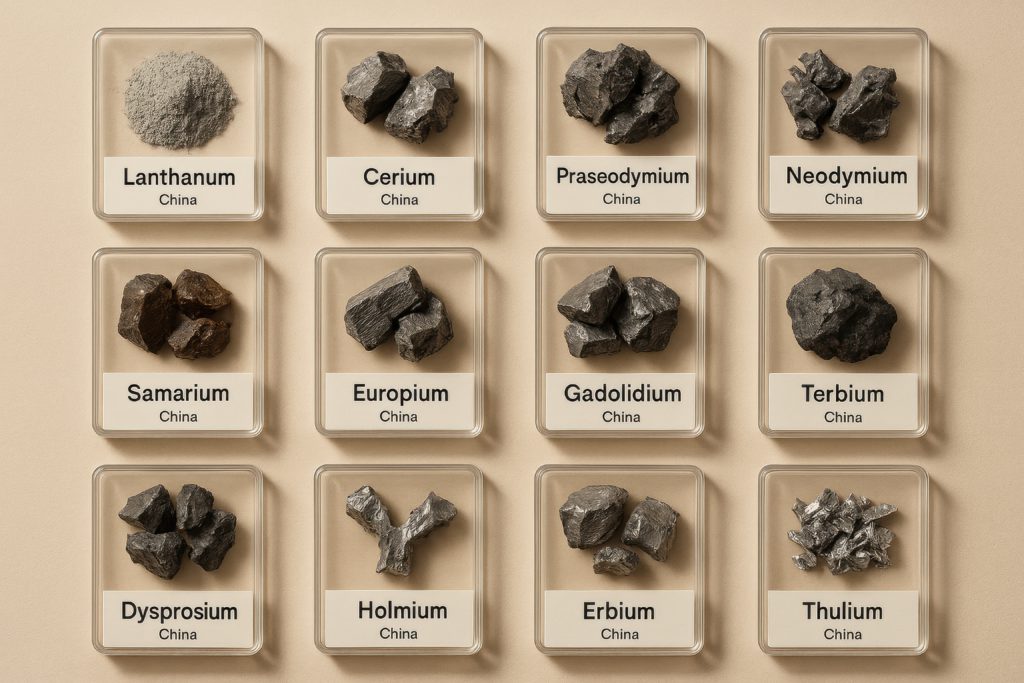
A display of various rare earth elements in labeled containers, showcasing their distinct forms and origins, primarily from China. Stock image.
The names — holmium, europium, ytterbium, thulium, erbium — don’t show up in any of the investing classics. But they’re fast becoming an integral part of the Wall Street lexicon.
These minerals, and others in the category known as rare earths, are used to make advanced weaponry, cutting-edge computer chips and high-tech cars. And China, which controls some 70% of the mining and near 90% of processing, is curbing access to them.
The implications for investors are far-reaching, as countries led by the US scramble to shore up access to the raw materials, often by funneling investments to miners outside of China. End users, from ASML Holding NV to Ford Motor Co. to Hyundai Motor Co., likely will have to ensure supplies or pivot to technologies that don’t require them. The stakes are high, since lacking even a single input can snarl entire production lines.
Investors looking for clues on how to trade the new era got a small lesson in April, when Beijing slapped curbs on seven rare earths, gumming up some carmakers’ productions. Now, the broader restrictions stand to impact a bigger slice of the market, if they take effect in December.
“By increasing the number of rare earths subject to export controls, it’s likely to make the issue relevant to a greater number of sectors,” said Katherine Ogundiya, a thematic investing analyst at Barclays.
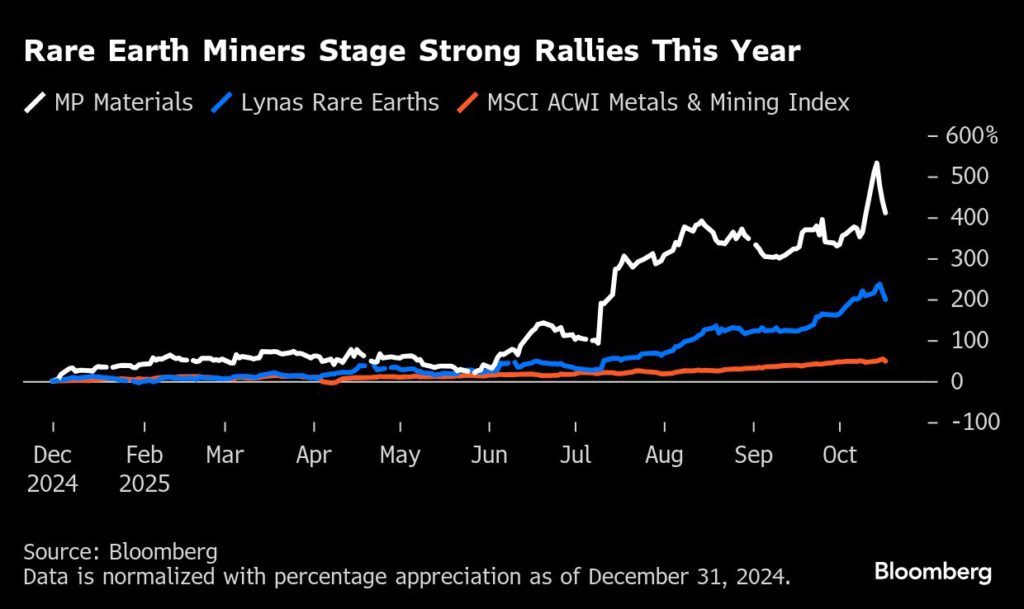
The issue is not just more metals will face curbs; the number of products subject to restrictions is also surging. That prompted a rush to shares of rare earth miners and processors, many of which have seen triple-digit gains this year.
Market reactions for rare earth users have been more muted so far, with traders speculating that China is using the new curbs as a bargaining chip. President Donald Trump tamped down his own rhetoric on Friday. But with tensions between the two superpowers showing few signs of easing, prudent traders have begun assessing just what might happen if the restrictions come into force.
Here are some sectors and stocks to watch:
Miners
Companies outside of China that can extract these scarce materials from the earth have already seen incredible share-price gains. In Australia, shares of Lynas Rare Earths Ltd., a major supplier backed by billionaire Gina Rinehart, almost tripled this year. MP Materials Corp. soared over 150% since the US government took a stake that will help it expand production capacity. Shares of Critical Metals Corp., a Canadian miner that’s developing deposits in Greenland, rallied on a report suggesting the US was considering an equity position, which the Trump administration later denied.
Geopolitical tensions and deal speculations create a “security premium” for the sector,
said B. Riley Securities analyst Ryan Pfingst.
Investors have to weigh whether gains can be sustained, and place bets on if Western nations will invest more in domestic champions. MP Materials remains loss-making. Lynas broke even in its most recent fiscal year, and analysts said it will take years for output to catch up with Chinese peers.
China’s miners have naturally benefited. Expectations for higher metals prices powered gains in shares of state-owned miners including China Rare Earth Resources and Technology Co. and China Northern Rare Earth High-Tech Co.
Semiconductors
The artificial intelligence boom has already made chipmakers the most important players in global stock indexes. Rare earths are critical to their production. A polishing liquid that contains cerium is used in a process to make wafers. Coatings made of Yttrium shield equipment components from corrosion. Lanthanum is added to many optical systems.
And China controls nearly the entire supply of them all, creating a potential choke point for chip equipment suppliers, according to Bank of America Corp. analysts including Didier Scemama.
While rare earths account for just a small portion of overall production costs for the chip industry, “to have that stop you is incredibly damaging,” said Willis Thomas, Principal Consultant at CRU Group.
That means companies like Applied Materials Inc., Tokyo Electron Ltd., ASM International NV and Lam Research Corp. could be at risk.
So far, investors haven’t grown skittish. BofA says current levels of strategic inventories should be sufficient for the next 12 to 18 months. The chip sector is trading near an all-time high following strong results at ASML and its top client, Taiwan Semiconductor Manufacturing Co. ASML said it’s “well prepared” for the curbs, and has materials for the “next couple of months.”
Defense
Weapons and drones can’t be made without rare earth elements. An F-35 fighter jet, manufactured by Lockheed Martin Corp., carries about 900 pounds of rare earth materials. A Virginia-classed nuclear submarine, built by General Dynamics Corp. and Huntington Ingalls Industries Inc., requires about 9,200 pounds. One drone motor contains between 12 and 60 magnets made from rare earth metals.
The question is whether these manufacturers can continue to access the minerals critical to production if the restrictions essentially block any rare earth exports to overseas military users.
“Even a few hundred thousand euros’ worth of parts can halt production given they often have only one supplier,” said Jens-Peter Rieck, an analyst at mwb research AG.
Investors will have to determine whether contractors get enough government support to justify already rising valuations. Rheinmetall AG jumped over 170% this year after Germany expanded its military budget. Lockheed erased yearly declines following speculation the US government might take a stake.
Automakers
A wide range of car components used in gas-powered and electric vehicles rely on rare earths. They are vital to parts like traction motors, sensors and braking systems, even though just a few hundred grams are needed in some cases.
China’s restrictions in April brought disruptions, with Ford temporarily shuttering a factory in Chicago in May because it ran short of rare earth components. That put investors in the likes of Toyota Motor Corp. and Volkswagen AG on alert for strategies that mitigate reliance on China.
BMW AG’s generation 5 and 6 and Renault SA’s E-Tech electric vehicle models are using motor technology that doesn’t require rare earth magnets, according to Morningstar analyst Rella Suskin. Indian automakers are also testing ferrite-based magnets, Bloomberg reported. Tesla Inc. laid out a plan to remove rare earths from its future models in 2023. Its Optimus robots would still need to use these elements.
Another strategy is to secure metals from suppliers outside of China. General Motors Co. has signed three domestic supply contracts for rare earth magnets, including a deal with Texas-based Noveon Magnetics Inc. in August.
Renewables
Like carmakers, wind turbine makers are diversifying their supply chain away from China, giving investors a metric to home in on. Siemens Energy AG signed an agreement in June to procure magnets from Japan’s TDK Corp. Australia’s Arafura Rare Earths Ltd. supplies both Siemens Energy and GE Vernova Inc.
Neodymium and dysprosium are two key elements for the wind power industry, and even without trade restrictions, analysts warn that the supply is at risk of being outstripped. About 10% of permanent magnets were used for wind turbines, according to a 2022 paper by the International Renewable Energy Agency.
While China’s new restrictions could push up metals prices, the industry has adapted well in the past, said Bloomberg Intelligence analyst Alessio Mastrandrea. He sees limited cost pressures on companies like Vestas Wind Systems A/S and expects any to be passed on to customers, if needed.
(By Henry Ren, Monique Mulima and Isolde MacDonogh)
Restart of Huge Nuclear Power Plant Faces Backlash in Japan
Local residents and anti-nuclear activists in Japan oppose the restart of one of the world’s biggest nuclear power plants.
TEPCO has planned for years to restart the Kashiwazaki-Kariwa power plant in the Niigata prefecture.
Since 2015, Japan has restarted 14 reactors, while 11 others are currently in the process of restart approval.
Local residents and anti-nuclear activists in Japan oppose the restart of one of the world’s biggest nuclear power plants and its operator’s plan to invest money in revitalizing the regional economy.
Tokyo Electric Power Company (TEPCO), which also operated the nuclear power plant in Fukushima prior to the 2011 disaster, has planned for years to restart the Kashiwazaki-Kariwa power plant in the Niigata prefecture.
But the company faces backlash over its restart plans and proposal from August this year to “contribute monetarily to vitalizing the regional economy,” and invest in projects to contribute to improving safety and security.
TEPCO’s monetary proposal is for the creation of a $667 million (100 billion yen) fund for the benefit of Niigata prefecture, Nikkei Asia reported last week.
Anti-nuclear activists have slammed the proposal as a “bribery” of the local residents to accept the restart of the Kashiwazaki-Kariwa plant.
“This is a big step forward for Tepco because they really want to restart the plant and the scale of the offer shows that,” Hajime Matsukubo, secretary general of the Tokyo-based Citizens’ Nuclear Information Centre, told This Week in Asia.
“But this is simply bribery,” Matsukubo added.
Opinion polls suggest that local residents are split on whether TEPCO should be allowed to restart the nuclear power plant.
In the wake of the Fukushima disaster in 2011, Japan closed all its nuclear power plants, and conducted rigorous safety checks and inspections.
Since 2015, Japan has restarted 14 reactors, while 11 others are currently in the process of restart approval.
Kashiwazaki-Kariwa has been offline since 2012, while the Nuclear Regulation Authority in 2021 barred the plant’s operator, TEPCO, from operating the facility due to safety breaches.
The regulator lifted the operational ban on Kashiwazaki-Kariwa in December 2023, paving the way for the restart.
But the restart still needs the approvals of the Niigata prefecture, the city of Kashiwazaki, and the village of Kariwa to resume operations.
In an address to a committee at the Niigata prefectural assembly this week, TEPCO president Tomoaki Kobayakawa said the operator aims to restart reactor No 6 and would consider decommissioning reactors No 1 and No 2.
The backlash against the restart of one of the biggest nuclear power plants in the world highlights Japan’s dilemma of how to ensure a stable energy supply while reducing emissions, as it has pledged. Restarting additional nuclear reactors would do the trick, but the country still faces negative public opinion and high concerns about safety, especially in the areas close to nuclear power plants.
Still, the share of fossil fuels in Japan’s power supply slumped to the lowest on record in the first half of 2025, as nuclear and solar electricity generation is growing.
Resource-poor Japan, a major importer of LNG, crude oil, and coal, saw its utility-scale electricity supply slump below 60% for the first time between January and June, according to data from clean energy think tank Ember cited by Reuters columnist Gavin Maguire.
At the same time, low-carbon electricity supply – nuclear and renewables – saw the highest level in more than a decade, as Japan is slowly re-opening some nuclear capacities after they were closed for safety checks following the Fukushima disaster in 2011.
As part of its decarbonization plans, Japan has made a U-turn in nuclear energy policy and plans to rely more on nuclear reactors for its power supply in the coming decades. The country looks to have 20% of its electricity supply coming from nuclear power by 2040, up from below 10% now.
Before the Fukushima meltdown in 2011, nuclear energy accounted for about 30% of Japan’s electricity mix.
By Charles Kennedy for Oilprice.com
New Guidance Provides Industry-First Roadmap For Nuclear-Powered Shipping
The new guidance promotes nuclear power as a reliable maritime energy source, addressing the complex regulatory, safety and economic challenges of its integration.
Lloyd’s Register (LR) has published Navigating Nuclear Energy in Maritime, a new guidance document providing the first roadmap for the safe and responsible use of nuclear technology in commercial shipping and offshore industries.
As the maritime sector accelerates its transition towards sustainable energy solutions, nuclear power has re-emerged as a viable solution to achieve net-zero ambitions.
The guidance, developed in partnership with Global Nuclear Security Partners (GNSP) and marine insurer NorthStandard, sets out the practical steps project teams must take – outlining regulatory, technical, operational and financial requirements for integrating nuclear technology, such as small modular reactors (SMRs), into maritime assets.
With no international regulatory framework yet in place, the document discusses the roles of key bodies, including the International Maritime Organization (IMO) and the International Atomic Energy Agency (IAEA), highlighting the importance of harmonising maritime and nuclear standards.
Topics covered include safety classification, environmental impact assessments, structural integrity, and the development of a robust nuclear safety case. Security measures are also addressed, with emphasis on physical and cyber protection systems, as well as insider threat mitigation.
Operational and financial aspects are thoroughly explored, including personnel qualifications, emergency response planning, and quality assurance throughout the project lifecycle. The document also examines insurance and reinsurance challenges, advocating for a predictable liability framework to support commercial viability.
Mark Tipping, LR’s?Global Power to X Director, said: “Nuclear energy has the potential to transform maritime, providing a scalable and zero-carbon energy source that can accelerate the industry’s energy transition. However, its adoption requires clarity, collaboration and trust across regulators, operators, insurers and wider society. This guidance offers a comprehensive starting point for stakeholders to navigate the risks and opportunities ahead.”
Nick Tomkinson, Senior Partner, Global Nuclear Security Partners, said: “Maritime nuclear will only succeed when safety, security and safeguards are considered together from the start. This guidance document helps first movers align maritime and nuclear frameworks, apply goal-based approaches where prescriptive rules are absent, and build the confidence required by regulators, insurers and the public. GNSP is proud to contribute to this important step for the sector.”
Helen Barden, Director - External Affairs at NorthStandard, added: “NorthStandard are proud to have been invited to contribute our expertise to the Navigating Nuclear Energy in Maritime guidance document. We collaborated with Lloyd’s Register to explore the insurance and reinsurance considerations for nuclear energy - particularly the interlink between classification and insurance, current P&I limitations around pooling nuclear risks and the importance of liability frameworks.
“We welcome the growing recognition that nuclear could play a meaningful role in the decarbonisation of shipping and we are proactively supporting the maritime industry when it comes to the insurance and regulatory challenges ahead.”
LR’s guidance builds on its industry-leading Fuel for Thought: Nuclear research programme and aims to fill a critical knowledge gap. It brings together decades of classification, safety and compliance expertise with specialist nuclear insight to provide an evidence-based framework for project teams at every stage of development.
The products and services herein described in this press release are not endorsed by The Maritime Executive.
French nuclear giant Orano to face trial over 2010 Niger hostage case
French nuclear group Orano is to stand trial in Paris over claims it failed to protect staff from a 2010 Al-Qaeda kidnapping near its uranium mine in Niger.
Issued on: 19/10/2025 - RFI
The Orano logo, the new name of former nuclear giant Areva, pictured outside the company’s headquarters in La Défense, near Paris
AFP - ERIC PIERMONT
Fifteen years after one of France’s most harrowing hostage crises, a French court has ordered a trial for nuclear group Areva – now known as Orano – over allegations it underestimated the threat from Al-Qaeda in the Sahara.
The company is accused of failing to protect workers at its uranium mine in Niger, paving the way for a 2010 kidnapping that shocked France.
The Paris correctional court will examine charges of "involuntary injury through negligence or breach of safety obligations", according to judicial sources quoted by AFP on Sunday, confirming an earlier report by Le Parisien.
The referral order, dated 26 September, marks a new chapter in a case that has shadowed the French nuclear sector for more than a decade.
The charge relates to the kidnapping of five French nationals, a Malagash and a Togolese employee near Areva’s Arlit uranium site in northern Niger in September 2010.
All were working for the company or its subcontractors when armed men stormed their living quarters in the night of 15-16 September.
Françoise Larribe, who was unwell, was freed after five months along with her Madagascan and Togolese colleagues.
The remaining four hostages – including her husband Daniel Larribe and fellow workers Pierre Legrand, Marc Féret and Thierry Dol – endured 1,139 days in captivity before their release in October 2013.
L'ouest de Arlit, secteur où le touriste français et son chauffeur ont été enlevés.
While the trial order covers the charge of involuntary injury, judges dismissed a series of more serious terrorism-related accusations – including "kidnapping and unlawful confinement by an organised group and complicity in a terrorist enterprise" – in line with recommendations from France’s National Anti-Terrorism Prosecutor’s Office (Pnat).
The Pnat had also requested that no trial be held on the negligence charge and has appealed the decision to proceed, filed on 2 October, according to judicial sources speaking to AFP.
Areva’s lawyer, Marion Lambert-Barret, said the group would not comment.
But for survivors, the decision to hold a trial is a long-awaited step.
“It’s unacceptable that, despite numerous warnings, Areva failed to take serious measures to protect staff on its sites,” said Olivier Morice, lawyer for ex-hostage Pierre Legrand, who filed the original complaint in 2013.
The investigation painted a troubling picture of security at Arlit, where around a hundred expatriates lived and worked.
The residential compound was reportedly unfenced and guarded only by unarmed Tuareg contractors. No alarm system or fallback base existed in case of attack.
Despite signing a security agreement with Niger’s government – which provided police and military protection for mining facilities and staff movements – the response on the night of the abductions was sluggish.
Police and gendarmes reportedly took more than 90 minutes to reach the scene.
As early as 2008, France’s defence attaché in Niamey had warned Areva about weak site security, noting the growing reach of Al-Qaeda in the Islamic Maghreb (AQIM), which was increasingly targeting Westerners and French interests in the Sahel.
During questioning in June 2022, Orano’s legal director rejected any suggestion of negligence, insisting that “the protection of employees was a priority.”
The group argued that each of its subsidiaries and subcontractors also bore responsibility for the safety of their personnel.
According to the company, its overall security framework was solid, but local implementation fell short. Investigating judges, however, concluded that the firm had seriously underestimated the risk posed by AQIM, which had escalated attacks and kidnappings since 2009.
At the time, Areva was a flagship of French industry and one of Niger’s largest employers.
Its uranium operations were central to both the French energy supply and Niger’s fragile economy – but also made the company a high-profile target in a region where state control was already crumbling.
The judicial investigation began in 2013 under France’s anti-terrorism division. The forthcoming trial, though limited in scope, will finally allow a public examination of how one of France’s most prominent companies operated in a volatile region – and whether corporate complacency played a role in a tragedy that resonated far beyond the desert town of Arlit.
(With AFP)
Revisiting Flywheel Energy Storage for Short-distance Ferry Propulsion
Recent advances in flywheel technology include making flywheels from high-strength materials that greatly increase hoop strength as flywheel rotational speed increases. While the energy sector uses such flywheels to smooth power flow from wind turbines, there is potential to adapt some modern, high-strength flywheels for short-distance maritime propulsion.
Introduction
The classical heavy-rim flywheel was made of steel and rotated at low rotational speed (RPM) around a vertical axis. Many such flywheels were mechanically connected to old classical windmills to smooth power flow in response to frequent and sudden wind gusts that resulted in unsteady wind speed. Flywheels were also used to sustain momentum and smooth the power flow of low-speed, single-cylinder engines. Energy storage of heavy rim flywheels was based on the combination of the mass of the rim, the square of the mean radius of the rim, and the square of the flywheel rotational speed.
The stress that spreads around the rim of the flywheel is comparable to the stress that fluid under pressure exerts around the circumference of a cylinder and is called the hoop stress. Both the hoop stress and energy storage are functions of the square of rotational speed. Prior to the development of carbon fiber, few materials offered sufficient tensile strength to allow large-diameter flywheels to spin at high RPM. The development of high tensile strength carbon fiber and the ability to wind the material into a heavy-rim spool, enhances flywheel development that includes transportation applications.
Energy Sector Flywheels
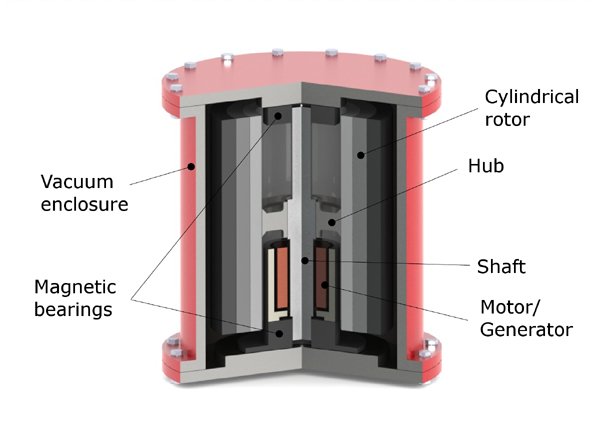
The Shenzen Energy Group of China has developed high-speed flywheels that spin inside tubular-shaped vacuum enclosures, suspended on magnetic levitation bearings and capable of delivering 250kW (kilowatts) of power. Siemens of Mulheim has also developed massive flywheels for application in the power generation sector, to keep electric generating equipment operating at near-zero speed fluctuation. The largest flywheel from Siemens incurs a weight of between 177 and 180 tons. Their 120-ton tube-shaped flywheel is made from special high-strength steel and is able to spin to 3,000 RPM and hold over 1 megawatt-hour of electrical power.
Beacon Power of Tyngsboro, Massachusetts, has developed carbon fiber flywheels capable of spinning up to 16,000 RPM on magnetic bearings, inside vacuum enclosures. Each flywheel can deliver 50kW of continuous power (65-horsepower) for up to 30 minutes duration. The technology is projected to offer 175,000-deep discharge cycles. Based on a modular design, a 1-acre array of Beacon Power flywheels can deliver up to 20 megawatts (26,800-horsepower) over a very short duration, or over 8,300-horsepower for 30 minutes. Based on weight and volume, flywheel technology from Shenzen Energy and from Beacon Power offer potential for short-distance maritime propulsion.
Cost Competitiveness
When repeatedly operated at maximum capacity, lithium-ion batteries typically offer a usable life expectancy of up to 500 deep-discharge cycles. Repeated operation from 100% to 50% discharge extends usable life expectancy to over 2,000 cycles. Competing improved traditional battery technologies that include carbon-foam, lead-carbon, and lead-crystal chemistry that repeatedly operated between 100% to 50% discharge, also offer usable life expectancy of 2,000 cycles and more. In terms of energy storage capacity, lithium-ion has the competitive edge. A battery capable of repeatedly operating at 50kW delivery over a 30-minute duration over a life expectancy of over 100,000 cycles, is very competitive against lithium technology.
A flywheel will offer 50 times to over 80 times the usable life expectancy of improved traditional battery technology. The lithium-ion battery offers the advantage of higher energy storage capacity over improved traditional battery chemistry, with the flywheel being able to offer 15 to 25 times the usable life expectancy. Over the long term that involves many years of service where the flywheel is recharged up to 20 times per day, 7 days per week, carbon fiber flywheel technology becomes cost-competitive against lithium-ion technology in short-haul ferry vessel operation, including involving multiple flywheels per vessel to increase power output.
Ferry Vessel Application
Vessels assigned to commercial ferry service would likely require a bank of multiple carbon fiber flywheels to deliver the required propulsive power. Ideally, the vessels would complete each trip within under 30 minutes. Ferry vessels that undertake trips of 45-minute duration would require additional banks of flywheels that would activate during successive portions of each trip. Internationally, many ferry services involve a trip duration of under 30 minutes, while other ferry trips last for several hours. Flywheel propulsion would be suitable for ferry vessels that sail comparatively short voyages, with flywheels approaching depletion of usable energy upon arrival.
A group of designated flywheels might provide rapid acceleration until a vessel makes the transition onto hydrofoils, when a second array of flywheels would blend in to provide cruising and propel the vessel to the destination port. Based on the performance characteristic of flywheels of two builders, the ferry vessel would need between 20 and 30 minutes of layover at a terminal to recharge the flywheels to maximum energy storage capacity. Installation of flywheel housings would require bearings known as gimbals, to allow for gyroscopic forces to maintain constant rotational axis direction despite vessel pitch and roll motions.
Conclusions
The combination of low weight, high tensile strength, and indirectly high hoop strength makes the carbon fiber flywheel suitable for short-distance ferry vessel propulsion. By comparison, the heavyweight of steel flywheels is only suitable for stationary applications, including at port side to recharge carbon fiber flywheels on board ferry vessels, during layover periods. The low demand for electric power during overnight periods between 11:00 PM and 6:00 AM allows for recharge of port side, electrical energy storage technology at low cost, along with out-of-service ferry vessels during the overnight hours.
The type of port-side electrical energy storage technology intended to recharge ferry vessels would reflect the operation cycle of the ferry vessels. At some locations, there would be massive demand for ferry vessel services during AM and PM rush hour periods, with minimal demand between those periods. Stationary energy storage would need to be suited to rapid recharges during AM and PM peak periods. The projected usable service life of carbon fiber flywheels makes the technology competitive for short-distance ferry vessel operation involving a trip duration of under 30 minutes.
The opinions expressed herein are the author's and not necessarily those of The Maritime Executive.
Nautical Institute and Lloyd’s Register Investigate Impact of Technology
The future of shipping is already here. From autonomous systems to artificial intelligence, maritime technology is transforming how ships are designed, operated and crewed. Despite this wave of innovation, one vital question remains: how do these changes affect the safety and welfare of people working at sea?
In collaboration with Lloyd’s Register Foundation, the Seafarer Technology Engagement, Empowerment and Resilience (STEER) project will harness The Nautical Institute’s extensive international network to explore the real-world impact of the combined introduction of new systems and working practices at sea. While individual technologies undergo rigorous testing, little is known about their collective effect on seafarers’ operational effectiveness, mental and physical health. This project will officially launch a global research and engagement initiative designed to answer that question, act on the findings and drive safer outcomes for those who work at sea.
Captain David Patraiko FNI, Director of Projects at The Nautical Institute, said: “Seafarers are at the heart of shipping, yet their lived experience is often overlooked due to commercial pressures and the rush to innovate. The STEER Project is about listening to those on the front line, their experiences, insights and collective knowledge. Only then we will be able to develop the right tools that the maritime industry can use to make technology work for people and enable better decision-making.”
The Nautical Institute and Lloyd’s Register Foundation share a deep commitment to safety, sustainability and human-centred processes that improve the working environment at sea. Both organisations believe that the benefits of innovation must never come at the expense of those who work on our ships and keep global trade moving.
During this project, The Nautical Institute will listen to the feedback provided from across the maritime spectrum, seafarers, shipowners, equipment manufacturers, regulators and trainers in order to gather real-world insights into how rapid technological change affects safety, skills, welfare and decision-making on board and ashore. The findings will be used to create a practical toolbox, enabling the industry to adopt new technologies in a way that strengthens, rather than undermines, human competence, knowledge and expertise.
Tim Slingsby, Director of Skills and Education at Lloyd’s Register Foundation, said: “Maritime education and training need to evolve quickly to keep pace with the rate of technological innovation, whilst also being aware of the risks of creating skills gaps between seafarers in comparatively wealthy or poorer regions. By leveraging The Nautical Institute’s extensive international network of maritime professionals, and Lloyd’s Register Foundation’s sectoral expertise, the STEER Project will help ensure the seafaring workforce have the capacity, capability and understanding to adopt new and emerging technologies safely and support the equitable transition to a decarbonised and digitalised ocean economy.”
With members in 153 countries and an established reputation for promoting professionalism, best practice, continuous professional development and safety, The Nautical Institute is uniquely positioned to bring the maritime community together for this open exchange of ideas and experiences. Combined with Lloyd’s Register Foundation’s mission to engineer a safer world, this collaboration will ensure the project’s findings reach decision-makers at every level.
By 2028 the project aims to have created the right tools for innovation and seamanship to thrive in a technologically advanced but human-cantered maritime industry.
Magnus Wallhagen, National Hydrographer of Sweden, has been nominated as a candidate for the position of Secretary-General of the International Hydrographic Organization (IHO). The role of Secretary-General is the highest executive position within the IHO, responsible for leading and managing the organization’s global operations. The IHO plays a central role in coordinating international efforts in hydrography and nautical charting, including standardization and harmonization of practices and technologies. This marks the first time a Swedish candidate has been nominated for one of the top positions within the IHO.
“It is a great privilege that Sweden, through the Swedish Maritime Administration, has built such a strong reputation that we can now put forward a candidate for this important position. Sweden’s commitment to innovation and progress in hydrography gives us an excellent foundation to contribute at the highest international level,” says Erik Eklund, Director-General of the Swedish Maritime Administration.
Magnus Wallhagen has held leading roles within the Swedish Maritime Administration’s hydrographic division for nearly 35 years and has long been active within the IHO. Since 2020, he has served as Chair of the Hydrographic Services and Standards Committee (HSSC) — the IHO body responsible for technical development and the creation of international hydrographic standards.
He has played a pivotal role in the development of the S-100 framework, the next-generation digital charting system that underpins modern, dynamic nautical charts — integrating real-time data such as weather, tides, and currents to enhance maritime safety and efficiency.
“Our dedicated work in developing international standards for the future of maritime navigation, combined with our strong engagement in the IHO, clearly demonstrates Sweden’s leadership in this field. We are hopeful that this nomination will take us all the way,” adds Erik Eklund.
Wallhagen’s candidacy is guided by a clear vision: to ensure that the IHO remains a strong, unifying organization that supports all member states in addressing the challenges of the digital transformation of hydrography and e-navigation. His approach emphasizes collaboration, inclusiveness, and responsiveness to the needs of all IHO members.
The election for the position of Secretary-General will take place in April 2026 in Monaco, during the IHO Assembly, where all 103 member states will vote to appoint the new Secretary-General for a six-year term.
The products and services herein described in this press release are not endorsed by The Maritime Executive.
ABS Acquires Maritime Training Firm MetaSHIP from Orka Informatics
In a landmark deal to deliver immersive, next-generation training at scale to the maritime industry, ABS has signed an agreement to purchase the MetaSHIP intellectual property and related vessel simulator software assets from Orka Informatics as part of the strategic growth plan for ABS Training Solutions.
The acquisition, subject to Turkish regulatory approval, will allow ABS to expand its highly realistic digital training program, which can be delivered on board, in port or at home, as well as in a global network of high-tech ABS learning centers in Qatar, Greece and Singapore. The software powers an embedded gaming experience using the industry-leading ABS MetaSHIP Fleet, virtual vessels that allow students to reach true competence without setting foot on board.
“Ultimately, the global maritime workforce must be equipped not only to understand new operating technologies, but to manage the transition itself, navigating hybrid systems, evolving safety standards and dynamic regulatory environments. Investment in advanced training that delivers true competence rather than minimum standards is not optional; it is a strategic imperative for fleet safety and resilience, environmental compliance and global maritime competitiveness,” said Christopher J. Wiernicki, ABS Chairman and CEO.
“ABS is leading the way for our industry by equipping ourselves to deliver critical training at scale and pace, which shipping will certainly need to meet the challenging skills gap. By redefining training with world class tools and immersive techniques, our technology-focused approach allows students to spend many hours studying vessel operations without ever stepping foot on board.”
The ABS MetaSHIP game-based training breaks down the complex tasks required to operate modern ships into highly visual and engaging lessons that equip seafarers with the skills they need in a rapidly evolving maritime landscape. MetaSHIP is a digital maritime universe featuring vessels, ports and waterways, and training and assessment on vessel operations through gamification. The ODENES platform, also included in the acquisition and part of MetaSHIP, tracks training completions and generates reports. Navigational Skill and Behavioral Assessment, another component of MetaSHIP, is a specific simulation used for measuring the performance of maritime personnel, designed to evaluate and enhance the operational skills and behaviors of users.
“MetaSHIP began as an idea to democratize access to maritime training, to make learning as immersive, realistic, and accessible as possible. Seeing it evolve into a technology that will now empower seafarers around the world under ABS’ leadership is incredibly rewarding,” said Levent ?en, Innovator of MetaSHIP.
ABS has appointed Campbell Smith as Senior Vice President of ABS Training Solutions to lead expansion of its pioneering maritime training solutions that harness the potential of immersive courses that can be delivered anywhere.
John McDonald, ABS President and COO, said: “Campbell Smith’s appointment signals ABS’ commitment to delivering training solutions that meet this urgent need. ABS sits at the intersection of regulation, technology and operational safety and is well equipped to support the industry with the tools and insight to operate safely in an increasingly complex environment.”
Smith will be joining ABS in November from Maersk Training where he currently serves as Chief Commercial Officer. He has a resume that includes leadership positions in a series of global maritime operations, building full-curriculum sales academies, devising global sales strategies and delivering organic growth at scale. He holds a master’s degree from INSEAD University in Fontainebleau, France, as well as a bachelor’s degree in marketing and international business and a post-graduate diploma in communications from the Auckland University of Technology, New Zealand.
Leading shipowners and operators are turning to ABS for crew training to enhance operational safety and performance. ABS Training Solutions offers a premium curriculum of targeted training to meet the technical, operational and management needs of the marine and offshore industries.
The products and services herein described in this press release are not endorsed by The Maritime Executive.