Sunday, October 19, 2025

Israel was part of the conspiracy to kill JFK

THERE WAS A CONSPIRACY TO KILL JFK?!


Jim DeBrosse 
8 October 2025
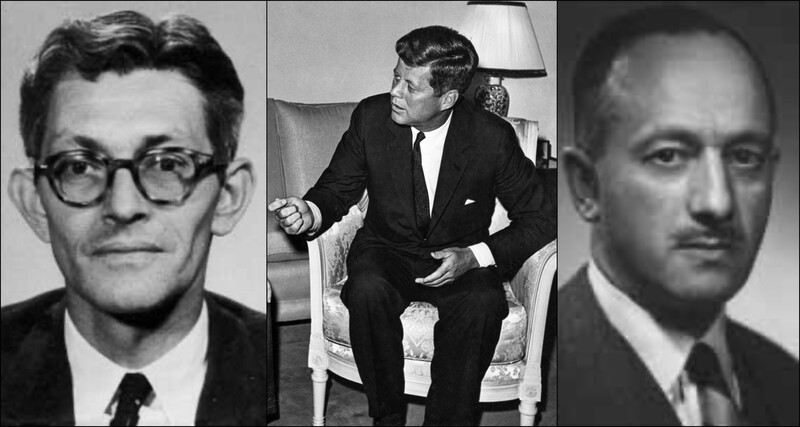


CIA spy chief James Jesus Angleton (left) and Canadian lawyer Louis Bloomfield (right) have both been linked to the plot to kill US President John F. Kennedy. Wikimedia Commons

With America’s leaders eager to supply billions of dollars in weapons to Israel for the genocidal war in Gaza and its world-destabilizing goal of a “Greater Israel,” it’s hard to imagine that an American president ever dared to oppose Israel’s colonialist and military ambitions.

John F. Kennedy was arguably the last US president to seek active restraints on Israel’s dominance of both the Middle East and US foreign policy.

In the early 1960s, Kennedy attempted: to prevent the spread of nuclear weapons into the tinder box of the Middle East by blocking Israel’s development of a bomb; to establish a more balanced US relationship with Arab countries in the region; to return at least some Palestinian refugees to their rightful homes; and to demand that pro-Israel lobbyists in the US register as foreign agents.

Israel’s leaders perceived JFK’s presidency as an existential threat to their fledgling nation. And there is mounting historical evidence that Israel’s intelligence services likely played a key role in financing and covering up JFK’s assassination.

A document released in 2023 from the JFK archive reveals that Reuben Efron, a lieutenant colonel in the US Army and a Jewish immigrant from Lithuania, was reading purported triggerman Lee Harvey Oswald’s private mail years prior to the JFK assassination as part of a closely-held CIA surveillance program.

The program was led by James Jesus Angleton, the agency’s counterterrorism chief and its liaison to the Mossad, Israel’s overseas spy agency. Efron, a Zionist whose mother died in the Holocaust, later emigrated from the US to live in Jerusalem.

JFK assassination documents released in 2025 show that Angleton used Mossad operatives to spy on Cuba following the Bay of Pigs fiasco.
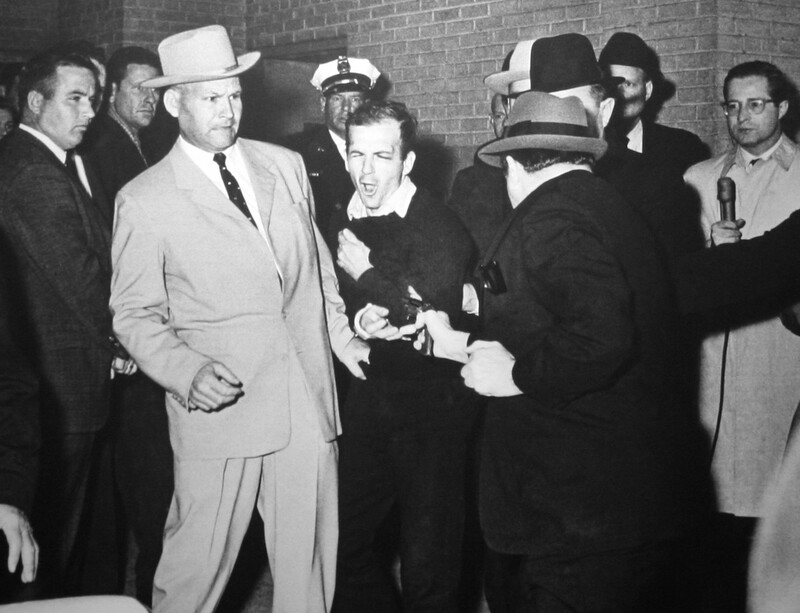


In images that shocked a nation, JFK’s supposed assassin Lee Harvey Oswald was murdered live on TV, ensuring he could never testify to the wider conspiracy. (Wikipedia)

Evidence that Angleton was at the very center of the JFK assassination conspiracy has been compiled by many respected JFK researchers, including former army intelligence analyst John M. Newman and former Washington Post reporter Jefferson Morley, founder and editor of the JFK Facts Substack.

The testimony and interviews of Gerry Patrick Hemming, a mercenary and former CIA asset, provides further evidence of connections between JFK’s assassins and the Zionist-backed, terrorist-financing organization known as CMC-Permindex.

Signs of Israel’s involvement in the Kennedy assassination have been ignored for more than 60 years by a mainstream media that still clings to the lies and omissions of the Warren Report, the official, but widely discredited, US government investigation into the assassination.

Even more shamefully, the vast majority of independent researchers who recognize the Warren Report as a botched attempt at a cover-up have failed to explore the Israeli connection for fear of being marginalized and, of course, labeled anti-Semitic.

For those willing to look at all the facts, there is evidence of a broad conspiracy to assassinate Kennedy, led by rogue elements of the CIA, Israel’s leaders and intelligence officials, the national crime syndicate under the leadership of Zionist gangster Meyer Lansky, and the French underground army of assassins known as the Organisation de l’Armée Secrète (OAS).

There were certainly motives other than the Zionist ones at play in the conspiracy to murder Kennedy. He withheld air support during the infamous “Bay of Pigs” invasion of Cuba in 1961, embittering the defeated anti-Castro rebels. There are also indications, in at least one National Security Action Memo, 263, that JFK wanted to withdraw American troops from Vietnam after his likely reelection in 1964.

And his brother, US Attorney General Robert F. Kennedy, had vowed to crack down on organized crime in America, infuriating many mobsters who believed they were responsible for helping JFK gain the winning edge in the swing states of West Virginia and Illinois against Richard Nixon in 1960. These efforts to combat organized crime in America essentially ended after JFK was murdered.
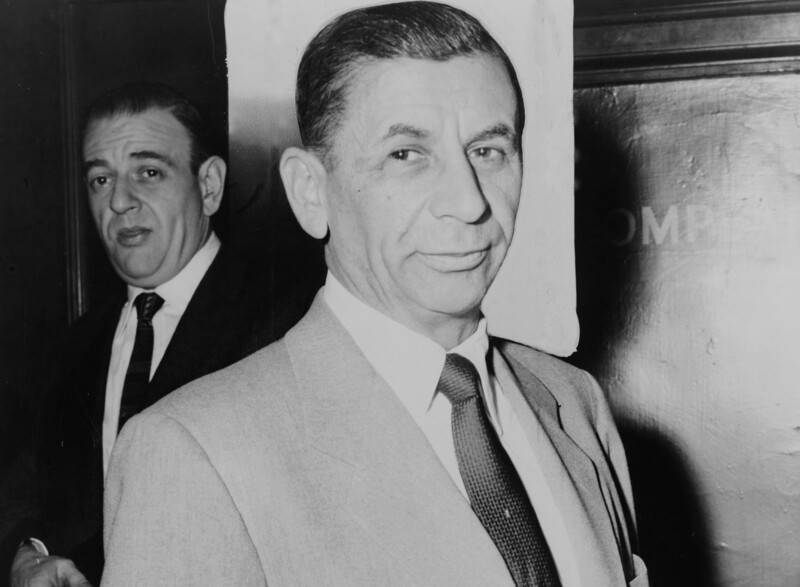


Mob boss Meyer Lansky ran guns into Palestine for Zionist militias in the 1940s. (Wikipedia)

All three of these factors were major sources of dangerous animosity towards the president on the part of right-wing elements, organized crime and the most stridently anti-communist faction in the CIA that most JFK researchers agree ultimately led to the murder of JFK in 1963.

Nonetheless, the Israeli link is the focus of this article in the hope of countering its marginalization by researchers over the decades.

First of all, consider the links between Israel’s Mossad and the OAS, the rebellious secret faction of the French military determined to assassinate French President Charles de Gaulle for overseeing his country’s withdrawal from Algeria. Both the OAS and the Mossad shared a deep hatred and distrust of Arabs.

CIA documents show that French OAS assassin Jean Souetre was present in Dallas on the day of the assassination.

There were also deep connections between Israel and Meyer Lansky, a mob boss at the top of America’s national crime syndicate. Lansky, a Zionist, had run guns to Jewish terrorists in Palestine in 1945 and later in life tried unsuccessfully to emigrate to Israel.

Lansky was connected to two gangsters closely involved in the JFK assassination plot. The first of these was Jack Ruby, who shot and killed Lee Harvey Oswald before the supposed killer of JFK could testify. “I’m just a patsy,” Oswald had famously said after his arrest.

The second was Eugene Hale Brading (aka Jim Braden). An ex-convict with known ties to a group of hitmen, Brading was also a suspected courier for Lansky. He was stopped by Dallas police for suspicious behavior in a Dealey Plaza office building minutes after the JFK assassination. Brading, who used numerous aliases and had a long criminal history, was taken in for questioning but released.
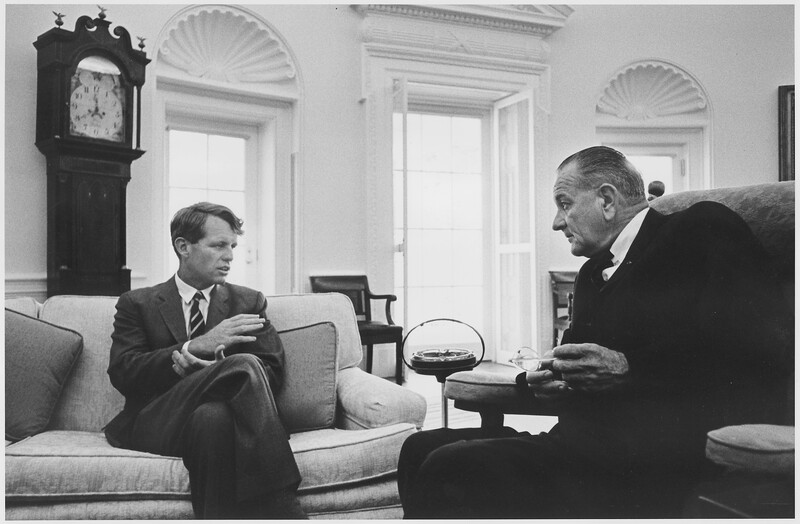


JFK’s attorney general Robert F. Kennedy (left) vowed to crack down on organized crime, yet the CIA was often covertly working hand-in-glove with the mob. (Wikipedia)

On the night Democratic Party presidential candidate Robert F. Kennedy was killed, Brading was once again found in Los Angeles just a mile from the hotel where the younger Kennedy was gunned down. RFK was not only JFK’s brother, but his attorney general.

Brading was later questioned by police, according to JFK researcher Peter Noyes who interviewed the LAPD officer involved. No charges were filed and Brading does not seem to have been arrested.

Ruby – Oswald’s killer – was by no means the small-time pawn of organized crime dismissed by the Warren Commission. By way of the Teamsters Union and the Chicago underworld, he rose to the top of the Dallas area mob. In the early 1950s, Ruby – who used his original surname Rubenstein at the time – befriended Lewis McWillie, the manager of Lansky’s casino operation in Havana. Several months after Castro’s takeover in 1959, Ruby made an unexplained six-day visit to Cuba, where some believe he secured the release of mob boss Santos Trafficante from a Cuban detention camp.

Investigators for the House Select Committee on Assassinations (HSCA), the short-lived 1976 follow-up to the Warren Commission, found that Ruby had made a minimum of 12 phone calls to at least five organized crime figures in the months and weeks leading up to the JFK assassination.

According to the HSCA, seven of those calls were to one individual: Lewis McWillie, of whom FBI records established that he “at least knew Santos Trafficante, the powerful Florida Mafia leader who played a role in the assassination conspiracies against Fidel Castro.”

And shortly before killing Oswald, Ruby had talked on the phone with Al Gruber, a henchman for Lansky’s West Coast operative Mickey Cohen.

Whatever his reasons, Ruby claimed to fear that a backlash against Jews would follow the Kennedy assassination.

In his 1994 autobiography, My Life as a Radical Lawyer, Ruby’s defense attorney William Kunstler wrote that Ruby repeatedly told him that he had killed Oswald “so they wouldn’t implicate Jews.” On Kunstler’s last visit to his jail cell, Ruby handed him a note that stressed again his wish to protect Jews from a pogrom that he feared would follow the nation’s outrage over the assassination of JFK.
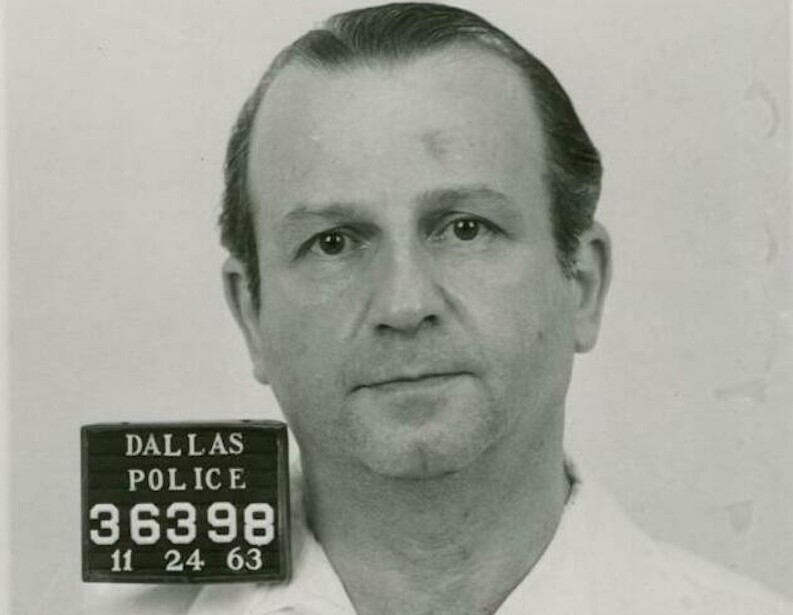


Jack Ruby, the mob operative who assassinated JFK fall guy Lee Harvey Oswald. (Wikipedia)

With a few notable exceptions, JFK researchers cautiously avoid any reference to Jews or Israel in their findings.

In Coup D’états in America, first released in 1975, authors Alan J. Weberman and Michael Canfield quote an FBI informant who was in the process of selling weapons to a Cuban exile group just prior to the JFK assassination. The informant reported that a member of the exile group told him the day before the assassination that “we now have plenty of money — our new backers are the Jews — as soon as they take care of JFK.”

While JFK was trying to stop the introduction of nuclear weapons into the volatile Middle East, the CIA’s Angleton, who had long and close ties to Israel’s Mossad, helped hide Israel’s secret nuclear program from Kennedy.

And according to the HSCA testimony of New York Times reporter Tad Szulc, Angleton even provided US technical assistance and access to the enriched US plutonium that Israel needed to produce its bombs.

Szulc later said that Angleton confirmed most of the story to him, but denied providing enriched plutonium.

Angleton’s role in hiding Israel’s nuclear development from US officials has been documented for decades in articles and books, including Avner Cohen’s Israel and the Bomb (1999) and, most recently, Jefferson Morley’s The Ghost: The Secret Life of CIA Spymaster James Jesus Angleton (2017).

Morley wrote in June that the latest declassified pages of Angleton’s testimony before the Senate in 1975 are so heavily redacted that they neither confirm nor deny Angleton’s involvement in Israel’s nuclear effort. What’s clear, Morley says, is that any public discussion of Israel’s nuclear weapons – which by most international estimates is at least 90 warheads – is still forbidden among Washington officials.
Mossad-CIA

Perhaps even more secretive is the history of the working relationship between the CIA and Mossad.

When the administration of US President Jimmy Carter “abruptly cut back [CIA] intelligence liaison with Israel,” Seymour Hersh wrote in his 1991 book The Samson Option, the Israelis thought that Carter’s men “perhaps did not fully understand how entwined Israel’s primary intelligence agency, Mossad, had become with the CIA during the Cold War.”

Hersh went on to write that “the complex amalgamation of American financing and Israeli operations remains one of the great secrets of the Cold War.”

A month after the JFK assassination, Israel’s nuclear reactor at Dimona went critical.

President Lyndon B. Johnson, an unwavering Zionist sympathizer, reversed Kennedy’s course on the Middle East and established the unquestioning support for Israel that still exists today. Johnson looked the other way as Israel developed its secret nuclear stockpile and began the first shipments of US offensive arms to Israel.

JFK’s opposition to Israel’s nuclear weapons development wasn’t his only threat to Israel’s leaders. It seems that Kennedy believed in the right of return for the 750,000 Palestinians that were expelled by Zionist forces as part of the establishment of Israel in 1948.

Two articles appeared in The New York Times on 21 November 1963 – the day before JFK’s assassination – detailing US efforts at the United Nations to allow Palestinian refugees to return to present-day Israel. They were headlined: “Israel Dissents as UN Group Backs US on Arab Refugees” and “US Stand Angers Israel.”
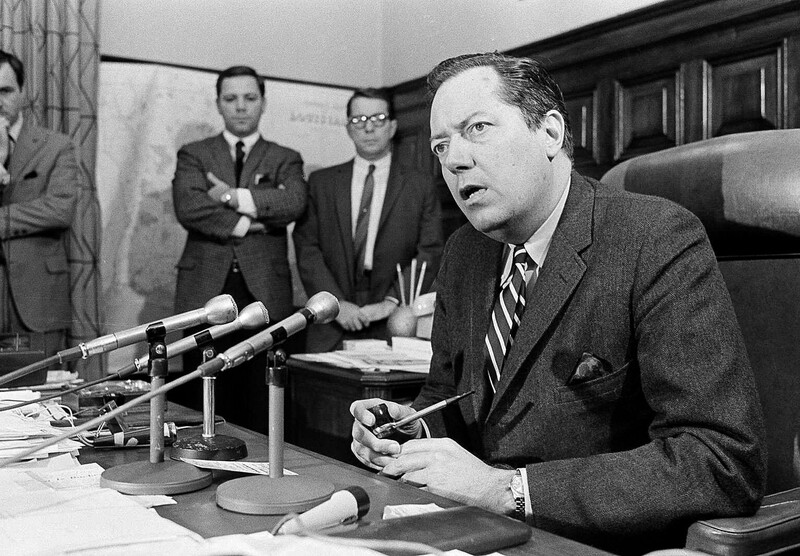
New Orleans District Attorney Jim Garrison at a December 1968 press conference. Garrison charged one of Permindex’s directors with conspiring to murder JFK. Clay Shaw was acquitted, but remains the only person to be brought to trial for the JFK plot. Jack ThornellAP Photo

In addition, in 1962, the Department of Justice, under Attorney General Robert F. Kennedy, argued that the American Zionist Council – a precursor to AIPAC – was being funded by the Jewish Agency for Israel and ordered the council to register as a foreign agent.

That order was quietly dropped in 1966 by the Johnson administration and, in 1967, an American Zionist Council front group was renamed and reorganized as the American Israel Public Affairs Committee (AIPAC) without having to register as a foreign agent.

“Follow the money” has long been an investigative guide for both journalists and lawyers.

New Orleans prosecutor Jim Garrison, the hero of Oliver Stone’s epic conspiracy film JFK, suspected with good reason that the financial source for the Kennedy assassination was the phony international trade promotion group CMC-Permindex.

Basel-based Permindex (short for Permanent Industrial Exposition), and its Rome-based parent company, Centro Mondiale Commerciale (Italian for World Trade Center), was a labyrinthine money laundering scheme for moving tens of millions of dollars in order to finance acts of right-wing espionage. These included everything from political bribes to terrorist bombings and the assassinations of left-leaning leaders.

CMC-Permindex had ties to any number of right-wing international counter-intelligence operatives and their supporters, from ex-Nazis to Zionists. The Italian leftist newspaper Paesa Sera and the Montreal newspaper Le Devoir were the first to report on the workings of CMC-Permindex in articles published in March 1967.

Paesa Sera wrote that the CMC may have been “the creature of the CIA … set up as a cover for the transfer of CIA … funds in Italy for illegal political-espionage activities.”

As well as planning the failed “Generals’ Putsch” of 1961, the Organisation Armée Secrète (OAS) twice tried to assassinate French President Charles de Gaulle. Right-wingers inside the French state wanted to stop de Gaulle withdrawing from France’s colony in Algeria. (Wikipedia)

Both Permindex and CMC were expelled from their respective countries in 1962. The year before, in September 1961, French President Charles de Gaulle had narrowly escaped an attempt on his life using a roadside bomb. Then in 1962, before the expulsions, de Gaulle narrowly survived another assassination attempt when a hit squad sprayed his Citroën with bullets. He escaped unharmed, joking, “they are such bad shots.”

Underground factions of the French army never forgave de Gaulle for withdrawing French troops from Algeria during its war of independence. As they saw it, he was handing over the French colony to Arab rebels, after nearly 26,000 French soldiers had been killed in suppressing the uprising.

The OAS also hated Kennedy for having pressured de Gaulle to leave Algeria.

The far-right OAS included Nazi sympathizers in its ranks and was alleged to be backed by the CIA. After reports in the French press, believed by the French government, that the CIA had been involved in a failed 1961 coup attempt against de Gaulle, the Kennedy administration privately made clear to France that the US president himself had not been involved.

Could the CIA, via CMC-Permindex, have funded the OAS assassination attempts on de Gaulle? It seems possible.

The connection of the trade groups to the OAS might not seem relevant to the JFK assassination until another piece of evidence is added to the puzzle.

Two days after JFK was killed, Jean René Souetre, an assassin for the OAS, was secretly deported from the US. He had spent the morning of the assassination in Fort Worth, where Kennedy had given a speech in front of the Hotel Texas, and the afternoon of that day in Dallas, where Kennedy was assassinated.

JFK researcher Mary Ferrell stumbled upon the supporting classified document among the thousands that were released by the CIA prior to 1977. The photocopied memo was heavily redacted with a magic marker. But by using strong backlighting and a powerful magnifying glass, Ferrell was able to make out its contents. The memo was later released by the CIA under its Historical Review Program.
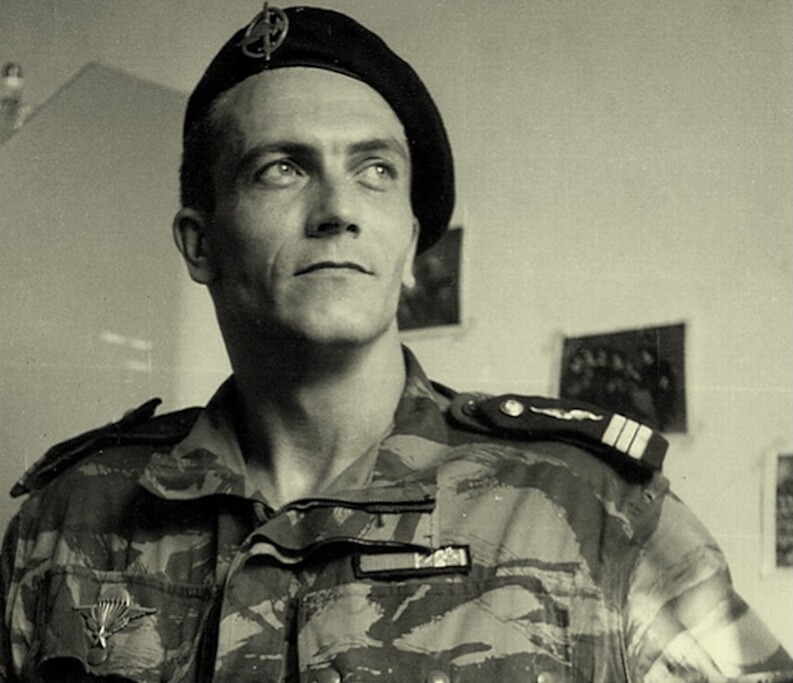


Jean Souetre was a French army captain who joined the Organisation Armée Secrète (OAS), a right-wing covert army which tried to kill President Charles de Gaulle. CIA documents imply that Souetre stalked JFK through Texas on the day of the assassination. (Deltas & Collines)

Neither Souetre’s deportation from Texas nor the existence of the CIA document was ever reported to the Warren Commission. The CIA generated the memo after the French secret service contacted US diplomats with concerns that Souetre was in Mexico, where de Gaulle was planning a visit.

The newspapers in Rome and Montreal noted in their 1967 articles that the board of directors for CMC-Permindex included New Orleans businessman Clay Shaw, who had recently been arrested as part of Garrison’s investigation into the Kennedy assassination.

Also listed on the board between 1967 and 1970 was an intriguing array of politicians, bankers, businessmen, landowners, royals, and Zionists – including Gershon Peres, the brother of Shimon Peres, in later years both prime minister and president of Israel.

As Seymour Hersh detailed in The Samson Option, Shimon Peres played a key role in organizing off-the-books funding for some of the most secret of Israeli projects, including the successful effort to develop the Israeli nuclear bomb itself (which was kept away even from the Israeli cabinet).

The main shareholder for both CMC and Permindex was Major Louis Mortimer Bloomfield, who held half the organization’s shares, or $250 million, “for party or parties unknown,” according to Garrison’s investigation.

Singled out by many JFK researchers as a central figure in the assassination, Bloomfield was a prominent Montreal lawyer who represented the wealthy Bronfman distillery family, raised money for Zionist causes, and at one time had worked for US intelligence.

Channeling the money from CMC-Permindex to the suspected JFK assassins was a convoluted path involving Italian fascists and the infamous Trujillo family of the Dominican Republic.

Michele Metta, an Italian journalist who gained access to the CMC files with the help of Italian intelligence officials, discovered that Valerio Borghese, a fascist who was high up in Mussolini’s government and later saved from prosecution because of his cooperation with the CIA, was in charge of a money-laundering bank called Credicomin with financial ties to CMC.

According to ex-CIA agent Gerry Hemming, 10 billion lire were deposited into Credicomin by Rafael Trujillo Jr., son of the assassinated dictator of the Dominican Republic, just before he left for a February 1963 meeting in Haiti to discuss hiring a team of OAS assassins to kill JFK. Prior to that meeting, Hemming says, the elder Trujillo’s intelligence officer, Arturo Espaillat, had been in Montreal where he had “gathered funds from Canada and Europe” to be sent to the French assassins.
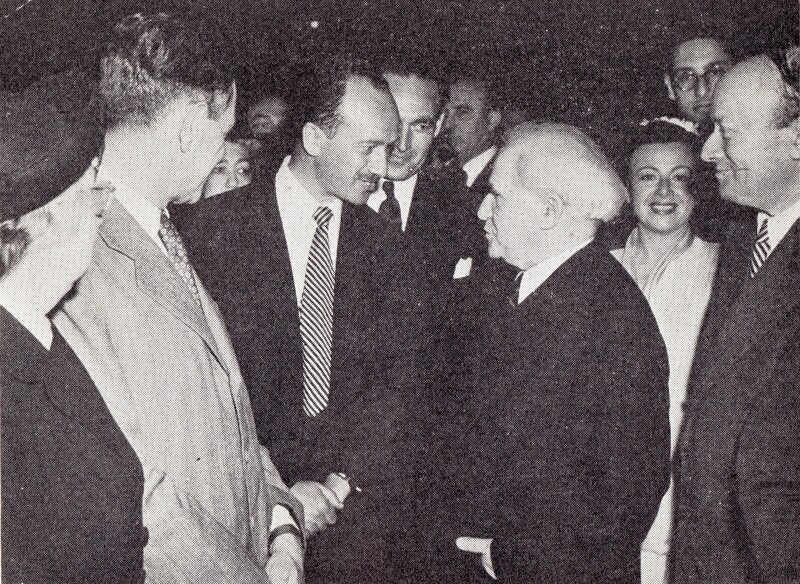


Louis Bloomfield (center, striped tie) and his brother Bernard meeting Israel’s first prime minister David Ben Gurion at a reception in Tel Aviv to mark Israel’s first anniversary in 1949. The photo was printed in Bernard’s now-rare 1950 book, Israel Diary.

Credible JFK researchers now believe that James Jesus Angleton – the CIA’s chief of counterintelligence and the agency’s liaison to Mossad during much of the Cold War – was at the very center of a broad conspiracy to assassinate President Kennedy.

A deeply paranoid anti-communist who shared little of his intelligence with other CIA departments, Angleton had a long list of motives for wanting to rid America of JFK.

Kennedy’s refusal to back the Cuban rebels with air power during the disastrous Bay of Pigs invasion, his vow to dismantle the CIA “into a thousand pieces” after learning how the agency had rushed him into the “Bay of Pigs” invasion of Cuba, his peace overtures to the Soviet Union following the Cuban Missile Crisis, and his opposition to an Israeli nuclear bomb, could all be counted as motives.

Angleton more than any other JFK assassination suspect was in a key position of power and secrecy to coordinate the actions among all those with a motive to kill the president, including elements of the CIA, organized crime, the French OAS and Israel’s Mossad.

Angleton’s ties to organized crime went back to his intelligence work in Italy during World War II as an officer in the OSS, the precursor to the CIA.

After the war, Angleton used Mafia deportees from the US to counter the growing power of the Communists in Sicily. In much the same way, Angleton, along with French intelligence, recruited Corsican gangsters to work against the Communists who threatened to take control of the key Mediterranean French port of Marseille, as documented in Alfred W. McCoy’s 1991 book, The Politics of Heroin: CIA Complicity in the Global Drug Trade.

Angleton’s close relationships with key figures in organized crime included Jay Lovestone of the AFL’s Free Trade Union Committee, who passed on funds from the CIA to the French gangs in Marseille. The Marseille gangs, in turn, worked with the Corsican heroin labs and distributors that crime syndicate boss Meyer Lansky had integrated into the drug-trafficking network known as The Marseille Connection – the mainline of heroin to the United States.

The CIA’s James Jesus Angleton (right) posing with Mossad chief Meir Amit in 1966. (Wikipedia)

Angleton emerged at pivotal moments in the gathering of evidence in the JFK assassination case.

He was the CIA’s liaison to the Warren Commission investigation – effectively the official cover-up. He was the “friend” who visited the home of CIA Mexico City Bureau Chief Winston Scott following his death in 1971 to confiscate cartons of sensitive files, photos and tapes related to Lee Harvey Oswald, according to Jefferson Morley’s research.

Not long after the assassination, Angleton and friend Ben Bradlee, then the Washington bureau chief of Newsweek, likewise broke into the home of JFK’s closest mistress, Mary Pinchot Meyer, to confiscate her sensitive diary.

Meyer had just been murdered under suspicious circumstances while walking along a secluded part of the Georgetown Canal towpath from her art studio. Details can be found in Peter Janney’s 2012 book, Mary’s Mosaic: The CIA Conspiracy to Murder John F. Kennedy, Mary Pinchot Meyer, and Their Vision for World Peace.

Only Angleton had the authority and the access to pull off what JFK researcher Peter Dale Scott calls a two-phase “dialectical cover-up.”

The first phase led US leaders, including President Johnson and FBI Chief J. Edgar Hoover, to initially believe that Oswald had been an agent for Cuba and the Kremlin. The initial phase was designed to generate fear that, if the American public learned this “truth,” it would lead to a nuclear confrontation with the Soviet Union and thus the instant obliteration of tens of millions of people.

But weeks later, when the nation’s leaders realized there was no truth to the Oswald-Soviet connection, they were trapped by their own hastiness inside the second phase of the cover-up – the “lone nut” gunman theory devised by the Warren Commission in 1964 and patched and jerry-rigged over the past 60 years like the wheezing engine of an old jalopy.
“Off limits”

In the epilogue of the 2008 edition of his book, Oswald and the CIA, author and former military intelligence analyst John Newman details how Angleton opened the CIA file on Oswald after he had defected to the Soviet Union, then carefully monitored Oswald’s mail and his political activities before and after he returned to the US. Angleton kept the Oswald file to himself until the day of the assassination when it suddenly emerged like a red flag within the agency.

Yet Newman fails to mention Angleton’s role as liaison to Mossad and his intimate ties to Israeli intelligence officials, whom Angleton had often lunched with at his favorite Washington, DC restaurant. Likewise, in his best-selling 1991 biography of Angleton, Cold Warrior, author Tom Mangold gives short-shrift to Angleton’s partnership with Mossad, writing in a footnote that it was irrelevant to the narrative of his book.

A more telling point, however, may have been made in another of Mangold’s footnotes. There he points out that the CIA’s officially designated historian for the counterintelligence staff, Richard Klise, was told flatly by Angleton in 1968 that the records on the Israeli desk were all “off limits.”

Did Angleton, who was at least complicit in hiding Israel’s nuclear program from JFK and who may have actively aided in its development, partner with Israel in “removing” Kennedy?

Hinting at the answer to that question are documents still under seal by US, Canadian and Israeli officials.

They include not only Angleton’s Mossad files but the heated correspondence between Israeli Prime Minister David Ben Gurion and JFK himself, the personal letters of Permindex chief Louis Bloomfield, and the roughly 3,000 records the CIA still hasn’t released.

Israel’s involvement in the assassination of JFK demands further exploration without demonizing the journalists and historians who venture there as anti-Semites.

With additional research by Asa Winstanley.

Jim DeBrosse, Ph.D., a veteran journalist and retired assistant professor of journalism, is the author of See No Evil: The JFK Assassination and the US Media.
Kamala Harris still blaming Gaza protesters


Michael F. Brown
3 October 2025


Kamala Harris, when she was still vice president, speaking on the presidential campaign trail in October 2024. She frequently faced protesters of the Gaza genocide. Paul Kitagaki Jr.TNS

Nearly two years into the Gaza genocide, the Associated Press is still referring to the Israeli onslaught as a war and recently referred to it as a “war in Israel.” And nearly one year after the 2024 election, defeated Democratic presidential candidate Kamala Harris is still at a loss as to why some Democrats were so upset at the Biden administration’s funding of that genocide.

In an article late last month about Harris’ book tour being met by pro-Palestinian protesters in New York City, AP journalist Steve Peoples asserted, “Few issues have divided the nation – and the Democratic Party – more than the war in Israel.”

Journalists at AP did not respond to my request for a correction. That “war in Israel” language – rather than “genocide in Gaza” or at least “war in Gaza” wording – remains in AP articles published by both PBS and CNN. The journalist did get it right elsewhere in the article with two references to “war in Gaza.”

Regarding the divide in the Democratic Party, a University of Maryland Critical Issues Poll administered in late July and early August found that 49 percent of Democrats “sympathize” more with Palestinians while 6 percent “sympathize” more with Israelis. This is a sea change, but a reality that still isn’t reflected by elected Democratic officials – the “Undemocratic Party” as The Electronic Intifada’s executive director Ali Abunimah termed it on Thursday.

A New York Times and Siena University poll administered in late September found a slightly less dramatic split among Democrats, but still a stark change in sympathies from just two years ago. Now, 54 percent of Democrats say they “sympathize” more with Palestinians while only 13 percent “sympathize” more with Israel.

By contrast, just under two years ago, 34 percent of Democrats sympathized more with Israel while 31 percent indicated they stood more with Palestinians.
According to the University of Maryland poll, 36 percent of Democrats believe Israel’s actions in Gaza constitute genocide, while another 31 percent say those actions are “major war crimes akin to genocide.” An additional 8 percent contend Israel’s actions are “major war crimes but not akin to genocide.”


This is despite scant reporting invoking the term “genocide” by mainstream US media. Social media, moral consistency and common sense are largely responsible for this emerging point of view from grassroots Democrats whose elected officials lag far behind them.

Genocide and MTG

The number of Democrats in the US Congress recognizing the Gaza genocide remains under 10 percent. For Republicans, the number is under 1 percent and represented by Christian nationalist Marjorie Taylor Greene.

In a recent interview with The New York Times, she said, “You can’t unsee dead children.”

She elaborated, “That’s not fake. It’s not war propaganda. They’re not actors. And journalists getting murdered and blown up? I don’t see that happening in any other war, and that’s shocking to me.”

Strikingly, she added, “I spoke to several Christian pastors. They’re saying this is really a genocide, innocent people are being killed. That was easily enough for me.”

If Greene helps get this viewpoint on the Gaza genocide to take root in evangelical churches that have historically been staunch supporters of whatever Israel does, it would be a momentous development. This seems unlikely, but just over a year ago Greene didn’t remotely seem like a candidate to recognize the reality of the Gaza genocide.

Republican Greene’s new position is making her a possible target for AIPAC in the 2026 election, a common experience for the occasional Democrat willing to challenge Israeli occupation policies. AIPAC spokesperson Marshall Wittmann has compared her views to those of Ilhan Omar and Bernie Sanders – on the left of the American political spectrum – while claiming her stance is “completely contrary to those of President [Donald] Trump and her Republican colleagues, who solidly stand with the Jewish state.”

According to The New York Times, Greene isn’t worried.

“It would surprise everyone. This is the Bible Belt – Deep South conservative Christians,” she stated. “They said, ‘Marjorie, we agree with you that it’s a genocide.’”

The University of Maryland poll indicates 6 percent of Republicans regard what is happening in Gaza as genocide and 8 percent see it as “major war crimes akin to genocide.” Yet the figure could be higher in a congressional district where the representative is making the case that it is, in fact, genocide.

Greene’s stance is surprising. As I have noted, I did not anticipate her changing viewpoint because of her long-standing Islamophobia.

But it is a notable development that she has moved this far – last year even recognizing informal Trump adviser Laura Loomer’s racism directed at Vice President Kamala Harris – and is exercising a significant degree of independence from the White House and Republican Party and their support for funding the genocide.

Loomer had claimed that if Harris won the presidential election “the White House will smell like curry and White House speeches will be facilitated via a call center and the American people will only be able to convey their feedback through a customer satisfaction survey at the end of the call that nobody will understand.”


Chartreuse genocide


Harris, nearly a year after her presidential defeat, still doesn’t acknowledge her chartreuse genocide in her new book, 107 Days, about her abbreviated campaign to win back voters, some of whom had fled from President Joe Biden over his incompetence and others who had departed due to his unrelenting embrace of Zionism and genocide.

As even Harris writes: While Biden “could passionately state, ‘I am a Zionist,’ his remarks about innocent Palestinians came off as inadequate and forced.”

But Harris is wrong to think her words came off much better.

In the book, Harris continues to play up her long-time pro-Israel bona fides. She recalls, as The Electronic Intifada has reported previously, her fundraising for the Jewish National Fund, a discriminatory organization contributing to the theft of Palestinian land.

Lest anyone forget, she reminds readers of her long support for Israel. “What I’m not ambivalent about is Israel’s security. As a young girl I carried around a little blue box for the Jewish National Fund, soliciting support to plant trees in Israel.”

She then adds: “I believe Israel was right to respond to the atrocities of October 7. But the ferocity of [Benjamin] Netanyahu’s response, the number of innocent Palestinian women and children killed, and his failure to prioritize the lives of the hostages had weakened Israel’s moral position internationally and created angry dissent within Israel itself.”

In her worldview, Palestinian men are guilty and aren’t worth mentioning among the victims of the Gaza genocide. She speaks of the “angry dissent within Israel,” while failing to understand the disgust then, and now, among grassroots Democrats with the situation in Gaza.

Instead, Harris is still blaming protesters. She writes that at a rally in Detroit, “a noisy group chanted: ‘Kamala, Kamala, you can’t hide. We won’t vote for genocide.’ The threat to withhold their vote got to me. It felt reckless. Either Trump or I would be elected. The issue was not binary, but the outcome of this election certainly was.”

Her comments on what was certainly a low moment for protesters of the Gaza genocide are telling. The Detroit speech was the moment it became clear her heart wasn’t willing to listen to those appalled by the Gaza genocide. Her political instincts didn’t realize or didn’t care that many Muslim, Arab and young voters would not support a candidate unwilling to stand up to the Israeli military’s terrible violence in Gaza.

In fact, she received nearly 6.3 million fewer votes than Biden in 2020.

Harris didn’t grasp the urgency of the moment or the need to take a much stronger stand, one in opposition to Biden’s fervent support for Israeli war crimes over Palestinian freedom.

“You know what?” she asked in Detroit. “If you want Donald Trump to win, then say that. Otherwise, I’m speaking.”

Demonstrating she still doesn’t understand that genocide is a red line, she writes: “Why weren’t they protesting at Trump rallies? I wondered. I wished they would understand that sitting out the election or voting for a third candidate would elect Trump and kill any effort for a just peace, any hope for a two-state solution.”

They weren’t protesting at Trump rallies because he was out of power and it was already known – from recent experience – that he was unlikely to do anything on behalf of Palestinian rights. Protesters held out hope for better from Harris and were rejected.

Her endless invocation of the moribund two-state solution also fails to grapple with the land grabs Israeli settlers have been making in the West Bank, thereby foreclosing on that possible outcome. She certainly doesn’t mention equal rights for all in one state.

Harris self-lauds her handling of Gaza in her convention speech, where no slot was provided to a Palestinian to speak about the horrors the US was funding in Gaza.

“I knew that the section of my speech dealing with the Gaza war had a lot riding on it. As David Von Drehle wrote in The Washington Post, it was ‘the rockiest, most perilous passage: her 5.0-degree-of-difficulty straddle on the war in Gaza. She charged right in and defended Israel, and just as it felt as though the room might split, she affirmed the humanity and suffering of the Palestinians. She then moved into a peroration on the subject that everyone was able to cheer for. And, behold, she had her boat through the impossible strait.’”

An “impossible strait” that said nothing of genocide and her adminstration’s arming of Israel for war crimes and crimes against humanity. That take on the speech surely does not reflect the thinking of Democrats and independents outraged by the Gaza genocide.

One year later, Democratic candidates for elected office still haven’t adequately wrestled with the reality of being a party whose leaders are overwhelmingly willing to fund and arm an apartheid army in Israel for genocide in Gaza and ethnic cleansing in the West Bank.

Mid-term elections are little more than a year away with many elected Democrats remaining out of step with constituents on Gaza.
Israeli extremist group blocks humanitarian aid to Gaza

Group Tsav 9 wants living, dead captives back; Hamas says working to recover remaining bodies of Israeli captives

Abdel Raouf Arnaout and Mohammad Sio 
 |17.10.2025 - TRT/AA
JERUSALEM / ISTANBUL

An Israeli extremist group blocked trucks carrying humanitarian aid to Gaza on Friday at the Kerem Shalom crossing.

The organization, calling itself Tsav 9, had repeatedly disrupted aid deliveries to Gaza during the Israeli genocide before the ceasefire went into effect on Oct. 10.

In a post on the US social media company X, the group said its members were “currently obstructing the passage of aid trucks” at multiple points en route to the crossing, which is controlled by Israel.

The group claimed that “Hamas violates the agreement and refuses to return hostages, so aid that enables them to rebuild must be halted,” adding: “No aid truck will pass until the last dead is returned.”

Contradicting these claims, the Qassam Brigades, the military wing of Hamas, said Wednesday that it is working intensively to recover the remaining bodies of Israeli captives.

The brigades noted that specialized equipment and techniques are required to search under rubble and retrieve the remaining bodies.

The Israeli extremist group posted a video showing its members blocking an aid truck from passing.

Formed during the recent Israeli offensive, Tsav 9 has recently blocked roads leading to crossings, staged protests nearby, and in some cases looted or damaged aid shipments, according to the Times of Israel daily.

Hamas released 20 living Israeli hostages and handed over the remains of 10 more captives in exchange for nearly 2,000 Palestinian prisoners under the ceasefire agreement.

The deal was reached between Israel and Hamas last week, based on a plan presented by US President Donald Trump. Phase one included the release of Israeli hostages in exchange for Palestinian prisoners. The plan also envisages the rebuilding of Gaza and the establishment of a new governing mechanism without Hamas.

Since October 2023, Israeli attacks have killed nearly 68,000 Palestinians in Gaza, most of them women and children, and rendered it largely uninhabitable.
NAKBA 2.0

West Bank Death Toll Amid Genocide Tops 1,000 as Israeli Forces Kill Child


Israeli forces shot and killed fourth grader Mohammad Bahjat Al-Hallaq while he was playing soccer with friends.

October 17, 2025


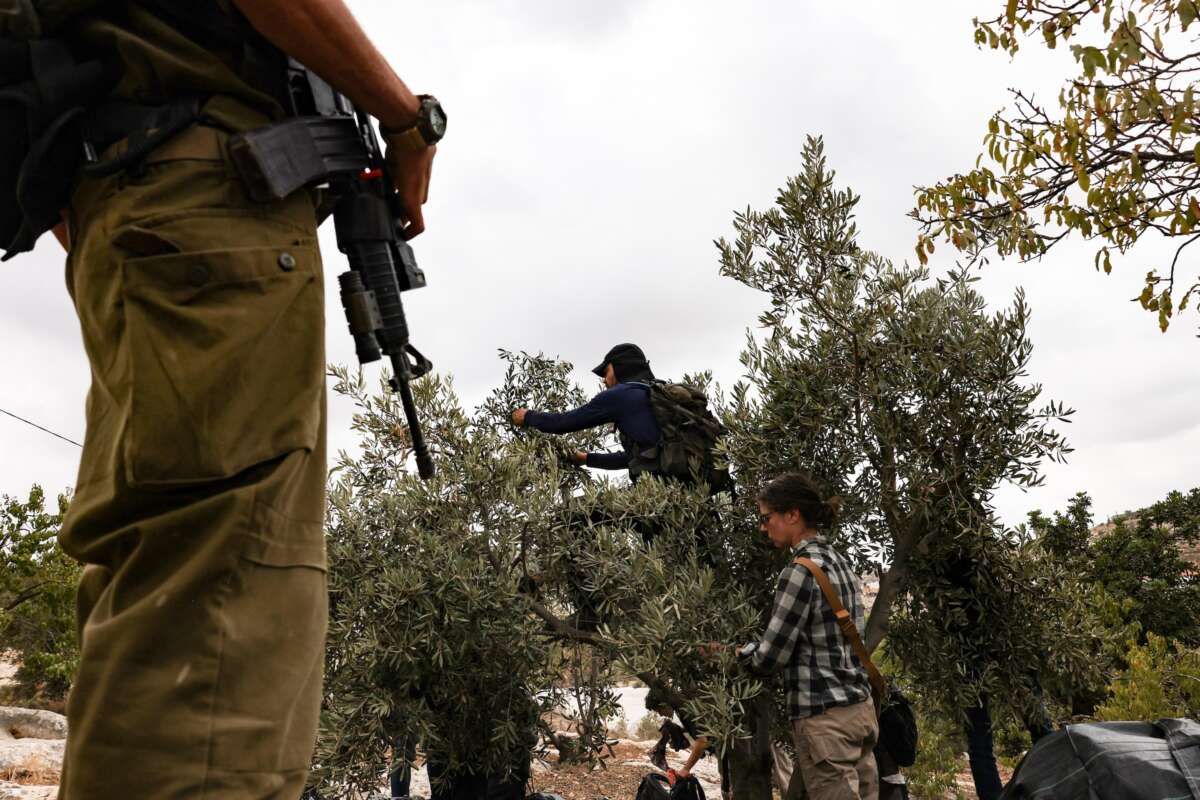
An Israeli soldier watches as activists help villagers to pick olives in the village of Edna, north of the occupied West Bank city of Hebron, during the olive harvesting season, on October 12, 2025.HAZEM BADER / AFP via Getty Images

The number of Palestinians killed by Israeli forces or settlers in the occupied West Bank amid the Gaza genocide has surpassed 1,000, according to the UN, after soldiers killed a young Palestinian child while he was reportedly playing soccer on Thursday.

The UN Human Rights Office in the Occupied Palestinian Territory reported Friday that Israeli forces and settlers have killed 1,001 Palestinians in the West Bank since October 7, 2023. One in every five victims is a child, the office said, with 213 children killed.

This includes the killing of young Mohammad Bahjat Al-Hallaq, who the UN says was just 9 years old, on Thursday. Reports say that Mohammad was playing soccer in a field with friends in Al-Rihiya, south of Hebron, on Thursday evening when Israeli forces opened fire on the group. The children were playing in the field of a girl’s school, according to Palestinian news wire Wafa.

Israeli forces shot Mohammad in the pelvis, and he was transferred to a hospital, where he was later pronounced dead. He was in the fourth grade.

“It’s normal, they were afraid and ran back towards the village,” one parent whose child was a witness told BBC. “There was no threat, no provocation. Nothing.”

Per BBC, Mohammad’s mother told the Ma’an news agency that he “loved birds, and he told me he wanted to be a heart doctor, he used to say this all the time.”

Israeli forces acknowledged the killing, and claimed the children threatened them with “confrontations and rock-hurling.” No Israeli forces were injured.

The death toll reflects the major increase in Israeli violence in the occupied West Bank as Israel has committed genocide in Gaza.

The UN human rights office said that 43 percent of Palestinian death toll in the occupied West Bank in the last 20 years happened in the last two years alone.

“Documentation by the UN Human Rights Office in the Occupied Palestinian Territory attributes this staggering number of killings of Palestinians to the [Israeli military’s] systematic use of lethal force against Palestinians in the vast majority of cases, including live fire, airstrikes, and shoulder-fired missiles, in an unlawful, unnecessary, and disproportionate manner, with evident disregard for Palestinians’ right to life, including children,” the group said in a statement.

Of the 1,001 Palestinians killed in the past two years, 640 were killed with live ammunition, including at least 355 who were shot in the head or upper body, according to the UN office.

The Israeli military was responsible for the vast majority of the death toll. However, the UN office notes that 19 people were killed by Israeli settlers — whose violence is encouraged by Israeli government officials — and that there were an additional 14 killings that could have been committed by either settlers or the military.

This year is on track to be the worst for Israeli settler attacks on record, with settler violence on the rise amid the genocide. In the first 8 months of 2025, the UN recorded 1,069 settler attacks in the occupied West Bank. There were 1,449 attacks recorded in the entirety of 2024, putting 2025 on track for a record high.

The Israeli government has been rapidly expanding settlements amid the genocide. Earlier this year, officials announced a plan for the largest settlement expansion since the signing of the Oslo Accords in 1993, furthering Israel’s “de facto annexation” of the West Bank, rights groups said.

 When Ceasefire Finally Arrived Here in Gaza, What Poured Out of Me Was Grief


Now that the airstrikes have stopped, we face a new devastation, assessing our ruined homes and mourning our loved ones.
October 16, 2025


Palestinians rally around aid trucks which entered from the Karem Abu Salem crossing, in Khan Younis in the southern Gaza Strip, on October 12, 2025.OMAR AL-QATTAA / AFP via Getty Images


Truthout is an indispensable resource for activists, movement leaders and workers everywhere. Please make this work possible with a quick donation.

Ithought that joy would keep me awake after the ceasefire in Gaza was confirmed in the hours before dawn on October 10, but instead, tears did. I opened my phone to check on my people, only to find sorrow spreading everywhere. After two years of endless war, what poured out of many of us was not joy — it was the grief we had buried too long.

There was no true cry of joy around me as there was at the start of the previous 60-day truce in January, which had ended quickly and was followed by the return of war. That painful experience was enough to break our spirits, making the celebration of the current ceasefire muted, cautious, and heavy with grief.

By the time the news of the ceasefire came, the Israeli military had killed 67,806 people in Gaza and left 170,066 more wounded and 9,500 missing. It had erased entire cities, leaving them uninhabitable and destroying every trace of life.

On the morning of October 9, 2025, I woke up in my tent in Khan Younis, the part of southern Gaza that I had fled to on September 23, after my life in the north was stripped of everything human.

Living in that tent, I was trying to hold on to the hope of graduating — finishing what I had started despite it all. I studied through power outages and internet blackouts, inside a tent that barely shielded me from the cold, just to prove to myself that the war hadn’t defeated me yet. It was a daily struggle between the will to live and the feeling of helplessness.

Related Story

In Gaza City, I Have Been Rendered Homeless in My Homeland
After our apartment was bombed, we tried to flee south but failed, returning to our ruined home only to be bombed again. By Dalia Abu Ramadan , Truthout September 24, 2025


I was surprised to hear ongoing airstrikes and shelling in the area I had fled to, despite the news of an imminent ceasefire. The situation was terrifying.

That day, when I heard that Trump planned to announce a ceasefire, I didn’t believe it; he had made that promise many times before.

I was living through a despair I had never known before. I was surprised to hear ongoing airstrikes and shelling in the area I had fled to, despite the news of an imminent ceasefire. The situation was terrifying, especially during the final critical hours of the war, when we all felt unsafe. After enduring two years of conflict, it was difficult to imagine that civilians could still die even amid mentions of a coming ceasefire.

Despair took over, and I went to sleep — until a call from my uncle in northern Gaza woke me at 2 a.m., telling me that Trump had officially announced the success of the first stage of the ceasefire. The rest of my exhausted family woke up; we heard the news, said, “Alhamdulillah” (“thank god”), and went back to sleep. I stayed up crying, unburying my grief.

The ceasefire was officially implemented at 12 p.m. on October 10, 2025. I heard ululations echoing across the camps — cries of relief that the killing had stopped, yet not of true joy. We know that new wars await us — even if we no longer contend with weapons, we now contend with the enormity of our grief and loss.

Those who lost their families would face the devastation of absence — remembering the smallest details of a life that no longer exists. And I, like many others, face another devastation — that of losing my home. My house was destroyed. It wasn’t just walls that fell, but a space filled with safety, laughter, and memories. Now, I carry my home within me, not upon the land.

Wafaa Al-Astal, my father’s cousin’s wife, lost her son Abdullah Haider Al-Astal in an Israeli strike in the al-Mawasi area of Khan Yunis. Israeli authorities had advised residents from northern Gaza to evacuate to that area, claiming it was safe. Yet Abdullah and his friends were targeted there. “I felt the depth of the pain when I heard the war had ended,” Wafaa told me. “My son, who was 21, had been waiting for that day. But as a mother, I still consider myself luckier than those who lost all their children, and have none left.”

Unfortunately, Israeli forces have not fully withdrawn from the Gaza Strip: Israel still controls about 58 percent of the territory. They only withdrew from central Gaza City and the Tel al-Hawa and Al-Rimal neighborhoods, while remaining in parts of northern Gaza such as Beit Lahia, Beit Hanoun, and sections of eastern and western Shujaiya.

After this partial withdrawal, many people returned to the rubble of their homes, trying to assess what remained of their lives. But the ceasefire was only the beginning of another phase of pain.

All of my father’s friends who returned north found their homes completely destroyed. As for us, our house in Tel al-Hawa, a neighborhood in the northern part of Gaza, had already been reduced to ruins during the first month of the war.

Even in the Mawasi area of Khan Younis in southern Gaza, where I was temporarily displaced after the escalation of fighting in the north, I saw many residents returning to Khan Younis City, the center of the governorate, carrying the same sorrow. Among them was my father’s cousin’s son, who went to Khan Younis City — one of the areas from which Israeli forces had withdrawn — only to find that all his property had been completely destroyed.


All of my father’s friends who returned north found their homes completely destroyed.

If the war had ended long ago, joy would have filled every home. But now, the situation is different: nearly every household, north and south, is mourning a family member killed by Israel during this genocide. All of us have lost a part of ourselves; no one has remained unchanged, especially after two years of this brutal extermination war.

Most of us have lost loved ones forever. Many have also lost limbs — hands or feet — and will suffer for the rest of their lives. Around 4,000 children are enduring these injuries.

The world thinks we are “happy” now, but how could we be? My city is dead in every sense: Israel has largely destroyed its homes, hospitals, universities, and schools. Two years of hell have turned our lives upside down. The question now is: when will we reclaim the old Gaza? And will we ever regain the 58 percent of the land that caused so many people to be displaced?

We continue to love Gaza despite its destruction, despite the ruins, despite all that we have lost. People abroad ask me, “Will you emigrate?” I answer, “How could I? I have lived two years of death, refusing to leave!”

We live here, amid the ruins and destruction, trying to get through each day as best we can. Gaza is our soul and our heart, even in the hardest moments. No matter how much the Israeli military tries to destroy us, it cannot break our will or kill our love for this land. We will stay, live, love, and resist!

This article is licensed under Creative Commons (CC BY-NC-ND 4.0), and you are free to share and republish under the terms of the license.


Dalia Abu Ramadan

Dalia Abu Ramadan is a Palestinian storyteller and aspiring graduate of the Islamic University of Gaza, sharing powerful narratives that reflect the strength, resilience, and challenges of life in Gaza.


The West’s Dehumanization Of Arabs Is Completely Unforgivable


These last two years have shown us that Western civilization doesn’t need protection, it needs redemption. It needs to save its soul.


In October 2024, a Lebanese writer named Lina Mounzer wrote, “ask any Arab what the most painful realization of the last year has been and it is this: that we have discovered the extent of our dehumanization to such a degree that it’s impossible to function in the world in the same way.”

I’ve thought about that line a lot over the last year.

I thought about it as Israel hammered Lebanon with at least 20 airstrikes during a supposed “ceasefire”.

I thought about it during the Gaza ceasefire negotiations when the Western political/media class kept calling the Israelis held by Hamas “hostages” while calling the innocent Palestinians held captive by Israel “prisoners”.

I think about it as the IDF continues to murder Palestinian civilians every day during the Gaza “ceasefire” when they are deemed to be traveling into forbidden areas, because Palestinians are so dehumanized that Israel sees bullets as a perfectly legitimate means of directing civilian foot traffic.

I think about it as these daily ceasefire violations and acts of military slaughter barely make a blip in the western news media, while any time anything happens that makes western Jews feel anxious or upset, it dominates headlines for days.

I thought about it while the western political/media class solemnly commemorated the second anniversary of the October 7 attack, even as the daily death toll from the Gaza holocaust ticked along with its victims unnamed and unacknowledged by those same institutions.

I thought about it when all of Western politics and media stopped dead in its tracks and stood transfixed for days on the assassination of Charlie Kirk while ignoring the genocide he had spent the last two years of his life actively manufacturing consent for.

Day after day after day, we see glaring, inexcusable discrepancies between the amount of attention that is given to the violent death of an Arab and the attention that is given to the violent death of an Israeli, a Western Jew, or any Westerner.

These last two years have been a time of unprecedented unmasking in all sorts of ways, but I think that’s the one that’s going to stick with me the most. The way Western civilization came right out into the cold, harsh light to admit, day after day after day, that they don’t truly view Arabs as human beings.

Ours is a profoundly sick society.

One of the main arguments you’ll hear from rightists about why the West needs to support Israel is that Israel is helping to defend the West from the savage Muslim hordes — a sentiment that Israeli pundits and politicians have been all too happy to feed into of late. It’s revealing because it’s just coming right out and saying that slaughtering Muslims is a virtue in and of itself, so anyone who kills Muslims is an ally of the West.

But whenever I come across this argument, all I can think is, why would anyone want to defend the West if this is what it has become?

Even if we pretend that these delusions that Arabs and Islam pose some kind of threat to Western civilization are valid, why would it even matter? This civilization does not deserve to be saved. Not if we’re going to be living like this.

If we’ve become so detached from our own humanity that we can’t even see innocent children as fully human just because they live somewhere else and have a different religion, then we are the monsters. We are the villains. We are everything the craziest Zionist pretends the Arabs are.

These last two years have shown us that Western civilization doesn’t need protection; it needs redemption. It needs to save its soul.

Caitlin Johnstone has a reader-supported Newsletter. All her work is free to bootleg and use in any way, shape or form; republish it, translate it, use it on merchandise; whatever you want. Her work is entirely reader-supported, so if you enjoyed this piece and want to read more you can buy her books. The best way to make sure you see the stuff she publishes is to subscribe to the mailing list on Substack, which will get you an email notification for everything she publishes. All works are co-authored with her husband Tim Foley. Read other articles by Caitlin.
Recognizing Palestinian Statehood Is the Floor. Liberation Must Be the Ceiling.


One by one, nations formally recognized the State of Palestine. But what does that mean with Gaza reduced to rubble?

By Hend Salama Abo Helow
October 18, 2025

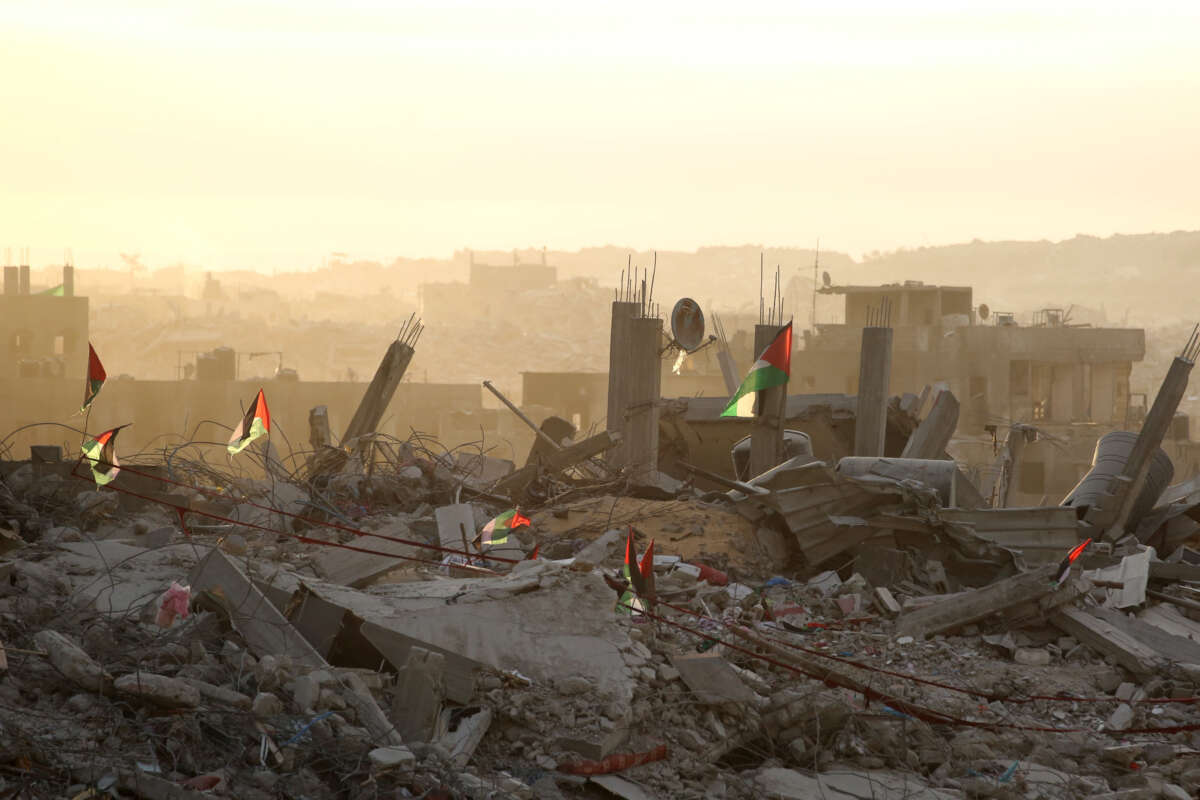
Palestinian flags flutter on top of rubble in Gaza City on October 12, 2025.
BASHAR TALEB / AFP / Getty Images

Since I first opened my eyes to this world as a third-generation refugee, I was taught that the notorious Balfour Declaration had brought upon us this long, unrelenting history of suffering. Issued in 1917, the statement declared the British government’s support for the establishment of a Jewish state in Palestine. It blatantly denied our existence in our own homeland, instead granting the Jewish people the right to establish their nation on land that is ours — under cover of the myth of “a land without a people for a people without a land.” Our homeland, with its people, was then presented on a gilded plate to Zionist militias and, eventually, the state of Israel, both of which wasted no time in massacring and displacing the Indigenous population during the Nakba and beyond.

It’s well known that the Balfour Declaration gave those who did not own the right to cut, divide, and distribute the land to those who did not deserve. Yet, 108 years later, the same country that once endorsed this promise has now recognized the State of Palestine, stressing our right to self-determination on our own land and cautioning against Israel’s expansionist intentions in the West Bank.

Britain was not the first of its ilk to make such a declaration, but it is the one most stained by the Palestinian struggle. One hundred forty-three countries — among them Spain, Ireland, Norway, and Slovenia — have already stepped onto the right side of history. Now, France, Canada, and Australia have followed suit, with others expected to join soon.

These measures might seem like a long-overdue correction — but these gestures are nothing more than ink on paper if they aren’t followed by immediate action to address nations’ legal obligations: fully ending the bloodshed across Palestine, enforcing an arms embargo, breaking Israel’s blockade, dismantling the occupation, severing ties with the oppressor, and elevating the Boycott, Divestment, and Sanctions (BDS) movement.

Even when the ceasefire came into effect, that was far from being the endgame, but a prelude toward achieving Palestinians’ sovereignty over our own land. Ceasefire shouldn’t stall the wheel of advocacy but fuel it.

Related Story

Israeli Forces Bomb, Loot, Vandalize Our Homes in Gaza. We Long for Normal Life.
When a home is destroyed, entire worlds of safety, love, and identity crumble with it.
By Taqwa Ahmed Al-Wawi , Truthout   September 8, 2025


It seems the world only began to see Gaza when it was reduced to ashes.

I cannot deny how crucial this historic turning point is, and I welcome it. Still, it is belated, lukewarm action. It should not have taken 77 years of dispossession, 58 years of occupation, six wars on Gaza, and two years of an ongoing genocide to simply recognize our self-determination. I cannot help but hold a cautious optimism that the world’s so-called “rules-based order” still has a moral compass. But it came at the cost of over 67,000 Palestinian lives — an official count that gravely underrepresents the truth. In reality, it has been projected that hundreds of thousands of people have been killed and far more injured. Ninety percent of Gaza’s residential buildings have been reduced to rubble; more than a million people displaced from their homes. The aggression has targeted not only lives, but also Gaza’s educational, cultural, historical, and social fabric — kidnapping and brutally torturing thousands in Israeli dungeons whose whereabouts remain unknown. This recognition came at the expense of maiming nearly all means of life in Gaza City — a city that had flourished for more than 5,000 years. And yet, it seems the world only began to see Gaza when it was reduced to ashes.

This recognition cannot undo the devastation already wrought, nor soothe the pain that burns in the hearts of those who lost their loved ones, nor reassure the families of Palestinian prisoners. It won’t erase our bleeding memories nor heal our fettering scars. Yet, it may still pave the way toward a better future — one in which Palestinians, just Palestinians, can exercise their unalienable right to self-determination on their own land. These governments’ decision to recognize Palestine is not a spur of the moment idea, nor did it come overnight. I believe it is a groundswell born of the pressure that their nations have exerted on them — citizens who took to the streets, who risked their lives on the frontlines, and who demanded an end to this carnage and to the decades-long occupation.

Still, the amount of time it took to grant this recognition did not come as a surprise to me. It took the world two years of a genocide just to name it a genocide — and even now, some still debate whether it meets the “genocidal criteria” or dismiss the violence done to us as mere exaggeration. Sadly, we have grown accustomed to silence, complicity, both-sides-ism, and even indifference in response to our pleas for ceasefire.


This international recognition may be meant to atone for a historic injustice, but it will remain meaningless unless followed by real action.

In September 2025, the International Association of Genocide Scholars finally declared that what is happening in Gaza is genocide, citing Article II of the 1948 United Nations Convention on the Prevention and Punishment of the Crime of Genocide. Shortly after, the UN Commission of Inquiry released a 72-page report condemning Israel for its genocidal acts in the enclave. Yet now, as Gaza enters its third year bearing the impacts of the genocide inflicted by Israel, I found myself deeply disappointed that such recognition took too long — and deep down I know that turning that recognition into reality will take even longer.

Even the declaration of famine came only after crippling loss, despite abundant proof. It took the deaths of hundreds of people from grinding malnutrition and starvation for the leading global food security initiative to finally classify Gaza as being in the fifth stage of hunger (“catastrophe” or “famine”). This grim belated statement alone debunks the hollow claim that has been regularly parroted by Israeli officials: “There is no famine in Gaza.”

Each advancing step toward acknowledging the broader truth — that Gaza is being annihilated and systematically obliterated — has been long deferred, debated, and doubted, only to arrive far too late to match the depth of the world’s long silence.

Yet finally, the long-awaited, much-needed ceasefire has taken effect. It may not have come with triumphs, nor with a liberated Palestine, but it preserves the soul of Gaza — Gazans themselves, who always will rise to rebuild what the world has allowed to burn.

We remain wholeheartedly grateful to those who stood firm against the genocidal machine — to the nations that made this gesture possible, and to countries like South Africa, one of the leading voices of advocacy for Palestine, which carried an unprecedented judicial case against Israel before the International Court of Justice. Back in 1994, when South Africa was freed from racial domination and a long history of apartheid, Nelson Mandela stated with determination: “Our freedom is incomplete until the freedom of the Palestinians.” This stipulation has not emanated from performative activism or support. It has risen from a joint history of struggle for liberation and sovereignty that both of our peoples have waged.

While our homeland Palestine is still under occupation, it is nonetheless a state — one whose independence was already declared by the Palestinian Liberation Organization back in 1988. Our right to exist and to self-determination is irrefutable. This international recognition may be meant to atone for a historic injustice, but it will remain meaningless unless followed by real action. Still, better late than never.

This article is licensed under Creative Commons (CC BY-NC-ND 4.0), and you are free to share and republish under the terms of the license.


Hend Salama Abo Helow


Hend Salama Abo Helow is a researcher, writer and medical student at Al-Azhar University in Gaza. She is also a writer with We Are Not Numbers and has published in the Washington Report on Middle East Affairs, Institute for Palestinian Studies, Mondoweiss and Al Jazeera. She believes in writing as a form of resistance, a silent witness to atrocities committed against Palestinians, and a way to achieve liberation.
BBC accepts sanction over ‘misleading’ Gaza documentary


By AFP
October 17, 2025


The UK media watchdog Ofcom has sanctioned the BBC over 'unacceptable flaws' in a documentary about the Gaza war - Copyright AFP Susannah Ireland

The UK media watchdog on Friday sanctioned the BBC for a Gaza documentary whose child narrator was later revealed to be the son of Hamas’s former deputy minister of agriculture, branding it “materially misleading”.

The broadcaster earlier this year apologised for “serious flaws” in the making of “Gaza: How To Survive A Warzone” and pulled it from its platform after a backlash.

The broadcaster said it shared the blame for the “unacceptable” flaws with UK production company Hoyo Films.

Ofcom said the programme had been a serious breach of its broadcasting code because of the “potential to erode the very high levels of trust audiences would have expected in a BBC factual programme about the Israel-Gaza war.”

“This is particularly pertinent in the case of a public service broadcaster such as the BBC,” it added.

As a sanction, the BBC will be required to broadcast a statement of the watchdog’s findings at a later date, it said.

The BBC said it accepted Ofcom’s ruling because the documentary, initially broadcast on February 17, had failed to disclose the relationship.

“We have apologised for this and we accept Ofcom’s decision in full,” it said.

“We will comply with the sanction as soon as the date and wording are finalised,” it added.
UK

Palestine Action can challenge ban after government loses appeal


17 October, 2025 
Left Foot Forward


'The court of appeal has rightly rejected Yvette Cooper’s attempt to block a legal review of her absurdly authoritarian ban'


The Court of Appeal has rejected the government’s attempt to stop a judicial review of the Palestine Action terror ban.

The Home Office appealed the review, arguing that Palestine Action could challenge the ban through a lengthy internal “deproscription” process instead.

Lawyers for co-founder of Palestine Action, Huda Ammori, argued that the High Court should review the ban.

Today three judges, led by Lady Chief Justice Sue Carr, dismissed the Home Office’s appeal. They ruled that Ammori could bring her legal challenge.

In her ruling, Baroness Carr said: “An application to deproscribe, with a right of appeal to POAC, was not intended to be a means of challenging the initial decision”.

She added that a judicial review would be a “quicker means of challenging the order proscribing Palestine Action, than applying to deproscribe”.

The court also granted Ammori two additional grounds to challenge the legality of the ban.

A High Court judge will hear the case over three days beginning on 25 November.

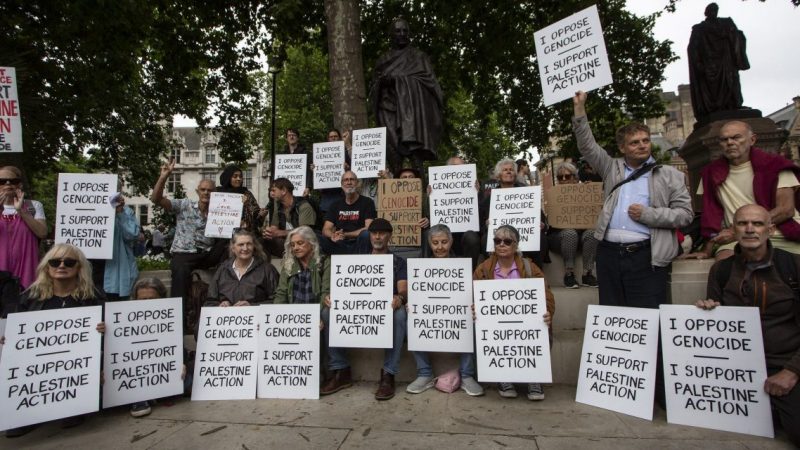
Since the government proscribed Palestine Action on 5 July, more than 2,000 people have been arrested. Most were arrested for holding placards reading: “I oppose genocide, I support Palestine Action.”

A spokesperson for Defend Our Juries said: “Today’s ruling is a landmark victory in the battle to Lift The Ban on Palestine Action. Not only has the government’s attempt to block the Judicial Review been struck down, the claimant has won back two more grounds for appeal, meaning the Judicial Review is more likely to be successful.”

“If the Judicial Review is successful the proscription order would be unlawful since inception and the thousands of subsequent arrests would be deemed unlawful too.”

“Met Police Commissioner Sir Mark Rowley yesterday complained of the ‘big burden’ that the mass arrests resulting from the ban are placing on his Counter Terrorism and public order teams and the Crown Prosecution Service.

“In stark contrast we have seen the people of Gaza subject to two years of genuine terrorism, war crimes, starvation, ethnic cleansing and genocide. Both Conservative and Labour governments aided and abetted these horrors.

“But Labour went further by designating citizens acting to stop the suffering as terrorists, setting a dangerous precedent for the right to protest in this country. The Judicial Review must now start to bring natural justice back into the domestic and international legal system.”

Amnesty International UK and Liberty, who will intervene in the case, said the ruling was “welcome news”, citing “serious human rights concerns” over the proscription and its impact on free speech and assembly rights.

Ammori told The Guardian: “The court of appeal has rightly rejected Yvette Cooper’s attempt to block a legal review of her absurdly authoritarian ban – while granting us additional grounds on which to challenge it.

“The ​government’s effort to avoid judicial scrutiny of its blatantly anti-democratic proscription – branding a protest group as ‘terrorists’ for the first time in British history – has backfired spectacularly, and we now head into the ​judicial review in ​November with an even stronger legal footing.​”

Olivia Barber is a reporter at Left Foot Forward

Trump’s Diplomatic Initiative: A New Dawn or Just Another Dusk?


Prefatory Note: The post below is based on modified responses to questions addressed to me by Rodrigo Craveiro, a Brazilian journalist. The focus is on what to expect in the weeks ahead to follow from the Trump diplomatic offensive to bring an Israeli-crafted peace to fruition in Gaza, and broader stability to the entire Middle East.

  1. There is a sense of joy but also of fury due to the fact that not all the bodies returned to Israel. How do you see this?

Given the overall experience of the past two years, the attention accorded to the hostages by the Western media is misleadingly disproportionate, and as usual, Israel-biased. And now the pain of those Israelis who seek the agreed return of the bodies of non-surviving hostages is an extension of this distortion that shifts global concerns away from the terrible carnage and ccontinuing suffering in Gaza, and the totally ravaged homeland of the Palestinians that is being subject to day after arrangements made by its tormentors without Palestinian participation, much less authentic representation selected by the Palestinian people. Legitimate Palestinian leadership does not presently exist, even if there existed a commitment to identify and endow such individuals with appropriate roles. For sustainable progress toward a just future peace, the Palestinians must participate and be represented by their own choosing. Such a reality can only be decided by the Palestinians themselves, most obviously, in an internationally monitored competitive election among rival claimants to Palestinian leadership throughout Occupied Palestine.

Hamas evidently agreed to return the bodies of dead hostages in their possession. Still, given the difficulty of locating the bodies and collecting the remains, unless there is a genuine repudiation by Hamas of this underlying duty associated with the ceasefire, their goodwill deserves the benefit of the doubt. The disappointment of the families in Israel that suffered from this human loss is understandable, but it should be interpreted in ways that are subordinate to more relevant issues, such as ceasefire violations. It was reported two days after the ceasefire went into effect that Israel killed by gunfire and missiles 7 Palestinians seeking to visit their destroyed home in Gaza City, a disturbing incident which seemed to receive scant, if any, coverage in international media or mainstream international commentary, and yet could be seen as evidence of the fragility of the ceasefire arrangements or an indication that Israel is ready to risk or is even seeking the collapse of the ceasefire by testing its limits. A carefree attitude toward the renewal of the violent encounter that rests on implied, or even secret, assurances of unwavering US support.

  • Trump addressed the Israeli Knesset, where he said his peace plan marks the “historic dawn of a new Middle East.” Do you believe this is something real, or is he exaggerating?

My best guess is that historians looking back at those words will conclude that Trump had confused dawn with dusk. There is no prospect of a brightening of the dark skies casting a shadow on the countries of the Middle East until Palestinian rights are respected, and that includes honoring the international right of return of the seven million Palestinian refugees. There must be a campaign to obtain proper accountability for the Gaza Genocide. Until the costs of Gaza reconstruction are borne by the perpetrators of the devastation, accompanied by some process of reconciliation that does not whitewash the crimes of Israel and its enablers, it will be impossible to create a peaceful future for the region. At the very least, the vast devastation caused by the genocide must be physically overcome by a process of reconstruction funded by adequate reparations. The scope of reconstruction must include health, heritage, and religious sites; educational and cultural institutions; residential neighborhoods; UNRWA facilities; and much more. The most painful losses of loved ones and body parts can never be compensated for by material means and are an enduring negative legacy of the Gaza Genocide. Even recognizing pragmatic constraints on peacemaking given political conditions a ‘peace’ crafted to please the perpetrator of genocide and its most complicit supporter, is highly unlikely to proceed very far. The Trump 20 Point Plan is not a break with the past, but an effort to induce forgetfulness necessary to attain credibility in proposing post-conflict arrangements. To grasp the ironies of this Trump Plan, we should imagine our reactions if the Nazi survivors of World War II had been put in charge of designing the future of the international order, or even of just post-war Germany. It would not have seemed like a step toward a peaceful future, regardless of the language used to obscure the perverse underlying reality.

3- Trump and the three mediating governments signed the peace plan for Gaza at the Sharm el-Sheik Summit. Given this development, what can we expect to happen in the future?

It is almost universally believed that the ceasefire should remain operative even if violations of the underlying plan occur or its further implementation stalls. Beyond this, it is a matter of how much leverage the US exerts to advance the governance proposals in Part II of Trump’s Plan. Whether Hamas and Palestinian resistance forces are subject to being coerced by further threats of Israeli renewal of its genocidal assault is unclear. It is also uncertain if the US would go along with an Israeli unilateral departure from the Trump Plan. Israel is quite capable of fabricating claims that Hamas is violating the ceasefire and related obligations, leaving it no choice but to resume its military operations. It would appear at this time that Trump would allow Israel to exercise such an option. At the same time, Trump is so mercurial and narcissistic that it is possible he would regard Israel’s action as undermining his claims as peacemaker and repudiate the Israeli resumption of large-scale violence in Gaza. In an odd way, Israel and Trump may turn out to have different goals. Israel has not given up its quest for ‘Greater Israel,’ which means absorbing not only East Jerusalem, but Gaza and the West Bank within its sovereign territory. Trump may still strangely believe he can obtain the Nobel Peace Prize if his Plan is operationalized in Gaza and the two conflicting parties accept the arrangements.

Overall, it is clear that peace and stability will not be the future of the Middle East until Israel respects Palestinian rights, drastically redefines or repudiates Zionism and apartheid in a manner consistent with international law, and agrees to the establishment of a Peace & Reconciliation Commission to acknowledge Israel’s past criminal violations of Palestinian rights and to announce a new dedication to the creation of an independent commission that assists the Palestinian/Israeli leadership to build future relations between Jews and Arabs on the basis of equality, dignity, and rights as the foundation for sustainable patterns of peaceful coexistence. For a truly new and stable Middle East, Israel must agree to the establishment of a nuclear-free zone, including itself and Iran.

4- What are the Risks of Clashes between Hamas and Gaza Clans and Factions?

These issues are murky, with contending interpretations and explanations of their recent prominence amid this most ambitious effort to develop the current ceasefire pause into a framework for long-term conflict resolution by implementing, perhaps with modifications, the advanced phases of the Trump 20 Point Plan. In this context, Israel seems to welcome these tensions within Gaza, by various means, including subsidies, to allow them an option to exit from this series of developments that might challenge their annexation plans in the West Bank as well as Gaza. It is possible that the Netanyahu government agreed to the ceasefire only to secure the return of the hostages, and never assented to any wider interference with its militarist approach, and may have had assurances of Trump’s support, no matter what.  If this plays out, Israel would actually welcome the collapse of the conflict-resolution part of the framework in a manner that would find tacit acceptance, if not outright approval, in Washington. Such a manipulation of reality requires pinning the blame on Hamas, which is currently taking the form of criticizing Hamas for seeking to destroy those armed groups in Gaza that collaborated with the Israeli military operations.

Such a line of interpretation is reinforced by Israeli unreasonably shrill complaints about Hamas’ failure to return all of the bodies of the dead hostages. On its part, Hamas claims it has returned all the remains it could discover with its existing equipment, given that some dead hostages remain trapped far beneath the rubble. This seems a reasonable explanation, as Hamas has little incentive to retain the remains of dead Israeli hostages or to take steps that provide an excuse for Israel to resume bombardment and other forms of violence in Gaza.

Such a line of interpretation is also consistent with Israel’s pattern of lethal violence killing Palestinians in several instances that have the clear appearance of being deliberate violations of the ceasefire agreement. Additionally, Israeli interference with the delivery of humanitarian aid by reducing the entry of relief goods by 50% is another expression of Israel’s unwillingness to allow even a conflict-resolving process weighted in its favor to go forward. These are serious provocations by Israel, causing sharp criticism from some governments that had previously endorsed the Trump approach, but not yet even a whimper of disapproval from the US.

The gathering evidence suggests that Israel is accumulating grounds for repudiating the ‘peace’ process and resuming its military operations, accompanied by a renewed clampdown on the further delivery of humanitarian aid, despite widespread hunger, disease, and trauma among the civilian population of Gaza. The next week or so shall determine whether this pessimistic assessment dooms the ceasefire and the prospects for conflict-resolution through diplomacy rather than further recourse to genocide. Israel, since the return of the living hostages in Gaza, holds all the cards, and Hamas has none except for its incredible capacity for resilience.

As yet, there are no signs pointing to a new dawn.

Richard Falk is an international law and international relations scholar who taught at Princeton University for forty years. Since 2002 he has lived in Santa Barbara, California, and taught at the local campus of the University of California in Global and International Studies and since 2005 chaired the Board of the Nuclear Age Peace Foundation. Read other articles by Richard, or visit Richard's website.