Monday, October 20, 2025

China imports no US soybeans in September for first time in seven years

By Ella Cao and Lewis Jackson
Sun, October 19, 2025 
REUTERS


Soybeans in a field on Hodgen Farm in Roachdale, Indiana, U.S. November 8, 2019. REUTERS/Bryan Woolston

BEIJING (Reuters) -China imported no soybeans from the U.S. in September, the first time since November 2018 that shipments fell to zero, while South American shipments surged from a year earlier, as buyers shunned American cargoes during the ongoing trade dispute between the world's two largest economies.

Imports last month from the U.S. fell to zero from 1.7 million metric tons a year earlier, data from China's General Administration of Customs showed on Monday.

Shipments fell because of the high tariffs China has imposed on U.S. imports and as previously harvested U.S. supplies, known as old-crop beans, have already been traded. China is the world's biggest soybean importer.

"This is mainly due to tariffs. In a typical year, some old-crop beans would still enter the market," said Wan Chengzhi, an analyst at Capital Jingdu Futures.

Brazil arrivals last month jumped 29.9% year-on-year to 10.96 million tons, accounting for 85.2% of China's total imports of the oilseed, customs data showed, while shipments from Argentina rose 91.5% to 1.17 million tons, or 9% of the total.

China's soybean imports reached 12.87 million metric tons in September, the second-highest level on record.

China has not purchased any U.S. soybean cargoes from this autumn's harvest. The window for U.S. soybean purchases is rapidly closing as buyers secure shipments through November, largely from Brazil and Argentina, helped by Argentina's brief tax holiday.

Without a breakthrough in trade talks, U.S. farmers could face billions in losses as Chinese crushers continue sourcing from South America. Beijing, however, may also face a potential supply crunch early next year before Brazil's new crops hit the market.

"A soybean supply gap may emerge in China between February and April next year if there's no trade deal in place. Brazil has already shipped a huge volume, and no one knows how much old-crop stock remains," said Johnny Xiang, founder of Beijing-based AgRadar Consulting.

Trade negotiations between Beijing and Washington appear to be regaining momentum after weeks of fresh tariff threats and export controls. U.S. President Donald Trump said on Sunday he believed a soybean deal would be reached.

For the January-September period, China imported 63.7 million tons from Brazil, up 2.4% year-on-year, and 2.9 million tons from Argentina, up 31.8% year-on-year.

Even as Chinese buyers are shunning this year's U.S. harvest, purchases earlier in 2025 mean that year-to-date imports of American beans have totalled 16.8 million tons, up 15.5%, data showed.

(Reporting by Ella Cao and Lewis Jackson; Editing by Christian Schmollinger)
Republicans mostly silent as millions of Americans protest Trump on No Kings day

Edward Helmore
Sat, October 18, 2025
THE GUARDIAN


A demonstrator dressed as a martian from Sesame Street, in Washington DC on Saturday.Photograph: Leah Millis/Reuters


Republican voices were mostly silent as No Kings rallies and marches against Trump administration policies unfurled on Saturday, many in the spirit of a street party that countered the “hate America” depiction advanced by senior members of the party.

Instead of provocation, there were marching bands, huge banners with “we the people” references to the US constitution, and protesters wearing inflatable costumes, particularly frogs, which have emerged as a sign of resistance.

It was the third mass mobilization since Trump’s return to the White House and came against the backdrop of a government shutdown that not only has closed federal programs and services but is testing the core balance of power, as an aggressive executive confronts Congress and the courts in ways that protest organizers warn are a slide toward authoritarianism.

In comments Friday, Donald Trump opposed the protest organizers’ characterization of him as a would-be monarch.

“They say they’re referring to me as a king. I’m not a king,” Trump said in a Fox News interview.

Later Friday, a Trump campaign social media account mocked the protests by posting a computer-generated video of the president clothed like a monarch, wearing a crown and waving from a balcony.

At a White House event on Wednesday, Trump tried to downplay the No Kings events. “I hear very few people [are] going to be there, by the way, but they have their day coming up and they want to have their day in the sun,” he said. Trump is spending the weekend at his Mar-a-Lago home in Florida.

In a counter-programming move, JD Vance and defense secretary Pete Hegseth were attending a live-fire amphibious capabilities demonstration at Camp Pendleton in California to commemorate the US Marine Corps’ 250th birthday.

However, a plan to fire live artillery shells over a nearby highway drew objections from governor Gavin Newsom, who said it forced the California highway patrol to close a portion of a major interstate through southern California for safety reasons.

“The President is putting his ego over responsibility with this disregard for public safety,” the Democratic governor said in a statement. “Firing live rounds over a busy highway isn’t just wrong – it’s dangerous.”

Vance posted a comment on X alluding to a meeting between New York’s Democratic mayoral candidate Zohran Mamdani and Siraj Wahhaj, imam of at-Taqwa, who appeared on a list of un-indicted co-conspirators in the trial of the 1993 bombing of the World Trade Center in New York.

“I’ve been reliably informed that Democrats are opposed to any kind of political violence, so I look forward to them universally condemning Zohran Mamdani for campaigning with an unindicted co-conspirator in a terrorist plot that killed 6 New Yorkers,” Vance wrote.

Fox News, meanwhile, ran a report claiming that organizers embedded in the global intifada to destroy the state of Israel had moved to join the No Kings protests in New York under the organizational groupings of “UAW Labor for Palestine” and “NYC Labor for Palestine”.

The right-leaning outlet also reported on Friday that foundations connected to George Soros were funding the No Kings protests via a $3m grant to the organizer Indivisible “to support the grantee’s social welfare activities”.

The relative silence of Republican leaders on Saturday came in contrast with efforts last week to preview the second No Kings day as a “hate America” day populated by Hamas sympathizers and a reason why Democrats were delaying an agreement to end the government shutdown, now on its 18th day.

Republican leaders disparaged rally-goers as “communists” and “Marxists”, and claimed that centrist Democrats, including the senate minority leader Chuck Schumer, who marched in New York, were being held political hostage by the far left.

“I encourage you to watch – we call it the ‘hate America’ rally – that will happen Saturday,” said the House speaker, Mike Johnson of Louisiana.

“Let’s see who shows up for that,” Johnson added, listing groups including “antifa types”, people who “hate capitalism” and “Marxists in full display”.

Trump vows to keep ‘massive’ tariffs on India until Russian oil imports cease


Reuters 
Published October 20, 2025 

US President Donald Trump reiterated on Sunday that Indian Prime Minister Narendra Modi told him India will stop buying Russian oil, while warning that New Delhi would continue paying “massive” tariffs if it did not do so.

“I spoke with Prime Minister Modi of India, and he said he’s not going to be doing the Russian oil thing,” Trump told reporters aboard Air Force One.

Asked about India’s assertion that it was not aware of any conversation between Modi and Trump, Trump replied: “But if they want to say that, then they’ll just continue to pay massive tariffs, and they don’t want to do that.”

Russian oil has been one of the main irritants for Trump in prolonged trade talks with India — half of his 50 per cent tariffs on Indian goods are in retaliation for those purchases.

The US government has said that petroleum revenue funds Russia’s war in Ukraine.

India has become the biggest buyer of seaborne Russian oil sold at a discount after Western nations shunned purchases and imposed sanctions on Moscow for its 2022 invasion of Ukraine.

Trump on Wednesday said Modi had assured him that day that India would stop its Russian oil purchases.


US President Trump says Indian Prime Minister Modi will halt oil purchases from Russia, calling it a ‘big step’ to isolate Moscow economically. The Indian embassy in Washington has not confirmed whether Modi made this commitment reut.rs/4okhwxt
Trump says Modi has assured him India will not buy Russian oil – News


India’s foreign ministry said it was not aware of any telephone conversation between the leaders that day, but said that New Delhi’s main concern was to “safeguard the interests of the Indian consumer.”

A White House official said on Thursday that India has halved its purchases of Russian oil, but Indian sources said no immediate reduction had been seen.

The sources said Indian refiners already placed orders for November loading, including some slated for December arrival, so any cut may start showing up in December or January import numbers.

India’s imports of Russian oil are set to rise about 20pc this month to 1.9 million barrels per day, according to estimates from commodities data firm Kpler, as Russia ramps up exports after Ukrainian drones hit its refineries.Follow Dawn Business on X, LinkedIn, Instagram and Facebook for insights on business, finance and tech from Pakistan and across the world.

Venture Global in Talks to Supply Ukraine With LNG as Winter Looms

Venture Global LNG (VG.N) has held discussions with Ukraine’s largest private energy company, DTEK, to supply additional cargoes of liquefied natural gas (LNG) from its Plaquemines facility in Louisiana, according to a Reuters report citing three unnamed sources familiar with the matter.

The talks come as Ukraine faces intensifying Russian strikes on its energy infrastructure ahead of the winter heating season. The sustained damage has forced Kyiv to import more natural gas to compensate for falling domestic production, raising concerns over the country’s energy resilience during the cold months.

Two of the sources said the negotiations involve additional LNG volumes from Venture Global’s 27.7 million metric tons per annum (mtpa) Plaquemines LNG terminal, which is currently in its commissioning phase. Ukraine’s DTEK, part of billionaire Rinat Akhmetov’s SCM Group, already signed a deal in 2024 to purchase LNG from Plaquemines, as well as 2 mtpa from Venture Global’s CP2 project, still under construction.

Venture Global’s CEO, Michael Sabel, reportedly joined other U.S. energy executives in a meeting with Ukrainian President Volodymyr Zelenskiy in Washington, D.C., on Thursday. Zelenskiy later posted a video on X emphasizing the importance of power in the region and claiming to have "made proposals to the US regarding gas infrastructure, nuclear power generation, and several other projects."

Neither Venture Global nor DTEK commented on the reported talks.

Venture Global has emerged as the only U.S. LNG operator with spare capacity available for flexible spot market sales, as its Plaquemines facility has yet to begin full commercial operations. During commissioning, the company exported 1.6 million tonnes of LNG in September - roughly 17% of total U.S. LNG shipments that month, according to preliminary data from LSEG.

The company’s practice of prioritizing spot sales while delaying the start of long-term supply contracts has sparked growing scrutiny. Last week, an arbitration tribunal found that Venture Global breached its contractual obligations with BP (BP.L) by failing to declare commercial operations at its Calcasieu Pass terminal in Louisiana on time. The ruling adds pressure to the company as it faces multiple disputes with buyers seeking access to contracted volumes.

Despite the controversy, Venture Global maintains that Plaquemines remains on schedule for full commercial startup, which would trigger the activation of its long-term supply deals at fixed, lower prices.

The potential sale of LNG to Ukraine underscores Washington’s broader effort to support Kyiv’s energy independence and resilience. If finalized, the deal could mark another step in deepening U.S.-Ukraine energy ties amid Europe’s ongoing realignment away from Russian gas.

By Charles Kennedy for Oilprice.com

Ukraine Strike on Orenburg Plant Exposes Kazakhstan’s Gas Reliance on Russia

A Ukrainian drone attack that halted gas processing at Russia’s Orenburg complex has underlined how deeply Kazakhstan’s energy system remains tied to Russian infrastructure. The strike, confirmed by Reuters, forced Gazprom to suspend intake from Kazakhstan’s Karachaganak field, cutting its gas output by roughly a quarter.

The Orenburg plant, one of the largest of its kind, sits at the heart of a cross-border supply chain. Gas extracted in northwest Kazakhstan flows north for processing before returning for domestic use or export. When Orenburg stops, Karachaganak’s condensate and gas production both fall, threatening more than 250,000 barrels per day of oil-equivalent output.

This arrangement gives Moscow structural leverage. By hosting the critical processing capacity and controlling several export pipelines, including the Caspian Pipeline Consortium (CPC) and the Druzhba network, Russia effectively acts as Kazakhstan’s downstream gatekeeper. Officials in Astana have sought to diversify routes toward China and across the Caspian, but the physical dependence on Russian midstream assets persists.

Russia, meanwhile, has been increasing its own gas exports to Uzbekistan through Kazakh territory, planning to boost volumes to more than seven billion cubic metres in 2025. The transit keeps Kazakhstan commercially relevant but reinforces its role as a conduit in Russia’s regional gas strategy.

The latest disruption exposes this mutual vulnerability, with Russia’s network targeted by Ukraine, while Kazakhstan’s production hinges on Russian uptime. Analysts cited by Upstream Online said any prolonged Orenburg shutdown would force Karachaganak’s partners, including Shell, Eni, Chevron, Lukoil and KazMunayGaz, to re-inject or flare excess gas, curbing oil output.

The attack marks the first instance where Ukraine’s energy-war tactics have directly constrained a non-Russian producer, revealing the fragility of Central Asia’s gas interdependence.

The strike also carries diplomatic weight. Kyiv has been courting Central Asian governments through trade and energy dialogue, portraying itself as a counterbalance to Russian dominance. By exposing vulnerabilities in the region’s dependence on Russian transit and processing systems, Ukraine reinforces its narrative that Moscow’s energy leverage can endanger neighbors as much as adversaries. 

By Charles Kennedy for Oilprice.com


Russia Intensifies Attack on Ukraine’s Ports and Railways Hitting Logistics

Ukraine damage from Russian attacks
reports of fires and damage to the ports, railways, and energy infrastructure after Russia's overnight attacks (Ukraine on Telegram)

Published Oct 20, 2025 12:53 PM by The Maritime Executive


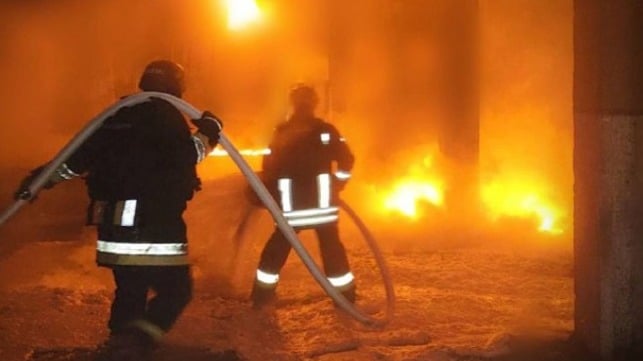
Ukrainian officials are reporting that Russia has intensified its attacks on the country’s logistics network to disrupt the flow of goods. Overnight, Russia targeted the ports' system as well as railway lines and the energy infrastructure with reports that a number of ports are currently not accepting trains.

Ukraine’s Deputy Prime Minister for the Reconstruction, Oleksiy Kuleba reported that port workers were forced into shelters overnight as Russia launched a barrage of drones and several ballistic missiles into the country. He reported that no one was injured but that there were fires and damages to the infrastructure after the attacks.

Railway lines in various parts of the country were damaged interrupting the flow of passengers and goods into the ports. Kuleba said the attacks had come in several waves so that when workers began to make repairs they were forced back into shelters as the Russian drones attacked the areas that were being repaired. He said they had been able to supply replacement diesel locomotives to resume some of the trains.

“Russia is purposefully hitting our transport arteries - because it connects the country, supports the economy, and ensures life,” said Kuleba.


Damage to railway lines stopped some trains from reaching the ports (Kubela on Telegram)


A board member for the railway company echoed similar comments saying that Russia is attacking the main routes and also trying to cut off backup lines. He said they were both disrupting connections to the front lines and into the ports as well as exports.

Electrical and energy facilities were also hit in various parts of the country in the overnight attacks. In more area they reported more than 2,700 customers were without electricity. The energy company described that damage as “very large scale.”

These latest attacks on the logistics infrastructure came as Ukraine has been reporting a decrease in agricultural exports in the 2025-2026 season which began in July. Market analysts reported a small increase last week, but wheat exports are down 21 percent year-over-year. There are similar decreases in the volume of barley, rye, corn, and flour exports.

Kuleba last week however highlighted that over the past two years Ukraine has exported 90 million tons of grain to 55 countries. Ukraine established its sea corridor in 2023 after the collapse of the Black Sea Grain agreement overseen by the UN and Turkey. Exports increased in 2023 and according to Kuleba a total of 150 million tons of cargo and over 6,000 ships have passed through the corridor.

He said that efforts were underway to further expand the safety for port workers with additional shelters. He said with current repairs to the transportation interchange, they expected to increase the throughput capacity by 20 percent.