Monday, October 20, 2025

What’s Driving the Fall in US EV Adoption?

  • The U.S. electric vehicle market is losing momentum as federal tax credits expire and support for zero-emission goals weakens under the Trump administration.

  • EV demand has softened amid affordability concerns, lack of charging infrastructure, and a widening price gap between new and used EVs.

  • While U.S. adoption stalls, China and Europe continue to lead the EV transition, with China accounting for 1.3 million of the 2.1 million global EV sales in September 2025.

In 2017, the CEO of General Motors, Mary Barra, committed the automaker to zero emissions by 2030.

“No more gas. No more diesel. No more carbon emissions,” she wrote at the time.

Following the lead of Barra of GM, Ford announced in 2018 that it planned to nearly triple its investments in electric and hybrid vehicles by 2022, with plans for 40 new such models…

But a series of challenges — cost concerns, sluggish adoption and the reversal in support in Washington — has left the U.S. auto industry with greater uncertainty about its EV future.

“Penetration has stalled,” said David Whiston, a senior analyst at Morningstar investment research company who covers autos. (NBC News)

We saw evidence of the slowdown last week, when General Motors said it will incur a $1.6 billion loss to scale back its electric vehicle (EV) operations, citing weaker expected demand due to recent US policy changes, including the end of federal EV tax credits and loosened emissions rules. (Zero Hedge)

On Sept. 30, the federal EV tax credit expired as part of a broader anti-EV mandate by the Trump administration. The credit started in 2008 and was expanded under the Biden administration. It had been a key driver of EV sales in the US.

In Bécancour, Quebec, the planned expansion of a battery facility was put on hold. The first phase of the project, called Ultium CAM, a partnership between General Motors and Korean steel manufacturer POSCO, is under construction, with the $600 million facility due to open in 2026.

But according to Energy NowA spokesperson for General Motors Canada said Thursday that the company is pausing the second phase of a project to produce cathode active materials for electric-vehicle batteries… The decision was made “in light of evolving market dynamics,” according to spokesperson Marie Binette.

As a result of that decision, Brazilian mining giant Vale SA has scrapped plans for a nickel sulfate plant that would have supplied the second phase of the Ultium CAM project. In a statement, Vale Base Metals said GM “will not need nickel sulfate in Quebec at this time.”

As my Oilprice colleague Irina Slav wrote on Oct. 14, US EV sales surged a record 40% in the third quarter, driven by a rush to buy before the $7,500 federal tax credit expired on Sept. 30.

The push to buy EVs ahead of subsidy expiry followed a dismal second quarter, when new EV sales declined by 6.3% year on year, according to Cox Automotive, which said the growth trajectory for EVs “has been curbed.”

The end of subsidies threatens the EV industry’s profitability, with Ford, GM, and Stellantis all losing money on electric models.

BloombergNEF says 14 million fewer EVs could be sold by 2030 under current policies.

“Demand has grown more slowly than expected, and that’s likely to continue given the elimination of consumer incentives and regulatory changes,” said James Cain, executive director for finance and sales communications at GM, quoted by Rob Wile, a Pulitzer Prize-winning journalist at NBC News.

He notes that even before Trump’s “One Big Beautiful Bill” ended the EV subsidy, signs of EV fatigue among US consumers had begun to show:

A survey published in August 2024 by Edmunds automotive information group showed concerns about finding charging stations and charging times, availability and reliability as the top reasons consumers would not purchase EVs…

Ford CEO Jim Farley said this month that EV sales could fall by around 50% after the EV tax credits expire…

The entire U.S. auto market also remains challenged by affordability issues. The average price of a new car surpassed $50,000 for the first time last month, Kelley Blue Book reported Tuesday…

EVs currently cost about $7,000 more, according to Kelley Blue Book data.

In a recent article, RBC Capital Markets argued the EV slowdown in the US is mainly driven by the wide price gap between new and used EVs, with more buyers incentivized to choose used cars over newer models.

“There's a lot of attention on the culture wars and range anxiety, but what we think is really happening is used EV prices have come down so much that consumers in the U.S. are essentially not buying new EVs,” says Tom Narayan, lead equity analyst for Global Autos, RBC Capital Markets.

Used battery electric vehicles (BEVs) are now priced at around USD$30,000, making them price-equivalent to used internal combustion engine (ICE) cars.

Narayan says US tariffs could force EV makers to raise prices on new vehicles, expanding the gap between the prices of new versus used EVs.

RBC has cut its 2030 forecast for EV adoption in the US in half, from 35 percent to 17 percent, saying that the main constraint is the lack of public charging infrastructure — especially fast Level 3 chargers.

According to consulting firm EY’s September 2025 “EY Mobility Lens Forecaster,” an AI-powered modeling tool developed to predict electric vehicle adoption timelines in the key US, China and EU markets through 2050, via Wards Autothe timeline to reach 50% EV adoption won’t happen now until 2039 — five years later than previously forecast.

The forecasting model found that Elimination of buyer incentives combined with regulatory uncertainty is expected to slow domestic electric vehicle adoption as the technology advances in other global markets.

Indeed, the US EV slowdown has not been duplicated in Europe and China.

While EV penetration forecasts in Europe have dropped from 50 percent to 40 percent, unlike in the United States, regulatory mandates require a certain share of EV sales.

China continues to lead the EV race with a major cost advantage in battery production and market penetration rates two to three times higher than in the US, according to RBC.

In September, global EV sales reached 2.1 million, hitting a monthly record. China alone accounted for 1.3 million sales.

By Andrew Topf for Oilprice.com


How the US Department of Energy Is Controlling Language to Shift Policy

  • The DOE has reportedly instructed employees to avoid terms like “climate change,” “clean energy,” and “decarbonization,” effectively narrowing how policy can be discussed.

  • This move, as in George Orwell’s 1984, will limit the language that can be used in order to drive ideological conformity within the Department of Energy.

  • Controlling language in government communications risks erasing vital environmental discussions and undermining transparent policymaking.

In George Orwell's novel, 1984a totalitarian regime now rules the homeland and operates by three slogans: 1) War is peace, 2) freedom is slavery and 3) ignorance is strength. In 1984, the term "Newspeak" refers to what is essentially a mandatory style guide for using the English language under that regime by substituting Newspeak formulations for common words and phrases so as to make public discourse conform to the ruling party's orthodoxy. (For a list of Newspeak words and phrases, check here.)

Not surprisingly, failure to conform to this style in written and oral communications is considered a crime. In fact, to think thoughts contrary to those expressed in Newspeak terms is considered a "thoughtcrime" because it implies one's personal values are not in harmony with official party dogma. Even having a facial expression that appears to imply disagreement with that dogma is a "facecrime."

Every modern regime tries to regulate the language used by its citizens (or subjects, as the case may be). As I have written previously, "If you want to corrupt a people, corrupt the language." So, it's not particularly surprising that the U.S. Department of Energy (DOE), now controlled by an oil industry insider, has put out its own Newspeak-like manual in the form of an email to department employees, which is focused on subtracting words and phrases according to Politico. In the email, the DOE is doing to the vocabulary of its personnel what the Trump administration is doing to the government, namely, cutting it.

The latest announcement appears to apply to those working for the Office of Energy Efficiency and Renewable Energy and adds to a list that was started some time ago. The list of "words to avoid" now includes the following:

  • clean or dirty energy
  • carbon/CO2 footprint
  • climate change
  • decarbonization
  • emissions
  • energy transition
  • green
  • sustainability/sustainable
  • tax breaks/tax credits/subsidies

Of course, this off-limits list seems ludicrous since all of these topics have been widely discussed in publications that fill library shelves and online repositories of scholarly work, journalism, and policy papers. How could this directive actually enforce the kind of rigorous elimination of ideas and words, á la 1984, which are "misaligned with the Administration’s perspectives and priorities" as the email puts it? Of course, it cannot.

However, DOE employees will henceforth not be allowed to use such words, and that will have definite effects on policy discussions for the simple reason that none of the ideas associated with those words will be contemplated in those discussions.

As social psychologist Eric Fromm explains in an afterword to the edition of 1984 that I have, the goal is not simply to force people to say the opposite of what they think. Fromm writes: "[I]n a successful manipulation of the mind the person is no longer saying the opposite of what he thinks, but he thinks the opposite of what it true."

There is a lot of that going around these days thanks to social media. People often only have discourse with those with whom they agree and agree to facts which they cannot personally verify and which may be the opposite of what they are told. If this were merely a benign process—say, revolving around the best way to make a Bundt cake—we'd have little to worry about. But it involves the very essence of how we will govern ourselves and how we will face a future of increasingly dangerous climate change and resource depletion.

In 1984 the main character, Winston, works for the Ministry of Truth where he helps to rewrite history to conform to the ideological views of the single political party that controls his country. Since the party changes its ideas and policies not infrequently, there are many people like Winston at the ministry rewriting history on a daily basis.

I am reminded of the Great Soviet Encyclopedia. In 1953 following the arrest and execution of Lavrentiy Beria, former head of the interior ministry and secret police, the publishers sent out three pages to owners of the encyclopedia on the topics of the Bering Sea and Bishop Berkeley (an Irish philosopher and clergyman), and asked owners to cut out the three pages which covered the life of Beria and replace them with these new pages.

As the DOE tries to turn the Office of Energy Efficiency and Renewable Energy into a mini ministry of truth, we should remember that forces representing the full spectrum of ideological beliefs are constantly putting out versions of history and versions of the present to advance their goals. Some may be accurate, some may merely be selective—no one can write a history of everything or cover the entire span of current events—and some may be flat-out lies.

One telltale sign that you are reading or listening to something that is not giving you the full story will be the language used. If the vocabulary is limited, repetitive, and/or sounds like sloganeering, you would do well to be skeptical of the writer or speaker. If the language is expansive and nuanced, there's a better chance that what you are reading or listening to will have some value.

By Kurt Cobb via Resource Insights

IRAQ

Kurdistan’s Oil Exports Top 200,000 Bpd amid Fragile New Deal

Crude oil exports from Iraq’s semi-autonomous region of Kurdistan have reached 205,000 barrels per day (bpd), but the oil flows via a pipeline to the Turkish point of Ceyhan could be under threat again.

Oil exports from Iraq’s northern region of Kurdistan via the Iraq-Türkiye Pipeline to Ceyhan resumed on September 27, after two and a half years of halt over disagreements between the federal Iraqi government and the Kurdistan Regional Government (KRG) over how export revenues should be distributed.

Crude from Kurdistan is now steadily flowing at a rate of about 205,000 bpd, according to details on output and exports obtained by the Kurdistan24 news outlet.

Yet, the fragile three-party agreement signed by the federal Iraqi government, the KRG, and most of the foreign firm operating in Kurdistan could unravel, the Kurdish website reports.

The federal government in Baghdad has reportedly failed to adhere to the agreement—it has failed to pay to the international oil companies their contractually obligated financial dues to cover operational costs and investment returns, according to Kurdistan24.

Eight foreign companies operating in Kurdistan have signed agreements with the KRG and the Federal Government of Iraq to enable the restart of international crude exports from the region.

This agreement paved to way to the restart of exports, which were halted for two and a half years, after they were shut in in March 2023 due to a dispute over who should authorize the Kurdish exports.

The federal government in Baghdad and the regional Kurdish government in Erbil squabbled for more than two years over who should be responsible for the oil exports and the subsequent revenue distribution.

Under the agreement to restart oil exports, hailed as historic by Iraq’s federal government, KRG began delivering at the end of September about 190,000 bpd of crude to Iraqi state marketing company SOMO. Kurdistan is also entitled to keep 50,000 bpd to use for local consumption.

By Charles Kennedy for Oilprice.com

UPDATE

Tanker Explosion Off Yemen Deepens Red Sea Security Fears for LPG Trade

A salvage operation is underway after the liquefied petroleum gas (LPG) tanker MV Falcon exploded and caught fire off Yemen’s coast, renewing concern over energy-shipping security in the Red Sea corridor, Reuters reported on Monday. 

The Cameroon-flagged vessel, carrying a full LPG load from Oman’s Sohar port to Djibouti, suffered an onboard explosion over the weekend, approximately 113 nautical miles southeast of Aden. The EU naval mission EUNAVFOR Aspides confirmed the ship’s distress call as crews fought to stabilize the vessel. 

Of the 26 crew members, 24 have been rescued and taken to Djibouti. Two sailors remain missing. The crew included 25 Indians and one Ukrainian officer, AP News reported. The fire continues to burn aboard the drifting ship, which is now being cooled by firefighting teams to prevent detonation of its pressurized cargo. A private contractor is assisting European naval forces in the salvage operation.

Automatic Identification System data reviewed by shipping analysts indicate the Falcon previously called at Iran’s Assaluyeh terminal before loading at Sohar, raising questions about the cargo’s insurance and routing compliance under current sanctions frameworks, gCaptain reported. Initial speculation suggested a projectile or drone strike, but EUNAVFOR’s latest statement said the blast appeared to have been “accidental in nature,” though investigation continues.

The Gulf of Aden is a key artery for LPG and refined-product shipments to Asia and the Middle East. Any prolonged closure or rerouting around the Cape of Good Hope would increase freight costs and voyage times. Insurers have begun reassessing risk premiums for tankers transiting the Bab el-Mandeb, with operators now reviewing whether to delay or divert upcoming energy cargoes through the corridor.

By Charles Kennedy for Oilprice.com


Cleveland-Cliffs eyes rare earths production in the US


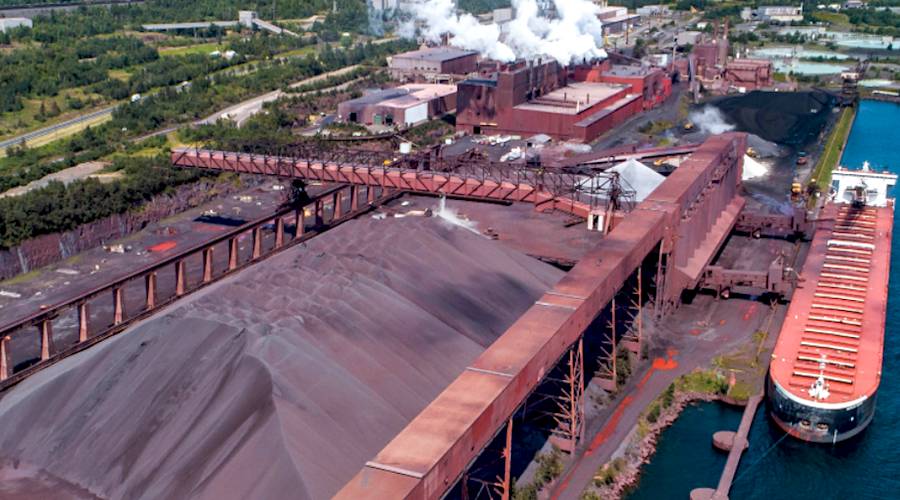
Northshore Mining iron ore operations. (Image courtesy of Cleveland-Cliffs .)

Cleveland-Cliffs (NYSE: CLF) announced plans to enter the rare earth mining business after discovering two potential deposits in Michigan and Minnesota, which would allow the Ohio-based company to expand beyond iron ore and steel.

The move, chief executive Lourenco Goncalves said, could strengthen the United States’ supply of critical minerals essential for electronics and clean energy technologies.

Goncalves said the company is working with geologists to determine whether the deposits are commercially viable. “We are a mining company; this isn’t new territory for us,” he told analysts during the company’s earnings call on Monday.

Cleveland-Cliffs’ shares surged 23% to $16.68 on Monday, the biggest gain since June, after the company also reported stronger-than-expected third-quarter earnings. The rally lifted its market value to about $8.2 billion.

Strategic shift

Goncalves said the new discoveries could “align Cleveland-Cliffs with the broader national strategy for critical material independence, similar to what we achieved in steel.” He added that American manufacturing “shouldn’t rely on China or any foreign nation for essential minerals,” emphasizing the company’s intent to contribute to domestic resource security.

The company’s quarterly revenue rose from a year earlier, and adjusted earnings topped analysts’ forecasts, despite President Donald Trump’s tariffs on foreign steel, which have weighed on Cliffs’ Canadian operations.

Cleveland-Cliffs also signed a memorandum of understanding with an undisclosed steel producer to leverage its “unmatched US footprint and trade-compliant operations”. It did not release further details.

The US currently has only one commercial rare earth mine, owned by MP Materials (NYSE: MP). In July, the Defence Department took an equity stake in MP Materials and agreed to a price floor and an offtake deal. Investors have speculated that Washington may pursue similar arrangements with other domestic companies developing rare earth mines and processing plants.


Trump signs agreement on critical minerals with Australia


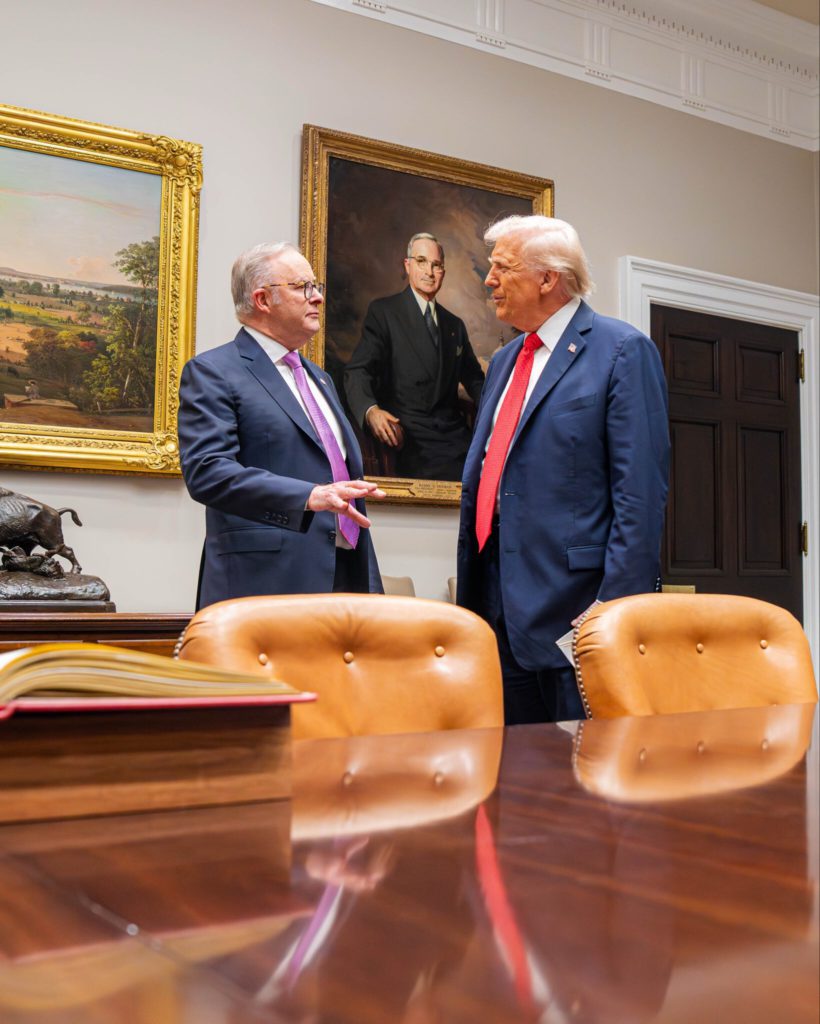
President Donald J. Trump welcomes the Prime Minister of Australia, Anthony Albanese to the White House. Credit: Anthony Albanese’s official X account

President Donald Trump signed an agreement with visiting Australian Prime Minister Anthony Albanese to boost access to critical minerals and rare earths, as the US looks to reduce reliance on Chinese supplies.

“In about a year from now, we’ll have so much critical mineral and rare earths that you won’t know what to do with them,” Trump said Monday at the White House during a meeting between the two leaders.

Albanese said the deal represented an $8.5 billion “pipeline that we have ready to go.” He hailed the minerals and rare earths pact as taking the nations’ economic and defense cooperation “to the next level.”

The leaders said the agreement would include Australian processing of rare earths, with Albanese adding that Australia had “capacity” to expand those efforts. The US and Australia pledged to protect their domestic markets from “unfair trade practices,” including through adopting trading standards that involve “price floors or similar measures,” according to the text of the deal circulated by Albanese’s office.

The deal will begin with the US and Australia each paying more than $1 billion over the next six months for initial projects, with some further projects in both countries and one development to include Japan, the Australian prime minister said. The document did not include details on which entities would provide that financing.

The Pentagon will help fund the construction of a 100 metric ton-per-year advanced gallium refinery in Western Australia as part of the deal, according to the White House. The Export-Import Bank of the United States is also issuing letters of interest for more than $2.2 billion in financing on critical mineral projects.

The sitdown, Albanese’s first White House visit since Trump retook power, comes as the Australian leader looks to shore up ties with the US, using his nation’s wealth in critical minerals as leverage. China’s move to impose unprecedented export restrictions on rare earths has rattled economies across the globe, with US Treasury Secretary Scott Bessent saying last week that allies — including Australia — are in talks about a united response.

Australia, which holds the world’s fourth-largest deposits of rare earths, has sough to position itself as a viable alternative to China for supplies crucial for industries covering semiconductors, defense technology, renewable energy and other sectors. The country is also the base of the only producer of so-called heavy rare earths outside China through Lynas Rare Earths Ltd.

Efforts to secure a deal were underway ahead of Albanese’s visit. More than a dozen Australian mining firms held meetings last month in Washington with officials from various agencies and were told the US was looking for ways to obtain equity-like stakes in companies, according to people familiar with the talks, part of a broader American strategy to develop supply chains to compete with China.

Australian Treasurer Jim Chalmers met with US investors from firms including Blackstone Inc. and Blue Owl Capital in New York last week to pitch his country as a stable, resource-rich destination for global capital and a key partner in efforts to diversify critical supply chains.

There has been growing confidence that Australia and the US would begin discussions on how Canberra could provide secure rare earth shipments and bolster US capabilities. That belief has sparked investor enthusiasm, sending shares of miners such as Lynas up by over 150% during the past 12 months.

Submarine sales

Trump on Monday said the two leaders were discussing “trade, submarines, lots of other military equipment,” with national security matters high on the agenda. The US president has pressed Canberra to increase defense spending to 3.5% of gross domestic product from around 2% now, a move Australia has so far resisted.

Australia agreed to purchase $1.2 billion in underwater drones and take delivery of a first tranche of Apache helicopters in a separate $2.6 billion deal, the White House said.

Another key issue is an arrangement for the US under the Aukus pact to sell Australia as many as five nuclear-powered Virginia-class submarines by the early 2030s. Australia and the UK would then design and build a next-generation submarine partly using American technology, due to be completed in the 2040s.

The Aukus agreement was signed by former President Joe Biden’s team in 2021 to counter Chinese military expansion in the Indo-Pacific region. The submarine deal is central to the nations’ collective security agreement. The Trump administration, however, is reviewing the pact to determine if it is “aligned with the President’s America First agenda,” according to the Pentagon, raising fears that Trump could abandon it.

Officials from Australia and the UK, though, have downplayed that prospect. And Trump on Monday suggested that he planned to push forward with submarine sales.

“We are doing that,” Trump said in response to a question about expediting the sales. “We have the best submarines in the world, anywhere in the world, and we’re building a few more, currently under construction. And now we’re starting, we have it all set with Anthony.”

The US president also praised military cooperation between the two allies.

Still, Trump suggested he was unlikely to offer Australia tariff relief, which Canberra has sought as a nation that runs a trade deficit with the US. Trump hit Australian goods with a 10% duty, the baseline the president imposed on many other countres’ products.

“Australia pays very low tariffs — very, very low tariffs,” Trump said.

Albanese faces a balancing act on trade as he meets Trump. The Australian leader has also sought closer trade ties with China, his country’s largest trading partner. Albanese visited Beijing in July, his second visit since taking office.

(By Lauren Dezenski and Hadriana Lowenkron)

EIB seeking critical minerals investments in Australia, exec says

EIB Group’s headquarters in Luxembourg. Credit: Caroline Martin – European Investment Bank, under licence CC BY-SA 3.0 IGO.

The European Investment Bank (EIB) is seeking critical minerals investments in Australia and will look to partner with Australian companies in Europe, Vice President Nicola Beer said on Tuesday.

“We are capable to take risk … we use our capital very efficiently to go for the right projects,” Beer said at a mining conference in Sydney.

(By Melanie Burton; Editing by Tom Hogue)

Minespider, Rare Earth Ventures partner to bring traceability to Australian minerals supply chain

Adobe Stock image

Minespider and critical minerals broker Rare Earth Ventures (REV) have entered into a strategic partnership aimed at bringing traceability to rare earth and other mineral supply chains in Australia.

Traceability is increasingly becoming a prerequisite for investment and market access, ensuring that mining projects can demonstrate responsible sourcing and ESG performance to global buyers. For this purpose, Minespider has developed a digital product passport (DPP) platform for reliably tracking supply chain data.

Australia represents one of the world’s most important markets – the fourth largest globally – for rare earths, and also holds significant deposits of lithium, graphite, cobalt, nickel, manganese and other critical minerals.

Founded in 2023, REV plays a strategic role in this landscape by facilitating foreign investment and development in the rare earth and critical minerals industries. As a trusted intermediary, REV connects mining projects with international investors, offtakers and strategic buyers, ensuring every deal is compliant, transparent and ESG-aligned.

This strategic partnership will enable REV to implement one of the most innovative traceability solutions on the market – proving that mineral supply chains are transparent, secure and ESG-compliant – while providing Minespider with access to Australian projects.

Through this collaboration, the two companies will deploy DPPs that embed transparent, verifiable data into raw material supply chains. Their joint efforts aim to strengthen the integrity and compliance of mining and industrial operations, ease access to foreign investment, and accelerate the development of critical mining projects.

“Traceability and transparency are no longer optional – they’re the foundation for gaining market access and investment. Through our partnership with Rare Earth Ventures, we’re helping Australian mines prove their ESG performance and unlock global opportunities,” Nathan Williams, founder and CEO of Minespider, stated in a press release.

“At REV, we see traceability as fundamental to building investor confidence in critical mineral supply chains. Partnering exclusively with Minespider allows us to deliver secure, transparent and ESG-aligned solutions to our clients worldwide,” said Theresa Schmidt, director at REV.

Earlier this year, Minespider formed another strategic partnership with Tethys: Trans-Eurasian Gateway, an investment consultancy firm focused on Turkey and Central Asian mining projects. Like the collaboration with REV, this partnership was designed to facilitate capital inflows into mining projects while embedding transparency and traceability into supply chains.

Currently, companies such as Tata Elxsi, Ford Otosan, Renault, PTL, Minsur, Luna Smelter and TEMSA are all using Minespider’s technology to drive the shift toward a sustainable future.