‘A White Nationalist List’: Trump Expands Travel Ban to 39 Nations, Palestinian Authority
“This administration’s racist cruelty knows no limits, expanding their travel ban to include even more African and Muslim-majority countries, even Palestinians fleeing a genocide,” said Rep. Rashida Tlaib.
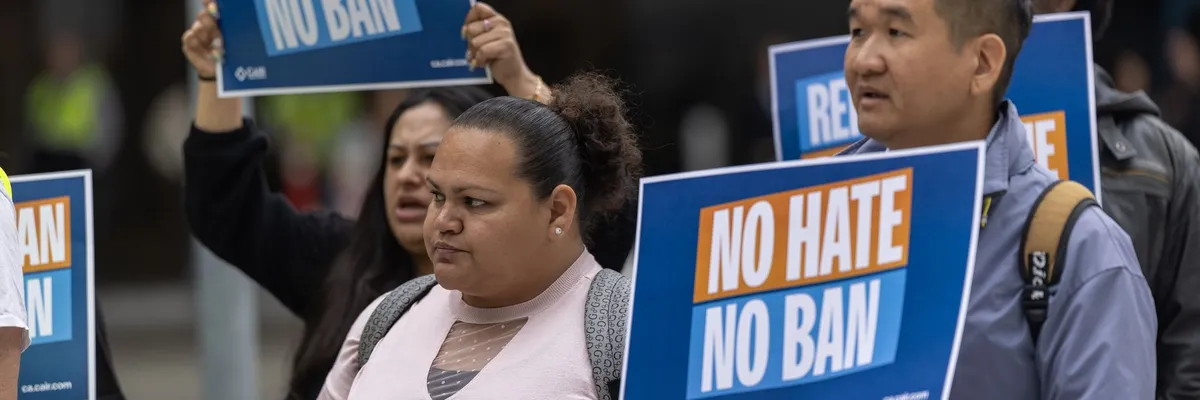
People protest against the Trump administration’s travel ban at California’s Los Angeles International Airport on June 9, 2025.
(Photo by David McNew/Getty Images)
Jessica Corbett
Dec 16, 2025
COMMON DREAMS
President Donald Trump faced sharp criticism on Tuesday after further expanding his travel ban—an effort the US leader launched during his first term, reinstated upon returning to office in January, and previously ramped up in June.
The Republican’s new proclamation maintains full restrictions for people from Afghanistan, Burma, Chad, the Republic of the Congo, Equatorial Guinea, Eritrea, Haiti, Iran, Libya, Somalia, Sudan, and Yemen, and introduces them for travelers from Laos and Sierra Leone, who previously faced partial limitations.
Trump also added Burkina Faso, Mali, Niger, South Sudan, and Syria to that list, just days after he vowed to “retaliate” for an Islamic State gunman killing three Americans, including two service members, and wounding three others in Syria. Journalist James Stout warned that “expanding the travel ban to Syria leaves few options for the people who fought and defeated the Islamic State and are being increasingly threatened by the Syrian state.”
While the US government does not recognize Palestine as a state—and has backed Israel’s genocidal assault on the Gaza Strip—the president also imposed full restrictions on individuals holding travel documents issued by the Palestinian Authority.
“The harm isn’t theoretical,” stressed Etan Nechin, a New York-based reporter for the Israeli newspaper Haaretz. Pointing to Palestinian peace activist Awdah Hathaleen, who earlier this year was denied entry at San Francisco International Airport, deported, and then murdered by an Israeli settler in the West Bank, the journalist suggested that Trump and his allies know the consequences of the travel ban, and “they don’t care.”
As Common Dreams reported earlier Tuesday, Sudan, Palestine, and South Sudan topped the International Rescue Committee’s annual humanitarian crisis forecast.
Trump’s latest proclamation continues partial restrictions for Burundi, Cuba, Togo, and Venezuela, and adds such limitations for Angola, Antigua and Barbuda, Benin, Cote d’Ivoire, Dominica, Gabon, Gambia, Malawi, Mauritania, Nigeria, Senegal, Tanzania, Tonga, Zambia, and Zimbabwe.
It also lifts a ban on nonimmigrant visas for people from Turkmenistan but maintains the suspension of entry for them as immigrants, with a White House fact sheet stating the country “has engaged productively with the United States and demonstrated significant progress.”
Writer Mark Chadbourn said, “It’s a white nationalist list—mainly Africa, some Middle East, plus Haiti and Cuba.”
US Rep. Rashida Tlaib (D-Mich.), the only Palestinian American in Congress, said that “this administration’s racist cruelty knows no limits, expanding their travel ban to include even more African and Muslim-majority countries, even Palestinians fleeing a genocide.”
Tlaib also accused the president, along with his deputy chief of staff for policy and homeland security adviser, of wanting the United States to resemble a Ku Klux Klan event, declaring that “Trump and Stephen Miller won’t be satisfied until our country has the demographics of a klan rally.”
As the Associated Press noted:
The administration suggested it would expand the restrictions after the arrest of an Afghan national suspect in the shooting of two National Guard troops over Thanksgiving weekend...
The Afghan man accused of shooting the two National Guard troops near the White House has pleaded not guilty to murder and assault charges. In the aftermath of that incident, the administration announced a flurry of immigration restrictions, including further restrictions on people from those initial 19 countries who were already in the US.
Laurie Ball Cooper, vice president of US Legal Programs at the International Refugee Assistance Project, said in a statement that “IRAP condemns the Trump administration’s escalating crackdown on immigrants from Muslim-majority and nonwhite countries. This expanded ban is not about national security but instead is another shameful attempt to demonize people simply for where they are from.”
“Subjecting more people to this policy is especially harmful given the administration’s recent invocation of the travel ban to prevent immigrants already living in the United States from accessing basic immigration benefits, including pulling them out of line at citizenship ceremonies,” she continued.
“The expanded proclamation notably includes Palestinians and eliminates some exceptions to the original ban,” she added. “This racist and xenophobic ban will keep families apart, but we are prepared to defend our clients, their communities, and the American values of welcome, justice, and dignity for all.”
Right-wing think tank rocked by more defections over failure to 'confront harmful ideas'RAW STORY

The Heritage Foundation's logo is displayed during the 2025 Joseph Story Distinguished Lecture in Washington, D.C., U.S., October 22, 2025. REUTERS/Kylie Cooper
Two high-profile members of the conservative Heritage Foundation's governing board recently resigned over the think tank's support for right-wing provocateur Tucker Carlson, according to a new report.
Abby Spencer Moffat and Shane McCullar resigned from the governing board, The New York Times reported on Tuesday. Their resignations followed Robert P. George, a professor at Princeton University, who resigned in November, and several departures from staff in recent weeks.
The departures occurred after Heritage President Kevin Roberts defended an interview Carlson had with an avowed white nationalist, Nick Fuentes. Roberts said after the interview that attacking Carlson was not in the Heritage Foundation's interests.
Moffat and McCullar said in their statements to the Times that the Heritage Foundation's "hesitation to confront harmful ideas" drove them to resign.
"When an institution hesitates to confront harmful ideas and allows lapses in judgment to stand, it forfeits the moral authority on which its influence depends,” Moffat statement said.
“No institution that hesitates to condemn antisemitism and hatred — or that gives a platform to those who spread them — can credibly claim to uphold the vision that once made the Heritage Foundation the world’s most respected conservative think tank,” McCullar said.
Read the entire report by clicking here.
Federal judge reveals how he may order Trump's ballroom to be 'taken down': report
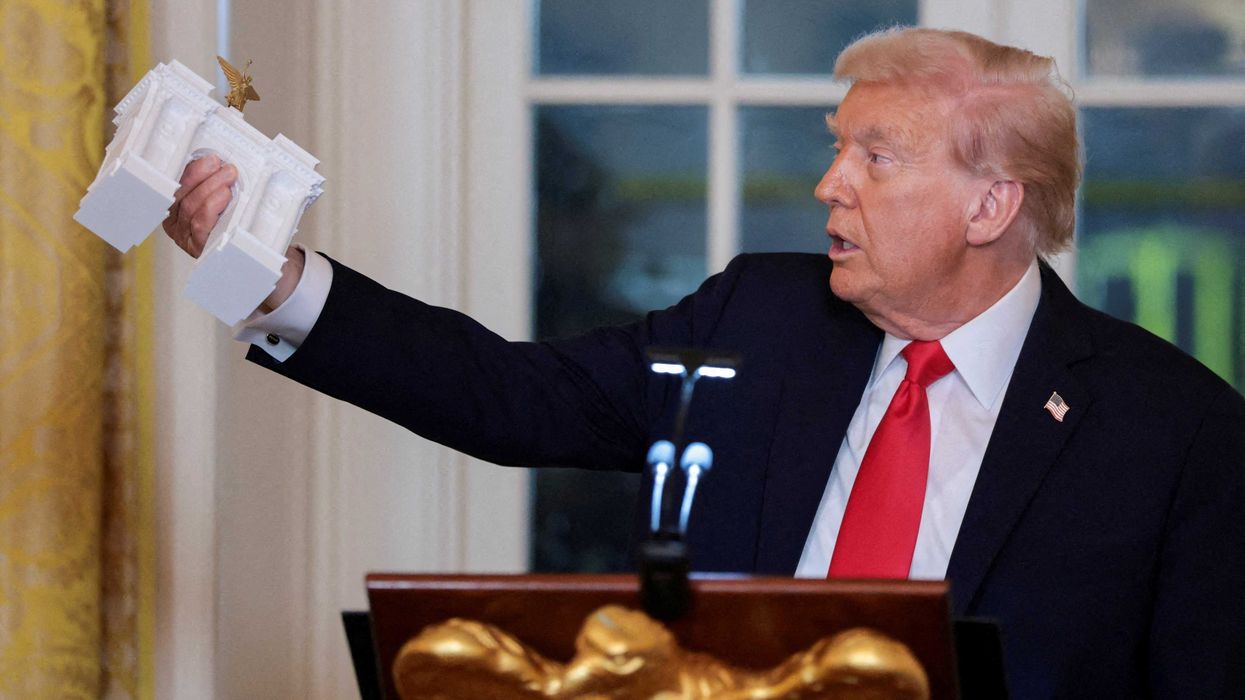
U.S. President Donald Trump holds a model of an arch monument during a ballroom dinner in the East Room at the White House in Washington, D.C., U.S., October 15, 2025. REUTERS/Jonathan Ernst TPX IMAGES OF THE DAYDecember 16, 2025
ALTERNET
CNN reports U.S. District Judge Richard Leon (a George W. Bush appointee) will not halt work on President Donald Trump’s $300 million ballroom, but he said he would hear arguments early next year about whether to issue a longer-term preliminary injunction against the project.
“The National Trust for Historic Preservation sued last week over the sprawling, privately funded project, claiming the White House has been unlawfully carrying out the construction because Trump hasn’t gotten approval from Congress or submitted his plans to the National Capital Planning Commission and the Commission of Fine Arts for review, which would give the public a chance to weigh in,” CNN reports.
“It’s not about the need for a ballroom, it’s about the need to follow the law,” argued Ted Heuer, an attorney for the preservation group. He added that had the group seen the assessments that were revealed in court papers Monday sooner, “we would have sued” before demolition of the East Wing began.
The group asked Leon to issue an emergency court order that would pause any further work on the ballroom until Congress authorizes it, the commissions review it and relevant environmental assessments are completed. But Leon, an appointee of former President George W. Bush, said the nation’s top historic preservation group had failed to show how it was being irreparably harmed by the construction in a way that required immediate court intervention.
Leon added, however, that the Trump administration must follow through on a pledge to submit the project to the National Capital Planning Commission by the end of this year.
“The court will hold them to that,” Leon said during a packed federal court hearing in Washington. “They’ve got until the end of this month.”
CNN reports the judge also warned that underground work set to be completed in coming months “must not dictate the ballroom’s eventual size or shape while the early stages of the legal challenge unfold. If it does, he said, it would have to be taken down.”
Trump argues the ballroom project is not subject to any oversight from ither Congress or independent agencies and he should be able to continue with it without any serious scrutiny.
Read the full CNN report at this link.
Trump's $300M White House ballroom makeover gets green light
Daniel Hampton
December 16, 2025 RAW STORY
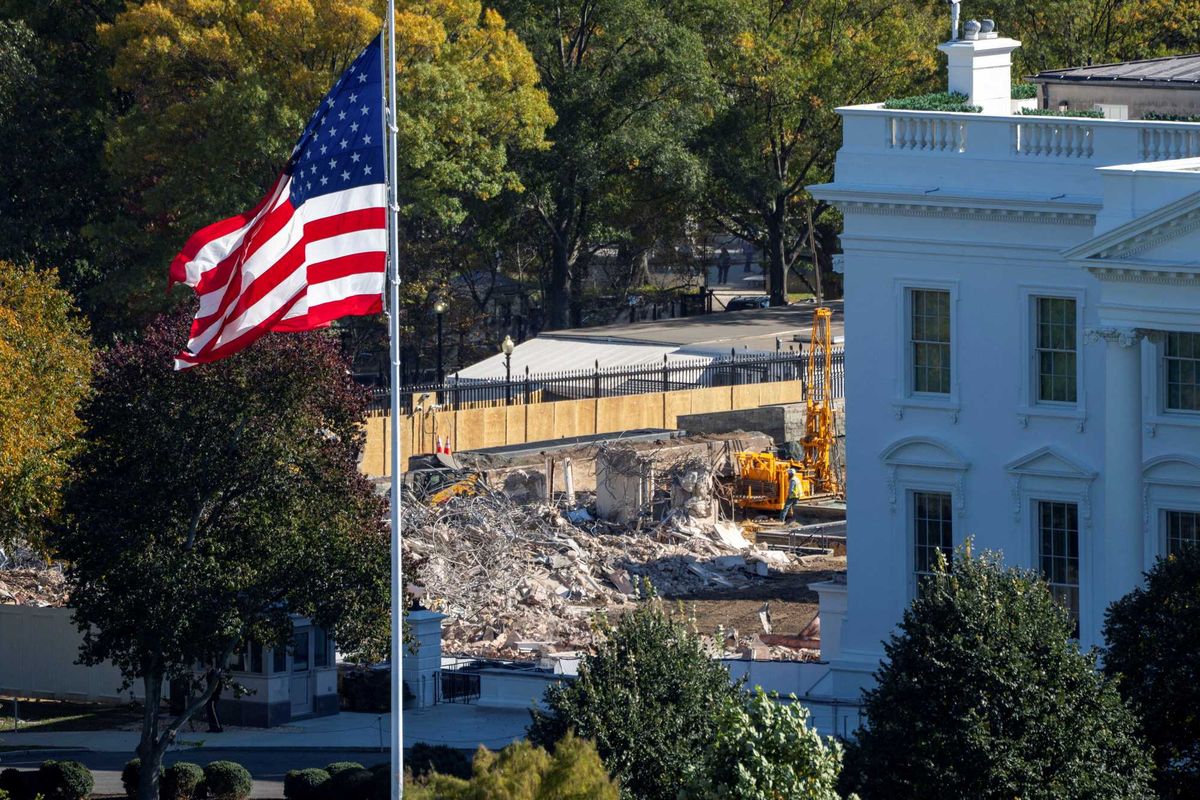
FILE PHOTO: The demolition of the East Wing of the White House, the location of U.S. President Donald Trump's proposed ballroom is seen from an elevated position on the North side of the White House in Washington, D.C., U.S., October 23, 2025. REUTERS/ Andrew Leyden TPX IMAGES OF THE DAY/File Photo
President Donald Trump's crusade to give the White House a $300 million ballroom was allowed to proceed on Tuesday, as a federal judge denied an emergency request to halt the posh project.
U.S. District Judge Richard Leon, a Bush-appointed judge, rejected a request from the National Trust for Historic Preservation to stop the renovation, finding that allowing subsurface work to proceed posed merely a minimal risk of permanently damaging the project's opponents, Politico reported. The preservationists had sought a temporary block. The judge agreed to consider a longer preliminary injunction when arguments resume early next year.
The Trump administration must present its plans to the National Capital Planning Commission by the end of December, the judge ordered.
"The court will hold them to that," Leon said at a crowded hearing. "They've got until the end of this month."
The judge made the decision after receiving a classified government submission warning of national security implications of halting work. Historically, the Presidential Emergency Operations Center has occupied space beneath the now-demolished East Wing.
The administration has insisted the project only requires Trump's authorization. However, it came to light this week that National Park Service officials completed an environmental assessment of the project in August and found it didn’t require a more detailed environmental review
National Trust counsel Tad Heuer dismissed that assessment as "woefully inadequate," pointing to significant deviations between approved plans and actual construction. He noted that the East Wing Colonnade was demolished in October, contradicting documentation describing "renovation."
"There are pile-drivers running around the clock," Heuer told the court. "There's ongoing construction. Every day you have more concrete, more footprint."
Jared Kushner's firm gives up controversial bid to buy Warner Bros. Discovery: report
Robert Davis
December 16, 2025 RAW STORY
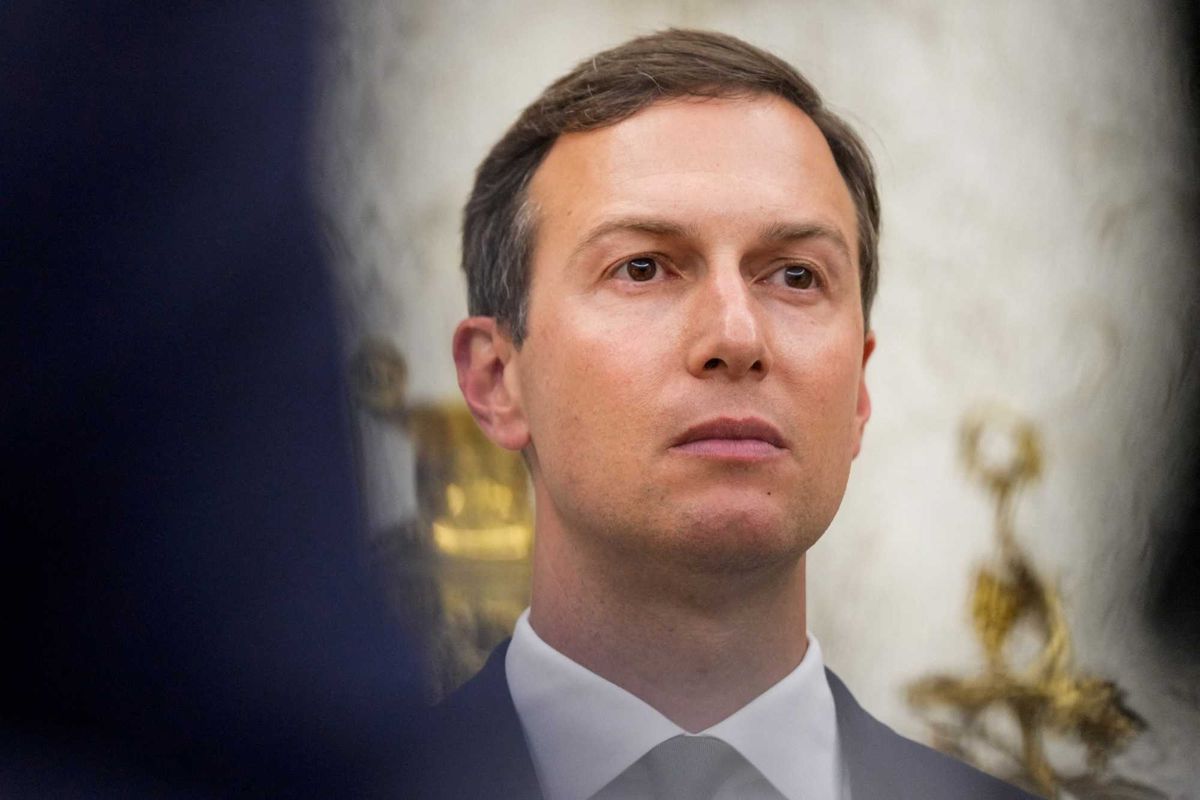
Jared Kushner looks on during a swearing-in ceremony of Special Envoy Steve Witkoff in the Oval Office at the White House in Washington, D.C. on May 6, 2025. REUTERS/Kent Nishimura
A private equity firm backed by President Donald Trump's son-in-law, Jared Kushner, dropped its controversial bid to buy Warner Bros. Discovery on Tuesday, according to a new report.
Axios reported on Tuesday that Kushner's Affinity Partners withdrew its bid for the company after learning that it was about to reject Paramount's offer to buy the company for more than $108 billion, or roughly $30 per share in an all-cash offer.
Paramount's first bid for Warner Bros was at $19 per share, according to the report. It happened at a time when Netflix was reportedly bidding to acquire the company. Experts worried that a merger between Netflix and Warner Bros. Discovery would create a media monopoly.
Trump has said he will "be involved" in reviewing the potential deal. He has also claimed that it is "imperative that CNN be sold."
Read the entire report by clicking here.

China to impose anti-dumping duties on EU pork for five years
By AFP
December 16, 2025

A butcher sells pork meat at a store in Beijing in June, 2024. China said Tuesday it will impose anti-dumping duties on European Union pork imports for five years, but at lower rates than temporary levies in place since September - Copyright AFP/File Pedro PARDO
China will impose anti-dumping duties on European Union pork imports for five years, but at lower rates than temporary levies in place since September, Beijing announced Tuesday.
The two sides have been locked in a trade spat fuelled by what many European countries view as an unbalanced economic relationship with China.
The levies come after a probe launched by China last year concluded that European pork imports “were being dumped, and the domestic industry suffered substantial damages” as a result, the commerce ministry said in a statement Tuesday.
The duties will range from 4.9 percent to 19.8 percent — down from temporary levies of 15.6 percent to 62.4 percent — and will be applied from December 17, it said.
“At present, the domestic industry is facing difficulties, and there are strong calls for protection,” a commerce ministry spokesperson said.
They added that the investigation’s conclusions were “objective, fair, and impartial”.
The two are key trading partners, with the EU running a trade deficit of more than $350 billion with China in 2024.
French President Emmanuel Macron said this month that Europe would consider adopting strong measures against China — including tariffs — if the trade imbalance was not addressed.
The current trade spat erupted last summer when the EU moved towards imposing hefty tariffs on Chinese electric vehicles, arguing that Beijing’s subsidies were unfairly undercutting European competitors.
Beijing denied that claim and announced what were widely seen as retaliatory probes into imported European pork, brandy and dairy products.
China — the world’s leading consumer of pork — imported 4.3 billion yuan ($600 million) in pork products from major producer Spain alone last year, according to official Chinese customs data.
France, meanwhile, exported 115,000 tonnes of pork to China in 2024, according to industry association Inaporc.
According to the new measures, Groupe Bigard, a major French pork producer, will be charged 9.8 percent, while Danish Crown will be hit with an 18.6 percent levy.
European producers criticised the imposition of temporary duties on pork in September, denying the dumping allegations.
They argued that Chinese consumers pay more than Europeans for products that the latter often ignore, such as pigs’ trotters or ears.
Alongside trade frictions, China and the EU are at odds on issues such as Russia’s 2022 invasion of Ukraine.
The EU has urged China exert pressure on Moscow to end the war, but Beijing has shown no sign of acceding.
Trump — a year of ruling by executive order
By AFP
December 16, 2025

US President Donald Trump signs an executive order on fentanyl in the Oval Office on December 15, 2025 - Copyright AFP ANDREW CABALLERO-REYNOLDS
Luca MATTEUCCI, Olivier THIBAULT, Valentin RAKOVSKY
With a stroke of his favorite black pen, Donald Trump has signed what should become his 221st executive order since January — a figure that exceeds the number in his entire first term, as he forges ahead with one of the biggest displays of US presidential power in modern history.
To promote artificial intelligence, fight “woke” culture and even increase the water flow of showers, Trump has churned out executive orders at a rate unprecedented since World War II, according to an AFP analysis.
The latest, signed Monday, classifies fentanyl as “a weapon of mass destruction”.
Previously, 220 texts — which are legally binding and do not need Congressional approval — have been published in the Federal Register, according to its update on Tuesday.
The total is more than he had signed during his first stint at the White House between 2017 and 2021 — and far more than his predecessors Joe Biden, Barack Obama and George W. Bush, who only signed an average of 30 to 40 per year.
Only Democrat Franklin D. Roosevelt — who over four terms signed nearly 4,000 executive orders between 1933 and 1945 — produced at Trump’s rate, although that occurred in the context of the Great Depression and World War II.
Trump, who returned to the White House on January 20, has relied on executive orders despite having a congressional majority.
“These orders are a part of a communications strategy,” John Woolley, professor of political science at the University of California, Santa Barbara, told AFP.
“It’s a way of signalling to important constituent groups that he is advancing ‘the cause’,” said Woolley who is also co-director of the American Presidency Project website, the main independent source of archives and analysis on the US presidency.
– Domestic, social agenda –
An AFP analysis of official government data shows that the majority — nearly 60 percent — deal with domestic issues, while fewer than 10 percent concern pure foreign policy. The rest cover miscellaneous matters.
Social issues dominate, ranging from culture and civil rights to education and health. These account for roughly 30 percent of all orders, surpassing trade, economy and investment (around 20 percent) and government reform (around 18 percent).
Immigration and security — his main campaign theme in 2024 — rank fourth at around 10 percent.
The orders classified within the social issues category include some that explicitly reference an “ideology” or value judgments.
For example, a July 23 order calls for AI systems to ban models that give attention to diversity and inclusion concerns, reflecting the Trump administration’s anti-“woke” agenda.
Another order from August 28 decrees that “classical and traditional architecture” is the preferred style for federal buildings.
– But are they efficient? –
Questions have been raised over whether governing by executive orders is efficient, given the number of texts disputed in court.
According to the independent legal website Just Security, which is linked to New York University School of Law, just over one fifth of Trump’s orders have been challenged in court.
More than 20 of them have already been blocked at least provisionally or partially by the courts.
In late August a federal appeals court ruled a large part of the texts on the new customs duties illegal.
The Supreme Court, whose conservative majority was bolstered by Trump during his first term and has been called to rule on the matter, appeared sceptical of the legality behind a swath of Trump’s tariffs in a November 5 hearing.
But Trump is not “afraid of being attacked about the substance of the orders,” Woolley said.”He is deliberately testing the limits of the law”.
“His bet is that on most of the big issues, the Supreme Court will agree with a lot of his view of executive power.”
– Settling of scores –
An AFP analysis of the language and vocabulary used in Trump’s executive orders shows a characteristically direct style.
He uses, for example, the verb “impose” five times more than his three predecessors.
His language also appears more patriotic: he speaks of the “nation” two to three times more often than Biden, Obama and Bush and the “American people” two times more.
In another difference, he attacks the previous administration frequently, accusing it, for example, of having let in millions of illegal immigrants.
More than 15 percent of the orders can be listed as “settling of scores”.
“No prior president issued orders explicitly attacking his critics and prior opponents,” said Woolley.
In November Trump said that all executive orders and documents signed by autopen, which replicates signatures, under Biden were “terminated” on the basis of allegations that Biden has rejected.
Economic losses from natural disasters down by a third in 2025: Swiss Re
By AFPDecember 16, 2025

The Los Angeles blazes in January constitute the largest-ever insured wildfire loss event by far, reaching an estimated $40 billion, said Swiss Re - Copyright AFP/File Pedro PARDO
Nathalie OLOF-ORS
Global economic losses from natural disasters are projected to have dropped by 33 percent to $220 billion in 2025, despite the damage wrought by the Los Angeles wildfires, reinsurer Swiss Re said Tuesday.
The total cost of insured losses from natural catastrophes is estimated at $107 billion, down 24 percent from the previous year, the Zurich-based reinsurance giant said in its preliminary estimates for 2025.
The decrease was attributed to a much less severe hurricane season in the North Atlantic than in 2024, said Swiss Re, which serves as an insurer of insurance companies.
“For the first time in 10 years, none of these hurricanes made landfall on the US coast, which explains why insured losses from this peril are set to be low in 2025”, Swiss Re said in a statement.
Nonetheless, 2025 marks the sixth year that insured natural catastrophe losses are set to exceed $100 billion.
This year’s hurricane season saw 13 named tropical storms, including three Category 5 hurricanes: Erin, Humberto and Melissa.
The most costly storm in 2025 was Hurricane Melissa, which devastated Jamaica and affected Haiti and Cuba, with insured losses estimated at $2.5 billion, according to the Swiss reinsurer.
With wind gusts reaching 298 kilometres per hour, the Category 5 hurricane caused significant flooding and landslides, with Swiss Re noting that it was one of the most powerful hurricanes ever recorded to make landfall.
Nevertheless, the 2025 hurricane season saw 13 named storms, including 3 Category 5 hurricanes (Erin, Humberto, and Melissa), but “for the first time in 10 years,” none of these hurricanes made landfall in the United States, which explains why the overall cost was significantly lower.
– Tornados and LA fires –
Severe storms “remain a major and persistent global loss driver”, Swiss Re said.
In 2025, insured losses from storms — which can be accompanied by violent gusts, hail, tornadoes and flooding — amounted to $50 billion, making it the third costliest year for storms after 2023 and 2024, due in particular to severe tornadoes in the United States in March and May.
“We are observing a steady rise in losses from severe convective storms,” said Balz Grollimund, Swiss Re’s catastrophe perils chief.
“Urbanisation in hazard-prone areas, rising asset values, higher construction costs and factors such as ageing roofs have made these storms a key peril for insurers.
“As single events rarely result in a large insured loss, it is key for insurers to consider the cumulative effect of frequent, low-loss events, along with increasing property values and repair costs.”
Overall, US events account for 83 percent of global insured natural catastrophe losses.
The Los Angeles blazes were the costliest-ever wildfire event globally, with insured losses of $40 billion.
“The scale of destruction reflects a convergence of meteorological drivers, such as extended hot, dry conditions and strong winds, with greater exposure,” said Swiss Re, especially high-value residential areas expanding into the fringes of hazardous wildlands.
Meanwhile Southeast Asia experienced severe river and flash-flooding events in November, specifically in Vietnam, Thailand and Indonesia, although Swiss Re has not yet provided a loss estimate at this stage.
“Strengthening prevention, protection and preparedness is essential to protect lives and property,” said Swiss Re’s group chief economist Jerome Jean Haegeli.
EU set to scrap 2035 combustion-engine ban in car industry boost
ByAFP
December 16, 2025

Just less than one in five new cars sold in Britain last year was an EV, a record market share but less than the government's 22 percent target - Copyright AFP/File Tolga Akmen
Umberto BACCHI
The EU looks set to scrap a landmark 2035 ban on new petrol and diesel cars on Tuesday, as part of a package of reforms aimed at supporting Europe’s embattled auto industry.
Carmakers and their backers have lobbied hard for Brussels to relax the ban over the past year — in the face of fierce competition from China and a slower-than-expected shift to electric vehicles (EVs).
The European Commission is expected to propose replacing it with a less ambitious 90-percent emission-reduction target, in a move critics say risks undermining the EU’s green agenda and deterring investments in electrification.
“This is a critical milestone for the future of the sector. There is a lot at stake,” Sigrid de Vries, the head of European auto lobby ACEA told a press conference in Brussels on Monday, referring to the expected reforms.
Set in 2023, the ban was a cornerstone of the EU’s environmental Green Deal, which has come under increased pressure from businesses and right-wing politicians as the EU seeks to bolster its industry.
“There is a clear demand for more flexibility on the CO2 targets,” commission spokeswoman Paula Pinho told a press conference Friday, saying Brussels was “aiming for balance”.
Carmakers argue the 2035 goal to have only electric vehicles sold in Europe, and an intermediate 2030 target, are no longer realistic.

Carmakers and their backers lobbied hard against EU plans to ban new combustion-engine car sales – Copyright AFP Fred TANNEAU
High upfront costs and the lack of adequate charging infrastructures in parts of the 27-nation bloc mean consumers have been slow to warm to EVs, producers say.
Just over 16 percent of new vehicles sold in the first nine months of 2025 run on batteries, according to ACEA.
Automakers would like to see continued sales authorised for hybrids with rechargeable batteries or those equipped with range extenders (small combustion engines which recharge the battery instead of powering the wheels).
Germany supports this option as do eastern European nations where German carmakers have set up factories.
– ‘Poisoning the debate’ –
Others, like Italy, want to see the use of alternative fuels such as those derived from agricultural crops and waste products allowed.
“EVs will be the dominant choice, but to make the transition work for society and industry, other options must be available too,” de Vries said in a social media post.
In the other camp are France, the Nordic countries and Spain who have long called for keeping to the planned trajectory in order not to harm firms that have invested in the transition to electric vehicles.
Last week Manfred Weber, the conservative head of the EU parliament’s largest group, said the 2035 ban would be discarded with carmakers required to meet a 90-percent reduction in CO2 emissions from their fleet instead.
EU sources confirmed to AFP that was likely, adding the review would probably allow for plug-in hybrids and range-extender vehicles to be sold after 2035.
This has many environmentalists worried, with a recent report indicating that plug-ins pollute almost as much as petrol cars.
But William Todts, director of the clean transport advocacy group T&E, said he hoped obtaining concessions would help the auto industry move on.
“I hope that if they get a little bit of what they want, they will stop poisoning the political debate,” he told AFP, arguing heated discussions had created confusion in the sector and among consumers.
The commission is also expected to unveil additional measures to support the sector, including plans for “greening” company fleets and encouraging production of small and “affordable” EVs.
France has advocated for a “European preference” compelling manufacturers receiving public subsidies to source components from within the bloc.
Road transport accounts for about 20 percent of total planet-warming emissions in Europe, and 61 percent of those come from cars’ exhaust pipes, according to the EU.
US unemployment rises further, hovering at highest since 2021
By AFP
December 16, 2025

Delayed government figures show that the US unemployment rate rose to 4.6 percent in November - Copyright AFP/File Patrick T. Fallon
Beiyi SEOW
The US jobless rate picked up again in November, hovering at its highest level in four years, official data showed Tuesday in a report underscoring a labor market cooldown in the world’s biggest economy.
The report, delayed by a lengthy government shutdown, also indicated that the US economy lost 105,000 jobs in October.
Hiring picked up again in November with a gain of 64,000 jobs, but this was still a slower pace than before, according to the Labor Department figures.
“Employment rose in health care and construction in November, while (the) federal government continued to lose jobs,” the department said.
There was a sharp decline of 162,000 government jobs in October, “as some federal employees who accepted a deferred resignation offer came off federal payrolls,” the report added.
In November, unemployment climbed to 4.6 percent from 4.4 percent in September. It is the highest rate since September 2021.
There was no October jobless rate as officials were unable to retroactively collect data after the shutdown, which lasted until November 12.
The figures will be closely scrutinized for their potential bearing on US interest rates.
The Federal Reserve has cut rates three times in a row this year as employment weakened, but hinted that the bar is likely higher for further cuts.
A rapidly deteriorating jobs market could nudge the central bank to lower rates more to boost the economy, despite some policymakers’ worries that higher inflation could become persistent.
While President Donald Trump’s tariffs have not sparked a broad inflation surge, firms say they have caused business costs to grow and fueled uncertainty.
Trump’s chief economic adviser Kevin Hassett told reporters Tuesday that government workers who took buyouts “are staying in the labor force and looking for work.”
He said he expects “that they’ll be very successful with it.”
– Americans ‘squeezed’ –
Elizabeth Warren, the top Democrat on the Senate Banking Committee, slammed Trump’s “chaotic tariffs” and economic policies, saying they were “hammering the labor market.”
“With wages struggling to keep up with higher costs, it’s no wonder Americans are more anxious about the economy than ever,” she said.
In November, average hourly earnings climbed 0.1 percent to $36.86, while wages rose 3.5 percent on an annual basis. But both numbers represent a slowdown from the prior month.
In another sign that the economy appears to be cooling, a separate report released Tuesday by the Commerce Department said that retail sales were flat in October at $732.6 billion.
This came on the back of sales declines at motor vehicle and parts dealers, and gasoline stations. Consumers also pulled back at restaurants and bars.
“Americans are feeling squeezed,” said Heather Long, chief economist at the Navy Federal Credit Union, adding that consumers were shifting to spending more on necessities.
– Long-term unemployment –
On employment, Long said: “The US economy is in a jobs recession. The nation has added a mere 100,000 in the past six months.”
She said businesses were adjusting to tariffs, uncertain conditions and AI, and that most of the new jobs were in health care which is regularly hiring as the American population ages.
Economist Samuel Tombs of Pantheon Macroeconomics said much of the overall drag came from a slump in federal payrolls. The government shutdown likely also exacerbated unemployment figures.
But a growing proportion of people are jobless for longer periods.
The number of individuals unemployed for 27 weeks or more has risen by 15.5 percent over the past year, said Nicole Bachaud, labor economist at ZipRecruiter.
For now, economists say the jobs market is likely not weakening enough to trigger a January rate cut.
“While net hiring remains soft and narrowly based, it is not softening further and in fact is moderately firmer than the weak readings in the summer,” said Nationwide chief economist Kathy Bostjancic.
She expected the Fed can continue holding rates steady for a few months.
Arctic sees unprecedented heat as climate impacts cascade
ByAFP
December 16, 2025

Springtime -- when Arctic sea ice reaches its annual maximum -- saw the smallest peak in the 47-year satellite record in March 2025 - Copyright AFP/File Olivier MORIN
Issam AHMED
The Arctic has experienced its hottest year since records began, a US science agency announced Tuesday, as climate change triggers cascading impacts from melting glaciers and sea ice to greening landscapes and disruptions to global weather.
Between October 2024 and September 2025, temperatures were 1.60 degrees Celsius above the 1991–2020 mean, the National Oceanic and Atmospheric Administration said in its annual Arctic Report Card, which draws on data going back to 1900.
Co-author Tom Ballinger of the University of Alaska told AFP it was “certainly alarming” to see such rapid warming over so short a timespan, calling the trend “seemingly unprecedented in recent times and maybe back thousands of years.”
The year included the Arctic’s warmest autumn, second-warmest winter, and third-warmest summer since 1900, the report said.
Driven by human-caused burning of fossil fuels, the Arctic is warming significantly far faster than the global average, with a number of reinforcing feedback loops — a phenomenon known as “Arctic Amplification.”
For example, rising temperatures increase water vapor in the atmosphere, which acts like a blanket absorbing heat and preventing it from escaping into space.
At the same time, the loss of bright, reflective sea ice exposes darker ocean waters that absorb more heat from the Sun.
– Sea-ice retreat –
Springtime — when Arctic sea ice reaches its annual maximum — saw the smallest peak in the 47-year satellite record in March 2025.
That’s an “immediate issue for polar bears and for seals and for walrus, that they use the ice as a platform for transportation, for hunting, for birthing pups,” co-author Walt Meier of the National Snow and Ice Data Center told AFP.
Modeling suggests the Arctic could see its first summer with virtually no sea ice by 2040 or even sooner.
The loss of Arctic sea ice also disrupts ocean circulation by injecting freshwater into the North Atlantic through melting ice and increased rainfall.
This makes surface waters less dense and salty, hindering their ability to sink and drive the Atlantic Meridional Overturning Circulation — including the Gulf Stream — which help keep Europe’s winters milder.
Ongoing melt of the Greenland Ice Sheet also adds freshwater to the North Atlantic Ocean, boosting plankton productivity but also creating mismatches between when food is available and when the species that depend on it are able to feed.
Greenland’s land-based ice loss is also a major contributor to global sea-level rise, exacerbating coastal erosion and storm-driven flooding.
– More Arctic blasts –
And as the Arctic warms faster than the rest of the planet, it weakens the temperature contrast that helps keep cold air bottled up near the pole, allowing outbreaks of frigid weather to spill more frequently into lower latitudes, according to some research.
The Arctic’s hydrological cycle is also intensifying. The October 2024 – September 2025 period — also known as the 2024/25 “water year” — saw record-high spring precipitation and ranked among the five wettest years for other seasons in records going back to 1950.
Warmer, wetter conditions are driving the “borealization,” or greening, of large swaths of Arctic tundra. In 2025, circumpolar mean maximum tundra greenness was the third highest in the 26-year modern satellite record, with the five highest values all occurring in the past six years.
Permafrost thaw, meanwhile, is triggering biogeochemical changes, such as the “rusting rivers” phenomenon caused by iron released from thawing soils.
This year’s report card used satellite observations to identify more than 200 discolored streams and rivers that appeared visibly orange, degrading water quality through increased acidity and metal concentrations and contributing to the loss of aquatic biodiversity.

