Saturday, December 20, 2025


Maersk Makes First Red Sea Transit Since December 2023
Maersk containership
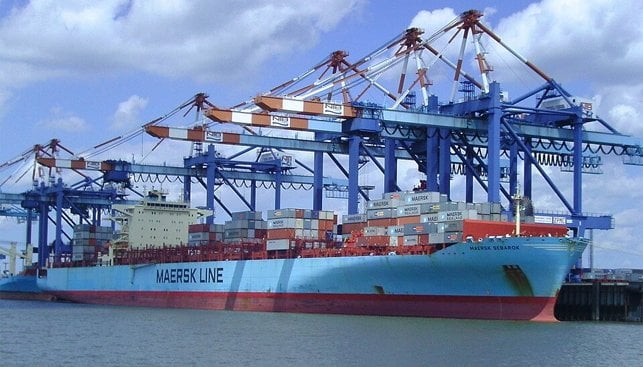
Maersk Sebarok made the company's first transit of the Bab el-Mandeb and Red Sea in two years (public domain photo)

Published Dec 19, 2025 10:58 AM by The Maritime Executive


Maersk confirmed that one of its smaller containerships has successfully completed the company’s first transit through the Red Sea and the Bab el-Mandeb in two years. The company is calling it a trial, and it comes after the Suez Canal Authority had been strongly lobbying for the return to the route.

The Maersk Sebarok (108,215 dwt) completed the transit between December 18 and 19. The vessel, which is owned by Maersk and registered in Singapore, was built in 2007 and has a nominal capacity of 6,648 TEU. The ship is deployed on a route between the U.S. East and Gulf Coast to India with stops at Port Tangier and in Saudi Arabia.

The company emphasized that the “highest possible safety measures were applied during the transit.” The vessel’s AIS signal shows it bound for the United States.

“Assuming that security thresholds continue to be met, we are considering continuing our stepwise approach towards gradually resuming navigation along the East-West corridor via the Suez Canal and the Red Sea. The first step is this initial sailing, followed by a limited number of additional trans-Suez sailings. However, there are no planned sailings currently,” Maersk said in its statement.

The Suez Canal Authority had announced in late November that Maersk would be resuming transits as the first step to a restoration of service in the region. They hailed the decision, but Maersk CEO Vincent Clerc sounded more cautious with reports saying they would return “when conditions allowed.” Security has remained a key concern, and some shipping companies cited the high costs of insurance for operations in the region.

Maersk had reported it was reviewing the regional situation after the Maersk Gibraltar had a near-miss incident on December 14, 2023, in the area of the Bab al-Mandeb. Two weeks later, the company said its vessel Maersk Hangzhou was among the first to go through the Red Sea again after the U.S.-led Operation Prosperity Guardian was launched. The vessel, however, was hit by an unknown object, and then reported four boats approached, opening fire in an attempt to board the ship. The U.S. Navy destroyed several Houthi boats conducting the attack, while Maersk immediately suspended all transits. On January 7, 2024, the company confirmed that “all Maersk vessels due to transit the Red Sea / Gulf of Aden will be diverted south around the Cape of Good Hope for the foreseeable future.”

CMA CGM was the only large carrier to continue limited transits, made when they were protected by vessels from EUNAVFOR’s Operation Aspides. Recently, CMA CGM has made additional test transits of the Suez Canal and is planning to restore its first route through the Red Sea in January.

Niels Rasmussen, Chief Shipping Analyst at the industry trade group BIMCO, had commented this week that, “The return to normal Red Sea and Suez Canal routings in the not-too-distant future.” He predicted that the shorter transit times would release capacity back into the industry, saying that it would result in a 10 percent reduction in ship demand.


Top photo by Tvabutzku1234 (Public domain)


Shipping Giant Maersk Completes First Red Sea Transit in Two Years

Shipping giant A.P. Moller-Maersk completed on Friday the first transit of a container ship via the Red Sea and Bab el-Mandeb Strait in almost two years, after having stopped voyages through the Suez Canal following Houthi attacks on vessels in the region.   

Since December 2023, global shipping traffic has been upended by intensified attacks from the Iran-aligned Houthis in Yemen on commercial vessels transiting the Red Sea before and after entering or exiting the Suez Canal.

The Houthi attacks forced many tanker and container ship operators, including Maersk, to reroute voyages via Africa. The longer voyages have increased travel times, delayed goods delivery, disrupted supply chains, and raised shipping costs.  

In a first in nearly two years, Maersk said on Friday that on December 18-19, 2025, the Singapore-flagged vessel Maersk Sebarok transited the Bab el-Mandeb Strait and Red Sea, with the highest possible safety measures applied during transit.

However, Maersk warned that “Whilst this is a significant step forward, it does not mean that we are at a point where we are considering a wider East-West network change back to the trans-Suez corridor.” 

“Assuming that security thresholds continue to be met, we are considering continuing our stepwise approach towards gradually resuming navigation along the East-West corridor via the Suez Canal and the Red Sea,” Maersk said, but noted that there are no planned sailings currently.

Apart from upending trade routes and shipping costs, the major shift in ocean vessel traffic has also boosted global demand for fuel oil to multi-year highs. 

Contrary to earlier expectations, global demand fuel oil demand has jumped the most since 2019 as longer routes to avoid the Houthi threat around the Red Sea and the surge in shadow fleet numbers have contributed to higher fuel oil use in the shipping industry, analysts told Reuters in October. 

By Tsvetana Paraskova for Oilprice.com

Port of NY/NJ Reaches Landmark Agreement Extending Maher Terminals Lease

containership terminal
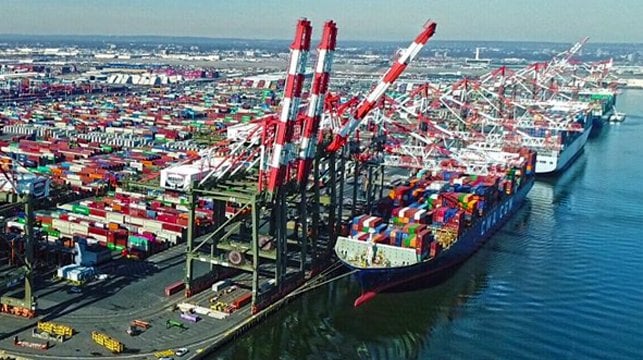
Maher Terminal is the largest in the Port of New York and New Jersey (Maher)

Published Dec 18, 2025 8:21 PM by The Maritime Executive


The Port Authority of New York and New Jersey announced a new agreement that it is calling a landmark as it prepares for the long-term future growth of the port, which is the largest on the U.S. East Coast.  It directly supports the Port Authority’s Port Master Plan 2050, which forecasts cargo volumes doubling or tripling by mid-century.

The Port Authority Board of Commissioners voted to approve a 33-year lease extension at Maher Terminals, the largest and busiest container terminal at the Port of New York and New Jersey. According to port officials, long-term leases provide unmatched stability and reliability and position the port to proactively respond to evolving supply chain demands. They said the new long-term agreement secures operations at the terminal through September 2063 and includes significant investments to strengthen the regional supply chain and prepare the East Coast’s busiest port for continued cargo growth. 

The agreement extends the lease on Maher, which is owned by Macquarie Infrastructure Partners, an infrastructure fund managed by Australia-based Macquarie Asset Management, which had an expiration in September 2030. It requires payment to the Port Authority in consideration of a lease extension and modified annual rental payments.  

“This lease extension is about getting ahead of the future,” said Port Authority Executive Director Rick Cotton. “Cargo volumes are growing, vessels are getting larger, and shippers are demanding more reliability than ever. By locking in sustained private investment and modernizing critical infrastructure, we’re making sure the East Coast’s busiest port is ready to move more goods, support more regional growth, and meet the demands of a more complex global economy.”

Under the agreement, Maher will assume full responsibility for the maintenance, rehabilitation, and replacement, as needed, of all wharf and berth structures within its leasehold by 2030. Additionally, the agreement includes increased rental payments structured to incentivize capacity growth. The lease agreement also includes a commitment from Maher to expand capacity as demand grows and to collaborate with the Port Authority on shared priorities, including security, innovation, and sustainability.

Building on the Port Authority’s sustainability initiatives, Maher Terminals has pledged to work towards net-zero greenhouse gas emissions in its operations and support the Port Authority’s goal of reaching net-zero agency-wide by 2050. The Port Authority highlights that the agreement also further strengthens collaboration between the Port Authority and Maher Terminals on shared priorities such as safety and security, innovation, customer experience, performance standards, and enhanced operational reporting. 

Unlike the port’s other container terminals, which are owned by ocean carriers and primarily serve their own vessels, Maher is a common-use terminal serving members of the Ocean Alliance as well as other independent carriers. It is the largest and busiest of the port’s five container terminals, spanning approximately 450 acres in Elizabeth, N.J., and handling approximately 35 percent of the port’s container traffic in 2024. 

In 2024, the Port of New York and New Jersey handled approximately $264 billion worth of goods, moving 8.7 million TEUs. 


Construction Order Placed for First Autonomous, Wind-Powered Cargo Ship

sail-powered autonomous cargo ship
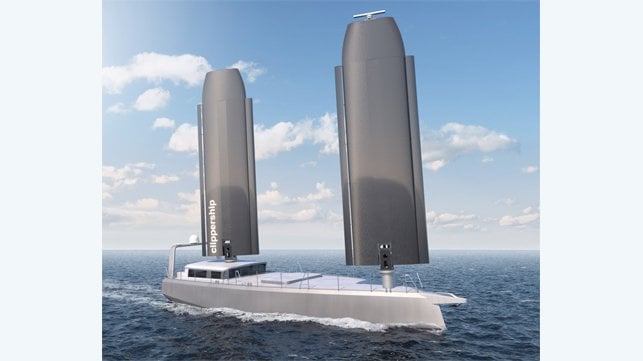
Clippership has ordered a 24-meter sail-powered vessel with a capacity of 75 pallets that is capable of autonomous operations (Clippership)

Published Dec 18, 2025 6:39 PM by The Maritime Executive


A California-based startup called Clippership, working with a team of established leaders in the maritime community, reports it has completed designs classed by RINA for its first vessel, a wind-powered cargo ship designed for autonomous operations. The first vessel is seen as a demonstration of the company’s unique concept targeting small shippers.

Naval architecture for the new vessel was carried out by Dykstra Naval Architects, renowned for innovative sailing vessels, while American naval architecture and marine engineering firm Glosten completed the vessel’s structural engineering. Clippership in developing the autonomy software and rigid sail/wing design in-house. RINA is the class society that approved the designs. 

Having successfully completed the designs, Clippership has now entered into a construction contract with KM Yachtbuilders in the Netherlands, a yard known for rugged, innovative expedition vessels. The first ship, a 24-meter (79-foot) design, they report, will be launched in late 2026 and sail under the flag of Malta.

The company points out that the vessel is specifically designed for small shippers and will provide advantages over attempting to move small cargoes on larger containerships and the costs of ground transportation, or the costs of air freight. The vessel will have a capacity for 75 Euro-pallets with a climate-controlled cargo hold. They report the design is optimized for point-to-point transportation.

The ship will have two foldable rigid wings for primary wind propulsion. The wings will be made of a carbon composite, which the company says will make the wings more than twice as powerful as modern fabric sails. Further, the folding mechanism will permit the sails to be stowed flat on deck during adverse weather conditions or in port.

Key to the concept are lower operating costs. To achieve that, the vessel is designed for open-ocean autonomy. Initially, they anticipate a supervisory crew on board, but the ship will function through a series of systems. The ship will use real-time environmental inputs to dynamically manage course selection, wing trim, and steering control, as well as collision avoidance with other ships and stationary objects. Integrated systems include high-resolution marine radar; video and forward-looking infrared (FLIR) cameras; satellite-based remote weather sensing; and constant sharing of automatic identification system (AIS) data with other craft and shore stations.

Clippership, which describes itself as a maritime robotics company whose mission is to build a new and better way of transporting cargo across oceans and waterways, has ambitious plans. They report that the first demonstration ship will gather data to design improvements that will deliver even better performance. They look to use the information to advance the designs for the vessels and plan to evolve to fully uncrewed voyages with remotely monitored autonomy as the platform matures and MASS regulations are adopted globally.

The first ship will sail trans-Atlantic and to the Caribbean and South America. The company’s future plans call for a 48-meter (158-foot) vessel that will have a capacity for 400 pallets and automated pallet handling.


EcoCO2-Equipped Vessel Successfully Completes Gas Trial

CO2 vessel

Published Dec 19, 2025 8:56 PM by The Maritime Executive


[By Babcock International Group]


Babcock’s LGE business, a global leader in liquefied gas solutions, has announced a significant new milestone in its pioneering ecoCO2® cargo handling system project.

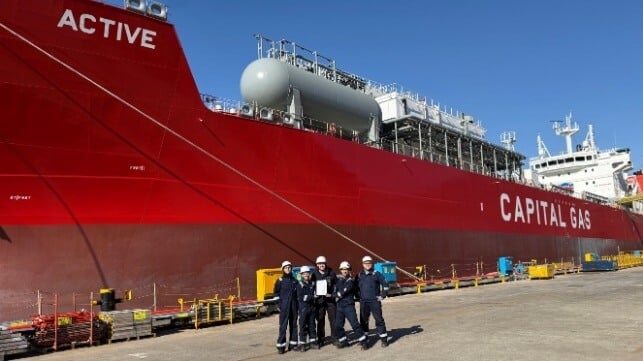
The first of four 22,000m³ liquefied CO? (LCO2) carriers, developed under a world-first contract with Capital Gas Ship Management, has now completed its maiden gas trial – a critical phase in the vessel’s commissioning process.

The trial marked the first operational test of the ecoCO2® system onboard a commercial vessel, validating its performance in handling and reliquefying low-pressure CO? cargo. The ecoCO2® system, which received Approval in Principle from Lloyd’s Register during Gastech 2023, is designed to support the full Carbon Capture, Utilisation and Storage (CCUS) value chain and is capable of transporting refrigerated liquid CO?, LPG and ammonia.

Managing Director of Babcock’s LGE business, Neale Campbell, said: “The successful completion of this gas trial represents a major step forward in demonstrating the operational readiness and flexibility of our ecoCO2® technology. This milestone is the result of our team and partners’ hard work as we move closer to full deployment of this innovative system, which supports global decarbonisation efforts.”

The vessel, the largest LCO2 carrier in the market, is scheduled for delivery in January 2026. The successful completion of the gas trial will pave the way for commercial operations and further adoption of ecoCO2® technology across the industry.
 

The products and services herein described in this press release are not endorsed by The Maritime Executive.


New Jersey religious activists call for investigation after ICE detainee’s death

NEWARK, N.J. (RNS) — The death of Jean Wilson Brutus marks the first recorded death at Delaney Hall — the largest immigrant detention facility on the East Coast — since its reopening in May.


Delaney Hall, a contracted ICE facility in Newark, NJ. Courtesy photo


Fiona Murphy
December 19, 2025
RNS


NEWARK, N.J. (RNS) — Faith leaders and religious advocates in New Jersey are calling for accountability and compassion following the death of a 41-year-old Haitian man after a reported medical emergency while he was detained at Delaney Hall, an immigration detention facility in Newark. It marks the first recorded death at the detention center since it reopened in May amid the Trump administration’s mass deportation campaign.

Delaney Hall is operated by private prison company GEO Group under contract with U.S. Immigration and Customs Enforcement. ICE confirmed the death of Jean Wilson Brutus in a statement on Thursday (Dec. 18), saying he entered ICE custody on Dec. 11, after he was released from Union County Jail in Elizabeth, N.J., which followed an arrest for criminal mischief/damage to property. The agency said Brutus died of “suspected natural causes” on Dec. 12.

“While at Delaney Hall Detention Facility, he experienced a medical emergency and local Emergency Medical Services was called,” ICE said in a news release. “EMS performed life-saving measures and transported Brutus to University Hospital in Newark, New Jersey, and later the hospital pronounced him deceased on Dec. 12.”

The statement described Brutus as a “criminal illegal alien,” and said that ICE notified federal oversight authorities and the Haitian consulate of his death, as required by agency policy. The agency stated it “is committed to ensuring that all those in custody reside in safe, secure, and humane environments.”

On Friday (Dec. 19), advocates and volunteers with the “Eyes on ICE” initiative issued a statement calling for an immediate independent investigation into Brutus’ death and greater transparency from immigration officials. The coalition includes faith leaders and community groups that have maintained near-daily vigils outside Delaney Hall to support families and monitor conditions at the facility, which houses about 1,100 inmates. Some volunteers took photos of an ambulance arriving at Delaney Hall, possibly to assist Brutus, on Dec. 11.

RELATED: Outside Newark’s 1,100-bed detention center, a weekly prayer service for anxious families

Citing a Freedom of Information Act request by Scripps News, the advocate statement said there were 12 emergency calls to Delaney Hall between Sept. 1 and Nov. 17, and argued that ICE’s decision to post public notice of Brutus’ death a week after it occurred underscores ongoing concerns about oversight and accountability.

Kathy O’Leary, a leader of Pax Christi New Jersey, a Catholic peace organization, said she is typically present outside Delaney Hall three to four days a week and was there the night of Dec. 11, but left before the incident unfolded.

“When I was there, there were people coming up to us, people who had some kind of connection to inside the building, who were really concerned about a man who, several nights before, had a seizure and had to have an emergency tracheotomy performed on him,” O’Leary said. “This is also not the first time that we’ve heard of seizures inside the building.”

O’Leary said a network of volunteers documented facility events in real time through photos, videos and a group chat. Advocates said they first became aware of ICE’s public notice of the death on Dec. 19, and released their statement the same day.

The U.S. Department of Homeland Security, which oversees ICE, did not immediately respond to a request for comment.

Religious leaders said the death raises serious moral questions about responsibility and how human life is valued inside detention. Sister Susan Francois, a Catholic sister who regularly volunteers outside Delaney Hall and documents her witness on TikTok, said Brutus’ death “was inevitable.”

“I’ve heard from the visiting family members that many regular medical conditions are not treated promptly and not treated well,” she said. “So, I think it was going to be inevitable.”

“I think that we need to raise the moral outrage,” Francois added. “The fact that they waited — he died a week ago. They waited until a holiday weekend to release the news with this very un-Christian, un-human demonizing of this gentleman.”

The Rev. Shannon Smythe, a Presbyterian minister who volunteers outside Delaney Hall, said she hopes Brutus’ death forces political leaders to intervene. “I hope it’s a turning point, but we need people with power who can stop this and say, get GEO out of our state. Get it out of Newark,” she said. “We need those people with power to speak up, as activists and clergy and people with basic moral consciences have been.”

O’Leary said that honoring Brutus’ dignity means refusing to let him become anonymous. “I think it’s important that we use his name and not talk about him only as ‘the man who died,’” O’Leary said. “We need to recognize his humanity … we need to remember he was a person.”

Delaney Hall reopened earlier this year under a long-term federal contract and has been the subject of protests, legal disputes and repeated allegations from advocates about dangerous and dehumanizing conditions.

Francois said witnessing families suffer outside the facility has heightened her concern and faithful devotion. Of visitors who wait in a shed-like structure at the facility to visit inmates, she said, “I cannot help but think about how there was no room at the inn for Jesus.”


House Dems ‘Deeply Concerned’ About Death in For-Profit ICE Processing Center

“While ICE claims he died of natural causes,” said Reps. Delia Ramirez and Rashida Tlaib, “there have been numerous complaints from family members and advocates about inhumane conditions and inadequate medical care at North Lake.”


US Rep. Delia Ramirez (D-Ill.) speaks during a news conference on congressional oversight in front of the US Capitol on April 8, 2025 in Washington, DC.
(Photo by Alex Wong/Getty Images)

Julia Conley
Dec 19, 2025
COMMON DREAMS

A press release from US Immigration and Customs Enforcement on Wednesday regarding the death of an immigrant named Nenko Stanev Gantchev at one of the agency’s facilities suggested ICE had provided a “safe, secure, and humane” environment—but considering numerous reports about medical neglect and abuse at immigrant detention centers in recent months, two Democratic lawmakers are demanding a full investigation into the man’s death.

US Reps. Delia Ramirez (D-Ill.) and Rashida Tlaib (D-Mich.) called on the federal government to open “an immediate, transparent investigation into the circumstances of Mr. Gantchev’s death, including an investigation into reports from other detainees that he asked for medical assistance and did not receive it in time to save his life.”


Senate Report Shares Stories of US Citizens Assaulted, Unconstitutionally Detained by DHS

That kind of medical neglect has been reported at immigration detention facilities such as Florida’s so-called “Alligator Alcatraz” and Krome North Service Processing Center and at detention centers run by for-profit companies like GEO Group—the corporation that runs North Lake Processing Center in Baldwin, Michigan, where Gantchev was found dead in his cell on Monday.

“We are deeply concerned about the death of Mr. Gantchev, an Illinois resident who was detained at the for-profit GEO Group’s North Lake Processing Center,” said Ramirez and Tlaib. “While ICE claims he died of natural causes, the circumstances surrounding his death are not yet clear, and we know there have been numerous complaints from family members and advocates about inhumane conditions and inadequate medical care at North Lake.”

Ten days before Gantchev’s death, Tlaib conducted an oversight visit at the facility after receiving reports of cold temperatures, inadequate food, unsanitary facilities, and inmates having trouble accessing medical care.

Our people-powered journalism cannot survive without you

Your support allows Common Dreams to continue covering the stories and amplifying the voices that the corporate media never will. Make a tax-deductible year-end gift to ensure we can sustain the reporting needed to meet the challenges of 2026.


“During this visit, we learned there have been multiple suicide attempts at the facility, including one in the last couple weeks, and heard that more medical staff are needed,” she said at the time. “No human being should be trapped in cages, forced to experience dehumanizing conditions, or separated from their family.”

North Lake was a juvenile detention facility in the 1990s, when the University of Michigan documented allegations of medical neglect and abuse. It later operated as a federal prison until 2022, when then-President Joe Biden prohibited private prison companies from running federal detention facilities. In June, GEO Group reopened the jail as an ICE facility.

A lawsuit filed in September by the ACLU of Michigan on behalf of an inmate at North Lake, Jose Contreras Cervantes, alleged that for nearly a month, staffers at the facility did not give him the chemotherapy pills he had been taking for leukemia.

Ramirez and Tlaib suggested that the past and current reports of abuse at the center, its operator’s history, and ICE’s record this year regarding detainee deaths left many open questions about how Gantchev died.

“To date, we are aware of at least 30 deaths at ICE detention centers this year, making 2025 the deadliest year for immigrants in ICE custody,” the congresswomen said.

Gantchev was 56 and was from Bulgaria, and was arrested on a warrant by ICE agents in Chicago in September. He had previously been arrested in the 1990s and 2000s for theft, battery, and driving under the influence. He was granted lawful permanent residence in 2005, but the status was revoked in 2009 and an immigration judge ordered Gantchev’s removal in 2023.

Christine Sauvé of the Michigan Immigrant Rights Center told MLive that in the immigration detention system, there has been “heightened cruelty under the Trump administration.”

“As this administration creates new barriers and releases fewer people, individuals are languishing in detention, often with delayed or inadequate medical care, while separated needlessly from their families,” Sauvé said.

Ramirez and Tlaib said that “the Trump administration’s attacks on our communities and immigrant neighbors must end.”

“We will continue to provide oversight to hold ICE accountable,” they said, “and protect our residents and communities.”


ICE Wants to Reopen Notorious California Prison. Locals Are Fighting Back.

FCI Dublin was shut down in 2024 after revelations of abuse against prisoners. Residents want it to stay closed.

By Victoria Law , 
Truthout/TheAppeal
December 20, 2025

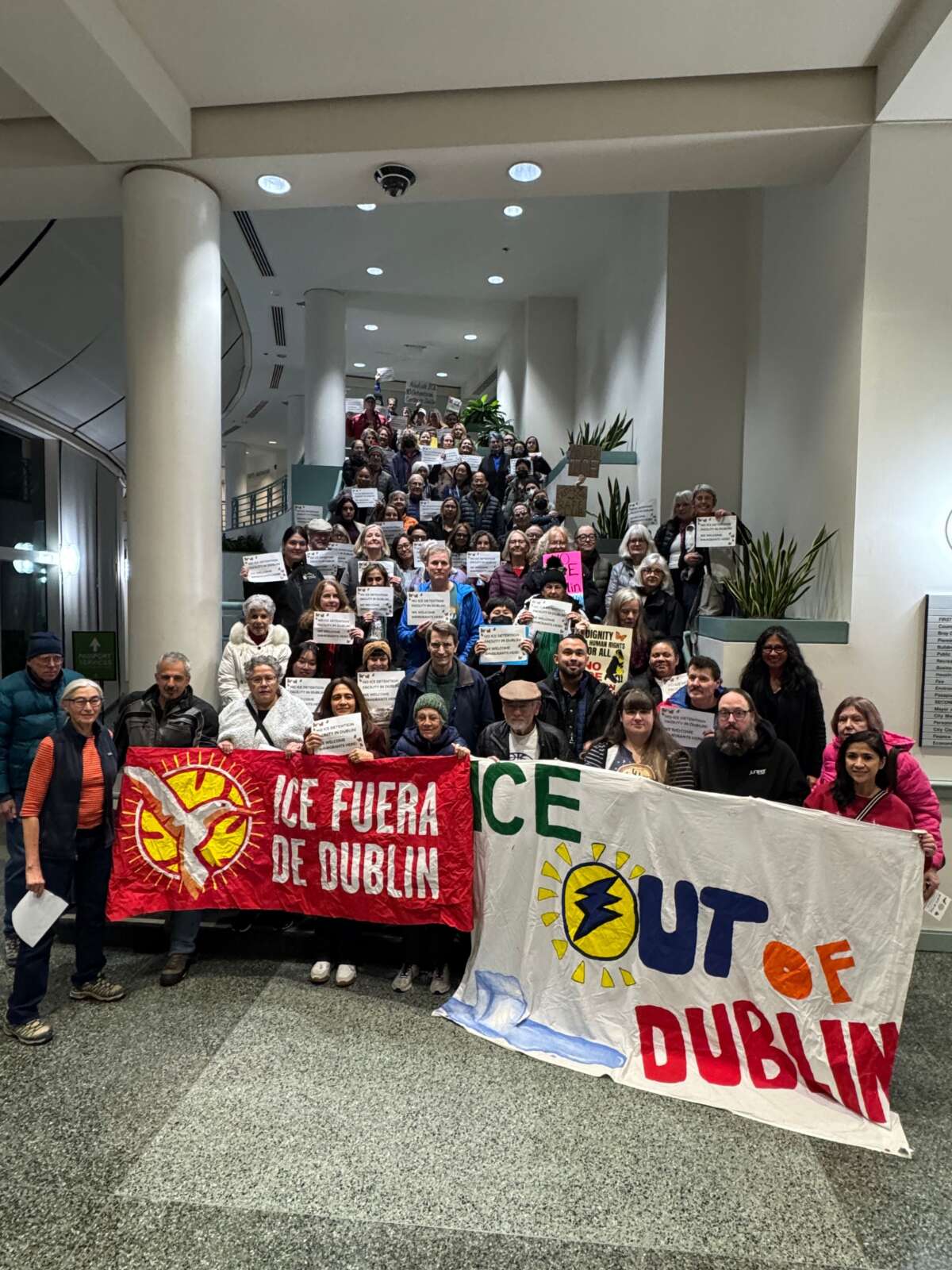
Dublin residents and immigrant justice advocates with the ICE Out of Dublin Coalition gather with signs and banners outside city hall in Dublin, California, before a city council meeting on December 16, 2025.Courtesy of the ICE Out of Dublin Coalition


Truthout’s December fundraiser is our most important of the year and will determine the scale of work we will be able to do in 2026. Please support us with a tax-deductible donation today.

On December 16, 2025, the Dublin City Council in California unanimously passed a resolution formally opposing reopening or reusing the notorious FCI Dublin prison for detention of any kind, including as an immigration jail. The resolution also urged the relevant federal agencies to “engage in open and transparent communication with the City regarding any decisions affecting the site.”

The resolution comes after months of organizing by local and regional residents and a coalition of faith-based organizations, advocacy groups, and those who were imprisoned in FCI Dublin.

That includes Darlene Baker, who was incarcerated at the Dublin federal prison camp from 2022 to 2023. There, she was sexually assaulted by then-medical officer Jeffrey Wilson.

“I suffered severe retaliation by Dublin officers and staff” for reporting the assault, she recounted in a letter to the Dublin City Council. Still, she continued to speak out. “During this time, I served as a whistleblower, forwarding details of abuse and neglect to former Congresswoman Jackie Speier who was actively investigating the ‘toxic culture’ of Dublin,” she continued.

In August 2025, Wilson and another officer pled guilty. They were the ninth and tenth staff members to be convicted of sexually abusing women imprisoned in Dublin.

Related Story

Prison Notorious for Rape Is Slated for Closure But Not Releasing Survivors
The Bureau of Prisons initially planned to empty FCI Dublin by April 19. Those inside fear being sent far from family.  By Victoria Law , Truthout April 16, 2024


As reported earlier by Truthout, FCI Dublin was abruptly shuttered in April 2024 following widespread coverage of rampant sexual abuse and the arrests of staff, from the warden and chaplain to more than half a dozen officers. In December 2024, the Bureau of Prisons (BOP) agreed to a $116 million settlement for 103 survivors, including Baker. It is the largest settlement for sexual assault survivors in U.S. prison history.

In August 2024, Immigration and Customs Enforcement (ICE) put out a request for information for available detention facilities within a two-hour commute of four urban areas in California, including San Francisco. The nearest ICE prisons are four to five hours away in Bakersfield.

In February 2025, ICE officials toured the closed prison. Since Donald Trump’s second inauguration, ICE has opened 59 new facilities and reopened 77 previously-closed sites to jail migrants.

When Baker learned that the prison, dubbed “the Rape Club” for the pervasive sexual abuse of prisoners, might be reopened as an immigrant prison, she was shocked.

“I learned the hard way while I was inside FCI Dublin Camp that the feds are not subject to the rules that the rest of us have to follow,” she wrote in an email to Truthout. “I was especially concerned about the vulnerable population of immigrants — with language difficulties, no due process, and limited access to legal assistance.”


Residents Spring Into Action


The city council resolution notes the ongoing opposition from longtime residents, county officials, medical professionals, and those whose family members have been taken by ICE.


“The frequent, ongoing protests in the Tri-Valley area have demonstrated the deep resistance felt by the public for ICE presence in Dublin and in the surrounding communities.”

“The frequent, ongoing protests in the Tri-Valley area have demonstrated the deep resistance felt by the public for ICE presence in Dublin and in the surrounding communities,” it noted.

In November, 150 people — including city residents, regional medical professionals, and advocates — rallied outside the monthly city council meeting. Nearly three dozen then filed in to voice their opposition to councilmembers. The next month, nearly 40 community members spoke in favor of the resolution before the council vote.

Brian, a Dublin resident, gives public comment in support of the resolution opposing the reopening of FCI Dublin as an immigration detention center during a packed Dublin City Council meeting on December 16, 2025.Courtesy of the ICE Out of Dublin Coalition

Dublin is located 23 miles from Oakland in the East Bay area of Alameda County, one of three counties that make up the Tri-Valley. Eighty-one percent of Dublin’s 70,500 residents are citizens although 40 percent are foreign-born.

In 2022, Detention Watch Network found that immigrants in counties with more detention beds are significantly more likely to be arrested and detained by ICE.

When news of FCI Dublin’s potential conversion spread, residents sprang into action. With ICE raids in many other cities, including Los Angeles, many fear that a migrant jail in Dublin would increase ICE presence and raids in the area, terrorizing their neighbors and community.

During the first Trump administration, area residents had formed Indivisible Tri-Valley, a regional chapter of a larger network aimed at electing progressive Democrats and defeating the MAGA agenda. After hearing about the potential conversion, the group joined ICE Out of Dublin, a coalition encompassing residents, faith-based organizations, advocacy groups, and those who were imprisoned in Dublin.

Dublin residents and immigrant justice advocates with the ICE Out of Dublin Coalition stand for a group photo with signs and banners inside city hall in Dublin, California, before a December 16 city council meeting.Courtesy of the ICE Out of Dublin Coalition

Every Saturday afternoon, Indivisible Tri-Valley members hold a vigil on Dublin Boulevard, the city’s main street. Dubbed the Dublin Peace Corner, 20 to 100 people rally with signs, flags, whistles, and horns.

They demonstrate their opposition in other ways as well. At another community gathering, members screen-printed signs that read “No ICE prison in Dublin” and “Immigrants are welcome here.” Members took those signs, along with red cards notifying people of their rights and yellow cards with hotline numbers to report ICE sightings, to local businesses, including restaurants, corner stores, and taquerias.

Indivisible Tri-Valley member Dan Morley told Truthout that more than one restaurant proprietor thanked them for their actions. “We have people back here in the kitchen who are living in fear,” they told him.

Lawmakers, too, have voiced their opposition. Representatives Mark DeSaulnier and Zoe Lofgren sent a letter to the Department of Homeland Security, the BOP, and ICE opposing any planned conversion. They highlighted the site’s insufficient infrastructure, hazardous conditions, and history of abuse of incarcerated immigrants. In April and again in November, Dublin City Manager Colleen Tribby sent a letter to BOP Director William K. Marshall III voicing the city’s opposition to repurposing the site for ICE detention and citing the well-documented health and safety hazards, including asbestos and mold.

“You Have the Power to Stop History From Repeating Itself”

The closed prison sits on federal land, exempting it from local and state zoning and permitting processes. The Dublin City Council has no power to prevent the U.S. General Services Administration (GSA) from transferring the site to ICE. But it does possess the power to pass a resolution opposing the conversion, which residents have urged them to do.

“Legally they can’t do anything more because it’s federal — not city — property,” local activist Liz Schmitt explained. Still, she continued, a resolution “would let everyone know that a detention center is not wanted here.”

At the city council’s November meeting, more than two-thirds of the 35 people who spoke were Dublin residents, ranging from high school students to grandparents. Some were the children or grandchildren of immigrants. Others had family members detained by ICE and some feared similar detentions. One resident, afraid to appear at the meeting, sent a statement with a friend. Their fear is not unfounded: three weeks earlier, ICE had taken their father. “My three-year-old sister always asks, ‘Where’s Dad?’ My mother has no answer because he was kidnapped,” they wrote.

Dublin residents raise their hands to show support for a speaker giving public comment in favor of the resolution opposing ICE detention during a December 16 Dublin City Council meeting.Courtesy of the ICE Out of Dublin Coalition

Kendra Drysdale, who was also sexually abused while incarcerated at Dublin, also testified. “I’m here tonight on behalf of all of the survivors to urge you to oppose the reopening of FCI Dublin — not by the Bureau of Prisons and not by ICE.” she said. “For hundreds of us, it was a place of abuse, retaliation and silence. Reopening it would reopen trauma that many of us are still fighting our way through.” She noted that ICE jails are rife with the same abuses, silencing, and retaliation.

Medical professionals also voiced their opposition. Jeff Wilson (a longtime Dublin resident and not the former FCI Dublin medical officer) works at Kaiser Permanente, a cancer hospital in Dublin. He showed a flyer from the hospital’s union instructing members on protecting their patients’ constitutional rights from ICE. He had supported the closing of FCI Dublin. “It’s shameful that people associate Dublin with ‘Club Rape,’” he said before adding, “I hope that Dublin doesn’t move on to become known as the City Against Human Rights.”

Douglas Yoshida is an emergency physician at Stanford Health Care Tri-Valley medical center, the nearest medical facility to the Dublin prison. His parents were teenagers when they were detained under then-President Franklin D. Roosevelt’s Executive Order 9066, which led to the imprisonment of more than 120,000 Japanese Americans.

“My parents survived these prison camps — but their experience was not a relic of history; it’s an injustice that feels all too familiar today,” he wrote in a June op-ed for the San Francisco Chronicle, comparing the ICE raids and detentions to his parents’ experiences.

Standing before the city council five months later, he added that an ICE jail “will threaten the health care of our community. We will have to admit many patients that could be treated as outpatients in the community. Furthermore, will our large immigrant community feel safe seeking care if there are armed, masked men patrolling the hospital?”

At the end of his three minutes, he told the city council, “You have the power to stop history from repeating itself.”

In late November, the Bureau of Prisons sent a brief response to the city manager’s letter: “At this time, BOP has no indication that the Department of Homeland Security’s Immigration and Customs Enforcement will utilize the facility and BOP has no plans to reopen the facility.” In December, the BOP told the City that it was planning to permanently deactivate, close, and dispose of the prison, transferring the site to the GSA. The GSA can transfer the site to ICE, allowing a migrant jail to open.


“I have a vivid memory of what it felt like to be detained, watching and experiencing the atrocities and inhumane conditions, and not really having a voice to help … I pray no other humans will have to experience this despair.”

Still, said Morley, the resolution was necessary to voice the city’s objections to an ICE prison. “It offers community members more of a sense of safety, that the city is standing up for them and supporting them. Then, the goal is to get surrounding cities to do similar resolutions because this affects the entire Bay Area and other northern California cities.”

Dublin is not the only city fighting to stop ICE from opening a migrant jail. In Leavenworth, Kansas, city leaders filed two lawsuits to prevent private prison contractor CoreCivic from opening an immigrant prison. A state court issued an injunction doing just that. And in Newport, Oregon, local residents launched a campaign against a prospective migrant jail ahead of rumors that ICE was looking into opening one in their city.

“I have a vivid memory of what it felt like to be detained, watching and experiencing the atrocities and inhumane conditions, and not really having a voice to help,” Baker wrote. “I pray no other humans will have to experience this despair.”


This article is licensed under Creative Commons (CC BY-NC-ND 4.0), and you are free to share and republish under the terms of the license.


Victoria Law

Victoria Law is a freelance journalist who focuses on incarceration, gender and resistance. Her books include Resistance Behind Bars: The Struggles of Incarcerated Women (2009), Prison by Any Other Name: The Harmful Consequences of Popular Reforms (2020), “Prisons Make Us Safer” & 20 Other Myths about Mass Incarceration (2021), and Corridors of Contagion: How the Pandemic Exposed the Cruelties of Incarceration (2024).


Iran Protests China’s Position on Disputed UAE Islands

  • China has angered Iran by backing the UAE’s call for a peaceful resolution to the long-running dispute over three strategic Gulf islands controlled by Tehran.

  • Iranian officials and media accuse Beijing of double standards.

  • The dispute strains Iran–China ties, as Beijing appears to prioritize relations with Gulf Arab states and energy security despite its strategic partnership with Tehran.


China has rattled Tehran by again backing the United Arab Emirates’s claim over three Persian Gulf islands controlled by Iran.

Following a visit to Abu Dhabi by Chinese Foreign Minister Wang Yi, the countries in a joint statement on December 13 highlighted Beijing’s “support for the efforts of the UAE to reach a peaceful solution to the dispute” over the three islands of Greater Tunb, Lesser Tunb, and Abu Musa. Notably, there is no explicit mention of Iran in the statement.

In response, Iranian Foreign Ministry spokesman Esmail Baqaei criticized the UAE’s “insistence on misusing every diplomatic delegation’s visit” to raise claims about the three islands.

The Taiwan Card

While Baqaei didn't criticize China, Iranian media have been more explicit in their assessment of Beijing's statement.

Keyhan, a hard-line newspaper whose chief editor is appointed by the supreme leader, argued that China’s support for the UAE’s claim meant that it “has implicitly accepted that its own claim over Taiwan is disputable and should be resolved through negotiations.”

Ahmad Naderi, a member of the presiding board of Iran’s conservative-leaning parliament, echoed a similar sentiment, accusing Beijing of adopting a “double standard” and saying it cannot insist on its One China policy while simultaneously questioning Iran’s territorial integrity.

In an implicit reference to Taiwan, the state-affiliated Mehr news agency said China itself considers “any mention of its territorial integrity a violation of its security red line.”

Therefore, it argued, China’s support for a statement questioning Iran’s sovereignty of the islands “is unjustifiable and cannot be ignored.”

The Islands

The controversy comes against the backdrop of a decades-old sovereignty dispute that has long tested Iran’s relations with its Gulf neighbors.

The three islands lie near the mouth of the Strait of Hormuz, a strategic chokepoint through which about one-fifth of the world’s seaborne oil passes.

Iran seized control of the islands on November 30, 1971 -- one day before the British withdrawal from the Gulf and the formation of the United Arab Emirates -- asserting historical claims that date back to the Persian Empire.

Declassified British files released in 2022 show London had agreed to transfer the Greater and Lesser Tunbs to Iran while establishing joint Iranian–Emirati administration over Abu Musa. The dispute reignited in the early 1990s when Tehran tightened its control and expanded its military footprint on Abu Musa.

Despite repeated calls from Gulf Arab states for arbitration or adjudication, Iran has consistently rejected the International Court of Justice’s jurisdiction, insisting that the islands are an inalienable part of its territory and not open to negotiation.

Iran’s strategic partners China and Russia have backed calls by Gulf Arab states on Iran to resolve the issue. Iran last year summoned both Chinese and Russian envoys separately to protest.

Centrist newspaper Jomhuri-ye Eslami, which is generally critical of closer ties with Beijing and especially Moscow, particularly targeted Iran's governments -- and the Foreign Ministry above all -- for "serious inertia and inefficiency.”

Iranian website Asia News said China’s attitude toward the islands has “raised serious doubts” over Tehran-Beijing relations despite a much-touted 25-year strategic partnership agreement.

“Beijing, in its pursuit of energy security and an expanded footprint in the Middle East, appears -- after weighing the costs and benefits -- to have placed greater emphasis on its relations with Arab countries,” it argued.

By RF/ERL


The Maritime Executive's Global Workboat Edition is Available Online

The Maritime Executive Global Workboat Edition

Published Dec 19, 2025 6:49 PM by Tony Munoz

(Article originally published in Nov/Dec 2025 edition.)


SATCOM RULES

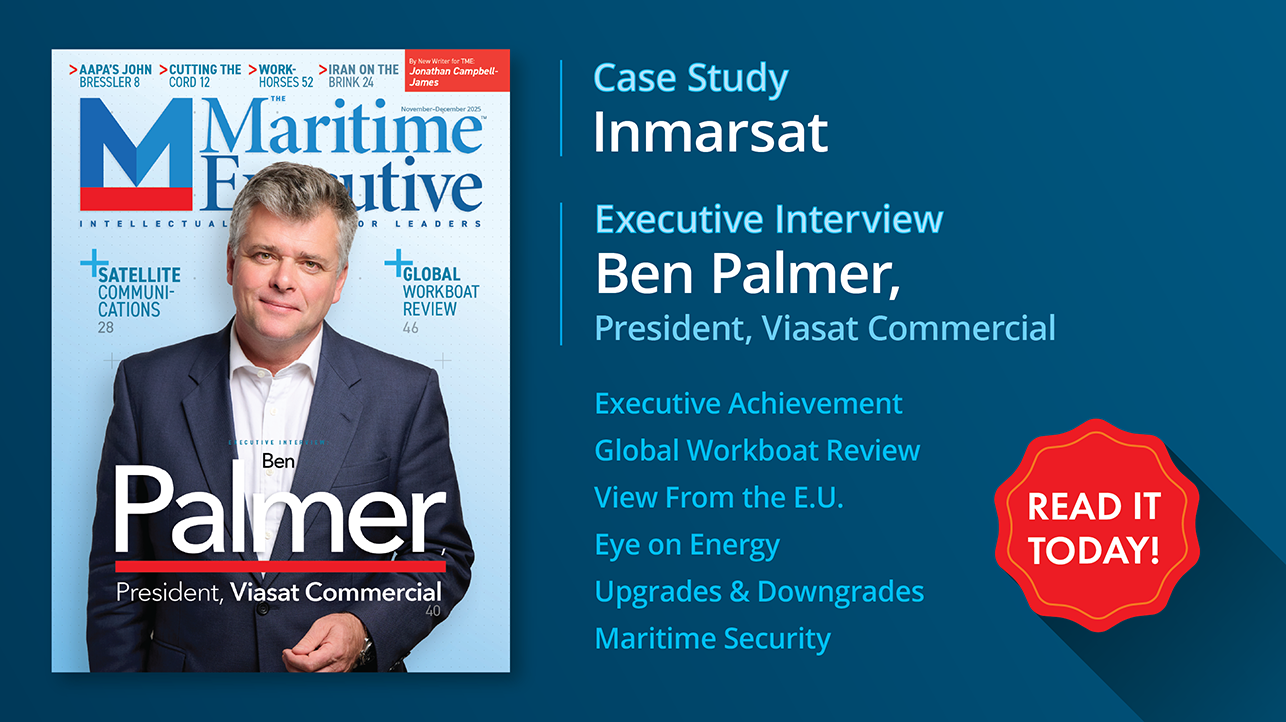
This edition's cover story features Ben Palmer, a man of many hats who helped negotiate Inmarsat's landmark merger vith Viasat two years ago and today, as the newly appointed President of Viasat Commercial, is leading the brand to new heights. Inmarsat's latest offering, NexusWave, is selling like hotcakes, combining LEO download speed with the reliability of its geostationary fleet.

Find out what comes next in our exclusive Case Study and Executive Interview profile, both authored by News Editor Paul Benecki, and not to be missed!

Continuing the satcom theme is Mia Bennett's fine overview of the major global providers, "From Sea to Sky.” Casting a wide net, she examines the many benefits of the cutting-edge sat-com products that are transporting maritime into the New Space Age.

On the geopolitical front, we're pleased to welcome a new columnist, Brigadier Jonathan Campbell-James, to our pages. Jonathan's military career took him to the Middle East where he spent many years in both government and business, excelling in every role he played. His debut column, appropriately enough, focuses on the current situation in Iran where he sees a crisis brewing along with opportunity. You won't be disappointed!

Meanwhile, Senior Editor Jack O'Connell interviewed John Bressler, Vice President of Government Relations at the American Association of Port Authorities, for his Executive Achievement article. Ports are often overlooked in this era of tariffs and shifting trade patterns, and Bressler details how they are responding and what his role is as a major lobbyist for the industry in Washington, D.C.

In his Upgrades & Downgrades column, titled “Closing Bell,” Jack looks at the past year's developments in the equity markets and their impact on some of his favorite shipping stocks. Don't miss it – he's always fun!

Our other all-star columnists, Erik Kravets and Allen Brooks, are up to their usual mischief with Erik, in “Cutting the Cord,” looking at the various forms of sabotage on the high seas, most of them involving anchors, and Allen advising the powers-that-be in Washington that "Fixing U.S. Maritime Starts With the Navy." Lots of sage advice here.

Not to be outdone, maritime expert Sean Holt does a masterful job of surveying the pros and cons of various alternative fuels in “Shifting Landscape,” while Sean Hogue analyzes the "Regulatory Turbulence” that is challenging he offshore world.

Rounding out this holiday edition are Chad Fuhrmann's eulogy to the tug-and-barge industry, aptly titled "Workhorses," and ports correspondent Tom Peters' column on how intermodal ports are adapting to the brave new world of constantly changing tariffs.

Lots of intellectual capital here to digest, so sit back and enjoy. It's been a challenging year for maritime, and next year promises much of the same. Stay tuned, and thanks for your continued readership and support! – MarEx


Tony Munoz is the Founder, Publisher and Editor-in-Chief of The Maritime Executive.

To read the latest edition of the magazine, go to The Maritime Executive November/December Global Workboat Report.  To subscribe to the magazine, please go to https://www.maritime-executive.com/subscribe.

The opinions expressed herein are the author's and not necessarily those of The Maritime Executive.

 SCI-FI-TEK GRIFT


Trump Media announces merger with fusion firm TAE Technologies


Trump Media & Technology Group - the social media firm majority-owned by US President Donald Trump - and US private fusion energy company TAE Technologies have announced an agreement to merge in a transaction valued at more than USD6 billion.
 
A rendering of TAE's sixth-generation fusion research reactor, Copernicus (Image: TAE Technologies)

Under the terms of the merger agreement, TAE and Trump Media & Technology Group (TMTG) shareholders will each own about 50% of the combined company - which will be one of the world's first publicly traded fusion companies - at closing. As part of the transaction, TMTG has agreed to provide up to USD200 million of cash to TAE at signing and an additional USD100 million is available upon initial filing of the Form S-4 registration statement. The transaction, which was approved by the boards of directors of both companies, is expected to close in mid-2026, subject to customary closing conditions, including shareholder and regulatory approvals.

In 2026, the combined company plans to site and begin construction of the world's first utility-scale fusion power plant (50 MWe), subject to required approvals. Additional fusion power plants are planned and expected to be 350–500 MWe.

TMTG Chairman and CEO Devin Nunes and TAE CEO and Director Michl Binderbauer plan to serve as co-CEOs of the combined company.

"Trump Media & Technology Group built uncancellable infrastructure to secure free expression online for Americans, and now we're taking a big step forward toward a revolutionary technology that will cement America's global energy dominance for generations," Nunes said.

"Fusion power will be the most dramatic energy breakthrough since the onset of commercial nuclear energy in the 1950s - an innovation that will lower energy prices, boost supply, ensure America's AI-supremacy, revive our manufacturing base and bolster national defence. TMTG brings the capital and public market access to quickly move TAE's proven technology to commercial viability."

Binderbauer said: "Our talented team, through its commitment and dedication to science, is poised to solve the immense global challenge of energy scarcity. At TAE, recent breakthroughs have prepared us to accelerate capital deployment to commercialise our fusion technology. We're excited to identify our first site and begin deploying this revolutionary technology that we expect to fundamentally transform America's energy supply."

Michael Schwab, founder and managing director of venture capital firm Big Sky Partners, is expected to be named Chairman of a planned nine-member board of directors. "Through my involvement with TAE over the two decades, I've watched first-hand their commitment to science and the promise of applying fusion power to help solve the world's demand for clean, abundant, affordable energy," he said. "With the infusion of TMTG's significant capital, TAE is on the precipice of scaling its leading technology to usher in a new era of energy abundance. The world needs energy, and fusion is the clear answer."

After more than 25 years of research and development, TAE says it has significantly reduced fusion reactor size, cost and complexity. TAE has built and safely operated five fusion reactors and raised more than USD1.3 billion in private capital to date, including from Google, among others.

TAE's approach to fusion combines advanced accelerator and plasma physics, and uses abundant, non-radioactive hydrogen-boron (p-B11) as a fuel source. The proprietary magnetic beam-driven field-reversed configuration (FRC) technology injects high-energy hydrogen atoms into the plasma to make the system more stable and better confined. This solution is compact and energy efficient, California-based TAE says.

For a fusion machine to produce electricity, it must keep plasma steadily confined at fusion-relevant conditions. On TAE's current fusion machine, eight powerful neutral beams are placed at precise angles to meet those requirements. Inside each neutral beam canister, protons are accelerated and then combined with electrons to create a stream of neutral, high-energy hydrogen atoms (the 'neutral beam'). Because the particles have no charge, they can bypass the fusion reactor's magnetic field to provide heating, current drive and plasma stability. TAE is the first to use neutral beams for both FRC plasma formation and high-quality plasma sustainment - which it says results in a streamlined design that is smaller, more efficient and more cost-effective.

The same accelerator technology which produced TAE's sophisticated neutral beam system for fusion has also been adapted for TAE's medical technology subsidiary, TAE Life Sciences, to provide a non-invasive, targeted treatment for complex and often inoperable cancers. TAE also has a partially-owned power subsidiary - TAE Power Solutions - which has developed innovative energy storage and power delivery systems to serve multiple industries, including AI data centres, industrial users, and electric vehicles.