It’s possible that I shall make an ass of myself. But in that case one can always get out of it with a little dialectic. I have, of course, so worded my proposition as to be right either way (K.Marx, Letter to F.Engels on the Indian Mutiny)
Sunday, December 21, 2025
SpaceX Is Buying Up an Unfathomable Number of Cybertrucks
Victor Tangermann Sat, December 20, 2025 FUTURISM
SpaceX bought over 1,000 Cybertrucks from Tesla, a number that could rise to 2,000 over time, according to Electrek.
Despite a pessimistic sales forecast, Tesla’s shares have skyrocketed and are up almost 50 percent over the last six months — showing yet again how the company’s $1.5 trillion market cap is largely untethered from the success of its core business.
But that hasn’t stopped Tesla CEO Elon Musk from seemingly putting his thumb on the scales. As an insider source told Electrek, the billionaire’s space company SpaceX has bought over 1,000 Cybertrucks from Tesla, a number that could rise to 2,000 over time.
In other words, one of Musk’s other companies has allegedly spent north of $100 million on Teslas that it’s hard to imagine it finding a use for — and in what looks an awful lot like an embarrassing ploy to save face for the EV maker.
A video circulating on Musk’s social media platform, X, shows an enormous number of Cybertrucks parked outside of SpaceX’s facilities in South Texas.
Considering the pickup EV has been an enormous commercial flop, only selling barely a fraction of Musk’s promised 250,000 to 500,000 Cybertrucks a year, there’s a good chance Tesla is using the mercurial CEO’s other venture to boost the numbers ahead of the end of an otherwise disastrous year.
As Musk continues to alienate his customers following his embrace of far-right ideologies, the company is struggling to close sales. Tesla’s US sales dropped to a nearly four-year low in November, as Reuters reported last week. A cheaper, stripped-down version of its Model Y SUV failed to reverse the downward trend.
According to registration data, the company sold just 5,385 Cybertrucks in the US in Q3, a precipitous drop of 62 percent compared to the same period last year.
Nonetheless, Musk is adamant that the truck is a success story, tweeting earlier this month that it’s an “incredible vehicle” and “our best ever from Tesla.”
How committed the EV maker still is to producing the stainless steel monstrosity remains to be seen. Musk has been trying to transition Tesla away from selling traditional vehicles, doubling down on a robotaxi service and humanoid robots instead.
In the meantime, Tesla’s core business is looking worse for wear. Beyond drying up demand, the company is facing fresh regulatory headwinds, with California threatening the company with a 30-day car sales ban in the state for misleading its customers with the term “Autopilot.”
Despite its erroneous marketing terms, Tesla vehicles — at least the ones being sold to the public — are not able to fully drive themselves, and require the driver to be able to take over control at any time.
Elon Musk Calls Cybertruck Tesla's 'Best Ever' — But Sales Say Otherwise
Badar Shaikh December 8, 2025 Benzinga and Yahoo Finance LLC
Tesla Inc. (NASDAQ:TSLA) CEO Elon Musk has touted the company's controversial Cybertruck as the best-ever Tesla, but the sales data tells a different story about the Cybertruck's successes (or lack thereof).
Cybertruck Is An ‘Incredible' Vehicle, Elon Musk Says
Musk took to the social media platform X on Thursday to express his thoughts on the truck, calling it an "incredible" vehicle. "Our best ever from Tesla," Musk said, as he quoted a post that showcased the Cybertruck's ability to operate in sub-zero temperatures and gas savings compared to traditional ICE-powered pickup trucks. Tesla's Cybertruck Woes
Despite Musk's claims, SpaceX and xAI stepping in to buy the trucks, as well as Twitter (now X) founder Jack Dorsey backing the EV pickup truck, the Cybertruck has fared poorly in terms of sales, failing to translate the hype into units sold off the EV giant's showroom lots. Tesla, in Q3 2025, sold just 5,385 Cybertruck units in the U.S., representing a 62.6% YoY decline.
Recent reports also suggest that Tesla could be sitting on tens of thousands of unsold units of the truck, as the automaker also discontinued the affordable RWD Long-Range version of the pickup, which retailed for $69,990 in the U.S. just five months after launching the trim level.
The company also tried a shift in marketing strategy to help accelerate sales growth, positioning it as a rugged, lifestyle vehicle, but it hasn't helped boost adoption among customers. Tesla also recently issued a recall for the Cybertruck, recalling 6,197 units of the vehicle due to a lightbar issue.
Cybertruck's Polarizing Design, Lawsuits
Another aspect of the truck is its polarizing design, which, according to investor Gary Black of the Future Fund LLC, holds the product back from selling. Meanwhile, Ross Gerber, co-founder of Gerber Kawasaki, who owns a Cybertruck himself, opined that Tesla should discontinue the pickup amid poor sales.
However, the design has also resulted in lawsuits, with parents of 19-year-old Krysta Tsukahara filing a wrongful death lawsuit against the automaker for an accident in November 2024.
The parents allege that Tsukahara was trapped inside the flaming vehicle due to the Cybertruck's electronic door system. The flush door handles have been a point of contention among safety experts. Musk's Million Bookings Claim
When it was showcased and bookings opened, Musk claimed that there were more than a million bookings for the Cybertruck. However, the company has, to date, sold approximately 57,000 units, with over 16,097 units sold in the first three quarters of 2025 so far, according to Kelley Blue Book data.
Tesla, earlier this year, began accepting Cybertruck trade-ins, offering close to $65,400 for an All-wheel-drive 2024 version, which was available at $100,000 at launch, representing a 34% decline in value.
Falling EV Demand
However, a broader look at the market would show that, besides the Cybertruck's poor performance, demand for EVs has fallen since President Donald Trump took office earlier this year.
The administration has made a series of anti-EV decisions, like the ending of the $7,500 Federal EV Credit and the recent relaxation of Corporate Average Fuel Economy norms, which have affected EV demand.
Ford Motor Co. (NYSE:F) recently paused production of the F-150 Lightning EV Pickup truck, and is reportedly considering scrapping the production altogether. Interestingly, the pickup is the best-selling EV pickup truck in the U.S. The company's EV sales also fell by over 60% in November.
General Motors Co. (NYSE:GM), too, scaled back on EV production as it laid off close to 3,400 workers across multiple EV facilities, as the company, during its third-quarter earnings call, announced it took on a $1.6 billion charge related to EVs.
Photo courtesy: Shutterstock
Morgan Stanley seen as front-runner for SpaceX IPO, sources say
Echo Wang, Joey Roulette and Milana Vinn Fri, December 19, 2025
NEW YORK, Dec 19 (Reuters) - Morgan Stanley is emerging as a leading contender for a key role in SpaceX's blockbuster initial public offering, as the bank's close ties to CEO Elon Musk give it an edge in his decision, according to three people familiar with the matter.
How large could SpaceX's IPO potentially be?
What are SpaceX's plans for the IPO proceeds?
Why is Morgan Stanley favored for SpaceX IPO?
What changed Musk's thinking about going public?
A selection process, or "bake-off," for the IPO is still underway, with a select group of banks, including Morgan Stanley, Goldman Sachs and JPMorgan, vying for roles, four people familiar with the matter said, adding that there is no certainty Morgan Stanley will secure the coveted "lead left" underwriting position, the sources said.
Musk's ties to Morgan Stanley run deep, dating back at least 15 years, leaving it widely viewed as the leading contender to run the syndicate of underwriters, three of the people said, though no banks have been selected yet and the discussions remain fluid.
The sources spoke on condition of anonymity because the discussions are confidential. Morgan Stanley, Goldman Sachs and JPMorgan declined to comment, while SpaceX did not respond to a request for comment.
SpaceX is one of the world’s largest private companies and its potential IPO would be highly complex.
While Musk has not yet picked the lead banks, a decision could come before the end of the year, with the full syndicate likely to be finalized afterward, two of the people added.
The people cautioned that while plans are progressing, the IPO remains contingent on market conditions, and SpaceX could choose to delay or abandon the offering altogether.
Morgan Stanley, which has advised Musk for years, was among the banks that took Tesla public in 2010, alongside Goldman Sachs, the lead left, JPMorgan and Deutsche Bank. Morgan Stanley later advised Musk and led the financing for his 2022 acquisition of Twitter, now X.
Musk recently tapped one of his Morgan Stanley bankers on that deal, Anthony Armstrong, to become chief financial officer of his artificial intelligence venture xAI.
The connection runs even deeper through Musk’s family office in Austin, Texas. Another former Morgan Stanley banker who advised Musk on various Wall Street dealings over the years, Jared Birchall, built and runs Excession, which manages his personal assets, Reuters previously reported.
STAFF MEMO
In a staff memo sent last week, SpaceX Chief Financial Officer Bret Johnsen informed staff that the company was preparing for a public offering in 2026.
"Whether it actually happens, when it happens, and at what valuation are still highly uncertain, but the thinking is that if we execute brilliantly and the markets cooperate, a public offering could raise a significant amount of capital," Johnsen wrote.
Reuters has previously reported that SpaceX is seeking to raise more than $25 billion in an IPO that could come next year, a sum that would make it one of the biggest public listings ever globally.
The decision to go public caught some by surprise, given SpaceX's status as one of the world's largest private companies.
While Musk has long expressed a preference for keeping SpaceX private, people familiar with his thinking indicated that the company’s growing valuation and the success of its Starlink satellite-internet service have prompted a shift in strategy.
SpaceX, long known for its dominant rocket launch business, has become the world's largest satellite operator through Starlink, a network of nearly 10,000 satellites beaming broadband internet to consumers, governments and enterprise customers.
While there had been previous speculation about Starlink going public on its own, these people say the IPO could include both businesses, though the plans remain subject to change.
AI FUELS NEED FOR CAPITAL
SpaceX, Johnsen wrote in his email, would use the capital raised from an IPO to increase the flight rate of its next-generation Starship rocket under development and deploy AI data centers in space, an effort complementary to its Starlink business that would more closely tie the company to the AI boom.
The company would also build "Moonbase Alpha," a base on the lunar surface that Musk has mentioned. SpaceX is a core contractor in NASA's Artemis moon program with a $4 billion contract to land astronauts on the lunar surface using Starship.
Sending humans and robots to Mars has been Musk's long-held vision for SpaceX, with revenues from Starlink contributing to development of Starship, which is also envisioned to serve as a Mars transportation system.
Musk, during his stint as a government efficiency czar with U.S. President Donald Trump, had pushed for a greater American focus on Mars and advocated for a former associate, Jared Isaacman, to lead NASA. Isaacman became NASA chief on Tuesday.
Starlink remains SpaceX's top revenue-generating business. The company is expanding the satellite network into the wireless market with Starlink Mobile, which it trademarked in October.
(Reporting by Echo Wang and Milana Vinn in New York and Joey Roulette in Washington; Editing by Dawn Kopecki, Jamie Freed and Nick Zieminski)
Elon Musk's SpaceX Could Be Preparing for a Huge IPO. Here's What to Know.
Colin Laidley Mon, December 15, 2025
Paul Hennessy / SOPA Images / LightRocket via Getty Images
Musk’s SpaceX is reportedly hearing pitches from investment banks interested in advising on an IPO.
Key Takeaways
Elon Musk's SpaceX is reportedly hearing pitches from investment banks this week as the space exploration company considers going public in what could be the largest IPO to date.
Next year could be a big one for IPOs: AI startups OpenAI and Anthropic are among the other private companies reportedly exploring going public next year.
Wall Street may be headed for a year of blockbuster IPOs in 2026. And a company led by Elon Musk could be leading the way.
Musk’s SpaceX is reportedly hearing pitches this week from investment banks interested in advising on what could be the largest initial public offering in history, The Wall Street Journal reported on Monday. That news advanced reports that the space exploration company was considering going public from last week, when Bloomberg said SpaceX is targeting a mid-to-late 2026 IPO that would raise $30 billion and value the company at about $1.5 trillion, among the biggest companies in the S&P 500.
If SpaceX hits its IPO targets, it would surpass Saudi Aramco, the Saudi state-owned oil company, as the largest debut in history. Aramco raised about $29 billion when it went public in 2019. (SpaceX is reportedly in the process of buying insider shares at a price that values it at $800 billion, double its valuation from this summer.) The company didn't respond to Investopedia's request for comment in time for publication.
Why This Is Important
IPO activity often reflects the prevailing mood on Wall Street, with listings rising when optimism is high and vice versa. The IPO market began to return to normal in 2025 after years of being pressured by high interest rates.
SpaceX stock can't be traded yet, but some market watchers are already betting on a big response from investors when it can. Saudi Aramco debuted with a market capitalization of nearly $1.9 trillion; users of online prediction market Polymarket on Monday put the chance of SpaceX's market cap finishing its first day of trading above $2 trillion at about 14%.
A listing of that size would make SpaceX founder and CEO Elon Musk, already the world's richest person, even wealthier. Musk's SpaceX stake accounts for more than a quarter of his $470 billion fortune, according to Bloomberg, which estimates that he owns about 42% of the company. Holding a stake anywhere close to that size when SpaceX goes public could make Musk the world's first trillionaire far earlier than some thought possible.
Musk has for years said he has no interest in taking SpaceX public, which he worried would derail his plans to facilitate the colonization of Mars. But he and others have lately discussed the notion that insufficient electricity is restraining the AI boom, and that sending data centers into space, where they can draw on solar energy, could help.
Musk last week called “accurate” a report that SpaceX was considering going public to fund efforts to develop orbital data center technology. SpaceX has reportedly floated the idea of using Starlink satellites to host AI workloads as part of its recent pitch to investors.
SpaceX is one of several massive companies considering a public offering next year. ChatGPT maker OpenAI, valued at $500 billion in October, has reportedly discussed a public offering with bankers. Competitor Anthropic is reportedly preparing for an IPO, according to the Financial Times, which also reported the company was targeting a $300 billion valuation in a funding round. Data software company Databricks, TikTok parent ByteDance and fintech Stripe are also rumored to be exploring IPOs next year.
Investors have been waiting years for the return of IPOs. Hundreds of companies went public via IPO or SPAC merger in 2021, spurred by post-pandemic liquidity and rock-bottom interest rates. Activity fell off a cliff in 2022 when the Federal Reserve began raising rates to address soaring inflation. The IPO market stayed cold until this year, when activity has finally picked back up, albeit at a more modest pace than during the pandemic bonanza
SpaceX’s Lofty IPO Valuation Hinges on Big Bet on Outsize Growth
Bailey Lipschultz, Sana Pashankar and Loren Grush December 11, 2025
(Bloomberg) -- To buy into SpaceX’s audacious $1.5 trillion valuation in a listing next year, investors will need to have faith in Elon Musk’s equally galactic vision for his rocket and satellite maker, from orbital data centers to lunar factories to human settlements on Mars.
SpaceX is planning an initial public offering that may be the world’s biggest ever. Its revenue is forecast to be between $22 billion to $24 billion in 2026, largely fueled by its Starlink satellite-internet unit, according to people familiar with the matter.
Photographer: Joe Raedle/Getty Images
At that level, the proposed IPO valuation would clock in at an eye-popping 62.5 times sales. Of listed firms with similar characteristics, only Palantir Technologies Inc. comes close, at about 70 times.
The near-term investment case is that Starlink and a nascent mobile phone service fueled by its acquisition of spectrum from EchoStar Corp. provide the foundation for the outsize growth that IPO buyers will demand.
Musk’s plan, and the driving force behind his decision to pursue a faster-than-expected IPO, is much grander: orbital artificial intelligence data centers forming a distributed network in space. Musk appeared to endorse this vision, as well as Starship rockets bringing humans to settlements on Mars, and the futuristic notion of satellite factories on the moon, in a post on X late on Wednesday.
SpaceX’s IPO, then, is a bet on owning vast swaths of the space economy through the convergence of AI, robots and travel.
Will investors buy it? Skeptics aren’t hard to find. But to a number of observers, the combination of the near-term potential and Musk’s long-term outlook is irresistible and will catapult SpaceX into the realm of the “Magnificent Seven” companies like Nvidia Corp. and Microsoft Corp.
“This is an N of 1 company with limited to no real competition from the Mag 7 and it will likely have the biggest retail bid of all time,” said Jeremy Abelson, founder and portfolio manager at Irving Investors, whose firm is an investor in SpaceX. “The valuation will not, and does not need to, make sense when it comes public.”
Crown Jewel
A critical aspect of pitching a valuation north of $1 trillion in 2026 is the company’s current crown jewel: Starlink.
There could be more than one billion Starlink subscribers in 2040, Morgan Stanley’s analysts estimated in October, with the unit potentially accounting for nearly three-quarters of SpaceX’s roughly $122 billion in projected sales by that time.
The fast-growing unit makes up the majority of SpaceX’s current sales, and its potential as a mobile network provider is already setting it up to take on a legacy industry similar to how Musk’s Tesla Inc. tackled the auto business.
The company has a partnership with T-Mobile US Inc. to provide satellite service to cell phone users in remote areas. It is set to increase its direct-to-mobile capacity by more than 100 times thanks in part to spectrum deals struck with EchoStar earlier this year, enabling full 5G cellular connectivity, Morgan Stanley analysts led by Adam Jonas, a long-time Musk bull, wrote in September.
The amount of spectrum in the EchoStar transaction wouldn’t be enough to provide a disruptive, competitive mobile service, Citigroup Inc. analyst Michael Rollins said in September.
For now, Starlink’s ambition to cross-sell existing carriers would offer lucrative sales opportunities without the investment burden of competing with them directly, according to Morgan Stanley.
Eventually, Starlink could “theoretically beam into every cell phone on planet Earth,” resulting in an “almost an unlimited total addressable market,” said Ali Javaheri, an emerging technology analyst at PitchBook, in an interview.
Investors are similarly bullish on the company’s near-monopoly on the business of sending things to space, counting NASA and the US Department of Defense among its customers. Even AST SpaceMobile Inc., an upstart rival to Starlink, relies on SpaceX’s Falcon 9 rockets to get its satellites in orbit.
Despite that dominance, Morgan Stanley believes launch will account for less revenue in the coming decades. The company’s developmental Starship rocket will eventually take the baton for launches from the Falcon 9. Musk promises it will do everything from launching satellites to shuttling people to the moon — which NASA has awarded SpaceX contracts worth roughly $4 billion to do.
SpaceX’s current dominance of internet from low-Earth orbit and the launch business, paired with dreams of data centers in space and frequent trips to Mars, could make the timing of an IPO “as good as it gets,” according to Bloomberg Intelligence analyst George Ferguson.
That’s not necessarily an endorsement.
Frothy Market
Ferguson expects competition to grow, and pointed to Blue Origin LLC, the company founded and bankrolled by Amazon.com Inc. founder Jeff Bezos, among the companies that could see success in the coming years to close the gap.
By that logic, there’s no time like the present for a public listing.
“The more you sit on it, the more other companies can build, have success launching into space, and the less people will value you as if you’re a one of a kind company,” Ferguson said in an interview.
SpaceX’s leadership in space, in an environment where “valuation sensitivity is not high,” means the company will have “a significant amount of latitude” to live up to expectations as a publicly listed company, said Evelyn Chow, portfolio manager of Neuberger Berman’s Next-Gen Space Economy strategy.
It would need a lot.
A massive IPO is designed to fund the development of Musk’s plan for space-based data centers, as Bloomberg reported. That wouldn’t assuage practical concerns raised by Morgan Stanley analysts, who caveated the list of potential benefits such as the low temperatures in space and abundant solar power, with challenges that include maintenance in orbit and radiation requiring specialized hardware.
Market timing could also work against a listing, especially if institutional investor concern around potential overspending on AI gets more serious.
Aviation analyst Rob Stallard sees SpaceX’s IPO calculation as a “sure sign that the equity market is frothy.” With its expected $15 billion in sales this year, a $1.5 trillion valuation would add up to “a mere” 100 times revenue, Stallard said.
Even at the $800 billion valuation being weighed in SpaceX’s latest insider share sale, the company would be larger than the combined market caps of the six largest US defense firms, and would trail just 12 members of the S&P 500 Index, Morgan Stanley said.
“Valuation is subjective, unless you’ve got a voting public that determines your price,” said Chris Quilty, co-CEO and president of Quilty Space, a space research firm. While SpaceX’s board is nominally choosing the target, “In essence, one person, Elon Musk, could set that valuation.”
Indeed, as with all of his ventures, valuation discussions ultimately lead back to the founder himself. Some see it as the ultimate key man risk; PitchBook’s Javaheri called Musk’s track record of building successful companies the “Elon premium”.
Regardless of the sum-of-the-parts model analysts use to estimate the fair value for SpaceX, the lack of direct rivals — and the Elon factor — will make any valuation “hard for investors to wrap their heads around,” according to Irving Investors’ Abelson. That ambiguity can work to the company’s advantage.
“What better time to go to market with this, at a time when you don’t know if data centers in space work, you don’t know if you can mine the moon, a trip to Mars seems possible?” said Bloomberg Intelligence’s Ferguson.
“There’s no better time than now, when there are all of these possibilities.”
Elon Musk's SpaceX to raise over $25 billion in blockbuster 2026 IPO, source says
REUTERS December 10, 2025 By Echo Wang, Manya Saini and Juby Babu
Dec 10 (Reuters) - Elon Musk's SpaceX is looking to raise more than $25 billion through an initial public offering in 2026, a move that could boost the rocket-maker's valuation to over $1 trillion, a person familiar with the matter told Reuters on Tuesday.
The company's move towards a public listing, which could rank among the largest global IPOs, has been largely driven by the rapid expansion of its Starlink satellite internet business, including plans for direct-to-mobile service and progress in its Starship rocket program for moon and Mars missions.
SpaceX has started discussions with banks about launching the offering around June or July, the person said, requesting anonymity to discuss confidential information.
The company did not immediately respond to a Reuters request for comment.
Talks over a listing plan are unfolding against the backdrop of a resurgence in the IPO market in 2025 after a three-year dry spell.
Wall Street's top executives expect the momentum to carry into 2026, turbocharged by a pipeline of high-profile companies preparing to test investor demand.
"SpaceX represents one of the most exciting opportunities in the global IPO market and has been on the dream-list of several investors for years," Samuel Kerr, head of equity capital markets at Mergermarket told Reuters.
"It is a genuine growth industry, with space technology seen as a key frontier in both defense, satellite proliferation and in tech infrastructure in general the growth of orbital data centers."
BLOCKBUSTER LISTING
Several big startups have stayed private for longer and continued to raise capital in private markets, and a listing from a company like SpaceX could prompt more of them to move toward public offerings.
SpaceX ranks as the world's second most-valuable private startup after ChatGPT maker OpenAI, according to data from Crunchbase. OpenAI and rival Anthropic are also reportedly in talks for an IPO next year.
"If all these deals come through the U.S. IPO market will experience a genuine revival, the green shoots of which have already been seen this year," Kerr said.
The news of the potential IPO comes days after a media report that said SpaceX is kicking off a secondary share sale that would value the rocket-maker at $800 billion. However, Musk dismissed the report, calling it inaccurate.
Saudi Aramco is the only completed IPO to achieve a more than $1 trillion valuation. The state-owned petroleum and natural gas giant debuted in December 2019 with an estimated market capitalization of $1.7 trillion.
SpaceX expects to use funds from the public listing to develop space-based data centers, including purchasing the chips required to run them, according to Bloomberg News, which was first to report the potential terms of the offering.
SPACE RACE
Several billionaires and private firms are fueling a new space race in the U.S., pouring money into rockets, satellites and lunar missions, including SpaceX and Jeff Bezos' Blue Origin.
With NASA relying more on commercial partnerships and defense spending rising, the space industry is becoming a high-stakes arena for technological dominance, national security and economic opportunity.
Still, questions about Musk's ability to run multiple listed companies valued at more than $1 trillion could keep investors cautious, analysts said.
"SpaceX could be one of the most divisive stocks to join the market in years," Dan Coatsworth, head of markets at AJ Bell told Reuters.
"If SpaceX did float, expect growing pressure on Musk to commit to only one of his listed entities – Tesla or SpaceX. It's hard to see how one individual could run two $1 trillion+ companies at the same time."
(Reporting by Echo Wang in New York, Juby Babu in Mexico City and Manya Saini in Bengaluru; Editing by Maju Samuel and Arun Koyyur)
Elon Musk reportedly plans massive IPO for SpaceX. Here’s what that means
Chris Isidore, Jackie Wattles, CNN December 10, 2025
Elon Musk is reportedly considering a public offering for SpaceX. - Evelyn Hockstein/Reuters
Elon Musk, already the world’s richest man, could soon be much richer. Bloomberg reports he’s planning one of the largest initial public offerings in history for SpaceX.
Musk’s space company plans to raise $30 billion next year, Bloomberg reported, and an IPO could value the company at up to $1.5 trillion. SpaceX did not respond to a request for comment on the report.
SpaceX has not had any trouble raising money despite being privately-held. But the ability to sell public shares could increase the cash flow into a company with ambitious, and exorbitantly expensive, plans.
A Wall Street debut would give Musk the added benefit of increasing his already massive wealth. However, it would also bring outside scrutiny to how SpaceX conducts business, something that has rankled Musk during his time running Tesla. What does Elon Musk stand to gain?
The money raised would go to the company, not to Musk. But given that he reportedly owns nearly half the company’s shares, it would significantly increase his net worth.
A publicly-traded SpaceX means Musk could more easily borrow against the value of his stake in the company, as he has with his Tesla holdings. That frees up tax-free cash for his various endeavors.
According to Bloomberg’s Billionaire Tracker, Musk currently has a net worth of $461 billion with most of that due to his Tesla shares and options. If SpaceX is worth $1.5 trillion, that net worth could more than double, according to Bloomberg. Why does it need to go public?
SpaceX is at an inflection point. It has cornered most of the market for astronaut and satellite launches. And its constellation of Starlink microsatellites has turned the company into a major internet service provider.
SpaceX's heavy Starship rocket makes a test flight in October. - Eric Gay/AP
More capital could help the company reach its more ambitious goals. (Even if its ultimate goal, a colony on Mars, proves to be technologically and economically prohibitive.)
SpaceX’s next generation of heavy rocket, dubbed “Starship” by the company, is a radical new approach to reaching outer space. But its still in development – and the rocket has suffered a number of mishaps and explosions during testing that have cast doubt on Musk’s ambitious timelines.
Going public would also allow current investors to cash out their stake in the company at a profit.
Who is invested in SpaceX?
SpaceX’s business has drawn a wide spectrum of major investors, including Google parent Alphabet, financial giants such as Fidelity Investments, and prominent venture capital firms such as the Founders Fund, Sequoia Capital, Valor Equity Partners, and Andreessen Horowitz.
The company has raised $10 billion in funding already, according to Pitchbook. And any time it’s raised funds, it’s had more people clamoring to give it money than it needs. Why is SpaceX believed to be so valuable?
Unlike most other space companies, SpaceX has a positive cash flow, according to the most recent tweets from Musk.
Musk said the Starlink business provides most of the company’s current revenue. But it also has multibillion-dollar contracts to service the International Space Station as well as carry astronauts to the moon under NASA’s program.
Starship has suffered several explosive setbacks during uncrewed test flights in 2025. However, if successful, Starship is expected to underpin SpaceX’s Mars ambitions, which include establishing a permanent settlement on the planet. Starship could also slash the price of carrying a kilogram of cargo to space by orders of magnitude. Are there drawbacks to going public?
Yes. And no one has been more focused on those downsides than Musk.
Going public could put investor pressure on the company’s capital-intensive plans, which might not produce a return on any investment for years to come, if at all.
It also means greater oversight from the public, and scrutiny from regulators such as the Security and Exchange Commission, which Musk has battled with in the past. This is evident in how he’s responded to scrutiny of Tesla. In 2018, Musk proposed taking Tesla private once again, a move he eventually abandoned.
Musk has also regularly battled some investor groups. That includes analysts and short sellers (who make money by betting a stock will decline) as well with firms that advise institutional shareholders. He recently called such research firms “corporate terrorists.”
Elon Musk, the CEO of Tesla (TSLA, Financials) and SpaceX, has confirmed what many investors have been wondering about for months: SpaceX is indeed moving toward an IPO. The acknowledgement came casually on X, where Musk replied to a post from Ars Technica's Eric Berger with, As usual, Eric is accurate. With that short comment, he essentially gave the strongest signal yet that the company is laying the groundwork to go public.
Musk didn't commit to a date, but the consensus view points to 2026. SpaceX's momentum from Starlink's expanding subscriber base to ongoing Starship development has only fueled expectations that the company could debut with a massive valuation. Some analysts think it could eventually reach the trillion-dollar mark, thanks to recurring revenue from satellite broadband and the growing demand for space infrastructure.
Musk also said that he is looking at options for Tesla stockholders to buy SpaceX shares when it goes public. The details aren't apparent yet, but the statement makes it seem like he's thinking about ways to thank long-time investors who have backed him in a number of businesses.
Now that Musk has publicly confirmed the plan, the attention switches to time and structure. Will SpaceX's public debut change the space sector in the same way that Tesla's debut changed the electric vehicle market.
Elon Musk once promised that SpaceX wouldn’t go public until it delivered humans to Mars (lest pesky shareholders prioritize short-term profits over the long-term project of Martian colonization). The Red Planet must be within shouting distance, judging by the financial buzz. No, turns out it’s a lot easier to land on the S&P 500 these days than on Mars, so why wait?
On Wednesday, Bloomberg reported that Musk’s aerospace company is moving ahead with plans to raise $30 billion for an initial public offering at an out-of-this-world valuation of $1.5 trillion, with a countdown clock set for mid- to late 2026. And while it may not be on course for Mars, the SpaceX rocket ship might yet deliver next year’s IPO market to a whole new stratosphere.
Reach For The Stars
SpaceX’s potential monster IPO would come after what has been a remarkable rebound year for public listings. Per another Bloomberg analysis published Wednesday, US IPO volume (not including SPACs and closed-end funds) is set to surpass $40 billion this year once medical supply company MedLine prices its IPO next week, easily besting last year’s total. Dealmakers on Wall Street are already preparing for an even bigger 2026. “The velocity of IPO pitch activity is overwhelming, in a good way, across every industry,” Jim Cooney, Bank of America’s head of Americas equity capital markets, told Bloomberg.
Already likely on deck for next year are names such as defense contractor York Space Systems and insurance firm Ethos Technologies, as well as crypto exchange Kraken and construction rental company EquipmentShare. But those names would be easily eclipsed by SpaceX, officially the world’s most valuable private company once again after a recent secondary share sale that valued the company at $800 million. And it may be one of a handful of shooting stars to go public next year:
Joining SpaceX, of course, might be the world’s second-most-valuable private company, OpenAI, which is similarly eying a $1 trillion valuation. (The difference between SpaceX and OpenAI? SpaceX claims to have been cash flow positive for several years now.)
Other “centicorns,” or private companies valued at $100 billion or more, possibly making public market debuts next year include Anthropic, ByteDance, DataBricks and Stripe; for reference, the median market cap of an S&P 500 company is about $40 billion. Per Bloomberg calculations, Wall Street could soon usher some $2.9 trillion worth of private companies into public markets.
Two Tickets to Paradise: While Musk may not have a ticket to Mars yet, a SpaceX IPO would be a second ticket to becoming the world’s first trillionaire. The first, of course, is Musk’s recently secured and first-of-its-kind 12-figure pay package at Tesla, which requires the company to reach some moonshot sales goals. Take it as a valuable lesson: Shoot for the moon, twice if you can, for even if you miss, you’ll land atop the Bloomberg Billionaires Index.
Quartz · Photo by Paul Hennesy/Anadolu via Getty Images
Shannon Carroll December 10, 2025
Elon Musk is getting ready to see how much public investors will pay for his literal moonshots.
SpaceX is working toward a mid- to late-2026 IPO that, according to Bloomberg, could raise significantly more than $30 billion at a valuation of about $1.5 trillion. If bankers hit those numbers, it would be the biggest stock-market debut on record, leapfrogging Saudi Aramco’s roughly $29 billion listing in 2019 and dropping a rocket company straight into the same valuation airspace as Meta or Amazon.
The deal would bring the entire SpaceX machine — rockets, Starlink satellites, a growing defense business, plus a slate of off-world infrastructure projects — onto public markets in one shot, not just the Starlink unit Musk once dangled as a standalone IPO after its cash flow turned “predictable.” Analysts and bankers are modeling revenue of around $15 billion in 2025 and $22 billion to $24 billion in 2026, with Starlink doing most of the work, which means investors would be paying something like 60 to 70 times next year’s sales for a company that still blows up prototypes on livestreams.
SpaceX’s pitch is that this is no ordinary industrial listing. A chunk of the IPO cash is reportedly earmarked for space-based data centers and the chips to run them — essentially turning low-Earth orbit into a cloud region — on top of funding Starship, more Starlink launches, and presumably some classified work that keeps the Pentagon on speed dial. All of that makes for a seductive growth story if you believe in off-planet infrastructure... and a very expensive science project if you don’t.
In 2013, Musk told his social media followers there were “no near term plans” to IPO SpaceX and that any listing was “only possible in [the] very long term when Mars Colonial Transporter is flying regularly.” Five years later, company president Gwynne Shotwell was still saying, “We can’t go public until we’re flying regularly to Mars.” Well, then.
Private markets have been rehearsing this moment for a while. A tender offer in late 2023 valued SpaceX at about $175 billion; by the end of 2024, an insider share sale had pushed that figure to roughly $350 billion, making it — at the time — the world’s most valuable startup on paper. (OpenAI briefly leapfrogged SpaceX.) The Wall Street Journal then reported talks around a secondary sale at an $800 billion valuation, which would have made SpaceX the most richly priced private company in the U.S.; Musk fired back on X that those fundraising reports were “not accurate” and pointed instead to years of positive cash flow and regular buybacks to give employees liquidity. And now: over $1 trillion.
Public investors would be buying into a company that already launches more than 80% of global payload weight, runs a fast-growing satellite internet service, and sits at the center of U.S. space and defense strategy — and whose CEO is simultaneously running Tesla, X, xAI, and a live feed of his own impulses. A blockbuster IPO at this scale wouldn’t just raise capital for rockets and data centers; it would lock in another gigantic public-market currency that Musk can use as a lever against everything else he touches. Oh, and a successful listing at a $1.5 trillion marker would more than double Musk’s already staggering net worth and hand him a second mega-cap stock to wield alongside Tesla.
If SpaceX does ring the bell in 2026, the story investors are buying is a record-scale space-and-infrastructure bet valued somewhere north of $1 trillion — plus a fresh test of how much volatility they’re still willing to underwrite from Musk.
Op-Ed
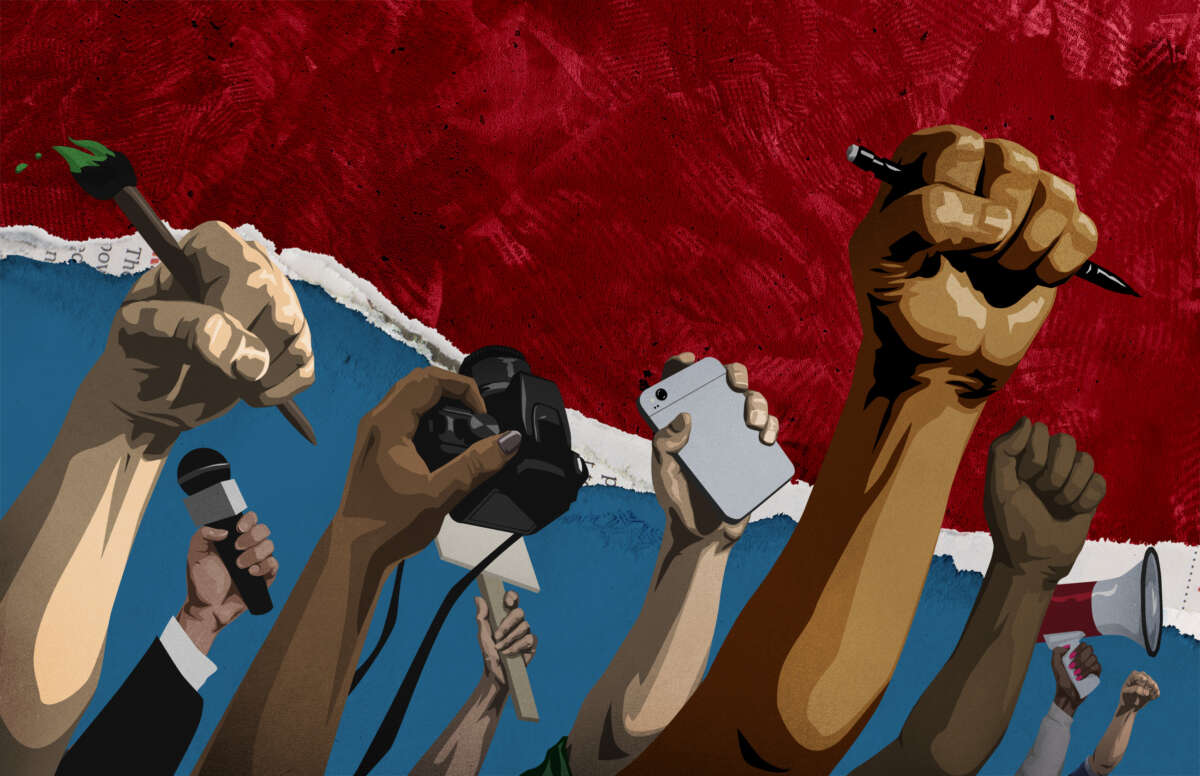
Billionaires Are Encroaching on the Free Press. Let’s Act to Defend It in 2026.
Independent grassroots journalism committed to the pursuit of liberation is an antidote to billionaire-dictated media.
It’s becoming something of a theme: Two massive companies are fighting to take over another massive company, in a deal that will enrich a variety of shareholders but leave the rest of us worse off.
The news that Netflix struck a bid to take over movie powerhouse Warner Bros. earlier this month likely horrified entertainment workers: Two Goliaths of the industry combining is no good for pay, job security, nor creativity. Workers at CNN, one Warner-owned product, though, had reason to rejoice. The Netflix deal doesn’t encompass CNN, unlike the proposition floated by Paramount to take over the entirety of the parent company’s subsidiaries.
CNN is hardly above reproach. But as it turns out, the news network — which recently teamed up with a gambling app that allows users to bet on whether Palestinians in Gaza will be ethnically cleansed — still has room to sink lower.
Days after the Netflix deal, Paramount announced it was launching a hostile takeover bid, appealing directly to Warner Bros. shareholders to overturn the decision of the company’s board. That bid, if it is successful, would put CNN in the hands of Paramount’s new owner, failed actor and son of a centibillionaire David Ellison, who has spent the last several months remaking CBS News in Donald Trump’s image. Under Ellison, CBS scrapped diversity, equity, and inclusion initiatives while installing right-wing commentator Bari Weiss as editor-in-chief, much to the dismay of the network’s staff.
If Ellison gets his way, he could do the same at CNN, a move that would be welcomed by his most powerful ally: Trump himself. The Wall Street Journal reported that Ellison promised “sweeping changes” at CNN during a December visit with the president.
In a year in which crucial sources of journalism have shuttered and corporate consolidation has continued at hyperspeed, the potential fall of another news outlet to Trump already has media critics concerned about the future of the free press. Journalism in the U.S. has already been subject to a process of death by a thousand cuts; the Ellison takeover streak is simply the latest slice.
Big Tech and Billionaires Ellison family members have made headlines over the last year for their more direct foray into media. Having already taken over Paramount in August, the Ellison family is now set to get its fingers on TikTok too: Oracle, owned by David’s father Larry, has been tapped to take over TikTok’s U.S. operations, including its algorithm, once sale of the app is finalized.
The wealthiest people in the U.S. have all long understood that placing a hand on the media scale can yield big payoffs … and they’re regularly finding new ways to poison public discourse with their tech.
But these moves are nothing new; the wealthiest people in the U.S. have all long understood that placing a hand on the media scale can yield big payoffs, whether that comes from owning a media outlet or a tech platform that serves as a means of distribution. And they’re regularly finding new ways to poison public discourse with their tech.
Elon Musk, who is worth $428 billion, and Mark Zuckerberg, worth $253 billion, currently sandwich Larry Ellison for the top three spots on the Forbes list of the richest people in the United States; both also sit atop social media empires whose algorithms are known for pushing users toward the right — with Musk’s AI chatbot Grok going so far as to spew Nazi hate speech — all while censoring dissent.
Zuckerberg’s Meta platforms and Musk’s X have also been accused of deprioritizing external links to keep people on their apps, a move that can lead to a bounty of bad effects: pushing people toward doomscrolling, robbing readers of context beyond what fits on a social media post, and stifling traffic to news outlets.
Next on the Forbes list is Jeff Bezos, who purchased The Washington Post and has proceeded to run it into the ground ever since. Most recently, the outlet rolled out error-riddled AI-generated podcasts, despite internal documentation of editorial issues, including fabricated or misattributed quotes. The Washington Post also reportedly plans to use AI to edit columns submitted by “nonprofessionals.”
Just after Bezos on the Forbes list of richest people in the U.S. are Google co-founders Sergey Brin and Larry Page. While they no longer are in positions of leadership at Google’s parent company, Alphabet, they still hold controlling stock shares in it. For years, Google has used its opaque algorithm to shuffle the audience of the world’s biggest search engine to a handful of huge outlets; an entire industry was created to try to “optimize” journalism to gain better search engine results, which hurts both smaller publications as well as audiences trying to find more context than shallow explainers loaded with keywords.
The same AI trend that is making Google’s stock — and Brin’s and Page’s net worth — rise could be even more dangerous for the news industry. Google is now using the work produced by news outlets to power its AI summaries, in a move that packs a double economic punch: ripping off journalism without compensation, while also tanking traffic to actual news organizations. Even bigger outlets like CNN and HuffPost have seen declines in traffic of around 30 to 40 percent; imagine what smaller publications are forced to contend with.
The tech oligarchs listed here would find benefits in owning outlets and managing distribution platforms regardless of who was in office. But Trump’s presidency has made billionaire ownership of media and its distribution into an even more urgent issue — especially when all of the people listed here, or the companies they are tied to, donated massive sums to Trump’s inauguration fund.
Democracy Dies in Broad Daylight
In 2016, corporate media organizations ran ad campaigns promising that support for media outlets would be key to resisting fascism under Trump’s first term. Now it’s clear that those same organizations are at best willing to roll over — or even worse, support the administration by manufacturing consent for its repressive agenda.
The most jarring example has been CBS News under the leadership of Ellison and Weiss. The network gutted its climate team and instead threw its resources toward a high-profile town hall with Erika Kirk, the widow of right-wing provocateur Charlie Kirk, who was assassinated in September, that managed to still be a ratings flop. Despite casting herself as a lonely advocate for viewpoint diversity, Weiss has suggested that the ideological window at CBS News could range from former National Rifle Association spokesperson Dana Loesch to Jeffrey Epstein’s longtime lawyer Alan Dershowitz.
Meanwhile The Washington Post — the paper that fashioned itself as a bulwark against the Trump administration’s first term ambitions — has moved further to the right every day since Bezos announced that the editorial board would primarily write in defense of “personal liberties and free markets.” It’s unclear if that mandate has spread to the newsroom or if the desk is publishing headlines like “Why you may not want lower prices as much as you think you do” out of its own accord.
Even outlets that have not announced public overhauls since Trump took over are finding new ways to back away from speaking truth to power. At the Wall Street Journal, that looks like publishing articles declaring that “Venezuelan Gangs and African Jihadists Are Flooding Europe With Cocaine” in a headline reminiscent of 2003 Iraq War propaganda. Meanwhile, The New York Times has doubled down on its panic about expanding health care to trans kids — one of the populations most vulnerable to the administration’s attacks — with an entire podcast series on trans health stuffed with disinformation from known hatemongers. A Crisis of Confidence
When corporate news organizations aren’t capitulating to Trump in the court of public opinion, they are bending to his will in literal courts, choosing to settle vanity lawsuits from the president instead of mounting an actual defense. The lawsuits are surely another Trumpian tactic — now he can brag that news networks agreed to settle rather than fighting these winnable, meritless cases. These attacks, from the president who has long cried “fake news” at every story he doesn’t like, come as the right wages its larger war against the legal protections that allow journalists to do their jobs without being sued into oblivion.
The current political assault on journalistic truth-telling is not only coming from Republicans. Hillary Clinton — speaking at a conference hosted by the far right Israeli newspaper Israel Hayom, which is owned by the billionaire Trump mega-donor Miriam Adelson — said young people were being fed “pure propaganda” on Gaza. Clinton’s statement was a perversion of the truth so offensive that leading genocide scholars have decried it as genocide denial. It was especially abhorrent given that so many of the videos young people are watching on social media are published by Palestinian journalists themselves, who have been killed at unimaginable rates by Israel. And both Trump’s legal attacks and Clinton’s downplaying of the documented atrocities in Gaza point to a larger bipartisan assault on the journalistic aim of truth-telling.
Coming out of this year, it’s no wonder that condemnations of “the media” are everywhere, and people are tuning out the news in record numbers: The Reuters Institutereported that 40 percent of respondents in their worldwide survey now “sometimes or often avoid the news,” compared to 29 percent in 2017.
The Antidote to Billionaire Media
And yet, it would be a mistake to throw up our hands and declare “the news” obsolete. “The news” isn’t just one thing. While corporate media are caving to the Trump administration and submitting to rule-by-billionaire, they’re not the only ones publishing the news — and some of the solutions to media collapse are already in active motion.
Grassroots-funded journalism isn’t just a theoretical aspiration; it’s a practice.
The antidote to billionaire-dictated media is alive already in the form of grassroots, independent publications that build their work in line with the values of justice, equity, and the pursuit of liberation. Billionaires are, for example, not running Truthout; you’ll be shocked to hear that they haven’t even come knocking on our door! But beyond this, publications like ours have poured our energy into building models directly counter to that type of dictatorial ownership.
Truthout is 80 percent funded by our readers’ small donations, and our average donation size is $20. No one has to pay to read our work because we want anyone to be able to access the news, but the fact that we’re sustained by folks giving $5 or $10 a month means we operate with a different kind of journalistic freedom: the freedom to actually tell the truth, instead of following the directives of the capitalists and fascists at the top. We share this not to sell you on Truthout — you’re already reading it! Rather, we mention this to affirm that grassroots-funded journalism isn’t just a theoretical aspiration; it’s a practice.
It’s also part of an ecosystem: Each of the 24 members of theMovement Media Alliance (which includes organizations like Prism, In These Times, The Real News Network, Haymarket Books, and many more) are making media grounded in principles, not profits, and publishing accurate reporting and analysis to directly face down fascism.
Right-wing brainwashing can only take place in a truth vacuum. As author and journalist Lewis Raven Wallace describes inThe Objective, “fascist leaders thrive on an ill-informed public.” Wallace, citing long-time abolitionist leader Andrea Ritchie, notes that movement journalism’s “purpose zero” is “to challenge fascism and authoritarianism by fighting disinformation.” This terrain of journalism is explicitly anti-authoritarian. Its goal is not only speaking truth in the face of rampant fascist propaganda, but also strategically countering that propaganda, engaging and rallying readers to push back, and spreading the word about resistance so more people can join in.
Right-wing brainwashing can only take place in a truth vacuum.
These are active missions. As movement media, we’re not simply shooting truth out into the ether; we are activating our audiences and showing them possibilities for connection and mobilization. As Scot Nakagawawrites, “Truth must be tied to communities of hope that create the conditions for liberation…. The truth alone will not set us free — but truth in the hands of a mobilized, organized movement might.” Documenting the Resistance
In this vein, our organizations are telling the stories of resistance and organizing, many of which are completely ignored by corporate media, even though they’re playing out in every corner of society. While most movement media organizations report regularly on activism, some platforms — like Waging Nonviolence, Convergence’s “Block & Build” podcast, The Forge, and the YES! newsletter — focus entirely on covering movements, providing both hope and inspiration for concrete action.
As fascist leaders zero in on specific oppressed communities, such as immigrants, trans people, and organizers for Palestinian liberation, corporate media outlets have specialized in exacerbating that harm. Yet over the past year, topic-specific independent media organizations have risen to the struggle.
What all these growing movement journalism projects have in common is not only a dedication to informing the resistance, but also a practice of being human.
Even as corporate media’s immigration coverage has often served overtly racist goals, we’ve seen the growth of diametrically opposed publications like Borderless Magazine, Documented NY, Migrant Roots Media, and others focused on telling true stories, including firsthand narratives, about both the government-sanctioned assault on immigrants and the power of immigrant justice movements.
Even as we’ve seen the rise of anti-trans publishing (with large mainstream outlets like The New York Times and The Atlantic leading the way), we’ve also seen the rise of trans justice-focused independent publications like Assigned Media,TransLash Media, and Erin In The Morning, which unwaveringly report the timely specifics of attacks on trans rights as well as tools for responding and stories of resistance.
And even as Bari Weiss, a self-described “Zionist fanatic,” has seized the reins at CBS News, we’ve seen the significant growth of journalism organizations specifically reporting on the struggle for Palestinian liberation, like Mondoweiss, The Electronic Intifada, and Palestine Square. In early 2024, Movement Media Alliance organizations, including Truthout, co-founded the coalitionMedia Against Apartheid and Displacement, which produces a roundup newsletter composed primarily of Palestine-related coverage, run byPrism.
Meanwhile, media criticism and literacy projects like Project Censored,The Objective, and the “Citations Needed”podcast are exposing right-wing lies and offering concrete tools for discerning reality and reshaping journalism to better serve our communities. In addition to timely analyses, they provide resources that can be used in classrooms, community groups, and political education programs in order to push back on disinformation and build media-making power.
Being Human
What all these growing movement journalism projects have in common is not only a dedication to ethical funding models, principled truth-telling, audience mobilization, and informing the resistance, but also a practice of being human. As AI rapidly tears through the journalism industry — “writing” stories,“hosting” podcasts,“illustrating” the news — we are often disrupting oppressive systems simply by doing journalism as human beings. Humans are capable of discernment, critical thinking, empathy, creativity, curiosity, originality, and collaboration. Doubling down on these commitments — the things we sentient beings can do, that AI can’t — is a central tenet of journalism-as-resistance, as we move into 2026.
This isn’t just a commitment for those working in media. It’s a commitment for anyone engaging with media — that is, you.
In 2026, let’s take back the media — and our minds and spirits — from the billionaires.
How can we all recommit to our humanity in 2026? How can we authentically seek truth, inform ourselves in active ways, and work together to challenge the forces of disinformation and injustice? How can we draw on our empathy, as living beings who exist in relation to each other, to fuel these practices? How can we keep asking questions, relentlessly, in the face of powerful forces demanding our silent compliance?
Moving into the new year, in this period of resolution-making and intention-setting, it’s worth it for each of us to deeply consider our relationship to media. How is it shaping what we think, feel, and do, for better, or worse, or different? How is it driving us toward action, or toward complacency? What media-related choices can we make, as autonomous, living beings capable of choices, to confront fascism and grow the society we want and need?
In 2026, let’s take back the media — and our minds and spirits — from the billionaires.
This article is licensed under Creative Commons (CC BY-NC-ND 4.0), and you are free to share and republish under the terms of the license.
Maya Schenwar is director of the Truthout Center for Grassroots Journalism. She is also Truthout‘s board president. She is the co-editor of We Grow the World Together: Parenting Toward Abolition; co-author of Prison by Any Other Name: The Harmful Consequences of Popular Reforms; author of Locked Down, Locked Out: Why Prison Doesn’t Work and How We Can Do Better; and co-editor of the Truthout anthology Who Do You Serve, Who Do You Protect? Police Violence and Resistance in the United States. In addition to Truthout, Maya’s work has appeared in many publications including The New York Times, The Guardian, NBC News and The Nation, and she has appeared on Democracy Now!, MSNBC, C-SPAN, NPR, and other television and radio programs. Maya is a cofounder of the Movement Media Alliance (MMA) and Media Against Apartheid and Displacement (MAAD). She lives in Chicago.
Negin Owliaei is Truthout‘s editor-in-chief. An award-winning journalist, she previously worked at Al Jazeera‘s flagship daily news podcast, The Take. She lives in Washington, D.C.
From longest night to quiet observance: how the winter solstice is marked across the MENA region
The winter solstice fell across the Middle East on 21 December, marking the shortest day of the year.
From this point on, daylight hours gradually begin to lengthen again, leading towards the spring equinox in March [Getty]
Across the Middle East and North Africa, Sunday 21 December marked the winter solstice, the astronomical moment when the Northern Hemisphere experiences its shortest day and longest night of the year.
The phenomenon marks the official start of winter in the Northern Hemisphere, as the Earth's axis tilts away from the sun and sunlight falls directly on the Tropic of Capricorn at 23.5 degrees south latitude.
From this point on, daylight hours gradually begin to lengthen again, leading towards the spring equinox in March. Longest night across the Arab world
In much of the Arab world, the solstice is noted primarily as a scientific and seasonal milestone rather than a cultural one. Media outlets and meteorological or astronomical bodies across the Gulf and wider region highlighted Sunday as the day of the shortest daylight hours and the longest night of the year. Related
In Qatar, the Qatar Calendar House announced that the winter solstice occurred at 6:04 pm local time, coinciding with the sun's apparent alignment over the Tropic of Capricorn.
Astronomical experts said the day had marked the shortest daylight hours of the year in the country, with the sun appearing at its lowest noon elevation and casting the longest shadows.
Similar explanations were shared in Saudi Arabia, where climate expert Abdullah Al Misnad said winter officially began in the evening hours, lasting around 89 days. He noted that all locations north of the equator experience their shortest day at this time, regardless of temperature fluctuations, which are governed by atmospheric conditions rather than astronomy.
In Egypt, astronomers described the solstice as the peak of winter in the Northern Hemisphere, with daylight lasting around 10 hours compared to roughly 14 hours of night. The sun’s low arc across the sky means shadows reach their greatest length at midday. Cultural silence in the Gulf
Despite this widespread astronomical awareness, Gulf countries, including Bahrain, Kuwait, Oman, Qatar, Saudi Arabia and the UAE do not traditionally mark the winter solstice with festivals or rituals.
Cultural calendars in the Gulf are centred on Islamic lunar events such as Ramadan, Eid al-Fitr and Eid al-Adha, as well as national days. Pre-Islamic seasonal observances linked to solar cycles were largely replaced after the spread of Islam, leaving the solstice without deep cultural roots in Arab or Bedouin traditions.
Any modern acknowledgement tends to be educational rather than celebratory, appearing in science columns, weather apps or social media posts by observatories and astronomy enthusiasts.
In cities such as Dubai or Doha, hotels or expat communities may occasionally reference the solstice, but it is not marked as a shared public or family tradition. Yalda night and the Persian cultural sphere
Further east, however, the longest night carries powerful cultural meaning. In Iran and across parts of the wider Persian cultural world, the winter solstice is marked by Shab-e Yalda, an ancient celebration dating back more than two thousand years.
Yalda, whose name is derived from a Syriac word meaning "birth", symbolises the rebirth of the sun and the victory of light over darkness as days begin to lengthen.
Families gather on the solstice night to stay awake together, sharing food, poetry and stories until after midnight or dawn.
The celebration is deeply rooted in pre-Islamic Iranian traditions, including Zoroastrian and Mithraic beliefs, and remains a central cultural event in Iran today.
Rituals often include reading poetry by Hafez, storytelling from classical texts such as the Shahnameh, and eating symbolic red fruits such as pomegranates and watermelon, representing life, warmth and the promise of brighter days.
hab-e Yalda is also observed in Afghanistan, Tajikistan, parts of Azerbaijan and Turkmenistan, and among Kurdish communities, reflecting the reach of Persianate culture across the region.
FIAT LUX
Iranians celebrate Yalda festival as economic woes bite
The country's economic crisis caused by international sanctions is weighing on ordinary Iranian preparing to celebrate Yalda.
Iranians celebrate with Yalda decoration in northern Tehran on 20 December 2025. [Getty]
Iranians of all religions and walks of life mark the ancient Persian festival of Yalda Sunday, though many say economic hardships fanned by international sanctions will put a damper on this year's celebrations.
Yalda falls on the winter solstice and is characterised by family gatherings and the eating of nuts, sweets and fruits.
"We mostly spend time with our families, our grandparents, aunts, cousins," Maral Bagherpour, a smiling 16-year-old student, told AFP in northern Tehran's Tajrish Bazaar.
"We take fal-e Hafez, we drink tea or coffee. My grandma sings for us sometimes," she said.
"Taking fal-e Hafez" is a popular tradition that entails using the works of renowned 14th century Persian poet Hafez, an all-time favourite in Iran, to try to divine the future and deal with difficult situations.
"On Yalda night the whole family gets together in my grandparents' house. We reminisce about the good old days and eat nuts and fruits that are in season," said Mary Goudarzi, 37.
However, rampant inflation and a sharp depreciation of the national currency against the dollar have diminished people's purchasing power to really push the boat out for Yalda.
In early December, the central bank announced annual inflation was running at 41 percent.
On Saturday, the US dollar was trading at around 1.32 million rials on the informal market - almost double the rate at the same time last year.
"Unfortunately, because of recent events such as the war and the dollar price that's rising sharply, people's purchasing power has fallen a lot," said Goudarzi, an interior designer.
"That's why you can't really see many of the items we used to see in previous years on every table," she said while shopping for Yalda.
In June, Israel launched an unprecedented attack on Iran, striking military and nuclear sites as well as residential areas, killing more than 1,000 people including nuclear scientists and military commanders.
The attack triggered a 12-day conflict in which Iran responded with drones and missiles targeting Israel, and in which the United States joined Israel and hit Iranian nuclear sites. Trying to cope
Some shopping centres in Tehran put up decorations for Yalda, including artificial trees adorned with hanging pomegranates or displaying huge plates of fruits linked to the festivities.
"Yalda has been around for a long time for families to get together, but with these high prices it's not like it used to be when people would invite the whole family," said Aliakbar Mohammadi, a fruit vendor at a well-stocked stall.
He said the price of pomegranates has doubled since last year, and sales are down markedly.
On Saturday, the reformist Ham Mihan daily had a cartoon entitled "Yalda Night", showing what appeared to be a poor man trying to grab at a basket of fruit hanging from the moon.
The implication was clear - buying fruit for the festivity is out of reach for some families.
"Inflation is high, the dollar price has gone up and subsequently all prices have increased including the commodities," said 21-year-old nut and fruit shop owner Rahimi, who gave his last name only.
"It's hard for people to buy what they want. The state of the market and the economy is in turmoil. Sales are down significantly this year."
Iran has been under a biting international sanctions regime for years over its nuclear programme, with the West accusing the Islamic republic of trying to build a nuclear bomb and Tehran vehemently denying the charge.
"Conditions will be more difficult, but we're trying to cope - we have no choice," said Rahimi. Yalda historically marks the victory of Good over Evil, and is also marked in Persian-speaking areas of some regional countries such as Afghanistan and Tajikistan.
Both Yalda and the fire festival, celebrated on the last Tuesday of the Iranian calendar year which ends on March 20, date back to Zoroastrianism, a religion dominant in Iran until the seventh century.