It’s possible that I shall make an ass of myself. But in that case one can always get out of it with a little dialectic. I have, of course, so worded my proposition as to be right either way (K.Marx, Letter to F.Engels on the Indian Mutiny)
Monday, December 22, 2025
In Conversation With Ilan Pappé And Mariam Barghouti
Israeli historian Ilan Pappé (1954), author of The Ethnic Cleansing of Palestine and other prominent works, has played a crucial role in challenging the dominant Western narrative that presents Israel as a liberal democracy born in innocence. His work exposed the foundational violence and displacement at the heart of the Israeli state project.
Palestinian journalist Mariam Barghouti (1993) documents from her home in the occupied West Bank how the process of dispossession and erasure continues today — through military occupation, segregation, and control over every aspect of Palestinian life.
Yet in the Netherlands, as in much of the West, politicians and major media outlets largely cling to a sanitized image of Israel that bears little resemblance to reality. Poll after poll, however, shows that a growing majority of Dutch citizens wish to break with this long-held but false ideas about Israel and support meaningful action for Palestinian liberation. Why, then, does a just policy toward Palestine remain so elusive?
At this event, Pappé and Barghouti connected past and present — exploring the persistence of colonial frames, the power of narrative, and the possibilities for change. The programme was moderated by Erella Grassiani, Associate Professor at the Department of Anthropology, University of Amsterdam, and Eduard Cousin, journalist and editor at The Rights Forum.
Recorded in Amsterdam, on December 13, 2025. Organized by The Rights Forum.
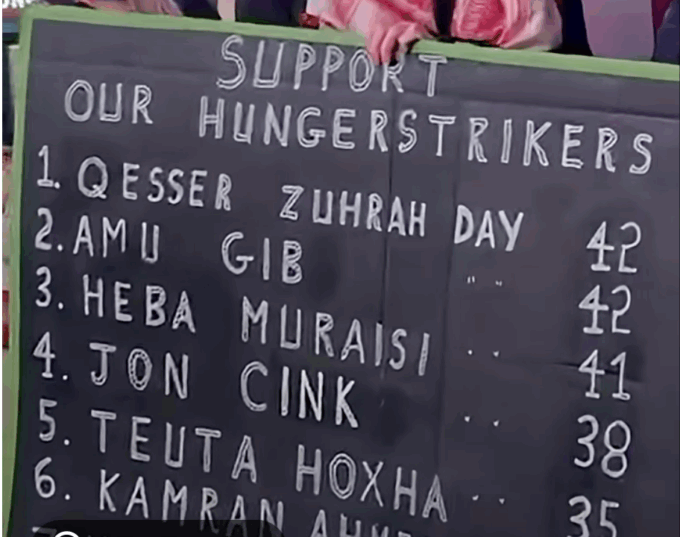
London protest in support of jailed Palestinian rights hunger strikers. Screengrab from video posted to Instagram.
Amu Gib is one of eight prisoners incarcerated for alleged involvement in direct action against Israeli genocide currently on hunger strike in UK jails. This piece is based on interviews conducted by Ainle Ó Cairealláin and ES Wight on Days 18 and 33 of the strike. Amu has subsequently been hospitalised, on Day 50 of their strike, the sixth hunger strike to be so.
We began our hunger strike on November 2nd: the anniversary of the Balfour Declaration, when Britain planted the seeds of the genocide we are witnessing today.
Palestinians are now facing another winter without any of the things that anyone needs to survive. It is such a joke to say there is a ceasefire in Gaza when nothing’s stopped: maybe carpet bombing has been less prevalent, but perhaps that is just because there are no more buildings left to shell. There are so many layers of violent displacement the Palestinian people have undergone. The Israeli occupation has meant that people who have lived on fertile land that they’ve grazed and managed and farmed for forty generations are no longer able to feed themselves. To reach the point we have, where Israel can weaponise starvation, you have to confront who enables that. Who arms them? Who allows Zionist settlers to steal and occupy Palestinian land? Who continues to allow Israel to blockade and target farmers and people harvesting their olives? The use of starvation as a weapon is the tip of the iceberg.
I first learnt about Palestine in sixth form–not from the teachers obviously, but from other students, young Muslim women who were doing all the legwork around the campaign. This was during a time when Palestine was undergoing an active bombing campaign. I didn’t understand the historical context back then, or have the language to explain it, but the bombing of civilian populations, residential buildings–you could just see that it was wrong. And then seeing the routine nature of it–from one year to the next, the same thing happening, and knowing that this wasn’t a war with a fixed end or even a clear goal: it was just so stark–this is going to keep going unless people stop it. And then the more I learnt the British role in the creation of the Zionist occupation, the more I was unable to deal with inaction towards that.
Our demands are simple. One: shut down the weapons factories that are supplying these arms to Israel. Two, deproscribe Palestine Action. Palestine Action is a direct action protest group and should never have been labelled a terrorist organisation; Three, an end to the mistreatment of prisoners in custody, including censorship and the use of terror legislation to harass us. Four, immediate bail. There’s people whose parents are ill or dying, people who have missed major life events. And five: a fair trial, including the release of the unredacted correspondence about us between British and Israeli officials and arms dealers. I think they’re quite reasonable demands; we could have gone much further! But I believe we can win all of them.
What prompted our hunger strike was partly just the understanding that while we’re in here the prison authorities can do whatever they want. They can give us bogus non-association orders so we can’t spend time with each other, they move our lives around at will, they can mess with our visits, they can mess with our gym slots, they can say that we’re a security threat so we’re not allowed to work. They’re banning our books and censoring our post – it’s completely out of control. I was barred from the crafts group because they said I was a security threat after I embroidered ‘Free Palestine’ on a cushion; ironically, that was on the day that the UK recognised the state of Palestine. After the protest outside the prison in August – and after two people were killed by the prison in a week – they really wanted to crack down on the eight or nine of us who were in here at the time. There was just this sense of ‘we must punish them because they have too much involvement with the outside world’. We all started to get demerits and negative IPs [‘Incentive Points’, which dictate the amount of phone credit, time outside your cell etc that you are entitled to] for hugging or just breathing too near to each other. And then John was randomly told to get behind his door during out-of-cell time and he just refused. He sat on the floor and told them, ‘I’m not moving to my cell, this has got ridiculous’. And Heba immediately sat down with him. It wasn’t a planned act of resistance, it just reached the point where we’re not going to comply with this because it’s completely unjustifiable. And at some point you have to resist that. Then they both got bent up, which is prison terminology for a routine assault of prisoners by screws, and spent the next five days in solitary confinement. Heba got shipped to a different prison five hours away from her loved ones, and John was moved to a different house block to further isolate him from us and others.
There is no rhyme or reason to our imprisonment. But when you’re on hunger strike, when you decide to take action despite being in prison, you’re free. There’s a freedom in taking action, and there’s an energy to it. And then there’s also this ongoing responsibility to the cause and to the liberation of Palestine that landed us here, and that we still all believe in and are committed to. Just because we are in prison, it doesn’t change the fact that we don’t believe that the UK should fund and supply weapons for genocide. Just because we’re in here doesn’t mean that we can’t see that the aid that desperately needs to get into Gaza is still being blocked and that no one seems to be able to actually change that. So our action is a way of declaring that the state can’t stop you even when it has you in prison; that we are not going to give up the focus and the responsibility to people, whatever conditions we’re in.
Physically, I have lost eleven kilos now and am moving in slow motion. My blood sugar’s really low and my ketones–which is the way that you measure the amount of toxins that your body produces by eating itself, burning through fat and muscle instead of calories–are really high. Kamran and T have been hospitalised already.
The response from other prisoners has been incredible. There’s no one who understands injustice like a prisoner does: whether you’re on hunger strike or not, it’s always the prisoners who keep each other going and the screws who make life hell. Everyone’s checking in on me, making sure I have hot water, coming to socialise in my cell even when I’m a shadowy version of myself, lending me clothes to keep warm; just lots of generosity. This is despite one of the screws telling the other prisoners that they would get negative behaviour points if they helped us. And they did: people were given negative IPs for bringing Qesser a flask of hot water and for washing her bedsheet in their washing. Luckily, the people in that spur have the right attitude towards authority figures.
So the hunger strike has sharpened the reality of prison: the shouting and screaming from the screws and the arbitrariness of the rules that they enforce. Their mood really dictates a prisoner’s entire life already. But in another way, the hunger strike also makes the prison fade into irrelevance. We’re focused on the world beyond these walls and it seems much more real.
Together we’re strong and we’re really capable of defeating the state, whether it’s in this round of the fight or in future rounds. I don’t believe that this genocidal imperialist hellhole can sustain itself because it’s people who make things and build things and grow things and repair things that actually make the world go round – not these money-hungry lunatics. In prison, as elsewhere, there’s always a reason not to resist: ‘what’s the point of resisting if we’re just gonna get bent up,or get a negative point, or get half of our money taken away?’ Or there’s that temptation to load the responsibility onto your lawyer to deal with your complaints, or ‘look, there’ll be a judicial review and it’ll all come to light then!’ There’s always a way around resisting. But there’s never not a point to resistance. And the act of being on hunger strike has really opened up this whole other world, where we’re fuelled by every act of resistance that we hear about. The prison demands that we be alive on their terms, but now it’s on our terms, and we have the power that they hold over us in our hands, in our bodies and in our empty stomachs.
We need to keep pushing ourselves to imagine a fuller reality. I just wish that I had a way to convey to people how much energy resistance brings you and how much power you have when you’re in solidarity. We actually have the power, agency, responsibility, creativity, resourcefulness and love that it takes to be fuelled and moved to action not just once but every minute of every day – now 33 days for some of us. It doesn’t ever feel like what we’re doing is enough but in another way it feels like the best thing in the world.
A shorter version of this piece originally appeared in the Guardian.
Amu Gib is an activist currently being held at Bronzefield Prison.
Israel Is Preparing for a Permanent Presence in Gaza, Satellite Images Reveal
Since the ceasefire, Israel has constructed at least 13 new military outposts inside Gaza, consolidated existing military infrastructure, built roads, and destroyed more Palestinian property.
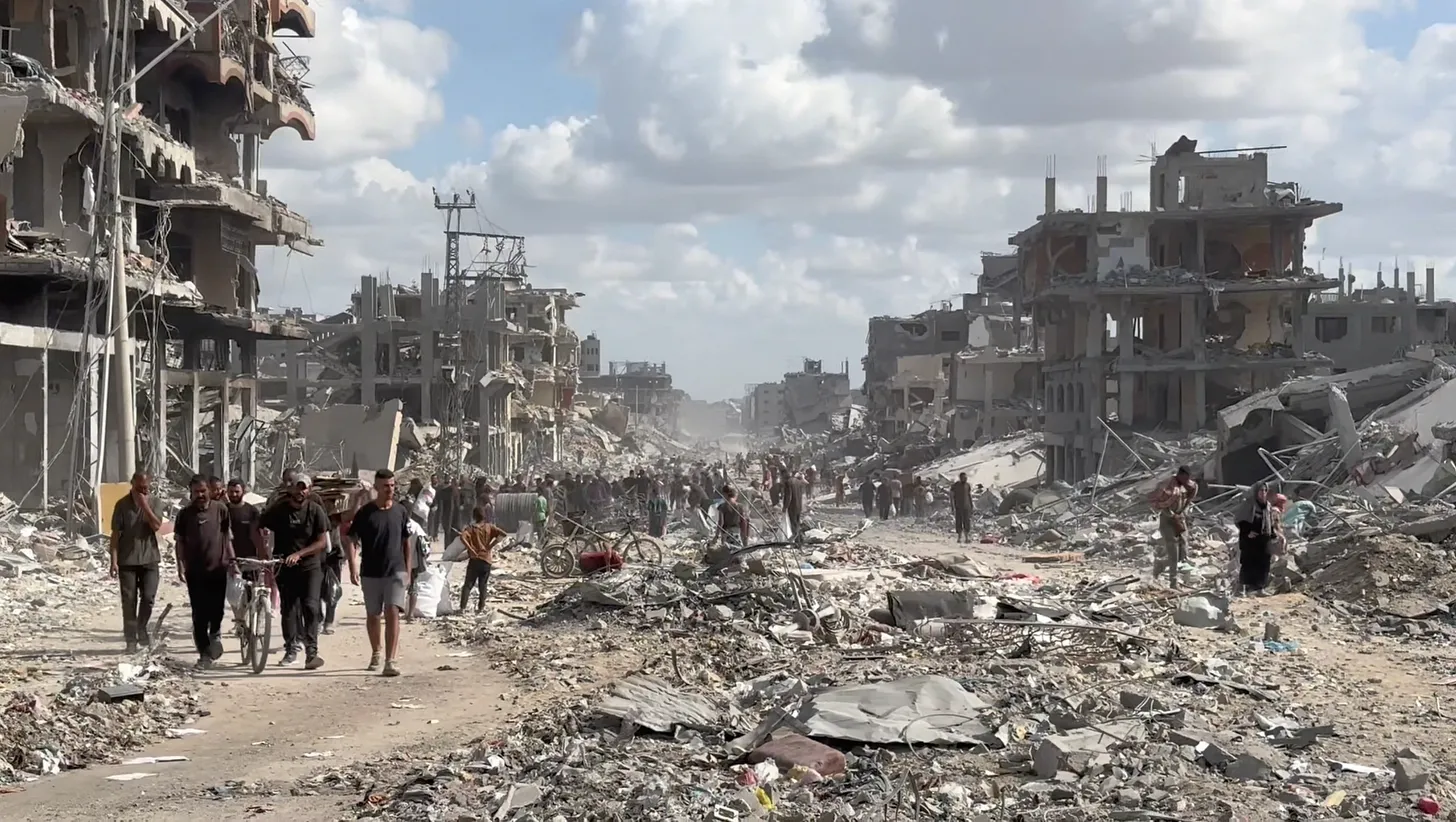
Displaced Palestinians returning to Gaza City on October 10, 2025. (Screenshot of video by Abdel Qader Sabbah.)
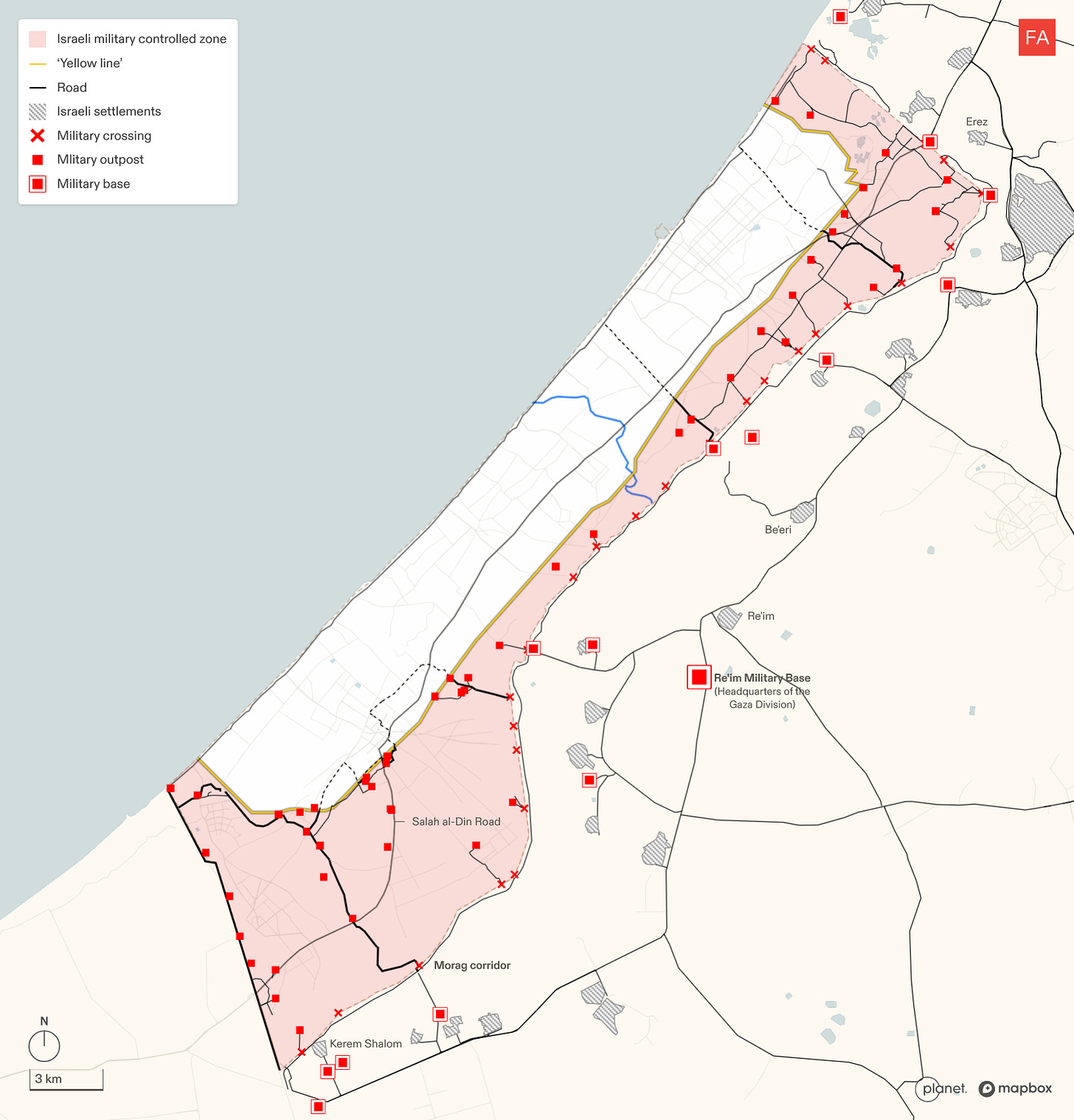
Since the so-called ceasefire came into effect in Gaza on October 10, Israel has been consolidating its control of over 50% of Gaza and—according to new research by Forensic Architecture—physically altering the geography of the land. Through a combination of the construction of military infrastructure alongside the destruction of existing buildings, Israel appears to be laying the groundwork to establish a permanent presence in the majority of the Gaza Strip.
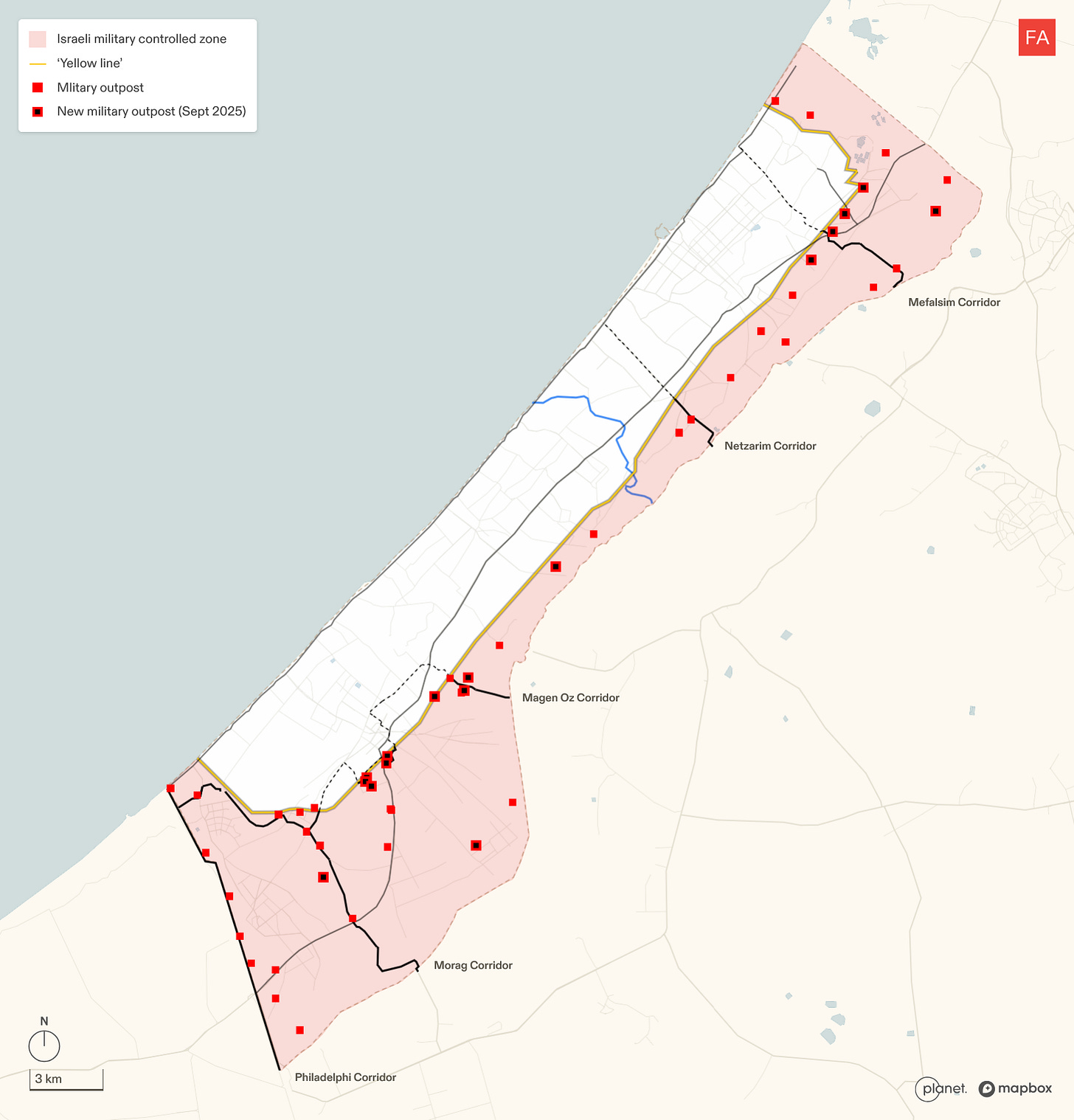
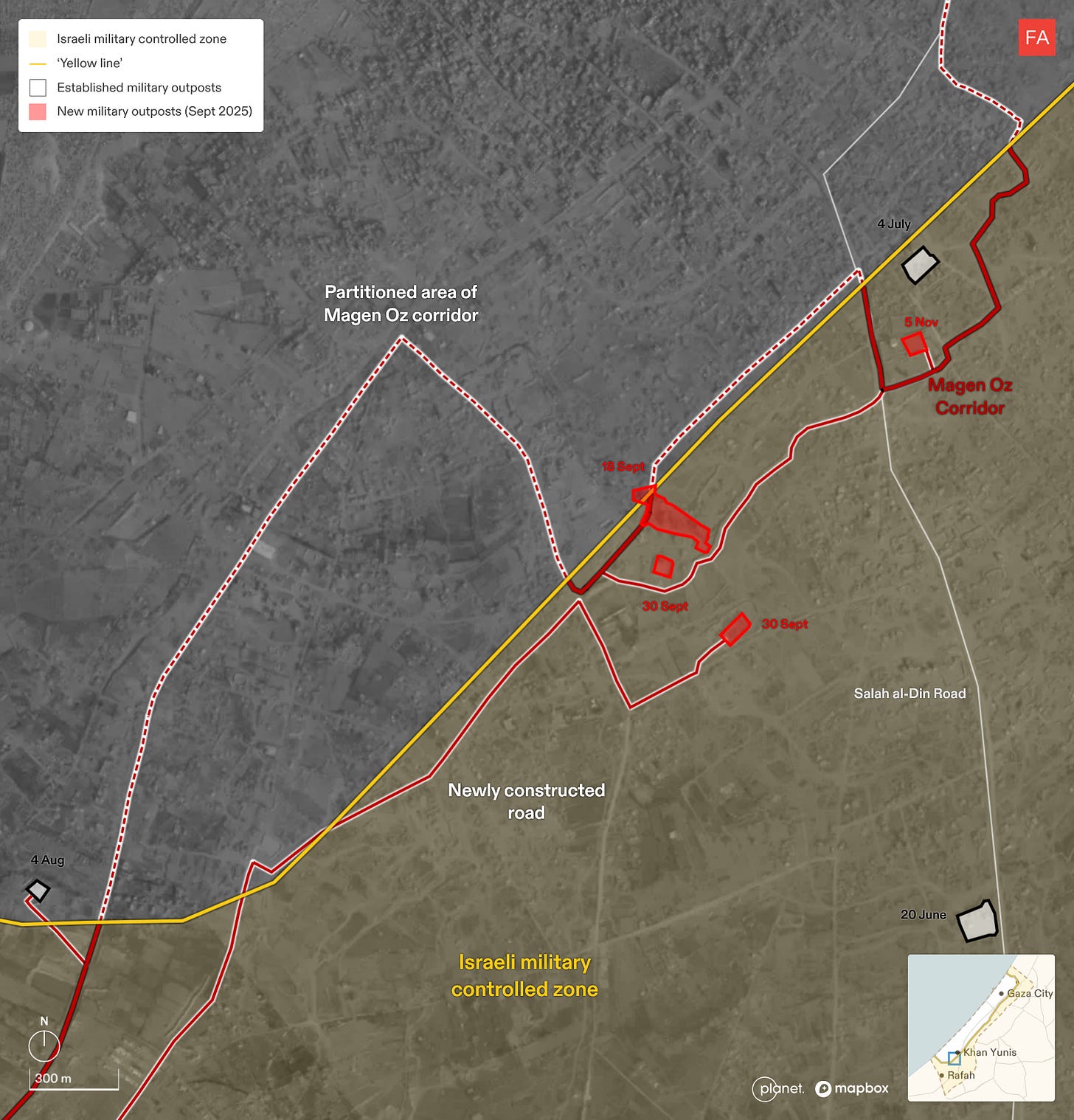
Israel has constructed at least 13 new military outposts inside Gaza since the ceasefire—primarily located along the yellow line, in eastern Khan Younis, and near the border with Israel, according to analysis of satellite imagery by Forensic Architecture.
“Israel is doing what it always does, and what it historically has done best: establish ‘facts on the ground,’ incrementally rather than spectacularly, and make them permanent once those with influence to force it to reverse course either lose interest, decide that the cost of confronting Israel is not worth the price, or come out in open support of Israeli violations. Israel is in no rush and prepared to play the long game,” Mouin Rabbani, co-editor of Jadaliyya and a former UN official who worked as a senior analyst on Israel-Palestine for the International Crisis Group, told Drop Site after reviewing a summary of the Forensic Architecture findings.
The analysis also shows that, between October 10 and December 2, 2025, Israel has:
Accelerated the growth and infrastructure development of 48 existing military outposts inside Gaza.
Expanded a network of roads connecting military outposts inside Gaza to the Israeli road network, bases and settlements outside of Gaza.
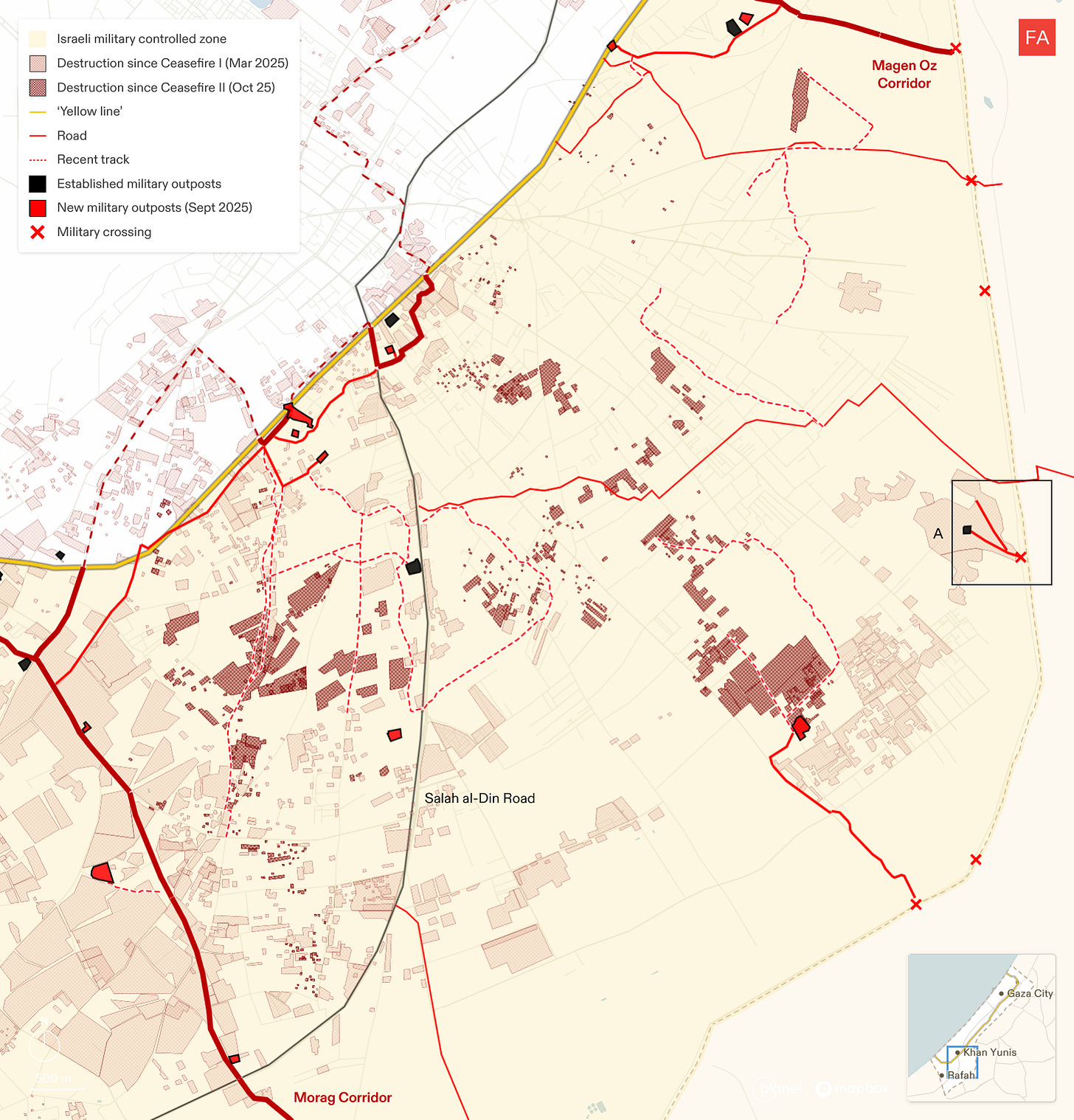
Continued construction that began in September 2025 of a new road in Khan Younis, re-routing the Magen Oz corridor to run within Israel’s area of control.
Engaged in the systematic demolition and destruction of Palestinian property, particularly in eastern Khan Younis, targeting areas which haven’t already been destroyed. New military outposts and roads have emerged across this area.
“Augmenting multiple Israeli statements about extending its borders with buffer zones to the north, east, and south, this is indisputably an Israeli campaign to partition the Gaza Strip and thereby promote its long-term objective of moving the Palestinian population elsewhere,” Rabbani said. “At the same time, Israeli success is not a foregone conclusion. If it was, the Palestinian population of the Gaza Strip would have been ethnically cleansed years if not decades ago.”
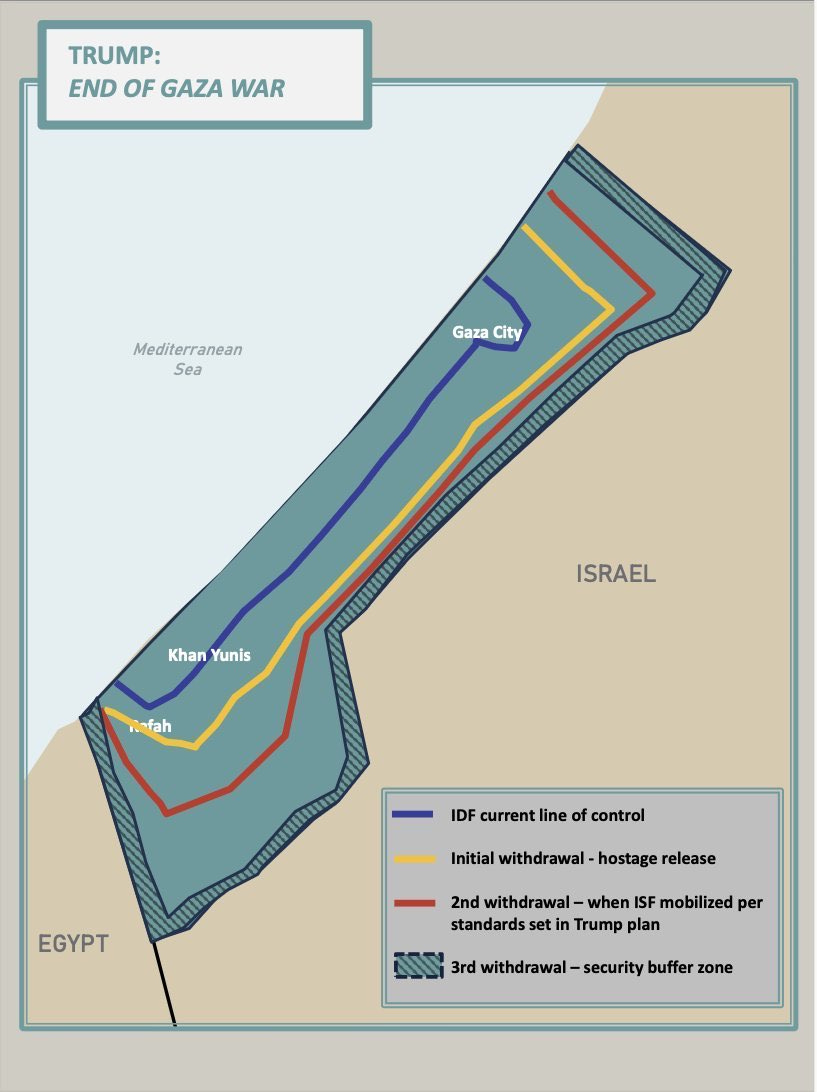
As part of the initial phase of the ceasefire agreement, the Israeli military partially withdrew to what became known as the “yellow line,” with over half of Gaza under continued Israeli control. The term comes from a map that was distributed in late September as part of President Donald Trump’s 20-point ceasefire plan that depicted a phased withdrawal of Israeli troops, to an initial yellow line, followed by another withdrawal, until an eventual pullback to a “buffer zone” running inside Gaza along the border with Israel.
The original withdrawal map according to President Trump’s 20-point Gaza plan.
Trump then posted a new map showing the initial withdrawal line that left Israel in control of 58% of Gaza. After the ceasefire came into effect, an Israeli military spokesperson posted yet another map with the yellow line showing Israel in control of 53% of Gaza.
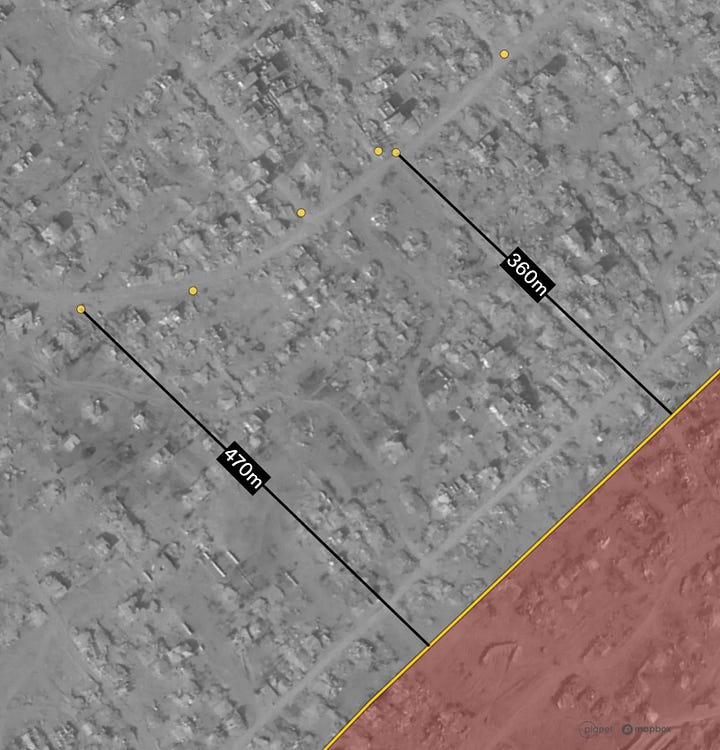
Since the ceasefire, Israel has seized more land by physically placing at least 27 yellow blocks (delineating its area of control) west of the yellow line marked in Israel’s own maps.
(Left) Satellite image from 7 Nov 2025, showing the distance of yellow blocks from the ‘yellow line’ in Sheikh Nasser neighborhood, Khan Younis. Source: Planet Labs LBC. (Right) Ground-level image of the yellow blocks in Sheikh Nasser neighborhood, Khan Younis. Source: @AmitSegal.
Point 16 of Trump’s 20-point plan explicitly states, “Israel will not occupy or annex Gaza. As the [International Stabilization Force (ISF)] establishes control and stability, the Israel Defense Forces (IDF) will withdraw based on standards, milestones, and timeframes linked to demilitarization.” It goes on to say, “Practically, the IDF will progressively hand over the Gaza territory it occupies to the ISF according to an agreement they will make with the transitional authority until they are withdrawn completely from Gaza, save for a security perimeter presence.”
While the “standards, milestones, and timeframes” around Israel’s withdrawal have been highly contentious, they are nevertheless the principal subject of ongoing negotiations. However, the analysis by Forensic Architecture clearly shows that Israel is consolidating its military presence on the ground east of the yellow line in a way that suggests no intention of a further withdrawal.
These findings come as the Trump administration is reportedly planning the construction of a number of residential compounds, dubbed “Alternative Safe Communities,” in areas east of the yellow line to provide housing to tens of thousands of Palestinians, with no construction allowed on the west side, that appear to be part of a plan to entrench the partition of Gaza and allow for permanent Israeli control over more than half of the enclave.
Within Gaza, Israel is currently maintaining 48 military outposts east of the yellow line. The outposts are connected to a network of roads which have been created, expanded or appropriated by the Israeli military. In turn, these link to Israeli bases, roads, and settlements outside of Gaza.
Since the ceasefire came into effect, Forensic Architecture observed three changes to Israeli military outposts east of the ‘yellow line’:
1. An increase in the number of outposts in locations strategic for occupation.
2. The expansion of outposts.
3. The development of outpost infrastructure.
Forensic Architecture documented 13 new outposts since the ceasefire. They are primarily located along the ‘yellow line’, in east Khan Younis, and near Gaza’s border.
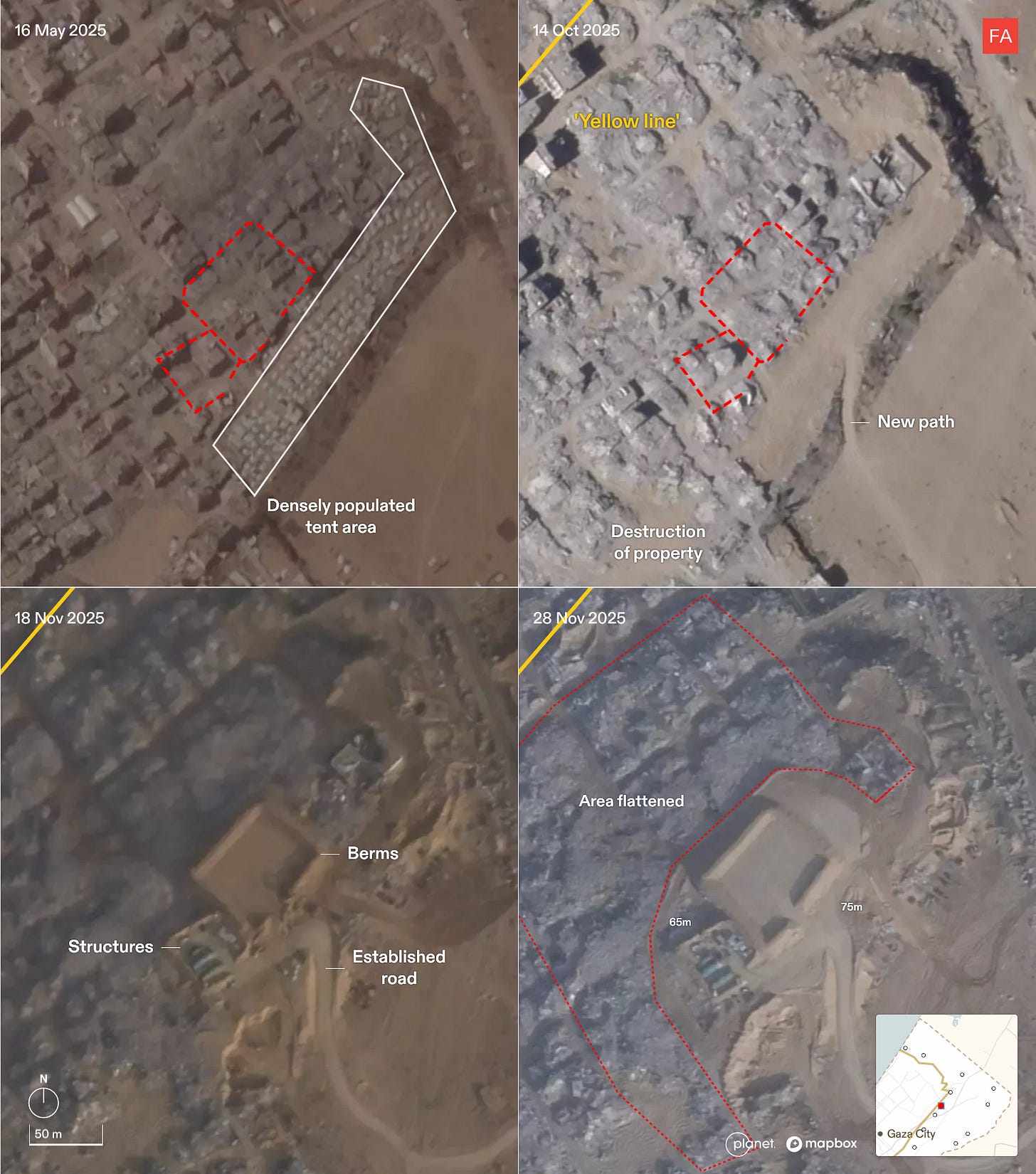
At a new outpost in Jabaliya, a densely populated tent area was dismantled, and Israel demolished the surrounding buildings. In their place, Israel carved a road, built berms, and constructed buildings on the outpost. The largest berms measure 75 by 65 meters.
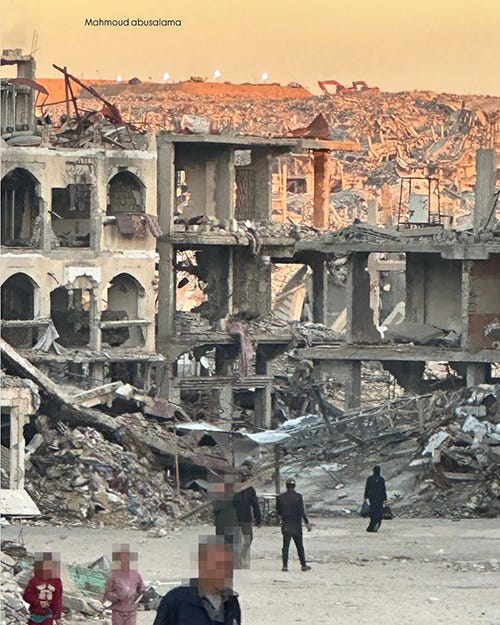
The outpost was constructed on high ground, and is visible on 26 November in a ground-level photograph taken from the west side of the ‘yellow line’, where Palestinians have been forcibly displaced to. The two areas are separated by a strip of destruction. From this vantage point, you can see the berms making up the outpost, with lights atop them, and the vehicles likely used to construct the outpost.
Photograph taken on 26 November 2025 in Jabaliya, west of the ‘yellow line’, looking towards an Israeli military outpost east of the ‘yellow line. Source: @mahmoud__abusalama
In mid-July 2025, the Israeli military announced the completion of the Magen Oz corridor, a 15-kilometer military road separating the city of Khan Younis into its eastern and western parts. Since September, Israel has been constructing a new road in Khan Younis, re-routing the Magen Oz corridor to run within its area of control.
Military expansion is occurring alongside continued destruction east of the ‘yellow line’.
The largest body of land under Israel’s control is in the south of Gaza, and includes Rafah and eastern Khan Younis, which remains densely packed with private property. Here, since the ceasefire, Israel has been destroying buildings not previously destroyed, and constructed new military outposts and roads across the area.
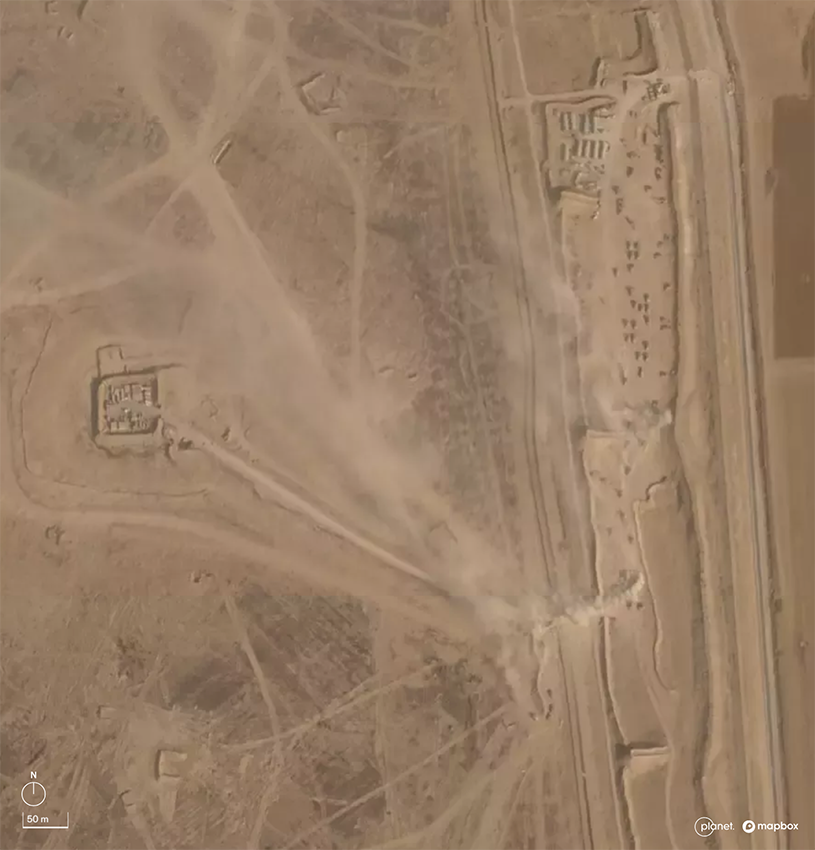
Nearby, demolition vehicles (A) are visible on the border.
Military outpost in Khan Younis, on the border of Gaza, connected by road to a military crossing in which demolition and military vehicles are visible. 5 November 2025. Source: Planet Labs LBC.
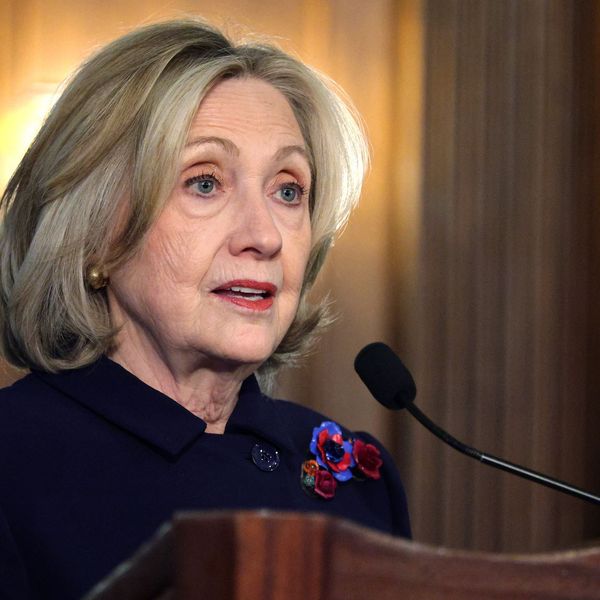
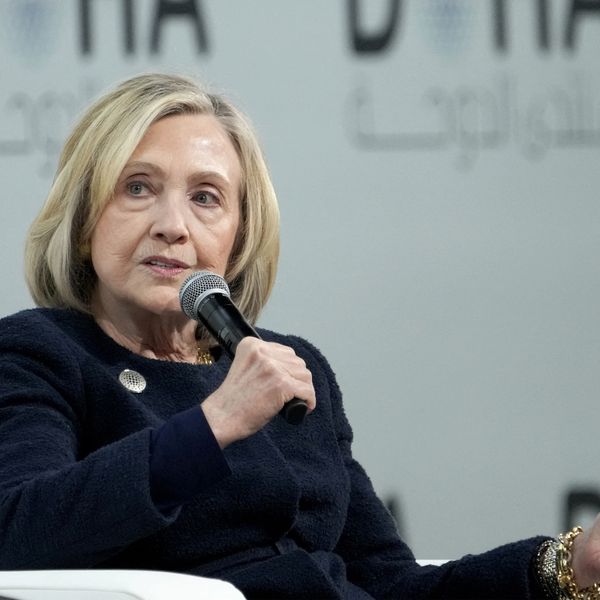
Hillary Clinton Is Wrong: The Gaza Genocide Isn’t ‘Fake News’
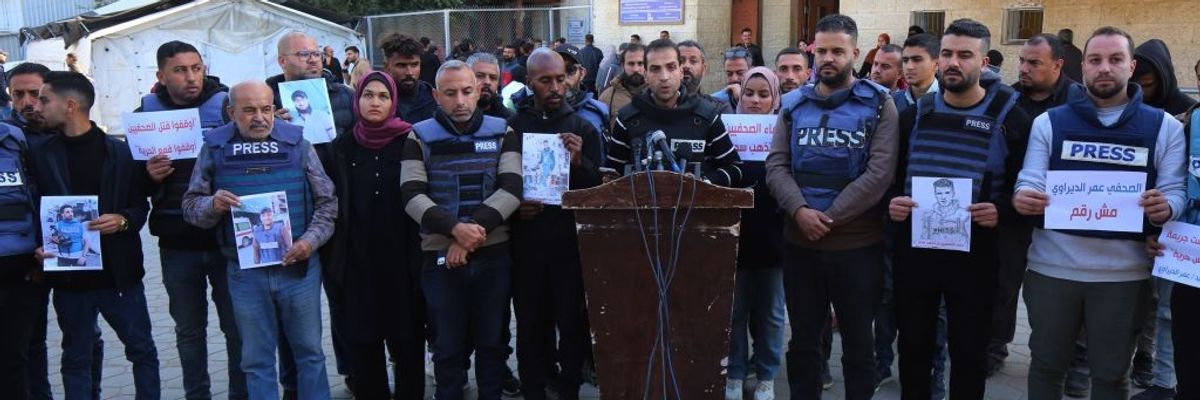
Youth support for Palestine reflects a changing media landscape. Journalists protest against the Israeli attacks on the Palestinian journalists outside a hospital in Deir al-Balah city, central Gaza Strip, on Jan. 8, 2025. (Photo by Rizek Abdeljawad/Xinhua via Getty Images
As unconditional support for Israel becomes more of a political liability and solidarity with Palestine establishes itself as a litmus test, former Secretary of State Hillary Clinton and her fellow status-quo defenders are blaming social media for the US public’s growing solidarity with Palestine.
In accusing young people of falling for fake news, they rely on an outdated assumption that equates social media with falsehoods—and equates legacy media with trustworthiness. What’s clear is that Clinton and her peers who partake in similar rhetoric fail to grasp the nuances of today’s media landscape, particularly as it has unraveled around Palestine.
More and more Americans have realized that Israel’s post-October 7 assault on Gaza is not only disproportionate but genocidal, and that in spite of the carnage, the US government continues to provide diplomatic cover and send billions in military aid. It’s no wonder that public sentiment has shifted considerably against Israel in the past two years, with young people in particular being increasingly supportive of Palestine. This sea change has made establishment politicians very nervous. In several recent speaking engagements, former Secretary of State Hillary Clinton has lamented that these pro-Palestine young people have the unfortunate habit of getting their news from social media; to her, that makes them uninformed and sorely misled.
“More than 50% of young people in America get their news from social media. Just pause on that for a second,” she said at an event for the newspaper Israel Hayom earlier this month. “They are seeing short-form videos, some of them totally made up, some of them not at all representing what they claim to be showing. And that’s where they get their information.”
The claim that social media is misleading and misinforming young people is simply an attempt not only to delegitimize pro-Palestine sentiment but to cast doubt on the devastation in Gaza itself.
Clinton’s framing is reminiscent of 2016-era misinformation discourse, back when the US public hadn’t fully figured out what to do with social media’s rapid acceleration and impact on politics. But that familiar rhetoric does not apply to the youth-driven political realignment on Palestine. When Clinton implies that pro-Palestine sentiment is a result of misinformation—a fraught umbrella diagnosis that often tries to encompass too much, and whose remedies can clash with the ideals of free speech—she attempts to place it within the context of Facebook fueling atrocities in Myanmar, Russian information campaigns working to influence the US election, and then-candidate Donald Trump labeling every media outlet “fake news,” forcing them to have tough conversations about when and how to fact-check his claims.
While the current media landscape and its relationship to politics is still bleak, Clinton’s accusation is much more about her fealty to Israel and the centrist-liberal order. The claim that social media is misleading and misinforming young people is simply an attempt not only to delegitimize pro-Palestine sentiment but to cast doubt on the devastation in Gaza itself.
The data point that half of Americans get (some of) their news from social media alarms most people—perhaps a valid instinct, given the current media landscape of local news in decline, billionaires taking over outlets, and profit-driven influencers peddling dubious wellness claims via vertical video. Social media did democratize information sharing without necessarily embedding any accountability mechanism for its quality and accuracy, resulting in a lot of low-quality content of dubious veracity.
But this doesn’t mean that social media users are only, primarily, or even significantly consuming fake news or slop. Pew Research Center reports that users, shockingly, do make assessments about what content they’re looking at. Not to mention that plenty of the content on social media is content from news outlets themselves.
According to Clinton, what’s most concerning is the fact that so many young people are getting their information from TikTok, given that the app is “governed by an algorithm—at least up til now—still largely manipulated by the Chinese Communist Party.” Her geopolitical paranoia echoes CNN commentator Van Jones, who in October placed blame on Iran and Qatar for running a “disinformation campaign” that flooded social media users with images of “dead Gaza baby, dead Gaza baby, dead Gaza baby.” Both try to convince audiences that concern for Palestine is just an information-operations campaign from our geopolitical enemies. Reports from earlier this year indicated that the legislation banning TikTok was, in part, ushered along by lawmakers’ worries about the prevalence of content critical of Israel on the platform.
Yet the most damning lesson here is not the growing reliance on getting information from social media, or even the fact that our collective outlook toward it should be more nuanced (it should!). Rather, it’s the collapse of trust in traditional legacy media that has accompanied young peoples’ shifting views on Palestine. The media industry utterly failed in its charge to report the news, and it failed to defend colleagues in Gaza as they were systematically murdered by the Israeli government. The New York Times in particular has been especially egregious, most infamously failing to retract their story “Screams Without Words” even after its credibility was seriously questioned.
Let’s say Clinton and her peers are only consuming these news sources (and even then, they’d have to be taking great lengths to avoid reading the quality reporting on Gaza that mainstream publications do often release, not to mention ignoring the numerous reports from human rights organizations and experts), then they’d be the ones who are uninformed—not the bogeyman of kids on social media.
The Lemkin Institute for Genocide Prevention and Human Security issued a statement last week on Clinton’s baseless accusations: What truly seems to unsettle Secretary Clinton is not “misinformation,” but rather the fact that younger generations are no longer consuming a single, state-controlled narrative. They are accessing unfiltered images and testimonies that challenge decades of political messaging.
At the Doha Forum, Clinton said it’s “a provable fact that most Americans... get their news from social media.” To echo Foreign Policy editor-in-chief Ravi Agrawal’s response: “Is that a bad thing?”
Our work is licensed under Creative Commons (CC BY-NC-ND 3.0). Feel free to republish and share widely.
Aastha Uprety Aastha Uprety is a writer and editor based in New York City. She has an MPA in social policy and technology, media, and communications from Columbia University. Full Bio >