Tuesday, December 23, 2025

Are You A Communist? Internet Says Yes!

Words like socialist and communist evoke deep fears within the citizens of the capitalist world, even when it comes to basic human rights and social welfare.


Anwiti Singh
12 December 2025 
OUTLOOK, INDIA

Photo: | Shutterstock |

Summary of this article


The terms communist, socialist, and feminist are often misused online as insults, detached from their real meanings.


Historical and contemporary examples show that accusations of being a “commie” are frequently directed at anyone advocating for rights, equality, or social justice.


True understanding of these ideologies requires nuance; advocating for fairness or human decency is not a world-ending threat, but calling someone a “commie” has become a lazy default reaction.


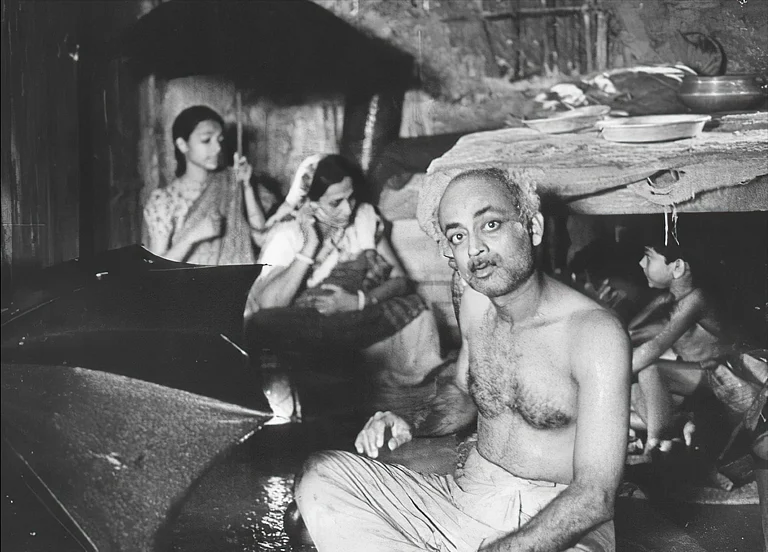
When Guru Dutt, playing the role of a struggling artist, speaks of the destitution and poverty plaguing those who sleep on footpaths with nothing to eat, Lalita Pawar’s character asks, “Are you a communist?”

In the now iconic dialogue from the movie Mr And Mrs 55 (1955), Dutt smiles and responds, “No, I am a cartoonist.”

When the then New York mayoral candidate Zohran Mamdani rode a city bike in Manhattan, a passerby yelled “communist” as an insult to him. He smiled and replied, “It’s a cyclist.”

From 1955 to 2025, not much has changed in how “communist” is used as an insult.

To be or not be (a communist) is the question, but accusing any person speaking of “rights” and equality as a “commie” is the answer, always, at least on social media and sometimes IRL (for non-cool folks, that’s “in real life”).

Related Content

Video | From ‘Communist’ to ‘Anti-National’: How Political Labels Lost Their Meaning In India


Mira Nair Reveals Son Zohran Mamdani Was Offered The Lead Role In A Suitable Boy
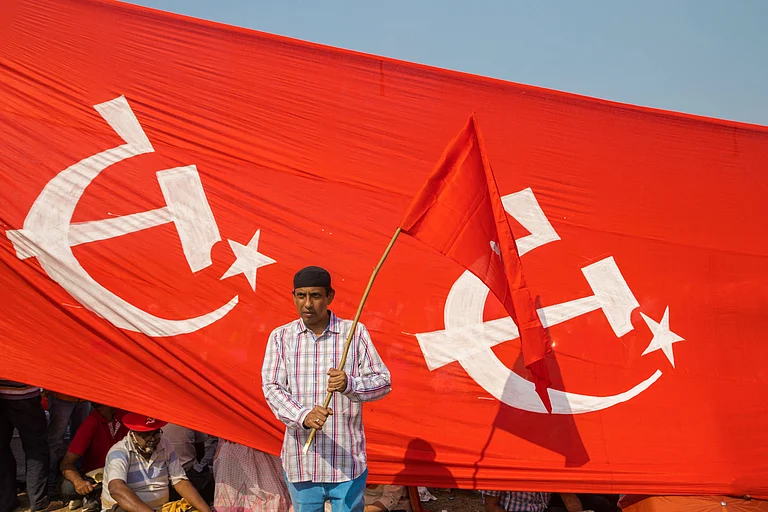

The Indian Left: Never Ruled, But Writing The Rules

While creativity seems to have died a thousand deaths in insults like these, it is not even correct half the time. Because why do you have a person yelling “commie bi***” under a woman’s reel about the rights of a married woman in India? My good sir, the faceless enigma, did he mean “feminist” by any chance?

Like all things good and bad about society at large, we can blame shows and movies for this as well. When the titular character of BoJack Horseman (undoubtedly the top… well, let’s not digress) rhymes ‘commie’ with ‘slap my salami’, there’s definitely a pattern of the ‘red scare’ in films and TV.

For your reference, and it may come as a surprise to many, communism, socialism, feminism, and all other isms are not interchangeable monikers to be lauded onto any “freethinker.”

A good haven of socialist/communist ‘allegations’ online is where people, especially women, advocate not burning children to death in Gaza. Asking for rights for Palestine and saying things like "Refugees must be given shelter" unfurl red banners in the reader’s/viewer’s mind. Same with women who request not to be killed and raped, or disallowed participation in the public space. A woman wanting to walk near her home after 9 PM freely is a harbinger of ‘nazi socialism and feminism’ in this country.

A female activist standing in front of bulldozers that want to tear down a forest is what, then? Or a person advocating for homeless people in Delhi should not be made to shiver and die in the cold and be provided with help by the government? That person has to be a commie, surely?

So maybe we should take a look at what these terms mean, so we can use them more appropriately as an insult.

But first, a few anecdotes. Communist Party of India (Marxist) Politburo member and general secretary of the Kisan Sabha, Vijoo Krishnan, was once attending a seminar in Beijing. The discussion was lively, everyone presented their opinions on that democratic stage, and Krishnan, in his speech, spoke ill of legacies such as Monsanto.

The story of Monsanto is long, so the best TL;DR version is this: a big capitalist company pushing GMO seeds on poor countries and taking away rights from poor farmers.

After he exited the stage, Krishnan was approached by a well-meaning professor who asked, “Are you a communist?” He laughs now as he recalls this memory, but then quotes Brazilian Archbishop Dom Helder Camara. The archbishop had once said, ‘When I feed the hungry, they call me a saint. When I ask why they have no food, they call me a communist.’ Krishnan says, “The quote explains effectively the distinction between charity—which is generally accepted and praised—while addressing systemic inequality is unacceptable to ruling classes.”

Unlike capitalism, liberalism, or other political theories, people tend to view socialism and communism within the absolute boundaries of the original texts. It is rather funny, though, that the scary communists and socialists who are dictators and tyrants are now equated with every person who speaks remotely in favour of the poor or minorities having rights.

If this writer could humbly share a personal anecdote, the first time I was called a communist was at the age of 13, when I said my neighbour fully had a right to divorce her abusive husband. Guess Karl Marx wrote about that, though I wouldn’t reference any of that at 13 now, would I?

Who Is A Commie-Socialist Then?

Is having blue hair a sure sign of a commie-feminazi? Apparently, on social media, yes. Wear glasses and read a book on inequality? Clearly plotting the downfall of capitalism. Post a thread about universal healthcare? You’re halfway to Gulag membership already. It’s as if every opinion that challenges the unquestioned superiority of the free market is immediately coded in neon red.

But let’s pause for a second. What is a communist, a socialist, a feminist—or, for that matter, a human being with a basic sense of decency? The answer is embarrassingly simple: none of the above are insults, and all of them are far more nuanced than your average YouTube troll or angry uncle on WhatsApp can process.

A communist, historically speaking, is someone who believes in common ownership of the means of production. That doesn’t mean they want to steal your iPhone or take away your Netflix subscription – or buffaloes. A socialist advocates for social ownership and welfare mechanisms, not necessarily the nationalisation of your local coffee shop. A feminist believes in gender equality and human rights for all. And yes, combining these labels doesn’t automatically summon a world-ending revolution or a dystopian state where everyone is forced to hug trees at gunpoint.

Yet here we are, in 2025, where calling someone a “commie” is the lazy equivalent of a Shakespearean insult like “thou pribbling ill-nurtured knave”—except it’s been dumbed down, globalised, and exported to Twitter threads, Instagram reels, and LinkedIn debates. People fling these terms without a thought, as if memorising Marxist terminology automatically qualifies as political critique. Spoiler: it doesn’t.

And the irony is thick. Those who shout the loudest about “Commie!” are often the same ones who have never opened Das Kapital, don’t know what social democracy entails, and think socialism means everyone gets a free Lamborghini. Meanwhile, someone quietly advocating for labour rights or affordable healthcare gets a digital spit take and a lifetime ban from casual conversation with the internet’s most discerning intellectuals: angry commenters.

So, what’s the takeaway? Maybe the real communists, socialists, and feminists are those who actually do the work, such as analysing policy, fighting for equitable laws, and supporting communities—not just yelling slogans from a keyboard. And maybe, just maybe, the next time you feel the urge to call someone a commie, step back and ask, ‘Am I criticising their ideas, or am I just trying to sound edgy?’

Because Guru Dutt had it right in 1955, and Zohran Mamdani in 2025—sometimes a cartoonist is just a cartoonist, and a cyclist is just riding a bike.

The digital age might have made insults faster, louder, and easier, but it has, unfortunately, not made them any more accurate. If we really want to keep the tradition alive, perhaps it’s time to start using terms thoughtfully, not just as shorthand for “I disagree and it scares me.” After all, nothing kills a debate faster than slapping an ideological label onto someone who’s just asking for fairness.

So yes, next time someone asks: “Are you a communist?” or “You must be a socialist feminist,” feel free to smile, sip your tea or vodka, and say exactly what you are (or aren’t). It’s unlikely you’re plotting world domination from a 2BHK in Delhi while using an iPhone anyway. You might just be someone who wants a slightly less absurd world; for minorities not be punished for the crime of their identity, for women not to be raped and killed for the crime of being a woman, or for children not be bombed to shreds in Gaza. And in 2025, that alone might be revolutionary enough.
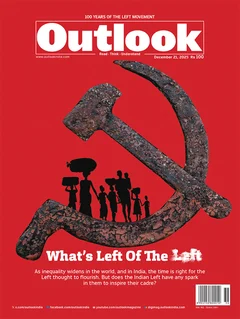
A Century of Red: The Indian Communist Movement

The Communist movement in India and the unfinished project of liberation


Atul Chandra
 17 December 2025 
0UTLOOK, INDIA


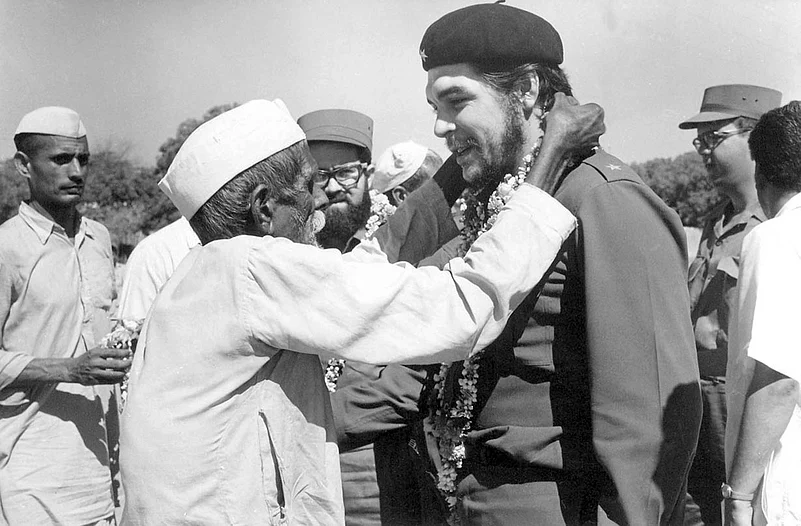
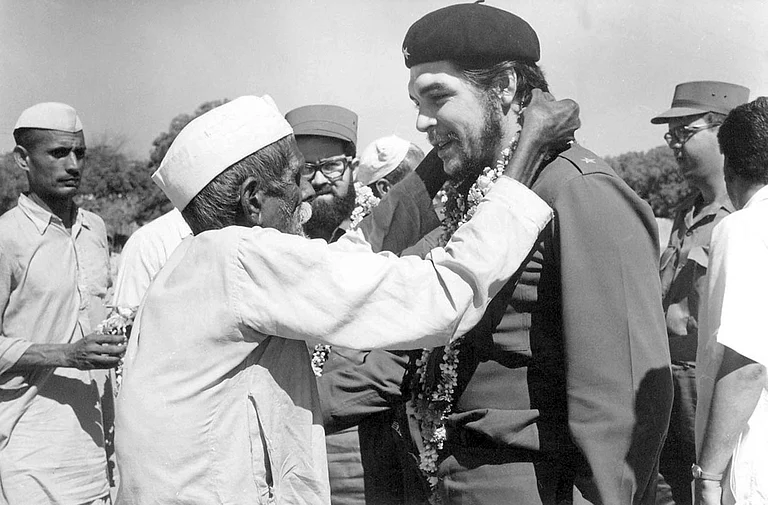
India Cuba: An elderly villager and member of indian communist party garlanding Che Guevara during his visit to a Community Project Area in Delhi, 1959


Summary of this article


The century of the Communist movement in India is a history of sacrifice, of ideological battles, of tremendous victories and painful defeats.


In April 1957, E. M. S. Namboodiripad took oath as Chief Minister of Kerala, leading the first democratically elected Communist government outside the Socialist Bloc.


The fundamental questions that animated Indian Communists remain urgent: Who controls the land? Who owns the factories? Who makes the decisions that shape our collective lives?


The Communist movement in India is now 100 years old. Whether one dates this from October, 1920, when Indian revolutionaries like M. N Roy, Abani Mukherjee and other Indian revolutionaries gathered in Tashkent to formally establish the Communist Party of India, or from December 1925, when Communist groups came together at the Kanpur conference in 1925 to constitute an all-India party, the fact remains that for over a hundred years, Communists have been an integral part of Indian political and social life. The Communists have fought colonial rule, built mass organisations of workers and peasants, governed states, resisted communal fascism and kept alive the dream of a society free from exploitation. The century of the Communist movement in India is a history of sacrifice, of ideological battles, of tremendous victories and painful defeats. It is also a history that speaks directly to our present moment, when the Right-wing Hindutva forces seek to shape India with their imagination and when the predations of global capital intensify the misery of the common people.


Any serious engagement with the history of Indian Communism must begin by acknowledging a historiographical debate that reflects the deeper questions about the nature of the movement itself. The Communist Party of India (Marxist), popularly known as the CPI (M), maintains that the party was founded on October 17, 1920, in Tashkent. This establishment was assisted by the Communist International. The Communist Party of India, popularly known as the CPI, on the other hand, considers the December 1925 conference in Kanpur as the authentic founding moment, when Communist groups already working inside India came together to establish an organised all-India party with a constitution and elected leadership.

This is not merely an archival dispute for historians to settle. The Tashkent formation represented the organic connection between Indian liberation and proletarian internationalism. It recognised that the struggle against British colonialism was inseparable from the worldwide movement against imperialism. The Kanpur conference, meanwhile, represented the rooting of the Communist organisation in Indian soil among workers and peasants of India. But one must understand that both these moments were necessary stages in the development of a movement that would eventually mobilise millions. The dialectical unity of these two currents, international solidarity and indigenous mass organisations, has defined Indian Communism throughout its existence.


Forged in the Colonial Fire

The British colonial administration understood, perhaps better than some nationalists of that era, the revolutionary potential of the Communist ideas among the India’s toiling masses. The colonial state responded with characteristic brutality. The Peshawar Conspiracy Cases, The Kanpur Bolshevik Conspiracy case and the most prominent, the Meerut Conspiracy case of 1929 to 1933, saw leading Communists prosecuted for seeking, in the words of the chargesheet ‘to deprive the King Emperor of his Sovereignty of British India, by complete separation of India from Britain by a violent revolution’.

Yet these trials, intended to crush the nascent movement, instead, provided a platform for the propagation of Marxist ideas across the country. In the Meerut courtroom, Communists spiritedly explained and defended their ideology, transforming their prosecution into a seminar on revolutionary theory. The photograph of the 25 accused, taken outside the Meerut Jail, remains an iconic image: S. A. Dange, Muzaffar Ahmad, P. C. Joshi and other revolutionaries who would shape the movement for decades. At the first party congress, held in 1943, the 138 delegates present had been collectively served 414 years in colonial prisons. This single fact testifies the death defying patriotism and sacrifices made by the Communists for Indian independence.


Muslim Women and the Left: Confronting New Realities

By the 1920s, Communists had established themselves as the most militant current within the anti-colonial movement. While the Congress often vacillated, Communists at the 1921 Ahmedabad session of the Indian National Congress moved a resolution demanding complete independence from the British rule, a demand that the Congress initially rejected. Along with the Workers and Peasants Party, the Communists organised industrial workers and peasants to form the All India Trade Union Congress and gather the All India Kisan Sabha into formidable mass organisations. In 1936, the All India Students’ Federation was founded, followed by the Progressive Writers’ Association and, in 1943, the Indian People’s Theatre Association. These organisations brought revolutionary consciousness to every section of Indian society. But it was the Telangana Armed Struggle of 1946-51 that demonstrated the revolutionary potential of Indian Communism most clearly. In the feudal hierarchical Nizam’s Hyderabad, where peasants were subjected to vetti (forced unpaid labour) and could be bought and sold, the Communists organised the most significant peasant movement since 1857. P. Sundarayya, who led the fight, documented the struggle in his monumental work titled ‘Telangana People’s Struggle and its Lessons’. Under the CPI’s leadership, the guerrillas armed with a few guns, lathis and slings and determination took on the Nizam’s forces and his Razakar militia. Women fought alongside men, shoulder to shoulder to defend their villages. At its peak, the rebellion established gram rajyams (village communes) across 4,000 villages controlling an area of 15,000 sq. miles with a population of four million. Approximately, one million acres were redistributed to landless peasants. The social transformation was revolutionary: caste distinctions were challenged, women’s participation in public life increased dramatically and feudal exactions were abolished. The rebellion led to 4,000 martyrs and more than 10,000 were imprisoned.


Forgotten By The Left — How Muslim Organisers Built Labour Movements And Were Written Out


Similarly, the Punnapra-Vayalar uprising in Kerala in 1946 saw Communist-led workers and peasants challenge the autocratic rule of the Travancore princely state. The Tebhaga movement in Bengal demanded that sharecropper’s share be increased to two-thirds of the harvest. Crucially, this movement maintained Hindu-Muslim unity based on class struggle at a time when communal riots were raging in other parts of Bengal. The areas where the Kisan Sabha had influence remained free of communal violence. This was a powerful demonstration of class consciousness as an antidote to communal poison, a lesson that remains relevant today.


Democratic Achievements and Imperial Subversion

In April 1957, E. M. S. Namboodiripad took oath as Chief Minister of Kerala, leading the first democratically elected Communist government outside the Socialist Bloc. The ministry’s 28 months in power, before its dismissal in July 1959, laid the foundations that continue to shape Kerala’s exceptional social indicators. The Agrarian Relations Bill threatened feudal landlordism; the Education Bill challenged the stranglehold of caste and religious organisations over schools. These were not socialist measures, but democratic reforms that the Congress had promised during the freedom struggle, but never delivered.


The response was ferocious. The so-called ‘Liberation Struggle’ (Vimochana Samaram) united the Catholic Church, the Nair Service Society, the Muslim League, and the Congress Party in a campaign of organised disruption. What was long suspected is now confirmed by declassified intelligence files: the Central Intelligence Agency (CIA) and the British MI5/MI6 mounted covert operations to bring down the Namboodiripad government. According to historian Paul M. McGarr’s recent research in the British archives, Congress leaders and union organisers were brought to the UK for intensive anti-Communist training. The CIA funnelled money to Congress politicians and anti-Communist trade unions. Daniel Patrick Moynihan, who later became USA’s ambassador to India, confirmed American involvement in his 1978 book A Dangerous Place, noting the objective was to prevent ‘additional Keralas’. On July 31, 1959, President Rajendra Prasad invoked Article 356, establishing a precedent for the abuse of constitutional provisions against non-Congress governments that would be repeated for decades.


Kerala After Bengal: Is the Left’s Shift Reinvention or a Neoliberal Turn?


Yet, Kerala’s Communist legacy proved resilient. The Left Democratic Front has governed the state for much of its history, producing India’s highest literacy rates, best health indicators, strong labour protections and eradicating extreme poverty through its multidimensional approach. In West Bengal, the Left Front's 34-year rule (1977-2011), the longest uninterrupted tenure of any democratically-elected Communist government globally, achieved significant land reforms and decentralised governance through panchayati raj. The Communist contribution to India’s constitutional framework, though often overlooked, includes the emphasis on workers’ rights, land reform provisions, and the vision of social and economic justice enshrined in the Directive Principles.

The Present Crisis and Future Possibilities

The Communist movement today confronts some serious challenges. The Left has electorally faced some setbacks. India’s top one per cent now owns over 40 per cent of national wealth. Unemployment, particularly among the youth, has reached crisis proportions. The Narendra Modi government’s economic policies have accelerate workers while enriching a handful of oligarchs. The Hindutva movement, born in the same year as the CPI, has captured state power and is systematically dismantling the secular, democratic republic that Communists helped build. Muslims face lynch mobs, Christians face bulldozers, and Dalits face renewed caste violence, all under the protection of the State machinery.


Yet, history rarely moves in straight lines. As Communists themselves would note, contradictions intensify before they resolve. The very success of neo-liberalism and Hindutva is immiserating the masses and creating conditions for a renewed resistance. The farmers’ movement of 2020-2021, which forced the Modi government to retreat on its agricultural laws, demonstrated that mass mobilisation is possible. The international situation―with the decline of US hegemony and the rise of a more multipolar world order―has opened new possibilities for the Global South that were unimaginable during the Cold War.

The Communist movement’s centenary is a moment to look back at what they have achieved for the masses and the Indian state and to take inspiration from it for their future struggles. It calls for what Marxists term as a concrete analysis of concrete conditions. The fundamental questions that animated Indian Communists remain urgent: Who controls the land? Who owns the factories? Who makes the decisions that shape our collective lives? How do we build a society where, in Marx’s famous phrase, the free development of each is the condition for the free development of all?

A hundred years ago, young Indians inspired by the October Revolution and determined to end colonial rule chose the path of Communism. Many gave their lives for this choice. Whatever the electoral map shows today, their dream of a liberated India, free from exploitation, oppression, and the degradation of caste and communalism, remains unfulfilled. Perhaps this is the most important lesson of the centenary: the struggle continues.


https://www.outlookindia.com/magazine/

(The author is a researcher and the Co-Coordinator of the Asia Desk at Tricontinental: Institute for Social Research)


(Views expressed are personal)
INDIA

The Right In The Left: Lessons And Limits

The challenge before communists is to use the lessons gleaned from historical hindsight to advance the movement today


Dipankar Bhattacharya
Updated on: 16 December 2025 
OUTLOOK, INDIA


Untitled Artwork by Chittaprosad Photo: | Courtesy: DAG

Summary of this article


Indian communists mark 100 years amid decline, while the RSS dominates national power.


The essay urges reclaiming secular, socialist ideals of the freedom movement.


Calls for reimagining class struggle to confront caste, inequality and authoritarianism.


As 2025 draws to an end, the organised communist movement completes its centenary in India. At the other end of the ideological spectrum, the far-Right Rashtriya Swayamsevak Sangh (RSS) also celebrated its centenary on October 1, 2025. The coincidence obviously leads to the question of why the communists find themselves electorally marginalised while the RSS has reached the zenith of power. Yet, when we look back, for much of the last 100 years, especially in the first five decades, it was the RSS that remained rather isolated while the communists had a fairly noticeable electoral presence.

The two trajectories could well have been different. There have been moments that the communist movement missed or mishandled, while the RSS benefited immensely from several turns of events in the last few decades. As long as the Congress dominated the scene, there was a period when the Left and the Right oppositions grew simultaneously, albeit in different parts of the country, but with a growing rightward shift across almost the entire policy spectrum and the Congress giving in to the aggression of the Sangh brigade, India since 2014 has been witnessing a virtual Bharatiya Janata Party (BJP) takeover while the communists have lost momentum.

Historical hindsight can offer plenty of experiences and lessons. However, the challenge before communists is to use those to good effect to advance the movement today. Like in many former colonies, in India too, the communist movement had emerged as a powerful anti-colonial stream. Within the overarching agenda of freedom from colonial rule, communists had distinguished themselves by their unwavering commitment to the secular democratic character of the republic and the cause of abolition of landlordism and the feudal order; securing of workers’ rights; and attainment of social progress.

The Constitution of India that emerged from the freedom movement broadly upheld this direction. At the time of independence and adoption of the Constitution, the RSS was explicitly opposed to the new constitutional framework of modern India. Following the assassination of Gandhi by a Hindutva terrorist, India’s first Home Minister, Sardar Patel, had no other option but to ban the RSS to protect India’s freedom. The short statement made by Patel blamed the RSS-promoted climate of hate and violence for Gandhi’s assassination and identified the organisation as a threat to India’s freedom. It was only after the RSS gave a written undertaking to accept the Constitution and the tri-colour national flag that the outfit was allowed to function as a self-proclaimed ‘cultural organisation’.

Today, the Indian state calls the RSS the world’s biggest NGO and celebrates its centenary by releasing commemorative stamps and coins. In fact, the BJP government and the dominant media are promoting the RSS as the ideological anchor of New India, with RSS appointees increasingly dominating the institutional spaces of education, research, policy-making and governance. Consequently, India is now undergoing a systematic legal and institutional restructuring, and this whole act of subversion of the constitutional foundation and institutional framework of modern India is being presented as a great exercise of decolonisation.

When the anti-colonial legacy of India is overturned in the name of decolonisation, the country clearly faces the challenge of not just defending the Constitution and parliamentary democracy, but also reclaiming the spirit of the freedom movement. Reigniting the anti-imperialist core of Indian nationalism and revitalising the vision of modern India as articulated in the preamble to the Constitution remain the principal ideological challenges for India’s communists as they enter the second century of their protracted journey. India has to wage nothing short of a second freedom struggle to reclaim democracy, and this battle is going to be the most pressing agenda of the Indian communist movement in the coming days.


Who Is A Comrade?


This is a fight that has to be fought on multiple levels. For millions of India’s toilers who will now have to fend for themselves in the corporate jungle raj of hire and fire and more work for less pay, it is a battle for sheer survival. India’s farmers, who had succeeded in getting the three dreaded laws of corporate takeover repealed, still remain utterly vulnerable. With education becoming an ever-expensive commodity and job security becoming increasingly elusive, young Indians find themselves trapped in a permanent state of anxiety and uncertainty. Draconian laws like the Unlawful Activities (Prevention) Act and regimentation drills like the National Register of Citizens (NRC) and Special Intensive Revision (SIR) are making liberty and rights a luxury for dissenting citizens and marginalised groups.

The Partition was the biggest tragedy of modern India as we emerged from two centuries of colonial rule. It left Indians with memories of a permanent wound and dreams of an undivided India or ‘Akhand Bharat’ that would become the aggressive credo of the RSS. But we tend to forget that even a partitioned India is a country of continental dimensions with all its complexity, diversity and vastness, and the RSS fad for bulldozing this diversity into an over-centralised uniformity is leaving the country ever more fragmented from within. The 42nd amendment to the Constitution had inserted not just the two epithets ‘secular’ and ‘socialist’ in the Preamble, it had also added the phrase ‘unity and integrity of the nation’. The Sangh-BJP establishment wants to erase every mention of secularism and socialism, but it does not understand that a multireligious, multicultural society like ours cannot stand united as a nation without secularism and socialist welfarism.

Ever since the publication of the Communist Manifesto in 1848, generations of communists in different parts of the world have had to navigate uncharted territories and deal with unforeseen situations. There have, however, been a few constant concerns—the focus on class struggle as the driver of social transformation, socialisation of capital, the working class emerging as the leading class and attaining political supremacy to constitute and lead their respective nations, and human emancipation from all fetters of bondage. In its attempt to grow at all costs, capital has not only pushed the world into wars and destruction, with growing environmental degradation and the climate crisis, the survival of the planet itself is now at stake.

How do communists in India deal with these questions in the emerging Indian context? The idea and practice of class struggle cannot be confined to the boundaries of economic struggle or the conceptual plane of abstract categories. Class is nothing if it cannot capture the concrete social existence and identity of the people, and if it cannot tackle the question of power, from the power of capital to the power of the state. With all the experience of the first 100 years of organised movement, can communists in India evolve a paradigm of class struggle that does not falter in challenging caste oppression and celebrating cultural diversity, a paradigm that pulsates with the spirit of gender justice and reflects the aspirations and sensitivities of the new generations? Challenging times must produce credible answers.


(Views expressed are personal)


Dipankar Bhattacharya is the general secretary, CPI(ML) Liberation


https://www.outlookindia.com/magazine/

This article appeared as The Right In The Left in Outlook’s December 21, 2025, issue as 'What's Left of the Left', which explores how the Left finds itself at an interesting and challenging crossroad now that the Left needs to adapt. And perhaps it will do so.
Why The Left Matters: A Century of Struggle, Social Justice And The Road Ahead

The future of the Left in India will be decided by the ability of the movement to rebuild and deepen its links with the working people.

MA Baby
Updated on: 12 December 2025 
OUTLOOK, INDIA


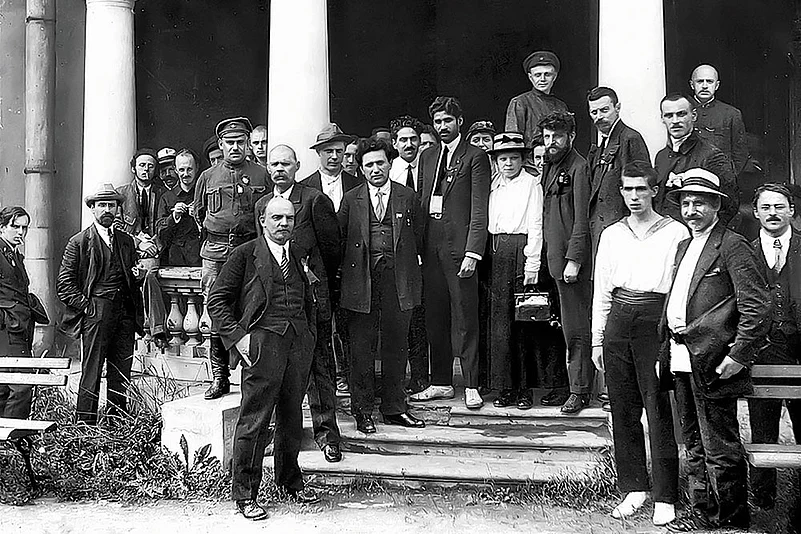
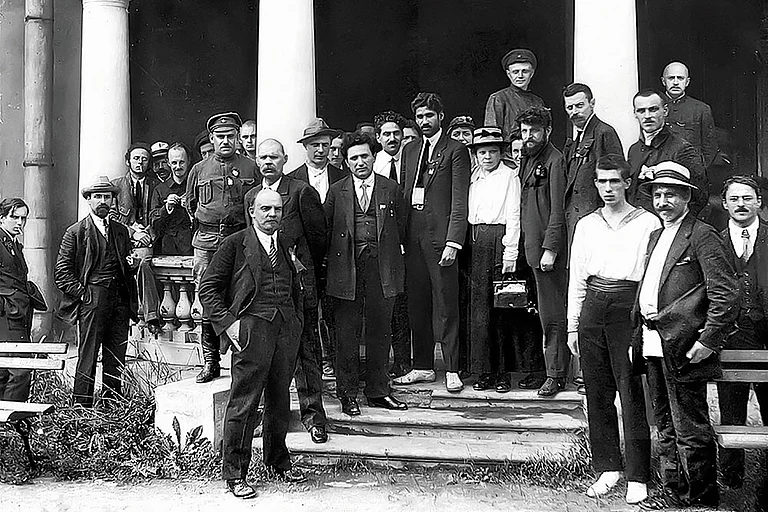
A Historic Gathering: Delegates to the second congress of the Comintern at the Uritsky Palace in Petrograd, including M.N. Roy, Vladimir Lenin, Maxim Gorky and Nikolai Bukharin

Summary of this article


The Left in India has endured for a century because it is rooted in the struggles, dignity and aspirations of workers and peasants.


Left ideas in India were not foreign imports but emerged organically from indigenous egalitarian traditions and early radical thought.


Communists played a decisive role in the freedom movement through organised mass struggles, trade unions, peasant uprisings and cultural platforms.


A hundred years is long enough for political currents to appear and disappear. Parties have risen on slogans and vanished in silence. What has endured in India, despite repression, distortions and political headwinds, is the Left movement. It has endured because it has always belonged to the working people of this country; to their labour, their dignity, and their dreams of a society free from exploitation. From the earliest murmurings of radical thought during anti-colonial resistance to the mass struggles of peasants and workers, from the severe blows of state repression to the experience of forming governments that delivered transformative reforms, the Left has left an indelible mark on modern India. The history of the Left is not parallel to the history of the nation, but it is rather interwoven with it.

The popular misconception that Left ideas were imported from abroad collapses the moment we revisit our own history with honesty. For example, in 1836, even before Karl Marx and Friedrich Engels joined the ‘League of the Just’, Vaikunda Swamikal, a social reformer who lived near the present day Marthandam (part of the erstwhile Travancore) started a utopian socialist movement called ‘Samathwa Samajam’. This is just one example. In fact, an investigation into the history of most societies and civilisations will reveal many examples of historical, mythological or intertwined narratives of a just and egalitarian society.


Images Against Darkness: 100 Years Of The Indian Communist Movement And The Culture Of Rebellion, In Photos


The 1905 Russian Revolution electrified the world, but India already had its own revolutionary impulses. The Anushilan Samiti in Bengal and the Ghadar Party in North America reflected an uncompromising resistance to colonial rule and a belief that freedom cannot be begged, it has to be seized. The Ghadarites, many of whom later became communists, carried the message that national liberation was inseparable from social liberation.

The October Revolution of 1917 provided inspiration, but not instruction. India’s young radicals were searching for tools to interpret the exploitation they experienced and witnessed in mills, plantations and villages. This search culminated in the formation of the Communist Party of India at Tashkent in 1920—five years before the party was organised publicly in Kanpur in 1925. The first Secretary of the Party, Mohammad Shafiq, symbolised a simple truth that the Left in India arose not from seminar rooms or drawing rooms, but from intense anti-colonial, anti-imperialist struggle.

Long before the Congress adopted the slogan of Poorna Swaraj in 1929, Hasrat Mohani, a communist, put forward the demand in 1921 at the Ahmedabad session of the AICC along with Swami Kumaranand, a peasant leader. The formation of the All India Trade Union Congress (AITUC) in 1920, and later organisations such as the Naujawan Bharat Sabha, the Hindustan Socialist Republican Association, the All India Kisan Sabha, the All India Students’ Federation and the Progressive Writers’ Association, turned radical thought into organised mass movements. Workers, peasants, women, students, youth, cultural activists and writers, all found in the Left a political home that combined the struggle for independence with the struggle for social transformation.

One of the final nails on the coffin of the morale of British rule in India was delivered by the sailors of the Royal Indian Navy uprising in 1946. It resulted in an insurrection by over 10,000 sailors and received massive support from the civilians and even police forces of the country. This mutiny was a loud message to the British that Indian soldiers will no longer aid or become a tool for the exploitation of their own people. It must not be forgotten that the sailors were proudly flying the Red Flag of the Communist Party on their ships (along with those of the Congress and the Muslim League flags) during the rebellion.


Crores On Strike: Bharat Bandh Disrupts Services Across India


Mass Struggles That Redefined India

What distinguishes the Left’s contribution to the freedom movement is not rhetoric but sacrifice. The communists led united struggles of workers and peasants that shook the pillars of colonial rule and feudal power. The Tebhaga movement in Bengal demanded two-thirds of the produce for the tiller. The Telangana struggle was carried forward by countless ordinary villagers, including women leaders like Mallu Swarajyam, and it confronted the nexus of feudal lords and the Nizam’s private militia. In the princely state of Travancore, the Punnapra-Vayalar uprising challenged autocratic rule. Each struggle was met with brutal repression. Yet each of them created a new political consciousness: that the land belongs to those who cultivate it, wealth belongs to those who produce it, and democracy means nothing without dignity.

Across the country, peasant movements asserted themselves in different contexts with shared aspirations. In Malabar, the struggles against Jenmi landlordism built the foundation of the Kisan Sabha. In Thane district, Adivasi struggles after 1947 challenged debt bondage and land dispossession under the leadership of the Sabha. P. Sundarayya, who would later lead the Communist Party of India (Marxist) as its General Secretary, dedicated his life organising poor peasants and farm workers, and towards the study of agrarian relations throughout undivided Andhra. In Tamil Nadu, G. Veeraiyan and others organised agricultural labourers against caste-linked exploitation and violence. The agrarian movement in Thanjavur was built by the CPI(M) and its mass/class organisations. This movement was intricately linked with the anti-caste struggle and over time, it gained so much strength that even the very idea of an agricultural union existing irked the landlords so much that they organised a gruesome massacre in the Keezhvenmani village, killing 44 Dalits, the majority of whom were women and children.

Kunwar Mohammad Ashraf (1903-1962): The Gandhi-ite Communist

Similarly, it was the CPI(M) and progressive class organisations that led a relentless struggle to get justice for the survivors of Vachathi state violence. These movements struck at the most deep-rooted structures of Indian society including but not limited to caste hierarchy, patriarchy and the culture of unpaid, invisible, unrecognised labour. In this sense, the Left did not wait for independence to begin fighting for social transformation. The battle for social equality was already underway in the fields and factories much before 1947. The Draft Platform for Action, 1930 was the first attempt towards preparing a programme for the party. This document recognised the ruthless abolition of the caste system along with agrarian revolution and overthrow of British rule as a necessity to achieve the complete social, economic, cultural and legal emancipation of all workers.

The years immediately after independence were marked by severe repression of the communists. The Telangana struggle was crushed with horrendous state repression. Leaders and cadres were jailed, forced to go underground, or killed in fake encounters. A distorted narrative was created to paint the Left as a threat to the nation precisely because the Left was demanding that land and power be returned to the people. Yet the repression did not erode the movement. Instead, it solidified the understanding that political democracy without economic democracy is hollow.

The turning point in parliamentary recognition came in 1957 when Kerala elected the first Communist government through the ballot. Land reforms, education reforms and democratic decentralisation fundamentally altered the social landscape of the state. The 1957 experiment proved that the Communists can govern, not just agitate; and govern in ways that expand people’s rights, not restrict them.

In later decades, Left governments deepened that legacy. In West Bengal, Operation Barga secured tenancy rights for millions of sharecroppers and laid the groundwork for rural poverty reduction. The panchayat system that empowered local democracy emerged in West Bengal and Kerala long before it was recognised in the Constitution in 1992. In Tripura, land redistribution ensured that two-thirds of land went to a tribal population that formed one-third of the state. These should be seen as parts of a coherent model of development in which human welfare is not an afterthought, but the starting point.

These experiences speak volumes about why Kerala continues to repose confidence in the Left, electing it twice in succession, something that has been unprecedented in the state’s political history. When governments deliver social justice in real terms, people do not forget.

Whenever India has been threatened by authoritarianism, the Left has taken an unmistakable stand. During the Emergency, when many parties compromised or justified excesses, we who opposed it paid a heavy price, but still refused to surrender constitutional and democratic rights. In the decades since, the Left has been the most consistent force against communal polarisation. It recognised much earlier than others that communal politics is inseparable from economic inequality, a divided society is easier to exploit.


What's Left Of The Left: The Thin Red Line In J&K

The crises India faces are the outcome of policies that prioritise private profit over public good and division over unity. A different future is possible—one based on secularism, equality, dignity of labour and democratic rights.

The CPI(M) warned in its 23rd Party Congress about the rise of the communal-corporate nexus which is an alliance of reactionary social forces and big capital. Today, as public assets are being handed over to private monopolies and dissent is being increasingly criminalised, that warning reads not like a precise description of current reality.

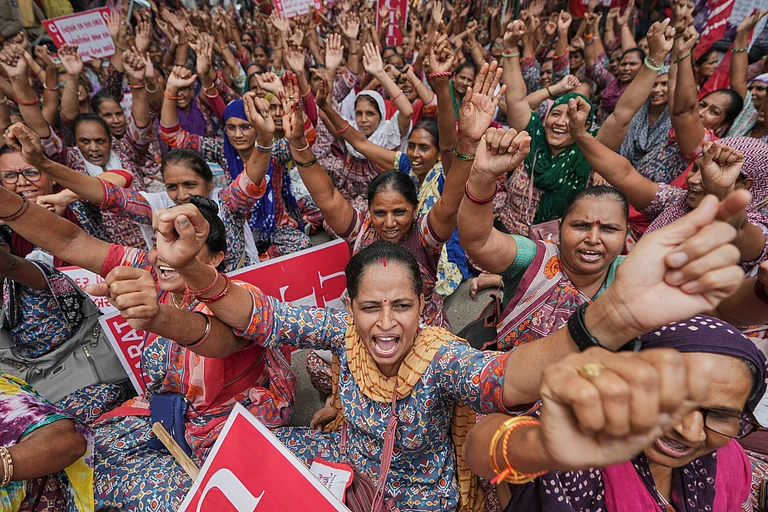
Whenever labour rights, public sector enterprises or natural resources have been threatened, the working class with the Left at the forefront has fought back , whether it is to prevent the sale of strategic Public Sector Units or to resist anti-worker labour codes. The one-year-long farmers’ movement on the borders of Delhi, which forced the repeal of three farm laws, saw active, consistent and disciplined participation from peasant organisations like the All India Kisan Sabha and other democratic and Left forces. The Kisan Long March in Maharashtra, where thousands of poor peasants walked peacefully with red flags, became a symbol of how democratic mobilisation can achieve what electoral arithmetic cannot.

Why the Left Matters Even More Today


There is a popular trend to judge political relevance solely by election results. But the Left’s history in India shows that the yardstick for us has always been larger: the strength of our links with working people, our ability to organise struggles, and our capacity to offer an alternative vision. Even in a period when the Left’s electoral strength is seeing unprecedented setbacks, its ideological and organisational presence continues to shape resistance movements across the country.

Today, India faces economic stagnation, record unemployment, nutritional crisis, collapse of public health funding, increasing numbers of suicides among peasants and agricultural labourers, rising caste violence, attacks on women, systematic communal polarisation that includes attacks on minorities, dalits, tribals and transgender people. In such a situation, the Left remains the only political force that speaks not of temporary relief but of structural change that includes public investment, universal welfare, labour rights, land reforms, public education, and a secular democratic republic rooted in equality.

The recent achievements of the Extreme Poverty Eradication Programme launched in Kerala show that it was a policy initiative grounded in the conviction that no human being should live without dignity. It does not mean that Kerala is free of poverty, but the achievements of this programme are a significant step in that direction.

It is this orientation that explains the renewed interest among young people in progressive politics worldwide. Against the rise of the far-Right forces, the youth are also marching behind the new faces of the Left and progressive forces in their countries to challenge inequality, corporate power and racism. The examples of Anura Kumara Dissanayake, Catherine Conolly, Zohran Mamdani, and countless other unnamed organisers and forces, speak volumes about this renewed interest. India is not an exception to this global churn.


Dhoom Macha Le: How Zohran Mamdani’s NYC Mayoral Victory Challenges Authoritarian Trends


The Next 100 Years


The Left movement in India has completed more than a century, but its task is far from finished. It has fought for generations of workers, peasants, women, students and marginalised communities; not for the sake of abstract ideals, but for concrete improvements in their lives and in the society as a whole. The future of the Left will be decided by the ability of the movement to rebuild and deepen its living links with the working people and other toiling masses.

Applying the scientific understanding of Marxism-Leninism in the concrete conditions of India is pertinent to achieve the above. As Young Comrade Lenin once mentioned, “We do not regard Marx’s theory as something completed and inviolable; on the contrary, we are convinced that it has only laid the foundation stone of the science which socialists must develop in all directions if they wish to keep pace with life. We think that an independent elaboration of Marx’s theory is especially essential for Russian socialists; for this theory provides only general guiding principles, which, in particular, are applied in England differently than in France, in France differently than in Germany, and in Germany differently than in Russia. We shall therefore gladly afford space in our paper for articles on theoretical questions and we invite all comrades openly to discuss controversial points.” (Collected Works of Lenin, Vol. IV, pp. 211-212).

The crises India faces are the outcome of policies that prioritise private profit over public good and division over unity. A different future is possible—one based on secularism, equality, dignity of labour and democratic rights. For that to become a reality, the Left is not just relevant but indispensable. The struggles of the past 100-plus years have immensely contributed towards shaping the democratic foundations of India. The next 100 years must complete the unfinished task of revolutionary social transformation.


(Views expressed are personal)


https://www.outlookindia.com/magazine/


M.A. Baby is General Secretary, Communist Party of India (Marxist)

This article appeared as 'We Shall Overcome' in Outlook’s December 21, 2025, issue as 'What's Left of the Left' which explores the challenging crossroads the Left finds itself at and how they need to adapt. And perhaps it will do so.

INDIA

Left-Brahmin, Right-Bahujan And Caste Of Ideologies

The Left needs to shrug its Left-Brahmin configuration to emerge with newer forms of solidarity.


Ajay Gudavarthy
18 December 2025 
OUTLOOK, INDIA


Marx Archive, 2018: Artwork by K. M. Madhusudhanan Photo: | Courtesy: Vadehra Art Gallery

Summary of this article


The Indian Left is in decline, increasingly seen as elite-driven (“Left-Brahmin, Right-Bahujan”) and out of sync with fragmented, pragmatic political behaviour shaped by neoliberalism.


It has failed to adapt to a new political idiom where culture, affect, symbolism and everyday experience shape politics—spaces the Right has successfully occupied.


To revive, the Left must shed elitism, reconnect class politics with culture and lived anxieties, rebuild unity, and create inclusive, popular forms of solidarity and organisation.


Left politics, for some time now, has been witnessing a terminal decline. There is a growing concern in university spaces that Left politics may end up attracting only the social elite, and those they are attempting to mobilise may move to the Right. It is a new political configuration that I refer to as Left-Brahmin, Right-Bahujan. The imagination of the Left has, over a period, been getting eroded in terms of its appeal and jouissance. Those who it was mobilising seem to be operating on a different register. It is a conflict between idealism and pragmatism, ideology and strategy, structural change and immediate survival. But what has changed so fundamentally?


What has changed fundamentally is the way transformation is being imagined after the neoliberal era. Farmer movements in the recent past have been a great exception in bringing back street protests in a big way. Farmer protests succeeded in pushing back the farm laws, but they did not succeed in electorally defeating the current political regime. It is in this context, some may argue, that farmers protested against the farm laws and not for the political defeat of the Bharatiya Janata Party (BJP). They may protest at Delhi’s borders, but may go back to voting for the BJP and Narendra Modi. Defeating the entire corporate model of development was never their intention; it was only about saving their land.

Why should the farmers defeat the political regime? This question does not make sense in Left-oriented politics. It is part of a structural logic, but some in today’s context may argue as to why burden the farmers with a regime change? Is it the logic of politics or the burden of morality? If farmers pushed back the farm laws, but went back to voting for the BJP for other considerations, how should one analyse such a thing? Some may argue in the current neoliberal context that expecting a continuity or consistency in the political behaviour or subjectivity is itself never empirically true. One should allow seeing that political action and choices are fragments and remain essentially fragmented.

The same political subjectivity can be framed in a different Left lexicon that fragmented behaviour is itself the product and symptom of neoliberal times. Should politics then not be about bringing a sense of a semblance of connection between the fragments? Or is it more liberating to think of change as disorderly, discontinuous and piece-meal? The later kind of a change imposes no moral burden on the political subject, while the aim and imagination of large change is burdensome and also totalitarian in character. This is the central question and challenge that the Left politics are facing in current times. Its old ways are not working and the new ways are not acceptable to it

The other major shift in Indian politics is that its idiom has changed. With representation becoming a significant dimension of social justice, there is a new local cultural idiom that has entered politics. There is a great shift to cultural symbolism and also making sense of economic and material issues through a cultural idiom. The BJP has been at the forefront of appropriating this phenomenon and the Left has not yet joined the party. It is still constrained by its social-ideological frameworks that lack affective depth. Revolutionary language brought in great symbolism of songs, dance, and slogans. They are now jaded and sound repetitive. The Left is often prone to confusing being repetitive with commitment. One could be tempted to compare it with the (Brahmin) Bhajan culture. It can be best understood by an anecdote when I took the initiative to arrange for a condolence meeting of a Left ideologue, and his comrades paid him rich tributes by saying that what he said in the 1950s, he said the same (or stood by the same) till 2000, when he passed away!

The Left certainly needs to reinvent itself. Both the parliamentary and non-parliamentary Left are on the wane. The decline becomes even more stark when you see that both the Communists and the Rashtriya Swayamsevak Sangh (RSS) began in 1925, and the opposite directions in which they seem to have travelled. With the coming of Gen Z, the Left begins to look even more archaic, even though it’s the Left student politics that continue to remain successful.

This is where the Left needs to link the questions of capital and exploitation to culture and more so everyday existential issues. The market and neoliberalism are not only an economic phenomenon, but also a cultural phenomenon. It impacts the way we think and interact. Is loneliness not the gift of late capitalism and distorted modernity? Anxiety is the product of excessive competitive ethic, and intrusive markets at the root of anomie. The Left fights the markets without linking it to anomie, and fights competition and monopoly without linking them to anxiety. It fights spatial inequalities without fighting boredom. One need not go too far, but take a detour to stop at Bollywood when it sings Khali bore do paharo se… jhola uthakar chale..Ramachandra ji (Fed up of these empty, boring afternoons, I’m packing my bag and leaving). Boredom has emerged as such a potent issue that populist authoritarians have reduced politics to entertainment. People are looking for new stories to celebrate life, and workers and peasants too possess mobiles. Entertainment and compensatory consumption have collapsed to be one. How can the Left enter and encroach such spaces? Mostly, the Left assumes all of culture to be conservative, and mistakes performance for manipulation.

The Left needs to move back into popular registers where everything that is popular is not necessarily progressive. But in order to recover the progressive one cannot eschew the popular. It is now clear that the progressive has to be built from within the popular by resignifying myths, mythologies, folklore and civilisational stories. Revolutionary poet Varavara Rao from Telangana was known for his robust interpretation of Karna for the caste question and Draupadi for the gender. With the emergence of independent Ambedkarite movements, mythologies were seen as casteist and they gradually receded from public discourse.

The rise of populism is questioning politics as a professional and a specialised field. It is bringing the everyday into the political. This is in itself radical. The intimate is bursting the opaqueness of the political as a distant and an indifferent field of discourses and policies. The Left got bamboozled with the intimate in the political. It needs to begin experimenting with a new organisational culture that is friendly, affable and above all, provides a deep sense of belonging. They need a new culture to settle differences without splits. They don’t need to learn from the RSS, but could well begin with Lenin’s ideas on concentric circles. While the RSS floats a great number of ‘shadow armies’, the Left is unable to hold on to corporeal bodies.

It is time for the Left to rethink the possibilities of a merger between various factions that have microscopic differences given disproportionate significance. They may need to open a fresh dialogue between the parliamentary and non-parliamentary factions. The ‘Great Debate’ is no longer as relevant as it once was. Neither China nor Russia has remained socialist. We need to make a fresh beginning in telling ourselves that we do not know how to build socialism. Bertrand Russell was among the first to return disappointed with his trip to the erstwhile Soviet Union and early to point to its bureaucratic culture and the absence of creative freedom. The Left needs to read and listen beyond its coterie sometimes to see what looked obvious to many.

Social elitism works in many ways in the Indian context. It is in this sense that the Left needs to shrug its Left-Brahmin configuration to emerge with newer forms of solidarity. As long as it fails to do so, it will, figuratively, remain an organisation of ‘Brahmin boys’.


(Views expressed are personal)


Ajay Gudavarthy is with the centre for political studies Jawaharlal Nehru University


https://www.outlookindia.com/magazine/

This article appeared as Left-Brahmin, Right-Bahujan in Outlook’s December 21, 2025, issue as 'What's Left of the Left' which explores how the Left finds itself at an interesting and challenging crossroad now the Left needs to adapt.
INDIA

Left’s Caste Blind Spot: Ambedkar And His Criticism of The Circle Of 'Brahmin Boys'

Dalit thinkers argue that caste as a dimension of social oppression was sidelined in communist practice. Intellectuals within the communist fold acknowledge that this neglect may be central to the crisis the Left faces today


N.K. Bhoopesh
Updated on: 11 December 2025 
OUTLOOK, INDIA


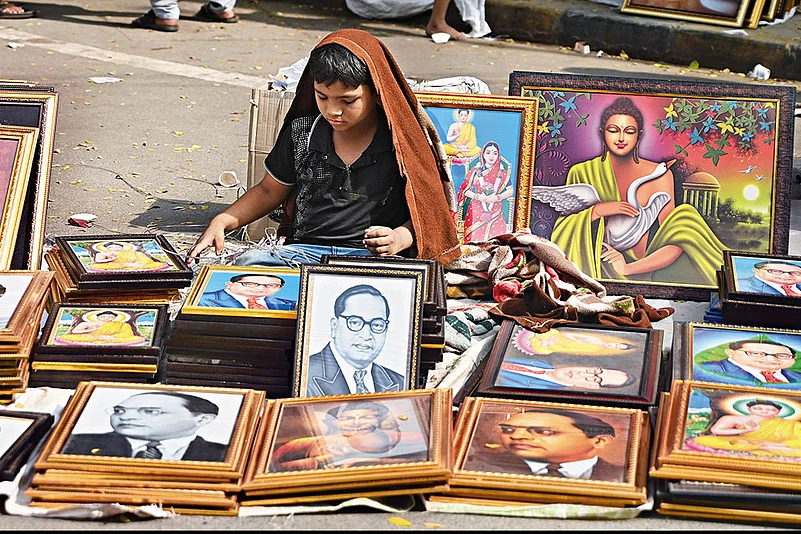
The Icon: A young boy sells portraits of Ambedkar | Photo: Imago/Hindustan Times

Summary of this article


Ambedkar accused communists of ignoring caste while CPI sought to dilute his influence.


Critics say Savarna-led Left long sidelined caste, pushing class over social oppression.


Late representational shifts expose ideological limits that haunt the modern Left.


Bhimrao Babasaheb Ambedkar never minced words.


For him, the Indian communist leadership was a circle of “Brahmin boys”, unable or unwilling to grasp the daily violence of caste. The communists, in turn, accused Ambedkar of siding with imperial interests and holding back the so-called untouchable masses from the wider democratic struggle.


The clash sharpened in 1952. After leading the Independent Labour Party (ILP), Ambedkar founded the Scheduled Caste Federation (SCF), shifting focus to specifically champion Dalit rights as a national political force, evolving from the ILP’s broader labour and anti-caste work into a platform dedicated solely to Scheduled Caste interests. The ILP was Ambedkar’s first political vehicle to address general labour rights and anti-caste issues. The SCF was formed to secure a distinct political platform to secure the rights of the Dalits.

Soon after, the Communist Party of India’s (CPI) central committee passed a resolution urging cadres to break Ambedkar’s influence among Dalits by taking up their demands and leading the fight against caste-Hindu oppression through common mass organisations. The resolution stated: “The party must sharply expose the policies of Ambedkar and wean the SCF masses away from his influence by boldly championing the democratic demands of the Scheduled Caste masses, by fighting caste-Hindu oppression against them and by drawing them into common mass organisations.”

Rooted in a classical Marxist framework, Indian communists largely saw caste as a secondary contradiction, something that would ultimately be resolved and subsumed within the broader context of class struggle. Yet, despite ideologically relegating caste to a lesser plane, it continues to haunt the Indian communist movement, especially after the Mandal era, which changed the Indian political landscape without recognition.

Related Content


Minimum Marxism: Reclaiming Class Politics


A Century of Red: The Indian Communist Movement


The Right In The Left: Lessons And Limits


Why The Left Matters: A Century of Struggle, Social Justice And The Road Ahead


Constitutional expert and former director of the National Law School of India, Mohan Gopal, argues that the Indian communist leadership’s longstanding discomfort with the anti-caste movement is rooted in its Savarna social orientation. To illustrate this, he cites Left ideologue EMS Namboodiripad. When Namboodiripad was invited to inaugurate a programme at Shivagiri on the birth anniversary of social reformer Sri Narayana Guru, he declined. Gopal notes that EMS reportedly justified his refusal by saying that if he had attended, he would have been expected to acknowledge Guru’s historical contributions, “which he did not like”.

Caste Is Poison, And Ambedkar Is The Antidote
BY Musafir Baitha


For Gopal, this episode captures a deeper pattern: a reluctance within sections of the communist leadership to recognise, let alone celebrate, the transformative role of anti-caste reformers. In his view, this reflects not merely ideological differences but a structural inability on the part of a Savarna-dominated leadership to engage fully with the politics of caste emancipation. The Indian Communist Party leadership’s caste elite domination has been pointed out by many as its inability to confront caste as a social reality.


“Caste was never brought as a subject that merits discussion within our organisation,” says O.K. Santhosh, professor at the University of Madras. Santhosh was a Students’ Federation of India (SFI) leader, a senate member, and a college union chairman in his college days. “In our committees, we used to discuss about liberalisation, privatisation and globalisation and a whole lot of things. But never caste issues. I don’t think it is deliberate. But growing up, I found the party’s approach inadequate to explain social realities and moved towards Ambedkarite movements,” he said.


C.K. Janu, a firebrand tribal leader, began her public life through the CPIM-led agricultural workers’ front, the Kerala Karshaka Thozhilali Union (KSKTU). She says the party and its leaders were impervious to the demands arising from the systemic issues tribals faced, such as landlessness and marginalisation. “Whenever I tried to present the case of the tribes, their problems and the ill-treatment meted out by the people who owned large swathes of land, it was given a short shrift. We were forced to form a tribal association—the Adivasi Gothra Mahasabha—because of the Left’s approach towards the tribals. They used us only for political processions and to stick posters,” she said.


A CPI(M) sympathiser, who did not wish to be identified, pointed to an interview given by former general secretary, the late Sitaram Yechury, to illustrate what he sees as the Left’s deeper ideological blind spot on caste. In that interview, Yechury recalled an exchange with the late Bahujan Samaj Party (BSP) founder Kanshi Ram. Kanshi Ram had asked him a seemingly simple question: How many Dalits are there in the West Bengal CPI(M) cabinet? Yechury admitted that he did not know and promised to check.


The sympathiser highlighted that even a close associate of Yechury—a CPI(M) minister—did not know the social background of his own colleague. Within the party culture, he said, “to be innocent of caste was regarded as a sign of ideological purity.” What is often celebrated as caste-blindness, he argued, is not an individual failing but a structural limitation of the Left’s ideological framework, which discourages acknowledging caste as a political reality even when it shapes access to power.


In 1989, when the VP Singh government announced the implementation of the Mandal Commission report, the Left’s vote share was at its highest, with the CPI (M) at 6.55 per cent and the CPI at 2.57 per cent. But the political decision that catapulted parties with a social justice agenda also sidelined the Left. Except in 2004, when the Left was instrumental in propping up the United Progressive Alliance government, its role has waned since then. Dalit thinkers argue that the cultural and identity-centred dimensions of social oppression, especially caste, were systematically sidelined in communist practice, even as anti-caste movements outside the Left dramatically reshaped India’s social landscape.


Interestingly, even intellectuals within the communist fold now acknowledge that this neglect may be central to the crisis the Left faces today. “The caste background of the earlier leaders could be one reason for not taking the caste issue seriously,” says Saira Shah Halim, author of Comrades and Comebacks. She notes that communist parties failed to recognise caste as a primary structure of oppression and instead relied almost exclusively on economic explanations. “They pushed the base-superstructure theory, believing that once the economic structure was corrected, every other social problem, including caste oppression, would disappear. That approach is deeply flawed,” she adds.

The Communist Party’s approach to identity politics is reflected starkly in the social composition of its leadership. For 58 years after its formation in 1964, the CPI(M) did not have a single Dalit member in its Politburo. It was only at the 2022 Party Congress that Ramachandra Dome, a Dalit leader from West Bengal, was inducted into the party’s highest decision-making body. The 2025 Congress added another leader from a marginalised community, Jitendra Chowdhury, a tribal leader from Tripura. The CPI, India’s oldest communist party, now has a Dalit general secretary in D. Raja, marking a late but notable shift in representational politics.

Engaging with caste has remained a persistent fault line in Indian politics, with Ambedkar on one side and nearly every other political formation, each in its own way, on the other. The communist approach, and its limitations, appear more pronounced because the Left explicitly claims a revolutionary mandate to abolish all classes. This makes its difficulty in fully grappling with caste even more glaring.

The question of how social markers such as caste and gender fit into the Left’s overarching class narrative is therefore unlikely to fade. In all likelihood, the Left will continue to animate political and intellectual debates, perhaps until both caste and class hierarchies are dismantled.


N.K. Bhoopesh is an assistant editor, reporting on South India with a focus on politics, developmental challenges, and stories rooted in social justice


MORE FROM THIS ISSUE


Tracing The Naxalites: How India’s Maoist Insurgency Is Crumbling in 2025


This article appeared as Reportage On Blind Spots Left Is Countering Ambedkar And The ‘Brahmin Boys’ in Outlook’s December 21, 2025, issue as 'What's Left of the Left' which explores the challenging crossroads the Left finds itself at and how they need to adapt. And perhaps it will do so.
Red Star, Lode Star: Where Does The Left Stand With The Global Rise Of The Right

The global rise of the Right has made the Left not irrelevant but indispensable


Brinda Karat
17 December 2025
OUTLOOK, INDIA


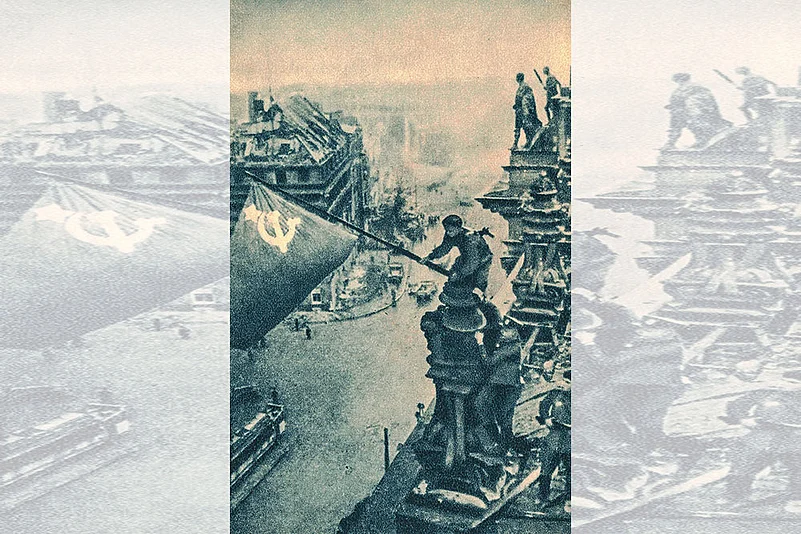
Flying High: Two Soviet soldiers plant a Soviet flag on top of the Reichstag building on May 2, 1945, symbolising the Soviet Union’s victory over Nazi Germany during the Battle of Berlin | Photo: Imago

Summary of this article


Persistent anti-Left rhetoric by Right-wing leaders reflects the enduring appeal of socialist ideas, which continue to resonate with working people.


The rise of neoliberalism after the collapse of the Socialist Bloc led to deregulation and soaring corporate power, deepening inequality and culminating in crises like the 2008 crash.


The global turn to the far-Right has been fuelled by economic insecurity, corporate backing and manufactured social polarisation.


Zohran Mamdani’s victory in New York underscores the continued relevance of egalitarian, despite aggressive attacks from leaders such as Trump.


It is striking that Right-wing leaders across the world continue to use communist and socialist-bashing as a central feature of their politics even while repeatedly declaring Left ideology “dead and buried”. If socialism is supposedly irrelevant, why is it still treated as a threat? The answer is simple: socialist ideas continue to resonate with working people everywhere, especially in times of deep crisis. This is why those in power remain preoccupied with discrediting the Left.

The vicious language used by US President Donald Trump against Zohran Mamdani—the self-declared democratic socialist who won the New York City mayoral election—is a telling example. While Mamdani was campaigning, Trump described him as a “lunatic communist,” a “subversive,” and condemned socialism as “the most noxious idea in human history”. Yet, Mamdani won decisively in the heart of global capitalism. His victory showed that even in metropolitan America, a political programme rooted in equality, public welfare and working-class rights has widespread support.

The collapse of the Soviet Union and the socialist bloc in the early 1990s was hailed by capitalist powers as “the end of history”. They celebrated the elimination of a model that had forced Western governments to adopt social security, welfare protections and labour rights. With its collapse, these concessions were treated as dispensable. Neoliberalism—the new template of global capitalism—proclaimed the privatisation of public assets, corporate tax concessions, sweeping deregulation, restrictions on labour rights and massive cuts in public expenditure as the formula for growth.


The Indian Left: Never Ruled, But Writing The Rules


On Bengali Cinema's Shift: From Socialist Ethos To Depoliticised Screens


Neoliberalism grew out of the demands of finance capital, merging into huge corporations across national borders for unfettered access to markets across the world without national regulations. Deregulation enabled speculative capital to flow across borders, unconstrained by concerns of social welfare or adherence to legal rights for workers, which were dismantled in many countries. The result was the dramatic enrichment of large corporations at the expense of ordinary people. Wages stagnated even as corporate profits and executive bonuses rose sharply. Public health and education systems were starved of funds. Pension guarantees and social security protections were steadily dismantled under the doctrine of “austerity”, while the wealthy enjoyed tax bonanzas. For workers, neoliberalism translated into outsourcing, contractualisation, the destruction of job security, and the weakening of unions. A vast population of precarious workers —with no guarantee of income or social protection—became the new global norm. The 2008 financial crash, which pushed millions into unemployment and poverty, was not an accident but the logical culmination of the neoliberal order.


When Absence Meant War


The absence of the Socialist Bloc of countries was felt throughout the world—by developing countries who lost a key ally against the hegemony of the Western imperialist powers, the working people in capitalist countries, those countries fighting for national sovereignty. It is no coincidence that this was when wars led by the US were waged, particularly on West Asian countries to grab their oil wealth. The US supported the most fundamentalist Islamist forces to overthrow regimes not compliant with US interests. The symbol of such forces, Osama Bin Laden, was a creation of this imperialist policy of the US as was the Taliban against the pro-socialist regime in Afghanistan.

As the social and economic consequences of neoliberalism hardened, discontent spread across the world. It was the betrayal of mainstream social-democratic parties and centrist parties, leading governments, that had earlier embraced neoliberal reforms themselves, unable to provide any alternatives which created the space for the far-Right. It channelled widespread economic insecurity into hatred—much like the Nazis did in 1930s Germany—replacing class anger with hostility towards immigrants, minorities and marginalised groups. In a kind of Right-wing International, these forces developed similar slogans and platforms: that authoritarian nationalism is the true guardian of culture, that corporate dominance represents development, and that attacks on minorities are legitimate expressions of majoritarian identity. The pattern has repeated itself across the US, Italy, Turkey, Hungary, the Philippines, and in India. In almost every case, the political rise of the far-Right has been achieved through the fusion of immense corporate backing with carefully manufactured social polarisation.

socialist ideas continue to resonate with working people everywhere, especially in times of deep crisis. This is why those in power remain preoccupied with discrediting the Left.


The scale of this shift is dramatic. A recent Global Parliament Index (Arden strategies) estimates that Right-wing governments now account for roughly 37 per cent of national leadership worldwide—the highest proportion in decades. Yet, contradictions are mounting. The neoliberal model that these governments championed is in crisis; protectionism is replacing globalisation, tariffs have been weaponised by the US to establish hegemony, and fears of another major financial collapse haunt Western economies. Public approval ratings for several Right-wing incumbents are falling sharply, including those of Trump in the United States.

At the same time, socialist China—which follows a model of state-led planning and public control of key resources—has emerged as a major pole in global politics against which the US is scrambling to build alliances. Whatever internal debates the global Left may have about the nature of Chinese socialism, the fact remains that a country once economically behind India now stands among the world’s most technologically advanced because it refused to submit to neoliberalism and retained what it describes as “Socialism with Chinese characteristics.” The relevance of socialism is proved by the example of China, which refused to bow under the bullying and intimidation of the US in its current tariff war, because it is confident of the strength of its own domestic economy based on socialist principles.

The Impact of the Left


The Left’s impact is often judged narrowly by electoral outcomes. But elections today are far from being democratic. Corporate financing plays an overwhelming role in shaping electoral success. Media houses across the world are owned by business conglomerates that openly champion Right-wing interests. Control of social media platforms enables the systematic spread of misinformation and the character assassination of dissenters. The question to be raised is: in so-called democracies are elections free and fair or is democracy corporate-driven, in which parties of the working classes, devoid of funds, have little chance to win an election?


Moreover, where electoral verdicts deliver a Left-wing victory, the US and its allies often intervene to instal compliant regimes. Look at what is happening in Latin America. The national sovereignty of the people of socialist Cuba, their lives, livelihoods and the very right to life, are under attack daily through the cruel decades-old sanctions imposed by the US and cowardly accepted by most so-called democratic governments. The people of Mexico, Columbia, Venezuela and Brazil defeated the US-backed efforts to impose pliant regimes electing governments committed to a pro-people policy framework influenced by socialist principles. Venezuela is currently being punished through the real threat of war.

Given this, it is misleading to assess the influence of the Left purely through its electoral strength, as though there has been a level playing field. The Left also shapes society through mass struggles, against class exploitation, against racial and caste violence and discrimination for the rights of marginalised communities, against war, ecological destruction. Its struggles have often been successful in defending peoples’ rights. The fightback of the working classes, the farmers, youth, students and women against neoliberal policies and for human dignity against Right-wing hatred, have been led by the Left through various organisations and platforms.

When most “centrist” political parties remained silent in the ongoing US-supported Zionist genocide in Gaza, it was the massive mobilisations of Left and progressive forces across campuses, workplaces and neighbourhoods that forced governments to shift their positions.

The Indian situation is inseparable from this global context. We are witnessing the consolidation of a political regime in which Hindutva ideology and corporate power reinforce each other—a communal corporate regime. The influence and control of the Rashtriya Swayamsevak Sangh (RSS) in determining the government agenda is clear. Economic and social policy today is structured simultaneously around neoliberal policies and majoritarian cultural domination marked by open hostility and escalating hate campaigns against minority communities and increasing attacks on all dissent.

The early 2000s showed that this trajectory was not inevitable. The surge in Hindutva mobilisation in the 1990s was checked by the emergence of the United Progressive Alliance (UPA) government in 2004, dependant on the Left, whose Common Minimum Programme (CMP)—drafted under Left pressure—forced a partial retreat from unrestrained neoliberalism. During this period, landmark legislation in which the Left played a critical role, such as the Forest Rights Act and the Mahatma Gandhi National Rural Employment Guarantee (MGNREGA) work guarantee were secured. Wherever the Left governed—in Kerala, West Bengal and Tripura—alternative policies took a systematic form. Land reforms; strengthened rights of agricultural workers and tenant farmers; minimum guaranteed wages; protection and advance of Dalits, Adivasis and minorities; defence of the public sector; and prioritisation of universal access to health and education. Kerala’s achievements, including its pioneering household-level micro-planning programme for poverty eradication, remain unmatched.

The Left’s strong stand prevented the hijacking of the political agenda by the Bharatiya Janata Party (BJP) when it was in Opposition. The rupture came when the Congress capitulated to corporate and US pressure to form a strategic alliance with the US, an instrument of which was the Indo-US nuclear deal, in violation of the CMP. Subsequently backed by the corporate media, the Congress spent its energies in attacking the Left even while the Right wing grew. Within five years, the coalition led by the Congress collapsed, leading to the victory of the BJP under Narendra Modi.

Despite the electoral setbacks, the Left has stood firm. In Kerala, confronting deliberate discrimination by the centre and resulting financial stress, the Left-led government has expanded welfare programmes and created new employment avenues. In Bengal, the unholy combination of parties from the extreme Left to the Right succeeded in defeating the Left Front government. Braving state-sponsored repression and murder of hundreds of cadre by the Trinamool Congress, through popular struggles, mobilisations and a rectification of past mistakes, the Left parties are building strong links with the people and are poised for a breakthrough. In Tripura, the party is regaining its strength through a brave resistance against BJP repression. The Left has played an important role in the significant struggles of workers and kisans (farmers), of students and women on their day-to-day issues, which have been an important aspect if not the backbone, of the fight against the current regime. The Left has been uncompromising in its defence of minority rights.

There are some well-wishers who urge the Left—and more specifically the Communist Party of India (Marxist)—to stop being “dogmatic” and “so ideological” and to become more practical. There are many legitimate criticisms of the CPI(M) or Left approaches which should and must be addressed. We have seen the sorry fate of those parties belonging to various hues, who sacrificed ideology for short-term gains. “Soft” Hindutva can never defeat Hindutva. The use of caste for political purposes can never eliminate the caste system. Compromise with policies which are anti-working class and which destroy the lives and livelihood of the rural poor and farmers in the name of development have to be strongly opposed. India needs a robust Left which will never compromise on the fundamental interests of the working people of India. To save those interests is to save and serve India. This is a battle for minds, not just for votes. A strong Left can help to bolster the wider platforms and combinations of secular political forces required to defeat the ongoing RSS-BJP project of a Hindutva rashtra.

The global rise of the Right has made the Left not irrelevant but indispensable. Capitalism is not the end of history. Injustice, inequality, hate and division are not human fate. The Left stands out as the enduring political current offering a coherent alternative based on public control of resources, an end to the exploitation of human labour, equitable access to the benefits of development, equality, secularism, peace and human dignity. This is why the Right cannot stop attacking socialism. It knows that an organised Left is the greatest obstacle to its project of division and exploitation. Socialism as an achievable goal fashioned in each country according to its national specificities, is the hope and the horizon to build a better world.


Brinda Karat is a politburo member of the CPI(M)

This article appeared as 'Red Star, Lodestar' in Outlook’s December 21, 2025, issue as 'What's Left of the Left' which explores the challenging crossroads the Left finds itself at and how they need to adapt. And perhaps it will do so.