Tuesday, December 23, 2025

‘Exactly What We Don’t Need’: Trump Bashed for Naming New Class of Warships After Himself

The reported move came just days after Trump added his name to the John F. Kennedy Center for the Performing Arts.


The USS Gravely warship enters the port of Port of Spain on October 26, 2025.
(Photo by Martin Bernetti/AFP via Getty Images)

Brad Reed
Dec 22, 2025
COMMON DREAMS

The Wall Street Journal on Monday reported that President Donald Trump will announce that the US Navy is building a new class of warship that will be named after him.

According to the Journal, the president is expected to reveal that the Navy is building “a new ‘Trump-class’ battleship, which will become the centerpiece of the president’s vision for a new ‘Golden Fleet.’”
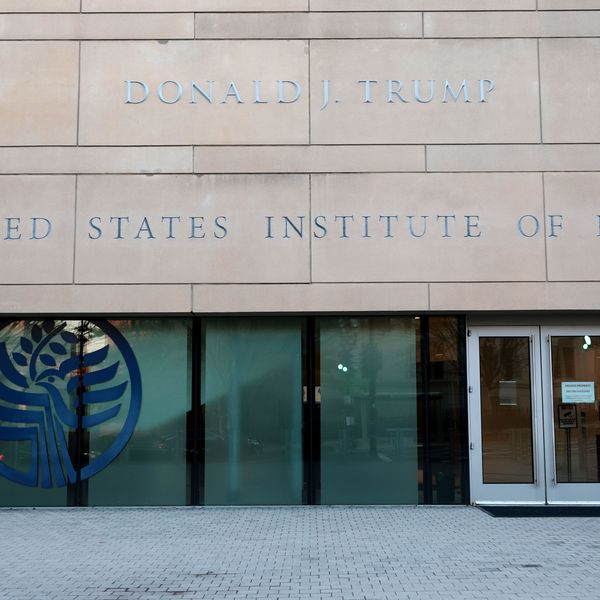

Genocide Backer and Narcissist Donald J. Trump Puts His Name on ‘US Institute of Peace’

The Journal noted that Trump in the past has complained about the aesthetic look of US warships, which he has described as “terrible-looking.” Sources told the Journal that the new ship will “be an upgrade to the Navy’s Arleigh Burke-class destroyers, which are the workhorse of the current fleet and which Trump has compared unfavorably to rival navies.”

Mark Montgomery, a retired rear admiral who currently serves as a senior director at the Foundation for Defense of Democracies, dumped on Trump’s “Golden Fleet” plans in an interview with the Journal, describing the ships as “exactly what we don’t need” and accusing Trump’s underlings of being “focused on the president’s visual that a battleship is a cool-looking ship.”

New York Times columnist Jamelle Bouie echoed Montgomery’s criticisms of the project, which he speculated was being done for entirely frivolous reasons.

“This just has me thinking about how so much of this government and the movement around it is purely a matter of aesthetics,” he wrote on Bluesky. “Is there a strategic reason for produce a new warship? Maybe. But my hunch is that this is happening because the president thinks it will look cool.”

CNBC‘s Carl Quintanilla observed that the Trump-branded warships were just the latest thing that the president has slapped his name on, as in recent months he has also announced the creation of the “TrumpRx” prescription drug website and the “Trump Gold Card,” while also adding his name to the John F. Kennedy Center for the Performing Arts.

Democratic political strategist Jim Manley reacted with horror to Trump naming American military equipment after himself.

“My God,” he wrote on Bluesky. “Well, that seals the deal. If House and Senate appropriators agree to this—burn it all down.”

Trump to announce new fleet of battleships bearing his name

WILL THEY BE PAINTED GOLD?!

Story by Carl Gibson
ALTERNET
Dec. 22, 2025
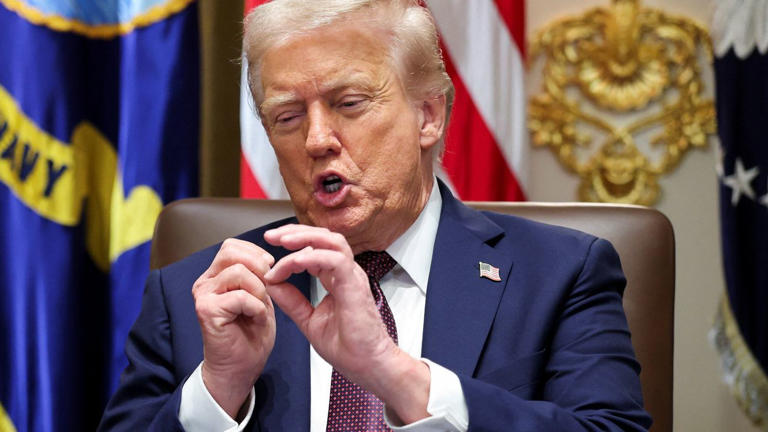

U.S. President Donald Trump gestures during a cabinet meeting at the White House in Washington, D.C., U.S., August 26, 2025. REUTERS/Jonathan Ernst© provided by AlterNet

President Donald Trump's ongoing efforts to cement his legacy by adding his name to U.S. government property has now spread to the Navy, according to a new report.

According to a Monday article in the Wall Street Journal, the president is now planning to announce a new fleet of "Trump-class" battleships for the Navy's "golden fleet." Trump's plan comes on the heels of the Navy's recent announcement that it will be building a series of frigates, with the first — dubbed the "U.S.S. Defiant" — scheduled to be on the open water by 2028.

"The self-aggrandizement spree continues," observed New York Times Chief White House Correspondent Peter Baker on X.

The company HII Ingalls Shipbuilding is in charge of construction of the "golden fleet," with the first of the new ships being built in Pascagoula, Mississippi. The Pascagoula shipyard is the current home of the U.S. Coast Guard's Legend-class Legend-class National Security Cutter (a ship roughly the same size as a frigate).

As the Journal reported, the U.S. Navy currently has 287 ships in its inventory, which include aircraft carriers, destroyers, cruisers, amphibious ships and submarines. The new battleships would replace the current fleet of Arleigh Burke-class destroyers, which Trump has frequently (and unfavorably) compared to ships in other countries' naval fleets.

Former Rear Admiral Mark Montgomery — who is now the senior director at the Foundation for Defense of Democracies — told the Journal that the "golden fleet" was "exactly what we don't need" and estimated the cost of each ship to be roughly $5 billion. He noted that the new ships would have "zero tactical use" as they lack a vertical launch system and would not be equipped with the Aegis ballistic defense system.


"We do not need ships that are not optimized to provide lethality against the Chinese threat," Montgomery said. "... That is not what these are focused on — they are focused on the president’s visual that a battleship is a cool-looking ship."

Trump's pending announcement of the new fleet of battleships named for him comes after last week's news that the president's hand-picked board of the Kennedy Center voted to add his name to the facility (even though officially changing the name requires an act of Congress). Rep. April McClain Delaney (D-Md.) recently introduced legislation aiming to stop Trump from adding his name to federal property, though its passage is unlikely given that Republicans control both chambers of Congress.

Click here to read the Journal's full report (subscription required).


'Trump Class' battleships plan already has major 'cultural shift' problem: analysis


Ewan Gleadow
December 23, 2025
RAW STORY
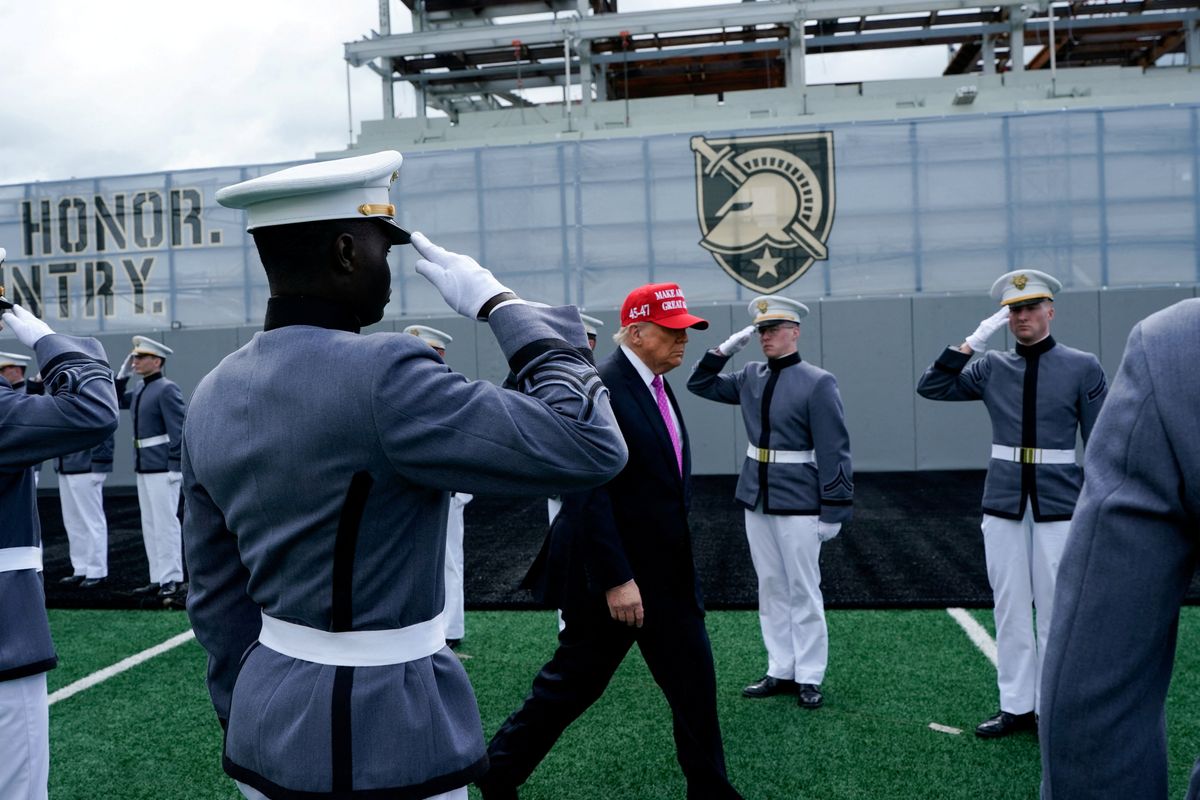

FILE: U.S. President Donald Trump attends the commencement ceremony at West Point Military Academy in West Point, New York, U.S., May 24, 2025. REUTERS/Nathan Howard

A proposed battleship line named after Donald Trump has already hit a snag according to a professor of war.

Professor Alessio Patalano of King's College London says the production of battleships named after Trump faces several problems, and that is before production has even started. The professor of war and strategy says the US may have the infrastructure necessary to building the new fleet, but it lacks the space and money necessary.

Speaking to CNN, professor Patalano said, "The question is … whether the US has a sufficient shipyard capacity and workforce to translate a visual gold fleet into a real sailing one."

"The US Navy is not known for being at the forefront of automation and innovative solutions in terms of more compact crew management." The professor of war and strategy has also suggested bringing these battleships up to speed with the rest of the US navy will require more than money.

It will also need a "cultural shift - in light of other new classes being built - of no trifling proportions," Patalano added. Fellow expert and former US Navy captain, Carl Schuster, agrees that a cultural shift is necessary for the project to be a success=

He said, "A national scale recruitment and training program for shipyard, electrical, information and sensor system workers (would be) required to support this program."

"This project will be managed by NAVSEA (Naval Sea Systems Command), an organization and staff that has screwed up every surface warship program of this century. I believe Trump must clean house in that organization if he wants any shipbuilding program to succeed."

Schuster would go on to suggest there is a comparison to be made between Trump's military plans and that of JFK's space program.

The ex-Navy captain said, "I think Trump is trying to achieve a maritime equivalent to JFK’s call for a space program. Remember, the Soviets seemed to be ahead of us in space, a direct threat to our national security."


"The PLAN is nearing the ability to challenge our access to the Western Pacific, a direct and clear threat to our national security. Since it also poses a threat to Japan and South Korea, enlisting their help to meet that challenge is a necessary solution to the problem."


PIRATES OF PENZANCE


Pentagon Fails 8th Consecutive Audit Days After Bipartisan Vote to Hand It $900 Billion

“Congress cannot continue funneling hundreds of billions of dollars to a completely unaccountable agency while American families can’t afford food or healthcare,” said one House Democrat.


US Defense Secretary Pete Hegseth speaks during a news conference on June 26, 2025 in Arlington, Virginia.
(Photo by Andrew Harnik/Getty Images)

Jake Johnson
Dec 23, 2025
COMMON DREAMS


Two days after the US Senate voted on a bipartisan basis to authorize just over $900 billion in military spending for the coming fiscal year, the chief recipient of that taxpayer money—the Department of Defense—announced it failed an audit of its books for the eighth consecutive year.

The now-predictable audit result was announced Friday by the Pentagon’s Office of Inspector General (OIG) after an examination of the agency’s roughly $4.6 trillion in assets. The OIG said it identified 26 “material weaknesses”—major flaws in internal controls over financial reports—in the Pentagon’s accounting.


‘Don’t Give the Pentagon $1 Trillion,’ Critics Say as House Passes Record US Military Spending Bill


Majority of Democrats Join Senate GOP to Pass Trump’s $900 Billion Pentagon Wish List

Auditors also uncovered “five instances of noncompliance with laws, regulations, contracts, and grant agreements,” OIG said.

The Military Times reported that “among the shortcomings were omissions in the Joint Strike Fighter Program, the Pentagon’s multifaceted effort to develop an affordable strike aircraft for the Air Force, Marine Corps, Navy, and allied nations.”

“Auditors determined the Pentagon failed to report assets in the program’s Global Spares Pool, and did not accurately record the property,” the outlet noted.

Jules W. Hurst III, the Pentagon’s chief financial officer, said in response to the findings that the department is “committed to resolving its critical issues and achieving an unmodified audit opinion by 2028.

The Pentagon remains the only US federal agency that has yet to pass an independent, department-wide audit, as required by law. But its repeated failures to return a clean audit haven’t deterred Congress from adding to its coffers each year.

With the passage of the 2026 National Defense Authorization Act (NDAA), which President Donald Trump signed into law last week, Congress has backed over $1 trillion in military spending this year.

“Congress cannot continue funneling hundreds of billions of dollars to a completely unaccountable agency while American families can’t afford food or healthcare,” said Rep. Pramila Jayapal (D-Wash.), who voted against the NDAA.


War Crime, Murder, or Both? House Dems Demand DOJ Probe Into Hegseth Order to Kill Shipwrecked Sailors

“Giving a general order to kill any survivors constitutes a war crime,” wrote Reps. Jamie Raskin and Ted Lieu. “Outside of war, the killing of unarmed, helpless men clinging to wreckage in open water is simply murder.”


US Secretary of Defense Pete Hegseth speaks during a Christmas service at the Pentagon on December 17, 2025 in Arlington, Virginia.
(Photo by Alex Wong/Getty Images)

Julia Conley
Dec 22, 2025
COMMON DREAMS

Making clear that the Trump administration’s “entire Caribbean operation,” which has killed more than 100 people in boats that the US military has bombed, “appears to be unlawful,” two Democrats on a powerful House committee on Monday called on the Department of Justice to investigate one particular attack that’s garnered accusations of a war crime—or murder.

House Judiciary Committee Ranking Member Jamie Raskin (D-Md.) and Rep. Ted Lieu (D-Calif.) wrote to Attorney General Pam Bondi four weeks after it was reported that in the military’s first strike on a boat on September 2, Defense Secretary Pete Hegseth ordered service members to “kill everybody”—prompting a second “double-tap” strike to kill two survivors of the initial blast.

A retired general, United Nations experts, and former top military legal advisers are among those who have warned that Hegseth and the service members directly involved in the strike—as well as the other attacks on more than two dozen boats in the Caribbean and eastern Pacific—may be liable for war crimes or murder.

Raskin and Lieu raised that concern directly to Bondi, writing: “Deliberately targeting incapacitated individuals constitutes a clear violation of the Department of Defense’s Law of War Manual, which expressly forbids attacks on persons rendered helpless by shipwreck. Such conduct would trigger criminal liability under the War Crimes Act if the administration claims it is engaged in armed conflict, or under the federal murder statute if no such conflict exists.”

The administration has insisted it is attacking the boats as part of an effort to stop drug trafficking out of Venezuela, and has claimed the US is in an armed conflict with drug cartels there, though international and domestic intelligence agencies have not identified the country as a significant source any drugs that flow into the US. As President Donald Trump has ordered the boat strikes, the administration has also been escalating tensions with Venezuela by seizing oil tankers, claiming to close its airspace, and demanding that President Nicolás Maduro leave power.

Critics from both sides of the aisle in Congress have questioned the claim that the bombed boats were a threat to the US, and Raskin and Lieu noted that the vessel attacked on September 2 in particular appeared to pose no threat, as it was apparently headed to Suriname, “not the United States, at the time it was destroyed.”

“Deliberately targeting incapacitated individuals constitutes a clear violation of the Department of Defense’s Law of War Manual, which expressly forbids attacks on persons rendered helpless by shipwreck.”

“Congress has never authorized military force against Venezuela; a boat moving towards Suriname does not pose a clear and present danger to the United States; and the classified legal memoranda the Trump administration has offered us to justify the attacks are entirely unpersuasive,” wrote the lawmakers.

Raskin and Lieu emphasized that Hegseth’s explanations of the September 2 strike in particular have been “shifting and contradictory.”

“Secretary Hegseth has variously claimed that he missed the details of the September 2 strike because of the ‘fog of war,’ and that he actually left the room before any explicit order was given to kill the survivors,” they wrote. “Later reporting suggests that he gave a general order to kill all passengers aboard ahead of the strike but delegated the specific order to kill survivors to a subordinate.”

The facts that are known about the strike, as well as Hegseth’s muddled claims, warrant a DOJ investigation, the Democrats suggested.

“Giving a general order to kill any survivors constitutes a war crime,” they wrote. “Similarly, carrying out such an order also constitutes a war crime, and the Manual for Courts-Martial explicitly provides that ‘acting pursuant to orders’ is no defense ‘if the accused knew the orders to be unlawful.’ Outside of war, the killing of unarmed, helpless men clinging to wreckage in open water is simply murder. The federal criminal code makes it a felony to commit murder within the ‘special maritime and territorial jurisdiction of the United States,’ which is defined to include the ‘high seas.’ It is also a federal crime to conspire to commit murder.”

Raskin and Lieu also emphasized that two memos from the DOJ’s Office of Legal Counsel (OLC) “do not—and cannot—provide any legal protection for the secretary’s conduct.”

A 2010 OLC memo said the federal murder statute does not apply “when the target of a military strike is an enemy combatant in a congressionally authorized armed conflict,” they noted. “In stark contrast, in the case of the Venezuelan boats, Congress has not authorized military force of any kind.”

A new classified memo also suggested that “personnel taking part in military strikes on alleged drug trafficking boats in Latin America would not be exposed to future prosecution,” and claimed that “the president’s inherent constitutional authority in an undeclared ‘armed conflict’ will shield the entire chain of command from criminal liability.”

The Democrats wrote, “Experts in criminal law, constitutional law, and the law of armed conflict find this sweeping, unsubstantiated claim implausible, at best.”

They also noted that even the author of the George W. Bush administration’s infamous “Torture Memo,” conservative legal scholar John Woo, has said Hegseth’s order on September 2 was clearly against the law.

“Attorney General Bondi, even those who condoned and defended torture in the name of America are saying that the Trump administration has violated both federal law and the law of war,” wrote Raskin and Lieu. “We urge you to do your duty as this country’s chief law enforcement officer to investigate the secretary’s apparent and serious violations of federal criminal law.”


University of Oklahoma Removes Teacher Over Failing Grade for Student’s Bible-Based Gender Essay

“So if a geology student at the University of Oklahoma says in class the earth is 6,000 years young because that’s what they believe, a geology teacher can’t say squat?” asked one critic.

 
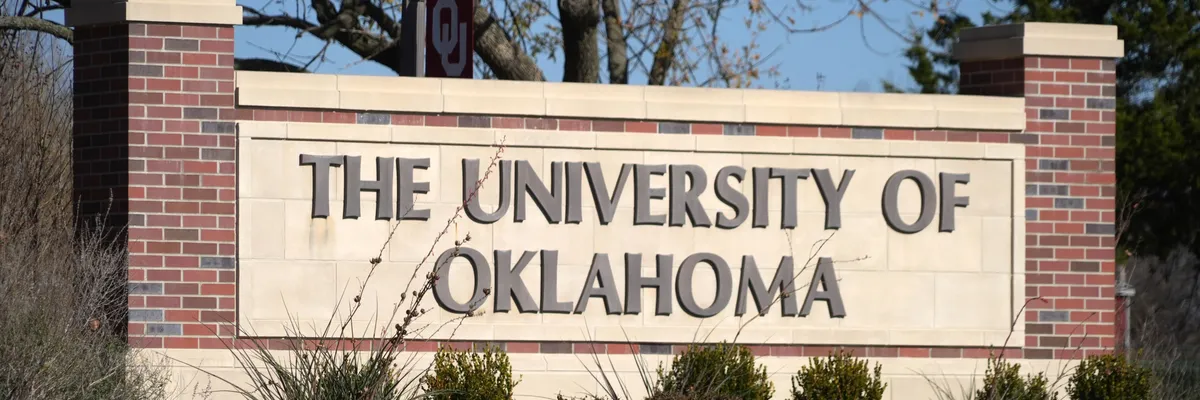
A sign on the campus of the University of Oklahoma is seen on December 1, 2024, in Norman, Oklahoma.
(Photo by Kirby Lee/Getty Images)

Julia Conley
Dec 23, 2025
COMMON DREAMS

A decision from the University of Oklahoma on Monday left some asking whether the research university can still be seen as having “academic standards” after an instructor was removed from teaching duties for giving a failing grade to a student who focused on her own religious beliefs about gender in a paper for a psychology course.

The university released a statement saying the graduate teaching assistant in the course, Mel Curth, had been “arbitrary” in the grading of a paper by student Samantha Fulnecky, who wrote an assigned essay about an article the class read about gender, peer relations, sterotyping, and mental health for the course.

Fulnecky’s paper cited the Bible and focused heavily on her beliefs that “God made male and female and made us differently from each other on purpose and for a purpose.”

“Women naturally want to do womanly things because God created us with those womanly desires in our hearts. The same goes for men,” she wrote in the essay, adding that “society pushing the lie that there are multiple genders and everyone should be whatever they want to be is demonic and severely harms American youth.”

Curth, who is transgender, gave Fulnecky a zero for the essay and emphasized in her response that she was “not deducting points because you have certain beliefs,” but because the paper “does not answer the questions for the assignment, contradicts itself, heavily uses personal ideology over empirical evidence in a scientific class, and is at times offensive.”


“Using your own personal beliefs to argue against the findings of not only this article, but the findings of countless articles across psychology, biology, sociology, etc. is not best practice,” Curth wrote.

Another instructor concurred with Curth on the grade, telling Fulnecky that “everyone has different ways in which they see the world, but in an academic course such as this you are being asked to support your ideas with empirical evidence and higher-level reasoning.”

On Monday, the university suggested Curth’s explanation for the grade was not satisfactory.

“What is there to say other than that the University of Oklahoma has no academic standards?” asked journalist Peter Sterne in response to the university’s statement.


One civil rights advocate, Brian Tashman, added that the school’s decision opens up numerous questions about how academic papers that focus on a student’s religious beliefs will be graded in the future.

“So if a geology student at the University of Oklahoma says in class the earth is 6,000 years young because that’s what they believe, a geology teacher can’t say squat?” asked Tashman. “What if their religion teaches the earth is flat? Or that all of mankind’s problems can be traced back to Xenu?”

Curth had initially been placed on administrative leave earlier this month when Fulnecky filed a religious discrimination complaint with the school.

Fulnecky’s allegations drew the attention of the school’s chapter of Turning Point USA, the right-wing group that advocates for conservative political views on college and high school campuses. The group is closely aligned with the Trump administration. Vice President JD Vance spoke at Turning Point’s AmericaFest last weekend—and used the appearance to tell young conservatives that their movement should not root out antisemitism with “purity tests”—and the assassination of its founder, Charlie Kirk, earlier this year, was followed by the White House’s efforts to crack down on what it called left-wing extremism, with President Donald Trump directly blaming the “radical left” for Kirk’s killing before a suspect was identified.

While Fulnecky garnered support from the Turning Point chapter, hundreds of her fellow students rallied in support of Curth in recent weeks, chanting, “Protect Our Professors!” at a recent protest.


A lawyer for Curth said Monday that she is “considering all of her legal remedies, including appealing this decision by the university.”

“Ms. Curth continues to deny that she engaged in any arbitrary behavior regarding the student’s work,” Brittany M. Stewart told the Washington Post.

The university did not release its findings of the religious discrimination investigation it opened into Fulnecky’s case.

The school’s decision to remove Curth from teaching duties, said author Hemant Mehta, “is what academic cowardice looks like.”
GOP revolts against Trump administration's move to gut key weather center

Matthew Chapman
December 22, 2025
RAW STORY

The Trump administration's plan to shut down a key weather research agency in Boulder, Colorado, is running into opposition — from Republicans.

According to NOTUS, "Republican Reps. Jeff Hurd, Jay Obernolte, Brian Fitzpatrick, and Jack Bergman joined Democrats, including Rep. Joe Neguse and Sens. Michael Bennet and John Hickenlooper, in a letter to Congressional appropriators Monday asking them to ensure sustained funding for the Colorado-based National Center for Atmospheric Research. Eighty lawmakers from both the Senate and the House signed the letter."

NCAR is responsible, among other things, for research into fire and flood risk.

Hurd put out a statement saying, “Dismantling this institution doesn’t make sense, and I’m glad to work with my colleagues in both chambers to make sure NCAR has the funding it needs to keep operating. The scientists at NCAR are doing work that matters — work that helps families prepare for storms, helps farmers plan their seasons, and keeps us ahead on the world stage."

"Supporting NCAR is a smart investment we should continue to make, not walk away from,” continued Hurd, who represents a sprawling district encompassing the Western Slope of Colorado.

President Donald Trump's Office of Management and Budget director, Russ Vought, announced plans to dismantle NCAR earlier this month, proclaiming it is "one of the largest sources of climate alarmism in the country." He said that functions of the agency the Trump administration deems essential will continue, just delegated to other agencies.

Bennet and Hickenlooper responded by blocking the "minibus" package Republicans hoped would prevent another federal government shutdown at the end of January, when the current continuing resolution expires.

This comes as Trump is also proceeding with a plan, initially devised in his first term, to relocate the U.S. Space Command headquarters from Colorado Springs to Huntsville, Alabama. This plan has drawn bipartisan fury from the entire Colorado congressional delegation, including Rep. Lauren Boebert, normally an unflinching supporter of Trump's agenda.


Trump’s Attack on Weather Center Would End Lifesaving Meteorological Research

The National Center for Atmospheric Research has enabled crucial predictions of wildfires and extreme weather.

December 22, 2025
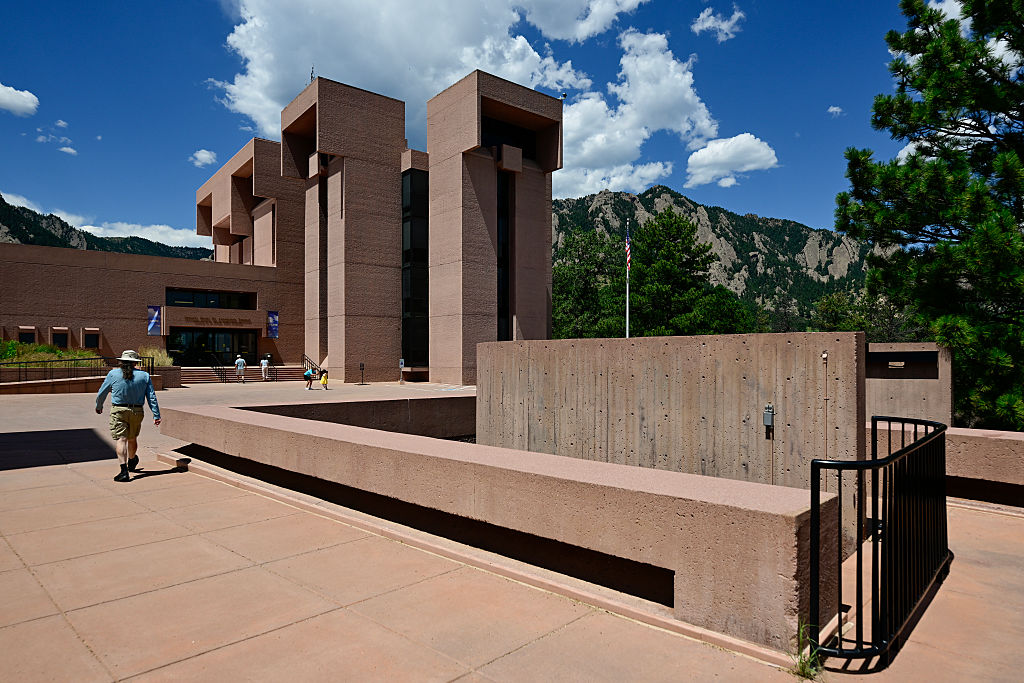
The National Center for Atmospheric Research Mesa Lab is seen in Boulder, Colorado, on July 7, 2025.Matthew Jonas / MediaNews Group / Boulder Daily Camera via Getty Images

On December 16, USA Today broke the news that the Trump administration was planning to eliminate the National Center for Atmospheric Research (NCAR). According to a tweet by Russell Vought, an architect of Project 2025 and current director of the Office of Management and Budget, the administration had determined that the Colorado-based center was a hub for “climate alarmism.” Dismantling it — and farming out its surviving, non-climate-change-related functions to other agencies — would strike a blow against a scientific community that has come to the overwhelming conclusion that global warming is real, caused by human activities, and accelerating. Some commentators also noted that attacking NCAR, which employs 800-plus people, is a stick-in-the-eye to Colorado, a state whose governor has consistently opposed many of Trump’s most extreme policies, and where election conspiracist and former county clerk Tina Peters resides in a state prison, after a federal judge ruled that she had to remain incarcerated despite her being pardoned for federal crimes by Trump. Peters was, after all, sentenced on state, rather than federal, charges, rendering Trump’s pardon largely pointless.

NCAR has long been in team Trump 2.0’s crosshairs. Previous proposals called for its funding to be slashed by 40 percent. The administration has also sought to end most climate-related research at the National Oceanic and Atmospheric Administration, and websites for the Environmental Protection Agency have scrubbed mentions of human-caused climate change. As a result, institutions that were once considered among global gold standards for the delivery of accurate scientific information on the climate crisis are now effectively neutralized.

The administration’s decision to go after NCAR is part of a broader retreat from any acknowledgement of the reality of climate change.

For the nation’s thousands of meteorologists and climate change scientists, the news about the proposed gutting of NCAR landed like a grenade. After all, NCAR — which on a day-to-day basis is administered by the University Corporation for Atmospheric Research on behalf of the National Science Foundation, but which is funded in large part by the federal government — has been the world’s preeminent weather and atmospheric research institution since the 1960s. Its purpose is to pool institutional resources and expertise to provide researchers with cutting edge super-computers, data repositories, specialized aircraft with extremely expensive, sensitive, on-board measurement equipment, and other tools of the trade. No single lab or university, no matter how flush with money, has the ability to replicate all of this single-handedly. Few other institutions anywhere on earth can model weather, climate change, or other atmospheric disturbances so granularly.

NCAR’s whole reason for existing, said University of Wisconsin-Madison Atmospheric and Oceanic Sciences Professor Ankur Desai, is to “supersize” the country’s research resources. Desai did a post-doctoral fellowship at the Boulder institution; his work there led to his publishing a number of papers; those papers were what landed him his professorship in Madison. “It’s the mecca of meteorology, and there’s no place like it in the world,” he enthused.

Desai is not alone in his enthusiasm. Most of the country’s top atmospheric scientists have, at one point or another, trained, studied, or carried out research at NCAR or using NCAR’s resources. “I can write a proposal to the National Science Foundation saying I need a state of the art modeling system, and I need an aircraft,” said Kenneth Davis, professor of atmospheric and climate science at Penn State. Without NCAR’s resources, he continued, “there’s no way in hell that happens. These tools serve the U.S. research community in a way that would not be possible without a centralized institution like this.”

Davis cannot see any upside to breaking apart NCAR. “I don’t see what you gain. The purpose is to smash. All it does is take away our ability to do important research work. U.S. universities get damaged by this.”

Desai’s colleague at the University of Wisconsin, Liz Maroon, agreed. “The idea of losing this crowning jewel in the atmospheric science community, it would be devastating,” she said. “Having access to this kind of science is saving life and property. And its technology goes into improving national security and the economy.” Take away NCAR and you take away much of the country’s ability to predict wildfire patterns, to better and more efficiently irrigate crops, and to give residents and businesses advanced warning about extreme weather.

Maroon explained that in addition to providing researchers with access to expensive technologies and providing storage repositories for decades of research data, NCAR also creates teaching materials used in schools and universities around the country. “NCAR is at the heart of atmospheric and earth systems science in the U.S.,” Maroon continued. “It allows the scientific community to do bigger things together that no one scientist or university could really do. The value of what NCAR has brought to the U.S. scientific community, to its citizens, and to the world should be self-evident.”

Around the country, scientists have begun pushing back against the administration’s proposal, as are members of Colorado’s congressional delegation, including Sen. John Hickenlooper, the former governor who has long been a champion of climate change research. Universities are also mobilizing their teams that liaise on federal issues to explain to the public and to Congress the vital importance of this institute and what will be lost if it is shuttered.

“This really seems existential for our field and certainly the U.S.,” said Desai. “It’s a tantrum being thrown to break things, with no plan for how to fix things.”

Raymond Ban, former executive VP of the Weather Channel and an ex-trustee of the University Corporation for Atmospheric Research, hopes that the realization of what is at stake here will mobilize citizens, political leaders, and industry to push back against the administration’s proposals. After all, he said, for more than 60 years, the NCAR has been “one of the most valuable R&D enterprises that we have in the earth, water, and atmospheric science community.” Want to study the way the sun and the earth interact? NCAR runs a high-altitude observatory, Ban notes. Want to know why there are fewer crash landings of airplanes during episodes of strong wind shear than there used to be?It’s because in the 1980s researchers at NCAR designed a low-level wind shear alert system that was installed in airports around the United States to allow pilots to receive advanced warning if they were about to enter a wind shear zone.

“We need to hope that the value of NCAR and everything it produces will be realized, and there’ll be voices in the decision room that will understand that value,” Ban said. “I’m hopeful that with enough input from the community and enough feedback the senior leadership of the National Science Foundation and the administration will take another look at this.”
‘Complete disgrace’: Lawmaker sues to undo Trump rebranding of DC landmark

Erik De La Garza
December 22, 2025 
RAW STORY


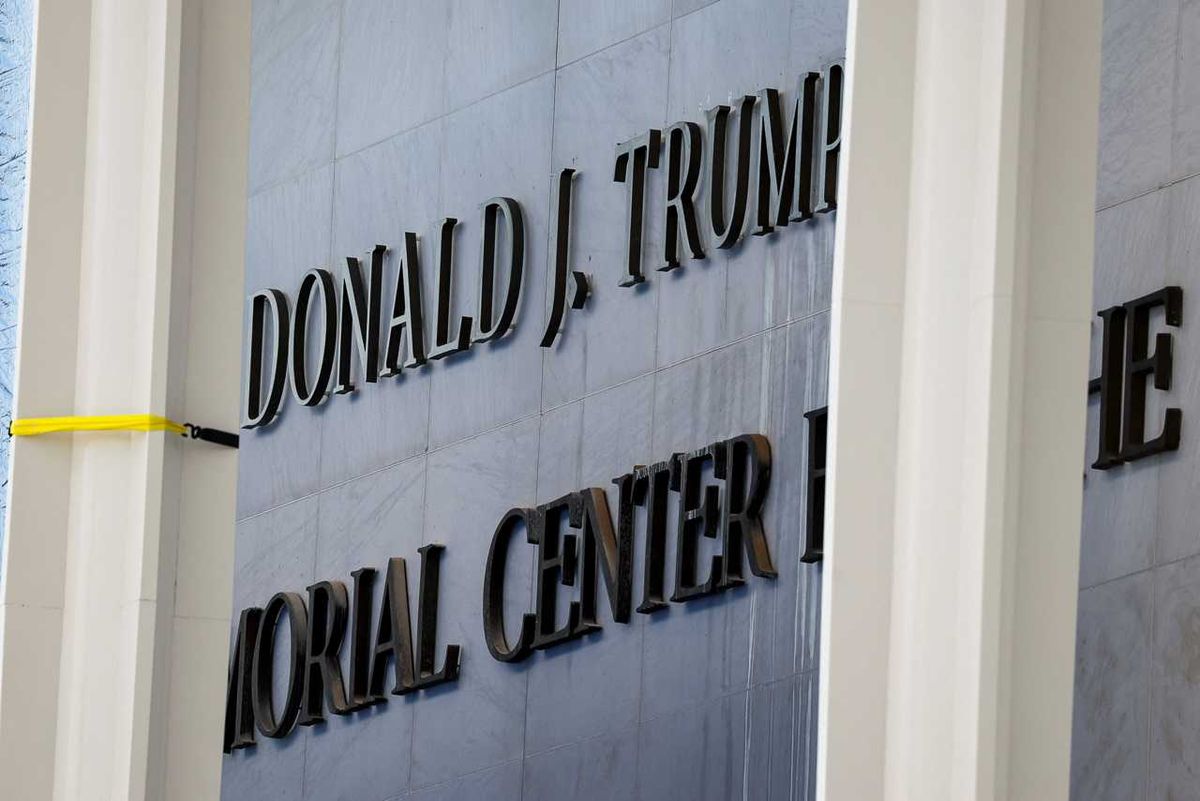
U.S. President Donald Trump's name is added at the facade of the John F. Kennedy Center for the Performing Arts, a day after its board announced it would rename the institution The Donald J. Trump and The John F. Kennedy Memorial Center for the Performing Arts, in Washington, D.C., U.S., December 19, 2025. REUTERS/Kevin Lamarque

Rep. Joyce Beatty (D-OH) filed a lawsuit Monday seeking to force the removal of President Donald Trump’s name from the John F. Kennedy Center for the Performing Arts, arguing that the move violated federal law and the Constitution.
The lawsuit, filed in D.C. federal court, names Trump and several loyalists he appointed to the Kennedy Center’s board as defendants. Beatty contends that the board’s vote last week to rename the Washington, D.C., cultural institution was illegal because only Congress has the authority to change the center’s name.

Norman Eisen, Beatty’s attorney and a former White House ethics counsel under former President Barack Obama, said the name change “violates the Constitution and the rule of law because Congress said this is the name.”

“The President and his sycophants have no lawful authority to rename the Kennedy Center,” Eisen added in a statement.

Trump, whose board installed him as its chair, sparked the lawsuit after his name was added to the exterior of the building Friday morning. The storied institution’s website and social media accounts soon followed and began referring to it as the “Trump Kennedy Center,” according to reports. A senior White House official previously told The New York Times that the administration rejects the argument that congressional approval is required and does not expect lawmakers to intervene.


Beatty, who brought the lawsuit in her capacity as an ex officio member of the Kennedy Center’s board, said she attempted to object during the meeting when the name change was approved – but was unable to do so.


“Everything was cut off,” Beatty said of the call, according to the Times. “And then they immediately said, ‘Well, it’s unanimous. Everybody is for it.’”

In a statement Monday, Beatty called the episode a “complete disgrace.”

“Only Congress has the authority to rename the Kennedy Center,” the lawmaker said. “President Trump and his cronies must not be allowed to trample federal law and bypass Congress to feed his ego. This entire process has been a complete disgrace to this cherished institution and the people it serves. These unlawful actions must be blocked before any further damage is done.”
Families want answers a year after South Korea’s deadliest plane crash

“Everyone could have survived — only with injuries — if it had been a mound of earth.”


By AFP
December 22, 2025


Grieving mother Lee Hyo-eun returns every weekend to the airport where her daughter and 178 others died last year - Copyright AFP ANTHONY WALLACE
Kang Jin-kyu

Grieving mother Lee Hyo-eun returns every weekend to the airport where her daughter and 178 others died last year, desperate for the truth about South Korea’s deadliest airline disaster.

Jeju Air Flight 2216 was coming in to land at Muan International Airport from Thailand when it struck a flock of birds and was forced to make a belly landing that sent it crashing into a structure at the end of the runway.

Only two flight attendants seated in the tail section survived.

Lee vividly remembers that day.

Her daughter Ye-won, a cello instructor, had just celebrated her birthday and was due to return from a short holiday in Bangkok.

Lee was planning a welcome dinner when her sister called to ask if Ye-won had landed.

What happened next, she said, was “unbelievable”.

“She was gone when she was at her brightest, in full bloom at 24,” Lee said.

Official findings have pointed to pilot error in explaining why the December 29, 2024 crash happened.

But one year on, Lee and other relatives of the victims say they harbour deep mistrust over how the investigation has been handled.

They are still demanding answers over the key question surrounding the crash: why was there a concrete block at the end of the runway, despite international aviation safety guidelines?


– ‘We demand answers’ –


At the Muan airport — which has been closed to commercial flights since the crash — families of the victims spend days and nights in and around tents set up in the departure terminal on the second floor.

Blue ribbons symbolising the victims adorn the airport, while letters remembering the dead line the stairways.

The localisers damaged in the crash still stand at the end of the runway, and what appear to be fragments of concrete slabs and pillars are strewn across a field not far away.

Banners draped along the walls criticise the official investigation, with one reading: “A country incapable of protecting citizens is not a country. We demand answers!”

Park In-wook told AFP he is “famous” among the two dozen relatives who choose to return to the airport weekend after weekend.

He lost five loved ones in the crash: his wife, daughter, son-in-law and two young grandchildren.

“In the first days, I felt like I was dreaming,” said Park, 70.

“Almost a year has passed, but I cannot recall how many days it took to hold my wife’s funeral or the exact date it took place.”

The families’ anger intensified following the release of an interim investigation report in July.

The report emphasised that the pilot decided to shut down the less damaged left engine during the crash, but it did not address the concrete structure housing antenna localisers at the end of the runway.

International aviation safety guidelines state that such navigation structures should be made of frangible, or breakable, material — a recommendation not followed at the Muan airport.

A nationwide inspection after the crash found six other airports where localisers were also housed in concrete or steel structures.

Five of them have had their localisers retrofitted with breakable material, while another will be retrofitted next year, Seoul’s transport ministry told AFP.

“The July report highlights the government’s attempt to frame the accident as being caused mainly by pilot error,” Ko Jae-seung, 43, who lost both parents in the crash, said.

“An official investigation should not be about assigning blame to individuals but about examining the systems and conditions that made the accident inevitable,” Ko said.


– ‘Everyone could have survived’ –


Ye-won’s mother believes the pilots did everything they could in those crucial moments to save lives on board.

“They managed to land the plane on its belly against all odds, with everyone still alive at that point, without knowing there was a concrete structure ahead of them,” she told AFP at her home in the southwestern city of Gwangju.

“Everyone could have survived — only with injuries — if it had been a mound of earth.”

Her home is decorated with photographs of her late daughter alongside handwritten letters from Ye-won’s friends.

“Thank you for everything. You were a deeply respected and beloved teacher,” the mother of one student wrote.

On a cabinet sit several framed photos from Ye-won’s final days in Bangkok, retrieved from her phone, which was discovered at the crash site.

“Sometimes it feels like she just hasn’t come home from her vacation,” Lee said.

“I find myself wondering when she will.”
Disputed Myanmar election wins China’s vote of confidence


By AFP
December 22, 2025


A woman cycles past campaign billboards ahead of Myanmar's general election in Pyin Oo Lwin in Myanmar's Mandalay Region - Copyright AFP Sai Aung MAIN

Myanmar’s military-run elections are being pilloried abroad and shunned at home, but neighbouring China has emerged as an enthusiastic backer of the pariah poll.

International monitors have dismissed the vote starting Sunday as a charade to rebrand Myanmar’s military rule since a 2021 coup, which triggered a civil war.

But Beijing’s brokerage has secured watershed truces and retreats by rebel groups — turning the tide of the conflict and strengthening the junta’s hand ahead of the weeks-long vote.

Once backing opposition factions, analysts say China now throws its weight behind the military and its polls as Beijing pursues its own private interests in Myanmar — and even the reordering of its leadership.

“It’s as if an outsider were involved in our family issues,” complained a resident of northern Lashio city, once the rebels’ biggest war prize but returned to the junta via Beijing’s intervention in April.

“I want to sort out my family matters by ourselves,” said the 30-year-old woman, declining to be named for security reasons. “I don’t like other people involved.”


– ‘No state collapse’ –


Myanmar’s military cancelled democracy nearly five years ago, detaining civilian leader Aung San Suu Kyi and alleging her electoral victory was secured by massive voter fraud.

The country plunged into civil war as pro-democracy activists took up arms as rag-tag guerrillas, fighting alongside formidable ethnic minority armies that have long resisted central rule.

China’s reaction to the military takeover was initially muted, but the explosion of internet scam centres along the China-Myanmar border threw a lever.

The massively profitable online fraud factories ensnared legions of Chinese citizens — both as trafficked, unwilling workers and as targets in elaborate romance and business cryptocurrency cons.

Irked by the junta’s failure to crack down, Beijing abandoned its agnosticism, giving at least its tacit backing to a combined rebel offensive, monitors say.

The “Three Brotherhood Alliance” trio of ethnic minority armies won stunning advances, including Lashio in the summer of 2024 — the first capture of a state capital and a regional military command.

“What I’ve seen is that China can control outside organisations,” said another 30-year-old Lashio resident, also speaking anonymously for security reasons.

The rebels marched on to the brink of Myanmar’s second city, Mandalay, before Beijing pumped the brakes, said Morgan Michaels, a research fellow at the International Institute for Strategic Studies think tank.

“Beijing’s policy is no state collapse,” he told AFP. “When it looked like the military was going to collapse, it equated that with state collapse and so it stepped in to prevent that.”


– Reshuffling ranks –


China may have settled on backing the military, but Michaels says there are terminal doubts about military chief Min Aung Hlaing, who plunged the country into an intractable crisis.

“I think there’s a general sense that he’s stubborn, not particularly good at what he does,” said Michaels. “They would like to see him moved aside or at least have his power diluted.”

Many monitors, including United Nations expert Tom Andrews, have described the election as a “sham”.

Rebels defying military rule have pledged to block the vote from their territory — deriding it as choreography allowing Min Aung Hlaing to prolong his rule by wearing a civilian sash.

But the nominal return to civilian rule will hedge Min Aung Hlaing’s power, said Michaels, forcing him to choose between the presidency or armed forces chief — roles he has held in tandem under military rule.

“It probably will result in his power being diluted or him having to make some sort of compromise,” said the analyst.

After the junta started to lay out an election timetable, Min Aung Hlaing enjoyed his first post-coup meeting with Chinese President Xi Jinping in May.

Meanwhile, China began to defuse the “Three Brotherhood Alliance” — peeling away two of its factions based along its border with truces.

The Ta’ang National Liberation Army agreed to an armistice in October, after the Myanmar National Democratic Alliance Army handed back once bitterly contested Lashio in April.

“I feel lost as a citizen,” said the Lashio woman who requested anonymity.

“Some of my friends cannot come back. Some have already died. They are not in the world anymore.”

A Chinese foreign ministry spokesman told AFP: “China supports Myanmar in broadly uniting domestic political forces, steadily advancing its domestic political agenda and restoring stability and development.”

Lashing back at foreign criticism of the poll last week, junta spokesman Zaw Min Tun told reporters: “It is not being held for the international community.”

But he said that “partner countries” are “assisting and supporting the election” — doing so “out of a desire for the betterment of Myanmar”.

Myanmar’s long march of military rule


By AFP
December 22, 2025


Myanmar's military chief Min Aung Hlaing (C) in Naypyidaw on March 28, 2025, after an earthquake in central Myanmar - Copyright AFP Sai Aung MAIN

Myanmar’s military has ruled the country for most of its post-independence history, presenting itself as the only force capable of guarding the fractious Southeast Asian nation from rupture and ruin.

A decade-long democratic thaw saw martial rulers loosen their grip and Nobel Peace Prize laureate Aung San Suu Kyi lead, before a junta snatched back power in a 2021 coup triggering a ferocious civil war.

The military has organised elections starting Sunday but the vote is being shunned at home and abroad, and the generals have pledged to preserve their role in politics.

Here is a brief history of military rule in Myanmar:


– Founding force –


Myanmar, formerly known as Burma, won its independence in 1948 as Britain dissolved its empire after World War II.

The autonomy struggle was led by Aung San, the father of Aung San Suu Kyi. He first fought with the invading Japanese to oust Britain, before swapping sides as the tide of war changed and currying favour with London for the cause of independence.

The fledgling democracy had a thriving press and cinema scene, and promising economic potential as the world’s leading rice exporter.

But as the civilian government battled rebellions and internal divisions, it handed power to the military in 1958 for a two-year caretaker spell.


– ‘Bamboo curtain’ –


Elections followed, but the voluntary relinquishing of power had emboldened the military to make a takeover by force in 1962.

Aung San’s wartime comrade Ne Win, who had taken the helm of the armed forces after the leader’s assassination in murky circumstances, swooped in in a putsch he justified as protection against Myanmar’s disintegration.

He later said the military “took over power against its cherished beliefs”, promising to “transfer power to the people in due course”.

But he ruled for 26 years, enforcing a nominally socialist one-party state that pulled a “bamboo curtain” around Myanmar making it a hermit nation, crashing the economy and crushing dissent.


– Protests, coup, protests –


Massive student-led pro-democracy protests that began on August 8, 1988 forced Ne Win to step down.

But a rebranded leadership swiftly staged a fresh coup, crushing demonstrations in a bloody crackdown that saw more than 3,000 people killed and many more spirited away to prison.

Than Shwe became the top general, facing his own uprising in 2007 when the “Saffron Revolution” led by robed monks took up the pro-democracy mantle.

He, too, used military might to quell the resistance.

The 1988 protests were a proving ground for activists, some still challenging military rule today. At the forefront was Suu Kyi, who won the Nobel Peace Prize in 1991 during one of many stints in detention.


– Military makes the rules –


Than Shwe retired in 2011, handing power to a civilian government, which was however led by an ex-general and reined in by a military-drafted constitution privileging the armed forces with a central role in parliament and cabinet.

Critics initially dismissed it as military rule wearing a civilian sash, but president Thein Sein proved a cautious reformist.

He released Suu Kyi, who surged to electoral victory in 2015 and assumed a leadership position carved out to sidestep military-drafted rules that barred her from the presidency.

The democratic figurehead opened the country up, often sparring with military chief Min Aung Hlaing.


– Civil war –


Her second landslide in 2020 polls proved a step too far, and Min Aung Hlaing snatched back power, making unsubstantiated allegations of voter fraud, re-jailing Suu Kyi and dissolving her party.

The coup triggered a full-blown civil war as long-active ethnic minority armies were joined on the battlefield by pro-democracy partisans.

The junta is touting the upcoming phased elections as a step towards reconciliation.

But Suu Kyi remains under junta lock and key, generals are managing the vote, rebels are set to block it from territory they control, and international monitors have dismissed it as a pretext for continuing military rule.

Results are expected around the end of January 2026.

Australian state poised to approve sweeping new gun laws, protest ban


By AFP
December 22, 2025


A police helicopter patrols over the Bondi Beach as life gradually returns to normal following seven days of mourning, a week after the Bondi Beach shooting attack, in Sydney on December 22, 2025 - Copyright AFP Saeed KHAN
Laura CHUNG

Australia’s most populous state was set Tuesday to approve sweeping laws cracking down on guns and giving authorities the power to ban protests after the nation’s deadliest mass shooting in decades.

Father and son Sajid and Naveed Akram are accused of targeting a Hanukkah event on Bondi Beach, killing 15 people in what authorities have said was an antisemitic terrorist attack.

Facing growing political pressure over the attack, state and federal governments have proposed radical changes to gun laws and a broad hate speech ban.

The government of New South Wales — where the shooting took place — has recalled its parliament to introduce what it called the “toughest firearm reforms in the country”.

The new rules will cap the number of guns an individual can own to four, or 10 for exempted individuals like farmers.

The legislation will also ban the display of “terrorist symbols”, including the flag of the Islamic State, which was found in a car linked to one of the alleged shooters.

And it will give authorities power to prohibit protests for up to three months following a terrorism incident.

The reforms are expected to pass the upper house of the New South Wales parliament on Tuesday evening or early Wednesday evening.

Premier Chris Minns said the laws “will be a clear message and clear progress to keep the people of New South Wales safe”.

“Whether that’s on gun regulation in New South Wales, or secondly, changes to protest, in order to lower the temperature in Sydney,” he told reporters.

A broad coalition of protest groups have vowed a constitutional legal challenge to the anti-protest laws.

Palestine Action Group Sydney, one of the groups involved in the challenge, accused the state of having “pushed through legislation without due process, attacking our fundamental right to protest”.

It also accused the state of making “unsubstantiated and plainly dishonest links between antisemitism and the Palestine solidarity movement”.


– ‘Meticulously planned’ –


Fresh details about the run-up to the Bondi killings have emerged in recent days.

Police documents released Monday said the two alleged gunmen had carried out “firearms training” in what was believed to be the New South Wales countryside.

Authorities alleged the pair “meticulously planned” the attack “for many months”.

The pair also recorded a video in October railing against “Zionists” while sitting in front of a flag of the Islamic State jihadist group and detailing their motivations for the attack, police allege.

And they made a nighttime reconnaissance trip to Bondi Beach just days before the killings, documents showed.

One of the alleged gunmen, Sajid Akram, 50, was shot and killed by police during the attack. An Indian national, he entered Australia on a visa in 1998.

His 24-year-old son Naveed, an Australian-born citizen, was moved from hospital to Long Bay jail in southeastern Sydney on Monday.

He was charged last week with 15 counts of murder, as well as committing a “terrorist act” and planting a bomb with intent to harm.

He has yet to enter a plea over the charges.
North Korea leads global crypto hacks with $2bn in 2025

ANN | The Korea Herald 
December 22, 2025

Illustration shows hackers against a North Korean flag backdrop.—Courtesy The Korea Herald

NORTH Korea–linked hacking groups has stolen more cryptocurrency than anyone else in 2025, siphoning off more than $2 billion as their operations became fewer but more targeted and higher impact, according to new research.

North Korean hackers stole about $2.02 billion worth of digital assets from January through early December, up 51 per cent from a year earlier, global blockchain analytics firm Chainalysis said in a report released this week.

The findings, part of Chainalysis’s annual overview of crypto crime, show global cryptocurrency theft reached about $3.4 billion this year, with North Korean operations accounting for nearly 60pc of the total. That pushed North Korea’s cumulative cryptocurrency theft to roughly $6.75 billion, the report showed.

While the overall number of hacking incidents linked to North Korea fell 74pc from 2024, their impact grew sharply. North Korean groups accounted for a record 76pc of all service-level compromises, excluding personal wallet hacks, underscoring a shift toward fewer but significantly larger breaches.


Chainalysis said the divergence has become more pronounced over time. Non–North Korean attackers showed a relatively even distribution across theft sizes this year, while North Korean operations dominated the highest-value ranges.

“When North Korean hackers strike, they target large services and aim for maximum impact,” the report said. Their tactics reflect a move away from exploiting decentralised finance vulnerabilities toward centralised exchanges and custodians as DeFi security improves. The $1.5 billion breach at Dubai-based exchange Bybit in February, the largest crypto heist on record, illustrates the scale of that approach.

The report pointed to insider infiltration as a key driver behind North Korea’s ability to execute such high-value thefts.

Published in Dawn, December 22nd, 2025


Amazon says blocked 1,800 North Koreans from applying for jobs


By AFP
December 22, 2025


US tech giant Amazon has said it blocked over 1,800 North Koreans from joining the company - Copyright Belga/AFP/File JONAS ROOSENS

US tech giant Amazon said it has blocked over 1,800 North Koreans from joining the company, as Pyongyang sends large numbers of IT workers overseas to earn and launder funds.

In a post on LinkedIn, Amazon’s Chief Security Officer Stephen Schmidt said last week that North Korean workers had been “attempting to secure remote IT jobs with companies worldwide, particularly in the US”.

He said the firm had seen nearly a one-third rise in applications by North Koreans in the past year.

The North Koreans typically use “laptop farms” — a computer in the United States operated remotely from outside the country, he said.

He warned the problem wasn’t specific to Amazon and “is likely happening at scale across the industry”.

Tell-tale signs of North Korean workers, Schmidt said, included wrongly formatted phone numbers and dodgy academic credentials.

In July, a woman in Arizona was sentenced to more than eight years in prison for running a laptop farm helping North Korean IT workers secure remote jobs at more than 300 US companies.

The scheme generated more than $17 million in revenue for her and North Korea, officials said.

Last year, Seoul’s intelligence agency warned that North Korean operatives had used LinkedIn to pose as recruiters and approach South Koreans working at defence firms to obtain information on their technologies.

“North Korea is actively training cyber personnel and infiltrating key locations worldwide,” Hong Min, an analyst at the Korea Institute for National Unification, told AFP.

“Given Amazon’s business nature, the motive seems largely economic, with a high likelihood that the operation was planned to steal financial assets,” he added.

North Korea’s cyber-warfare programme dates back to at least the mid-1990s.

It has since grown into a 6,000-strong cyber unit known as Bureau 121, which operates from several countries, according to a 2020 US military report.

In November, Washington announced sanctions on eight individuals accused of being “state-sponsored hackers”, whose illicit operations were conducted “to fund the regime’s nuclear weapons programme” by stealing and laundering money.

The US Department of the Treasury has accused North Korea-affiliated cybercriminals of stealing over $3 billion over the past three years, primarily in cryptocurrency.