Tuesday, December 23, 2025

Understanding the Dangerous Trump-MAGA National Security Strategy


Declaring an end to Pax Americana, the strategy reinforces white supremacy, authoritarianism, and kleptocracy at home and abroad.


Joseph Gerson
Dec 22, 2025
Common Dreams


After living on life support in the last half of the post-Cold War, Pax America is now a memory. It was relegated to the dustbin of history with the “Trump” National Security Strategy published earlier this month. President Donald Trump and his clique are not solely responsible for the reduced ambitions of the United States global empire. The world—including the United States—has changed. The strategy is the answer of a right-wing billionaire sector of the US elite to tectonic economic, military, and technological changes.

Eighty years ago, when the US emerged as the world’s dominant power nation, it possessed 50% of the world’s wealth, the most advanced “conventional” military forces, and was the only nation possessing genocidal nuclear weapons. After European nations and Japan rebuilt their economies in the aftermath of WWII, China brought 600 million people out of poverty, and the demise of colonialism, the US share of global GDP has fallen by half to 24%. These changes have had an immense impact on what can be spent to develop and deploy “advanced” and murderous militaries, the number of engineers and scientists a nation can produce, and even the exercise of soft power.

Other forces have also been at play. Witness the emergence of the Global South as a powerful force. South Africa had the temerity to challenge the Western assisted Israeli genocide in the International Court of Justice. The BRICS (Brazil, Russia, India, China, and others) are contesting US economic dominance. And the Emirates have emerged as a powerful economic and political force with leverage over Trump.

The strategy is also a mutant offspring of the information revolution and of an extreme right-wing Supreme Court that played a central role in birthing an immense concentration of wealth resulting in the rise of new and anti-democratic elites reminiscent of feudal era princes, lords, and masters.

The strategy is contradictory, ignorant, and white supremacist; written in highly accessible language designed to win support of the MAGA masses.

Thus, a powerful sector of the US billionaire elite has developed a revised, destructive, and nationally self-destructive strategy to reinforce their privilege and power for the still emerging multipolar world disorder.

The Trump strategy is painful to read. It reeks of white supremacist rhetoric and policy commitments. It begins with fawning and obsequious praise of our Great Helmsman, Trump. And it is rife with braggadocio that belies observable reality, for example the boasts of having obliterated Iraq’s nuclear program and ending eight wars including Gaza, Rwanda-Democratic Republic of Congo, and Thailand-Cambodia. But the strategy does crystallize what was implicit during Trump’s first term in office and what we have witnessed and suffered in the past very painful year.

There is also the truism that foreign policies are manifestations of domestic priorities. From reinforcing white supremacy to authoritarianism and kleptocracy, this is also the case for the Trump-MAGA strategy.

Analysts across the country and foreign leaders have been stunned by the strategy’s declaration of the end of Pax Americana, the confession that global hegemony is a “fundamentally undesirable and impossible goal.” Richard Haass, formerly the president of the liberal Council on Foreign Relations, declared that the strategy is “ the biggest redirection of US foreign policy since the end of WWII and the dawn of the Cold War…” Chinese officials describe it as “moving from unipolarity to multipolarity.” And Russians have not been shy about saying that it is consistent with their vision. European leaders are panicked.

How the World Sees the Strategy


Chinese leaders, since their pursuit of new great power relations in the Obama era, see the new US military and economic priorities as the logical consequence of US post-Cold War “hegemonic failures”: failed and disastrous imperial wars, its economic fragility, social and political fragmentation, and the worldwide perceptions that the US is no longer invincible.

Walden Bello, among the most inspired and inspiring Asian analysts and progressive political leaders, describes the strategy as a compromise document negotiated between three forces in Trump’s coalition: Maximalists who “still cling to the dream of American dominance,” Specifists led by Elbridge Colby at the Pentagon and his allies “who believe America must retreat from Europe and the Middle East to focus single-mindedly on China,” and Continentalists or “neo-Monroeists, led by Stephen Miller and Vice President JD Vance, ” who advocate “an almost hermit-like retrenchment, turning the US into a fortress continent.”

In Europe, where fear has abounded that the United States would abandon its continental protectorate, German Chancellor Friedrich Merz declared the end of Pax Americana. Carl Bildt, the former Swedish prime minister, warned that the strategy places the US to the right of the extreme right in Europe. And reflecting an increasingly shared belief, a researcher at the European Council on Foreign Relations declared that “the West as it used to be no longer exists.” And he is right.

The strategy has also sown panic among US neoconservatives and liberal imperialists. Speaking for many, Anne Applebaum remarked that it is “hard to think of another great power ever abdicating its influence so quickly and publicly.” And for some, the New York Times eight-page special opinion section which argues that the US military has been “overmatched” by China provides a path back to “normalcy.” It urges still greater military spending, focusing on creating greater AI and cyber warfare capabilities, and returning to the era when the Pentagon had 51, not 5, primary military contractors.


Extending the MAGA Counterrevolutionary Agenda

The strategy is contradictory, ignorant, and white supremacist; written in highly accessible language designed to win support of the MAGA masses.

The historian Heather Cox Richardson was clear that the National Security Strategy is explicit in its goal of creating a “white supremacist country,” rejecting immigration, and “'restoring Europe’s civilizational self-confidence and Western identity.” We hear echoes of Nazi and Charlottesville “great replacement” rhetoric as code words and dog whistles such as “restoration and reinvigoration of American spiritual and cultural health,” defending and preserving “civilization,” and “strong traditional families that raise healthy families” appear throughout the document.

While the strategy pledges the “predisposition to non-interventionism,” gunboat diplomacy continues apace with the largest US naval flotilla since the Cuban Missile Crisis assembled off the coast of Venezuela.

Its featured first goal is to establish “full control over our borders.” Why? Because “mass migration has strained domestic resources, increased violence and other crime, weakened social cohesion… undermined national security.” This despite actual crime statistics that immigrants are one-third less likely to be imprisoned than those born in the US, that construction and agricultural employers are hurting as tens of thousands of dedicated workers are deported, that fewer young workers mean weakened Social Security and support for our aging population. And our universities and industries that depend on attracting the best and brightest from around the world are deprived of essential human capital.

If that weren’t enough, the strategy pledges to “root out” diversity, equity, and inclusion in foreign, as well as domestic, policy—one other way that Trump and MAGA are sabotaging the nation’s foundations.

And on the subject of contradictions, while the strategy pledges the “predisposition to non-interventionism,” gunboat diplomacy continues apace with the largest US naval flotilla since the Cuban Missile Crisis assembled off the coast of Venezuela that is illegally sinking boats, murdering sailors in clear contravention of international law, and enforcing a blockade to impose regime change in Venezuela, and by extension Cuba.


Prioritizing Commerce and Profits


Soon after Donald Trump’s reelection a former senior US arms control diplomat was asked by his Russian interlocutor what Trump’s foreign policy priority would be. The answer: Trump’s first, second, and third priorities would be doing all that he can to enrich himself and his family. Not surprisingly we have been delivered the country’s most mercantile foreign policy agenda in more than a century. Access to other nations’ raw materials and markets are the priority, and, in another break with at least three generations of foreign policy rhetoric, the strategy is explicit that human rights concerns will not be a factor that interferes with US commercial interests and that the US won’t be imposing “democratic social change.” The New York Times: put it well when it carried a report saying, “The world as seen from the White House is a place where America can use its vast powers to make more money.”

What is its agenda? Seeking “balanced trade,” access to resources, protecting supply chains, and “reindustrialization.” Never mind that despite Trump’s devastating tariffs, which are increasing costs for Americans and alienating much of the world, offshored manufacturing is NOT returning to the US. Other commitments include maintaining the “dollar’s global reserve status,” pushing back against “Non-Hemispheric competitors’” economic inroads in “our hemisphere,” and the insistence on Latin American nations granting no-bid contracts to US companies. Taiwan’s value is boiled down to semiconductors and serving as a geopolitical cork, US forces are to maintain a “free and open Pacific” for trade purposes, and Saudi Arabia and the Emirates are seen as resources for investments. “Every US Government official that interacts with these countries should understand,” US diplomats and the world are told, “that part of their job is to help American companies compete and succeed.”


Geopolitics

After conceding that the US will not seek to control developments in every corner of the world, the strategy opts to maintain US primacy via balances of power and consolidating spheres of influence, not that China is to have a sphere. Consistent with its Biden and Obama predecessors, we are to be reassured by the Trumpian commitment to building the “world’s most powerful, lethal, and technologically advanced military,” ostensibly to “protect our interests” and to maintain the world’s “most advanced economy.” It allows no light to shine between the Trump agenda and the New York Times’ call for increased US military spending to modernize the US military industrial base, to maintain the world’s most deadly nuclear arsenal, and to divert hundreds of billions of dollars to military contractors to build Trump’s “Golden Dome” of missile defenses that will never work.

The strategy is consistent with the Jesse Helms-John Bolton insistence on sovereignty—personal and national. This should be read as white individualist sovereignty and rejection of international law, the United Nations, and foreign aid on which millions of human lives have depended. Moreover, the order in which the strategy addresses geopolitical regions is telling. First the Western Hemisphere, then Asia, then Europe, then the Middle East, and finally Africa


Europe

But let me begin with antecedents to the Trump-MAGA animus toward Europe. More than 200 years ago, as he retired from the presidency, George Washington warned the newly independent nation to avoid dangerous European entanglements. Prior to World Wars I and II, powerful isolationist movements opposed the US entering those wars. Decades later, in 2003, anger in response to French resistance to joining the US in its Iraq War for oil led to congressional dining rooms renaming French fries as “freedom fries!”

Since 1945, Western Europe has been a US protectorate. When NATO was founded in 1949, Lord Ismay, the alliance’s first secretary general, observed that its purpose was to keep Russia out, Germany down, and the US in. Now, after NATO’s expansion to Russia’s borders, European economic competition as well as collaborations with the US, Russian President Vladimir Putin’s invasion of Ukraine, and the reelection of a president more aligned with Russian authoritarianism that European liberal and social democracy, the strategy makes clear that the US will no longer guarantee Europe’s security. Europe must make its way between the hammer and anvil of Russian military power and China’s economic juggernaut. With the strategy’s mercantilist priorities, Europe is primarily valued for its trade and investment opportunities,

The strategy distances the US from NATO and brings it closer to Russia, which is seen as small potatoes compared with China. Moscow is a major nuclear power, but not an economic power. It makes clear that despite its ambitions Ukraine cannot join NATO—something that neither former President Joe Biden nor the most powerful NATO allies would tolerate. And as Trump insists that European NATO nations must take the lead in attending to their own defense, he simply offers to mediate between Europe and the Eastern powers, not to protect it. Worth noting, Walden Bello writes that this appears to include “Russian suzerainty in Eastern Europe.”

As economic security is traded for military capabilities, it further opens the way for fascist forces to gain power.

It is no secret that Trump, like Putin, has little patience for democracy, and this illuminates an underreported dimension of the strategy. Contagious thoughts travel. Thus, by their very existence, European democracies pose political and cultural threats to autocracies—American as well as Russian or Chinese. Ideologically, as well as economically and militarily, a growing number of European leaders now experience the US as a “security risk” for Europe. In a clarion call warning, a Danish intelligence report advises that “the United States uses economic power, including in the form of threats of high tariffs, to enforce its will and no longer excludes the use of military force, even against its allies.” In the tradition of international relations mirroring the rules of the game among Mafia families, the fate of Copenhagen’s mineral rich and geostrategically vital (think ice melt in the Northwest Passage) Greenland colony is at risk.

Perhaps worse is the strategy’s commitment to support “like minded” and racist “patriotic” parties—extreme right-wing and fascist—across Europe. In barely disguised code, the strategy warns that Europe faces “civilizational erasure” necessitating US to support “resistance.” There were intimations of this policy transformation in Vice President Vance’s February Munich Security Conference speech; his expressed support for the fascist right Alternative for Germany party; and the administration’s embrace of Prime Minister Viktor Orbán in Hungary, Prime Minister Giorgia Meloni in Italy, and Marine Le Pen in France.

In response to the fragility of US commitments to NATO, European elites have turned to create a more unified European military, either to reinforce NATO or potentially as an independent power. Since Vance’s Munich speech, compounded by fears that Russian ambitions may not be limited to eastern Ukraine, this process has been on steroids. Pressure is on to create an integrated European military-industrial complex. To increase the number of troops under arms, conscription and other forums of voluntary enlistment are being reintroduced. The numbers of tank forces and warplanes are being increased, and pressure is on to increase AI and cyber-security capabilities. Germany now seeks to become the continent’s major land power. And off-camera diplomacy quietly continues over whether the French or British nuclear weapons should replace the US nuclear umbrella as the source of extended deterrence.

As the newly created Stop ReArm coalition warns, this vastly increased military spending also threatens the viability of social democratic welfare commitments. As economic security is traded for military capabilities, it further opens the way for fascist forces to gain power.


Reinforcing US Indo-Pacific Military Dominance and Containment of China

That Danish intelligence report reminds us that with “the USA’s increasingly strong focus on the Pacific Ocean” the pivot to Asia and the Pacific begun by President Barack Obama remains at the center of US military and economic policy.

Media reports have concentrated on the strategy’s economic, not military, competition with China, in its section “Win the Economic Future, Prevent Military Confrontation.” There we read about the focus on industrial policies, intellectual property theft, protecting supply chains and access to minerals and rare earths, fentanyl, and propaganda and influence operation. Gone is Biden-era confrontational rhetoric.

Yes, China is no longer described as a peer competitor. The strategy advises that “the Indo-Pacific… will continue to be among the next century’s key economic and geopolitical battlegrounds…we must successfully compete there.” But, like the magician who diverts our attention when she shuttles a pea under shells, the media misses the continuity of US imperialism dating back to the “opening” of Japan, Admiral George Dewey’s gunships in Manila Bay, and US forces joining in repressing China’s nationalist Boxer Rebellion. Despite Trumpian allergies to alliances, the strategy reports that “President Trump is building alliances and strengthening partnerships in the Indo-Pacific that will be the bedrock of security and prosperity long into the future.”

Toward that end, the strategy stresses the US need to maintain dominance over the First Island Chain that extends from South Korea, through Japan, to Taiwan and the Philippines, extending westward to Australia. Instead of seeking regime change in Beijing, consistent with 80 years of building military alliances and creating hundreds of US military bases across the Asia-Pacific and Biden’s lattice-like network of Indo-Pacific alliances, Trump and company are explicit about containing China via balance of power dominance and Indo-Pacific alliances. Highlighted are the Biden era QUAD (US, Japan, South Korea, and India) and AUKUS (Australian, Britain, US) alliances. They are called to increase their burden sharing and move to burden shifting, the willingness to sacrifice their troops in US wars. And, to ensure their loyalty to Washington, the strategy calls for their collaborations into an “economic group” to ensure they don’t become “subordinate to any competing power.”

How serious is the competition? Two weeks after release of the strategy, US nuclear-capable bombers joined Japanese warplanes in a show of force. This came one day after Chinese and Russian bombers flew around western Japan to demonstrate Beijing’s rage at Japanese Prime Minister Sanae Takaichi’s warning that Japan would move to defend Taiwan if it were attacked.

Three other US military commitments to contain China are worth noting. To enforce US “deterrence” of China, the strategy promises to “build a military capable of denying aggression anywhere in the First Island Chain” and the US will not tolerate “any unilateral change to the status quo in the Taiwan Strait.” This, we are told, will require still greater US spending—including for defense industry bases. It insists that the US will not tolerate a “competitor” attempting to control the South China Sea, across which one-third of world trade travels. And after maintaining strategic ambiguity over US commitments to Taiwan, we are now told that war there must be avoided because it would have “major implications for the US economy;” because the autonomous island provides direct access to the Second Island Chain (Japan, Guam, and Micronesia), and its loss could split Northeast and Southeast Asia into two theaters; and because it is a “key” to controlling the South China Sea.

Thus, it came as no surprise that within days of the publication of the strategy, the Trump administration committed to selling Taiwan $11 billion of advanced military equipment to help transform it into an unappetizing military porcupine.

Some believe that the strategy’s less than hysterical language about China was designed to ensure that our would-be monarch receives the adulation he believes is his due when he travels to the Middle Kingdom in March. But profit and business deals come first. Shortly before the strategy was released and the TikTok deal was done, Trump signed off on Nvidia selling its second-most advanced chips, with AI and military capabilities, to China. How many of these chips, reported to give China a boost in the AI race, will ultimately land in China has yet to be determined. That uncertainty may provide Trump with one dimension of leverage in future negotiations with Beijing. But if Trump limits the numbers and uses each shipment as leverage, the effects will be far less dramatic.


The Global South (Trump’s “Shithole” Countries)

Beyond the tectonic signaling of the end of the 80-year transatlantic alliance, media outlines have shared the shock of the “Trump Corollary” to the Monroe Doctrine, a naked recommitment to US Western Hemispheric neocolonialism and hegemony. It’s about who gets the money, about oil, and about the white nationalist obsession with race.

As we see in recent reports, the US Central, European, and African Commands are to be downgraded and integrated into a new International Command, with the transfer of some forces to the Western Hemisphere, and, we can assume, to the Indo-Pacific. Thus, we now have an aircraft carrier fleet and thousands of troops redeployed from Europe to Venezuela, and in the words of the strategy, to “address urgent threats in our hemisphere.” On the subject of ideological and political alternatives, it is worth remembering that the Cuban economy is dependent on Venezuelan oil.

On other fronts, the strategy isn’t hesitant in describing Washington’s ambitions for Latin America. Where the US has “the most leverage,” we are instructed that it “must be sole-source contracts for our companies.” And, with Trump’s racist fantasies of an invasion of as many as 30 million immigrants—criminals, rapists, drug dealers, and more—and Immigration and Customs Enforcement shattering families and communities across the nation, the strategy tells us that “the Era of Mass Migration is Over.”

Proverbs tells us that “a people without a vision will perish.” It thus behooves us to provide alternate visions of what real security is and how to achieve it.

Terrorism originating in the Middle East is no longer a major security concern. Since Trump bowed to Saudi monarchs in the opening months of his first term, and his son-in-law took $2 billion as a going away present, Trump and his family have been wed to the Saudi and Persian Gulf emirs. We saw Qatar’s influence when it forced the White House to impose an Israeli-Hamas ceasefire in the wake of Israel’s assassination of Hamas’ lead negotiator in Doha.

While Trump claims that Venezuela has stolen our oil under its soil, neither Trump nor Defense Secretary Pete Hegseth have yet to claim that it is our oil under Middle East sands. Instead, Saudi Arabia and the Emirates are described as a source and destination of international investment, including nuclear energy, AI, and military technologies.

Consequently, not unlike China, the strategy rejects previous commitments to encourage social and political change in the Middle East. It “accept[s] the region, its leaders and its nations as they are.” It commits our country to “prevent an adversarial power from dominating the Middle East, its oil and gas supplies.” In order to do so, it pledges the “revitalization of our alliances in the Gulf, with other Arab partners, and with Israel.” Along these lines, it celebrates its collaborations with Israel but does not name Trump’s complicity in Gaza genocide or that its missile attacks on Iran’s nuclear infrastructure came in the midst of negotiations with Tehran.

When it comes to Africa, the strategy has little to say about what Trump once described as “shithole” countries. It will look to “select countries” to “ameliorate conflict” as it seeks to “foster mutually beneficial trade relations.” The goal is to “harness Africa’s abundant natural resources and latent economic potential.” So much for the end of colonial exploitation!


From Here


In a recent webinar about the “Security Strategy,” I was asked what then must we do? The challenge is as old as the commitment to building an empire in the Declaration of Independence, the genocidal conquest of a continent, the brutality of colonial conquests at the end of the 19th century, and President Dwight D. Eisenhower’s valedictory warning about the dangers of the military-industrial complex.

First and foremost is our responsibility to name and denounce the Trump-MAGA assault against constitutional democracy, against our security, and the well-being of rising generation, and people in other nations who are at the receiving and losing end of the strategy.

Proverbs tells us that “a people without a vision will perish.” It thus behooves us to provide alternate visions of what real security is and how to achieve it. My list begins with the non-utopian paradigm that served as the foundation for the end of the first Cold War. That was the concept of Common Security diplomacy that recognizes that security cannot be achieved against a rival, but only through difficult win-win diplomacy with competing nations. It has been observed that China has been able to take 600 million people out of poverty, and to create what is fast becoming the world’s most advanced infrastructure, in large measure because it has not wasted lives, wealth, and resources in wars for almost a half a century. Defending constitutional democracy and electing a US government committed to providing housing, health, food, and justice are essential places to begin. And there is no going back to those good old days that never really existed!


Our work is licensed under Creative Commons (CC BY-NC-ND 3.0). Feel free to republish and share widely.


Joseph Gerson
Dr. Joseph Gerson is the president of the Campaign for Peace, Disarmament, and Common Security; co-president of the International Peace Bureau; and author of Empire and the Bomb.
Full Bio >



Trump's 'stealth tax increases' forcing holiday shoppers to 'make some choices': report


Image: Shutterstock

Adam Lynch
December 23, 2025 
ALTERNET

Wichita Eagle Opinion Editor Dion Lefler said most voters are feeling the weight of President Donald Trump’s tariffs this holiday season, but elderly grandparents on fixed incomes are definitely catching the worst of it.

“One of the funny things about tariffs — those pesky tax increases President Donald Trump has imposed on imported goods — is they show up where you least expect them. Like on your grocery bill,” Lefler said. “You may have absolutely nothing in your shopping cart but American-grown meat and produce. But that doesn’t mean that tariffs — Trump’s chief weapon in his trade war against the world — aren’t biting you in the budget this Christmas season.”

Lefler participated in a Monday Zoom conversation with Debbie Collins, a retiree living mainly on the state of Kansas’ public employees’ retirement system after 36 years in state government, and Nick Levendofsky, who is the executive director of the Kansas Farmer’s Union.

Collins described a season of more shopping at discount stores, more low-quality generics over name brands, more couponing and more stockpiling items when they’re on sale.

“But even with those adjustments, my grocery bill is still higher than it ever was before, and it’s really hard to make my budget stretch,” said Collins, adding that the holiday season has added stress to shopping for presents for “two perfect grandchildren.”

“I’ve had to kind of, you know, make some choices about what I can and can’t get for them,” Collins said. “These tariffs may sound really abstract to people in Washington, but for those of us back home and people like me, they show up every single time I go to the store.”

Lefler wrote that he wishes Collins well in her holiday shopping, adding: "I don’t like higher prices, especially not when they’re caused by stealth tax increases, which is all tariffs really are."

Over on the producer’s end of the spectrum, Levendofsky warned that the tariffs are ruining markets upon which Kansas farmers depend.

“Reckless tariffs disrupt export markets, invite retaliation and make it harder for Kansas farmers to compete, especially when other countries respond by shutting out US products,” Levendofsky said. “At the same time, tariffs raise farmers’ costs by increasing the price of essential inputs like equipment, fertilizer, fuel and packaging materials.”

Financial pressure doesn’t “stop at the farm gate,” Levendofsky warned.

“When farmers face higher costs and fewer markets, those. They move through the supply chain. That’s how tariffs end up raising prices for groceries and everyday items that Kansas families rely on,” he said.

“Meanwhile, the president is doing what he usually does — blame his predecessor and deny, deny, deny,” said Lefler, adding that Trump, “in his free-range rambling national address last week,” cherry-picked a handful of items that have dropped in price, including eggs — which not only dropped less in price than Trump claims, but also had everything to do with a spike in bird flu that purged henhouses of birds, not Trump’s intelligent leadership.

With only one Kansas U.S. House member willing to oppose Trump’s tariff doctrine, however, the chances of grandparents' budgets being less stressed is slim.

“[Kansas has] one [Democrat] of four representatives and the other three [Republicans] are committed to riding Trump’s tariff train wherever it takes their constituents,” Lefler said. “From groceries to gifts, we’re feeling the pinch of Trump’s tariffs this holiday season, and I expect we will be for at least the next three Christmases yet to come.”

Read Lefler's article in the Kansas City Star at this  link.


Trump’s Embrace of Natural Gas Exports Is Driving Up Energy Bills for Consumers


US households paid $124 more on natural gas in the first nine months of 2025 compared to the same period in 2024.


By Mike Ludwig , 
December 23, 2025

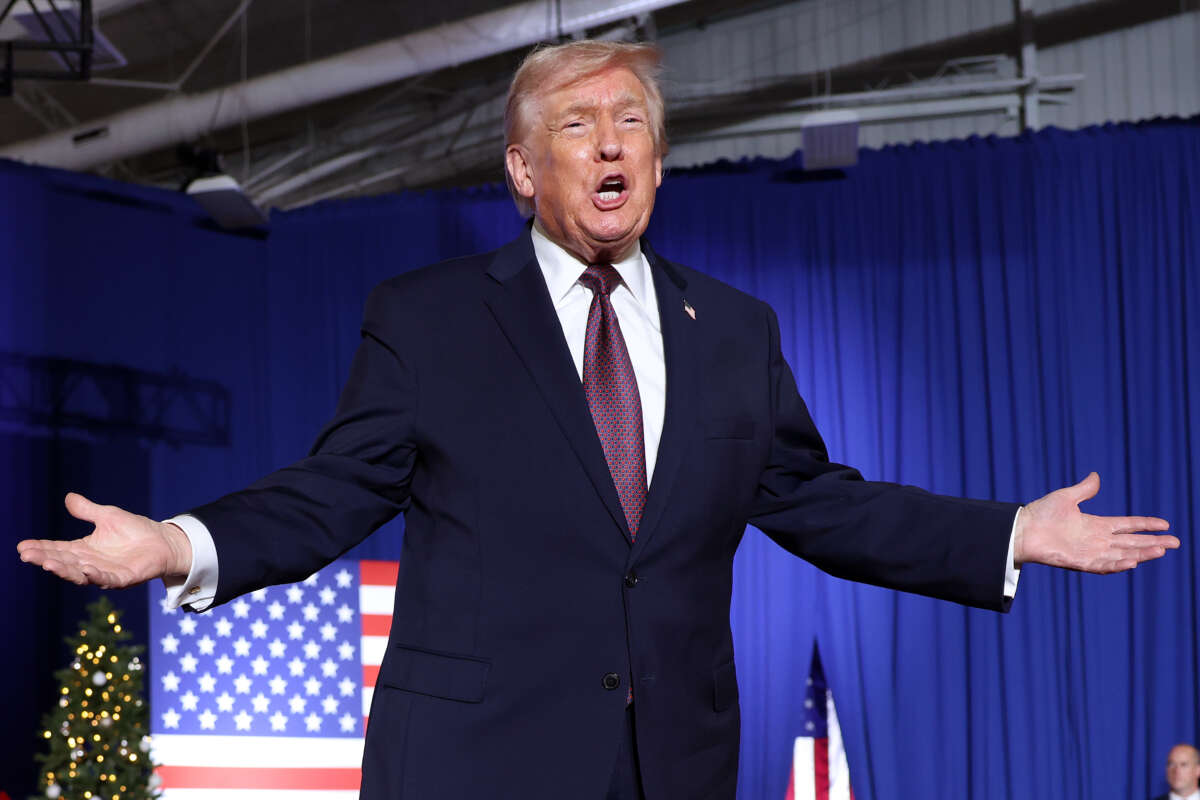
President Donald Trump takes the stage during a rally at the Rocky Mount Event Center on December 19, 2025, in Rocky Mount, North Carolina.
Tasos Katopodis / Getty Images


Despite repeated promises from President Donald Trump on the campaign trail to lower the cost of energy, consumers in the United States collectively paid $12 billion more for natural gas to power their homes over the first nine months of 2025 — about $124 more per family — than they did a year earlier, according to a new report on federal data by the watchdog group Public Citizen.

Thanks to a fracking boom that has polluted communities from Pennsylvania to Texas, the U.S. is the world’s top producer and exporter of “natural” methane gas. But the price of refined natural gas sold to residential customers is rising to record levels under Trump. Almost immediately after taking office, Trump embraced the rapidly expanding natural fossil gas export industry and ordered the Department of Energy to expedite permits for shipping fracked gas overseas.

“Over and over in his stump speeches Donald Trump specifically promised all Americans energy and utility bills would be slashed in half,” Tyson Slocum, director of Public Citizen’s energy program and author of the report, told reporters on December 16. “Not only are prices not declining, they are increasing, and we Americans are experiencing an energy affordability crisis driven by high natural gas prices.”
The natural gas export industry already consumes more gas than the 73 million U.S. households that use natural gas.

Rising gas exports are linked to the increase in natural gas prices, primarily from eight liquified natural gas (LNG) terminals where fracked gas is processed into liquid and loaded onto barges for transport. The natural gas export industry already consumes more gas than the 73 million U.S. households that use natural gas, according to Reuters. About 25 percent of the gas produced in the U.S. is exported, either at LNG terminals or through pipelines to Mexico and Canada. That’s up from 5 percent just a decade ago, federal data show.

Flush with gas produced by the fracking boom over the past decade, the industry has rushed to build more LNG export terminals along the Gulf Coast and in southern Louisiana. Environmental groups are currently challenging a contentious state permit for Commonwealth LNG in Louisiana, which would destroy vital coastal wetlands and emit as much greenhouse gas as 14 coal-burning power plants each year, according to the Sierra Club. The proposed location for the export terminal is near two massive existing terminals that have also faced legal challenges from environmental groups over pollution.

Related Story

Utility Bills Hit Record Highs Under Trump
Experts say Trump’s “Big Beautiful Bill” is likely to drive up energy prices even higher.
By Elizabeth Weill-Greenberg , Truthout August 1, 2025


“LNG is wiping out the small commercial fishing industry there and replacing it with this giant global export industry,” said Eric Huber, a managing attorney for the Sierra Club, during a press call.

Huber and activists in Louisiana say the buildout of massive fossil fuel infrastructure is destroying wetlands that are critical for coastal restoration and the livelihoods of traditional fishers in an area where residents are already overexposed to petrochemical pollution. A 2024 report by the Environmental Integrity Project found that seven LNG terminals operating at the time violated their air pollution permits over the past three years while emitting millions of tons of greenhouse gases, with state and federal regulators handing out about $1 million in penalties.

“Record LNG exports are driving domestic demand and increasing domestic prices for residential consumers,” Slocum said. “The United States is exporting so much natural gas that the eight export terminals are consuming … more natural gas than all 184 million Americans that get direct natural gas from utilities.”

“What’s clear is Donald Trump’s policies are exacerbating this,” Slocum said, in reference to the rising cost of energy for residential consumers.

Slocum pointed to President Joe Biden’s decision in early 2024 to temporarily pause permitting for new LNG export terminals while federal regulators updated their standards for determining whether a proposed fossil fuel project is in the public interest. The pause gave regulators time to consider the potential climate impacts and costs to consumers of allowing the LNG industry to build out more export terminals.

Biden’s order was a victory for environmentalists fighting to save Louisiana’s coastal wetlands and waterways as well as consumers of natural gas. However, Trump railed against the permitting pause on the campaign trail and reversed it on his first day in office, signing an executive order directing agencies to deregulate the fossil fuel industry. Under Trump’s appointees, federal agencies have since rolled back environmental protections and pollution controls while Trump attacks the clean energy sector.

Trump also promised to halve electricity bills in his first year, but those have also gone up in 2025 compared to 2024, with households seeing up to a 13 percent increase on average depending on the season.

The affordability crisis has flummoxed Trump, who has attempted to blame Democrats and Biden for the public’s frustration with rising prices. In multiple interviews and speeches, Trump has called the nation’s mounting affordability crisis a “Democrat hoax” even as voters feel the pinch of higher utility bills and grocery prices.

Trump appears to believe that deregulating the fossil fuel industry and allowing more exports will “unleash” domestic production and eventually bring down prices for consumers. The White House continues to boast about low gasoline prices, but the Consumer Price Index calculates that they have fallen about 0.5 percent since 2024. In an Energy Department statement titled “Promises Made, Promises Kept,” the Trump administration says it has achieved “energy dominance” and ended the “Biden LNG export ban” on day one.

Thanks to these changes, “The Energy Department has approved more LNG export capacity than the volume exported today by the world’s second-largest LNG exporter,” the statement said. The Energy Department says the increased exports would bring “prosperity at home and peace abroad,” which Slocum said reflects Trump’s habit of pushing other countries to commit to buying U.S. LNG as the president leverages steep tariffs to renegotiate international trade terms.

“Almost every trade deal he negotiates, he is trying to force countries to buy more U.S. LNG whether they need it or not, because that doesn’t matter to Trump,” Slocum said. “What matters to Trump is bigger numbers for exports because that is going to deliver bigger profits for the LNG export industry.”

‘An Abject Failure’: Economists Trash Trump’s Disastrous Job Creation Record in Year-End Reviews


“The jobs aren’t coming back, the wages aren’t rising,” one economist said.


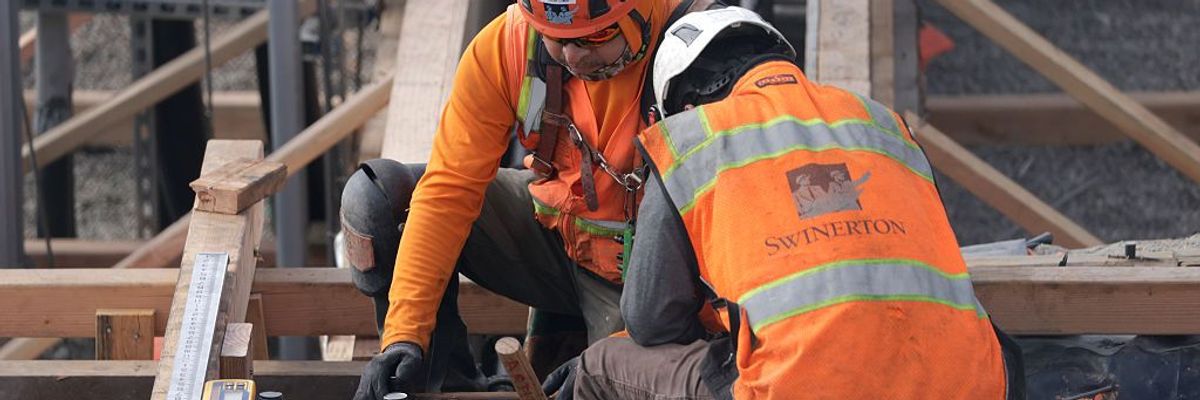
Workers construct a new building on September 5, 2025 in San Francisco, California.
(Photo by Justin Sullivan/Getty Images)


Brad Reed
Dec 22, 2025
COMMON DREAMS

President Donald Trump has justified his historically high tariffs on foreign goods by promising that they would lead to a boom in domestic manufacturing jobs in the US.

However, in year-end reviews of the US job market, three economists make the case that Trump’s record on creating manufacturing jobs has been a massive bust.


‘Yikes’: New Jobs Data Further Undermines Trump Fiction of Thriving Economy


‘This Is Pathetic’: Flailing Trump Defends Economic Agenda as Approval Tanks and Costs Rise

Mike Konczal, senior director of policy and research at the Economic Security Project and a former member of President Joe Biden’s National Economic Council, argued in his personal newsletter on Friday that the Trump administration’s efforts to reorganize the US labor market away from service sector jobs have completely failed.

In particular, he found that jobs in manufacturing, mining, and logging have all declined throughout the first year of Trump’s second term, while jobs in construction have remained mostly flat after years of steady growth during former President Joe Biden’s administration.

What’s more, the administration’s stated goal of opening up more jobs for native-born US workers by conducting mass deportations of immigrant workers has also flopped, as native-born unemployment has been higher in 2025 than in either of the last two years.

“The bleak irony is that even after sacrificing real prosperity to chase this 4chan-level political economy, they still won’t achieve their goal,” Konczal concluded. “The jobs aren’t coming back, the wages aren’t rising, and family formation won’t be rescued by trying to rewind the labor market to a world that never existed in the first place.”

Nobel Prize-winning economist Paul Krugman concurred with Konczal’s assessment of the US labor market in an analysis published Monday in which he described Trump’s record on jobs as “an abject failure.”

Krugman argued that Trump’s war on clean energy projects is almost certainly making the situation even worse by killing blue-collar manufacturing and construction jobs in the wind and solar industries.

“Trump has scrapped Biden’s green energy policies in favor of tariffs and fossil fuels,” Krugman noted. “But it isn’t working. Instead, employment in ‘manly’ sectors has fallen since Trump took office.”

Additionally, said Krugman, Trump’s plan to use tariffs to bring back manufacturing jobs to the US was always destined to fail given the realities of how modern economies work.

“In the modern world nations mostly don’t sell each other completed consumer goods,” he explained. “Instead, the majority of trade involves sales of goods that are used to produce other goods... What this means in practice is that tariffs, which raise the prices of those capital goods and inputs, raise the production costs of US manufacturers, in many cases making them less competitive with foreign producers.”

Ball State University economist Michael J. Hicks, in a column published Monday by the Indianapolis Star, also pointed the finger at Trump’s tariffs when explaining his failure to revive US manufacturing.

Hicks argued that the damage the president’s policies have done to manufacturing won’t be undone any time soon.

“The US is in the early days of a manufacturing contraction that will run through most of 2026, even if the tariffs are lifted today,” he warned. “We should call it the deindustrialization of America. All of this flies in the face of the nonsensical claims of a manufacturing renaissance or onshoring that would bring factory jobs back to the US.”
‘Blatant Act of Retaliation’: Trump Denies Colorado Request for Fire, Flooding Disaster Relief

Coloradans’ “courage, strength, and willingness to help one another is unmatched—values that President Trump seems to have forgotten,” said Gov. Jared Polis.


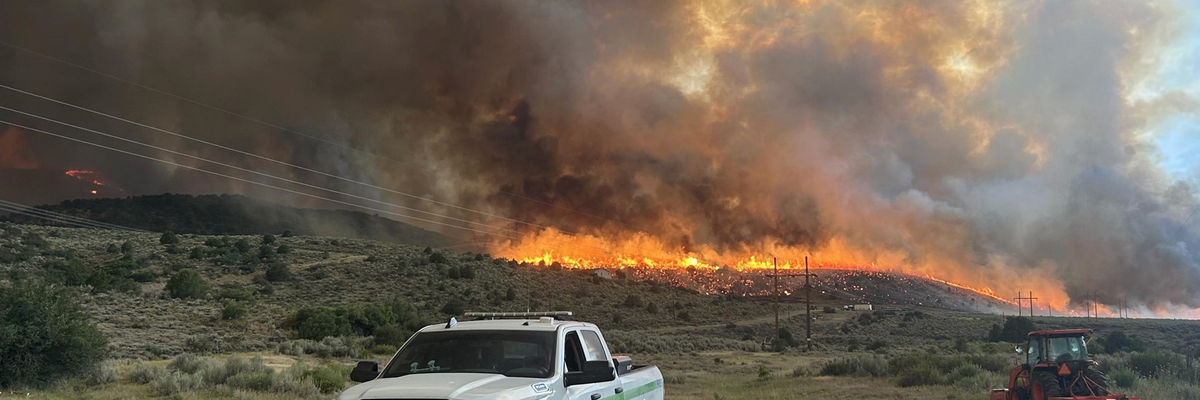
The Lee Fire is seen in August 2025 near Meeker, Colorado.
(Photo: Inciweb.wildfire.gov)

Julia Conley
Dec 22, 2025
COMMON DREAMS

Top Democratic officials in Colorado are among those condemning President Donald Trump’s denial of two disaster relief requests from Gov. Jared Polis—his latest action in a state that critics say he is retaliating against for its prosecution of a former county clerk who was involved in election denial efforts in 2020.

After the White House denied the requests for Trump to declare major disasters in parts of Colorado that experienced the Lee and Elf fires in August and flooding in October—a move that would unlock Federal Emergency Management Agency (FEMA) funding to help with recovery efforts—Polis joined other Democratic leaders in calling on Trump to reconsider and accusing him of playing “political games.”

“One of the most amazing things to witness as governor has been the resilience of Coloradans following a natural disaster,” said Polis. “Their courage, strength, and willingness to help one another is unmatched—values that President Trump seems to have forgotten. I call on the president’s better angels, and urge him to reconsider these requests. This is about the Coloradans who need this support, and we won’t stop fighting for them to get what they deserve. Colorado will be appealing this decision.”

The governor was joined by Democratic Sens. Michael Bennet and John Hickenlooper in speaking out against the denial.

Polis made the requests in late September and last month, noting in his first request that Rio Blanco County, which both fires ripped through, has an economy driven “largely by energy production” at the Piceance Basin.


“This local industry is powered by two local utility providers who have sustained over $24 million in damages to their infrastructure,” his office said. “Without support to recover local utility infrastructure, stalled production risks the local economy, major rate increases on Coloradans, and local economic collapse.”

In November, Polis noted that FEMA had confirmed $13.8 million in damages to public infrastructure from flooding in several western counties, with roads and bridges particularly affected.

Communities also have ongoing debris removal needs, sewer system failures, and damages to essential drinking water and wastewater infrastructure.

The Stafford Act authorizes the president to declare a major disaster in order to unlock additional federal funding to respond to floods and other emergencies.

Trump has sought to reduce federal funding that goes to states for emergency management—denying at least 12 requests from states between January-October, with Democratic-led states facing many of the denials.

He has overtly politicized disaster relief, announcing in August that any state or city that boycotts Israeli products in protest of its attacks on and policies in Palestinian territories would not receive funding they requested.

Despite this, White House spokesperson Abigail Jackson told The Hill on Monday that “there is no politicization to the president’s decisions on disaster relief”—but Polis and other Democrats suggested the flooding and fire relief request denial was part of Trump’s larger efforts to retaliate against the state of Colorado.

Last week, the president’s top budget adviser, Office of Management and Budget Director Russell Vought, announced the administration was dismantling the National Center for Atmospheric Research (NCAR), a major climate research and meteorological facility in Boulder.

A number of critics said that move appeared to be in retaliation for the conviction in a state court of Tina Peters, a former county clerk who was found guilty of allowing someone access to secure voting system data as part of an effort to prove the baseless claim that the 2020 election was stolen from Trump.

Despite uncertainty about Trump’s authority to pardon Peters, the president claimed recently that he will do so. He has directly attacked Polis for Peters’ treatment by the state.

“When the people of Western Colorado need assistance the most—as recovery from the Elk and Lee fires continues—President Trump abandons them in a blatant act of retaliation against our state,” said Rep. Joe Neguse (D-Colo.) on Sunday night of Trump’s latest action toward Colorado. “Shameful.”
Trump Continues ‘War Against Renewables’ With Halt of Five Offshore Wind Farms

“Trump is killing jobs, raising energy costs, and harming the planet,” said Sen. Tim Kaine. “Grinch!”


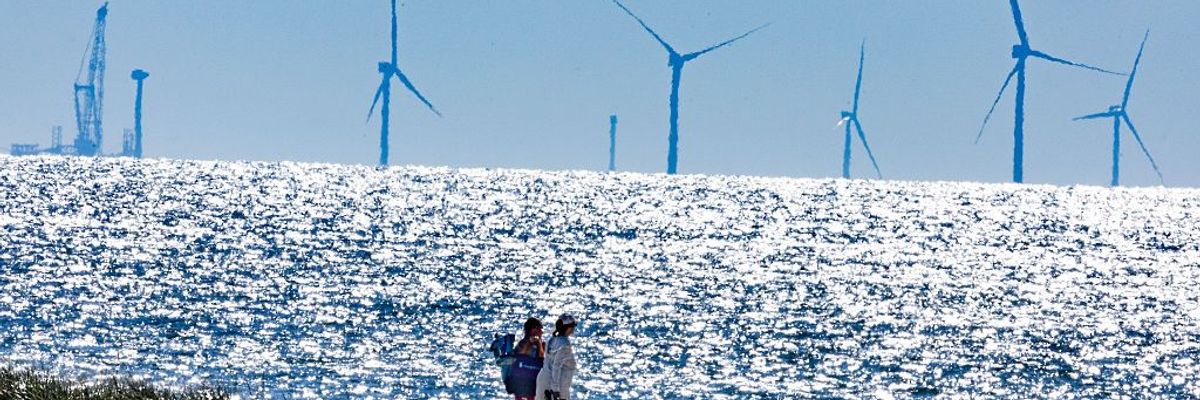
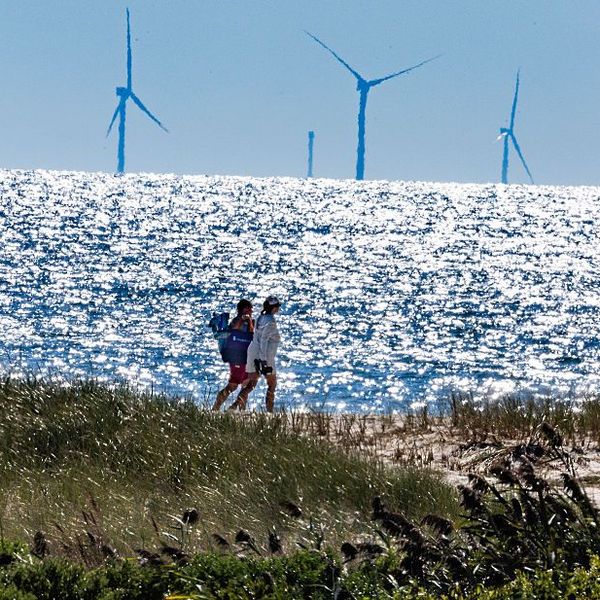
Madaket beachgoers walk along the beach with the Vineyard Wind turbines in the background on September 11, 2025.
(Photo by Stan Grossfeld/The Boston Globe via Getty Images)


Jessica Corbett
Dec 22, 2025
COMMON DREAMS


The Trump administration’s efforts to thwart a transition from climate-wrecking fossil fuels to renewable energy continued on Monday with a halt on five wind farms along the US East Coast under the guise of national security concerns.

The US Department of the Interior announced that it is immediately pausing Coastal Virginia Offshore Wind off Virginia, Empire Wind 1 and Sunrise Wind off New York, Revolution Wind off Rhode Island and Connecticut, and Vineyard Wind 1 off Massachusetts, citing unclassified government reports that “the movement of massive turbine blades and the highly reflective towers create radar interference called ‘clutter.’”

Bloomberg reported Monday that “President Donald Trump has long opposed offshore wind power and began imposing restrictions on it within hours of taking office this year. The policies have led to numerous court battles, and a federal judge this month ruled his ban on projects was illegal. Citing national security issues may be a more legally durable way to keep wind turbines out of US waters.”

“Offshore wind farm projects raised national security concerns under previous administrations, too. The Defense Department under former President Joe Biden pushed successfully for changes to leases being sold along the West Coast to address some of the issues,” Bloomberg noted. Elsewhere, such as in the United Kingdom, government and industry have responded to radar interference issues by investing in mitigation technologies.


Responding to the news on social media, American anthropologist and journalist Scott Carney said that “shutting down wind farms in the name of national security only proves that Trump is a national security risk. Lying that climate change doesn’t exist is not an effective policy against environmental collapse.”

Jonathan Cohn, political director of the grassroots group Progressive Mass, pointed out that “if these were oil drilling projects being canceled, Republicans would scream that canceling the project was theft from the company. If renewable energy is canceled, those same Republicans cheer.”

Dean Baker, senior economist at the Center for Economic and Policy Research, warned that “any company would be crazy to invest a dime in Donald Trump’s America... The jerk can confiscate property any time he wants for any reason he invents.”

According to the New York Times: “Vineyard Wind 1 is currently under construction and partially operational, with about half of the project’s 62 turbines sending power to the electric grid as of October. Once complete, the project could produce enough electricity to power 400,000 homes.”

Congressman Greg Stanton (D-Ariz.) declared that “wind farms are an essential part of a diversified energy strategy. Trump’s cancellation of approved, in-progress projects wastes public dollars and widens the gap between America and its competitors.”

Rep. John Larson (D-Conn.), whose constituents would benefit from the Revolution Wind project, said that “the president has taken an axe to wind energy, solar projects, and our state’s clean hydrogen sector, putting hundreds of people out of work and saddling households across the state with even higher electricity bills. The state of Connecticut, led by Attorney General William Tong, already took him on to halt his illegal stop work order before, and we’re prepared to do it again.”


Sen. Tim Kaine (D-Va.) said: “Trump is killing jobs, raising energy costs, and harming the planet. Grinch!”

Senate Majority Leader Chuck Schumer (D-NY) similarly responded: “Donald Trump is trying AGAIN to kill thousands of good-paying union jobs and raise your electricity bill. I have been fighting Trump’s war against offshore wind—a war that threatens American jobs and American energy. I will keep fighting to make sure these projects, the thousands of jobs they create, and the energy they provide can continue.”

Sierra Club legislative director Melinda Pierce said in a statement that “blocking construction on all offshore wind projects underway in the US is an attack on our economy and our public health. The Trump administration’s vengeance towards renewable energy knows no end.”

“Instead of progressing us forward as a nation, they are obsessed with attacking a growing industry that provides good clean energy jobs and affordable, clean electricity,” she added. “Americans need cheaper and more reliable energy that does not come at the expense of our health and futures.”

Interior Secretary Doug Burgum discussed the decision on Fox Business Monday, pointing to the radar interference concerns.


Noting the appearance, writer and filmmaker Lee West said: “So ‘national security’ means suspending wind farms Navy approved for years—while drilling rigs multiply off Florida. The [administration’s] pretexts grow taller than turbine blades.”


Senate Dems Stop Permitting Talks Over Trump’s ‘Reckless and Vindictive Assault’ on Wind Power

“By sabotaging US energy innovation and killing American jobs, the Trump administration has made clear that it is not interested in permitting reform,” said Sens. Sheldon Whitehouse and Martin Heinrich.


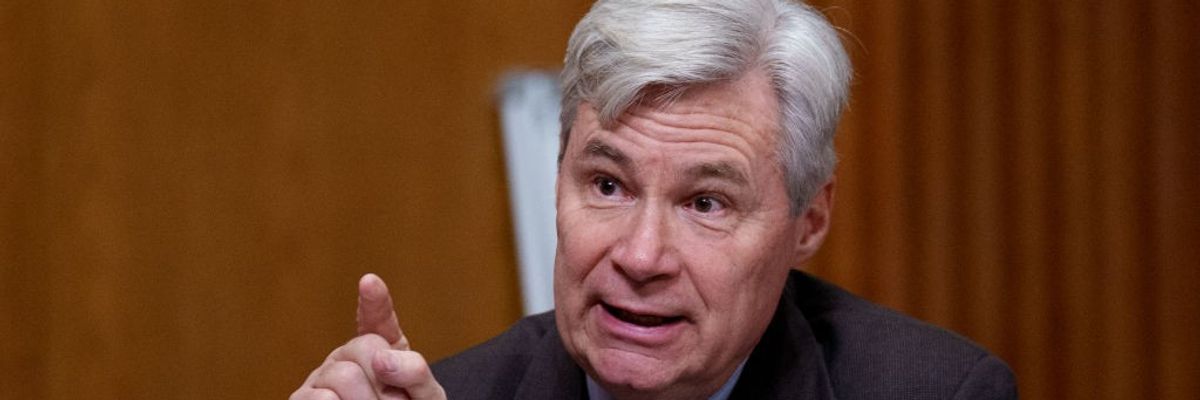
US Sen. Sheldon Whitehouse (D-RI) speaks during a hearing on March 6, 2025 in Washington, DC.
(Photo by Andrew Harnik/Getty Images)

Jessica Corbett
Dec 22, 2025
COMMON DREAMS

The top Democrats on a pair of key US Senate panels ended negotiations to reform the federal permitting process for energy projects in response to the Trump administration’s Monday attack on five offshore wind projects along the East Coast.

Senate Environment and Public Works Committee Ranking Member Sheldon Whitehouse (D-RI) and Energy and Natural Resources Committee Ranking Member Martin Heinrich (D-NM) began their joint statement by thanking the panels’ respective chairs, Sens. Shelley Moore Capito (R-W.Va.) and Mike Lee (R-Utah), “for their good-faith efforts to negotiate a permitting reform bill that would have lowered electricity prices for all Americans.”


Trump Continues ‘War Against Renewables’ With Halt of Five Offshore Wind Farms


11 House Democrats Help GOP Pass ‘Disastrous’ Pro-Polluter Permitting Bill

“There was a deal to be had that would have taken politics out of permitting, made the process faster and more efficient, and streamlined grid infrastructure improvements nationwide,” the Democrats said. “But any deal would have to be administered by the Trump administration. Its reckless and vindictive assault on wind energy doesn’t just undermine one of our cheapest, cleanest power sources, it wrecks the trust needed with the executive branch for bipartisan permitting reform.”

Earlier Monday, the US Department of the Interior halted Coastal Virginia Offshore Wind off Virginia, Empire Wind 1 and Sunrise Wind off New York, Revolution Wind off Rhode Island and Connecticut, and Vineyard Wind 1 off Massachusetts, citing radar interference concerns.

Governors and members of Congress from impacted states, including Whitehouse and Senate Minority Leader Chuck Schumer (D-NY), condemned the announcement, with Whitehouse pointing to a recent legal battle over the project that would help power Rhode Island.

“It’s hard to see the difference between these new alleged radar-related national security concerns and the radar-related national security allegations the Trump administration lost in court, a position so weak that they declined to appeal their defeat,” he said.


Later, he and Heinrich said that “by sabotaging US energy innovation and killing American jobs, the Trump administration has made clear that it is not interested in permitting reform. It will own the higher electricity prices, increasingly decrepit infrastructure, and loss of competitiveness that result from its reckless policies.”

“The illegal attacks on fully permitted renewable energy projects must be reversed if there is to be any chance that permitting talks resume,” they continued. “There is no path to permitting reform if this administration refuses to follow the law.”

Reporting on Whitehouse and Heinrich’s decision, the Hill reached out to Capito and Lee’s offices, as well as the Interior Department, whose spokesperson, Alyse Sharpe, “declined to comment beyond the administration’s press release, which claimed the leases were being suspended for national security reasons.”

Lee responded on social media with a gif:


Although the GOP has majorities in both chambers of Congress, Republicans don’t have enough senators to get most bills to a final vote without Democratic support.

The Democratic senators’ Monday move was expected among observers of the permitting reform debate, such as Heatmap senior reporter Jael Holzman, who wrote before their statement came out that “Democrats in Congress are almost certainly going to take this action into permitting reform talks... after squabbling over offshore wind nearly derailed a House bill revising the National Environmental Policy Act last week.”

That bill, the Standardizing Permitting and Expediting Economic Development (SPEED) Act, was pilloried by green groups after its bipartisan passage. It’s one of four related pieces of legislation that the House advanced last week. The others are the Mining Regulatory Clarity Act, Power Plant Reliability Act, and Reliable Power Act.

David Arkush, director of the consumer advocacy group’s Climate Program, blasted all four bills as “blatant handouts to the fossil fuel and mining industries” that would do “nothing to help American families facing staggering energy costs and an escalating climate crisis.”

“We need real action to lower energy bills for American families and combat the climate crisis,” he argued. “The best policy response would be to fast-track a buildout of renewable energy, storage, and transmission—an approach that would not just make energy more affordable and sustainable, but create US jobs and bolster competitiveness with China, which is rapidly outpacing the US on the energy technologies of the future.

Instead, Arkush said, congressional Republicans and President Donald Trump “are shamefully pushing legislation that would only exacerbate the energy affordability crisis and further entrench the dirty, dangerous, and unaffordable energy of the past.”

Trump administration suspends 5 wind projects off the East Coast, cites national security concerns

Story by Matthew Daly
Dec 22, 2025
AP


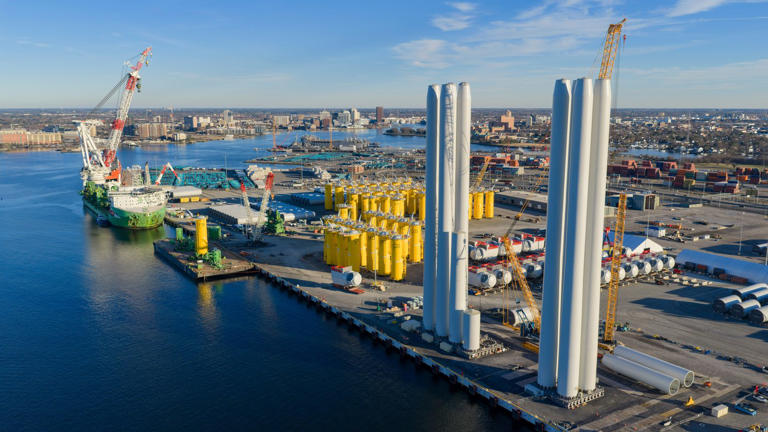
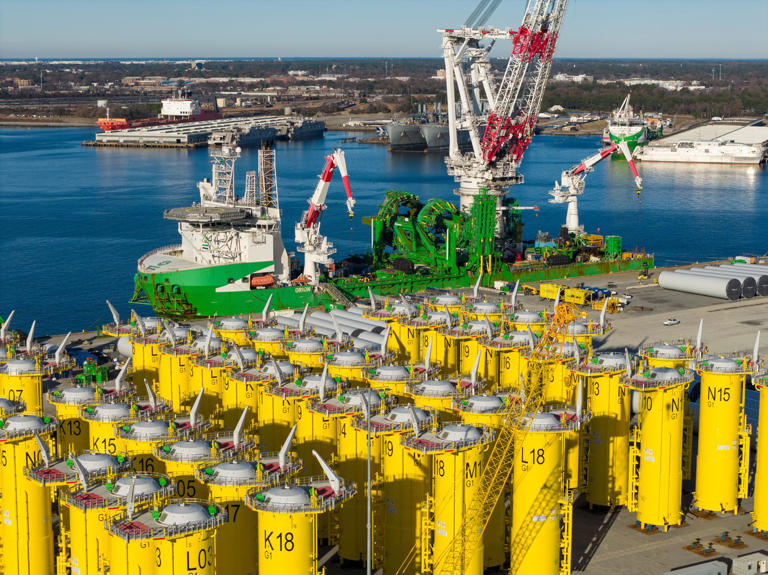
Wind turbine bases, generators and blades are positioned at The Portsmouth Marine terminal that is the staging area for Dominion Energy's wind turbine project Monday Dec. 22, 2025, in Portsmouth, Va. (AP Photo/Steve Helber)© The Associated Press

WASHINGTON (AP) — The Trump administration on Monday suspended leases for five large-scale offshore wind projects under construction along the East Coast due to what it said were national security risks identified by the Pentagon.

The suspension, effective immediately, is the latest step by the administration to hobble offshore wind in its push against renewable energy sources. It comes two weeks after a federal judge struck down President Donald Trump’s executive order blocking wind energy projects, calling it unlawful.

The administration said the pause will give the Interior Department, which oversees offshore wind, time to work with the Defense Department and other agencies to assess the possible ways to mitigate any security risks posed by the projects. The statement did not detail the national security risks. It called the move a pause, but did not specify an end date.


Wind turbine bases, generators and blades are positioned at The Portsmouth Marine terminal that is the staging area for Dominion Energy's wind turbine project Monday Dec. 22, 2025, in Portsmouth, Va. (AP Photo/Steve Helber)© The Associated Press

“The prime duty of the United States government is to protect the American people,” Interior Secretary Doug Burgum said in a statement. “Today’s action addresses emerging national security risks, including the rapid evolution of the relevant adversary technologies, and the vulnerabilities created by large-scale offshore wind projects with proximity near our east coast population centers.”


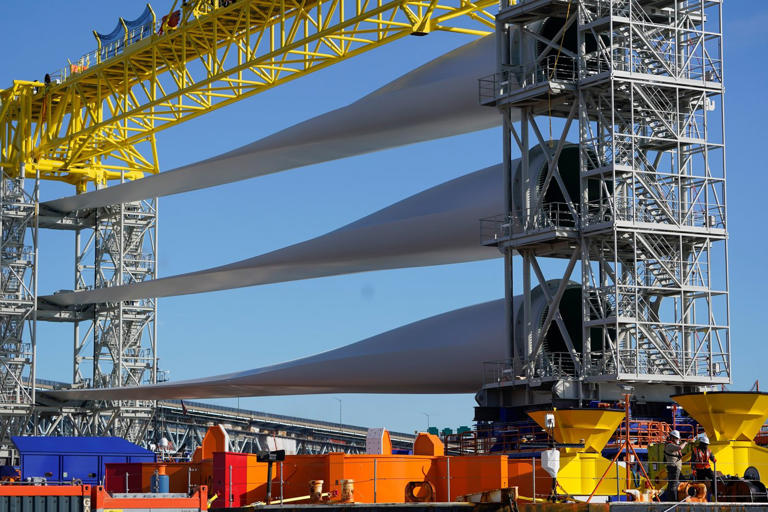
FILE - A generator and it's blades are prepared to head to the open ocean for the South Fork Wind farm from State Pier in New London, CT., Dec. 4, 2023. (AP Photo/Seth Wenig, File)© The Associated Press

Wind proponents slammed the move, saying it was another blow in an ongoing attack by the administration against clean energy. The administration’s decision to cite potential national security risks could complicate legal challenges to the move, although wind supporters say those arguments are overstated.

Projects paused over national security concerns

The administration said leases are paused for the Vineyard Wind project under construction in Massachusetts, Revolution Wind in Rhode Island and Connecticut, Coastal Virginia Offshore Wind, and two projects in New York: Sunrise Wind and Empire Wind.

The Interior Department said unclassified reports from the U.S. government have long found that the movement of massive turbine blades and the highly reflective towers create radar interference called “clutter.” The clutter caused by offshore wind projects can obscure legitimate moving targets and generate false targets in the vicinity of wind projects, the Interior Department said.

National security expert and former Commander of the USS Cole Kirk Lippold disputed the administration’s national security argument. The offshore projects were awarded permits “following years of review by state and federal agencies,” including the Coast Guard, the Naval Undersea Warfare Center, the Air Force and more, he said.

“The record of decisions all show that the Department of Defense was consulted at every stage of the permitting process,” Lippold said, arguing that the projects would benefit national security because they would diversify the country's energy supply.

Sen. Sheldon Whitehouse, D-R.I, said Revolution Wind was thoroughly vetted and fully permitted by the federal government, “and that review included any potential national security questions.” Burgum's action "looks more like the kind of vindictive harassment we have come to expect from the Trump administration than anything legitimate,'' he said.

A judge ruled blocking wind projects was unlawful

The administration's action comes two weeks after a federal judge struck down Trump’s executive order blocking wind energy projects, saying the effort to halt virtually all leasing of wind farms on federal lands and waters was “arbitrary and capricious” and violates U.S. law.

Judge Patti Saris of the U.S. District Court for the District of Massachusetts vacated Trump’s Jan. 20 executive order blocking wind energy projects and declared it unlawful.

Saris ruled in favor of a coalition of state attorneys general from 17 states and Washington, D.C., led by New York Attorney General Letitia James, that challenged Trump’s Day One order that paused leasing and permitting for wind energy projects.

Trump has been hostile to renewable energy, particularly offshore wind, and prioritizes fossil fuels to produce electricity. Trump has said wind turbines are ugly, expensive and pose a threat to birds and other wildlife.

Wind proponents slam the move

Wind supporters called the administration's actions illegal and said offshore wind provides some of the most affordable, reliable electric power to the grid.

“For nearly a year, the Trump administration has recklessly obstructed the build-out of clean, affordable power for millions of Americans, just as the country’s need for electricity is surging,” said Ted Kelly of the Environmental Defense Fund.


“Now the administration is again illegally blocking clean, affordable energy," Kelly said. “We should not be kneecapping America’s largest source of renewable power, especially when we need more cheap, homegrown electricity.''

The administration's actions are especially egregious because, at the same time, it is propping up aging, expensive coal plants "that barely work and pollute our air,” Kelly said.

Connecticut Attorney General William Tong called the lease suspension a “lawless and erratic stop-work order” that revives an earlier, failed attempt to halt construction of Revolution Wind.

“Every day this project is stalled is another day of lost work, another day of unaffordable energy costs and burning fossil fuels when American-made clean energy is within reach," Tong said. “We are evaluating all legal options, and this will be stopped just like last time.”

Suspension is praised by anti-wind group

A New Jersey group that opposes offshore wind hailed the administration's actions.

“Today, the president and his administration put America first,'' said Robin Shaffer, president of Protect Our Coast New Jersey, a nonprofit advocacy group.

“Placing largely foreign-owned wind turbines along our coastlines was never acceptable," he said, arguing that Empire Wind, in particular, poses a threat because of its close proximity to major airports, including Newark Liberty, LaGuardia and JFK.

Offshore wind projects also pose a threat to commercial and recreational fishing industries, Shaffer and other critics say.

Developers of U.S. offshore projects include Denmark-based Orsted, Norway-based Equinor and a subsidiary of Spanish energy giant Iberdrola. Orsted, which owns two of the projects affected, saw stock prices decline by more than 11% Monday.

Richmond-based Dominion Energy, which is developing Coastal Virginia Offshore Wind, said its project is essential for national security and meeting Virginia’s dramatically growing energy needs, driven by dozens of new data centers.

“Stopping CVOW for any length of time will threaten grid reliability ... lead to energy inflation and threaten thousands of jobs,” the company said in a statement.

Pausing the Virginia project, which is nearly 70% complete, creates a “perfect storm” to harm customer affordability and grid reliability, said David Shepheard, an energy expert at Baringa, a global consulting firm.

East Coast residents are familiar with winter storms that can devastate local economies, Shepheard said, adding: “This is a new one for the area: a Washington-borne nor'easter where the political winds are going to stop the blades from spinning."

___

Associated Press writer Jennifer McDermott in Providence, R.I., contributed to this report.

Matthew Daly, The Associated Press