Thursday, December 19, 2024

Digital labels can help grocers waste less food


Consumers, stores, and the environment benefit when electronic tags allow speedy price changes


University of Texas at Austin


In 2022, U.S. grocers wasted 5 million tons of food, with 35% of it going to landfills, according to the food waste nonprofit ReFed. More than half of that waste — 2.7 million tons — was past the labels’ expiration dates.

But there’s a potential technological solution to the waste problem, according to new research from Texas McCombs. By moving from paper shelf labels to digital ones, supermarkets can easily lower prices and move older stock from their shelves to consumers’ homes.

Using technology to quickly change prices on labels, a process known as dynamic pricing, benefits more than just consumers, says Ioannis Stamatopoulos, associate professor of information, risk, and operations management.

“Everyone is better off when dynamic pricing is enabled,” he says. “There’s less food waste and less emissions from food ending up in landfills.”

Grocers save time and money, too. They can change digital labels — also called electronic shelf labels — with a few keystrokes on a tablet, compared with printing physical labels and sticking them onto shelves. When it’s easier and cheaper to update prices, Stamatopoulos says, grocers should do it more often.

How much is more often? To find out, Stamatopoulos — with Naveed Chehrazi of Washington University in St. Louis and Robert Sanders of the University of California, San Diego — analyzed two unnamed European grocery chains as they installed the tags.

One, in the United Kingdom, introduced digital labels for 940 perishable products. The labels displayed the base price and added discounts as products got closer to expiring. The researchers found the stores changed prices 54% more often.

Raising the Bar for Barcodes

The second supermarket chain, in the European Union, adopted electronic labels but added a second technology: expanded barcodes.

Unlike a standard barcode, an expanded one can hold inventory details such as packaging dates, lot numbers, and expiration dates. When inventory nears its “sell-by” date, a store can lower prices to stimulate buying.

After the EU stores installed the two technologies, the researchers found, they increased price change frequency 853%.

Rapid price changes aid shoppers, says Stamatopoulos. “If you’re a consumer who really, really cares about price, then you can buy the blueberries that will expire two days later and consume them today.”

By better managing inventories, the barcodes also boost stores’ bottom lines, he adds. “Because the grocery store can put things on discount when they’re about to expire, they can afford larger orders, so they take advantage of economies of scale in ordering.”

The Price of Dynamic Pricing

Although dynamic pricing has long-term benefits, it faces short-term obstacles. One is consumer fear that retailers will jack up prices when demand is high — as ride-hailing companies such as Uber do.

In February, when the fast-food chain Wendy’s announced it would roll out dynamic pricing, it drew backlash. It quickly clarified that it would cut prices during slow periods but not raise them during busy periods.

But unlike restaurants, it’s hard for grocers to pinpoint hours of high demand for individual products, Stamatopoulos notes. “For retailers to estimate demand very finely and dynamically respond accordingly, so as to squeeze every dollar out of it, I think that’s kind of impossible,” he says.

Another barrier is cost. Grocers must invest in digital labels and tablets, while employees must update data daily for thousands of items.

Europe is ahead of the U.S. on adopting these technologies, but that could be changing. In June, Walmart announced it will transition to digital price labels in 2,300 stores by 2026. Amazon Fresh and the Midwestern chain Schnuck’s are also using them.

To speed the transition, Stamatopoulos suggests government subsidies, like those for solar panels and electric vehicles.

 “Somebody needs to break this equilibrium,” he says. “Then things will move to a new era where everybody’s using the additional information.”

Inventory Information Frictions Explain Price Rigidity in Perishable Groceries” is forthcoming in Marketing Science.

Story by Suzi Morales

 MAGICK IS QUANTUM PHYSICS 0=2

Large Hadron Collider regularly makes magic


University of Adelaide
colliding-top-quarks 

image: 

The magic of a mixed top-antitop final state in (a) the qq channel and (b) the gg channel.

view more 

Credit: University of Adelaide/Queen Mary University of London


A brotherly research duo has discovered that when the Large Hadron Collider (LHC) produces top quarks – the heaviest known fundamental particles – it regularly creates a property known as magic.

This finding, published in Physical Review D, has implications for the progression of quantum computing, with magic being a measure that describes how difficult a quantum system is for a non-quantum computer to calculate.

“The higher the magic, the more we need quantum computers to describe the behaviour,” explains Professor Martin White, from the University of Adelaide’s School of Physics, Chemistry and Earth Sciences, who co-led the study with his twin brother, Professor Chris White, a physicist from Queen Mary University of London.

“Studying the magic properties of quantum systems generates significant insights into the development and potential uses of quantum computers.”

The LHC is the world’s largest and most powerful particle accelerator, consisting of a 27-kilometre ring of superconducting magnets with a number of accelerating structures through which two high-energy particle beams travel at close to the speed of light before they are made to collide.

The amount of magic exhibited by top quarks depends on how fast they are moving and their direction of travel, all of which can be measured by the ATLAS and CMS detectors that observe the results of the LHC proton collisions.

“Quantum research has long focused on entanglement, which is where particles become linked; however, our work on magic explores how well-suited particles are for building powerful quantum computers,” says Professor White.

“The ATLAS experiment has already observed evidence of quantum entanglement. We have shown that the LHC can also observe more complex patterns of quantum behaviour at the highest energies yet attempted for these kinds of experiments.”

For decades, scientists have strived to build quantum computers that leverage the laws of quantum mechanics to achieve far greater processing power than traditional computers.

The potential benefits of quantum computers are vast, impacting fields like drug discovery and materials science. Harnessing this power requires robust and controllable quantum states, and magic plays a critical role in achieving that control.

"Our research paves the way for a deeper understanding of the connection between quantum information theory and high-energy physics,” says Professor White.

“This discovery is not just about the heaviest particles in the universe, it's about unlocking the potential of a revolutionary new computing paradigm.”

More people living without running water in US cities since the global financial crisis of 2008-2009


King's College London
Map of US households without access to running water in 2017–2021. 

image: 

Map of US households without access to running water in 2017–2021. Cities with 613 notable concentrations are listed by name. Source data: US Census Bureau.

view more 

Credit: (Meehan et al. 2024)


More American cities – even those seen as affluent – are home to people living without running water as people are being ‘squeezed’ by unaffordable housing and the cost-of-living crisis, new research finds.

Published in Nature Cities, the study revealed the problem worsened following changes to the housing market triggered by the 2008 global crash. And since 2017 it has been “expanding in scope and severity” to affect a broader array of US cities including Portland (OR), Phoenix, Houston, Atlanta, Dallas-Fort Worth, and Philadelphia, as well as large urban areas such as Los Angeles, New York City and San Francisco.

The research also found that people of color were disproportionally affected by a lack of household water, a situation defined by the authors as ‘plumbing poverty’, in 12 of the 15 largest cities.

The researchers from King’s College London and the University of Arizona said the findings should “raise alarm bells” and warned it would take a “heroic” transformation of housing conditions and social infrastructures for the USA to meet the United Nations goal for everyone to have access to safe drinking water, sanitation and hygiene.

Lead researcher Professor Katie Meehan, Professor of Environmental Justice at King’s College London, UK, said: “It is alarming how many US cities, including those thought of as affluent and growing, are now home to more people living in situations of extreme poverty, namely without access to running water.

“Our research is the first effort to track these changes over time, starting in the 1970s and noting a dramatic urbanization of plumbing poverty in the 1990s and sharp acceleration triggered by the 2008 crash and the current housing and cost-of-living crisis.

“The compound pressures of high housing costs and expenditures mean that more low-income, asset-limited people are living without running water in these expensive cities. Far too many people, especially those of color, are now in such extreme poverty they are being pushed into homes that do not meet the basic standard for human dignity and life.”

Meehan said people can find themselves living without running water because of a range of reasons and, in most cases, people are working but not earning enough to make ends meet. Some households might have been disconnected from water service after falling behind with bills or had to “downgrade” to housing without any water access because other expenses take priority. Others might be in homes which have been poorly maintained by their landlord but cannot afford to move out, some might be living in buildings such as sheds or warehouses not designed to be homes, while others could be experiencing homelessness.

Lucy Everitt, a PhD student at King’s College London who was part of the research team, said water service shut-offs are a hidden problem across US cities that may be indirectly picked up by US census data.

“New York City tops the ‘worst offenders’ list for the total number of households in a US metro without running water. Despite this, the municipal Water Board issued more than 2,400 shutoff notices in March of this year alone to properties behind in their payments. Because our analysis tracks the status of running water in households, as measured by the US Census, we anticipate that we are capturing many thousands of households whose access is denied by their inability to pay.”

The study is the first to track the problem over a 51-year period in the 50 largest US cities. In the 1970s, according to census data, 3.5 million US households lacked running water and by 2021 this overall number had reduced, but 0.5 million households or 1.1million people still lacked household access to running water. This is equivalent to one  out of 245 households live without running water. The team believe this is likely to be an underestimate of the true number because of limitations in US census data.

Other key findings from the study include:

  • From 1990, plumbing poverty shifted from being a mainly rural to urban issue and latest figures show 71 percent of those in plumbing poverty now live in cities.
  • In 2021, the New York City metro area led the nation in the number of people living in plumbing poverty – a staggering 56,900 people  – followed by Los Angeles (45,900 people) and San Francisco (24,400 people).
  • People of color represent the majority of individuals without access to running water in 12 of the 15 largest US cities, including Los Angeles (82%), Miami (79%), San Francisco (74%), and Houston (71%) in 2021.

Dr Jason R. Jurjevich, Assistant Professor in the School of Geography, Development and Environment at the University of Arizona who was part of the research team, said: “Our results underscore that the success in reducing plumbing poverty in select US cities over the past twenty years is uneven, with households of color often left behind.  In Philadelphia, for example, people of color comprised 40% of the total population, but represented 66% of people without access to running water in 2021.”

The authors said not enough attention is being given to how the housing crisis is shaping people’s access to running water. They recommend reform and improvements to the US Census Bureau’s capacity to collect nationwide data about household water access and the extent of water service shut-offs, to monitor and meet SDG development goals. They also said local water utilities and water boards must revisit and overhaul low-income assistance programs in light of the expanding cost-of-living and housing expenses, which are ‘squeezing’ people’s ability to pay for water services.   

Ends

‘President Musk’ makes his presence felt in Washington

By AFP
December 19, 2024

Elon Musk speaks at a rally for Donald Trump at Madison Square Garden in New York, October 27, 2024. - Copyright AFP ANGELA WEISS

Aurélia END

Elon Musk’s role in wrecking a bipartisan Congress deal to avert a US government shutdown has underlined his extraordinary influence over the Republican Party and the incoming administration of Donald Trump.

In addition to his usual title of the world’s richest man, Democrats are now describing him as “President Musk.”

Musk has been tapped by Trump to run the new Department of Government Efficiency (DOGE) agency, but the billionaire is throwing his weight around even before the president-elect takes office on January 20.

On Wednesday, shortly after 4:00 am, the hyperactive owner of Tesla and SpaceX used his social platform X to attack the budget bill hammered out by Republicans and Democrats in Congress to keep the federal government operating.

“This bill should not pass,” the 53-year-old Musk wrote in the first of what became a barrage of posts.

“Kill the bill,” he exhorted Republican members of the House of Representatives. “This bill is criminal.”

A number of Republican lawmakers quickly fell in line, with some even engaging in a bit of flattery.

“In five years in Congress, I’ve been awaiting a fundamental change in the dynamic,” Representative Dan Bishop commented on an X post by Musk. “It has arrived.”

Other right-wing members of Congress even went so far as to suggest that the South African-born Musk should take over as House speaker.

Trump himself joined the budget battle later in the day.

The 78-year-old president-elect denounced the spending bill as “ridiculous and extraordinarily expensive.”

The dramatic developments left the country facing a government shutdown just days before Christmas.

Musk rejoiced after the bill was torpedoed. “The voice of the people was heard,” he said. “This was a good day for America.”

He followed up by reposting a picture of himself in front of an American flag with the words “VOX POPULI” and “VOX DEI,” a Latin phrase which translates to “the voice of the people is the voice of God.”

After the intervention, Republicans in Congress on Thursday came up with a new funding package that satisfied Trump — and Musk.

– Who’s in charge? –

Democrats have painted the tech billionaire as unstable and a megalomaniac, and hope calling him “President Musk” will needle Trump.

“Democrats and Republicans spent months negotiating a bipartisan agreement to fund our government,” Senator Bernie Sanders said. “The richest man on Earth, President Elon Musk, doesn’t like it.

“Will Republicans kiss the ring?” Sanders asked. “Billionaires must not be allowed to run our government.”

Democratic Representative Jim McGovern said “at least we know who’s in charge.”

“He’s president and Trump is now vice president,” McGovern said.

Speaking on CNN, David Axelrod, who served as chief strategist for Barack Obama’s White House campaigns, said Musk and Trump need to “get together and decide who the president is.”

Musk’s rapid political ascension is unprecedented. While wealthy patrons have exerted influence before, no unelected businessman has ever wielded such political power.

Musk played a large role in the closing stages of Trump’s presidential campaign, appearing with him at a rally in Pennsylvania on the site where a gunman wounded the Republican candidate, and personally funding a reelection committee.

He has been omnipresent since Trump’s election victory, virtually taking up residence at Trump’s home in Mar-a-Lago Florida where the incoming president is mapping out the transition.

Musk and Amazon owner Jeff Bezos, a space race rival, dined with Trump on Wednesday evening at Mar-a-Lago.

Musk has not been formally named to Trump’s cabinet but his expansive brief of cutting federal government spending has sparked conflict of interest concerns.

SpaceX, for example, depends for a large part on US government contracts.

Musk’s $270 million in political donations during the November election cycle made him the largest political donor in US history.

But he shelled out far more for Twitter (since re-branded as X) in 2022, paying $44 billion.

“It’s weird to think that Elon Musk will end up having paid far less for the United States Government than he did for Twitter,” joked George Conway, a conservative critic.

Looming government shutdown a 'terrifying preview' of Trump and DOGE

Jessica Corbett,
 Common Dreams
December 19, 2024

U.S. President-elect Donald Trump shakes hands with U.S. House Speaker Mike Johnson (R-LA) as he meets with House Republicans on Capitol Hill in Washington, U.S., November 13, 2024. REUTERS/Brian Snyder REFILE - QUALITY REPEAT

U.S. President Trump and his allies, including billionaires Elon Musk and Vivek Ramaswamy, are blowing up bipartisan efforts to prevent a government shutdown that could begin this weekend with statements opposing a proposed stopgap measure.

"Currently reading the 1,547-page bill to fund the government through mid-March. Expecting every U.S. congressman and senator to do the same," Ramaswamy posted on Musk's social media platform X late Tuesday. Trump has asked the two billionaires to co-lead the forthcoming Department of Government Efficiency (DOGE), which they have said will pursue massive cuts to federal regulations and spending.

Musk responded to Ramaswamy early Wednesday, asserting that "this bill should not pass," a sentiment he repeated in several posts throughout the day, as the clock ticked closer to the Friday night deadline set by September legislation.

Ramaswamy also came out against the continuing resolution (CR) Wednesday morning, declaring that a "debt-fueled spending sprees may 'feel good' today, but it's like showering cocaine on an addict." He blasted various provisions, including $100 billion in disaster relief needed after hurricanes as well as funding to renew the Farm Bill for a year, replace the Francis Scott Key Bridge, and raise federal lawmakers' pay.

Donald Trump Jr. then weighed in, taking issue with a provision about subpoenas for U.S. House of Representatives data.

Appearing on "Fox & Friends" Wednesday, House Speaker Mike Johnson (R-La.) said that he was on a text message thread with Ramaswamy and Musk, claimed that "they understand the situation," and suggested he convinced them that the CR must pass.


However, later Wednesday, the president-elect and Vice President-elect JD Vance—who still represents Ohio in the Senate—released a lengthy statement opposing the CR and calling out specific policies, including the subpoena provision and the pay hike for lawmakers.

Trump and Vance—who are set to take over for Democratic President Joe Biden and Vice President Kamala Harris next month—also argued that "the most foolish and inept thing ever done by congressional Republicans was allowing our country to hit the debt ceiling in 2025. It was a mistake and is now something that must be addressed."


"Increasing the debt ceiling is not great but we'd rather do it on Biden's watch," the incoming Republican leaders said. "If Democrats won't cooperate on the debt ceiling now, what makes anyone think they would do it in June during our administration?"

"Republicans want to support our farmers, pay for disaster relief, and set our country up for success in 2025," they claimed. "The only way to do that is with a temporary funding bill WITHOUT DEMOCRAT GIVEAWAYS combined with an increase in the debt ceiling. Anything else is a betrayal of our country."

Trump echoed that point in a series of posts on his platform Truth Social, saying that "if Republicans try to pass a clean Continuing Resolution without all of the Democrat 'bells and whistles' that will be so destructive to our Country, all it will do, after January 20th, is bring the mess of the Debt Limit into the Trump Administration, rather than allowing it to take place in the Biden Administration."


"Any Republican that would be so stupid as to do this should, and will, be Primaried," Trump added. "Everything should be done, and fully negotiated, prior to my taking Office on January 20th, 2025."

Citing unnamed sources familiar with Johnson's thinking, outlets including The Hill and Politico reported Wednesday that the House speaker is now considering trying to pass a "clean" CR that would cut provisions such as disaster aid and economic assistance for farmers.

According toPolitico, "As GOP members streamed into Johnson's office to pick up gifts and stop by an ironically timed Christmas party, they didn't voice enthusiasm for Trump's demands."


White House Press Secretary Karine Jean-Pierre said in a Wednesday statement that "Republicans need to stop playing politics with this bipartisan agreement or they will hurt hardworking Americans and create instability across the country."

"President-elect Trump and Vice President-elect Vance ordered Republicans to shut down the government and they are threatening to do just that—while undermining communities recovering from disasters, farmers and ranchers, and community health centers," she continued. "Triggering a damaging government shutdown would hurt families who are gathering to meet with their loved ones and endanger the basic services Americans from veterans to Social Security recipients rely on. A deal is a deal. Republicans should keep their word."

Progressive leaders in Congress suggested that Trump's eleventh-hour statements on the CR were guided by his billionaire allies.

"Democrats and Republicans spent months negotiating a bipartisan agreement to fund our government," noted Sen. Bernie Sanders (I-Vt.). "The richest man on Earth, President Elon Musk, doesn't like it. Will Republicans kiss the ring? Billionaires must not be allowed to run our government."

Also taking aim at Musk, Rep. Maxwell Alejandro Frost (D-Fla.) said that "an unelected billionaire was crowned co-president by the Republican Party. They've given him the influence to make a damn post that throws a spending bill into limbo cause House Republicans are scared of him. No greater example of oligarchy. Where the ultrawealthy run the show."

Outgoing Congressional Progressive Caucus Chair accused House Republicans of "bowing to Elon Musk and pushing us toward a shutdown," which would force active duty service members to work without pay, pause rent and food assistance, and cancel and delay flights right before major holidays.


Rep. Mark Pocan (D-Wis.) quipped: "'President-elect' Elon Musk and former President Donald Trump want to shut down the government. Nothing like a couple billionaires wreaking havoc on working families right before the holidays."

Lisa Gilbert, co-president of the watchdog Public Citizen, similarly said that "an unelected billionaire should not be allowed to shut down the government. Musk's temper tantrum this afternoon—and the speed at which Trump fell in line after being cornered—is a terrifying preview of what a Trump-Musk co-presidency will look like."

House Minority Leader Hakeem Jeffries (D-N.Y.) was also critical, saying: "House Republicans have been ordered to shut down the government. And hurt the working-class Americans they claim to support. You break the bipartisan agreement, you own the consequences that follow."


Sen. Chris Murphy (D-Conn.) tied the anti-CR push to Republicans' ambitions to pass another round of tax cuts for the superrich.

"Remember what this is all about: Trump wants Democrats to agree to raise the debt ceiling so he can pass his massive corporate and billionaire tax cut without a problem," he said. "Shorter version: tax cut for billionaires or the government shuts down for Christmas."


Senator slams 'President Elon Musk' for derailing bipartisan spending deal as shutdown looms
December 19, 2024
ALTERNET

Thanks to a bipartisan spending deal, lawmakers in the U.S. House of Representatives appeared to be on track to avoid a federal government shutdown before a Saturday, December 21 deadline.

But the deal ran into problems after Tesla/SpaceX CEO Elon Musk railed against it on X, formerly Twitter. And Sen. Bernie Sanders (I-Vermont) is slamming House Republicans for being influenced by him.

In a Wednesday, December 18 tweet, Musk — who President-elect Donald Trump has picked to head a new agency that would be called the Department of Government Efficiency (DOGE) — wrote, "Any member of the House or Senate who votes for this outrageous spending bill deserves to be voted out in 2 years!"

Musk, in a separate tweet, posted, "Please call your elected representatives right away to tell them how you feel! They are trying to get this passed today while no one is paying attention."

Sanders responded with a December 18 tweet of his own, writing, "Democrats and Republicans spent months negotiating a bipartisan agreement to fund our government. The richest man on Earth, President Elon Musk, doesn't like it. Will Republicans kiss the ring? Billionaires must not be allowed to run our government."

The following day on X, Axios' Mike Allen weighed in on Musk's role in sinking the bill.

Allen posted, "A Trump source tells @axios @JimVandeHei & me yesterday's @elonmusk @X storm, which sunk a huge spending bill, is the new playbook: GOP lawmakers got "instant and overwhelming feedback. Before, it had to be slowly funneled through conservative press. Now there is a megaphone."


President Elon? GOP Follows Billionaire Musk’s Call to Block Debt Ceiling Bill

“It’s clear who’s in charge, and it’s not President-elect Donald Trump,” said Washington Rep. Pramila Jayapal.
December 19, 2024
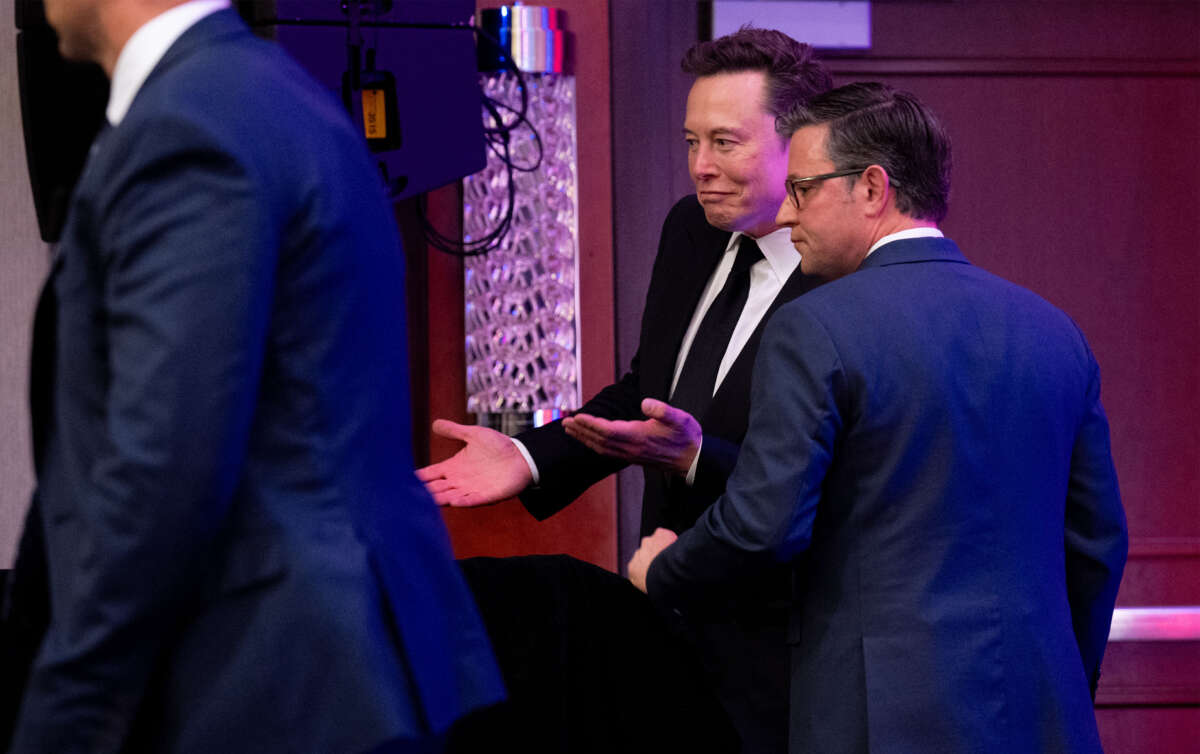
Speaker of the House Mike Johnson (right) tries to help Elon Musk (center) to a seat as he arrives with President-elect Donald Trump to a House Republicans Conference meeting at the Hyatt Regency on Capitol Hill on November 13, 2024, in Washington, D.C.Andrew Harnik / Getty Images


Independent journalism like Truthout has been struggling to survive for years – and it’s only going to get harder under Trump’s presidency. If you value progressive media, please make a year-end donation today.

At the behest of billionaire Elon Musk and president-elect Donald Trump, Republicans scrapped a bipartisan agreement to keep the government funded for the next three months on Wednesday, just two days ahead of a deadline for avoiding a shutdown.

Knowing he had to secure some votes from Democrats in the near-evenly split House of Representatives, Speaker of the House Mike Johnson (R-Louisiana) had crafted a continuing resolution that included raising the debt limit until March. Now that the bill has been shot down, it’s unclear whether a shutdown can be averted.

The bill included a number of Democratic Party demands, such as new regulations for health plan administrators, federal funds to rebuild the collapsed bridge in Baltimore, pay raises for members of Congress, and other provisions. The bill also included agreements to raise funding for responses to natural disasters by more than $110 billion, and $10 billion in additional aid to farmers across the U.S.

Upset with the continuing resolution heading for a vote later this week, Musk — who is set to lead the so-called Department of Government Efficiency (DOGE) within the Trump administration — spent most of Wednesday railing against the bill, publishing more than 100 posts on his social media site X calling for Republicans to oppose it.

Within those posts, Musk wrongly stated that Democrats were calling for a 40 percent increase in pay for lawmakers (when, in fact, the raise would have represented a 3.8 percent increase, the first raise for members of Congress since 2009); falsely claimed that the bill would block Republicans from being able to investigate the work of the January 6 committee; and wrongly asserted that the bill would force taxpayers to pay for a new NFL stadium in Washington, D.C. (The bill merely transfers management of an existing stadium to the district.)

Related Story

DOGE Heads Musk and Ramaswamy Signal Social Security Cuts Are Coming
Trump vowed to “not cut one penny” from Social Security, but his other statements and actions suggest that he plans to.
By Chris Walker , Truthout December 9, 2024


Musk also claimed that the government and the economy would “be fine” if there were to be a shutdown until Trump becomes president on January 20. Past shutdowns showcase how wrong he is — a shutdown crisis during Trump’s first term as president, for example, cost the U.S. economy $11 billion, and a month-long shutdown right now is likely to cost billions of dollars, too.

A lengthy shutdown could also make it harder for people living in the U.S. to access government services. National parks, museums and zoos could temporarily shutter, while other offices could have to shorten hours or close completely. Millions of federal workers would be laid off and others would have to continue working without pay. And while disbursements for Social Security, Medicare and Medicaid would continue, under a shutdown it’s possible that recipients of those benefits could see response delays if there are issues with their payments.

Following Musk’s tirade on X, Trump announced his opposition to the bill later that day, demanding that the entire legislation be renegotiated. “Republicans must GET SMART and TOUGH,” a joint statement from Trump and vice president-elect J.D. Vance read.

Some commentators have noted the timing of Trump’s opposition to the bill.

“Johnson probably wouldn’t be in this position if it weren’t for Musk, who spent all day Wednesday stoking rage on the right over Johnson’s deal. There was little evidence Trump cared much about the [continuing resolution] before that,” read an analysis from Politico’s daily “Playbook.”

That analysis continued:


The most prominent theory of what happened yesterday is this, per multiple Hill Republicans: Musk, as the anointed co-chair of the so-called Department of Government Efficiency panel, got waaay out over his spending-slashing skis and backed Trump into a corner.

Indeed, there are other indications that Trump wasn’t initially opposed to the bill’s passage, as he had privately urged Johnson to pass a continuing resolution right after he was elected president this year, to avoid any drama at the start of his term next month.

Perhaps trying to steer the spotlight back onto himself, Trump has now called for abolishing the debt ceiling, stating in a phone interview with NBC News that doing so would be the “smartest thing [Congress] could do,” and that he would “support that entirely.”

Trump also claimed that the debt ceiling “doesn’t mean anything, except psychologically” — demonstrating a deep lack of understanding regarding what the debt ceiling actually is.

Over the past decade, there have been several calls to eliminate the need to raise the debt ceiling through legislative decree, including by allowing the president to issue an executive order to raise the debt ceiling. But the debt ceiling, which is the amount the federal government is authorized to borrow in debt, would still exist if that were the case.

Ridding the U.S. of the debt ceiling entirely could feasibly lower the credit of the country, as happened after a different debt ceiling crisis in 2011. A significant change in the country’s credit rating could lead to a crisis of its own, in terms of the borrowing power of debt the U.S. could ask for from other countries.

Many Democratic lawmakers condemned Musk for his role in blocking the agreement, questioning who is actually set to be “president” of the next administration.

“You have to ask Donald Trump if Elon Musk is the one making decisions,” Sen. Jeanne Shaheen (D-New Hampshire) told HuffPost.

“It’s not Donald Trump asking for this. It’s very clearly President Elon Musk asking for this,” Rep. Daniel Goldman (D-New York) said on Bluesky.

Sen. Bernie Sanders (I-Vermont) also weighed in on the matter, noting that “the richest man on Earth, President Elon Musk,” was responsible for the bill being killed.

“Billionaires must not be allowed to run our government,” Sanders added.

Rep. Pramila Jayapal (D-Washington) echoed that sentiment, calling Musk a “shadow president.”

“It’s clear who’s in charge, and it’s not President-elect Donald Trump,” Jayapal wrote on social media.


'President Musk' Trends After Trump's Top Oligarch Torpedoes Federal Spending Deal

"Welcome to the Elon Musk presidency," wrote Democratic Rep. Robert Garcia.


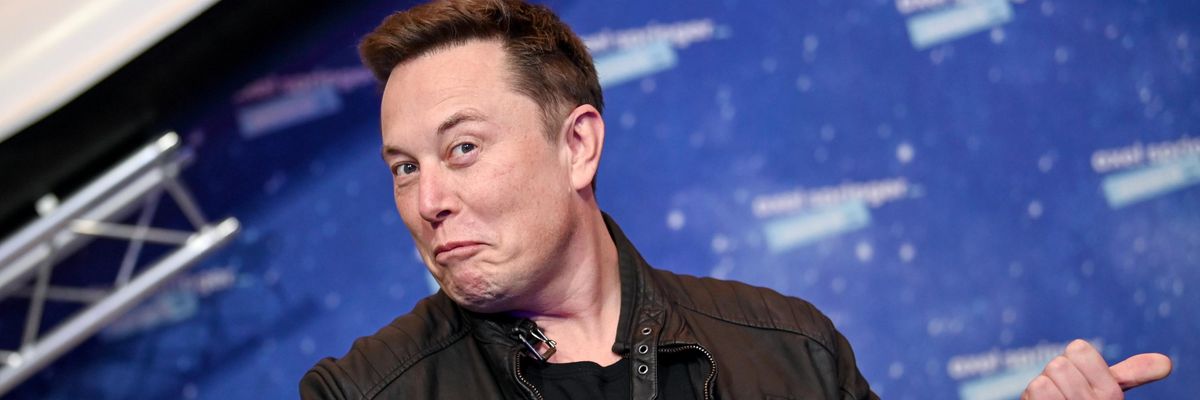
SpaceX owner and Tesla CEO Elon Musk poses on the red carpet of the Axel Springer Award ceremony  in Berlin, Germany.
(Photo: Britta Pedersen-Pool/Getty Images)


Eloise Goldsmith
Dec 19, 2024
COMMON DREAMS

Congress is careening toward a government shutdown after U.S. President-elect Trump, egged on by billionaire Elon Musk—who helped bankroll Trump's reelection campaign and is slated to help oversee cuts to government spending and regulation in the new administration—torpedoed a federal spending bill that would have kept the government open for the next few months.

The episode has drawn sharp rebuke from Democrats, and caused a number to muse whether it's Musk who's really in charge.

"The U.S. Congress this week came to an agreement to fund our government. Elon Musk, who became $200 BILLION richer since Trump was elected, objected. Are Republicans beholden to the American people? Or President Musk? This is oligarchy at work," wrote Sen. Bernie Sanders (I-Vt.) in a social media post late Wednesday.

During a Wednesday night appearance on MSNBC, Rep. Jasmine Crockett (D-Texas) called Musk "basically a shadow president."

These sorts of remarks continued Thursday, with Rep. Robert Garcia (D-Calif.) writing: "Welcome to the Elon Musk presidency, where Donald Trump is now clearly the vice president. They want a government shutdown that would hurt millions of Americans. It’s totally insane," wrote Rep. Robert Garcia (D-Calif.)

Former Secretary of Labor Robert Reich echoed this sentiment in an opinion piece for Common Dreams published Thursday, writing: "If this isn't oligarchy, I don't know what is. You may not get access to services you depend on just before the holidays because an unelected billionaire shadow president wanted it that way."

[Related: If Musk Blocking a Key Spending Bill Isn’t Oligarchy, I Don’t Know What Is ]

Trump and Vice President-elect JD Vance threw cold water on the spending bill Wednesday afternoon with a joint statement, arguing that the bill included "DEMOCRATIC GIVEAWAYS." The directive from Trump came after Musk spent much of Wednesday airing his opposition to the spending package on the platform X, which he owns. In total, Musk shot off over 150 posts demanding the members of the GOP back away from the spending bill, according to The New York Times.

The bipartisan spending package unveiled by House Speaker Mike Johnson (R-La.) on Tuesday would have funded the government at current levels through March 14, and also provided some $100 billion for disaster relief as well as $10 billion in economic relief for farmers.

In their statement denouncing the bill, Vance and Trump also called for an increase to the debt ceiling—adding the fraught issue of national debt, which currently stands at more than $36 trillion, into the debate. Trump also called for getting rid of the debt ceiling entirely, according to Thursday reporting from NBC News.

Sen. Chris Murphy (D-Conn.) said this of the debt ceiling demand: "Ha! Trump wants to lift the debt ceiling for one reason and one reason only—so he can borrow shitloads of money to afford his new giant tax break for billionaires and corporations. In other words, saddle regular Americans with mountains more debt so the rich can get richer."


'Delete CFPB': Elon Musk declares war on key regulatory agency


Elon Musk attends the America First Policy Institute (AFPI) gala at Mar-A-Lago in Palm Beach, Florida, U.S., November 14, 2024. REUTERS/Carlos Barria

November 28, 2024
ALTERNET

The Consumer Financial Protection Bureau (CFPB) came into existence when President Barack Obama signed into law the Dodd–Frank Wall Street Reform and Consumer Protection Act of 2010. One of the most aggressive proponents of the agency was now-Sen. Elizabeth Warren (D-Mass.), an Obama adviser who argued that aggressive regulation of Wall Street was badly needed in light of the financial crash of September 2008.

In 2010, the United States was still in a deep recession. The Great Recession was the country's worst financial crisis since the Great Depression of the 1930s, with the national unemployment rate averaging 9.6 percent that year (according to the U.S. Bureau of Labor Statistics).

During its 14-year history, the CFPB has had both defenders and detractors. Some conservatives and libertarians claim that the regulatory agency hobbles the markets; Warren, however, has maintained that the CFPB is a safeguard against devastating financial events like the crashes of 1929 and 2008.

READ MORE:What will Trump and GOP congress do to the Consumer Financial Protection Bureau?

In late 2024, the CFPB has a major foe in billionaire Elon Musk, CEO of Tesla, SpaceX and X (formerly Twitter). President-elect Donald Trump has picked Musk, along with MAGA businessman Vivek Ramaswamy, to head a proposed government agency that would be called the U.S. Department of Government Efficiency (DOGE)

On November 27, Musk tweeted, "Delete CFPB. There are too many duplicative regulatory agencies."

Forbes' Derek Saul reports, "Musk's post was in response to a recent podcast clip from Marc Andreessen, billionaire venture capitalist and fellow multimillion-dollar Trump donor, who said the CFPB's primary purpose is to 'terrorize financial institutions.' Yahoo Finance reporter Jordan Weissmann notes the CFPB shut down a portfolio company of Andreessen’s firm a16z in 2021."

The CFPB has also been a target of far-right Project 2025, the Heritage Foundation's highly controversial 920-page blueprint for a second Trump Administration. Project 2025 has called for Congress to abolish the agency.


READ MORE: Robert Reich: The last tariff increase 'ended up worsening the Great Depression'

But Warren remains an outspoken defender of the CFPB, recently telling the Washington Post, "The CFPB is here to stay…. There's big talk, but the laws supporting the CFPB are strong."

READ MORE: ''Rocketships to nowhere:' Not everyone on Team Trump is happy with 'co-president' Elon Musk

Read Forbes' full article at this link.
Elon Musk meets with UK far-right leader Nigel Farage


Tech billionaire Elon Musk's meeting with UK far-right firebrand Nigel Farage on Monday is fuelling concerns over a possible donation to the Reform UK party. Musk has already put his fortune and influence at the service of Donald Trump in the US and concerns are growing that he could seek to influence London's ties with Washington.


Issued on: 19/12/2024 
By: NEWS WIRES
FRANCE24

Concerns are growing in the UK that Tesla and SpaceX CEO Elon Musk is cosying up to hard-right firebrand UK lawmaker Nigel Farage. © Angela Weiss, AFP


Concerns are growing in the UK as tech billionaire Elon Musk takes an increasingly close interest in Britain's political scene, appearing to cosy up to hard-right firebrand lawmaker Nigel Farage.

With Musk named to a new position in the incoming US administration of Donald Trump, there are fears the world's richest man could seek to influence London's future ties with Washington.

On Wednesday, Farage, who leads the upstart anti-immigration Reform UK party, said he was in talks with Musk about making a donation to his party.

Writing in the Telegraph newspaper, Farage said "the issue of money was discussed" when he met the X owner at Trump's Mar-a-Lago resort in Florida on Monday.

"There will be ongoing negotiations on that score," the arch-Eurosceptic wrote, in comments that will likely unnerve the ruling Labour party and main Conservative opposition.

Newspaper reports have suggested that Musk is preparing to donate up to $100 million to Reform but Farage told the BBC the pair did not discuss figures.

Musk "described the Labour and Conservative parties as the uniparty, and left us in no doubt that he is right behind us", Farage added.

Farage said they would have to find a way to ensure any donation from Musk was made "legally through UK companies" but the idea which emerged a few weeks ago has already sent shivers down the spines of UK lawmakers.

Reform UK won five seats in the 650-seat UK parliament in July's general election, draining support from both Labour and the Tories.
'Police state'

Farage is already eyeing the next general elections, which have to be held by 2029 at the latest.

Nigel Farage, the leader of Britain's far right party Reform UK, is already eyeing the next UK general elections in 2029. © Benjamin Cremel, AFP

Conservative party co-chairman Dominic Johnson said any such donation by Musk would be "basically buying" one of the UK's political parties.

"People like Elon Musk, like Donald Trump, like Nigel Farage ... the sort of the new right, they really hate the old right" which is seen as having become too liberal, said Russell Foster, senior lecturer in British and International politics at King's College.

This old right "were not killed off by the left or centre. They're killed off because a more right-wing movement comes along".

So far, Musk has contented himself with taking aim at the Labour government of Prime Minister Keir Starmer, launching a series of searing comments on his social network X.

"The people of Britain have had enough of a tyrannical police state," he stormed in November.

At the height of this summer's anti-immigrant riots -- the UK's worst unrest in years -- Musk wrote in X that "civil war is inevitable" and accused the government of dealing with the rioters too harshly.

It won him support among UK social network users and influencers on the far-right.

Musk also advised people in September not to visit the UK when "they're releasing convicted pedophiles in order to imprison people for social media posts".

"He appears to believe that he is on some sort of a mission against the establishment," said Foster.
Pragmatism

Some observers believe Musk is also up in arms about UK government plans to toughen legislation regulating social networks.

Former US president Donald Trump dubbed Nigel Farage 'Mr Brexit'.
 © Andy Wigmore, UKIP, AFP

Starmer said the riots had been fuelled by online content and later did not invite Musk to an investors' conference -- something the SpaceX and Tesla CEO had taken as an insult, sources close to him said.

Since the US presidential elections, Musk and Trump have become inseparable, and their "bromance" could complicate Labour's efforts to boost its ties with the Republicans.

Labour has historically been closer to the Democrats but Starmer, who met Trump in New York in September, has been seeking to open a new chapter in the party's relations with Republicans.

"The prime minister looks forward to working with President Trump and his whole team, including Elon Musk," a Downing Street spokesman said last month.

"Starmer is very aware that he can't alienate the incoming US president," said Foster.

"We think that we have to maintain that special relationship. So it doesn't matter who's in the White House, we're always going to be nice towards Washington."

Labour politician and former cabinet minister Peter Mandelson said it would be "unwise" for the UK to ignore Musk, calling on the Labour party to "swallow your pride."

He described Farage as a "bridgehead, both to President Trump and to Elon Musk and others. You've got to be pragmatic, practical about this".

(AFP)

Musk’s possible meddling in UK politics stirs concern


By AFP
December 18, 2024

Concerns are growing in the UK that Tesla and SpaceX CEO Elon Musk is cosying up to hard-right firebrand UK lawmaker Nigel Farage - Copyright AFP ANGELA WEISS
Marie HEUCLIN

Concerns are growing in the UK as tech billionaire Elon Musk takes an increasingly close interest in Britain’s political scene, appearing to cosy up to hard-right firebrand lawmaker Nigel Farage.

With Musk named to a new position in the incoming US administration of Donald Trump, there are fears the world’s richest man could seek to influence London’s future ties with Washington.

On Wednesday, Farage, who leads the upstart anti-immigration Reform UK party, said he was in talks with Musk about making a donation to his party.

Writing in the Telegraph newspaper, Farage said “the issue of money was discussed” when he met the X owner at Trump’s Mar-a-Lago resort in Florida on Monday.

“There will be ongoing negotiations on that score,” the arch-Eurosceptic wrote, in comments that will likely unnerve the ruling Labour party and main Conservative opposition.

Newspaper reports have suggested that Musk is preparing to donate up to $100 million to Reform but Farage told the BBC the pair did not discuss figures.

Musk “described the Labour and Conservative parties as the uniparty, and left us in no doubt that he is right behind us”, Farage added.

Farage said they would have to find a way to ensure any donation from Musk was made “legally through UK companies” but the idea which emerged a few weeks ago has already sent shivers down the spines of UK lawmakers.

Reform UK won five seats in the 650-seat UK parliament in July’s general election, draining support from both Labour and the Tories.

– ‘Police state’ –

Farage is already eyeing the next general elections, which have to be held by 2029 at the latest.

Conservative party co-chairman Dominic Johnson said any such donation by Musk would be “basically buying” one of the UK’s political parties.

“People like Elon Musk, like Donald Trump, like Nigel Farage … the sort of the new right, they really hate the old right” which is seen as having become too liberal, said Russell Foster, senior lecturer in British and International politics at King’s College.

This old right “were not killed off by the left or centre. They’re killed off because a more right-wing movement comes along”.

So far, Musk has contented himself with taking aim at the Labour government of Prime Minister Keir Starmer, launching a series of searing comments on his social network X.

“The people of Britain have had enough of a tyrannical police state,” he stormed in November.

At the height of this summer’s anti-immigrant riots — the UK’s worst unrest in years — Musk wrote in X that “civil war is inevitable” and accused the government of dealing with the rioters too harshly.

It won him support among UK social network users and influencers on the far-right.

Musk also advised people in September not to visit the UK when “they’re releasing convicted pedophiles in order to imprison people for social media posts”.

“He appears to believe that he is on some sort of a mission against the establishment,” said Foster.

– Pragmatism –

Some observers believe Musk is also up in arms about UK government plans to toughen legislation regulating social networks.

Starmer said the riots had been fuelled by online content and later did not invite Musk to an investors’ conference — something the SpaceX and Tesla CEO had taken as an insult, sources close to him said.

Since the US presidential elections, Musk and Trump have become inseparable, and their “bromance” could complicate Labour’s efforts to boost its ties with the Republicans.

Labour has historically been closer to the Democrats but Starmer, who met Trump in New York in September, has been seeking to open a new chapter in the party’s relations with Republicans.

“The prime minister looks forward to working with President Trump and his whole team, including Elon Musk,” a Downing Street spokesman said last month.

“Starmer is very aware that he can’t alienate the incoming US president,” said Foster.

“We think that we have to maintain that special relationship. So it doesn’t matter who’s in the White House, we’re always going to be nice towards Washington.”

Labour politician and former cabinet minister Peter Mandelson said it would be “unwise” for the UK to ignore Musk, calling on the Labour party to “swallow your pride.”

He described Farage as a “bridgehead, both to President Trump and to Elon Musk and others. You’ve got to be pragmatic, practical about this”.