Monday, February 03, 2025

How climate change could  WILL
upend the American Dream


REUTERS/Mario Anzuoni
Kay Young, a homeowner whose house was destroyed after the Eaton Fire tore through a neighborhood, looks on, while a pair of massive wildfires menacing Los Angeles from the east and west were still burning uncontained, in Altadena, California, U.S. January 9, 2025.

February 03, 2025

Houses in the Altadena and Pacific Palisades neighborhoods were still ablaze when talk turned to the cost of the Los Angeles firestorms and who would pay for it. Now it appears that the total damage and economic loss could be more than $250 billion. This, after a year in which hurricanes Milton and Helene and other extreme weather events had already exacted tens of billions of dollars in American disaster losses.

As the compounding impacts of climate-driven disasters take effect, we are seeing home insurance prices spike around the country, pushing up the costs of owning a home. In some cases, insurance companies are pulling out of towns altogether. And in others, people are beginning to move away.

One little-discussed result is that soaring home prices in the United States may have peaked in the places most at risk, leaving the nation on the precipice of a generational decline. That’s the finding of a new analysis by the First Street Foundation, a research firm that studies climate threats to housing and provides some of the best climate adaptation data available, both freely and commercially. The analysis predicts an extraordinary reversal in housing fortunes for Americans — nearly $1.5 trillion in asset losses over the next 30 years.

The implications are staggering: Many Americans could face a paradigm shift in the way they save and how they define their economic security. Climate change is upending the basic assumption that Americans can continue to build wealth and financial security by owning their own home. In a sense, it is upending the American dream.

Homeownership is the bedrock of America’s economy. Residential real estate in the United States is worth nearly $50 trillion — almost double the size of the entire gross domestic product. Almost two-thirds of American adults are homeowners, and the median house here has appreciated more than 58% over the past two decades, even after accounting for inflation. In Pacific Palisades and Altadena, that evolution elevated many residents into the upper middle class. Across the country homes are the largest asset for most families — who hold approximately 67% of their savings in their primary residence.

That is an awful lot to lose: for individuals, and for the nation’s economy.

The First Street researchers found that climate pressures are the main factor driving up insurance costs. Average premiums have risen 31% across the country since 2019, and are steeper in high-risk climate zones. Over the next 30 years, if insurance prices are unhindered, they will, on average, leap an additional 29%, according to First Street. Rates in Miami could quadruple. In Sacramento, California, they could double.

And that’s where the systemic economic risk comes in. Not long ago, insurance premiums were a modest cost of owning a home, amounting to about 8% of an average mortgage payment. But insurance costs today are about one-fifth the size of a typical payment, outpacing inflation and even the rate of appreciation on the homes themselves. That makes owning property, on paper anyway, a bad investment. First Street forecasts that three decades from now — the term of the classic American mortgage — houses will be worth, on average, 6% less than they are today. They project that decline across the vast majority of the nation, affirming fears that many economists and climate analysts have held for a long time.

Part of the problem is that many people were coaxed into living in the very high-risk areas they call home precisely by the availability of insurance that was cheaper than it should have been. For years, as climate-driven floods, hurricanes and wildfires have piled up, so have economic losses. Insurance companies canceled policies, but in response, states redoubled support for homeowners, promising economic stability even if that insurance — required by most mortgage lenders — one day disappeared. It kept costs manageable and quelled anxiety, and economies continued to hum.

But those discounts “muffled the free market price signals,” according to Matthew Kahn, an economist at the University of Southern California who studies markets and climate change. They also “slowed down our adaptation,” making dangerous places like Florida’s coastlines and California’s fire-prone hillsides seem safer than they are. First Street found that today, insurance underprices climate risk for 39 million properties across the continental United States — meaning that for 27% of properties in the country, premiums are too low to cover their climate exposure.

No wonder costs are rising. Insurers are playing catch-up. But it means Americans are playing catch-up, too, in terms of evaluating where they live. And that leads to the potential for large numbers of people to begin to move. First Street, in fact, correlates the rise in insurance rates and dropping property values with widespread climate migration, predicting that more than 55 million Americans will migrate in response to climate risks inside this country within the next three decades, and that more than 5 million Americans will migrate this year. First Street’s analysts posit that climate risk is becoming just as important as schools and waterfront views when people purchase a home, and that while property values are likely to drop in most places, they will rise — by more than 10% by midcentury — in the safer regions.

There are many reasons to be cautious about these projections. Precise estimates for climate migration in the United States have remained elusive in large part because modeling for human behavior in all its diverse motives is nearly impossible. First Street’s economic models also don’t capture the immense equity many Americans have accumulated in those properties as home values have lurched upward over the past two decades, equity that gives many people a cushion larger than the relatively modest projected losses. The models assume that all the past patterns of reckless building and zoning will continue, and they don’t account for the nation’s housing shortage, nor the difference between longtime homeowners and a new generation trying to buy now.

However imprecise, First Street’s work “plays the role of Paul Revere, of the challenge we could face if we fail to adapt,” Kahn said. Climate-driven costs and climate risk may drive sweeping change in both homeownership and migration, at the same time that both of those factors are expected to continue to increase.

It means that homeowners will need to be far wealthier, or renters will have to pay much more. Like many aspects of the climate challenge, this one will also drive climate haves and have-nots further apart, especially as relatively safe regions emerge, and discerning buyers flock to their appreciating real estate markets.

No one is abandoning Los Angeles. Its wealth, density and government support make it far more resilient than places like Paradise, California, the New Jersey shore or Florida. But it will be economically and physically transformed. Pacific Palisades will probably be rebuilt to its past splendor: Its homeowners can afford it. Altadena, a middle-class neighborhood, may face a different fate: Its properties are more likely to be snatched up by investors, gentrified and made unaffordable by both the cost of rebuilding, insurance and upscaling of new homes as they are rebuilt.

In that way, Altadena may prove to be the true harbinger — of a future in which no one but the rich owns their own homes, where insurance is a luxury good and where renters pay a monthly toll to large private equity landowners who may be better suited to manage that risk.
Trump’s tariffs won't solve America’s fentanyl crisis — here's why


REUTERS/Andrew Kelly/File Photo
Pills are seen pressed from a pill press at Reuters' office in New York City, U.S., 


February 02, 2025


Americans consume more illicit drugs per capita than anyone else in the world; about 6% of the U.S. population uses them regularly.


One such drug, fentanyl – a synthetic opioid that’s 50 to 100 times more potent than morphine – is the leading reason U.S. overdose deaths have surged in recent years. While the rate of fentanyl overdose deaths has dipped a bit recently, it’s still vastly higher than it was just five years ago.

Ending the fentanyl crisis won’t be easy. The U.S. has an addiction problem that spans decades – long predating the rise of fentanyl – and countless attempts to regulate, legislate and incarcerate have done little to reduce drug consumption. Meanwhile, the opioid crisis alone costs Americans tens of billions of dollars each year.

With past policies having failed to curb fentanyl deaths, President Donald Trump is turning to another tool to fight America’s drug problem: trade policy.

During his presidential campaign, Trump pledged to impose tariffs on Canada and Mexico if they didn’t halt the flow of drugs across U.S. borders, and on China if it didn’t do more to crack down on the production of chemicals used to make fentanyl. Trump reiterated his plan on his first day back in office, and on Feb. 1, he made good on that threat, imposing tariffs on all three counties and citing fentanyl as a key reason.

Speaking as a professor who studies social policy, I think both fentanyl and the proposed import taxes represent significant threats to the U.S. While the human toll of fentanyl is undeniable, the real question is whether tariffs will work – or worsen what’s already a crisis.

Fentanyl: The ‘single greatest challenge’


In 2021, more than 107,000 Americans died from overdoses – the most ever recorded – and nearly seven out of 10 deaths involved fentanyl or similar synthetic opioids. In 2022, fentanyl was killing an average of 200 people each day. And while fentanyl deaths declined slightly in 2023, nearly 75,000 Americans still died from synthetic opioids that year. In March of that year – the most recent for which full-year data on overdose deaths is available – the then-secretary of homeland security declared fentanyl to be “the single greatest challenge we face as a country.”

But history shows that government efforts to curb drug use often have little success.

The first real attempt to regulate drugs in the U.S. occurred in 1890, when, amid rampant drug abuse, Congress enacted a law taxing morphine and opium. In the years that followed, cocaine use skyrocketed, rising 700% between 1890 and 1902. Cocaine was so popular, it was even found in drinks such as Coca-Cola, from which it got its name.

This was followed by a 1909 act banning the smoking of opium, and, in 1937, the “Marihuana Tax Act.” The most comprehensive package of laws was instituted with the Controlled Substances Act of 1970, which classified drugs into five categories based on their medical uses and potential for abuse or dependence. A year later, then-President Richard Nixon launched the “War on Drugs” and declared drug abuse as “public enemy No. 1.” And in 1986, Congress passed the Anti-Drug Abuse Act, directing US$1.7 billion for drug enforcement and control. President Richard Nixon declared drug abuse “Public enemy No. 1” at this 1971 press conference.

These policies have generally failed to curb drug supply and use, while also causing significant harm to people and communities of color. For example, between 1980 and 1997, the number of incarcerations for nonviolent drug offenses went from 50,000 to 400,000. But these policies hardly put a dent in consumption. The share of high school seniors using drugs dipped only slightly over the same period, from 65% in 1980 to 58% in 1997.

In short, past U.S. efforts to reduce illegal drug use haven’t been especially effective. Now, it looks like the U.S. is shifting toward using tariffs – but research suggests that those will not lead to better outcomes either, and could actually cause considerable harm.

Why tariffs won’t work

America’s experiments with tariffs can be traced back to the founding era with the passage of the Tariff Act of 1789. This long history has shown that tariffs, industrial subsidies and protectionist policies don’t do much to stimulate broad economic growth at home – but they raise prices for consumers and can even lead to global economic instability. History also shows that tariffs don’t work especially well as negotiating tools, failing to effect significant policy changes in target countries. Economists generally agree that the costs of tariffs outweigh the benefits.

Over the course of Trump’s first term, the average effective tariff rate on Chinese imports went from 3% to 11%. But while imports from China fell slightly, the overall trade relationship didn’t change much: China remains the second-largest supplier of goods to the U.S.

The tariffs did have some benefit – for Vietnam and other nearby countries with relatively low labor costs. Essentially, the tariffs on China caused production to shift, with global companies investing billions of dollars in competitor nations.

This isn’t the first time Trump has used trade policy to pressure China on fentanyl – he did so in his first term. But while China made some policy changes in response, such as adding fentanyl to its controlled substances list in 2019, fentanyl deaths in the U.S. continued to rise. Currently, China still ranks as the No. 1 producer of fentanyl precursors, or chemicals used to produce illicit fentanyl. And there are others in the business: India, over that same period, has become a major producer of fentanyl.

A question of supply and demand


Drugs have been pervasive throughout U.S. history. And when you investigate this history and look at how other nations are dealing with this problem rather than criminalization, the Swiss and French have approached it as an addiction problem that could be treated. They realized that demand is what fuels the illicit market. And as any economist will tell you, supply will find a way if you don’t limit the demand. That’s why treatment works and bans don’t.

The U.S. government’s ability to control the production of these drugs is limited at best. The problem is that new chemical products will continually be produced. Essentially, failure to restrict demand only places bandages on hemorrhaging wounds. What the U.S. needs is a more systematic approach to deal with the demand that’s fueling the drug crisis.

This article was updated to include details of the tariffs once they were imposed.

Rodney Coates, Professor of Critical Race and Ethnic Studies, Miami University

This article is republished from The Conversation under a Creative Commons license. Read the original article.
Even Those Who Believe Tariffs Are Useful Think Trump's Trade War Makes 'Zero Sense'

One economist warned the tariffs would amount to the "largest tax increase... that has ever been imposed" on working-class families.


A truck drives into the United States at the Otay Mesa Port of Entry on the U.S.-Mexico border on February 1, 2025 in San Diego, California.
(Photo: Apu Gomes/Getty Images)

Jake Johnson
Feb 03, 2025
COMMON DREAMS

The trade war that U.S. President Donald Trump launched over the weekend by announcing sweeping new tariffs on imports from Canada, Mexico, and China drew intense criticism from experts and analysts across the ideological spectrum, including those who believe strategically deployed tariffs can help protect domestic jobs and workers.

"Tariffs are a powerful, effective tool to deliver certain goals. But Trump's Canada/China/Mexico tariffs make zero sense. And even undermine tariffs' legit uses," Lori Wallach, director of the Rethink Trade program at the American Economic Liberties Project, wrote on social media late Sunday, expressing agreement with United Auto Workers president Shawn Fain.

Fain said in a statement that the UAW "supports aggressive tariff action to protect American manufacturing jobs as a good first step to undoing decades of anti-worker trade policy," pointing specifically to the North American Free Trade Agreement (NAFTA) and its successor agreement that Trump negotiated during his first White House term.

The union does not, however, "support using factory workers as pawns in a fight over immigration or drug policy," Fain continued. "The national emergency we face is not about drugs or immigration, but about a working class that has fallen behind for generations while corporate America exploits workers abroad and consumers at home for massive Wall Street paydays."


The officially stated purpose for Trump's 25% tariffs on Canadian and Mexican imports and 10% tariffs on Chinese imports is to confront what the White House described as the "extraordinary threat" posed by the movement of migrants and drugs across the southern and northern U.S. borders.

But Wallach argued Sunday that using tariffs to address immigration and the flow of drugs "is like trying surgery using a saxophone—wrong tool!"

"After decades of an American trade policy run by and for the largest corporations and to the detriment of American workers, independent farmers, and small businesses, we certainly do need a new approach," she added. "But simply imposing 25% tariffs on Mexico and Canada and another 10% on China will not rebuild American manufacturing/create U.S. manufacturing jobs or raise wages. Particularly, if such tariffs can be axed, lowered, or upped at the president's whim for reasons unrelated to trade/jobs."

"While tariffs can play a constructive role in protecting U.S. jobs and enforcing labor and environmental standards when part of a strategic industrial policy, Trump's approach is neither strategic nor appropriate."

Trump told reporters late last week that he is "not looking for a concession" in response to the new tariffs, which prompted swift retaliation from Canada, Mexico, and China.

The announced tariffs, which are set to take effect on Tuesday, also shook U.S. and global equity markets as Trump threatened additional duties against imports from European Union nations and admitted Americans could experience "some pain" stemming from the trade war. Mexican President Claudia Sheinbaum said Monday that her country reached an agreement with Trump to delay implementation of the tariffs on Mexican imports for a month, reportedly in exchange for the deployment of 10,000 Mexican soldiers to the country's northern border.

Contrary to Trump's insistence that tariffs are paid by targeted nations, they are in fact paid by U.S. importers, who then either eat the costs or pass them on to consumers through higher prices. Economist Dean Baker noted that the new tariffs amount to "a tax increase of roughly $200 billion a year ($1,600 per family) that will overwhelmingly be paid by moderate-income and middle-income families."

"It is the largest tax increase on them that has ever been imposed," Baker wrote Sunday. "And retaliation from both countries is likely to impose additional costs."

Melinda St. Louis, Global Trade Watch director at the consumer advocacy group Public Citizen, said in a statement that "no matter the intractable problem, Trump's go-to playbook is to bully our neighbors through tariffs and to scapegoat immigrants."

"Instead of addressing the actual causes or seeking real solutions to the complex public health crisis surrounding fentanyl, Trump jumps to impose damaging and self-defeating across-the-board tariffs and to spout more hateful rhetoric that dehumanizes our immigrant neighbors," said St. Louis. "While tariffs can play a constructive role in protecting U.S. jobs and enforcing labor and environmental standards when part of a strategic industrial policy, Trump's approach is neither strategic nor appropriate."

"Using tariffs to bully countries to advance an anti-immigrant and anti-humanitarian agenda will do nothing to support U.S. workers and will make our immigrant neighbors less safe," she added.

The tariffs also drew backlash from the right-wing Wall Street Journaleditorial board, which slammed the president for launching "the dumbest trade war in history."

"Bad policy has damaging consequences," the editorial board wrote late Sunday, "whether or not Mr. Trump chooses to admit it."
'Big government populist demagogue': Right-wingers slam Trump tariffs as markets plummet


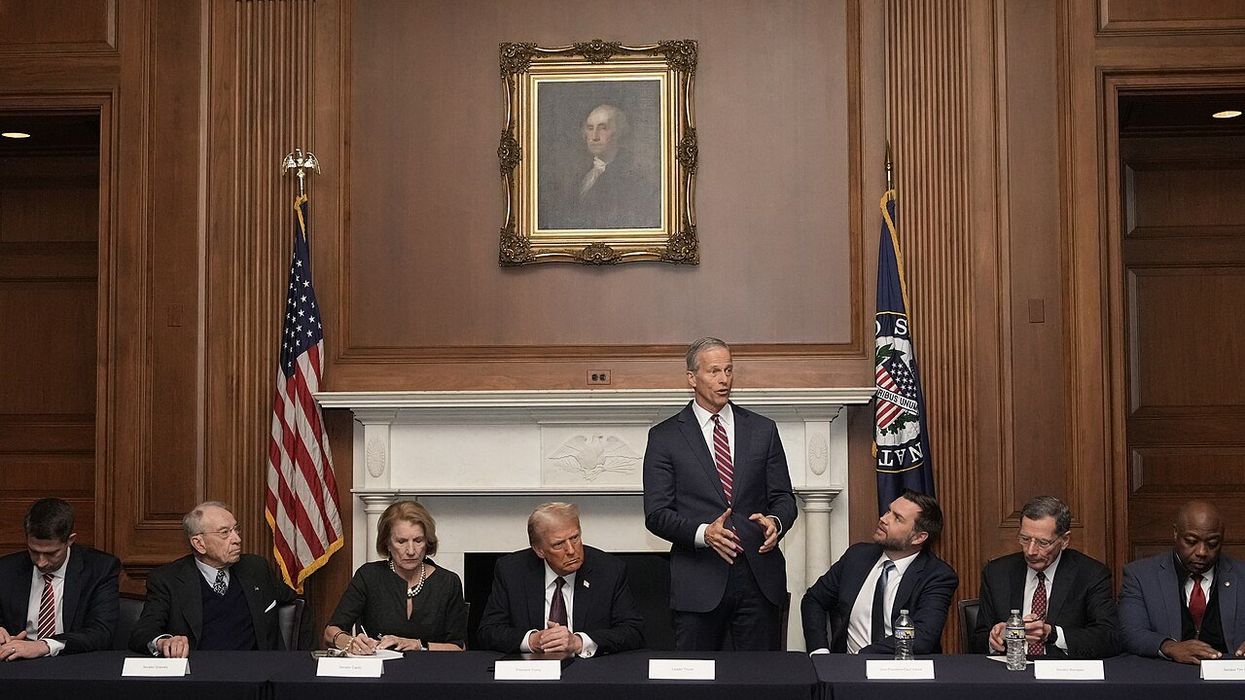
Donald Trump with Senate Majority Leader John Thune, Sen. Chuck Grassley, JD Vance and others on January 8, 2025 (Wikimedia Commons)

ALTERNET
February 03, 2025

Opponents of President Donald Trump's tariff proposals were hoping that he would change his mind. But on Saturday, February 1, Trump, via executive order, imposed across-the-board tariffs of 25 percent on all goods entering the United States from Canada and Mexico. And for goods coming from Mainland China, Trump imposed a ten percent tariff.

Canadian and Mexican officials responded with a combination of anger and disappointment, saying that they felt like a close ally had just slapped them in the face. Canada, in response, is promising a 25 percent tariff on U.S. goods, although Mexican President Claudia Sheinbaun tweeted that Trump is agreeing to a one-month pause on the tariff for Mexican goods coming into the U.S.

The stock market also had a quick response to the tariffs, and futures declined.

READ MORE: Donald Trump’s tariff wallop demonstrates the brute power of an imperial presidency

On X, formerly Twitter, Reuters observed, "Investors sold stocks and bought dollars as Trump imposed new tariffs on Mexico, Canada, and China, affecting $1.3 trillion in trade. Markets tumbled, with Japan's Nikkei down 3% and European car stocks plunging. Retaliatory tariffs loom."

X is full of reactions from the financial world. Christopher M. Brigati of SWBC Investment Services tweeted, "The market reacted sharply to Trump’s weekend trade tariff imposition and resulting reactions from both Canada and Mexico and resulting threats in-kind from their respective governments. Furthermore, he warned European Union counterparts that tariffs 'will definitely happen…. Concerns about negative implications to US economic growth pushed stocks lower.'"

Conservatives have a lot to say about the tariffs and their effect on the stock market, from ultra-MAGA defenders to scathing critics.

The conservative Republicans Against Trump noted, "Pierre Poilievre, leader of Canada’s Conservative Party, condemns Trump's tariffs and declares."

Former Arkansas Gov. Asa Hutchinson, a Republican, complained, "Trump wants to put a ring around America. A …. tariff on Canada, Great Britain… that hurts our consumers. That's not conservative. His spending is not conservative."

Chris Vance, a former GOP lawmaker, posted, "Trump is slapping massive new tariffs on our major trading partners, which will spike inflation and start a global trade war. Trump is not a conservative; he is a big government populist demagogue. He is the anti-Reagan."

Former Rep. Joe Walsh (R-Illinois) posted, "If Republicans now think tariffs (tax increases on Americans) are such a good thing, why are they all begging Trump to exempt certain industries & companies from his wonderful tariffs?"

Politico's Meredith Lee Hill noted Farm Bureau's negative reaction to the tariffs, also pointing out, "Some Trump officials said Sunday there still may be a resolution before tariffs hit Tuesday. Senate Majority Leader John Thune and farm state Republicans know what a trade war will do to their home states. Farmers there are still reeling from 2018."

But Trump defender Mark Wlosinski argued that Trump's critics were overreacting to the tariffs.

Wlosinski, posting a chart, tweeted, "I remember when Trump put tariffs on China in 2018 and started the first trade war. Everyone said that it would cause the stock market to crash and bring on a nasty recession. See that tiny dip circled in red? That was the 'devastating crash' everyone was worried about."


Another Trump defender, John Delano, was angry with the conservative Wall Street Journal's editorial board for criticizing the tariffs.

Delano tweeted, "@WSJ has chosen to ignore the hundreds of thousands of Americans killed and trafficked by Democrats open borders and Mexico and Canada’s refusal to work with President Trump to ensure America’s safety. Despicable."

The ultra-MAGA Austin Conservative defended the tariffs as well, posting, "Justin Trudeau crying to his libtard friends about Trump’s tariffs. First it was Colombia and now it’s Canada about to FAFO!"

Rik Schneider, a blogger for The New Democrat, noted what right-wing Fox Business host Charles Payne has to say about tariffs. Schneider posted, " Hearing FOX Business anchor Charles Payne talk about Donald Trump's tariffs, you would think he was reading off some script that was written for him by Robert Reich, or some other left-wing economist."
Donald Trump’s tariff wallop demonstrates the brute power of an imperial presidency


February 03, 2025


As promised, United States President Donald Trump has imposed punishing tariffs on all exports from Canada and Mexico, leading to retaliatory tariffs from Canada.


Canada’s closest ally has torn up the Canada-U.S.-Mexico trade deal negotiated only seven years ago. The rationale behind what the Wall Street Journal editorial board has called “the dumbest trade war in history” isn’t even clear.

The pessimistic view is that if Canada doesn’t give Trump everything he wants, he will bulldoze the country with more tariffs, sanctions on banks, enhanced border inspections and even a travel ban — everything he recently threatened to do to Colombia.

Canada’s political class is scrambling because the U.S. has long been a cultural sibling and an economic partner. But now it is toxic, threatening and untrustworthy. Will Canada sign another trade deal with Trump in office? The chances recede the longer the tariffs remain in place.
Iron-fisted

It’s never been more clear that Trump is obsessive, seldom a bluffer and always iron-fisted. He seems to have planned and executed this tariff bomb to cause maximum pain and chaos. Now he says the European Union is next on his list.

Trump is counting on his new majorities in U.S. Congress to ram through his radical right populist agenda, forcing other countries to play a role in his melodrama.

In response to Trump’s charge that the U.S. subsidizes Canadian trade, former Conservative prime minister Stephen Harper pointed out that half of America’s imported oil comes from Canada, and its price is significantly discounted due to a lack of pipeline capacity. “It’s actually Canada that subsidizes the United States in this regard,” Harper said.

Nevertheless, Trump’s preferred foreign policy tactic is to hit first with economic sanctions and negotiate later. With his near total grip on U.S. government, he can now achieve all his aims through tariffs.
The imperial presidency

Trump’s vision for his imperial presidency is organized around an old idea: the revenue tariff. Before income taxes, border tariffs were the primary source of income for government. But back then, government did a lot less.

For example, America’s 19th-century navy of wooden sailing ships was purchased with tariffs. But it would be impossible to fund modern-day health care, student loans and $13 billion aircraft carriers with tariff revenues.

A recent study by the Peterson Institute for International Economics shows the math doesn’t add up. Tariffs are levied on imported goods and are worth about US$3 trillion. American income tax is levied on incomes and are worth more than US$20 trillion. Government would have to be much smaller, and tariffs would have to be so high they would choke American trade, for tariffs to make economic sense.

And yet Trump has a broad mandate. In the summer of 2024, the U.S. Supreme Court ruled in Trump v. United States that presidents require a broadly defined “presumptive immunity from prosecution for … official acts.”

This decision has given Trump the legal clout to force the entire federal government to answer to the president himself.
War against democracy

Trump is using his vast new mandate to wage multiple wars simultaneously. These wars against the guardrails of liberal democracy require the punishment of his enemies inside his own party.

Republicans who have voted against Trump legislation during his first term faced high-profile challenges in the primaries as he funded their opponents. Today, the war is waged against those who are insufficiently loyal, including the highest ranks of the Coast Guard and the FBI.

The war against the administrative state involves the mass firing of independent inspectors, federal lawyers and thousands of civil servants to be replaced by foot soldiers personally loyal to the leader.

The Trump administration has sent out “deferred resignation” notices that invite the entire civil service to resign. This is the tactic Trump’s key adviser, Elon Musk, implemented at X, and it suggests a wave of firings will soon begin.
Nonsensical trade war

The trade war against Canada and Mexico is peculiar because neither country has expressed any willingness to abolish the United States-Mexico-Canada Agreement, which is among the achievements of Trump’s first administration.

Nevertheless, the paranoid Trump seems to be convinced that he got a raw deal in 2018, and so he wants to scrap the whole treaty and negotiate something tougher that brings more jobs home.

In 2024, the cars that were ranked most “American” in terms of their content and final assembly were made by Tesla, Honda and Volkswagen. By comparison, the best-selling the Dodge Ram 1500 pickup truck ranked No. 43 on the list. What Trump considers American and non-American isn’t clear, even to voters.

A new Bank of Canada forecast predicts that American tariffs may reduce Canadian GDP by six per cent. The federal government is planning an enormous bailout package to compensate for widespread job losses like the one offered to businesses and individuals during the pandemic.

Unsurprisingly, Trump divides Canada’s leadership. Alberta and Saskatchewan have publicly criticized the Team Canada approach. Alberta Premier Danielle Smith refused to sign the joint federal/provincial statement and played to her secessionist base.

Even so, former Alberta premier Jason Kenney recognizes the peril, arguing that Alberta needs to “be prepared to retaliate … we can’t be wusses about this; we have to have a spine.”
What’s next?

Canada is an export-led economy based on natural resources. Its strength lies not in refusing to buy California wine or Florida orange juice. Its main sources of leverage are oil and gas, potash and uranium, rare earth minerals, timber products and hydroelectric power. But of all these, oil, uranium, and hydro-electric power are Canada’s biggest guns.

It’s not yet clear how effective the Canadian government’s strategy will be. Previous rounds of retaliation after the steel and aluminum tariffs in Trump’s first term did not drive him to the negotiating table. It’s also unclear what the CEOs of Canada’s branch-plant multinational corporations will do when their loyalties are divided between Trump and Canada.

Furthermore, it’s anyone’s guess how much the dissent of western Canadian premiers has hurt Canada’s case with Trump. Certainly, his preferred tactic is to divide and conquer.

Finally, it’s unclear if Ontario Premier Doug Ford’s “Captain Canada” approach will earn the respect or disdain of Republicans — although, ultimately, it doesn’t matter what the rest of the American political class thinks because Trump and his inner circle are calling all the shots.

In practical terms, there is little Canada can do to address the false accusations that it’s complicit in the illicit drug trade and in migrants crossing the border into the U.S. Facts don’t matter to Trump. He will eventually come up with a demand, and if Canada doesn’t give in, he will ramp up the economic pain.

Welcome to the post-liberal world order.

Daniel Drache, Professor Emeritus, Department of Politics, York University, Canada and Marc D. Froese, Professor of Political Science and Founding Director, International Studies Program, Burman University

This article is republished from The Conversation under a Creative Commons license. Read the original article.
'Congratulations, America!' Trump mocked over his response to WSJ’s scathing tariff rebuke


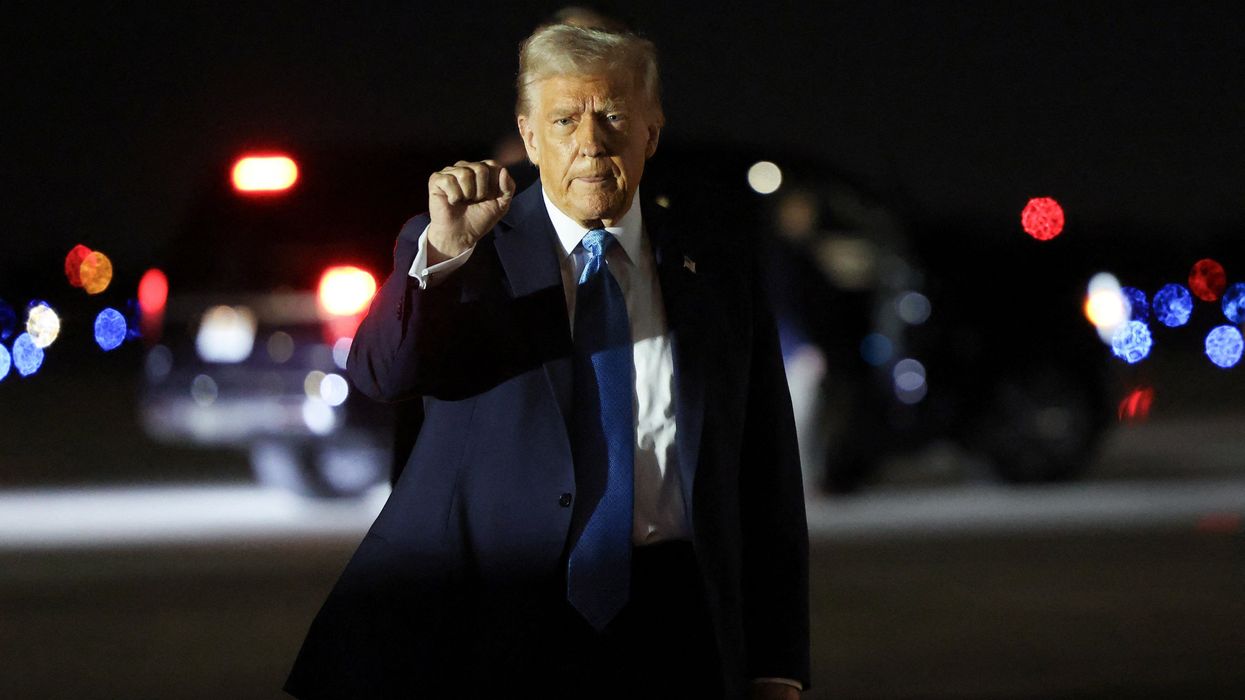
U.S. President Donald Trump pumps his fist upon his arrival in West Palm Beach, Florida, U.S., January 31, 2025. REUTERS/Kevin Lamarque
ALTERNET
February 02, 2025


President Donald Trump early Sunday morning responded to a scathing rebuke from the conservative leaning Wall Street Journal over the MAGA leader's decision to impose 25 percent tariffs on Canada and Mexico.

Criticizing the president's move, the newspaper's editorial board on Friday, January 31, published an op-ed titled, "The Dumbest Trade War in History."

Trump took to social media to shoot back at the board, suggesting that the result of the tariffs will inflict "pain" on Americans.

READ MORE: 'Trump is squandering this resource' with his 'hard power' approach to foreign policy: analysis

"The 'Tariff Lobby,' headed by the Globalist, and always wrong, Wall Street Journal, is working hard to justify Countries like Canada, Mexico, China, and too many others to name, continue the decades long RIPOFF OF AMERICA, both with regard to TRADE, CRIME, AND POISONOUS DRUGS that are allowed to so freely flow into AMERICA," the president began. "THOSE DAYS ARE OVER! The USA has major deficits with Canada, Mexico, and China (and almost all countries!), owes 36 Trillion Dollars, and we’re not going to be the 'Stupid Country' any longer."

Trump continued, "MAKE YOUR PRODUCT IN THE USA AND THERE ARE NO TARIFFS! Why should the United States lose TRILLIONS OF DOLLARS IN SUBSIDIZING OTHER COUNTRIES, and why should these other countries pay a small fraction of the cost of what USA citizens pay for Drugs and Pharmaceuticals, as an example? THIS WILL BE THE GOLDEN AGE OF AMERICA! WILL THERE BE SOME PAIN? YES, MAYBE (AND MAYBE NOT!). BUT WE WILL MAKE AMERICA GREAT AGAIN, AND IT WILL ALL BE WORTH THE PRICE THAT MUST BE PAID. WE ARE A COUNTRY THAT IS NOW BEING RUN WITH COMMON SENSE — AND THE RESULTS WILL BE SPECTACULAR!!!"

Reason Editor in Chief Matt Welch replied, "Congratulations, America!"

Former Trump White House communications director Anthony Scaramucci commented: "This of course is nonsense. Not grounded in fact. Trump wants to isolate us even if it causes economic destruction. He doesn’t like how much America has helped the world after WW2 and he wants to reverse our course. Bad outcomes ahead without a course reversal."

READ MORE: Trump on 'an ego trip' following announcement of tariffs on Canada, Mexico and China: top Dem

Cato Institute Vice President of General Economics Scott Lincicome added: "But wait I thought this was about fentanyl"
Greenlight for tyranny as impotent Dems' lack of resistance opens the floodgates


Donald Trump
(Official White House Photo by Tia Dufour)
ALTERNET
February 03, 2025

Is Trump’s, Musk’s, and Putin’s coup against democracy complete?

Under the guise of a 44-year campaign to reverse the middle-class advances of the New Deal and Great Society, rightwing billionaires and the Republicans they own have pushed a fundamentally fascist agenda that is now openly at war with America. They are engaging in a coup, finishing the work Trump started on January 6, 2021.

Trump is nakedly breaking the law right in front of the entire country, just as progressive Democrats have been predicting. Not a single elected Republican has had the courage to try to stop him or even speak out against his lawlessness, and only a handful of Democrats have found that fearlessness. That has to change.

— Trump is illegally firing career Civil Service prosecutors in the DOJ and agents in the FBI. The principal message he is conveying is, “Donald Trump, his family, and his friends are above the law. Investigate them and you will lose your job.”


— He’s illegally fired Inspectors General who search out and prosecute corruption within their own agencies.

— He’s illegally impounded money appropriated by Congress.

— He’s illegally imposing tariffs against Mexico and Canada, turning our friends against us, just like Putin has dreamed for years.

— USAID, created by President Kennedy, is our single most effective tool for keeping poor countries on America’s side instead of joining Russia or China. Musk has declared war on this Agency, and the only beneficiaries will be those two dictatorships.

— And now this South African billionaire has apparently downloaded all of your and my private information from the federal agencies responsible for making six trillion dollars’ worth of payments every year, with the explicit permission of Treasury Secretary and billionaire Scott Bessent — who was put into his job with the votes of 15 compliant Democratic senators.

As Senator Patty Murray (who voted against Bessent) noted on Bluesky yesterday:

“All of your most sensitive data and our country’s checkbook are in the hands of an unelected billionaire. This is the most corrupt administration in history and it’s putting our economy & government in serious jeopardy.

“It’s time to speak out and fight back. www.nytimes.com/2025/02/01/u...

Hell, it’s way past time to speak out and fight back.

Ever since Reagan’s Revolution on behalf of the billionaire class, many of us have been shouting from the rooftops about the inevitability of this day. I’ve published multiple books and hundreds of articles (see * below), as have many of my colleagues, warning of this exact scenario.

This is the tail-end of the battle, not the beginning:

— When Republicans claimed that corporations were “persons” with rights guaranteed under the Bill of Rights (including the right to fund political campaigns), Democrats could have spoken out, but — other than the progressives — didn’t. Instead, Bill Clinton encouraged corporate contributions to his “New Democrats.”

— When Republicans said billionaires and corporations bribing politicians was legal (and could even be considered “tips”), Democrats could have spoken out, but — other than the progressives — didn’t. Instead the “Problem Solvers” and many others simply put their hands out.

— When Republicans gutted union protections, borrowed $34 trillion to fund tax breaks for billionaires, and ended support for college tuition, Democrats could have spoken out, but — other than the progressives — didn’t. Instead, many “moved to the center.”

— When Republicans fought voting rights and purged over 50 million voters from the rolls over the past decade (giving Trump the White House last year), Democrats could have raised hell, but — other than the progressives — didn’t. Instead, they abandoned Red states, often not even bothering to run candidates.


— When Republicans denied climate change and went to the mat to protect the hundreds of billions in subsidies the fossil fuel industry gets every year, Democrats could have stopped them, but — other than the progressives — didn’t. Instead, they complained about “disruptive” groups protesting pipelines.

— When Republicans raised an entire Astroturf Tea Party movement to fight progressive efforts to put into place a national healthcare system that would include a buy-in option for Medicare at all ages, Democrats could have fought for their constituents, but — other than the progressives — didn’t. Instead, they offered a privatized Obamacare and weak “negotiation” with drug companies to lower prices on 10 drugs while ignoring the creeping privatization of Medicare with the Medicare Advantage scam.

In each case, progressive Democrats were ahead of the curve and corporate Democrats either ignored or even obstructed needed reforms.

Republicans, meanwhile, have been steamrolling ahead with their plan — first laid out by Lewis Powell in 1971 — to turn our country into an oligarchy that’s no longer accountable to its people.


And now they’re just months away from finishing off our democratic republic, silencing all voices of dissent, and guaranteeing — like Trump promised — that we may never be able to even vote again in a meaningful election with candidates who aren’t pre-vetted by billionaires.

The greatest danger America is facing today — because Democratic messaging and outrage have been so weak for so long — is that average people won’t realize what’s happening until it’s too late.

Meanwhile, the leadership of the Democratic Party — Hakeem Jefferies in the House and Chuck Schumer in the Senate — are both saying that they’re not going to challenge Trump on every crime he commits, and Democratic senators voted unanimously for Trump’s pick for Secretary of State, who’s now in Panama threatening that sovereign government.

Trump is working as hard as possible to make his fascist vision of America a reality by attacking, threatening, and suing reporters and media outlets while his billionaire buddies and AIPAC threaten to fund primary challenges against any politician — Democrat or Republican — who dares to challenge them.

And the threats are working:

— The media is walking on pins and needles, trying to avoid pissing off Trump or Musk.

— The FCC just launched an investigation that could lead to the end of NPR and PBS.

— Major networks are paying off Trump to settle frivolous lawsuits.

— Democrats are treating Vichy Republicans as if they were good faith colleagues during normal times, many even voting for Trump’s cabinet nominees.

But these are not normal times: Our democracy is hanging by a thread. The simple reality is that the MAGA takeover of the GOP has turned it into, essentially, an agent of Putin’s Russia and Xi’s China. And an immigrant billionaire is deconstructing our government like a toddler busting up a Lego set.

Democrats — who campaigned on the allegation that Trump was a fascist — must now behave like their claim was true and fight back, before Trump and Musk finalize Orbán’s and Putin’s neofascist governance model, making such a response impossible.

— Shut down the House and the Senate.

— Challenge Johnson’s speakership.

— Fight every unanimous consent vote.

— Use quorum calls to bring floor business to a standstill.

— Put holds on every Trump nominee, even for things like naming Post Offices or noncontroversial positions.

— Hold a major press conference every day and coordinate with Democrats across the nation to amplify that day’s message across local and national media.

— Organize political guerilla theater and mass protest events.

Average people can reach out to their elected officials — the phone number for Congress is 202-224-3121 — and raise absolute holy hell. Blow up social media with protest and outrage posts. Share your concerns with friends, family, co-workers, and neighbors.

As Bernie Sanders — who’s been fighting this fight his entire life and was on my radio/TV show every Friday for 11 years — shared yesterday with people subscribed to his newsletter:
“We must fight back — effectively. This is not a time for wallowing in despair and hiding under the covers. The stakes are too high. We’re not just fighting for ourselves. We’re fighting for our kids and for future generations. We’re fighting for the future of this planet.
“Further, we must not become overwhelmed and think that Trump has some kind of extraordinary mandate and an inevitable glide path into the future. That’s what the right-wing mouthpieces want you to believe, but it’s not true. Trump won the election because Kamala Harris and a very weak and out-of-touch Democratic Party received 5 million votes LESS than Biden did in 2020, not because Donald Trump or his agenda were popular. His agenda can be defeated. …
“We cannot just play defense. We have got to be on offense. Please, never forget, the agenda that we are fighting for is widely supported by working families all across this country. And we must continue to fight for that agenda.”


It only took Hitler 53 days to use legal means to turn Germany from a functioning democracy into a dictatorship. We’ve officially gone way too far down that same road, and if Trump and Project 2025 aren’t stopped now it may well be too late by as soon as this Spring.

*Many of us have been raising the alarm for years:

Three decades ago (1995), I wrote a bestselling book about climate change, The Last Hours of Ancient Sunlight, which is now in its third complete rewrite/edition and available in 17 languages. It’s been made into or inspired several feature-length movies, including a short, shocking video that Leonardo DiCaprio and I put together a decade ago. Today’s Republicans, owned outright by fossil fuel billionaires since the 1980s, continue to deny the clear link between their products and the deaths and property damage extreme weather are causing.

Just a few years later (1999), I broke the story in my book Unequal Protection: The Rise of Corporate Dominance and the Theft of Human Rightsthat corporate personhood had not, in fact, been ratified by the Supreme Court in 1886, but was a scam promulgated by the wealthy Republican Clerk of the Court, John Chandler Bancroft Davis, on behalf of the railroad oligarchs.

When George W. Bush doubled down on Reaganomics with his massive trillion-dollar 2001 and 2003 tax cuts for billionaires and a Labor Department hostile to workers’ rights, I wrote Screwed: The Undeclared War Against the Middle Class, detailing how Republican policies are devastating working class people, students, and people living on Social Security. Things have only gotten worse in the years since it was first published.

When Bush and Cheney lied us into two illegal wars to seize oil and save Halliburton, I wrote We The People: A Call to Take Back America. The back cover copy says:
“America faces its greatest threat since the Civil War. The worst fears of the Founders are being realized, as powerful corporate interests have taken over our culture and representative government. We the People now face a fundamental choice: take back our country ... or do nothing, and become victims of tyranny and empire.”


Those were followed by a book on the rightwing’s war on American culture (Threshold: The Progressive Plan to Pull America Back from the Brink), political messaging (Cracking the Code: How to Win Hearts, Change Minds, and Restore America's Original Vision), and two histories of America’s founding and what it means for today (What Would Jefferson Do?and The American Revolution of 1800with Dan Sisson).

Since then I’ve published the Hidden History series of 10 short books alerting Americans to our gun crisis, the GOP’s war on voting, the Supreme Court’s betrayal of America, the rise of American monopolies (foreword by Ralph Nader), the dangers of rising oligarchy, our corrupt healthcare system, how tech billionaires are this generation’s Big Brother, how neoliberalism took over both political parties and then America, the history of our democracy and its Native American inspiration, and what’s happened to the American Dream and how to recover it.

Many of us have been fighting this predicted rise of fascism — kicked off in 1981 by Ronald Reagan — for years, even decades. Please join us and share the message as far and wide as you can!

'Do we have a king? Experts warn Trump and Musk’s moves signal growing 'Constitutional crisis'


David Badashand
The New Civil Rights Movement
February 03, 2025


Legal and political experts are raising alarms over what they describe as a deepening constitutional crisis after associates and close allies of Elon Musk—whom President Donald Trump appointed to lead the newly created temporary Department of Government Efficiency (DOGE)—reportedly gained access to or locked employees out of at least four federal agencies: the U.S. Treasury, the Office of Personnel Management (OPM), the United States Agency for International Development (USAID), and the General Services Administration (GSA).

"USAID being unlawfully dismantled. DOGE member has closed HQ. New tranche of workers cut off email," wrote the former Assistant USAID Administrator for Global Health, Atul Gawande. "Staff tell me, 'It is frightening being inside USAID right now. Our checks and balances failed. Congress has abdicated its responsibilities.' And Sec. [of State Marco] Rubio has abdicated his."

The Atlantic's Norman Ornstein is a political scientist and co-author of the book, "It's Even Worse Than It Looks: How the American Constitutional System Collided With the New Politics of Extremism."

Dr. Ornstein writes, "All of this is completely illegal; we have people who are not a part of government staging a coup right in front of our eyes. Not a single Republican in Congress objecting, Democrats floundering, the press treating it as a misdemeanor. Beyond frightening."

READ MORE: ‘This Could Be a Coverup’: Dem Senator Says Trump ‘Very Vulnerable’ Over Mid-Air Collision

"This is how democracy dies," responded economist Tony Annett, a 16-year veteran of the International Monetary Fund (IMF). "The opposition does nothing. The media play it down. The bureaucrats comply."

Longtime congressional reporter Jamie Dupree writes, "Congress approved money to run USAID. Trump is evidently ready to shut it down. The Constitutional crisis may already be here."

Constitutional law professor and political scientist Anthony Michael Kreis responded, "They have used the presidency like the royal prerogative. This is a constitutional crisis. Does Congress make laws or do we have a king who can dispense with them as James II did?"

Gawande, who left USAID on January 20, spoke with Fox News' Jennifer Griffin. She reports that he "confirms 50 top USAID officials removed. DOGE teams forced their way into USAID offices this weekend."

“If you want to end foreign aid, let’s have that discussion, but this is a Congressionally statutorily created agency that President Kennedy signed into law. What is happening now is an unlawful shutdown and purge,” Gawande told Fox News, as Griffin reported. “800 people work for USAID’s Global Health, 400 have been terminated. It’s not legal.”

“It’s an unlawful shutdown, purge and dismantling of the agency,” he said.

“This is a gift to our enemies and competitors. This pause is not a pause. It’s the destruction of the agency,” Gawande also told Griffin. “Two weeks ago I was combatting diseases. We had 21 serious outbreaks at the time worldwide. Three are serious now: an Ebola outbreak in the capital of Uganda. Bird flu has broken out in 49 countries. Our efforts to contain them have all been shut down.”

“We were on the verge of ending HIV, TB, and malaria. That has all ended with this pause. It is a gift to our enemies and competitors,” Gawande said.

On Friday, U.S. Senator Chris Murphy (D-CT), pointing to USAID, wrote: "Hearing that Trump is about to double down on the constitutional crisis. A President cannot eliminate an appropriated federal agency by executive order. That’s what a despot - who wants to steal the taxpayers money to enrich his billionaire cabal - does."

Late Monday morning Senator Murphy added, "It’s hard to overhype how dangerous this moment is. This a naked attempt to seize government by the right wing billionaire class so they can steal from the American people."

Elon Musk on Sunday wrote: "USAID is a criminal organization. Time for it to die."

Dylan Williams, Vice President for Government Affairs at the Center for International Policy, responded: "Without any lawful authority, goons are physically forcing their way into federal agencies to intimidate staff, seize protected records and shut them down. Musk then brags about it using incendiary language that could well incite violence. This is a full constitutional crisis."

READ MORE: ‘Draconian’: Trump’s ‘Trade War’ Tariffs Will Increase Prices — and Inflation, Experts Say

On Saturday, New York magazine's Chas Danner reported: "Elon Musk May Have Your Social Security Number."


"The world’s richest man may now have access to the confidential personal information of every taxpayer in the United States. According to the New York Times and The Wall Street Journal, Treasury secretary Scott Bessent on Friday granted Elon Musk and his minions at the faux agency DOGE full access to the Treasury’s massive federal payment system. As with the rest of Musk’s wide-reaching project within the U.S. government under Donald Trump, it’s not at all clear what he plans to do with this unprecedented access."

Danner also pointed to reporting from political scientist Seth Masket, saying he is "sounding the alarm, as well."

"There are many disturbing aspects of this," Masket wrote. "But perhaps the most fundamental is that Elon Musk is not a federal employee, nor has he been appointed by the President nor approved by the Senate to have any leadership role in government. The 'Department of Government Efficiency,' announced by Trump in a January 20th executive order, is not truly any sort of government department or agency, and even the executive order uses quotes in the title. It’s perfectly fine to have a marketing gimmick like this, but DOGE does not have power over established government agencies, and Musk has no role in government. It does not matter that he is an ally of the President. Musk is a private citizen taking control of established government offices. That is not efficiency; that is a coup."

Journalist Mehdi Hassan on Sunday noted, "A private citizen is invading and shutting down government departments. The courts and Congress are awol. If this isn’t a constitutional crisis, and oligarchy gone wild, then I don’t know what is."

"What Musk and DOGE are doing is THE constitutional crisis, responded journalist Mike Rothschild. "It is literally unconstitutional and illegal. Congress decides on spending, not 20 year old cronies of an oligarch. So where is Congress while Trump and Musk delegate them out of existence? What are they doing?"

On Monday, former U.S. Rep. Adam Kinzinger (R-IL) called for members of Congress to "Do something," and go into the agency buildings where Musk's associates, he said, "locked out" employees. "Dare them to stop you."

Watch the video below or at this link.


Why the world’s richest man is messing with your religion, your Social Security and everything else


REUTERS/Brian Snyder/File Photo
Tesla CEO and X owner Elon Musk stands with President-elect Donald Trump during a campaign rally in Butler, Pennsylvania, U.S., October 5, 2024.

February 03, 2025

Elon Musk vowed yesterday to unilaterally cancel hundreds of millions of dollars’ worth of government grants after he and his goons gained access to the Treasury Department’s vast payments system over the weekend.

The Treasury system disburses $5.4 trillion a year, or 88 percent of all federal payments, including social security checks. David Lebryk, who had spent more than 36 years in government and was responsible for overseeing the payments system — resigned abruptly Friday rather than turn over the system to Musk.

In short, the world’s richest man bankrolled Trump’s re-election campaign to the tune of some quarter of a billion dollars. In return, Trump tasked him with running a so-called “department of government efficiency,” and allowed him to get his hands on the keys to the kingdom.

But Musk hasn’t been confirmed by Congress. His “department” was never authorized by Congress. No one other than Trump has given Musk any authority. No one knows exactly who Musk’s goons are; they have not been vetted yet are handling some of the most sensitive personal information in the government.

Not even Trump has the authority to stop your Social Security payments, let alone your Medicare or Medicaid or unemployment insurance or your food stamp benefits.

Yet Musk and his goon squad assert they’re able to do so if they believe those payments are illegal.

Musk boasted on his social media site X that he was “rapidly shutting down . . . illegal payments.” But who is Musk to decide that a payment is illegal?

Musk’s boast came in response to a post on X by Mike Flynn, Trump’s disgraced former national security adviser, that contained a spreadsheet showing government payments to a number of Lutheran charities (which, by the way, are doing important work, and obtained the grants legally), Flynn claimed that the screenshots showed “there are MANY more organizations cashing in on our hard-earned money.”

But how did Flynn — who Trump pardoned in 2020 after Flynn pled guilty to lying about his contacts with Russians — obtain a screenshot of those government payments? And what else do Flynn, Musk, or any number of Trump insiders know about government payments made to any group or individual?

The conflicts of interest are wild. Musk’s own companies are government contractors that get paid through the Treasury’s payments system. Others contractors compete directly with Musk’s companies. Musk’s goons with ties to the tech sector could benefit financially from steering federal money this way or that,

And why in hell does Mike Flynn have this kind of access? After pleading guilty to a federal crime, Flynn has spent the last few years as the headliner for the ReAwaken America Tour (or RAT for short), a traveling carnival of MAGA politics, Trumpian “prophecies,” anti-vax rhetoric, COVID-19 conspiracies, and Christian Nationalistic messages of revenge against those who oppose Trump. A regular on the tour with Flynn was Kash Patel, Trump’s nominee to lead the FBI.

Other Musk goons have gained access to the U.S. Agency for International Development, following a clash with security officials over the weekend. They have effectively closed the agency.

Reminder: USAID is an independent organization whose independence is codified into law. “It’s a coup,” said a current USAID official. It was unclear when, if ever, the agency would be up and running again, the official added.

Last week, Musk’s goons locked career civil servants out of computer systems at the Office of Personnel Management containing personal data on millions of federal employees, including dates of birth, Social Security numbers, appraisals, home addresses, pay grades, and length of service.

Senior career employees at the Office of Personnel Management have had their access to some of the department’s data systems revoked.

The actions inside OPM make it harder for anyone outside Musk’s inner circle to know what’s going on.

Friends, this does seem like a coup. Offhand, I can think of at least eight federal laws that have been broken by Musk and his goons over the last few days, and at least two provisions of the U.S. Constitution.

Much of this occurred over the weekend. “Very few in the bureaucracy actually work the weekend, so it’s like the opposing team just leaves the field for 2 days!” Musk wrote on X on Saturday.

Hello? Musk’s “opposing team” works for you. Musk works for Trump and Musk.

Musk and his goon squad are riding roughshod over the institutions of our government, negating decisions that hav been made by Congress. They are trampling on our democracy, and getting information about you that they have no right to have.

Democratic lawmakers along with any Republican lawmakers who still possess a shred of integrity should immediately seek an injunction from the federal courts to stop this pillage.

Meanwhile, you might call your senators and representatives in Congress and tell them you don’t want Elon Musk messing with your Social Security or anything else. That number, again, is 202-224-3121.


Robert Reich is a professor of public policy at Berkeley and former secretary of labor. His writings can be found at https://robertreich.substack.com/
'Exaggerated his own made-up claim': CNN rapid-fire fact-check busts Trump’s presser talking points
(Wikimedia Commons)

A;TERNET
February 03, 2025


On Monday afternoon, February 3 — two weeks after President Donald Trump started his nonconsecutive second term — he spoke to reporters inside the White House. And Trump forcefully defended his new tariffs, which include 25 percent across-the-board tariffs on any goods coming into the United States from Canada or Mexico. For goods coming from Mainland China, Trump imposed a 10 percent tariff.

Following the press conference, CNN's Daniel Dale gave Trump a comprehensive fact-check — pointing out Trump's ability to build on his own exaggerations and false claims.


Dale told CNN hosts Brianna Keilar and Boris Sanchez, "There's a concept I think of as Trumpflation, where he makes a false claim — and then, it keeps getting falser and falser over time. The numbers keep rising."

READ MORE: 'Congratulations, America!' Trump mocked over his response to WSJ’s scathing tariff rebuke

Sanchez noted that Trump previously claimed that the United States, under former President Joe Biden, was sending $50 million to Gaza to buy condoms for members of Hamas — a number Trump increased to $100 million during the presser.

Sanchez told Dale and Keilar, "Trump actually exaggerated his own made-up, exaggerated claim during this. He doubled it." And Keilar added that the $100 million figure "is doubly incorrect."

Dale, during the fact-check, pushed back against Trump's claim that Canada and the European Union (EU) aren't buying as many U.S. exports as they should be buying.

Dale told his CNN colleagues, "He said, when talking about Canada: They don't take our agricultural products, for the most part. In fact, Canada is the third largest export market for U.S. agriculture: about $28 billion in purchases in 2023. There is a dispute about milk exports that he referred to, but in terms of agriculture as a whole, it's not true."

READ MORE: Donald Trump’s tariff wallop demonstrates the brute power of an imperial presidency

Dale continued, "He said that the European Union doesn't take our farm products. The European Union is the fourth largest export market, about 12 billion per year. He said we have about a $350 billion trade deficit with the EU — another gross exaggeration. It's about 125 billion. And he repeated this claim about aid to Ukraine that he repeatedly makes: He said that the EU provides way less aid to Ukraine than the U.S. does — they need to catch up and so on. In fact, according to the latest numbers we have, the EU has committed about double the aid to Ukraine during this war than the U.S. has."


Watch the full video below or at this link.