Friday, April 18, 2025

🌟The Bright Side: Mongolian LGBTQ youth use art to fight for recognition


A growing number of Mongolian LGBTQ youth are challenging stereotypes and fighting for acceptance through media representation in the socially conservative country, where they are often forced to hide their identities from employers and colleagues, for fear of discrimination.


Issued on: 18/04/2025
By: FRANCE 24


Khulan Batbaatar, a lesbian non-binary comedian known better by the name Kena, performs in Mongolia's capital Ulaanbaatar on September 10, 2024. © Anand Tumurtogoo, AFP


Mongolian influencer Anudari Daarya looks effortlessly glamorous and carefree in her social media posts – but the classically trained pianist's road to acceptance as a transgender artist has been anything but easy.

She is one of a growing number of Mongolian LGBTQ youth challenging stereotypes and fighting for acceptance through media representation in the socially conservative country.

LGBTQ Mongolians often hide their identities from their employers and colleagues for fear of discrimination, with a survey by the non-profit LGBT Centre Mongolia showing that only 20 percent of people felt comfortable coming out at work.

Daarya, 25, told AFP she has faced discrimination since she began publicly living as a woman at her arts university, where she said fellow students shunned her and she graduated without a single friend.


"I naively believed future artists and art teachers would embrace my transition," she said.

Read moreHungary approves bans on LGBTQ public events and gatherings

After graduation, Daarya applied for multiple positions.

She said she waited to hear back about teaching hours at Mongolia's State Conservatory for three months before a contact told her that "the administration is saying someone like you can't work with children".

The Conservatory said in a statement to AFP they had realised they did not have a need to hire new teachers the year Daarya applied.

It selects staff "based on their skills and education without discriminating against religion, sexual orientation, and so on", it said.

Daarya's fortunes changed last year when a video of her giving a private piano lesson went viral.

The online attention transformed her career, with Daarya now working as a model for Mongolian fashion brands in addition to teaching and performing music.

Power of storytelling

For Khulan Batbaatar, a lesbian non-binary comedian who performs under the name Kena, performing on stage is a way to tell marginalised communities' stories.

Kena is a member of "Big Sistas", a comedy project founded by human rights activist Zolzaya Batkhuyag.

The Big Sistas are a rarity in the Mongolian comedy scene, which is dominated by men and often features sexist jokes.

Kena spends their time on stage telling relatable jokes about New Year's resolutions and financial troubles, while also sharing stories about their experiences of love and sex as a lesbian.

"When I was growing up, I never saw a happy LGBTQ person," Kena told AFP.

"Every person I used to see as a role model suffered and had a tough life because of homophobia."

As a comedian, Kena says they want to "show the teenagers who follow me as a role model that we can lead a happy and successful life".

Zolzaya said she started "Big Sistas" to raise awareness of gender diversity and the fight for equality.

"When we simply talk and innocently complain (about minorities' struggle), people don't really get it," Kena told AFP.

"But when we talk about our problems in jokes, when your storytelling is polished – it really works."

Watch more'Deviants': Author Santanu Bhattacharya explores attitudes towards homosexuality in India
Tough reality

While performers like Daarya and Kena help provide role models for LGBTQ Mongolians, the reality of life for many in the country remains bleak, activist Tseveenravdan Tsogbat told AFP.

Tseveenravdan is the director of Youth Lead Mongolia, which advocates for the health and rights of sexual minorities.

Discrimination in education settings often leads Mongolian LGBTQ teens – especially transgender youths – to drop out of school or be kicked out of their homes by their parents.

This limits their career prospects, forcing LGBTQ youths into minimum-wage jobs where they struggle to afford rent and food.

According to a 2022 survey by LGBT Centre Mongolia, 27 percent of LGBTQ Mongolians made less than the national minimum wage of 420,000 tugrik ($124) a month.

"That's why we seriously tell each other not to come out in the winter," Tseveenravdan said, when temperatures in the country can drop to minus 40 degrees Celsius (minus 40 Fahrenheit).

"When the public sees Daarya, they think the life of transgender people must be gorgeous ... but people have no clue about the reality for sexual minorities," he added.

But Anuka Anar, a 22-year-old non-binary resident of Ulaanbaatar, was grateful that there are now a few public figures open about their gender identity.

"Some parents get worried and tell their children to hide who they are," Anuka told AFP.

"They assume homophobia will make their children's lives miserable forever, but when they see public figures from our community, they realise their children can be loved too."

(FRANCE 24 with AFP)
MAD SCIENCE
Client left brain-dead after botched cryotherapy session in Paris


A client who was injured during a fatal cryotherapy session that earlier this week claimed the life of another woman is now brain-dead, the prosecutor's office said on Friday. An autopsy on the first victim showed she suffocated due to a lack of oxygen, which might confirm the theory of a nitrogen leak into the cryotherapy chamber.


Issued on: 18/04/2025 
By: FRANCE 24


One person is brain-dead after a cryotherapy accident in Paris that also killed one person. © Martin Bureau, AFP


A woman injured during a fatal cryotherapy session at a gym in France's capital earlier this week is now brain-dead, the prosecutor's office said Friday.

The client, in her early thirties, was admitted to hospital in a critical condition after the accident late Monday claimed the life of an employee in her late twenties.

The client has been brain-dead since Thursday, the Paris prosecutor's office said.

An autopsy on the first victim showed she suffocated due to a lack of oxygen, it added, which might confirm the theory of a nitrogen leak into the cryotherapy chamber.


Cryotherapy uses vaporised liquid nitrogen or nitrous oxide to lower the skin's surface temperature to below minus 100 degrees Celsius (minus 148 Fahrenheit) for a recommended time of no more than three minutes.

Nitrogen is a colourless, odourless gas. It makes up around 80 percent of the air we breathe, while oxygen accounts for 20 percent.

But a nitrogen leak in a closed space could lead to oxygen depletion.

Advocates say whole-body cryotherapy is effective in reducing muscle soreness, stress, rheumatism and various skin conditions – like ice baths.

But many experts warn that the treatment has not been proven to be medically sound and are urging further research to determine the short- and long-term effects.

Cryotherapy sessions came under scrutiny in the United States in 2015 after a woman froze to death at a Las Vegas spa.

The 24-year-old woman was believed to have entered one of the spa's cold chambers after business hours to relieve some aches, and was discovered the next day by a co-worker.

(FRANCE 24 with AFP)
BAN BLASPHEMY LAWS

Man from Pakistan's persecuted religious minority lynched by Karachi mob

A mob, which included many members from the anti-blasphemy political group Tehreek-e-Labbaik Pakistan (TLP), on Friday lynched a member of Pakistan's persecuted Ahmadiyya minority in the port city of Karachi. Hundreds of radical Islamists stormed the streets chanting slogans, enraged that Ahmadis were allegedly offering Friday prayers.


Issued on: 18/04/2025
By:FRANCE 24

Members of the Ahmadiyya community are being escorted in a police van as they leave after offering Friday midday prayers in Karachi on April 18, 2025. © Rizwan Tabassum, AFP

A mob beat to death a member of Pakistan's persecuted Ahmadiyya minority on Friday after hundreds of radical Islamists surrounded their place of worship in the port city of Karachi, police said.

A mob, many from the anti-blasphemy political group Tehreek-e-Labbaik Pakistan (TLP), stormed through the narrow streets of Saddar neighbourhood chanting slogans, enraged that Ahmadis were allegedly offering Friday prayers.

"One member of the community was killed after the mob identified him as an Ahmadi. They attacked him with sticks and bricks," Muhammad Safdar, a senior local police official in the port city of Karachi where the incident happened.

"The mob included members of several religious parties," he told AFP.

Safdar said police took around 25 Ahmadis into custody for their safety.

An AFP journalist at the scene saw a prison van escorted by police vehicles take the Ahmadi men away, after negotiating with the 600-strong chanting mob.

The Ahmadiyya community are considered heretics by the Pakistani government and have been persecuted for decades, but threats and intimidation have intensified in recent years.

A local resident among the crowd, Abdul Qadir Ashrafi, told AFP he joined the mob to pressure police to arrest the Ahmadis.

"We requested that the place be sealed and that those conducting the Friday prayers be arrested, with criminal proceedings initiated against them," Abdul Qadir Ashrafi, a 52-year-old businessman said.

The Human Rights Commission of Pakistan said it was "appalled by the orchestrated attack by a far-right religious party on a colonial-era Ahmadi place of worship".

"This failure of law and order is a stark reminder of the continued complicity of the state in the systematic persecution of a beleaguered community," it said on X.

Watch moreBrazil's African origin faiths under attack as Evangelicals carry out 'holy war'
Deadly mob violence

Ahmadis, who number around 10 million worldwide, consider themselves Muslims, and their faith is identical to mainstream Islam in almost every way, but their belief in another messiah has marked them blasphemous non-believers.

Pakistan's constitution has branded them non-Muslims since 1974, and a 1984 law forbids them from claiming their faith as Islamic.

Unlike in other countries, they cannot refer to their places of worship as mosques, make the call to prayer, or travel on the Hajj pilgrimage to Mecca.

Hardline TLP supporters regularly monitor Ahmadi places of worship and file police complaints against them for identifying as Muslims and conducting prayers in a manner similar to Islamic practices – illegal in Pakistan.

According to a tally kept by the community, six Ahmadis were killed in 2024, and more than 280 since 1984.

In the same period, more than 4,100 Ahmadis have faced criminal charges including 335 under blasphemy laws which carry the death penalty.

Read moreFirst openly gay Imam shot dead in South Africa

Mob violence is common in Pakistan, where blasphemy is an incendiary issue that carries the death penalty.

Dozens of churches were ransacked in the city of Jaranwala in 2023 when clerics used mosque loudspeakers to claim that a Christian man had committed blasphemy, sparking a crowd of hundreds of Muslim rioters.

Last August, the Supreme Court was pressured into backtracking on a landmark ruling that would have allowed Ahmadis to practise their faith as long as they do not use Muslim terms, after weeks of protests by fundamentalist groups including death threats to the chief justice.

(FRANCE 24 with AFP)


Is Israel's partition of Gaza a prelude to total control of the enclave?


The Israeli military is tightening its hold on the Gaza Strip, expanding buffer zones and security corridors and keeping border crossings closed. Since the end of the Israel-Hamas ceasefire on March 18, the partition of the Gaza Strip has accelerated, perhaps a prelude to a lasting Israeli occupation. The Israeli Defence Minister said on Wednesday that the army “will remain in the security zones to act as a buffer between the enemy and the [Israeli] communities”.


Issued on: 18/04/2025 -
By: Grégoire SAUVAGE

An Israeli army vehicle in the Gaza Strip as seen from southern Israel, January 16, 2025. © Ariel Schalit, AP


The prospect of a lasting Israeli occupation of the Gaza Strip seems increasingly possible. Israeli Defence Minister Israel Katz on April 16 endorsed a permanent army presence in certain sectors of the enclave, as Israel continues to extend its grip on the Palestinian territory.

The army "will remain in the security zones as a buffer between the enemy and the [Israeli] communities in any temporary or permanent situation in Gaza – as in Lebanon and Syria", the minister said in a statement, adding that a blockade on humanitarian aid in place since March 2 would remain in force.

Last December, Katz posted on X that after “eliminating Hamas's military and governmental capabilities in Gaza, Israel would have security control” over the territory, with “complete freedom of action".

“The fact that the Israeli army no longer leaves conquered areas marks a break with previous policies,” says Tewfik Hamel, military historian and expert on the Israeli army. "However, the implications of a permanent Israeli army presence are numerous and worrying. It could lead to a worsening of the already critical humanitarian crisis, and prolonged instability in the region," Hamel says.


Since a two-month ceasefire with Hamas collapsed on March 18, the Israeli army has considerably stepped up its presence in the enclave. On April 13, Israel announced that it had secured a new axis in the south called the “Morag corridor” between the southern cities of Rafah and Khan Yunis.

This corridor leaves Rafah, close to the Egyptian border, completely isolated. In the centre, the army also regained control of the Netzarim corridor, cutting off Gaza City from the rest of the territory.

The division of Gaza on April 16, 2025. © FRANCE 24 graphics studio

This partition is accompanied by the enlargement of the buffer zone adjacent to the Israeli border. Before the Hamas terrorist attacks of October 7, 2023, the Gaza buffer zone along the border with Israel was about 300 metres wide. It now has an average width of one kilometre, creating a vast no-man's-land within the narrow Palestinian territory.
Evacuation orders

In a report published on April 7 and entitled "The Perimeter", the Israeli NGO Breaking the Silence estimates that this buffer zone now represents over 15 percent of the territory of the Gaza Strip and 35 percent of its agricultural land.

Entirely off-limits to Palestinians, it constitutes a "death zone of enormous proportions", asserts the NGO, which claims that soldiers were ordered to “deliberately, methodically and systematically annihilate whatever was within the designated perimeter".

In addition to the vast swathes of territory that have become uninhabitable, repeated evacuation orders are plunging the Gazan population into permanent insecurity. According to the UN's Office for the Coordination of Humanitarian Affairs (OCHA), 66% of the enclave's territory "is in no-go areas, or subject to displacement orders, or both".

Already considered to be one of the most densely populated territories in the world, Gaza's habitable surface area is shrinking fast, while three-quarters of its civilian infrastructure has been wiped out.

“We are witnessing in real time the destruction and forced displacement of the entire population of Gaza,” said Amande Bazerolle, emergency co-ordinator for Médecins Sans Frontières (MSF) in the enclave on Wednesday.

Bazerolle said that the humanitarian response is “severely struggling under the weight of insecurity and critical supply shortages”. According to the UN, 500,000 Palestinians have been displaced in just one month.

Officially, the Israeli strategy of carving up the territory is designed to put maximum pressure on Hamas to sign a new truce agreement, which would include the release of the last hostages and the group’s disarmament, but without forcing Israel to give up its armed operations.

"We are dissecting the [Gaza] Strip and increasing the pressure step by step, so that they [Hamas] will return our hostages," said Israeli Prime Minister Benjamin Netanyahu on Monday during a visit to the White House.

On the ground, Israeli troops are meeting almost no resistance, a sign that "Hamas could be in the process of withdrawing, reorganising or changing its methods in response to the pressure," notes Hamel.

"The Israeli army could also be in a phase of preparing or reinforcing its positions before being faced with more determined resistance. The current lack of resistance does not guarantee a quick victory, nor an absence of future confrontations," Hamel says.

Meanwhile, it is civilians who have been paying the highest price since the resumption of Israeli air strikes. On Tuesday, the Hamas Ministry of Health announced that at least 1,630 Palestinians had been killed since March 18, bringing the death toll in Gaza since the war began to 51,000.
A prolonged 'uncertain' occupation

According to the Associated Press, Israel now controls half of the Gaza Strip. For its part, the Israeli army claimed on Wednesday to have transformed around 30 percent of the enclave into a “security perimeter”. This territorial occupation suggests a lasting takeover by Israel, while the Israeli far right has made no secret of its desire to recolonise the enclave since the terrorist attacks of October 7.

According to the Financial Times, the army has even proposed a plan to the government for a long-term occupation. The plan would see Gaza's two million inhabitants parked in camps by the sea, so as to empty the urban centres and limit the exposure of Israeli soldiers to the risks of guerrilla warfare. Humanitarian aid would be totally controlled by the army or authorised NGOs, to prevent Hamas from seizing it.

“While the Israeli army has the resources and technology to occupy Gaza, a prolonged presence requires ground troops, which becomes much more costly in terms of human and material resources,” says Hamel. "A prolonged occupation therefore remains uncertain, and the scenario of an army presence in key areas to ensure Israel's security more plausible."

The Israeli hawks' plans for conquest could also be challenged by army reservists, many of whom have recently spoken out in the media or on social networks against the Gaza offensive. Many say they are exhausted by the hundreds of days of active service over the past year and a half. Critics say the policy of pursuing all-out military operations is at an impasse, while Netanyahu and his far-right allies fiercely defend the strategy.

At the same time, the Israeli government is facing ever-greater pressure from public opinion. According to a survey by the Israel Democracy Institute, 68 percent of Israelis say the government’s priority should be the return of the hostages – up from 62 percent last September – rather than the destruction of Hamas.

Lastly, the Trump administration's position also remains unknown. A fan of quick fixes, US President Donald Trump could become impatient with a conflict that is damaging his relations with Arab countries like Egypt and Saudi Arabia, crucial to regional stability and the fight against Iran.

This article was translated from the original in French by David Howley.

DOGE Aims to Embed Agents in All 
Non-profits That Receive Federal Funds


“We can only surmise that these tactics seek to silence us,” said one nonprofit that has been targeted by Trump.

 Truthout
April 17, 2025

The Vera Institute of Justice, a nonprofit dedicated to reform of the criminal legal system, has revealed that Elon Musk’s “Department of Government Efficiency” (DOGE) recently attempted to embed staff within the organization, citing Vera’s prior receipt of federal funds. According to DOGE officials, this was part of a broader plan to install government teams inside all nonprofits that receive federal funding.

“The attempted intrusion by DOGE — a temporary, un-elected and non-Congressionally approved agency — toward the Vera Institute should alarm every American,” Diane Yentel, president of the National Council of Nonprofits, said in a statement.

During a call with DOGE representatives, Vera’s legal team challenged the legitimacy of the request, noting that the U.S. Department of Justice had already terminated the nonprofit’s federal grants, which had totaled approximately $5 million over three years. While the Vera Institute successfully pushed back and DOGE ultimately withdrew the request, civil society advocates warn that the incident is part of a broader campaign to undermine nonprofit independence.


“This action by DOGE sets a dangerous precedent, leaving any recipient of federal funding — nonprofit, for-profit, and individuals alike — vulnerable to the whims of this destructive group. DOGE and The Trump Administration’s professed commitment to free speech and financial efficiency falls flat when their actions selectively target and weaken groups whose missions they may oppose,” Yentel said.

This tactic to control nonprofits could have far-reaching consequences. An Urban Institute analysis found that more than 103,000 nonprofit organizations received a combined $267 billion in government grants in 2021. These figures, based on IRS filings, excluded smaller organizations with limited reporting requirements — highlighting the vast scale of the nonprofit sector’s entanglement with public funding.


Whistleblower Who Exposed DOGE Raid of NLRB Data Finds Threats Taped to His Door
The worker said he received a note with photos of him that seemed to be taken by drone after he spoke out against DOGE.  By Sharon Zhang , Truthout April 15, 2025


“The end goal is to destroy all of civil society. NGOs include everything from community clinics to civil rights orgs. It means the end of the ACLU, NAACP, and all advocacy orgs,” Harvard cyberlaw instructor Alejandra Caraballo wrote on Bluesky in February. “Elon is seeking to eliminate any and all independent sources of power outside of an [authoritarian] government he controls.

This is just the latest in a growing series of attacks by the Trump administration aimed at exerting control over the nonprofit sector. In one of its most dramatic moves, DOGE assumed control of the U.S. Institute of Peace (USIP) — an independent nonprofit created by Congress in 1984 — by firing its board and leadership, installing loyalists, and transferring ownership of its headquarters to the federal government. DOGE officials reportedly referenced this takeover in their conversations with Vera, citing USIP as an example of a successful federal intervention into nonprofit affairs.

Elon Musk has publicly accused nonprofit organizations receiving government contracts of widespread fraud, asserting without evidence that leaders of these “fake NGOs” should face imprisonment. In a post on X last month, Musk claimed, “The Democrat government-funded NGO scam might be the biggest theft of taxpayer money ever.”

Musk’s comments seem to support that targeting the Vera Institute is part of a broader effort to delegitimize civil society by portraying nonprofits as threats to government authority — a hallmark of authoritarian regimes. Khalil Gibran Muhammad, a Princeton professor and board chair of the Vera Institute of Justice, warned on LinkedIn that Trump’s executive order empowering DOGE to target “waste, fraud, and abuse” is merely a “pretext for what amounts to a federal takeover” of nonprofit organizations.

“Fascists need to crush civil society orgs because they are a bulwark of liberalism. They democratize access to power and institutions while defending civil liberties,” Caraballo said on Bluesky. “That’s what all of this is about.”

Advocates like Caraballo are especially alarmed by the Trump administration’s mounting pressure on private universities — including Harvard, Princeton, Columbia, University of Pennsylvania, Cornell, Northwestern and Brown, all of which are 501(c)(3) organizations. The Trump administration has frozen billions in funding from these institutions, demanding the elimination of DEI initiatives, imposing hiring and curriculum oversight, and pressuring universities to collaborate more closely with law enforcement and immigration authorities.

Advocates say the Trump administration is using these institutions as a testing ground before expanding its attacks to all nonprofit organizations. “Trump has to crush Harvard and all other civil society institutions to consolidate power,” Caraballo explained.

Harvard has refused to comply with Trump’s demands. In a recent statement, the university’s president declared that “The University will not surrender its independence or relinquish its constitutional rights.” In response, Trump threatened to revoke its tax-exempt status, which Caraballo says will be used as a tactic against nonprofit organizations next.

Caraballo previously warned that the Trump administration will likely attempt to “gut the entire nonprofit sector” by using investigations into DEI, “antisemitism” — code for opposition to Israel’s genocide in Gaza — or “gender ideology” as a pretext to revoke the tax-exempt status of organizations that challenge Trump.

“This administration has systematically attacked every aspect of civil society, from academia to law firms and the media, and is now coming after the nonprofit sector. We can only surmise that these tactics seek to silence us,” the Vera Institute said in a statement. “It will not happen. We will not back down.”

Truthout is an indispensable resource for activists, movement leaders and workers everywhere. Please make this work possible with a quick donation.


CANADIAN BORDER!

New England Couple Detained “for Several Hours” at Border Despite Being Citizens

Border Patrol agents kept the couple in separate cells, and demanded to go through the husband’s emails.
April 17, 2025

U.S. Customs and Border Protection officer checks a tractor-trailer for clearance after crossing from Canada on September 20, 2005, in New York.Robert Nickelsberg / Getty Images

ANew Hampshire couple was detained this past weekend by U.S. Customs and Border Protection (CBP) agents, who held them in separate cells without explanation and demanded to go through the husband’s emails.

Both individuals — Bachir Atallah, a real estate lawyer, and his spouse, Jessica Fakhri — are U.S. citizens. The two were stopped by CBP agents as they crossed from Canada into Vermont.

The two recounted the ordeal to an NBC News affiliate station in Boston and The Independent.

The couple was told to exit their vehicle by the border agents, one of whom appeared to reach for his gun. “I said, ‘OK, I’m exiting the vehicle, keep your gun at your waist,'” Atallah recollected.

Atallah said he was “treated like a criminal.” He and his wife were kept in separate cells, with neither allowed to wear shoes or a jacket.

“It was freezing,” Atallah said.

The experience was so overwhelming to Atallah that his blood pressure rose to 153 over 112, causing border agents to call for paramedics. He refused to be treated because CBP officials told him it would delay the process of being released.

Agents also demanded to see Atallah’s email correspondences, which included clients’ names. At first refusing to hand over his phone due to attorney-client privilege, Atallah eventually conceded, saying that, under duress, federal agents “made me write a statement” permitting them to look through his device.

Atallah says he is now pursuing legal action over how he and his spouse were treated. He is dismayed that this is happening under the Trump administration’s watch.

“I really thought things would change after this administration, when we have Mr. Trump in office, things would change to the better. Things actually changed to the worse,” Atallah said.

A spokesperson for CBP insists that the incident was routine, part of a “secondary inspection” that can “apply for any traveler.” However, several other U.S. citizens have reported being harassed by Trump administration officials or detained by immigration agents in recent weeks.

Two lawyers in Massachusetts received letters from the Department of Homeland Security (DHS) telling them that their immigration paroles had been revoked, and that they should leave the country voluntarily or risk being deported. Both lawyers are U.S. citizens.

“Do not attempt to remain in the United States — the federal government will find you,” the letter told them.

Lisa Anderson, a physician born in Pennsylvania who now resides in Connecticut, also received an email from DHS telling her, “It is time to leave the United States.”

And according to a Washington Post report from earlier this month, at least seven people, some of them children, have been detained by federal immigration officials as part of the administration’s sweeping raids against immigrants in the U.S.

“As immigration officials become more indiscriminate about who they’re targeting — all while they’re pressured to deport people faster and to avoid immigration court proceedings — it creates a situation in which the possibility of illegally detaining and deporting a U.S. citizen rises immensely, because citizenship is not something that we can spot on people’s foreheads,” said César Cuauhtémoc García Hernández, a law professor at Ohio State University, speaking to the Post.
Trump Has Issued 8 “National Emergencies” Since Re-entering the White House


Trump's many national emergency declarations take “misuse of this law to a new level," one critic said.
April 18, 2025

A new report details how President Donald Trump has issued more national emergency declarations than any other modern-day president during their first 100 days in office, showcasing the lengths he has gone to bypass Congress and enact policy through unilateral decrees.

According to reporting from Axios, which relied on data collected by the Brennan Center for Justice, Trump has declared eight national emergencies since assuming office in mid-January. For comparison, President Joe Biden issued two national emergency declarations during his first 100 days in office, and President Barack Obama issued none within that time frame in either of his terms in office.

Trump has declared 21 national emergencies across his two terms so far — more than any other president this century, as the eight he announced this year, combined with the 13 he declared during his first four-year term, amount to 35 percent of all national emergencies declared by the four presidents since 2001. The next highest number of emergencies declared came from former President George W. Bush, who issued 16 such orders over the course of eight full years in office.

National emergencies allow presidents to temporarily enhance their executive powers without congressional approval. While Trump is not the first president to declare national emergencies to expand his authority, legal scholars say that he is exploiting such declarations to enact his far right agenda.

“You have this dynamic of presidents increasingly relying on emergency powers to do things that are not directly related to any actual emergency in the traditional understanding of that term,” said Elena Chachko, assistant professor at Berkeley Law School, speaking to Vox about the issue.

The National Emergencies Act of 1976 established more than 120 powers that presidents can use when declaring emergencies. Meant to empower the executive branch to respond to events that required faster response times than allowed for by the ordinary legislative process, the law also originally included a “legislative veto” on emergency decrees, to ensure presidents couldn’t abuse the law.

That veto, which only required a simple majority vote under the law, was deemed unconstitutional by the Supreme Court in 1983. To overturn a presidential national emergency order today would require the passage of a law, with a veto-proof two-thirds support in both houses of Congress.

Trump has issued national emergencies related to fossil fuel energy production, mineral drilling, additional militarization of the U.S.-Mexico border, and the country’s economy, using the latter of those declarations to justify imposing tariffs on nearly every country on the globe. Despite some abuses of the law by multiple presidents, Trump’s actions have been much more numerous and noticeable, according to Elizabeth Goitein, senior director of the Brennan Center’s Liberty and National Security Program.

“This is not the first time a president has used emergency declarations to push policy goals despite the lack of a sudden crisis. … Trump’s imposition of tariffs, however, takes misuse of this law to a new level,” Goitein said in a recent op-ed.

Goitein added:

Emergency powers are designed to let a president respond swiftly to sudden, unforeseen crises that Congress cannot act quickly or flexibly enough to address. … Emergency powers are not meant to solve long-standing problems, no matter how serious those problems may be. Nor are they intended to give a president the ability to bypass Congress and act as an all-powerful policymaker.

Goitein pointed out that the third branch of government, the judiciary, could play a role in limiting Trump’s orders by finding them unconstitutional or irrational.

This week, the state of California announced that it would indeed sue Trump over his use of the International Emergency Economic Powers Act (IEEPA). After declaring a national emergency over the state of the U.S. economy, Trump imposed tariffs on imports from scores of countries, justifying doing so by dubiously claiming they would lead to negotiations on trade and somehow bring manufacturing jobs back to the U.S.

Gov. Gavin Newsom (D-California) said that Trump is misusing his national emergency declaration powers.

“Donald Trump does not have the authority to unilaterally impose the largest tax hike of our lifetime with his destructive tariffs,” Newsom said on Wednesday. “We’re taking him to court.”
Trump’s Education by Indoctrination Must Be Fought With Social Justice Unionism

Trump is advancing fascism not just through violence, but through control over knowledge.
April 14, 2025

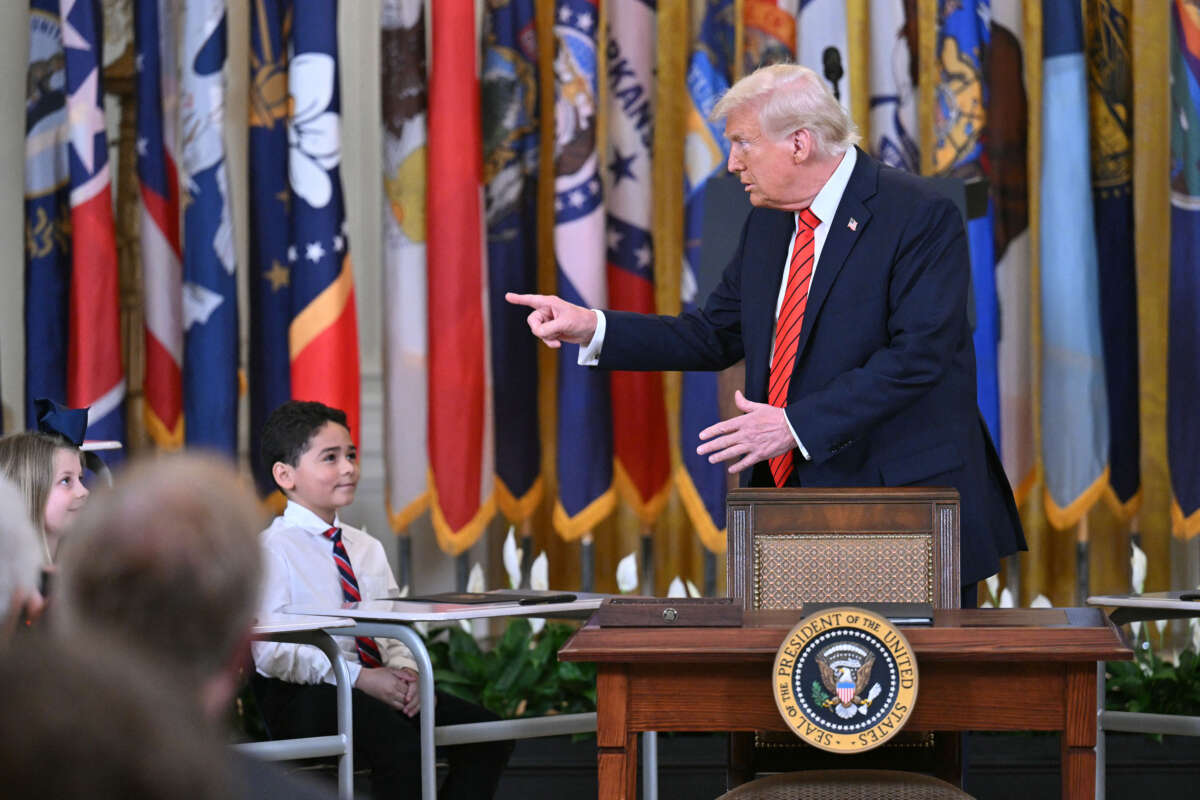
President Donald Trump gestures toward school children during an education event in the East Room of the White House in Washington, D.C., on March 20, 2025.Roberto Schmidt / AFP via Getty Images

From the outset of his second term, President Donald Trump has fed the Constitution through a paper shredder. He has sought to strip away birthright citizenship — a constitutionally guaranteed right under the 14th Amendment — and declared, chillingly, “He who saves his country does not violate any law.” He defied a federal judge’s order to halt a deportation flight, sending immigrants to a notorious prison in El Salvador. His administration is increasingly using federal power to punish political speech, especially in academic spaces. The message being sent is clear: Academic dissent — especially from Muslim and international students — now carries the risk of what one protester called “state-sanctioned political kidnapping.”

Legal scholars have stopped using euphemisms — they now call this a full-blown constitutional crisis. But we must go further to understand the gravity of the moment: These aren’t just signs of constitutional breakdown — they are blaring sirens warning us that fascism is unfolding in real time.

Trump knows the fastest route to authoritarian rule runs through the classroom — that’s why his assault on children, educators and schools has become the wedge he has used to pry open the door of fascism. Transgender students have been singled out for erasure — banned from sports, stripped from curricula, and targeted by policies that force teachers to out them, putting lives at risk. From banning the teaching of race, gender, and colonialism, to threatening to defund any school that includes lessons on systemic oppression, to targeting diversity, equity and inclusion programs, Trump has made it clear: Education must serve the state — not the pursuit of truth.

These aren’t just signs of constitutional breakdown — they are blaring sirens warning us that fascism is unfolding in real time.

In other words, Elon Musk’s gesture at Trump’s inauguration was a chilling statement of the Trump administration’s policy agenda for education and society.

Irony is lost on Trump. He issued an executive order to abolish the Department of Education — a move that would have the effect of eliminating federal civil rights protections for vulnerable students — insisting he wanted to “move education back to the states”; and yet his administration has imposed sweeping top-down censorship, banning entire subjects and demanding loyalty to a federally approved version of history. He has moved to punish universities like Columbia for tolerating pro-Palestinian protests, stripped funding from research institutions, and used executive orders to rewrite curricula. Trump’s assault on education isn’t a distraction — it’s the strategy: the leading edge of enforcing fascism today, and an attempt to indoctrinate the next generation to accept it as normal.

Trump’s assault on education isn’t a distraction — it’s the strategy: the leading edge of enforcing fascism today, and an attempt to indoctrinate the next generation to accept it as normal.

Fascism is sustained not only by violence, but also by the suppression of truth and the control of knowledge. That’s why what I call Trump’s “truthcrime” laws — policies that punish honest teaching about race, gender and history — are foundational to his authoritarian strategy. Philosopher Jason Stanley explains it plainly in Erasing History: How Fascists Rewrite the Past to Control the Future: “[F]ascist education works by strategically erasing accounts of history and current events that include a diversity of perspectives, narrowing the scope of what can be taught until students are presented with a single viewpoint, which is formulated specifically to justify and perpetuate a hierarchy of value between groups.” Stanley warns that this narrowing is “inconsistent with multi-racial democracy, antithetical to egalitarianism, and carries the possibility of conjuring mass violence.”

Trump’s education agenda is doing exactly what fascist regimes have always done: narrowing curriculum to a single, state-approved version of history — one where submission is called freedom and dissent is called extremism.
U.S. Education as a Model for Fascism

Long before Trump’s crackdown on honest education, the United States implemented racist schooling policies that helped inspire fascist regimes abroad. In the early 20th century, eugenics — a pseudoscience rooted in white supremacy — was taught in universities and schools and embedded in public policy. It barred reproduction among those labeled “inferior” — specifically Black, Indigenous, disabled, and poor people. More than 20,000 people were forcibly sterilized in California alone. American scientists advised Nazi officials, and Adolf Hitler explicitly cited U.S. eugenics programs as a model for Germany’s racist and antisemitic laws.

Jim Crow schooling was also a fascistic system in practice. It enforced racial hierarchy through segregation, indoctrinated white students with myths of superiority, and denied Black students equal resources and truthful history — all maintained through the law, violence and surveillance.

During World War II, while fighting fascism abroad, the U.S. enacted it at home: 120,000 Japanese Americans were incarcerated in concentration camps where schools worked to erase their cultural identity and enforce patriotic obedience.

After the war, the McCarthy era brought mass firings of educators for suspected leftist ties, while the Lavender Scare targeted LGBTQ+ teachers. These purges mirrored tactics used in Nazi Germany, replacing dissenters with state-aligned loyalists — and the ones being revived by Trump.

Today, almost half of all students in the U.S. go to a school where their teacher is required to lie to them about U.S. history, systemic racism, transgender identity, and oppression.

The threat we face under Trump isn’t a carbon copy of Nazi Germany; we should be wary of simplistic one-to-one comparisons. But we must also reject the false comfort of thinking “it can’t happen here” simply because it doesn’t look identical.
Democrats’ Failure to Defend Education From Fascism

As Trump escalates his assault on public education and civil liberties, the Democratic Party too often resembles a pilot watching the warning lights flash as the plane takes a nosedive but refuses to touch the controls.

Imagine, for example, if the Democratic Party establishment had used its vast resources to support the annual National Day of Action to Teach Truth — a grassroots campaign started in 2021 and led by educators and students to defend the right to teach honest history. Book bans are deeply unpopular across party lines. If Democratic leaders had supported the #TeachTruth movement, they could have brought millions to the streets in defense of antiracist education.

But they didn’t.

Why? Because, like the GOP, the Democratic Party relies heavily on funding from billionaires and corporate donors who are deeply invested in keeping young people ignorant of the realities of racism, capitalism and oppression. These donors don’t want students learning about how power works — they want students trained to serve it. As Diane Ravitch, the renowned education historian and former U.S. assistant secretary of education, has pointed out, the loudest liberal oligarchs lost their voices when public education came under attack:


Other prominent absentees from the [critical race theory (CRT)]-censorship-book banning controversy were the billionaires who usually are verbose about what schools and teachers should be doing.

Where was Bill Gates? Although rightwing wing-nuts attacked Bill Gates for spreading CRT, Gates said nothing to defend schools and teachers against the attacks on them. He is not known for shyness. He uses his platform to declaim his views on every manner of subject. Why the silence about teaching the nation’s history with adherence to the truth? Why no support for courageous teachers who stand up for honesty in the curriculum?

Many Democrats have been complicit in the very truthcrime laws they claim to oppose. Some have remained silent while these laws passed. Others weakened opposition or even voted to support curriculum bans.

“I get frustrated with the Democrats’ lack of movement, to be quite transparent,” Revida Rahman, a Brentwood, Tennessee, mother of two and cofounder of the racial equity group One WillCo, told The Washington Post. “I think the other side has an engine that is always moving. They have a playbook. They’re playing chess, and we’re playing Go Fish or something.”
A Strategy to Defeat Fascism: Social Justice Unionism

We must be clear about what we’re up against. Trump’s so-called director of government efficiency Musk recently reposted a message saying, “Hitler didn’t murder millions of people. Public sector employees did,” and he’s not just trolling. He’s broadcasting the authoritarian worldview of this administration: that public workers and teachers are the enemy, that the state must be purged of dissent, and that history must be rewritten to serve the powerful.

But we are not powerless. In Washington, D.C., when federal agents recently attempted to detain a health care worker at H.D. Cooke Elementary School during morning arrival, school staff intervened. They followed legal guidance, demanded a warrant, and refused to let the agents proceed unchecked. The agents ultimately left without making an arrest. In a moment of rising authoritarianism, educators and school workers modeled exactly what resistance can look like: collective and principled defiance of unjust authority.


Rising fascism has always been connected to attacks on education — and these attacks were only reversed when people collectively built resistance.

Rising fascism has always been connected to attacks on education — and these attacks were only reversed when people collectively built resistance. For example, it wasn’t powerful people or elite institutions that broke McCarthy-era repression — it was the civil rights movement. Through grassroots organizing, people realized they weren’t alone and found the courage to defy repressive laws. When Black communities and their allies lost their fear of being labeled “communist,” they became willing to fill the jails to win their freedom and ultimately toppled Jim Crow.

Today, the idea of a new mass rebellion against injustice can feel distant. But history reminds us not to mistake relative calm for consent. Just months before igniting one of the most consequential movements in U.S. history, Rosa Parks told fellow organizers at the Highlander Folk School she didn’t believe anything big would happen in Montgomery, Alabama. Parks worried her city was too “complacent,” that Black residents “wouldn’t stand together.” Still, she returned home committed to doing what she could: working with young people, encouraging them to join the NAACP, and reminding them of their right to freedom. Thankfully, Parks continued her freedom work even when change seemed unlikely — and in doing so, helped spark a movement that changed the world.

The conditions may feel bleak today, but there is power hidden in our ranks — and precedent on our side.

The good news? Education is the most unionized sector of labor in the country— and when educators unite with social movements, they can become the earthquake that shakes the pillars of this brittle empire. The Red State Revolt showed what’s possible: Teachers in GOP-controlled states walked out of classrooms, shut down school systems, and forced Republican governors to raise wages and increase education funding. That same model of social justice unionism — grassroots, bottom-up and unapologetically bold — is exactly what’s needed now.

All of us must work to build social movements that use the power of protest to disrupt narratives that dehumanize people — and we must also work to use the power of labor to shut down any institution or corporation that profits from oppression or imposes silence where there should be truth.

There is no major political party coming to save us. With migrant children illegally being separated from the parents, hundreds of students being threatened with deportation, and honest education being banned from the classroom, it’s time for our unions to build escalating campaigns with political demands for justice. If those demands aren’t met, our unions — those representing educators but also auto workers, baristas, fulfillment center workers, dock workers, and more — must prepare to use the economic power of the strike to challenge those who criminalize truth, punish solidarity and legislate hate.

We can’t allow fascism to disguise itself as “local control,” “parental rights,” or “curriculum transparency.” It’s time to organize — and teach — like freedom depends on it, because it does.


Copyright © Truthout. 


Jesse Hagopian is a Seattle educator, the director of the Zinn Education Project’s Teaching for Black Lives Campaign, and the author of the book, Teach Truth: The Attack on Critical Race Theory and the Struggle for Antiracist Education. You can follow him on Instagram or Bluesky.

To Combat Trump’s Attacks on Public Education, We Need Democracy in Our Unions

Education workers are mobilizing for a day of action on May 1. Building toward a national walkout should come next.
April 17, 2025

People protest against the nomination of Linda McMahon to serve as education secretary on February 12, 2025, in Washington, D.C.Al Drago / Getty Images

As May Day approaches, two grassroots organizations of education workers, one created in response to neoliberal reforms and the other emerging from the strike wave that swept several red states in 2018, are coalescing to organize a rank-and-file movement of education workers. At the same time, a coalition launched by the Chicago Teachers Union, under the banner of “bargaining for the common good,” bringing together labor and community groups, is supporting a National Day of Action on May 1, providing tool kits and online trainings for activists. This moment of action from both the independent rank-and-file movement of teachers and the National Day of Action network (MayDay Strong) is welcome as Trump’s unconstitutional dismantling of the U.S. Department of Education (DOE) has grabbed headlines and sparked widespread protest, putting education in the political spotlight.

The situation for schools and communities is dire and wide-ranging, including repercussions from the firings of thousands of employees, cuts and changes to student aid, school lunch programs and civil rights protections, loss of essential information about school enrollment and funding, and much more. The possibility the DOE will be shuttered has plunged hundreds of thousands of U.S. education workers into a tailspin of fear, confusion and rage. Their jobs are at risk, along with their ability to fulfill their ideals and responsibilities — to teach truth, to protect children from deportations and to protect schools from cuts in essential services.

Education workers have looked, often in vain, for leadership from their local school boards and administrations. Teachers with whom I have been in contact, members of the American Federation of Teachers (AFT) and the National Education Association (NEA), have told me they feel vulnerable, left on their own to protect students from deportations, unless they work for school systems in which boards of education have established policies for sanctuary schools. Many education workers feel vulnerable and powerless, without even the most rudimentary guidance about protecting their students and themselves. Because they feel unprotected, they spoke with me with the agreement their names will not be used.

NEA and AFT have taken some steps to fill this vacuum. AFT has provided legal advice in webinars and wording for safe-zone-resolutions, and NEA has given members model language for safe schools resolutions to raise with school boards. One seasoned NEA activist recently remarked to me that without support and resources from the state and national unions to organize, resolutions won’t be implemented. Educators are too overwhelmed with putting out fires to be able to act on their own. AFT also organized a “national day of action” and NEA a demonstration in Washington. Some activists have welcomed the NEA and AFT calls for days of action. Others have been looking for more militant direction, such as a general strike, and have expressed their frustration on social media, dismissing the days of action as “performative” theater for public relations.

Although AFT and NEA are endorsing the idea of rallies, and their own coalition, the Alliance to Reclaim Our Schools (AROS), linked to the May 1 organizing group in an email, this explicit support for organizing is undercut by their own strategy, one that emphasizes lawsuits and Beltway lobbying. Several “red state” affiliates of NEA don’t mention Trump or his policies on their websites, reflecting the mindset that the Oklahoma Education Association adopted in the “red state” 2018 walkouts. AFT has filed lawsuits by itself about student loan forgiveness and with the American Sociological Association to oppose Trump’s anti-DEI policies. NEA in turn has filed its own lawsuit with the NAACP and other civil rights groups arguing that the staff cuts left the Department of Education unable to carry out many of its mandatory functions and put student civil rights in jeopardy.

The unions’ emphasis on lawsuits and lobbying doesn’t often make it into the public sphere for deliberation. Michael Mulgrew, AFT President Randi Weingarten’s most powerful lieutenant, who controls New York City’s United Federation of Teachers (UFT), though, recently boasted of the union’s use of the courts to push back against the Trump administration; meanwhile, a candidate running against Mulgrew in a coalition slate is calling for the union to put more emphasis on organizing. Legal challenges are an essential aspect of an overall strategy to stop Trump, but the cumbersome legal process and questions about whether Trump will obey the courts show that reliance solely on the courts, legal rallies and political friends cannot substitute for mobilizations of members, with allies, in mass action.

Democratizing the Unions — a Messy and Essential Task

Amid the political and economic changes accelerated by the Trump administration, NEA and AFT’s lack of leadership is profoundly dangerous for public education and democracy. Meanwhile, the unions are steering clear from the role of venture capital and private equity in privatizing education and of finance capital’s support for Trump’s political agenda. Silicon Valley identifies problems in public policy that it “solves” with edtech companies, reaping profits and more power. Another seismic shift is private equity’s control of corporate ownership, its concentration of wealth so massive it has become the most powerful force on Wall Street. Private equity firms are notorious for investing in corporations to bleed them dry, but they also make huge profits in surveillance and detention. Blackrock, by far the world’s largest asset manager, has purchased two ports in the Panama Canal, reflecting that the most powerful force in finance capital fully endorses Trump’s authoritarianism and imperial agenda, while basking in the “spoils.” Blackrock’s latest plan to profit from infrastructure investments includes a new alliance with Microsoft to fuel AI. Private equity and venture capital have joined a frenzy for huge new profits that Trump’s privatization and authoritarianism advance. And Democrats, many of whom endorse or waver on charter schools, also have close relationships with Silicon Valley, accepting funds from tech moguls as they make statements opposing Elon Musk. While a few may join us after we organize, they will not lead or save us.

When AFT welcomes a partnership with Microsoft to help “empower” teachers to use AI, it’s implicitly throwing its weight behind Blackrock’s and Microsoft’s economic and political agenda — privatization of education and government. NEA has not pursued relationships with edtech companies, but its policy toward AI says nothing about Silicon Valley’s explicit aim to privatize education with edtech, despite members’ explicit concerns about AI, nor does it discuss how it will counter the problems it does identify. According to a union activist in the Pacific Northwest representing his college at NEA’s 2025 Higher Ed Conference, attendees heard from leaders that AI is a neutral “advancement of human knowledge” — the few delegates who critiqued its use were dismissed as “fearful” and “afraid.”

Those welcoming collaborations with edtech companies in using AI are wearing ideological blinders shared by prominent liberal opponents of charter schools and vouchers. They have missed the re-alignment of swaths of venture capital and private equity to make public education one huge “free” market funded by the government, capital’s dream come true. Toward that end Trump is creating new forms of privatization that will dwarf the damage of neoliberalism’s push for charter schools and vouchers. A new type of voucher, called Education Savings Accounts, (ESAs) allows federal funding to be used for home schooling and private schools. While ESAs that Trump is pushing are not currently tied to standardized testing, the model policy for ESAs described by the far right American Legislative Exchange Council (ALEC) requires testing, a model Alabama has already implemented. The data the right demands is rooted in ubiquitous, omnipotent standardized testing, used to control schools and teaching, on the bogus claim they measure learning fairly and well.

A growing number of AFT and NEA members are restive, feeling their union leadership is insulated from members’ needs, voices and ideas. These rank-and-file leaders are organizing both within and outside of the union structure. For example, after NEA announced the National Walk-in Day on March 19, the re-emerging network of rank-and-file education workers held a “Walk-in 101,” providing training with a quick toolkit to help members newer to organizing spaces.

The need to democratize local, state and national unions is rejected by some activists as a diversion from the “united front” we need at this moment. But ignoring AFT and NEA allows them to collaborate with the corporations allied with Trump’s push to privatize education, as the national unions did when neoliberal reforms pushed testing into our schools. Vibrant union democracy increases our capacity to build a movement of activists in both NEA and AFT, a united force of education workers that could even push state affiliates of NEA and AFT to become unified, democratic organizations, as occurred in West Virginia after its walkouts. Robust union democracy in teachers unions also opens the door to respectful and mutually beneficial collaboration with allies in social movements because it frees up the power of education workers to develop a resilient connective tissue between life in schools and beyond their walls, which a union bureaucracy cannot accomplish from its office buildings.

In the NEA that means building a rank and file movement, which also entails challenging the ideas of members as well as long-time national and state staff, who don’t necessarily share the political ideas of reformers. In AFT, democratization requires defeating a powerful national machine, one that has thwarted organizing to push the union to divest from Israel, as well as democratizing union conventions. Democratizing the union is the door to drawing on the union’s greatest strength, the collective power of an informed, mobilized membership.

Leveraging Our Strengths


Our strength lies in the reasons the right has intensified its assault on public schools. Despite their weaknesses, U.S. teachers unions are a threat because they have a presence in every state and almost every community. Unlike most U.S. unions, NEA and AFT have relatively high density of union membership (percentages of workers who are union members), which the right intends to change by creating teacher organizations to replace unions and orchestrating new anti-teacher union campaigns. Another reason the right has aimed at education is because schools powerfully influence existing social inequalities, and education workers have the potential power to threaten an unjust status quo. Even if teachers don’t identify as “idea workers,” the independence of thought encouraged in most disciplines (and in teacher education done well) and the occupation’s ideals about helping students mean teachers pose a danger to authoritarian regimes. As an overwhelmingly female profession, teachers and their unions are a threat to Trump, as is evident from what one teacher-activist whom I collaborate with describes as “Project 2025’s exaltation of the White, heterosexual, cis-gender male.” She added that while teachers have not consistently defended struggles for social equality, today teachers and their unions often endorse movements and curricula within and outside of schools that support Black and Brown, immigrant, queer, trans, dis/abled, non-Christian, poor and multilingual students and their families.

The NEA and AFT lawsuits and rallies to save the Department of Education (DOE) illuminated our strengths and our mistakes. We have been able to focus public attention on the illegality of the closure and harm that is being done. Yet, we forfeited strategic and political advantages with the broad slogan of saving the DOE’s role in the cabinet rather than seeing more precisely what functions it serves we need to protect, and perhaps where else in the government bureaucracy those laws might be better protected, as well as what functions of the DOE we should reject.

First, most regulations and services we want to save were created because of direct action by the civil rights movement for equal educational opportunity, including school integration. Lyndon B. Johnson’s “Great Society” legislation, a response to civil unrest, ushered in massive funding and with it a new federal involvement in K-12 education, including passage of the Elementary and Secondary Education Act (ESEA) and Head Start. AFT, NEA and organized labor supported this new federal role though keeping at arm’s length — or actively opposing — social movements trying to extend equal opportunity to women, immigrants and disabled people. The unions’ stance changed when these movements succeeded in winning laws that funded programs in schools. Another lesson in this history is how civil rights protections and federal funding were changed as a conservative restoration turned back those Great Society reforms, shortly after they were passed.

The Carter administration’s creation of the DOE in 1977 as a cabinet position, which moved its functions from the Department of Health, Education, and Welfare, was hotly contested for reasons of narrow self-interest among education’s constituent organizations, who vied for federal money and power. NEA supported having a DOE immediately because it had a political advantage; the AFT, fearing the NEA’s influence, opposed it, as did the AFL-CIO, following Albert Shanker’s lead. The Catholic Church didn’t want a cabinet level department that might fund public schools with more money than it could raise; and higher education worried a new education department, championed by the NEA, would shift more funding toward K-12 education.

The third historical turn in education policy that should inform our strategy is the bipartisan neoliberalization of the DOE, when “No Child Left Behind” (NCLB) replaced The Elementary and Secondary Education Act (ESEA) in 2002. Both NEA and AFT initially embraced NCLB’s premises and federal aid tied to testing. Eventually they were forced by parents and teachers to criticize testing mandates when results were used to evaluate and fire teachers. Though the unions finally spoke out against test results being used for teacher evaluation and school closings, NCLB’s legacy of education controlled by standardized tests remained and has grown with increased use of software and platforms. Campaigns to stop Trump from closing the DOE failed to make a distinction between beneficial functions of the agency and the harm done by NCLB and the federal programs and policies created under its ideological premises, especially standardized testing, expanded exponentially, enshrined as the only acceptable (“scientific”) measure of academic achievement for federal aid, research and curricula.

The “Great Society” programs reveal what regulations we should protect and restore and how much ground we have lost to the right in defense of civil rights and in school funding. We should question whether the unions were right to adopt a blanket approach to saving the DOE without regard to defending specific programs and policies. A more targeted strategy would have allowed us to hone in on the key responsibilities of the DOE, especially reductions or changes to the federal funding the DOE administers” on which states and local districts depend to fund services to students and teachers’ jobs, as well as the hard-won and vital safeguards in the Office of Civil Rights.

Further, education and teachers unions need to consider the ways in which a cabinet agency has sometimes insulated and isolated them from social movements demanding gender equality, disability rights and immigration rights. Working with these allies whose interests include but are not limited to education might have strategic advantages, encouraging unions and education workers to create alliances to win broader support for education funding and curricula that speak truth to power about economic inequality and Trump’s suppression of human rights.

Is it realistic to hope for and try to build a national rank-and-file movement, one that challenges the leadership directly in demands for democracy and with independent organization and struggle? It’s a challenge. Educators are a diverse group in all respects. They don’t all share the same values and beliefs, a reality often used to discourage activism and pursue more moderate policies — often without debate by members. Although NEA or AFT have not released results from polls about how members voted in 2024, 20 percent of AFT members voted for Trump in 2016, as did a third of NEA members. Education Week’s poll of 1135 educators identified as a representative sample (with 731 teachers) found 35 percent planned on voting for Trump. Unions rely on dues from educators who support Trump (and his agenda) as well as members who desire more progressive values. The answer to navigating that reality is in robust union democracy, opening the union’s structures and publications to members’ voices on issues. Suppressing differences and debate fails to win over conservative members, as a neoliberal news outlet reporting on education noted. Exercising power in the name of members whose voices are excluded encourages alienation and primes members for the right’s arguments about its alternative to unions being run by bosses.

While the movement will decide its program, recognizing that communities, locals and states differ in their political situation and consciousness, three broad demands might guide its work:Full public funding for public schools, pre-K through college, for the common good, including defense of the rights of students, educators and communities to collectively determine their educational tools and curricula free from the whims and interests of billionaires and profit-seekers.

Protection and affirmation of human rights for students, parents and caregivers, and educators in their schools and in society.

Protection and expansion of the political and economic rights for all working people to organize collectively in their unions to demand and defend our dignity in the workplace and the world beyond, with our allies.

There was never a better time for AFT and NEA members to build on the rallies and actions being held on May 1 to start to organize for a national walkout to protect our schools, our students, and our work as educators, taking the lead when union leadership won’t. Making our unions into organizations that fight for our interests ultimately requires their democratization.

These campaigns in our local, state and national organizations, in alliance with allies for social justice and democratic schools, must fight for what billionaires and the far right are stealing: our taxes, our rights, control of our schools, and our children’s future.

This article was written with assistance from Leah Z. Owens, Erin Dyke, Chloe Asselin, and Keith Eric Benson.

Angry, shocked, overwhelmed? Take action: Support independent media.

We’ve borne witness to a chaotic first few months in Trump’s presidency.

Over the last months, each executive order has delivered shock and bewilderment — a core part of a strategy to make the right-wing turn feel inevitable and overwhelming. But, as organizer Sandra Avalos implored us to remember in Truthout last November, “Together, we are more powerful than Trump.”

Indeed, the Trump administration is pushing through executive orders, but — as we’ve reported at Truthout — many are in legal limbo and face court challenges from unions and civil rights groups. Efforts to quash anti-racist teaching and DEI programs are stalled by education faculty, staff, and students refusing to comply. And communities across the country are coming together to raise the alarm on ICE raids, inform neighbors of their civil rights, and protect each other in moving shows of solidarity.

It will be a long fight ahead. And as nonprofit movement media, Truthout plans to be there documenting and uplifting resistance.

As we undertake this life-sustaining work, we appeal for your support. We have 6 days left in our fundraiser: Please, if you find value in what we do, join our community of sustainers by making a monthly or one-time gift.

This article is licensed under Creative Commons (CC BY-NC-ND 4.0), and you are free to share and republish under the terms of the license.



Lois Weiner
Lois Weiner is a former teacher and union activist who is Professor Emerita at New Jersey City University. She writes widely on education and teachers unions, and is completing a new book about what the left can learn from teachers and educational researchers.