Monday, April 21, 2025

Trump Massacres Yemenis so Israel can Massacre Palestinians
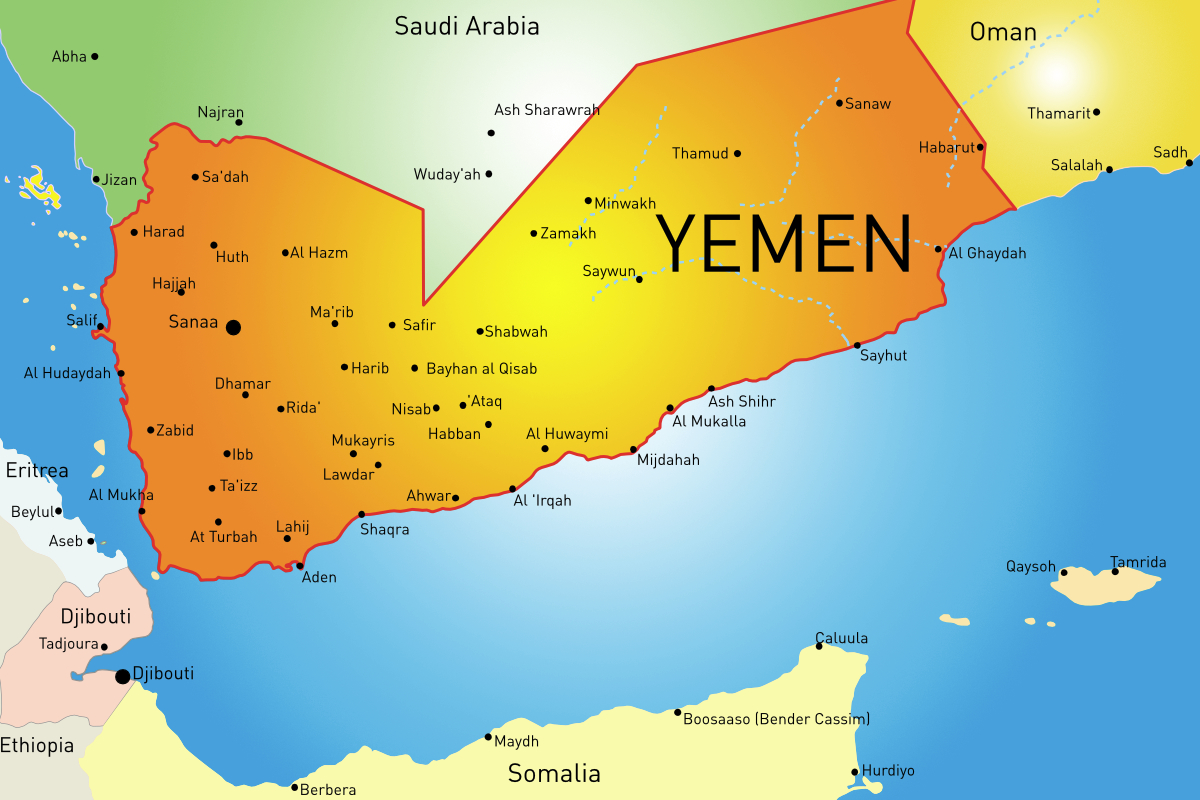

On April 17, US airstrikes on Yemen killed 74 people and injured 171 in a dangerous escalation of US President Donald Trump’s war against the poorest country in the Middle East. A resident of the area around Yemen’s Ras Issa fuel port told Chinese media that “among the victims were employees, truck drivers, contracted workers, and civilian trainees of the port,” and “rescue teams recovering bodies and extinguishing fires were also targeted in [US] subsequent strikes.”

Trump’s attack targeted Ras Issa a vital lifeline connecting the isolated, bombarded country to outside supply shipments. For its part, the US administration claimed that the bombing intended to prevent Iranian fuel from reaching “the Iran-backed Houthi terrorists” in order to “deprive them of illegal revenue that has funded Houthi efforts to terrorize the entire region for over 10 years.”

While it is US policy to delegitimize Ansar Allah (also known as “the Houthis”) as “Iran-backed terrorists,” in fact, 80 percent of Yemenis live under the Sanaa-based Supreme Political Council led by Ansar Allah, making them Yemen’s de facto government. They have a huge degree of public support, as evidenced by the regular protests of tens of even hundreds of thousands of Yemenis opposing US aggression and supporting Ansar Allah’s armed support for Palestinian liberation.

Ansar Allah survived eight years of Saudi-led attacks on Yemen, a war of aggression (backed militarily and diplomatically by governments of the US, Canada, and Europe) that levelled civilian infrastructure and killed almost 400,000 Yemenis. Trump’s bombings will not destroy the vilified “Houthi rebels,” but that is not their goal. What Washington wants is to force Yemen to withdraw its armed support for Palestinians resisting Israel’s genocide.
After Israel launched its onslaught against Gaza in October 2023, Yemen imposed a blockade on Red Sea shipping to Israel. As Israel’s assault on Palestinians in Gaza reached genocidal proportions, Yemen launched drone and missile attacks against Israeli targets. From the beginning, Ansar Allah was very forthright: they stated that the attacks on Red Sea ships and Israeli targets would stop once Israel ceased its genocidal assault on Gaza. During the Gaza ceasefire of January 19 to March 18, 2025, Ansar Allah did cease its military actions in the Red Sea (even as Israel violated the ceasefire 962 times), clearly demonstrating the connection between Israel’s genocide and Yemeni military activity.

US efforts to paint the Yemenis as puppets of Iran, mindless terrorists, and maritime pirates are part of a concerted effort by Washington to obfuscate the just, defensive, and humanitarian motivations behind Ansar Allah’s actions. The recent phase of US attacks on Yemen began in January 2024 under former president Joe Biden, and these bombings received logistical support from, among other countries, Canada and the United Kingdom. After coming to office, Trump intensified the US war on Yemen. Since March, his attacks have killed more than 50 Yemenis, not counting the recent bombardment of civilians at the Ras Issa port. Reportedly, his administration is mulling a ground invasion of Yemen.

One must always keep in mind why America is upping its attacks on the Yemeni people. It is because Yemen is trying to prevent Israel, an outpost of US power in the Middle East, from carrying out a genocide. That’s it. International and humanitarian law mean nothing to Washington. US efforts to paint Ansar Allah as illegitimate, criminal, or aggressors are transparent attempts to rhetorically discredit a regional resistance movement in order to make the massacre of Yemenis palatable to Western audiences.

In the US empire’s eyes, the reason Yemenis need to be massacred is obvious: they are opponents of Israel’s genocide in Gaza. Trump is massacring Yemenis so that Israel can continue massacring Palestinians. It really is that simple.FacebookTwitterRedditEmail

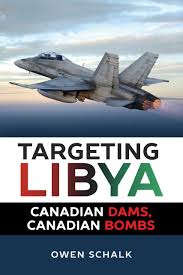
Owen Schalk is the author of Targeting Libya: Canadian Dams, Canadian Bombs (available for preorder from Lorimer Books). Read other articles by Owen.


Trump’s Unconstitutional, Presidential War Against Yemen


For Americans who still think that Donald Trump is an advocate of realism and restraint in foreign policy, the events in Yemen should come as a rude awakening.  Unfortunately, the most prominent indicator enabled the president’s political opponents to evade their own share of the blame for the tragic events in that country.  Revelations that members of Trump’s national security team had conducted a discussion of highly classified information about war plans in Yemen over an insecure system exploded in the news media last month.  One official, apparently National Security Advisor Mike Waltz, had even inadvertently invited Jeffrey Goldberg, editor of the Atlantic, to join the chat.  The resulting “Signalgate” scandal dominated the news cycle for the next two weeks.

The dominant focus of most news stories about the episode was both revealing and depressing.  Critics vehemently denounced the Trump team for an egregious inability to keep the Yemen war plans secret.  Few journalists or members of Congress condemned the participants in the chat for planning an unconstitutional war.  There was no hint that President Trump planned to seek a formal declaration of war as required by the Constitution.  Instead, the principal officials intend to continue the illegal practice of waging presidential wars that has become the norm since the end of World War II.

Indeed, a new phase of the conflict with Yemen was already well underway. Vice President J. D. Vance boasted to the other participants in the chat that U.S. forces had located a “terrorist leader” (i.e. a high-level military official of Yemen’s Houthi rebel government) and would be taking him out.  Indeed, the U.S. launched an air and missile attack on the apartment complex where the official was visiting his girlfriend. The collateral damage included the collapse of the building along with extensive casualties. Notably, very few administration critics bothered to criticize the Trump foreign policy team for such conduct.

Matters have grown worse since that episode.  On April 17, U.S. forces conducted an even larger assault on a civilian port in Yemen.  This time, more than 80 people, mostly civilians, perished.  And once again, there was silence from critics who have denounced the Trump administration for everything from the ill-treatment of immigrants, to harassment of law firms linked to the Democratic Party, to the White House’s efforts to downsize the federal bureaucracy.

Bipartisanship about waging brutal, unconstitutional wars, though, apparently remains thoroughly intact. Given the long history of pro-war views on Yemen in both parties, one should not be especially surprised that there would be no meaningful dissent regarding Washington’s current belligerence toward that country.  When Saudi Arabia first intervened in Yemen’s simmering civil war in 2015, Barack Obama’s administration gave full backing to its ally and the coalition that Riyadh led.  Washington supplied weapons to the Saudi-led forces, shared military intelligence with those forces, and helped to refuel coalition warplanes.  Most of that support continued through both Trump’s first term and Biden’s presidency.

The U.S. meddling helped produce one of the worst tragedies in the perennially troubled Middle East.  In the years that followed during the Obama, Trump, and Biden administrations, the people of Yemen suffered from famine, a cholera epidemic, and the chronic infliction of military casualties.  Even when the fighting subsided from time to time, the respites were relatively brief.  Before Trump took office for his second term in 2021, the Biden administration had launched a new wave of attacks on Houthi targets because the Yemini regime condemned Israel for its war crimes in Gaza and harassed Western shipping passing through the Red Sea.

The Trump administration’s decision to reignite full-scale warfare in Yemen is horrifying and immoral.  To do so without a declaration of war is also unconstitutional.  For administration critics to condemn officials for insufficient skill in concealing such illegal and immoral conduct but not to denounce the conduct itself is disgraceful.

Dr. Ted Galen Carpenter is a contributing editor to 19FortyFive and a senior fellow at the Randolph Bourne Institute and the Libertarian Institute.  He also served in various senior policy positions during a 37-year career at the Cato Institute.  Dr. Carpenter is the author of 13 books and more than 1,300 articles on defense, foreign policy and c.ivil liberties issues.  His latest book is Unreliable Watchdog: The News Media and U.S. Foreign Policy (2022)

Op-Ed: Iran’s Withdrawal Doesn’t Signal Abandonment of Houthis
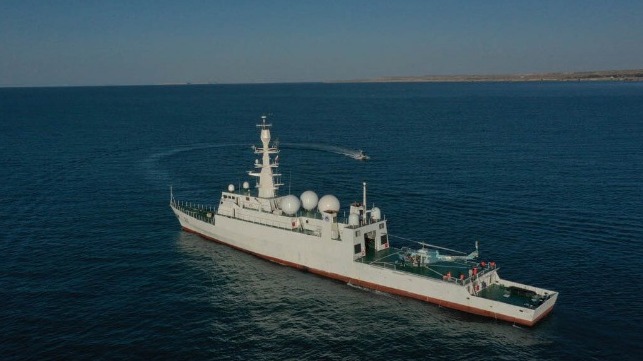
Iranian Intelligence Destroyer
Zagros was described by Iranian state media as its first domestically built "intelligence destroyer" (Fars Iranian State Media)

Published Apr 21, 2025 2:48 PM by Fernando Carvajal


Earlier this month, observers pointed out the lack of activity by Iran’s Nedaja along the Red Sea. The presence of two U.S. Carrier Strike Groups (CSG) across Bab al-Mandab is cited as possible reason behind Iran breaking its naval “continuous presence in the Red Sea and Gulf of Aden area since 2008.” This unique absence also highlights the redeployment of Iranian spy vessels such as the ZagrosBehshadSaviz and Behzad, which “have played an important role in the collection of intelligence and its dissemination to Iran’s Houthi allies.” 

This unique coincidence may have contributed to recent reports claiming Iran has abandoned Houthis. Recent events however show an East Africa footprint provides the Iran-Houthi alliance capabilities to retain threats along the Red Sea. 

In recent months, the build-up of Iranian assets across territory held by the Sudanese Armed Forces (SAF) has come under scrutiny, particularly since SAF took control of Khartoum in March. While Nedaja vessels may have withdrawn from the Red Sea, Iranian vessels continue to call at Port Sudan from Bandar Abbas. Just as Iran has provided assistance to Yemen’s Houthis, Tehran has helped SAF build a series of tunnel bases and deployed modern air defense and radar systems. 

Iran has yet to provide such systems to Houthis, perhaps as consequence of the vulnerability to U.S. strikes authorized under Operation Prosperity Guardian, and now Operation Rough Rider. Whereas in Sudan, there is no authority to interfere in the ongoing armed conflict, which would risk a wider war among regional powers and China. 

Houthis have also followed in Iran’s footsteps and established themselves along Sudan’s Red Sea coast. Multiple priorities pushed Houthi expansion into East African territories like Sudan and Somalia. Houthi presence has established outposts that allowed mobility for their operatives and future leap-frog bases as an umbrella for a “network of resistance.” Shared interests with Iran advanced the Houthi footprint across East Africa with help from well-established smuggling networks during the Saleh (d.2017) era, offering services to all parties. 

Iran’s own interests in East Africa absolutely center in countering growing influence of Gulf rivals like Saudi Arabia and the UAE. Sudan’s shores grant both allies direct access to Yanbu, a major port for gas and oil export that allow Saudi Arabia to bypass the Strait of Hormuz and Bab al-Mandab en route to Suez Canal. Houthi drone capabilities, both aerial and sea-based, now have alternative launch points from Sudan capable of protecting their rear in event of a foreign invasion by sea and retain capability to threaten international naval presence across Bab al-Mandab.   

The US administration launched Operation Rough Rider specifically citing Houthi threats to maritime navigation along the Red Sea. Although Houthis have not targeted vessels since December 6, 2024, the month-long U.S. air campaign has reportedly degraded Houthi capability to launch drone or missile strikes against civilian ships across the Bab al-Mandab area. 

The Houthi-Iran alliance however can undoubtedly pose a similar threat from across Sudan’s Red Sea coast, targeting any naval forces providing support to ground troops moving toward Hodeida seaport. U.S. awareness of the threat from Sudan’s shore may also explain the use of Diego Garcia base for B2 bombers and position of U.S. naval forces farther north from Port Sudan and around Gulf of Aden. 


Fernando Carvajal served on the UN Security Council Panel of Experts on Yemen from April 2017 to March 2019 as a regional and armed groups expert. He holds an MA in National Security Studies and has over 20 years of experience conducting fieldwork in Yemen and the Gulf.
 

The opinions expressed herein are the author's and not necessarily those of The Maritime Executive.


Beneath the Surface: Is the Trump-Netanyahu ‘Unthinkable’ About To Erupt?


Israeli Prime Minister Benjamin Netanyahu’s recent visit to Washington was no ordinary trip. The consensus among Israeli analysts, barring a few remaining loyalists, is that Netanyahu was not invited but, rather, summoned by US President Donald Trump.

All evidence supports this assertion. Netanyahu rarely travels to the US without extensive Israeli media fanfare, leveraging his touted relationships with various US administrations as a “hasbara” opportunity to reinforce his image as Israel’s strongman.

This time, there was no room for such campaigns. Netanyahu was informed of Trump’s summons while on an official trip to Hungary. There, he was received by Hungarian President Viktor Orbán with exaggerated diplomatic accolades, signaling defiance against international condemnation of Netanyahu, an accused war criminal wanted by the International Criminal Court (ICC), and portraying him as anything but an isolated leader of an increasingly pariah state.

The capstone of Netanyahu’s short-lived Hungarian victory lap was Orbán’s announcement of Hungary’s withdrawal from the ICC, a move with profoundly unsettling implications.

It would have been convenient for Netanyahu to use his Washington visit to deflect from his failed war in Gaza and internal strife in Israel. However, as the Arabic saying goes, “the wind often blows contrary to the ship’s desires.”

The notion that Netanyahu was summoned, not invited, is corroborated by Israeli media reports that he attempted to postpone the visit under various pretexts. He failed, ultimately flying to Washington on the date determined by the White House. Initially, reports circulated that no press conference would be held, denying Netanyahu the platform to tout Washington’s unwavering support for his military actions and to expound on the “special relationship” between the two countries.

A press conference was held, though it was largely dominated by Trump’s contradictory messages and typical rhetoric. Netanyahu spoke briefly, attempting to project the same confident body language observed during his previous Washington visit, where he sat with an erect posture and spread out his legs, as if in command. But this time, his body language betrayed him; his eyes shifted nervously, and he appeared stiff and surprised, particularly when Trump announced that the US and Iran would begin direct talks in Oman soon.

Trump also mentioned the need to end the war in Gaza, but the Iran announcement clearly shocked Netanyahu. He desperately tried to align his discourse with Trump’s, referencing Libya’s disarmament under Muammar Gaddafi. But that was never part of Israel’s official regional plan. Israel had consistently advocated for US military intervention against Iran, despite the certainty that such a war would destabilize the entire region, potentially drawing the US into a conflict far more protracted and devastating than the 2003 invasion of Iraq.

Further evidence of the US’ diverging views from Israel’s regional ambitions – centered on perpetual war, territorial expansion, and geopolitical dominance – lies in the fact that key political and intellectual figures within the Trump administration recognize the futility of such conflicts. In leaked exchanges on the encrypted messaging platform Signal, JD Vance protested that escalating the war in Yemen benefits Europe, not the US, a continent with which the US is increasingly decoupling, if not engaging in a trade war.

The Yemen war, like a potential conflict with Iran, is widely perceived as being waged on Israel’s behalf. Figures like Tucker Carlson, a prominent commentator, articulated the growing frustration among right-wing intellectuals in the US, tweeting that “anyone advocating for conflict with Iran is not an ally of the United States, but an enemy.”

Trump’s willingness to openly challenge Netanyahu’s policies remains unclear. His conflicting statements, such as calling for an end to the Gaza war while simultaneously advocating for the expulsion of Palestinians, add to the ambiguity. However, recent reports suggest a determined US intention to end the war in Gaza as part of a broader strategy, linking Gaza to Yemen, Lebanon, and Iran. This aligns with Washington’s need to stabilize the region as it prepares for a new phase of competition with China, requiring comprehensive economic, political, and military readiness.

Should Trump prove capable of doing what others could not, will Netanyahu finally submit to American pressure?

In 2015, Netanyahu demonstrated Israel’s unparalleled influence on US foreign and domestic policy when he addressed both chambers of Congress. Despite a few insignificant protests, Republican and Democratic policymakers applauded enthusiastically as Netanyahu criticized then-President Barack Obama, who did not attend and appeared isolated by his own political class.

However, if Netanyahu believes he can replicate that moment, he is mistaken. Those years are long gone. Trump, a populist leader, is not beholden to finding political balances in Congress. Now in his second and final term, he could, in theory, abandon the US’s ingrained reliance on Israel’s approval and its aggressive lobby in Washington.

Moreover, Netanyahu’s political standing is diminished. He is perceived as a failed political leader and military strategist, unable to secure decisive victories or extract political concessions from his adversaries. He is a leader without a clear plan, grappling with a legitimacy crisis unlike any faced by his predecessors.

Ultimately, the outcome hinges on Trump’s willingness to confront Netanyahu. If he does, and sustains the pressure, Netanyahu could find himself in an unenviable position, marking a rare instance in modern history where the US dictates its terms, and Israel listens. Time will tell.

Dr. Ramzy Baroud is a journalist, author and the Editor of The Palestine Chronicle. He is the author of six books. His latest book, co-edited with Ilan Pappé, is Our Vision for Liberation: Engaged Palestinian Leaders and Intellectuals Speak Out. His other books include My Father was a Freedom Fighter and The Last Earth. Baroud is a Non-resident Senior Research Fellow at the Center for Islam and Global Affairs (CIGA). His website is www.ramzybaroud.net.


Forgive Me, Gaza…

Jamal Kanj


April 21, 2025


Image by Mohammed Ibrahim.

I write forgive me, not forgive us, because this guilt is deeply personal. It’s a burden I carry in the comfort of my home, sipping clean water while the children of Gaza drink from brine water wells mixed in sewage—their small bodies wracked with dehydration and disease—if they even find water at all.

I can pluck wild mallow leaves from my backyard—not to satisfy hunger, but for the luxury of a healthy diet. I’m guilty of throwing away leftovers, when fathers and mothers in Gaza search through the rubble of demolished homes for a can of food that might have survived an Israeli bomb. Or they dare crawling through cratered fields, scavenging for wild greens to silence their children’s growling stomachs—only to become moving targets under the cold gaze of Israeli drones.

Forgive me—I have a home, a heater and blankets to keep my children warm. While in Gaza, parents lie awake—not just from the cold, but from the torment of being unable to warm their children’s tiny, freezing feet.

Forgive me when I kiss my daughter on her birthday and her laughter rings in my ears—while only the buzzing of Israeli drones rings in yours. She blows out her candles in a breath of joy, while you light a candle to push back the darkness, wheezing for air in a world that denies you breath.

I can hold my daughter, while you can’t even retrieve yours from beneath the rubble—can’t gather enough of her remains for one final embrace. American-made Israeli bombs scattered her flesh like sand in the wind, leaving you empty, aching with grief and dust.

Your hospitals, doctors, medics, and first responders who chose their professions to save lives—but became targets, because saving a Palestinian life is deemed existential threat for Israel. I beg forgiveness from every journalist whose words to expose war crimes became bullets, and whose cameras were more dangerous to Israel than cannons.

Forgive the world that calls your starvation, the destruction of schools and universities—and the murder of your educators—Israel’s “self-defense.”

Dear people of Gaza, forgive them if you once believed humanity had learned from the sins of African enslavement, the genocide of Indigenous peoples, and the European Holocaust. I repent, Gaza, if you believed that “Never Again” included you.

I’m sorry that the progeny of the victims of “Never Again” have organized under the agency of ADL, AIPAC, and Political Zionism to kosher a genocide—carried out in the name of Judaism. “Never Again” is not for everyone, dear Gaza; it is only for the white West and the self-chosen.

The ideological antisemites are now Israel’s closest allies. Today, “antisemite” no longer means those who hate Jews, but it is those who protest Israeli genocide. “Never Again” is monopolized by the professional victims—licensed by a god using past European cruelty to justify present Israeli injustice in Palestine.

I’m sorry, Gaza, the Palestinian Authority (PA) has betrayed you. Instead of shielding you, it became an arm of your oppressor. When the refugee camps of Jenin, Nur Shams, and Balata rose to support you, they faced not just Israeli force, but PA bullets and batons. And in cities and towns that didn’t rebel, the PA still failed to protect them from Jewish settler rampages—burning homes and groves, killing livestock, and shooting farmers.

Forgive me, Gaza, for believing in the illusion of Arab unity—that you were part of a greater Arab nation. That the rulers of Cairo, Amman, Damascus, Baghdad, Riyadh, and others would rise for you. I believed we shared a common pain, a common struggle. I believed the Arab world would never let you starve. I was wrong.

Instead, they became part of your siege. Rafah is sealed not only by Israeli soldiers but by Egyptian concrete walls and watchtowers. Arab dictators shake hands with those who bomb your hospitals. Rulers from the rich Arab Gulf buy Israeli technology—tested first on your neighborhoods.

Forgive me, Gaza, for believing the rulers who betrayed Palestine in 1948 would ever defend you. Like their ancestors who opened the gates to the Crusaders 900 years ago—trading Palestinian blood for their survival—they do so again today.

History repeats itself, Gaza. The same kings and emirs who welcomed invaders then, embrace Israel now—gorging themselves on roasted camels while your children wither from hunger. Their capitals glow with the lights of music festival, while Gaza’s nights are set ablaze by the flares of American-made 2,000-pound bombs.

To the Arab tyrants who still bow to their colonial masters, I say: the European Crusaders did not spare your ancestors once they conquered Palestine. They turned their swords on the very rulers who helped them, devouring their mini kingdoms one by one.

I’m sorry, Gaza, that when the people of Yemen stood for you—blocking shipments to an Israeli port to demand food for your children—their own children were murdered in an Israeli-American proxy war. Like yours, their suffering is silent, and their pain earns no headlines.

Forgive me that only the Lebanese Resistance—unyielding under Israeli bombardment—steadfast, while other Arabs profited from your agony. Yemen and the Lebanese Resistance sought not applause, but to let you know you are not alone. Though the Arab world and much of humanity turned their backs, they did not waver. Yemen and the Lebanese Resistance traded neither dignity nor principle with the forces of evil.

Gaza, your blood is a mirror the world dares not face. But I will not look away.

Forgive me for my helplessness.
Forgive me for every sip of water, every bite of food, every breath I take while you suffocate.
Forgive me, if those I met in Gaza years ago ever thought I’d forgotten them.
Forgive me if I couldn’t help everyone who asked.
Forgive my comfort.
Forgive my peace.

I seek not your absolution—
Only that you know:
You are not forgotten.


Jamal Kanj is the author of Children of Catastrophe: Journey from a Palestinian Refugee Camp to America, and other books. He writes frequently on Arab world issues for various national and international commentaries.


De Facto Occupation: Israel’s Security Zone Strategy


Binoy Kampmark

April 21, 2025


Photograph Source: User:שועל, modified by User:MathKnight – File:IDF Caterpillar D9 in action.JPG – CC BY-SA 3.0

In recent months, the Israeli Defense Forces have been much taken by a term that augurs poorly for peaceful accord in the Middle East. “Security zones” are being seized in the Gaza Strip, Lebanon and Syria. Land is, for claimed reasons of self-defence, being appropriated with brazen assuredness.It is hard, however, to see this latest turn as anything other than a de facto military occupation, a situation that will prolong the crisis of vulnerability the Jewish state so wishes to overcome. Israel’s insecurities are much the result of various expansions since 1948 that have only imperilled it to future attack and simmering acrimony. The pattern threatens to repeat itself.

In Syria, Israel rapidly capitalised on the fall of the Assad regime by shredding the status quo. Within a matter of 11 days after the fleeing of the former President Bashar Al-Assad to Moscow, and again on February 1 this year, satellite images showed six military sites being constructed within what is nominally the UN-supervised demilitarised zone, otherwise known as the Area of Separation. A seventh is being constructed outside the zone and in Syria proper. Such busy feats of construction have also accompanied Israeli encroachment on the land of Syrian civilians, coupled with vexing housing raids, road closures and unsanctioned arrests.

All this has taken place despite undertakings from Syria’s transitional President Ahmed al-Sharaa that he would recognise the 1974 agreement made with Israel, one which prohibits Israel from crossing the Alpha Line on the western edge of the Area of Separation. “Syria’s war-weary condition, after years of conflict and war, does not allow for new confrontations,” admitted the new leader on December 14, 2024. Israeli Prime Minister Benjamin Netanyahu was only scornful, regarding the 1974 agreement between the two countries as a dead letter buried by history. “We will not allow any hostile force to establish itself on our border,” he snottily declared.

Lebanon is also facing a stubborn IDF, one that refuses to abide by the Israel-Hezbollah agreement last November which promised the withdrawal of both forces from southern Lebanon, leaving the Lebanese army to take over the supervising reins. Lebanese President Joseph Aoun, who faces the herculean task of removing Hezbollah’s weapons while potentially integrating members of its group into the Lebanese army, has found his task needlessly onerous. In recent discussions with US deputy Mideast envoy Morgan Ortagus, the Lebanese leader reasoned “that Israel’s presence in the five disputed points gives Hezbollah a pretext to keep its weapons.”

On April 16, Israeli Defence Minister Israel Katz promised that such security zones would provide relevant buffers to shield Israeli communities.Ominously, the IDF would “Unlike in the past [not evacuate] areas that have been cleared and seized”. They would “remain in the security zones as a buffer between the enemy and [Israeli] communities in any temporary or permanent situation in Gaza – as in Lebanon and Syria.”

In Gaza, it is becoming increasingly clear that any prospect of Palestinian autonomy or political independence is to be strangled and snuffed out. Israel has already arbitrarily created the “Morag Corridor”, which excises Rafah from the Strip, and the Netzarim Corridor, which severs Gaza in half. Katz has also promised that the policy of blocking all food, medicine and other vital supplies to Gaza implemented on March 2 will continue, as it “is one of the main pressure levers preventing Hamas from using it as a tool with the population”.

Displacement orders, euphemised as “evacuation orders”, have become the staple of operating doctrine, the means of creating buffers of guns and steel. On April 11, Israeli authorities issued two such orders, effectively “covering vast areas in northern and southern Gaza”, according to UN spokesperson Stéphane Dujarric. “Together, these areas span more than 24 square kilometres – roughly the size of everything south of Central Park here in Manhattan.” Within these zones of military seizure lie medical facilities and storage sites filled with vital supplies.

The UN Human Rights office also expressed its concerns about Israel seemingly “inflicting on Palestinians in Gaza conditions of life increasingly incompatible with their continued existence as a group in Gaza.” The population was being “forcibly transferred into ever shrinking spaces with little or no access to life-saving services, including water, food, and shelter, and whey they continue to be subject to attacks.” Engaging in such conduct against a civilian population within an occupied territory, the office pointedly observes, satisfies the definition of a forcible transfer, being both a violation of the Fourth Geneva Convention and a crime against humanity under the Rome Statute of 1998.

The latest doctrine of appropriation and indeterminate occupation adopted by Katz and the IDF has not impressed the Hostages and Missing Families Forum in Israel, long advocating for the release of Israeli hostages still being held in Gaza by Hamas. “They promised that the hostages come before everything,” came the organisation’s aggrieved observation. “In practice, however, Israel is choosing to seize territory before the hostages.” In doing so, the prerogatives of permanent conflict and habitual predation have displaced the more humane prerogatives of peace.


Binoy Kampmark was a Commonwealth Scholar at Selwyn College, Cambridge. He lectures at RMIT University, Melbourne. Email: bkampmark@gmail.com

Towards a Counter Anthropology


 April 21, 2025
Facebook

Image by Sajimon Sahadevan.

It goes without saying that the study of any subject seeks to deepen understanding through careful analysis, employing all available methodological tools. Such understanding serves as the foundation for making informed decisions. When the subject of study is a foreign country—particularly one with a different language and culture—this raises important questions about the purpose of the study: What are its short- and long-term goals? Who is its intended audience? And can it influence cultural perceptions or challenge prevailing narratives about that country and its people?

These questions are especially pertinent given the significant number of books published by Western university presses on Arab countries. These works often explore religion, sectarian dynamics, political systems, geography, customs, traditions, and both ancient and modern histories. Many of these studies are produced by scholars working within academic traditions shaped by classical Orientalism. Edward Said and others have critically examined this tradition, exposing the underlying assumptions, methodologies, and racial biases, as well as its entanglement with colonial interests. Within this framework, the portrayal of foreign “others” has too often served to justify domination, violence, and exploitation—examples of which are numerous and well-known.

Edward Said’s Orientalism had a profound and lasting impact on how the Middle East is studied in the Western academy. It helped shift the label “Orientalist” to “researcher” and prompted scholars to recognize that objectivity, especially in our commodified age, is not a neutral stance but a complex and often problematic ideal.

This is not to cast doubt on the integrity of researchers and academics, nor to diminish the significance of Western universities and their cultural contributions. Rather, the aim is to draw attention to a deeper issue: the complex relationship between the vast body of academic work produced about the non-Western “other” and the cultural role such scholarship plays in shaping, and potentially transforming, the way we understand the world.

In the Arab world, we have yet to fully develop the capacity to study the world and define our place within it—as other advanced nations have done. More critically, we remain largely unable to study ourselves with the depth and rigor required. We struggle to deconstruct our relationship with the past or to confront the layered problems of our present. At the popular level, inherited beliefs and traditional views continue to shape our understanding of everything around us. As a result, we have become the subjects of external study—observed and analyzed as though we were relics or anthropological specimens.

These studies are not conducted by us, nor are they primarily for our benefit. Instead, they are produced by Western universities to sharpen the intellectual tools of their students, enrich academic curricula, expand research frontiers, and feed vast institutional databases. The Western researcher, supported by prestigious institutions, granted funding, and provided with the resources to live comfortably in our societies while devoting themselves to studying us, undoubtedly achieves notable academic outcomes. Yet these accomplishments often remain disconnected—not only from the local audience but even from the broader readership of the language in which the research is written. They are, in effect, confined within the walls of the academic ivory tower.

We must acknowledge the intellectual and theoretical value of many outstanding Western researchers, as well as the depth, breadth, and precision found in some of the studies written about the Arab world. However, these works often fail to play a dynamic cultural role due to their academic isolation. University researchers are typically removed from public discourse and remain inaccessible to the wider public. Their insights, while rich, rarely permeate mainstream cultural or political conversations.

Yet the issue is more complex than any simplistic “conspiracy theory” explanation would suggest. The vast literature produced about the Arab “other” frequently becomes a reference point for politicians, fellow academics, and policymakers. Some of these works even enjoy commercial success. Still, the typical English-speaking reader interested in Syria, Iraq, or other Arab countries often lacks sufficient background knowledge, and may not be motivated to explore further. As a result, these studies, however well-researched, rarely disrupt the entrenched stereotypes that continue to shape Western perceptions of Arabs—stereotypes that are routinely reinforced in newspapers, books, television, and film. The Arab figure remains all too often cast as backward or threatening, locked in a narrative that perpetuates a culture of dominance and control.

A number of younger Western scholars have begun to challenge the traditional dynamics of ethnographic research. They question the framing of the “other” as a mere object of study and have advocated moving away from terms like “informant” toward more reciprocal terms such as “conversation partner” or “interlocutor.” These researchers emphasize that the subject of study should be seen as an active partner in the co-production of knowledge—an approach that calls for attentiveness, flexibility, and sustained engagement.

When an American writes about Syria or another Arab country, they do so from within a different cultural framework, using a language shaped by its own intellectual traditions and historical experiences. Even when they are sympathetic and well-intentioned, they often lack the depth of immersion necessary to transcend the limits of conventional ethnographic methods. Without that sustained, lived engagement, their perspectives—however insightful—remain constrained by the distance between observer and subject.

Rather than labeling individuals as “Alawite informant,” “Sunni writer,” “Shiite novelist,” or “Druze journalist,” it would be more thoughtful—and more accurate—to refer to them simply as “Syrian,” “researcher,” “writer,” “novelist,” or “university professor.” These sectarian identifiers may serve ethnographic, sociological, or anthropological purposes, but they often reduce complex individuals to narrow categories. This is especially problematic when their views engage with broader cultural, political, or intellectual concerns that transcend such identities.

When a Western researcher says, “This incident was recounted to me by an Alawite or Sunni writer,” one must ask: what exactly is being conveyed? Why not express it differently—more inclusively and without reinforcing sectarian boundaries? For instance, rather than saying “an Alawite writer told me,” one could simply say “a Syrian writer told me.” Framing them this way situates the speaker within a shared cultural space, inviting readers to consider perspectives that go beyond sectarian labels and highlight commonalities.

It is important to recognize and honor anthropologists and scholars who resist dominant narratives and reject perspectives shaped by bias, as their work contributes to more just and meaningful understandings of the world.

I recently came across a remarkable example of this in a book about Syria by American anthropologist Jonathan Holt Shannon. What struck me was how deeply the book resonated—not as a detached academic study, but as though it had been written from within the culture itself. It felt as if the author belonged to it, or was enriched by it in a meaningful and unusual way. His affection for the culture, his personal connection to the topics he explores, and his attentive, respectful engagement with the people he meets—seen not as subjects, but as educated, knowledgeable, and fully human—imbue the work with a rare authenticity.

But it goes beyond that. Among the Jasmine Trees: Music and Modernity in Contemporary Syria stands out as one of the most compelling examples of writing about the so-called foreign “other” without treating them as foreign at all. Instead, Jonathan Holt Shannon engages with the Syrian people and their experiences as an extension of himself, crafting a kind of counter-anthropology—one that resists the traditional anthropological gaze that so often exoticizes or distances its subjects. In doing so, he challenges the dominant discourse that has long portrayed Arabs and Eastern cultures through the lens of strangeness and spectacle, not unlike the caricatures seen in Hollywood cinema. Shannon’s work offers a powerful alternative, grounded in empathy, a passionate critical spirit, intellectual depth, and a refreshing humanism.

Meanwhile, Western studies on Arab societies continue to flourish in the absence of a robust critical cultural movement within the Arab world capable of engaging with and deconstructing these works. The capacity to read in foreign languages remains limited, and the translation movement lacks integration into a local critical framework—one that could analyze ideas, question assumptions, and creatively apply Western methodologies in ways that resonate with local context.

It is telling, for example, that the translation of philosphers like Nietzsche, Michel Foucault, Jacques Derrida, and Louis Althusser into English is fundamentally different from their translation into Arabic. In English-speaking contexts, these thinkers are situated within a vibrant intellectual culture that actively engages with their ideas, relating them to epistemological, existential, and societal questions relevant to contemporary life. In contrast, their Arabic translations often remain confined to dense, inaccessible language and an elite academic sphere disconnected from broader cultural or societal discourse. As a result, their ideas remain intellectually alien—unrooted in local reality, and largely unused in the development of indigenous theoretical frameworks or critical methodologies.

In my view, there is a way forward. Within the Syrian and broader Arab context, the key lies in cultivating a critical and analytical intellectual culture—one rooted in independent universities that are free from religious and political censorship, and supported by journals committed to open, rigorous inquiry. This must be complemented by a robust translation movement, one not limited to linguistic conversion but connected to a vibrant local intellectual tradition capable of engaging with, analyzing, and contextualizing the most significant Western studies on our region.

Such a cultural infrastructure would allow us to approach these works from our own perspective, situated within our own historical and societal context. In doing so, we would move from being passive recipients of external knowledge to active participants in its interpretation, critique, and application. This shift would enrich our understanding of our own realities, sharpen our ability to evaluate and deconstruct imported ideas, and adapt them in ways that are meaningful and useful to us.

Adopting this approach would help rescue the many books written about Syria and other Arab countries from being misread, misunderstood, or simply forgotten on dusty shelves. It would release us from the status of anthropological, ethnological, or ethnographic specimens and affirm our place as thinking, speaking subjects. It would allow our voices—grounded in experience and critical reflection—to enter the global conversation on our own terms.