Saturday, May 10, 2025


Bratty Royal: Prince Harry and Bespoke Security Protection


It has been unedifying, and, it should be said, far from noble. But being unedifying has become something of a day specialty for Prince Harry, Duke of Sussex, notably when giving interviews from commodious abodes in California. On taking a step down from the subsidised duties that characterise his position, the disgruntled Royal fled the stable and made for the United States. He had found love with Meghan Markle, but it proved to be that sort of noisy, declarative love that Buckingham Palace loathes, and his relatives generally try to sedate.

The latest tremor of narcissistic display on the Duke’s part involved an interview with the BBC which could be billed as confession and advertisement: “I confess; I advertise”, with an afterthought of “Please Forgive Me Daddy” while funding my security detail on visits to the United Kingdom.

The man, self-proclaimed victim, had been consistently sinned against. He felt that the courts had wronged him in not accepting the proposition that he needed as much security as other working Royals and public figures, despite seeking a pampered life in California and exiting the British orbit in 2020. The lack of a risk assessment post-2019 of his family was “not only a deviation from standard practice [but] a dereliction of duty.” His court failure was also a “good old fashioned establishment stitchup”.

The legal proceedings so irking Harry centred on an appeal against the dismissal of his High Court claim against the UK Home Office. The interior ministry had accepted the decision of the executive committee for the protection of royalty and public figures (RAVEC) that he should receive a different, less hefty measure of protection when in the UK. The Court of Appeal was unconvinced by the Duke of Sussex’s claim that his “sense of grievance translated into a legal argument for the challenge to RAVEC’s decision.” Judge Geoffrey Vos appreciated that, from Harry’s view, “something may indeed have gone wrong” in that stepping back from Royal duties and spending most of his time abroad would lead to the provision of “more bespoke, and generally lesser, level of protection than when he was in the UK. But that does not, of itself, give rise to a legal complaint.”

In a terse statement, Buckingham Palace reiterated the point: “All of these issues have been examined repeatedly and meticulously by the courts, with the same conclusion reached on each occasion.”

Harry felt his family had not given him his due, certainly on the “sticking point” of security, but wished for “reconciliation”. As a plea, it was lamentable; as an effort, it could hardly have softened well hardened hearts.

A bit of blackmail was also proffered. Not giving him the security assurances would mean depriving his children and wife of any chance of visiting Britain. It was the fault of Britain, its courts, and Buckingham Palace that the state had not provided the subsidised level of security he sought. Pompously, he was certain “there are some people out there, probably most likely wish me harm, [who] consider this a huge win.”

Cringeworthy justifications flow, not least the shameless use of his dead mother, who died in a Paris tunnel with her lover because of the drunken actions of an intoxicated chauffeur. Blaming the insatiable paparazzi for what was otherwise an appalling lack of judgment on the part of Diana and her bit of fluff, Dodi Fayed, is all too convenient. Responsibility is found elsewhere. The levers of destiny lie in another realm. The best thing to do, as the duke demonstrates, is sentimentalise and exploit the situation.

Unfortunately for him, sympathy for his arguments in the Sceptred Isle is not in abundant supply. Marina Hyde of The Guardian preferred to call him “His Rich Highness” who had changed his life but failed to appreciate the examples of others in the well heeled category. BeyoncĂ©, for instance, was not complaining about splashing out on security knowing that such matters went “with the territory, and that you have to pay for it out of your riches.”

In The Spectator, Alexander Larman made the pertinent observation that Harry, despite seeing himself as a “maverick” on the hunt for justice, sounded all too much like President Donald Trump. “Both men have talked passionately, if not always persuasively, about the shadowy forces that have frustrated their popular crusade for truth and justice”. One difference proved incontestable: Trump won.

This hereditary figure of aristocracy cannot help his instincts on entitlement. He was “born” into the role, and for that birthright, he demands a degree of security protection exceptional, whatever his personal decisions and choices about career, location and Royal duties. Here is a figure who insists on not so much damaging the monarchy as an institution – as if more could be done to it – but by airing his public life as a new, celluloid royal, a figure happy to condemn the media and its violations of privacy on the one hand, yet reveal the rather disturbed contents of a private life he has cashed in on. The public arena has become the site of his ongoing, distinctly unattractive effort at raking in the cash and seeking therapy.

Binoy Kampmark was a Commonwealth Scholar at Selwyn College, Cambridge. He lectures at RMIT University, Melbourne. Email: bkampmark@gmail.comRead other articles by Binoy.

Gatsby Meets Nietzsche on the Train to Town


“Time present and time past
Are both perhaps present in time future
And time future contained in time past.
What might have been and what has been
Point to one end, which is always present.” – T.S. Eliot, The Four Quartets

“You can’t repeat the past,” says Nick Carraway to Jay Gatsby in F. Scott Fitzgerald’s The Great Gatsby, which was published one hundred years ago this spring.

Gatsby responds incredulously, “Can’t repeat the past? Why of course you can!”

This often quoted exchange is typically used to exhibit Gatsby’s delusions, but he may have been right, in the wrong way.

A deep reading of the book suggests it offers the perfect description of today’s political and cultural life, in Nick’s words: “a satisfactory hint of the unreality of reality, a promise that the rock of the world was founded securely on a fairy’s wings.”

Commentating on the Roaring Twenties as they started to meow, Fitzgerald later wrote, “By 1927 a widespread neurosis began to be evident, faintly signaled, like a nervous beating of the feet, by the popularity of crossword puzzles.” He said that once “pretty much of anything went“ at Cap d’Antibes on the French Riviera near where he and his wife Zelda had lived for a while. It also was an apt description of New York City and other places where the wild life of the post-World War I reaction was in full force. It was not just speakeasies, jazz, and a sexual revolution, but the first full-blown phase of the technological and commercial world we know today. The 1920s’ modernism, with its ethos of the prohibition to prohibit still somewhat limited to certain cities, was the seedbed for postmodernism’s vastly expanded and deeper rooted transformation of cultural mores today where anything goes.

But by the late 1920s, tamed by political and economic world events, personal disillusionment from the war’s reality, and hangovers from unbridled excess, dispirited days followed, only to be followed by deeper depressions emanating from the stock market crash, followed by the Great Depression, and World War II.

Nevertheless, in 1934 Cole Porter wrote the song, Anything Goes, for the musical by the same name, that, despite being censored for its naughty lyrics, captured in witty words the aftereffects of a world where the old mores were dying as the world was sailing into disaster on a ship of fools.

In olden days, a glimpse of stocking
Was looked on as something shocking
But now, God knows
Anything goes

Good authors too who once knew better words
Now only use four-letter words
Writing prose
Anything goes
………………………………………………………………………
The world has gone mad today
And good’s bad today
And black’s white today
And day’s night today
………………………………………………………………………
Just think of those shocks you’ve got
And those knocks you’ve got
And those blues you’ve got
From that news you’ve got
And those pains you’ve got
If any brains you’ve got

It was also in the mid-nineteen thirties that Fitzgerald penned three essays for Esquire magazine about his personal breakdown that were posthumously collected in 1945 in The Crackup. Fitzgerald barely made it through the 1930s, dying in 1940 as WW II was underway, the confirmation that WW I was not “the war to end all wars.”

From “shell shock” to economic shock to “combat fatigue” to post-traumatic stress disorder (PTSD), the wars rolled on over millions of corpses and destroyed countries. They roll on still. The toll on the combatants and victims is obvious, but the crackups among those who danced through the carnage or sat fat and seemingly satisfied or indifferent remains unknown.

Still does, as indifference reigns with bi-partisan savagery hidden behind illusory party politics that shroud rule by the monied class via a systemic duopoly. Their elitism and materialism – for which some critics have dismissed Fitzgerald’s book because he describes and castigates its ugly characters and their careless indifference to regular people – define the lifestyles of those who today own the country yet are the envy of so many people besotted by celebrity worship and wish they too were immoral billionaires running the show.

Gatsby is set in the 1920s, but one could easily rewrite the story today – because it is a recurring American tragedy and is repeating – with some figure like Donald Trump cast as Gatsby. But Gatsby or Trump or Daisy or the racist Tom Buchanan are gross symptoms of a class system of domination. As individuals, they are replaceable, revolving characters in a structural order that repeats and repeats.

The character of Jay Gatsby and his luxurious life may be Hollywood’s focus (as are the grotesqueries of today’s celebrities and media billionaires), but the narrator of Fitzgerald’s book, Nick Carraway, who participated in WW I and who, to disguise his torment, says – that he “enjoyed the counterraid so thoroughly” – is the key. Speaking facetiously can hide a lot of pain. Fitzgerald threw a lot of his pain into The Great Gatsby. Despite its glittering surface, it is the story of lost souls, and Fitzgerald was one of them, but by writing the book he strove to find what he had lost.

If this sounds at all familiar, it may be because you are thinking of today’s focus on rich celebrities like Gatsby and Trump who pepper the news, convoluted intimations of disaster both martial and economic, and the popularity of the web based Wordle puzzle and its offshoots as well as crossword puzzles (more about pop cultural reference words these days) – among other similarities to the moribund 1920s.

What’s the right word to describe what is underway today?

Clearly there is a widespread anxiety as in the late 1920s – now a tapping of nervous fingers on billions of cells – that we are involved in a puzzle that needs solving yet are running out of chances to find the right word to characterize it, not to say solve it. For Wordle devotees, it couldn’t be “repeat” since that has six letters. How about “rerun”? That fits Wordle’s numerical format and today’s video world but leaves the question: rerun of what?

Would “havoc” work, or do we need something much stronger that doesn’t fit within the strictures of word games? Catastrophe?

WW III? A Greater Depression?

Last night I had a very disturbing dream. I am not making this up. I was in a car that was also a house with a woman I know and her mother. The woman put the car on automatic self-drive to go backwards and it was proceeding down a dark country road. I was greatly agitated as we traveled automatically backwards, “borne back ceaselessly into the past,” as Fitzgerald ends his book, and I told the woman I would ask her twenty-five times to reverse our direction or I would leave. She refused twenty-five times and I left.

I am not opposed to looking back, but not automatically. Going back by choice to come forward wiser and more enriched by all experiences – good and bad – is an essential journey.

Was my dream a premonition of what I am writing here, a prologue to my musings about The Great Gatsby, which I had been rereading for a reason unconnected to its centennial? Perhaps. For are our dreams not telling us something important, something far greater than, but not excluding, our personal lives?

When he died, Fitzgerald was working in Hollywood, the Dream Factory, where one can imagine he might still have harbored Gatsby’s “colossal vitality of his illusion,” even as his physical health deteriorated after years of very heavy drinking.

I have come back by train and choice with the woman of my dreams for a short visit to New York City where I was born and grew up. All is changed, changed utterly, yet it remains the same, filtered through memory. It is not repetition but a reminder.

The train coming into the city flashed quickly by an apartment building at 204th Street in the Bronx where I recalled hearing as a twelve year old the news that our nice neighbor’s wife, Mrs. Schwartz, had jumped to her death onto the tracks, a Bronx Anna Karenina. It was April 29th – my mother’s birthday.

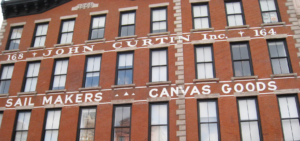
After arrival at Grand Central Station, our peregrinations took us past our old railroad flat with its rascally stairwell, as our four year-old daughter used to describe it. On Atlantic Avenue in Brooklyn John Curtin’s name still poses prominently for his sail making company, a reminder of a time when people as well as answers were blowing in the wind. In a park I met the white dove who might have sailed many seas and once slept in the sand but now pigeon-toes its way back and forth at my feet, cooing messages that entrance my unknowing mind. In Central Park, where as high school student I would train for basketball season by running around the reservoir track and later would wander dreamily looking for girls and watch Shakespeare plays at the Delacorte Theater, we dawdled under an avenue of cherry blossom trees whose blossoms flew like snow with the slightest breeze and little children screamed and ran in circles of delight and we silently lost ourselves in reveries of life’s ephemerality. Didn’t Eliot say that “the leaves were full of children,/Hidden excitedly, containing laughter. /Go, go, go, said the bird: human kind/Cannot bear very much reality”?

Scott Fitzgerald was right, when at the age of twenty-eight he realized through the voice of Nick Carraway that the future recedes before us year by year. It is the thought of a much older man, or a man who senses his mode of life is wrong and doomed. But he knew too that we are always “borne back ceaselessly into the past.” Dying at the age of forty-four, his past was quite brief and his future expunged.

But no matter how long or short our lifespans and no matter how fine or tragic our lives, everything and everyone who have passed through them are ours to accept or reject. One time and one time only – for every time is that one time – do we have a chance to say yes or no, to affirm or deny that everything is connected, is one. That we are who we were with all our experiences. And as Friedrich Nietzsche said, “ … if ever you wanted one thing twice, if ever you said, ‘You please me, happiness! Abide, moment!’ then you wanted all back. All anew, all eternally, all entangled, ensnared, enamored.” The good and the bad, all your life; for it is yours, no other’s.

It might sound strange that my thinking about Nietzsche brought me back to read The Great Gatsby. I first read it long ago, in high school as I recall, Regis High School, that sits on the upper east side of Manhattan between Park and Madison Avenues, a neighborhood where during four years, between my travels back and forth on the subway to and from my Bronx home, I would encounter the world of the very wealthy. Sometimes on cold evenings before basketball games, I would walk the neighborhood, mentally preparing to play my best. On Park Avenue I would watch the cabs and limousines glitter as they went back and forth, picking up and disgorging their rich passengers. Two blocks over on Fifth Avenue I would see women in mink coats walking little dogs in racoon wraps coming and going from doors opened and closed by doormen. I would often wonder what the doormen thought, having a great beloved uncle Nealy who was one. I thought that Gatsby, while wishing to also be treated with that old money obeisance, might think their wealth was also gotten by stealth, but of the legal kind. He would have been right in most cases. These thoughts that interrupted my game preparations stay with me still.

Nietzsche was always preoccupied with the connection between literature and life. He believed in making a work of art out of himself. He saw his own life as a narrative and authors’ best moments in their work. “The ‘work,’ he wrote, whether of the artist or the philosopher, invents the person who has created it, who is supposed to have created it: ‘the great,’ as they are venerated, are subsequent pieces of wretched minor fiction.”

On the train back from the city, May 1, the date of my father’s death, I read this from Freddy, as I have come to call my literary friend Nietzsche, who, despite his reputation, ironically or not, took Jesus very seriously, and who in his own way repeats his teaching that the kingdom of God is here now:

And if we consider that every human action, not only a book, is in some way or other the cause of other actions, decisions, and thoughts; that everything that happens is inseparably connected with everything that is going to happen, we recognize the real immortality, that of movement – that which has once moved is enclosed and immortalized in the general union of all existence like an insect within a piece of amber.

So do you think Gatsby was right in one way and right in the wrong way – that as individuals we not only can repeat our pasts but should (as in affirm them, not redo them) – because by doing so we take full responsibility for our identities, become who we are, assert our freedom, and immortalize our lives?

I do.

I do too, she said. Celebrate “the transitory enchanted moment” and eternity recurs! The eternal return.

As for the circumstances of our lives that we were tossed into and couldn’t control, accept them also. But from this moment on, our only time, let us try to create a social order where a book like The Great Gatsby never has to be written again, to make the world it describes a bad dream, so we can say with Nick Carraway that that “party’s over.”

Edward Curtin: Sociologist, researcher, poet, essayist, journalist, novelist....writer - beyond a cage of categories. His new book is At the Lost and Found: Personal & Political Dispatches of Resistance and Hope (Clarity Press). Read other articles by Edward, or visit Edward's website.


Can a Charter School Not Be a Private Entity?


Despite endless insistence by privatizers that charter schools are public schools, many people spontaneously think that charter schools are not public schools.

Much of the public does not automatically see charter schools as public schools proper. They are viewed as being different from public schools and put in a separate category than public schools.

When asked what they think a charter school is, the average person often says something like: “I’m not really sure, aren’t they some sort of private school, I really don’t know, but I have heard of them, they seem like private schools to me.”

In this vein, people often share different things they have heard about charter schools. For example, they have heard that charter schools are deregulated schools, take money from public schools, have high teacher turnover rates, cherry-pick students, offer no teacher retirement plan, have no teachers union, pay teachers less than public school teachers, etc. Such facts naturally infiltrate the public sphere and produce a certain social consciousness about charter schools, which have been around for 33 years.

Although the mass media works overtime to promote disinformation about the “publicness”/”privateness” of charter schools, it is significant that people generally see charter schools as being private in some way. There is a pervasive sense that charter schools and public schools are dissimilar entities with different structures, functions, aims, and results.[1] A main problem here though is that while people are aware of certain facts about charter schools they rarely have an integrated, cogent, well-worked-out analysis of what charter schools represent as an education arrangement in the U.S. A detailed big-picture view connecting many important dots is often missing, leaving many vulnerable to disinformation about charter schools.

A main reason for the widespread public perception of charter schools as private education arrangements is that charter schools do in fact differ from public schools in many ways, despite neoliberal efforts to mix up the “publicness” and “privateness” of these two different organizations.

But to add even more confusion to the mix, even some prominent “critics” of charter schools claim that charter schools are neither completely public nor completely private in character. They are supposedly “a little bit of both;” they are “a mix” of public and private.

According to this view, charter schools, all of which are owned-operated by unelected private persons, organizations, or companies, are supposedly “hybrid schools”—they are semi-private and semi-public, so to speak.

In other words, charter schools ride the public/private fence without being fully one or the other. This implies that one aspect (public or private) does not eclipse the other, which suggests that it is erroneous to see charter schools as the essentially privatized arrangements that they really are.

Keeping in mind that the U.S. constitution does not recognize education as a basic human right, it is important to discuss whether charter schools really operate as public schools or privatized education arrangements. This is not a trivial issue. Moreover, can charter schools be considered “hybrid” schools with both private and public features in the proper sense of both words, as some claim?

For starters, public and private mean the opposite of each other; they are antonyms. Importantly, public law deals with relations between the state and individuals, while private law deals with relations between private citizens. Contract law, for example, is part of private law. Charter schools are contract schools. Charter means contract. Thus, the laws that apply to charter schools differ from the laws that apply traditional public schools. This is why, for example, teachers’ rights in charter schools are not the same as teachers’ rights in public schools.

Public refers to everyone, the common good, all people, transparency, affordability, accessibility, universality, non-rivalry, non-discrimination, and inclusiveness. Examples of public goods include public parks, public libraries, public roads, public schools, public colleges and universities, public hospitals, public restrooms, public housing, public banks, public events, forests, street lighting, and more. These goods are available to everyone, not just a few people. They are integral to a civil society that recognizes the role and significance of a public sphere in modern times. Such public provisions can be optimized only in the context of arrangements that are genuinely and thoroughly democratic.

Private, on the other hand, means exclusive, not for everyone, not for the common good, not for all people, not collective, not governmental, not free, not broadly obtainable, only available to or accessible by a few. Something is private when it is “designed or intended for one’s exclusive use.” Examples include private property, private facilities, private schools, private clubs, designer shoes, Ferraris, first class plane tickets, mansions, and more. Such phenomena usually cost money, they are based on ability to pay.

To further elaborate, private also means:

-Secluded from the sight, presence, or intrusion of others.

-Of or confined to the individual; personal.

-Undertaken on an individual basis.

-Not available for public use, control, or participation.

-Belonging to a particular person or persons, as opposed to the public or the government.

-Of, relating to, or derived from nongovernment sources.

-Conducted and supported primarily by individuals or  groups not affiliated with governmental agencies or corporations.

-Not holding an official or public position.

-Not for public knowledge or disclosure; secret; confidential.

In its essence, private property is the right to exclude others from use of said property; it is the power of exclusion;[2] it is not concerned with transparency, inclusion, the common good, collective well-being, or benefitting everyone. This is why when something is privatized, e.g., a public enterprise or social program, it is no longer available to everyone; it becomes something possessed and controlled by the few, for the few. This then ends up harming the public interest and social progress. Privatization typically increases corruption, reduces efficiency, lowers quality, raises costs, and restricts democracy. This applies to so-called “public-private partnerships” as well.

It is also worth noting that something does not become “public” just because it is called “public” many times a day. Simply repeating over and over again that something is public does not magically make it public. Nor does an entity spontaneously become “public” just because it receives public funds. This is not the definition of “publicness.” Thus, for example, as contract schools, charter schools do not automatically become state actors (i.e., public entities) just because they receive public funds. “Publicness” requires something more under State Action Doctrine.[3]

It is not surprising that there has always been a big chasm between charter school rhetoric and reality. Over-promising and under-delivering has been a stubborn but down-played feature of this deregulated private sector for 34 years. This can be seen in the large number of charter schools that have failed and closed in three decades, leaving millions out in the cold (see here and here).

Charter schools may look, sound, and feel public on paper, but they work differently in practice and under the law. Most charter schools operate in a manner that is the opposite of their description on paper. They do not live up to their description on paper.

Unfortunately, many do not question the description of charter schools on paper. They impulsively assume that if something is written on paper and declared “legal,” then it is automatically valid, unassailable, and true in reality. They embrace “paperism.” Critical thinking disappears in this scenario and anti-consciousness takes over. Dogmatic repetition of legal text takes hold and all thinking freezes.

The reason this obstinate large gap between rhetoric and reality remains under-appreciated by many to this day is because neoliberal discourse on charter schools keeps everything at the superficial level, regularly eschewing deep analysis, especially analysis that exposes the private character of charter schools and rampant corruption in the charter school sector. And combined with confounding what is on paper with what exists in reality, many are prevented from discerning the inherently privatized character of charter schools and the significance of this conclusion for education, society, the economy, and the national interest.

To be clear, charter schools are not hybrid public-private schools, nor are they public schools, properly speaking. They are private entities. And in the final analysis, the fundamental principle at stake is that public funds must not flow to private entities or so-called “semi-private” entities because public funds belong only to the public. The private sector has no legitimate claim to public funds that belong solely to the public. Only the public sector can control and use public funds for public goals.

Non-profit and for-profit charter schools are private businesses, regardless of their size, name, education philosophy, type, authorizer, general makeup, or location. Charter schools have always been owned-operated by private organizations. They are not state actors. They are not political subdivisions of the state or government agencies. They are not organic or natural components of state public education systems. They are not set up like that under state laws.  Charter schools are not created by the State even though they may be delegated certain functions by the State. Creation and delegation are not synonymous. Furthermore, delegating a function (a way of doing something) is not the same as delegating authority (enforcing obedience). Charter schools are started/created by unelected private persons.

Charter schools have always been a different type of entity altogether: contract schools owned-operated by unelected private persons or organizations. They are performance-based contracts entered into by two distinct parties: a private organization and the government (or government-sanctioned entity). Naturally, partnering with the government is not the same as being part of the government. This is an important distinction in State Action Doctrine. Charter schools are not an arm of the government like traditional public schools are. They are not acting on behalf of a governmental body. Nor do they act with the same authority as the government. Interestingly, the appearance of the word “charter” before “school” is actually one of the many ways charter schools are distinguished from traditional public schools. It is also significant that the unelected private persons or corporations that own-operate charters, typically business people, derive more than an incidental benefit from owning-operating a charter school. Charter school administrators and trustees, for example, often derive a large amount of wealth and privilege from owning-operating a charter school.

For these and other reasons charter schools are intentionally called “independent,” “autonomous,” and “innovative” schools that do not follow most of the laws, rules, and regulations followed by public schools. These descriptors are key to the non-public character of charter schools. Consistent with “free market” ideology, charter schools are deregulated “schools of choice”—something “consumers” seek, even though most of the time it is the charter school that “chooses” the “shopper.”

Another major feature of the private character of charter schools is that, unlike public schools, they cannot levy taxes either. This is a particularly revealing difference between charter schools and public schools. Only the State and specific political subdivisions of the State (e.g., traditional public schools, cities, counties) can levy taxes. Charter schools are not part of this sovereign power. Also unlike public schools, charter schools are generally not zoned schools and their teachers are treated as “at will” employees, just like in a corporation. Many states even legally permit teachers to work in charter schools without any certification. Numerous other differences can be found here.

Public schools, on the other hand, are state agencies, actual government entities (1) created, (2) authorized, and (3) overseen by the State. They are therefore engaged in state action, while charter schools are not. Put differently, “Action taken by private entities with the mere approval or acquiescence of the State is not state action.”

As “autonomous,” “independent,” “innovative, “rules-free” schools, charter schools are not entangled with the state in the same way that traditional public schools are. The state’s mere labeling of an institution as public or private does not determine whether it is a state actor in State Action Doctrine. Under the law and in practice, the state exercises far more control over traditional public schools than it does over charter schools, which are “schools of choice,” at least on paper. Enrollment in a charter school is voluntary. In this sense, charter schools are more like private schools that have dotted the American landscape for generations. The main point is that the State does not coerce or compel charter schools to act in the same way as public schools proper. The degree of “entanglement” between the State and the entity in question is a very important consideration in State Action Doctrine. Artificial indicators, superficial signs, or various labels are not sufficient forms of “deep entwinement” with the State. The State must be “significantly involved” in a private entity’s actions in order to conclude that State action (and therefore the 14th Amendment) is at play. For decades, the actions of deregulated charter schools have not been attributable to the government, certainly not in the same way as the actions of traditional public schools have.

This is precisely why various provisions of the U.S. Constitution do not apply to privately-operated charter schools. Many private actions are not subject to constitutional scrutiny under State Action Doctrine. Certain constitutional standards generally do not apply to acts of private persons or entities. Constitutional standards apply mainly to the States and their subdivisions (like cities, counties, and school districts). Thus, as deregulated private actors, charter schools are generally not subject to liability under 42 U.S.C. § 1983,[4] while traditional public schools are. Never mind the fact that government has long been dominated by narrow private interests anyway. All levels of government today privilege private interests over the public interest. Americans exercise no control over what takes place in society.

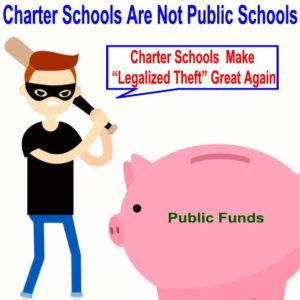
The main reason neoliberals tirelessly repeat the disinformation that charter schools are public schools, or that charter schools have enough meaningful public features about them to render them “public” schools, is in order to justify siphoning billions of dollars a year from traditional public schools that have educated about ninety percent of America’s youth for generations. Charter schools could not seize these public funds if they were not called “public.” If they were openly recognized as the privatized entities that they are, what valid claim would they have to public funds? Public funds belong to the public. Why should public funds be handed over to private interests?

To go further, charter schools are privately-operated schools that increase segregation, intensify corruption, spend millions on advertising, have high teacher turnover rates, and constantly seek ways to maximize profits regardless of whether they are designated as non-profit or for-profit entities. They are fundamentally pay-the-rich schemes that are proliferating in the context of a continually failing economy dominated by major owners of capital. For these and other reasons, the intrinsic character of charter schools cannot be changed easily or quickly, especially given how long they have been around and how charter school laws have been written for 34 years. Can a charter school not be a charter school? Charter school owners-operators are big supporters of no governmental control and have long-referred to charter schools as “free market” schools.

For more than three decades this neoliberal financial parasitism has been cynically carried out in the name of “serving the kids,” “empowering parents,” “promoting innovation,” “getting results,” “providing choices,” “busting teacher unions,” and “increasing competition.”

Individualism, self-interest, consumerism, competition, and a dog-eat-dog ethos—the  so-called “free market”—frame and drive this assault on public education and the public interest. Charter school advocates have long promoted a survival-of-the-fittest view of human relations. They believe parents are consumers who should fend-for-themselves in their quest to secure a “good education.” They think it is normal if a charter school fails, closes, and abandons everyone. This is how “businesses operate,” neoliberals casually declare.

Charter school promoters do not view parents and students as humans with an inalienable right to education that must be guaranteed in practice. You are basically on your own as you spend an extensive amount of time “shopping” for a “good” school. Fingers crossed. There are no guarantees of stability, quality, or security. Such an arrangement is claimed to be “the best of all worlds” in which the “fittest” survive while the “weak” fail. There is supposedly no conceivable alternative to this Social Darwinist ethos and the discredited racist doctrine of DNA that underlies such an obsolete ideology.

The  private character of these outsourced contract schools also comes out in the fact that all charter schools in the U.S. are not only governed by unelected private persons, but many, if not most, are routinely supported, operated, or owned directly by wealthy individuals and organizations that are wreaking havoc in other spheres of society in the name of progress. In fact, many charter schools are openly operated as for-profit schools, which means cashing in on kids is their “education model.” Students are seen as a source of profit for these privately-owned-and-operated contract “schools of choice.”

Widespread patronage and nepotism in the charter school sector only add to the problems plaguing this deregulated sector, and a persistently low level of transparency and accountability in this deregulated sector does not help either. Charter authorizing bodies, the entities that supposedly oversee charter schools for a fee, have had little impact in ensuring high standards and quality in this nonpublic sector. In practice, “free market” accountability has actually lowered quality and standards.

Philosophically, legally, academically, organizationally, programmatically, and socially charter schools have little in common with public schools. They have more in common with private organizations and corporations than with public entities.

It is no accident that in recent years, neoliberal disinformation about the “publicness” and “privateness” of charter schools has become more debased in a desperate attempt to justify the expansion of charter schools across the country. Deliberate mystification about the “publicness” and “privateness” of charter schools has been at the forefront of neoliberal ideology and school privatization, disorienting even some critics of charter schools. But such “justifications” do not work because they lack legitimacy and authority; they are belied by reality.

A main thrust of the decades-long neoliberal antisocial offensive of neoliberals is to blur the distinction between public and private so as to promote narrow private interests in the name of serving the public interest. Such a top-down agenda carried out under the veneer of high ideals is self-serving because it damages education, society, the nation, and the economy. It undermines a modern nation-building project that empowers people and rejects monopolization of the economy by major owners of capital.

Charter schools prove that not every “innovation” that comes into being in the name of “education reform” benefits education, society, the economy, and the national interest.

The oral arguments presented on April 30, 2025 in the Supreme Court of the United States (SCOTUS) on the public funding of St. Isidore of Seville Catholic K-12 Virtual School in Oklahoma show that there is a strong push to treat charter schools as the private entities they are, and that the long-standing critical distinction between public and private is marred by more confusion and disinformation than ever. Keeping in mind that charter schools are “public” only on paper, if SCOTUS deems charter schools to be state actors (i.e., public schools), then the First Amendment’s Establishment Clause applies, which means that charter school cannot be religious. However, early news reports suggest that, for the first time in history, SCOTUS may well approve the funneling of public funds to private religious actors like St. Isidore. While no court decision will change the long-standing private character of charter schools for the last 34 years, a final decision on this divisive landmark case by the SCOTUS is expected in June 2025. More on this in a future article.

The first charter school law in the U.S. was established in Minnesota in 1991. Today, about 3.8 million students attend roughly 8,000 charter schools across the country. Charter schools are legal in 47 states, Washington DC, Puerto Rico, and Guam.

ENDNOTES:

[1] The vast majority of teacher education students in the United States pursue teaching credentials in order to teach in a traditional public school. Very few, if any, are striving to become charter school teachers.

[2] The right to exclude is “one of the most treasured” rights of property ownership.

[3] It should always be borne in mind that the State today is a State of the rich and not a State that serves the public interest.

[4] The 14th Amendment is central to State Action Doctrine.

Shawgi Tell is author of the book Charter School Report Card. He can be reached at stell5@naz.eduRead other articles by Shawgi.

The Explosive Israeli Bomb

The nuclear deterrent that is not designed to deter


When the United States sent the B-29 Super fortress bomber, Enola Gay, to drop “Little Boy” on an unwary Hiroshima and usher in the nuclear age, its administration neglected to plan for a major concern; how to prevent nuclear proliferation. Granted, America could not deter the Soviet Union and China from developing nuclear capabilities and did not want British and French allies from feeling deprived. The word “deterrent” guided who could develop an arsenal of mass destruction. Nuclear weapon balance would deter aggression between nuclear equipped nations.

The nuclear powered nations, with the United States in the lead, had the power to prevent other nations from atomic bomb making and force them into being content with conventional armaments. Why did they neglect to perform the dutiful task? Was it because Israel started nuclear weapons developments in 1963 and none of its antagonists were thinking nuclear? No rationale existed for Israel to have nuclear balance or a “deterrent.” Its nuclear pursuits meant obtaining nuclear unbalance and demonstrating, if it became necessary, doomsday capability. By allowing Israel to have the Samson option and develop atomic weapons, the U.S. and friends stimulated an arms race; Middle East nations sought means to neutralize the Israel bomb. Saddam Hussein expressed this dilemma in a speech at al-Bakr University, 3 June 1978.

When the Arabs start the deployment, Israel is going to say, ‘We will hit you with the atomic bomb.’ So should the Arabs stop or not? If they do not have the atom, they will stop. For that reason they should have the atom. If we were to have the atom, we would make the conventional armies fight without using the atom. If the international conditions were not prepared and they said, “We will hit you with the atom,” we would say, “We will hit you with the atom too. The Arab atom will finish you off, but the Israeli atom will not end the Arabs.”

France started Israel on the road to nuclear capability with the sale of a nuclear reactor and uranium fuel. From Israel’s Nuclear Weapon Capability: An Overview, The Risk Report, Volume 2 Number 4 (July-August 1996).

Franco-Israeli nuclear cooperation is described in detail in the book ‘Les Deux Bombes’ (1982) by French journalist Pierre Pean, who gained access to the official French files on Dimona. The book revealed that the Dimona’s cooling circuits were built two to three times larger than necessary for the 26-megawatt reactor Dimona [supplied by France] was supposed to be – proof that it had always been intended to make bomb quantities of plutonium. The book also revealed that French technicians had built a plutonium extraction plant at the same site. According to Pean, French nuclear assistance enabled Israel to produce enough plutonium for one bomb even before the 1967 Six Day War. France also gave Israel nuclear weapon design information.”

Great Britain paved the road for Israel to reach the bomb. When he was UK prime minister, Harold Wilson supplied Israel with plutonium.

In Harold Macmillan’s time the UK supplied uranium 235 and the heavy water which allowed Israel to start up its nuclear weapons production plant at Dimona – heavy water which British intelligence estimated would allow Israel to make ‘six nuclear weapons a year.’

The United States looked the other way.

After the United States discovered the Dimona reactor in 1960, U.S. nuclear specialists inspected Dimona every year from 1965 through 1969, looking for signs of nuclear weapon production. It is not clear what they found, but in 1968 the Central Intelligence Agency (CIA) reported to President Lyndon Johnson its conclusion that Israel had already made an atomic bomb. In 1969, Israel limited inspection visits by U.S. scientists to such an extent that the Americans complained in writing. Without explanation, the Nixon administration ended the visits the following year.

By tacitly agreeing to Israel’s nuclear weapon developments, the western powers allowed India to casually develop its nuclear arsenal. Belatedly and ineffectively, the U.S. terminated economic and military aid to Pakistan in Oct. 1992 and tried to discourage a frightened Pakistan in its attempt to achieve a “balance of terror.” Muslim nations cannot have deterrents. The bluster did not work. Not containing the atomic arsenals of the two arch foes on the India continent is one of the major foreign policy and military policy blunders of the post-war era. Every few years, both nations engage in confrontations, prepared for a war that could unleash nuclear catastrophes.

The consequence of not facing down to India and Pakistan propagated the nuclear arms race. Could there eventually be a nuclear weapon in the military depots of extremists? Pakistan has many atomic bombs, which Pakistan’s present government won’t use, but it is possible that anarchy in Pakistan can enable bombs to slip to radical groups that have no compunction in exploiting the deadly weapon. The laxity is emphasized by the lack of control on previous actions by Dr. Abdul Qadeer Khan, Pakistan’s (in)famous nuclear physicist.

In 2004, Dr. Khan indicated he had provided Iran, Libya, and North Korea with designs and centrifuge technology to aid in nuclear weapons programs. Where was the CIA when Khan roamed the world? Pondering about Iran, no doubt, and developing policies that have driven Iran to pursue nuclear developments.

Blind to the effects on Iran’s posture, the U.S. staged its military in adjacent nations to Iran, constantly harangued Iran about its human rights record and its despotic government, and accused Iran of dubious terrorist activities. None of these activities were adequately described and the charges did not consider that Iranians are mysteriously getting assassinated, their facilities are being blown up, their computers are attacked by the Stuxnet virus, and CIA spies are being uncovered and arrested by them. Threatened, attacked, blindsided, and expecting destruction by Israel’s vassal, is it strange that being falsely accused of terrorist activists while being terrorized might force the Islamic Republic to pursue the nuclear deterrent. Same with North Korea.

Considering U.S. intensive hostility towards the Democratic People’s Republic of Korea (DPRK), coupled with its extensive military presence in Japan and South Korea, shouldn’t the Pyongyang leaders be apprehensive? Their apprehension inspired them to welcome previous treaties. In October 1994, President Clinton negotiated the healthy U.S.-North Korea Agreed Framework:

  • North Korea agreed to freeze its existing plutonium enrichment program and be monitored by the IAEA;
  • Both sides agreed to replace by 2003 North Korea’s reactors with light water reactors, financed and supplied by the Korean Peninsula Energy Development Organization (KEDO);
  • The United States agreed to provide heavy fuel oil to the DPRK for energy purposes until atomic energy was available;
  • The two sides agreed to move toward full normalization of political and economic relations;
  • Both sides agreed to work together for peace and security on a nuclear-free Korean Peninsula; and;
  • Both sides agreed to work together to strengthen the international nuclear non-proliferation regime.

What happened to this anxiety relieving treaty? The charges, countercharges, truths, and distortions are difficult to unravel. Not debatable is that the George W. Bush administration signaled North Korea with unfriendly intentions. Despite being the most significant milestone in the treaty, the first reactor, promised for delivery by 2003, was pushed up until 2008 at the earliest. A leaked version of the Bush administration’s January 2002 classified Nuclear Posture Review mentioned North Korea as a country against which the United States should be prepared to use nuclear weapons.

After starts and stops, self-destruction of nuclear facilities and reconstruction of the same facilities, the DPRK proceeded to definitely develop nuclear weapons. Their arguments for this posture had validity. The United States did not meet its most important commitment, President George W. Bush designated North Korea as part of an “axis of evil,” the State Department continually equated not having a peace treaty with Pyongyang violations of human rights, and Washington carelessly inferred that, if hostilities developed, North Korea could expect a nuclear attack. What did the Bush administration expect of the ‘hermit state’ leaders? The U.S. State Department evidently imagined, by being conciliatory, Kim Jong Un would take advantage and secretly develop an atomic bomb. However, by not being conciliatory, it assured the DPRK would be provoked into securing a nuclear weapon.

Except for the United States’ offensive attack against Japan, the nuclear club nations that signed the nuclear non-proliferation treaty developed the weapons as deterrents. The Soviet Union needed to oppose USA power. Great Britain and France requisitioned a nuclear arsenal to defend against the Soviet Union. China had the greatest fear ─ it was surrounded by a world of enemies.

Of those who have not signed the Treaty on the Nonproliferation of Nuclear Weapons — India, Pakistan, North Korea, and Israel — all, except Israel had deterrent as an immediate reason. India feared China, Pakistan feared India, and North Korea feared the United States. When Israel started nuclear weapons developments in 1963, none of its antagonists, gushing in oil, mentioned the word ‘nuclear.’

Shouldn’t the U.S. State Department consider in its policies the argument that those most likely to use the bomb are more important than those who pursue the bomb? Great Britain has the bomb, but there is no possibility it will use the weapon. There is little probability that even if about to be defeated, the DPRK will use the bomb ─ against whom, their own brethren? Only Pakistan radical elements and Israel can effectively use the bomb in an offensive manner; the former because they have suicidal elements, and the latter because it does not face nuclear retaliation.

Even if an engaged nation had a nuclear weapon, and presently none of Israel’s foes have a mass destruction device, Israel’s small size and closeness to Arab peoples in adjacent nations give it a protection against a nuclear strike. The possibility of inflicting severe damage to innocent Arab populations in the neighboring countries hinders a retaliatory action to Israel’s aggression. Israel’s principal reason to have the bomb is for the threat, real or imagined, it poses to any nation that counters its policies. The Islamic Republic cannot use nuclear weapons for an offensive purpose. Any attempt to do that and Iran’s enemies will extinguish the Islamic Republic in a flash of the radioactive light. Its bomb can only neutralize other bombs

In the 1973 Yom Kippur War, when Israel faced possible defeat, a fear existed that unless the United States assisted Israel with more armaments, Israel might use nuclear weapons against its adversaries. A large U.S. airlift of military aid finalized the battle in favor of Israel. A French official explained the situation.

In 1986, Francis Perrin, high commissioner of the French atomic energy agency from 1951 to 1970, was quoted in the press as saying that France and Israel had worked closely together for two years in the late 1950s to design an atom bomb. Perrin said that the United States had agreed that the French scientists who worked on the Manhattan Project could apply their knowledge at home provided they kept it secret. But then, Perrin said, ‘We considered we could give the secrets to Israel provided they kept it a secret themselves.’ He added: ‘We thought the Israeli bomb was aimed against the Americans, not to launch it against America but to say ‘if you don’t want to help us in a critical situation we will require you to help us, otherwise we will use our nuclear bombs.

After the smoke screen that guides the talks with Iran clears, the brightened atmosphere might reveal that the initial development of the Israeli bomb was to deter the U.S. from interfering with Israel’s expansion plans, as the U.S. did in the 1956 Suez War.

How could the U.S. behave so recklessly, not realizing it was responsible for the atomic arms race and for allowing and even moving others to obtain the bomb? Why does it not consider in its policies the argument that those most likely to use the bomb are more important than those who desire the bomb? Answers to both these questions expose an almost purposeful U.S. policy to drive others to obtain the “doomsday explosive.” A simple proposition can deaden that determination, and not only for Iran; the world’s major powers can give any nation that entertains a “first strike” a rethink ─ do it and get demolished.

Which leads to the a way to halt nuclear proliferation in the Middle East ─ either dismantle all existing bombs or allow them to be neutralized. Better yet ─ signal that a first nuclear strike by any nation will be met by a severe strike on that nation with conventional weapons from the great powers of the United Nations Security Council. Give them an offer they can’t refuse. Not far-fetched!

Dan Lieberman publishes commentaries on foreign policy, economics, and politics at substack.com.  He is author of the non-fiction books A Third Party Can Succeed in AmericaNot until They Were GoneThink Tanks of DCThe Artistry of a Dog, and a novel: The Victory (under a pen name, David L. McWellan). Read other articles by Dan.