Sunday, May 11, 2025

SMOKERS’ CORNER: BETWEEN DOGMA AND SURVIVAL

DAWN
May 11, 2025 

Illustration by Abro


In a 1956 essay, the British writer Aldous Huxley wrote, “At least two thirds of our miseries spring from human stupidity, human malice, and by the great motivators and justifiers of malice and stupidity: idealism, dogmatism and the proselytising zeal on behalf of religious or political idols.”

Huxley wrote these words just 11 years after the end of World War II. The memory of the horrors of that war would have still been fresh in his mind — such as the memory of an idealistic programme in Nazi Germany to create a ‘1,000-year Reich’ founded on the supposed intellectual, spiritual and physical ‘superiority’ of the white ‘Aryan race’, which was ‘destined’ to rule supreme after vanquishing ‘inferior’ races.

Such beliefs were concocted by the Nazis to motivate a polity that was struggling to come to terms with the ‘humiliation’ that their country had suffered in the First World War. Then, in the late 1920s, Germans became victims of a rapidly crumbling economy. So, a lot of them quite liked the idea of being told that they were a superior race, led by a ‘strongman’ (Hitler), who shaped himself not only as a ‘fearless leader’, but also as a messianic figure whose impulse, will and wisdom would put in place the building blocks of the coming 1,000-year Reich.

Therefore, the core theme in most of Huxley’s post-war writings was the manipulation of whole societies through ideologies that harden to become dogmas. These dogmas are then given a sacred status. Huxley was most concerned by the fact that this process diminishes the ability of critical thinking in societies because the education that is imparted in schools is more about indoctrinating ideologies and dogmas rather than about sharpening and expanding the intellect.

In an age of rising populism and fragile states, Pakistan’s ‘hybrid system’ may be less about democratic ideals and more about national survival and political pragmatism

But doesn’t it take the indoctrination of one ideology to dislodge another?

Soon after World War II, democracy was pitched and romanticised (by the West) as an ideology against those ideologies that stifle thinking and ‘natural rights’. But what the world has been witnessing from the 2010s is an adverse reaction to democracy. This reaction is manifesting a renewed interest in many people in stiffer ideologies, even to the extent of them desiring to be ruled by messianic figures and ‘strongmen’.

This is mostly emerging in the shape of populism. Populism is often described by political scientists as a ‘thin-centred ideology’, or an albeit clumsy, theatrical style of politics that borrows from other ideologies. Nevertheless, today it is gleefully devouring democracy.

Interestingly, there is a school of thought that suggests that by borrowing heavily from the right, clumsy modern-day populism has even begun to erode mainstream conservatism and conventional right-wing politics. However, the other (more alarming) view is that, clumsy or not, populism will lead to the return of systematic fascism and totalitarianism.

Keeping in mind the way populism is causing some serious social, economic and political disruptions in established democracies (in Europe, the US and India) — imagine what it may end up doing in developing democracies such as Pakistan. Actually, one has already seen what it did before it was uprooted — not by another ideology — but by an ‘-ism’ that is often not considered to be an ideology as such: (political) pragmatism.


Ideologies are systems of beliefs and values that shape understanding of the world and guide actions. Political pragmatism is an approach focused on the practical consequences and usefulness of ideas and actions. Idealists and romantics detest it. They call it ‘centrism’. They do so because they can’t help but view things through an ideological lens alone. Centrism is an ideology, but it is different from political pragmatism, which isn’t one.

I will try to demonstrate this by making a case for political pragmatism as an effective deterrent against populism in Pakistan. This political pragmatism is manifested by what we now call the ‘hybrid system’ that produces ‘hybrid regimes.’ Hybrid regimes — at least in the context of Pakistan — are governments that are ‘democratic’ but in which state institutions such as the armed forces are ‘allowed’ to become important stakeholders in the decision-making process.

Ever since the 1990s, Pakistan has had hybrid regimes. But the hybrid system that the military establishment (ME) began weaving from the early 2010s was almost officially declared as a recognised system in 2018. It had serious teething problems, though, mainly because the ME chose to pick populism as a ‘useful idea.’ Ideologies, including thin-centred ones such as populism, do not gel well with pragmatism.

Therefore, by 2019, the populism-centred hybrid system began to trigger deep structural conflicts, until the ME decided to pull out the system’s populist drive and replace it with the experience of established mainstream parties that are inherently pragmatic.

The hybrid system was not discarded. It remained in place but, this time, instead of pretending to be based on an ‘ideology’, it is justifying itself as a necessity to maintain economic and political stability, something It has somewhat succeeded in achieving. It does not have any idealistic pretensions, other than that of the textbook nationalism kind. It is largely pragmatic and antithetical to any kind of populist politics.

Of course, as expected, those who were ousted by it, and the usual cast of idealists and romantics, are constantly castigating it. A lot of their criticism does carry weight. But, I also believe, there is nothing so terribly flawed in the argument that the hybrid system as it is today is indeed a necessity — at least until threats posed by populist politics, economic fragility, insurgencies in Balochistan and Khyber-Pakhtunkhwa, and by India, are largely warded off.

This needs to be done (and is being done) in a realistic and pragmatic manner. We can all return to play with ideology later, when actual threats are actually mitigated.

Published in Dawn, EOS, May 11th, 2025


UK Increases Funding and Areas to Spur Offshore Wind Energy Development

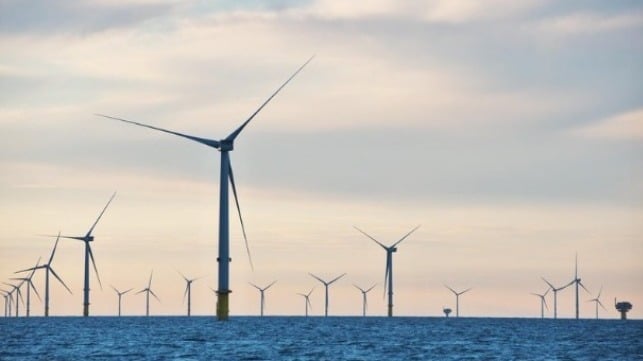
offshore wind farm
UK is taking more government steps to spur offshore wind development (Vestas)

Published May 9, 2025 5:20 PM by The Maritime Executive


Offshore wind energy continues to be a key portion of the UK’s plan for renewable energy with the government announcing on May 9 that it will expand funding and the available areas in response to strong demand from the industry. The UK continues to be the leader in Europe and the second largest globally with nearly 15 GW currently installed, while the government has set a target to reach 50 GW by 2030.

This week, the plan appeared to be in jeopardy when Danish developer Ørsted said it had decided to shelve plans for the fourth phase of the Hornsea project. Located 75 miles off the east coast of England, the first phase of the project started generation in 2020 with 1.2 GW of capacity, followed by phase 2 in 1.4 GW in 2022. Construction is underway on Hornsea 3, which will add 2.9 GW, while the now-shelved fourth phase was to provide an additional 2.4 GW. Ørsted cited the continued increase of supply chain costs, higher interest rates, and an increase in the risk to construction and operation on the planned timeline.

Secretary Ed Miliband, heading the Department for Energy Security and Net Zero, countered today asserting that the government continues to receive strong interest for the development of offshore wind energy projects. He said hundreds of bids have been received in the latest government scheme, a “strong signal that industry supports the government’s clean power by 2030 mission.” 

Following higher than expected demand, the Energy Secretary said the government was going to increase funding in its Clean Industry Bonus program from the planned £200 million ($266 million) to £544 million ($724 million). The award winners will be announced shortly.

The Clean Industry Bonus program will provide financial rewards for offshore wind developers that prioritize investments in regions that most need clean energy. The government points to the opportunities to aid traditional oil and gas communities, ex-industrial areas, ports, and coastal towns. According to the government, the program will support cleaner manufacturers, new upgraded factories, port infrastructure, and more business for UK supply chains. This and other government support efforts are projected to spur up to £9.3 billion ($12 billion) in private sector investment over the next four years.

“Now is the time to go further and faster to capture this unrivalled opportunity for green industrial growth,” said Claire Mack, Chief Executive at Scottish Renewables.

Last month, Prime Minister Keir Starmer announced they were accelerating £300 million ($400 million) in investment through another scheme, Great Britain Energy, to support the growth of the offshore energy sector. Since taking office in 2024, Starmer’s government has also increased the pricing subsidy and taken other steps to support the development of wind and other renewable energy sources.

At the same time, on Friday, The Crown Estate, which is responsible for the management of Britain’s seabed rights, announced it was also taking steps to expand offshore wind energy. It approved the Capacity Increase Program, which will maximize existing offshore wind lease areas for seven current wind farms. By amending the seabed rights, The Crown Estate estimates an additional 4.7 GW of energy could be generated. 

The Crown Estate highlights that the projects were awarded rights in the Round 3 leasing that took place in 2010 or the 2017 Wind Extension program. All seven of the projects have existing grid connections and infrastructure, which The Crown Estate says will enable swift development, noting they are within pre-established offshore wind energy sites.
 

Canada Marks 80th Anniversary of Battle of the Atlantic

Royal Canadian Navy
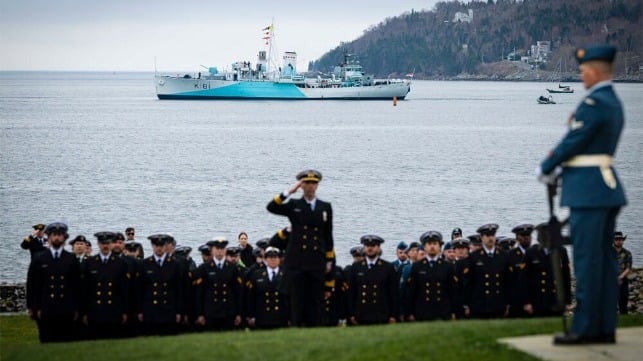
Canada conducted ceremonies to mark the 80th anniversary of the end of the Battle of the Atlantic (RCN)

Published May 9, 2025 7:51 PM by The Maritime Executive


Canada is maintaining its tradition of honoring the heroism of sailors who took part in the Battle of the Atlantic and ended up paying the ultimate price. On May 4, the country commemorated the 80th anniversary of the battle that was the longest continuous military campaign during World War II and which claimed the lives of 4,600 Canadians.

Canada has designated the first Sunday in May as the day navy families gather to commemorate the battle, not only to honor the struggle, sacrifice, and loss but also to celebrate the courage of its sailors in the face of daunting obstacles. This year, events were held across the country in order to keep the memories alive.

The Battle of the Atlantic, which lasted from the outbreak of hostilities in September 1939 until victory in May 1945, is credited with transforming the Royal Canadian Navy (RCN) from a tiny, ill-equipped, and under-trained force into one of the largest navies. At the outbreak of the war, the RCN comprised only six destroyers, a handful of smaller vessels, and 3,500 sailors. By the time the conflict was ending, RCN had grown to over 373 fighting ships and almost 100,000 sailors.


The battle remains an important aspect of WWII. With continental Europe under Nazi Germany’s control, the United Kingdom stood alone against the Nazi threat. To sustain Britain’s war effort, supplies of food and war materials from the rest of the world had to be shipped there. The Nazi used all-out submarine warfare to try to cut Britain off and starve the island nation into submission, making no distinction between military warships and civilian merchant vessels.

In response, convoys were formed, with warships (escorts) protecting the merchant ships carrying the supplies. Canada was at the forefront in providing its warships to offer escort services. Over the course of the war, Canada alongside other allied naval and air forces fought more than 100 convoy battles and performed as many as 1,000 single ship actions against submarines and warships of the German and Italian navies. The RCN destroyed or shared in the destruction of 33 U-boats and 42 enemy surface craft.

RCN suffered significant casualties. The country lost over 60 ships while over 2,100 sailors, 1,700 merchant mariners, and more than 900 aviators lost their lives. The battle also reached Canadian waters with 23 ships sunk in the Gulf of St. Lawrence and the St. Lawrence River.

“As we commemorate the 80th anniversary of the Battle of the Atlantic, we honor the bravery of the Canadians who served with unwavering resolve and remember those who made the ultimate sacrifice. The Battle of the Atlantic left a lasting imprint on Canada’s national story and the identity of the RCN,” said Vice-Admiral Angus Topshee, RCN Commander.

On the 80th anniversary, Topshee recalled the bravery and inspiring action of the sailors of HMCS Esquimalt, the last Canadian ship sunk in the war on April 16, 1945. The sinking, coming just three weeks before the end of the war, remains a painful memory as 44 sailors, more than half of the crew, died within sight of their home port of Halifax. 

This year’s ceremonies were more poignant as the number of living World War II veterans continues to decline. 
 

Canada's Veterans organization compiled a detailed history of the Battle of the Atlantic presented online.

'I was there when the German U-boats surrendered'

David Wilson
BBC News NI

BBC
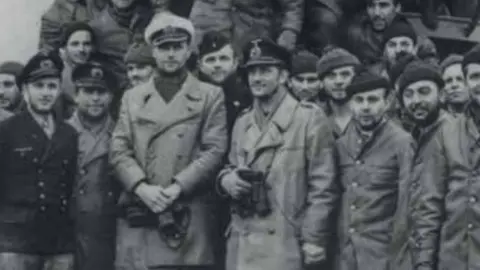
Bert Whoriskey was 14-years-old when a fleet of U-boats berthed outside his home

On 14 May 1945, almost a week after Britain and its allies celebrated victory in Europe, Hitler's defeated Atlantic U-boats berthed for the final time.

The German submarines – the "U-boat peril" as Churchill had called them - had been the Allies' principal threat at sea during the Battle of the Atlantic, a campaign that raged throughout the war.

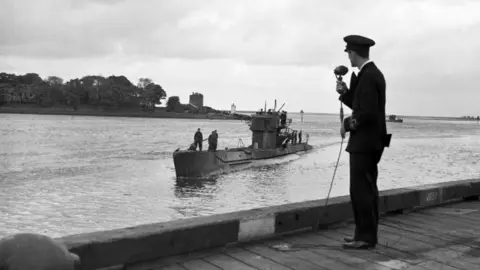
On that day, the first of the U-boats made their way up the River Foyle to Lisahally in County Londonderry to formally surrender.

Eighty years on, Bert Whoriskey, then just 14, and who watched the surrender, told BBC News NI it is a day he can "never ever forget".

'The war had ended, excitement was second to none'

"The war had ended, excitement was second to none, " he said.

"There were ships of of all kinds, and at their head a big Navy destroyer, and there they were coming up the Foyle.

"The U-boats were following, around eight, or 10 of them, and they berthed about 200 yards from our house."

BBC commentator Lt. Commander Harry McMullan, reported on the surrender of German U-boats at Lisahally

Pre-war, Lisahally had been a quiet hamlet on the shores of the River Foyle.

It was home to about 20 families, mainly workers at a manure factory, whose homes had been built by the factory owners.

"All we had was a nice cricket pitch, and a pavilion – that was Lisahally until 1939 when Hitler decided it was time to have a war," Bert said.

Within months, Lisahally, as well as the city of Derry, and the wider north west of Northern Ireland, would be transformed. Lisahally would become one of the Allies' most strategically important ports.

Vast amounts of timber arrived, stretched out across Bert's childhood cricket pitch, along with US Naval Construction Battalions (Seabees).

Work began, and continued day and night for months.

A huge jetty was built at the "back of our house," he said.

Then the Royal Air Force arrived.

Huge oil storage facilities were built nearby, an airfield too.

Barrage balloons arrived, surrounding the area to protect it from air strike.

'Lisahally was ready'


Never had then nine-year-old Bert "seen anything as big".

"When that was all built you just looked at it, Lisahally was ready," said Bert.

Soon, he said, the ships started to arrive.

"Destroyers, battleships submarines, they all came to refuel and rearm. There was British, Canadian, American, Australian, Dutch. This went on every day for the rest of the war," Bert said.

Derry City and Strabane District Council Archive Collection
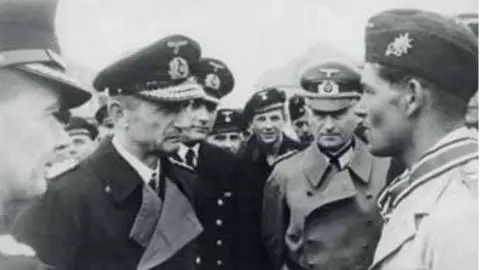
U-boat commanders were formally ordered to surrender by Admiral Sir Max Horton, commander-in-chief, Western Approaches

The naval base - shared by the Royal Navy, the Royal Canadian Navy and the United States Navy - was vital to the protection of convoys in the Atlantic.

At one time, 140 Allied escort ships were based on the River Foyle, and Londonderry was home to Base One Europe, the US Navy's operating base in Northern Ireland.

The Battle of Atlantic was the longest continuous military campaign of World War Two.

More than 66,000 Allied merchant seamen, sailors and airmen died, with 175 Allied warships and 5,000 merchant ships destroyed by German U-boats.

'They paid the ultimate price'

As months gave way to years, Bert said, "you could see the the price that was being paid for where we are today".

"The ships were coming in damaged. They would have let us on every once in a while. The young men who were crewing the ship, you could see in their faces they were terrified," he said.

"Nearly every day there would be bodies on the jetty, waiting to be taken away. That always comes back into my dreams, the bodies on the jetty getting put into the back of a lorry - people who paid the ultimate price."

When victory in Europe finally came, Bert remembers sailors jumping into the Foyle "because they were so excited".

A "big announcement" came in the days that followed, he said.

"They announced the U-boats fighting at our end of the Atlantic were surrendering at Lisahally," he said.

On 14 May the first of the U-boats berthed at Lisahally and formally ordered to surrender by Admiral Sir Max Horton, commander-in-chief, Western Approaches.

"Of all the things that happened, all the things we had seen, this was the biggest of them all," Bert said.

"We were only young. All we thought was we had spent six years fighting the Germans, and now we were going to see actual real Germans," Bert said.
Advertisement

Derry City and Strabane District Council Archive Collection
Bert remembers the German crews singing marching tunes, and playing football after their surrender


Bert and his pals had to wait until "all the pomp died down".

"The first thing we heard was the singing of marching tunes.

"When we looked at them and I will never forget, they were all very young. Not many of them were even as old as 30.

"You could tell they were glad the war was over, they knew they had survived."

The German submariners were held at the naval base for about a year and Bert and his friends used to go down and look through the fence.

"One day they were all on their knees in a big line, we thought they were going to be shot," Bert said.

"What they were doing was pulling the grass out of the ground to make a football pitch – the next day a goalpost was put up.

"We spent time marching up and down with them. They made us toys at Christmas, they made a toy double decker bus – I had never seen a double decker bus."


Admiral Lord West of Spithead said the port in Northern Ireland was hugely important

Derry's strategic importance can not be underestimated, Admiral Lord West of Spithead, the First Sea Lord and Chief of the Naval Staff from 2002 to 2006, said.

"It was absolutely crucial and we needed to get our ships and facilities as far to the west as we could," he told BBC Radio Ulster's Good Morning Ulster programme.

"It was wonderful that we could use the base up in Londonderry which put our ships a bit closer."

The U-boats were deliberately sunk - or scuttled - off the coast of Derry and Donegal after the war.

A special event to commemorate the city's wartime role is set to take place in Derry's Ebrington Square on 17 May.


Robberies Continue in Singapore Strait with Six Ships Hit in May

Robberies Singapore Strait
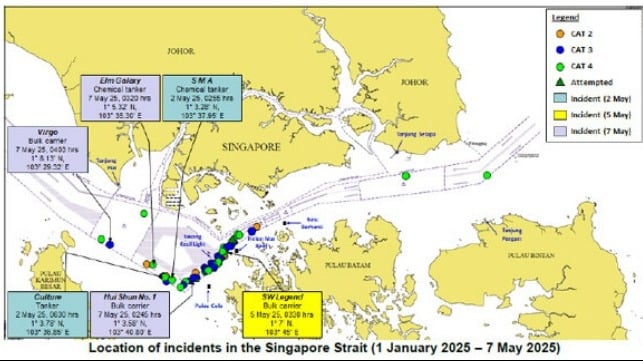
Map shows the clustering of the 50 incidents in 2025 (ReCAAP)

Published May 9, 2025 6:46 PM by The Maritime Executive


ReCAAP (Regional Cooperation Agreement on Combating Piracy and Armed Robbery against Ships in Asia) is sounding the alarm as the robbery spree in the area around the Singapore Strait continues. The organization, which marked 20 years, is expressing concern and warning of the possibility of further incidents.

While there has been a total of 50 incidents reported to ReCAAP since the start of 2025, they are highlighting that there were three incidents in close proximity in one hour and 15 minutes on May 7 and two other incidents in just three and a half hours on May 2. All the incidents were aboard vessels underway in the eastbound lane of the Singapore Strait near the western area near the Phillip Channel. Most of the incidents reported in 2025 have been in this same area.

Most of the incidents are robberies where the perpetrators attempt not to interact with the crew or flee when they are spotted. ReCAAP, however, has warned that more of them are being seen with guns or knives, including two people who appeared to have guns when they were spotted among a group of five boarders on a Greek-owned bulker, Virgo, on May 7. The two boarders seen on the Wisdom Ocean bulk carrier Hui Shun No. 1 on May 7 had knives.

The incidents vary between a single person aboard the MOL Singapore chemical tanker Elm Galaxy to five people on the UAE-managed product tanker S M A on May 2. Both the S M A and the Galaxy reported engine spare parts were stolen, while the other vessels did not report anything missing. None of the crew were injured in any of the latest incidents.

ReCAAP notes its concern stems from the dramatic increase. This year it has received 50 reports compared with 14 incidents between January 1 and May 7, 2024.

As it is only a monitoring and coordination initiative designed to educate everyone, ReCAAP can only issue alerts. It is, however, again urging the littoral states to increase patrols and surveillance in the region. They said it is critical to respond promptly to reports from the vessels and to strengthen coordination and promote information sharing.

For ships transiting the area, ReCAAP advised intensifying vigilance and maintaining lookouts while in these waters. The greatest concern is in the hours of darkness.

The area between the Singapore and Malacca straits has become a hotbed for piracy and robberies. Across the whole of the Southeast Asia region monitored by ReCAAP, it lists only 58 incidents so far in 2025, with 50 in the area around Singapore.


Mooring Lines in Poor Condition Caused Cargo RoRo Endurance to Break Free

breakaway cargo ship
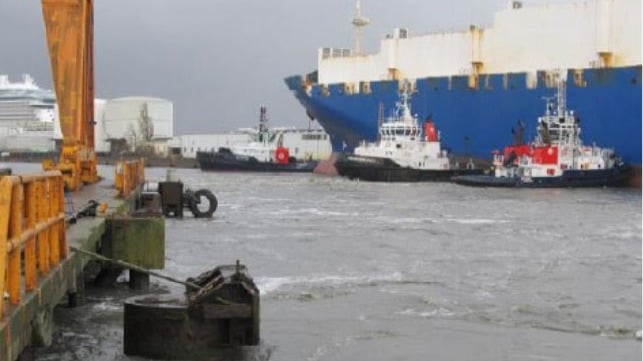
Tugs struggled to regain control of the breakaway ship after the lines parted (Bremen Police)

Published May 9, 2025 7:28 PM by The Maritime Executive


Worn-out mooring lines that were not replaced on time are being called the reason a US-flagged cargo RoRo broke free from its dock and out-of-control hit a pier and dry dock at the Port of Bremerhaven in Germany. Germany's Federal Bureau of Maritime Casualty Investigation (BSU) issued a report concluding that if the lines had been properly maintained, the incident might never have happened.

BSU analyzes the incident involving the RoRo cargo ship Endurance (49,000 dwt) built in 1996 and operated by ARC (American Roll-on Roll-Off Carriers). The incident occurred on March 13, 2021, when the vessel’s mooring lines broke, causing her to drift through the harbor and collide with a dry dock, among other things.

Investigators have now determined that the main cause of the line breakage was the worn mooring lines that were not replaced in good time due to an inadequate safety management system. Owing to the conditions of the mooring lines, coupled with offshore winds with gusts reaching speeds of up to 50 knots, the accident was most likely to happen despite preventive efforts by the ship’s master.

The Endurance was moored starboard side in Bremerhaven when the lines parted at about 0945. Investigators were able to establish that the master was aware of the weather forecast and conscious of the potential danger of mooring line failure. For this reason, he had taken appropriate precautionary measures against line failure by requesting tugs.

Nineteen minutes before the incident at 0924, the master had gone to the bridge because of the prevailing wind conditions at the berth. At 0930, he requested tug assistance and instructed two of his deck officers to inspect the lines. When the lines failed, he issued instructions to drop the starboard anchor, start the main engine, and raise the lowered vehicle ramp.

Before the arrival of the tugs, the 868-foot (264.6-meter) Endurance had drifted toward the Lloyd Werft dockyard. The first two tugs arrived about eight minutes after the line failures and before the main engine was running, but could not prevent the allision. It was determined that the vessel was only about 120 meters (less than 400 feet), meaning the tugs did not have enough time and space to prevent the contact.

The line failure contributed to the material damage to the ship, the berth, and the dockyard. However, nobody was injured, and no pollution was reported. The damage on the ship included a crack above the waterline in the shell plating on the port side, a hole in the bulbous bow, and a dent and paint abrasions at the stern on the starboard side.

BSU concluded in its investigation that the mooring lines were in poor condition. The vessel’s operator, ARC, had also arrived at the same conclusion in its internal investigation, determining that the condition of the lines may not have been consistent with requirements. The lines were damaged to such an extent that only two of the 14 lines met the requirements for mooring lines.

Following the BSU investigation, actions have been taken to prevent similar occurrences. They include the procurement of berth analysis software by the Port of Bremerhaven. Expected to be deployed this year, the software is designed to trigger alerts that would help the port inspect a vessel's mooring arrangement.

The report also highlights that as of January 1, 2024, new internationally binding guidelines for the inspection and maintenance of mooring equipment, including lines, came into force. In particular, the vessel operator is now required to introduce a procedure for mooring operations, as well as the inspection and maintenance of mooring equipment, including mooring lines. A maintenance procedure must be implemented on ships so that worn lines are identified in good time before they fail. Maintenance must be carried out and documented on board.


How Freight Forwarders Can Contribute to Maritime Decarbonization

iStock containers
iStock

Published May 11, 2025 1:43 PM by David Hume


A freight forwarder is an organization that helps other companies manage freight transportation across transport modes and geographies. As freight moves from one location, like a factory in China, to another destination, like a distribution centre in Kansas, it will often use multiple modes of transportation. Companies use freight forwarders to simplify the complexity of handling the planning, coordination, documentation, reporting and customs clearance across these different transportation modes and geographies.

Freight forwarders balance the relationship between the shipper (the company that wants to move cargo) and the carrier (the company that moves it). Being an intermediary provides an opportunity to wield influence within the supply chain to help reduce emissions. Here are four ways freight forwarders can support maritime decarbonization.

1. Measurement and education

The most fundamental decarbonization service a freight forwarder can provide to shippers is freight emissions measurement. By utilizing established and accepted methodologies like the Global Logistics Emissions Council Framework, freight forwarders can help shippers better measure and understand the emissions impacts of each shipment. Accurate measurement is foundational for understanding the impact for any decarbonization intervention.

When a freight forwarder is communicating with their clients about the status of shipments, these client interactions are a useful touch point to educate the shipper on their total emissions footprint and maritime decarbonization options. By making supply chain data more transparent, they enable shippers to make low-emission shipping decisions.

2. Demand aggregation

A single shipper is unlikely to persuade a carrier to shift their operations to use low-carbon fuels or provide other low-emissions freight services. However, if there are hundreds or thousands of shippers asking, it sends a more powerful message. This idea of buyers alliances has been used in many sectors. It's also the core principle behind the Zero-emission Maritime Buyers Alliance (ZEMBA) for example that pools shippers' demand for low-emission maritime freight options.

Demand aggregation is a core element of the freight forwarder business model. Some freight forwarders represent the cargo interests of tens of thousands of clients, and they can leverage this client roster to secure discounts in freight rates from carriers. For example, Kuehne + Nagel, a large freight forwarder, claims to have over 400,000 customers.

This leverage could also support the formation of green shipping corridors. When freight forwarders negotiate cargo rates and volumes, they could commit to purchasing cargo volume from ocean carriers using low-carbon fuels on specific trade lanes. Focused efforts targeting specific trade lanes could accelerate broader adoption and lower costs faster than a more diffused decarbonization approach.

3. Routing optimization and vessel efficiency

When a shipper books a shipment with a freight forwarder, their primary concern is that the cargo arrives on time and undamaged. It is up to the freight forwarder to arrange the shipment details such as which ship and how it is routed across the intermodal network.
How cargo is assigned matters immensely for the shipment's emissions. For example, if air freight is prioritized over ocean freight, the emissions can be approximately 50 times higher. While a freight forwarder doesn't control the specific route used a plane, truck, or ship on any given leg of the shipment's overall journey, they can suggest different combinations of transport legs that could lower emissions. This is a complex optimization problem, but it could yield major benefits for freight forwarders and maritime decarbonization.

Not only can routing be optimized, so too can the transportation asset used. For example, within the maritime sector, the IMO's carbon intensity indicator (CII) could be a pragmatic way to compare the emissions intensity of specific vessels. Shippers could indicate preference with their freight forwarder for their cargo to only be carried on ships with a certain CII score, thereby lowering the shipper's scope three emissions footprint.

4. Consolidation and container utilization

Freight forwarders typically know the volume of cargo or the number of pallets that they move on behalf of their clients. When it comes to shipping containers, how much stuff that is in the container, as a fraction of available volume, is called container utilization. Freight forwarders have a financial incentive to move more containers, but a shipper wants to minimize their shipment costs, which is done by maximizing container utilization for each shipment. By keeping container utilization consistently above 80%, shippers need relatively fewer shipments which thus results in relatively fewer emissions, all else being equal.

Sometimes shippers don't need the entire volume of a container. In this instance, freight forwarders can help consolidate shipments from multiple shippers into a single container. This consolidated option is referred to as a less-than-container load (LCL) shipment. This can also help maximize container utilization, thus reducing emissions.

The path for freight forwarders

Freight forwarders interact with thousands of shippers and carriers. As intermediaries between these two stakeholder groups, freight forwarders are uniquely positioned as agents of change for the maritime energy transition. By encouraging emissions measurement, educating clients, aggregating demand, optimizing routing, promoting energy-efficient ships, and maximizing container utilization, freight forwarders can decarbonize global supply chains on a massive scale.

The opinions expressed herein are the author's and not necessarily those of The Maritime Executive.


Morocco’s Tanger Med Wins Contract to Upgrade Liberia's Ports

Monrovia
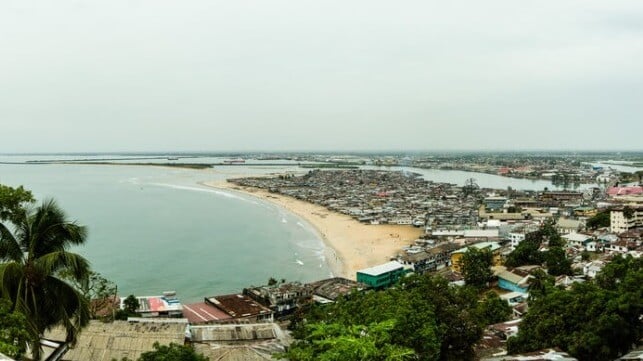
Port of Monrovia (file image courtesy blk24ga / CC BY 3.0)

Published May 11, 2025 1:54 PM by The Maritime Executive


Morocco is further expanding its footprint in the African port sector with a new deal to modernize Liberia’s major ports. Last week, the Liberian National Port Authority (NPA) signed a modernization agreement with Tanger Med Engineering, a subsidiary of Tanger Med Group.

According to NPA, the deal marks the start of the full-scale implementation of a comprehensive master plan for the Freeport of Monrovia and the Port of Buchanan. For the last year, Liberia - in partnership with China - has been developing master plans for all its ports, including the Freeport of Monrovia and Buchanan. Liberia said the goal is to enable the ports to attract investors for their expansion.

The deal with Tanger Med Engineering will see NPA improve the efficiency and capacity of Monrovia and Buchanan ports, as envisaged in the master plans. This includes modernization of container terminals, cargo berths and warehousing zones, as well as deployment of smart logistics platforms.

In addition, Tanger Med Engineering will conduct dredging works to enhance the ports’ ability to accommodate larger vessels as trade volumes in Liberia surge. Notably, Liberia acts as a maritime gateway for landlocked Mali and parts of Guinea. NPA is keen to retain Liberia’s competitive edge, as the port sector in West Africa is changing fast with huge expansion initiatives in Ghana, Nigeria, Cote d’Ivoire and Senegal.

“This agreement is more than an infrastructure project; it is a national milestone as Liberia begins the implementation phase of an ambitious port redevelopment plan. We are improving Liberia’s competitiveness along West African maritime corridor,” said NPA Managing Director Sekou Dukuly.

The deal is part of a Memorandum of Understanding(MoU) signed last year between Liberia and Morocco on ports development. The partnership was between NPA and Marsa Maroc - a Moroccan port operator and a subsidiary of Tanger Med Group.

As part of its 2030 strategy, Marsa Maroc has been targeting key African ports. The operator is keen to expand its operations from its base in Morocco to become an international port developer. In January, Marsa Maroc registered two new subsidiaries - Marsa Djibouti and Marsa Benin - strengthening its position in the African logistics sector.

Marsa Djibouti will help the operator acquire a stake in Damerjog Oil Free Zone Establishment (FZE). This investment will see Marco Maroc enter the East African market. In addition, it will have access to Damerjog Industrial Free Zone, where Djibouti has proposed to build a mega oil and gas port capable of handling 13 million tons of cargo.

Marsa Benin is now operating Terminals 1 and 5 at the Port of Cotonou, after commencing operations in the country a month ago.

Top image: Port of Monrovia (file image courtesy blk24ga / CC BY 3.0)

RIP

Salvage Diver Dies as Specialist Team Prepares to Raise Superyacht Bayesian

salvage effort
Salvage efforts began this week at the site where the Bayesian sank in August 2024 (Salvatore Cavalli photo / AP Photo)

Published May 9, 2025 6:02 PM by The Maritime Executive


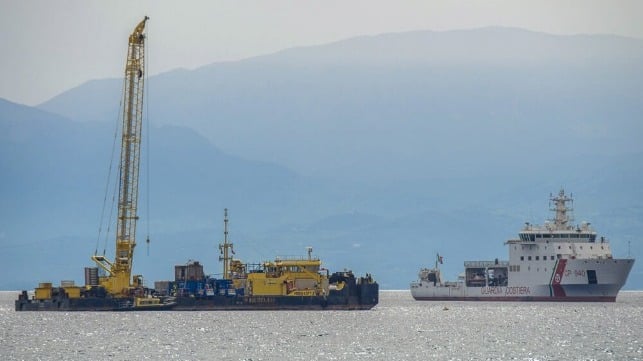
A salvage diver working on the preliminary efforts preparing to raise the superyacht Bayesian was killed today, May 9. Italian officials confirmed the incident without providing further details.

Local media are reporting that a 39-year-old salvage diver, a Dutch national, died as teams were continuing the preparation to lift the 184-foot yacht, which is resting on the seabed off Porticello, Italy. They reported the diver was working underwater at the time of his death without providing further details.

A specialized team was assembled for the complex task of raising the vessel, which is lying at a depth of 50 meters (approximately 164 feet). The effort is being supervised by the UK’s TMC Marine and involves Dutch companies Hebo and SMIT Salvage as well as Italian specialists. Reports are saying about 70 specialists are now on site for the operation, which is expected to take several weeks.

Work began this week with a new underwater survey to determine the position of the yacht and its condition after the winter. It departed Italy on August 14 with a premier guest list headed by tech tycoon Mike Lynch. The vessel went down five days later while anchored offshore, killing Lynch, his teenage daughter, the chairman of Morgan Stanley International, Lynch’s U.S. lawyer, and others. Seven of the 22 people aboard died, while 15 were able to make it into a lifeboat and survived.

Officials hope that raising the yacht will help to answer the questions surrounding why the vessel went down. They know a strong storm hit the vessel, but believe it should not have been in danger of foundering even in those conditions. 

The salvage team reports the vessel is in good condition, and their plan calls for removing the rigging from the 236-foot mast. They will store the removed pieces on the seabed for recovery after the hull. A steel sling will need to be placed to hold the hull in place and for the eventual lift.

The Italian Coast Guard has been on the scene, and reports indicate the salvage operation will now be delayed while an investigation is launched into the diver’s death.

Beyond Socialist Purity

From Beatific Otherworldliness to Messy Transitions

Orientation
International political economy at a crossroads

As most of you know the world economy is peppered with fault lines. On one hand we have the rising in the East of a new economic block, the BRICS nations and their friends. On the other hand, in the West we have a rapidly declining Yankeedom and its European vassals on. What are socialists in the West to do with this malestream, this great turning point? Is it not clear whether to support BRICS or not? After all, the BRICS countries have only one clear socialist country and two countries that are Hindu fundamentalists (India) as well as a theocracy (Saudi-Arabia). So does it make sense for socialists to support Russia, India, and Saudi-Arabia that are conservative politically? This article proposes that Western socialists need to give up their purist ideologies and accept that while the BRICS countries may be lacking in socialist policies domestically,they still should be supported because of their international attempts to follow Marx and Engels’ exhortation to “develop the productive forces”. This means striving to create material abundance through technological innovation.

Who am I
I am no academic socialist nor am I a red diaper baby. In fact, reading and school for me were mutually exclusive opposites. When I was a young adult I couldn’t stand reading and dropped out of community college. I only started to care for reading after I left and began hitchhiking across the country. Because I am self-educated, I did not have the benefits of being systematically educated in all the different schools of socialism, what socialist organizations were like and where and how socialism was applied all over the world. So I eclectically dabbled with books and organizations. I eventually found my way and this article is the result of conclusions I’ve come to after 50 years. Twelve years ago my partner and I started our own website and Facebook page which now has 10,000 followers. We each work 20-25 hours per week in various aspects of this work. Socialist Planning Beyond Capitalism is our baby!

What do I Mean by Socialist Purist?
By the term socialist purist I mean someone who holds out for the most extreme, utopian form of socialism, whether it is defined by Marx, Engels, Lenin or an anarchist hero like Kropotkin. For Leninists socialism means no capitalism with the state which controls all economic transactions, the society is classless and does not use any currency. For the anarchists the ideal is no state, no capitalism, no classes and no money. If actually existing socialism has any of these things it is treated, not as part of a long process of development, but as a sign of a) betrayal of the party or a bureaucracy (Trotskyists) and b) corruption or some kind of pollution from the original source. That source is most often treated like a bible. It is more or less the same as the old ruling law in Louisiana that if a person had 1/32 of what was considered African American blood, they were considered black.

China
If I support China, I will be told that China isn’t really socialist or communist. If the state-controlled enterprises compose 60% of the Chinese economy I will be told that the 40% of the economy that is in private hands matters more. It will also be pointed out that in China strikes are outlawed and independent labor unions are illegal. I would prefer that strikes in China were legal and workers were allowed to form unions. There are labor unions in China but under the auspices of the state. Also, there are plenty of strikes in China. But for the purists this is enough for the entire country to be dismissed as a socialist project. For me it is not. Where do the purists get their definitions? I will be told that Marx and Engels defined socialism and communism in a particular way and that is the definition we should work with despite the fact that the definitions were intentionally sketchy and they were written over 150 years ago. If I point out China’s great work on the Belt and Road Initiative of building infrastructures and harnessing energy all over the world, I would be told they are still deriving a profit from them. Profits are bad! From anarchists for whom all states are bad, I will be told that China is really just continuing Western imperialism. For anarchists, helping to develop the productive forces in another country is nothing more than a “debt trap”. For them all capitalist and state socialist societies are imperialist the moment they engage with a country on the capitalist periphery.

Russia
There is no country in the world which has been more brutally and tenaciously demonized than Russia and that was so before, during and after the Russian Revolution. If we post a story on our website or social media pages about the Russian economy now being the fourth strongest in the world, we will be told by Trotskyists or Social Democrats that Russia is, after all, a capitalist country, as if that should end all discussion. Anarchists will tell me that Putin is a dictator. These folks don’t understand that Russia has at least four or five parties and that in the last election, Putin’s party got 49% of the vote and the Community party got 20%. I will be told by other purists that much of Russia’s spending is on its own and others’ military, not so much on producing goods and services for a better life for its citizens. The anarchists will tell me that anarchists and other dissidents are rotting away in Russian prisons. For them it doesn’t seem to matter that Putin has 80% approval ratings and Russia has built up its domestic economy even more since US sanctions. For socialist purists, the fact that Russia has been investing in the northern Arctic Silk Road which will increase trade in regions that have not been connected seems not to matter to them. The domestic economy is first and geopolitics is second. I believe the reverse to be true.

The International Proletarian Revolution Around the World at the Same Time

For anarchists any power at a national level is against socialism. So what do they advocate? An international revolution of workers’ councils that overthrows all states and is linked up locally, regionally, nationally and internationally. How realistic is this? As we stand now in the history of the United States we have never had a general strike that encompassed more than one local state. If we face this fact it is ludicrous to propose that workers’ councils are going to spontaneously arise, spread across an entire country then link up to other countries until the whole system is global. Doesn’t it seem ridiculous to assume this is going to happen in the near future? In Europe, the English, French and German heads of state are hated. Germany is de-industrializing, the French and English living standards have declined, still we have yet to see a general strike among the working classes of all countries that can drive them from power. It has struck me that:

  • Since these European rulers are all bitterly against Russia;
  • Russia possesses that cheap natural gas which could improve working class living standards; and
  • the working classes could unite against their rulers and demand to have cheap Russian gas shipped to them.

How likely is even this semi-continent alliance? Unfortunately, not very. It has taken the rulers of states and capitalists roughly 300 years to convince people that their nation-state deserve more loyalties than their previous loyalties to provinces, principalities, regions and city states. How likely are the citizens today to give that national loyalty? Marx and Engels naively thought that workers would give up their fatherland for the international loyalty of the working class. All socialists found out the hard way through the results of two world wars that workers of the world uniting is not something workers across states have any intention of doing. So whether we like it or not, the real fight for the foreseeable future is between the rulers of capitalist states and their working classes. That is the best we can do for now and in the near future.  

World-Systems Theory and the Long View of Capitalism
In Giovanni Arrighi’s great book The Long Twentieth  Century, in world systems terminology, over the last 500 years capitalism has jumped all over the world from Italy, Holland, England and to the United States. Each ‘hegemon’ has ruled from between 220 to 100 years before its decline. In every case when the hegemon has fallen it has been replaced by a country on the capitalist semi periphery. The United States has been in decline for over 50 years. What’s next? Well, China certainly qualifies as a semi-periphery country that is still rising. But something much deeper is going on. Not only China, but all the other BRICS countries – Russia, India, Iran and Saudi Arabia have been in the semi-periphery world system. Can it be that after 500 years in Europe, we are witnessing the world economy shifting from the West to the East? It certainly looks that way. Every member of BRICS is a country on the capitalist semi-periphery.

The Rise of BRICS
I celebrate the emergence of a block of anti-imperialist countries that have broken away from the Anglo-American Empire. China, Russia, Iran and to a lesser extent India have resisted using the dollar as a world trade currency. Further, they have insisted on using their own local currency in trade transactions. With the exception of China Russia, Iran and Saudi Arabia are capitalist countries, but their commitment has not been primarily to make a profit on war or forms of fictious capital such as stocks, bonds, derivatives or stock options as does the United States. Following the Chinese great Belt and Road Initiative (BRI) these countries have traded with each other in exchanges of energy systems, infrastructures such as roads and trains as well as in agricultural products and military defense.

The BRICS economic agreement between Brazil, Russia, India, China and South Africa was established as an alternative to the imperialist World Bank and the International Monetary Fund. This breakaway movement is growing stronger by the day as the United States and the rest of the West sinks into decay. As a socialist I support this breakaway movement even if it is not explicitly socialist. In answer to my support of BRICS, I will be told that most of its members are capitalist and that socialism can never come from it. So how is socialism supposed to come about?

Nationalism as a Revolutionary Force in a BRICS Dominated World

For traditional socialists, nationalism has been the enemy. After all, historically it keeps workers from uniting with other workers around the world and it propagandizes them into aligning with the capitalist class rather than their own class. These are all reasons to be against nationalism. But the problem in today’s world is that we are fighting against a global capitalism that sets up continental systems such as the European Union which is organized to encourage the free flow of capitalism across the entire European continent. The EU does big business for the European capitalist class, a kind of Bilderberg economic union. The EU has no working-class representation. In my opinion, it is an advance for the working class of nation states to fight for independence from this European parasitic organization.

Conservative parties are moving towards nationalism – socialists are not

The problem for socialists is that in Europe and other parts of the world the  traditional conservative parties have taken positions of supporting the nation-state against the European Union and are not anti-Russian. This includes Le Pen in France, the AFD in Germany and Orban in Hungary. Sadly, to my knowledge there is not even an intermediate scale socialist party in Europe that has taken a nationalist stance. So am I advocating support of these conservative parties?

The linear political spectrum is bankrupt in the 21st century
In order to align ourselves with the current BRICS program we badly need a new political spectrum, one that leaves behind the current linear version. On this topic, please see my article of 2 ½ years ago which is still highly relevant.  As I said in my article, Are Socialists Going to let Neoliberals Define Fascism: Why the Linear Political Spectrum is Bankrupt this spectrum must be:

  • inclusive of many more combinations than the communism-liberalism-conservative, fascist and libertarian, linearly strung out;
  • economic as well as political;
  • must account for qualitative leaps – which is the difference between socialism and capitalism;
  • decentered so that both moderate and extreme solutions would seem reasonable under certain conditions. This means that all political tendencies would have to be seen as having pros and cons. The way it stands now liberals and conservatives are seen as virtuous and communism and fascism are seen as having vices;
  • the spectrum must be flexible enough to make room for alliances between the extremes on the political spectrum such as China and Saudi Arabia or between India (fundamentalist) and China and
  • not limited to ideologies that are next to each other on the political spectrum.

BRICS Leads the Way in Revolutionizing the Linear Political Spectrum                      

This is where things get messy. If we follow the lead of China, Xi Ping does not form alliances based on loyalty to socialism. He is committed to building communism but has formed alliances with a Hindu fundamentalist nationalist in India and with the theocratic state of Saudi Arabia. Putin is no socialist yet his strongest ally is to a country that wants to build communism. Modi, a right-winger is ok doing business with communist China. Cuba and Venezuela would be happy to do business with any of the BRICS countries whether they are socialist or not. So what united these BRICS countries that might make socialists of the West support them?

  • They are anti-imperialist.
  • They are anti-war.
  • They are anti-finance capital.
  • They want to develop the productive forces of the world.

Importance of Technological Innovation
Let me develop the last point. In the Communist Manifesto Marx spent a good deal of time praising the capitalist system for developing industry – building railroads and factories and upgrading the standing of living for the middle classes and parts of the working class. These are the very activities the BRICS countries are engaged in now. In Marxian terms, what is so good about this? It is based on the idea that socialism must be founded on abundance. It means increasing the ratio between freedom and necessity. This means maximizing productivity while decreasing the numbers of work hours. For me this is a more important goal to fight for even if internally the countries of BRICS suffer from class, race and gender inequalities.

Siege Socialism
Typically in the West, when socialist countries are compared to capitalist countries they are criticized in terms of standard of living, varieties of political parties and freedom of expression. In the first place, socialist countries should be measured in comparison to what these countries were like before the socialist revolution. Capitalist countries have had 300 years to develop themselves unopposed after they defeated feudalism. Socialist countries have had a little more than 100 years to develop yet they have done so in spite of constant capitalist attempts at sabotage, assassinations and betrayal. It is way too soon to make sweeping generalizations about the viability of socialism. In fact, based on the last 35 years of the “triumphant” West, when we look at the world around us, it is capitalism that is either is in deep trouble or has failed.

Secondly, capitalist critics fail to understand that Western concepts of freedom are not shared around the world. What matters to working-class people most is the ability to read and write, have low-cost health care and free education. In terms of housing, socialism either provides low-cost housing or makes it possible for people to buy their house outright. Socialist countries like China and Cuba have a higher percentage of home ownership than the United States. As far as the variety of political parties, I can well understand that the socialist leaders who have come to power may be extremely cautious about allowing many political parties to form. When we consider the ability of capitalist spies to turn alternative parties into organs of counter revolution, the concerns of socialist leaders is completely understandable. The best book I know which makes a case for actually existing socialism, is Michael Parenti’s Blackshirts and Reds.

Throwing Down the Gauntlet
What’s wrong with anarchism?

I do not share the criticism of anarchists by Marxists and or Marxist-Leninists. For the most part they were not “petite bourgeois individualists.” Most of the 19th and 20th  century anarchists were working classpeople who were very influential during the revolutions in Russia, 1917-1921, and Spain, 1936-1939. I respect many of their leaders from Bakunin to Louise Michel to Kropotkin to Malatesta, to Emma Goldman and to Buenaventura Durruti. However socialism must be based on abundance, not scarcity. Many anarchists don’t believe material abundance is a necessity. For those anarchists who support material abundance, a decentralized economy is not going to deliver the goods. A kind of promethean socialism requires some state centralization coordination of the distribution of water, heat, gas and electricity and other infrastructural projects.

Following Pannekoek and Gorter I agree that workers’ councils should be the micro unit of a communist society. But local workers’ councils plans for production need to be linked up regionally and then nationally. Centralization is necessary but it must be open so that there is a dialectical relationship from workers’ councils to the top and from the state back down to the bottom. Anarchists are hostile or cynical about centralization. The way political organs are organized today, a political body has to be a state in order even gain recognition. What do anarchist expect to do? Dismantle the entire state system founded at the Treaty of Westphalia in 1648? It’s completely unrealistic.

Secondly, anarchism and workers’ councils have always been hostile to parties. The heart of politics is to steer, to develop social policy. Workers’ councils or radical unions cannot be solely economic organizations. Whatever their production goals they have to be coordinated by social needs outside of work. This includes consumer groups with community needs, family needs, social and psychological needs where there is an ongoing dialectic in which plans are first made and monitored. Political parties are necessary for both directing our future and learning from our past.

Lasty, there needs to be room for markets. As many of you know markets are much older and much different than capitalist exchange. They go all the way back to horticultural societies and even existed among complex hunter-gatherer societies. Markets will continue to exist among small traders who do not hire workers for wages. The possible relationship between workers’ councils, the state and markets is well laid out in David Schweickart’s  book After Capitalism.

What is Wrong with Stalinism
By themselves workers can only achieve trade union consciousness (more money and better working conditions)
I do not share Trotskyist evaluations of Stalin as some kind of bureaucratic madman implying that Trotsky wanted more party democracy. Neither do I share anarchist dismissal, not only of Stalin, but also equating Stalin, Lenin and even Marx as all authoritarian. My criticism of Stalin as a political leader can be broken down into the following parts. As far back as 1905 with the founding of the Bolshevik party, they claimed that left to their own devices working class people can attain only a trade union consciousness. They ignored what the workers did during the Paris Commune which went way beyond trade union consciousness. Workers  created revolutionary organs of self-management without much, if any, input from any socialist or socialist parties at the time. This leads me to my second criticism.

This is that the Communist Party, not just Stalin, but also Lenin never trusted the workers’ councils that formed in Russia. They did not trust workers’ own creativity. “All power to the Soviets” was a slogan the Bolsheviks used before they came to power. After that the factory committees in the cities and the self-organization of the peasants were treated as rivals rather than comrades. In addition, Stalin actively destroyed workers’ councils during the Spanish revolution when he saw he could not control them. Devoted Leninists will state that it was the war against Western capitalist parties that forced the communist parties into a narrower, heavy-handed approach. I agree with this up to a point, but I don’t think it could explain all the more repressive behavior. The anarchists have every right to despise the Communists for what happened to them and their comrades.

The limits of vanguard parties

Marx and Engels never talked about vanguard parties. In fact, they made fun of the secret revolutionary societies of August Blanqui. However, it makes sense to me that a secret party was necessary in Russia in the early 20th century, a society without even a liberal party, no constitution and a monstrous secret police. But Leninist parties that continued to build vanguard parties that operated under relatively liberal stable conditions in the West, where a legal party was possible and political activity could be public is just mechanically holding  onto a theory that longer fits in Western conditions. In their hands Leninist theory became a dogma.

The scholastic treatment of the sciences and philosophy

There were a number of areas where dialectical materialism became dogmatic rather than scientific. I will mention two. In anthropology, Marxist-Leninist, with or without Stalin preserved Marx and Engels’ stage theory of social evolution for 100 years in spite of real empirical data from anthropologists that challenged Marxism. There were new stages of simple and complex horticulture societies that came between hunter-gatherers and the emergence of the state. In addition, slavery and feudalism were not  universal stages of social evolution. Also, in the field of psychology, the communist psychology of Vygotsky was banned in Russia for 20 years. One his most creative followers, Evald Ilyenkov was forbidden to publish and was harassed to the point of committing suicide.

Every school in the history of philosophy was crammed into the categories of objective idealism, subjective idealism or materialism. See my article which shows philosophy can be grouped into six different schools: Out on a Limb With Dialectical Materialism. Lastly the various schools of 20th century philosophy are crudely labelled based on whether the school of philosophy – pragmaticism, logical atomism, analytical philosophy – was for or against imperialism. In addition to which class the school represented. This was the case even if the school of philosophy never made any political statements.

Lastly it was very short-sighted for Stalin to insist on controlling all communist parties of the world in the service of Russia. In the case of the United States, the American Communist Party lost many opportunities to move the Yankee working class towards communism because the American communist leaders were never allowed to adapt communist theory to their own conditions. It makes complete sense to me that on a world scale, smaller communist parties should defer to the party that had achieved state power. But that doesn’t mean the party that achieved state power should dictate the strategies and tactics of countries with different political and economic conditions. We need a mass socialist party, not a secret vanguard party.

What Stalin did right
Internationally Stalin was a great politician. For 25 years the Communist Party outfoxed the entire Western world of the United States, England, France and Germany that were all in cahoots to destroy state socialism in Russia. Also the Communist Party practically single-handedly defeated the Nazis. Nationally Stalin raised the standard of living for workers and peasants compared, not to Western societies, but under the conditions of that existed under the czars until the Revolution.

There are issues that in the West Stalin is regularly attacked about:

  • the treatment of peasants on the collective farms;
  • the famines in Russia;
  • the notion that Stalin was a dictator;
  • that Russia operated in totalitarian way and
  • the political trials of the 1930s.

Ludo Martens in his book Stalin: Another View, talks about each of these issues and exposes the typical Western ideology about thisIt is important to remember that the statistics about the collective farms and famines were mostly written by CIA agents. Further, Martens does not take the position of idealizing everything that Stalin did. He simply presents facts that show Western propaganda as either wrong at worst or exaggerated at best.

So What are Messy Transitions?
The world of BRICS is a messy world. As I said before, China is the only country moving in a clear socialist direction. It has to work with two right wing countries – Hindu fundamentalist India and a theocracy in Saudi Arabia. Russia and Iran are clearly locked in with China but they are not socialist. Secondly, there is the class struggle going on within BRICS countries. None of these countries are supporting radical labor unions so the class struggle will go on within BRICS. Thirdly, workers cooperatives are a growing but small movement around the world. They represent potential dual forms of power. It is unclear how the heads of the BRICS countries will deal with worker co-ops as radical forms of economic exchange. Fourthly there are the ecological problems of extreme weather, accumulation of toxins, desertification and species extinction that the human species face. BRICS countries will deal with this in various ways. Lastly, there is the collapsing empire of the United States whose ruling class will fight to the death to keep it from slipping even to a minor power status. It will take all the ingenuity to navigate in, around and through this ruling class before it takes down half of the world with them.

Over many years organizations such as the United Nations have developed world programs for abolishing poverty and world hunger, increasing political participation and many other improvements. Those plans continue to gather dust because the world capitalist class is dead set against them. These plans can be potentially put into practice by some of the more progressive members of BRICS. In short it will be a messy bitches’ brew for the next century. We socialists have to accept messes and attempt to be more dialectical, not only in how we deal with the messes but also the bitterness of all socialists groups to each other.

Cooling Out the Socialist Family Feuds

For the past 170 years socialist groups have fought each other bitterly, sometimes justified and sometimes not. But we might do better if we understand each other as having various tensions that were there from the beginning, specifically:

  • What is the role of the state?
  • What is the role of a socialist party?
  • What is the role of self-organizing workers? and
  • What is place of markets?

To begin with, Leninists of all types need to face the fact that they don’t have the answers to everything. In fact, workers’ councils have shown that workers are far better at co-creating than they have been given credit for. On the other hand, anarchists and Council Communists need to come to terms with the fact that the state is a necessary part of socialism and for socialists to compete with capitalism on a world scale, some infrastructural industries require a state. In addition, council communists and anarchists cannot exist by themselves in economics organizations with no party. We need socialist parties to navigate political direction. Lastly, both anarchists and Council Communists need to appreciate that what the USSR, Cuba and Venezuela have achieved with their population is to be admired, not just criticized.

Finally, all these groups have to respect what the social democratic parties in the Scandinavia countries achieved domestically, at least before the rise of neoliberalism. They made some real improvements domestically for the populations in terms of standard of living, wages, health care and housing.  On the other hand Social Democrats internationally should be roundly condemned for actively or passively not standing up to the imperialist powers of the West with a sense of international solidarity with other socialist countries against capitalists. Finally, while Social Democrats have given far too much power to capitalists domestically in their own country, they have also shown that local markets can be productive contributors to socialism and that markets are not synonymous with capitalism.

What is the Opposite of Purity?
Throughout this article I have criticized socialist purity. But the opposite of purity is enmeshment. In psychological terms, enmeshment is a process by which a person cannot easily tell where their boundaries end and another’s begin. The worst example of enmeshment politically are the actions of the social democratic parties of the world since the end of World War II. They allowed themselves to become entangled with capitalism. Their boundaries were enmeshed. They couldn’t tell the difference between domestic socialism and international imperialism

The worst example of socialist enmeshment is the Democratic Socialists of America. This organization for 60 years has been devoted to “moving the Democratic Party to the left”. In reality the Democratic Party has been moving right despite whatever interventions they’ve made. The Democratic Party has continuously moved to the right, today being a center-right party. Yet the leaders of the Democratic Socialists of American continue to support the Democratic Party. Today it is difficult, if not impossible to tell the difference between Social Democrats and left liberals.

Conclusion
I began my article by defining what I meant by socialist purity. I said it could apply to both the anarchist as well as the Leninist left – Trotskyists, Stalinists or Maoists. At the end my article I said that the opposite of socialist purity was socialist “enmeshment”. It is the Social Democrats in Europe and the Democratic Socialists in the United States that are the best example of this. I pointed out examples of socialist purity in attitudes towards two countries, China and Russia. I argued why BRICS holds the best hope for a socialist future and I based this partly on World Systems Theory of the history of capitalism. I pointed out the Utopian nature of the wish for a workers’ revolution all over the world at the same time. I argued that based on how they behave today, workers fighting for socialism within their nation-states is the best we can do. I also claimed that these days nationalist loyalties in the West is an advance against regional institutions like the European Union on the one hand  or global institutions like the IMF or the World Bank on the other. I proposed that nationalism is an advance, whether it comes from countries such as Cuba or Venezuela on the left or European nationalists on the right including Le Pen’s party in France, the AfD in Germany or Orban in Hungary.

I attempted to be dialectical in weighing both anarchism and the varieties of Leninism for their pros and cons. I defended what has been called siege socialism against the purists, using Michael Parenti’s book Black Shirts and Reds and Ludo Martens book, Stalinism: Another View as two sources.

For over 50 years I have drawn from some very unlikely bedfellows. Some of these groups I joined and some I was on the periphery of and only knew them from their writings:

  • beginning with historical anarchists culminating with Murray Bookchin (2 years);
  • The Situationists of Raoul Vaneigem and Guy Debord culminating in Pannekoek and Gorter’s council communism (3 years);
  • National Caucus of Labor Committees (NCLC) converging in Lyndon Larouche’s book Dialectical Economics (1 year). More recently I’ve been influenced by William Engdahl, Matthew Ehret and Cynthia Chung, also in the Larouche orbit;
  • world-systems theory following the work of Immanuel Wallerstein, Christopher Chase-Dunn and Giovanni Arrighi;
  • communist psychology of the Soviet Union whose main practitioners were Vygotsky, Luria and Leontiev. Also one year’s involvement with Social Therapy founded by Fred Newman and Lois Holtzman in New York City;
  • in 2000 the anti-war movement headed by ANSWER (8 years);
  • the Occupy movement from 2011-2012;
  • the founding of our own organization Socialist Planning Beyond Capitalism from 2012 to today; and
  • one year with anarchists from Olympia Assembly and the Industrial Workers of the World.
Bruce Lerro has taught for 25 years as an adjunct college professor of psychology at Golden Gate University, Dominican University and Diablo Valley College in the San Francisco Bay Area. He has applied a Vygotskian socio-historical perspective to his three books found on Amazon. He is a co-founder, organizer and writer for Socialist Planning Beyond Capitalism. Read other articles by Bruce, or visit Bruce's website.