Sunday, May 18, 2025

Australia Set To Miss Energy Transition Targets

  • Australia's goals to transition to renewable energy sources are threatened by difficulties in expanding battery storage and managing the fluctuations of solar power.

  • The plan to shut down all coal power plants by 2038 faces hurdles due to the loss of baseload capacity, despite efforts to invest in renewable energy and storage.

  • Concerns about electricity price volatility and potential blackouts are increasing as Australia attempts to rapidly shift its energy production to wind and solar power.

Australia, which has some of the most ambitious targets of shifting from hydrocarbons to wind and solar is set to miss those targets due to challenges that are difficult to overcome. The warning comes from Wood Mackenzie and should stimulate a debate about how realistic those targets were to begin with.

The new Australian government—which is the same as the old Australian government after Labor won reelection this month—wants to shut all coal power plants by 2038 and generate 82% of its electricity from so-called renewable energy sources meaning wind and solar. Yet, according to Wood Mac, it would only be able to achieve 58%—and even that 58% will be problematic.

First, the consultancy said this week, as cited by Reuters, the massive buildout of wind and solar capacity requires an equally massive buildout of battery storage. This second buildout takes time and faces “grid connection and project planning barriers.” Still, battery storage capacity in Australia is set to reach more than 16 GW by 2030, up from the current 2.5%, despite the challenges. The cost of this buildout is probably another challenging factor worth considering, but it does not seem to feature in the Wood Mac report.

Solar is another challenge as it will also expand strongly over the next five years—and make the grid less stable. Wood Mac analysts called it “challenges in managing midday solar peaks,” but it actually comes down to increased supply fluctuations leading to heightened electricity price volatility and compromised balance.

The Australian Energy Council warned about it last year. Like much of Europe where solar is being built like there’s no tomorrow and land is infinite, Australia has started to see negative electricity prices during periods of peak solar production. This has, in turn, led to so-called curtailment, meaning switching off panels to avoid overproduction and sub-zero prices, which has put a strain on solar operators’ financials.

“The increase in extreme price periods (either high or low) suggests the supply-demand balance is becoming tighter than it was historically, and harder to accurately predict,” the Australian Energy Council, an industry group, wrote last October. It then went on to suggest this may become the new normal without additional investments in “new generation, storage and transmission.”

Wood Mac analysts appear to share the opinion that throwing more money at wind, solar, and batteries could fix the transition target problems—or at least some of them. One problem that is not in the hands of the federal government entirely is state governments having other ideas about energy security.

“Efforts may be further complicated by moves from some state governments, such as Queensland and the Northern Territory, to repeal or scale back their renewable energy targets,” Wood Mac senior analyst Natalie Thompson said in the consultancy’s report. “This highlights the urgent need for increased investment and greater coordination across all levels of government to accelerate the energy transition,” she added.

The biggest problem with the transition, however, remains the loss of baseload capacity under Labor’s plan for accelerated coal power plant retirement and the replacement of those plants with wind and solar. Evidence from Europe shows that even when coupled with batteries, wind and solar are not as reliable as baseload generators running on coal, gas, or, indeed, nuclear.

“Renewable energy adoption is accelerating at unprecedented rates, and Australia is at the forefront of a battery revolution,” the head of Australia research at Rystad Energy said in March. “However, more action is urgently needed to prevent a power shortfall in the coming years. The continent’s dispatchable generation is nearing critical levels and decisions made today will be pivotal in avoiding blackouts,” Gero Faruggio added.

Australia is no stranger to blackouts already. The first major one in the new, renewable energy era actually happened in South Australia back in 2016. The blackout was attributed to various causes, chief among them a violent storm that hit the state at the time. Yet despite a major effort to deflect any and all blame from wind and solar, authorities had to admit that about half of South Australia’s electricity at the time of the blackout was being generated by wind turbines—just like Spain was generating more than half of its electricity from solar panels at the time of its blackout on April 28.

It appears that Australia’s government is betting above all on battery storage to make wind and solar installations as similar to baseload generators in terms of reliability as possible. How this would turn out and, more importantly, how much it would add to Australians’ electricity bills remains to be seen. If developments in Europe are any indication, however, Canberra might take a moment and consider whether those states scaling back their energy transition targets don’t have a very good point.

By Irina Slav for Oilprice.com


Hydropower Under Threat in Pakistan's Water Crisis

  • India has suspended the Indus Waters Treaty, a significant water-sharing agreement, which supplies Pakistan with water from the Indus basin rivers.

  • Pakistan relies heavily on the Indus basin for electricity, with hydropower being its second-largest energy source, as well as for its agricultural sector, contributing substantially to the nation's GDP.

  • The treaty suspension not only impacts water flow but also halts the sharing of critical data, such as flood warnings, potentially jeopardizing lives and livelihoods in Pakistan.

India has suspended the Indus Waters Treaty with Pakistan, a major water-sharing agreement brokered by the World Bank. The move came on April 23, within a day of a deadly shooting in Pahalgam, in the Indian-administered part of Kashmir, marking the first time the treaty has been paused since the pact’s inception in 1960. In response, Pakistan stated that an attempt to stop the flow of water would be considered an “act of war”. Tensions mounted between the two nuclear-armed nations in the following weeks, breaking out into four days of fighting, before quelling again with a ceasefire mediated by the U.S. announced on Saturday, with both nations pulling back from the brink.

Water resources are an important part of the equation right now between the two countries. The Indus Waters Treaty (IWT) divides the six main rivers of the Indus basin between the two nations, with the three westerly rivers — Indus, Jhelum and Chenab — supplying Pakistan with water, while the three easterly ones — Ravi, Beas and Sutlej — feed India.

According to reporting by ABC, in addition to the suspension of the Indus Waters Treaty, India has also fast-tracked the construction of four new hydropower projects on rivers flowing into Pakistan and refused to share data on river flows with Islamabad. David Michel, Senior Fellow for the Global Food and Water Security Program at the Center for Strategic and International Studies, explains in an analysis that while India cannot completely stop the water flow to Pakistan in the near term due to its current infrastructure, it can stop the flow of information to its neighbor. He explains: 

“The IWT requires the parties to share a good deal of data on project development, river flows, and hydrological conditions. By suspending the treaty, India can also cease data sharing, depriving Pakistan of flood warnings, for example, prospectively hampering the nation’s water management and potentially imperiling Pakistani lives and livelihoods.”

Observers cite concerns over India’s building of dams, including four which are on one of the westerly rivers intended to supply Pakistan, and flag the issue of what would happen to the flow of water to Pakistan if such infrastructure is expanded to enable more storage.

Pakistan is dependent on the rivers of the Indus basin not only for some of its population’s drinking water, but also for agriculture, which accounts for almost a quarter of the country’s GDP, as well as for power. 

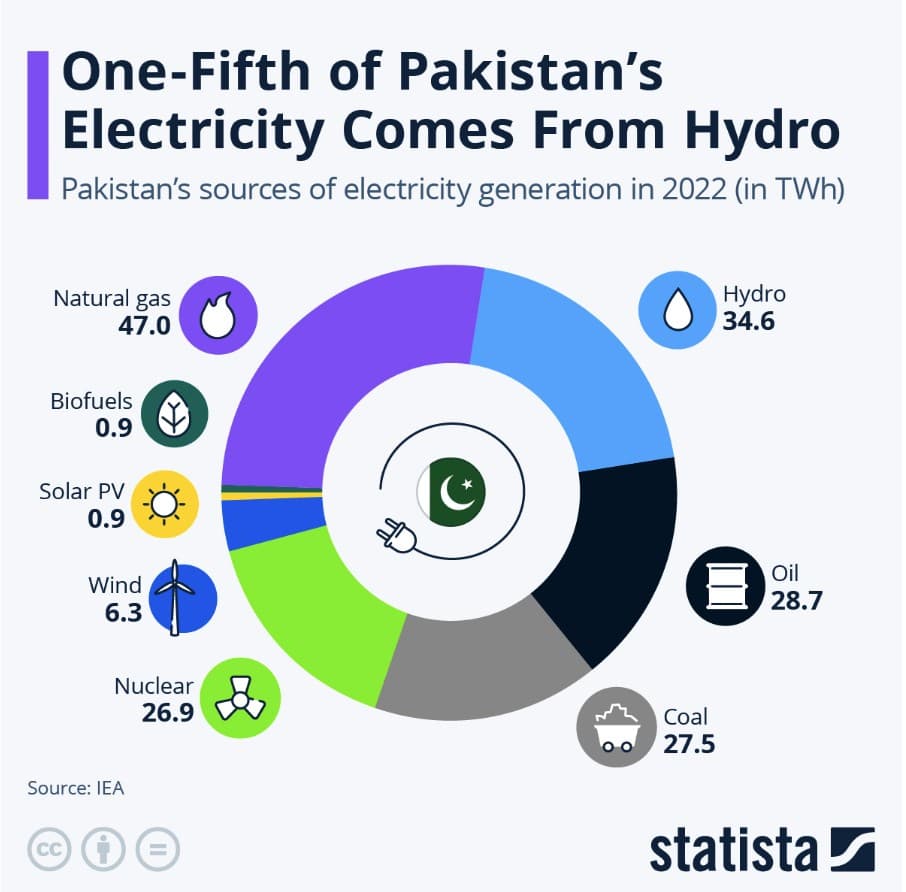
As Statista's Anna Fleck shows in the chart below, using data from the International Energy Agency (IEA) shows, 34.6 TWh of electricity in Pakistan was sourced from hydropower in 2022 (latest available data), all of which comes from the Indus basin. 

You will find more infographics at Statista

This makes it the second most important energy source for electricity in the country, following only after natural gas (47 TWh or around 27 percent). 

The next biggest energy sources are oil (16.6 percent), coal (15.9 percent and nuclear (15.6 percent).

By  Zerohedge.com


African Nations Lead in Critical Mineral Supply

  • Africa holds a significant portion of the world’s critical minerals essential for renewable energy technologies and electric vehicles, presenting a major opportunity for economic growth.

  • The increasing global demand for these minerals is attracting investment, but it is crucial to ensure that mining activities benefit African nations through value-added processing and job creation.

  • To avoid exploitative practices and promote equitable partnerships, sustainable and transparent investment strategies are necessary, moving away from historical extraction patterns.

Several parts of Africa have a long history of mining, with the sector contributing high levels of employment across the continent. As the demand increases for critical minerals – needed to fuel a green transition, mining companies are increasingly showing an interest in Africa for its vast untapped resources. Several countries could benefit from this increase in demand by developing their mining and processing industries to add value to the raw materials, which many have previously been unable to accomplish due to a lack of funding for greater industrialisation.

Africa is home to vast untapped reserves of critical minerals, however, accessing these deposits requires high levels of funding and mining expertise. South Africa and Zimbabwe have significant Platinum group metals, needed for green hydrogen and decarbonising heavy transport, heating, and industry. The two countries also hold chromium, which is used for solar power, geothermal, nuclear, hydropower, and wind technologies. 

Some estimates suggest that Africa may contain roughly 30 percent of the world’s critical minerals, although the true extent may be even higher as vast areas remain under-explored. Several countries across the region have cobalt and manganese reserves, required for lithium-ion batteries for electric vehicles and utility-scale energy storage, as well as solar power, wind, and hydro technologies and geothermal energy generation systems. Africa holds around a fifth of the world’s natural graphite. 

At present, mining activities in Cote d’Ivoire, the Democratic Republic of Congo, Gabon, Ghana, Madagascar, South Africa, and Zambia help provide vast supplies of these critical minerals. Namibia, Mali, and Tanzania all have significant graphite and lithium potential, already providing some of the world’s supply. And Guinea is the biggest global producer of bauxite, the main raw material for aluminium.

The global demand for rare earth minerals is expected to quadruple by 2030. Eight new mines are currently under development in Angola, Malawi, South Africa, and Tanzania, with operations expected to launch by 2029. These eight operations are expected to contribute around 9 percent of the world’s rare earth mineral supply. By the end of the decade, the African continent is projected to produce 10 percent of the world’s rare earth minerals, up from less than one percent in 2020. 

Veronica Bolton Smith, CEO of the Critical Minerals Africa Group, stated, “The global energy transition is already creating massive demand for lithium, cobalt, and other minerals.” She also stressed that the International Monetary Fund has forecast that critical minerals could add at least 12 percent to the continent’s GDP by the mid-century. However, achieving this figure will require high levels of private investment in the sector, across several countries. 

At present, China produces over two-thirds of the world’s rare earth minerals, meaning it holds a monopoly on the supply of raw materials needed to support a green transition. As several high-income countries seek to boost their energy security and reduce their reliance on China, many are looking to develop alternative mineral mining operations to secure their supply. Several countries in Africa have the potential to develop partnerships with U.S., European and other international mining companies to help boost their critical mineral supply, seeking investment in renewable energy and value-adding operations in exchange. 

Adding value to these critical minerals could help several African countries to develop their economies and workforce. A January World Economic Forum publication suggests that if the African region could capture a small share of the global battery manufacturing market, it could create between 500,000 and 1 million jobs, helping to reduce unemployment and the outflow of skilled labour. Expanding Africa’s industrial activities will push the region’s energy demand up, which could provide countries with the opportunity to seek foreign investment to develop their renewable energy sectors to support these value-added operations. 

The approach to mining in the region has already begun to shift to benefit African countries. In 2022, the Zimbabwe government banned the export of raw lithium. The government told potential buyers that if they wanted the lithium, they must invest in developing car battery manufacturing facilities in Zimbabwe. 

However, to ensure access to development opportunities and support a global green transition, foreign investment in African mining must be approached equally and sustainably. Free trade agreements, local benefits, and a departure from the historic patterns of extraction, where external powers profit while African communities bear the brunt of the costs, must take place to promote equal partnerships and help avoid green neo-colonialism

There are vast, largely untapped reserves of critical minerals across Africa. Several countries across the continent hold massive deposits of the metals and minerals needed to support a global green transition. While some countries have already established mineral mining activities, others require high levels of private investment to tap into these precious resources. However, new projects should be approached with care to ensure that all sides benefit from the mining operations, with countries providing a much-needed supply of critical minerals in exchange for investment in value-added operations and the development of a renewable energy sector. 

By Felicity Bradstock for Oilprice.com


Emirates Global to build US aluminum plant touted by Trump next year

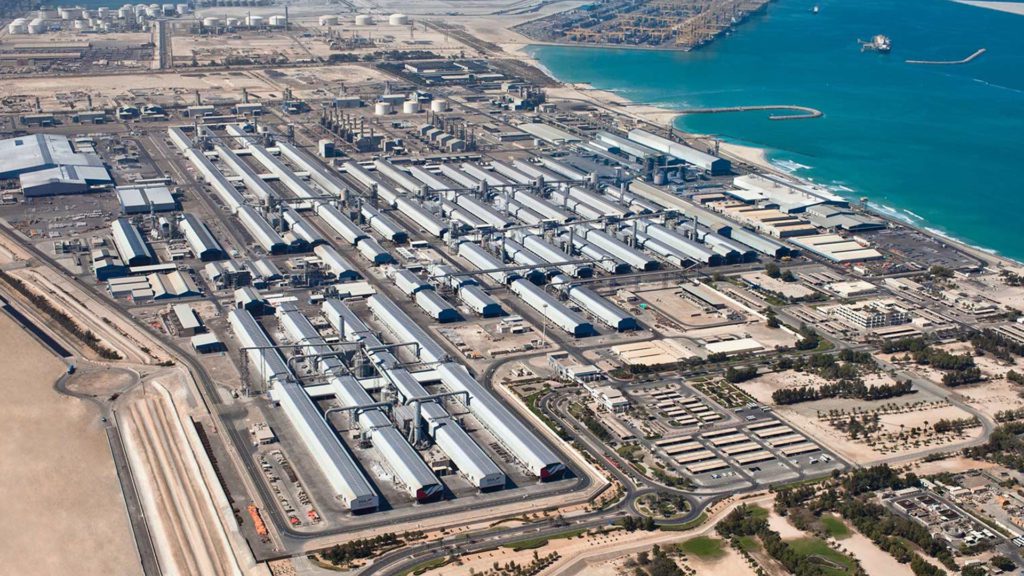
EGA’s Jebel Ali smelter. Credit: Emirates Global Aluminium

Emirates Global Aluminium plans to start building a $4 billion plant in Oklahoma next year as Donald Trump pushes for massive investments from oil-rich Gulf states to avoid his tariffs.

The smelter will have the capacity to produce as much as 600,000 tons a year of primary aluminum, with construction slated to start by the end of 2026 and to be ready by 2030, the company said in a statement on Friday. EGA is also partnering with US defense company RTX Corp. and the UAE’s Tawazun Council on a gallium project.

The US president announced $200 billion in deals with the United Arab Emirates during the final stop of his Middle East tour, adding to investment commitments from Saudi Arabia and Qatar.

Dubai-based EGA completed its first US acquisition last year when it bought 80% of Spectro Alloys Corp. in Minnesota and said it would make further investments to counter the impact of US tariffs.

Trump suggested an UAE aluminum plant would be built in the US because the company would “have to pay a big tariff” if the facility were to be built in the Emirates. The smelter and the gallium project are part of the investments he announced.

The smelter’s construction is contingent on securing a competitive power deal, local investment incentives and tax credit arrangements, EGA said.

EGA said it has signed an exclusive land option agreement for a site near Tulsa and is in advanced negotiations with Public Service Company of Oklahoma and the Oklahoma government.

RTX and Tawazun Council signed a memorandum of understanding to establish EGA as a supplier of gallium, a critical mineral used in chips, the aluminum producer said in a separate statement. The gallium would be extracted and refined at EGA’s alumina refinery in Abu Dhabi. The value of the potential investment wasn’t disclosed.

(By Verity Ratcliffe)


Chinese gold miner scours globe for takeover targets

Credit: Chifeng Jilong Gold Mining

A major Chinese gold producer is scouting for acquisition opportunities around the world, although the recent price volatility driven by global trade turmoil means it’s not rushing to secure deals.

“There are so many projects on the market that owners are willing to sell,” Lydia Yang, chief executive officer of Chifeng Jilong Gold Mining Co., said in an online interview Thursday from Beijing. She noted there seemed to be more takeover opportunities this year than previously.

Known as Chifeng Gold, the miner has been rapidly expanding production both at home and overseas and is the nation’s largest producer that’s not state owned. Combined annual output of the precious metal from its five mines in China and one apiece in Ghana — bought in 2021 — and Laos has surged from around 2 tons in 2019 to 15.2 tons last year.

Miners in China — the world’s biggest gold producer — are increasingly vying for deals overseas against international heavyweights, spurred by bullion’s record-breaking rally over the past three years. As part of its global push, Chifeng Gold listed on the Hong Kong Stock Exchange in March after raising HK$2.82 billion ($361 million). Its shares have since surged 80%.

Hong Kong provides direct access to capital, “so that when we identify attractive investment opportunities, we can move quickly,” Yang said.

With global production of gold flat-lining near 2018 levels and greenfield exploration lagging, some miners with aging assets see M&A as the best avenue to pursue growth. Along with China’s CMOC Group, Australia’s Northern Star Resources Ltd. and South Africa’s Gold Fields Ltd. have been among the most recent buyers of smaller companies.

In 2024, the value of precious metal deals completed and proposed grew almost a quarter and made up more than half of the total deals inked across the wider metals sector, according to Bloomberg calculations.

To be sure, Chifeng is taking a measured approach to M&A amid heightened immediate price volatility. Gold has fallen around 8% since hitting a record of around $3,500 an ounce last month, as optimism over improving US-China relations dented its haven value.

That means Chifeng — which Yang said had no plans of diversifying into other resources — will be judicious about takeover deals in the immediate future.

“When prices are this high, it’s hard to pin down a valuation, as sellers have rising expectations,” she said. “It may be better to wait until things stabilize.”

(By Yihui Xie, Sybilla Gross and Chongjing Li)


Lynas becomes first producer of heavy rare earths outside China

The Lynas Malaysia advanced materials plant. Credit: Lynas

Australia’s Lynas Rare Earths (ASX: LYC) has become the first producer of so-called ‘heavy’ rare earths outside of China following the successful production of dysprosium at its Malaysia plant.

Dysprosium is a key input in the production of high-performance magnets used for powering electric vehicles and wind turbines. Due to its strategic importance, the mineral was recently placed under export restrictions by China, the leading producer of rare earths.

On Friday, Perth-based Lynas confirmed that it has successfully produced the first batch of dysprosium oxides from its Lynas Malaysia refinery. The facility has been in operations in 2012, producing mainly ‘light’ rare earths used in smartphones and defense applications.

Lynas’ production of dysprosium — the amount of which was undisclosed — marks the first time that a company outside China has produced a heavy rare earth on a commercial level. China has dominated the world’s supply of all rare earths, accounting for about 70% of the mined output and nearly all of the processing.

Lynas currently sources ore for its refineries from its Mt Weld mine, located near Kalgoorlie in Western Australia. The deposit is estimated to contain 2 million tonnes of total rare earth oxides in reserves.

“The production of this on-spec dysprosium is a significant step for supply chain resilience and provides customers with the option of sourcing product from an outside China supplier,” Lynas CEO Amanda Lacaze said in a Friday release.

She added that the company has “engaged with customers in Japan, the United States and Europe” regarding its supply of heavy rare earths.

Last month, Lynas commissioned the new heavy rare earths separation circuit at its Malaysia plant. First production of dysprosium has been achieved on schedule, with production of terbium to follow in June. According to the company, the new circuit is capable of separating up to 1,500 tonnes of heavy rare earths per year.

In its recently quarterly operational report, Lynas noted that pricing for its heavy rare earth product is expected to be at a premium compared with benchmark prices in China, reflecting “high demand” from Western customers.

In the US, the rare earth producer is also building a new refinery in Texas, but has said it may need government funding to complete the project.

Shares of Lynas Rare Earths traded 2.7% higher at market close in Australia, giving it a market capitalization of A$7.2 billion.


Video: Suspect arrested in Peru gold mine massacre

Image: Ministerio del Interior de Peru

The main suspect in the kidnapping and murder of 13 gold miners in Peru has been arrested in Colombia, according to Peru’s Ministry of the Interior.

Miguel Antonio Rodríguez Díaz, also known by the alias “Cuchillo” (Knife), was detained in the Colombian city of Medellín on Thursday.

“Miguel Rodríguez Díaz, alias ‘Cuchillo,’ was captured following intelligence work and close coordination between the Peruvian Police, Colombian Police, and Interpol,” the Ministry said in a post on X.

Thirteen security guards were kidnapped earlier this month from one of Peru’s largest gold mines, amid growing violence fueled by a gold rush in the northern Pataz district, where illegal miners are allied with armed criminal groups.

Rodríguez Díaz is accused of “organized crime, aggravated kidnapping, and aggravated homicide” and is due to be extradited back to Peru.

Colombian police chief Carlos Triana stated on X that the arrest was supported by the United States’ Homeland Security Investigations agency, which targets transnational criminal networks.

As reported by Al Jazeera, the suspect’s lawyer, Kevin Díaz, told local radio station RPP that his client had been in Venezuela for “a few days” before returning to Colombia, where he was arrested.

The wave of violence in Pataz prompted the Peruvian government to establish a military facility in the area.

Mining company La Poderosa, which owns the mine where the murders took place, claimed that nearly 40 people — including contractors and miners — have recently been killed in the district by criminal gangs.

The 13 guards were abducted on April 26 and held in a mine shaft, where they were threatened for days. According to local news site Diario Correo, a video circulating on social media — allegedly filmed by the captors — shows the guards being executed at point-blank range.

Previously, in December 2023, illegal miners launched a coordinated attack on the La Poderosa mine using explosives, killing nine and injuring 15 others. A similar attack occurred in April 2023.

Illegal gold mining has surged in Peru in recent years, driven by high gold prices. The illicit activity was worth over $6 billion in 2024, according to the Peruvian Institute of Economics. The violence tied to it is part of a broader regional crisis, with Peru, Ecuador and Colombia all declaring or extending states of emergency in response to criminal activity linked to mining, narcotics, and extortion.

US mining permits fast tracked? 
Legal insights on Trump critical minerals executive order

Amanda Stutt | May 15, 2025 | 


AI-generated stock image by Сергей Дудиков.

President Trump’s March executive order was issued to boost the United States’ ability to produce critical minerals as part of a broad effort to ramp up development of domestic natural resources to render the country less reliant on foreign imports.


Amid the geopolitical drama incited by a turbulent trade war, China’s export controls on metals vital across the defence and tech sectors spotlight the urgent need for more robust domestic supply chains.

The order to stimulate US production aims to alter the political landscape of languishing mining project permitting files by prioritizing mineral development and invoking the Domestic-Production Act.

In April, the administration reinforced the order, beckoning an archaic bureaucracy into the age of digital efficiency by issuing Updating Permitting Technology for the 21st Century, which states the significant delays to important infrastructure projects that impact the nation’s economic well-being “will now change.”

MINING.com spoke with Jason Hill, former DOJ trial attorney in the Environment and Natural Resources Division and current Public Policy & Regulation partner at Holland & Knight in Houston, Texas, who shared his insights on what it all means for miners in this exclusive interview.

MDC: What can we anticipate changing with the executive order, and within what timeline?

Hill: This executive order comes in the midst of a lot of change and emphasis on permitting reform and streamlining. A lot of the environmental review process comes under the National Environmental Policy Act (NEPA) that was passed in (19)70, and those regulations were put out in the late 70s under Carter. But we have seen a lot of change in that area over the last five years, and especially over the last five months.

One thing that’s become clear is both sides of the aisle recognize the need for permitting reform in some fashion. When they did that initial regulatory revision effort in 2020, the Council on Environmental Quality (CEQ), which was created under NEPA, had done some studies and determined that it was taking on average about four and a half years to complete an Environmental Impact Statement (EIS).

And with 25% taking over six years and 25% taking less than two years.

Secretary Bernhardt had put out Secretary’s Order (S.O.) 3355 that had limited those times to one year for an EIS and six months for an Environmental Assessment (EA). So much of the time it takes to complete these is not because they’re actually being worked on, but because they’re sitting on someone’s desk for a review.

Most of the time, the desk that they’re sitting on is not somebody that’s required by statute or regulations to review it, but somebody in a policy role making sure it’s consistent with an administration’s policy priorities.

One of the things they did under S.O. 3355 was to consolidate those reviews of all the different policy makers so that there was less time in between when the field office completed doing the work and they got approval to move forward with carrying out the approvals or modifications.

That was picked up government-wide in the 2020 regulation changes to the CEQ regulations for NEPA with a requirement that an EIS (Environmental Impact Statement) be completed within 2 years, and an EA in 1 year. The Biden administration came in and did some revisions to the 2020 regulations in 2022.

Then Congress, through the Fiscal Responsibility Act, amended the NEPA statute to incorporate several of the 2020 regulatory changes, including the timelines for completion, before the administration could do a more substantial rewrite of CEQ’s regulations, which it finalized in 2024.

Congress actually created a cause of action under NEPA for the first time that allowed project proponents, like a mining company, to bring a cause of action if the government went outside those statutory limits.

So the new mineral executive order unleashes and expands on prioritizing mineral development and invokes the Domestic- Production Act.

MDC: How will the executive order be deployed at a high level?

Hill: It directs the agencies to prioritize these applications. They’ll be looking at them faster than other things initiated by the department or other types of projects. The interesting thing about the mineral executive order is it talks about the critical minerals list maintained by the USGS – there are two critical mineral lists, one by DOE, one by Interior.

The executive order specifically references the USGS list, but it also adds other minerals to that list that aren’t typically on the critical minerals list, like uranium, copper, potash and gold.

Then it allowed for the NEDC, under the energy czar role to add other minerals. So there’s an opportunity to lobby and add other minerals that either aren’t on the critical mineral list or haven’t been specifically called out in the executive order to get that same prioritization. Then they issued a new executive order that essentially amended the first one by adding coal to that list.

I think the overall effort here is a longstanding recognition that the amount of time to get things permitted is unacceptable to both sides of the aisle. This is trying to tap into that and speed the permitting process, saying that as a national priority and as a policy for the nation, we’re going to prioritize these mineral development projects for permitting and environmental review.

MDC: Is there a timeline imposed that can prevent a file from languishing?

Hill: What had historically happened, early in NEPA, is the field people did their jobs.

But somewhere along the way, the chief of staff for the Secretary of Interior came in for a required review at that level before NEPA documents could be finalized – when it’s at that level, the deputy secretary says, ‘if they’re going to review it, I need to review it before they do’. And then the assistant secretary says, ‘if they’re gonna review it, I need to review it.’

And then the director says, ‘if they’re going to review it, I’m going to review it.’ And then the state director says, ‘if they’re going to review it, I’m going to review it.’

The end result is that you get the field staff putting this together, and then it goes up, and sits on their boss’s desk until their boss finds time or prioritizes reviewing it to make sure it’s consistent with whatever the policy is. Then it goes down for edits. And then once those are made, it goes up to the next level. Then repeat multiple times. Before there was no real accountability for where it was in the process, and no real tracking ability either.

MDC: What’s different now?

They put in a tracking system in order to be able to follow those documents and know who had them at a particular time. A digital tracking system.

With that, you could tell (if they entered it into the document tracking system) whose desk it was sitting on and how long it had been there. That was one way for transparency, for management and visibility.

The other problem is; imagine you’re a career field person. You’ve got all these bosses above you and it’s sitting on your boss’s boss’s desk. And are you in a position to say, ‘hey, can you hurry up?’ You’re not. That’s where these things sit for months or years.

It’s not that they’re being worked on. It’s not that you’re getting a better document out of it. You’re sitting there waiting for somebody to tell you, yes, this is consistent with our policies, you can proceed or no, it’s not.

And if you need to make changes, then it goes back down. But the longer it takes in that review process, by the time it goes down to the people that originally worked on it, they’ve moved.

So you’ve got to get somebody new in place to kind of read everything, relearn it, put it together and then move it back up again. It interjects opportunities for mistakes in what is done because they’re not familiar with the document.

They correct it in three spots, but leave it in one spot uncorrected. And that’s what a plaintiff picks up on, so it makes it more vulnerable to legal challenge.

One aspect of the review process that the first Trump administration at Interior said, is all these people, the BLM director, the assistant secretary, the deputy secretary, all the people in their offices that are going to review – “When the field office has the document ready, go to the assistant secretary, let them know that you’ve got it ready. They’ll distribute it to everybody. They’ll have five days to review it. We’ll have a meeting where you’ll present this. We’ll have reviewed the document. We’ll tell you what our concerns are about it. And if there are any, then we’ll give you a single point of contact to make sure that those concerns are addressed and it can move forward.”

So instead of multiple months of multiple levels of review, you had a single review opportunity within a couple of weeks.

MDC: What about potential lawsuits?

Hill: One of the things they did was assign a solicitor very early on in the process to work with the field staff to make sure that everything was legally sufficient and there weren’t any issues at the end. And so that helped streamline it, make a better, legally defensible document.

Each state or region within BLM or other offices have what they call senior executive service people, which are managers paid at a higher rate to make sure they manage things. And a lot of these things just weren’t being reviewed at that level.

And so it was holding those people accountable for actually reviewing the document before their staff submitted it. That way you can find things that can be omitted. For instance, you probably don’t need to tell the BLM Director that they manage lands under the Federal Land Policy Management Act. They probably know that already. But you certainly don’t need to tell them that more than once in the same document.

I think when people started reading documents they started seeing things like that in there that could be cut. In the end, you get a much more streamlined document that was actually easier to read for the public and the decision maker.

And they imposed distinct page limits, so you’re not getting these 10,000-page documents anymore. You’re getting a concise document that has a page limit that’s reasonable. And much more in line with the original intent of NEPA.

I think some of the right sizing on streamlining is coming through with recent developments, and I think some of these executive orders will reimpose some of those limits to prioritize, take good practices and put them into the agencies’ regulations, and hopefully speed the process along.

MDC: What are the national security and economic implications?

Hill: I think understanding what critical minerals are. They are rare earths minerals that have a single point of failure in the supply chain, with an adversary being in control of the processing or sourcing of the material – the March executive order was geared at increasing domestic production to remedy that issue [because] a lot of those minerals have military applications. There’s a real national security component to making sure that we can produce and refine those products domestically.

What this executive order is geared towards is increasing that. Where I’ve seen the opportunities are in situations like with gallium, where we need to domestically store that for military application, and working on the technology.

The interesting thing is you have a lot of mines that have produced a lot of material that wasn’t economical, or it was a byproduct when they were going after a target mineral. There are a lot of waste piles that can be refined. Some of the opportunities that the government is looking at are ways to go over those ‘already produced but not refined’ waste piles to acquire some of these minerals and find an opportunity for storage of those minerals for military application.

I think there are great opportunities there and I’ve met some of the companies that are working with the government and the military specifically on those projects, to refine already produced waste piles and develop technologies to continue to extract those from what they already produce in their operations.

I think it’s a trend you’re seeing in the public-private opportunities where government is working with companies to produce technologies in an economically feasible way to take what’s a waste product and turn it into revenue.


China’s glut of coal locks market in vicious cycle of decline


MEANWHILE TRUMP ENCOURAGES COAL PRODUCTION

Bloomberg News | May 15, 2025 |
Stock image.

Chinese coal prices remain locked in a downward spiral due to a persistent glut of the fuel, according to the country’s top industry group.

The optimism that’s taken hold in the wake of China’s trade truce with the US doesn’t extend to the market for power fuels, with utilities reluctant to buy while inventories are full and prices are falling, said the China Coal Transportation and Distribution Association.

Miners, meanwhile, are responding to pressure from local governments keen to boost revenues to ease their own fiscal woes. The result is a vicious cycle that ultimately isn’t sustainable, Li Xuegang, an analyst at the association, said at a briefing on Wednesday.

Rising levels of production and contracting demand have pushed prices below cost in some cases, Li said. The benchmark at the port of Qinhuangdao was last quoted at a four-year low of 630 yuan a ton after dropping 17% this year. Mining profits have plunged, with worse probably yet to come.

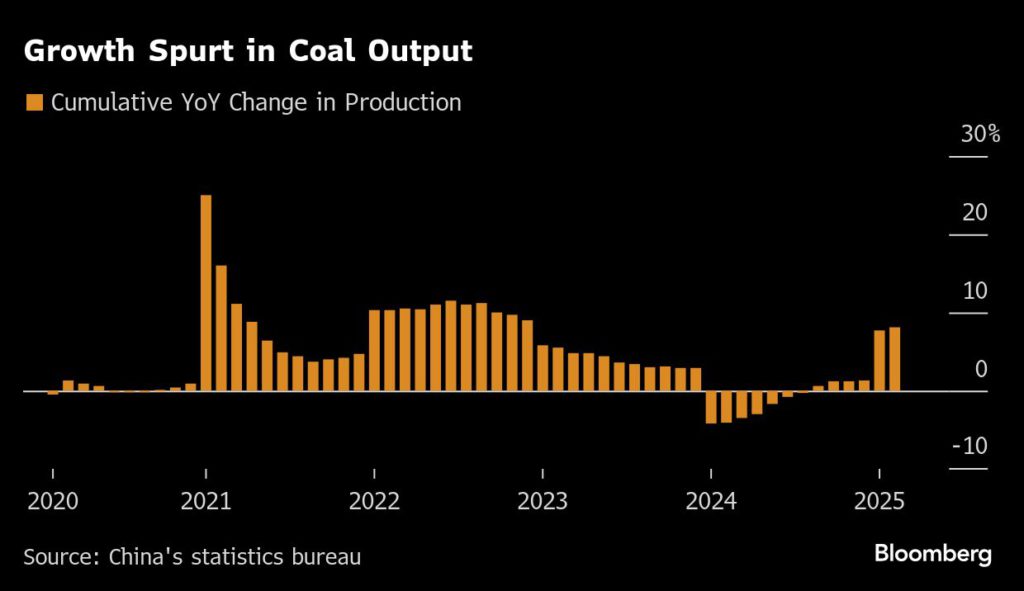
Chinese coal output climbed 8.1% to a record 1.2 billion tons in the first quarter. At the same time, thermal power generation, which mostly uses coal, fell 2.3%, challenged by the country’s rapid adoption of clean energy. Power market liberalization from June should make renewables even cheaper.

Imports at least are dwindling as shipments become uneconomic, although they only accounted for 11% of Chinese consumption last year. Otherwise, the market will be looking to weather forecasts for indications of a hotter-than-usual summer, said Li, with increased demand from air-conditioners a possible brake on price declines.