It’s possible that I shall make an ass of myself. But in that case one can always get out of it with a little dialectic. I have, of course, so worded my proposition as to be right either way (K.Marx, Letter to F.Engels on the Indian Mutiny)
Friday, June 13, 2025
World Bank ends ban on funding nuclear energy
Thursday, 12 June 2025
The World Bank is ending its long-standing ban on providing funding for nuclear energy projects - and will be open to supporting efforts to extend the life of existing reactors and accelerate the potential of small modular reactors in developing countries.
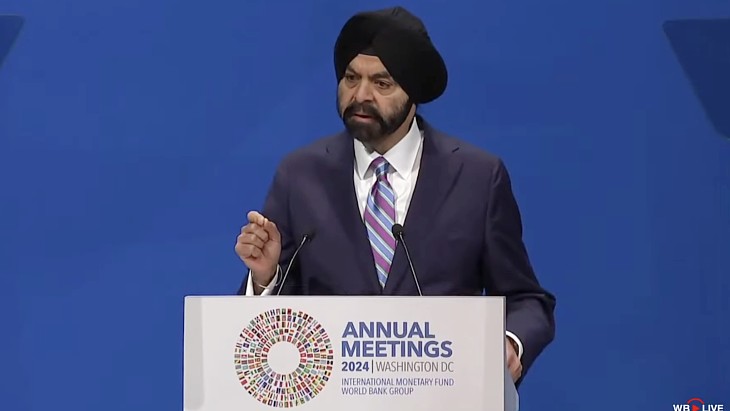
Ajay Banga, pictured here at the 2024 annual meeting, said the goal was to help deliver electricity as a driver of development (Image: Screengrab World Bank video)
The change was made at the World Bank's board meeting on Tuesday and confirmed in an email sent to the organisation's staff by World Bank President Ajay Banga, which has been seen by World Nuclear News.
In it he set out the rationale for change, saying that "electricity is a fundamental human right and the foundation of development. Jobs require electricity - as do health systems, education, clean water, public safety, and so much more. And demand will only grow as populations expand, economies industrialise, and digitalisation accelerates".
The goal is to give countries the flexibility to choose how to deliver the reliable energy needed to meet their development goals, especially with electricity demand in developing countries expected to more than double by 2035, which the World Bank thinks will require "investment in generation, grids, and storage to rise from USD280 billion today to roughly USD630 billion".
Banga says in the email that "what’s new is that, for the first time in decades, the World Bank Group will begin to reenter the nuclear energy space". Working in partnership with the International Atomic Energy Agency (IAEA) and other partners "we will support efforts to extend the life of existing reactors in countries that already have them, and help support grid upgrades and related infrastructure. We will also work to accelerate the potential of Small Modular Reactors - so they can become a viable option for more countries over time".
Countries would be in the driving seat to select the means that best fits their context and resources - "some may choose to invest in solar, wind, geothermal, or hydro where those make the most sense. In a number of others, the best path forward may include natural gas - or, over time, nuclear".
He said that there was not yet agreement on the World Bank board about engaging with upstream gas and "we’ll organise deep dives where we need a better understanding of evolving technologies like nuclear, carbon capture, and ocean energy".
Banga said that the constructive discussions meant "we’ve made real progress toward a clear path forward on delivering electricity as a driver of development".
The World Bank's decision was welcomed by Sama Bilbao y León, Director General of World Nuclear Association, who said: "This is a momentous shift for international energy policy, that comes after years of engagement with World Bank on the sustainability of nuclear energy. Access to finance is critical for extending the benefits of clean and reliable nuclear energy to all. World Nuclear Association is ready for further collaboration with World Bank and other multilateral development banks to support them in capacity building for decision making on nuclear financing."
Background
The World Bank Group, whose largest shareholder is the USA at 17%, is a multilateral lending organisation whose mission "is to end extreme poverty and boost shared prosperity on a livable planet. This is threatened by multiple, intertwined crises. Time is of the essence". In 2024 the World Bank Group says it facilitated USD117.5 billion "in loans, grants, equity investments and guarantees to partner countries and private businesses".
Although some multinational development banks have provided lending for decommissioning or upgrades to existing nuclear plants, they do not contribute to the financing of new-build projects - the World Bank's only loan for new nuclear capacity was USD40 million in 1959 for Italy's first nuclear power plant.
The pledge to aim for a tripling of nuclear energy capacity, originally unveiled at COP28 and backed by more than 30 countries, included inviting "shareholders of the World Bank, international financial institutions, and regional development banks to encourage the inclusion of nuclear energy in their organisations’ energy lending policies as needed, and to actively support nuclear power when they have such a mandate, and encourage regional bodies that have the mandate to do so to consider providing financial support to nuclear energy".
At the moment there are about 440 nuclear power reactors operating in 31 countries with at least 70 power reactors under construction. The IAEA says there are about 30 countries considering, or embarking on, nuclear power, with about two-thirds of them in the developing world and financing remains a major hurdle for many.
Poll finds global public support for nuclear remains high
Friday, 13 June 2025
Twice as many people support the use of nuclear energy than oppose it, according to the latest multinational public opinion poll conducted by market research firm Savanta on behalf of energy consultancy Radiant Energy Group.
(Image: Radiant Energy)
The Public Attitudes toward Clean Energy (PACE) index is described as "the world's largest publicly-released international study on what people think about nuclear energy", with data collected from almost 32,000 respondents in 31 countries.
"Across the countries surveyed, which represent almost two-thirds of the world's population, 46% support nuclear energy compared to 23% who oppose it," Radiant Energy said. That compares with the previous year when 46% of respondents supported nuclear energy with 28% opposing it. The newly published report shows that "22 of the 31 countries surveyed have net support (support exceeding opposition) for nuclear energy's use. Support is over three times higher than opposition in China, Poland, and Russia".
The survey shows that more than three times as many respondents want to keep using nuclear as want to phase it out. In most countries surveyed, over 40% support building new nuclear plants. In Russia, Poland, Norway, Finland, the Netherlands, Sweden, and France, public support for subsidising new nuclear construction is comparable to support for subsidising large-scale solar and onshore wind.
While support for nuclear was found to be high, 86% of respondents said they are concerned about the health and safety implications of nuclear's use. In addition, while 42% of respondents see nuclear energy as creating no or low levels of carbon emissions, 48% see nuclear energy as creating moderate or high levels of carbon emissions.
The survey found that the cost of nuclear is seen as low by more people than the cost of wind or solar in countries that have previously phased out nuclear's use. In Germany, Taiwan, Japan, South Korea and Sweden - countries that have had the largest politically-mandated nuclear phase-outs or closures - nuclear energy is the most positively viewed technology for reducing energy bills.
All countries show strong concern about nuclear waste. Countries pursuing one of several different waste solutions show less negative attitudes towards nuclear waste.
Public concern about nuclear waste is relatively low in Finland, home to the Onkalo repository. Similarly low levels of concern are seen in the Netherlands, which stores its waste at its above-ground COVRA facility, as well as in Egypt and Turkey, which plan to send their used fuel back to Russia.
"Given that the majority of respondents say they know little about nuclear energy, geopolitical and other non-technical factors may have a larger bearing on nuclear trust of certain countries than nuclear expertise," Radiant Energy said.
Savanta questioned 31,831 adults from 31 countries between November last year and May this year. The survey was conducted online. The countries selected include all G7 and BRICS countries, the world's top 15 countries by 2023 nuclear electricity generation, and several other countries considering their future use of nuclear energy. Eighty five percent of the global population powered by nuclear were represented in the survey.
Oklo named to supply microreactor for Alaska airbase
Friday, 13 June 2025
The US Defense Logistics Agency Energy Office has issued Oklo Inc a new Notice of Intent to Award for the development and operation of a licensed microreactor facility at Eielson Air Force Base in Alaska, clearing the way for contract negotiations to begin.
A rendering of an Aurora powerhouse (Image: Oklo)
"We are excited to partner with Oklo to take a significant step toward enhancing energy security at our installations," Acting Assistant Secretary of the Air Force for Energy, Installations, and Environment Michael Saunders said. "Following an extensive evaluation, Oklo was selected for their innovation, commitment to safety, and ability to support the mission-critical needs of this installation."
The US Air Force confirmed in 2021 that Eielson - which currently relies on coal to power its operations - would be the preferred site for its first microreactor, and in September 2022 issued a request for proposals for a "nuclear microreactor energy production facility" able to produce electricity and steam and to meet a baseload electricity demand of 5 MWe. The US Defense Logistics Agency (DLA) issued a similar notice to Oklo in August 2023, but rescinded it less than a month later to allow for "further consideration". This new Notice of Intent to Award again designates Oklo as the apparent successful offeror following a comprehensive evaluation process, the company said.
Oklo would design, construct, own, and operate the power plant, delivering both electricity to the Eielson base under a long-term power purchase agreement. The notice issued by the DLA on behalf of the Department of the Air Force and the US Department of Defense, initiates the negotiation process to potentially award a 30-year, firm-fixed-price contract to Oklo after obtaining a licence from the US Nuclear Regulatory Commission.
"This microreactor pilot could position Alaska and the nation at the forefront of energy innovation - leading us to a new era of safe, secure, and reliable energy," said Secretary of the Air Force Troy Meink. "It has the potential to shape future approaches to powering national security infrastructure, especially in the Arctic - where energy reliability is vital in the face of evolving threats."
Oklo is developing fast fission power plants capable of recycling used nuclear material, and has been given access to high-assay low-enriched uranium recovered from used fuel from the Department of Energy Experimental Breeder Reactor-II, which operated at Idaho National Laboratory from 1964 to 1994, to fuel its first core. The company's Aurora "powerhouse" can provide continuous, resilient energy that can operate independently from the grid, which the company said are key attributes for energy security at remote installations like Eielson.
As well as being rooted in legislative and executive initiatives including the 2019 National Defense Authorization Act and a 2021 Executive Order promoting small modular reactors for national defence and space exploration, the announcement also supports the aims set out in the raft of Executive Orders signed by President Donald Trump in late May.
Oklo CEO Jacob DeWitte - who was part of the White House ceremony marking the signature - said the notice "reflects continued confidence in Oklo's ability to deliver clean and secure energy solutions for mission-critical infrastructure," adding: "We are honoured to support national defense resilience objectives while demonstrating the value of US-pioneered fast reactor technology."
TVONS expands consultancy services to include SMRs
Friday, 13 June 2025
Finnish consulting company TVO Nuclear Services says it has expanded its service portfolio to include the advisory and expert services required for the preparatory and planning stages of small modular reactor projects.
The Olkiluoto plant (Image: TVO)
TVO Nuclear Services (TVONS) is a consulting company wholly owned by Finnish utility Teollisuuden Voima Oyj (TVO), owner of the Olkiluoto nuclear power plant. It was founded in 1998 to share TVO's expertise in the operation of Olkiluoto's two boiling water reactors (units 1 and 2), the construction of the first-of-a-kind EPR reactor (unit 3), as well as radioactive waste management.
TVONS says it is now offering consultancy services related to the construction of small modular reactors (SMRs).
"The potential of SMR plants can only be realised provided project planning and implementation, as well as the operation and maintenance of the plants represent the very highest standards," it said. "In other words, the SMR plants must hold the same trump cards as plants of the conventional size class."
"In both cases, it is our task to ensure that the plants operate reliably and efficiently through their whole life cycle," said TVONS Managing Director Ari Leppänen. "The scale of the plants may be smaller, but the responsibility is at least as great as with the larger plants. This is even more so as many of the future SMR plants are planned to be located much closer to built-up areas than the existing conventional plants."
Leppänen said services to support the commissioning and operational reliability of SMR plants will be available in Olkiluoto.
TVONS said it will offer SMR project developers services based on its extensive experience with safety standards and regulatory requirements; practice-oriented expertise in overall project management; supporting services from design through the commissioning and operational stages; knowledge required to build up the future operating organisation during the project stage; a client-driven approach, working as part of the client's core team throughout the project; and operating models refined over the decades to support risk management and successful implementation of projects.
TVONS has already provided consultancy services related to SMRs. In June 2023, it signed a letter of intent with Norsk Kjernekraft to jointly investigate the deployment of small modular reactors in Norway. In April 2024, TVONS signed a collaboration agreement with Steady Energy - Finnish developer of the LDR-50 small modular reactor - related to the development of a nuclear heating plant, initially focusing on the planning of the nuclear facility's operation and safety.
Fortum, EDF deepen cooperation on new-build projects
Friday, 13 June 2025
French energy company EDF has signed an Early Work Agreement with Finnish utility Fortum as the partners continue their collaboration toward the potential development of new nuclear projects in Finland and Sweden.
(Image: EDF)
"This agreement builds on two years of close collaboration - including joint technical workshops and site visits - under the Framework Contract signed in December 2023," Vakis Ramany, EDF's Senior Vice President International Nuclear Development, said in a LinkedIn post. "It paves the way for more in-depth cooperation and preparatory work, and for both parties to explore key technical and commercial aspects of deploying EPR technology in Finland and Sweden."
Fortum launched the feasibility study in October 2022 to explore the commercial, technological, and societal prerequisites for new nuclear in the two Nordic countries. The study involved in-depth discussions with several technology vendors, potential partners and customers as well as societal stakeholders.
In December 2022, EDF and Fortum announced the signature of a Framework Cooperation Agreement through which they would study opportunities for cooperation for the development of nuclear reactor projects in Finland and Sweden, both with conventional large reactors and small modular reactors (SMRs).
Fortum announced in March this year that it had selected two large reactor vendors plus one SMR vendor to continue discussions with after concluding its feasibility study. The company said it will continue to deepen the collaboration with two conventional reactor technology providers - EDF (EPR) and Westinghouse-Hyundai (AP1000) - and one SMR developer - GE-Hitachi (BWRX-300).
"At EDF, we are committed to supporting Fortum's nuclear development strategy in Sweden and in Finland, contributing to a secure, sustainable, and low-carbon energy future," Ramany said. "EDF teams are fully mobilised to bring their expertise to the table and move together with Fortum with confidence into the next phase."
Utah to host NuCube test reactor
Thursday, 12 June 2025
US innovative microreactor developer NuCube Energy has signed a memorandum of understanding with the Utah San Rafael Energy Lab to collaborate on the siting of a test reactor at the laboratory.
(Image: USREL)
Idaho Falls-based NuCube and Utah San Rafael Energy Lab (USREL) said they have already begun discussions about community outreach and engagement regarding siting the test reactor in Orangeville, Utah.
NuCube said its technology is capable of producing the highest-temperature heat from a fission reactor that can be easily integrated with chemical processes and energy conversion technologies. The reactor design utilises tri-structural isotropic - or TRISO - fuel and heat pipe technology, among other innovations, that are designed to minimise the use of moving parts within the reactor, thereby enhancing safety and reliability. The microreactors are housed in a stainless-steel compartment that increases safety and streamlines permitting.
Testing of NuCube's microreactors at USREL will be the next step in the technology's development, it said.
NuCube's reactor can produce electricity via high temperature heat greater than 1000 degrees Celsius. "It is the only reactor that can compete with natural gas for high temperature industrial customers," the company said. "The technology can deliver cost competitive electricity and can also be operated independently from existing power grids, which could be transformative for rural areas in states such as Utah."
"Utah has an enormous amount of momentum as it explores how best to leverage nuclear energy to meet the needs of its residents and businesses," said NuCube Energy cofounder and CEO Cristian Rabiti. "NuCube's innovative reactor is ideal for Utah and we're looking forward to bringing the highest temperature application for nuclear energy to the state for the first time. We are especially excited to be working with USREL given its proven track record of demonstrating advanced power generation technologies including a supercritical carbon dioxide power cycle."
In 2023, management of USREL was transferred to the Utah Office of Energy Development (OED). The lab says it is working with partners to develop promising advanced nuclear energy technology concepts. It says it has world-class capabilities to manufacture and characterise molten salts as a nuclear fuel carrier.
OED is Utah's primary office for energy and mineral development. The office is charged with developing and implementing energy policy and resources, creating energy-related educational and workforce development programs and promoting energy efficiency and infrastructure.
"The USREL has the space and equipment necessary to host projects like NuCube Energy's test reactor," said OED Director Emy Lesofski. "The lab will be a site for a variety of research projects that focus on keeping our energy clean, affordable, reliable and sustainable. The research at USREL will play a critical role in bringing promising technologies to market safely and quickly so the state can continue to increase its reliable and clean energy supply, while also working with local community members. We're particularly excited about NuCube's technology because of the opportunities around research it will afford."
Last month, Utah Governor Spencer Cox announced that it has agreed with California-based Valar Atomics to site a test SMR at USREL. He said the test reactor is anticipated being operational within one year.
Chevron and Halliburton Launch Autonomous Fracturing Tech in Colorado
Chevron U.S.A. Inc., a subsidiary of Chevron Corporation, and oilfield services firm Halliburton have unveiled a groundbreaking intelligent hydraulic fracturing system in Colorado’s shale fields. The joint innovation leverages closed-loop, feedback-driven completions to improve asset performance, precision, and efficiency—marking a major step forward for digitalization in unconventional oil production.
The technology replaces manual controls with real-time, automated stage execution based on subsurface feedback. This autonomous process uses Halliburton’s ZEUS IQ platform—featuring the OCTIV auto frac system and Sensori monitoring tools—to create a dynamic, self-adjusting loop. It continuously analyzes pressure, flow, and geomechanical data to adapt to changing downhole conditions.
Chevron contributes its subsurface engineering expertise and proprietary algorithms, allowing the system to fine-tune fracture strategies mid-operation. Unlike static models, this setup reacts to real-time reservoir behavior, enhancing fracture complexity, reservoir contact, and hydrocarbon recovery.
The technology reduces execution variability, ensures consistency across completions, and empowers crews to focus on high-level optimization rather than routine controls. Environmental gains are also notable: less fluid use, lower emissions, and minimized surface impact.
Chevron VP Kim McHugh said the system reflects the company’s goal to improve performance safely through innovation and strategic collaboration. Halliburton’s VP Shawn Stasiuk emphasized the digital revolution’s direct impact at the wellsite, accelerating field experimentation and refinement.
The project’s success could set a global standard for intelligent fracturing in shale and tight formations. With scalable architecture and cloud connectivity, Chevron and Halliburton’s system is poised for broader adoption across North America and beyond—delivering smarter, cleaner, and more efficient energy production.
Petrobras, ABB, Seatrium to Develop Two All-Electric FPSO Vessels
Petrobras is advancing offshore oil innovation through a strategic partnership with ABB and Seatrium to develop two all-electric FPSO (Floating Production Storage and Offloading) vessels, P-84 and P-85, destined for Brazil’s Atapu and Sépia oil fields. These next-generation vessels, each capable of producing 225,000 barrels of oil per day, represent Petrobras’ first foray into fully electrified offshore platforms. The design aims to boost energy efficiency, reduce emissions, and improve operational flexibility.
ABB will supply advanced automation and electrical systems, including its ABB Ability System 800xA, substation automation compliant with IEC 61850, and modular eHouses. Notably, the project will debut ABB’s Is-limiter technology in offshore operations—crucial for preventing short-circuit damage and ensuring electrical system stability under extreme demands. Key components, like UniGear ZS1 switchboards, will be produced locally at ABB’s Sorocaba facility, supporting Petrobras’ local content goals and contributing to Brazil’s industrial economy.
Seatrium will handle the FPSOs’ engineering and construction, collaborating closely with ABB to meet complex offshore requirements and stringent safety standards. This joint effort highlights a global engineering synergy that combines digital automation and large-scale offshore fabrication.
Petrobras is responding to the growing global demand for oil with innovative, sustainable technologies. The P-84 and P-85 projects not only increase production but also set a new standard for cleaner offshore energy. As the FPSO market is projected to reach $46.2 billion by 2033, Petrobras is positioning itself as a leader in both energy output and environmental stewardship.
New forecasting model pinpoints what moves clean energy stocks
Macroeconomic predictors dominate the pick-up rate, with UNRATE ranking the highest at 25.64%, followed by GPRH at 20.86%, and TPU at 20.80%. These predictors capture key aspects of labor market dynamics, geopolitical risks, and trade policy uncertainty. This aligns with Baumeister et al. (2022), who demonstrated that macroeconomic indicators, such as unemployment rates and economic activity indices, are robust predictors of energy-related market performance.
Credit: Xinling Liu (Southeast University, China) Binjie Wang and Jianhao Xue (Nanjing University of Aeronautics and Astronautics, China) Qunwei Wang (Nanjing University of Aeronautics and Astronautics, China) Xingyu Dai (Nanjing University of Aeronautics and Astronautics, China) Xuan-Hoa Nghiem (Vietnam National University, Vietnam)
Background and Motivation
As the global energy transition accelerates, clean energy stocks (CES) have become a key asset class in financial markets. However, CES returns are driven by a complex interplay of macroeconomic trends, climate policies, and technological shifts, making them far harder to predict than traditional financial assets. Addressing this challenge, China Finance Review International (CFRI) presents the article “Clean energy stock returns forecasting using a large number of predictors: which play important roles?” This article explores how integrating 56 predictors from technical, macroeconomic, climate risk, and financial domains can significantly improve clean energy stock (CES) forecasting accuracy.
Methodology and Scope
This study develops a comprehensive forecasting framework incorporating 56 predictors across technical, macroeconomic, climate risk, and financial categories, using monthly data from the WilderHill Clean Energy Index (2009–2023). Advanced econometric methods—including LASSO, Group LASSO, quantile regression, and model combination techniques—are employed to tackle multicollinearity, overfitting, and the challenges of high-dimensional data. The analysis systematically examines the time-varying importance of different predictor groups and evaluates their effectiveness over multiple forecasting horizons and rolling time windows.
Key Findings and Contributions
Macroeconomic dominance: Economic indicators like CFNAI are the most stable and powerful predictors, especially during periods of market volatility.
Time-varying climate risk: The influence of climate policy uncertainty and extreme weather fluctuates significantly with policy changes and seasonal effects.
Short-term power of technical signals: Momentum (MOM) and volume-based signals (OBV) provide valuable short-term forecasting power during rapid market swings.
Innovation in grouping and quantile analysis: By using group regularisation (Group LASSO) and quantile regression, the study uncovers synergies between predictor groups and exposes tail risk dynamics.
Research contribution: This is the first systematic integration of 56 heterogeneous predictors into a dynamic model tailored for clean energy markets, offering new methodological tools for dimension reduction and factor selection in high-dimensional finance.
Why It Matters
Theoretical value: It breaks through traditional single-factor or single-model frameworks, demonstrating how multidimensional factors interact to shape returns.
Practical value: It provides investors with evidence-based signals for optimising asset allocation, and helps policymakers gauge how markets react to climate policy interventions.
Practical Applications
For Researchers: Provides a comprehensive empirical framework for multi-factor, high-dimensional forecasting in clean energy finance, incorporating macroeconomic, climate, technical, and financial predictors. Demonstrates the effectiveness of regularisation and quantile regression methods for variable selection and forecasting, offering methodological guidance for future research.
For Investors: Identifies the most reliable indicators (such as macroeconomic variables and market volatility signals) to support investment decision-making and risk management in the clean energy sector. Highlights the changing importance of predictors under different market conditions, helping investors refine timing and asset allocation strategies.
For Policymakers: Reveals the time-varying impact of climate policy and macroeconomic shocks on clean energy stock returns, offering insights for dynamic and responsive policy design. Provides empirical evidence to support the evaluation of climate and energy policies' effects on financial market stability.
Discover high-quality academic insights in finance from this article published in China Finance Review International. Click the DOI below to read the full-text original! Open access for a limited time!
House Republicans are advocating for revisions to the clean energy tax credit provisions within the reconciliation bill, arguing that the current 60-day timeline and "placed in service" standard will disrupt ongoing projects.
Lawmakers suggest replacing the "placed in service" requirement with a "commence construction" provision to provide more flexibility and certainty for businesses investing in energy projects.
The proposed changes aim to modernize the energy tax code in a way that promotes fiscal responsibility and ensures long-term investment in energy infrastructure across the country.
Kiggans and a nearly identical group of House Republicans wrote to their House colleagues last month seeking positive changes to the clean energy tax credit phaseout plan that came out of committee work on the reconciliation bill. Instead, the House-passed version of the bill imposes a faster phaseout timeline, including a repeal of tax credits for projects that don’t begin construction within 60 days of the bill’s enactment.
The Republican lawmakers in support of IRA’s clean energy credits asked that the Senate alter that provision — along with a foreign entity of concern provision that was again called “overly prescriptive” — and maintain tax credit transferability throughout the credits’ lifetime. The group said that though they were “proud to have worked to ensure that the bill did not include a full repeal of the clean energy tax credits,” they remain “deeply concerned about those provisions.”
The tax credit phaseout schedule included in the House-passed bill, “would cause significant disruption to projects under development and stop investments needed to win the global energy race,” the letter said. The lawmakers said the overall approach to the tax credit changes “jeopardizes ongoing development, discourages long-term investment, and could significantly delay or cancel energy infrastructure projects across the country.”
The group recommended the 60-day timeline and the bill’s “placed in service” standard should be replaced with a “commence construction” requirement. The group said that due to permitting delays and other issues outside of project developers’ control, it is hard for the businesses to be sure when their projects will be “placed in service.” Swapping that language with a “commence construction” provision would give companies more flexibility to understand if they are eligible for certain credits and give “the investment clarity and lead time required for energy projects to succeed,” according to the Republican lawmakers.
“Our position has always been that the energy tax code should be modernized in a way that promotes fiscal responsibility and business certainty,” the letter said. “Fully realizing that balance requires improvements to the House-passed version of … the One Big Beautiful Bill Act.”
Kiggins was joined on the letter by Reps. Andrew Garbarino, Mike Lawler and Nick LaLota of New York; Mark Amodei of Nevada; Don Bacon of Nebraska; Brian Fitzpatrick and Rob Bresnahan of Pennsylvania; Juan Ciscomani of Arizona; Gabe Evans of Colorado; Young Kim and David Valadao of California; and Thomas Kean Jr. of New Jersey. Garbarino reportedly slept through the full House vote on the bill — which passed by a single vote — but later said he looks forward to supporting the bill’s passage when it comes back from the Senate.
Utilities and renewable energy experts have said the current 60-day timeline would “trigger a scramble” to do as much as possible within that window, while other clean energy experts called the House-passed bill “unworkable” in its current form.
By Lamar Johnson of Utility Dive via Zerohedge.com

_44004.jpg)
_91852.jpg)
_47392.jpg)
_42978.jpg)