Tuesday, July 08, 2025


Nippon Steel Acquires U.S. Steel After Prolonged Battle

  • Nippon Steel has successfully acquired U.S. Steel after an 18-month process, with the deal now including concessions such as a "golden share" for the U.S. government.

  • The acquisition is largely seen as positive for steel buyers, preventing layoffs and further industry consolidation, and Nippon plans substantial investments in U.S. facilities.

  • Progress is being made on several trade agreements, including a deal with Vietnam, with ongoing negotiations with Canada, the EU, and Mexico expected to further impact steel prices and import flows.

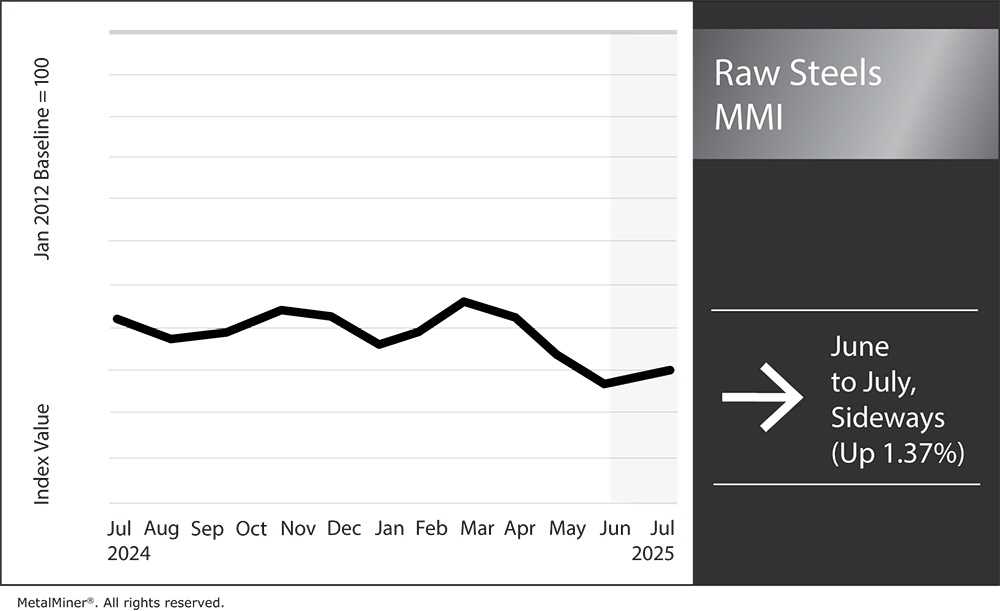
The Raw Steels Monthly Metals Index (MMI) trended sideways, with a 1.37% increase from June to July. With a few exceptions, steel prices remained largely steady as long-awaited trade deals with the U.S. began to materialize.
Raw Steels MMI, July 2025

Nippon Officially Acquires U.S. Steel

After an arduous 18-month process, Nippon Steel officially acquired U.S. Steel. Initially blocked by former President Biden in January 2025, President Trump revived the deal, calling for a new review after months of lobbying efforts. As a result, the previous board stepped down, replaced by ones appointed by the Japanese steelmaker. Nippon Steel kept David B. Burritt, who will remain president and CEO, and named Takahiro Mori, Naoki Sato and Hiroshi Ono as the new board members to oversee the transition.

The terms come with several concessions. Among these include a “golden share,” which, according to a recent filing with the Securities and Exchange Commission, will give the U.S. government influence over things like pay, operations and production. It will also allow the federal government to appoint a board member. 

Avoid being blindsided by sudden steel supply constrains or price shifts. Get the data and expert analysis you need to stay competitive with MetalMiner’s weekly newsletter.

Most See the Acquisition as a Boon

For steel buyers, the acquisition appears to be positive news. After the deal was blocked, U.S. Steel warned of impending layoffs and facility closures. Nippon’s acquisition not only reverses those negatives but also prevents further consolidation of the U.S. steel industry, which had given U.S. producers considerably more control over the U.S. steel market in recent years. Especially amid tariffs, which have crimped import supply, this could have spelled big problems for steel prices.

Meanwhile, Nippon plans substantial investments at Big River, Gary Works, Mon Valley, Keetac/Minntac and Fairfieleld Works, in addition to $1 billion towards the construction of a new mini mill.

Trade Agreements Slowly Start to Roll In

In other positive developments, progress has been made regarding ongoing trade agreements, with several more expected in the coming months. In addition to tentative frameworks with China and the UK, President Trump recently announced a deal with Vietnam. While the announcement has yet to be formally outlined, it will reportedly include a 20% tariff on Vietnamese imports and a 40% tariff on transhipped goods.

The latter would have the largest impact on the U.S. steel market, but many details remain unclear at the moment. Vietnamese CRC and HDG imports have historically offered a substantial drag on U.S. steel prices. High volumes, particularly throughout 2024, fed oversupply, making mill efforts to raise prices difficult. Meanwhile, tariff threats and countervailing duties largely stemmed flows from Vietnam. 

Much of the supply from Vietnam appeared to be the result of transhipment efforts, where a country like China ships competitively priced volumes of HRC to Vietnam for Vietnam to process into other forms of steel, such as CRC or HDG.

However, it remains unclear under the terms of the deal whether those processing efforts will be considered sufficient to count as transhipping, where a 40% tariff would be applied, or simply as imports subject to the 20% duty. Regardless of this determination, countervailing duties, which were determined in 2025, will continue to place a cap on steel imports from Vietnam. 

Other Deals Currently in the Works

Meanwhile, negotiations remain ongoing with Canada, the EU and Mexico. Depending on their results, these discussions could further ease tariff constraints. As oversupply from China remains the key issue, those deals could hinge on sufficient protections from those countries.

  • Canada – Trade negotiations were recently resumed on Canada’s decision to drop a digital services tax. Canada is the largest steel supplier to the U.S., so a deal could put downward pressure on steel prices.
  • EU – A deal with the EU appears less certain, particularly ahead of the July 9 deadline. Negotiations remain ongoing, and in the short term, could result in another deadline delay.
  • Mexico – Reports suggest Mexico may receive a quota, which would allow a certain volume of steel imports into the U.S. free of duties. 
Steel Prices, Mill Lead Times Move Sideways

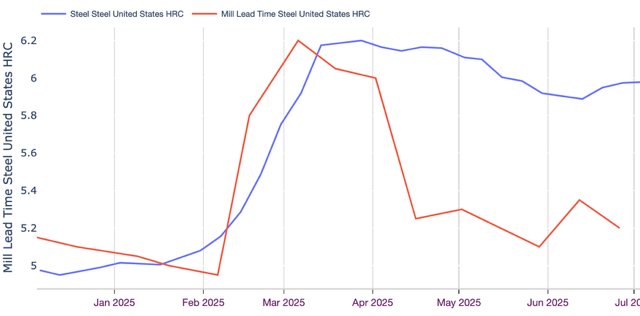
Amid the trade uncertainty, steel prices trended sideways throughout June. HRC prices experienced a slight increase during the month, while mill lead times fluctuated near the same levels seen at the end of June. Service centers noted that Q3 would likely prove a pivotal month. Any failure among mills to raise or stabilize steel prices could result in the resumption of the downtrend.
steel correlations, July 2025

If that occurs, mills will likely use fall maintenance outages to regain control of the price trend, as occurred last year. Despite a largely soft market in the second half of 2024, outages reports saw steel prices find a bottom in late July 2024, followed by a modest increase throughout Q3.

By Nichole Bastin


EU Parliament Endorses Eased Natural Gas Storage Targets

The European Parliament approved on Tuesday eased rules and targets for natural gas storage refills in the EU in a move aimed at preventing price spikes.

Earlier this year, the EU member states agreed to ease the bloc’s natural gas storage targets by allowing a 10 percentage point deviation in the 90% full storage goal.

The greater flexibility comes in response to the fears of several large gas-consuming nations in Europe that they would have to either subsidize storage filling when it’s uneconomical or miss the targets.

The new targets and greater flexibility to achieve them needed to be endorsed by both the EU member states and the European Parliament.

The Parliament approved today the eased targets with 542 votes to 109, with 30 abstentions.

Under the softened rules, the EU member states should reach the target of 90% full storage anytime between October 1 and December 1, instead of an unmoving target by November 1, as it was the case in previous years.

The EU countries are also given the possibility to deviate by up to 10 percentage points from the filling target in the event of difficult market conditions, such as indications of speculation hindering cost-effective storage filling.

“The Commission may further increase this deviation by a further five percentage points by means of a delegated act, for one filling season, if these market conditions persist,” the European Parliament said.

The 90% storage filling obligation was extended by two years, until the end of 2027.

“This revision will provide for more flexibility and less bureaucracy but, above all, it will bring Europe’s gas prices down, while we continue advancing towards energy independence from unreliable suppliers,” said rapporteur Borys Budka of the Christian Democrat European People’s Party (EPP).

Following the approval by the European Parliament, the eased targets must now be formally approved by the EU member states, with this step expected to pass without amendments.

By Charles Kennedy for Oilprice.com


Nissan to Curb Production of New EV Amid China’s Rare Earths Export Controls

Japanese car manufacturing giant Nissan Motor is revising down production plans for its new Leaf series electric vehicle as the Chinese controls on exports of rare earth elements have created a shortage of car parts, Kyodo News reported on Tuesday.

The setback for Nissan’s new EV is the latest in a series of hurdles that carmakers globally have faced since China announced export controls of rare earths in early April.

Suzuki Motor, another Japanese giant, has reportedly halted production of its flagship Swift subcompact because of supply chain shortages, sources with knowledge of the matter told Reuters last month.

At the beginning of April, China announced it would curb its exports of dysprosium, gadolinium, scandium, terbium, samarium, yttrium, and lutetium. These so-called “heavy” and “medium” rare earth elements are mostly used in automotive applications, including rotors and motors and transmission in electric vehicles and hybrids, as well as in the defense industry in parts of jets, missiles, and drones.

The Chinese export restrictions reverberated through global supply chains and were initially felt in the automotive industry, where major car manufacturing associations warned that production and assembly lines are being idled due to a bottleneck in magnet and rare earth supply.

Germany’s automotive industry group VDA joined other carmakers to sound the alarm that the curbs and controls on China’s exports of rare earth elements and magnets could disrupt and even idle manufacturing lines.

In May, the Alliance for Automotive Innovation – which represents GM, Toyota, Volkswagen, and other major car manufacturers – warned of production reductions and even shutdowns of assembly lines without access to magnets and to rare earths.

China has eased some of its restrictions on exports of rare earth elements by approving “a certain number” of export licenses. However, global supply chains continue to feel the shortage of magnets and other rare earth-derived parts.

Charles Kennedy for Oilprice.com


JinkoSolar Boosts Massachusetts Clean Energy Goals

JinkoSolar Holding Co., one of the world’s leading solar module manufacturers, has successfully commissioned 21.6 megawatt-hours of energy storage systems in Massachusetts, a move that bolsters the state’s ambitious clean energy goals under its Solar Massachusetts Renewable Target (SMART) program. The three systems, developed by Distributed Energy Infrastructure (DEI), are now operational, enhancing grid reliability and supporting the state’s transition to a cleaner energy future.

The newly deployed systems, which use both DC and AC-coupled configurations for maximum flexibility, provide critical grid services while improving the performance of solar assets. JinkoSolar’s U.S.-based engineering team collaborated closely with DEI, offering system design expertise and ensuring seamless integration with power conditioning and energy management platforms. DEI managed the projects’ full execution, from development to commissioning, minimizing delays and risks.

“This is a significant step toward a more resilient and sustainable grid in Massachusetts,” said Jeff Juger, deputy general manager and head of energy storage systems at JinkoSolar (U.S.) Inc. “Our collaboration with DEI highlights our ability to deliver tailored, high-performance solutions.”

Massachusetts’ SMART program, recently updated to stabilize solar markets amid federal policy shifts, incentivizes solar and storage projects to meet the state’s goal of 5,000 megawatts of storage by 2030. The state’s push comes as federal clean energy tax credits face uncertainty, with recent Senate proposals ending subsidies for renewables, according to The New York Times. Massachusetts’ proactive policies aim to fill this gap, ensuring solar remains viable.

Sean Harrington, CEO of DEI, praised JinkoSolar’s robust technology and local support. “Their U.S. team streamlined integration, helping us deliver these projects efficiently,” he said. The systems align with Massachusetts’ broader efforts to modernize its grid, reduce carbon emissions, and protect natural landscapes through innovative land-use policies tied to the SMART program.

The deployment reflects a growing trend in U.S. energy storage adoption. Reuters reported that startups like Lyten are expanding storage capacity to meet rising demand, while states like Massachusetts lead with mandates to curb reliance on fossil fuels. JinkoSolar’s project underscores the role of private-sector innovation in achieving these goals, especially as global clean energy investments surge, driven by national security and economic priorities, per The New York Times.

For Massachusetts, these systems are more than infrastructure—they’re a lifeline for clean energy progress. As the state works to reclaim its position as a solar leader, projects like this signal a commitment to resilience and sustainability, even in a shifting policy landscape.

By Michael Kern for Oilprice.com


Chesapeake Utilities to Power New Data Center with Natural Gas

Chesapeake Utilities Corporation announced Tuesday that its Ohio subsidiary, Aspire Energy Express, LLC, will construct a $10 million intrastate natural gas pipeline in central Ohio to supply a new fuel-cell facility powering a data center. The project, in partnership with American Electric Power (AEP), is set to deliver reliable natural gas by the first half of 2027, addressing the surging energy demands of the data center industry.

The pipeline will support a fuel-cell facility providing on-site electricity to a data center, reflecting a broader trend of utilities adapting to the power-intensive needs of data infrastructure driven by artificial intelligence and cloud computing. The U.S. Energy Information Administration projects U.S. electricity consumption will hit record highs in 2025 and 2026, largely due to data centers, with natural gas playing a key role in meeting this demand despite its declining share in power generation, expected to drop from 42% in 2024 to 40% in 2025.

Chesapeake’s investment aligns with its growth strategy, leveraging its expertise in natural gas transmission to serve high-growth regions. “This project is a clear example of how Chesapeake Utilities continues to execute on our growth strategy by leveraging our core capabilities,” said Jeff Sylvester, senior vice president and chief operating officer. The company, with a market cap of $2.84 billion, reported a 20.34% revenue increase over the past year, driven by strong natural gas demand and infrastructure investments.

AEP, a major utility serving 5.6 million customers across 11 states, is also positioning itself to meet rising commercial load growth, which hit 12.3% in the first quarter of 2025. Its collaboration with Chesapeake underscores efforts to provide innovative power solutions, including low-carbon options like fuel cells, as seen in AEP’s recent 100-megawatt Bloom Energy fuel cell project in Ohio.

The project comes amid concerns about the risks of overbuilding gas infrastructure. Environmental groups, like the Sierra Club, warn that speculative data center demand could lead to stranded assets, burdening ratepayers if projects fail to materialize. AEP Ohio has introduced tariffs requiring data centers to cover most of their projected energy costs to mitigate such risks.

This pipeline, operated by Aspire Energy Express, founded in 2020, adds to Chesapeake’s 2,300 miles of natural gas pipelines across 40 Ohio counties. As data centers reshape energy landscapes, this initiative highlights the critical role of natural gas in balancing reliability and growth, even as utilities navigate a complex transition toward cleaner energy sources.

By Michael Kern for Oilprice.com 


Hess Exits Suriname's Block 59 as Deepwater Exploration Proves Too Costly

U.S. oil producer Hess Corp has announced its decision to exit Suriname’s offshore Block?59, returning operations to the national oil firm Staatsolie. Hess fulfilled its minimum exploration obligations but opted not to advance to the next phase when the deadline passed on July?8,?2025. Earlier, ExxonMobil and Equinor abandoned their stakes in the block, citing high drilling risks in the deepwater wildcat zone, and Hess was unable to secure new partners.

Located in northwest Suriname, Block?59 spans approximately 4,400?km² with water depths between 2,700 and 3,500?m. Initial seismic studies were conducted by the previous partners, but costly drilling challenges have stalled progress. With the block returned, Staatsolie intends to incorporate the area back into its offshore contracting strategy, which already covers nearly 50% of Suriname’s maritime territory.

Hess’s engagement with Suriname traces back to 2016, viewing the offshore acreage as a geological extension of its highly successful Guyana play. The company actively sought partners through 2024 but failed to reach a deal. According to Hess’s 2024 annual report, it plans to relinquish 94% of its undeveloped acreage in Guyana and Suriname by 2028, reflecting a strategic recalibration.

With deepwater offshore projects in Suriname proving too risky and unpartnerable, Staatsolie is now poised to reclaim Block?59 and explore further developments with international firms. The decision comes amid growing activity in Suriname's oil sector, including an offshore bond-backed venture, major investments in Blocks 52 and 58 with partners TotalEnergies, APA Corp, and QatarEnergy, and progress toward future exploration and production sharing contracts.