It’s not enough that Trump slashes taxes on the rich. He partially pays for those cuts in ways that punish poor and working-class people. Now we must fight like hell to regain what we've lost—and go further.

Burk Ketcham, who turned 100 years old in March, sits on his rolling walker holding a protest sign against President Trump at the corner of Nott Terrace and Eastern Avenue in Schenectady in June of 2025.
(Photo: Paul Nelson/Albany Times Union via Getty Images)
Amy Hanauer
Jul 11, 2025
Common Dreams
As Republican Senators moved their megabill through the Senate, I was celebrating the life of my father-in-law who died at 91 earlier this spring. Born during the Great Depression, he lived a long, prosperous, healthy life because of work and luck, but also because of doors opened by policies enacted between 1900 and 1980. This country’s biggest historical challenge has been delivering this progress to all Americans, but Republicans have cut it back for everyone, retreating from many 20th century achievements in ways that will slam doors, rather than opening them, for the next generation.
Lawmakers established the individual income tax in 1913, the corporate income tax in 1909, and the estate tax in 1916. The new tax law weakens all three. These taxes, combined with the payroll tax created in the 1935 New Deal, enabled poverty to plunge, education levels to soar, and lifespans to nearly double over the course of the 20th century. The roads and railroads, schools and colleges, and pipes and power sources that our tax dollars funded catalyzed industrial, educational, and health advancements that transformed our world.
The income tax, corporate tax, and estate tax raise revenue for our collective needs and do so progressively, falling most heavily on those most able to pay. These are the funding sources Republicans chose to attack in their megabill. That’s why the law’s huge giveaways go so resoundingly to the uber-rich. All told, the richest 1 percent – a group with incomes exceeding $916,900 per year – will get a trillion dollars in tax cuts over the next decade. Find the average annual gift to the wealthiest 1 percent in your state here.
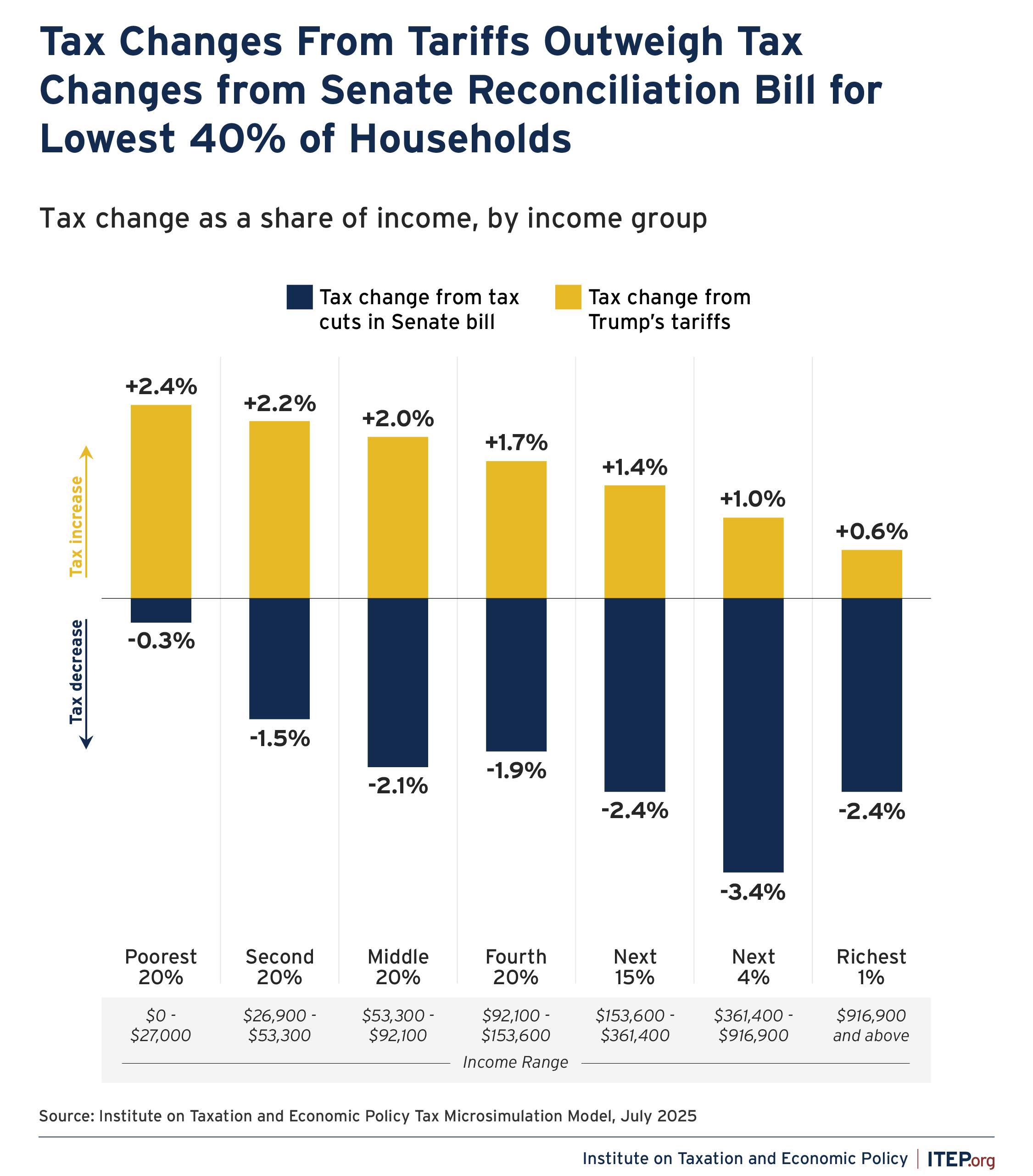
More than 70 percent of this law’s tax cuts go to the richest fifth of people, while middle-income Americans get just 10 percent and the poorest fifth get less than 1 percent. And for 80 percent of Americans, Trump’s tariffs will offset most or all of the tax cuts by raising prices on things we all buy.
Make no mistake, President Trump and his Congress have guaranteed that fewer Americans will have health insurance, more children will go hungry, and states will have less federal funding to deliver good schools, affordable college, and quality roads and bridges.
It’s not enough that Trump slashes taxes on the rich. He partially pays for those cuts in ways that punish poor and working-class people. The new law makes the biggest reductions to health care in American history – stripping insurance coverage from 17 million Americans by kicking them off of Medicaid and taking away their Affordable Care Act subsidies. On top of booting people off health care, this will force near immediate closure of more than 300 rural hospitals.
The second major funding source literally takes food from hungry families by slashing the Supplemental Nutrition Assistance Program (SNAP) (once known as food stamps), a program that provided a meager but essential $2.84 per person per meal last year. These are the biggest attacks on food aid in history, abandoning a core federal commitment to provide at least minimal nutrition to the elderly, disabled people, and the very poorest children.
The final major spending cuts end incentives that were sparking jobs and investments in the green energy economy. This threatens 4,500 clean energy projects, imperils hundreds of thousands of jobs, and is projected to add billions of dollars to Americans’ annual energy costs. The subsidies were reducing the carbon emissions that contribute to climate change. Gutting them is a baffling choice as hurricane season bears down on coastal regions. They also were strengthening domestic energy production, making the U.S. less dependent on oil suppliers in the middle east and elsewhere.
Despite spending cuts, the bill will add trillions over the next decade to the national debt. This will shift costs onto the next generation, making it more expensive to borrow to buy a home, finance college, or even purchase the basics.
My father-in-law lived a great life in part because of taxes. His generation – particularly white men in his generation – benefitted from growing investments in public schools, affordable college, a GI bill that made housing and higher education even more manageable, a skyrocketing economy, and plentiful jobs often with unions, wage growth, and sometimes, as in his case, great health insurance and a full pension.
None of the benefits of the boomer generation were distributed equally and Black Americans were particularly left out. And starting with Ronald Reagan’s assault on unions, job quality deteriorated, with health coverage and pensions eroding particularly for workers without a college degree. But make no mistake, President Trump and his Congress have guaranteed that fewer Americans will have health insurance, more children will go hungry, and states will have less federal funding to deliver good schools, affordable college, and quality roads and bridges.
A hard-working, devoted, optimistic man, my father-in-law had unyielding confidence that America would keep its promise to the next generation. This week Republicans reneged on that promise. We can collectively reclaim it, so every baby born today has the chance at upward mobility and achievement that many in previous generations did. America’s future just got dimmer. We have an obligation to restore its brightness.
Our work is licensed under Creative Commons (CC BY-NC-ND 3.0). Feel free to republish and share widely.
Amy Hanauer joined ITEP in 2020, bringing nearly 30 years of experience working to create economic policy that advances social justice. As executive director of both ITEP and Citizens for Tax Justice, Amy provides vision and leadership to promote fair and equitable state and national tax policy.
Full Bio >
As Republican Senators moved their megabill through the Senate, I was celebrating the life of my father-in-law who died at 91 earlier this spring. Born during the Great Depression, he lived a long, prosperous, healthy life because of work and luck, but also because of doors opened by policies enacted between 1900 and 1980. This country’s biggest historical challenge has been delivering this progress to all Americans, but Republicans have cut it back for everyone, retreating from many 20th century achievements in ways that will slam doors, rather than opening them, for the next generation.
Lawmakers established the individual income tax in 1913, the corporate income tax in 1909, and the estate tax in 1916. The new tax law weakens all three. These taxes, combined with the payroll tax created in the 1935 New Deal, enabled poverty to plunge, education levels to soar, and lifespans to nearly double over the course of the 20th century. The roads and railroads, schools and colleges, and pipes and power sources that our tax dollars funded catalyzed industrial, educational, and health advancements that transformed our world.
The income tax, corporate tax, and estate tax raise revenue for our collective needs and do so progressively, falling most heavily on those most able to pay. These are the funding sources Republicans chose to attack in their megabill. That’s why the law’s huge giveaways go so resoundingly to the uber-rich. All told, the richest 1 percent – a group with incomes exceeding $916,900 per year – will get a trillion dollars in tax cuts over the next decade. Find the average annual gift to the wealthiest 1 percent in your state here.
More than 70 percent of this law’s tax cuts go to the richest fifth of people, while middle-income Americans get just 10 percent and the poorest fifth get less than 1 percent. And for 80 percent of Americans, Trump’s tariffs will offset most or all of the tax cuts by raising prices on things we all buy.
Make no mistake, President Trump and his Congress have guaranteed that fewer Americans will have health insurance, more children will go hungry, and states will have less federal funding to deliver good schools, affordable college, and quality roads and bridges.
It’s not enough that Trump slashes taxes on the rich. He partially pays for those cuts in ways that punish poor and working-class people. The new law makes the biggest reductions to health care in American history – stripping insurance coverage from 17 million Americans by kicking them off of Medicaid and taking away their Affordable Care Act subsidies. On top of booting people off health care, this will force near immediate closure of more than 300 rural hospitals.
The second major funding source literally takes food from hungry families by slashing the Supplemental Nutrition Assistance Program (SNAP) (once known as food stamps), a program that provided a meager but essential $2.84 per person per meal last year. These are the biggest attacks on food aid in history, abandoning a core federal commitment to provide at least minimal nutrition to the elderly, disabled people, and the very poorest children.
The final major spending cuts end incentives that were sparking jobs and investments in the green energy economy. This threatens 4,500 clean energy projects, imperils hundreds of thousands of jobs, and is projected to add billions of dollars to Americans’ annual energy costs. The subsidies were reducing the carbon emissions that contribute to climate change. Gutting them is a baffling choice as hurricane season bears down on coastal regions. They also were strengthening domestic energy production, making the U.S. less dependent on oil suppliers in the middle east and elsewhere.
Despite spending cuts, the bill will add trillions over the next decade to the national debt. This will shift costs onto the next generation, making it more expensive to borrow to buy a home, finance college, or even purchase the basics.
My father-in-law lived a great life in part because of taxes. His generation – particularly white men in his generation – benefitted from growing investments in public schools, affordable college, a GI bill that made housing and higher education even more manageable, a skyrocketing economy, and plentiful jobs often with unions, wage growth, and sometimes, as in his case, great health insurance and a full pension.
None of the benefits of the boomer generation were distributed equally and Black Americans were particularly left out. And starting with Ronald Reagan’s assault on unions, job quality deteriorated, with health coverage and pensions eroding particularly for workers without a college degree. But make no mistake, President Trump and his Congress have guaranteed that fewer Americans will have health insurance, more children will go hungry, and states will have less federal funding to deliver good schools, affordable college, and quality roads and bridges.
A hard-working, devoted, optimistic man, my father-in-law had unyielding confidence that America would keep its promise to the next generation. This week Republicans reneged on that promise. We can collectively reclaim it, so every baby born today has the chance at upward mobility and achievement that many in previous generations did. America’s future just got dimmer. We have an obligation to restore its brightness.
Our work is licensed under Creative Commons (CC BY-NC-ND 3.0). Feel free to republish and share widely.
Amy Hanauer joined ITEP in 2020, bringing nearly 30 years of experience working to create economic policy that advances social justice. As executive director of both ITEP and Citizens for Tax Justice, Amy provides vision and leadership to promote fair and equitable state and national tax policy.
Full Bio >
'Indefensible': Trump Budget Law Subsidizes Private Jet Owners While Taking Healthcare From Millions
A provision of the budget law that President Donald Trump signed last week will leave taxpayers to "pick up the tab for the private jet industry and billionaire high flyers."

Private jets were seen on the tarmac at Friedman Memorial Airport ahead of a business conference on July 5, 2022 in Sun Valley, Idaho.
(Photo: Kevin Dietsch/Getty Images)
Jake Johnson
Jul 07, 2025
COMMON DREAMS
The Republican budget measure that U.S. President Donald Trump signed into law late last week contains a provision that analysts say will allow private jet owners to write off the full cost of their aircraft in the first year of purchase, a boon to the ultra-rich that comes as millions of people are set to lose healthcare under the same legislation.
FlyUSA, a private aviation provider, gushed in a blog post that with final passage of the unpopular budget reconciliation package, "business jet ownership has never looked more fiscally attractive or more fun to explain to your accountant."
The law, crafted by congressional Republicans and approved with only GOP support, permanently restores a major corporate tax break known as 100% bonus depreciation, which allows businesses to deduct the costs of certain assets in the first year of purchase rather than writing them off over time.
Forbes noted that the bonus depreciation policy "applies to a slew of qualified, physical business expenses which depreciate over time, such as machinery and company cars, but the policy is often associated with big-ticket luxury items, such as private aircraft, and its institution last decade led to a boom in jet sales."
"Trump and congressional Republicans have certainly delivered for the billionaire class."
Chuck Collins, director of the Program on Inequality at the Institute for Policy Studies, called bonus depreciation "a massive tax break for billionaires and centi-millionaires that use the most polluting form of transportation on the planet."
"A corporation purchasing a $50 million private jet could potentially deduct the entire $50 million from their taxes in the year of the purchase, rather than spreading the deduction over many years," Collins wrote. "This amounts to a massive taxpayer subsidy, as ordinary taxpayers pick up the tab for the private jet industry and billionaire high flyers."
"Subsidizing more private jets on a warming planet is reckless and indefensible," he added.
The National Business Aviation Association, a lobbying group for the private aviation industry, celebrated passage of the Republican legislation, specifically welcoming the bonus depreciation policy as "effective for incentivizing aircraft purchase." (The Institute for Taxation and Economic Policy argues that "depreciation tax breaks have never been shown to encourage more capital investment.")
Meanwhile, communities across the United States are bracing for the law's deep cuts to Medicaid and federal nutrition assistance, which are expected to impose damaging strains on state budgets and strip food benefits and health coverage from millions of low-income Americans.
"Trump and congressional Republicans have certainly delivered for the billionaire class," said Robert Weissman, co-president of Public Citizen. "This is certainly one of the cruelest bills in American history, backtracking on the country's painfully slow history of expanding healthcare coverage and, equally remarkably, taking food away from the hungry."
"That's a lot of needless suffering just to make the richest Americans richer," he added.
A provision of the budget law that President Donald Trump signed last week will leave taxpayers to "pick up the tab for the private jet industry and billionaire high flyers."
Private jets were seen on the tarmac at Friedman Memorial Airport ahead of a business conference on July 5, 2022 in Sun Valley, Idaho.
(Photo: Kevin Dietsch/Getty Images)
Jake Johnson
Jul 07, 2025
COMMON DREAMS
The Republican budget measure that U.S. President Donald Trump signed into law late last week contains a provision that analysts say will allow private jet owners to write off the full cost of their aircraft in the first year of purchase, a boon to the ultra-rich that comes as millions of people are set to lose healthcare under the same legislation.
FlyUSA, a private aviation provider, gushed in a blog post that with final passage of the unpopular budget reconciliation package, "business jet ownership has never looked more fiscally attractive or more fun to explain to your accountant."
The law, crafted by congressional Republicans and approved with only GOP support, permanently restores a major corporate tax break known as 100% bonus depreciation, which allows businesses to deduct the costs of certain assets in the first year of purchase rather than writing them off over time.
Forbes noted that the bonus depreciation policy "applies to a slew of qualified, physical business expenses which depreciate over time, such as machinery and company cars, but the policy is often associated with big-ticket luxury items, such as private aircraft, and its institution last decade led to a boom in jet sales."
"Trump and congressional Republicans have certainly delivered for the billionaire class."
Chuck Collins, director of the Program on Inequality at the Institute for Policy Studies, called bonus depreciation "a massive tax break for billionaires and centi-millionaires that use the most polluting form of transportation on the planet."
"A corporation purchasing a $50 million private jet could potentially deduct the entire $50 million from their taxes in the year of the purchase, rather than spreading the deduction over many years," Collins wrote. "This amounts to a massive taxpayer subsidy, as ordinary taxpayers pick up the tab for the private jet industry and billionaire high flyers."
"Subsidizing more private jets on a warming planet is reckless and indefensible," he added.
The National Business Aviation Association, a lobbying group for the private aviation industry, celebrated passage of the Republican legislation, specifically welcoming the bonus depreciation policy as "effective for incentivizing aircraft purchase." (The Institute for Taxation and Economic Policy argues that "depreciation tax breaks have never been shown to encourage more capital investment.")
Meanwhile, communities across the United States are bracing for the law's deep cuts to Medicaid and federal nutrition assistance, which are expected to impose damaging strains on state budgets and strip food benefits and health coverage from millions of low-income Americans.
"Trump and congressional Republicans have certainly delivered for the billionaire class," said Robert Weissman, co-president of Public Citizen. "This is certainly one of the cruelest bills in American history, backtracking on the country's painfully slow history of expanding healthcare coverage and, equally remarkably, taking food away from the hungry."
"That's a lot of needless suffering just to make the richest Americans richer," he added.