July 26, 2025
By Rikard Jozwiak
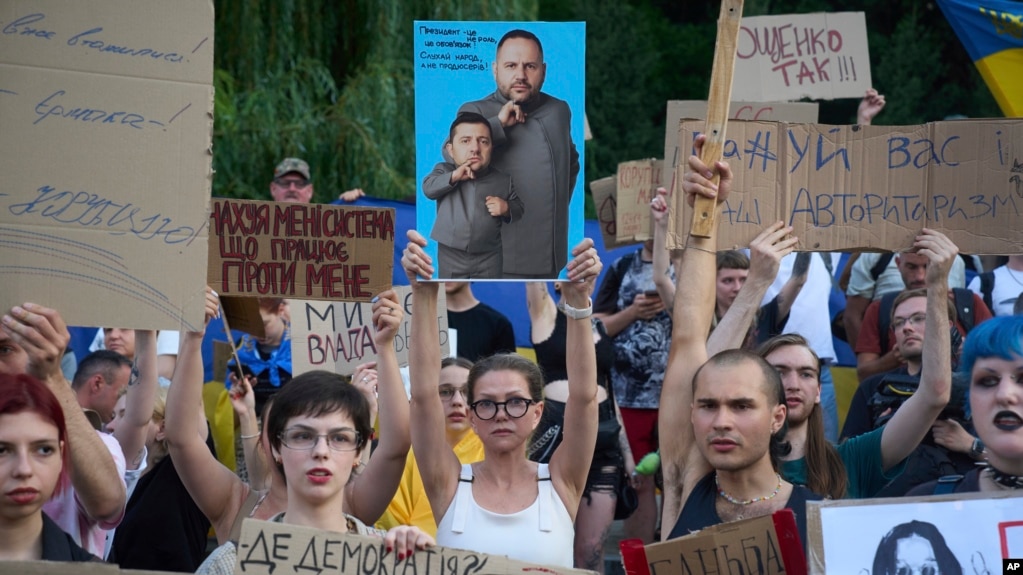
The EuropeanUnion has breathed a collective sigh of relief after Ukrainian President Volodymyr Zelenskyy’s swift U-turn this week over legislation that would have limited the independence of two key anti-corruption agencies.
But questions and speculation remain about what triggered it, what it says about Kyiv’s ruling class and how it will affect the war-torn country’s chances to join the bloc.
On July 22, Zelenskyy signed a bill approved by parliament that placed the National Anti-Corruption Bureau of Ukraine (NABU) and the Special Anti-Corruption Prosecutor’s Office (SAPO) under the auspices of the Prosecutor General, a position appointed by the president.
Zelenskyy’s Anti-Corruption Climbdown: What It Means For Ukraine
Within hours Ukrainians, despite Russian air strikes earlier in the day, took to the streets to protest the move, which critics said took away the independence of the institutions in a country long know for deep-seated corruption.
The response also was immediate from Brussels to the Ukrainian parliament and president rushing through the legislation.
Both the European Commission President Ursula von der Leyen and the president of the European Council, Antonio Costa, called Zelenskyy demanding an explanation and expressing “strong concerns.”
European enlargement commissioner Marta Kos said in a post on X that “independent bodies like NABU and SAPO are essential for Ukraine’s EU path.”
Within two days Zelenskyy had done an about-face, putting forward new legislation that would reverse course and ensure independence for NABU and SAPO.
But the damage was already done.
Speaking on condition of anonymity, one diplomat said Zelenskyy “really had managed to shoot himself in the foot for no apparent reason” as it gave ample ammunition to the many in the 27-nation bloc who claim that Kyiv just is hopelessly corrupt.
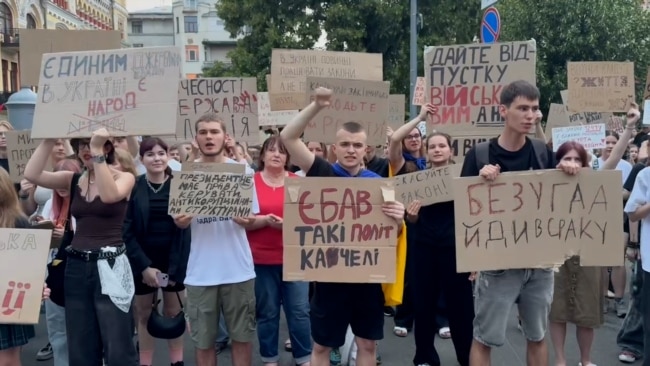
Another noted that it seemed that Ukraine suddenly had transported back to the era of former President Viktor Yanukovych, who constantly battled to control the judiciary.
Yanukovych was ousted from power in 2014 during the Maidan protests, sparked by his decision not to sign a political association and free trade deal with the EU, instead choosing closer ties with Moscow.
Grumblings over this week's legislative rollercoaster were also directed against Zelenskyy’s head of office, Andriy Yermak, a powerful but deeply polarizing figure in European circles.
Sources said questions persist if this in fact was the “real face” of Zelenskyy and his entourage given that many officials have long held fears about what they call his “tendencies to want to centralize power.”
Zelenskyy admitted that demonstrations in the country, the first such show of defiance against the government since Russia launched its full-scale the invasion in February 2022, had made him change his mind.
'A Perilous Moment For Ukraine' As New Law Undermines Wartime Unity
EU officials saw the change as positive -- signaling both a healthy and powerful civil society that also highlighted Zelenskyy’s democratic credentials -- in contrast with the considerable backsliding, for example, that has been seen recently in Georgia.
It appears as though pressure from Brussels may have also helped Zelenskyy's decision.
Everything was on the table, admits one official, and the bloc made that known.
That would mean freezing some of the billions of euros in funds that the EU provides Ukraine on a regular basis. A lot of this cash is conditioned on reform efforts, notably when it comes to the judiciary.
Visa Liberalization
One of the benchmarks for Ukraine to get visa liberalization to the bloc back in 2017 was the setting up of NABU. While no one was openly suggesting the suspension of visa liberalization, as is currently being mooted with Tbilisi, the threat of looking into it was enough to rattle Kyiv.
Then there was the delicate issue of de-coupling Ukraine from Moldova, allowing the latter to proceed alone in the EU accession process. That would be a heavy blow to Ukraine given the pair so far have moved closer to membership hand in hand.
The discussion about this started in Brussels in the spring with Hungary reluctant to give green light to Kyiv to start accession talks.
The idea was very much alive before the latest developments in Ukraine and EU officials have indicated to RFE/RL that it may come up again in early September with the view of giving Moldova’s ruling pro-EU government a boost before its crucial parliamentary election later that same month.
The fact that Hungary appears to be unlikely to change its position on the issue ahead of its own national elections in April next year, has made the issue even more pressing.
Many EU member states believe that this decoupling would be unfair as it essentially would give in to Budapest’s "blackmailing."
Yet some diplomats admitted that the latest events had weakened their argument, regardless of the subsequent Ukrainian backtracking.
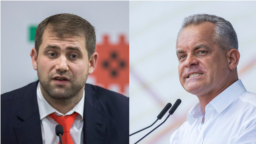
Highlighting the diverging paths, the same day Ukraine's parliament approved the controversial law, Greek police arrested the Moldovan oligarch Vladimir Plahotniuc, arguably the country’s most wanted man.
EU Ministers Set To Approve Sanctions Targeting Moldova's 'Destabilizers'
A former politician and one of Moldova's richest people, Plahotniuc is allegedly the mastermind behind the theft of $1 billion from Chisinau a decade ago -- a charge he denies.
At this moment, Moldova’s and Ukraine’s efforts to fight corruption couldn’t have contrasted more in the eyes of some in Brussels.
Interestingly, there is a feeling in Brussels that the Ukrainian frustration with the Hungarian veto and the bloc’s inability to deal with it could have driven Zelenskiy to care less about EU “hobby horses” such as corruption.
Rumors are swirling that several of the bloc’s leaders told him at a recent conference in Rome that he should be ready to accept that Moldova might move ahead of Ukraine.
That, coupled with less focus on the issue from the new American administration, gave him an opportunity to deal with long-standing nuisances such as pesky anti-corruption officials, diplomatic sources said.
He may have overplayed his hand on this occasion or possibly revealed it. Either way, the EU has taken note

Rikard Jozwiak is the Europe editor for RFE/RL in Prague, focusing on coverage of the European Union and NATO. He previously worked as RFE/RL’s Brussels correspondent, covering numerous international summits, European elections, and international court rulings. He has reported from most European capitals, as well as Central Asia.
jozwiakr@rferl.org
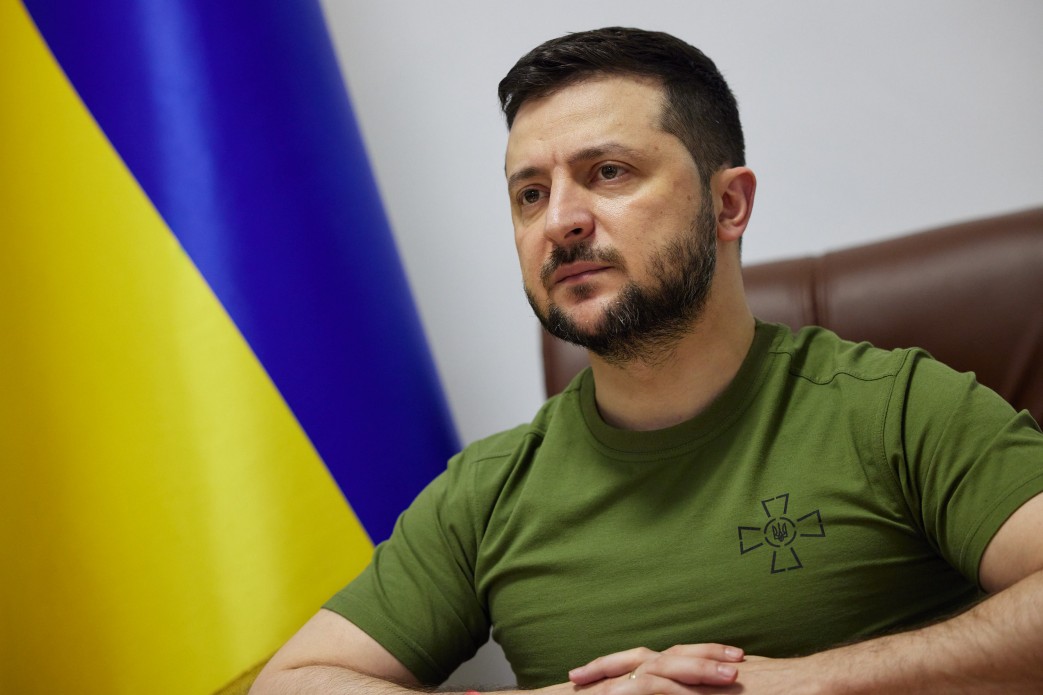
In his announcement, President Zelenskyy claimed that this bill will guarantee full autonomy to anti-corruption bodies, establish tools to prevent Russian interference, and adopt measures to prevent abuses. The president also stated that EU experts have been consulted to “engage all necessary expert capabilities.” According to the Chairman of the Verkhovna Rada, Ruslan Stefanchuk, officials have scheduled the bill’s consideration date for the end of July, along with other legislative initiatives.
Earlier this week, a separate new law, 4555-IX, was adopted, weakening the independence of Ukraine’s two main anti-corruption bodies, the National Anti-Corruption Bureau of Ukraine (NABU) and the Specialized Anti-Corruption Prosecutor’s Office (SAPO). These anti-corruption bodies were created in 2015 after the Euromaidan protests, and their establishment was a condition for financial support to Ukraine by the International Monetary Fund.
Because of the swift adoption of 4555-IX and its contentious provisions, it earned widespread criticism from Ukrainians. On the day the law was adopted, protests took place in Kyiv, Dnipro, Lviv and Odesa, eventually spreading to nearly every city in the country. Protestors fear the law will significantly weaken the authority and effectiveness of the NABU and SAPO, undermining their independence in fighting corruption. The protestors demanded the abolition of the law and stated that they would continue demonstrating until they were heard by the government.
The new law also strengthens the role of the Prosecutor General, granting it the authority to delegate the powers of the SAPO prosecutor to other prosecutors, request materials from any of the NABU and SAPO cases, delegate them to other prosecutors, delegate the NABU’s criminal proceedings to other pre-trial investigation bodies, and provide NABU with written instructions that are binding. Given the NABU and SAPO’s previous level of independence, the provisions in 4555-IX could reduce their procedural and operational autonomy. After parliament adopted the law in late July, President Zelenskyy signed it that same day, which turned the bill into law the very next day.
The EU also voiced strong criticism of 4555-IX. President of the European Commission Ursula von der Leyen contacted President Zelenskyy to convey her worries about the consequences of the legislative changes and requested the Ukrainian government for an explanation. A spokesperson for the commission emphasized that the EU values the rule of law and anti-corruption efforts: “The respect for the rule of law and the fight against corruption are core elements of the European Union. As a candidate country, Ukraine is expected to uphold these standards fully. There cannot be a compromise.”
Human Rights Watch (HRW) additionally condemned the law, similarly warning that it threatens the rule of law, Ukraine’s democratic foundations, and its EU accession prospects. HRW also expressed concern that Ukrainian officials were targeting Vitaliy Shabunin, a well-known anti-corruption activist.

.JPG)
