Thursday, July 31, 2025

RFK Jr. brags he's doing a 'good job' on measles as outbreak nears 1,300 cases


David Edwards
July 14, 2025 
RAW STORY


Health and Human Services Secretary Robert F. Kennedy Jr. insisted he was doing a "good job" controlling a measles outbreak that he said had neared 1,300 cases this year, the most since the disease was eradicated in the country.

During a Monday event on removing dyes from ice cream, NBC News asked Kennedy about the ongoing outbreak.

"There's an international measles outbreak right now," Kennedy explained. "We are doing probably better than any, certainly better than any of the other industrial countries in the world in controlling it. We've had about 1,300 measles cases in this country."

The secretary pointed out that Mexico and Canada had more cases despite having smaller populations.

"We've done a very, very good job at controlling it," Kennedy insisted. "The outbreaks are actually declining. We have CDC teams everywhere where governors have requested it."

"And we are also taking care of those populations that don't want to vaccinate," he added. "Most of the cases are unvaccinated Americans. There are some populations that do not want to vaccinate."


'Him first': Trump ridiculed as he brings Presidential Fitness Test back to schools

Sarah K. Burris
July 31, 2025 
RAW STORY


Donald Trump plays golf in July 2022. (Shutterstock)

President Donald Trump's administration has decided to reinstate the Presidential Fitness Test, which was given to students in American schools until 2013.

The move was instantly mocked by onlookers eager to point out that the fitness of Trump might not be something to aim for — despite the president's past brags about his health.

The program had been changed to the Presidential Youth Fitness Program, which took into account each student's individual assessment and goals rather than pitting students against each other.

"The program minimizes comparisons between children and instead supports students as they pursue personal fitness goals for lifelong health," the Office of Disease Prevention and Health Promotion website says.

Civil rights advocate Tara Blunt pointed out that the program Trump will return to once "shamed kids, ignored neurodiversity, and measured worth by push-ups instead of well-being."

She complained, "This isn’t about health. It’s about control, nostalgia, and performance politics dressed up as 'fitness.” If you really cared about kids, you’d be funding school lunches, inclusive PE, trauma-informed education, and mental health—not reviving a test that made half the class feel like failures."

New York Health Campaign leader Melanie D'Arrigo couldn't help but note that all of this is coming at a time when Trump is also cutting aid to children.

"Bringing back the Presidential Fitness Test while slashing healthcare and food assistance for kids is like a president promising to release the Epstein files — then burying them to protect pedophiles because his name’s in there too," she wrote on X.

It drew mockery aimed at both Trump and Health and Human Services Secretary Robert F. Kennedy Jr.

Psychiatrist Christopher Rodgman, MD asked, "Question: has Donald Trump, an exquisite physical specimen, personally passed this presidential fitness test?"

He later added: "It’s just funny imagining Trump trying to do 10 pushups."

There were several posts of photos of Trump, many of which showed the 79-year-old in an unflattering light.

"Him first," posted an X user named Miss Claudia Menlo.

Others requested that Trump be required to take the test himself, with some asking him to pass just one of the requirements, such as 10 push-ups.

"I won’t criticize him again for the rest of his term if Trump does the Presidential Fitness Test live on national television," pledged appellate attorney Peter J. Tomasek.


But Trump's health wasn't the only thing that got mocked. RFK Jr.'s history as a drug user and other risky behavior drew ridicule as well.

"THANK YOU!!! I really needed this belly laugh from the heroin addict," noted one woman.
Commentary

Americans are changing their minds about Trump’s immigration policies


William A. Galston
July 29, 2025
BROOKINGS


Less than seven months into Trump’s second term, a majority of Americans disapproves of his record on immigration, and overall attitudes about immigration have made a U-turn.

Americans have strong procedural objections to the way the Trump administration is carrying out its policies.

Support for Trump’s immigration policy has been especially weak among the groups in which he made the greatest gains last November.
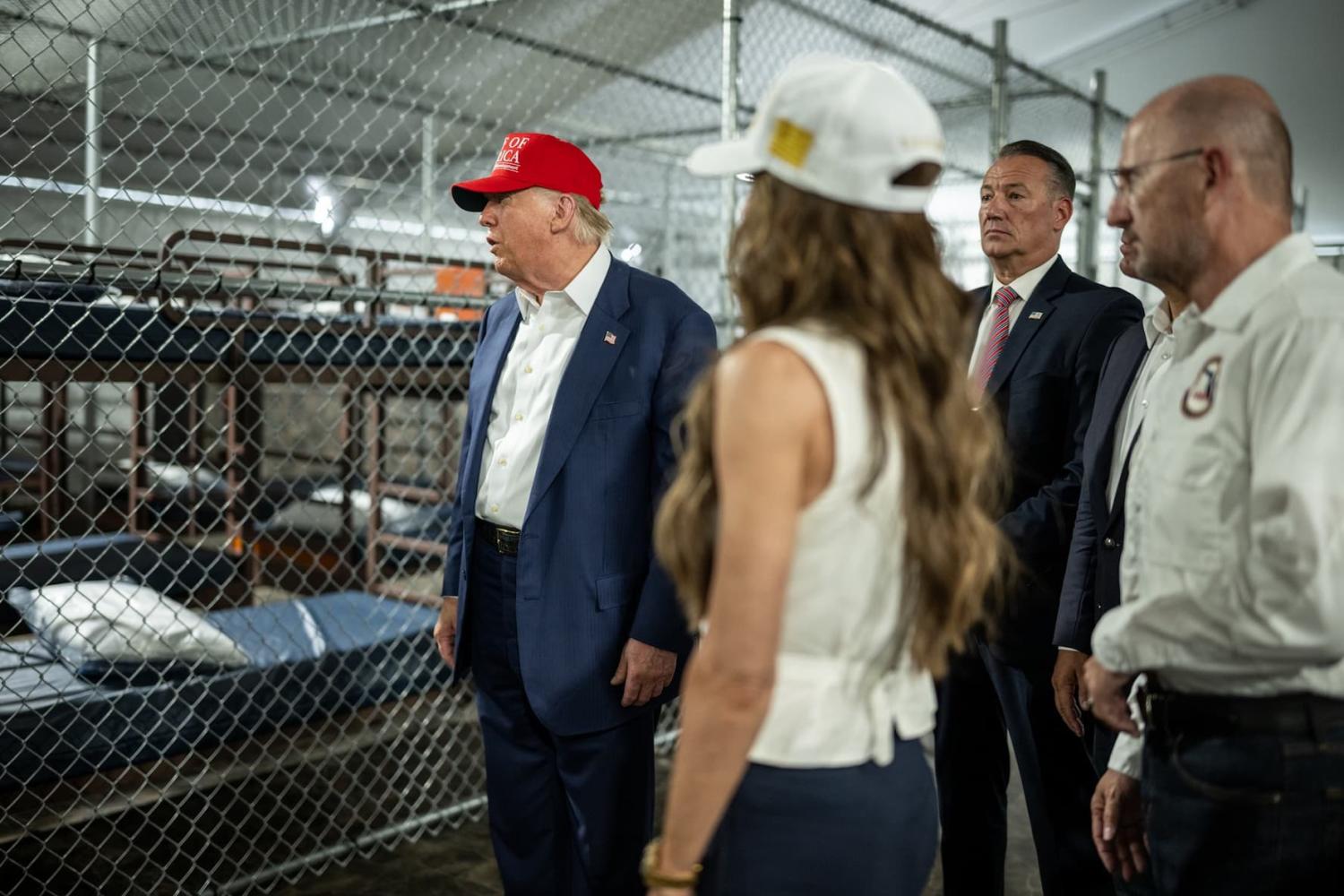
President Donald Trump with Secretary of Homeland Security Kristi Noem and others, participate in a walking tour of the immigration detention center nicknamed “Alligator Alcatraz” on July 1, 2025 in Ochopee, Florida. 
Credit Image: © Daniel Torok/White House/ZUMA Press Wire

Governance Studies Media Officegsmedia@brookings.edu202.540.7724

For the past two decades, as public discontent has risen, elected leaders in Washington have failed either to enforce or to update our obsolete immigration laws. Donald Trump rode the issue to his improbable victory in 2016. Eight years later, President Biden’s failure to control immigration at the United States’ southern border generated a massive public backlash. By July of 2024, 55% of surveyed Americans wanted immigration to be reduced, 53% supported building a wall along the U.S.-Mexico border, and nearly half wanted all immigrants who entered the U.S. illegally to be deported, regardless of their work history and conduct while in the United States. Former President Trump highlighted immigration during his 2024 campaign, and post-election surveys showed that it had contributed significantly to his comeback victory over Kamala Harris, who failed to put any daylight between her approach to immigration and Biden’s unpopular policies.

Unsurprisingly, Trump began his second term with majority support for his get-tough policies. But now, less than seven months later, a majority disapproves of his record on immigration, and overall attitudes about immigration have made a U-turn. Support for decreasing immigration has fallen by nearly half, to just 30%, and a record-high 79% now consider immigration to be good for the country. This has happened despite broad support for the president’s actions to close the southern border—and for cooperation between federal and local officials to enforce immigration laws, which Democrats often resist.

What happened?

Let’s begin with general attitudes. According to polling by The Economist/YouGov from July 11 to 14, 2025, 52% percent of Americans think that President Trump’s approach to immigration has been “too harsh,” compared to 36% who think it has been “about right.” Similarly, 54% say that in enforcing immigration laws, ICE agents have gone “too far,” while only 27% say that their actions are “about right.” Four years ago, a majority of Americans thought that former President Biden wasn’t tough enough in dealing with immigration; now they believe that President Trump has made the opposite mistake.

Backing up these overall negative impressions are procedural objections to the way the Trump administration is carrying out its policies.Americans believe that the administration has been moving too quickly—and making numerous mistakes by not being careful enough.
They disapprove of ICE agents wearing masks—and not wearing uniforms—during their raids.
They do not like the way the Trump administration is using detention facilities, especially the Florida detention center known as “Alligator Alcatraz,” which is built in wetlands surrounded by alligators and crocodiles, and they believe that immigrants in these facilities are being treated too harshly.
They believe that immigrants should have the right to challenge their deportation in court, and they oppose deporting immigrants who entered the U.S. illegally to countries where they are not citizens.

In addition, Americans believe that the Trump administration’s policies have been overly broad and have failed to make distinctions they think are important. They say that the administration is trying to deport more people than they expected and is no longer giving priority to dangerous criminal aliens. They think that Hispanic people are being unfairly singled out for deportation searches. They oppose both conducting immigration raids in workplaces and deporting immigrants who have not committed crimes while present in the United States.

Finally, majorities of Americans question the attitudes that underlie Trump’s immigration policy. Sixty-four percent say that America’s openness to people from all over the world is essential to who we are as a nation, compared to 35% who say that this openness is a threat to our national identity. Only 25% believe that “illegal immigrants” take jobs that Americans want, compared to 57% who believe that these immigrants take jobs that Americans don’t want to do. Majorities oppose deporting “illegal immigrants” doing jobs that are essential to large sectors of the economy, such as agriculture and food service.

Notably, support for Trump’s immigration policy has been especially weak among the groups in which he made the greatest gains last November. While overall support for this policy stands at 45% in a recent survey that closely tracks the national average, it is 37% among moderate voters, 35% among Independents, 33% among Hispanic people, and 30% among young adults ages 18 to 29. While 52% of Americans think that the president’s policies are too harsh, this figure rises to 57% for Independents, 60% for moderates, 61% for Hispanic people, and 65% for young adults.

Immigration has helped Republicans in recent elections. But unless Trump takes steps to make his policies more acceptable to voters outside his MAGA base, he and his party will find it hard to repeat these successes.


William A. GalstonSenior Fellow - Governance Studies, Center for Effective Public Management (CEPM), Ezra K. Zilkha Chair in Governance Studies


The Brookings Institution is committed to quality, independence, and impact.
We are supported by a diverse array of funders. In line with our values and policies, each Brookings publication represents the sole views of its author(s).
Immigrant labour has made outsize economic contributions to the world’s wealthiest countries

Human mobility is an essential driver of economic growth, demographic resilience and cultural cohesion.
The Conversation
Jul 29, 2025 · 


Protesters demand the closure of the immigrant detention centre known as "Alligator Alcatraz" at the Dade-Collier Training and Transition Airport in Ochopee, Florida, on July 22. | AFP

As anti-immigration rhetoric surges across Europe and the United States, it is vital that we look beyond the fearmongering and analyse what is really going on. While human mobility is often presented as a burden, the truth is quite the opposite. It is an essential driver of economic growth, demographic resilience and cultural cohesion.

Ignoring this fact is not just a miscalculation – it flies in the face of both empirical evidence and the democratic principles that modern societies claim to defend.

Migration is also not a 21st century anomaly. From the Mediterranean diasporas of antiquity to the mass migrations of the 20th century, human history has been defined by movement. City-states, colonial empires and modern nation-states have been built – and rebuilt – through the movement of people, languages, knowledge and goods. Presenting human mobility as a threat ignores this historical pattern, and tries to turn the exception – isolation – into the rule.

Any political discourse that presents migrants as intruders, rather than as potential citizens or economic agents, is a dangerous distortion, not only in moral but also in strategic terms.

Migration drives economies


In 2016, an analysis by the McKinsey Global Institute drew some compelling conclusions. While migrants accounted for only 3.3% of the global population in 2015, they generated 9.4% of global gross domestic product that year – about $6.7 trillion. In the United States alone, their contribution amounted to about $2 trillion.

More recent studies confirm this. The International Monetary Fund (IMF) estimated in 2024 that net migration flows to the eurozone between 2020 and 2023 – including millions of Ukrainian refugees – may raise the region’s potential GDP by an additional 0.5% by 2030. This is not a marginal amount, as it represents roughly half of all expected potential growth. Without migration, Europe’s economic horizon would be considerably more limited.

Workers, innovation, growth


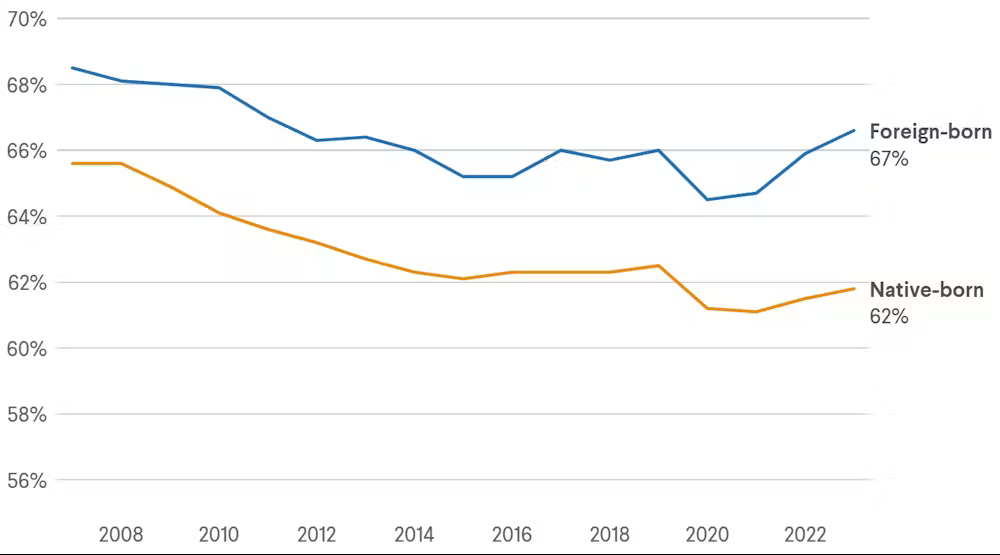
In the US, more than 31 million immigrants were part of the labour market in 2023 – 19% of the total, according to the Council on Foreign Relations. Their participation rate (meaning the percentage of the working-age population that is active in the labour market) was 67%, compared to 62% of native-born workers. This difference signals a disproportionate contribution to tax revenue, domestic consumption and economic dynamism in general

.
Labour force participation rate in the US: immigrants have been more active participants in the labour market than their native-born counterparts for nearly two decades. Credit: Council on Foreign Relations via The Conversation.

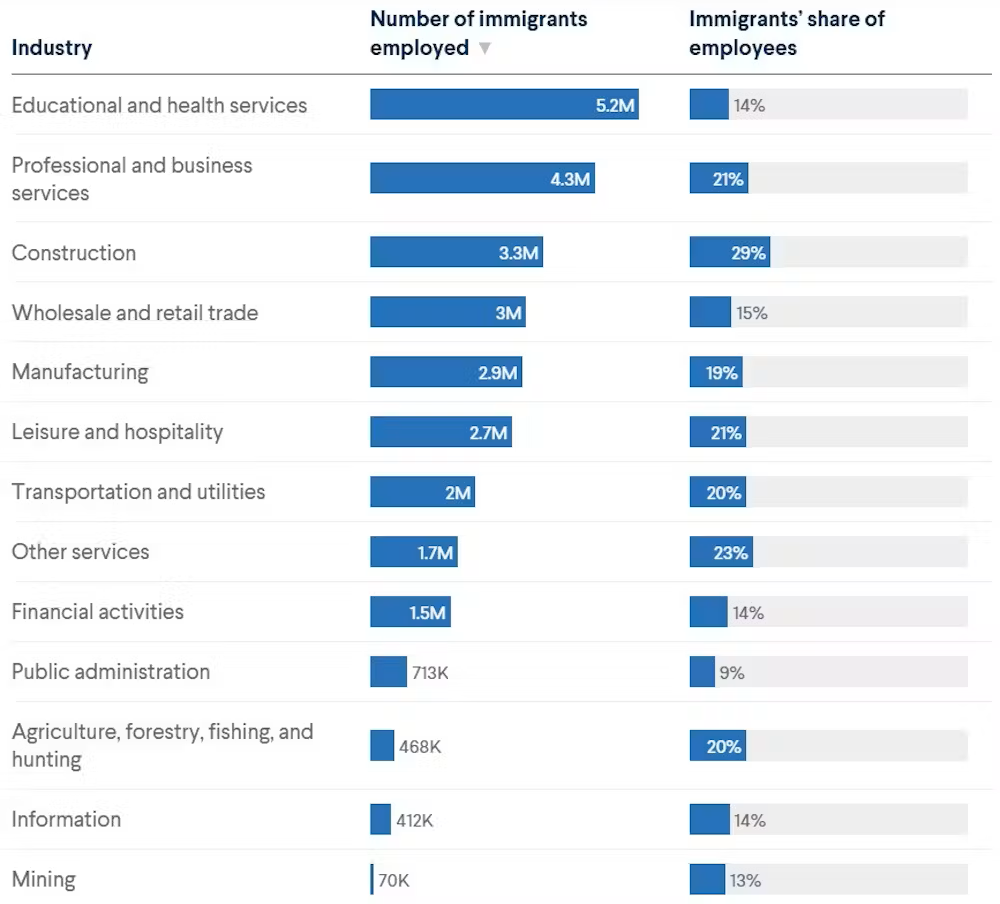
Statistics also show that immigrants do not compete on a level playing field: they tend to work in physically demanding jobs, or in those that are not covered by locals. This reinforces the idea that they complement, rather than substitute, native-born workers. This role becomes even more significant in contexts of full employment or population ageing.

Employed civilian workers 16 years old and over in the US, 2022. Note: Immigrants include naturalised US citizens and non-US citizens. Council on Foreign Relations via The Conversation

Migration and innovation

Migration brings not only workers, but also new ideas. According to the World Economic Forum, immigrants to the US are 80% more likely to start new businesses than native-born people, and more than 40% of Fortune 500 companies were founded by migrants or their descendants.

This pattern is repeated in academia and technology: a significant proportion of patents filed in the United States have at least one foreign inventor. The country’s leading universities also depend on international students to sustain their science, technology, engineering and mathematics programmes. In other words, closing borders means closing the door to innovation.

In the European Union, their impact is no less significant. According to the 2024 IMF report, between 2019 and 2023, two thirds of new jobs were filled by non-EU migrants. These statistics refute the idea that migrants “steal jobs”. On the contrary, they fill structural vacancies that neither automation nor the internal market has been able to fill.

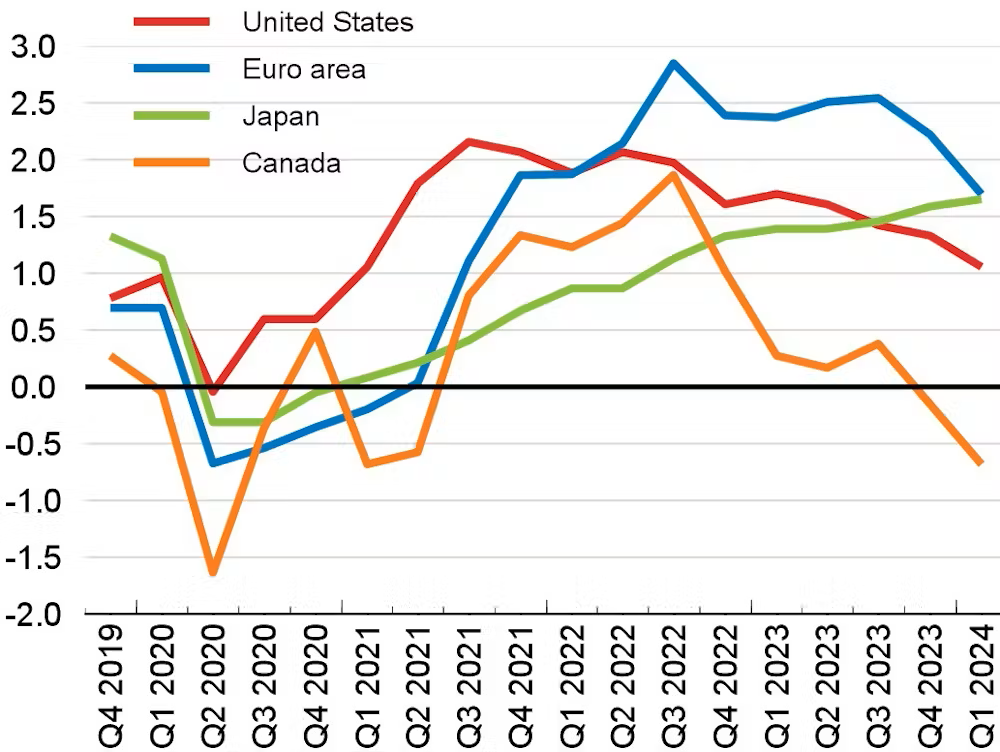
Moreover, the OECD warned in 2025 that if more women, older people and immigrants are not brought into the labour market, GDP per capita growth in member countries could fall from 1% per year (2000-2020) to a meagre 0.6% by 2060. Conversely, a more inclusive migration policy could add at least 0.1 percentage point to annual growth.


OECD labour shortage index, 2019-2023: there is a clear need for immigrant labour to fill persistent gaps. Credit: OECD Economic Outlook, May 2024, CC BY 4.0.


Sending money home


The 2024 World Migration Report confirmed that global remittances – immigrants sending money to family members in their country of origin – reached $831 billion in 2022, a growth of more than 650% from 2000.

This far exceeds official development assistance and even, in many cases, foreign direct investment. However, they perform a similar function – remittances are mainly invested in health, education and housing.

They are, in effect, a global redistribution of wealth that does not pass through any multilateral system. For the people who receive them, their impact is stabilising, and profoundly humane.


Looking forwards

This is not just a question of economics. When political and social rhetoric starts to exclude those perceived as outsiders, it undermines their capacity to adapt and change. Ignoring the evidence comes at a great cost, which can be summarised in three areas:

Economic losses: reduced immigration means giving up a structural source of growth, innovation and fiscal sustainability.

Social instability: anti-immigration discourse feeds the stigmas that fracture coexistence and weaken social cohesion.

Geopolitical weakness: less immigration means losing influence in a world increasingly defined by intense competition for talent and human capital.

The good news is that there are tried and tested solutions. From streamlining professional accreditation processes to regional migration coordination systems, there are already tools available to governments. The challenge is a political and, above all, narrative one. Public opinion – which is shaped by political rhetoric – needs to recognise and embrace the value of human mobility as part of our contemporary social contract.

As the World Economic Forum rightly points out, migration is not a problem to be solved, but a strategic asset to be managed intelligently and humanely. To underestimate it is to undermine the foundations of global development in the 21st century.


Deniz Torcu is Adjunct Professor of Globalization, Business and Media, IE University

This article was first published on The Conversation. We welcome your comments at letters@scroll.in.


Jan 21, 2022 ... ... multitude. Access-restricted-item: true. Addeddate: 2022-01-26 09:09:20. Associated-names: Negri, Antonio, 1933-. Bookplateleaf: 0004. Boxid ...

Download Empire in PDF format here (1.34mb) ... Aufheben critically review Negri and Hardt's works, Empire and Multitude, examining in particular their conception ...

Commonwealth / Michael Hardt, Antonio Negri. p. cm. Sequel to “Empire” and “Multitude.” Includes bibliographical references and index. ISBN 978-0-674-03511 ...


Judge halts GOP defunding of Planned Parenthood

The Trump administration can't withhold Medicaid funds from Planned Parenthood, said the ruling


The Trump administration is trying to 'indirectly squeeze clinics' into dropping their abortion services
(Image credit: Michael M. Santiago / Getty Images)


By Rafi Schwartz,
published 2 days ago

What happened

A federal judge in Massachusetts ruled Monday that the Trump administration can't withhold Medicaid funds from Planned Parenthood under a provision of the recently passed Republican "big, beautiful" megabill. The preliminary injunction, a nationwide expansion of a narrower order issued earlier this month, comes as the White House works to defund the women's health care provider, citing its abortion services.

Who said what

The new GOP law likely violates Planned Parenthood's constitutional rights by singling it out for punishment, U.S. District Judge Indira Talwani said in Monday's ruling, and the organization's patients are "likely to suffer adverse health consequences where care is disrupted or unavailable." The judge found that the administration was trying to "indirectly squeeze clinics" into dropping their abortion services "using Medicaid payments as leverage," said The New York Times.

Federal law already prohibits using Medicaid to cover abortion costs. Planned Parenthood member locations "stand to lose over a third of their aggregate revenue" from the Trump-backed law, said Axios.
What next?

The White House has filed an appeal of Talwani's earlier ruling. Barring action from the appeals court, said the Times, her broader ruling will likely "stay in effect for the time being."


Rafi Schwartz, The Week US
Rafi Schwartz has worked as a politics writer at The Week since 2022, where he covers elections, Congress and the White House. He was previously a contributing writer with Mic focusing largely on politics, a senior writer with Splinter News, a staff writer for Fusion's news lab, and the managing editor of Heeb Magazine, a Jewish life and culture publication. Rafi's work has appeared in Rolling Stone, GOOD and The Forward, among others.
DOGE 'cost-cutting' results in 154K workers being paid not to work: report

Tom Boggioni
July 31, 2025 
RAW STORY

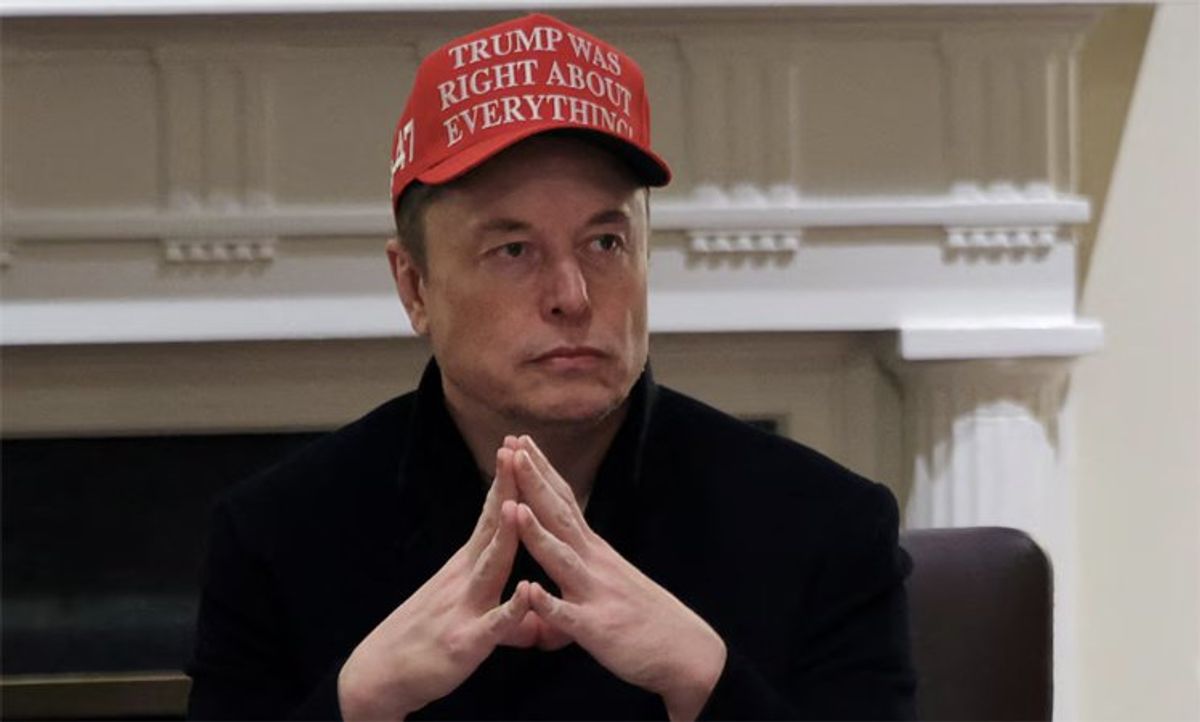
Tesla CEO Elon Musk wears a 'Trump Was Right About Everything!' hat while attending a cabinet meeting at the White House, in Washington, D.C., U.S., March 24, 2025. REUTERS/Carlos Barria

The Department of Government Efficiency (DOGE), designed to root out unnecessary expenses and dismantle government agencies, has faded from the limelight and left taxpayers funding civil servants on administrative leave and being paid to sit at home and not work.

According to a report from the Washington Post, the ham-handed efforts of DOGE-mastermind Elon Musk's hires to cut government spending has not matched the hype, with the report noting that an early retirement component has been a major drag on cost-cutting.

The report states that approximately 154,000 federal employees are receiving paychecks as they accepted an offer from the Trump administration to get paid as of June until the fiscal year ends on Sept. 30 or at the end of the year.

The Post's Meryl Kornfield, Hannah Natanson and Laura Meckler reported, "The buyouts have rapidly sped up the process of slashing the federal workforce at an unprecedented rate, the officials said. But critics have argued the administration’s tactics of using buyouts and administrative leave have been wasteful because the public is paying tens of thousands of employees not to work for months."

According to critics in the Democratic Party, that wasted money can be added to the billions "paying workers who are on leave either through the voluntary departure program or because of ongoing litigation over mass firings, according to a report released Thursday," the Post added.


Some experts have also questioned using administrative leave to reduce costs, with employment attorney Michelle Bercovici stating, "It’s ridiculous. I’ve never seen anything like it. It seems so wasteful.”


You can read more here.


This is what fascist control looks like


Robert Reich
July 31, 2025 
RAW STORY


Today I want to describe for you the specific mechanism of control the Trump regime is using over the core institutions of America — the media, higher education, our largest corporations, and Wall Street.

It's all in the fine print.

Start with CBS. It’s now owned by Skydance Media. Under its Trump-appointed chairman, Brendan Carr, the Federal Communications Commission insisted, as a condition of allowing Paramount to sell CBS to Skydance, that the new owner install an “ombudsman.”

What will that ombudsman do? According to Skydance Media’s agreement with the FCC, the ombudsman will “receive and evaluate any complaints of bias or other concerns involving CBS” for at least two years.

The agreement doesn’t specify the meaning of “bias,” nor does it define whose “complaints” are to be responded to, nor enumerate what “other concerns” might trigger action. But none of this is difficult to imagine. Trump himself could complain of CBS’s bias or anything else. In fact, he probably will. He already has at least once.


If the ombudsman then decides that any complaint of bias or other concern is justified, CBS will have to remedy it. If the ombudsman decides that CBS has not remedied it, Skydance Media’s new president, David Ellison, must do so.


If Ellison does not remedy it — or if Trump believes the problem continues, regardless of what the ombudsman decides — the Trump regime can claim that CBS has reneged on its agreement, in which case Skydance’s ownership of CBS could be contested by the FCC. Its stock price would plummet.

Note that this method of Trump control is indirect but powerful. The regime doesn’t have to assert control over CBS; it just retains the power to do so. And it’s up to Trump to determine what CBS will have to do to avoid being found to be “biased” or avoid any “other concern.”

This mechanism of control is similar at Columbia University, whose new agreement with the Trump regime stipulates a mutually agreed-upon “monitor” who will, like CBS’s ombudsman, respond to complaints about “bias.”


Columbia will provide the monitor detailed information about the race of students who are admitted and rejected, including grade point averages and standardized test scores broken down by race. All data related to faculty and administrative staff hiring and promotion practices must be provided to the monitor annually, and hiring data will be subject to a “comprehensive audit.”

The monitor is also charged with assuring that the university establishes processes to guarantee “civil discourse, free inquiry, open debate, and the fundamental values of equality and respect.” And the monitor will review data to assure Columbia is meting out discipline without regard to a student’s immigration status.

The monitor’s decisions are advisory. If the Trump regime is dissatisfied with the monitor’s decision or feels that the university is not acting in accordance with it, the Trump regime reserves the right to open a new investigation of Columbia and possibly revoke current or future federal research funds.


Just like the CBS agreement, the Columbia agreement gives final power to the Trump regime. It allows the regime to maintain control over Columbia by holding a cudgel over the university. As Linda McMahon, Trump’s secretary of education, told Fox Business, “This is a monumental victory for conservatives who wanted to do things on these elite campuses for a long time because we had such far-left-leaning professors.”

Or consider the Trump regime’s agreement allowing Nippon Steel to acquire U.S. Steel.

During his 2024 campaign, Trump denounced Nippon Steel’s acquisition of U.S. Steel as a threat to American manufacturing.


“I am totally against the once great and powerful U.S. Steel being bought by a foreign company, in this case Nippon Steel of Japan,” Trump wrote in a post on Truth Social. “As President, I will block this deal from happening. Buyer Beware!!!”

On resuming office, though, Trump approved the deal. But this was after forcing Nippon Steel to give a “golden share” to the Trump regime — essentially giving Trump veto power over strategic decisions by the company.

You see the pattern? Veto power over strategic decisions. Ombudsmen. Monitors.


They’re all mechanisms for giving the Trump regime power to prevent these institutions — a television network, university, or corporation — from doing something that the Trump regime doesn’t want it to do. But because that power is held in reserve, Trump doesn’t have to display it. The heads of these institutions will do all the work for him; they’re likely to go out of their way to avoid offending the regime. The potential chilling effect is enormous.

It’s much the same with major law firms that have surrendered to Trump. And with ABC. And with Jeff Bezos’s control over The Washington Post’s editorial page — which appears to be motivated by fear that Trump might retaliate against Bezos’s other businesses unless Bezos forces the Post to toe the line.

It’s the same even with Wall Street.


“I have been working on multiple deals where I have people inside the White House telling me what I can and can’t do,” a top dealmaker involved in mergers and acquisitions unrelated to the government recently told the Financial Times. “It’s a level of intrusion I have never experienced before.”

Note these words: A level of intrusion I have never experienced before. That from a dealmaker on Wall Street! The words apply to more and more institutions in America that used to be free from government control.

This level of intrusion inhibits public criticism of Trump, which is what Trump wants. It also deters so-called “conservative bias” in university hiring, however the Trump regime wants to define it. It eviscerates whatever Trump dislikes, such as corporate “diversity, equity, and inclusion” programs, or transgender women in women’s sports, or contracts with people or institutions against which Trump holds grudges.

In short, this level of intrusion gives the Trump regime potential control over almost every institution and organization in America, every aspect of American life — but indirectly, quietly, and as a default if the leaders of the institution go too far.


I’m old enough to remember when conservative Republicans stood for limited government and accused Democrats of wanting too much government. No longer.

We’re now at a point in American history when a so-called Republican regime in Washington is extending its control far beyond the wildest dreams of the most left-wing of Democrats — or even socialists.

But this control is not exercised publicly. It’s behind the scenes. It’s found in the fine print. And it is personal. It depends on Trump’s whims.

This is what fascist control looks like, people.

By the way, my memoir of my life and times, entitled Coming Up Short, will be out next Tuesday, August 5. If you wish, you can preorder here from Bookshop.org, which supports local bookstores, or find it wherever books are sold.

I wrote it to share what I’ve learned about stopping bullies — at a time in American history when we’re dealing with an authoritarian bully who is encouraging bullying throughout the nation and the world.

I hope you find it helpful for understanding how we combat the bullies. And why I believe so passionately that we will.Robert Reich is a professor emeritus of public policy at Berkeley and former secretary of labor. His writings can be found at https://robertreich.substack.com


Trump is not just a conman on climate

Bill Mckibben, 
Common Dreams
July 31, 2025 


Demonstrators in London. REUTERS/Isabel Infantes

When I was a cub reporter at the New Yorker in the early 1980s, New York City was actually a somewhat seedy and dangerous (if fascinating) place (sort of fitting the image currently assigned it by MAGA ideologues who have ignored its almost complete makeover into a remarkably safe enclave). In those days, anyone wandering the Times Square neighborhood where I worked could count on seeing a three-card monte game on every block, with fast-talking card sharps hustling the tourists. It wasn’t very sophisticated, but it must have worked because they were out there every day.

The grift playing out this week in the federal government around climate is no more complicated, but it too relies on speed and distraction. On the first day of his term, U.S. President Donald Trump set up the con by asking the Environmental Protection Agency (EPA) to evaluate its 2009 finding that greenhouse gas emissions were dangerous. Yesterday, EPA czar and former failed gubernatorial candidate Lee Zeldin dutifully made his long-awaited announcement: Nothing to fear from carbon dioxide, methane, and the other warming gases.

Today is the greatest day of deregulation our nation has seen,” EPA Administrator Lee Zeldin said when he first announced the idea. “We are driving a dagger straight into the heart of the climate change religion to drive down cost of living for American families, unleash American energy, bring auto jobs back to the U.S., and more.”

Trump didn’t really need to do this in order to stop working on the climate crisis — he’s done that already. The point here is to try and make that decision permanent, so that some future administration can’t work on climate either, without going through the long and bureaucratic process of once again finding that the most dangerous thing on the Earth is in fact dangerous.

The problem with this simple one-two punch from Trump and Zeldin is that someone will challenge it in court as soon as it becomes official. “If EPA finalizes this illegal and cynical approach, we will see them in court,” said Christy Goldufss of the Natural Resources Defense Council. And they’ll have an argument, since — well, floods, fires, smoke, storms. I mean, if carbon dioxide was dangerous in 2009, that’s a hell of a lot more obvious 16 years later.

The Supreme Court upheld the idea that CO2 was dangerous in 2007 — here’s how Justice John Paul Stevens began that opinion:

A well-documented rise in global temperatures has coincided with a significant increase in the concentration of carbon dioxide in the atmosphere. Respected scientists believe the two trends are related. For when carbon dioxide is released into the atmosphere, it acts like the ceiling of a greenhouse, trapping solar energy and retarding the escape of reflected heat. It is therefore a species — the most important species — of a “greenhouse gas.”

But that was a different, and non-corrupted, Supreme Court. John Roberts wrote the dissent, and he’s doubtless eager to do with climate change what he’s already done with abortion. But that would be easier if they had some “well-respected experts” to say that there’s not any trouble — stage three of this grift.

It’s true that there aren’t any well-respected experts that believe that, but the White House has hired several aged contrarians who have maintained for decades that global warming is not a problem, even as the temperature (and the damage) soared. And yesterday they released a new report that reads more or less like a Wall Street Journal op-ed.

In it, they cherry pick data, turn to old and long-debunked studies, and in general set up a group of strawmen so absurd that one almost has to grin in admiration. Actual climate scientists were lining up to say their papers had been misquoted, but all you needed was a modicum of knowledge to see how stupid the whole enterprise was.

Just as an example, our contrarians hit the old talking point that CO2 is plant food — indeed, “below 180 ppm [parts per million], the growth rates of many C3 species are reduced 40-60% relative to 350 ppm (Gerhart and Ward 2010) and growth has stopped altogether under experimental conditions of 60-140 ppm CO2.”

Great point except that there is no one calling for, and no way, to get CO2 levels anywhere near that low. I led a large-scale effort to remind people that anything above 350 ppm is too high, and that was so successful that we’re now at 420 ppm and climbing. Too little carbon dioxide is a problem for the planet in the way that too little arrogance is a problem for the president

And yet, when it finally reaches the court, they will doubtless cite this entirely cynical and bad-faith document to buttress the case that the EPA should be allowed to stop paying attention to carbon dioxide. As I said, it’s a pretty easy to follow swindle, but they count on the fact that most people won’t. Butter won’t melt in their mouths — as Energy Secretary (and former fracking executive) Chris Wright said in his foreword to the new report:
I chose the [authors] for their rigor, honesty, and willingness to elevate the debate. I exerted no control over their conclusions. What you’ll read are their words, drawn from the best available data and scientific assessments. I’ve reviewed the report carefully, and I believe it faithfully represents the state of climate science today.

Every word of that is nonsense, but it doesn’t matter — because it’s an official document on the right letterhead it will do the trick. This is precisely what science looks like when it’s perverted away from the search for truth. It’s disgusting.

Still, there’s another grift also under way this week, and this one that may work the other way and do the world some good. The president announced his new trade deal with the European Union, which calls for 15% tariffs — but it’s sweetened by the European promise to buy $750 billion worth of American natural gas in the next three years.

Trump has essentially been using the tariff process as a shakedown, a way to repay his Big Oil cronies for their hundreds of millions in support: it’s pretty much exactly like a mob protection racket, where you buy from the guy you’re told to or you get a rock through the window.

The White House quickly put out a list of thank yous, including one from the American Petroleum Institute: “We welcome POTUS’ announcement of a U.S.-E.U. trade framework that will help solidify America’s role as Europe’s leading source of affordable, reliable and secure energy.”

And yet, as Reuters first noted and then many others also calculated, the numbers are clearly nonsense. First, the E.U. actually doesn’t buy any energy itself, and it can’t tell its member states what to purchase; in fact, even those member states usually rely on private companies to buy stuff. Second, it’s physically impossible to imagine the U.S. selling Europe $250 billion worth of natural gas a year. As Tim McDonnell wrote at Semafor:
Total U.S. energy exports to the world were worth $318 billion last year, of which about $74.4 billion went to the E.U., according to Rystad Energy. So to meet the target, the E.U. would need to more than triple its purchases of U.S. fossil fuels — and the U.S. would need to stop selling them to almost anyone else.

“These numbers make no sense,” said Anne-Sophie Corbeau, a researcher specializing in European gas markets at Columbia University’s Center on Global Energy Policy.

The biggest reason it won’t happen, though, is that Europe is quickly switching to renewable energy. As Bill Farren-Price, head of gas research at the Oxford Institute for Energy Studies, explained to the Financial Times:
“European gas demand is soft, and energy prices are falling. In any case, it is private companies not states that contract for energy imports,” he said. “Like it or not, in Europe the windmills are winning.”

Trump will doubtless coerce some countries into buying more liquefied natural gas (LNG) in the short run, and that will do damage. Global Venture announced Tuesday that they’d found the financing for the massive Calcasieu Pass 2 (CP2) export terminal, which has been opposed by both climate scientists and environmental justice activists.

As Louisiana’s Roishetta Ozane said Tuesday:
The CP2 LNG facility is an assault on everything I hold dear. It’s a direct threat to the health and safety of my community and an assault on the livelihoods of our fishermen and shrimpers.

I’ve seen my kids struggle with asthma, eczema, headaches, and other illnesses that result from the pollution petrochemical and LNG plants dump into my community. I won’t stop opposing this project in every way I can, because my children — and everyone’s children — deserve to breathe clean air, drink clean water, and live in a healthy environment. I refuse to let Venture Global turn my community into a sacrifice zone for the sake of its profits.

But my guess is that such facilities won’t be pumping for as many decades as their investors imagine. Europe pivoted hard to renewables because Russian President Vladimir Putin proved an unstable supplier of natural gas; Trump’s America is hardly more reliable, since the president has made it clear he’ll tear up any agreement on a whim. Any rational nation will be making the obvious calculation: “I may not have gas of my own, but I’ve got wind and sun and they’re cheap. I’d rather rely on the wind than the windbag.”

Trump’s a conman, but he’s also a mark.


Bill McKibben is the Schumann Distinguished Scholar at Middlebury College and co-founder of 350.org and ThirdAct.org. His most recent book is "Falter: Has the Human Game Begun to Play Itself Out?." He also authored "The End of Nature," "Eaarth: Making a Life on a Tough New Planet," and "Deep Economy: The Wealth of Communities and the Durable Future."
One Arizona man showed the power of marching for your beliefs
 Arizona Mirror
July 31, 2025 


Protesters demonstrate against the Trump administration. REUTERS/Leah Millis

The last time I saw Alfredo Gutierrez was at this year’s May Day rally outside the State Capitol.

He was standing toe-to-toe with a MAGA supporter who had shown up at the protest and was marching through the crowd, wielding an oversized Trump flag, determined to start trouble.

While I couldn’t hear what he was telling the man over the din of the protestors, it was clear Alfredo wasn’t having it. Even at his advanced age, Alfredo let the surly MAGA loyalist know he wasn’t about to let him cramp the enthusiasm of rally-goers, even going so far, at one point, as to jerk down the man’s flag before onlookers stepped in to keep the face-off from escalating.

The incident was quintessential Alfredo Gutierrez, who died this week at 79 of cancer.

To say that Alfredo Gutierrez was passionate about social justice would be a colossal understatement. A follower of civil and human rights icons like Cesar Chavez, Mahatma Gandhi and Dr. Martin Luther King, Jr., the arc of Alfredo’s life was driven by the struggle for civil rights here and nationwide.

Booted out of Arizona State University in the 1970s for helping lead a student protest to raise the wages of laundry workers — though he returned last year to complete his undergraduate degree — Alfredo possessed a piercing and daunting intellect.


Born in Miami, Arizona, a small mining town east of Phoenix, to engage Alfredo was to know that this was a man who spent a great part of every day pondering the state of the world. He was never afraid to share his opinion, whether on stage or from the audience — and when he stood to speak, he commanded attention.

There was a presence about him, a physical and intellectual quality that ensured he would not be ignored, attributes that no doubt came in handy later as a state legislator, lobbyist and born-again protest leader.

After an extended stint as a businessman, Alfredo returned to grassroots activism with unfettered passion in the 2000s, eager to fight against the state’s growing anti-immigrant tilt. Partnering with other established Latino leaders and a deep bench of young, up-and-coming immigrants rights activists, Alfredo helped organize the largest protest march in Arizona history in 2006. By some accounts, as many as 100,000 people marched that day in support of immigrants rights.


Later, Alfredo would help organize Arizona’s opposition to Sheriff Joe Arpaio and Senate Bill 1070, then the most stringent anti-immigrant bill in the nation. More recently, he’s been a vocal critic of right-wing, Trump-era policies against immigrants.

In his later years, his reputation as a firebrand evolved not so much to temper but refine his unquenchable spirit.

I didn’t always agree with Alfredo — like when he once suggested that Latino voters should step away from voting as a way to remind party leaders of the value and power of our burgeoning electoral bloc — but I always knew that he had arrived at his points of view honestly and logically.

As confrontational as he could be, he was also capable of great humility. I saw an example of this up close at a luncheon honoring former Arizona Gov. Raul H. Castro, the state’s first and only Latino governor, when Alfredo approached our table to show his deep respect for the aging ex-governor despite a decades-long rift between the two men.

At heart, Alfredo was the consummate Chicano activist, a true believer in El Movimiento. Despite his forays into Democratic Party politics and later as a lobbyist, he always remained convinced that marching in the streets could effect change.

In a fictionalized version of Alfredo in my play, American Dreamer: The Life & Times of Raul H. Castro, I imagined him making this point to Castro:


GUTIERREZ: Your problem is you think the system is here to help you. All that talk about the founding fathers. They’re not my founding fathers. My people are proud mestizos, who, despite the rejection of this country at almost every turn, had the courage to push off the yoke of our oppression so we could live our lives with dignity.

CASTRO: How? By marching in the streets?!

GUTIERREZ: Sí, hombre, sí. How do you think we passed the Civil Rights Act? The Voting Rights Act. It’s because we marched in the streets. We didn’t need an army or guns to do it. All we needed was the people’s army and our faith in justice man, justice.


Rest in justice, Alfredo Gutierrez, rest in peace.
'Not a damned penny!' 'Abandoned' Texas flood survivors prepare to clash with Trump officials


Alexander Willis
July 31, 2025 7:24AM ET
RAW STORY

U.S. Homeland Security Secretary Kristi Noem and Representative Chip Roy (R-TX) attend a roundtable with first responders and local officials, after catastrophic floods, at Hill Country Youth Center, in Kerrville, Texas, U.S., July 11, 2025. REUTERS/Kevin Lamarque


Survivors of the deadly July 4 flood in Central Texas are planning to confront state lawmakers next week after their disaster response has left many feeling “abandoned,” The New York Times reported Thursday.

“I get that people have to go home and return to their lives,” said Mike Richards, whose property was ravaged by the flood, speaking to The New York Times. “But you can’t help but feel abandoned.”

Richards was one of many Texans along the Guadalupe River who have worked tirelessly with volunteers to search for survivors, and he joins a growing number of frustrated residents planning to attend a Texas legislative committee on Aug. 7 to confront lawmakers on what they say has been an inadequate response.

“Not a damned penny came through this gate from my taxpaying dollars,” Richards said. “And I don’t understand why.”

Both local and federal officials have faced scrutiny for the response to the flood, which killed at least 138 people, making it the deadliest flood in the United States in nearly 50 years.

Some experts have laid blame almost entirely on local officials and their failures to proactively prepare, given the region’s nickname of “flash flood alley.” Local law enforcement and officials have struggled to answer questions and, at times, have outright dodged inquiries from members of the press.


Others have pointed to President Donald Trump’s funding cuts to the Federal Emergency Management Agency and the National Oceanic and Atmospheric Administration, along with staffing shortages at the National Weather Service.

Where a consensus does exist, however, is among those affected, who have unilaterally called for help from state and local officials to continue the search for survivors, clear debris or fund recovery efforts.

“It’s good that they are coming here and thinking of ways to prevent tragedies,” said Graciela Reyes, a volunteer for the recovery efforts, speaking with the New York Times. “They keep telling us that there is no way they could have predicted this. But maybe, they should have.”