It’s possible that I shall make an ass of myself. But in that case one can always get out of it with a little dialectic. I have, of course, so worded my proposition as to be right either way (K.Marx, Letter to F.Engels on the Indian Mutiny)
Tuesday, August 26, 2025
Guard killed in armed attack at Kodal’s Mali lithium mine
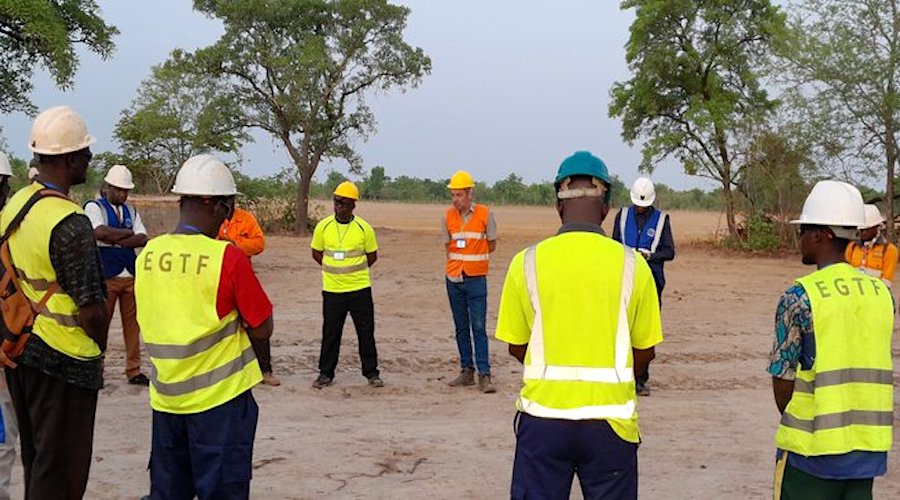
Some members of the mining team at Bougouni (Image courtesy of Kodal Minerals.)
Kodal Minerals (LON: KOD) confirmed on Tuesday that a security guard was killed in an attack on its Bougouni lithium mine in Mali on August 22.
The company said assailants on motorcycles targeted the site but were repelled after military forces stationed at the mine engaged them. The attackers fled, but one guard employed by Kodal’s security contractor died at the scene. No other staff or contractors were harmed.
Kodal said it is working closely with the Malian government to reinforce protection for employees and contractors. Military security around the site has since been increased.
Operations at Bougouni remain unaffected. The mine, which began production in February, has an agreement to sell its entire output to China’s Hainan Mining.
Mining and processing activities at the Bougouni mine have not been impacted by the incident, the company said.
Located 170 kilometres south of Bamako, Bougouni is targeting production of 11,000 tonnes of spodumene concentrate per month. It is set to become Mali’s second operating lithium project, following Ganfeng Lithium’s Goulamina mine, which opened in late 2024.
Rare earth prices hit two-year peak after MP Materials stops China shipments
LONDON/BEIJING, Aug 26 (Reuters) - Prices of two rare earth elements needed for super-strong magnets have surged to their highest in more than two years after U.S. miner MP Materials (MP.N), opens new tab stopped raw material exports to leading magnet maker China amid rising demand. China dominates the global supply chain for rare earths, accounting for 90% of refining capacity and around 70% of mined output, but the U.S. has pushed back, signing a deal with its biggest producer MP in July to refine its output domestically.
MP's shipments had in the past three years fed 7%-9% of China's oxide production from mine output of rare earths neodymium and praseodymium (NdPr) - vital to magnets that power electric vehicles, wind turbines and defence equipment - consultancy Adamas said. "MP's shipments were a very material portion of NdPr oxide supply for China's factories, so that's left a big void," said Ryan Castilloux, managing director of Adamas.
The Chinese price of NdPr oxide , regarded as a benchmark, has jumped to 632,000 yuan per metric ton or $88 per kg, the strongest since March 2023, from $63 on July 9. Its 40% rally after several years of weakness will boost prospects for mine projects seeking investment outside China as the West seeks to wean off reliance on Beijing.
Prices have surged recently of neodymium and praseodymium, the two main rare earth elements needed to make super-strong permanent magnets
Boosting the West's rare earth output became more urgent after China clamped down on exports in April amid a trade war with the U.S., prompting some auto plants to shut.
The U.S. government announced a ground-breaking deal with MP last month stipulating the company halt shipments to China. It also offered price support to MP for the NdPr it produces based on $110 per kg, at the time about twice the Chinese price.
MP had paused shipments to China in April due to high tariffs, but any shortage was masked by weakness in magnet demand due to Chinese export curbs, analysts said. U.S. rare earth ore supply to China slid in May and hit zero in June before jumping last month, probably due to the final MP shipments, they added.
China's exports of rare earth magnets recovered to hit a six-month high in July after Beijing eased its export controls, having agreed a series of deals with the U.S. and Europe. It's often called the “world’s highest garbage dump.”
PEAK MANUFACTURING SEASON NdPr prices have been weighed down by oversupply in recent years and in March last year, they sank to 345,000 yuan, the weakest since November 2020.
Their recent gains have also been driven by a rebound in demand.
"China is currently in its peak manufacturing season for electric vehicles, wind turbines, and consumer electronics. This cyclical uptick in demand has put additional pressure on available NdPr supply," said Neha Mukherjee, research manager for rare earths at consultancy Benchmark Mineral Intelligence.
Many rare earth prices have been weak in recent years, burdened by heavy supply from top producer China.
Support has also come from uncertainty surrounding Chinese rare earth mining and smelting quotas, which were released this year without the typical public statement. Castilloux said some players may be anticipating lower quotas, adding that he expects a modest 5% increase in Chinese output this year, in contrast to demand growing at about 10%.
Whether the rally will continue will partly depend on demand from magnet makers and whether they can absorb the higher prices, said Ellie Saklatvala, head of metal pricing at Argus.
"Producers of NdPr products are relieved to now see prices lift away from loss-making territory – it’ll be a question for buyers such as magnet makers whether their margins are healthy enough to keep paying those higher prices for feedstock."
Reporting by Eric Onstad; Editing by Veronica Brown and Jan Harvey
Locksley Resources forms US alliances to establish domestic antimony supply chain
Locksley Resources (ASX: LKY) announced Tuesday it has engaged Washington, DC-based advisory group GreenMet to support the advancement of its antimony and rare earth elements (REE) Mojave project in Inyo County, California.
Under the terms, GreenMet will position the Mojave project within key US government initiatives under the Defense Production Act, Inflation Reduction Act and Department of Energy programs. The firm is led by Drew Horn, a former US official on strategic minerals and energy supply chain development.
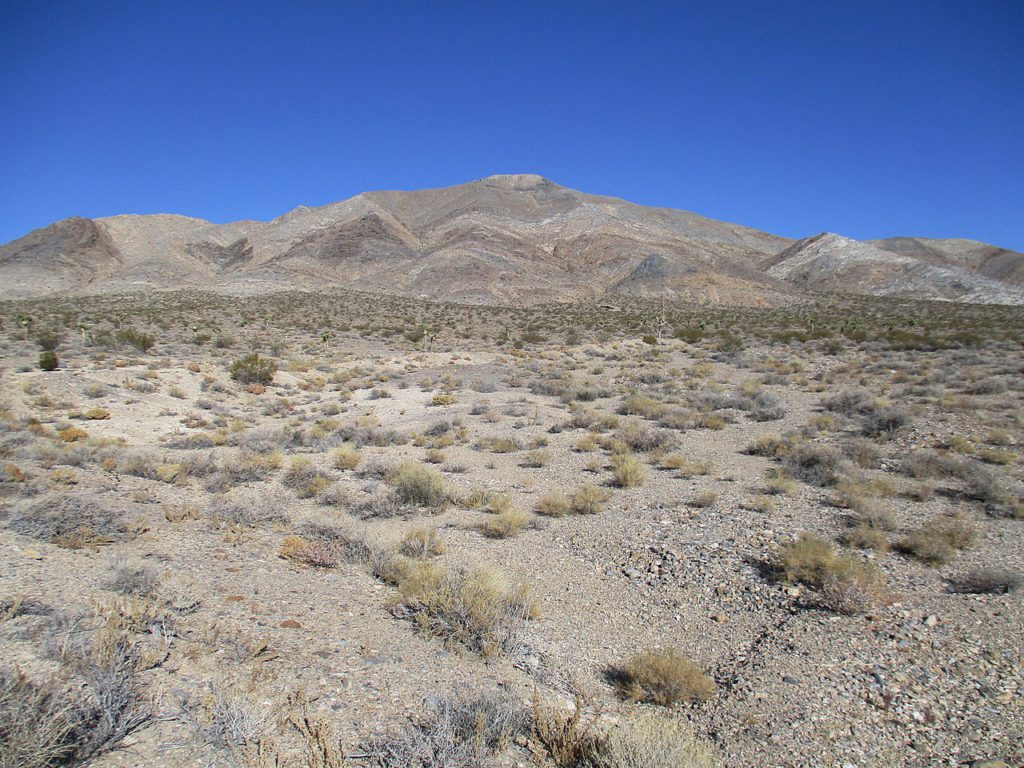
The Mojave project is located next to MP Materials’ Mountain Pass mine, the only active rare earths mine in the US. It includes the Desert antimony prospect, with historic high-grade samples up to 46% antimony, and the El Campo rare earth prospect, where recent rock chip assays returned up to 12.1% total rare earth oxides.
The location, says Locksley, offers a “strategic opportunity” to secure antimony and rare earth supplies within the US.
The Australian critical minerals explorer said it is positioning to establish the first domestic mine-to-market antimony supply chain, addressing a critical gap where currently 90-95% of refined supply comes from countries outside the US alliance network.
Antimony is vital for military applications and ammunition, batteries and semiconductors. There is currently no domestic antimony source, and 90% of world supply is controlled by China and Russia, an untenable narrative when it comes to sourcing minerals crucial to North America’s supply chain.
Locksley said it has obtained Bureau of Land Management (BLM) approvals for expanded drilling programs at both Desert and El Campo, with drilling scheduled to start in September. This week, it secured $6 million cash from a heavily oversubscribed placement to fund near-term exploration programs at Mojave.
The company also said it has struck an alliance with Houston-based Rice University to pioneer domestic antimony processing and advanced materials research in the US – a move that it believes could position its project at the heart of America’s push to rebuild its antimony supply chain from scratch.
US adds copper, potash, silicon in critical minerals list shake-up
Manganese stayed in the 2025 version of the USGS list of critical minerals. (Stock image by BJP7images.)
The US government has added copper, potash and silicon to its draft list of critical minerals, in the most significant overhaul since the it was first published in 2018.
The update, mandated every three years under the Energy Act of 2020, follows the 2022 version and now includes 54 minerals. Six were proposed for addition — copper, silicon, potash, silver, lead and rhenium — while two, tellurium and arsenic, were removed.
Copper and silicon were included because of the severe economic consequences that supply disruptions could trigger in refined forms, Kendra Russell, chief of staff, US Geological Survey (USGS) said.
Lead and rhenium, which narrowly missed the 2022 cutoff, were added under the new methodology.
Potash was also included after updated modelling flagged the risks of potential trade barriers from major suppliers, particularly Canada. Silver was added to hedge against a low-probability but high-impact disruption scenario in Mexico.
Tellurium was dropped as the US has shifted from net importer to exporter following increased domestic production. Arsenic was removed after revised data showed Peru, not China, is the leading producer, lowering the risk of supply disruption.
Three types of minerals
For the first time, critical minerals are divided into three risk categories: high, elevated and moderate. The new methodology also considers the economic fallout of supply shocks and highlights “single points of failure,” where reliance rests on a sole domestic producer.
The assessment spans 84 mineral commodities, 402 industries and more than 1,200 scenarios, which the USGS says offers a more realistic and usable framework for policymakers.
“Minerals-based industries contributed over $4 trillion to the US economy in 2024, and with this methodology we can pinpoint which industries may feel the greatest impacts of supply disruptions,” USGS acting director Sarah Ryke said.
She noted the new approach also helps see where strategic domestic investments or international trade relationships may help mitigate risk to individual supply chains.
The 2025 draft underscores how evolving market conditions and new data are reshaping Washington’s view of supply vulnerabilities. The final list will be published after a 30-day period of public comment.
Thor Adcock
Trump is a piece of scum and rips off the American people for millions of dollars in 7 months. he is a complete idiot
I recognize that potash is critical, however, any shortage due to trade issues is a self-inflicted wound. Canada would not stop exporting or apply export taxes except in retaliation to foolish tariffs levied by Donald Trump. And before Donald Trump’s unprovoked attack on Canada, the risk would have been even lower. But the risk right now is very small and almost in the complete control of the US government. Perhaps this was added to send a message to the commander-in-chief?
Americans can add any critical minerals they want. We Canadians have nothing Americans want so we will be selling potash and our other critical minerals to other customers.
Gemfields’ massive 11,685-carat ‘buffalo’ emerald set for auction
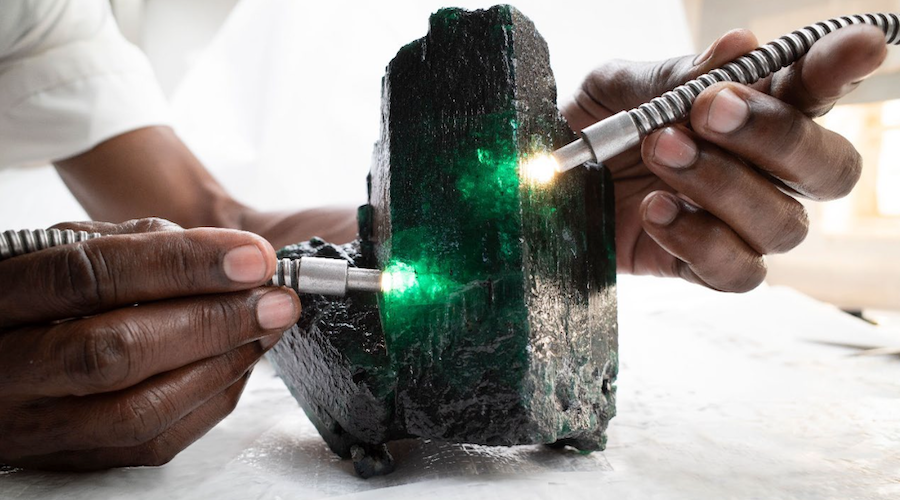
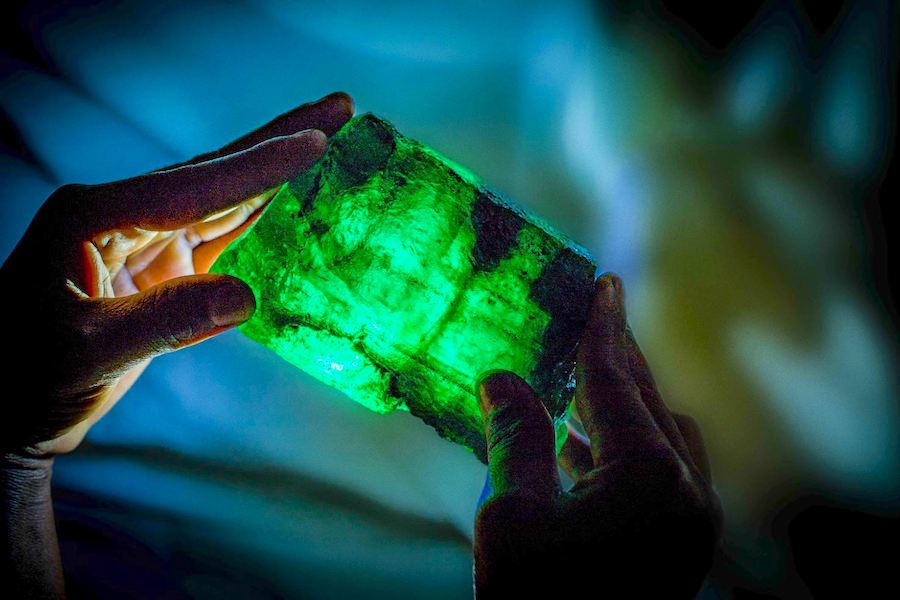
Imboo, the 11,685 carat ‘buffalo’ emerald, Kagem 2025. (Image courtesy of Gemfields.)
Coloured precious stones miner Gemfields (LON: GEM) (JSE: GML) has unveiled a colossal emerald weighing 11,685 carats, discovered at its 75%-owned Kagem mine in Zambia.
Named Imboo, meaning buffalo in the local Bemba and Lamba dialects, the gemstone is the largest of several extraordinary emeralds unearthed at Kagem, already famed for record-breaking finds. The emerald will be sold at Gemfields’ auction running until Sept. 11.
“Even under the beam of a strong light that is necessary to illuminate a gemstone of this remarkable size, Imboo reveals an intense, verdant green touched with golden warmth and a clarity that captivates the eye,” Gemfields’ managing director of product and sales, Adrian Banks, said in a statement.
Banks added the stone could yield multiple fine-quality emeralds large enough to form a complete high-jewellery suite, or serve as an investment destined for the history books.
Bigger, greener, rarer
At 2,337 grams, Imboo surpasses the mine’s earlier discoveries: the 6,225-carat Insofu (“elephant”) in 2010, the 5,655-carat Inkalamu (“lion”) in 2018, and the 7,525-carat Chipembele (“rhino”) in 2021.
Discovered on Aug. 3 at the Chama pit, the emerald was first freed from rock by geologist Dharanidhar Seth and chiseller Justin Banda, whose precise extraction was crucial to preserving the crystal. The complex geological setting, known as the Tri-Junction Model, where three rock and structural domains converge, creates ideal conditions for emerald formation. Similar geology produced the “Kafubu Cluster,” a 37,555-gram emerald grouping found in 2022.
The 5,655-carat emerald, dubbed Inkalamu (the “Lion Emerald”) found at Kagem in 2018. (Image courtesy of Gemfields Group.)
“In my thirty years at Kagem, I’ve rarely seen such a remarkable formation of large, high-quality crystals,” grading manager Jackson Mtonga said. “The immense size and nature of the crystal formation makes it fitting that this unique piece is given the name ‘buffalo’, or Imboo in our local languages. This is a true masterpiece carved by nature’s hand.”
Traceable
Gemfields’ partner Provenance Proof will offer the new owner nanoparticle tagging technology, providing permanent traceability of the emerald even after cutting and polishing. This ensures its origin at Kagem remains verifiable.
Zambia, the second-largest emerald producer globally after Colombia, holds a 25% stake in the Kagem mine through its government.
Outside Zambia, Gemfields owns a 75% stake in the Montepuez ruby mine in Mozambique.
Giustra-backed mining firm teams up with informal miners in Colombia
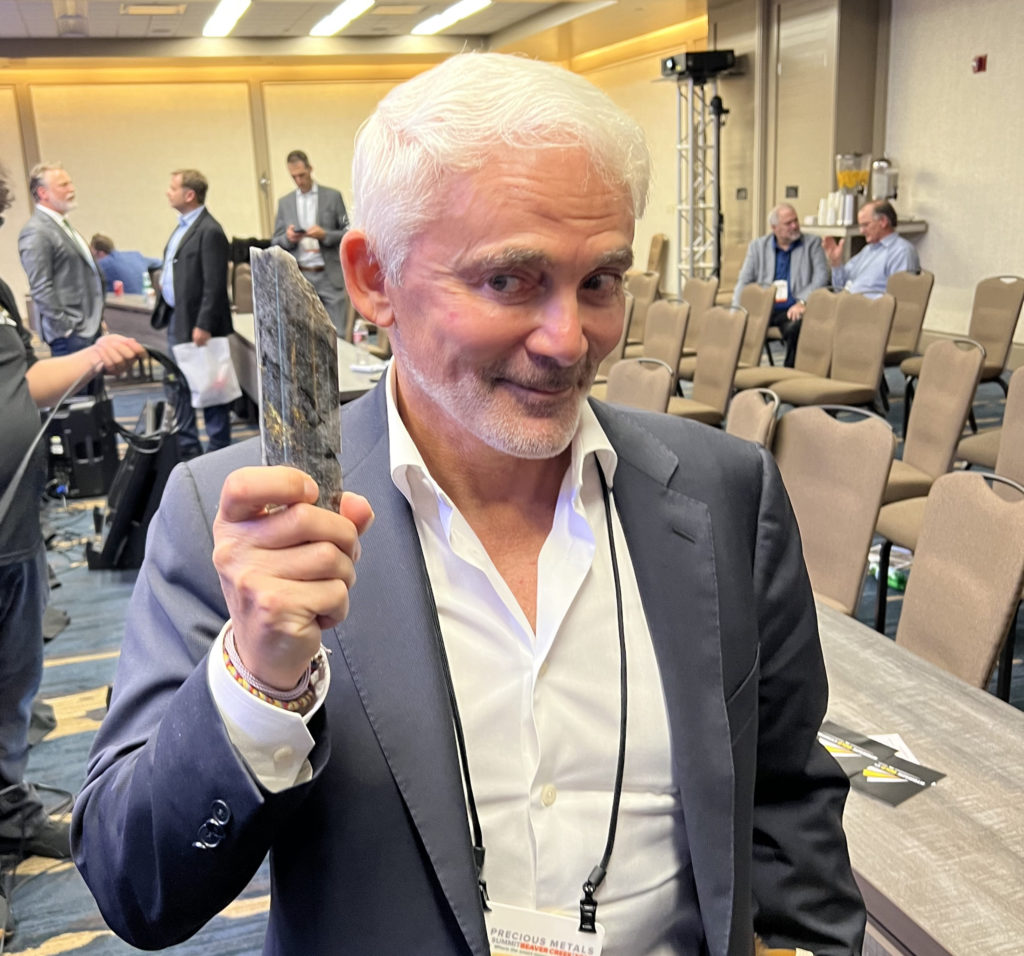
Frank Giustra during the Precious Metals Summit in Colorado. (Credit: Henry Lazenby)
Colombia’s artisanal miners are helping a Canadian precious metals producer backed by Frank Giustra navigate the country’s illicit gold boom via some unusual agreements.
Aris Mining Corp. has signed partnerships with about 2,500 small-scale miners who now account for 45% of the gold that comes out of its Segovia mine in Antioquia department, according to chief executive officer Neil Woodyer.
Typically, established mining companies look to expel informal miners from their properties. Instead, the Canadian firm is helping them with financing, planning and safety and then buys their gold.
Woodyer’s team is expanding the partnership program at Segovia and its other Colombian mine, Marmato, where some small-scale miners are even using the company’s own tunnels. At a new project, the company estimates 20% of capacity will be dedicated to such partnerships, which may help the company exceed its goal of doubling output to 500,000 ounces a year.
“We add our skills and our technical knowledge, and we pick up their local knowledge and community support,” said Woodyer in a recent interview with Bloomberg. “We enhance our social license and at the same time we get additional production.”
Informal mining in South America from Bolivia to Peru is on the rise driven by record-high bullion prices. Aris isn’t immune from the surge in activity by illegal armed groups in Colombia, and a booming illicit gold trade is estimated to generate more money for organized crime than the cocaine industry. Management has been working with police to shut down illegal groups.
Aris’s approach — to work with local miners who may lack permits but aren’t explicitly banned or inherently criminal — contrasts with that of Zijin Mining Group, a Chinese group grappling with violent conflicts since buying the Buritica underground mine in Antioquia five years ago.
“The partners we have are against the bad guys,” Woodyer said. “So they actually are a defense and help us because it undercuts the bad guys.”
Though infrequent, partnerships with artisanal miners are not unheard of as similar agreements exist in Ghana.
Woodyer founded Aris along with strategic investor Giustra three years ago with the merging of Aris Gold and GCM Mining. Ian Telfer, the architect of Goldcorp, is chairman, while Mubadala Investment Co. is an investor. In the past six months, Aris shares have jumped 91%, the biggest gain among peers tracked by Bloomberg, taking its market value to $1.5 billion.
MSC World Europa, one of the largest cruise ships in the world with a reported 8,500 people aboard, lost propulsion early Monday, August 25, off the coast of Italy. The incident drew wide media attention with sensational reports saying it had grounded or crashed. The Guardia Costiera responded to the ship, and it was emphasized that the vessel was never in any physical danger.
Introduced in 2022 as the first MSC cruise ship to exceed the 200,000 gross ton mark, the ship was making a week-long cruise circuit in the Western Mediterranean and sailing between Genoa and Naples when, according to passengers, the vessel stopped at approximately 0530 Monday morning. The incident was reported to the Coast Guard control center at approximately 0730, and two patrol boats and a helicopter were dispatched to survey the situation.
At 215,863 gross tons, the massive 1,094-foot (333-meter) vessel is reported to have a total of 8,585 people aboard, including 6,496 passengers on an end of summer cruise and 2,089 crewmembers. Some of the passengers were due to disembark today in Naples, and others were waiting to join the ship.
The Coast Guard placed officers aboard the ship to survey the situation and reported it was told that the ship was experiencing an electrical problem with its propulsion. The ship is one of the largest to be fueled with LNG. The ship uses GE Power Conversion’s in-board electric propulsion system using two 25 MW induction motors that drive two conventional fixed-pitch propellers via direct shaftlines. It was built by Chantiers de l’Atlantique and is third in size only to Royal Caribbean International’s sister ships Icon and Star of the Seas and the Oasis class of cruise ships. MSC introduced a second ship of the class this year and has ordered four more World Class ships.
Passengers were reported calm while the ship was drifting approximately eight miles off the coast of the Italian island of Ponza. The ship was able to continue to run its generators and was maintaining passenger services.
Two tugs from the ports of Gioia Tauro and Naples were dispatched, and plans were being made to tow the ship, if necessary, the approximately 50 miles to Naples. However, by early afternoon, MSC Cruises was reporting that the crew had been able to initially restore partial propulsion. The Coast Guard did a further inspection, and the ship was moving at 15 knots with a Coast Guard escort to Naples. It docked at 2100 local time on Monday night.
MSC said technicians would continue to repair and inspect the cruise ship. Passengers were proceeding with the disembarkation and embarkation. The plan called for the ship to resume its cruise on Tuesday, sailing for Messina.
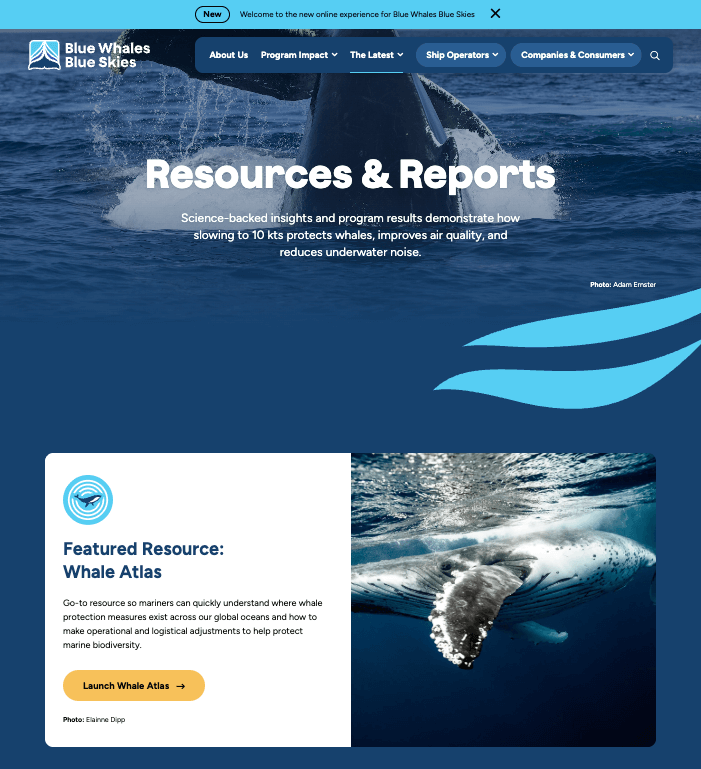
Whale Atlas: An Easy-to-Use Mapping Tool for Whale-Safer Global Navigation
2025 has been a tumultuous year for large whales in California and beyond. At least eight gray whales have been killed by ship strikes just in the Bay Area. While the majority of ship strikes go unobserved and undetected, researchers estimate that 80 endangered whales are fatally struck each year off the West Coast of the U.S.
This reality was the impetus behind creating a new online portal which offers digitized details of whale conservation zones to make it easier for mariners planning multinational transits to understand and cooperate with whale-protection measures.
Background
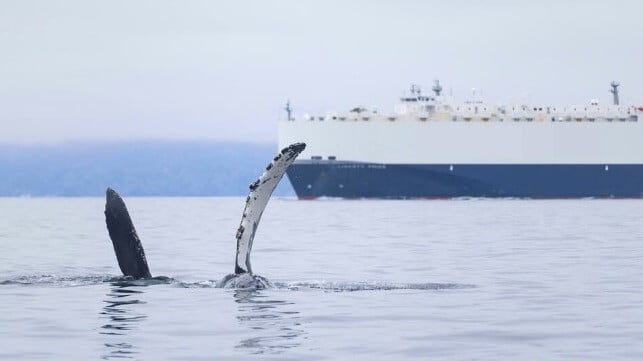
In many places throughout the world, high-traffic shipping zones overlap with whale foraging areas and migration routes. Marine managers aim to reduce the risk of strikes by slowing ships down or asking them to avoid certain areas at certain times of the year. For the past ten years, Protecting Blue Whales and Blue Skies (BWBS) has engaged shipping companies, asking them to reduce their speeds voluntarily to a whale-safer level of 10 knots or less off the coast of California during peak whale migratory season. Programs like BWBS, which verifies cooperation with NOAA’s voluntary Vessel Speed Reduction (VSR) requests, work collaboratively with industry, and have been proven to be effective - reducing fatal strike risk by 50%. Where and when vessels reduce speeds is just as important as the slowing down itself. Resource managers use the best available science to determine the placement and timing of VSR zones.
Video credit: Katherine Brook; vessel and whale footage by Adam Ernster
Advancing global awareness and collaboration around whale protection measures
Whale conservation programs and protection measures centered on reducing shipping impacts on whales exist around the world, including in the Strait of Gibraltar; Hellenic Trench; Bering and Salish Seas; Costa Rica; Gulfs of Panama, Hauraki and Saint Lawrence; and the Canadian Arctic. In 2023 and 2024 the World Shipping Council released a first-of-its-kind Whale Chart Report that compiled and outlined whale protection measures across the globe in order to raise awareness to mariners of opportunities to reduce biodiversity impacts. This included VSR zones, Areas to be Avoided (ATBAs), and Traffic Separation Schemes (TSSs), all aimed at directing vessel traffic to either reduce speeds within or stay away from critical whale habitat areas.
Seeing an opportunity to make this valuable information more interactive and user-friendly, California Marine Sanctuary Foundation (CMSF) and the BWBS team developed an online platform to enhance how mariners access and engage with the information critical to understanding and cooperating with whale protection measures.
CMSF is proud to introduce “Whale Atlas: A Mariners Guide to Whale-Safer Shipping”
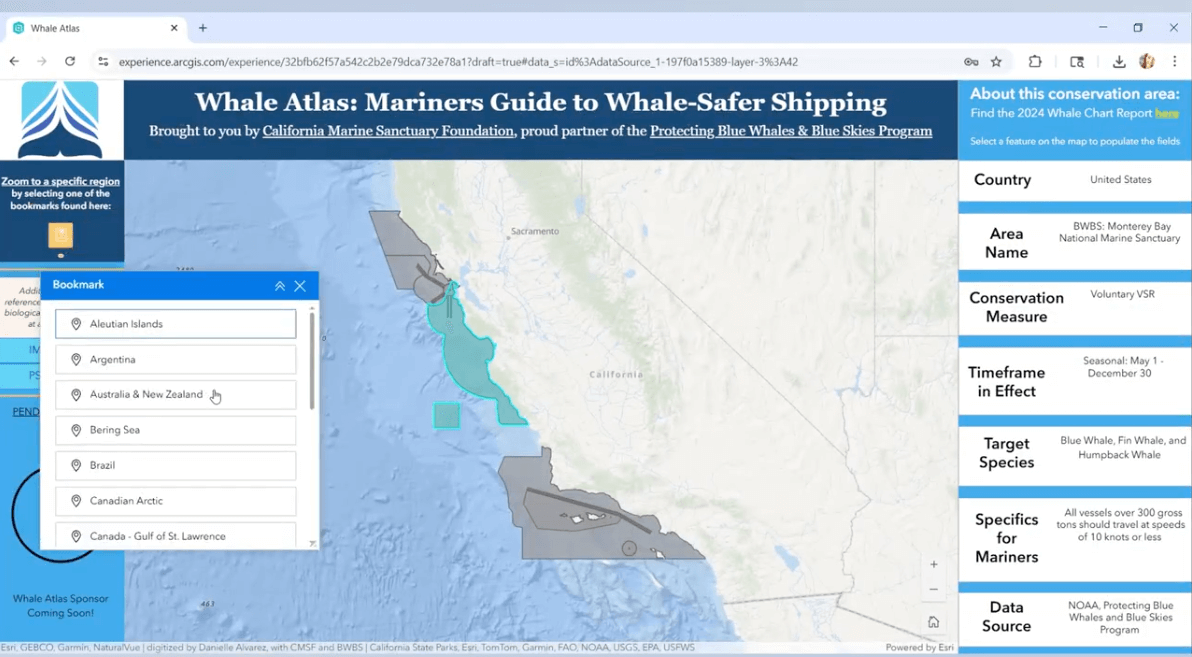
This new, online portal showcases digitized whale conservation zones and protection measures relevant to maritime shipping activities. It houses information on:
Global VSR (Vessel Speed Reduction) zones, Areas to be Avoided (ATBAs) and Traffic Separation Schemes (TSSs)
Zone designations and parameters, including which whale species it protects
Seasonality of the whale protections
Specifics of the measures (what speeds to slow to; ship class or size targeted)
Whale Atlas with Monterey Bay National Marine Sanctuary selected, part of the NOAA voluntary VSR request, and Blue Whales Blue Skies program in California
Whale conservation zones represent areas where mariners are requested to either: reduce speeds or avoid important habitats for a few months or year-round. Whale Atlas provides this information, as well as the source/administering agency, so mariners can zoom in and out of relevant geographies, learn about opportunities to operate more sustainably, download layers in relevant formats, and incorporate measures into their transit plans.
CMSF and the BWBS team will regularly update the data to ensure that the conservation zones are current as guidance, data, and priority zones evolve. Maritime shipping is a global industry, and Whale Atlas brings us one step closer to ensuring that mariners consider whale-friendly shipping practices on the same global scale.
South Africa's government has implemented new restrictions on STS transfers and bunkering off its coastline, hoping to head off environmental damage from a potential spill. Its Algoa Bay area is a key bunkering hub for traffic on the Cape of Good Hope route, which has grown by leaps and bounds due to the Red Sea crisis - but conservation groups say that all the activity is putting a colony of critically-endangered penguins at risk.
The regulation bans STS transfers within three nautical miles of shore, as well as areas within aquaculture zones and marine protected areas. The rule sets up restrictions on bunkering in Algoa Bay, limiting transfers to specific anchorages and imposing seasonal restrictions on activity. Operators will also have to monitor for the presence of protected penguins and marine mammals during transfers, and will have to use a hydrophone system to listen for the movements of these species.
To further reduce the risk of pollution, transfers will be prohibited in wind speeds over 22 knots or wave heights over six feet, and only a limited number of vessels will be allowed in the bay at any given time. Operators will also be required to maintain spill-response vessels on standby to be ready to clean up in the event of a petroleum release.
Breaches of the new rules are punishable with a penalty of up to $2.1 million and a prison sentence of up to five years.
“These regulations are a decisive step to safeguard our oceans and secure the future of our African Penguin. They set strict standards for offshore ship-to-ship transfers, ensuring that maritime activity can only proceed in a safe and responsible way," said South African environment minister Dr. Dion George.
Conservationists claim that heightened bunkering activity has cut the population of the African penguin in Algoa Bay by more than 90 percent, putting the world's most endangered penguin species further at risk. Local wildlife NGO SANCCOB said in a statement that it doubts that the new measures will be effective. A colony on Algoa Bay's St. Croix Island was once the largest remaining African penguin colony, with 8,000 breeding pairs living there in 2015, the year before bunkering started in the bay. There are currently 700 breeding pairs on the island, according to SANCCOB, which blamed noise from increased vessel traffic and a series of spills.
The group called for banning bunker transfers at night, when releases are least likely to be detected and hardest to clean up, and reducing the wave height limitation to three feet. According to SANCCOB, the government loosened the final version of the rule by removing a requirement for operators to abide by IMO underwater noise reduction guidelines, a modification that favors vessel operators.
Zim Confirms Turkey’s Immediate Ban on Shipping Associated with Israel
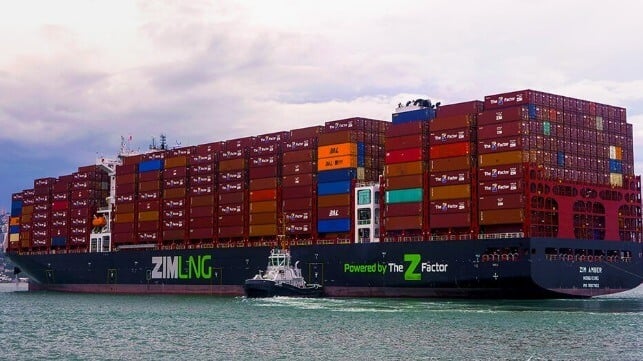
Zim ships are rerouting away from Turkish ports after the country banned Israeli shipping (Zim)
Zim confirmed the earlier reports that Turkey has begun turning away ships associated with Israel. The company, which is the ninth-largest container carrier, reports it is rerouting ships scheduled to call at Turkish ports and working on a mitigation plan.
In a stock exchange filing on Monday, August 25, Zim writes, “It received a notice from the Turkish Port Authorities through the company’s local agent in Turkey, that as a result of a new regulation adopted in Turkey, vessels that are either owned, managed or operated by an entity related to Israel will not be permitted to berth in Turkish ports.” The change was said to be effective immediately as of last Friday.
The Globes newspaper in Israel reports that one of the company’s ships was turned away from Istanbul last Friday. It writes that the vessel was forced to proceed to Piraeus, Greece, and that there is no clear solution for the cargo scheduled to be loaded or unloaded in Istanbul.
The new regulation also impacts all vessels that are carrying military cargo destined to Israel, which Zim says it was told would not be permitted to berth in Turkish ports. Also, Turkish-flagged vessels are prohibited from calling at Israeli ports.
Globes reports that while it is an expansion of the trade embargo Turkey imposed 15 months ago, it says shipping companies are still waiting for clear instructions from the Turkish government. It says other major carriers, such as MSC Mediterranean Shipping Company and Maersk, are seeking clear instructions. A ship’s flag is said not to be a guarantee that it will be permitted into a Turkish port.
It is not the first country to bar Israeli shipping, for example, Malaysia took a similar step in December 2023, but it is a minor trading partner with Israel. Turkey and Israel had a large trade flow, and even after the embargo, trade continued between the countries.
The ban comes as Zim has already been under pressure. Last week, the company reported a 15 percent decline in revenues in the second quarter of 2025 and a 38 percent decline in earnings (EBITDA) for the quarter. Carried container volume was down six percent in the second quarter to 895,000 TEU, but box volume for the six months was up year-over-year to 1.84 million TEU.
Management cited the company’s agility and ability to respond to the challenging market conditions. Based on its outlook, it raised its midpoint guidance for the full year 2025 despite the softness in the quarter. Today, it however, warned that if Turkey’s ban remains unchanged, it is expected to negatively impact financial and operating results.
Recently, there have been market rumors that management was exploring a possible buyout of Zim with an investment group. Zim went public in January 2021 with a listing on the New York Stock Exchange.





Thor Adcock
Trump is a piece of scum and rips off the American people for millions of dollars in 7 months. he is a complete idiot
Norm Dill
I recognize that potash is critical, however, any shortage due to trade issues is a self-inflicted wound. Canada would not stop exporting or apply export taxes except in retaliation to foolish tariffs levied by Donald Trump. And before Donald Trump’s unprovoked attack on Canada, the risk would have been even lower. But the risk right now is very small and almost in the complete control of the US government. Perhaps this was added to send a message to the commander-in-chief?
Shawn M. Hierlihy
Americans can add any critical minerals they want. We Canadians have nothing Americans want so we will be selling potash and our other critical minerals to other customers.