It’s possible that I shall make an ass of myself. But in that case one can always get out of it with a little dialectic. I have, of course, so worded my proposition as to be right either way (K.Marx, Letter to F.Engels on the Indian Mutiny)
Saturday, September 06, 2025
Manufactured Famines in Gaza Began Almost Two Decades Ago, So Why Haven’t They Been Halted?
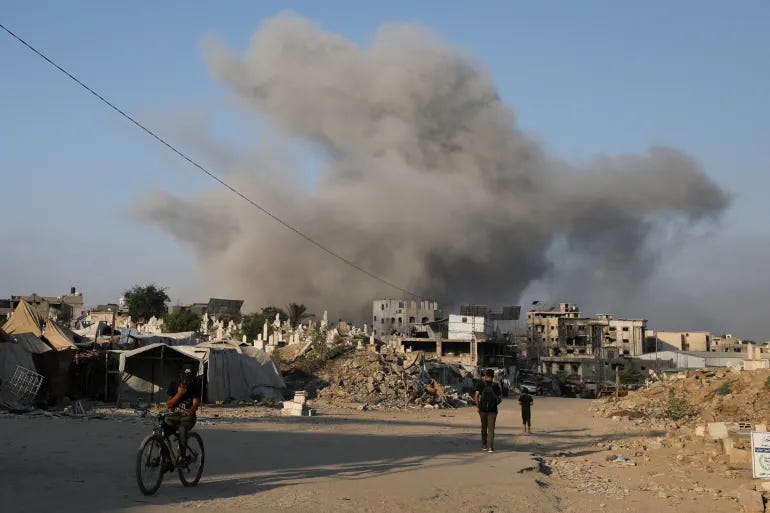
Recently, international media has highlighted the mass famine in Gaza. Yet, there have been effectively three waves of famine in Gaza since spring 2024. First weaponized 18 years ago in the Strip, these hunger games could have been preempted several times. Why weren’t they?
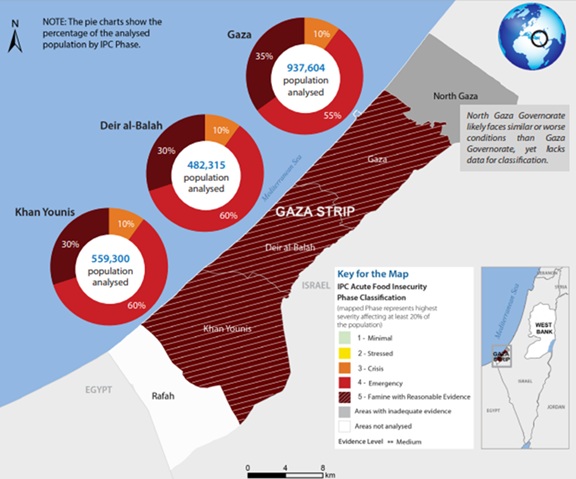
On Friday, August 22, the Integrated Food Security Phase Classification (IPC), the global famine watchdog, declared widespread famine in Gaza. The IPC is regarded as the international gold standard in nutritional crises.
As international media was quick to point out, the declaration meant that a quarter of all Palestinians in Gaza are starving – more than 500,000 people – with that number expected to rise to more than 640,000 within six weeks.
Projected Acute Food Insecurity | 16 August – 30 September 2025
What was most damning to most international media is that this outbreak of full famine as described by the IPC and UN agencies had been fully avoidable.
What should be far, far more damning is that several waves of famines have been widespread in Gaza for some 20 months and that precarious conditions of life and episodic famines have prevailed episodically in the Strip since 2007 – that is, for almost two decades.
The blockade since 2006
In the 2006 Palestinian election, when Hamas won a clear majority in all occupied Palestinian territories, Israel and the Middle East Quartet—U.S., Russia, the UN and EU—launched economic sanctions against the Palestinian Authority, Hamas’s parliamentarians and Palestinian territories. The sanctions were coupled with a blockade, Israel’s attempt to push the Gazan economy “to the brink of collapse,” according to a U.S. diplomatic cable released by Wikileaks.
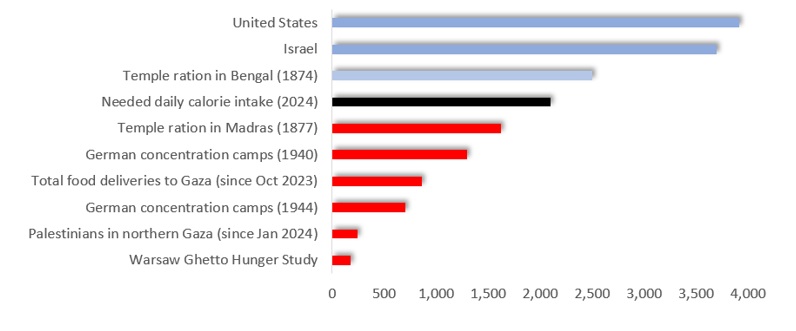
With the inception of its blockade in 2007, the Israeli government estimated how many daily calories were needed to prevent or to cause malnutrition in Gaza. The average daily calorie intake critical to survival is estimated at 2,100 kilocalories (kcal) per day. The Israeli “Red Line” document used a calculation of 2,279 calories per person.
During the 2008–2009 Gaza War, the Strip was subjected to a “Shoah” (Hebrew for Holocaust), as Deputy Defense Minister Matan Vilnai said. The idea was to “send Gaza decades into the past,” stated then commanding general Yoav Gallant.
Some 15 years later, Gallant was targeted by an International Criminal Court warrant “for the war crimes of starvation as a method of warfare.” But in 2009, he and other Israeli leaders complicit in the starvation games were ignored by international community.
The first wave of famine
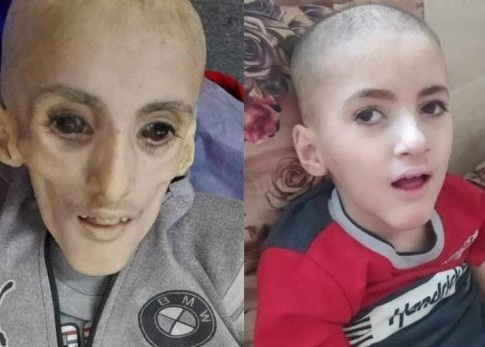
By early 2023 – months before October 7 – four of five Gaza’s residents were largely dependent on humanitarian aid and many suffered from widespread food insecurity, thanks to the Israeli total blockade. In March 2024, the 10-year-old Palestinian boy, Yazan al-Kafarneh, became the face of Gaza’s children. He died from malnourishment.
Yazan al-Kafarneh before the Gaza catastrophe and shortly before his death in March 2024 Source: B’Tselem
Then, just two days after the Hamas offensive of October 7, 2023, Israel blocked the entry of food and water into the Gaza Strip, as it initiated a massive, largely indiscriminate bombardment, with subsequent ground operations.
By December 2023, over 90 percent of the Gaza population was estimated to face high levels of acute food insecurity, with 40 percent at emergency levels and over 15 percent at catastrophe levels. The UN experts cautioned of genocide, warning that Israel was destroying Gaza’s food system and using food as a weapon against the Palestinian people.
Despite mounting evidence, the head of Israel’s Coordination of Government Activities in the Territories (COGAT) for Gaza stated there was no food shortage in Gaza. The IDF alleged Hamas stole humanitarian aid, killed people seeking humanitarian aid and kept its own supply reserves. Yet, both the U.S. and the UN denied Israeli claims that Hamas caused the famine.
It was the first wave of famine in Gaza.
The second wave of famine
By June 2024, the IPC reported that the entire Gaza population remained at high risk of famine. Three months later, the UN concluded that through its “total siege… Israel’s use of starvation as a method of war would affect the entire population of the Gaza Strip for decades to come, with particularly negative consequences for children.”
As the IPC estimates indicated, the second wave was expected to peak in early 2025. That it did not happen was due to the ceasefire in January 2025.
A second bout of famine was to be facilitated by a controversial General’s Plan,” led by Maj. Gen. (ret.) Giora Eiland, to lay siege to northern Gaza. It was a plan PM Netanyahu was considering. Eiland argued that “Gaza women are the mothers, sisters, and spouses of Hamas murderers.” So, “epidemics in the South [of Gaza] will bring victory closer.”
In late 2024, the IPC projected that through spring 2025, Gaza would remain in an emergency state regarding food insecurity. Some 345,000 people would face extreme lack of food, starvation and exhaustion of their livelihoods and almost 900,000 would be in emergency state.
When the ceasefire fell apart, the second famine wave ensued and Israel blocked all humanitarian assistance to Palestinians in Gaza after March 1, 2025. A month later, at least 60,000 children in Gaza were at risk of serious health complications due to malnutrition.
Toward the third famine wave
By the end of September, more than 640 000 people across Gaza will face Catastrophic levels of food insecurity; classified as IPC Phase 5. An additional 1.14 million people in the territory will be in Emergency (IPC Phase 4) and a further 396 000 people in Crisis (IPC Phase 3) conditions.
Conditions in North Gaza are estimated to be as severe – or worse – than in Gaza City.
In comparative historical view, weaponized mass starvation is the common denominator of settler colonialism, including American Indian Wars, the German Herero and Nama genocide, the Nazi Hungerplan all the way to the Yemeni civil war and the genocidal atrocities in Gaza. In this role, it is often associated with ethnic cleansing, as the pioneer of the Genocide Convention Raphael Lemkin noted, “after removal of the population and the colonization of the area by the oppressor’s own nationals”.
What about Gaza? Measured in terms of total food deliveries into the Strip since October 2023, the calorie intake was about 860 kcal, a third less than in the Nazi camps over eight decades ago. As the German invasion of the Soviet Union failed and the tide of World War II shifted, the Nazi camps deteriorated, with the daily intake shrinking to 700 kcal in 1944. That’s almost three times the intake of 245 kcal in northern Gaza in the first half of the year 2024, when the New York Post famously headlined that there was no famine in the Strip.
Weaponization of Starvation: Selected Historical Examples
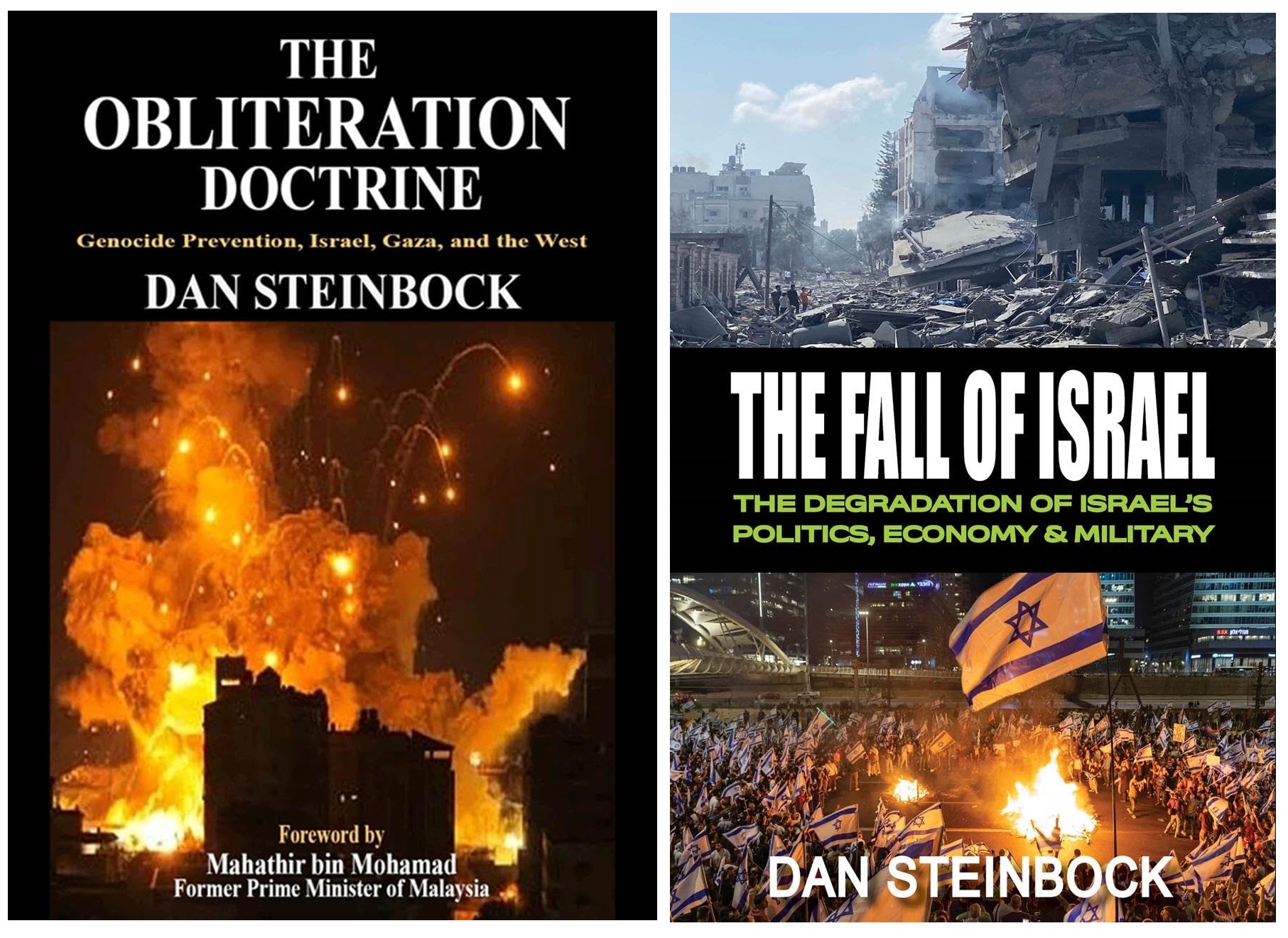
Source: Dan Steinbock (2025) The Obliteration Doctrine, Chapter 1
Missed preemption opportunities
In May 2018, the UN Security Council adopted unanimously resolution 2417 condemning the starving of civilians as a method of warfare and the unlawful denial of humanitarian access to civilian populations. Yet, in the course of the Gaza catastrophe, most tenets of UNSC Resolution 2417 have been consistently violated.
The recent “moral outrage” can be seen as the West’s belated effort at absolution. In the past 18 years, the path to Gaza’s genocide and mass starvation could have been preempted several times.
In 2006, instead of sanctions, the West could have accepted the results of the Palestinian democratic elections. Instead of the subsequent blockade and other regime change efforts, the West could have fostered peaceful development.
In 2007, the US could have condemned Israel’s deliberate effort to cause a widespread famine in Gaza.
Subsequently, the West could have intermediated peace talks between Israel and Hamas/Palestinian Authority. As Mossad’s ex-chief Efraim Halevy has said, mutual recognition is not a necessary precondition of talks, but the preferred end result.
In fall 2023, when Israel declared unilateral siege against Gaza, the West could have preempted the effort with appropriate pressure – U.S. by halting arms transfers, the EU by pausing trade – and used the opportunity to initiate the peace process.
In 2024 when Israel triggered the second famine wave in Gaza, the West could have escalated pressure, halt all arms sales and trade with Israel.
In 2025, when Israel rejected the ceasefire and intensified Gaza’s mass starvation, the West could have insulated the country from the UN and international community, as it once did with South Africa. When several Israeli intelligence and security leaders openly charge their country for apartheid rule, it is exceedingly hard to understand why the Western powers of the international community would ignore such charges.
That each of these fatal steps in the path to mass starvation and genocide were purposely ignored by the West and vetoed by the United States suggests that “moral outrage” became useful only when the entire Gaza had been decimated and an entire generation of Gazans had been butchered.
It is this deliberate sanctification of mass butchery that will cast a long dark shadow over the West and everything it claims to represent in the early 21st century.
Dr. Dan Steinbock is an internationally recognized visionary of the multipolar world and the founder of Difference Group. He has served at the India, China and America Institute (US), Shanghai Institutes for International Studies (China) and the EU Center (Singapore). For more, see https://www.differencegroup.net.
This commentary was originally published by Informed Comment (US) on September 2, 2025
“We Will Not Be Silent:” Hearing Stilled Voices of the Gaza Genocide
by Kathy Kelly / September 6th, 2025
In his last minutes of freedom before Israeli Defense Forces arrested him, Dr. Hussam Abu Safiya, clad in a medic’s white coat, walked alone toward two Israeli tanks. His captors awaited him amid the rubble of Gaza’s Kamal Adwan hospital. An artist swiftly created a dramatic poster showing Dr. Safiya striding through the ruins of the hospital he directed. The artist, David Solnit, recently updated the poster’s caption. It now reads: Free Dr. Abu Safiya Eight months in prison Dec. 27, 2024 – August 27, 2025.
Dr. Safiya had already endured agonizing losses at the Kamal Adwan hospital. In late October 2024, an Israeli drone attack killed his son, also a doctor. In a November 2024 attack on the hospital, Dr. Safiya was wounded by shrapnel, but continued working, insisting he would not close the hospital. He witnessed his colleagues being humiliated, beaten, and marched off to prison. By December 27, 2024, when Dr. Safia’s ordeal as a prisoner began, most hospitals in Gaza were non-functional.
On August 28, 2025, Dr. Safiya’s lawyer, Ghaid Ghanem Qassem, visited him in the Ofer Prison. She reports he has lost one-third of his body weight. While imprisoned in the Sde Teiman military Detention Center, located in an Israeli military base in the Negev desert, he showed signs of torture. Subjected to beating with electric shocks and batons, he sustained blows that may also cause him to lose his right eye. Yet his message remains intact:
“I entered in the name of humanity, and I will leave in the name of humanity… We will remain on our land and continue to provide healthcare services to the people, God willing, even from a tent.”
Regimes conducting a genocide have more than one reason to eliminate brave professionals attempting, life by precious life, to undo their inhuman work: doctors not only seek to slow down the dying, but they, like the journalists the Israeli regime so frantically targets, are specially positioned and specially qualified to accurately report on the intensity and nature of Israel’s extermination campaign. Silencing the citizens most capable of reporting on genocidal savagery is a key objective of genocide.
In one of the most egregious efforts to eliminate a key eyewitness, Israeli naval forces, on May 9, 2025, killed twelve-year-old Mohammed Saeed al-Bardawil, who, as a passerby alongside his father, had witnessed Israel’s March 23rd pre-dawn execution of 15 unarmed emergency rescue workers. The murdered paramedics had driven their clearly marked ambulances to a spot where they intended to retrieve victims of an earlier attack. The bullets that killed them were fired over six minutes as Israeli soldiers advanced to shoot directly into the survivors’ heads and torsos, afterwards using earth-moving equipment to bury their corpses and vehicles. On that day, Mohammed and his father were detained and made to lie face down near a burning ambulance. He is listed as a source in a well-documented NYT video on the massacre, dated May 2nd. Eleven days later, an Israeli gunboat fired on his father’s fishing boat, killing Muhammed in his father’s presence off the coast of Gaza’s southern Rafah governate.
It was less than two weeks ago, on August 25th, that Israel killed Reuters camera operator Hussam Al Masri and nineteen others, four of them also journalists, in a series of double-tap precision-guided aerial attacks on buildings and a stairway of the Al Nasser Hospital. Al Masri was easily targetable as he broadcast a live video feed from a Reuters outpost on a top floor of the hospital. Describing the second wave of the attack, Jonathan Cook writes: “And when Israel struck 10 minutes later with two coordinated missiles, it knew that the main victims would be the emergency workers who went to rescue survivors from the first strike and journalists — al-Masri’s friends—who were nearby and rushed to the scene … Nothing was a “mishap.” It was planned down to the minutest detail.”
Snipers and weaponized drone operators routinely kill Palestinians who courageously continue to don bulletproof press jackets, set up cameras, and report on Israel’s atrocities. Israel refuses entry to foreign journalists, and when brave, grieving, impassioned young Palestinians insist on carefully documenting their people’s agony for Western news outlets, Israel carefully targets them using the traceable phone and broadcasting equipment necessary to their work, before posthumously branding them Hamas operatives. Craven Western officials watch from within Israel’s patron states, discounting brown lives on whatever flimsy pretexts white authorities offer them. Almost daily, new faces appear in an assemblage of photos showing hundreds of journalists Israel has killed.
Health care workers and journalists who are still alive do their work amid struggles to prevent their families, their colleagues, their neighbors, and, of course, themselves from deaths not just by direct massacre but by militarily imposed starvation and its handmaiden, epidemic disease. Surgeons speak of being too weak to stand throughout an operation. Reporters document their own starvation.
Palestinians long for protection, but even the prospect of UN-mandated protective forces carries terrifying possibilities. What if “peacekeepers” assigned to monitor Palestinians collect data that the Israelis will use to control them? Weaponized “stabilizing forces,” equipped with U.S. surveillance technology, could be used to target, imprison, assassinate, and starve even more Palestinians.
In the summer of 1942, in Munich, Germany, five students and one professor summoned astonishing courage to defy a genocidal regime to which we, reluctantly, have to look if we want to find a racist cruelty comparable to that currently seizing not just Israel’s leadership but, in poll after poll, strong majorities of its non-native population. The students’ collective, called The White Rose, distributed leaflets denouncing Nazi atrocities. “We will not be silent” was the final line of each leaflet. Hans Scholl, age 24, and his sister, Sophie Scholl, age 21, hand-delivered the leaflets to their university campus in February 1943. The Gestapo arrested them after a janitor spotted them disseminating the leaflets. Four days later, Hans and Sophie, as well as their colleague Christopher Probst, were executed by guillotine.
With Israel’s nuclear arsenal capable of out-killing the Nazi regime over the course of a few minutes, and in the process inciting humanity’s final war; and with its leadership and populace radicalized through decades of fascist impunity to the point of endorsing not just a genocide but multiple, preemptive military strikes upon most of its neighbors at once, we may well be arriving at the moment when, as a result of our having let Israel assassinate, with impunity, the reporters of its crimes, there will be no-one in the outside world left to receive reports.
The silence we allow ourselves today may soon be involuntary and absolute. Let us summon up a fraction of Dr. Safiya’s, of young Mohammad’s, of Sophie Scholl’s, and Hussam al-Masri’s courage and speak while we can.
Kathy Kelly (kathy.vcnv@gmail.com) is the board president of World BEYOND War (worldbeyondwar.org) and a co-coordinator of the Merchants of Death War Crimes Tribunal. (merchantsofdeath.org). Read other articles by Kathy.
At least 21,000 children disabled in Gaza war: UN committee
Restrictions on humanitarian aid being brought into the Gaza Strip are disproportionately impacting the disabled, said the committee - Copyright AFP Bashar TALEB
Robin MILLARD
At least 21,000 children in Gaza have been disabled since the war between Israel and Hamas began on October 7, 2023, a United Nations committee said Wednesday.
Around 40,500 children have suffered “new war-related injuries” in the nearly two years since the war erupted, with more than half of them left disabled, said the UN Committee on the Rights of Persons with Disabilities.
Reviewing the situation in the Palestinian territories, it said Israeli evacuation orders during the army’s offensive in Gaza were “often inaccessible” to people with hearing or visual impairments, “rendering evacuation impossible”.
At a news conference, committee member Muhannad Al-Azzeh cited the example of a deaf mother in Rafah killed alongside her children, unaware of instructions to evacuate.
“Reports also described people with disabilities being forced to flee in unsafe and undignified conditions, such as crawling through sand or mud without mobility assistance,” the committee said.
Restrictions on humanitarian aid being brought into the Gaza Strip were disproportionately impacting the disabled, said the committee.
“People with disabilities faced severe disruptions in assistance, leaving many without food, clean water, or sanitation and dependent on others for survival,” it said.
– Gaza aid restrictions –
The decision to centralise aid distribution in Gaza has also made it far more difficult for the disabled to access desperately needed assistance, the committee warned.
While the new private US- and Israel-backed Gaza Humanitarian Foundation has four distribution points across the territory, the UN system it has largely replaced had about 400.
“We can’t expect children with disabilities… to be able to run and go to the (aid) points,” said Azzeh.
“This is why one of our main recommendations is that children with disabilities must be reached out to,” as a high priority for humanitarian aid, he said.
Physical obstacles, such as war debris and the loss of mobility aids under the rubble, have also prevented people from reaching the relocated aid points.
The committee said 83 percent of disabled people had lost their assistive devices, with most unable to afford alternatives such as donkey carts.
It voiced concern that devices like wheelchairs, walkers, canes, splints and prosthetics were considered “dual-use items” by the Israeli authorities and were therefore not included in aid shipments.
The committee called for the delivery of “massive humanitarian aid to persons with disabilities” affected by the war.
It said it had been informed of at least 157,114 people sustaining injuries, with over 25 percent at risk of life-long impairments, between October 7, 2023 and August 21 this year.
There were “at least 21,000 children with disabilities in Gaza as a result of impairments, acquired since October 7, 2023”, it said.
The committee urged Israel to adopt specific measures for protecting children with disabilities from attacks, and implement evacuation protocols that take into account persons with disabilities.
Israel should ensure disabled people are “allowed to return safely to their homes and are assisted in doing so”, it added.
UK police arrest 150 people in latest Palestine Action demo
Palestine Action was banned under the UK’s Terrorism Act of 2000
Critics, have condemned the ban as legal overreach and a threat to free speech.
An elderly protester was taken away by police at the 'Lift The Ban' demo
- Copyright AFP Tiziana FABI
Some 150 people were arrested in London on Saturday during a tense protest in support of the Palestine Action group, which has been banned under terror laws, police said.
Several hundred people demonstrated in front of the UK parliament, with some holding placards that read: “I oppose genocide. I support Palestine Action.”
The capital’s Metropolitan Police force (Met) had warned people that it would not hesitate to arrest anyone who explicitly expressed support for the prohibited group.
“We are not terrorists,” 74-year-old retiree Polly Smith told AFP, adding: “The ban must be lifted.”
Nigel, a 62-year-old CEO of a recycling company who declined to give his surname, said the government’s ban imposed in July was “totally inappropriate”.
“They should spend more time working on trying to stop genocide, rather than trying to stop protesters,” he told AFP before being arrested as protesters chanted “Shame on you!” at police.
Skirmishes broke out between officers and demonstrators who tried to prevent arrests.
Some of the alleged offences committed included “assault on a police officer”, the Met said on X.
Palestine Action was banned under the UK’s Terrorism Act of 2000 following acts of vandalism including at a Royal Air Force base, which caused an estimated £7 million ($10 million) in damage.
Critics, including the United Nations and campaign groups such as Amnesty International and Greenpeace, have condemned the ban as legal overreach and a threat to free speech.
More than 800 people had already been arrested before Saturday’s demonstration, with 138 charged with supporting or encouraging support for a proscribed organization.
Most face six months in prison if convicted but organisers of the rallies could be sentenced to up to 14 years if found guilty.
The government has been granted permission to appeal an earlier ruling which allowed Palestine Action co-founder Huda Ammori to challenge the ban.
A separate pro-Palestinian demonstration saw several thousand people take to the streets elsewhere in London on Saturday, as Israel launched new strikes on Gaza, with the stated aim of seizing Gaza City to defeat the militant group Hamas.
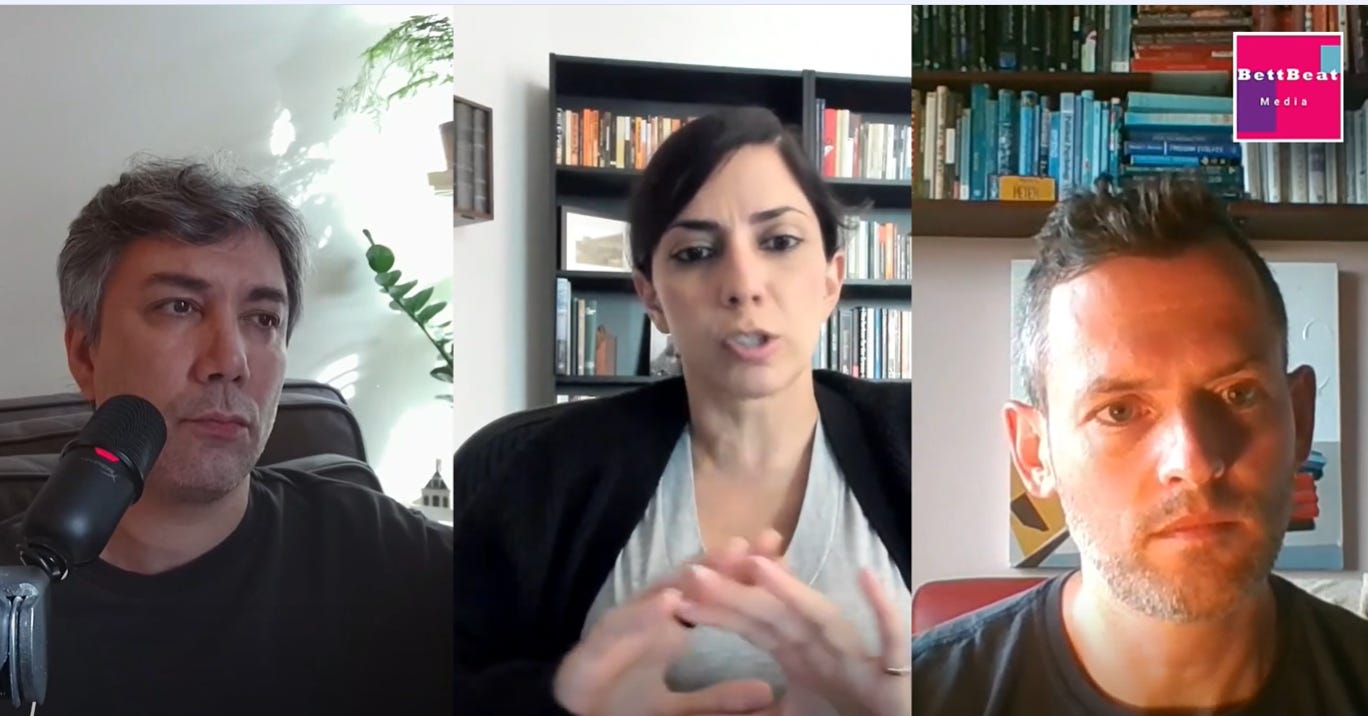
A Yank and a Dutchman Exploring on their BettBeat Channel The World
Interview of Karim and Peter from Chinese University of Hong Kong
by Paul Haeder / September 4th, 2025
They’ve had skin in the game — the Podcast and Substack game — for four years.
Amazing guests, and unfortunately for us, but fortunately for us, too, they have been covering the genocide in the Jewish State of Raping and Murdering and Starving and Maiming and Poisoning Palestine: Going on TWO goddamned years.
One of their favorite guests, and mine too: Assal Rad, Peter and Karim examine the ongoing genocide in Gaza and the failure of international institutions to respond effectively. The conversation explores how Israeli propaganda has become increasingly ineffective as images of starvation make their justifications harder to sell, yet Western governments continue providing unwavering support despite shifting public opinion.
An outright assault on all Palestinian Life Anywhere.
Now, both are floundering, as they start a new semester in Hong Kong. Floundering because the world and their own adopted country, China, isn’t doing anything to stop the genocide. Here, a telling interview with a Portuguese fellow, also in China, talking about the lack of soft power from China toward the West, and the odd bullshit in China’s textbooks describing Palestine as a terrorist place:
But, let’s not forget, that the Jewish Illegal State of Israel has a lot of cadres in their camp that have committed settler colonial genocide and mass murder.
Man, oh, man, the Jews of Israel have solid genocidal ground to stand on: Let us put this in a historical perspective: the commemoration of the War to End All Wars acknowledges that 15 million lives were lost in the course of World War I (1914-18).
The loss of life in the Second World War (1939-1945) was on a much larger scale, when compared to World War I: 60 million lives, both military and civilian, were lost during World War II. (Four times those killed during World War I).
The largest WWII casualties were suffered by China and the Soviet Union:
26 million in the Soviet Union,
China estimates its losses at approximately 20 million deaths.
Ironically, these two countries (allies of the US during WWII) — which lost a large share of their population during WWII — were under the Biden-Harris administration as categorized as “enemies of America”, which are threatening the Western World. Under Trump? Same continuation of the hatred.
Germany and Austria lost approximately 8 million people during WWII, Japan lost more than 2.5 million people. The US and Britain respectively lost more than 400,000 lives.
Here’s a carefully researched article by James A. Lucas documenting the more than 20 million lives lost resulting from US led wars, military coups and intelligence ops carried out in the wake of WWII, in what is euphemistically called the “post-war era” (1945- ).
The extensive loss of life in Lebanon, Syria, Yemen, Ukraine and Libya, Palestine is not included in this study.
Nor are the millions of deaths resulting from extreme poverty — largely induced by economic sanctions and Western interference in nations’ ability to democratically elect who they want. Selling weapons to both sides of a revolution or war, well, that has its multiplier effect.
The causes of wars are complex. In some instances nations other than the U.S. may have been responsible for more deaths, but if the involvement of our nation appeared to have been a necessary cause of a war or conflict it was considered responsible for the deaths in it. In other words they probably would not have taken place if the U.S. had not used the heavy hand of its power. The military and economic power of the United States was crucial.
This study reveals that U.S. military forces were directly responsible for about 10 to 15 million deaths during the Korean and Vietnam Wars and the two Iraq Wars. The Korean War also includes Chinese deaths while the Vietnam War also includes fatalities in Cambodia and Laos.
The American public probably is not aware of these numbers and knows even less about the proxy wars for which the United States is also responsible. In the latter wars there were between nine and 14 million deaths in Afghanistan, Angola, Democratic Republic of the Congo, East Timor, Guatemala, Indonesia, Pakistan and Sudan.
But the victims are not just from big nations or one part of the world. The remaining deaths were in smaller ones which constitute over half the total number of nations. Virtually all parts of the world have been the target of U.S. intervention.
The overall conclusion reached is that the United States most likely has been responsible since WWII for the deaths of between 20 and 30 million people in wars and conflicts scattered over the world.
To the families and friends of these victims it makes little difference whether the causes were U.S. military action, proxy military forces, the provision of U.S. military supplies or advisors, or other ways, such as economic pressures applied by our nation. They had to make decisions about other things such as finding lost loved ones, whether to become refugees, and how to survive.
And the pain and anger is spread even further. Some authorities estimate that there are as many as 10 wounded for each person who dies in wars. Their visible, continued suffering is a continuing reminder to their fellow countrymen.
It is essential that Americans learn more about this topic so that they can begin to understand the pain that others feel. Someone once observed that the Germans during WWII “chose not to know.” We cannot allow history to say this about our country. The question posed above was “How many September 11ths has the United States caused in other nations since WWII?” The answer is: possibly 10,000. — James A. Lucas
Here, a bio on Karim:
I am interested in how the asymmetrical cultural flow from the West into societies across the world, reinforced by corporate hegemony in a neoliberal global political economy (e.g., dominance in the spheres of social media, the movie industry and fashion), influences the individual psychology of the global population. In particular, the effects of racism/white supremacy, capitalism and colonialism hold my strong attention. My research revolves around questions such as: Why do racism and colorism follow highly similar patterns across the globe; How do (Western) social media platforms perpetuate racial hierarchies in cultures across the globe; What are the psychological ramifications of colonialism; What is the relationship between neoliberal political economies and our understanding of human nature?
“When Left is Right and Right is Left: The psychological correlates of political ideology in China” (Under Review). [Link]
“Knowing what the electorate knows: Issue-specific knowledge and candidate choice in the 2020 elections” (Under Review). [Link]
*****
We intended to get into geopolitical or political economy, but we ran out of time: Here, a primer with Peter Phillips, former director of Project Censored and professor of Political Sociology at Sonoma State University. His new book Giants: The Global Power Elite details the 17 transnational investment firms which control over $50 trillion in wealth—and how they are kept in power by their activists, facilitators and protectors.
Ahh, we did get briefly into the Fertile Crescent, when agriculture highjacked humanity:
Ahh, Peter Beattie said things have been messed up for 10,000 years: Think about this evolution of the brain and psyche for two million years, or more, and now what, the Fertile Crescent fucked us up big TIME.
2 million years ago: The earliest evidence of a hunter-gatherer culture emerges with the appearance of the genus Homo.
1.9 million years ago: The lifestyle became more developed and accelerated with Homo erectus, a species with a larger brain and physique suited for long-distance walking to acquire meat.
700,000 to 40,000 years ago: Hunting and gathering was the way of life for later hominins, including Homo heidelbergensis and Neanderthals, who used increasingly sophisticated tools.
200,000 years ago to ~12,000 years ago: The hunter-gatherer lifestyle continued through most of the existence of our own species, Homo sapiens. This period ended with the Neolithic Revolution, which led to the development of agriculture.
I’m adding this here in the DV piece:
Locking up the food and fencing in the hunter/ gatherer and nomadic and pastoral lands caused:
Social stratification
Specialization and gender roles
Warfare
While in 1995 there appeared to have been at least a 1,500-year gap between plant and animal domestication, it now seems that both occurred at roughly the same time, with initial management of morphologically wild future plant and animal domesticates reaching back to at least 11,500 cal BP, if not earlier. A focus on the southern Levant as the core area for crop domestication and diffusion has been replaced by a more pluralistic view that sees domestication of various crops and livestock occurring, sometimes multiple times in the same species, across the entire region. Morphological change can no longer be held to be a leading-edge indicator of domestication. Instead, it appears that a long period of increasingly intensive human management preceded the manifestation of archaeologically detectable morphological change in managed crops and livestock. Agriculture in the Near East arose in the context of broad-based systematic human efforts at modifying local environments and biotic communities to encourage plant and animal resources of economic interest. This process took place across the entire Fertile Crescent during a period of dramatic post-Pleistocene climate and environmental change with considerable regional variation in the scope and intensity of these activities as well as in the range of resources being manipulated.
Check out my interview with Manning here:
Scroll Down and find the old show illustrated above HERE.
*****
Peter has a big essay — “The Pull of Humanitarian Interventionism: Examining the Effects of Media Frames and Political Values,” (with Jovan Milojevich) International Journal of Communication 12: 831–855 (2018). [Link]
(Oh, winning those hearts and minds with intervention of the Western Humanitarian (sic) kind!)
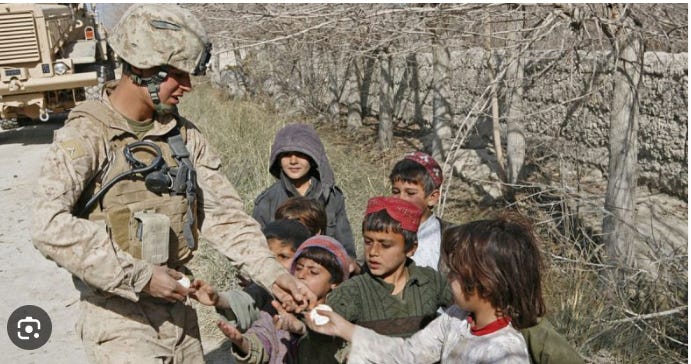
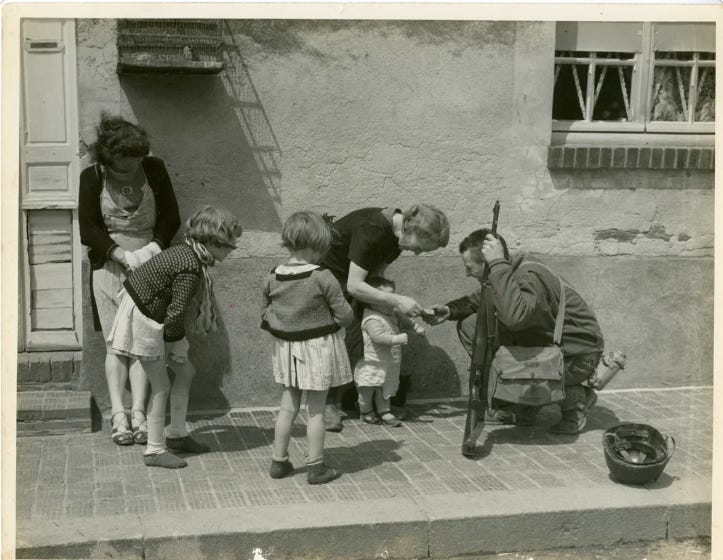
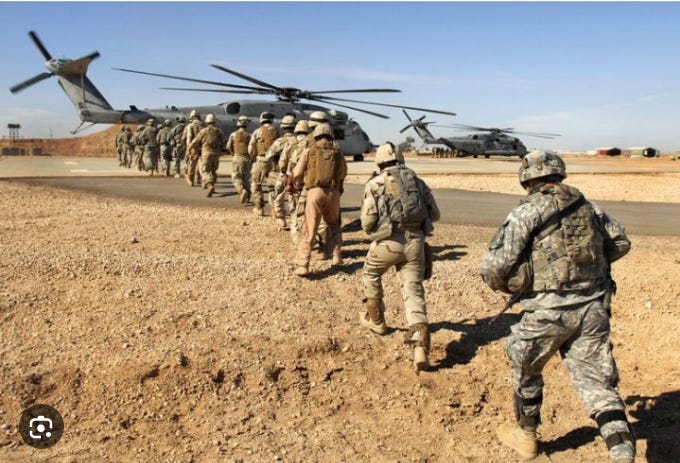
The Candy Man Soldiers of Good Will?
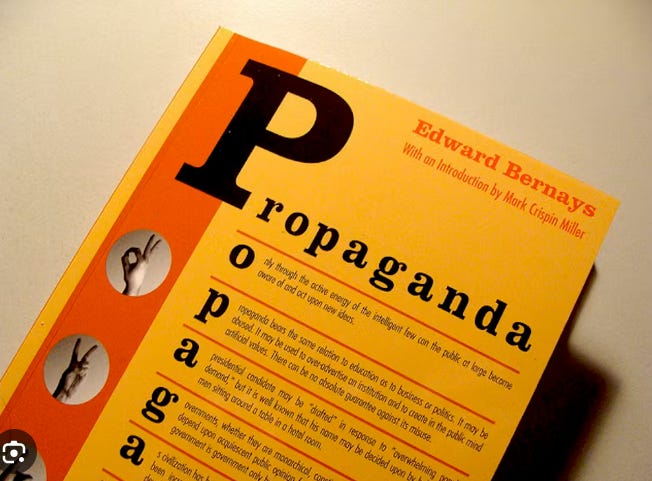
Propaganda:
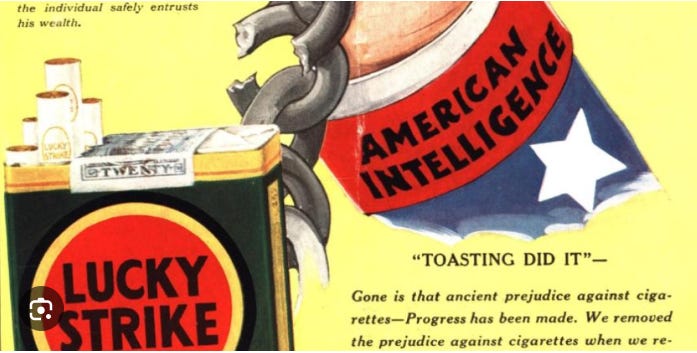
Edward Bernays anyone?
“If we understand the mechanism and motives of the group mind, it is now possible to control and regiment the masses according to our will without them knowing it.” — Edward Bernays, from Propaganda
Soft power into murderous coups:
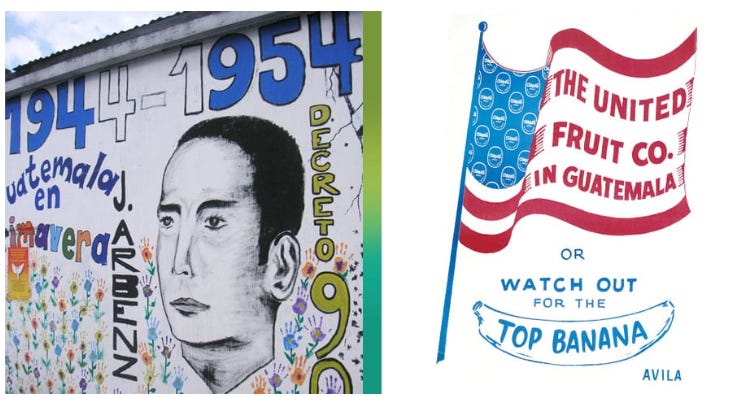
We talked about soft (not mashed banana) power: Edward Bernays’ promotional stunts were only a smokescreen for a not-so-innocent deep-state strategy. With sly public relations tactics, he began to influence American media toward discrediting the new Guatemalan President and ultimately incite action against the duly-elected leader. In 1954, a CIA-backed coup d’état turned the government of Guatemala over to what was ostensibly a leader hand-picked by the U.S. government and indirectly by a U.S. corporation — the United Fruit Company.
I’ll have them both on again, soon: Peter Beattie
The media create frames to transmit information to the public, and the frames can have varying effects on public opinion depending on how they combine with people’s values and deep-seated cultural narratives. This study examines the effects of media frames and values on people’s choice of resolution of conflict. The results show that neither values nor exposure to frames are associated with outcome. Participants overwhelmingly chose the humanitarian intervention option regardless of frame exposure and even in contrast to their own political values, demonstrating the influence of the mainstream media’s dominant, humanitarian interventionist frame on public opinion.
In early 2013, the Syrian crisis was growing worse by the day, and violence was escalating at a rapid pace. Then–U.S. president Barack Obama was weighing the option of a full-scale military intervention, based on humanitarian grounds, in the troubled state. Islamic State was wreaking havoc throughout the country; however, it was Syrian president Bashar al-Assad who was primarily making the headlines in the United States for alleged atrocities and violations of the Geneva Accords and human rights. The seemingly perpetual beat of war drums in the United States did not take long to sound off, and they grew louder each day President Obama did not declare war on Assad. The media played along, and, generally, so did the political elite. Even former U.S. president Bill Clinton contributed by stating that if Obama chose not to go to war because Congress voted against it, he would risk “looking like a total wuss” (Voorhees, 2013)—a feeble and desperate attempt to demean the president into taking the United States to war. Former secretary of state Hillary Clinton and Senator John McCain, never ones to shy away from a military confrontation (Johnstone, 2015; Landler, 2016), echoed Bill Clinton’s sentiment as they were both displeased with Obama’s foreign policy decision making on Syria (Landler, 2016; Voorhees, 2013). Highly emotive phrases—popular in interventionist frames—such as, “History will judge us,” “We don’t want to be on the wrong side of history,” “We cannot look the other way,” “The world is watching us,” and “What will and “What will the world think,” dominated the headlines and news reports. Then–secretary of state John Kerry touched on almost all of these in his speech at a State Department briefing in August 2013, at a time when President Obama was deliberating possible recourses in response to an alleged chemical attack by Assad’s forces.
Kerry stated,
As previous storms in history have gathered, when unspeakable crimes were within our power to stop them, we have been warned against the temptations of looking the other way. . . . What we choose to do or not do matters in real ways to our own security. Some cite the risk of doing things. But we need to ask, “What is the risk of doing nothing?” . . . So our concern is not just about some far-off land oceans away. That’s not what this is about. Our concern with the cause of the defenseless people of Syria is about choices that will directly affect our role in the world and our interests in the world. It is also profoundly about who we are. We are the United States of America. We are the country that has tried, not always successfully, but always tried to honor a set of universal values around which we have organized our lives and our aspirations. . . . My friends, it matters here if nothing is done. It matters if the world speaks out in condemnation and then nothing happens. History would judge us all extraordinarily harshly if we turned a blind eye to a dictator’s wanton use of weapons of mass destruction.
…
Continued, Beattie:
One of the main cultural themes in the United States is the nationalism theme, with the global responsibility nationalism theme—which emerged after World War II—being the most dominant. As Gamson (1992) articulates, “With the advent of World War II and the cold war, public discourse fully embraced the global responsibility theme” (p. 142), and the American public threw its support behind the United Nations and the idea of collective security. Democrats and Republicans alike “embraced a dominant U.S. role in the creation of political-military alliances, not only in Europe but in other regions as well” (Gamson, 1992, p. 142). The global responsibility theme was the dominant theme during the Cold War and the framing of the U.S. doctrine of containment, and it continues to be the dominant theme today in the framing of the humanitarian interventionist doctrine.
Prior to World War II, the “America first” nationalist theme was the most dominant; however, the global responsibility (then) countertheme was still quite prevalent. When the America first theme was dominant, the kind of isolationism that it supported “was never incompatible with expansionism in what was regarded as U.S. turf” (Gamson, 1992, p. 141); therefore, the global responsibility (at that time) countertheme actually supported the America first theme rather than countering it. The Monroe Doctrine is evidence of this compatibility, because it reinforced American isolationism—by telling European powers to stay out of the Americas—yet supported U.S. expansionism. The global responsibility countertheme was “reflected in the idea of America’s international mission as a light unto nations” (Gamson, 1992, pp. 141–142), with the belief that the “expansion of American influence in the world would bring enlightenment to backward peoples and confer upon them the bounties of Christianity and American political genius” (p. 142). The global responsibility (then) countertheme clearly embodied the notion of American exceptionalism, just as it does today as the dominant nationalism theme. Nevertheless, we would like to make it clear that we are not claiming that deep-seated cultural narratives in the United States are necessarily pro–humanitarian interventionist. What we are claiming, and will substantiate throughout this section, is that the U.S. media and political elites have tapped into a deep-seated cultural narrative to gain support for pro–humanitarian intervention policy options.
Many Americans believe, just as Kerry and other political elites publicly pronounce, that their country does try to honor a set of universal values around which they have organized their lives and aspirations and that these values include the notion that the United States is the leading “defender of democracy and human rights” around the world and that it is “exceptional.” Regardless of whether political elites actually believe this or whether it is simply rhetoric on their part, the mere invocation of this notion to justify war (much of the time conducted illegally—without United Nations or congressional approval) is troubling on its own. For instance, American exceptionalism “originally meant that the U.S. had a God given duty to impose its government and ‘way of life’ on lands not already under its control” (Pestana, 2016, para. 3), and it was, therefore, used to justify American imperialism. In more recent times, however, American exceptionalism has morphed into a more idealistic notion, being viewed as a
belief that the American political system is unique in its form, and that the American people have an exceptional commitment to liberty and democracy. By virtue of this, American exceptionalists assert that America has a providential mission to spread its values around the world. American power is viewed as naturally good, leading to the proliferation of freedom and democracy. (Britton, 2006, p. 128)
*****
In the end, really, what is a new semester and a new bunch of students in this time of genocide? The following should lend pause to anyone who is comfortably numb.
The classroom feels smaller than I remembered, like the walls have moved closer while I was gone. Professor X assigns readings on constitutional interpretation, and I watch twenty-three students highlight passages about due process while Palestinians are denied the most basic right of all: the right to exist. The girl next to me underlines “equal protection under law” in yellow marker, and I wonder if she knows that phrase is meaningless when some lives are worth more than others.
“The framers intended,” someone says, and I stop listening. The framers intended many things, but they could not have intended for us to sit in air-conditioned rooms debating legal theory while children suffocate under rubble. They could not have intended for us to parse the meaning of justice while justice dies in real time, broadcast live, ignored by everyone in this room.
During breaks, I sit on the steps and watch them. They cluster in their familiar groups, talking about internships and weekend plans and whether Professor Y is a hard grader. Their voices float past me, a steady stream of nothing that matters.
“I’m so stressed about the bar exam.” “Are you going to the Football game this weekend?” “My parents want me to come home for Labor Day, but like, I have so much reading.”
I listen for something else, anything else. I wait for one of them to mention that children are being murdered while we debate constitutional amendments. I wait for someone to say the word Palestinian, or genocide, or even just acknowledge that the world exists beyond their study guides and social calendars. I wait for an hour, and then another, and I hear nothing.
In another class, we discuss mens rea and actus reus, the guilty mind and the guilty act. Professor Z explains how intent matters, how knowledge of wrongdoing affects culpability. I think about my classmates’ guilty minds, their knowledge of genocide coupled with their deliberate choice to say nothing. I think about their guilty acts of scrolling past videos of dying children to double-tap vacation photos. But this kind of guilt will never be prosecuted. This kind of crime never sees the inside of a courtroom.
“Can someone give me an example of willful blindness?” Z asks.
I could give twenty-three examples right here in this room, but I stay quiet.
This is my new reality. Sitting in rooms with people who revealed themselves to be the kind of people who would have looked away during any other genocide. Listening to them complain about reading assignments while Palestinians are denied the right to read anything ever again. Watching them stress about internships while Palestinian children will never have the chance to worry about their futures.
The loneliness is not in being alone. The loneliness is in being surrounded by people who chose to be strangers to their own moral obligations. It is in sharing space with those who had the chance to speak and chose silence, who had the opportunity to care and chose comfort, who had the moment to act and chose nothing.
At the coffee shop, I overhear a conversation about whether the new professor is mean. At the library, someone complains that their laptop is slow. In the dining hall, a group debates which Netflix show to binge next. Normal life continues, mundane concerns persist, and the world beyond their bubble might as well not exist.
The hardest part is not their cruelty. It is their comfort with it. It is how easily they moved on, how quickly they forgot, how completely they have convinced themselves that their silence was not a choice. They live their lives as if Palestinian children were not buried alive while they read for evidence.
I am back now, walking through classrooms where professors teach about human rights while ignoring the most basic human right being violated in real time. I am surrounded by people who think my people’s elimination is too complicated to have an opinion about, whose cowardice proved stronger than their morality.
And I still carry shame that I must even share the same air.
Paul Haeder has been a teacher, social worker, newspaperman, environmental activist, and marginalized muckraker, union organizer. Paul's book, Reimagining Sanity: Voices Beyond the Echo Chamber (2016), looks at 10 years (now going on 17 years) of his writing at Dissident Voice. Read his musings at LA Progressive. Read (purchase) his short story collection, Wide Open Eyes: Surfacing from Vietnam now out, published by Cirque Journal. Here's his Amazon page with more published work Amazon. Read other articles by Paul, or visit Paul's website.