It’s possible that I shall make an ass of myself. But in that case one can always get out of it with a little dialectic. I have, of course, so worded my proposition as to be right either way (K.Marx, Letter to F.Engels on the Indian Mutiny)
Tuesday, September 23, 2025
China Defies Sanctions With Sixth Russian Arctic LNG Cargo
China has received a sixth LNG cargo from Russia’s heavily sanctioned Arctic export project in a sign that the Chinese-Russian trade from Arctic LNG 2 has been flourishing in recent weeks despite U.S. and European sanctions on the project.
The Arctic Mulan discharged its LNG cargo at the Chinese terminal of Beihai on Tuesday, Reuters reports, citing vessel-tracing data on LSEG and Kpler.
The Arctic Mulan has thus made a second voyage from the Russian plant to China, being the first vessel to offload fuel from Arctic LNG 2 in China at the end of August.
The Russian project is now shipping out regularly, with at least two or three vessels spotted en route from the plant to Asia, according to tanker-tracking services.
The Russian export project has been under U.S., EU, and UK sanctions. Arctic LNG 2, operated by Russian LNG exporter Novatek, had struggled for more than a year to find buyers after the Western sanctions were imposed last year.
However, the export plant came to life this summer and has been shipping cargoes to China in recent weeks.
Arctic LNG 2 roared back to life in August, in a sign that Russia is done waiting and is now sending off loaded LNG cargoes, which could be testing the Trump Administration’s willingness to sanction Russia’s LNG customers in China.
For over a year, the U.S. and EU sanctions on Russia’s Arctic LNG 2, which was billed as Russia’s flagship LNG project, had effectively frozen the start-up of the export facility in the Gydan Peninsula.
The wait ended at the end of August, when a cargo from the facility docked at a Chinese import terminal. The Arctic Mulan arrived at the Beihai LNG terminal, and China received the cargo, making it the first-ever actual exported cargo out of the Russian facility.
By Tsvetana Paraskova for Oilprice.com
Norwegian Offshore Oil and Gas Production Surges Past Expectations
Norwegian oil and gas production exceeded the regulator’s forecast by 2.6% in August, for the second consecutive month, data from the Norwegian Offshore Directorate showed on Tuesday.
Last month, oil output in Western Europe’s biggest crude and natural gas producer averaged 1.924 million barrels per day (bpd), up by 7.1% compared to the directorate’s forecast, as new fields are ramping up output. Natural gas production offshore Norway topped projections by 1.2%, the regulator said.
Preliminary oil and gas production for August is lower than in July, as output depends on the scheduled late-summer maintenance on Norwegian export infrastructure and unplanned outages at the dozens of offshore oil and gas fields.
Yet, total gas sales inched up in August compared to July, the regulator said.
Norway topped production forecasts for July, too, when crude oil output was 8.2% above expectations and gas output was 2.2% higher compared to the forecast.
Norway has been boosting its gas production since 2022 when it overtook Russia as Europe’s top gas supplier. Not a member of the EU, but a NATO founding member and key EU and UK ally, Norway looks to continue providing the gas Europe needs.
So companies operating offshore Norway are raising production of gas and oil, with the support of the Norwegian government, which continues to bet on the oil and gas industry and the massive revenues it raises for the country and its sovereign wealth fund, the world’s largest.
Norway has also started to plan its 26th oil and gas licensing round in little-explored frontier areas as it looks to boost exploration and resources to stem an expected decline in production from the early 2030s.
“Norway wants to be a long-term supplier of oil and gas to Europe, while the Norwegian continental shelf will continue to create value and jobs for our country,” Energy Minister Terje Aasland said last month.
Shares in Ørsted (CPH: ORSTED) surged by 12% at opening in Copenhagen on Tuesday after a U.S. court blocked last month’s Trump Administration stop-work order on a nearly completed offshore wind project.
Ørsted and its joint venture partner Skyborn Renewables were progressing the construction of the Revolution Wind off the Rhode Island coast when the Trump Administration issued a stop-work order in August, throwing the project – which is 80% completed – and Ørsted’s operational and financial targets in doubt.
Ørsted and Skyborn Renewables sued to have the order lifted, and a U.S. District Court for the District of Columbia on Monday cleared Revolution Wind to restart activities while the underlying lawsuit challenging the stop-work order progresses.
“Revolution Wind will continue to seek to work collaboratively with the US Administration and other stakeholders toward a prompt resolution,” Ørsted said in a statement.
The Revolution Wind project is 80% complete, with all offshore foundations installed and 45 out of 65 wind turbines installed.
Revolution Wind is a 704-megawatt (MW) offshore wind farm located in federal waters 15 miles south of the Rhode Island coast, 32 miles southeast of the Connecticut coast, and 12 miles southwest of Martha’s Vineyard. The project has 20-year offtake deals, including 400 MW to Rhode Island and 304 MW to Connecticut, which is enough to supply more than 350,000 homes across the two states. This would make Revolution Wind the first multi-state offshore wind project in the United States.
Following the U.S. court’s decision, Revolution Wind will resume impacted construction work as soon as possible, said the Danish company, which is the world’s biggest offshore wind developer.
The U.S. judge’s decision is a big early court win for Ørsted, which has faced unfavorable U.S. Administration decisions and regulations since President Donald Trump took office.
Due to unfavorable U.S. regulatory environment and runaway costs globally, Ørsted is seeking to raise $9.4 billion (60 billion Danish crowns) from shareholders via a rights issue, to have sufficient capital to complete its projects under development.
By Charles Kennedy for Oilprice.com
MARS THE CANDY COMPANY
Mars Invests Billions in European Renewable Energy
Mars Inc. announced Tuesday that its ten Mars Snacking factories across Europe are now operating entirely on renewable energy sources. The move is a significant step in the company's broader sustainability and decarbonization efforts, which aim for net-zero emissions by 2050.
The shift to renewable power follows a decade of investments in the company's European manufacturing facilities. According to the company, these investments include over $1.6 billion (€1.5 billion) spent over the past five years. The company's strategy involved both direct investments in energy reduction and conversion, as well as the purchase of Guarantees of Origin (GO) certificates to cover remaining electricity and natural gas consumption.
The ten factories are located in the Czech Republic, France, Germany, the Netherlands, Poland, and the United Kingdom. These facilities collectively produce approximately 900,000 metric tons of popular confectionery brands annually, including SNICKERS, TWIX, and M&M'S. Around 85% of this production is distributed for consumption within the European region.
This transition comes amid a wider push across the food and beverage industry to reduce its carbon footprint and address consumer demand for more sustainable practices. Many companies are facing pressure from investors and regulators to align their operations with global climate goals. The sourcing of renewable energy, either through direct investment in projects like wind farms or through the purchase of energy certificates, has become a common strategy for corporations to lower their operational emissions.
"At Mars, we believe that the world we want tomorrow starts with how we do business today," said Marc Carena, Regional President for Mars Wrigley. "Therefore, we measure our success not only by financial results, but also by the positive impact we have on people, the planet, and society. Sustainability makes good business sense and is at the heart of our strategy."
The company stated that this development is a key part of its global strategy to achieve its net-zero target by 2050. Mars plans to invest an additional $1.1 billion (€1 billion) in its European manufacturing operations by the end of 2026. This investment is aimed at supporting innovation, economic growth, and the development of modern, energy-efficient infrastructure.
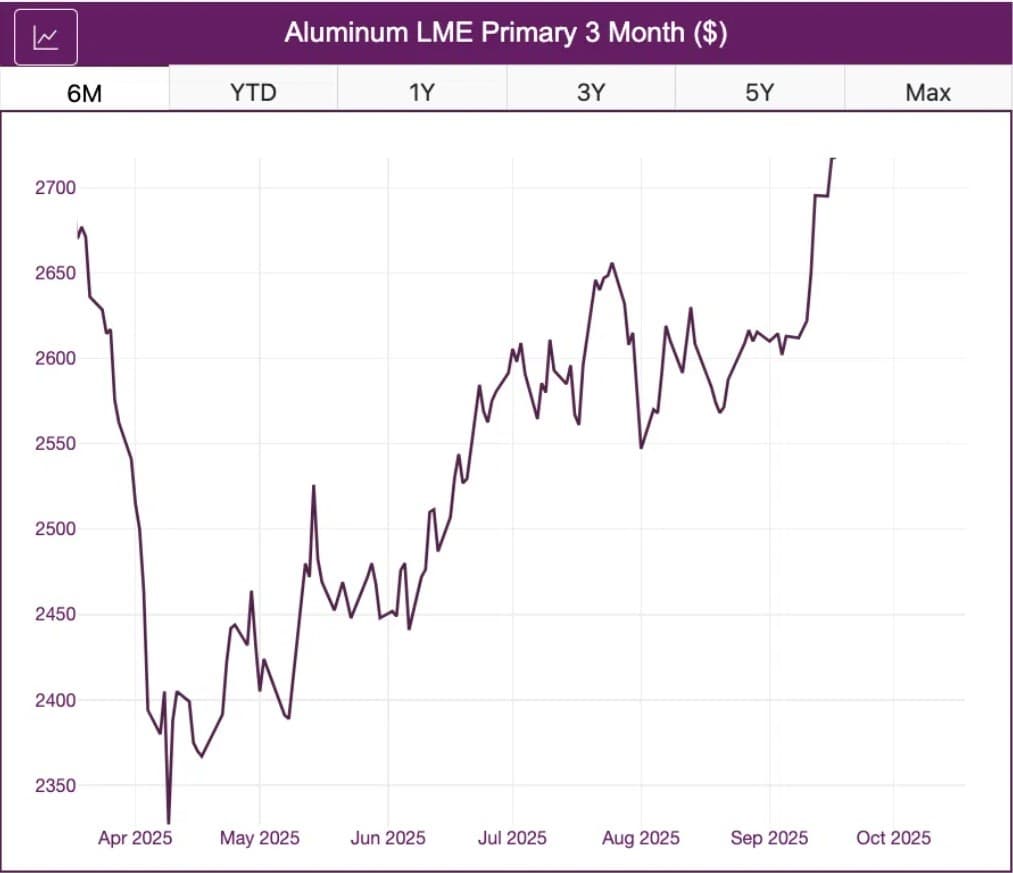
Aluminum touched its highest price since early 2025 as China neared its 45-million-ton output cap, stoking deficit fears.
Despite bullish momentum, global production continues to rise and U.S. demand fell 4.4% in H1 2025 under tariff pressure.
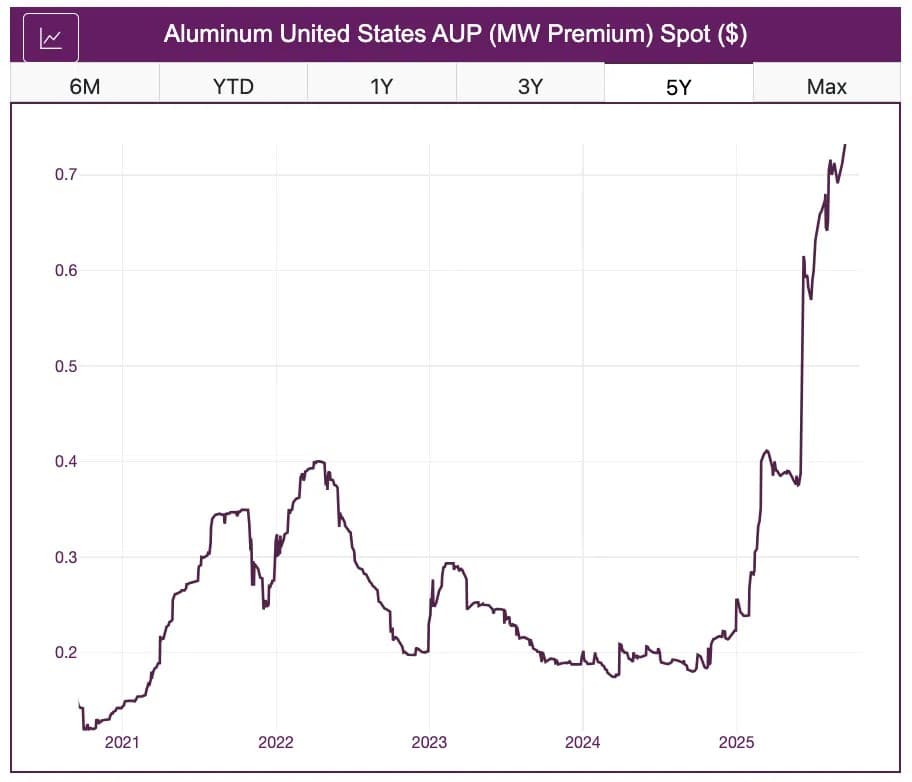
The Midwest Premium hit a record $0.7323/lb, while trade flows shifted as Canadian exports to Europe increased sharply.
The Aluminum Monthly Metals Index (MMI) remained sideways with an upside bias, rising 0.56% from August to September. Meanwhile, the global price of aluminum reached highs not seen since the beginning of the year. Track other MetalMiner monthly indexes here, and compare how the overall industrial metal market is performing.
Aluminum Prices Bullish on Global Supply Concerns
LME aluminum touched a 6-month high by its September 16 close as the price of aluminum broke out of its sideways trend on emerging deficit concerns due to Chinese output nearing its production cap.
For years, China’s aluminum sector fueled global overcapacity. State subsidies gave Chinese producers a significant market advantage, while rising electricity prices and ample global supply presented considerable headwinds for their global counterparts. The West is increasingly working to address this issue through trade barriers, including U.S. tariffs and the EU’s Carbon Border Adjustment Mechanism (CBAM), which offer new threats to Chinese exports.
Meanwhile, domestic demand conditions in China remain soft. The country’s property sector, once a significant consumer of aluminum, remains in the doldrums, with no signs of near-term resuscitation. This forced China to set a 45-million-ton production cap in 2017 and promote a “closed-loop” system, where old capacity must be shuttered before new capacity can be built.
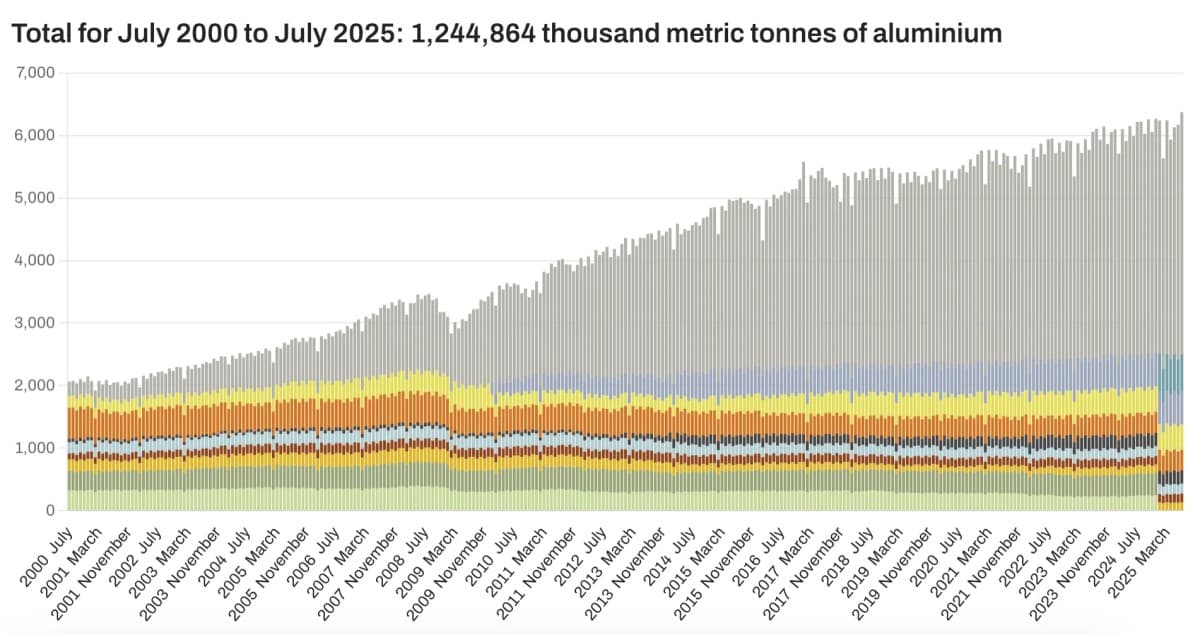
For most of the year, market response to China’s cap appeared somewhat muted, even as global exchange inventories dwindled. By April, Chinese production hit 44 million tons. While output was close to its cap, it hadn’t reached it yet. However, China’s aluminum capacity is estimated to have reached 45.69 million tons in June, raising concerns about what happens if Chinese output flattens. The situation looks especially dire as the world embarks on grid infrastructure projects that would help fuel aluminum demand.
Headwinds for the Price of Aluminum
While deficit concerns have added renewed momentum to aluminum prices, there are reasons to be skeptical about the recent breakout. Though China may have reached its production cap, both Chinese and global output remain on the rise. Data from the country’s National Bureau of Statistics showed Chinese primary aluminum production rose 7.4% year-over-year back in June. This echoes data from the International Aluminum Institute, which shows global production levels have yet to stagger meaningfully.
And while both SHFE and LME exchange inventories are low, they have also begun to rebound. A continued rise would serve to quell supply-side jitters. Rather than exceptional demand conditions, part of the LME drawdown stemmed from the decision to block Russian material from warehouses as a result of the ongoing war in Ukraine. So far, China has helped fill the gap left by Europe as it continues to buy Russian aluminum. Import data showed Chinese aluminum imports rose 38% year over year. So, while sanctions have diverted shipments, they have not removed Russian material from the global market.
Aluminum Demand Falls in the United States
Meanwhile, U.S. tariffs have suppressed U.S. aluminum demand conditions and shifted trade flows. According to the Aluminum Association, North American aluminum demand fell 4.4% during the first half of 2025. Outside of foil, demand reportedly fell in all market segments.
Amid slow demand and tariff pressures, Canadian producers have shifted aluminum deliveries toward Europe. Indeed, recent data showed that Europe’s share of Quebec’s aluminum exports rose from 0.2% in Q1 to 18% in Q2, which has helped to lift LME warehouse stocks off their multi-year lows.
Overall, subdued demand conditions remain a constraint on market sentiment. Back in April, Goldman Sachs reduced its aluminum price forecast as a result of a weaker economic growth outlook. Sachs’ outlook also suggested the possibility of a surplus into 2026 if demand does not recover as strongly as anticipated.
Though long-term deficit concerns remain, the near-term price outlook appears less certain. Economic growth remains ongoing, but slow. Meanwhile, time will tell whether China abides by its production cap and how quickly producers elsewhere around the world can ramp up output to meet the anticipated shortfall.
Aluminum Midwest Premium Reaches New ATH
The Midwest Premium joined the LME aluminum price rally, rising to a new all-time high of $0.7323 per pound. Prices appeared to stabilize by mid-August, just short of the level expected to fully price in the cost of U.S. tariffs.
The recent rise above the $0.73 per pound mark now puts the premium within a few cents of most forecasts. While buyer uncertainty regarding trade policy remains a fixture within the market, domestic conditions appear relatively stable. Simultaneously, mill lead times for most products appear steady or slightly longer.
Indian primary cash aluminum prices witnessed the largest increase of the overall index, rising by a modest 1.75% to $2.91 per kilogram as of September 1.
Chinese primary cash aluminum prices rose 1.46% to $2,892 per metric ton.
The 5052 coil premium over 1050 Korean aluminum fell 5.69% to $4.18 per kilogram.
The 3003 coil premium over 1050 Korean aluminum dropped 5.86% to $4.08 per kilogram.
Korean commercial 1050 sheet prices declined by 5.92% to $4.04 per kilogram.
Serbia and Hungary are collaborating with Russia on energy infrastructure, including an extension of the Druzhba pipeline, which undermines EU efforts to reduce reliance on Russian energy.
Ukrainian drone attacks on the Druzhba pipeline have disrupted oil shipments and highlighted the vulnerabilities of relying on this infrastructure, leading to a strong reaction from Hungary.
Serbia's actions pose a dual challenge for the EU by maintaining Russian energy dependence and potentially anchoring Chinese influence, complicating its EU accession negotiations on green agenda and sustainable connectivity.
Serbia is a candidate for European Union membership and Hungary has been a full member since 2004, but that hasn’t prevented them from collaborating with Russia to undermine EU cohesion and meddle with efforts to break Europe’s dependency on Russian energy. Ukrainian drones, however, have succeeded in disrupting Belgrade’s and Budapest’s designs.
EU Commissioner for Energy Dan Jørgensen unveiled an ambitious plan in June to stop all Russian oil and natural gas exports to the European Union by 2027. A little over one month later, Hungary and Serbia announced a joint effort to build additional infrastructure that would enable Russian oil exports to reach Serbia via an extension of the Druzhba pipeline. Once built, the pipeline will be able to convey upwards of 5 million tons of oil annually to Serbia. The target completion date is 2027.
A recent analysis published by the Western Balkans Center at New Lines Institute explains how Serbia’s actions are “revealing broader inefficiencies in the EU’s strategy to mitigate external energy influences.”
The analysis states Serbia is pursuing a “deliberate strategy of maneuvering between Russia and China to maximize autonomy while extracting concessions from Brussels. The result is a dual challenge for the EU – Serbia’s continuation of Russian energy dependence that undermines sanctions unity, and resource politics that could anchor Chinese influence at the heart of the Union’s green transition.”
Given Serbia’s EU candidate status, Belgrade’s actions additionally highlight “a broader vulnerability in the EU’s enlargement policy – its inability to prevent candidate states from using external partnerships to evade reform demands necessary for accession.”
As the analysis notes, Serbia’s Druzhba extension plan complicates its negotiations with Brussels on Cluster 4 requirements, which oblige an aspiring member state to harmonize its policies with EU standards concerning the “green agenda and sustainable connectivity.” Among the specific topics that need to be settled are energy supply, infrastructure and the internal energy market. Although the EU opened negotiations with Serbia on Cluster 4 topics in 2021, none of the necessary provisions have been finalized to date.
“The planned pipeline deepens Serbia’s reliance on Russian oil and contradicts EU accession requirements outlined in Cluster 4,” the New Lines analysis states.
In August, Ukrainian drone attacks on the Druzhba pipeline on Russian territory raised questions about the utility of the Serbian pipeline extension plan. The damage done to the Unecha pumping station in one of those strikes caused a disruption to Europe-bound oil shipments, prompting complaints by Hungary and Slovakia. Despite EU efforts to wean itself off Russian energy, Druzhba remains a vital supply conduit for both Budapest and Bratislava.
In the aftermath of the August attacks, Ukraine’s president, Volodymyr Zelensky suggested that Kyiv might target Druzhba again, unless Hungary moderates its stance on hindering EU assistance to Ukraine, including a block on accession. “We have always supported friendship between Ukraine and Hungary. And now the existence of Druzhba [which means 'friendship’ in Ukrainian] depends on Hungary’s position,” Zelensky said. Hungarian leader Viktor Orban, in turn, warned Zelensky that further Ukrainian efforts disrupt the Hungary-bound flow of Russian oil would have big consequences for Kyiv.
Regardless of whether Ukraine mounts new strikes on Druzhba, the proposal of a Serbian pipeline extension presents a serious challenge to the EU’s cohesion, the New Lines analysis underscores.
“Serbian geopolitical maneuvering involving Russia is dangerous to European geopolitical stability and prosperity,” the analysis states. “Russia has historically capitalized on destabilization and conflict in the Western Balkans. This further diverts the region from EU democratic norms and allows Russia to extend its influence in Europe, despite EU sanctions.”