Sunday, October 12, 2025

No Fascist USA


 October 10, 2025
Facebook


JOSHUA FRANK is co-editor of CounterPunch and co-host of CounterPunch Radio. He is the author of Atomic Days: The Untold Story of the Most Toxic Place in America, and the forthcoming, Bad Energy: The AI Hucksters, Rogue Lithium Extractors, and Wind Industrialists Who are Selling Off Our Future, both with Haymarket Books. He can be reached at joshua@counterpunch.org. You can troll him on Bluesky @joshuafrank.bsky.social

Great American Anti-Fascists

Stephen F. Eisenman

October 10, 2025


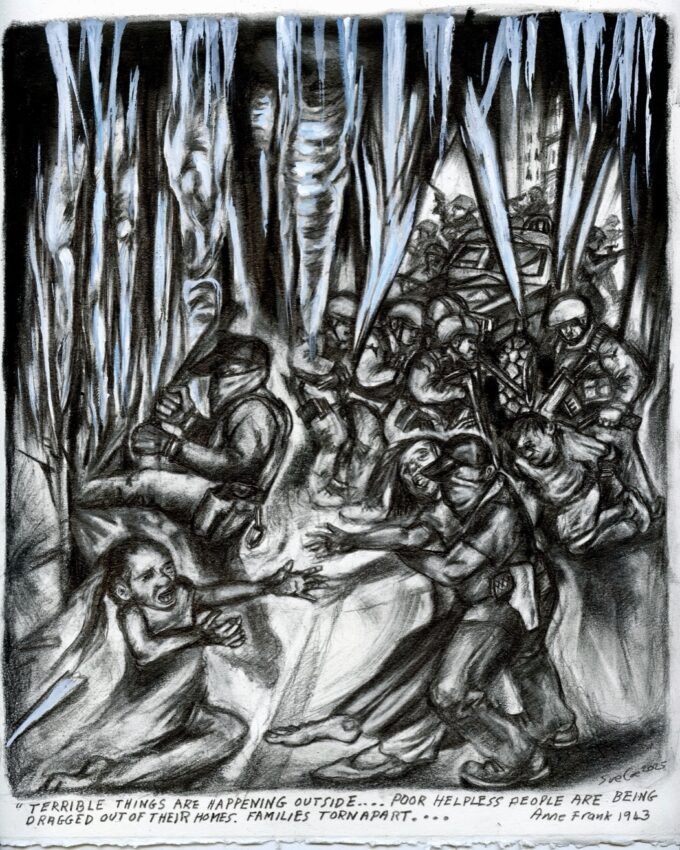
Sue Coe, Terrible things are happening outside, 2025. Courtesy, the artist.

“First they came”

I always scoffed at “First They Came,” the often quoted, 1946 poem by the German Lutheran pastor Martin Niemöller. There are several versions of it, but the best-known starts “First they came for the communists/And I did not speak out because I was not a communist.” Each of the following three verses names another target — socialists, trade unionists and Jews, until concluding: “Then they came for me/And there was no one left/To speak out for me.”

The poem suggests, wrongly, that “they” – the unmentioned Nazis – targeted everyone, not just communists, socialists, trade unionists and Jews. (Niemöller should have added to the list queers, Roma, Slavs, and the disabled.) In fact, the Nazi regime made great efforts to placate the broad, middle and lower-middle class populace and increase its size. Nazism was aggressively pro-natalist, rewarding families that had many children, so long as they were the right kind. In addition, the secret Lebensborn (“fount of life”) program, established by SS chief Heinrich Himmler, supported unwed, supposedly “Aryan” mothers through their pregnancies and distributed the children to similarly racially elite, SS parents. The goals of these initiatives were eugenicist and militarist: the creation of a racially superior population and enough soldiers to forge and sustain a thousand-year Reich.

The Nazis, in other words, knew very well who they wanted to imprison or kill and who they wanted to protect or nurture, and the idea that they would inevitably “come for” someone not on their targeted list is mistaken. Niemöller’s poem is harmful because it suggests that anyone could be a victim of fascism when in fact only some are; protecting those in danger requires solidarity and entails risk. To the pastor’s credit, he openly opposed Nazification of the Protestant Church and was consequently cast into Sachsenhausen and then Dachau concentration camps. Much later, long after the Nazi defeat, pastor Niemöller was active in the anti-Vietnam War and anti-nuclear movements. His poem is therefore belied by his own life; he understood very well who were and who were not the likely victims of fascism and embraced the role of anti-fascist or “antifa” to use the shorthand beloved of Reichkanzler Trump, Reichsmarschall Hegseth, and Reichsministers Miller, Bondi, Patel, Holman, Noem, and Kennedy.

Carefully selected targets

Until about two weeks ago, the Trump administration carefully followed the script of “First They Came.” One by one, it targeted groups and individuals who might challenge the kleptocratic, neofascist state, confident that it could do so without significant resistance. First it was the special counsels and ombudsmen who policed federal agencies for corruption. Then it was the U.S. Attorneys and prosecutors whose job is to ensure that federal laws are faithfully executed, and violators punished. Following that, was the regulatory state. Even junior employees were fired if they worked for agencies – including EPA, Education, Justice, Treasury, HUD, Interior, and HHS – who might object to privatization, deregulation, and sleaze.

Then came the attacks on individuals and institutions of civil society. University presidents were dressed down by Republicans at congressional show trials. (It didn’t help that these leaders conceded error of which they were innocent.) Around a dozen college and university presidents have resigned in the face of administration, congressional Republican, or state Republican pressure. Other universities were forced to accept limitations on their institutional freedom or make cash payments (aka bribes) to continue to receive federal grants. Columbia coughed up $200 million. Many colleges and universities pro-actively limited student and faculty free-speech rights in the hope of avoiding government or conservative trustee sanction.

Law firms too have been targeted. Despite court rulings consistently affirming the right of attorneys to choose their own clients without fear of federal retribution, at least eight major firms – most notably Paul Weiss — acceded to Trump’s demands that they pay money or provide pro bono services in exchange for continuing access to lucrative U.S. government contracts. Other civil society organizations, including non-profits focused on women’s health, the environment, civil rights, immigration law, and fair housing, have had grants cancelled or awards rescinded. Many have changed their rhetoric and programs so as not to attract Trump administration ire. Entertainment companies and sports franchises have also bowed to Trumpian pressure to change programming or limit outreach to targeted communities, especially immigrants. The German word for such a coordinated pressure campaign, first used in 1933, is Gleichschaltung: bringing all institutions of state and civil society into conformity with Nazi ideology and practice.

By attacking each group — universities, law firms, non-profits, media companies — separately and in succession, the Trump administration has succeeded in keeping them isolated, unable to marshal the solidarity and collective strength available to them. To be sure, many of the richest and most powerful corporate heads and tech entrepreneurs – Elon Musk at Tesla, Larry Ellison at Oracle, Mark Zuckerberg at Facebook, Sam Altman at Open AI, Tim Cook at Apple, Jeff Bezos at Amazon, Peter Thiel, and others – have welcomed Trump’s strong-armed interventions. They support technocratic Caesarism – rule by one or several tech and finance billionaires beholden to no one, and believe Trump is sympathetic to their goal, despite the president’s claim to speak for a broad, working-class MAGA base. Indeed, low-income Republicans have been assaulted by tariffs, elimination of green energy subsidies, and soon, cuts to Medicaid and the ACA, but their congressional representatives have registered no protest. They remain fully in Trump’s thrall. Small business leaders and professionals, harmed by the president’s tariff, deregulation, and immigration policies, have similarly remained quiet out of fear of reprisal.

Larger goals

Trump’s dismantling of democracy has been methodical and effective and has served his primary goal: self-aggrandizement. But the president’s most influential courtiers, including Stephen Miller, Russell Vought and J.D. Vance as well as the ideologues of the Heritage Foundation and Claremont Institute, have other ambitions, broadly consonant with the fascism of interwar Europe. Their goals are to:

1) Purify the body politic by the deportation or exclusion of non-whites.

2) Embed Christian nationalist ideology in government and educational institutions.

3) Broadcast and promote American exceptionalism.

4) Reject feminism, invigorate patriarchy, and denounce non-binary models of gender.

5) Insulate or protect the corporate elite from regulation, taxation, and organized labor.

6) End competitive elections. Vance whisperer Curtis Yarvin supports a monarchy. Marco Rubio’s former Director of Policy Planning, Michael Anton, prefers a Caesar.

7) Destroy the disinterested, professional, government bureaucracy, and slash spending on health, food, education, housing and environmental protection.

8) Revive the American empire by alignment with Russia (a racial comrade) and antagonism to China (a racial foe).

9) Buttress the Leadership cult: Trump als Führer. (This is Trump’s personal favorite.)

10) Welcome environmental catastrophe. Umberto Eco wrote: “The Ur-Fascist hero is impatient to die. In his impatience, he frequently sends other people to death.”

Anybody who opposes these ten goals is anti-fascist or antifa; they are enemies of the regime.

Coordination interruptus

Buoyed by success, the Trump administration decided to press its advantage; Niemöller’s final stage of political capture — “then they came for me/And there was no one left” — is the order of the day. Having begun the work of Gleichschaltung mere months ago, the Trump regime now wants to foreclose democracy altogether — if not for a thousand years, at least beyond the 2026 midterm elections.

But the necessary work of coordination remains unfinished. Unlike Germany in 1933-34, the administration lacks SA or SS enforcers. ICE, FBI, and other federal forces – abusive and violent as they are — remain constrained by custom and law. The judicial branch of government is not yet fully co-opted, as indicated by the succession of lower court rulings barring immigrant expulsions, executive branch dismissals, and placement of federal troops in cities. While many of these decisions have been reversed by the Supreme Court, every defeat – even temporary — exposes administration weakness and invites resistance. Legislative opposition exists too, just not from Republicans. Democrats in Congress may be feckless, but they are large in number. Their size has prevented Trump from passing anything like the Enabling Act of 1933 that provided Hitler an easy glide path to authoritarianism. Civil society organizations, including wealthy, liberal-left foundations are also still functioning. Counter-hegemonic non-profits remain active and, in some cases, more energized than before. Most colleges and universities, and most law firms have not (so far) yielded to Trump’s threats.

While the mass media have long been colonized by conservative and even fascist provocateurs – Steve Banon, Tucker Carlson, Sean Hannity, Candace Owen, Jesse Wattters, Joe Rogan and many others – their reach is less extensive than it seems. Even the biggest outlet is small by historical standards. At the height of its popularity in the early 1960s, Walter Cronkite’s “CBS Evening News” had 30 million viewers, or about 15% of the U.S. population. Today, Fox’s most popular conservative talk show, “The Five” has 3.5 million viewers, or just 1% of the population. Steve Bannon’s WarRoom podcast has 85,000 listeners per month. (Counterpunch has more than five times that number of monthly readers.) So far, the right has been unable to dismantle the left ecosystem of magazines, podcasts, and broadcasts. Mainstream TV hosts Stephen Colbert, John Stewart, Jimmy Kimmel and the rest may not be very “left,” but they are certainly oppositional. Colbert and Kimmel each have about 2 million nightly viewers. Given this ideologically fractured environment, the question arises: Has Trump’s effort at fascist coordination reached its apogee, and will it now begin to recede? Is this a case of coordination interruptus?

Whither NSPM-7?

On September 25, 2025, the White House issued a memorandum, National Security Presidential Memorandum 7 (NSPM-7), “Countering Domestic Terrorism and Organized Political Violence”. The document falsely asserts that there has been a dramatic upsurge in “violent and terroristic activities under the umbrella of self-described anti-fascism.” The directive goes on to state: “This ‘anti-fascist’ lie has become the organizing rallying cry used by domestic terrorists to wage a violent assault against democratic institutions, constitutional rights, and fundamental American liberties.” A previous Executive Order designated “antifa” a “domestic terrorist organization,” even though no such group exists, and there is no legal category “domestic terrorist organization.”

Memorandum NSPM-7 then directs the National Joint Terrorism Task Force (established in 1980 and led by the FBI) to investigate and prosecute political violence and its institutional or individual funders, as well as identify “any behaviors, fact patterns, recurrent motivations, or other indicia common to organizations and entities that coordinate these acts in order to direct efforts to identify and prevent potential violent activity.” Poor writing masks the author’s intentions here, but the memorandum proceeds to designate troubling “indicia”:

“anti-Americanism, anti-capitalism, and anti-Christianity; support for the overthrow of the United States Government; extremism on migration, race, and gender; and hostility towards those who hold traditional American views on family, religion, and morality.”

The vagueness of the targeting is breathtaking; it would be hard to find anybody who isn’t hostile – sometimes or always — to “traditional American values on family, religion and morality.” Isn’t that the topic of conversation or at least the undercurrent at most family dinner tables?

Though the memorandum doesn’t specifically target Democrats, Trump, Miller and others have elsewhere called them “vermin,” “an enemy within”, “gnats” and the “party of hate, evil and Satan.” Simply being a Democrat thus makes you a subject for investigation. About 45 million people in the U.S. are registered Democrats. (37 million are Republicans.) Kamala Harris gained 75 million votes; Biden got 81 million in 2020. Are we all antifa now?

With the federal government shutdown, prices rising, employment falling, health insurance set to increase (in many cases double) for millions of Americans, a recession likely, and an enemies list as large as half the U.S. population, Trump may finally succeed in forging solidarity among his enemies, thereby creating the very bogey he imagined, a genuine antifa movement. And if that happens, there will be an army of people ready to “speak out for me.”

Great American anti-fascists

The following is a list of famous or notable anti-fascists, or antifas. They are not all radicals, socialists, liberals, or even Democrats — but they are anti-fascist. Trump would sic ICE on them if he could. Feel free to add names to the list and send them to me:

Thomas Paine, Benjamin Rush, Aaron Burr (not for shooting Hamilton), William Lloyd Garrison, Nat Turner, Frederick Douglas, John Brown, Harriet Tubman, Henry Ward Beecher, Sojourner Truth, Abraham Lincoln, the Union Army, Walt Whitman, Herman Melville, Louisa May Walcott, Henry David Thoreau, William Dean Howells, Edward Bellamy, Margaret Fuller, Thorstein Veblen, Eugene V. Debs, Emma Goldman, Lincoln Steffens, John Reed, Upton Sinclair, Jane Addams, Mabel Dodge Luhan, Georgia O’Keefe, Helen Keller, Franklin Roosevelt, George S. Patton, 2.5 million U.S. troops in the European theatre of war in World War II, Clifford Odets, Eleonor Roosevelt, John Garfield, Humphrey Bogart, Dashiell Hammett, Edward G. Robinson, Dorothy Parker, Orson Welles, Billie Holiday, Robert Ryan, Lillian Hellman, Henry Fonda, the Marx brothers, Meyer Schapiro, Barnett Newman, Philip Guston, Norman Lewis, Ad Reinhardt, General Dwight D. Eisenhower, Frank Sinatra (for a while), Woodie Guthrie, Theodore Bikel, Joan Baez, Jackson Pollock, John Coltrane, Marilyn Monroe, Arthur Miller, Bob Dylan, Norman Mailer, Gore Vidal, Philip Roth, Benjamin Spock, Allen Ginsberg, William Kunstler, Louis Armstong, Malcolm X, Betty Friedan, Martin Luther King, Muhammed Ali, Angela Davis, Willie Nelson, Johnny Cash, Sam Cooke, Phil Ochs, Gil Scott-Heron, Pete Seeger, Nina Simone, Aretha Franklin, Max Roach, Mahalia Jackson, Stanley Kubrick, Zero Mostel, Norman Lear, Spike Lee, Jane Fonda, LeBron James, Billie Eilish, Tom Hanks, AOC, Jamelle Bouie, Joaquin Phoenix, Bernie…


Illustration by Sue Coe.


Stephen F. Eisenman is emeritus professor at Northwestern University and Honorary Research Fellow at the University of East Anglia. His latest book, with Sue Coe, is titled “The Young Person’s Illustrated Guide to American Fascism,” (OR Books). He is also co-founder and Director of Strategy at Anthropocene Alliance. He can be reached at s-eisenman@northwestern.edu

Empire by Numbers: 392 U.S. Military Interventions Across Every Region of the World

by  | Oct 9, 2025 | ANTIWAR.COM

Monica Duffy Toft and Sidita Kushi’s 2023 book Dying by the Sword is both a work of scholarship and an unflinching indictment. It demolishes the enduring myth of the United States as a hesitant warrior, reluctantly drawn into conflicts by others. Instead, using their Military Intervention Project – the most comprehensive dataset of its kind – they prove that America has been the most interventionist state in modern history. The numbers are stark. From 1776 to 2019 the United States engaged in 392 military interventions. Thirty-four percent of these occurred in Latin America and the Caribbean, twenty-three percent in East Asia and the Pacific, fourteen percent in the Middle East and North Africa, thirteen percent in Europe and Central Asia, and nine percent in sub-Saharan Africa. More than half of all interventions have taken place since 1945, and nearly one-third since the end of the Cold War. Remarkably, Toft and Kushi note that 1974 was the last year in which the United States did not launch at least one new military intervention. Before that, the only other pause in the postwar era was 1952 – underscoring how constant war has become the American default. Measured over time, the tempo of U.S. intervention has accelerated dramatically. Between 1776 and 1945, Washington intervened roughly once to one and a half times per year. During the Cold War this climbed to nearly 2.5 interventions annually. After the Cold War it surged to 4.6 per year, and since 2001 it has remained extraordinarily high at 3.6 annually.

Perhaps the book’s most damning finding comes from their comparison of U.S. hostility levels with those of its enemies. During the Cold War, the hostility levels were roughly symmetrical. But in every period before and after, the United States displayed higher hostility levels than its adversaries – often significantly higher. This strongly suggests that most U.S. wars throughout its history were not defensive wars, but imperial wars of choice in which Washington was the prime escalator. Moreover, from 1776 until the end of the Cold War more than 75 percent of all US interventions were unilateral. Since 1990 this percentage dropped to 57.7 percent. The self-declared global policeman never cared very much for global opinion or international law.

One of Toft and Kushi’s most revealing statistical facts is that America’s principal adversaries today are not random enemies, but rather the very countries it has intervened in most often throughout its history. The top seven are telling: China, Russia, Mexico, North Korea, Cuba, Iran, and Nicaragua. Far from building stability, repeated interventions left behind legacies of grievance, mistrust, and resistance. What emerges is a sobering picture: today’s conflicts are not accidents of geopolitics but the direct outgrowth of a long history in which Washington sought to impose its will by force. In other words, America’s most enduring enemies are, to a large extent, the ones it helped create. And crucially, U.S. military interventions, interference, economic sanctions, and constant threats in these countries not only entrenched cycles of hostility but almost certainly contributed to their lack of democracy, liberalism, and prosperity – the authoritarian regimes that Washington now loves to demonize are, in no small part, the product of its own aggressions. When people live under siege from a great power, when their societies are scarred by violence, poverty, and the erosion of education and opportunity, they do not become more democratic or liberal. Instead, fear, hardship, and insecurity create fertile ground for authoritarian rule – and Washington’s aggressions have repeatedly helped bring exactly that about. In the starkest terms, America manufactures its own enemies, and then condemns them for the very conditions it helped to create.

This review draws on both the book and its companion case studies to provide a chronological overview of the crimes that resulted from this pattern of intervention. From the scorched-earth campaigns against Indigenous peoples to the water-cure torture in the Philippines, from the terror bombings of Japan, Germany and Korea to the support for death squads in Guatemala and El Salvador, from the chemical devastation of Vietnam to the War on Terror, Toft and Kushi’s evidence adds up to a damning portrait. America’s wars have rarely been wars of survival. They have overwhelmingly been wars of choice, driven by expansionist, commercial, and imperial ambitions.

Empire at Home: Conquest and Expansion

The first century of American military activity was devoted above all to continental conquest. The wars against Indigenous nations were systematic campaigns of annihilation and displacement, not isolated frontier skirmishes. Entire villages were burned to the ground, crops destroyed, and populations forced onto death marches like the Trail of Tears. From the Seminoles in Florida to the Sioux and Apache on the Plains and in the Southwest, the pattern was the same: the use of overwhelming force to clear land for settlers, often accompanied by massacres of noncombatants.

At the same time, the young republic projected force overseas. In North Africa, the Barbary Wars saw U.S. naval bombardments of Tripoli and Algiers, coupled with punitive raids on coastal towns. In the Caribbean, American warships landed marines in places like Cuba and Puerto Rico long before they became formal U.S. possessions. In the Pacific, early interventions targeted Polynesian islands and Chinese ports in the name of commerce, often leaving destruction behind.

The Mexican-American War of 1846-1848 was the republic’s first major overseas conquest. Framed as defense, it was in reality an expansionist war that stripped Mexico of half its territory. U.S. troops occupied cities, committed looting, and carried out summary executions of suspected guerrillas. Civilians bore the brunt of the violence, and the conquered lands became the foundation of America’s continental empire.

By mid-century the pattern was unmistakable: the United States was not a besieged power fighting for survival. It was an expansionist republic using force to displace, conquer, and secure commercial advantage.

The Imperial Turn: From the Caribbean to the Pacific

By the end of the nineteenth century the United States had outgrown its continental frontier and turned outward. The Spanish-American War marked the opening of a new imperial phase. Cuba was occupied, Puerto Rico and Guam annexed, and the Philippines violently subdued. In the Philippines the U.S. military unleashed a counterinsurgency so brutal it stands comparison with the worst colonial wars of Europe. Villages were burned to the ground, civilians herded into concentration zones, and torture became routine. The “water cure,” a form of simulated drowning, was applied systematically. On the island of Samar, General Jacob Smith ordered his troops to turn the region into a “howling wilderness” and to kill any male over ten years old. Tens of thousands of Filipinos died in a war of pacification waged under the banner of civilization.

The new century saw the Marines become the iron fist of American empire in the Caribbean and Central America. Nicaragua was invaded repeatedly, sometimes for years at a stretch, and its politics subordinated to Washington’s will. Honduras endured a series of occupations and landings designed to protect American corporate interests. Haiti was occupied from 1915 to 1934, during which time U.S. forces imposed forced labor, shot down protestors, and maintained direct military rule. In the Dominican Republic, another occupation beginning in 1916 installed a regime sustained by American bayonets and riddled with abuses against civilians. In Cuba, formal independence masked a reality of repeated American interventions, military occupations, and economic domination.

The methods were strikingly consistent: forced labor in Haiti, executions and collective punishments in the Dominican Republic, massacres of insurgents in Nicaragua, and the training of local security forces whose brutality was legendary. Across the Caribbean basin, U.S. interventions propped up regimes, safeguarded corporate plantations and banks, and crushed dissent through violence.

Beyond the hemisphere, the United States projected power into China, joining other imperial powers in the suppression of the Boxer Rebellion, and into the Pacific, using gunboat diplomacy to enforce commercial treaties. In every theater the hallmark was not restraint but escalation. Where opponents resisted, the United States used overwhelming force – burning villages, occupying capitals, and imposing direct control.

By the eve of World War I, the United States had become an unmistakable imperial power. Its reach extended across the Caribbean and Central America, into the Pacific and Asia, and onto the world stage in Europe. And the price was paid not only in annexed territory but in the blood of civilians subjected to massacres, scorched-earth campaigns, and military occupations.

World Wars and the Globalization of Violence

The entry into World War I projected American power onto the European continent for the first time, but the war was framed by what came before and after: the consolidation of empire in the Caribbean and the beginnings of global intervention. Marines still patrolled Haiti, the Dominican Republic, and Nicaragua even as American troops crossed the Atlantic. By 1918 the United States was both a European belligerent and a hemispheric occupier.

World War II is often remembered as the “good war,” but Toft and Kushi’s framework strips away the mythology. American bombing campaigns targeted cities and civilian infrastructure with devastating effect. In Europe, raids destroyed cultural centers like Dresden. In Asia, strategic bombing reached its apotheosis in the firebombing of Tokyo, which incinerated more than 100,000 civilians in a single night, and in the atomic destruction of Hiroshima and Nagasaki. These were not surgical strikes. They were deliberate acts of mass killing designed to terrorize populations into submission.

The Cold War transformed America’s global reach into a permanent system of intervention. Korea was the first testing ground. Between 1950 and 1953 the U.S. Air Force dropped more tonnage of bombs on the peninsula than it had on the entire Pacific during World War II. Cities and villages were flattened, dams and irrigation works destroyed, producing widespread famine and civilian deaths. The case narratives describe entire towns erased from the map.

Vietnam, Cambodia and Laos followed. The My Lai massacre, in which U.S. troops slaughtered hundreds of unarmed villagers, became emblematic of a war fought with pervasive disregard for civilian life. Napalm and Agent Orange were used indiscriminately, burning flesh and poisoning generations. Strategic hamlets, free-fire zones, and search-and-destroy missions blurred any line between combatants and civilians. The countryside was devastated, millions displaced, and the land itself poisoned.

At the same time the covert side of American power expanded. In 1954 in Guatemala, a U.S.-backed coup overthrew the elected government of Jacobo Árbenz. What followed was one of Latin America’s darkest chapters: a forty-year civil war marked by massacres of entire villages, forced disappearances, and a genocidal campaign against the Mayan population.

From East Asia to Latin America to the Middle East, the record is consistent. U.S. interventions escalated conflicts, empowered repressive regimes, and inflicted extraordinary violence on civilian populations. And the dataset shows what the narratives make visceral: in the majority of these confrontations it was the United States, not its adversaries, that chose escalation and inflicted the greater share of destruction.

Central America’s Dirty Wars

Nowhere is the brutality of U.S. intervention more visible than in Central America during the 1970s and 1980s. The Military Intervention Project records these episodes in detail, and the case studies give them human texture: scorched-earth campaigns, death squads, massacres, and systematic terror carried out by governments and paramilitaries armed, trained, or financed by Washington.

El Salvador’s US-backed government prosecuted its war with death squads that hunted down priests, nuns, teachers, and peasants. The 1981 El Mozote massacre, in which nearly a thousand civilians were slaughtered, is only the most infamous example. U.S. advisors trained the Atlacatl Battalion that carried it out, and successive administrations poured military aid into the country despite overwhelming evidence of systematic killings.

In Nicaragua, the U.S. sought to overturn the Sandinista government by funding and arming the contras. Their campaign of terror targeted civilians, burning schools and clinics, murdering teachers and health workers, and depopulating the countryside with indiscriminate violence. The International Court of Justice eventually condemned U.S. actions as unlawful aggression, but the policy continued for years, devastating the country.

Honduras became a staging ground for these operations. The U.S. military established bases and trained local security forces that carried out assassinations and disappearances against domestic opponents. The infamous Battalion 316, supported by U.S. advisors, ran a campaign of kidnappings and torture.

Across the region, the pattern was unmistakable. When popular movements sought reform or revolution, the United States responded with military force, coups, and proxy wars. The cost was borne by peasants, labor organizers, teachers, and clergy, who were systematically targeted by militaries and paramilitaries acting with U.S. support. The crimes were not incidental. They were the strategy: terrorizing populations into submission, destroying the social base of insurgency, and keeping governments aligned with Washington.

Latin America became a laboratory of repression. And it was all the more damning because the United States was not reacting to existential threats. These were small, impoverished countries. Their struggles threatened American dominance, not American survival. The wars were wars of choice, and the crimes were the price Washington was willing to exact to maintain control of its “backyard.”

Wars of Choice in the New American Century

The end of the Cold War did not bring an end to American interventionism. On the contrary, the pace quickened. The Military Intervention Project shows that nearly one-third of all U.S. interventions took place after 1991, and they were increasingly wars of choice against much weaker opponents. The pattern of disproportionate violence documented across earlier centuries continued into the present.

The 1991 Gulf War inaugurated the new era. U.S. airpower devastated Iraq’s infrastructure in a matter of weeks, targeting not only military sites but electricity grids, water treatment facilities, and bridges essential for civilian life. Tens of thousands of civilians died directly or indirectly from the bombing and its aftermath. The following decade of sanctions further destroyed Iraq’s economy and contributed to mass malnutrition and preventable deaths, especially among children.

The 2003 invasion of Iraq stands as the paradigmatic war of choice. Launched without a clear defensive justification, it toppled Saddam Hussein but unleashed chaos that killed hundreds of thousands. U.S. forces conducted night raids that killed civilians, detained tens of thousands without due process, and operated torture sites like Abu Ghraib, where prisoners were humiliated, beaten, and sometimes killed. The occupation fragmented the state, triggered sectarian war, and created the conditions for the rise of the so-called Islamic State.

Afghanistan, the longest war in U.S. history, followed a similar trajectory. After the fall of the Taliban in 2001, the occupation stretched for two decades. Night raids by U.S. and allied special forces repeatedly killed civilians, drone strikes hit weddings and funerals, and detention centers became notorious for abuse. Civilian casualties mounted year after year even as the war’s stated objectives shifted and receded. By the time of withdrawal, Afghanistan was left impoverished and unstable, with millions displaced.

Elsewhere, the U.S. turned increasingly to air campaigns and proxy wars. In 2011, NATO’s intervention in Libya, driven by American airpower, destroyed Muammar Gaddafi’s regime but left the country in ruins. Rival militias carved up territory, civilians bore the brunt of lawlessness, and the state collapsed into chaos. In Syria, U.S. military involvement fueled a brutal conflict that devastated entire cities like Raqqa, where bombardments leveled neighborhoods and killed thousands.

The era of drone warfare extended American violence across borders with little accountability. In Pakistan, Yemen, and Somalia, drone strikes killed suspected militants but also countless civilians, spreading fear in rural areas where the constant buzzing of drones became a form of psychological terror. Families were obliterated at weddings and funerals, farmers struck in their fields, children killed in their homes. These were not accidents at the margins of precision warfare. They were the predictable consequences of a strategy that privileged remote killing over political solutions.

Across the globe, interventions destabilized entire regions. In West Africa, U.S. counterterrorism programs armed and trained militaries that later staged coups. In Somalia, interventions stretching from the 1990s to the present repeatedly produced cycles of violence, from the infamous Black Hawk Down incident to ongoing drone strikes and special operations. Even in Europe, interventions in the Balkans left a legacy of destroyed infrastructure and displaced civilians.

The post-Cold War interventions reveal most clearly what Toft and Kushi’s dataset proves statistically: these wars were not responses to existential threats. They were chosen. And in the overwhelming majority of cases, the United States used more force than its adversaries, escalating conflicts that might otherwise have remained local. The methods may have shifted – from scorched-earth to drones, from occupations to proxy wars – but the results were the same: shattered states, traumatized societies, and civilians paying the highest price.

Conclusion: The Arithmetic of Empire

Monica Duffy Toft and Sidita Kushi have done something rare. They have replaced myth with measurement. By assembling the most comprehensive dataset of U.S. military interventions ever created, they show in black and white what generations of victims already knew in blood and fire. The United States has not been a reluctant warrior. It has been the most interventionist power in modern history – rivalled only by the British Empire.

Even in its budgetary priorities, the imbalance is clear. The authors note that State Department spending – a rough proxy for diplomacy and peaceful engagement – has crept up only slowly from about 1 percent of Defense Department spending in the 1960s to around 4 or 5 percent in recent years. The pattern is unmistakable: the United States has consistently poured multiple times more resources into war-making than into diplomacy.

The figures are devastating. Three hundred and ninety-two interventions from 1776 to 2019. The trend is unmistakable. As America grew stronger, it intervened more often. And the methods were not defensive. In the vast majority of cases the United States used more force than its adversary. Time and again, it was Washington that escalated, that bombed, that occupied, that tortured. Its enemies, when they fought at all, were usually far weaker, and the overwhelming share of destruction was inflicted by American hands.

The case studies expose the human cost. They are not isolated aberrations. They are the record of a state that has consistently used its power to dominate, to coerce, and to destroy. The book’s great achievement is to prove this not just through narrative but through data. The dataset is the skeleton, the case studies the flesh. Together they show a nation that has institutionalized military intervention, made violence a default tool of policy, and exported suffering on a global scale.

Dying by the Sword is more than a history. It is an indictment. It demands that Americans and the world alike face a truth too long obscured by rhetoric about freedom and democracy: the United States has built its global position not on hesitant leadership, international law or human rights; but on repeated, aggressive wars of empire. And in those wars, it has too often been the author of the greatest crimes.

You can find Michael’s interviews with Jeffrey Sachs, Trita Parsi, Scott Horton and other antiwar voices on his author’s page for NachDenkSeiten — the videos are in English!

Michael Holmes is a German-American freelance journalist specializing in global conflicts and modern history. His work has appeared in Neue Zürcher Zeitung – the Swiss newspaper of record – Responsible Statecraft, Psychologie Heute, taz, Welt, and other outlets. He regularly conducts interviews for NachDenkSeiten.  He has reported on and travelled to over 70 countries, including Iraq, Iran, Palestine, Lebanon, Ukraine, Kashmir, Hong Kong, Mexico, and Uganda.  He is based in Potsdam, Germany.

When Presidents Kill


by  | Oct 10, 2025 

During the past six weeks, President Donald Trump has ordered U.S. troops to attack and destroy four speed boats in the Caribbean Sea, 1,500 miles from the United States. The president revealed that the attacks were conducted without warning, were intended not to stop but to kill all persons on the boats, and succeeded in their missions.

Trump has claimed that his victims are “narco-terrorists” who were planning to deliver illegal drugs to willing American buyers. He apparently believes that because these folks are presumably foreigners, they have no rights that he must honor and he may freely kill them. As far as we know, none of these nameless faceless persons was charged or convicted of any federal crime. We don’t know if any were Americans. But we do know that all were just extrajudicially executed.

Can the president legally do this? In a word: NO. Here is the backstory.

The Constitution was ratified to establish federal powers and to limit them. Congress is established to write the laws and to declare war. The president is established to enforce the laws that Congress has written and to be commander-in-chief of the armed forces. Restraints are imposed on both. Congress may only enact legislation in the 16 discrete areas of governance articulated in the Constitution – and it may only legislate subject to all persons’ natural rights identified and articulated in the Bill of Rights.

The president may only enforce the laws that Congress has written – he cannot craft his own. And he may employ the military only in defense of a real imminent military-style attack or to fight wars that Congress has declared. The Constitution prohibits the president from fighting undeclared wars, and federal law prohibits him from employing the military for law enforcement purposes.

The Fifth Amendment – in tandem with the 14th, which restrains the states – ssures that no person’s life, liberty or property may be taken without due process of law. Because the drafters of the amendment used the word “person” instead of “citizen,” the courts have ruled consistently that this due process requirement is applicable to all human beings. Basically, wherever the government goes, it is subject to constitutional restraints.

Traditionally, due process means a trial. In the case of a civilian, it means a jury trial, with the full panoply of attendant protections required by the Constitution. In the case of enemy combatants, it means a fair neutral tribunal.

The tribunal requirement came about in an odd and terrifying way. In 1942, four Nazi troops arrived via submarine at Amagansett Beach, New York, and exchanged their uniforms for civilian garb. At nearly the same time, four other Nazi troops arrived via submarine at Ponte Vedra Beach, Florida, and also donned civilian clothing. All eight set about their assigned task of destroying American munitions factories. After one of them went to the FBI, all eight were arrested.

President Franklin Roosevelt panicked and ordered all eight summarily executed. When two of the eight protested in perfect English that they were born in the U.S., and their protests proved accurate, FDR decided to appoint counsel for all of them and to hold a trial.

At trial, all eight were convicted of attempted sabotage behind enemy lines – a war crime. The Supreme Court quickly returned to Washington from its summer vacation and unanimously upheld the convictions. By the time the court issued its formal opinion, six of the eight had been executed. The two Americans were sentenced to life in prison. Their sentences were commuted five years later by President Harry Truman.

The linchpin to all this was FDR’s decision to appoint counsel and have a trial. The Supreme Court made it clear that even unlawful enemy combatants – those out of uniform and not on a recognized battlefield – are entitled to due process; and, but for the trial afforded to the Nazi saboteurs, it would not have permitted their executions.

This jurisprudence was essentially followed in three Supreme Court cases involving foreign persons whom the George W. Bush administration had arrested and characterized as enemy combatants detained at the U.S. Naval Base in Guantanamo Bay, Cuba.

In wartime, U.S. troops can lawfully kill enemy troops that are engaged in violence against them. But, pursuant to these Supreme Court cases, the United Nations Charter – treaty that the U.S. wrote – as well the International Covenant on Civil and Political Rights – another treaty that the U.S. wrote – if combatants are not engaged in violence, they may not be harmed, but only arrested. All this presumes that Congress has in fact declared war on the country or group from which the combatants come. That hasn’t happened since Dec. 8, 1941.

Now, back to Trump ordering the military to kill foreigners in the Caribbean. International law provides for stopping ships engaged in violence in international waters. It also provides for stopping and searching ships – with probable cause for the search – in U.S. territorial waters. But no law permits, and the prevailing judicial jurisprudence deriving from the Constitution and federal statutes absolutely prohibits, the summary murders of folks not engaged in violence – on the high seas or anywhere else.

The Attorney General has reluctantly revealed the existence of a legal memorandum purporting to justify Trump’s orders and the military’s killings – but she insisted the memorandum is classified. That is a non sequitur. A legal memorandum can only be based on public laws enacted by Congress and interpreted by the courts. There are no secret laws, and there can be no classified rationale for killing the legally innocent.

If the memorandum purports to permit the president to declare non-violent enemy combatants on a whim and kill them, it is in defiance of 80 years of consistent jurisprudence, and its drafters and executors have engaged in serious criminality. Where will these extrajudicial killings go next – to Chicago?

Andrew P. Napolitano, a former judge of the Superior Court of New Jersey, is the senior judicial analyst at Fox News Channel. Judge Napolitano has written seven books on the US Constitution. The most recent is Suicide Pact: The Radical Expansion of Presidential Powers and the Lethal Threat to American Liberty. To find out more about Judge Napolitano and to read features by other Creators Syndicate writers and cartoonists, visit www.creators.com. COPYRIGHT 2025 ANDREW P. NAPOLITANO – DISTRIBUTED BY CREATORS.COM