Saturday, November 01, 2025

Catherine Connolly wins: An historic victory for the left in Ireland

Sunday 26 October 2025, by Paul Murphy

Catherine Connolly’s resounding victory in the Presidential election in Ireland is a watershed moment. It is the first time that the left has won a majority of votes in a national election. This was not a narrow victory either; Catherine won the largest percentage and largest total vote of any Presidential candidate in history.

The combined forces of the political and media establishment threw everything they could at Connolly to try to stop the momentum behind her campaign. “Smear the bejaysus out of her”, as Ivan Yates [1] suggested, was the strategy deployed. Her trip to Syria, her employment of a Republican convicted of a gun crime, her comments in opposition to US, French and British imperialism, as well as her previous work as a barrister, were all endlessly scrutinised and picked over.

The red thread running through the majority of the smears was the fact that she is out of touch with the political and media establishment in her defence of neutrality and opposition to aligning more and more openly with NATO. While Fine Gael’s Heather Humphreys pointedly refused to criticise what she termed “our allies” and their arming of genocide, Catherine Connolly openly criticised US funding of Israeli war crimes and the drive for rearmament in Europe, to the horror of most political commentators.

Despite this, her campaign, backed by all the ‘left’ parties and a movement from below, continued to gain support in successive polls and handily beat the establishment candidate. There will be attempts to minimise the extent of the victory by pointing to the calamities that struck the establishment parties - from the dropping out of the preferred Fine Gael candidate, Mairead McGuinness, due to illness, and the dramatic withdrawal of Fianna Fáil’s candidate mid-contest, to the unconvincing media performances of Heather Humphreys. But these calamities were mostly an expression of the declining social bases of Fianna Fáil and Fine Gael.

The fact that Fianna Fáil, the historically largest party in the state, could not find a credible candidate within its own ranks and the leadership felt compelled to go with a celebrity candidate in order to stop the corrupt former Taoiseach, Bertie Ahern, from being nominated, is itself instructive. That Jim Gavin was undone by a scandal of being a landlord who robbed money from a tenant was poetic justice for Fianna Fáil.

Similarly, the fact that Heather Humphreys proved to be such a poor candidate exemplifies f how deeply out of touch Fine Gael is with the majority of people. They were convinced that Humphreys would prove a popular figure with a down-to-earth manner. In practice, she appeared uncomfortable with any questioning that went beyond soundbites. Despite her previous position as a Minister, she had never been faced with much challenging questioning. Might Mairead McGuinness have been a better candidate for FG? She would have been a more capable debater, undoubtedly. But in that case, the debate would have focused more on the direction of the European Union, and her close relationship with Israel-supporting European Commission President Ursula von der Leyen, the majority are still with Connolly.
Why did she win?

We should not forget that mainstream journalists largely missed the boat. They were busy telling us over and over how this presidential election was “dull” and “uninspiring”, while a movement was rapidly developing behind Connolly. For those who think real politics only takes place within the four walls of Leinster House, this was a boring campaign. But out in the real world, Catherine was motivating 1,500 young people to attend a fundraising gig at Vicar St., which was sold out in less than an hour, and rallies and meetings across the country were packed out on every occasion.

Much ink will now be spilt to avoid the most basic and simple conclusion: she won because the majority of people agree with her values, the values of the left, rather than those of Fianna Fáil and Fine Gael. A big majority support neutrality, support the right to housing, and aspire towards a more equal and just society. They’re horrified by the genocide in Gaza and want a president who is unambiguous about Palestinian freedom. Connolly’s message of a movement working to build what she termed ‘a new Republic’ resonated deeply.

Young people were the energy and vitality of the campaign. In the final Red C poll, she polled 57% amongst 18-34 year olds compared to Humphreys’ 17%. Amongst 35-54 year olds, she had 49%, and for over 55s, she was at 43%. The Irish Times interviewed 35 first-time voters, 29 were voting for Connolly, five were spoiling their vote, with only one voting for Humphreys! She also polled higher amongst women than men, and that was evident on the ground. Many in the campaign remarked on the similarities to the Repeal campaign for abortion rights - with young women as a driving force. Young people rejected the conservative parties and voted for someone who offered hope and an alternative.

The smear campaign was utterly ineffective and ultimately counterproductive for FG for a number of reasons. One is that Connolly never wavered in the face of the attacks. She didn’t give an inch and made no apologies for her criticisms of European rearmament, nor for hiring a convict. The notion that her outspokenness would work against her made no sense considering our current, much-beloved President, Michael D. Higgins, is also a critic of US imperialism and government policy. The nature of the Presidency itself also created a terrain more favourable for the left. The President’s lack of real power means people were free to vote for the progressive values they aspire to, without the establishment being able to credibly threaten dire economic implications.

Catherine’s personal qualities also came to the fore in the campaign. ‘Authentic’ was the word that many ordinary people used to describe her. All the videos of her playing with kids and adults alike, from the keepie uppies and dribbling a basketball, to clips of her dancing a ceili and playing the piano, revealed a human side to her that people found immensely appealing.

Another reason Catherine won by such a large margin is that a movement was energised around her. There is no precedent in recent history for a Presidential campaign to become a movement in this way. While Michael D. Higgins has proven to be an effective President, his 2018 campaign was actually supported by Fianna Fáil and Fine Gael, while he won in 2011 as a result of the collapse of support for Sean Gallagher after the final debate. The closest is the victory of Mary Robinson in 1990, backed by a coalition of Labour, the Workers Party and the Greens.

This was an insurgent, oppositional campaign organised by capable activists from the independent and party left. Over 15,000 people volunteered - the vast majority of whom were not members of any political party. Over half of those donated or became active in the campaign. This energy, combined with smart digital organising and social media messaging, meant that the Connolly campaign was far more effective than the Fine Gael campaign at meeting and discussing with voters. In every constituency, there was a significant amount of organised canvassing, on a level for a Presidential election that certainly hasn’t been seen in decades.
Spoil the vote?

With the ultra-conservative Catholic right narrowly failing to get sufficient nominations from TDs or Senators to get on the ballot paper, the far-right ran an active ‘Spoil The Vote’ campaign. This is again a first for Irish politics.

The over 12% they scored in spoils is another warning - the far-right have their claws and influence in working class communities. Yet, experience of canvassing more hard-pressed working class areas proves that this is not a lost battle, but one to be engaged with. Most of those considering spoiling their ballot were open to being convinced that the best protest was to defeat the political establishment. Deep community organising and trying to mobilise people in action on issues like the cost of living crisis will be essential in order not to cede these communities to the far-right.

Although the far-right wasn’t directly on the ballot, their rise and the increase in racist attacks and reactionary sentiment were undoubtedly a factor in the campaign. Many rightly saw supporting Connolly as a way of opposing the rightward political turn, which Fine Gael and Fianna Fáil have both leaned into. Her victory is part of a counter-current to the rise of the far-right.

Connolly also stood out as a long-time campaigner for investment in the Gaeltacht and support for the Irish language. That she learned to speak fluent Irish well into her 40s underscored her commitment to the language and Gaeltacht communities. So, we should see her campaign as part of a new revival of the Irish language, seen in the popularity of Kneecap and other artists. This is part of forming a progressive identity of what it is to be Irish today, relating to our anti-colonial history, and in opposition to the narrow white nationalism of the far-right, who misuse the tricolour.
Socialist left - a key backbone of the campaign

The socialist left, in particular People Before Profit and independent left activists, were a crucial part of the Connolly campaign. Many of the key activists playing central roles nationally were veterans of previous successful left-led campaigns.

The decision of People Before Profit to throw itself into this campaign, despite the limitations of the position of Presidency, was vindicated by the dynamism of the campaign, the result and the opportunities that open up now. While the level of activism on the ground was less than what might have been possible with a longer campaign, it nonetheless represents a crucial victory after a challenging general election and opens new opportunities.

Independent activists who may have been previously sceptical about PBP have noted the constructive and non-sectarian approach taken by PBP. They should consider joining PBP to work together to build it into a mass pluralist and ecosocialist party.

Those sections of the socialist left who gave grudging endorsements for Catherine while criticising PBP’s engagement in the campaign will hopefully reflect on what happened and what they stood aside from. A left-right polarisation took place, and the left won. Thousands of new activists were mobilised for the first time and gained organising experience. Momentum that had slipped to the right has been regained by the left.
Other parties in the Connolly camp

The Connolly campaign also had a dynamic within the other parties that supported her. The Social Democrats were with PBP from the beginning in supporting Catherine Connolly. They helped to create a momentum amongst the left, which effectively left Labour and the Greens with a choice between supporting Connolly or not having any candidate. Social Democrat party members enthusiastically engaged at a local and national level.

Sinn Féin came on board the campaign relatively late, after considering running its own candidate. They qualitatively added to the campaign at a central and local level, working constructively, while also using it as an opportunity to re-popularise Mary Lou McDonald as a future alternative Taoiseach. This was the first serious attempt to implement the strategy of a “progressive left republican bloc which respects the independence and autonomy of cooperating political parties”, first floated after the last general election by the Sinn Féin national chairperson, Declan Kearney.

By any standard, it has been a success, not just with the victory of Catherine Connolly, but with a 5% jump in the polls for Sinn Féin. Working with others has proven effective at boosting support for SF. For Sinn Féin members and the leadership, the key question is whether they are now willing to rule out coalition with Fianna Fáil and Fine Gael and put all their energy into a campaign for a left government.

For the Labour Party and the Greens, Connolly’s campaign was polarising. It exposed and undermined their most right-wing sections. Former Labour leader Alan Kelly was wheeled out almost weekly by the media to declare his opposition to Catherine Connolly and his support for Fine Gael. The media reported wider disquiet amongst the parliamentary party, although it did not publicly materialise. With Connolly having won so decisively, Kelly’s position is now weakened.

The same happened in the Green Party, with former TD Brian Leddin, resigning from the party in opposition to supporting Catherine Connolly, mostly it seems because of her opposition to war and imperialism. A smattering of others followed him out the door.

The diminishing of opposition to left co-operation in Labour and the Greens should make it easier for their leaderships to pursue this further if they wish. A major obstacle there, though, is that up until now, the progressive alliance proposed by both Labour and the Greens (overwhelmingly directed at the Social Democrats) has been to maximise the negotiating leverage of these parties in a future coalition with either Fianna Fáil or Fine Gael. That is not what those involved in the Connolly campaign are looking for - they rightly want to clear FF and FG out.
What next?

For the thousands of people who actively engaged in the Catherine Connolly campaign and for many more who passively supported it, the big question is: what next? Nobody believes that winning the Presidency is enough to change the country, given the very limited powers associated with it. Catherine Connolly will represent our values in the Presidency well and will prove to be a thorn in the side of the political establishment. Undoubtedly, the columns from commentators tut-tutting about the President overstepping the limits of the role, which became so common under Michael D. Higgins, will continue.

But people understand that to effect the change we need, we need to win much more than the Presidency. The big lesson is that if the left unites and seeks to mobilise people, it can win. The dynamic of unity can create confidence and enthuse others to get involved. The question of a Left government once again comes increasingly centre stage.

However, any attempt to develop an initiative which focuses only on the next general election is doomed to failure by allowing the energy and activism to dissipate. Playing the role of responsible government in waiting between 2020 and 2024 proved calamitous for Sinn Féin,

People who are suffering under the impact of repeated hikes in energy and grocery prices cannot wait. Those who are facing eviction or massive rent hikes under the government’s new plans cannot wait. Those who want meaningful action for Palestine and defence of our neutrality cannot wait. Joint initiatives must be organised, together with unions and social movements - to defend the Triple Lock; to demand the full implementation of the Occupied Territories Bill before Christmas; to end the cost of living crisis through price controls and an end to profiteering; and to implement an eviction ban alongside meaningful rent controls and public house building.

However, defensive struggles alone are insufficient. We need to raise people’s sights for the possibility of a Left government for the first time in the history of the state. People Before Profit is proposing to other parties and individuals the organisation of a major conference of the Left in the New Year to discuss how left co-operation can be deepened with a view to presenting a clear choice in the next general election: Fianna Fáil and Fine Gael, and those who would prop them up, versus a Left government.

All of this poses complicated questions to the socialist left. We understand that the capitalist system, where profit dominates, simply cannot deliver what people demand and need - the right to a home and a good life, a world without war and oppression, the right to a sustainable and liveable future for our children. We therefore will only enter a government that commits to a people-power strategy of mobilising from below to overcome the opposition of the powerful capitalist class and deliver ecosocialist change. That is far from the programme of the other major parties supporting Connolly.

Nonetheless, we actively want the rule of Fianna Fáil and Fine Gael to end. We want a left government, even on a programme far weaker than the ecosocialist one we would advocate. We want this government and the approach of reforming capitalism to be tested before the masses. We are therefore open to participating in this dynamic towards a left government, including committing to vote to allow this government to be formed, despite the very significant limitations of the likely programme. The key condition for us is that we retain our right to independence, to put forward our own ecosocialist position, and continue strengthening our connections with communities to mobilise the power of people from below.

In 1843, Karl Marx provided useful guidance for socialists approaching complicated situations:

”we do not confront the world in a doctrinaire way with a new principle: Here is the truth, kneel down before it! We develop new principles for the world out of the world’s own principles. We do not say to the world: Cease your struggles, they are foolish; we will give you the true slogan of struggle. We merely show the world what it is really fighting for, and consciousness is something that it has to acquire, even if it does not want to.”

Significant numbers of people are now anxious to take the next steps after the Connolly campaign to work towards getting rid of Fianna Fáil and Fine Gael and electing a left government. We should be right there, alongside them, organising and taking steps together, while using it as an opportunity to win people to the argument put forward by James Connolly in 1897:

“If you remove the English Army tomorrow and hoist the green flag over Dublin Castle, unless you set about the organization of the Socialist Republic your efforts will be in vain.”

To win a truly new Republic, it will not be enough to replace the government or even to write a new Constitution. A socialist Republic with working people and the oppressed in power is needed.

25 October 2025

Source: Rupture.

Attached documentscatherine-connolly-wins-an-historic-victory-for-the-left-in_a9234.pdf (PDF - 929.5 KiB)
Extraction PDF [->article9234]

Footnotes


[1] Former Fine Gael MP, now a political commentator.

Ireland
Paul Murphy Detained in Egypt in Rafah Group
Closure of the Israeli embassy in Dublin: good riddance!
GE24: Changing of the Mudguard
Time for a new united left alliance to topple Fianna Fáil and Fine Gael
Five Takeaways from the Recent Elections in Ireland

Paul Murphy is a member of RISE in Ireland. He was re-elected to the Irish parliament in 2019, having been first elected in 2014. He was previously an MEP for the Socialist Party (2011-14).
International Viewpoint is published under the responsibility of the Bureau of the Fourth International. Signed articles do not necessarily reflect editorial policy. Articles can be reprinted with acknowledgement, and a live link if possible.
Oil Speaks Loudest: Environmental backsliding and the limits of Brazil’s energy transition

Tuesday 28 October 2025, by Subvertacomunica

On 20 October, exactly three weeks before the beginning of COP30 in Belem, Brazil’s environmental regulator, IBAMA, finally approved a licence for the state-controlled oil company, Petrobras, to drill an exploratory well off the coast of Amazonia, close to the mouth of the Amazon River. That same Monday, within hours of the announcement, drilling began. A couple of days later, Petrobras said it would need to sink three more wells in Block 59 to evaluate the exact extent of the reserves. Petrobras is hoping these deep-sea oil fields will prove to hold reserves similar in size to the estimated 11 billion barrels that Exxon-Mobil has begun to exploit further north off Guyana, in waters disputed with Venezuela. That’s more than 30 times the amount of oil held in the Rosebank field off Shetland, which the UK government is about to rule on.

On 23 October, eight Brazilian NGOs sought a legal order to block the drilling. They pointed to the lack of any proper consultation with Indigenous peoples in the region, and the failure of any full evaluation of the environmental impact, both locally and globally. They suggested the move made a mockery of the Brazilian government’s commitments for the coming COP30. But it seemed unlikely their injunction request would succeed. President Luis Inacio Lula da Silva, of the Workers Party (PT), regretted that “nobody is in a position to do without fossil fuels”. He said the income from the Amazon oil would be used to combat poverty and pay for the transition away from fossil fuels.

Subverta, one of the currents in the PSOL that makes up the Brazilian section of the Fourth International, says the decision reflects a much more fundamental limitation in the government’s approach to the environment.[IVP]


The recent decision by Ibama (the Brazilian Institute of the Environment and Renewable Natural Resources) to grant the state-controlled oil company, Petrobras, an environmental licence for exploratory drilling along the Equatorial Margin, near the mouth of the Amazon River, represents a huge step backwards for the country’s environmental and energy policy. It shows that the logic of fossil fuel-based development continues to dominate within the Brazilian state, something that we urgently need to overcome.

On the eve of COP 30, to be held in Belém in Pará, this decision is by no means just a technical choice, but rather a political repositioning of Brazil in the face of the global climate crisis; it contradicts the image of a country seeking to lead a global just transition and reinforces the perception that Brazil remains trapped in a historical cycle of dependence and extraction.

Although the current government’s programme is based on an ecological transition with social and environmental justice, this authorisation of oil exploration in one of the most sensitive regions of the planet highlights the contradictions between theory and practice. The rhetoric of a ‘just transition’ collides with the continuation of an extractive model that depends on fossil fuels, and which is justified on the grounds of energy sovereignty and national self-sufficiency.

Exploration on the Equatorial Margin will have an impact well beyond Brazilian territory. Much of the oil extracted would go for export, transferring emissions to other countries and undermining Brazil’s global climate responsibility. According to estimates by climate organisations, burning the oil potentially extracted from this region could release more than 11 billion tonnes of CO₂. That is about 5% of the total remaining carbon budget available if warming is to be limited to 1.5 °C. In other words, this has a planetary impact, not just a regional one, which compromises the country’s role in the international climate fight.

This puts us in a situation of even greater climate insecurity and uncertainty. The planet has already exceeded seven of the nine planetary boundaries (defined by the scientific community as the limits of stability for the planet’s ecosystems), and the fossil fuel industry is primarily responsible for this. It is a mistake to expand drilling for more wells, wherever they may be.

In addition to the environmental and climate impacts, there is also an economic argument that cannot be ignored. Several international studies, such as those by the International Institute for Sustainable Development (IISD), warn that Petrobras’ oil expansion represents a high-risk investment. They estimate that up to 85% of new production projects would only be profitable in a scenario of global warming above 2.4°C, i.e., in a context incompatible with the Paris Agreement targets. Although economic factors and figures alone should not be our main motivation for rejecting exploration, they show that, even according to the logic of profit, the country is investing in assets that may quickly become stranded by the global transition to renewable sources.

Petrobras, as a strategic company, occupies a paradoxical position in this situation. While seeking to reposition itself as a leader in the energy transition, with many renewable energy projects (despite a number of conflicts around wind and solar power plants in the Northeast of Brazil) and a lot of green advertising, it is also investing heavily in new oil fields. Ibama’s decision legitimises this ambiguity, and puts off confronting the need for a social and territorial restructuring of the energy sector.

The Equatorial Margin coastal region, stretching from Natal in the Brazilian Northeast to the border with French Guyana, is renowned for its high marine and river biodiversity, as well as being home to artisanal fishing communities, quilombolas and indigenous peoples who depend directly on coastal ecosystems. Even the installation of infrastructure for research and exploration in the Amazon estuary region will have a significant impact, not to mention the future risk of oil spills and contamination that could damage entire ecological chains, affecting fishing, water quality and traditional ways of life.

From an eco-socialist perspective, the permit given to Petrobras shows that territories on the periphery continue to be sacrificed for the sake of a centralised, dependent development project; it illustrates in practice the impasse of a ‘transition’ that has been captured by capital. It is not a question of denying the need for energy, but of questioning who produces it, according to what logic, and in the service of what kind of society.

Drilling for oil in the Amazon estuary reveals a conflict between two kinds of rationale: the productivist rationale (of ‘commodity peoples’, in the words of Davi Kopenawa), which transforms nature into a commodity, and the ecological rationale (of the forest peoples), which understands the interdependence between living systems, territories and cultures. Defending the Amazon is not an ‘environmentalist’ demand in the narrow sense, but a political struggle for other ways of living and other kinds of social reproduction. Protecting the mouth of the Amazon means fighting for a future for our civilisation that cannot be measured in barrels of oil, but in flows of life, autonomy and socio-environmental diversity.

This dispute between different rationales also reveals how the path of more drilling for oil reproduces historical inequalities. The indigenous, quilombola and traditional communities that live on the Amazonian coast find themselves confronting the advance of the energy frontier with no access to real decision-making mechanisms. The absence of any free, prior and informed consultation, as laid down in ILO Convention 169, reinforces the marginalisation of these peoples. The colonial logic of exploitation and environmental racism is revived, imposing socio-environmental risks on those who benefit least from the extracted wealth.

The challenge facing the progressive camp, especially those who make up the social and political base of the government, is to insist that there can be no socio-environmental justice without a break with fossil capitalism. We need to strengthen initiatives that contribute to the development of a new energy infrastructure, with communities playing an active part from the planning stage onwardsç the aim must be to replace thermal power and fossil fuels with decentralised, accessible, renewable and low-pollution public infrastructure at all levels.

We are opposed to any new thermal power plants, to drilling new oil wells and all other polluting projects, as well as to renewable power projects that lack socio-environmental justice. We must continue to promote dialogue with oil workers’ unions and other workers in the fossil fuel sector. Only organised struggle will be able to stop fossil capitalism, and we call on everyone to join us in this struggle!

22 October 2025

Translated by International Viewpoint from Subverta.


Attached documentsoil-speaks-loudest-environmental-backsliding-and-the-limits_a9237-2.pdf (PDF - 902.1 KiB)
Extraction PDF [->article9237]

Brazil
Trump Tariffs Threaten Brazil: Pushing for Regime Change
The BRICS and de-dollarisation
Brazil Will Take to the Streets in Defense of Palestine and the Global Sumud Flotilla!
II Latin American and Caribbean Ecosocialist Meeting: Free Territories and Convergence for Action
Hundreds of thousands protest against amnesty for Bolsonaro
Ecology and the Environment
Manifesto for an Ecosocialist Revolution: Possible consequences in the Philippines
Introduction to the Manifesto for an Ecosocialist Revolution: Work Less, Live Better
Agent Orange, a slow violence that still kills
Stand with Peasants and Rural Communities in the wake of the 2025 worst ever floods
State Neglect and Corporate-Driven Development Deepen Rural Devastation: Punjab faces unprecedented flood challenge

Subvertacomunica is an ecosocialist political organisation working to transform the world and end all forms of exploitation, oppression and destruction of the planet.

International Viewpoint is published under the responsibility of the Bureau of the Fourth International. Signed articles do not necessarily reflect editorial policy. Articles can be reprinted with acknowledgement, and a live link if possible.


Madagascar


After Rajoelina’s regime collapses - desire for a radical break


Wednesday 29 October 2025, by Paul Martial


In Madagascar, the youth who call themselves “Gen Z,” in reference to the mobilizations taking place in the four corners of the world, have won their struggle against the regime of President Andry Rajoelina, with the military taking power on 14 October 2025.

These young people have had to face fierce repression: at least twenty deaths and dozens of arrests have hit young activists, but also trade unionists who have rallied to this battle.
Army abandons regime

If, at the beginning, the mobilization began on issues of water and electricity shortage, it very quickly led to political demands, including the departure of Rajoelina.

While on Saturday, 11 September, the demonstrators were even more numerous than in the previous days, a decisive event occurred: the entry on the scene of the soldiers of the CAPSAT military unit. Their colonel, Michael Randrianirina, called on all security forces to stop shooting at demonstrators and to no longer obey government orders, saying in the same statement: “Young people are struggling to find work while corruption and the plundering of wealth continue to increase in various forms”, and “the security forces persecute, wound, imprison, and shoot at our compatriots.”

The Army Administration and Technical Services Corps (CAPSAT) is the army’s logistics management service: it manages the equipment and is responsible for the storage of ammunition. In the military, being transferred to CAPSAT is often synonymous with a dead end. This is how Michael Randrianirina, former head of the Androy region in the south of the country, found himself transferred to CAPSAT because of political differences with the authorities.
A special army corps

However, this unit has played a decisive role in the recent political life of the Big Island. Indeed, in 2009, when large demonstrations broke out throughout the country against the president at the time, Ravalomanana, it was the intervention of CAPSAT that made it possible to overthrow him to put in place a young politician, mayor of the capital Antananarivo: a certain Andry Rajoelina.

CAPSAT is the only unit whose barracks are located inside the capital, in the Soanierana district, unlike the others which are located in Ivato, near the international airport, about thirty kilometres from the centre. The CAPSAT soldiers rub shoulders with the inhabitants of the capital on a daily basis and share the demands of the populations.

CAPSAT officers said the entire army has swung to the side of the mutineers. This materialized in the transfer of power to a general endorsed by CAPSAT.

As for Rajoelina, he was taken away by a French army plane, thus allowing him to escape his responsibilities for the economic plundering of the Big Island by his clan and the violence against young people that left more than twenty dead and a hundred wounded, and refuses to resign.

There remains the most important and also the most difficult task: the radical change of the system, a demand of the people.

As international pressure mounts to demand the restoration of constitutional order, young people from GenZ and workers are sketching out what the Madagascar of tomorrow could look like.

Now a new regime has been installed in Madagascar, in the person of Colonel Michel Randrianirina, head of the CAPSAT (Army Administration and Technical Services Corps), in charge of the army’s logistics. This unit, at the end of two weeks of exemplary struggles of the Malagasy youth, known as GenZ, had sided with the demonstrators.
Pressure and threats

This seizure of power was immediately denounced by Andry Rajoelina, now former president, considering it a coup d’état. It should be remembered that he himself came to power in 2009 under similar conditions. He declared: “Power belongs to the people, it is the people who give power and who take back power.”

“Respect for the constitutional order” is now intoned by all the supporters of the established order. France’s president Macron is not to be outdone: he warns against foreign interference in the Big Island, having organized the exfiltration of Rajoelina to avoid a possible appearance before the justice of his country.

The African Union (AU) has an identical discourse on respect for the Constitution. It offers Rajoelina room for manoeuvre by paving the way for economic pressure on the country’s new authorities. There is a threat of a suspension of aid, estimated at about $700 million a year, until constitutional order is restored. An AU that spends its time endorsing the electoral masquerades that are taking place elsewhere on the continent.
Building the aftermath

Another major challenge is the risk of confiscation of the revolution. At the rally in the 13th of May Square in Antananarivo, the capital, organized to pay tribute to the victims of repression and celebrate the victory, army officers, politicians and priests tried, in vain, to relegate the young people to the background.

However, the widely shared desire for a radical break with the old political order remains alive. Already, a “Citizens’ Manifesto for a new balanced governance in Madagascar” has emerged, and meetings are planned to discuss “a change of system.”

This effervescence can also be observed among workers. At Madagascar Airlines, for example, the union issued an ultimatum demanding the departure of the chief executive, a former Air France executive, as well as all foreign consultants. In the event of refusal, the union calls for no longer obeying the orders of the management and for a collegial body to be set up to manage the company.

While the situation remains difficult, young people and workers, aware of the experiences of the past, especially that of 2009, are striving to collectively build a new Madagascar, free from neocolonialism and dependence.

18 and 24 October 2025

Translated by International Viewpoint from l’Anticapitaliste and l’Anticapitaliste.

Attached documentsafter-rajoelina-s-regime-collapses-desire-for-a-radical_a9239.pdf (PDF - 910.3 KiB)
Extraction PDF [->article9239]

Madagascar
Mobilization shakes regime in Madagascar
Draft laws play hide-and-seek in Madagascar
Madagascar - victim of a past and present colonial policy
A fraught election in Madagascar

Paul Martial is a correspondent for International Viewpoint. He is editor of Afriques en Lutte and a member of the Fourth International in France.


International Viewpoint is published under the responsibility of the Bureau of the Fourth International. Signed articles do not necessarily reflect editorial policy. Articles can be reprinted with acknowledgement, and a live link if possible.


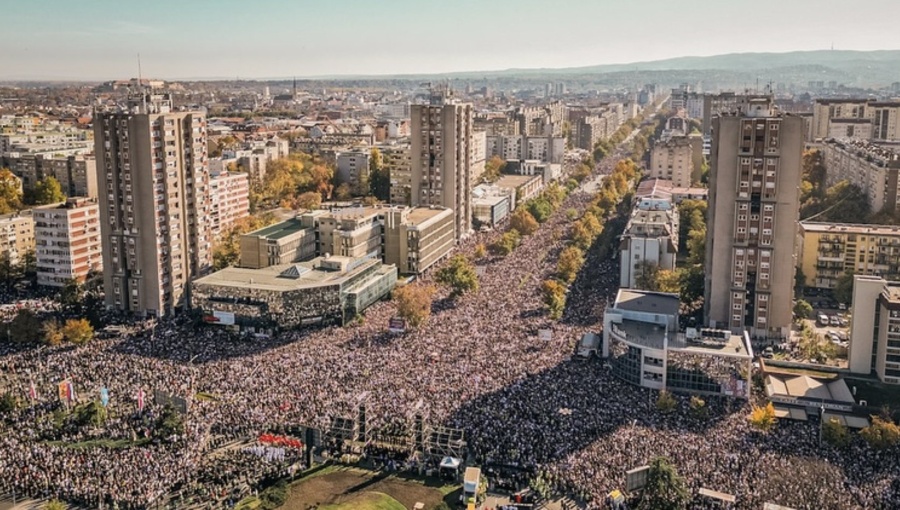
 

Tens of thousands rally in Serbia's Novi Sad one year after deadly station collapse

Tens of thousands rally in Serbia's Novi Sad one year after deadly station collapse
/ Uroš Arsić (Instagram:_lunja__)
By Tatyana Kekic in Belgrade November 1, 2025

Tens of thousands of people gathered in Novi Sad on November 1 to mark one year since the collapse of the city’s railway station canopy that killed 16 people and injured one, one of Serbia’s worst infrastructure disasters.

The tragedy has become a symbol of public anger over corruption and negligence, fueling Serbia’s largest protest movement in more than a decade.

Citizens assembled at 16 locations across the city — one for each victim — before marching to the station, where they observed a minute of silence at 11:52 a.m., the time of the collapse. Wreaths were laid as church bells tolled, and in Belgrade, Patriarch Porfirije led a memorial service. Serbia and Republika Srpska declared a national day of mourning.

Participants arrived from across the country, including student and farmer convoys travelling on foot, by bicycle and by tractor. Police closed central streets as crowds filled Liberation Boulevard and traffic was diverted around the city centre.

The demonstrations began last year as an outpouring of grief but have since evolved into a broader challenge to President Aleksandar Vucic and his ruling Serbian Progressive Party (SNS), with protesters demanding early elections.

SNS offices in Novi Sad, damaged during earlier violent protests, were closed and guarded. The event remained peaceful during the day, with organisers describing it as a memorial rather than a political rally.

The large turnout underscored the persistence of the movement and its support across Serbia.

The anniversary comes amid growing economic and diplomatic pressure on Vucic’s government, including US sanctions on the country's sole oil firm NIS, factory closures, criticism from the European Union and tensions with Russia over stalled gas talks.

One year after the collapse, the scale of Saturday's gathering shows that Serbia’s protest movement retains momentum and the potential to influence the country’s political course.


The streets against the regime in Serbia: one year of mobilization in review


Friday 31 October 2025, by Gaëlle Guehennec


For a year now, young people in Serbia have been continuing their fight for a democratic society in the face of Aleksandar Vučić’s authoritarian regime. On both sides of Serbia, student marches are criss-crossing the country in the direction of Novi Sad to commemorate the collapse of the railway station, responsible for the deaths of 16 people on 1 November 2024. This tragic event triggered a political protest on an unprecedented scale.


Throughout the last year, Serbian students have been taking to the streets. They have succeeded in organizing the largest protest movement since the fall of Slobodan Milošević in 2000. They accuse Aleksandar Vučić’s authoritarian and corrupt regime of being responsible for the tragedy in Novi Sad. Since the Serbian Progressive Party (SNS) came to power in 2012, the president has concentrated power, marginalized the opposition and stifled the independent press.

From April 2025, the mobilization turned to the international arena. Some of the students travelled to Brussels and Strasbourg to alert the European institutions to the authoritarian excesses of their government. At the same time, the movement denounced the role of the public media in relaying state propaganda. Faced with European silence and the contempt of those in power, the movement took a strategic turn: from civic to political.

In June, the creation of the Social Front marked a turning point: [1] this confederation of workers’ collectives and professional associations brought together Serbia’s five main trade unions for the first time. In a country where policy remained focused on privatization and the dismantling of labour law, this alliance opened the way to a possible reorganization of the labour movement.

But the regime’s response was brutal. Repression intensified, the police used illegal means such as sound cannons, and confrontations multiplied. On the night of 13 October, several Serbian towns became the scene of violent clashes between demonstrators and SNS supporters supported by the police and paramilitary militias. [2]

This escalation weakened the government on the international stage. Last Wednesday, the European Parliament adopted a resolution condemning the political polarization and state repression in Serbia, [3] denouncing threats to the media, anti-EU and pro-Russian propaganda, and the regime’s political responsibility for weakening democracy. However, the resolution remains non-binding, underlining Europe’s reluctance to deal with a partner considered ‘indispensable’ for regional stability.
Neither Brussels nor Moscow: for an international Balkans

By offering relative political security at Europe’s borders and privileged access to Serbian markets, Vučić has secured the complacency of Brussels and Paris. During her visit to Belgrade in early October, Ursula von der Leyen urged the president to make ‘progress on the rule of law’ [4]: a very weak reaction to a large-scale movement that was violently repressed. By betting on stabilocracy, Europe is choosing authoritarian stability rather than democracy [5], a calculation that feeds a geopolitical status quo that entrenches authoritarianism and increases regional instability.

The legacy of non-aligned Yugoslavia has left Belgrade with a tradition of the ‘third way’. Since its collapse, this position has turned into strategic ambiguity. While Serbia negotiates its entry into the EU, it maintains close ties with China and Russia.

The European Union exercises normative and economic imperialism, imposing its democratic and commercial standards while remaining the country’s main investor. This dependence is accompanied by political pressure, particularly on the issue of sanctions against Moscow. Russia, for its part, embodies symbolic and energy imperialism: Gazprom controls a large part of the sector, and the Kremlin supports Belgrade on the Kosovo issue.

For Vučić, playing on this ambivalence between Brussels and Moscow enables him to strengthen his internal legitimacy and assert his position on the international stage. Caught between two blocs, neither of which offers an emancipatory way out, the Serbian people see their sovereignty confiscated by a game of cross-dependencies.

The only progressive prospect now lies in building a social front capable of breaking away from all external control and rebuilding an autonomous democracy.

It is in this context, where internationalism is once again relevant, that a Franco-Belgian delegation made up of activists from the NPA and the Gauche anticapitaliste went to Belgrade last May. They returned there at the end of October for the Novi Sad commemoration to meet trade unions, student collectives and activists. An in-depth report on our discussions and the prospects for regional organization is forthcoming.

29 October 2025

P.S.


If you like this article or have found it useful, please consider donating towards the work of International Viewpoint. Simply follow this link: Donate then enter an amount of your choice. One-off donations are very welcome. But regular donations by standing order are also vital to our continuing functioning. See the last paragraph of this article for our bank account details and take out a standing order. Thanks.

Attached documentsthe-streets-against-the-regime-in-serbia-one-year-of_a9240.pdf (PDF - 899.3 KiB)
Extraction PDF [->article9240]

Footnotes


[1] Europe Solidaire Sans Frontières, “Serbia. Declaration of the Social Front”, 1 September 2025.


[2] Le Courrier des Balkans, “Étudiants face aux milices et à la police : la nuit où la Serbie a basculée”, 14 October 2025.


[3] European Parliament, Motion for a Resolution on the Polarisation and Increased Repression in Serbia, One Year After the Novi Sad Tragedy, B10-0459/2025, 22 October 2025.


[4] Le Courrier des Balkans, “Von der Leyen demande à Vučić « des progrès en matière d’État de droit» en Serbie”, 7 October 2025.


[5] Luka Šterić, ‘Sortir de la “stabilocratie” : repenser l’approche française des Balkans occidentaux’, Fondation Jean-Jaurès, 2 June 2022.

Gaëlle Guehennec  is a member of the NPA-A in France.


International Viewpoint is published under the responsibility of the Bureau of the Fourth International. Signed articles do not necessarily reflect editorial policy. Articles can be reprinted with acknowledgement, and a live link if possible.

Where will France go? Interview with La France Insoumise


First published at Meer.

In the nine years since its founding in 2016, La France Insoumise (LFI) has become the leading left formation in France, with its current parliamentary representation at 71, ahead of the traditional parties of the left, the Socialist Party and Communist Party. The personality most identified with it is Jean-Luc Mélenchon, who has run for president three times, the last time in 2022, when he gathered 21.9 per cent of the votes, finishing third after second-placer Marine Le Pen of National Rally and Emmanuel Macron. La France Insoumise describes its orientation as democratic socialist and ecosocialist.

The following is a composite interview. When he visited Paris in July 2025, Walden Bello interviewed some of the leaders of LFI, including Nadege Abomangoli, Vice President of the National Assembly; Aurelie Trouve, Chairwoman of the Economic Affairs Committee of the Assembly; and Members of Parliament Arnaud Le Gall, Aurelien Tache, and Aurelien Saintoul. This was followed in September 2025 by an email interview with LFI leader Jean-Luc Mélenchon (JLM).

The crisis of Macronism

Can you give your assessment of the current political situation in France?

LFI: In terms of the strategic situation, we are at the end of Macronism. The Macronists are very divided, and in their desperation, they’re allying with the far right.

Let’s begin by pointing out that last year, when the National Rally won the European Parliament elections, Macron was willing to make a deal with them. He was going to appoint a prime minister from the National Rally. That was the plan.

That did not pull through. But even if it did not, the reality is that Macronism has already absorbed much of the ideology and slogans of the far right. The Macronists are in an alliance with the far right in the current government.

The Republicans, the traditional right-wing party, are already, more than ever, positioned alongside the far right. The new head of this party, a man named Bruno Retailleau, is now minister of the interior, and therefore of the police. In a meeting, he said, “Down with the veil.” As you know, this is a slogan of the far right. Also, as you probably know, during the colonial war in Algeria, the French colonial community also shouted, “Down with the veil,” targeting Muslim women. So this is something very old, but at the same time very worrisome given the current situation. Islamophobia represents a very real threat insofar as it provides the ideological glue of all the right-wing forces in our country.

Popular protests and the left

What are the key challenges facing the left at this point?

JLM: The capitalists are getting behind the far right. Do you know why? Because there is intense social mobilization against the decisions stemming from the neoliberal program. There is a pre-revolutionary atmosphere in France, according to the admission of analysts who are themselves favorable to those in power. In fact, all over the world, for many years now, there have been revolutionary situations. We call these events “citizen revolutions.” In my book Now the People, I try to analyze them, including the conditions that produce them. This situation is what has worried Macron and the establishment.

In France, there was a movement of the yellow jackets. In the beginning, the traditional left did not support them. They said the yellow jackets were fascists. It was only ten days after it began that the left, the trade unions, and the alter-globalization movement made a declaration saying we support them. What was happening was that a new line of conflict was emerging: not left versus right, but the oligarchy versus the people.

As you know, there were mass protests that took place in 2005 and 2023. The character of the two protests was different. Those in 2005 took place in the suburbs of big cities. Those in 2023 were in smaller cities as well. They were very young people. Some sociologists said the 2005 and 2023 protests had the same causes, but we think the 2023 protests were different. People participating in them were very young, and they felt very deeply what they were against, including the right of the police to kill them, the license to kill, especially young Arab men.

There was no spokesperson, but it was clear what it was against. It was a reaction to an extrajudicial execution. And the polarization was sharper in 2023, partly because of social media. There was this outpouring of anger from the right in reaction to the protests, with some people expressing that it was right for the police to kill these young Arab and Black men.

Capitalism and racism

Were the protests in 2023 linked as well to economic issues?

LFI: Yes, they were, and we pointed out that the events were caused by neoliberal policies.

These were people’s responses to neoliberalism's impact on their concrete existence. All the other parties called them riots. We did not. The term used was very important for us. Those who are the victims of racism must also be seen as the victims of capitalism. They are the people who are also totally exploited by capitalism. So, contrary to the position of the head of the Communist Party and some in the Socialist Party, you cannot separate the fight against racism from the fight against capitalism.

We need to stress this, that racism is not just a moral issue. It is linked to economics. For instance, they say that we only have that much wealth to share, and sharing it with migrants will disadvantage our own people. So, this serves to divide people. You start with migrants, then you say the poor white people must also be excluded, and so on.

So the Macronists are trying to do this, to normalize this division promoted by the far right. They find it desirable to frame it this way. That’s what they’ve started to do in Mayotte, to destroy the rights of migrants, and after Mayotte, they’ll bring this idea to France. So, Mayotte and other overseas territories of France are serving as laboratories. But there are also such efforts in many places, like the suburbs around Marseilles, where the National Rally, Marine Le Pen’s party, exercises some influence.

They are creating many states of exception. For instance, there is now a bill, put forward by the National Rally, to put any arrested foreigner in jail for at least 200 days if he has been previously convicted and sentenced. That is a clear violation of basic rights: you cannot put anyone in jail if he has not been convicted and sentenced. 85 per cent of new laws in one year are sponsored or supported by the National Rally.

We’d like to add that we’re also trying to create a new anti-racism. One problem we have faced is that in the past, anti-racism was weaponized by the Socialists when they were in power to go after their enemies. So, now people are very, very suspicious of anti-racism, especially if those espousing it are leaders who are white men with a political agenda.

We’re also combating new forms of racism, like the allegation that non-white people are infiltrating society and government to get to high positions, and they’re doing it through special advantages provided by the government. This is strange because in the past, their criticism was that Muslims don’t want to integrate. But now, when some non-white people get to high positions, like Comrade Nadege, who’s Vice President of the National Assembly, they say it’s because of special benefits they enjoy.

So, from what I can gather from what you’re saying, you don’t think other sections of the left are sympathetic with or really understand the plight of the migrants?

LFI: Yes, but this is not new for the communist leaders because 40 years ago, they already said there was a problem with immigrants. But our differences with the Communist Party go beyond just the labelling of protests as riots, to different visions of society. It comes down to who is part of the people, and this is something that evolves with time. The Communist Party is dead because it is stuck with an obsolete view of who the ‘revolutionary people’ are. The working class has evolved so that Arabs and other non-white communities are now the majority in many sectors of the working class. You can see this in the hospitals, where even the majority of doctors are not white. So, it is very important to fight against racism, because if you don’t, you allow the people and the working class to be divided.

The divided left

Shifting to a related topic, can you tell me what the state of the left is in France?

LFI: You can say that without France Insoumise, there would no longer be a viable left in France. There are, of course, other parties, like the Socialist Party. But the Socialist Party does not confront the many challenges in the country. They do not fight racism as strongly as they should. Specifically, the Socialist Party is divided. They have no agenda, they have no program. And the only question for them is to know how to win elected seats and whether they should ally with LFI or not.

It is a difficult situation, but we must move forward even if we are accused of divisiveness. In terms of the strategic situation, we confront Macronism, which is very divided because it’s the end of Macronism, and there’s the far right. Of course, as in many other countries, you have the media, which is dominated by billionaires who very much favor a victory of the far right.

So, when you are talking about the Socialists, are you saying they do not want an alliance with LFI?

LFI: The Socialists are divided into two groups. One group does not want an alliance with us under any circumstances. The other group does not want an alliance, but would accept it in certain situations. However, they are focused on getting support from voters who support Macron in the next elections, and since they think an alliance would alienate these voters, these people don’t want an alliance with us at the moment. But they do not ask themselves whether voters would continue to vote for them in the second round of the elections. Their strategy is typical of the desire to place the people back under the authority of the petty bourgeoisie out of fear of the far right.

For us, the Socialists’ pursuit of the Macronist voters is an illusion, since the supporters of Macron are mainly conservatives and would not support socialists or social democrats, even if some of the media lump the Socialists and the Macronists in the same bloc. But given their project, the Socialists try their best to distinguish themselves from us. For instance, when it comes to the situation in Gaza, they still don’t want to use the word “genocide.” Then they say we are supporting Hamas and terrorism.

What more can the far right ask for? It’s a gift to them. The established right party, the Republicans, has, in fact, asked for a parliamentary inquiry into our alleged links to terrorist groups. We are facing a true demonization. They have this label for us, calling us “Islamo-Marxist.” These people use these labels to frighten people and to divide them in the face of the crisis of neoliberalism. But for now, they are the most discredited when it comes to public opinion. Their opportunism disgusts ordinary people.

The divided center and the divided right

There will be presidential elections in 2027 and general elections in 2029. Do you think the left will be able to unite to effectively contest these elections?

LFI: In other circumstances, things would be favorable for the left. The Macronists are very divided. If you look at those who voted for Macron in 2017 and those who did in 2023, you see a big difference. In 2017, his votes came mainly from older, centrist voters. In 2023, they came from younger voters who can be described not so much as centrists but as people interested in modernizing conservatism. You no longer have anyone who can unite these two groups. Macron is prohibited by law from running again. It is now clear that Macronism was a one-shot phenomenon. Most Macronists are now for allying with the far right, as we said earlier.

As for the right and far right, they are also divided. There’s Bruno Retailleau, the leader of the Republicans, the traditional conservative party. Then there’s the National Rally of Marine Le Pen. Because she has been convicted of embezzlement along with other leaders of her party, she has been banned from running for public office. Her protégé, Jordan Bardella, will be running in her stead. But Bardella is not credible; he has a low cultural level, is very young, quite lazy, and is very inexperienced compared to Retailleau, who has served in many positions and who’s been spouting the same rhetoric for the last 40 years. Between Bardella and Retailleau, Big Capital would likely favor Retailleau.

As we said earlier, in other circumstances, the situation would be favorable to the left. We’re open to talking with the Socialists, but the Socialists are pursuing the Macronists, which, as we said earlier, is an illusion, since the Macronists would rather side with the far right. The Greens, Socialists, and Communists are talking about an electoral alliance among themselves, and the only thing that unites them is to avoid talking to France Insoumise. But given the fact that each of them is just interested in increasing their number of seats, which can only come at the expense of the others, these talks won’t get very far.

Collectivism: La France Insoumise’s program and vision

Assuming you, Comrade Mélenchon, run for president in 2027, what would be the key elements of your program?

JLM: Yes, there will be an Insoumise candidacy. We will have a candidate to carry our program “L’Avenir en commun” (The Future in Common). The program comes from society itself. Associations, trade unions, collectives, scientists. These are 831 measures to build a New France, breaking with the capitalist order. These measures are constantly updated, costed, and detailed in program booklets. They propose to start from the needs of society itself to bring forth a new people.

To break with neoliberal mistreatment and move away from productivism, we will establish the “green rule”: not to take from nature more than it is capable of regenerating by itself. We propose to protect the commons and what we call the rights of the species. The right to night, to silence, to healthy food, to breathe clean air, and to drink water that does not poison. These measures are at the heart of our program to profoundly transform society and build harmony among human beings and with nature. They also have a concrete application to guide the economy, replacing market logics with those of ecological planning. This method will make it possible to implement major projects in housing, energy, agriculture, and industry. Thousands of jobs will be created.

L’Avenir en commun”, our program, is also a break with the government’s action plan and the presidential monarchy. That is why we will move to the 6th Republic, with measures allowing popular intervention, such as the recall referendum for any elected official or the citizens’ initiative referendum. In recent years, our country has been marked by powerful expressions of the authoritarianism of the 5th Republic, as was the case with the raising of the retirement age to 64, without a vote in the National Assembly and despite a historic popular mobilization in our country’s history. We will restore retirement at 60, so that everyone can regain control over their free time.

Comrade Mélenchon, can you describe the kind of socialism that you propose for France?

JLM: I prefer to speak of collectivism. It is not only about resolving the social question, but also about addressing the question of the general human interest and the rights of living beings, which form a systemic collective.

We observe the emergence of a new world: an urban people, organized in networks. This new France already exists in itself, its people defined by their conflict of interest with the oligarchy. The latter has appropriated the collective networks on which daily life depends. We believe this world is coming to an end, and that only two outcomes are possible: collectivism or the law of the strongest.

Take the case of climate change, which is inevitable and irreversible. How do we rebound? How do we propose collectivist solutions? The choice of individualism, of the law of the strongest, means letting thousands of people be poisoned by forever chemicals, just to keep the money cycle turning. It means failing to plan to prevent mega-fires from burning everything, because the budgets for Canadair planes have been cut.

The law of the strongest is expressed when there is no longer a logic of collective progress in France. When one in two French people is obese or overweight, when infant mortality has been rising for 10 years, and when one in four mothers raises her children alone. The fortunes of billionaires have doubled since Macron became president.

Collectivism is not a utopia but a necessity. Understanding the moment means taking reality with us, making ourselves masters of the situation. The dead end of the capitalist system can be good news, an opportunity to paralyze it, to push it to its limits. Each and every one of us is responsible for the outcome we will give to this rupture.

Walden Bello is currently co-chair of the Board of the Bangkok-based research and advocacy institute Focus on the Global South, an associate of the Transnational Institute in Amsterdam, and a retired professor at both the University of the Philippines and the State University of New York at Binghamton. A recipient of the Right Livelihood Award, aka the Alternative Nobel Prize, he is the author of 26 books, the latest of which is Global Battlefields: Memoir of a Legendary Public Intellectual from the Global South (2025).


What a trip to Cuba meant for a US student in the 21st century

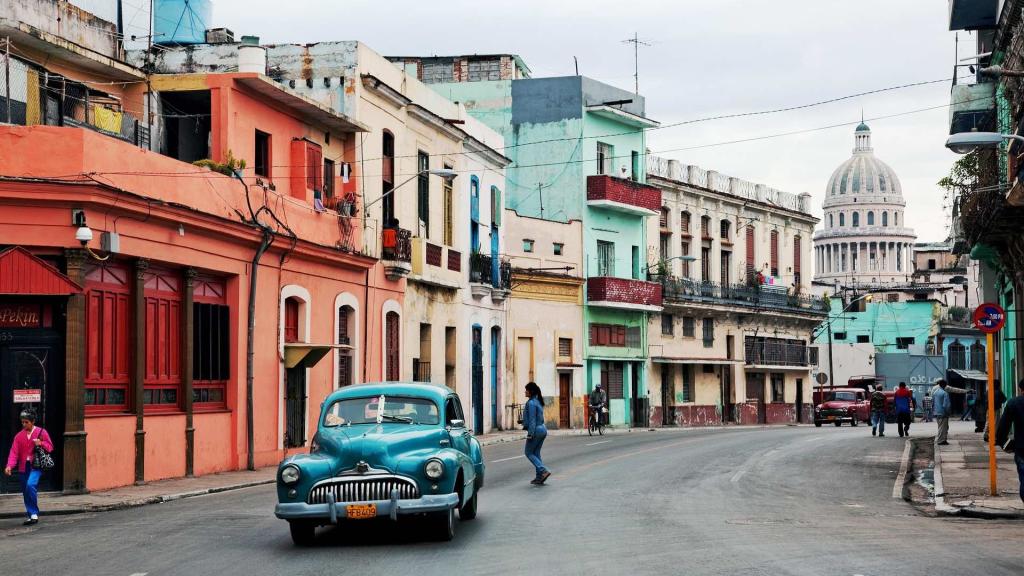
Havana Cuba

On the morning of May 21, 2024, in the small but endearing airport of Burlington, Vermont, I hugged my father tightly and bade him and my stepmother goodbye, a little over an hour before embarking on the journey that would change my life. I was preparing to spend a month abroad — something I had never done before — and the uncertainty of the journey ahead was all at once exciting and unsettling. On some level, I knew right there in the airport that the trip would alter the course of my life. To what extent and in what ways it would do so, I was not sure — I could only guess.

My parents divorced when I was very young — I have no memory of them being together. Despite the split, I have the chance to visit my father frequently, for which I am grateful, but I spent most of my time growing up in the household of my mother, a Russian immigrant whose decision to move to rural New York afforded her no opportunities to employ the master’s degree she had earned in her home country. The result was that my mother was forced to put herself through school again here while working part time as a clinical assistant to provide for herself and her child — me. As one might imagine, this was tremendously stressful for her.

Certain memories from this period still stick out to me: paying for food at a gas station with the money in my piggy bank. Mom crying and shaking the steering wheel when the car would not start in winter. I noticed things: the stress on mom’s face after a long day at work, the bags beneath her eyes. The sharpness of her voice was not so much a product of anything I had done, but rather of so many different stressors and financial strains piling up. The Christmas tree slim on presents.

There were some things I did not notice. Some things she told me later, when she had gotten a better job and the worst financial strains were behind us. How my Christmas presents the year the tree was thinnest on them all came from a local charity. How she pretended she was not hungry when there was only enough money for one of us to eat.

Abstracting from the emotion of these experiences and training the cold eye of honest appraisal upon them, I can say that they are likely to elicit sympathy. They are also far from the most horrible experiences that class societies have forced working people to endure throughout history. My best friend in my Senior year of high school had once been homeless. A girl I knew once told me how her family’s home was being repossessed by their bank.

Independence

Long before I grew and began to take note of such things in my immediate vicinity, the working classes of Cuba had been trapped in a struggle for their own emancipation. Spanish colonizers in the 16th century forced indigenous Taíno to flee to neighboring islands or the mountains to avoid being murdered and enslaved en masse. Later, those same colonizers kidnapped Africans and brought them to the island in chains, instituting a slave labor system that would last hundreds of years. In 1898, just when brave Cuban independentistas (independence fighters) were about to rid the island of Spanish colonialism for good, the United States intervened militarily with the express goal of filling Spain’s former role as the hegemonic power in the Caribbean.

After 1898, the Cubans ostensibly obtained independence, but the US retained the right to intervene militarily in Cuba whenever it wanted. US soldiers laid the groundwork for the predominance of US capital in the Caribbean nation’s economy.1 Cuban production served the interests of US businessmen, whether the Cubans liked it or not. This state of affairs, which prevailed on the island for decades, was suddenly and rapidly reversed after 1959. Fidel and Raul Castro, Camilo Cienfuegos and Ernesto Che Guevara led a revolutionary movement, toppled US-backed dictator Fulgencio Batista and took a series of bold measures against imperialism, nationalizing land that had formerly belonged to exploitative US corporations and refusing to allow Washington’s politicians to dictate life in Cuba.

I am hardly the first person to write about such things, nor am I the most qualified. But my growing interest in working class history — a product of my childhood experiences — and my own university’s partnership with the University of Cienfuegos, coupled with my interest in the Spanish language and Latin American culture, all combined to bring me to the land of orange earth and great horned bulls in the countryside and the most hospitable people in the world: Cuba.

Socialism in action

For years leading up to the trip I had been studying the texts of Karl Marx and Friedrich Engels, which I found convincing from a rhetorical perspective, and which felt very much like the natural intellectual expression of the emotions my family’s brush with poverty evoked in me. The deeper I delved into Capital, The German Ideology or Vladimir Lenin’s What Is To Be Done?, the stronger my desire became to witness firsthand what life was like in a post-capitalist society. Marx’s conception of the working class as an entity capable of independent development outside its relationship with capital seemed brilliant — how would real working-class people pursue that development? Unfortunately, thus far, the US working class has not had the opportunity to find out. Thus, to go beyond the realm of theory and see what real people thought about socialist solutions where they had been implemented, became a primary motivator for my trip.

Stepping off the plane and into the warm Caribbean air was something of a dream for me. As we took our hour and a half bus ride from the airport where we arrived to the city of Cienfuegos, my eyes were constantly swiveling, drinking in as much of the countryside as possible. I quickly discovered that my Spanish was not as good as I thought it was, but I was there to learn and that was what mattered. I got better quickly; dozens of tiny, everyday interactions forced me to learn to respond in ways that I had not thought to investigate when I had a purely academic understanding of the language. (You learn the difference between scrambled and fried eggs very quickly when you vastly prefer one and accidentally ask for the other).

I came to Cuba with a group of five other students, four from SUNY Potsdam, like me. One, John Scott, was from Louisiana, attending Ole Miss University. One of our professors, Axel Fair-Schulz, was born in East Germany, and had been an intellectual mentor for me. Axel co-taught our course on the Cold War with the affable Dictinio Diaz Gonzalez, a brilliant Cuban professor with a crown of gray hair wrapped around his head and an impressive ability to dance. Yadira and Dayana, our guides, made themselves indispensable by translating for us and informing us about the history of the island.

Education and healthcare

Very quickly we learned what the revolution meant to everyday Cubans. Dayana’s grandmother and her entire family had been poor peasants prior to 1959, unable to pay for basic education. When the Revolution came, massive literacy campaigns were carried out across the country. Dayana’s abuela was one of the beneficiaries; she learned to read and write at 26 years old.

Stone steps greet you at the entrance to one of the main buildings of the University of Cienfuegos. There is a mural painted on the wall just beyond those steps. It reads “Sin educacion, no hay revolucion ... no hay socialismo posible.” (Without education, there is no revolution... [without it] socialism is impossible). We learned how before the revolution, there were just a handful of universities scattered across Cuba. The campus where we studied day in and day out had not existed before the revolution. Today, dozens of universities dot the island, spread across hundreds of campuses. Dayana’s grandmother, who had been illiterate until she was 26, was able to send all four of her children to receive a university education — an opportunity she likely would not have had without the revolution.

In the US, the ruling classes continue to squeeze universities by making them operate like businesses and slicing their budgets. We live in the richest country on Earth, yet higher education in the US is cripplingly expensive. Cuba — an island with far fewer resources than us — manages to provide free education for all its citizens. This despite the illegal sanctions the US government has maintained against the island’s people since the 1960s. Perhaps we in the US should shift our priorities from contributing to the material scarcity of other countries to making education as affordable as they do. We certainly have the means — if only we wrest control of society for working people from the hands of the capitalists. Dictinio, our Cuban professor, once recounted how Fidel Castro visited his childhood school on occasion, overseeing its construction along with many others. For Cubans, education is the revolution — it is the very core of what it means to be revolutionary.

We took several day trips around the island between classes, including visits to the Bay of Pigs and old Spanish colonial fortresses. In Havana, we visited art museums and Afro-Cuban cultural events. To finish off the journey, we took a week-long road trip across the island, visiting the cities of Trinidad, Matanzas, Pinar del Rio and others, learning a bit about the unique histories of each and getting a feel for contemporary Cuban culture. We moved around enough to work up some serious sweat in the blazing summer sun, but fun conversation and good company made the heat just a little less oppressive. Our guides were careful to remind us to drink enough to stay hydrated. When one travels there are always concerns about how the stomach will adjust to the local food, but in that regard, I had few issues. Funnily enough, the one time I was sick in Cuba, it was my own fault.

When I made the ill-advised decision to consume an aging airport sandwich, I quickly began to regret it. Our guides brought me to a local medical clinic in Cienfuegos. Joking with the staff there after they gave me something to ease my stomach (and some electrolytes to stay hydrated) is one of the fondest memories I retain from the trip. Cuba provides free healthcare for its citizens. The US ruling classes will not do the same, despite the U.S. being the richest country on Earth. The working class is fed up with the affordability crisis — Zohran Mamdani’s recent victory in the New York City mayoral primary is an indication of this. Perhaps we can use the momentum of his victory to begin to build a new socialist movement in the US, reminiscent of the Cuban model in that it puts people before profits.

Since the revolution, Cuba’s medical system has developed tremendously. Cuban doctors are some of the best in the world, and the country even manufactured its own vaccine for the COVID-19 pandemic. Shortages of important medicines have forced medical professionals to adapt to tough conditions. Through impressive innovation in the face of these shortages, the Cuban system has developed advanced strategies for preventative care. Thousands of Cubans volunteer overseas in humanitarian aid missions after natural disasters; the Cuban government once offered to send medical personnel to aid the victims of Hurricane Katrina in New Orleans. Unbelievably, and revealing the depth of its moral bankruptcy in a single decision, the George W Bush administration refused Cuban aid while the people of New Orleans were suffering.

Problems

If I speak very highly of the Cubans and the type of society they have built, it must be said that Cuba still faces serious problems. Finding basic foodstuffs on the island can be difficult; electrical blackouts are uncomfortably common. We experienced these problems firsthand on the island: in Havana, the power went out for a few hours while we were visiting; another time our Cienfuegos hosts went fishing in the morning to catch dinner for us that night. Cubans face these issues on the daily, and unlike us they have no retreat from them at the end of the month.

This scarcity has led some, such as our host Melba in Cienfuegos, to express disappointment with the current state of things in Cuba. Melba most clearly expressed this sentiment to me when she declared: “Che fue el verdadero revolucionario.” (Che was the real/ true revolutionary). Once, a faulty power line failed and the electricity went out. I remember Melba’s stressed reaction; she threw up her hands and declared, “Se me perdió todo.” (I lost everything). The power failure damaged Melba’s electrical appliances, some of them perhaps irreparably. One morning we were set to leave for a few days in Havana, and a pipe burst, leaving my space upstairs without water. I was lucky — the water flow was fixed by the time we returned from Havana, and I was not the one who had to deal with replacing the pipe.

Socialism and the revolution clearly remain the dominant ideological forces on the island, but for some ideology matters little. There was the hotel worker who complimented my Spanish when I struck up a conversation with him on the edge of a pool, who seemed to have little interest in political matters. There was Brayan, the English language student in Cienfuegos who mentioned little about politics but confided in me that he would like to live in the US someday. For some who deal more immediately with ideological matters, like the college professor entering her middle years, the island’s prevailing ideology might not suffice in the face of serious material shortages. I asked, “Do you consider yourself Marxist-Leninist?” Her response was ambiguous. (“What a question! That’s difficult to say.”)

Any socialist system must practice serious self-criticism. At least in one crucial case, the Cubans have done that — by all accounts, LGBTQ+ people were treated poorly in the years immediately after the revolution. Today, having corrected this, Cuba has adopted one of the most progressive family codes in the world. Criticism of political repression continues to be directed towards the island, a favorite talking point of the bourgeois press. One must point out that the imperial core, with its enormous gravity, constantly threatens to erode the self-determination of Cubans and pull the aspiring socialist nation back into a capitalist orbit. It is an express goal of the US to achieve regime change in Cuba. Still, within the Cuban system, valid concerns about imperialist counter-revolution and external threats should not lead to the reflexive denouncement of all internal disagreements as counterrevolutionary.

Cuba is not a paradise simply because Marxism holds sway; hundreds of thousands of people have left Cuba in the years since the revolution, some for ideological reasons, many more (perhaps most) simply because they seek better opportunities and less material hardship. It is important to note that migration is something of a regional problem across the Caribbean due to lack of opportunity and difficult living conditions; Puerto Rico, Haiti and the Dominican Republic all have large diasporas in the US.2 What cannot be ignored is that the US embargo — a series of ongoing sanctions against Cuba because the island’s people dared to chart a course of independent, anti-imperialist development in the 1960s — is probably the main reason for material hardship on the island today. The embargo has cost the island’s economy billions of dollars since it began. History has proven that the ruling classes of the world will never let socialist experiments develop in peace, because the success of socialism anywhere brings the death of class society and ruling class privilege everywhere ever closer. If humanity has a pleasant future ahead of it, it will only be a matter of time until the bourgeoisie is swept into the dustbin of history.

Defend the revolution

I left Cuba with countless fond memories, new friends and a better understanding of the island’s people. I left also with the firm conviction that the Cuban Revolution must be defended at all costs, not merely because the Cuban state is avowedly socialist or its intellectuals use Marxist language, but because in Cuba, society pursues concrete policies to improve the lives of its people. I had learned about Cuba’s bold initiatives in housing, medicine and education in books, but it was being on the ground in Cuba, witnessing what los logros of the revolution meant to the working-class people who had won them, which cemented my faith in Cuba’s brave social experiment. Being on the island showed me that a better world is possible.

The Cuban model is far from perfect — no revolutionary model is or ever will be. But the Cubans have taken a great stride towards human emancipation through their revolution, and we in the US would do well to acknowledge that.

I would like to thank Dairo Moreno and the other members of the Civitas Global Educational Services team for organizing our trip; their work is invaluable in that it fosters empathy and understanding between Cubans and students such as me in the US. The connections they help build are especially important when the hostile rhetoric of the US ruling classes towards Cuba — imperialist words cloaked in self-righteous sermons about freedom, when the only freedom the US recognizes is its freedom to intervene militarily in other countries — dominates and shapes the prevailing historical narrative about the island.

The US working class must oppose the criminal embargo against Cuba, which only Israel has not condemned at the United Nations in recent years. It must fight for gains like those the Cuban people have won for themselves, all while demanding that Cubans be given the right to live their lives and develop their society in peace. Perhaps one day, if we are lucky, US and Cuban students can study and learn together in numbers far greater than the US regime currently allows. Perhaps one day, a socialist US can stand together with socialist Cuba in fraternity and shared humanity.

Bibliography

Batalova, Jeanna and Lorenzi, Jane. “Caribbean Immigrants in the United States.” Migration Policy Institute, 7 July 2022.

Castro, Fidel and Ramonet, Ignacio. My Life: A Spoken Autobiography. Scribner, 9 June 2009.

Arias, J. C., Bedforck, L. S., Bombino, L. L., Caballero, J. D., Corzo, J. F., Freyre, R. P., Gonzalez, C. S., Gonzalez, J. A., Jover, J.N., Lopez, M. B., Louredo, M. Z., Padron, G. P., Palenzuela, V. S., Pi, M., Pedroso, J. F., Pupo, R. P., Rodriguez, J. G., Sanchez, C. H. & Zayas, N. M. Lecciones de Filosofia Marxista-Leninista: Tomo 1. Editorial Pueblo y Educacion. 2011.

Farber, Samuel “The Criminalization of Opposition Politics in Cuba.” Spectre Journal, 13 January 2021.

Ferrer, Ada. Cuba: An American History. Scribner, 7 September 2021.

Guadalupe de Jesus, Raul. Sindicalismo y lucha política: Apuntes históricos sobre el movimiento obrero puertorriqueño. Editorial Tiempo Nuevo, 2009.

Guevara, Ernesto. Diarios de Motocicleta: Notas de viaje por América Latina. Seven Stories Press, 28 March 2023.

Katz, Jonathan M. Gangsters of Capitalism: Smedley Butler, The Marines, and the Making and Breaking of America’s Empire. St. Martin’s Press, 18 January 2022.

Meléndez-Badillo, Jorell. Puerto Rico: Historia de una nación. Planeta Publishing, 2 April 2024.

Yaffe, Helen. We Are Cuba! How a Revolutionary People Survived in a Post-Soviet World. Yale University Press, 6 April 2020.

  • 1

    Ada Ferrer, Cuba: An American History. Scribner, 7 September 2021. 178-193.

  • 2

    Jane Lorenzi and Jeanna Batalova, “Caribbean Immigrants in the United States.” Migration Policy Institute, 7 July 2022.