USA
‘Not Good Enough’: Trump to Pay Partial November SNAP Benefits After Court Rulings
“Trump needs to stop weaponizing hunger. They have the authority to fully fund SNAP,” said Rep. Rashida Tlaib. “It shouldn’t take a court order to get the president to stop starving families and release the funds.”
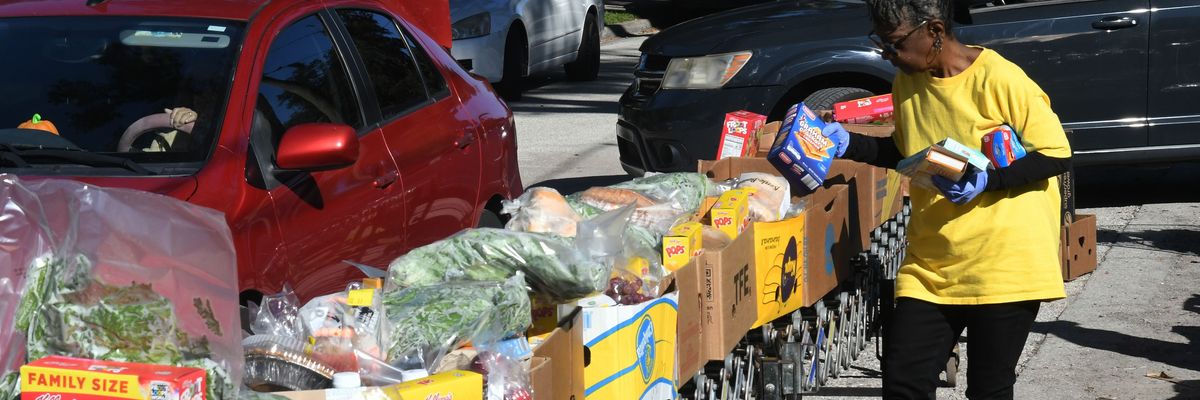
A volunteer prepares food packages at a distribution event sponsored by the Second Harvest Food Bank of Central Florida and volunteers at the Apostolic Church of Jesus on October 31, 2025 in Altamonte Springs, Florida.
(Photo by Paul Hennessy/Anadolu via Getty Images)
Jessica Corbett
Nov 03, 2025
COMMON DREAMS
On the verge of the longest government shutdown in US history and in the wake of two losses in district courts, President Donald Trump’s administration announced Monday that it would only partially fund Supplemental Nutrition Assistance Program benefits for 42 million Americans this month.
In response to lawsuits filed by state attorneys general, municipalities, nonprofits, and labor groups, federal judges in Massachusetts and Rhode Island on Friday ruled against the US Department of Agriculture’s (USDA) refusal to use a contingency fund for at least some of November’s $8 billion in SNAP benefits, often called food stamps.
RECOMMENDED...

Despite Court Rulings, Trump Refuses to Pay Out Food Stamp Benefits to Tens of Millions
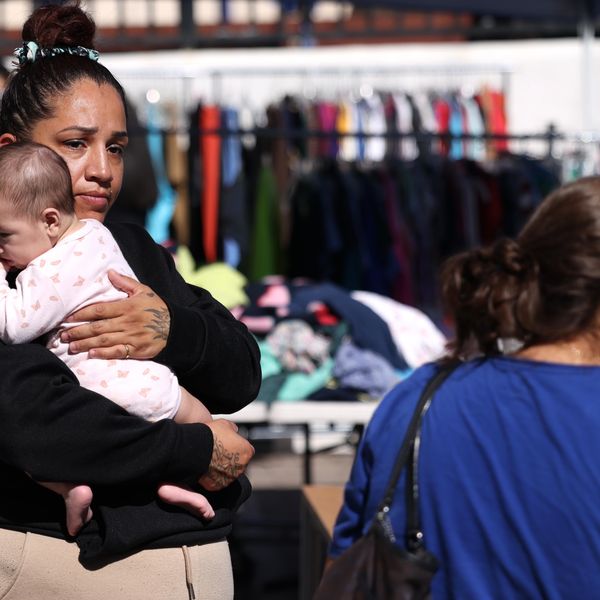
‘It Does Not Have to Be This Way’: Child Hunger Set to Surge as Trump Withholds SNAP Funds
Judge John McConnell, appointed to the District of Rhode Island by former President Barack Obama, gave the USDA two options: Fully cover the November SNAP benefits with the emergency funding and money pulled from other sources by the end of Monday, or make a partial payment of the total amount of the contingency fund by the end of Wednesday.
In a pair of Monday filings, the Trump administration chose the latter, explaining that there is “a total of $4.65 billion in the contingency fund for November SNAP benefits that will all be obligated to cover 50% of eligible households’ current allotments.”
While the development means millions of low-income families will at least get some benefits this month, a hunger crisis still looms. As one of the filings notes, “This means that no funds will remain for new SNAP applicants certified in November disaster assistance, or as a cushion against the potential catastrophic consequences of shutting down SNAP entirely.”
In a Monday statement, Skye Perryman, president and CEO of Democracy Forward, which is representing the municipalities, nonprofits, and labor groups that sued in Rhode Island, welcomed that McConnell’s order “means SNAP beneficiaries—including children and seniors—whose money ran out at the end of last month should be receiving funds for essential nutrition.” However, she also called out the Trump administration for “still trying to deprive people of their full benefits,” which “will not only prevent people from getting the full sustenance they need but also delay payments going out altogether.”
“We are reviewing the administration’s submission to the court and considering all legal options to secure payment of full funds,” she pledged. “It shouldn’t take a court order to force our president to provide essential nutrition that Congress has made clear needs to be provided. But since that is what it takes, we will continue to use the courts to protect the rights of people. For now, we are pleased to have forced the administration to release money it had been withholding from 42 million people in America who rely on their benefits. Rest assured, we will continue to fight so that people have the full benefits they are entitled to under SNAP.”
Democratic Massachusetts Attorney General Andrea Joy Campbell—who co-led the case in her state with over two dozen other AGs—noted Monday that “never in the history of the SNAP program—including during government shutdowns—has SNAP funding ever been suspended or only partially funded.”
“While some funding is better than no funding, the federal government has made it clear that they are only willing to do the bare minimum to help our residents, and only after they were required to do so by our lawsuit and the courts,” she said. “The Trump administration has the means to fund this program in full, and their decision not to will leave millions of Americans hungry and waiting even longer for relief as government takes the additional steps needed to partially fund this program.”
Democrats in Congress—who have refused to vote for the GOP majorities’ funding legislation to end the shutdown unless they reverse devastating cuts to Medicaid and extend expiring Affordable Care Act tax credits—also criticized the USDA’s plan.
“USDA has the authority to fully fund SNAP and needs to do so immediately. Anything else is unacceptable,” Senate Minority Leader Chuck Schumer (D-NY) said on social media. “Trump’s ‘decision’ to follow the court order and only send partial SNAP benefits to 42 million hungry Americans as Thanksgiving approaches is cruel and callous. Trump should focus less on his ballroom and his bathroom and more on the American people.”
Senate Appropriations Committee Vice Chair Patty Murray (D-Wash.) similarly said: “The letter of the law is as plain as day. Trump should have paid SNAP benefits all along. Just now paying the bare minimum to partially fund SNAP is not enough, and it is not acceptable. Trump should immediately work to fully fund benefits under the law.”
Both Senate Democrats from Massachusetts, Ed Markey and Elizabeth Warren, also took aim at the president on Monday. Markey said: “Two federal courts confirm what we already knew: Trump must use contingency funds to fund SNAP this month. But millions will still see their benefits delayed because Trump tried to hold SNAP hostage. No more games. Use all available resources to ensure no one goes hungry.”
While it’s the Senate where Republicans need some Democratic votes to send a government spending bill to Trump’s desk, House Democrats also blasted the administration’s decision to only partially fund SNAP benefits in November.
“This is a very temporary Band-Aid,” stressed Rep. Pramila Jayapal (D-Wash.), adding that “42 million hardworking Americans are trying to figure out how they will keep food on the table. Partial is not good enough. End this Republican shutdown now so we can fully fund SNAP.”
Congresswoman Rashida Tlaib (D-Mich.) declared: “Trump needs to stop weaponizing hunger. They have the authority to fully fund SNAP for 42 million Americans—including 1.4 million Michiganders. Anything less is unacceptable. It shouldn’t take a court order to get the president to stop starving families and release the funds.”
“Trump needs to stop weaponizing hunger. They have the authority to fully fund SNAP,” said Rep. Rashida Tlaib. “It shouldn’t take a court order to get the president to stop starving families and release the funds.”
A volunteer prepares food packages at a distribution event sponsored by the Second Harvest Food Bank of Central Florida and volunteers at the Apostolic Church of Jesus on October 31, 2025 in Altamonte Springs, Florida.
(Photo by Paul Hennessy/Anadolu via Getty Images)
Jessica Corbett
Nov 03, 2025
COMMON DREAMS
On the verge of the longest government shutdown in US history and in the wake of two losses in district courts, President Donald Trump’s administration announced Monday that it would only partially fund Supplemental Nutrition Assistance Program benefits for 42 million Americans this month.
In response to lawsuits filed by state attorneys general, municipalities, nonprofits, and labor groups, federal judges in Massachusetts and Rhode Island on Friday ruled against the US Department of Agriculture’s (USDA) refusal to use a contingency fund for at least some of November’s $8 billion in SNAP benefits, often called food stamps.
RECOMMENDED...
Despite Court Rulings, Trump Refuses to Pay Out Food Stamp Benefits to Tens of Millions
‘It Does Not Have to Be This Way’: Child Hunger Set to Surge as Trump Withholds SNAP Funds
Judge John McConnell, appointed to the District of Rhode Island by former President Barack Obama, gave the USDA two options: Fully cover the November SNAP benefits with the emergency funding and money pulled from other sources by the end of Monday, or make a partial payment of the total amount of the contingency fund by the end of Wednesday.
In a pair of Monday filings, the Trump administration chose the latter, explaining that there is “a total of $4.65 billion in the contingency fund for November SNAP benefits that will all be obligated to cover 50% of eligible households’ current allotments.”
While the development means millions of low-income families will at least get some benefits this month, a hunger crisis still looms. As one of the filings notes, “This means that no funds will remain for new SNAP applicants certified in November disaster assistance, or as a cushion against the potential catastrophic consequences of shutting down SNAP entirely.”
In a Monday statement, Skye Perryman, president and CEO of Democracy Forward, which is representing the municipalities, nonprofits, and labor groups that sued in Rhode Island, welcomed that McConnell’s order “means SNAP beneficiaries—including children and seniors—whose money ran out at the end of last month should be receiving funds for essential nutrition.” However, she also called out the Trump administration for “still trying to deprive people of their full benefits,” which “will not only prevent people from getting the full sustenance they need but also delay payments going out altogether.”
“We are reviewing the administration’s submission to the court and considering all legal options to secure payment of full funds,” she pledged. “It shouldn’t take a court order to force our president to provide essential nutrition that Congress has made clear needs to be provided. But since that is what it takes, we will continue to use the courts to protect the rights of people. For now, we are pleased to have forced the administration to release money it had been withholding from 42 million people in America who rely on their benefits. Rest assured, we will continue to fight so that people have the full benefits they are entitled to under SNAP.”
Democratic Massachusetts Attorney General Andrea Joy Campbell—who co-led the case in her state with over two dozen other AGs—noted Monday that “never in the history of the SNAP program—including during government shutdowns—has SNAP funding ever been suspended or only partially funded.”
“While some funding is better than no funding, the federal government has made it clear that they are only willing to do the bare minimum to help our residents, and only after they were required to do so by our lawsuit and the courts,” she said. “The Trump administration has the means to fund this program in full, and their decision not to will leave millions of Americans hungry and waiting even longer for relief as government takes the additional steps needed to partially fund this program.”
Democrats in Congress—who have refused to vote for the GOP majorities’ funding legislation to end the shutdown unless they reverse devastating cuts to Medicaid and extend expiring Affordable Care Act tax credits—also criticized the USDA’s plan.
“USDA has the authority to fully fund SNAP and needs to do so immediately. Anything else is unacceptable,” Senate Minority Leader Chuck Schumer (D-NY) said on social media. “Trump’s ‘decision’ to follow the court order and only send partial SNAP benefits to 42 million hungry Americans as Thanksgiving approaches is cruel and callous. Trump should focus less on his ballroom and his bathroom and more on the American people.”
Senate Appropriations Committee Vice Chair Patty Murray (D-Wash.) similarly said: “The letter of the law is as plain as day. Trump should have paid SNAP benefits all along. Just now paying the bare minimum to partially fund SNAP is not enough, and it is not acceptable. Trump should immediately work to fully fund benefits under the law.”
Both Senate Democrats from Massachusetts, Ed Markey and Elizabeth Warren, also took aim at the president on Monday. Markey said: “Two federal courts confirm what we already knew: Trump must use contingency funds to fund SNAP this month. But millions will still see their benefits delayed because Trump tried to hold SNAP hostage. No more games. Use all available resources to ensure no one goes hungry.”
While it’s the Senate where Republicans need some Democratic votes to send a government spending bill to Trump’s desk, House Democrats also blasted the administration’s decision to only partially fund SNAP benefits in November.
“This is a very temporary Band-Aid,” stressed Rep. Pramila Jayapal (D-Wash.), adding that “42 million hardworking Americans are trying to figure out how they will keep food on the table. Partial is not good enough. End this Republican shutdown now so we can fully fund SNAP.”
Congresswoman Rashida Tlaib (D-Mich.) declared: “Trump needs to stop weaponizing hunger. They have the authority to fully fund SNAP for 42 million Americans—including 1.4 million Michiganders. Anything less is unacceptable. It shouldn’t take a court order to get the president to stop starving families and release the funds.”
Trump Takes Food from the Poor during Budget Crisis
Monday 3 November 2025, by Dan La Botz
 |
| THE POLITICKS OF CRUELTY |
President Donald Trump has taken advantage of the current budget crisis, which has lasted more than a month, shutting down the federal government, to stop funding food programs that affect tens of million. Trump said the shutdown provided an opportunity to close “Democrat programs that we want to close up or we never wanted to happen.” By “Democrat programs” he means social welfare programs that provide food and education to low-income people.
The Republicans and Democrats have not been able to come to agreement on the federal budget, largely because the Democrats refuse to vote for a new budget without guarantees that the Affordable Care Act (ACA), which provides health insurance coverage to 44 million Americans, would be continued. Open enrollment for ACA began on November 1, but many have been shocked to find that their ACA insurance premiums have risen, in some cases astronomically. A single person earning $32,000 a year who way paying $58 a month will now have to pay about $180, an increase of $1,468 per year. Similarly, a family of four earning $66,000 annually could see the payment rise from about $121 to $373 per month, an increase of roughly $3,025 annually. While ACA is a federal program, some states provide subsidies that make it more affordable, so costs can differ from state to state. In New Jersey premiums would rise more than 175 percent and in Colorado by 101 percent.
In an attempt to protect their constituents from these rising costs, Democrats refused to vote for the budget, and the government shutdown. Trump has taken advantage of the government closure to fund programs he likes, such as the military and the Immigration and Customs Enforcement (ICE), while shutting down others.
Trump has stopped funds for the Supplemental Nutrition Assistance Program (SNAP), also known as “food stamps,” that provides food to 42 million people with low or no income, that is, to 12.5 percent of all Americans. Most recipients are children, the elderly, or the disabled. One has to understand that in the United States Poverty and economic inequality are endemic. There are 100,000 children from homeless families in New York City alone.
The program distributes over $90 billion a year, about 10 percent of all spending on groceries, a benefit therefore to grocery stores. In some poor neighborhoods, the small, family-owned store’s customers may be 75 to 90 percent food stamp customers. The SNAP program, run by the Department of Agriculture, also subsidizes the farmers who provide the food and therefore benefits rural communities.
Federal judges have ordered Trump to fund SNAP using the government’s six-billion-dollar contingency fund, but Trump told his lawyers to ask for more specific instructions.
Trump has also stopped funding for about 10% of the Head Start Program, a pre-school education program that serves 750,000 children from low-income families. Head Start also provides food and health services to these children.
The first U.S. food stamp program was set up in 1939 under President Franklin D. Roosevelt, a Democrat, and the current program began in 1964, created under Democrats President Lyndon B. Johnson. And Head Start was created by President Johnson in 1965. As Trump says these programs were created by Democrats, but many of the beneficiaries are Republicans, and Trump’s cuts will hurt them too.
Many of those who marched on October 18 in the No Kings protests held in 2,700 cities and towns and involving seven million protestors had signs criticizing Trump’s attack on working people and the poor. And this month there will be elections for governors and state legislators as well as six special elections to Congress to replace representatives who have resigned or died. We will see how Trump’s latest act of cruelty affects those races.
2 November 2025
Attached documentstrump-takes-food-from-the-poor-poor-during-budget-crisis_a9247.pdf (PDF - 905.3 KiB)
Extraction PDF [->article9247]
Dan La Botz was a founding member of Teamsters for a Democratic Union (TDU). He is the author of Rank-and-File Rebellion: Teamsters for a Democratic Union (1991). He is also a co-editor of New Politics and editor of Mexican Labor News and Analysis.

International Viewpoint is published under the responsibility of the Bureau of the Fourth International. Signed articles do not necessarily reflect editorial policy. Articles can be reprinted with acknowledgement, and a live link if possible.
USDA Tells Grocery Stores They Can’t Give Discounts to People Hit by Trump’s Food Stamp Freeze
“Can’t follow the law when a judge says fund the program, but have to follow the rules exactly when they say don’t help poor people afford food,” one lawyer said.
“Can’t follow the law when a judge says fund the program, but have to follow the rules exactly when they say don’t help poor people afford food,” one lawyer said.
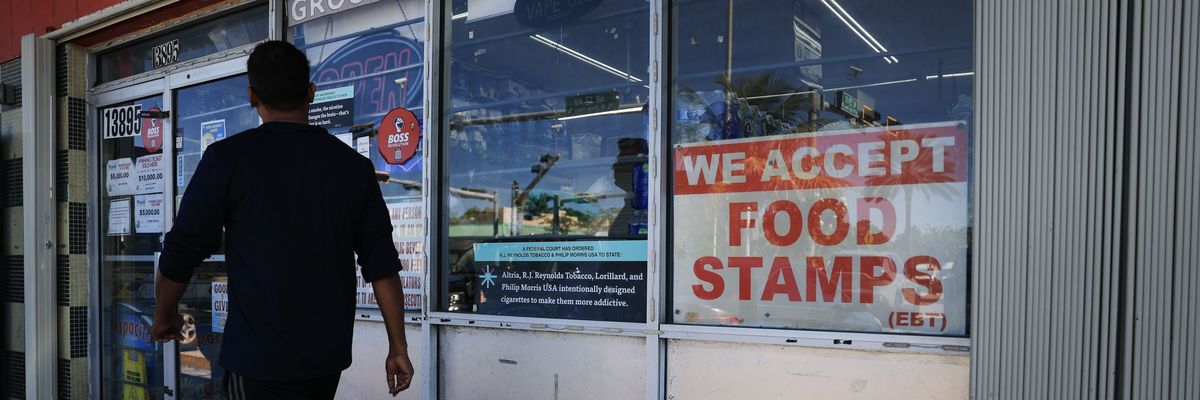
A ‘We Accept Food Stamps’ sign hangs in the window of a grocery store on October 31, 2025, in Miami, Florida.
(Photo by Joe Raedle/Getty Images)
Stephen Prager
Nov 02, 2025
COMMON DREAMS
As the Trump administration continued its illegal freeze on food assistance, the US Department of Agriculture sent a warning to grocery stores not to provide discounts to the more than 42 million Americans affected.
Several grocery chains and food delivery apps have announced in recent days that they would provide substantial discounts to those whose Supplemental Nutrition Assistance Program (SNAP) benefits have been delayed. More than 1 in 8 Americans rely on the program, and 39% of them are children.
But on Sunday, Catherine Rampell, an anchor at MSNBC, published an email from the USDA that was sent to grocery stores around the country, telling them they were prohibited from offering special discounts to those at greater risk of food insecurity due to the cuts.
“You must offer eligible foods at the same prices and on the same terms and conditions to SNAP-EBT customers as other customers, except that sales tax cannot be charged on SNAP purchases,” the email said. “You cannot treat SNAP-EBT customers differently from any other customer. Offering discounts or services only to SNAP-eligible customers is a SNAP violation unless you have a SNAP equal treatment waiver.”
The email referred to SNAP’s “Equal Treatment Rule,” which prohibits stores from discriminating against SNAP recipients by charging them higher prices or treating them more favorably than other customers by offering them specialized sales or incentives.
Rampell said she was “aware of at least two stores that had offered struggling customers a discount, then withdrew it after receiving this email.”
She added that it was “understandable why grocery stores might be scared off” because “a store caught violating the prohibition could be denied the ability to accept SNAP benefits in the future. In low-income areas where the SNAP shutdown will have the biggest impact, getting thrown off SNAP could mean a store is no longer financially viable.”
While the rule prohibits special treatment in either direction, legal analyst Jeffrey Evan Gold argues that it was a “perverted interpretation of a rule that stops grocers from price gouging SNAP recipients... charging them more when they use food stamps.”
The government also notably allows retailers to request waivers for programs that incentivize SNAP recipients to purchase healthy food.
Others pointed out that SNAP is currently not paying out to Americans because President Donald Trump is defying multiple federal court rulings issued Friday, requiring him to tap a $6 billion contingency fund to ensure benefit payments go out. Both courts, in Massachusetts and Rhode Island, have said his administration’s refusal to pay out benefits is against the law.
One labor movement lawyer summed up the administration’s position on social media: “Can’t follow the law when a judge says fund the program, but have to follow the rules exactly when they say don’t help poor people afford food.”
Nov 02, 2025
COMMON DREAMS
As the Trump administration continued its illegal freeze on food assistance, the US Department of Agriculture sent a warning to grocery stores not to provide discounts to the more than 42 million Americans affected.
Several grocery chains and food delivery apps have announced in recent days that they would provide substantial discounts to those whose Supplemental Nutrition Assistance Program (SNAP) benefits have been delayed. More than 1 in 8 Americans rely on the program, and 39% of them are children.
But on Sunday, Catherine Rampell, an anchor at MSNBC, published an email from the USDA that was sent to grocery stores around the country, telling them they were prohibited from offering special discounts to those at greater risk of food insecurity due to the cuts.
“You must offer eligible foods at the same prices and on the same terms and conditions to SNAP-EBT customers as other customers, except that sales tax cannot be charged on SNAP purchases,” the email said. “You cannot treat SNAP-EBT customers differently from any other customer. Offering discounts or services only to SNAP-eligible customers is a SNAP violation unless you have a SNAP equal treatment waiver.”
The email referred to SNAP’s “Equal Treatment Rule,” which prohibits stores from discriminating against SNAP recipients by charging them higher prices or treating them more favorably than other customers by offering them specialized sales or incentives.
Rampell said she was “aware of at least two stores that had offered struggling customers a discount, then withdrew it after receiving this email.”
She added that it was “understandable why grocery stores might be scared off” because “a store caught violating the prohibition could be denied the ability to accept SNAP benefits in the future. In low-income areas where the SNAP shutdown will have the biggest impact, getting thrown off SNAP could mean a store is no longer financially viable.”
While the rule prohibits special treatment in either direction, legal analyst Jeffrey Evan Gold argues that it was a “perverted interpretation of a rule that stops grocers from price gouging SNAP recipients... charging them more when they use food stamps.”
The government also notably allows retailers to request waivers for programs that incentivize SNAP recipients to purchase healthy food.
Others pointed out that SNAP is currently not paying out to Americans because President Donald Trump is defying multiple federal court rulings issued Friday, requiring him to tap a $6 billion contingency fund to ensure benefit payments go out. Both courts, in Massachusetts and Rhode Island, have said his administration’s refusal to pay out benefits is against the law.
One labor movement lawyer summed up the administration’s position on social media: “Can’t follow the law when a judge says fund the program, but have to follow the rules exactly when they say don’t help poor people afford food.”
CNN's Tapper forces Scott Bessent to admit Trump admin is unsure how to fund SNAP benefits
Alexander Willis
November 2, 2025
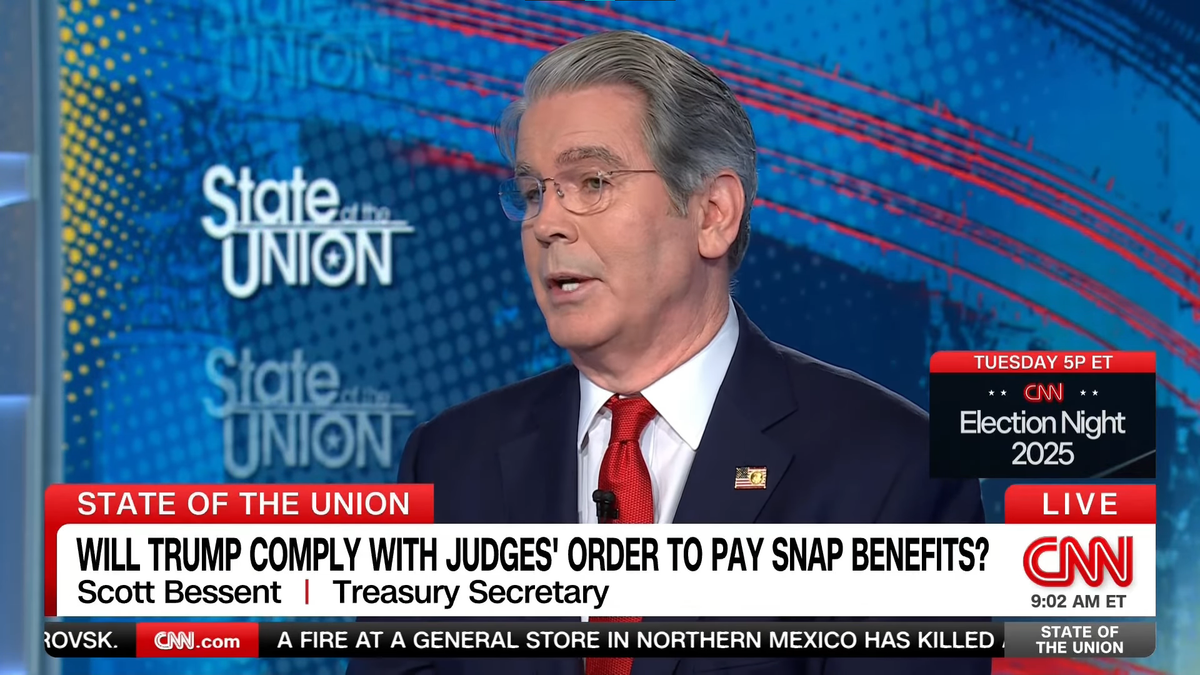
Treasury Secretary Scott Bessent appears on CNN, Nov. 2, 2025.
Alexander Willis
November 2, 2025
RAW STORY
Treasury Secretary Scott Bessent appears on CNN, Nov. 2, 2025.
(Screengrab/CNN)
Treasury Secretary Scott Bessent struggled Sunday to explain why the Trump administration has hesitated to use available funds to support Americans receiving food assistance, citing “the courts” and saying he was unsure how the administration could legally release the money.
Around 42 million Americans missed their food assistance payments Saturday – including 16 million children – under the Supplemental Food Assistance Program as the government remains shut down over a dispute over health care subsidies. And yet, while the Trump administration has used alternative funding to pay active service members amid the shutdown, it has refused to tap into a $6 billion pool of emergency funds earmarked specifically for programs like SNAP.
“There is this contingency fund, and as recently as Sept. 30th, the Agriculture Department had a memo saying that these funds – I think about $6 billion – could be used to pay these benefits,” said CNN’s Jake Tapper, speaking with Bessent Sunday. “Now, it'd only be two or three weeks, but that's a lot for people who need the food.”
Bessent pivoted to blaming “the courts,” citing a social media post from Trump on Friday in which he claimed that “two courts have issued conflicting opinions on what we can and cannot do” regarding funding SNAP.
“Well, President Trump just Truthed out that he's very anxious to get this done, and it's gotta go through the courts,” Bessent said. “The court keeps jamming up things, Democrats are in the middle of a civil war, and they should just open the government, that is the easiest way to do this.”
However, federal courts have not issued conflicting rulings on the matter.
In Massachusetts, a federal judge ruled that the Trump administration’s decision to suspend SNAP benefits during the shutdown was “unlawful,” and ordered the administration to tap into the emergency funds to make at least partial payments. And in Rhode Island, another federal judge issued a similar ruling.
Tapper pushed back on Bessent’s pivot to blame the courts, asking the Treasury Secretary to clarify his statement.
“Is the administraiton going to appeal the ruling by the judge, is that what you mean by the courts need to weigh in?” Tapper said. “Because the courts have weighed in.”
Stuttering his words, Bessent proclaimed that the Trump administration was still working to “figure out” the legal process that would allow SNAP payments to be sent out.
“Uh, no, but… there's a process that has to be followed, so we've got to figure out what the process is,” Bessent said. “President Trump wants to make sure that people get their food benefits.”
“So it could be done by Wednesday?” Tapper asked.
“Could be,” Bessent responded. “Could be, and five Democratic senators could cross the aisle and open the government by Wednesday.”
Treasury Secretary Scott Bessent struggled Sunday to explain why the Trump administration has hesitated to use available funds to support Americans receiving food assistance, citing “the courts” and saying he was unsure how the administration could legally release the money.
Around 42 million Americans missed their food assistance payments Saturday – including 16 million children – under the Supplemental Food Assistance Program as the government remains shut down over a dispute over health care subsidies. And yet, while the Trump administration has used alternative funding to pay active service members amid the shutdown, it has refused to tap into a $6 billion pool of emergency funds earmarked specifically for programs like SNAP.
“There is this contingency fund, and as recently as Sept. 30th, the Agriculture Department had a memo saying that these funds – I think about $6 billion – could be used to pay these benefits,” said CNN’s Jake Tapper, speaking with Bessent Sunday. “Now, it'd only be two or three weeks, but that's a lot for people who need the food.”
Bessent pivoted to blaming “the courts,” citing a social media post from Trump on Friday in which he claimed that “two courts have issued conflicting opinions on what we can and cannot do” regarding funding SNAP.
“Well, President Trump just Truthed out that he's very anxious to get this done, and it's gotta go through the courts,” Bessent said. “The court keeps jamming up things, Democrats are in the middle of a civil war, and they should just open the government, that is the easiest way to do this.”
However, federal courts have not issued conflicting rulings on the matter.
In Massachusetts, a federal judge ruled that the Trump administration’s decision to suspend SNAP benefits during the shutdown was “unlawful,” and ordered the administration to tap into the emergency funds to make at least partial payments. And in Rhode Island, another federal judge issued a similar ruling.
Tapper pushed back on Bessent’s pivot to blame the courts, asking the Treasury Secretary to clarify his statement.
“Is the administraiton going to appeal the ruling by the judge, is that what you mean by the courts need to weigh in?” Tapper said. “Because the courts have weighed in.”
Stuttering his words, Bessent proclaimed that the Trump administration was still working to “figure out” the legal process that would allow SNAP payments to be sent out.
“Uh, no, but… there's a process that has to be followed, so we've got to figure out what the process is,” Bessent said. “President Trump wants to make sure that people get their food benefits.”
“So it could be done by Wednesday?” Tapper asked.
“Could be,” Bessent responded. “Could be, and five Democratic senators could cross the aisle and open the government by Wednesday.”
'No one is entitled!' MAGA congressman shames SNAP recipients for 'life choices'
Alexander Willis
November 2, 2025
Alexander Willis
November 2, 2025
RAW STORY
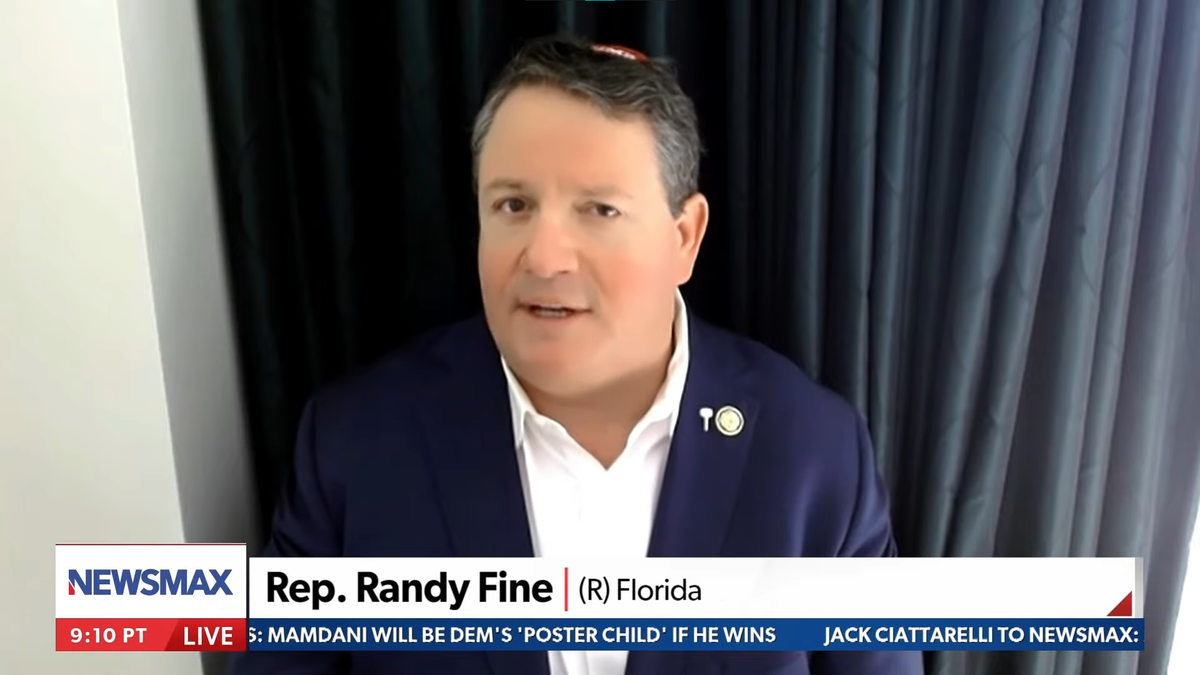
Rep. Randy Fine appears on Newsmax, Nov. 2, 2025. (Screengrab/Newsmax)
As 42 million Americans go without federal food assistance, including 16 million children, Rep. Randy Fine (R-FL) took to Newsmax Sunday to shame Americans who receive help through the Supplemental Nutrition Assistance Program, demanding they show “gratitude” and admit that their own “choices in life” led them to relying on the popular anti-poverty program.
“No one is entitled to [food stamps], that is a gift that is given to you by your fellow taxpayers because you are unable to care for yourself,” Fine said.
More than 12% of the U.S. population receives food assistance through SNAP, which due to the ongoing government shutdown has been disrupted for millions of Americans. Much like the Trump administration did for the military, it has the ability to fund SNAP using a pool of $6 billion in emergency funds earmarked for programs like SNAP, but has refused to do so.
Fine joined Newsmax Sunday to tout a new bill he plans on introducing to prohibit all non-citizens from receiving any form of welfare, and despite federal law already limiting federal welfare program eligibility to U.S. citizens, though some states operate their own welfare programs that aid individuals regardless of immigration status, such as Medi-Cal, California’s Medicaid program.
While speaking on his proposal, Fine launched into a rant against those receiving SNAP benefits, decrying any who have voiced criticisms at the program’s disruption, and urging them instead to show “gratitude.”
“The only thing that we should hear when it comes to food stamps is gratitude and an admission that choices made in life led to the need for it,” Fine said. “So when we hear people who expect it, then we know that we have a problem.”
On his bill, Fine clarified that it would also apply to legal immigrants, granted they failed to demonstrate the ability to be “self-reliant.”
“If you're coming here whether it's legally or illegally to get free stuff, then you ought to stay home,” Fine said. “Immigrants ought to be self-reliant; if they aren't, we shouldn't be letting them into our country.”
Rep. Randy Fine appears on Newsmax, Nov. 2, 2025. (Screengrab/Newsmax)
As 42 million Americans go without federal food assistance, including 16 million children, Rep. Randy Fine (R-FL) took to Newsmax Sunday to shame Americans who receive help through the Supplemental Nutrition Assistance Program, demanding they show “gratitude” and admit that their own “choices in life” led them to relying on the popular anti-poverty program.
“No one is entitled to [food stamps], that is a gift that is given to you by your fellow taxpayers because you are unable to care for yourself,” Fine said.
More than 12% of the U.S. population receives food assistance through SNAP, which due to the ongoing government shutdown has been disrupted for millions of Americans. Much like the Trump administration did for the military, it has the ability to fund SNAP using a pool of $6 billion in emergency funds earmarked for programs like SNAP, but has refused to do so.
Fine joined Newsmax Sunday to tout a new bill he plans on introducing to prohibit all non-citizens from receiving any form of welfare, and despite federal law already limiting federal welfare program eligibility to U.S. citizens, though some states operate their own welfare programs that aid individuals regardless of immigration status, such as Medi-Cal, California’s Medicaid program.
While speaking on his proposal, Fine launched into a rant against those receiving SNAP benefits, decrying any who have voiced criticisms at the program’s disruption, and urging them instead to show “gratitude.”
“The only thing that we should hear when it comes to food stamps is gratitude and an admission that choices made in life led to the need for it,” Fine said. “So when we hear people who expect it, then we know that we have a problem.”
On his bill, Fine clarified that it would also apply to legal immigrants, granted they failed to demonstrate the ability to be “self-reliant.”
“If you're coming here whether it's legally or illegally to get free stuff, then you ought to stay home,” Fine said. “Immigrants ought to be self-reliant; if they aren't, we shouldn't be letting them into our country.”
Faith leaders join Democrats to decry health care cuts, expiring SNAP benefits
WASHINGTON (RNS) — ‘We will not retreat, and we will use every nonviolent tool at our disposal, to call this nation, this Congress, to stop all of this partisan fighting and get down to the business of the people,’ said the Rev. William Barber II.
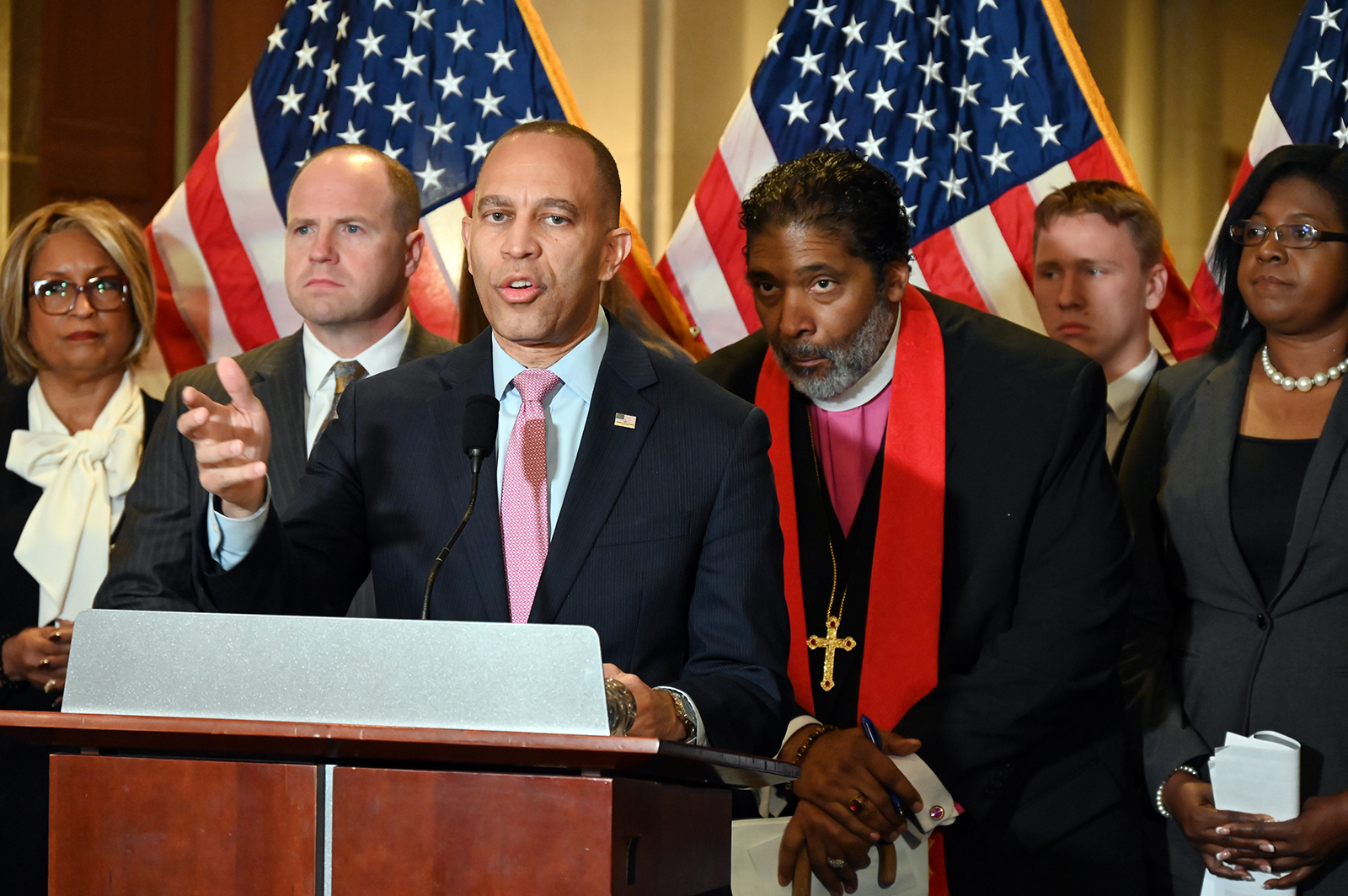
House Minority Leader Hakeem Jeffries, D-N.Y., speaks during a news conference on the 30th day of a government shutdown, on Capitol Hill, Oct. 30, 2025, in Washington. The Rev. William Barber II stands beside Jeffries. (RNS photo/Jack Jenkins)
Jack Jenkins
October 30, 2025
RNS
WASHINGTON (RNS) — House Minority Leader Hakeem Jeffries and other Democrats joined faith leaders on Thursday (Oct. 30) to pray and speak against the dangers of health care cuts and allowing government assistance programs to expire during the ongoing government shutdown.
“We will not retreat, and we will use every nonviolent tool at our disposal to call this nation, this Congress, to stop all of this partisan fighting and get down to the business of the people,” said the Rev. William Barber II, a prominent social justice activist, at a press conference on Capitol Hill. “Open this government so that you can open up good news for the poor.”
Barber was echoed by Jeffries, who accused Republicans of committing “policy violence” by cutting Medicaid spending earlier this year with the passage of the “Big, Beautiful Bill” — which Barber vigorously protested, resulting in his arrest at the U.S. Capitol in April.
Jeffries then pivoted to an issue Democrats argue is at the center of the nearly monthlong government shutdown — a dispute over whether to extend health insurance subsidies that are set to expire at the end of the year.
“The refusal to extend the Affordable Care Act tax rates, the unwillingness to find a dime to meet the health care needs of the American people, when some folks can find $40 billion to bail out a right-wing dictator in Argentina — that’s policy violence,” Jeffries said, referring to President Donald Trump’s decision to authorize up to $40 billion in a bailout package to help address Argentina’s economic crisis.
Jeffries and Barber were joined by other Democratic lawmakers, such as Rep. Steven Horsford of Nevada, as well as an array of faith leaders from a range of traditions and organizations, such as the National Council of Churches, United Methodist Church, Disciples of Christ and the Union for Reform Judaism.
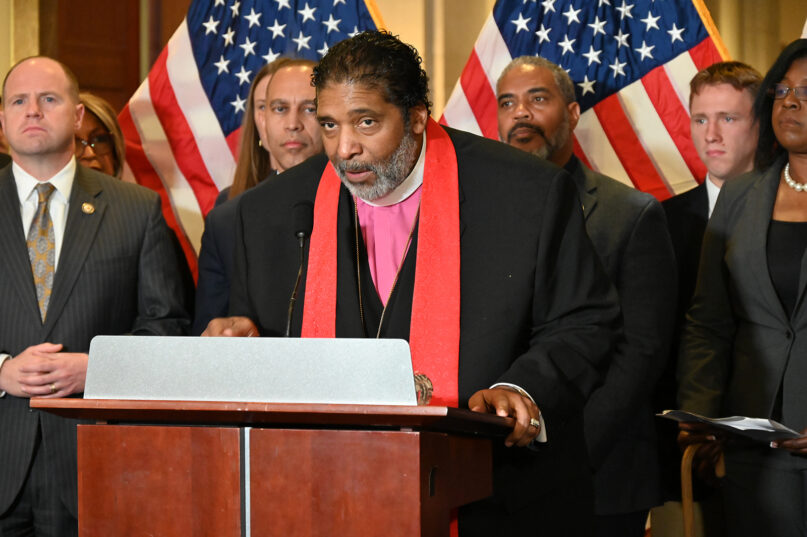
The Rev. William Barber II speaks during a news conference on the 30th day of a government shutdown, on Capitol Hill, Oct. 30, 2025, in Washington. (RNS photo/Jack Jenkins)
Republicans such as House Speaker Mike Johnson have accused Democrats of using the fight over health care subsidies as a foil, arguing they are instead refusing to open the government because liberal leaders are afraid of angering the “radical, far-left voices in their party,” Johnson said in a news conference.
But the religious leaders gathered on Capitol Hill — some of whom, like Barber, have long advocated for greater access to health care — insisted the subsidies issue was paramount. Among their delegation were at least three people who said they stand to be directly impacted by policy changes, including if the subsidies expire.
Lawmakers and faith leaders also highlighted concerns about the looming threat of allowing Supplemental Nutrition Assistance Program benefits, formerly known as food stamps, to lapse, as they are set do on Saturday if the government does not reopen or other measures are not taken. The press conference was happening at the same time as a legal hearing over the Trump administration’s decision to not draw on emergency funds to help cover SNAP benefits in November.
The Rev. Ryan Stoess, a United Methodist Church pastor from Louisville, Kentucky, was asked to pray for the group over the lawsuit.
“God, we lift up the court hearing that is happening … at a time when we are holding food over the heads of poor people so that we can take away their health care,” Stoess said. “God help us.”
He added, “When the cruelty is the point, when the cruelty is in our face, God give us your mercy.”
In a separate interview with Religion News Service, Stoess said a series of GOP-led policy decisions are having a compounding effect on impoverished people in his community. In addition to hosting traditional worship services, his Church of the Promise has long offered a pay-what-you-can restaurant, a nonprofit construction group to help build housing, an outreach effort to unhoused people, an addiction recovery program and early childhood development programming, he said.
Stoess said members of his staff broke down in tears this week as they began reckoning with the reality that SNAP benefits will likely expire for many they serve. Meanwhile, food banks across the country, many of which are faith-based, are bracing for a massive increase in people seeking food if SNAP benefits expire.
Stoess joined others in warning that outfits like his likely will not be able to handle the influx of people seeking services, should the benefits expire. He said that while many people pay for food at his church’s restaurant by offering to clean dishes, the number offering to do so has risen throughout the year — and likely will increase even more if SNAP benefits dry up.
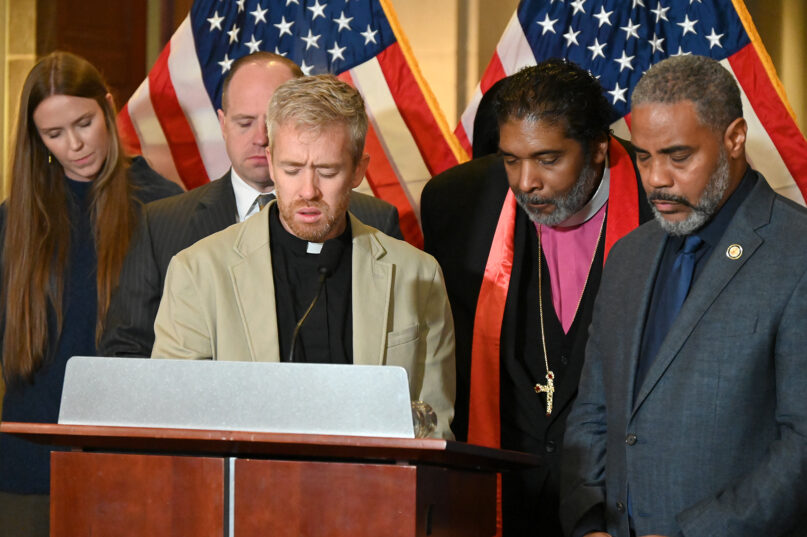
The Rev. Ryan Stoess leads a prayer during a news conference on the 30th day of a government shutdown, on Capitol Hill, Oct. 30, 2025, in Washington. (RNS photo/Jack Jenkins)
Rabbi Esther Lederman, who was part of the faith delegation, noted another dynamic impacting people at a congregation she attends in Washington, D.C.: government workers who have been furloughed during the shutdown. She said her Jewish faith compels her to advocate for them, along with others in need.
“Fighting for health care has been part of our core understanding of what it is to be an American Jew,” she told RNS.
Barber also railed against the idea that food banks and churches could step in to fill the gap left if SNAP benefits expire, saying it’s a “lie” perpetrated by devotees of “extremism, religious nationalism and MAGA.” Impoverished Americans are being hit with a growing list of problems created by lawmakers, he said.
“One minute you can’t eat. The next minute you can’t get your medicine. One minute you’re scared to go to the hospital. The next minute, you’ve got to pay higher prices, then somebody dies — because food and health and health care are all connected,” Barber, who himself suffers from a chronic illness, said in an interview. “You’re creating anxiety, you’re creating burdens.”
Whether the courts will intervene to force the administration to dole out funds to cover SNAP benefits remains an open question, but Barber said he plans to stage protests centered on the plight of poor Americans later this year. He said he is in talks to coordinate his massive “Moral Mondays” demonstrations with the group Indivisible, which helped organize the No Kings protests, and hopes to hold a large prayer vigil in front of the U.S. Capitol.
Referring to the concept of a “fellowship of suffering,” drawn from the Book of Philippians, Barber said he interprets it to mean that suffering “forces a coming together and a standing up like we’ve never seen before.” He said he hopes that kind of effort would be enough to turn the hearts — or at least the votes — of many in Congress.
“There are forces that live in such a mythology of what it means to be human that they think power is to be used and measured by how many people they hurt, and how many people they make rich, rather than how many people they heal and how many people they lift up,” he said.
WASHINGTON (RNS) — ‘We will not retreat, and we will use every nonviolent tool at our disposal, to call this nation, this Congress, to stop all of this partisan fighting and get down to the business of the people,’ said the Rev. William Barber II.
House Minority Leader Hakeem Jeffries, D-N.Y., speaks during a news conference on the 30th day of a government shutdown, on Capitol Hill, Oct. 30, 2025, in Washington. The Rev. William Barber II stands beside Jeffries. (RNS photo/Jack Jenkins)
Jack Jenkins
October 30, 2025
RNS
WASHINGTON (RNS) — House Minority Leader Hakeem Jeffries and other Democrats joined faith leaders on Thursday (Oct. 30) to pray and speak against the dangers of health care cuts and allowing government assistance programs to expire during the ongoing government shutdown.
“We will not retreat, and we will use every nonviolent tool at our disposal to call this nation, this Congress, to stop all of this partisan fighting and get down to the business of the people,” said the Rev. William Barber II, a prominent social justice activist, at a press conference on Capitol Hill. “Open this government so that you can open up good news for the poor.”
Barber was echoed by Jeffries, who accused Republicans of committing “policy violence” by cutting Medicaid spending earlier this year with the passage of the “Big, Beautiful Bill” — which Barber vigorously protested, resulting in his arrest at the U.S. Capitol in April.
Jeffries then pivoted to an issue Democrats argue is at the center of the nearly monthlong government shutdown — a dispute over whether to extend health insurance subsidies that are set to expire at the end of the year.
“The refusal to extend the Affordable Care Act tax rates, the unwillingness to find a dime to meet the health care needs of the American people, when some folks can find $40 billion to bail out a right-wing dictator in Argentina — that’s policy violence,” Jeffries said, referring to President Donald Trump’s decision to authorize up to $40 billion in a bailout package to help address Argentina’s economic crisis.
Jeffries and Barber were joined by other Democratic lawmakers, such as Rep. Steven Horsford of Nevada, as well as an array of faith leaders from a range of traditions and organizations, such as the National Council of Churches, United Methodist Church, Disciples of Christ and the Union for Reform Judaism.
The Rev. William Barber II speaks during a news conference on the 30th day of a government shutdown, on Capitol Hill, Oct. 30, 2025, in Washington. (RNS photo/Jack Jenkins)
Republicans such as House Speaker Mike Johnson have accused Democrats of using the fight over health care subsidies as a foil, arguing they are instead refusing to open the government because liberal leaders are afraid of angering the “radical, far-left voices in their party,” Johnson said in a news conference.
But the religious leaders gathered on Capitol Hill — some of whom, like Barber, have long advocated for greater access to health care — insisted the subsidies issue was paramount. Among their delegation were at least three people who said they stand to be directly impacted by policy changes, including if the subsidies expire.
Lawmakers and faith leaders also highlighted concerns about the looming threat of allowing Supplemental Nutrition Assistance Program benefits, formerly known as food stamps, to lapse, as they are set do on Saturday if the government does not reopen or other measures are not taken. The press conference was happening at the same time as a legal hearing over the Trump administration’s decision to not draw on emergency funds to help cover SNAP benefits in November.
The Rev. Ryan Stoess, a United Methodist Church pastor from Louisville, Kentucky, was asked to pray for the group over the lawsuit.
“God, we lift up the court hearing that is happening … at a time when we are holding food over the heads of poor people so that we can take away their health care,” Stoess said. “God help us.”
He added, “When the cruelty is the point, when the cruelty is in our face, God give us your mercy.”
In a separate interview with Religion News Service, Stoess said a series of GOP-led policy decisions are having a compounding effect on impoverished people in his community. In addition to hosting traditional worship services, his Church of the Promise has long offered a pay-what-you-can restaurant, a nonprofit construction group to help build housing, an outreach effort to unhoused people, an addiction recovery program and early childhood development programming, he said.
Stoess said members of his staff broke down in tears this week as they began reckoning with the reality that SNAP benefits will likely expire for many they serve. Meanwhile, food banks across the country, many of which are faith-based, are bracing for a massive increase in people seeking food if SNAP benefits expire.
Stoess joined others in warning that outfits like his likely will not be able to handle the influx of people seeking services, should the benefits expire. He said that while many people pay for food at his church’s restaurant by offering to clean dishes, the number offering to do so has risen throughout the year — and likely will increase even more if SNAP benefits dry up.
The Rev. Ryan Stoess leads a prayer during a news conference on the 30th day of a government shutdown, on Capitol Hill, Oct. 30, 2025, in Washington. (RNS photo/Jack Jenkins)
Rabbi Esther Lederman, who was part of the faith delegation, noted another dynamic impacting people at a congregation she attends in Washington, D.C.: government workers who have been furloughed during the shutdown. She said her Jewish faith compels her to advocate for them, along with others in need.
“Fighting for health care has been part of our core understanding of what it is to be an American Jew,” she told RNS.
Barber also railed against the idea that food banks and churches could step in to fill the gap left if SNAP benefits expire, saying it’s a “lie” perpetrated by devotees of “extremism, religious nationalism and MAGA.” Impoverished Americans are being hit with a growing list of problems created by lawmakers, he said.
“One minute you can’t eat. The next minute you can’t get your medicine. One minute you’re scared to go to the hospital. The next minute, you’ve got to pay higher prices, then somebody dies — because food and health and health care are all connected,” Barber, who himself suffers from a chronic illness, said in an interview. “You’re creating anxiety, you’re creating burdens.”
Whether the courts will intervene to force the administration to dole out funds to cover SNAP benefits remains an open question, but Barber said he plans to stage protests centered on the plight of poor Americans later this year. He said he is in talks to coordinate his massive “Moral Mondays” demonstrations with the group Indivisible, which helped organize the No Kings protests, and hopes to hold a large prayer vigil in front of the U.S. Capitol.
Referring to the concept of a “fellowship of suffering,” drawn from the Book of Philippians, Barber said he interprets it to mean that suffering “forces a coming together and a standing up like we’ve never seen before.” He said he hopes that kind of effort would be enough to turn the hearts — or at least the votes — of many in Congress.
“There are forces that live in such a mythology of what it means to be human that they think power is to be used and measured by how many people they hurt, and how many people they make rich, rather than how many people they heal and how many people they lift up,” he said.






.JPG)