Monday, December 22, 2025

A Peace Conference on Kashmir Highlights New Delhi's Unfulfilled Promises

KASHMIR IS INDIA'S GAZA


Ajoy Ashirwad Mahaprashasta
20/Dec/2025
THE WIRE

Nearly all speakers, including Mani Shankar Aiyar, Mirwaiz Umar Farooq (who sent a message), Aga Syed Ruhullah Mehdi, Kapil Kak and others spoke about the sense of disempowerment and anger among Kashmiri youth after the reading down of Article 370 and urged the Union government to fulfill its promise of restoring statehood.
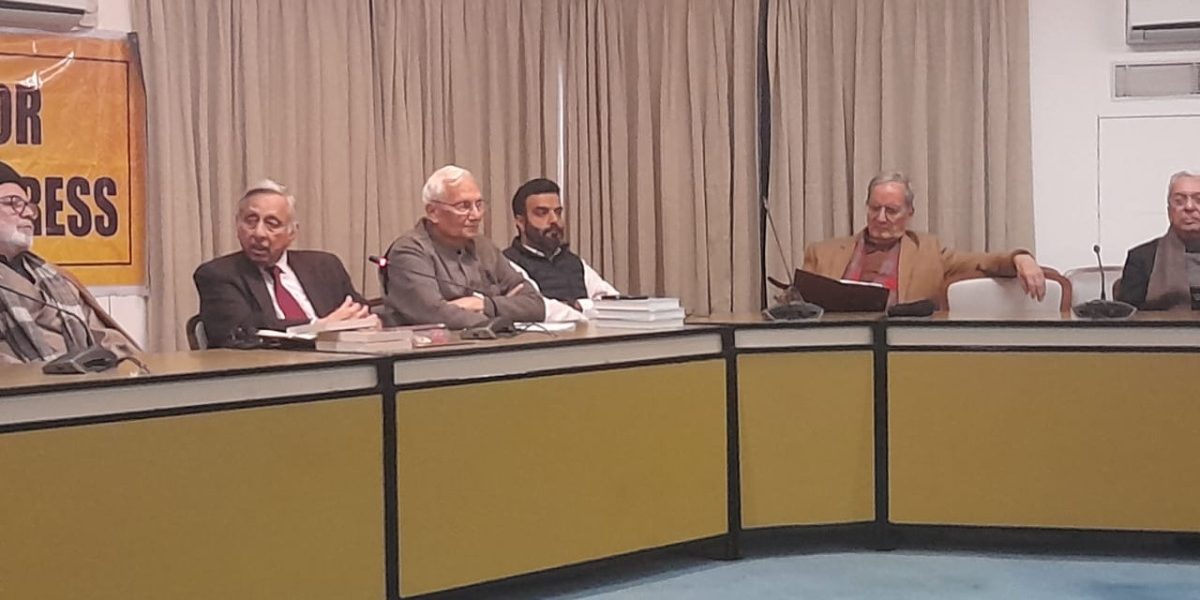

Congress leader Mani Shankar Aiyar, peace activist O.P. Shah and other speakers and attendees at the peace conference held in New Delhi on December 20, 2025. Photo: By arrangement.


New Delhi: With no national political party, including the Congress, demanding the restoration of Article 370 in Jammu and Kashmir, senior Congress leader Mani Shankar Aiyar on Saturday suggested that stakeholders invoke “special provisions” under Article 371 to press the Union government to grant the Union Territory some degree of autonomy.

Speaking at a conference organised by Centre for Peace and Progress in New Delhi, Aiyar said that he favoured restoring statehood “as promised by the Centre” while reading down Article 370, and granting special status to Jammu and Kashmir. But since no political party “including my own party, the Indian National Congress” is making such a demand, “then please negotiate on special provisions under Article 371, like you have done in Gujarat and Maharashtra” and other states, and provide “temporary, transitional and special provisions” to the Union Territory, he said.

Aiyar said that the logic advanced by the Union government to read down Article 370 was that it would substantively fix the problem of terrorism, but the Pahalgam attack and the recent war with Pakistan contradict such a claim. Moreover, he said, Operation Sindoor and the decision to take away the constitutional autonomy of Jammu and Kashmir have weakened India’s diplomatic power vis-a-vis Pakistan and China – an indication that reading down Article 370 has done more harm than good.

The conference, an initiative by the former editor of monthly journal Parlance O.P. Shah, a well-known peace activist, brought together a range of leaders and analysts who have been playing crucial roles in improving relations between New delhi and Kashmir. Interestingly, all speakers, except former NCERT director J.S. Rajput were in favour of restoring Jammu and Kashmir’s statehood and Article 370, even while advocating that negotiations with the Union were the only way forward.

The Chairman of All Parties Hurriyat Conference Mirwaiz Umar Farooq, who was scheduled to be present but wasn’t cleared by the government to travel from Srinagar, sent a message to be read at the conference.

“I was genuinely looking forward to being part of this important conversation. Unfortunately, due to circumstances beyond my control, I am unable to attend, much to my regret,” Farooq’s letter to Shah said.

The once-hardline separatist leader who advocated a non-violent way to demand independence before 2019 appeared a toned-down version of himself in the letter.

“Engagement and dialogue are the bedrock of a humane and dignified process of resolution and reconciliation. Understanding of each other’s concerns and their redressal is best achieved when we talk and listen to each other. My view has always been that every act of violence is to be unequivocally condemned. It only leads to pain and is self-defeating. And such condemnation must not be allowed to transform into collective punishment or blanket suspicion of an entire people or community,” he said.

The Hurriyat chairman had recently strongly condemned the terrorist attack in Delhi, in which a explosion in a car in Old Delhi killed 20 people and injured over 30.

However, Farooq reminded that the post-Article 370 period in Kashmir is far from normal, and indicated that resentment in the Valley has grown.

“…peace cannot be built through demolitions, harassment of families, shrinking civic space, or measures that deepen fear and alienation. These practices do not resolve conflict; rather they aggravate resentment and despair, particularly among youth,” he said.

“A key concern I have consistently highlighted is the growing sense of disempowerment among the people, especially young Kashmiris. When avenues for peaceful political expression narrow, civil liberties are curtailed, employment prospects shrink and individuals live under constant fear of surveillance, arbitrary action or loss of livelihood, a deep feeling of suffocation sets in… Disempowerment, if left unaddressed, becomes fertile ground for alienation and unrest.”

Farooq also demanded a dialogue process “rooted in compassion and mutual respect – not force or coercion.

“I have consistently urged young people to reject violence and extremism , which are morally wrong, religiously impermissible, and ultimately self-defeating. At the same time, security measures alone may suppress symptoms, but only justice, redressal and genuine inclusion can heal wounds and make reconciliation possible,” he said.

The Jammu and Kashmir National Conference MP from Srinagar Aga Syed Ruhullah Mehdi’s intervention was more blunt. “Anyone who thinks that we don’t need to negotiate with Kashmir lives in a fool’s paradise. Anyone who thinks people can reconcile with Kashmir’s degraded status is deeply mistaken,” he said, identifying himself as a representative of a party that has consistently sworn allegiance to the Indian Constitution and the Union of India.

He said that while “power is decentralised in other states”, it is “controlled in Kashmir”. “They want to reshape the identity of Kashmir. They think Kashmir is the homeland of Hindus,” he said, adding that all such political aspirations of the Union government will only embolden the sections within Kashmiri society that have consistently opposed negotiations.

Those in Kashmir who believe negotiation is “betrayal” have strengthened, and pro-India voices have weakened because of the Union government’s actions, Mehdi said.

“If you want to realise the truth, the situation [in Kashmir] is worse than pre-2019 [when Article 370 was read down],” Mehdi said, adding:

“People of Kashmir have not reconciled with the reading down of Article 370. They feel why should they give up their sovereign right… What happened was bulldozing of the Constitutional arrangement.”

Mehdi said that Kashmiri’s elected the National Conference leadership hoping it would get Article 370 restored. “I see a future India where not only J&K but every state will negotiate with the Centre to have something like [Article] 370 or some form of autonomy,” Mehdi said.

Former Air Vice Marshal Kapil Kak, too, was scathing in his criticism of the government in New Delhi. “People’s mood in Kashmir is one of sullen silence. There is a volcano of anger and frustration that is bordering on hate, which can assume dangerous proportions,” he said.

Kak said “resentment and anger against the central government is growing exponentially”.

“Reality in Kashmir is far removed from what is being told by New Delhi or is shown by the media,” Kak, who had also challenged the reading down of Article 370 in the Supreme Court, said. The media has been “muzzled completely”, he said.

Such have been repercussions of reading down Article 370, Kak said, that there is an alarming growth in “uncertainties, alienation, substance abuse and new spaces of radicalisation”.

Other speakers agreed with the central contention that alienation has grown as a result of the Union’s “excesses” in Kashmir in the years following the reading down of Article 370. A Hindu Dogra representative from Samba and peace activist, I.D. Khajuria, said that people from Jammu and Kashmir haven’t been given full citizenship by the Union government, and Kashmiris are being denied even education as they are constantly seen with suspicion in the rest of India.

Khajuria said that political polarisation has been given such a fillip by the government in New Delhi that “one fears” that people from Jammu and those from Kashmir may clash with each other in the future. Echoing a point also emphasised by Aiyar earlier, he said:

“There is no federalism now. The chief minister and other ministers have been rendered powerless. They have become subservient to even a sub-inspector at a police station.”

Leader of Awami National Conference Muzaffar Shah was even more emphatic about restoration of Article 370. He said such conferences must bring together representatives of the Bharatiya Janata Party and the Rashtriya Swayamsevak Sangh too, so that they understand the pain of Kashmiris.

“We can talk about reconciliation, shared peace and negotiation with people from the establishment but there can be no compromise on our demand to restore Article 370,” he said.

“If you want federalism in this country, you need [Article] 370 in every state,” he said. He added that the diverse people of Jammu and Kashmir – the Kashmiri Shias and Sunnis, Hindu Dogras, Ladakhi people – will first have to reconcile with each other and build bridges while also negotiating with the Union government.

Nearly all speakers expressed the view that any possible solution to the Kashmir unrest can only be found when the Union government begins negotiating with “both Srinagar and Islamabad”. There can be no peace without getting Pakistan involved, Aiyar said.

Only Rajput, who was NCERT director during prime minister Atal Bihari Vajpayee’s tenure, did not speak about Article 370, but insisted on “looking for solutions instead of talking about problems”. He said New Delhi could gain Kashmir’s trust by investing heavily in primary education and upskilling the local population.

However, Aiyar and Khajuria refuted Rajput’s views, saying that literacy rates and educational standards in Jammu and Kashmir were comparable to those in Kerala and Tamil Nadu, which are at the top of India’s human development pyramid. They argued that the root cause of Kashmir’s lack of confidence in New Delhi was political in nature – not an outcome of social backwardness.

Magnus Hirschfeld, LGBT pioneer

Modern political agitation for gay, lesbian, and transgender rights started in the late 19th century with German socialists.


Workers' Liberty
Author: Peter Tatchell
 5 November, 2025


Picture: Magnus Hirschfeld

By Peter Tatchell

Over 100 years ago, the gay German sexologist Dr Magnus Hirschfeld pioneered the understanding of human sexuality and the advocacy of lesbian, gay, bisexual, transgender and intersex (LGBTI) human rights at a time when it was deeply unpopular to do so. That took immense courage — and determination. He was battling against the ignorance and prejudice of centuries.

While Oscar Wilde was being tormented in Reading Gaol, Hirschfeld launched the world’s first gay rights organisation in Berlin. Whereas Wilde merely lamented the persecution of LGBTI people, Hirschfeld organised to fight it.

His Scientific Humanitarian Committee, founded in Germany in 1897, trail-blazed the struggle for homosexual emancipation. A similar movement did not emerge in Britain until the 1960s, over half a century later. He truly was a man ahead of his time.

Hirschfeld was born into a conservative Jewish family in what was then Prussia in 1868. During his childhood he developed a curiosity and fascination with sex. Against the conventions of his era and the moralism of his elders, even as a young boy he viewed sexuality as something entirely natural and wholesome.

At medical school, he was traumatised by a lecture on “sexual degeneracy”, where a gay man — who had been incarcerated in an asylum for 30 years because of his homosexuality — was paraded naked before the students like a laboratory animal. Hirschfeld was the only student revolted by such mistreatment. All the others, even his best friend, viewed it as normal and justified.

Further trauma ensued when, soon after setting up himself as a doctor in Berlin in 1893, he was waylaid outside his apartment at night by a soldier who was deeply disturbed by his homosexuality. Hirschfeld resisted the soldier’s pleading for a consultation there and then, telling him to come to his surgery the next day. Overnight, however, the soldier committed suicide.

Hirschfeld’s terrible guilt and remorse motivated him to begin studying homosexuality and, eventually, to write a pamphlet calling for the decriminalisation of gay sex, which was then outlawed under Paragraph 175 of the German penal code [not fully repealed until 1994].

When his family advised him to study something more worthy and respectable like cholera, arguing that research into homosexuality will not bring him any acclaim or joy, Hirschfeld riposted: “What are you saying: that cholera brings you more joy than sexuality?”

As his pro-gay reputation spread, more and more men who were unhappy with their homosexuality came to him as patients. Hirschfeld’s prescription? Lots of gay parties and plenty of boyfriends!

One of Hirschfeld’s biggest problems was hostility from other gays and lesbians. They mostly accepted their second-class legal status. Many did not like him rocking the boat. He was seen as a trouble-maker. They refused to co-operate with his sex surveys and law reform campaigns.

Realising that his lone efforts were not enough, in 1897 Hirschfeld founded the Scientific Humanitarian Committee (SHC). Its strategy was to promote research and education on all sexual matters; in particular to debunk homophobic prejudice and to present a rational case for the decriminalisation of homosexuality.

Demanding

The 1890s equivalent of the UK gay lobby group Stonewall, the SHC’s motto was: “Justice through science”. Some of it’s more radical supporters adapted the battle cry of the French Revolution, demanding: “Liberté, Fraternité, Egalité, Homosexualité!”

As well as having to contend with the complacency and disparagement of other gay people, Hirschfeld was also attacked from left by militant OutRage!-style campaigners led by Adolf Brand. Advocating direct action and the outing of homophobes, Brand denounced Hirschfeld’s “queeny committee” as a talking shop of respectable, middle-class homosexualists.

Much as I admire Brand’s defiant, assertive gay activism, his criticism of the SHC was a bit unfair. In those ignorant, bigoted days, to have a group like Stonewall was truly radical — almost revolutionary. This is confirmed by the way the SHC and Hirschfeld were put under police surveillance as subversives and subjected to repeated harassment.

Thanks to Hirschfeld’s tireless campaigns, in 1898 the German parliament debated the repeal of Paragraph 175. Leading the call for its abolition was August Bebel, head of the left-wing Social Democrats (Hirschfeld was also a prominent member of the SPD). Although defeated, the debate put homosexual equality onto the mainstream political agenda for the first time.

Undeterred by this setback, Hirschfeld decided to tackle the police, in a bid to stop them enforcing the unjust anti-gay laws. He took the police commissioner of Berlin on a tour of gay bars and clubs. Instead of the dens of debauchery that he was expecting, the commissioner found that LGBTI people were witty, stylish, polite and well behaved — and he enjoyed their company. “I wanted to see Sodom and Gomorrah,” he complained somewhat disappointedly.

To strengthen the rational, scientific case for law reform, Hirschfeld proceeded with his medical research into the causes and nature of homosexuality, in the hope that understanding the facts would discourage prejudice and promote acceptance.

Far in advance of others, he concluded that everyone is a mixture of male and female. But this perceptive true analysis led him to erroneously advance the idea that lesbian and gay people were an “intermediate sex” that was biologically predetermined at birth. In his view, male homosexuals possessed a “woman’s soul trapped in a man’s body.”

This well-intentioned misjudgement aside, Hirschfeld was right on most other things. He can and should be forgiven.

As well as his concern for the welfare of homosexuals, he was also a strong advocate of the rights of transgender people — again, decades ahead of his time. Good fortune shone on Hirschfeld when he was paid a fabulous sum to perform one of the world’s first gender reassignment operations. The payment enabled him to establish the Institute for Sexual Science (ISS) in 1919, which predated Dr Alfred Kinsey’s US sex research institute by nearly three decades.

As well as its research role, the Institute promoted sex education, contraception, marriage guidance counselling, advice for gay and transgender people, the treatment and prevention of sexually-transmitted diseases, gay law reform and women’s rights. It saw over 20,000 people a year.

These were novel ideas at the time, and Hirschfeld’s fame and notoriety spread worldwide. When told that the American newspapers were hailing him as “the Einstein of sex”, he wittily replied that he would feel much happier if they called Einstein “the Hirschfeld of physics.”

But his work brought him into conflict with the Nazis. They ranted against his “perversions” — attacking his public meetings and beating up him and his lover and assistant Karl Giese.

While he was away in the US lecturing in 1933, Nazi stormtroopers attacked and ransacked the Institute for Sexual Science, destroying its priceless research archives. The vast library was burned in the great bonfire of “enemy books.” The newsreel footage of these burning books features in almost every documentary about the Nazis and in all the main history books. But it is rarely acknowledged that it was Hirschfeld’s sexological institute and the headquarters of his German gay rights movement that were the main targets and victims of the stormtroopers’ wrath.

The Nazis also seized the Institute’s huge list of client’s names and addresses. These were used by the Gestapo to compile their notorious “pink lists”, which identified homosexuals and led to their arrest and deportation to the concentration camps.

With the Nazis publicly denouncing Hirschfeld as one of the country’s leading “Jewish criminals,” which was effectively a death sentence, friends advised him not to return to Germany. He went to the south of France instead, where he died suddenly of a stroke in 1935. His partner and fellow researcher and campaigner, Karl Giese, committed suicide in 1938, while on the run from the Nazis. Both died sad, lonely deaths; unbefitting their enormous humanitarian contributions.

It took many decades for Hirschfeld’s life and work to be properly documented and for him to receive the social acclaim he so richly deserved.

His extraordinary endeavours are thankfully now well documented... his political campaigns, sexual research and the myriad ups and down of his own less than joyful personal life. As with so many other human rights campaigners, Hirschfeld often sacrificed his own happiness and comfort for the love and welfare of others. A true pioneer and hero of the struggle for sexual human rights and queer emancipation!

• Taken with thanks from here


Queer Health, Livelihoods Improve But Structural Barriers Still Prevail: Pride Fund India Repor
THE WIRE

Across April–November 2025, Pride Fund India tracks progress across 8 states, showing how steady funding lifts communities excluded from welfare and healthcare; and how queer survival strengthens with community care and weakens without the State.


Representative image. Photo: PTI/Mitesh Bhuvad

New Delhi: The Pride Fund India initiative, which supports LGBTQIA+ communities, has published an assessment that reads like a progress report and a quiet indictment of the country’s social systems. Covering April to November 2025, Pride Fund India’s review maps the work done across eight states through 13 grassroots organisations: a snapshot of what steady funding can achieve for communities historically cut out of public welfare, healthcare and formal employment.

The Pride Fund finding states where community-led systems step in, queer people survive and even thrive. However, where the state and institutions stay absent, discrimination flourishes unchecked. Legal victories may decorate courtrooms, the report suggests, but they have not dismantled lived inequality.

Speaking to The Wire on what the review reveals about the gap between law and lived experience, queer-rights scholar Akshay Khanna said: “Recognition on paper doesn’t guarantee dignity in real life.”

He further notes, “What this review shows is that community-run interventions are doing the heavy lifting that institutions should have taken up years ago.”

Healthcare: The first, and still the fiercest, battle

Healthcare appears as the most urgent frontier, according to the report, not because of medical complexity but because of the routine indignities queer and trans people face inside hospitals. Misgendering, moral judgement, denial of treatment and outright hostility remain widespread.

Addressing why healthcare keeps emerging as a crisis point in queer rights, physician and educator Aqsa Shaikh told The Wire, “Healthcare is where stigma becomes policy without ever being written down.” She added, “People are turned away not by law, but by bias.”

The report further highlights that despite these barriers, Pride Fund India’s grantees supported 1,513 individuals with gender-affirming care, counselling, screening and mental health interventions. The scale of this outreach reflects both need and the exhaustion of navigating a hostile healthcare system.

Mitwa Samiti, a community-based organisation facilitating essential documents for transgender individuals through welfare centres, provided hormone therapy to 24 people and laser treatment to 20 others in this duration, offering rare access to medically supervised gender-affirming procedures in spaces where dignity is not up for negotiation.

Naz Foundation’s NAZ Dost helpline, which offers counselling, coming-out support, safe-sex guidance and legal aid to queer people, conducted more than 1,095 calls, a stark barometer of the community’s daily battles: anxiety, family rejection, and STI worries that many are too afraid to take to mainstream hospitals.

Basera Samajik Sansthan, a transgender-led community organisation supporting people living with HIV and other chronic conditions, ran mind-body wellness workshops for 60 members, anchoring care in both physical and emotional health. Meanwhile, in a rare rural, community-driven health-mapping effort, the Karna Subarna Welfare Society surveyed 290 transgender and gender-diverse people in West Bengal, enabling screening for HIV, syphilis, Hepatitis B and C, and tuberculosis.

These numbers are substantial for community-led interventions, but demoralising when contrasted with the near-absence of mainstream health systems.

Asked whether community-run care can remain the backbone of queer health, Naz Foundation founder Anjali Gopalan said, “If the public health system doesn’t evolve, we will continue depending on community networks to fill life-saving gaps. That model is heroic, but not sustainable.”

Economic independence: The long road to dignity

Economic vulnerability is the predominant issue running through most queer lives. Without documentation, safe schooling or workplace acceptance, queer and trans people often have no path into formal employment. Pride Fund India’s review recognises that livelihoods are not just income; they are dignity in motion.

The report states that, in 2025, 316 people were trained across hospitality, stitching, digital literacy, beautician work, driving and financial literacy, with 74 individuals securing jobs or launching small enterprises. Deepshikha Samiti trained 128 participants, placed 46 in employment and helped 28 set up home-run businesses. At the AASRA shelter, Tweet Foundation trained trans men through a partnership with Hamdard Hospital, offering work-ready skills to a group often shut out of formal skilling programmes.

Karna Subarna Welfare Society developed rural livelihood models in mushroom cultivation, spice processing, poultry and textile work; options tailored for regions where formal hiring remains scarce and stigma often decides who gets a chance.

The organisation is still vocal about the gap between skilling and stability. Without stipends, workplace safety, identity documents, mental health support and employer sensitisation, the uplift remains fragile.

Responding to this gap, labour rights expert Ashwini Deshpande said, “Skilling without structural support is like giving someone a boat with no oars. You are technically afloat, but nowhere close to moving forward.”

Safety and shelter

As per the report, safety remains a daily negotiation for queer people; at home, in public, in institutions and workplaces. Pride Fund India’s partners worked on legal literacy, crisis intervention and documentation support, acknowledging that safety is multidimensional.

Basera Samajik Sansthan trained 75 transgender individuals in collaboration with legal service authorities. The Naz Foundation ran rights-based capacity-building programmes on domestic violence and POSCO for sex workers and trans women.

Tweet Foundation continued operating AASRA, one of India’s few dedicated shelters for trans men, while launching a Digital Garima Kendra to support identity documents and government services. Sensitisation sessions with the Delhi Police and a local church signal small but meaningful shifts in institutions historically associated with exclusion and fear.

Speaking to The Wire on the concern of systemic safety, activist Grace Banu said, “For queer people, safety is not the absence of violence; it’s the presence of systems that won’t abandon them when violence happens.”

Culture, visibility and narrative power

Beyond survival, the report highlights the power of visibility grounded not in token Pride imagery but in community-driven cultural work. Sappho for Equality’s Rongdhonu Mela showcased 46 queer and disabled entrepreneurs and drew more than 3,000 visitors. In Karnataka, Payana trained trans theatre artists and staged five productions reaching over 650 people. Sappho is also translating foundational queer texts and preparing Bioscopia, a queer film festival in Kolkata, signalling a shift toward community-owned archives and narrative spaces.

These interventions indicate that community organisations are not merely responding to crises but shaping culture and public imagination. When asked about what visibility means in this context, writer Sunil Mohan puts it to The Wire, “Visibility is not decoration; it is documentation. It is how a community saves itself from erasure.”

Institutional barriers and challenges ahead

The Pride Fund India review shows persistent structural barriers: routine misgendering in hospitals and government offices, lack of identity documents, workplace harassment, collapsing rural market linkages, burnout among small CBO teams and the constant weight of stigma. These pressures cause programme dropouts driven not by disinterest but survival needs.

The report argues that the most effective interventions are those co-designed with the community: models where safety nets, stipends and mental health support are foundational, not optional.

Over seven months, Pride Fund India’s partners enabled 1,513 people to access healthcare, 316 to receive training, 74 to secure livelihoods and 110 to obtain legal empowerment, while 726 participated in cultural initiatives. Three queer publications and one livelihood-mapping study were also produced.

The report warns that queer dignity hinges on whether institutions; healthcare systems, labour markets, welfare schemes, local administrations, can evolve at the pace at which communities are rebuilding themselves.

Asked what queer communities demand today, Banu said, “Queer people are not asking for acceptance anymore. They are asking for resources, recognition and the right to live without negotiation. The question is whether India is ready to meet them halfway.”
UK

Employment Rights Bill is law, but more battles to come


Workers' Liberty
Author: Gerry Bates
 16 December, 2025 


The Labour government's flagship Employment Rights Bill passed both houses of Parliament on 16 December, so will soon become law.

Not all done and dusted, though. As Nils Pratley writes in the Guardian:

"It would be a mis­take to think royal assent will mark the moment when the lob­by­ing ends and every­body, employ­ers and uni­ons alike, can con­cen­trate on imple­ment­a­tion. In fact, the reverse is true...

"Take the intro­duc­tion of guar­an­teed hours con­tracts... It is not clear how a worker’s right to guar­an­teed hours, hav­ing worked those hours reg­u­larly dur­ing a ref­er­ence period, would oper­ate in prac­tice.

"What is the threshold for a 'low hours worker'? Does it mean as few as eight hours a week or, say, as many as 30? How reg­u­lar is 'reg­u­lar work'? How long is the ref­er­ence period?...

"The extraordin­ary fea­ture of the bill is that many things have been delib­er­ately left to be resolved in sec­ond­ary legis­la­tion..."

Which could mean, diluted seriously by that "secondary legislation" (legislation which is simply presented by ministers to Parliament and which normally goes through without debate). Trade unions must be made vigilant and insistent. Some of the provisions of the Bill will come into effect early in 2026, but others not until October 2026 or early 2027,

The Lords finally backed down, after several weeks of refusing to accept the Commons version of the Bill, when the government coaxed the CBI and other bosses' organisations into an open appeal to the Lords to do so.

The CBI had been sweetened by "day one" rights on unfair dismissal being dropped from the Bill, to be replaced by a six-months delay before you can claim unfair dismissal rather than the current two years. That backdown was approved by the TUC, and indeed we understand that the government used the TUC as its intermediary to convince bosses' organisations that six months was acceptable.

Unions should be pressing for Labour to introduce an additional one-clause Bill for "day one" unfair dismissal rights, to be persevered with even if the Lords use their powers of delay to the one-year maximum.

The Bill includes licence for unions to use electronic (rather than postal) balloting and removal of the turnout thresholds for industrial-action ballots mandated by the Tory Trade Union Act 2016.

As far as we can see from employment-law websites, thresholds will go two months after "Royal Assent" for the Bill, so mid-February 2026. (So the March 2025 statement by the TUC that it wouldn't go until after electronic balloting came in was wrong?) In early December (later than expected) the government published "consultation" documents on electronic balloting. That was due to be implemented in April 2026, but some reports now say it could be late 2026.
Poland 1970: 55 years since workers fought back


Workers' Liberty
Author: Gerry Bates
16 December, 2025 


Today marks 55 years to the day that Polish workers were on strike in revolt against their so-called 'socialist' authorities. By the 19th of December 1970, 44 workers on the Baltic coast had been murdered by the Polish state and over 1000 people were wounded.

Two years earlier in 1968, the same government had, at the behest of Russian imperialism, sent Polish troops to participate in the invasion of Czechoslovakia. They had also engaged in a violent crackdown on student protests across Poland and forced the emigration of 13,000 Polish jews. Both the crackdown and the forced emigration was conducted under the guise of ‘anti-zionism’.

In mid-December 1970 the Stalinist government under Wladyslaw Gomulka had announced huge hikes in basic foods. On the 14th of December protests against the measures erupted in cities on the Baltic Coast, with workers walking out of multiple workplaces.

In Gdansk, protestors and strikers, predominantly from the Lenin Shipyard marched to the provincial Headquarters for the ruling PZPR Party. The authorities refused to enter negotiations and the highest-level bureaucrats were away in Warsaw.

The police gathered to demand the workers to return to work. The protestors seized the police loudspeaker and announced a further rally in front of the building and a General Strike from the following day.

The police and security forces roamed the city rounding up workers and beating them.

The following day the strikers set fire to the PZPR HQ in Gdansk. The authorities killed 6 people. Hundreds more were wounded. The government appealed for workers to go back to work. Despite this, soldiers opened fire on trains carrying workers to the shipyard in Gdynia, killing 11. Elsewhere in town, soldiers and police shot dead a further 7 protesters.

Over the next 3 days the protests, strikes and workplace occupations spread across Poland. Gomulka ordered 10k’s of solders and heavy tanks to be deployed to violently crush the resistance and at least 44 people were killed with over 1000 injured.

This fueled the indigation among the population and the growing unrest and spreading strikes and workplace occupations forced the government to reverse the price rises. Even the Russian imperialist overlords had to accept that this was the only way to prevent a potential revolution and acquiesced to Warsaw’s capitulation.

Poland would come much closer to that 10 years later when mass strikes resulted in the Gdansk Agreement, where the communist authorities were forced into accepting independent trade unions among other demands, including a demand to build a monument outside the Shipyard in Gdansk, in commemoration of the workers killed in 1970. This remains the first and only monument to Stalinist oppression to be erected by the government that perpetrated it.
China's Engine of Environmental Collapse


Workers' Liberty
Author: Owen Falls
21 December, 2025 


China is responsible for over 30% of GHG emissions. It is responsible for more emissions than the next 5 highest emitting countries combined (USA, India, Japan, Russia, and Germany). However, China’s population is two-thirds the combined population of those countries and its GDP is 32% of their combined GDPs. Is there something special about China’s economic model that makes this the case? This is the conundrum that Richard Smith tries to answer in China’s Engine of Environmental Collapse.

The book was written in 2020 and covers the extent of China's environmental destruction, with a focus on the past 20 years. Richard Smith covers how from 1978 China has ramped up its emissions. He covers a range of topics from pollution of soil and rivers to excessive building and construction, to the inner workings of the CCP. The book was published before the Covid-19 pandemic and so does not cover the period of China’s ultra-lockdowns.

China is now fully integrated into the world economy. It has played an ever-increasing role in the renewable technologies market. Since 1978, China’s economy has grown on average 10% per year. Its rapid growth and growing share of world manufacturing (now at around 30%) has been due in no small part to its ever expanding capacity to burn coal. Coal plays a massive role in China’s economy not only in its energy supply but also in its iron and steel production. China leads world production in the latter and is the third largest producer of iron-ore after Australia and Brazil.

A significant part of the left cheer on China and play down its authoritarianism. Smith’s book is a useful antidote for anyone who needs a reminder of the extent to the Chinese state suppresses national minorities, intimidates and elilinatesn political opponents, leads the world in executions, and regularly crushes dissent with police violence - whether this to repress Uyghurs, Hong Kongers, Tibetans or to attack and crush the labour and other progressive movements.

Smith paints a vivid picture of China’s environmental destruction. He describes at length China’s excessive construction projects that have led to entirely redundant office blocs, railway stations, airports, districts of cities, and even so-called “ghost cities” that lie completely empty. In its populated cities, Smith describes the extent of the air pollution, the heavy use of cars and massive multilane motorways that nonetheless have not abated China's massive traffic and congestion issues. China’s rivers, lakes and soils are massively polluted and in large part this due to a combination of unenforced but existing environmental and health and safety legislation, corruption within the CCP bureaucracy, and of course a rapacious drive to grow the economy at nearly any cost.

Since 2017 Xi Jinping has announced his intention to make China into an “ecological civilization”. This has included promoting the State Environmental Protection Agency to ministerial rank, which gives the agency more powers to intervene and the real steps being taken to tackle small polluters, limit combustion vehicles, tackle issues of plastic and e-waste, and bring in more protections for natural reserves. Yet as Smith argues even if Xi Jinping were serious about tackling environmental issues, he runs a state and economy where it is near impossible to decarbonise without a massive overhaul of the political system. As Smith puts it Xi Jinping “runs a politico-economic system characterized by systemic growth drivers which are, if anything, more powerful and more eco-suicidal than those of “normal” capitalism in the West.”

Smith’s explanation of what drives China’s internal growth and environmental destruction is in parts clear and in other parts confused and contradictory. In his earlier writing Smith argued that China was a bureaucratic-collectivist. He has since revised this position to argue that it is some mix of bureaucratic-collectivist and capitalist. And he breaks down the drivers of China’s emissions as being: intra-bureaucratic competition, nationalist and imperialist ambitions, employment maximisation, consumer maximisation, and corruption. These are all major drivers, however, an important aspect of China’s growth that Smith leaves out (or at least understates) is its integration into the world capitalist economy.

Moreover, at various points in the book Smith seems to be at pains to say that the mix of the economy being both bureaucratic-collectivist and capitalist provides a more potent mix when it comes to growth and environmental destruction than if it was just capitalist or just bureaucratic-collectivist. Broadly speaking Smith argues that there is something qualitatively different about China’s political-economic system from that of capitalist states in the rest of the world.

I am not convinced there is something qualitatively different about China, so much as the world is more capitalist and more capable of driving development from a low starting point - and China provides a prime example of this.

Much of what Smith claims about China being uniquely different from capitalism does not stand up to scrutiny. For example, Smith argues that Xi can’t stop his party subordinates and other officials from wasting resources and polluting because if he did, he would have to challenge their economic interests. Do we not have this in the West and nearly any capitalist economy? If states try to impose regulations on waste and pollution they get push back from sections of capital and reactionary political forces. Smith does not account for why the supposed bureaucratic-collectivism in China makes this so qualitatively different.

On a different occasion Smith argues that the main driver for growth under capitalism is competition. The only limit to growth is if profits can't be made. So far so good. Smith goes on to argue that this is not the case for China. He maintains that because China is a hybrid of bureaucratic-collectivist and capitalist, the system is “largely exempted from the laws of capitalism”. He argues that exemplary of this is that not one SOE has gone bankrupt or failed. Smith seems to have blinded himself to all the ways in which companies and banks under capitalism are regularly kept afloat, subsidised and saved by the state - in fact it is something distinct about how how a capitalist state acts. If anything, China under the rule of the CCP does this aspect of capitalism better than other countries. And if anything its combination of lack of regulation in health and safety and the environment and its willingness to keep SOEs going at any cost, along with China’s nationalist ambitions to be dominant on the world stage, account very well for why it has outdone itself in economic growth and environmental destruction.

Smith’s book is a great primer on China’s environmental and economic record. While I think Smith’s analysis of China in part is confused and the analytical conclusions he draws are mistaken, his insights into how the CCP functions and what ambitions drive it are valuable. Anyone who wants to learn more about China and the environment should make time to read and discuss this book.


The Proof is in the Pudding: A Few Comments on Socialism with Chinese Characteristics

Anyone interested in socialism in the twenty-first century must take into account what is happening in China seriously. It’s future economic supremacy will either shape global capitalism, which socialists worldwide will have to respond to or the future of socialism will be determined by China’s planned transformation toward a socialist economy                                                                       —  Jan Turowski [1]

China has achieved what is perhaps the most spectacular modernization in the history of the world in timespan and scale, accomplishing in decades what took centuries elsewhere… it has developed productive forces in agriculture, industry, technology, science and culture. It has raised millions from poverty to prosperity. It has integrated into the world system, for better or worse. It manufacturers much of what the rest of world consumes. It leads the world in green energy and other scientific and technical advances necessary for global survival. It is a force for peace in a mad world where the drums of war are beating more dangerously than ever. Because of this, I see China as the hope of the world.                                           — Helena Sheehan [2]

The Communist Party of China (CPC) was founded in Shanghai in July 1921. At its inception the CPC had only 50 members ( 100 million today) and came to power in 1949 after 28 years of revolutionary struggle. Mao Zedong reminds us that “Revolution is not a dinner party or writing an essay or painting a picture or doing embroidery. It cannot be so refined, so leisurely and gentle, so temperate, kind, courteous and restrained and magnanimous. A revolution is an insurrection, an act of violence by which one class overturns another.”

The Communist revolutionaries, freed China from foreign domination and defeated the virulently anti-communist Chiang Kai-shek’s Kuomintang. They attempted to meet the immediate basic needs of the people while operating under extremely debilitating circumstances. China was an immense, semi-feudal, semi-colonial country and the new government encountered problems that were both challenging and often sui generis. They needed to find answers in order to continue the socialist transformation of the country, the historical mission begun in 1949.

The ideal of “Common Prosperity” had its origins in the CPC’s founding and was made official policy in December 1953 in a report drafted by Mao Zedong. The phrase then appeared in the September 25 issue of the semi-official People’s Daily in an article entitled, “The Path of Socialism is the Path to Common Prosperity,” and again in December 12, 1953. It’s important to clarify that the term envisioned an egalitarian, mutual aid type society in which resources would be held in common. In 1956, the CPC understood that the primary contradiction facing China “was between the need for building a modern industrial society and the reality of a backward agricultural economy,” and further, “the needs of the people for rapid economic and cultural development and the failure of current economic and cultural supplies to meet these needs.” [3]

All the evidence suggests that in the period following the Revolution, China saw gains in the material living standards of peasants and workers, including extending life expectancy, literacy rates improving from 20 to 93 percent, land reform initiated, women liberated, a decline in infant mortality and “Barefoot doctors” insured that basic medical care reached a population that was 99% peasant in composition. Unquestionably, impressive strides were accomplished — until things began to stall.

Later, Deng Xiaping was to characterize the Mao Zedong period as 70% good and 30% bad and that has been the common formula adopted to this day in China. The Chinese people still revere Mao and view his errors as “the errors of a great proletarian revolutionary.” Although Mao’s contributions are seen as far exceeding his errors, Deng’s 30% includes both the Great Leap Forward (1958-1961) and the Cultural Revolution which set back China in serious ways. There are still debates among respected scholars about those two events but there is agreement that China remained at a very low level of development, lagging decades behind Western nations in terms of technology, science and services.

Without in any way disparaging the heroic gains cited earlier. I don’t think Hua Bin overstates his assessment of the Maoist period when he writes, “The CPC in the first thirty years of its rule was a revolutionary party led by people who didn’t understand modern economics, science and technology. So it imported a rigid system from the USSR — we can call it Marxism with Russian characteristics. Obviously, the result was disastrous.” [4]

The socialist market economy eventually chosen by the CPC remains controversial in some quarters but as China specialist Carlos Martinez asserts, had there not been genuine improvement in the standard of living, the CPC’s socialist project and socialism itself would have lost legitimacy. In that sense, we can interpret Deng’s statement about Maoism’s shortcomings as necessary to differentiate his new “pragmatic” path in 1978 from what preceded it.

The link between egalitarianism and common prosperity was officially severed on April 15, 1979, when the People’s Daily carried an article, “A Few Get Rich First and Common Prosperity.” In Deng Xiaping’s words, “in encouraging some regions to become prosperous first, we intend they should inspire others to follow their example and that all of them should eventually help economically backward regions to develop. The same holds true for some individuals.” From that point onward, the path was all about maximizing the development of productive forces because China was decades behind the advanced countries, especially in science and technology.

Deng was acutely aware of the dangers of polarization that could result and said, “As long as public ownership occupies the main position in our economy, polarization can be avoided.” It’s important to note that this new path was to be temporary, an expedient but absolutely necessary stage in what would ultimately achieve common prosperity via a comprehensive national strategy. Trial and error was not discouraged and in Deng’s words it involved “crossing the river by feeling the stones.”

Here we should be mindful that in China, Marxism has been adapted to the country’s concrete material conditions. Again, quoting Martinez: “Marx wrote that the development of the productive forces of social labor is capitalism’s ‘historic mission’ and justification. For that very reason it unwittingly creates the material conditions for a higher form of production. The CPC replaced “unwittingly” with “purposely”: using capital with strict limits and under heavy regulation, to bring China into the modern world.” [5]

China opened the door to transnational capital in order to obtain access to technology and science on behalf of economic development. Martiniz continues, “Deals with foreign investors were drawn up such that foreign companies trying to expand their capital in China were compelled to share skills and technology and operate under Chinese regulation.” This was all in sync with the state’s development planning and although there was resistance from investors, it was the price of “gaining access to the vast and growing Chinese market.”

China incorporated market mechanisms but they operate under the socialist state which is controlled by the CPC, not private capitalists as is the case in the United States. Deng Xiaping put it this way: “In order to realize communism, we have to accomplish the tasks set in the socialist stage. They are legion, but the fundamental one is to develop productive forces so as to demonstrate the superiority of socialism over capitalism and provide the material basis for communism.”

Yes, millionaires and billionaires exist in China (some are even party members) but the CPC does not allow them to constitute a capitalist class. They’re prevented from establishing their own political parties or organizing their own media. Further, the ‘commanding heights’ of the economy remain under the stringent control of the party, including heavy industry, energy, transport, aviation, communications and foreign trade. China’s ‘big four’ banks are majority owned and accountable to the government, not shareholders.

In their socialist market economy, 71% of China’s Forbes 500 companies are state-owned enterprises (SOEs). There are some 360,000 SOEs in China and they dominate the economy. For our purposes, it’s imperative to note that in keeping with “socialism with Chinese characteristics” they are required to operate in accordance with the government’s macro-economic plan. They answer only to the Communist Party’s leadership.

The New Era, began in 2012, with Xi Jinping as Chairman of the Communist Party and his use of Mao Zedongs’s words, “carrying the revolution to its completion.” After first publicly uttering the phrase on December 30, 2012,  President Xi has reiterated it over one thousand times. For him, it’s quintessential Marxism. And in 2017, the new principle contradiction was, “between unbalanced and inadequate development and the people’s ever growing need for a better life.

Common Prosperity, when employed in the Xi era, means reducing income inequality, enhancing welfare and curtailing excessive wealth. There will be both incentives and pressures for charitable giving and also crack downs on tax evasion. In 2012 the CPC specified that by 2035, “substantial progress” toward common prosperity would be achieved. This means narrowing regional, urban-rural and income disparities. It does not mean, “robbing the rich to help the poor “ or sharing everything equally. Nor does it mean imitating the Nordic welfare state model. The goal is that the “middle income group” — neither rich nor poor — will be significantly expanded. A recent, authoritative, data-based study found that China is fully capable of achieving common prosperity by 2035, including providing assistance to low-income people in difficult situations (200 million to 300 million people.) [6]

It also means guarding against, as Xi has often mentioned, party officials becoming part of a privileged elite and departing from the socialist project. Further, it entails dealing with corruption which is openly acknowledged by the government. Officials caught being involved in graft have been made examples in keeping with the Chinese adage, “kill a chicken to scare the monkeys.” President’s Xi’s well-known, ongoing anti-corruption campaign is highly popular with ordinary Chinese citizens, including his recent actions against the high tech sector, the gaming industry and for profit private tutoring companies.

Going further, Hua Bin writes that the campaign has, “Taken down hundreds  of thousands of officials at national and local levels, including members of the Politburo, defense minister, foreign minister, railroad  ministers, provincial governors, mayors of many cities, bank CEOs, state owned company executives, military procurement officials, hospital administrators and countless others. Chinese corruption is about corrupt individuals. Corruption is illegal and highly punishable. It may never go away as human defects won’t go away but it is risky for the corrupt individuals. Corrupt officials can steal a lot of money, but they run a risk of being shamed and losing everything, including their lives (the railroad minister was executed).” [7]

It’s a well-known fact that by 2021, the hundredth anniversary of the CPC founding, China had eradicated “extreme poverty” (the poverty reduction miracle) 10 years ahead of schedule. By 2022, 1.346 billion people were covered by basic medical insurance and 1.1 billion by basic pension insurance, an increase of 24 million from the previous year. In 2023, the “middle income group” already constituted almost 25 percent of China’s population. It rose from 10 million in 2002 to 336 million in 2023. [8] China projects that its middle-income group will increase to 800 million in the next 10 years, creating an olive-shaped distribution chart. This will occur as the government “invests more in people” and spends more on human capital and social safety nets.

This higher stage of socialist development or “advanced socialism” will also entail increased government control over resource allocation. In a sense, the inevitable inequality which accompanied the introduction of private capital to China, must be deconstructed. There will be resistance to these efforts and the CPC will need to employ appropriate responses. Socialism with Chinese characteristics or “Common Prosperity” must coexist within a global capitalist system for the foreseeable future but the goal for 2049, the centenary of the Chinese revolution, is to have built, “a great modern socialist country that is prosperous, strong, democratic, culturally advanced and beautiful.” The exact term is “advanced socialism.”

Further, Xi has often spoken about the need to “build a world of common prosperity through win-win cooperation” and “a shared future for mankind”. China’s Belt and Road Initiative (BRI) embodies this vision and Beijing has committed more than $1.3 trillion to the BRI since 2000. A recent report found that over 79% of leaders in the Deep South viewed Beijing as actively supporting their countries’ development. Without naming the United States, the report also noted “heavy handed attempts by the PRC’s strategic competition to vilify Beijing’s contributions as entirely bad for local economies are likely to ring hollow.” [9]

Finally, constructing socialism is a long term historical process and nothing I’ve suggested here guarantees that China will move on to Marx’s higher form of production, to “advanced socialism,” by 2049. There are forces both within and especially outside China that will attempt to subvert or even doom further efforts. However, to affirm their achievements so far, the Chinese have adopted the English proverb, “the proof of the pudding is in the eating” or shortened, “the proof is in the pudding.” At this juncture, it’s safe to conclude that they’re correct.

[1] Jan Turowski, “How the Chinese Talk About Socialism,”Rosa Luxemburg Stifling.
[2] Helena Sheehan, “Exploring the Chinese Revolution Today,” Monthly Review, Vol.77, No.6 (November, 2025).
[3] For details, see, Roland Boer, Socialism with Chinese Characteristics: A Guide for Foreigners (New York: Springer, 2021).
[4] Hua Bin, “Making Sense of China’s Meteoric Rise, “The Greanville Post, December 11, 2025. This was a response to interview questions posed by Mike Whitney and was originally on Hua’s Substack. There are, of course, analyses that interpret this period more sympathetically and some dismiss Mao’s critics as capitalist roaders.
[5] For these quotes and his compelling explication, I’m indebted  to Carlos Martinez’s book, The East Is Still Red (Glasgow, Scotland: Praxis Press, 2023)
[6] Angang Ha and Shaoje Zhou, China in 2025: Toward a Society of Prosperity for All: London: Palgrave Macmillan,2024). See, https://researchgate.net January 20247]
[7] Hua Bin, “Corruption in the US and China — A Comparative Analysis,”  The Unz Review, December 4, 2004.
[8] See, Terry Sinclair, Xiune Yang and Bjorn Gustafson, “China’s Middle-Income Class, Macroeconmic Growth, and Common Prosperity,” China Leadership Monitor, CLM, November 30, 2024.
[9] Sarina Patterson, “The BRI at 10: A Report from the Global South, AIDDATA, March 26, 2024. I wrote about this in my piece, Gary Olson, “China’s BRI: Toward a Hybrid International Order with Chinese Characteristics,” Left Turn, #13, Summer, 2023.

Gary Olson is Professor Emeritus at Moravian College, Bethlehem, PA. Contact: glolson416@gmail.com. Per usual, thanks to Kathleen Kelly, my in-house ed. Read other articles by Gary.
50 years since Franco; István Szabó


Workers' Liberty
Author: John Cunningham
 3 December, 2025


Some years ago I attended a conference in Valencia where a Spanish participant told me that in her village, on hearing the news of Franco’s demise, the celebrations were such that they ran out of champagne. 50 years on there will no doubt be a more reflective response but the anniversary of this vile dictator’s death is still worthy of note.

Pan’s Labyrinth (2006), in my opinion one of the best Spanish films ever made, written and directed by (Mexican born) Guillermo del Toro, is set in Spain in 1944. Anti-Franco guerrillas are still active in the north and the thuggish Captain Vidal (Sergi Lopez) is dispatched to sort them out. His wife, heavily pregnant, and step daughter Ofelia (Ivana Baquero) accompany him.

Ofelia has visions of an underground cave which she visits to see a magical Faun (Pan in the English title) who, despite his rather fearsome, fantastical appearance, befriends her, informing her that she is really Princess Moanna. In the real world Vidal attempts to suppress the guerrillas with utmost brutality. His wife dies in childbirth but Vidal is unmoved, concerned only that she gives birth to a son. The guerrillas eventually defeat and capture Vidal and extract revenge.

If you are looking for a present for that film-loving friend check out the new Second Run Box Set of three of Hungarian director István Szabó’s best films: Oscar-winning Mephisto (1981), Colonel Redl (1985) and Hanussen (1988), all set in Central Europe and featuring the Austrian actor Klaus Maria Brandauer.

Each DVD in the set is accompanied by a booklet giving the historical background to the films and other details. I am duty bound to mention that I wrote the Mephisto booklet. Each film has been restored, with new English sub-title translations. The set also includes four rarely seen short films by Szabó. A cineaste’s delight, highly recommended.
Between Bernstein and Lenin


Workers' Liberty
Author: Rayner Lysaght
 19 November, 2025 


This section takes the story of the first three workers’ Internationals from the 1890s to 1905. Though idiosyncratic in its slant on some points, the account (abridged from a pamphlet, The First Three Internationals, published in 1989), gives important elements of history.

The French Possibilists abandoned their attempts to form an International and affiliated to the Marxist body [in 1891]. That did not mean that they abandoned their politics. In fact, these were restated by one of their leaders, Alexandre Millerand (1859-1943) as being the aims of gradual reform within the nation state. This emphasised the fact that, even without the Anarchists, the International was far from being an homogeneous Marxist body.

Most French Socialists were influenced by Possibilist views. Most British Socialists were similarly inclined. The comparative seniority of the latter’s working class, which had caused its union leaders’ opportunism in the 1860s and which had since delayed the appearance of its own independent party, was now ensuring that the one party that made the breakthrough into parliament was the Possibilist Independent Labour Party. Of the genuinely mass affiliates, those of what were then the separate colonies of Australia were similar.

Only the mass German Social Democratic Party seemed to provide a bastion of Marxist politics, and this appearance was itself being challenged.

The party was based mainly in the new Empire’s industrial north: the states of Prussia and Saxony. The country was organised federally, with each state maintaining its own electoral laws. In Prussia, the system was loaded to give extra representation to the landlords (junkers) and hardly any to the workers. The southern states had more nearly democratic franchises but were less industrialised so that the party had a weaker base. These two factors made it seem both possible and necessary for the South German Social Democrats to proceed by collaborating with sections of their class opponents.

In 1891, those in Württemburg voted with the Liberal State Government to pass its budget. In 1894, this practice was accepted by the Party’s National Congress as being justified by local conditions, despite a protest from old Friedrich Engels.

The next year, the South German tendency suffered a setback. The Party Congress defeated its members’ proposal to adopt a land policy aimed at winning small farmers. This defeat was significant, less in itself than in its revelation of forces far more important to advancing reformism than were the south Germans. For the proposal was not defeated only on its merits, though these were few enough. The Party Leader, the Marxist, Bebel, supported it. It was defeated by the vote of officials from the new Social-Democratic trade unions, who preferred to allow the small farmers to be proletarianised (and hopefully, members of their trade unions) rather than make a political effort to win them.

They were supported in this, and their assumptions rationalised, by the party’s leading theoretician, Karl Kautsky (1854-1938).

Kautsky’s fatalistic approach would not be strong enough to keep him allied to the developing Social Democratic bureaucracy without disagreement. In any case, that bureaucracy did not need him. On the other hand, German Social Democracy had come to need the bureaucracy to organise it.

A further complication was that it was only since 1890 that the Party had been able to develop legally; the German Anti-Socialist Laws were a recent memory and a standing threat against too radical political action. And the reformists could argue that they were facing problems that orthodox Marxists ignored. However inadequately, they recognised the political problem of the need to win the small farmer.

Defeat

A year after their defeat on this, they could claim a further justification of their class-collaborationism. In Saxony, the advance of independent Social Democracy was answered by the capitalist parties uniting to replace the comparatively democratic franchise with a form of the Prussian system. The South Germans argued that intelligent class collaboration could have avoided this: the Party’s majority had no answer.

The time was ripe for German reformism to be given a theoretical dignity that would make it appear more than a system of surrender to events by alleged Marxists. In Britain, the Fabian Society was providing such a rationalisation but it was not yet part of the working-class movement, nor was it trying to be. Nonetheless, its members’ writings did influence Engels’ former secretary, Edward Bernstein (1850-1932).

Between 1896 and 1898, Bernstein published a series of articles that defended the practice of most Socialist Parties and counterposed it to the stated Marxist aim of the Socialist Society. He summarised his approach better than he realised in his comment that, for him, the aim is nothing... the movement everything. He reduced Marxism’s value to one of historical analysis of economic pressures and class struggles. He denied the possibility of capitalist economic collapse, whether general (for society as a whole), or individual (small concern liquidating into monopoly). He substituted for the Marxist dialectic a combination of empirical investigation and moral purpose. For him a Socialist Party’s chief role was to produce a series of piecemeal reforms through Parliament. His proposals were a revision of Marxism: Revisionism.

In this haziness as to ends, Bernstein was arguably more honest — if less radical — than the reformist spokesman, the Bavarian Georg von Vollmar (1850-1922), who asserted that it would be possible and desirable to achieve a Socialist society within the State boundaries of one country.

Bernstein’s attack provoked a reaction from the Marxists who claimed the majority in German Social Democracy. Two foreign recruits, the Byelorussian Parvus (Alexander Helphand, 1869-1924) and the Pole Rosa Luxemburg (1870-1919), published pamphlets defending Marxist principles. So too did Kautsky, another of Engels’ protégés and a far more prominent figure, but he did so only after persuasion by his Russian counterpart, George Plekhanov (1856-1918).

What was more, although Bernstein’s ideas were condemned at successive Party Congresses between 1899 and 1903 and at the International’s Amsterdam Congress in 1904, many known revisionists, including himself, on occasion voted for the condemnation. His political career flourished and he was elected to the German Parliament (Reichstag) for his Party in 1902.

The sun of mass political growth was nurturing bureaucratic interests in German Social Democracy. Their relationship to Bernstein’s Revisionism differed between the bureaucracies of the trade unions and that of the Party proper. Having trade unions organised by Party members had been expected to frustrate the opportunism that developed in Britain. In practice, their work’s necessary concentration on bread-and-butter issues with little political support and their own relative but increasing material privilege compared to their members made the German Social Democratic trade-union leaders the readiest to accept Revisionism.

The Party’s own bureaucracy was organised at a higher political level; it was concerned more directly with advancing the Programme passed originally at Gotha (1875) and renewed at Erfurt (1891). This theoretical base was made less effective by the Programme’s division into a minimum list of reforms compatible with capitalism and a maximum or full Socialist programme. Basing themselves on the latter, the majority leaders of German Social Democracy attacked the theory of Revisionism, without being able to offer any alternative to the Revisionists’ practical solutions to the short-term problems.

Strategy

Both theory (against the Anarchists) and practice tended to limit Social Democracy’s strategy to one of parliamentary means. Against the Anarchist demand to abolish the State it had asserted the need to take State power. But what did this mean? It was all too easy to interpret it as did the Revisionists: the electoral struggle every few years to win the right to administer the existing state machine. In itself this provided the reason for a major part of any Social Democratic activity, in Germany or elsewhere, at the time.

In most countries manhood suffrage, without which electoral victory was impossible, did not exist and women had no national vote. In Belgium and Austria, indeed, the workers struck for the right to vote. Bernstein himself supported such a means for an end, since democracy was a necessary pre-condition for achieving the greatest reform. He disagreed with the political strike for other causes and had the agreement of most trade union leaders. Eventually, it would be the workers of Russia who would bring back the revolutionary seizure of State power as, in effect, the missing and crucial part of any Socialist programme without which it would remain, at best, Marxist in theory and Revisionist in practice.

When Bernstein’s articles appeared first the Social Democratic Party Secretary, Ignaz Auer (1846-1907) wrote him: “My dear Ede, you don’t pass resolutions. You don’t talk about it (Revisionism). You just do it”.

Until 1899 the controversy over Revisionism remained centred in German Social Democracy. Although French Socialism seemed even more divided (organisationally as well as politically) between Possibilists and Impossibilists, the debate between the two was less developed and deemed likely to end in reconciliation as common (Reformist) practice tended to unite the participants. However, in 1899 the Possibilists broke even with that practice in a way that defied the basic principle of independent working-class political organisation even more definitely than the South German budget votes.

The Anti-Dreyfusards, a powerful antisemitic movement supported and used as a front by Monarchists, Clericalists and Militarists, had influenced successive French Governments and seemed to threaten the Republic itself. To defend it and to open the way for possible reforms, Alexandre Millerand did not only pledge support for a new Government but joined it as Minister for Commerce, with the support of his Possibilist colleagues.

The following year the matter was discussed at the International’s Fifth Congress, in Paris. After much debate, Kautsky drafted a compromise. It was passed, despite some opposition which included that of two united national delegations, those of Belgium and Ireland (the Irish Socialist Republican Party; this was the only Second International Congress at which Ireland was represented). It was agreed that, in future, no member of an affiliate of the International would be allowed to take office in a State Government without his party’s permission. The central political issue (the relationship of the Party to the capitalist state) and the central person (Millerand) were both ignored.

This was less than satisfactory, in that Millerand’s action was not even justified by political results. He and his Ministerial colleagues did break the influence of the Anti-Dreyfusards, get their victim, Captain Alfred Dreyfus (1859-1935) released from jail and begin a series of educational reforms, but they did little more over three years and ended by using the army against striking workers and colonial peoples. As would happen in all such future alliances, Millerand had not captured a bourgeois ministry but had been captured by the capitalist state.

Controversy

However, the controversy he had started reflected the fact that French Marxism was starting from a theoretical basis even less developed than that of Germany. Its leader, Jules Guesde (1845-1922) was far more influenced by Proudhon’s anti-political views than Bebel or Kautsky were by Lassalle. For Guesde, the Dreyfus case was irrelevant to the working class. French Socialism’s most able thinker, Jean Jaurès (1859-1914), was a Possibilist and a defender of Millerand. On the other hand, many genuinely revolutionary Socialists were abandoning Marxism or else trying to merge it with a new form of strategy that opposed the International’s definition of political action by action through industrial unions: Syndicalism.

In the English-speaking world, problems were even more acute. In Britain and the dominions the Marxists were still losing ground while honestly Reformist parties advanced. In Ireland, the Irish Socialist Republican Party was organised by a genuine Marxist, James Connolly (1868-1916), but its rank and file were less conscious and, in 1903, he left them for the USA. In any case, more real electoral support was given to the Belfast Labour Party which was in the Independent Labour Party mould.

Connolly was not misguided in seeing the USA as more promising. It had produced Daniel de Leon (1852-1914), a theoretician whose writings were admired by Lenin and whose Socialist Labour Party became the centre of the Marxist tendency in the English-speaking world before 1914.

It had been founded by German-American Lassalleans and, far more than the Germans, upheld the Lassallean principle of close party control of its associated trade unions and their indoctrination with the Lassallean Iron Law of Wages and the resultant futility of strikes for wage rises. This weakened the Party against its country’s non-political union organisation, the American Federation of Labour. By 1901 it too had provoked Revisionists and genuine Marxists into joining to form a looser, less homogeneous (in effect less Marxist) Socialist Party of America, which would soon win more support than de Leon’s organisation.

The most effective opposition to Revisionism and to the more subtle degeneration of world Marxism was being developed in central and eastern Europe. Rosa Luxemburg was fighting for greater clarity in a revolutionary approach to the issues raised by Bernstein. In Russia, where the movement was less developed, Plekhanov and Lenin (Vladimir Ilyich Ulyanov, 1870-1924) were fighting to build a Russian Social Democratic and Labour Party with the norms they believed existed in the German Social Democracy.

This last body condemned Revisionism firmly at its 1903 Dresden Congress. At the same time it avoided accepting its practical challenge, as Luxemburg demanded. It sent the motion it had passed to the International, which itself passed it at its sixth Congress in Amsterdam the following year.

The Amsterdam Congress was to the Second International what the Basle Congress had been to the first. It was the organisational highpoint that preceded its highpoint in practice. Its affiliates were advancing everywhere. In the Commonwealth of Australia that year, the Labour Party formed a Government. In Belgium, Austria and the less democratic German states of Prussia and Saxony, the Social Democrats led the fight for the democratic franchise.

The chief achievement of the Amsterdam Congress was that it consolidated this growth by passing a motion to unite its national affiliates. On the theoretical side, its ratification of the Dresden motion made a gesture towards the idea that such unity should be on Marxist political lines. In fact, neither was really successful. The French united, though the right-wing Possibilists led by Millerand preferred to break altogether with Socialism. However, the Russians and Americans remained divided. More importantly, the Dresden motion remained a substitute for serious Marxist analysis.

Just as Basle had been followed by the Paris Commune, so, now, Amsterdam was followed even more swiftly by the Russian Revolution of 1905. Starting and continuing formally on a bourgeois-democratic programme, it stimulated the establishment of working-class councils or soviets in St Petersburg and Moscow which posed practically the seizure of state power by workers in a way not seen since and more radically than the Paris Commune. For a time it threatened to spread westward. The German and Austrian Emperors considered intervening to save Tsarism. Radicalised by the upsurge, the normally Revisionist German trade-union leaders threatened a general strike if this occurred.
Gender divisions and capitalist history


19 November, 2025 
Author: Katy Dollar


In Rethinking Women’s Oppression, a chapter of her book Women and the Politics of Class, Johanna Brenner  surveys Michèle Barrett’s well-known book Women’s Oppression Today.

Brenner rejects reductionist Marxist approaches which assert women’s oppression is an integral part of capitalism’s basic mechanics, and thus leave untheorised why it is women who carry out domestic labour and can obscure sexism within the working class and working-class families. She also rejects theories of capitalism and patriarchy as dual systems, because they tend to be ahistorical in their analysis of patriarchy and to posit gender ideology as something autonomous and outside material conditions.

She argues that gender ideology, like all ideology, is rooted in our lived everyday. Gender divisions are produced by a complex balance of forces at a given point in the history of capitalism.

Michèle Barrett posits a historical account of the formation of the family-household system. But she then sees the ensuing ghettoisation of women in low-paying sectors of capitalist production as shaped by protective legislation and union exclusionary practices.

“Better-organised male craft unions and the bourgeois-controlled state were able to override the interests of female workers... These divisions are systematically embedded in the structure and texture of capitalist social relations in Britain and they play an important part in the political and ideological stability of this society. They are constitutive of our subjectivity as well as, in part, of capitalist political and cultural hegemony”.

Brenner’s historical work shows there is little evidence that protective legislation had a determining negative effect. It was not universal and came long after the gender division of labour was established. Trade union action was not the cause of gender division, either. Trade unions were not homogeneous. Sometimes trade unions promoted discrimination against working women with the idea that men and women have or should have “separate spheres”. There are also many examples of trade union support for women’s organisation.

Studies of women’s work in the nineteenth century indicate that usually women withdrew from full-time  work in factories at the time of their first child. Women who worked in factory conditions had more difficult pregnancies, and were more likely to miscarry or have a child with health problems. Bottle-feeding was not safe or affordable, and full-time work prevented breastfeeding.

Before protective legislation or union contracts, women changed their employment around family constraints. Mothers found jobs that fitted with the domestic demands: part-time work, seasonal work.

Economies

In pre-industrial economies, reproduction and production accomodated each other. The organisation of production remained in the hands of the workers themselves sufficiently that work rate and location could be flexible around biological needs. The increasing determination of work conditions by machine production posed difficulties.

Pregnancy, childbirth, lactation are not easily compatible with factory or office work without maternity leave, breastfeeding facilities, childcare, and flexibility in late pregnancy. Capitalists will not willingly pay for those provisions as they increase costs. Until we win the provisions, the reproduction of labour power becomes problematic for the working class as a whole and for women in particular.

Working-class families did not have enough money to buy in social reproduction as goods and services (nannies, housekeepers, washing machines, etc.). Given that, a division of labour where one person undertook domestic labour (plus maybe supplementary wage work), while another earned wages full-time made sense.

Of course precapitalist ideologies, and then the bourgeois family ideal, had a role. But the shaping of working-class family norms was reinforced by the material realities of working-class life.

Women’s work was more precarious and paid less because the workforce was usually less able to organise. Mothers had domestic work which left them less time and energy for union organising. Young women not yet married had more time but often stayed in work more briefly.

Gender ideology was and is rooted in and shaped by women’s and men’s experience in everyday life.  Gendered divisions were not so much embedded in the barebones fundamentals of capitalist relations of production, as produced by the balance of forces at a point in the history of capitalism.