Tuesday, December 23, 2025

Feds to reveal future of EV mandate in 2026, as Liberals urged to relent on 100% target


Story by Stephanie Taylor
National Post
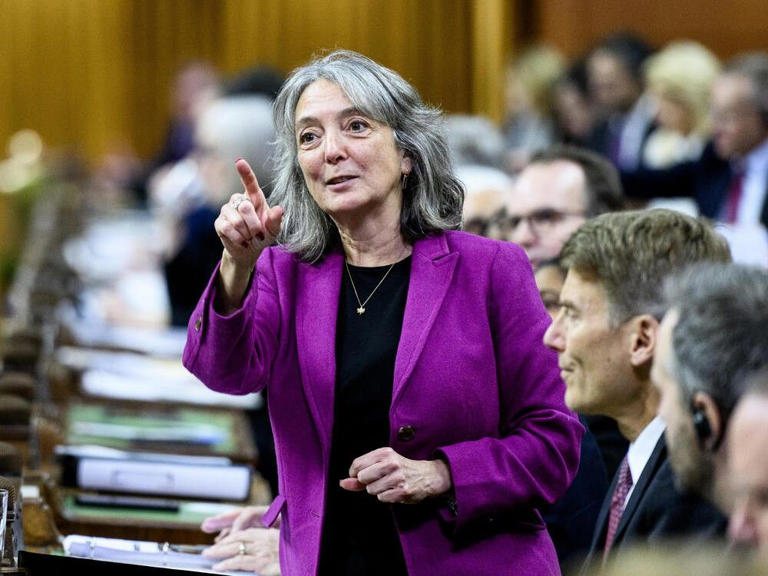

Minister of Environment and Climate Change Julie Dabrusin rises in the House of Commons during Question Period on Parliament Hill in Ottawa, on Thursday, Dec. 11, 2025.

OTTAWA — As Prime Minister Mark Carney ushers in a new era of climate policy for the Liberals, a key decision is hanging over the governing party’s approach to electric vehicles.

Namely, will the 2035 sales mandate be kept or outright repealed?

The regulation currently requires manufacturers to hit certain sales targets for zero-emission vehicles, with those targets progressively rising until all new vehicle sales are zero emissions by 2035.

Keean Nembhard, a spokesman for Environment Minister Julie Dabrusin, said in a statement that “we will have more to share in the new year,” regarding the results of the 60-day review and the future of its zero-emission vehicle policy.

That timeline is beyond what some in the industry had expected, as automakers seek clarity on the regulation they spent this year urging Carney to repeal, citing the plummeting sales of electric vehicles and the ongoing Canada-U.S. trade war, where the auto industry has found itself on the frontlines.

“We’re very disappointed that there has not been a decision communicated to the auto industry, and we’ve been urging the federal government and the prime minister to move quickly on this and make a decision,” said Brian Kingston, president and CEO of the Canadian Vehicle Manufacturers’ Association, which represents Ford, General Motors, and Stellantis.


The Liberals’ Nov. 4 budget stated that the government would “announce next steps on electric vehicles in the coming weeks.”

The government now expects that to happen early next year, as it works through changes to the policy.

Carney launched a 60-day review of the policy back in September, pausing the requirement for 2026, which would have mandated that 20 per cent of new vehicle sales be zero-emission.

The review was launched amid concerns that hitting that target was unrealistic. Kingston, who, along with auto CEOs, met with Carney over the summer, warns that to comply, manufacturers would have to spend “billions” on purchasing credits from other electric-vehicle makers, such as Tesla, or restrict the sales of gas-powered and hybrid vehicles.

“Companies are making decisions about production and inventory for the 2027 model year. And the longer that this goes on and this uncertainty hangs out there, the more damage and cost is put on the industry,” he said.

Manufacturers can also comply by spending money to build out charging infrastructure.

While automakers say the Liberals ought to scrap the policy, other stakeholders have urged the government to maintain the rule, but with changes, such as dropping the target that all new vehicle sales must be zero-emission by 2035.

Electric Mobility Canada, a national association representing the electric transportation industry, wrote in its submission as part of the government’s review that it should “eliminate” the 100 per cent target, “to remove a political flashpoint that is not necessary to maintain momentum in the transition.”

Clean Energy Canada, a think-tank based out of Simon Fraser University, recommended the same, instead suggesting the government lower the 2035 target to between 90 to 95 per cent.

“Reducing the (100 per cent) target could enhance public support by removing the perceived ‘ban’ on gas-powered vehicles and offer options for ‘hard-to-electrify’ jurisdictions, while still achieving significant emission reductions and improving (electric vehicle) affordability and availability,” it wrote in its submission.

Both British Columbia and Quebec, two provinces with their own sales mandates, revised their own policies to remove the 100 per cent target by 2035, with Quebec lowering it to 90 per cent, and B.C. stating it wanted to align its provincial policy with whatever the federal government releases.

Quebec also relaxed requirements for what counted as a zero-emission vehicle, including on its list non-plug-in hybrid vehicles, which have smaller batteries. The federal definition only includes plug-in battery hybrids and fully electric vehicles or ones powered by hydrogen fuel cells.

Opposition Conservative Leader Pierre Poilievre has been one of the most vocal critics of the federal policy, arguing that it amounts to a “ban on gas vehicles” and an affront to rural living, where driving remains essential.

Nembhard said the government received “considerable input from stakeholders, provinces and territories and Indigenous organizations” during the course of its 60-day review, which he said was launched to address “changes in tariffs and trade, economic uncertainty and shifts in the automotive industry.”

“Its aim was to ensure (Electric Vehicle Availability Standard) continues to reflect market realities, remains effective for Canadians, and does not place undue burden on automakers.”

Rachel Doran, executive director of Clean Energy Canada, said she believes the most important thing is that Canada makes policy choices that guarantee “affordable (electric vehicles) are available to Canadians.”

“And I will say right now, that is not the case.”

Doran points to moves like the federal government’s decision to suspend the purchase rebates for electric vehicles earlier this year, as well as the levying of a 100 per cent tariff on Chinese-made electric vehicles, which are cheaper to purchase.

The latter remains a must to maintain, say leaders in Canada’s auto industry, who say it is not only essential that Canada stay aligned with the U.S., which first took the step under former U.S. president Joe Biden, given how integrated the two auto markets are, but also to protect the domestic industry against unfair advantages of competing against these vehicles, which Beijing has heavily subsidized and produced using less rigorous labour practices.

Doran nevertheless points to examples like the European Union, where more affordable models of electric vehicles remain available, including from Japanese and South Korean automakers.

“So we really do have kind of a problem here that needs to be solved.”

Despite campaigning on plans to reintroduce a purchase incentive, Carney’s government has yet to do so.

An internal briefing note, signed by officials within Transport Canada last December as the government prepared to announce a pause on the rebate program, which was released to National Post under federal access-to-information legislation, warned that ending the program was expected to be met with “strong criticism from industry, environmental organizations, consumers and other levels of government.”

Officials stated that around $2.9 billion had been spent on the incentive program since it was launched back in 2019 and that, as of November 2024, it had helped Canadians buy or lease more than 519,000 zero-emission vehicles and grow its market share.

Automakers and environmental advocates alike have blamed the ending of the program, which the federal government announced back in January, because it had run out of its allotted money, for the dramatic drop in sales.

Rick Smith, executive director of the Canadian Climate Institute, another think-tank, said scrapping the mandate altogether would “grind to a halt decarbonization in the transportation sector.”

Next to the oil and gas sector, the transportation sector remains the second-highest source of greenhouse gas emissions.

Smith said the regulation, which the institute supports, is only part of the overall policy picture he believes the federal government must fulfil to make it easier for Canadians to make the switch to electric vehicles.

“Our hope is, in the new year, that the federal government make good on its commitments to bringing back purchase subsidies,” Smith said, adding it also needs to boost the building of public charging infrastructure.

With files from The Canadian Press

National Post


V0TE NO!
'Independent state?' Proposed referendum question approved on Alberta separation


Story by Jack Farrell


EDMONTON — Alberta's election agency announced Monday it has approved a proposed referendum question on the province separating from Canada.

The question seeks a yes or no answer to: "Do you agree that the province of Alberta should cease to be a part of Canada to become an independent state?"

Elections Alberta said the proponents — the Alberta Prosperity Project and its chief executive officer, Mitch Sylvestre — have until early January to appoint a financial officer for its petition campaign, after which signature collection can begin.


TINY GROUP OF SEPERATISTS WHO LOVE USA MORE THAN CANADA


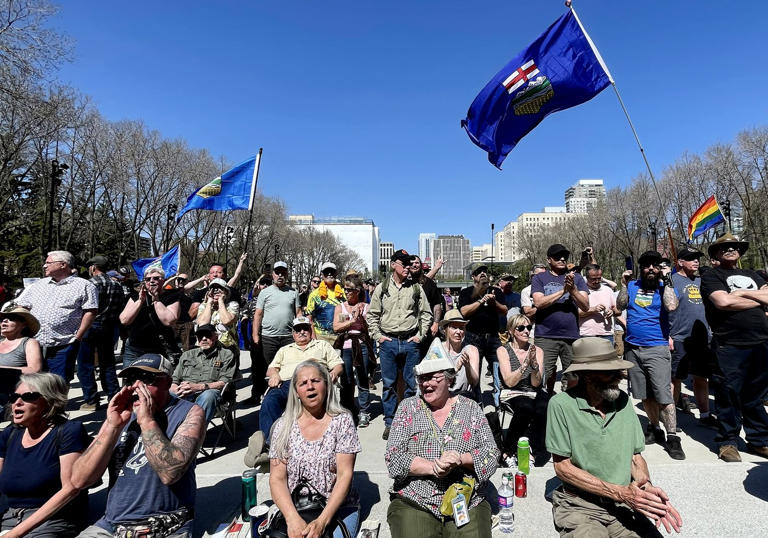
People gather in support of Alberta becoming a 51st state during a rally at the legislature in Edmonton, on Saturday, May 3, 2025. THE CANADIAN PRESS/Jason Franson© The Canadian Press  JUST MOVE SOUTH


Sylvestre, a constituency association president for Premier Danielle Smith's United Conservative Party, has four months to collect just under 178,000 signatures. If he does so, the question would be put to Albertans in a referendum.

The Alberta Prosperity Project said on social media Monday that the approval is a "huge victory" for the province.

"This is the breakthrough we've been fighting for," it said.

Sylvestre, in an interview, said he thought Alberta needs to go it alone because of Ottawa's restrictions on oil production and dim prospects for federal electoral change.

"This last election when the Liberals won after 10 years of absolute brutal government, as far as I was concerned, I believe that there's absolutely no way that we'll ever win another election in Alberta," he said.

"It's up to us to decide what to do about that."

Sylvestre said the group already has 2,000 people signed up internally to collect signatures, and more than 240,000 people who have previously pledged their willingness to sign.

"This is very non-partisan as far as I'm concerned," he said.

"Every Albertan will benefit from this, and it'll give Alberta children and my grandchildren and my kids a much brighter future as far as I'm concerned, or I wouldn't be doing it.

The group's approved question is similar to one it had previously submitted: “Do you agree that the province of Alberta shall become a sovereign country and cease to be a province in Canada?”

That question was held up in court for a review of its constitutionality.


The delay prompted Smith's government to change the rules for citizen-initiated referendums earlier this month.

The changes rendered the court review moot, as it allowed Sylvestre to reapply at no charge while also preventing Alberta's chief electoral officer from rejecting referendum proposals should they be unconstitutional or not factually accurate.

Justice Colin Feasby, who issued his decision on the original question despite the government vetoing the result, deemed the proposal to be unconstitutional, but only under the previous rules.

Feasby, in his decision, wrote that Alberta separating from Canada would violate certain Charter and treaty rights, as there are no guarantees Albertans would keep their right to vote federally or maintain mobility rights if the province were to become its own nation.

He also noted that those rights would need to be accounted for in any negotiation undertaken to amend the Constitution, something that would be required should Alberta actually look to quit confederation.

"Alberta chose not to give citizens the power to propose to take away Charter and Treaty rights through the citizen initiative process," Feasby wrote.

But he added: "Alberta seems to regret this decision now."


Justice Minister Mickey Amery's press secretary, Heather Jenkins, said in an email that it's a democratic right for people to participate in citizen initiated referendums and bring forward questions they deem important.

"If those seeking independence believe that they have the support for it, this is their chance to prove it," she said.

Sylvestre said he was excited at the prospect that Albertans could soon decide their own fate.

"In spite of the fact that this has been a roller-coaster up and down ride, I think it's going to be well worth it no matter what happens," he said.


"The people are going to be able to decide based on the information that they get what they want to do with their future, and I think this is what democracy should be all about."

This report by The Canadian Press was first published Dec. 22, 2025.

— With files from Dayne Patterson in Calgary.

Jack Farrell, The Canadian Press


Alberta Next Panel recommends ditching RCMP, referendum to quit CPP

Story by Lisa Johnson


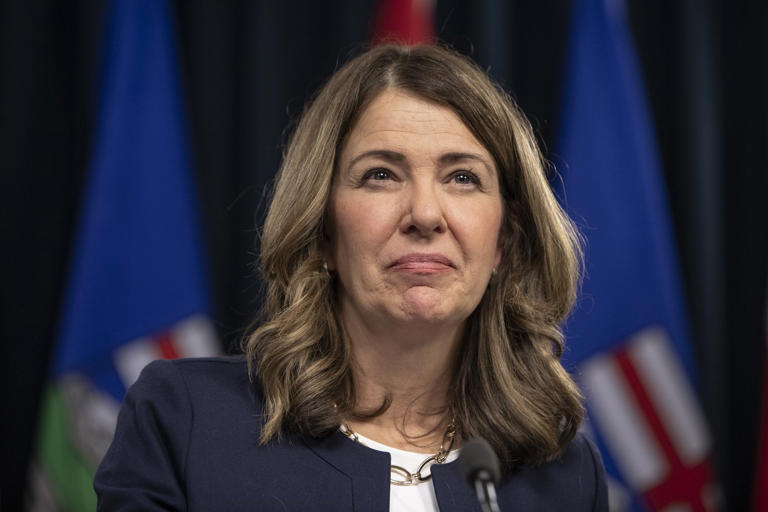
Premier Danielle Smith speaks to the media at the Legislature in Edmonton, on Wednesday, Dec. 10, 2025. THE CANADIAN PRESS/Amber Bracken© The Canadian Press

EDMONTON — Alberta Premier Danielle Smith’s hand-picked panel re-examining the province's relationship with Ottawa says it’s time to ditch the RCMP and hold a provincewide referendum on quitting the Canada Pension Plan.

The Alberta Next panel, in a report with findings and recommendations, says creating a provincial pension plan was the most hotly debated topic among citizens and one that needs to proceed to a vote.

“Replacing the CPP with an (Alberta plan) is the most financially meaningful initiative Albertans have the right to pursue on our own to enhance our sovereignty and financial independence within a united Canada,” says the report from the panel, which was headed up by Smith.

But the panel stresses such a vote should only be held after residents receive more information on the pros and cons of the province going it alone.

And it says a vote would be contingent on an Alberta pension plan matching or improving the payouts and premiums of the federal system.

The report was issued Friday afternoon without a news conference, and Smith was not made available for an interview.

Her office, asked if she would support a CPP referendum, pointed to Smith's earlier comments that it would be tight to get the issue on any ballot for next fall.

The next general election is set for October 2027.


Related video: RCMP official says police force's future in Alberta uncertain (CBC)


The report comes after months of public town halls across the province and survey feedback.

It also recommends continuing work to create an Alberta police force to replace the RCMP when the latest contract with the national force ends in 2032.

Smith’s government has long questioned whether the province is getting value for money on the Mountie contract, while saying a provincial force can bolster accountability.

The panel acknowledged a provincial force was also a polarizing topic in debates but said it heard concerns about police staffing levels, particularly in smaller communities, with hundreds of contracted policing positions going unfilled.

“Some, like Cypress County, have been paying the RCMP with zero officers provided,” says the report.

The panel also called for referendums on more provincial control over immigration and on specific constitutional questions, such as abolishing the "unelected Senate."

It suggested doing a cost-benefit analysis of Alberta running its own tax system.

And it urged Alberta to push harder for equalization reform, saying that on balance Albertans are OK with subsidizing smaller provinces but “the vast majority strongly oppose their federal tax dollars subsidizing provinces with the fiscal and economic strength to deliver such services on their own.”

Opposition NDP Leader Naheed Nenshi labelled the Alberta Next project a stage-managed distraction from government failures on health care and education.

He said Smith didn't campaign on any of the issues prioritized in the report, which he noted was released on the Friday before Christmas.

"The government has spent millions of taxpayer dollars on a sham consultation, where they actively silenced anyone who dared to disagree with them,” Nenshi said in an interview.

“(They) are now pretending that that was the voice of Albertans to justify spending millions of dollars more on referenda on things that Albertans don't want.

Nenshi said the CPP issue is a stalking horse to create a government controlled piggy bank.

“They want to create a large asset fund that is under the control of the government to invest in things the government wants to invest in," he said.

Debate in Alberta over whether to quit the more than $777-billion CPP has been ebbing and flowing for more than two years under Smith. The premier has linked a standalone plan to long-standing concerns that Albertans are paying more into Confederation than they deservedly get back.


In 2023, her government issued a report estimating Alberta is entitled to more than half the money in the national nest egg should it go its own way.

That number was hotly contested. Absent a clear exit figure, Smith put formal consultations on hold and the issue faded into the background.

As late as this spring, Smith said no firm bottom line number coupled with a lack of public “appetite” for leaving the CPP precluded any referendum for the time being.

However, the panel said a straw vote of people at its town halls supported the idea, as did a slim majority of those in its poll. But it noted a “clear majority” of those who sent online feedback opposed leaving the CPP.

The panel said it heard concerns about what would happen if a provincial fund was mismanaged or if Alberta’s strong economic advantage didn't continue, not to mention questions about portability.

The panel said all those details – contribution rates, management structure, benefits and more — need to spelled out for Albertans ahead of any referendum.

This report by The Canadian Press was first published Dec. 19, 2025.

Lisa Johnson, The Canadian Press


Alberta increases referendum petition fees to $25,000 — a 5,000 per cent hike

Story by Lisa Johnson


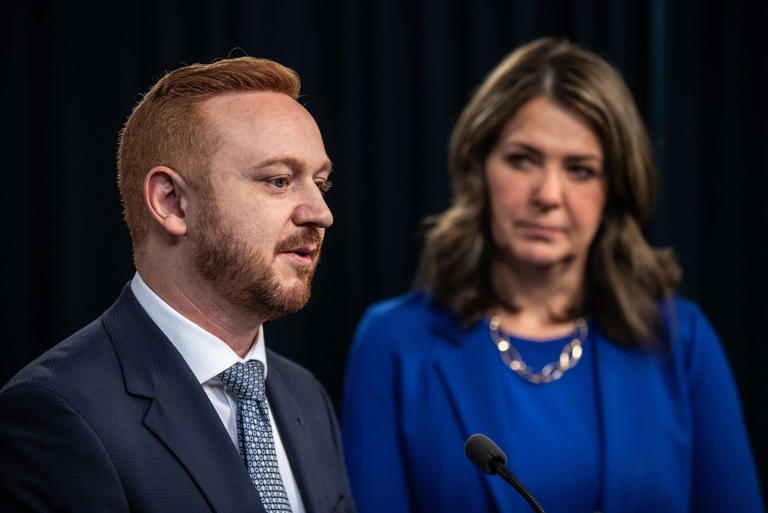
Alberta Premier Danielle Smith and Minister of Justice Mickey Amery announce proposed changes to several pieces of democratic process legislation, in Edmonton on Tuesday April 29, 2025. THE CANADIAN PRESS/Jason Franson© The Canadian Press

EDMONTON — Alberta Premier Danielle Smith's government is hiking the cost to apply for a citizen-initiated referendum by 5,000 per cent, saying it's about making sure applicants are serious.

It’s the latest in a series of rule changes that one petitioner – country singer Corb Lund – characterizes as exhausting.

A cabinet order released late Wednesday afternoon upped the fee to $25,000 from $500.

Heather Jenkins, press secretary to Justice Minister Mickey Amery, says the cost will be refundable if the applicant meets the required threshold of signatures and completes reporting requirements.

"Citizen initiative petitions are costly,” Jenkins said Thursday in a statement.

“That is why a higher application fee was chosen, to discourage frivolous applications and protect Alberta taxpayers.”

The move comes despite previous efforts by Smith's United Conservative Party government to make it easier for citizens to apply for a policy initiative or a constitutional referendum, including efforts to put Alberta separation on the ballot.

Lund may not have to pay the higher fee.

Elections Alberta confirmed Thursday his prior application to launch a referendum to stop new coal mining in Alberta's Rockies will have a grace period


The new fee would be waived if Lund files his paperwork by Jan. 11.

Lund, in an interview, said it’s disturbing to see Smith’s government make sudden rule changes for what he views as "random, self-serving reasons.”

"The chaos and confusion and exhaustion is very similar to the same confusion, chaos and exhaustion that we've seen from the government on how they've been handling the coal situation for the last six years," Lund said.

"It just keeps changing."

He said no matter what else might shift, he won't be deterred from completing a process that's already been cancelled by recent election law changes, forcing him to start again.

"We'll fill out as many forms as they make us fill out if it means we can keep the coal mines out of the headwaters of the rivers that provide our drinking water."

Premier Smith has long championed the merits of direct democracy.

In late November, when asked about Lund's petition, she said, "I support citizen-initiated referenda. I think it's really important that people have their say. The rules are out there, and I will watch with great interest.”

Earlier this year, Smith's government significantly lowered the thresholds for citizens to apply for a referendum, including the number of signatures required.

Earlier this month, her government passed a new law to clear further legal hurdles faced by those aiming to hold a separation referendum.

A pro-Confederation petition organized by former Alberta deputy premier Thomas Lukaszuk is not affected. Elections Alberta has already certified that petition as having the required signatures. Lukaszuk seeks to spike separatist sentiment by forcing a decision to reaffirm Alberta staying in Canada.

Another application has already received the green light to proceed. It seeks to gather signatures to ask whether Alberta should end spending public money on independent schools.

Alberta NDP justice critic Irfan Sabir says the fee increase shows the UCP government doesn't have any respect for the democratic process.

"This change is clearly meant to stifle democratic action,” Sabir said in a statement.

Chief electoral officer Gordon McClure told a legislative committee earlier this month it cost $340,000 to verify Lukaszuk’s petition and that the cost to prepare for a subsequent provincewide referendum would be more than $3 million.

This report by The Canadian Press was first published Dec. 18, 2025.

Lisa Johnson, The Canadian Press

How Tamil Nadu Challenges BJP's Narrative of Cultural Hegemony

As Hindutva ideology reshapes political narratives across much of India, Tamil Nadu is emerging as a key battleground

N.K. Bhoopesh
Updated on: 3 December 2025
OUTLOOK, INDIA


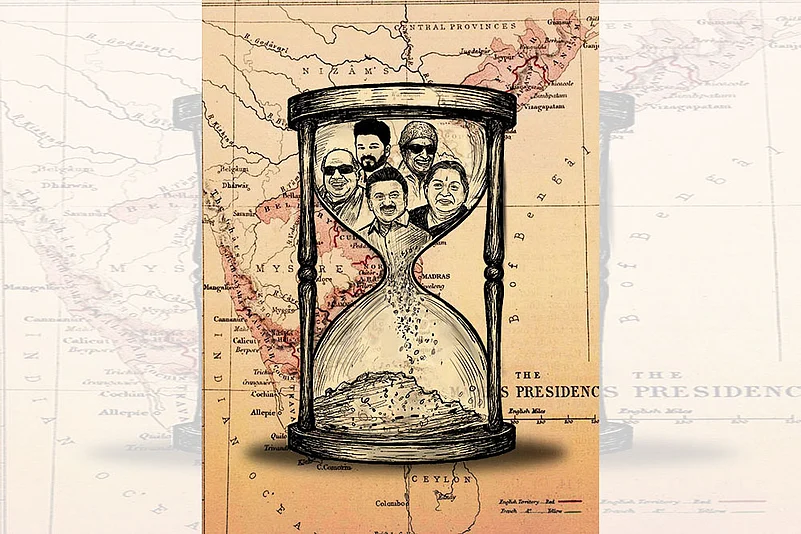
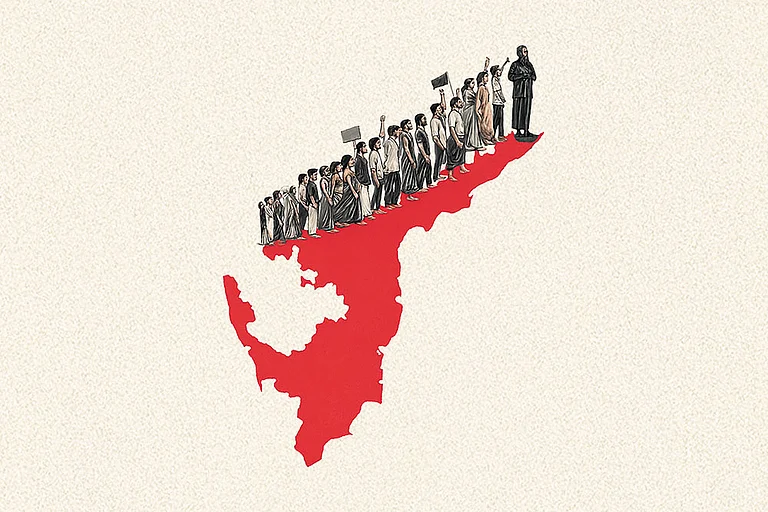
The Dravidian movement emerged with a clear purpose: to challenge what it saw as the Union government’s growing drive to centralise power. Photo: Illustration: Saahil


“I claim, Sir, to come from a country, a part in India now, but which I think is of a different stock, not necessarily antagonistic. I belong to the Dravidian stock. I am proud to call myself a Dravidian. That does not mean I am against a Bengali, a Maharashtrian or a Gujarati. I say that I belong to the Dravidian stock and that is only because I consider that the Dravidians have got something concrete, something distinct, something different to offer to the nation at large. Therefore, it is that we want self-determination.”

When C.N. Annadurai, the founder of the Dravida Munnetra Kazhagam (DMK), delivered these words in his maiden Rajya Sabha address in 1962, he left members on both sides of the aisle spellbound. It was a speech steeped in sub-national consciousness, boldly challenging the mainstream narrative of Indian nationalism from the floor of the sovereign Indian Parliament. For many, it announced that a new political force that was rooted in Dravidian identity and Tamil pride had arrived with clarity and confidence.

Though the DMK later moved away from its early secessionist position, it has remained the country’s most vocal political force in demanding strict observance of federal principles. This continuity is evident in Chief Minister and DMK leader M.K. Stalin’s recent criticism of the Supreme Court’s opinion on prescribing timelines for Governors to act on bills submitted for assent. After the court declined to fix such a timeline, Stalin said he would not rest until a constitutional amendment made timely action mandatory. The stance reflects the DMK’s long-standing ideological line, consistent from its founding to the present.

The Dravidian movement emerged with a clear purpose: to challenge what it saw as the Union government’s growing drive to centralise power. For leaders like Annadurai, this was not merely a political disagreement but a question that touched the heart of Tamil identity, language and dignity. As the conflict between regional aspiration and federal centralisation intensified, the movement found deep resonance in Tamil Nadu.

Related Content


Forging A Horizontal Dravidian-Tamil Solidarity | Excerpt From The Dravidian Pathway


Inside Tamil Nadu’s Ideological War: Dravidian Politics vs BJP’s Hindutva Push


Dravidian Model Of Governance Vs Hindutva: The Battle For Tamil Nadu’s Soul


Stage, Speech, Cinema, Clothing: How Dravidian Politics Won The Tamil Public


By the time Annadurai stepped onto the political stage as a mass leader, this sentiment had become an electoral force. His articulation of regional pride, coupled with sharp critiques of the Centre’s policies, captured the public imagination in a way the Congress, long dominated by its stalwart leader K. Kamaraj, could no longer match.


The result was a dramatic realignment.


The Dravidian movement surged to power, riding a wave of popular enthusiasm, while Kamaraj’s once formidable Congress slipped to a distant second. In the years that followed, Congress gradually faded from the centre of Tamil Nadu’s political arena, leaving Dravidian parties to define and dominate the state’s narrative for decades

Over the years, and more sharply under the present Prime Minister Narendra Modi-headed government, the Union government’s centralising impulse has grown significantly. Policies and instruments such as the National Eligibility cum Entrance Test (NEET), the New Education Policy and new mechanisms of central funding, as well as the threat of delimitation, have repeatedly been interpreted in Tamil Nadu as attempts to erode state autonomy. For the DMK government, this has meant occupying a position of near-constant resistance, confronting New Delhi on one front after another.

These confrontations have played out in different ways. At times, the fight has spilled onto the streets, as seen more recently during public outcry against the New Education Policy, when students, activists and political cadres turned the debate into a mass movement. At other moments, the conflict has shifted to the courts, with the state alleging that the Governor’s delays and interventions were carried out at the behest of the Union government. To the DMK, this reflects an increasingly centralised federal structure.

Meanwhile, Tamil Nadu’s political landscape has been undergoing its own churn. With the All India Anna Dravida Munnetra Kazhagam (AIADMK) weakened by a prolonged leadership vacuum, the BJP has attempted to step into the role of principal opposition. The ideological contest is no longer merely administrative. It is a clash between the Dravidian political tradition, rooted in rationalism, social justice and regional pride, and the assertive Hindutva project the BJP seeks to advance.

The DMK is acutely aware of the shifting political terrain. Speaking to Outlook, Industries Minister and senior DMK leader Dr T.R.B. Raja admitted that the challenges before the party are real and evolving.

“There are forces attempting to change the very character of Tamil Nadu,” he says. “A divisive idea is being pushed consistently. But Tamil Nadu will resist it. By staying firmly anchored in constitutional values and pluralism, we can counter these attempts. We are also in constant communication with the people about the issues they face daily, despite the divisive tactics employed by certain forces. This approach resonates with people across demographic lines,” Raja added.

The BJP’s engagement with Tamil Nadu’s political spectrum has been long and strategic. Since the late 1990s, it has aligned with both major Dravidian parties, the DMK and the AIADMK, at different moments. Its cordial relationship with the DMK during the Vajpayee era, however, was short-lived and limited to a single electoral cycle.

The more consequential developments came after Jayalalithaa’s passing, when internal fissures began pulling the AIADMK in multiple directions. Sensing an opportunity, the BJP increased its involvement in the party’s internal affairs. According to veteran politician Panruti Ramachandran, an associate of the late MG Ramachandran and a minister in the latter’s, this shift may fundamentally reshape Tamil Nadu politics in the long run. “This is going to help the BJP,” he argues. “By aligning with the saffron party, the AIADMK has committed a cardinal mistake. It risks losing its core anti DMK voter base.”

In Tamil Nadu, 89 per cent of the population is Hindu, and within this, backward classes make up 45.5 per cent. Yet, Hindutva politics has struggled to gain a foothold here.

Ramachandran points out that neither MGR nor the AIADMK ever adhered to Dravidian ideology, or to any ideology in a strict sense. “MGR was immensely popular and felt he could lead a party of his own, so he formed the AIADMK. What concerns me now is the AIADMK’s proximity to the BJP at a time when the latter has grown into a formidable national force. Aligning with the BJP, especially when it has become such a behemoth, will only weaken the AIADMK further, inadvertently helping the BJP,” he warns.

The importance the BJP assigns to Tamil Nadu is evident in the many methods it has adopted to break its long-standing electoral jinx in the state. From organising the Tamil Kashi Sangamam to project a civilisational bond between Tamil traditions and the broader Hindu cultural landscape to presenting poet saint Thiruvalluvar in saffron, the BJP has repeatedly attempted to reframe Tamil icons within its ideological universe.

The most striking gesture was the installation of the sengol, a ceremonial sceptre from the Thiruvaduthurai Adheenam, inside the new Parliament building. Presented as a symbol of righteous governance rooted in ancient Hindu tradition, the sengol’s placement was widely interpreted as an attempt to weave Tamil religious heritage into the Hindutva narrative.

Political observers see these symbolic acts as efforts to co-opt elements of Dravidian cultural identity and fold them into the BJP’s national project. “It is a fact that the counter-culture narrative the DMK has been pushing for so many years has not been resonating with the younger generation as it used to do earlier. Though the DMK has identified this problem, it has to develop innovative methods. This, along with the weakening of the AIADMK, in the long run might help the BJP,” says Dr Arun Kumar, Professor, Political Science, Vellore Institute of Technology, Chennai.

While these cultural overtures unfolded subtly, Prime Minister Modi himself led the political push of Hindutva forces into Dravidian territory. A news report noted that since 2021, Modi has visited Tamil Nadu 18 times, most of them for political purposes. In the 2024 Lok Sabha election, although the BJP failed to win a single seat in the state, it increased its vote share significantly despite contesting without the support of either of the Dravidian majors. In 2019, the party contested only five seats. In 2014, it was in the fray in 19 constituencies. Its vote share rose from 3.59 per cent to 11.24 per cent.

A closer look at constituency-level data shows that the BJP’s rise has come predominantly at the AIADMK’s expense. In strongholds such as Coimbatore, Kanyakumari, Sivaganga, Thoothukudi and Ramanathapuram, the party has kept its vote share intact irrespective of alliances. In Coimbatore, where former BJP state president K. Annamalai contested and lost to the DMK’s candidate, the party retained the vote share it secured in 2019 when it was aligned with the AIADMK.

“The writing on the wall is clear,” Annamalai insists. “Eighty lakh people voted for the BJP in the last election. This is bound to double in the immediate future.” According to him, the party is gaining ground by offering representation to the underprivileged. Targeting the DMK, he says, “What the DMK passionately preached was never practised. That is why they could never win elections without alliances. The people of Tamil Nadu have started questioning the credibility of the DMK.”

Ahead of the 2024 Lok Sabha polls, Modi also invoked the 1998 Coimbatore bomb blasts that killed 58 people, paying homage to the victims. Investigators concluded that the February 14, 1998 explosions were part of a larger conspiracy, allegedly executed by Al Umma, an Islamist outfit formed after the demolition of the Babri Masjid, to assassinate senior BJP leader L.K. Advani. In the aftermath, Hindu communal groups attacked Muslim neighbourhoods and properties, sparking a major law and order crisis. Eighteen Muslims, some of them burnt alive, and two Hindus were killed in the retaliatory violence.

Although Coimbatore has not witnessed large-scale communal riots since then, fundamentalist organisations have kept tensions simmering. “The BJP is trying to divide people on communal lines and gain mileage out of it,” says Ganapathy Raju, the Coimbatore MP and former city mayor. “But our relentless campaign, especially among the youth and their commitment to pluralism, is standing as a bulwark against such penetration.” The DMK continues to foreground Dravidian values and warn against the dangers of what it says is the BJP’s strategy of communal polarisation. According to a district-level leader, CM M.K. Stalin has instructed his party to recapture the seats the BJP won in the 2021 Assembly election. That year, the BJP, contesting in alliance with the AIADMK, won four of the 20 seats it contested. A party functionary from Tirunelveli says Stalin urged them to focus on the seat held by state BJP president Nainar Nagendran.


“We are already the third largest party in the state,” says the BJP’s chief spokesperson, Narayan Thirupathi. “Under the guise of promoting Dravidian ideology, the DMK has been spreading a divisive ideology. People are realising this. There is no Aryan-Dravidian binary. Everything is Bharatiya. The DMK’s ideology is against this,” he says.


In Tamil Nadu, 89 per cent of the population is Hindu, and within this, backward classes make up 45.5 per cent. Yet, Hindutva politics has struggled to gain a foothold here. The reason lies in the deep-rooted cultural and political bulwark of Dravidianism. But as Hindutva ideology reshapes political narratives across much of the country, and as the state’s internal political dynamics shift, Tamil Nadu is emerging as a key battleground—one where culture does not merely influence politics but actively defines and contests it.


The Big Blind Spot: How Caste Still Shapes Tamil Nadu's Society


Dignity of Self-Respect: How Periyar Reimagined Society Beyond Caste, Religion, Patriarchy


N.K. Bhoopesh is an assistant editor, reporting on South India with a focus on politics, developmental challenges, and stories rooted in social justice
Are You A Communist? Internet Says Yes!

Words like socialist and communist evoke deep fears within the citizens of the capitalist world, even when it comes to basic human rights and social welfare.


Anwiti Singh
12 December 2025 
OUTLOOK, INDIA


Photo: | Shutterstock |

Summary of this article


The terms communist, socialist, and feminist are often misused online as insults, detached from their real meanings.


Historical and contemporary examples show that accusations of being a “commie” are frequently directed at anyone advocating for rights, equality, or social justice.


True understanding of these ideologies requires nuance; advocating for fairness or human decency is not a world-ending threat, but calling someone a “commie” has become a lazy default reaction.


When Guru Dutt, playing the role of a struggling artist, speaks of the destitution and poverty plaguing those who sleep on footpaths with nothing to eat, Lalita Pawar’s character asks, “Are you a communist?”

In the now iconic dialogue from the movie Mr And Mrs 55 (1955), Dutt smiles and responds, “No, I am a cartoonist.”

When the then New York mayoral candidate Zohran Mamdani rode a city bike in Manhattan, a passerby yelled “communist” as an insult to him. He smiled and replied, “It’s a cyclist.”

From 1955 to 2025, not much has changed in how “communist” is used as an insult.

To be or not be (a communist) is the question, but accusing any person speaking of “rights” and equality as a “commie” is the answer, always, at least on social media and sometimes IRL (for non-cool folks, that’s “in real life”).

Related Content


Video | From ‘Communist’ to ‘Anti-National’: How Political Labels Lost Their Meaning In India


Mira Nair Reveals Son Zohran Mamdani Was Offered The Lead Role In A Suitable Boy


The Indian Left: Never Ruled, But Writing The Rules

While creativity seems to have died a thousand deaths in insults like these, it is not even correct half the time. Because why do you have a person yelling “commie bi***” under a woman’s reel about the rights of a married woman in India? My good sir, the faceless enigma, did he mean “feminist” by any chance?

Like all things good and bad about society at large, we can blame shows and movies for this as well. When the titular character of BoJack Horseman (undoubtedly the top… well, let’s not digress) rhymes ‘commie’ with ‘slap my salami’, there’s definitely a pattern of the ‘red scare’ in films and TV.

For your reference, and it may come as a surprise to many, communism, socialism, feminism, and all other isms are not interchangeable monikers to be lauded onto any “freethinker.”

A good haven of socialist/communist ‘allegations’ online is where people, especially women, advocate not burning children to death in Gaza. Asking for rights for Palestine and saying things like "Refugees must be given shelter" unfurl red banners in the reader’s/viewer’s mind. Same with women who request not to be killed and raped, or disallowed participation in the public space. A woman wanting to walk near her home after 9 PM freely is a harbinger of ‘nazi socialism and feminism’ in this country.

A female activist standing in front of bulldozers that want to tear down a forest is what, then? Or a person advocating for homeless people in Delhi should not be made to shiver and die in the cold and be provided with help by the government? That person has to be a commie, surely?

So maybe we should take a look at what these terms mean, so we can use them more appropriately as an insult.

But first, a few anecdotes. Communist Party of India (Marxist) Politburo member and general secretary of the Kisan Sabha, Vijoo Krishnan, was once attending a seminar in Beijing. The discussion was lively, everyone presented their opinions on that democratic stage, and Krishnan, in his speech, spoke ill of legacies such as Monsanto.

The story of Monsanto is long, so the best TL;DR version is this: a big capitalist company pushing GMO seeds on poor countries and taking away rights from poor farmers.

After he exited the stage, Krishnan was approached by a well-meaning professor who asked, “Are you a communist?” He laughs now as he recalls this memory, but then quotes Brazilian Archbishop Dom Helder Camara. The archbishop had once said, ‘When I feed the hungry, they call me a saint. When I ask why they have no food, they call me a communist.’ Krishnan says, “The quote explains effectively the distinction between charity—which is generally accepted and praised—while addressing systemic inequality is unacceptable to ruling classes.”

Unlike capitalism, liberalism, or other political theories, people tend to view socialism and communism within the absolute boundaries of the original texts. It is rather funny, though, that the scary communists and socialists who are dictators and tyrants are now equated with every person who speaks remotely in favour of the poor or minorities having rights.

If this writer could humbly share a personal anecdote, the first time I was called a communist was at the age of 13, when I said my neighbour fully had a right to divorce her abusive husband. Guess Karl Marx wrote about that, though I wouldn’t reference any of that at 13 now, would I?

Who Is A Commie-Socialist Then?

Is having blue hair a sure sign of a commie-feminazi? Apparently, on social media, yes. Wear glasses and read a book on inequality? Clearly plotting the downfall of capitalism. Post a thread about universal healthcare? You’re halfway to Gulag membership already. It’s as if every opinion that challenges the unquestioned superiority of the free market is immediately coded in neon red.

But let’s pause for a second. What is a communist, a socialist, a feminist—or, for that matter, a human being with a basic sense of decency? The answer is embarrassingly simple: none of the above are insults, and all of them are far more nuanced than your average YouTube troll or angry uncle on WhatsApp can process.

A communist, historically speaking, is someone who believes in common ownership of the means of production. That doesn’t mean they want to steal your iPhone or take away your Netflix subscription – or buffaloes. A socialist advocates for social ownership and welfare mechanisms, not necessarily the nationalisation of your local coffee shop. A feminist believes in gender equality and human rights for all. And yes, combining these labels doesn’t automatically summon a world-ending revolution or a dystopian state where everyone is forced to hug trees at gunpoint.

Yet here we are, in 2025, where calling someone a “commie” is the lazy equivalent of a Shakespearean insult like “thou pribbling ill-nurtured knave”—except it’s been dumbed down, globalised, and exported to Twitter threads, Instagram reels, and LinkedIn debates. People fling these terms without a thought, as if memorising Marxist terminology automatically qualifies as political critique. Spoiler: it doesn’t.

And the irony is thick. Those who shout the loudest about “Commie!” are often the same ones who have never opened Das Kapital, don’t know what social democracy entails, and think socialism means everyone gets a free Lamborghini. Meanwhile, someone quietly advocating for labour rights or affordable healthcare gets a digital spit take and a lifetime ban from casual conversation with the internet’s most discerning intellectuals: angry commenters.

So, what’s the takeaway? Maybe the real communists, socialists, and feminists are those who actually do the work, such as analysing policy, fighting for equitable laws, and supporting communities—not just yelling slogans from a keyboard. And maybe, just maybe, the next time you feel the urge to call someone a commie, step back and ask, ‘Am I criticising their ideas, or am I just trying to sound edgy?’

Because Guru Dutt had it right in 1955, and Zohran Mamdani in 2025—sometimes a cartoonist is just a cartoonist, and a cyclist is just riding a bike.

The digital age might have made insults faster, louder, and easier, but it has, unfortunately, not made them any more accurate. If we really want to keep the tradition alive, perhaps it’s time to start using terms thoughtfully, not just as shorthand for “I disagree and it scares me.” After all, nothing kills a debate faster than slapping an ideological label onto someone who’s just asking for fairness.

So yes, next time someone asks: “Are you a communist?” or “You must be a socialist feminist,” feel free to smile, sip your tea or vodka, and say exactly what you are (or aren’t). It’s unlikely you’re plotting world domination from a 2BHK in Delhi while using an iPhone anyway. You might just be someone who wants a slightly less absurd world; for minorities not be punished for the crime of their identity, for women not to be raped and killed for the crime of being a woman, or for children not be bombed to shreds in Gaza. And in 2025, that alone might be revolutionary enough.

A Century of Red: The Indian Communist Movement

The Communist movement in India and the unfinished project of liberation


Atul Chandra
 17 December 2025 
0UTLOOK, INDIA


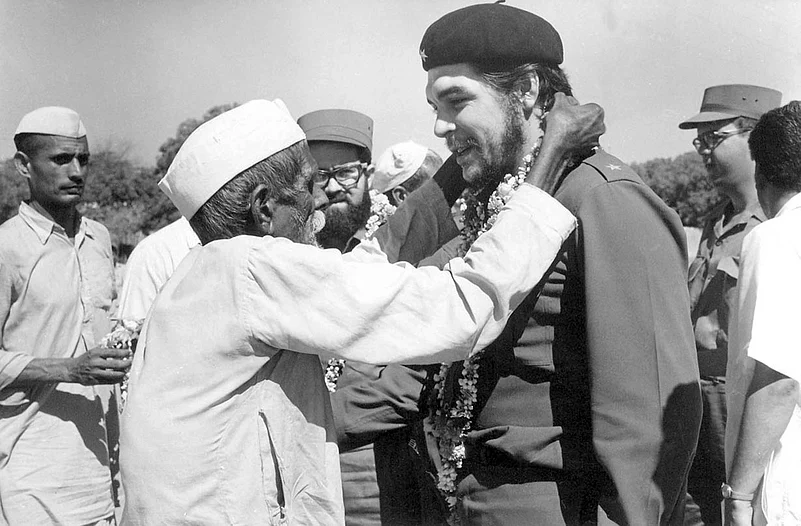
India Cuba: An elderly villager and member of indian communist party garlanding Che Guevara during his visit to a Community Project Area in Delhi, 1959


Summary of this article


The century of the Communist movement in India is a history of sacrifice, of ideological battles, of tremendous victories and painful defeats.


In April 1957, E. M. S. Namboodiripad took oath as Chief Minister of Kerala, leading the first democratically elected Communist government outside the Socialist Bloc.


The fundamental questions that animated Indian Communists remain urgent: Who controls the land? Who owns the factories? Who makes the decisions that shape our collective lives?


The Communist movement in India is now 100 years old. Whether one dates this from October, 1920, when Indian revolutionaries like M. N Roy, Abani Mukherjee and other Indian revolutionaries gathered in Tashkent to formally establish the Communist Party of India, or from December 1925, when Communist groups came together at the Kanpur conference in 1925 to constitute an all-India party, the fact remains that for over a hundred years, Communists have been an integral part of Indian political and social life. The Communists have fought colonial rule, built mass organisations of workers and peasants, governed states, resisted communal fascism and kept alive the dream of a society free from exploitation. The century of the Communist movement in India is a history of sacrifice, of ideological battles, of tremendous victories and painful defeats. It is also a history that speaks directly to our present moment, when the Right-wing Hindutva forces seek to shape India with their imagination and when the predations of global capital intensify the misery of the common people.


Any serious engagement with the history of Indian Communism must begin by acknowledging a historiographical debate that reflects the deeper questions about the nature of the movement itself. The Communist Party of India (Marxist), popularly known as the CPI (M), maintains that the party was founded on October 17, 1920, in Tashkent. This establishment was assisted by the Communist International. The Communist Party of India, popularly known as the CPI, on the other hand, considers the December 1925 conference in Kanpur as the authentic founding moment, when Communist groups already working inside India came together to establish an organised all-India party with a constitution and elected leadership.

This is not merely an archival dispute for historians to settle. The Tashkent formation represented the organic connection between Indian liberation and proletarian internationalism. It recognised that the struggle against British colonialism was inseparable from the worldwide movement against imperialism. The Kanpur conference, meanwhile, represented the rooting of the Communist organisation in Indian soil among workers and peasants of India. But one must understand that both these moments were necessary stages in the development of a movement that would eventually mobilise millions. The dialectical unity of these two currents, international solidarity and indigenous mass organisations, has defined Indian Communism throughout its existence.


Forged in the Colonial Fire

The British colonial administration understood, perhaps better than some nationalists of that era, the revolutionary potential of the Communist ideas among the India’s toiling masses. The colonial state responded with characteristic brutality. The Peshawar Conspiracy Cases, The Kanpur Bolshevik Conspiracy case and the most prominent, the Meerut Conspiracy case of 1929 to 1933, saw leading Communists prosecuted for seeking, in the words of the chargesheet ‘to deprive the King Emperor of his Sovereignty of British India, by complete separation of India from Britain by a violent revolution’.

Yet these trials, intended to crush the nascent movement, instead, provided a platform for the propagation of Marxist ideas across the country. In the Meerut courtroom, Communists spiritedly explained and defended their ideology, transforming their prosecution into a seminar on revolutionary theory. The photograph of the 25 accused, taken outside the Meerut Jail, remains an iconic image: S. A. Dange, Muzaffar Ahmad, P. C. Joshi and other revolutionaries who would shape the movement for decades. At the first party congress, held in 1943, the 138 delegates present had been collectively served 414 years in colonial prisons. This single fact testifies the death defying patriotism and sacrifices made by the Communists for Indian independence.


Muslim Women and the Left: Confronting New Realities

By the 1920s, Communists had established themselves as the most militant current within the anti-colonial movement. While the Congress often vacillated, Communists at the 1921 Ahmedabad session of the Indian National Congress moved a resolution demanding complete independence from the British rule, a demand that the Congress initially rejected. Along with the Workers and Peasants Party, the Communists organised industrial workers and peasants to form the All India Trade Union Congress and gather the All India Kisan Sabha into formidable mass organisations. In 1936, the All India Students’ Federation was founded, followed by the Progressive Writers’ Association and, in 1943, the Indian People’s Theatre Association. These organisations brought revolutionary consciousness to every section of Indian society. But it was the Telangana Armed Struggle of 1946-51 that demonstrated the revolutionary potential of Indian Communism most clearly. In the feudal hierarchical Nizam’s Hyderabad, where peasants were subjected to vetti (forced unpaid labour) and could be bought and sold, the Communists organised the most significant peasant movement since 1857. P. Sundarayya, who led the fight, documented the struggle in his monumental work titled ‘Telangana People’s Struggle and its Lessons’. Under the CPI’s leadership, the guerrillas armed with a few guns, lathis and slings and determination took on the Nizam’s forces and his Razakar militia. Women fought alongside men, shoulder to shoulder to defend their villages. At its peak, the rebellion established gram rajyams (village communes) across 4,000 villages controlling an area of 15,000 sq. miles with a population of four million. Approximately, one million acres were redistributed to landless peasants. The social transformation was revolutionary: caste distinctions were challenged, women’s participation in public life increased dramatically and feudal exactions were abolished. The rebellion led to 4,000 martyrs and more than 10,000 were imprisoned.


Forgotten By The Left — How Muslim Organisers Built Labour Movements And Were Written Out


Similarly, the Punnapra-Vayalar uprising in Kerala in 1946 saw Communist-led workers and peasants challenge the autocratic rule of the Travancore princely state. The Tebhaga movement in Bengal demanded that sharecropper’s share be increased to two-thirds of the harvest. Crucially, this movement maintained Hindu-Muslim unity based on class struggle at a time when communal riots were raging in other parts of Bengal. The areas where the Kisan Sabha had influence remained free of communal violence. This was a powerful demonstration of class consciousness as an antidote to communal poison, a lesson that remains relevant today.


Democratic Achievements and Imperial Subversion

In April 1957, E. M. S. Namboodiripad took oath as Chief Minister of Kerala, leading the first democratically elected Communist government outside the Socialist Bloc. The ministry’s 28 months in power, before its dismissal in July 1959, laid the foundations that continue to shape Kerala’s exceptional social indicators. The Agrarian Relations Bill threatened feudal landlordism; the Education Bill challenged the stranglehold of caste and religious organisations over schools. These were not socialist measures, but democratic reforms that the Congress had promised during the freedom struggle, but never delivered.


The response was ferocious. The so-called ‘Liberation Struggle’ (Vimochana Samaram) united the Catholic Church, the Nair Service Society, the Muslim League, and the Congress Party in a campaign of organised disruption. What was long suspected is now confirmed by declassified intelligence files: the Central Intelligence Agency (CIA) and the British MI5/MI6 mounted covert operations to bring down the Namboodiripad government. According to historian Paul M. McGarr’s recent research in the British archives, Congress leaders and union organisers were brought to the UK for intensive anti-Communist training. The CIA funnelled money to Congress politicians and anti-Communist trade unions. Daniel Patrick Moynihan, who later became USA’s ambassador to India, confirmed American involvement in his 1978 book A Dangerous Place, noting the objective was to prevent ‘additional Keralas’. On July 31, 1959, President Rajendra Prasad invoked Article 356, establishing a precedent for the abuse of constitutional provisions against non-Congress governments that would be repeated for decades.


Kerala After Bengal: Is the Left’s Shift Reinvention or a Neoliberal Turn?


Yet, Kerala’s Communist legacy proved resilient. The Left Democratic Front has governed the state for much of its history, producing India’s highest literacy rates, best health indicators, strong labour protections and eradicating extreme poverty through its multidimensional approach. In West Bengal, the Left Front's 34-year rule (1977-2011), the longest uninterrupted tenure of any democratically-elected Communist government globally, achieved significant land reforms and decentralised governance through panchayati raj. The Communist contribution to India’s constitutional framework, though often overlooked, includes the emphasis on workers’ rights, land reform provisions, and the vision of social and economic justice enshrined in the Directive Principles.

The Present Crisis and Future Possibilities

The Communist movement today confronts some serious challenges. The Left has electorally faced some setbacks. India’s top one per cent now owns over 40 per cent of national wealth. Unemployment, particularly among the youth, has reached crisis proportions. The Narendra Modi government’s economic policies have accelerate workers while enriching a handful of oligarchs. The Hindutva movement, born in the same year as the CPI, has captured state power and is systematically dismantling the secular, democratic republic that Communists helped build. Muslims face lynch mobs, Christians face bulldozers, and Dalits face renewed caste violence, all under the protection of the State machinery.


Yet, history rarely moves in straight lines. As Communists themselves would note, contradictions intensify before they resolve. The very success of neo-liberalism and Hindutva is immiserating the masses and creating conditions for a renewed resistance. The farmers’ movement of 2020-2021, which forced the Modi government to retreat on its agricultural laws, demonstrated that mass mobilisation is possible. The international situation―with the decline of US hegemony and the rise of a more multipolar world order―has opened new possibilities for the Global South that were unimaginable during the Cold War.

The Communist movement’s centenary is a moment to look back at what they have achieved for the masses and the Indian state and to take inspiration from it for their future struggles. It calls for what Marxists term as a concrete analysis of concrete conditions. The fundamental questions that animated Indian Communists remain urgent: Who controls the land? Who owns the factories? Who makes the decisions that shape our collective lives? How do we build a society where, in Marx’s famous phrase, the free development of each is the condition for the free development of all?

A hundred years ago, young Indians inspired by the October Revolution and determined to end colonial rule chose the path of Communism. Many gave their lives for this choice. Whatever the electoral map shows today, their dream of a liberated India, free from exploitation, oppression, and the degradation of caste and communalism, remains unfulfilled. Perhaps this is the most important lesson of the centenary: the struggle continues.


https://www.outlookindia.com/magazine/

(The author is a researcher and the Co-Coordinator of the Asia Desk at Tricontinental: Institute for Social Research)


(Views expressed are personal)
INDIA

The Right In The Left: Lessons And Limits

The challenge before communists is to use the lessons gleaned from historical hindsight to advance the movement today


Dipankar Bhattacharya
Updated on: 16 December 2025 
OUTLOOK, INDIA


Untitled Artwork by Chittaprosad Photo: | Courtesy: DAG

Summary of this article


Indian communists mark 100 years amid decline, while the RSS dominates national power.


The essay urges reclaiming secular, socialist ideals of the freedom movement.


Calls for reimagining class struggle to confront caste, inequality and authoritarianism.


As 2025 draws to an end, the organised communist movement completes its centenary in India. At the other end of the ideological spectrum, the far-Right Rashtriya Swayamsevak Sangh (RSS) also celebrated its centenary on October 1, 2025. The coincidence obviously leads to the question of why the communists find themselves electorally marginalised while the RSS has reached the zenith of power. Yet, when we look back, for much of the last 100 years, especially in the first five decades, it was the RSS that remained rather isolated while the communists had a fairly noticeable electoral presence.

The two trajectories could well have been different. There have been moments that the communist movement missed or mishandled, while the RSS benefited immensely from several turns of events in the last few decades. As long as the Congress dominated the scene, there was a period when the Left and the Right oppositions grew simultaneously, albeit in different parts of the country, but with a growing rightward shift across almost the entire policy spectrum and the Congress giving in to the aggression of the Sangh brigade, India since 2014 has been witnessing a virtual Bharatiya Janata Party (BJP) takeover while the communists have lost momentum.

Historical hindsight can offer plenty of experiences and lessons. However, the challenge before communists is to use those to good effect to advance the movement today. Like in many former colonies, in India too, the communist movement had emerged as a powerful anti-colonial stream. Within the overarching agenda of freedom from colonial rule, communists had distinguished themselves by their unwavering commitment to the secular democratic character of the republic and the cause of abolition of landlordism and the feudal order; securing of workers’ rights; and attainment of social progress.

The Constitution of India that emerged from the freedom movement broadly upheld this direction. At the time of independence and adoption of the Constitution, the RSS was explicitly opposed to the new constitutional framework of modern India. Following the assassination of Gandhi by a Hindutva terrorist, India’s first Home Minister, Sardar Patel, had no other option but to ban the RSS to protect India’s freedom. The short statement made by Patel blamed the RSS-promoted climate of hate and violence for Gandhi’s assassination and identified the organisation as a threat to India’s freedom. It was only after the RSS gave a written undertaking to accept the Constitution and the tri-colour national flag that the outfit was allowed to function as a self-proclaimed ‘cultural organisation’.

Today, the Indian state calls the RSS the world’s biggest NGO and celebrates its centenary by releasing commemorative stamps and coins. In fact, the BJP government and the dominant media are promoting the RSS as the ideological anchor of New India, with RSS appointees increasingly dominating the institutional spaces of education, research, policy-making and governance. Consequently, India is now undergoing a systematic legal and institutional restructuring, and this whole act of subversion of the constitutional foundation and institutional framework of modern India is being presented as a great exercise of decolonisation.

When the anti-colonial legacy of India is overturned in the name of decolonisation, the country clearly faces the challenge of not just defending the Constitution and parliamentary democracy, but also reclaiming the spirit of the freedom movement. Reigniting the anti-imperialist core of Indian nationalism and revitalising the vision of modern India as articulated in the preamble to the Constitution remain the principal ideological challenges for India’s communists as they enter the second century of their protracted journey. India has to wage nothing short of a second freedom struggle to reclaim democracy, and this battle is going to be the most pressing agenda of the Indian communist movement in the coming days.


Who Is A Comrade?


This is a fight that has to be fought on multiple levels. For millions of India’s toilers who will now have to fend for themselves in the corporate jungle raj of hire and fire and more work for less pay, it is a battle for sheer survival. India’s farmers, who had succeeded in getting the three dreaded laws of corporate takeover repealed, still remain utterly vulnerable. With education becoming an ever-expensive commodity and job security becoming increasingly elusive, young Indians find themselves trapped in a permanent state of anxiety and uncertainty. Draconian laws like the Unlawful Activities (Prevention) Act and regimentation drills like the National Register of Citizens (NRC) and Special Intensive Revision (SIR) are making liberty and rights a luxury for dissenting citizens and marginalised groups.

The Partition was the biggest tragedy of modern India as we emerged from two centuries of colonial rule. It left Indians with memories of a permanent wound and dreams of an undivided India or ‘Akhand Bharat’ that would become the aggressive credo of the RSS. But we tend to forget that even a partitioned India is a country of continental dimensions with all its complexity, diversity and vastness, and the RSS fad for bulldozing this diversity into an over-centralised uniformity is leaving the country ever more fragmented from within. The 42nd amendment to the Constitution had inserted not just the two epithets ‘secular’ and ‘socialist’ in the Preamble, it had also added the phrase ‘unity and integrity of the nation’. The Sangh-BJP establishment wants to erase every mention of secularism and socialism, but it does not understand that a multireligious, multicultural society like ours cannot stand united as a nation without secularism and socialist welfarism.

Ever since the publication of the Communist Manifesto in 1848, generations of communists in different parts of the world have had to navigate uncharted territories and deal with unforeseen situations. There have, however, been a few constant concerns—the focus on class struggle as the driver of social transformation, socialisation of capital, the working class emerging as the leading class and attaining political supremacy to constitute and lead their respective nations, and human emancipation from all fetters of bondage. In its attempt to grow at all costs, capital has not only pushed the world into wars and destruction, with growing environmental degradation and the climate crisis, the survival of the planet itself is now at stake.

How do communists in India deal with these questions in the emerging Indian context? The idea and practice of class struggle cannot be confined to the boundaries of economic struggle or the conceptual plane of abstract categories. Class is nothing if it cannot capture the concrete social existence and identity of the people, and if it cannot tackle the question of power, from the power of capital to the power of the state. With all the experience of the first 100 years of organised movement, can communists in India evolve a paradigm of class struggle that does not falter in challenging caste oppression and celebrating cultural diversity, a paradigm that pulsates with the spirit of gender justice and reflects the aspirations and sensitivities of the new generations? Challenging times must produce credible answers.


(Views expressed are personal)


Dipankar Bhattacharya is the general secretary, CPI(ML) Liberation


https://www.outlookindia.com/magazine/

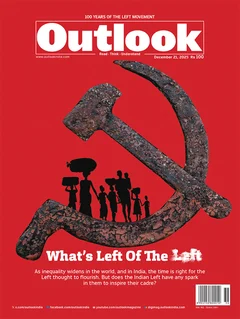
This article appeared as The Right In The Left in Outlook’s December 21, 2025, issue as 'What's Left of the Left', which explores how the Left finds itself at an interesting and challenging crossroad now that the Left needs to adapt. And perhaps it will do so.
Why The Left Matters: A Century of Struggle, Social Justice And The Road Ahead

The future of the Left in India will be decided by the ability of the movement to rebuild and deepen its links with the working people.

MA Baby
Updated on: 12 December 2025 
OUTLOOK, INDIA


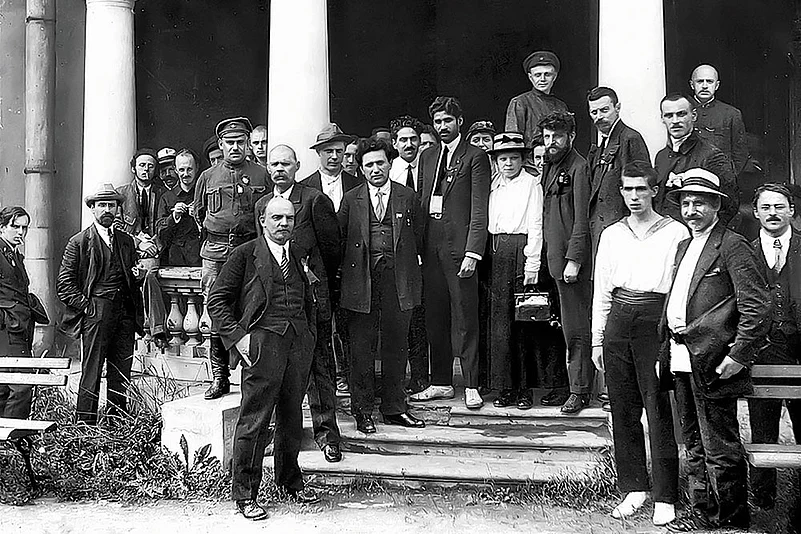
A Historic Gathering: Delegates to the second congress of the Comintern at the Uritsky Palace in Petrograd, including M.N. Roy, Vladimir Lenin, Maxim Gorky and Nikolai Bukharin

Summary of this article


The Left in India has endured for a century because it is rooted in the struggles, dignity and aspirations of workers and peasants.


Left ideas in India were not foreign imports but emerged organically from indigenous egalitarian traditions and early radical thought.


Communists played a decisive role in the freedom movement through organised mass struggles, trade unions, peasant uprisings and cultural platforms.


A hundred years is long enough for political currents to appear and disappear. Parties have risen on slogans and vanished in silence. What has endured in India, despite repression, distortions and political headwinds, is the Left movement. It has endured because it has always belonged to the working people of this country; to their labour, their dignity, and their dreams of a society free from exploitation. From the earliest murmurings of radical thought during anti-colonial resistance to the mass struggles of peasants and workers, from the severe blows of state repression to the experience of forming governments that delivered transformative reforms, the Left has left an indelible mark on modern India. The history of the Left is not parallel to the history of the nation, but it is rather interwoven with it.

The popular misconception that Left ideas were imported from abroad collapses the moment we revisit our own history with honesty. For example, in 1836, even before Karl Marx and Friedrich Engels joined the ‘League of the Just’, Vaikunda Swamikal, a social reformer who lived near the present day Marthandam (part of the erstwhile Travancore) started a utopian socialist movement called ‘Samathwa Samajam’. This is just one example. In fact, an investigation into the history of most societies and civilisations will reveal many examples of historical, mythological or intertwined narratives of a just and egalitarian society.


Images Against Darkness: 100 Years Of The Indian Communist Movement And The Culture Of Rebellion, In Photos


The 1905 Russian Revolution electrified the world, but India already had its own revolutionary impulses. The Anushilan Samiti in Bengal and the Ghadar Party in North America reflected an uncompromising resistance to colonial rule and a belief that freedom cannot be begged, it has to be seized. The Ghadarites, many of whom later became communists, carried the message that national liberation was inseparable from social liberation.

The October Revolution of 1917 provided inspiration, but not instruction. India’s young radicals were searching for tools to interpret the exploitation they experienced and witnessed in mills, plantations and villages. This search culminated in the formation of the Communist Party of India at Tashkent in 1920—five years before the party was organised publicly in Kanpur in 1925. The first Secretary of the Party, Mohammad Shafiq, symbolised a simple truth that the Left in India arose not from seminar rooms or drawing rooms, but from intense anti-colonial, anti-imperialist struggle.

Long before the Congress adopted the slogan of Poorna Swaraj in 1929, Hasrat Mohani, a communist, put forward the demand in 1921 at the Ahmedabad session of the AICC along with Swami Kumaranand, a peasant leader. The formation of the All India Trade Union Congress (AITUC) in 1920, and later organisations such as the Naujawan Bharat Sabha, the Hindustan Socialist Republican Association, the All India Kisan Sabha, the All India Students’ Federation and the Progressive Writers’ Association, turned radical thought into organised mass movements. Workers, peasants, women, students, youth, cultural activists and writers, all found in the Left a political home that combined the struggle for independence with the struggle for social transformation.

One of the final nails on the coffin of the morale of British rule in India was delivered by the sailors of the Royal Indian Navy uprising in 1946. It resulted in an insurrection by over 10,000 sailors and received massive support from the civilians and even police forces of the country. This mutiny was a loud message to the British that Indian soldiers will no longer aid or become a tool for the exploitation of their own people. It must not be forgotten that the sailors were proudly flying the Red Flag of the Communist Party on their ships (along with those of the Congress and the Muslim League flags) during the rebellion.


Crores On Strike: Bharat Bandh Disrupts Services Across India


Mass Struggles That Redefined India

What distinguishes the Left’s contribution to the freedom movement is not rhetoric but sacrifice. The communists led united struggles of workers and peasants that shook the pillars of colonial rule and feudal power. The Tebhaga movement in Bengal demanded two-thirds of the produce for the tiller. The Telangana struggle was carried forward by countless ordinary villagers, including women leaders like Mallu Swarajyam, and it confronted the nexus of feudal lords and the Nizam’s private militia. In the princely state of Travancore, the Punnapra-Vayalar uprising challenged autocratic rule. Each struggle was met with brutal repression. Yet each of them created a new political consciousness: that the land belongs to those who cultivate it, wealth belongs to those who produce it, and democracy means nothing without dignity.

Across the country, peasant movements asserted themselves in different contexts with shared aspirations. In Malabar, the struggles against Jenmi landlordism built the foundation of the Kisan Sabha. In Thane district, Adivasi struggles after 1947 challenged debt bondage and land dispossession under the leadership of the Sabha. P. Sundarayya, who would later lead the Communist Party of India (Marxist) as its General Secretary, dedicated his life organising poor peasants and farm workers, and towards the study of agrarian relations throughout undivided Andhra. In Tamil Nadu, G. Veeraiyan and others organised agricultural labourers against caste-linked exploitation and violence. The agrarian movement in Thanjavur was built by the CPI(M) and its mass/class organisations. This movement was intricately linked with the anti-caste struggle and over time, it gained so much strength that even the very idea of an agricultural union existing irked the landlords so much that they organised a gruesome massacre in the Keezhvenmani village, killing 44 Dalits, the majority of whom were women and children.

Kunwar Mohammad Ashraf (1903-1962): The Gandhi-ite Communist

Similarly, it was the CPI(M) and progressive class organisations that led a relentless struggle to get justice for the survivors of Vachathi state violence. These movements struck at the most deep-rooted structures of Indian society including but not limited to caste hierarchy, patriarchy and the culture of unpaid, invisible, unrecognised labour. In this sense, the Left did not wait for independence to begin fighting for social transformation. The battle for social equality was already underway in the fields and factories much before 1947. The Draft Platform for Action, 1930 was the first attempt towards preparing a programme for the party. This document recognised the ruthless abolition of the caste system along with agrarian revolution and overthrow of British rule as a necessity to achieve the complete social, economic, cultural and legal emancipation of all workers.

The years immediately after independence were marked by severe repression of the communists. The Telangana struggle was crushed with horrendous state repression. Leaders and cadres were jailed, forced to go underground, or killed in fake encounters. A distorted narrative was created to paint the Left as a threat to the nation precisely because the Left was demanding that land and power be returned to the people. Yet the repression did not erode the movement. Instead, it solidified the understanding that political democracy without economic democracy is hollow.

The turning point in parliamentary recognition came in 1957 when Kerala elected the first Communist government through the ballot. Land reforms, education reforms and democratic decentralisation fundamentally altered the social landscape of the state. The 1957 experiment proved that the Communists can govern, not just agitate; and govern in ways that expand people’s rights, not restrict them.

In later decades, Left governments deepened that legacy. In West Bengal, Operation Barga secured tenancy rights for millions of sharecroppers and laid the groundwork for rural poverty reduction. The panchayat system that empowered local democracy emerged in West Bengal and Kerala long before it was recognised in the Constitution in 1992. In Tripura, land redistribution ensured that two-thirds of land went to a tribal population that formed one-third of the state. These should be seen as parts of a coherent model of development in which human welfare is not an afterthought, but the starting point.

These experiences speak volumes about why Kerala continues to repose confidence in the Left, electing it twice in succession, something that has been unprecedented in the state’s political history. When governments deliver social justice in real terms, people do not forget.

Whenever India has been threatened by authoritarianism, the Left has taken an unmistakable stand. During the Emergency, when many parties compromised or justified excesses, we who opposed it paid a heavy price, but still refused to surrender constitutional and democratic rights. In the decades since, the Left has been the most consistent force against communal polarisation. It recognised much earlier than others that communal politics is inseparable from economic inequality, a divided society is easier to exploit.


What's Left Of The Left: The Thin Red Line In J&K

The crises India faces are the outcome of policies that prioritise private profit over public good and division over unity. A different future is possible—one based on secularism, equality, dignity of labour and democratic rights.

The CPI(M) warned in its 23rd Party Congress about the rise of the communal-corporate nexus which is an alliance of reactionary social forces and big capital. Today, as public assets are being handed over to private monopolies and dissent is being increasingly criminalised, that warning reads not like a precise description of current reality.

Whenever labour rights, public sector enterprises or natural resources have been threatened, the working class with the Left at the forefront has fought back , whether it is to prevent the sale of strategic Public Sector Units or to resist anti-worker labour codes. The one-year-long farmers’ movement on the borders of Delhi, which forced the repeal of three farm laws, saw active, consistent and disciplined participation from peasant organisations like the All India Kisan Sabha and other democratic and Left forces. The Kisan Long March in Maharashtra, where thousands of poor peasants walked peacefully with red flags, became a symbol of how democratic mobilisation can achieve what electoral arithmetic cannot.

Why the Left Matters Even More Today


There is a popular trend to judge political relevance solely by election results. But the Left’s history in India shows that the yardstick for us has always been larger: the strength of our links with working people, our ability to organise struggles, and our capacity to offer an alternative vision. Even in a period when the Left’s electoral strength is seeing unprecedented setbacks, its ideological and organisational presence continues to shape resistance movements across the country.

Today, India faces economic stagnation, record unemployment, nutritional crisis, collapse of public health funding, increasing numbers of suicides among peasants and agricultural labourers, rising caste violence, attacks on women, systematic communal polarisation that includes attacks on minorities, dalits, tribals and transgender people. In such a situation, the Left remains the only political force that speaks not of temporary relief but of structural change that includes public investment, universal welfare, labour rights, land reforms, public education, and a secular democratic republic rooted in equality.

The recent achievements of the Extreme Poverty Eradication Programme launched in Kerala show that it was a policy initiative grounded in the conviction that no human being should live without dignity. It does not mean that Kerala is free of poverty, but the achievements of this programme are a significant step in that direction.

It is this orientation that explains the renewed interest among young people in progressive politics worldwide. Against the rise of the far-Right forces, the youth are also marching behind the new faces of the Left and progressive forces in their countries to challenge inequality, corporate power and racism. The examples of Anura Kumara Dissanayake, Catherine Conolly, Zohran Mamdani, and countless other unnamed organisers and forces, speak volumes about this renewed interest. India is not an exception to this global churn.


Dhoom Macha Le: How Zohran Mamdani’s NYC Mayoral Victory Challenges Authoritarian Trends


The Next 100 Years


The Left movement in India has completed more than a century, but its task is far from finished. It has fought for generations of workers, peasants, women, students and marginalised communities; not for the sake of abstract ideals, but for concrete improvements in their lives and in the society as a whole. The future of the Left will be decided by the ability of the movement to rebuild and deepen its living links with the working people and other toiling masses.

Applying the scientific understanding of Marxism-Leninism in the concrete conditions of India is pertinent to achieve the above. As Young Comrade Lenin once mentioned, “We do not regard Marx’s theory as something completed and inviolable; on the contrary, we are convinced that it has only laid the foundation stone of the science which socialists must develop in all directions if they wish to keep pace with life. We think that an independent elaboration of Marx’s theory is especially essential for Russian socialists; for this theory provides only general guiding principles, which, in particular, are applied in England differently than in France, in France differently than in Germany, and in Germany differently than in Russia. We shall therefore gladly afford space in our paper for articles on theoretical questions and we invite all comrades openly to discuss controversial points.” (Collected Works of Lenin, Vol. IV, pp. 211-212).

The crises India faces are the outcome of policies that prioritise private profit over public good and division over unity. A different future is possible—one based on secularism, equality, dignity of labour and democratic rights. For that to become a reality, the Left is not just relevant but indispensable. The struggles of the past 100-plus years have immensely contributed towards shaping the democratic foundations of India. The next 100 years must complete the unfinished task of revolutionary social transformation.


(Views expressed are personal)


https://www.outlookindia.com/magazine/


M.A. Baby is General Secretary, Communist Party of India (Marxist)

This article appeared as 'We Shall Overcome' in Outlook’s December 21, 2025, issue as 'What's Left of the Left' which explores the challenging crossroads the Left finds itself at and how they need to adapt. And perhaps it will do so.