It’s possible that I shall make an ass of myself. But in that case one can always get out of it with a little dialectic. I have, of course, so worded my proposition as to be right either way (K.Marx, Letter to F.Engels on the Indian Mutiny)
Tuesday, August 25, 2026
Indian Seafarers Complain of Pressure to Transit Strait of Hormuz
The Forward Seamen's Union of India has raised concerns that some shipowners are pressuring seafarers to sail through the high-risk zone in the Strait of Hormuz against their wishes, an apparent breach of the right to request repatriation under the MLC. Multiple vessels have come under fire from Iran's Islamic Revolutionary Guard Corps in recent weeks, and a chief engineer was killed by an Iranian strike on a bulker overnight Monday.
Against this background, FSUI has been campaigning to ensure that seafarers can exercise their right to choose whether to enter a designated war risk zone. In a video appeal that FSUI released August 17, the master of the foreign-flagged MPSV AM Pioneer alleged that the ship's operator is "forcing us to cross Hormuz and go to Fujairah." He claimed that the firm had begun to make security arrangements with U.S. forces for a passage from Ras al-Khaimah to the Gulf of Oman through the contested southern lane, where Iran has targeted neutral shipping.
The master and his officers said that they had signed on a month ago to perform a survey of the vessel, and that they had agreed to go through Hormuz once the waterway was formally open and safe for all ships - not beforehand.
The company later denied having pressured the captain to make the run through the strait, the master said. The following day, according to FSUI, the managers subsequently removed the captain with immediate sign-off.
Effective July 15, the Directorate General of Shipping of India ordered shipping and crewing companies not to send Indian seafarers on voyages through the Strait of Hormuz, given the potential risk of attack by Iranian forces. Iran has repeatedly targeted vessels that do not comply with its "Persian Gulf Strait Authority" traffic management scheme.
FSUI has emphasized the hazards and the directorate's instructions. "No seafarer should risk death for owners’ profits or convenience. Immediate repatriation with full wages and dues is non-negotiable," FSUI said in a statement.
Indian seafarers make up more than 10 percent of the global mariner pool, and may be an even larger share of the crewmembers who are waiting on the west side of the Strait of Hormuz, according to the FSUI.
Tanker Hit and Disabled Near Strait of Hormuz
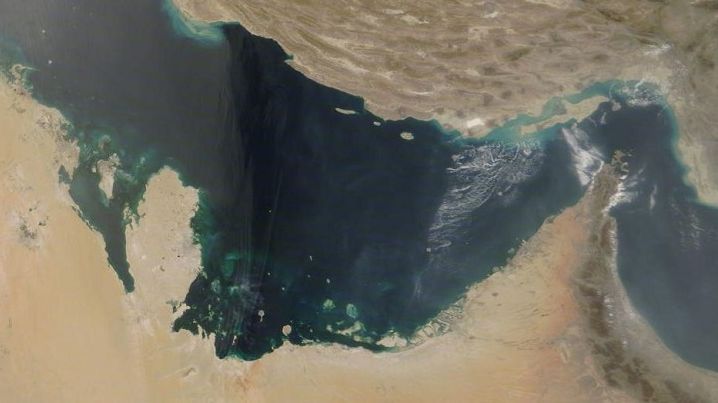
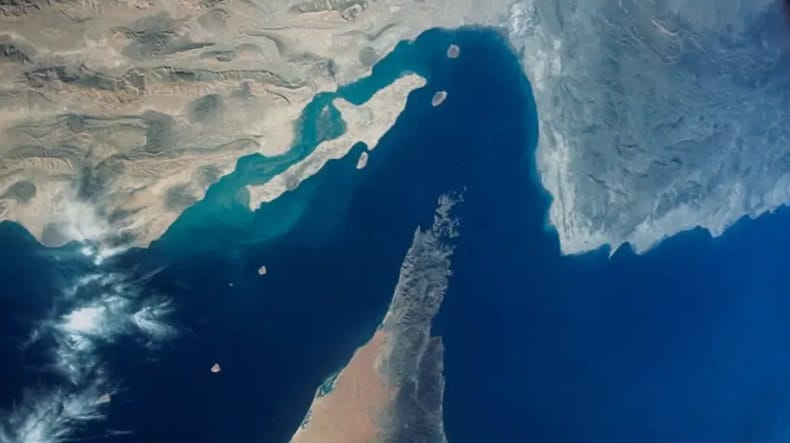
The strike occurred just east of the Musandam Peninsula, center, in Omani waters (NASA file image)
Overnight Monday, a tanker was hit by a projectile at a position east of the Musandam Peninsula, on the Omani coastal route through the Strait of Hormuz.
At about 2025 UTC, the master of an unnamed oil tanker reported that the vessel had been hit, damaging the engine room and disabling the ship. The crew remained safe, according to reporting agency UKMTO; the status of any environmental impacts was not known. The last reported position was about nine nautical miles to the northeast of Ash Shishah, a roadless outpost on the eastern edge of the peninsula.
The strike adds to a long tally of damaging attacks on shipping in the Strait of Hormuz and the Arabian Gulf. The IMO counts a total of 68 incidents since the conflict in the Gulf began six months ago, averaging about three casualties a week. At least 20 seafarers have been killed, 35 have been wounded and one remains missing, by IMO's assessment.
The potential for environmental damage from these repeated attacks is high. After a disabling strike earlier this month, the bulker Minoan Pioneer remained stranded in the strait for days; it likely released a fuel oil slick that stretched northwest as far as Qeshm, on the opposite side of the waterway. The outcome can be much worse: the wrecked Suezmax tanker Caroline Bezengi, which was disabled by an explosion and drifted aground on an island off southeastern Oman, has polluted thousands of square kilometers in an environmentally sensitive marine area.
Despite the risks, there are powerful motives to make the run. Current spot charter rates for a VLCC lifting oil inside the Gulf can reach as high as $800,000 per day, per Clarksons. Oil traders can afford to pay such extreme freight rates because they are able to buy GCC crude grades at heavily discounted prices - as low as $30-40 below Brent, according to TotalEnergies CEO Patrick Pouyanne.
"It costs more or less $20 million to move a VLCC through Hormuz and ?come back . . . divided by two million barrels of oil, that's an extra $10 a barrel," Pouyanne said at an energy conference Monday, per Reuters.
Oman Signals Progress on Hormuz Shipping Corridor Agreement
Omani foreign minister Badr Albusaidi (left) with his Iranian counterpart, Seyed Abbas Araghchi (right) (Omani Foreign Ministry)
The foreign minister of Oman announced Tuesday that talks with Iran on the joint management of a Strait of Hormuz shipping corridor were proceeding well, despite repeated Iranian attacks on neutral merchant vessels in Omani waters - including one as recently as last night.
In a statement, minister Badr Albusaidi said that he had visited Tehran for a "constructive dialogue" with his Iranian counterpart, Abbas Araghchi. The two sides are nearing an agreement on one temporary shipping corridor - not the contested two-corridor scheme that currently prevails - and will be announcing a system to restore "safe navigation" shortly, Albusaidi said.
For the long term, he added, the Omani-Iranian plan remains to negotiate a permanent arrangement for control of the strait, in conjunction with other regional stakeholders.
Oman previously proposed a plan that would include service fees on all passing traffic - an arrangement demanded by Iran, but strongly opposed by the United States and by international shipping interests. Last week, President Donald Trump threatened to bomb Oman - a longtime U.S. ally - in response to the news of that proposal, two Mideastern officials confirmed to AP.
Iran remains clear on its long-term intentions for control of Hormuz. On Sunday, the Iranian Parliament's foreign policy committee moved ahead with new domestic regulations to charge "service fees" for transits through the international waterway. "Fees will be charged for services we provide, including navigation, environmental, insurance, and safety services; refueling under special circumstances and other services," committee spokesman Hassan Ghashghavi told state news agency Islamic Republic News Agency (IRNA).
Such an arrangement hinges on Iran's ability to control the waterway by force, but the White House says that Iran's influence on traffic volume is limited. U.S. Central Command has set up a transit corridor through Omani waters, which - though not impenetrable - has quietly shielded dozens of tanker transits from attack in recent weeks. Claims over the size of convoys vary, but most independent analysts estimate that an average of about 4-6 million barrels per day of crude have been escaping Iran's cordon - and the latest indications (and administration claims) suggest that the volumes are increasing.
These bold, below-the-radar, well-compensated transits still involve considerable risk to seafarers: in the latest instance, an unnamed tanker was struck in the engine room and disabled overnight Monday.
On Tuesday, Trump claimed that Iran's sea mines have been cleared from the transit lanes in the center of the strait. However, U.S. Central Command's latest advisory from the Joint Maritime Information Center suggests "a continued risk of drifting or uncharted mines in and near the TSS, with mine danger areas still active."


No comments:
Post a Comment