Showing posts sorted by relevance for query Cockroach Janata Party. Sort by date Show all posts

Monday, July 06, 2026

From memes to political movement, India's 'Cockroach' party leads youth revolt

India's Cockroach Janata Party began life as a series of internet memes and has grown into a real-life movement, bringing together young people angry about unemployment and alleged exam fraud. What began five weeks ago as a satirical response to comments by India's chief justice has become a fast-growing campaign which now has political ambitions, even as observers question whether it can survive without more effective organisation.


Issued on: 05/07/2026 - RFI

Abhijeet Dipke, founder of the Cockroach Janata Party, holds a portrait of anti-colonial revolutionary Shaheed Bhagat Singh at a protest in Amritsar against alleged irregularities in India's national entrance exams on 13 June. AFP - NARINDER NANU

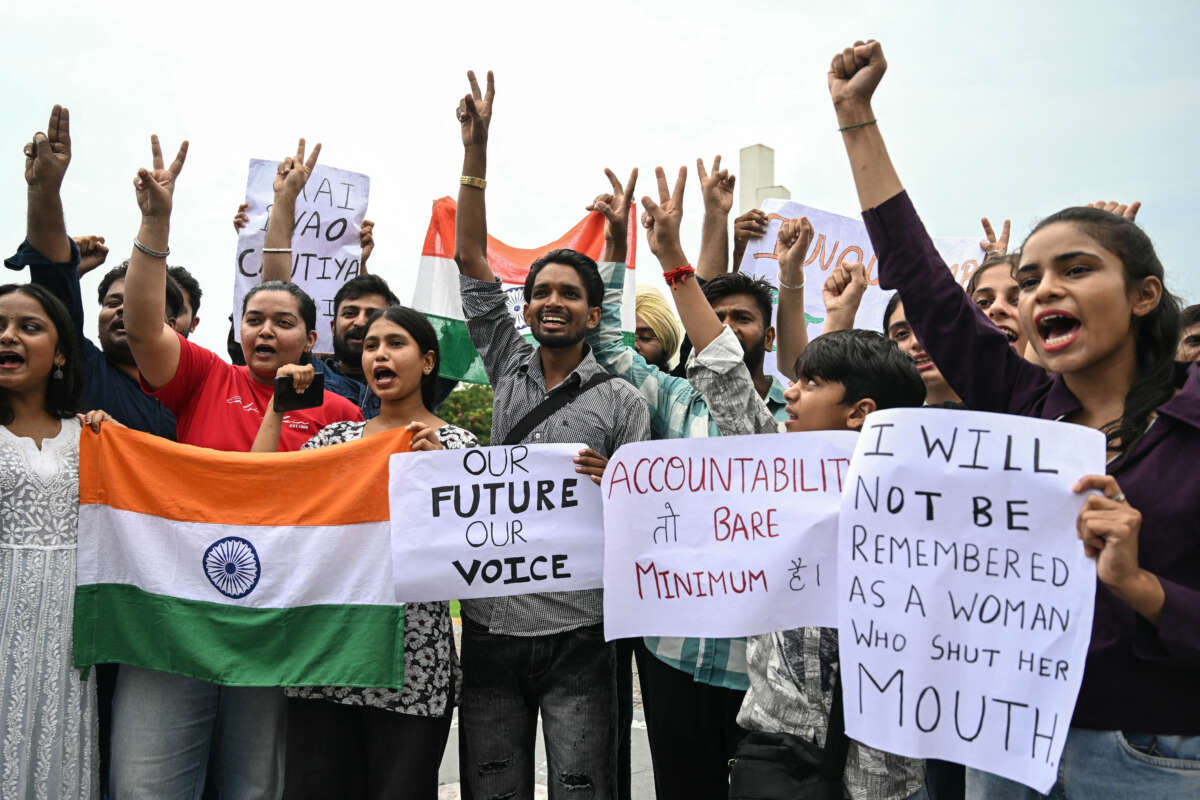
Protesters have been camping out day and night beneath the trees at Jantar Mantar, New Delhi's best-known protest site, despite a ban by authorities. Many are wearing cockroach masks and carrying placards inspired by satirical internet memes, and carrying copies of the Indian constitution.

A few weeks earlier, nothing suggested those memes would grow into such a movement.

Most of the protesters are students or recent graduates protesting against unemployment and alleged fraud in medical college entrance exams.

"There are no more opportunities for young people," Devika, who was attending her second rally, told RFI. "We are worried about the future of Generation Z. Our fight is a fight against corruption."

From Instagram to the streets

The Cockroach Janata Party (CJP) was launched on 16 May by Abhijeet Dipke, a 30-year-old communications specialist educated at Boston University.

Based in the United States, he was reacting to comments by India's chief justice, who compared unemployed young people to "cockroaches" and "parasites". Shocked, he decided to turn the insult back on its author.

"We created this party as satire," Dipke said. It quickly exceeded every expectation.

Within four days, its Instagram account drew almost 10 million followers. Within a few weeks it had reached 22 million, overtaking the account of Indian Prime Minister Narendra Modi's Bharatiya Janata Party (BJP).

"That made me realise the enormous frustration among young people over unemployment and the fraud that tainted the medical entrance exam," Dipke said.

The movement quickly spread beyond social media.


Abhijeet Dipke, 30, founder of the Cockroach Janata Party. He says the movement is ready to protest for as long as necessary after its rapid rise on social media. 
© Abdoollah Earally/RFI

Dipke returned to India at the end of May and organised seven rallies across six states and territories before returning to Delhi, where supporters decided to occupy Jantar Mantar.

Psychiatrist Rajendra Prasad, who attended the first rally, said the movement's spontaneous nature stood out. "No one brought them here," he said. "They came by themselves."

However, Prasad also questioned whether it could survive without clearly identified leadership.

This concern is echoed by other observers. Nandita Narain, a former professor at Delhi University and president of the Federation of Central Universities Teachers Associations (Fedcuta), said she had not seen student mobilisation on this scale for several years.

"These young people rise above political loyalties," Narain said. "Many probably come from families that support the government. They have little experience and everything seems improvised, but they are expressing real anger and, above all, they are beginning to overcome their fear."

Political ambitions


While the CJP had succeeded in capturing the anger of part of India's educated youth, it still lacked a clear ideological foundation, said Mehina Fatima, a researcher at Delhi University.

"The question is where it will be in five years," she said.

Dipke rejected that assessment.

"Our ideology is based on secularism, social justice and the constitution," he argued. "We draw inspiration from Ambedkar, Gandhi and Nehru."

Those references to India's founding figures mark a change for a movement that only weeks earlier was an Instagram account parodying official posters, government slogans and AI-generated images.

Its organisers now openly say they have political ambitions and have taken their campaign into public spaces.

However the movement remains highly decentralised. Decisions are made through online discussions that students join and leave freely. Meanwhile teachers, doctors and retirees supporting the protests do not always speak with one voice.

That flexibility appeals to young people who distrust traditional political parties, but it is also seen as the movement's greatest weakness.

Uncertain future

Even its name remains a joke. Asked why it was called Cockroach Janata Party – with the CJP initials echoing those of the ruling Bharatiya Janata Party – Dipke smiled.

"It was a satire," he told RFI. "A wink at the ruling party."

Dipke insisted, however, that the CJP was more than just a communications exercise.

"Everything we do is political," he said. "If we stop doing politics, then the government is no longer held accountable."

Five weeks after its creation, the Cockroach Janata Party remains difficult to define. Its rapid rise has exposed deep frustration among young Indians, but its political future remains uncertain.

This article has been adapted from the original version in French by Abdoollah Earally


Saturday, June 06, 2026

Supporters of India's Gen Z 'cockroach' party stage first protest in New Delhi

Hundreds of mostly young Indians gathered in New Dehli on Saturday for the first street protest organised by the Cockroach Janata Party – a movement which began as an online joke but has quickly gained momentum among Indian youth disillusioned with their education, employment and economic prospects.


Issued on: 06/06/2026 - 
By: FRANCE 24
Video by: Navodita KUMARI

A person wearing a mask holds a poster which reads "I am a Cockroach" as supporters of the Cockroach Janta Party (CJP) gather in New Delhi, India on June 6, 2026. © Adnan Abidi, Reuters
01:35


Hundreds of supporters of the Cockroach Janata Party, an online joke that drew millions across India, gathered for the first time in the national capital on Saturday, taking the social media movement off screens and into its biggest real-world test yet.

The protest at Jantar Mantar in New Delhi, marks the movement’s first foray into street politics after weeks of dominating social media feeds and news headlines, attracting millions of online followers and widespread support among young Indians.

The immediate trigger for Saturday’s protest was reported irregularity in a recent exam that has dominated headlines in India, angering a large community of students.

Hundreds of mostly young Indians gathered in the heart of New Delhi’s protest zone near the parliament building, some with placards and cockroach masks.

Abhijeet Dipke, founder of the online movement, joined the protest after he landed in the capital from the US on Saturday morning. Police had laid steel barricades at arrivals at New Delhi’s international airport.


Abhijeet Dipke, head of the Cockroach Janta Party (CJP), speaks to supporters at a sit-in protest in New Delhi on June 6, 2026. © Adnan Abidi, Reuters

Dipke said in a social media post shortly after arriving that police granted permission to the Cockroach Janta Party, or CJP, to hold the protest, adding: “Cockroaches gather at Jantar Mantar.”

CJP organisers used social media to rally supporters for Saturday’s march, demanding the resignation of Education Minister Dharmendra Pradhan. The demand grew out of an exam irregularity controversy in May that quickly became a broader outlet for frustration over India’s education system and limited job opportunities.

Supporters chanted slogans including, “Cockroaches are coming, Dharmendra Pradhan is going!” One placard read: “Waiting for exams that don’t leak.”

Participants were encouraged to bring India’s national flag and a book, which organisers said symbolised the right to education and equal opportunity for all. Organisers also urged demonstrators to remain peaceful and avoid any confrontations with police.

“Time to turn this tiny joke into a revolution,” the official CJP account on X posted Friday.
India’s Cockroach Janta Party goes viral as Gen Z movement grows


© France 24
01:58


Mansi Sehgal, a 26-year-old protester, said the protests began around exam issues, but the deeper problem is that people haven’t had a space to speak up or ask questions. “CJP is doing that. So, this is literally the first thing that people can connect and ask questions,” she said.

“This is a long fight. We are seeing that’s it’s nearly a month that we are demanding (Pradhan’s) resignation,” Dipke said at the venue.

How many ultimately would join the protest remained unclear, making the event an early test of whether the movement can channel its online popularity into a broader grassroots support around growing frustration among young Indians over education, jobs and economic prospects.

The other main challenge would be how the party navigates the kind of pushback earlier protest movements have faced under Prime Minister Narendra Modi’s government.

Over the past decade, authorities have sought to stamp out protests against his government, including demonstrations against a controversial citizenship legislation and yearlong farmers’ protests. Some protest movements also have faced legal action against organisers and activist arrests, which critics say reflects a broader effort by the government under Modi to suppress dissent.

But despite challenges, protesters expressed optimism for a change.

This is a youth first movement,” said Satya Prakash Yadav, a young student. “Youth is the future and we will ensure that our future is secure.”

The CJP emerged only three weeks ago to become an unlikely outlet for discontent among supporters who proudly call themselves “cockroaches.”

India’s Chief Justice Surya Kant likened critics and some unemployed youth to cockroaches during a May hearing, sparking backlash among frustrated young Indians. Dipke, a political communications strategist and Boston University student, used the insult as inspiration for a parody political party. Weeks after launching a website and social media accounts, CJP’s Instagram page has until now amassed more than 22 million followers.

The party has turned the cockroach into a wry badge of endurance and political articulation. Videos and memes lampooning unemployment, corruption and political dysfunction have drawn millions of views online. Parody CJP accounts also have adopted the cockroach as a political symbol and use memes, mock campaign slogans and satirical commentary.

The movement’s tongue-in-cheek messaging blends self-deprecating humor with political criticism. Supporters jokingly describe themselves as unemployed, perpetually online and shut out of meaningful influence. Beneath the humour lies a broader criticism of Modi’s government. CJP supporters argue that under Modi ordinary Indians, particularly young people, have been left with fewer opportunities.

Young people in India make up more than a quarter of the population but face limited job opportunities, rising unemployment and growing disillusionment with traditional politics. Many young voters also are critical of Modi’s ruling Hindu nationalist ruling Bharatiya Janata Party, citing concerns over rising religious polarisation, widening inequality and mounting economic pressures.

The movement’s skeptics, particularly supporters of Modi’s party, dismiss the phenomenon as little more than a social-media gimmick. They argue the movement’s online popularity may not translate into street mobilisation and that its rapid rise is likely fleeting.

The group’s rise echoes a similar trend across South Asia of youth movements born out of social media playing a central role in anti-government protests, including uprisings in Sri Lanka and Bangladesh and unrest in Nepal.

Tuesday, July 21, 2026

India's opposition leader calls for Modi to step down as youth-led 'Cockroach' protests press on

Rahul Gandhi, India's opposition leader, called for Prime Minister Narendra Modi to resign on Tuesday "for destroying the future" of the country's youth. The youth-led Cockroach movement continued their protests in New Delhi, refusing to leave their sit-in site a day after police used tear has and batons to disperse demonstrators marching towards parliament.


Issued on: 21/07/2026 
By: FRANCE 24
Video by: Delano D'SOUZA

Cover image: India's opposition leader Rahul Gandhi stands with hands tied as he participates in a sit-in protest outside Modi's residence in New Delhi on July 21, 2026. © Shekhar Yadav, AP
01:47


India's main opposition leader, Rahul Gandhi, demanded on Tuesday that Prime Minister Narendra Modi step down over the police crackdown against student protests demanding reforms in the education system.

Modi must resign "for destroying the future of India's youth", the Congress Party leader said in a post on social media as he led a march with other MPs towards the prime minister's residence in New Delhi.

"The government doesn't want to take any accountability, nor does it want to have a debate on it in parliament," said Gandhi.

Along with dozens of his Congress party lawmakers, Gandhi staged a sit-in protest outside Modi's residence. Several were seen fastening zip ties around their wrists.

Gandhi's comments came after police said 60 protesters were injured in clashes with security forces in the heart of New Delhi on Monday, marking the biggest street rally in the capital for about five years.

Thousands of protesters had gathered to demand the resignation of Education Minister Dharmendra Pradhan, following an appeal by the Cockroach Janta Party (CJP) online movement.

Police fired tear gas and charged with batons at protesters, who responded by pelting stones. At least 118 police personnel were also injured, Delhi Police said.

The CJP vowed to press on with its demands for Pradhan's removal as hundreds of protesters remained camped at Delhi's Jantar Mantar protest site on Tuesday, many of them calling for changes to the wider education system.

The CJP has won millions of followers on social media since its launch in May, fuelling one of the biggest challenges to Hindu-nationalist leader Modi since he won his third term in office in 2024.

'Shameful day'


"We won't stop. Pradhan has to be sacked," CJP spokesman Ashutosh Ranka said on social media.

There were far fewer protesters at Jantar Mantar than on Monday, when the CJP mobilised huge crowds to march on India's parliament.

CJP founder Abhijeet Dipke urged protesters on Tuesday not to lose hope.

"They want to break our spirit," he said, perched on top of a lorry. "Do not let them silence you."

Protest organisers condemned the "high-handedness" of the authorities and said hundreds of protesters had been injured.

"It's a shameful day in the history of Indian democracy that people, honest students, who had come for a genuine issue were brutally beaten by the Delhi police," Ranka told AFP.

Ranka, who met senior minister JP Nadda on Monday, said the government had yet to respond to their demands.

Protesters said they would not relent.

"We have become even more fearless now," said 25-year-old law student Chandra Pratap Sishwi.

"When I saw people being beaten up by the police like that, my blood boiled."

Parliament was adjourned on Tuesday after the opposition benches demanded a discussion on the alleged "brutality unleashed on students".

Despite rapid economic growth, millions of people in the world's most populous nation still struggle to find stable and well-paying jobs, fuelling discontent.

The protests follow a series of examination scandals that have shaken confidence in India's testing system.

Some 2.2 million aspiring medical students sat for a re-examination under tight security last month after the previous test was scrapped following the leak of a question paper.

That came on top of another scandal related to the online marking of tests taken by nearly two million high school students.

Parliamentary Affairs Minister Kiren Rijiju defended the government on Tuesday, saying it had acted swiftly after the exam paper leaks by arresting several people.

He said Modi had called for a "foolproof system" to prevent irregularities in the future at a closed-door meeting with his allies on Tuesday.

Modi has yet to comment directly on the protests.

(FRANCE 24 with AFP and AP)


‘Black Day for Democracy’: Indian Police Bash and Gas Youth-Led ‘Cockroach’ Protesters

“It’s just shocking to see that the people we elected have turned a blind eye to youth dying,” said one protester.


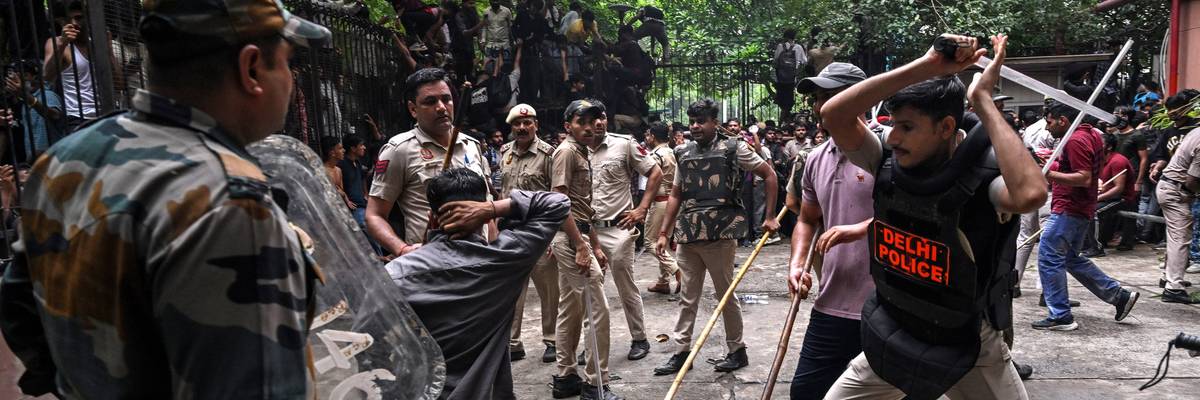
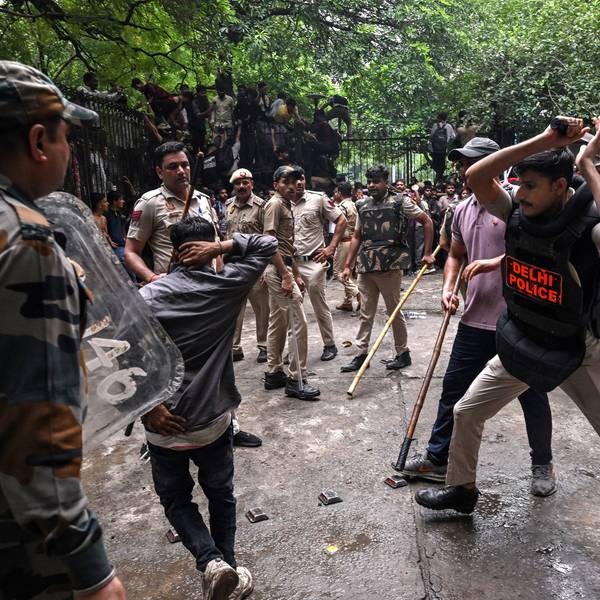
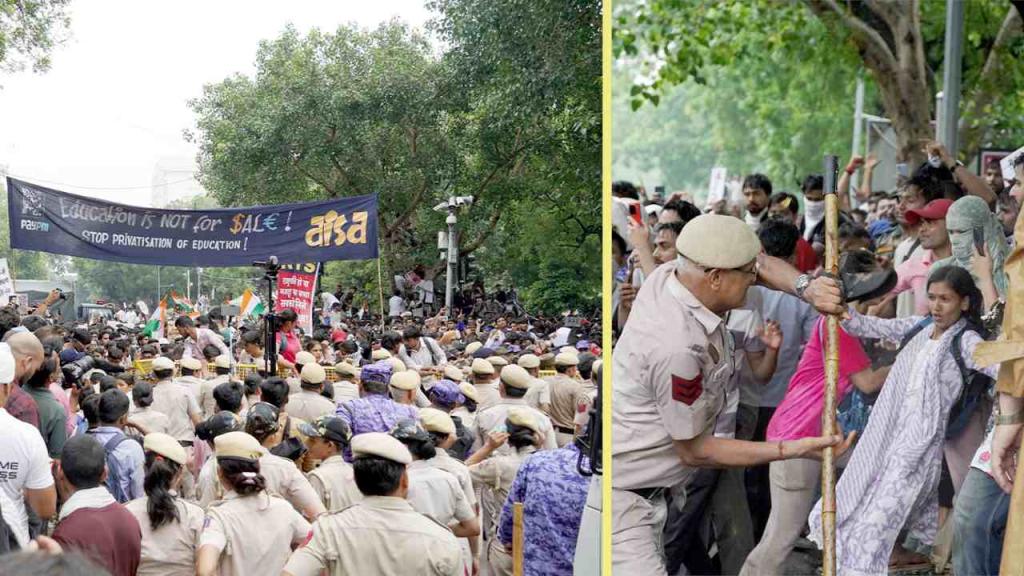
Delhi police officers beat Cockroach Janta Party protesters during a July 20, 2026 protest in New Delhi demanding the resignation of India’s education minister.
(Photo by Arun Sankar/AFP via Getty Images)

Brett Wilkins
Jul 20, 2026
C0MM0N DREAMS

Indian protesters rallying Monday in New Delhi under the banner of the youth-led Cockroach Janta Party were brutally attacked by police as they marched toward the country’s Parliament demanding the resignation of the country’s education minister and denouncing the right-wing government of Prime Minister Narendra Modi.

Tens of thousands of protesters took to the streets of the Indian capital despite police bans, barricades, internet shutdowns, and a heavy security presence. Police, some of them in plain clothes, attacked the overwhelmingly peaceful demonstrators with baton charges and tear gas. Delhi police are controlled by the Bharatiya Janata Party (BJP)-ruled central government.

The Wire reported that thousands of people were injured—some seriously—by police. Despite video footage and photos showing officer brutality, Delhi Police denied “sporadic use of violence” against protesters.


The protesters are seeking the resignation of Education Minister Dharmendra Pradhan following repeated leaks of National Eligibility Entrance Test papers that have upended the lives of millions of students by forcing them to retake the grueling exams and delaying university admissions. Protest organizers say more than 20 students have killed themselves over the matter.

Late last month, Pradhan dismissed the protesters as “the B-team of terrorists.”

“Already more than 20 students have died by suicide, but this government is not done yet,” Cockroach Janta Party (CJP) founder Abhijeet Dipke said on social media. “This government has resorted to hooliganism now.”

Protester Rhythm Katoch told The Guardian on Monday: “They are calling this protest illegal, they are calling us anti-national. But I am 22 years old, and I am standing here to fight for our education system, for the rights of the young people, and for our democracy. Is it too much to ask for the government to listen to us?”

The CJP and other student groups have been leading hunger strikes at the Jantar Mantar, an 18th-century astronomical observatory designated as the protest site. Three students from the leftist All India Students’ Association ended their fast on Monday, while environmentalist Sonam Wangchuk, who has been on a hunger strike since June 28, was taken by authorities on Saturday to Safdarjung Hospital, where he continues his fast.

“I am touched and moved by how the youth have held on to peace despite provocation,” Wangchuk said Monday.

The movement began in May after Chief Justice of India Surya Kant reportedly compared unemployed young people to “cockroaches.” The protesters satirically reclaimed the slur as the symbol of a movement that has grown into a broader challenge to Modi’s increasingly authoritarian Hindu nationalist rule, which has seen mounting repression of protest and dissent, including restrictions on journalists and activists, and the use of legal measures to target critics.

On Monday, protesters chanted “Go, Pradhan, Go, Saat Mein Modi Ko Bhi Lo! (Take Modi along with you too!),” banging plastic bottles on the ground to keep the beat.

“It’s just shocking to see that the people we elected have turned a blind eye to youth dying… because of their incompetency,” Sajal, a 22-year-old law student, told The Straits Times.


Another protester, yoga instructor Jyoti Rajput, told The Associated Press that she joined the demonstration because “this rotten system refuses to take action.”

“It cannot see the pain of students, and that’s why so many people have joined this movement,” she added.

Amid Monday’s demonstration, CJP leaders met Union Minister JP Nadda at his Delhi home.

“The minister assured us he will discuss this at the appropriate level,” CJP spokesperson Saurav Das said on social media. “However, no commitments have been made so far.”

Responding to the brutal crackdown, Amnesty International India board chair Aakar Patel said in a statement that “the images and reports emerging from the protest at Jantar Mantar show how peaceful dissent is being suppressed in India.”

“The role of the authorities is to protect and facilitate peaceful protests, not to suppress them,” he continued. “The right to freedom of peaceful assembly is recognized under international human rights law and the Indian Constitution.”

“The Delhi Police’s actions raise serious questions about whether their response met the requirements of legality, necessity, and proportionality under international human rights standards,” Patel added. “We call on the Delhi Police to exercise restraint and immediately cease the use of unlawful force against peaceful protesters. Authorities must ensure that all allegations of unlawful conduct, including the reported excessive use of batons, tear gas, and stone-throwing by police personnel, are promptly, independently, and impartially investigated.”


India's Cockroach party leads thousands of youth in protest to parliament

Issued on: 21/07/2026  - FRANCE24

Demonstrators in the Indian capital have marched to parliament as they demand the sacking of the country's education minister. The youth-led Cockroach movement, started as a satirical youth platform, but has morphed into something larger. Protesters are more galvanised after a hunger-striking social activist was forcibly moved to hospital, against his will.

Video by:  Delano D'SOUZA


India's Cockroach protests vow to continue despite police crackdown


Issued on: 21/07/2026 - FRANCE24

The leaders of India's youth-led Cockroach movement are vowing to continue protesting a day after police cracked down on demonstrators. They have been demanding the country's education minister, Dharmendra Pradhan, resign amid repeated leaks for entrance tests to medical schools. While two of the movement's members met with a government minister on July 20th, India's prime minister, Narendra Modi, is failing to address the issue for now. Delano D'Souza reports.

Video by: Delano D'SOUZA


Indian police shift Cockroach Party activist on hunger strike to hospital against his wish


Indian police on Saturday forcibly moved environmentalist Sonam Wangchuk to hospital after his health deteriorated during a weeks-long hunger strike in New Delhi. Wangchuk, a prominent activist tied to the viral, opposition Cockroach Janata Party, is seeking education reforms. His family has denounced the “lack of transparency" and trust in Indian authorities.

Issued on: 18/07/2026 - 
By: FRANCE 24
Video by: 
Navodita KUMARI

Cover image: Abhijeet Dipke, founder of the Cockroach Janta Party, center, talks to activist Sonam Wangchuk, on an indefinite hunger strike in New Delhi, July 10, 2026. © Manish Swarup, AP
04:20


Police forcibly transferred a prominent activist to a hospital in New Delhi on Saturday after his health deteriorated during a 20-day hunger strike tied to India’s viral Cockroach Janta Party movement for education reform.

Authorities tightened security around New Delhi’s Jantar Mantar, a designated public protest ground enclosed by police barricades, where activist Sonam Wangchuk has been camped along with students and Cockroach Party activists who demand the resignation of India's Education Minister Dharmendra Pradhan, after allegations that exam papers were leaked in advance.

The movement also seeks sweeping reforms to the examination system and compensation for families of students who died by suicide over the leaks or exam results.

The 59-year-old engineer and education reformer’s strike has become a rallying point for the party, which began in May after Supreme Court Chief Justice Surya Kant compared some unemployed young people to “cockroaches” during a hearing on another issue. Supporters embraced the insult as a badge of resilience, turning it into a satirical political campaign that amassed more than 21 million Instagram followers in a few days.


Delhi Police said Wangchuk was taken to hospital after his health worsened during the hunger strike, and that a brief commotion occurred when some protesters tried to block the move.

Sachin Sharma, a deputy commissioner of police, said Wangchuk’s hospitalisation was carried out following medical advice and a court directive.

“Mr. Sonam Wangchuk has been taken from here to an appropriate government hospital, a much-needed medical intervention, under medical supervision,” Sharma said.

The Cockroach Party said in a social media post that the government “forcefully abducted” Wangchuk “without his or his family’s consent” two days before their planned march to India’s Parliament.

Saurav Das, chief spokesperson of the Cockroach Party, disputed the police account, saying the court had not ordered Wangchuk’s forcible removal. He questioned the medical grounds for the move, noting that no doctor had examined him shortly before he was taken away, and alleged that authorities were trying to curb a protest movement that had been gaining momentum.

Shortly after the incident, Abhijeet Dipke, a Boston University student and founder of the Cockroach Party, announced he would begin a hunger strike and called for nationwide protests.


Dipke told The Associated Press at the protest ground that police used force while removing Wangchuk and alleged that he was “kidnapped by the police like criminals and goons” after “covering him in sheets".

The party founder reaffirmed the movement’s plan to march to India’s Parliament, scheduled for Monday, when its session begins.

“The resolve and the movement will only get stronger from here,” Dipke said.

Meanwhile, Wangchuk’s wife, Gitanjali J. Angmo, in a letter to Delhi’s Safdarjung Hospital, said “lack of transparency has shaken their trust” and sought her husband be shifted to a medical centre of their choice. She said nothing should be given to Wangchuk orally or intravenously without her consent.

Authorities deployed additional police and paramilitary soldiers and erected barricades around Jantar Mantar. Police said the heightened security measures were precautionary and urged protesters to cooperate with authorities.

(FRANCE 24 with AP)


How India's youth-led 'Cockroach' movement challenges Modi

Murali Krishnan in New Delhi
DW
21/07/2026

What started as a satirical protest against exam leaks in India has grown into a wider movement voicing young Indians' anger over jobs and education.

The Cockroach Janta Party accused police of a brutal crackdown following the New Delhi protest
Image: Manish Swarup/AP Photo/picture allianc


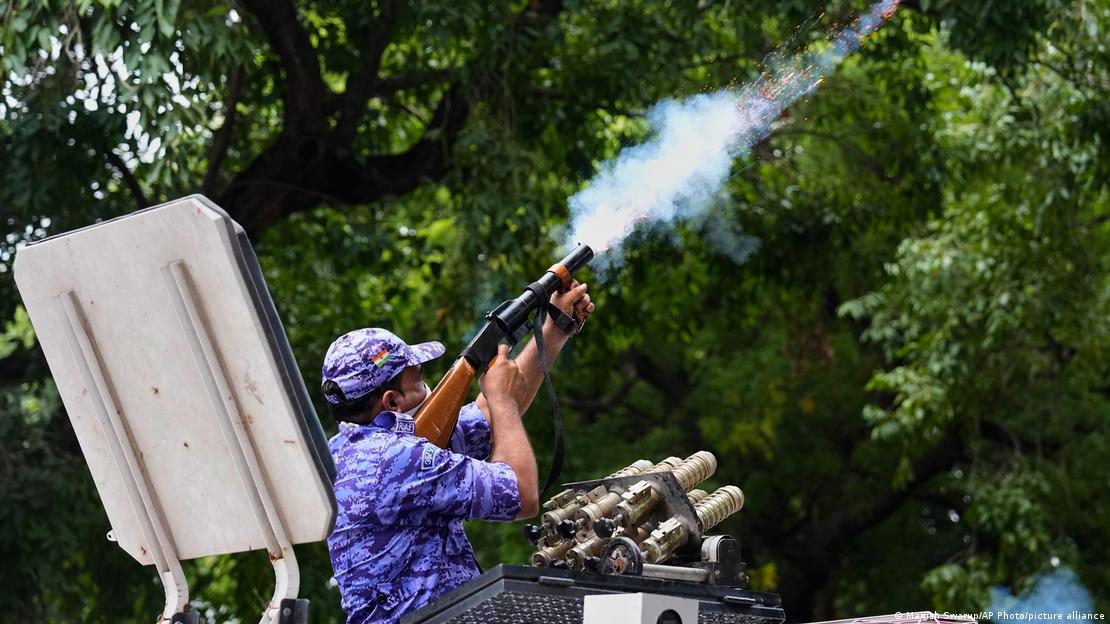
Riot police fired tear gas and used batons in New Delhi as tens of thousands of supporters of the satirical Cockroach Janta Party (CJP) marched towards India's Parliament on Monday (July 20).

Police in the Indian capital said 60 protesters and 118 police officers were injured in the clashes between demonstrators and security forces. Mobile internet was suspended in parts of the city, including around the Jantar Mantar protest site, during the violence.

Protesters are demanding the resignation of Education Minister Dharmendra Pradhan. Earlier this year, authorities canceled the high-stakes NEET medical entrance exam over a leaked question paper, affecting millions of students and sparking outrage across India.
What is India's Cockroach Janta Party?

The CJP began as an online campaign in May and rapidly evolved into a Gen Z street movement, giving a voice to a generation frustrated by unemployment, shrinking opportunities and a failing education system.


The protesters attempted to march toward India's ParliamentImage: Manish Swarup/AP Photo/picture alliance

The youth-led "Cockroach" party is now posing an unexpected challenge for Prime Minister Narendra Modi's government, prompting a response that combines political outreach with police action.

Modi's rivals have also tried to step in and take advantage of the youth's frustrations.

"Is this how a government behaves? Using tear gas and baton charges against students? This is a worthless government," Renuka Chowdhury, an MP from India's opposition Congress party, told DW.


Lessons from earlier protests in India


The CJP movement gained fresh momentum over the weekend after veteran reform activist Sonam Wangchuk, whose three-week hunger strike has become a symbol of the protests, was forcibly taken to a hospital by police.

It is not the first time India has experienced major protest movements. Hunger strikes, famously used by Mahatma Gandhi, remain a common and peaceful form of protest in India.

India Against Corruption (IAC) led by veteran activist Anna Hazare, managed to mobilize millions in 2011 and reshape the country's political landscape. A decade later, yearlong farmers' protests forced Modi to repeal controversial farm laws. However, a 2023 Olympic wrestlers' protest over allegations of sexual harassment achieved few of their goals, despite widespread sympathy.

Analysts say the CJP lacks a nationwide organizational network, which the farmers had at their disposal. Yet like the IAC movement, it has tapped into a broader public mood.

"This protest is different because it reflects a much broader cross-section of Indian society," said Yamini Aiyar, an analyst and senior visiting fellow at Brown University. "They are expressing their frustration with a country whose long-atrophied education system has left them with very little hope of a better future."

"Like the IAC movement, it has drawn the middle class onto the streets," Aiyar told DW. "But this is a far more coercive political environment. From the anti-citizenship protests to the farmers' movement, citizens have increasingly looked beyond political parties to hold governments to account."

Police response sparks backlash among Indian protesters

This week's clashes have done little to quell the anger among India's Gen Z.

"Like many young people across India, I am angry about a lack of jobs and an education system that crushes my aspirations. Even though my family supports the BJP, I managed to get away," Rukmini Singh, a student from Meerut, told DW.

"This was an attack against our children. I saw many young boys and girls hurt and bleeding. They will never forget it but the courage these people displayed gives me hope," Vasundara Singh, a teacher from Bihar, told DW.

As during the farmers' protests, leftist parties and student organizations have become visible on the ground, helping mobilize supporters and giving the movement organizational backing.

"After 50 years, youth have occupied the road to parliament," political activist Yogendra Yadav told DW. "This energy by the students shows that the path to parliament goes through the streets. It is remarkable."
Can CJP mobilize India's villages as easily as its cities?

The surge in protest numbers forced the government to engage with the movement after weeks of dismissing it.

Alongside the police action, senior ministers opened talks with CJP leaders. Home Minister Amit Shah met cabinet colleagues while Health Minister J P Nadda held discussions with representatives of the movement.

"We will decide on how best to address the students' demands," a senior Bharatiya Janata Party (BJP) MP, told DW on condition of anonymity.

Most CJP support appears to come from students and India's urban middle class. The BJP's strongest electoral base remains in rural India and smaller towns, where the CJP has yet to prove that its message resonates with young voters.

However, some experts believe that the CJP will do just fine beyond India's urban centers.

"This movement is likely to resonate beyond India's cities because the aspirations of young people in small towns and villages are no different," political analyst Radhika Ramaseshan told DW.

India's 'cockroach' protests meet with batons and tear gas  02:24


"For a generation that saw education as the route to a better life, the failure of the education system has become a deeply political issue," she said.

"Young people in rural India no longer see farming or traditional occupations as their only future. Whether the CJP itself survives is another matter, but the anger and frustration it has tapped into have the potential to reshape politics."

'The anger is now directed at the government'

A movement focused on India's cities may generate headlines without altering the BJP's political fortunes. But if the CJP spreads to rural youth, it could become a much broader political challenge.

"I don't think this will remain an urban movement," said commentator Apoorvanand.

"People constantly move between villages and cities, and those who witnessed the police action will carry those experiences home," Apoorvanand told DW.

"The anger is now directed at the government. Whether it becomes a broader political movement depends on the CJP's ability to widen its appeal."

For now, the CJP has already achieved something unusual. It has transformed satire into sustained street mobilization, forced the government into talks, and ensured that the concerns of India's young people remain firmly in the national spotlight.

"This is a long fight. We will have to engage in a very long struggle for this. Because you have to change an entire system, the nexus of that system is very deep-rooted," said Saurav Das, CJP's chief spokesperson.


Edited by: Keith Walker


Murali Krishnan Journalist based in New Delhi, focusing on Indian politics, society and business@mkrish11


Monday, July 27, 2026

‘Cockroaches Won!’: Youth-Led Protests Called Off After India’s Education Minister Quits

“Don’t mistake the beginning for the end,” said the Cockroach Janta Party, which vowed to press for further reforms and government accountability.


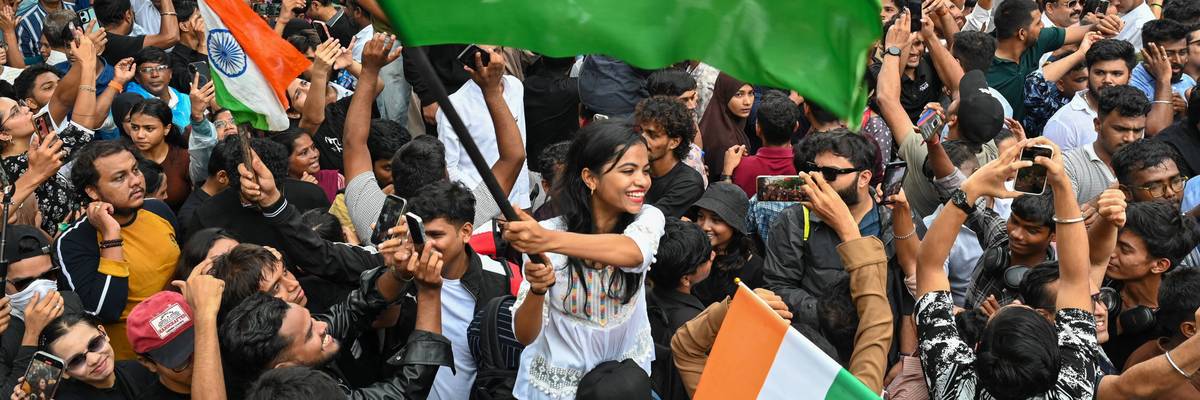
Cockroach Janta Party supporters wave Indian flags a day after the resignation of Education Minister Dharmendra Pradhan, in Mumbai, on July 26, 2026.
(Photo by Punit Paranjpe/AFP via Getty Images)


Brett Wilkins
Jul 26, 2026
COMMON DREAMS

India’s Cockroach Janta Party ended its five-week multi-city protest on Saturday after the youth-led movement’s key demand—the resignation of Education Minister Dharmendra Pradhan—was met.

“We have done it,” CJP spokesperson Saurav Das told a jubilant crowd at New Delhi’s Jantar Mantar. “Pradhan has sent in his resignation, which means that our first demand has been met.”


‘Black Day for Democracy’: Indian Police Bash and Gas Youth-Led ‘Cockroach’ Protesters

Das said that the protesters’ second main demand, the withdrawal of criminal investigations targeting CJP members, was also met. However, members and supporters of the movement noted that some cockroach protesters remain in detention and vowed to continue pressing for their release.

Pradhan’s resignation is the first such surrender to public pressure during the 12-year tenure of Hindu nationalist Indian Prime Minister Narendra Modi.


“Considering the situation at Jantar Mantar and elsewhere in the country, and so that anti-national forces do not take advantage of the circumstances, national unity is maintained, no student’s future gets entangled in legal complications, and our children can focus on their studies and building their careers, I have submitted my resignation,” Pradhan said in a statement.

Pradhan’s tenure was marred by repeated leaks of National Eligibility Entrance Test (NEET) papers in a scandal that has upended the lives of millions of students by forcing them to retake the grueling exams and delaying their university admissions. CJP organizers said more than 20 students have killed themselves over the matter.

The now-ex education minister had dismissed the protesters as “the B-team of terrorists.”

On Sunday, Modi said he would authorize the creation of an examination reform task force headed by Nandan Nilekani, co-founder of Indian tech giant Infosys.

“The government of India is continuously taking various measures for the future of students,” the Bharatiya Janata Party prime minister said in a video posted on social media. “However, we must look to the future. Our examination system needs to be reliable and transparent, and it must make maximum use of technology.”


The protest movement began in May after Chief Justice of India Surya Kant reportedly compared unemployed young people to “cockroaches.” The protesters, led by political strategist Abhijeet Dipke, satirically reclaimed the slur as the symbol of a movement that has grown into a broader challenge to Modi’s increasingly authoritarian rule, which has seen mounting repression of protest and dissent, including restrictions on journalists and activists, and the use of “lawfare” to target critics.

Last week, tens of thousands of youth-led protesters marched in New Delhi, where they were met and attacked by police batons and tear gas. Indian media reported thousands of injuries.

The mood was markedly different following Pradhan’s resignation.


“Cockroaches won!” many CJP members and supporters said.

Others added, “Democracy Won!”

“This is democracy,” said the CJP.

“Now that the cockroaches have won their first battle, may they win many more,” Tavleen Singh, a columnist for The Indian Express, wrote on X. “May they become a real political party in the near future.”

Sonam Wangchuk, an environmentalist whose hunger strike was a focal point of the cockroach protests, was released Sunday from a Gurugram hospital, where he had been recovering from his 26-day fast since Thursday.

Emboldened by the CJP victory, members of the Communist Party of India (CPI)-affiliated All-India Youth Federation and All-India Students’ Federation marched on the Chennai residence of Tamil Nadu Gov. Rajendra Vishwanath Arlekar demanding the abolition of the NEET. According to Indian media reports, police detained more than 200 of the demonstrators.


“The struggle will intensify,” said CPI.

“Don’t mistake the beginning for the end,” echoed CJP.

Asked Sunday what’s next for the cockroach movement, Dipke told an ANI reporter that “we will soon share the next strategy.”

“This has just ended yesterday,” he added, “please give us a little time.”

India: When the streets came alive with new hope and people’s people


Delhi, July 20: When the Streets Came Alive with New Hope and Power of the People

First published at MLUpdate.

Delhi will remember July 20, 2026 for years and years to come. The fledgling digital outfit Cockroach Janata Party and progressive student organisations, notably All India Students' Association (AISA), had given a call for a march to Parliament on the inaugural day of the monsoon session to press for the resignation of Union Education Minister Dharmendra Pradhan. The government responded by issuing a police advisory which said that there was no permission for such a march and participants would be liable to be punished for participating in any unauthorised event. Just three days ago Amit Shah had changed the Police Commissioner of Delhi. Two days ahead of the march, climate activist Sonam Wangchuk who was on an indefinite fast at Jantar Mantar for the same demand had been bundled away wrapped in a white sheet by plain clothes police personnel. The 'new normal' common sense of Modi's India suggested that no parliament march worth its name was possible in these circumstances.

As the day began amidst heavy showers on July 20, Delhi realised that it had never seen a march like this. Waves of young people were surging through every road in the heart of Delhi. Barricades erected by the Delhi Police were overcome as easily as seasoned athletes cross hurdle races in track and field events. The whole of Delhi had become Jantar Mantar, every road was leading to the Parliament building. The monsoon session began, only to be adjourned amidst loud protests by the opposition. As the day progressed reports of severe baton charges, tear gas shelling and even stone pelting by the police started pouring in from all over Delhi. Many areas looked like battlefields covered in thick smoke and several protesters suffered critical injuries. Yet videos of young people facing baton charges with the tricolour or the Constitution in their hands signalled the courage and determination of India's new generation. And as the evening drew in, protesters could be seen reclaiming the Jantar Mantar protest site that had earlier been 'cleared up' by heavy police violence.

The sit-in protests at Jantar Mantar had begun exactly a month ago on 20 June. A week later, on 28 June started the indefinite fast by Sonam Wangchuk and six leaders of AISA. As days passed and the condition of the hunger strikers began to deteriorate in the heat and sweat of a taxing Delhi summer, three of the six fasting student activists had to be hospitalized, while the other three continued to refuse food. Yet the government did not care to respond. Nor did the Godi media care to report. They must have thought that this conspiracy of silence would tire the protesters out. But at the end of the day the power of word of mouth and the extensive coverage on social media proved more than equal to this devious Modi-Godi strategy. The turnout of July 20 took both the government and the media by utter surprise.

Indeed, the scale of spontaneous response to this new combination of digital satire and real world protest also exceeded the expectations of organisations involved in the campaign as well as opposition parties watching it from a distance. Given the disappointing experience of the 2012 anti-corruption movement under the leadership of Anna Hazare, there was understandably considerable scepticism around the CJP phenomenon and the role of Sonam Wangchuk in the ongoing struggle. The positions adopted by Sonam Wangchuk till recently in support of abrogation of Article 370 and many other policies of the Modi government did not inspire much confidence in his new found role as an opponent of the education-examination system in spite of his widely recognised record as an educator, innovator and climate activist. Yet the mass response to the July 20 call clearly showed that the protests had struck a deep chord with India's youth, not only on the agenda of education, examination and employment but also on the question of holding the government accountable.

The unprecedented scale and spirited nature of participation of the people, especially of the Gen Z contingent of youth below the age of thirty, made July 20 stand out as the unmistakable indication of the assertion of Gen Z as a force for social and political change. It had shades of the July 2024 uprising in neighbouring Bangladesh or the September 2025 uprising of Nepal, both of which led to a change of government in their respective countries. Here the demand was only for resignation of the Union Education Minister to make him accountable for the serial paper leaks under his watch. In his notes sent from the hospital, Sonam Wangchuk had even appeared to omit that central demand, expressing his readiness to end his fast if the opposition could assure him of a serious parliamentary discussion on the agenda of education. The reduction of the demand for fixation of accountability with the government to the opposition raising the education agenda in Parliament, something which the opposition had repeatedly been doing in recent sessions, had confused and disappointed his supporters.

To the credit of the participants of the July 20 March to Parliament, it must be said that despite obvious lack of clarity and coordination, the marchers remained peaceful and determined, withstanding the brutality of the police and provocation of the agents of the Sangh brigade who joined the police to malign and attack the march in many parts of Delhi. It reminded us of the Modi government’s conspiracy to discredit and derail the historic farmers' movement after the 26 January 2021 tractor march. But just as the farmers regrouped and bounced back and the movement continued till the repeal of the three anti-farmer farm laws, India wishes the same strength and resilience to its youth to march forward till its core demands are met.

Ten years ago, students had risen in protest in India's universities following the shocking institutional murder of Rohith Vemula. The government had responded by jailing student leaders and maligning the student movement as an anti-national conspiracy. Then in January-February 2020, students and citizens, especially Muslim women, had launched an inspiring protest movement against divisive and discriminatory amendments to the Citizenship Act. The government suppressed that historic Shaheen Bagh protest movement by unleashing communal violence in Delhi and jailing activists under UAPA. Even after six years young scholars like Umar Khalid and Sharjeel Imam continue to languish in jail without any trial.

Unlike university-based student movements of the past, the Shaheen Bagh protests or the Delhi border farmers’ movement, this time the youth movement made its presence felt right in the heart of Delhi. It created a platform of unity where students from universities merged with the local youth from Delhi's neighbourhoods, parents mingled with their children, young women marched shoulder to shoulder with young men cutting across communities and cultures. Activists of AISA and other Left student organisations devoted their fullest energy and efforts to sustain and strengthen the movement against all odds, and demonstrated how student leaders like the hunger strikers Neha and Danish, Manish and Aameen, Hrishikesh and Deepak could also work alongside Sonam Wangchuk and CJP leaders like Abhijeet Dipke and Sourav Das.

Defying massive disenfranchisement and systematic denial of fundamental rights, serial electoral frauds and the relentless blitzkrieg of hate, lies and the all-pervasive fear and despair that seeks to reduce empowered vocal citizens to fearful loyal subjects, Jantar Mantar of July 2026, and the Parliament March of July 20 symbolise a decisive break with the fear and apathy that had gripped large sections of society. If protesters have to risk their lives to demand justice for the victims of paper leak and accountability of the education minister, then does Prime Minister Modi have any right to continue in office? The people of India have suffered enough, they now demand answers and accountability.


Condemn the massive crackdown unleashed by Bihar BJP regime on the student-youth movement

CPI(ML) Liberation, July 24, 2026

CPI(ML) Liberation strongly condemns the large-scale arrests of CPI(ML) leaders, AISA activists, democratic voices, and students across Bihar ahead of the 25 July Bihar Bandh called by the student-youth movement, which is demanding the resignation of Union Education Minister Dharmendra Pradhan and accountability for the rampant examination paper leaks.

As of now, CPI(ML) MLA Sandeep Saurav, CPI(ML) Central Committee member Kumar Parvez, Dhananjay, CPI(ML) leader and former JNUSU President, and AISA leaders Dipankar Mishra, Saba Afreen, Naushad, and Divyam have been arrested in a massive crackdown. Several other AISA activists and students have also been arrested, including many who have remained incarcerated since the 23 July Patna rally. Fabricated cases have been foisted on leaders and students in an attempt to silence the growing voices of the youth demanding accountability, justice, and quality education.

After unleashing brutal police violence against students and youth in Delhi on 20 July, and in Patna on 23 July, the Modi-Shah regime and its BJP government in Bihar have now intensified their campaign of repression in the state.

The BJP must read the writing on the wall. Arrests, fabricated cases, and intimidation will not silence the voices of students and youth demanding justice and accountability. CPI(ML) Liberation demands the immediate release of all arrested leaders, students, and youth, and the withdrawal of all cases against them which are fabricated.

The people of Bihar will give a resounding reply to the BJP government's repression by making the 25 July Bihar Bandh a complete success.


Condemn police crackdown on the student-youth movement at Jantar Mantar

CPI(ML) Liberation, July 18, 2026

CPI(ML) Liberation strongly condemns the early morning police crackdown on the student-youth movement for justice and accountability at Jantar Mantar, Delhi. The hijacking of climate activist Sonam Wangchuk, who had been on a hunger strike for 21 days, and the attempted kidnapping of AISA hunger strikers once again expose the Modi-BJP government's deep hostility towards students and youth.

The Modi government has resorted to repression because it has no answers to the growing anger against corruption, paper leaks and the systematic destruction of the public education system. Instead of addressing the legitimate demands of the protesters, it has chosen intimidation, force and the suppression of democratic dissent.

Despite the forceful removal of Sonam Wangchuk, the students foiled the police's attempt to disrupt the movement. AISA comrades Neha, Manish and Aameen, along with other hunger strikers, are continuing the indefinite hunger strike carrying the struggle forward.

We stand with Sonam Wangchuk and salute his courage and determination. We also salute the exemplary strength, resilience and resolve of the student protesters, who have refused to bow before state repression.

We call upon all sections of society to unite against this tyranny and join the July 20 Parliament March call given by the student-youth movement, demanding the resignation of Education Minister Dharmendra Pradhan, the disbanding of the NTA, the scrapping of NEP 2020, an end to corruption and paper leaks in the examination system, and the guarantee of affordable, inclusive and quality education for all.

Saturday, August 01, 2026

India’s “Cockroach Movement” Woke Up a Nation. But Is It Already Asleep Again?


India’s Gen Z-led movement confronted Modi, but some see it as a missed opportunity for transformational change.
July 30, 2026


Clad in a black T-shirt and sporting slightly unkempt hair, Abhijeet Dipke conducted the massive crowd in front of him. As they waved a sea of Indian flags to the beat of the music, he stood over them waving one back. The song they were all singing, “Maa Tujhe Salaam,” is one of India’s most patriotic, released by A.R. Rahman in 1997 to mark the country’s 50th year of independence. And when it reached its bridge and chorus, Dipke held up a little red book: the founding document of that independence, the constitution of India.

It was a poignant moment. Not just because the past 12 years of Prime Minister Narendra Modi’s rule has threatened that constitution’s integrity on multiple levels. But also because it constituted an act of resistance against how Modi’s party has pushed a Hindu nationalist project that has marginalized the country’s minorities, as well as its secular fabric.

Rahman is Muslim, and his song “Maa Tujhe Salaam” evokes memories of the pre-Modi years — a more inclusive time, when India’s diversity was celebrated rather than beaten down.

The collective invocation of Rahman’s song became one of the more iconic moments of the largely Gen Z protest movement in India this summer, which has grown into what many feel is the most significant challenge Modi’s government has ever faced.

“I think that was what was so beautiful,” said Aarti Neharsh, a protester who traveled from Mumbai to the capital New Delhi to be a part of the movement. Neharsh told Truthout that it stood out to her how many people were making overt displays of patriotism — something that in recent years has come with connotations of right-wing Hindu nationalism.


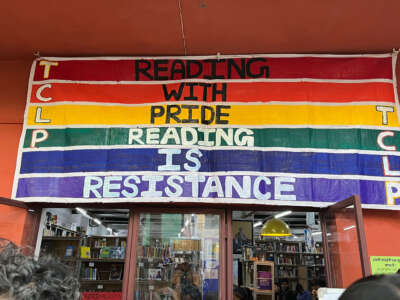
India’s Free Library Movement Counters Caste Discrimination and Authoritarianism
Organizers are leaning into the library as a crucial institution in broader movements for social and political change. By Emily Drabinski , Truthout  January 2, 2025


“People were not shying away from it,” she said. “It genuinely felt like a reclaiming of these songs and phrases … I think that reminded people [the country] is worth fighting for, and this is what India should be.”

What Started as Satire Grew Into a Movement


But the movement that Dipke has been leading, which over the weekend forced the resignation of India’s education minister, was not sparked by these big-picture battles over what India represents. That story begins with a disparaging remark by Surya Kant, the chief justice of India’s Supreme Court, who in May referred to unemployed youth as parasites and cockroaches.

Kant’s remark led Dipke, who was just a student in the U.S. at the time, to write on X: “What if all cockroaches come together?” The post went viral, and Dipke responded by jokingly creating the Cockroach Janta Party (CJP) — a play on the name of Modi’s ruling Bharatiya Janata Party (BJP). The CJP website said membership was open to the chronically online, lazy and unemployed — as well as those with “the ability to rant professionally.”

But what started as satire then grew into something more because it tapped into genuine frustrations. Modi first won power based on a promise that “acche din” (good days) were coming. Over a decade later, many are still waiting.


Almost 40 percent of graduates between the age of 15 and 25 in India are unemployed.

And nobody feels more in limbo than India’s 370 million youth, who make up more than a quarter of the country’s population. As more of them have had access to education in recent decades, the job market has not kept up.

According to a recent report, almost 40 percent of graduates between the age of 15 and 25 in India are unemployed. For many, the fact that Kant chose to malign Gen Z with his cockroach comment rather than do anything to fix the problem was emblematic of a government that doesn’t work for them.

“The name cockroach wouldn’t have been there if the CJI (chief justice of India) wouldn’t have compared us with the cockroaches,” Dipke told Reuters in May, pointing out that cockroaches “exist in a place which is rotten,” and reasoning, “So is the system so rotten, that the cockroaches are coming out in such a huge number?”

Students celebrate the resignation of India's Education Minister Dharmendra Pradhan, in Amritsar, India, on July 25, 2026, amid an ongoing protest by the Cockroach Janta Party (CJP) at New Delhi's jantar Mantar over alleged NEET examination irregularities. India's Education Minister Dharmendra Pradhan resigned on Saturday after mass youth-led protests demanded his ouster in anger over a string of irregularities in potentially life-changing exams.
Narinder NANU / AFP via Getty Images


Mishandling of Medical School Entrance Exam Stokes Despair Among Youth

But what really fueled the movement was news in mid-May that questions on India’s medical school entrance exam had been leaked before students had taken it a few weeks earlier. In response, the government announced that the results would be invalidated, and the more than 2.2 million students who took the test would have to retake it.

In a country with high levels of inequality and poverty, education is seen as many people’s best shot at social mobility. Poor families spend life savings and take out ruinous loans to pay for years’ worth of test preparation for their children, in hope that passing exams like the medical entrance one will give them a better life. For the kids, studying can dominate entire childhoods.

As journalist Manu Joseph wrote in the Indian business newspaper Mint: “For decades, there has been a covenant between India and its young — pass these entrance exams and you are set … In return, the young wasted their youth in the gloom of preparing for life.”

But even at the best of times, the odds are stacked against them. Fewer than 130,000 undergraduate spots existed for the 2.2 million students who took this year’s medical exam.

It’s incredible pressure. And having to go through the process all over again was too much for some to take. In the months since the exam was invalidated, the Cockroach Janta Party said 21 students committed suicide. Their families’ emotional journey has been unbearable.

“She triumphantly told me she had aced her papers,” Jafar Hussain, the father of 19-year-old Sana Shaikh recently told the People’s Archive of Rural India. “I told her to celebrate with her mother or go to a hotel and enjoy a meal.” A few weeks later, after the blow of the results being invalidated, Sana Shaikh hanged herself.

Her mother, Habib-un-Nisaa Sheikh, who traveled roughly 1,000 miles to join the protests, told the People’s Archive of Rural India that she holds those in power responsible: “My daughter died because of their decisions. You are supposed to protect us, not ruin our lives.”

Rana Ayyub, a journalist based in Mumbai, also said she spoke to protesters on the ground there and in Delhi who had traveled from all over the country to voice their pain.

“These are people coming from rural areas — villages where there’s not even electricity, where parents are taking loans on their small piece of land and sending their kids for education because it’s an aspirational country. Everybody wants their children to be an Indian Administrative Service or an Indian Police Service officer,” Ayyub told Truthout, referring to two sought-after government jobs that require competitive placement exams.

Protests Gather Steam in the Face of Brutal Treatment by Police


Dipke was a student at Boston University in the United States when he started the Cockroach Janta Party. But when he returned to India on June 6, 2026, he went straight to Jantar Mantar, New Delhi’s main protest site for the movement’s first street protest. From the outset, he and his fellow protesters demanded the resignation of Dharmendra Pradhan, the country’s education minister.

The movement built over weeks, getting a boost when Sonam Wangchuk, a 59-year-old activist, came to Jantar Mantar in late June to start a hunger strike in solidarity with the Gen Z protesters. Hunger strikes have great resonance in India dating back to its independence struggle. Mahatma Gandhi went on hunger strike 18 times, for as long as 21 days on two occasions, during India’s fight for freedom.

And so when Wangchuk was forcibly removed by police, three weeks into his hunger strike on July 19, it was seen as an attempt to silence his message. What followed was the biggest day of protest the movement had seen until that point, with tens of thousands showing up at Jantar Mantar.

Among them was Neharsh, the protester who flew in from Mumbai. “I was following what was happening,” Neharsh told Truthout, “and I just had this feeling that there is some hope because of the number of people that were standing up for this.”

Protesters were met with extreme force — police using tear gas, batons, and pellet guns, injuring over 100, including one woman who ended up on a ventilator.

But protesters were met with extreme force — police using tear gas, batons, and pellet guns, injuring over 100, including one woman who ended up on a ventilator.

“Because the police were using so much force, there were constant stampedes … there was nowhere to move … people were fainting because it was claustrophobic,” said Neharsh, who was tear-gassed.

“We saw a bunch of people coming — one by one injured on their heads and arms.”

Organizing Amid a Climate of Fear

Among the many characteristics that have marked the Modi years is a climate of fear. Dissent is rare, and often punished. In 2021, the Sweden-based V-Dem Institute downgraded its classification of India from an “electoral democracy” to an “electoral autocracy,” highlighting “the diminishing of freedom of expression, the media and civil society.” The few major protest movements that have taken place during Modi’s 12 years in power have generally petered out without achieving much.

A compliant mediascape that has been increasingly bought up by government-friendly businessmen has only added to the sense that Modi is untouchable. And when it came to the protests, that initially seemed to be holding true.

“If we still relied on mainstream media, we wouldn’t have known the kind of police brutality that students faced on July 20, because mainstream media didn’t document it,” said Priyanshi Sharma, a journalist who co-founded Peek TV, a short-form, independent media outlet, last year.

But what the Cockroach Janta Party protests fostered was a groundswell of Gen Z activity on social media expressing solidarity with protesters, documenting police brutality, and taking aim at Education Minister Pradhan and even Modi himself. Their critiques flooded the internet, bypassing traditional media as a main artery of information.

“ Many people thought that this protest will not become big because mainstream media is not covering it. But that wasn’t the case. Mainstream media were not covering it, but this became an ‘Insta’ revolution,” Sharma told Truthout.


“ Many people thought that this protest will not become big because mainstream media is not covering it. But that wasn’t the case. Mainstream media were not covering it, but this became an ‘Insta’ revolution.”

Ayyub said that a difference between 2026 and previous years is that the emergence of independent news platforms like Peek TV have also helped push back against mainstream media discourse.

“I think one of the biggest victories of this protest is to show the irrelevance of the mainstream media,” she told Truthout. “They tried really hard to create a narrative that [the protests] were funded by George Soros or outside forces. It didn’t stick.”

As the momentum built, both online and on the streets, the government lost control of the narrative, and Gen Z protesters found a new level of defiance. Crushing dissent didn’t work in the way it usually does.

“The police brutality actually removed whatever bit of fear was still in the minds of people,” Sharma said. “After that they thought, ‘We’ve seen the worst that can happen.’”

Neharsh agrees: “For the first time, a lot of us experienced what living without that fear feels like.”

For the first month or so of the protests, the government had barely paid them any attention. But now they were desperately scrambling to keep up.

“The government realized that this protest is not happening on the horizontal screens of television, but it’s happening on the vertical screens of mobile phones in people’s hands,”said Sharma.

On July 24, the government held a cabinet meeting where it emphasized the need to start connecting with young people more on social media. The night before, Modi had made his own first attempt at this — a selfie video addressed to protesters that was roundly mocked for numerous reasons, including his face being too close to the screen.

The efforts were ineffective and too late. Pradhan resigned on July 25, becoming the first full cabinet member to resign from the Indian government during the Modi years. The Cockroach Janta Party immediately ended its protest movement.

A Missed Opportunity?


One of the most noticeable ways in which fear subsided during the protests was the way people spoke up about how Modi has used religion to divide.

“I never thought I would hear something like … ‘Jab Jab Modi Darta Hai, Hindu Muslim Karta Hai’ (‘Whenever Modi Is Afraid, He Divides Hindus and Muslims’),” Ayyub told Truthout.

“That was heartening [and] a uniting sentiment across the board … it just goes to show that people have seen through Modi’s majoritarianism.”

And though the Cockroach Janta Party’s biggest demand throughout the protests was the resignation of Pradhan, as the movement grew, Gen Z began to take aim at Modi too. And they did it in a way Ayyub said she hasn’t seen before.

Though the Cockroach Janta Party’s biggest demand throughout the protests was the resignation of Pradhan, as the movement grew, Gen Z began to take aim at Modi too.

“The language used in these protests — there was no fear. The kind of abusive words used for the prime minister himself, the memes, the T-shirts, the merchandise that was selling on the streets.”

The strength of the movement was enough to get the government to agree to a list of demands — not just the resignation of Pradhan. But in the days since that victory, many are questioning whether calling off further protests was the right move.

The Cockroach Janta Party has already threatened to resume protests because the government has not implemented one of its demands: that those involved in the movement would not face retribution. Police cases have been filed against protesters in multiple states led by the ruling party, and the Cockroach Janta Party said more than 100 people have been arrested.

Another action promised by Modi — a fast-track court to investigate the exam leak — has already hit a roadblock after the government’s lawyer failed to show up for the first hearing.

While Ayyub recognizes that forcing the resignation of a cabinet member was a huge achievement, she also said the government acceding to the Cockroach Janta Party’s demands was a “token” gesture to end the protests. As a result, she’s been left feeling disappointed, and wishing the movement had kept its momentum going to achieve more.

“Modi’s myth-making has been shattered. His image has been punctured … [but] I don’t see [Pradhan resigning] as a big victory,” she told Truthout, adding that the Cockroach Janta Party “could have consulted senior lawyers, intellectuals, and people who have seen movements like this, and asked for systemic changes.”

Comparisons have been made between the Cockroach Janta Party and other recent Gen Z–led protests in the region that have led to the total fall of the governments in Sri Lanka, Bangladesh, and Nepal. That outcome was always going to be unlikely in India, which has seen close to 80 years of democratic, peaceful transitions of power as an independent nation.

But what’s interesting to note is that the Cockroach Janta Party itself was quick to distance itself from those movements when it started.

Ayyub was surprised by that.

“I understand there was violence involved [in those other movements] … and violence should never be a part [of a protest]. But I didn’t like that framing, that somehow we are different from them,” Ayyub said. “Gen Z rage is coming from the same space as what’s happening in those countries, so I felt like there were many similarities.”

But given they’ve now ended, Ayyub is not hopeful that the protests in India will create transformational change.

“There’s nothing really that’s going to change,” Ayyub said. “The country lost the momentum when it was really going in a direction where we could have sought some accountability.”

Note: A correction was made to clarify that the Cabinet meeting occurred on July 24 rather than June 24.


This article is licensed under Creative Commons (CC BY-NC-ND 4.0), and you are free to share and republish under the terms of the license.


Ashish Malhotra

Ashish Malhotra is the host of “The Soccernomics Podcast,” and the series creator of “The Dark Side of The World Cup” for Zeteo. He was previously a producer for Al Jazeera English programs such as “The Stream,” “UpFront,” and “The Take,” and was a correspondent based in India where he wrote for The Guardian, The Los Angeles Times, The Times of London, and others.


GenZ Protest: A Beautiful India is Possible


Manan Kumar |


The microcosmic replica of real India seen in Jantar Mantar, has awakened and will rise again, until it shakes off the accumulated dirt of inequality, communalism and nepotism.


Image Courtesy: Manan Kumar

During my 13-day pilgrimage to Jantar Mantar beginning June 6, including seven consecutive days starting July 19, I increasingly felt that besides being a singular entity, I also belonged to a larger ‘Being’. This ‘Being’ was slowly growing organically into a remarkably beautiful creature of myriad and vibrant colours by attracting the best available souls from all parts of India. The organic process of evolution did not allow any vicious or self-centric soul to be a part of it. 

Initially, it seemed that the protest might derail the blitz campaign launched by the Indian Youth Congress, at Rahul Gandhi's call, against the NEET paper leak. Perhaps, that was the original idea of the Narendra Modi regime, which is why it allowed the Cockroach Janata Party or CJP to stage a sit-in at Jantar Mantar. But the organic evolution of the ‘Being’ didn't allow this.

The protest grew, slowly gaining momentum after it was joined by famous climate change activist Sonam Wangchuk. It grew bigger when the man from Ladakh went on an indefinite fast along with many other student activists. It grew even bigger when the regime, afraid of its beautiful evolution, kidnapped Wangchuk and unleashed brutal repression on hapless students, not sparing even the minors, women and girls.

Volunteers and strangers formed a human chain in Jantar Mantar to successfully thwart a kidnapping attempt of the rest of the student activists on hunger strike. Similar replicas of the ‘Being’ evolved in major cities across India with a similar sense of urgency and purpose. The pictures and videos of the raw violence unleashed against the unarmed protesting youth travelled the world via social media and foreign press, leading to sporadic protest rallies by Indians in various cities across Europe, Canada, the US, Sri Lanka and Australia.

What shocked the State and its security apparatus was that the badly beaten and bruised students with broken limbs returned and looked straight into the eyes of their attackers. 

"Police uncle, this time tell us 10 minutes in advance before the lathi-charge," one protester said in humour with a typical GenZ smile emoji, lowering her tormentor's eyes.

"Uncle, ye maarne se pehle ye helmet de dena," (Please lend us your helmet before you start baton-charging us) came another gem sporting a GenZ heart emoji.   

The fear had ended. As more people poured into Jantar Mantar after the news of repression, police presence also swelled. But a tired security apparatus finally gave up when GenZ broke loose into dances on their own creative songs like Police Wale Babu Mujhe Danda Laga Do and Mujhe Apne Bank Ki Kitaab Dijiye, Desh Ki Tabahi Ka Hisaab Dijiye. The scene left many young policemen with heavy gear and batons, squirming. Their hearts and feet seemed to want to break free and join in, but the compulsion of a job kept them in check.

Meanwhile, the ‘Being’ kept evolving, growing bigger and more beautiful. 

As a reporter of 30 years' vintage and now unemployed, I was awestruck by the tenacity of the ‘Being’. During my long hours of visits, the thought of capturing it on video and starting my own YouTube channel crossed my mind but the cost was very high. I would have failed to live the moment and absorb the nectar flowing abundantly from the pure souls of hundreds of people like, Neha, Aameen, Manish and Amitoj, who were staking their lives through an indefinite hunger strike; selfless individuals like Junaid, Anuj, Suraj and hundreds of nameless individuals arranging and distributing food, water and snacks; volunteers and sewadars from Gurudwara Bangla Sahib and nearby mosques; dozens of young beautiful volunteer students cleaning littered trash; volunteers fanning the sweat-drenched crowd and trying to bring order; young doctors with first-aid kits and important medicines; and young lawyers painstakingly jotting down the accounts of victims of State-sponsored brutality. Like my younger daughter and her friend, I also became a part of the ‘Being’, doing whatever small tasks we could find to keep the protest healthy, happy and vibrant. 

An important factor that sustained the protest was the slogans and songs of struggle, revolution, courage and hope sung by the young comrades of the Left parties. Under a banner reading, "Yuva Rakt Ki Garmi Se, Barf Ki Ghati Pighlegi (The heat of young blood will melt the valley of ice)," activists from the All India Students Association (AISA), the student wing of the Communist Party of India Marxist-Leninist (Liberation); the Students Federation of India (SFI) of the Communist Party of India-Marxist; and the All India Students Federation of India (AISF) of the Communist Party of India, kept providing ample dosage of glue and adrenaline to keep the ‘Being’ in high spirits.

Groups of young and old could be seen having animated discussions on the key issues troubling India and the world: education, environment, E20, crony capitalism, climate change, rights of Dalits and Adivasis, constitutional rights, and the Brahminical order.

On July 24, my daughter decided to stay at the protest site with her friend for the night. I was scared, as I couldn’t have stayed. After braving several days of heat, dust and rain, my body had given up. I had fever. That night between 12:30 a.m and 6 o'clock, I called my daughter four times. Each time she seemed perfectly fine, doing some work or talking and listening to the struggles of newly made friends -- young boys and girls from villages, small towns and ghettos. Letting her spend a night at Jantar Mantar was a decision that I will always feel proud of. One night at the protest site made her wiser, more informed, and more humane.

Protest sites are great teachers indeed. These cramped places, teeming with people, teach you at no cost and much more quickly what you cannot learn in the best universities that teach behavioural science, psychology, human relations, politics and civic sense. It teaches you things even beyond any curriculum: love, camaraderie, empathy, care, brotherhood, bravery, unity, resoluteness and fraternity. 

When my daughter returned home on the morning of July 25, she angrily prophesied us not to worry as the protest would not end even after Wangchuk’s “climbdown” from the main demand during midnight.  She was unhappy that the main face of the protest had agreed for unsigned “paltry demands” and accepted juice from the State that had beaten students black and blue. 

I decided to go back to Jantar Mantar to mark our family’s attendance. I was expecting another showdown as the police presence had increased to unprecedented levels. 

My daughter proved correct. Ending the fast by the Ladakh man on lesser terms had met with a royal ignore by the ever-expanding ‘Being’.  

Aghast at the raw courage, the haughty and adamant regime ultimately bowed down. Union Education Minister Dharmendra Pradhan resigned.

The ‘Being’ erupted in joy when Abhijeet Dipke of CJP announced the news of Pradhan's resignation. Soon these souls started leaving Jantar Mantar, feeling mixed emotions: joy from the shared struggle and victory and grief over the separation. I too became a part of it. 

As I left my pilgrimage centre and retreated home, there was a feeling of longing but I was also brimming with newfound hope that the beautiful ‘Being’ is here to stay and will only grow bigger and bolder. Suddenly it occurred to me that the popular name of this ‘Being’ is Bharat Mata. Not the one personified by Bankim Chandra Chattopadhyay and first painted by Abanindra Nath, but as described and immortalised by India’s first Prime Minister Jawaharlal Nehru in his book The Discovery of India. 

At Jantar Mantar, I had seen only a microcosmic replica of Bharat Mata. It has awakened and will rise again and again, until it shakes off all the accumulated dirt of opulence, inequality, communalism and nepotism. 

The writer is a senior independent journalist based in Delhi. The views are personal.


A Dent in Impregnable Wall of ‘Elected Autocracy’: Youth Show the Way

Ram Puniyani |
We should hail and salute the youth and hope the bigger challenges of indirect attacks on our Constitution will be taken up in due course.

Image Courtesy: Deepak Jha

The formation of the Cockroach Janata Party (CJP) and the protest demonstration at Jantar Mantar is too well known by now. The torture of youth, lathi-charge by uniformed police and doubtful elements, the use of pellet guns and even AK-47 was totally against the norms of democratic values.

The other side of the protest was youth singing and dancing, making posters collectively, laughing and singing, reminding one of Karl Marx’s famous adage, ‘Revolution is the festival of the masses’, though the degree and context of the Jantar Mantar protest and many other protests all over the country were totally different.

The autocratic government, which is totally unresponsive to the valid cry of the people, buckled after a long time, as the pattern of protest was picking up city after city. The inhibitions imposed by the dictatorial stance of the government was melting into thin air. Earlier, we have seen the same government was impervious to the farmers’ protests lasting as long as over 12 months and withdrawn only after the laws were rolled back when elections were to be held. The government has encouraged troublesome elements to disrupt the Shaheen Bagh movement against the Citizenship Amendment Act or CAA. The prolonged voices against exam leaks were totally ignored.

This time the matters were different. The government tried to look the other way but could not and had to accept the demands, the key among which was the resignation of Education Minister Dharmendra Pradhan. He has been replaced by Pralhad Joshi. who again belongs to the Rashtriya Swayamsevak Sangh or RSS background. His persona can be judged from his approval of the release of rapists of Bilkis Bano

Now, a committee has been formed to look into the leak of examination papers, and the committee interestingly includes the likes of those who “specialise in cow urine”, as per Congress leader Priyanka Gandhi, and some others who don’t know the alpha and omega of the education system.

While currently the student leaders are struggling to ensure that the government fulfils its written assurance, we also need to understand the ‘success’ of this student uprising. It is nowhere close to the student uprising in France in 1968, or the happenings of our neighbouring countries -- Sri Lanka, Bangladesh or Nepal. But it has contributed a lot in changing the perceptions created by the IT and media cell of the ruling Bharatiya Janata Party (BJP), the ‘Godi Media’ and the word-of-mouth propaganda by RSS through its shakhas and hundreds of schools and other subordinate organisations. The sense of fearlessness in speaking against the government is likely to return gradually.

While the CJP and its leader Abhijeet Dipke acted as the precipitating factor of this protest, the ground for it had been in the making over the past many years. Rising unemployment, the rising cost of living and destitution had been the base on which all this stood. While falling indices of freedom of expression, freedom of religion, hunger index, happiness index are dismissed by the ruling dispensation, they do reflect the worsening social situation in the real sense.

While the mainstream media has reversed its role to be the eulogiser of rulers and critics of the Opposition, the collapse of this Fourth Estate was reflected when the youth hooted at journalists from Godi Media. Though this should not have happened, it does reflect the image of Godi Media among the youth, as it has deserted its role and has become the handmaiden of the rulers.

The spirit of the protesting youth was very much on display and very heartening, as it tried to lift some embargos on democratic freedoms.

Has the protest achieved its goals in total? Depends on what we see the totality as. The change of the Education Minister, though significant in smashing the ego of our ‘non-biological’ ruler, will not change the situation much, as Tweedledum has been replaced by Tweedledee. The core cause of the exam paper leaks -- corruption in the society -- has not been ended in any way, which can be curtailed only by making the system more transparent and accessible to society’s audit.

On the issue of corruption, though RSS did plan the Anna Hazare movement, leading to formation of the Aam Aadmi Party, to undermine the United Progressive Alliance-led Congress (which was then in power), the BJP-led National Democratic Alliance never made any move toward eradicating corruption. Neither was it an issue of concern for the ruling government. Heavy investment in some roads and bridges have been washed away, as these structures built by the BJP government, were probably riddled with heavy corruption.

One has to concede that a large amount of the ground for success, to whatever extent, was also prepared by Leader of Opposition Rahul Gandhi’s multiple meetings exposing the government's callous attitude toward social issues.

One is not yet sure if communal polarisation created by RSS-BJP has become weaker due to the impact of the July Jantar Mantar sit-in protest. The problems that have seeped into the system need to be tackled in a broader sense.

Can this movement, in the long term, remain away from electoral politics and pick up the core issue of communal forces, derailing the national agenda of peace and progress? The ‘idea of India’, as visualised by the freedom movement and embodied in our Constitution, has been cleverly by-passed to push the country toward Hindu Rashtra. The issues of building the nation have been substituted by demolishing mosques and universities. The State has gradually been infiltrated by those who have taken the divisive training of RSS shakhas, or are fed by the Godi Media and social media, popularly called ‘WhatsApp University.’

The students’ sit-in protest came as a breath of fresh air. What is still needed is that the youth march continues to bring us back as Indian citizens, rather than as Hindus or Muslims. This country belongs to the people, to all the people, while communal politics asserts Hindu Rashtra based on Manu Smriti. Their agenda is to impose Brahminical values with the relegation of Muslims, Christians, Adivasis, Dalits, Workers and women to second grade citizens.

One is enjoying the high spirits and pleasantness spread by this youth dharna. But, to presume that it has totally achieved its goals, will be self-defeating. Till we can contain, if not totally defeat, the communal forces, we will be inflicted one after the other by injustice from the ruling dispensation. We should hail and salute the youth/students and hope the bigger challenges of indirect attacks on our Constitution will be taken up in due course.

The writer is a human rights activist, who taught at IIT Bombay. The views are personal.

A Celebration That Should Never Have Been Necessary


Shirin Akhter |


Citizens were celebrating the eventual arrival of something that should have been routine in any constitutional democracy.

Image Courtesy: AISA Facebook

Students embraced one another at Jantar Mantar. Slogans filled the air. Flags were raised. Sweets were distributed. There was relief, joy and celebration. A Union Minister had resigned.

Yet nothing extraordinary had happened.

The resignation came after nearly 34 days of sustained nation-wide protests, widespread public outrage, reported loss of lives linked to the examination controversy, repeated police action against demonstrators and the deployment of coercive state power against students demanding accountability. What should have been an institutional response became the outcome of a prolonged political confrontation.

That this resignation became an occasion for celebration is itself an indictment of the present state of democratic accountability. In any functional democracy, ministers are expected to accept political responsibility for serious institutional failures. Democratic accountability is not a concession or a favour that must be extracted through prolonged public struggle. It is an ordinary constitutional expectation.

The question, therefore, is why the resignation was anything to celebrate at all.

The picture is much larger than the resignation of a minister. It reflects a deeper crisis in the relationship between the State, public institutions and India’s youth.

For years, young Indians have been told that education remains the principal route to economic mobility. They have been urged to acquire more qualifications, develop new skills and prepare for an increasingly competitive economy. At the same time, access to quality public education has failed to expand in proportion to demand. Public investment has remained inadequate, recruitment in public institutions has slowed and the growing dependence on private educational institutions and the coaching industry has shifted an increasing share of the financial burden on families themselves.

The consequences of this shift extend well beyond the education sector. Families have accepted rising private expenditure on schooling, university education and coaching because they believed these were investments rather than expenses. Students have accepted years of uncertainty, intense competition and delayed entry into the labour market because they believed the system, however demanding, would remain fundamentally fair.

Competitive examinations, therefore, perform a function far greater than selecting candidates for jobs or university admissions. They sustain the belief that effort, ability and perseverance continue to provide a legitimate route to social and economic mobility. Repeated examination irregularities begin to erode this belief. A paper leak undermines confidence in the institutional mechanism through which opportunity is allocated.

Every compromised examination, every delayed recruitment and every cancelled selection process weakens the credibility of the promise that merit will ultimately be recognised. The immediate consequence is the loss of a job or an admission. The deeper consequence is the erosion of trust in public institutions themselves.

Further, a paper leak is not one single grievance, it is a compendium of complaints. An examination controversy ultimately evolves into a discussion about unemployment because delayed or cancelled recruitment postpones employment. Unemployment, in turn, raises questions about the State’s developmental priorities, the shrinking availability of secure public employment and the increasing precariousness of labour markets.

What begins as a demand for a fair examination soon becomes a wider interrogation of governance, institutional accountability and democratic responsibility. Students connect these issues because they experience them not as separate policy failures but as different manifestations of the same broken promise. One that stifles their aspirations and hopes.

This is why student movements possess a distinctive political significance. They speak not only for the candidates but also for their families who have invested their savings, their aspirations and years of sacrifice in the belief that education remains the most reliable pathway to a better life. When confidence in that pathway begins to collapse, the crisis is no longer confined to the education system. It becomes a crisis of developmental legitimacy itself.

History shows that this transformation is neither unusual nor accidental. Student movements rarely remain confined to campuses because they articulate anxieties that extend far beyond students themselves. The movement led by Jayaprakash Narayan drew much of its initial energy from students before developing into a nationwide challenge to political authority. The May 1968 protests in France began in universities before spreading to workers and eventually becoming one of the largest general strikes in modern history.

Student activism played a decisive role in South Korea’s democratic transition during the 1980s. More recently, protests over public recruitment in Bangladesh evolved into a much broader questioning of state legitimacy. Across countries and historical periods, the pattern is remarkably similar. Student movements become politically significant when society begins to recognise its own anxieties in the demands of its youth.

This is also the point at which governments face a choice. They can respond by restoring confidence in institutions through transparency, accountability and reform. Or they can seek to restore order through policing, restrictions and coercion. Political economist Antonio Gramsci described this as the distinction between governing through consent and governing through coercion. Democratic governments derive their legitimacy primarily from consent, from citizens believing that public institutions remain fair and responsive.

Coercion becomes increasingly prominent when that confidence begins to erode. It cannot resolve the underlying crisis. It merely suppresses its immediate expression.

The significance of Jantar Mantar, therefore, lies not in the resignation itself but in everything that preceded it. A ministerial resignation, which should have followed naturally from institutional failure, came only after weeks of sustained protests, public anger, police action and mounting political pressure. Accountability became something that had to be wrested from the state rather than something the state willingly embraced.

That is why the celebrations at Jantar Mantar deserve to be remembered. They were expressions of relief, not triumph. Citizens were celebrating the eventual arrival of something that should have been routine in any constitutional democracy.

The paradox is difficult to ignore. The more jubilant the celebration, the more serious the failure that made such a celebration necessary. Democracy has not performed an extraordinary act. It has merely delivered, after enormous resistance, what should have happened in the ordinary course of democratic responsibility.

The writer is Associate Professor at Zakir Husain Delhi College, University of Delhi. The views are personal.

Why Delhi Police’s July 20 crackdown transgressed Law on Use of Force


Edgar Kaiser |


A deluge of videos document the Delhi police resorting to pellet shots, nail-studded lathis, tear gas, and even assaulting women protestors on July 20. By every metric, it impinged the principles of proportionality and minimal use of force.

On July 20, when thousands of youth marched towards the Indian parliament, the police cracked down with tear gas, pellet guns and nail-studded lathis, leaving more than a hundred injured, with a 22-year-old man losing his eyesight. While most evidence shows that it was a peaceful protest and later, the Rapid Action Force chief conceded to the excessive use of force, what exactly does the Indian law say on the rightful use of force to contain assembly?

The law of peaceful assembly and Jantar Mantar

Jantar Mantar's status as a dedicated protest site itself is a product of constitutional adjudication. In 2017, the National Green Tribunal (‘NGT’) banned peaceful assembly, protest or any gathering at Jantar Mantar, citing noise pollution. This takes us to the constitutional limitations on peaceful assembly, which include public order, sovereignty, security and integrity of the state, and friendly relations with foreign states, among others under Article 19(1)(b). The Supreme Court then, in Mazdoor Kisan Shakti Sangathan (2018), overturned NGT’s decision where the Union’s defence was that demonstrations leave a negative impact on foreign dignitaries to the country and tarnish bilateral relations. Justice A.K. Sikri had commendably declared that the right to protest "strengthens representative democracy by enabling direct participation in public affairs” and “exposes the flaws in governance and demands accountability" and also directed the Delhi Police Commissioner to frame guidelines. Demanding accountability was exactly what the ‘cockroaches’ were attempting to do, this summer.

The guidelines that followed limited the site to a thousand participants and interestingly prohibited the use of lathis and firearms by protestors but had no word about the use of force or weapons by the police. The guidelines also note that no marching from the designated spot is allowed unless specific written permission from the police is obtained. In the Shaheen Bagh case (2020), in the aftermath of the Delhi riots, the Court clarified that the right to protest does not extend to the indefinite occupation of public roads or to unrestricted disruption of public life. While the no-marching rule in the guidelines does have a legal effect on the July 20 Chalo Sansad, does it justify the excessive force used by the RAF?

Justice A.K. Sikri had commendably declared that the right to protest "strengthens representative democracy by enabling direct participation in public affairs” and “exposes the flaws in governance and demands accountability".

The legality of the restriction imposed on July 20

Before delving into the use of force, the specific prohibitory order that was in effect on July 20 and its legality needs to be disentangled. The evening before the proposed march by the protestors, the Delhi Police issued an order under Section 163 of the Bharatiya Nagarik Suraksha Sanhita for the entire New Delhi district, disallowing any gathering or march outside the designated protest site at Jantar Mantar, and clarified that they had received no permission for the march. DCP Sachin Sharma also announced that the protestors violating the order would ‘be liable for legal action’, which is a fair restriction under the settled law. 

Nonetheless, the order itself should be legally tested because in Madhu Limaye (1970), the Supreme Court had held that this provision should be carefully applied only where the specific material facts signal ‘a likelihood of being able to prevent some harmful occurrences’ or  ‘disturbance to public tranquillity’. The first day of protest at Jantar Mantar was June 6, and it was already more than a month of peaceful protest, and there were no signs of any apprehension of violence. There were no weapons carried by the protestors as prohibited by the city guidelines. There were only flowers, slogans, pieces of artwork, books and the Constitution of India that the students held in their hands. If there was any danger that the Delhi Police could have apprehended, perhaps it was the copies of the Constitution of India carried by the protesters. Perhaps that is what they feared the most. 

In Ramlila Maidan (2012) too, the Court reinstated that the prohibition should be proportionate to the threat apprehended based on material facts and not on the state’s mere assumption. There is another layer to this brutal labyrinth. In Mazdoor Kisan, the Supreme Court pulled up the Delhi police for routinely renewing the prohibitory orders and virtually imposing a blanket ban on the right to protest. Eight years later, the Delhi police continued to do so, and this time, when the Gen Zs were actively coordinating their protests through digital space, the government imposed several internet shutdowns a few days before July 20 and even after.

How much force is ‘lawful force’?

The 1985 Code of Conduct for the Police in India mandates that “the police should, as far as practicable, use the methods of persuasion, advice and warning” and use ‘irreducible minimum force’ only when it is inevitable.  In Ramlila Maidan, the Court held that even an assembly that had ceased to be lawful did not forfeit the protection against disproportionate force and held that the crackdown was not "proportionate to the exigency". Standing orders 72 and 309 of the Delhi police clarify the use of force: it should be only used for crowd dispersal in a controlled manner with ‘utmost restraint’. This is also only in the case of the crowd turning violent, when the police should, only with the advice of a senior officer, use minimal force and videograph the entire use of force. Before using the force, the police should announce and declare the assembly unlawful, should constantly liaise with the leaders of the protest and only then resort to minimal force with the single aim of dispersing the crowd. 

At Jantar Mantar, it was the protestors who captured videos of brutal violence on protestors, pellet shots, nail-studded lathis and tear gas, which impinges the principle of proportionality and minimal use of force as elucidated above. There were even videos of women being slapped and sexually assaulted by the Delhi police. “I was leading protesters, and I had my hands folded when they fired,” said the boy who lost his eye, describing a gesture of peace towards the security forces.

What about Pellet guns? It has been treated as a Kashmir-specific weapon due to the unique insurgent situation in Kashmir as a "non-lethal" alternative to live ammunition during crowd control operations. Although the Central Reserve Police Force calls it the ‘least lethal weapon’, it is not a non-lethal weapon as per international standards. It has been a subject of legal dispute since the 2016 unrest after Burhan Wani's killing in Kashmir. The usage of pellet guns in farmer protests and Manipur riots were condemned, but its legal history dates even further back in history.  

The Supreme Court in 2016 had refused to ban the weapon but directed the Centre to convene an expert committee on alternatives and ordered it not be used indiscriminately. The Committee recommended resorting to shells and grenades, STUN-LAC shells and grenades, all to disperse violent protestors, failing which they could use pellet guns. The Jammu and Kashmir High Court’s rationale to retain pellet guns was the presence of unruly mobs creating an insurgent situation, which is not even remotely relevant to July 20 and Delhi, in general. There was no insurgency or violence whatsoever. What was required was a mere crowd dispersal with a proportionate and minimal use of force.

An international human rights report noted that pellets, colloquially known as ‘bird shot’, are hunting rounds fired as a single group of hundreds of high-velocity metal balls, which could be lethal if fired from a close distance. While the Standard Operating Procedure in India sets a minimum distance of 500 feet to fire pellets, the Delhi police were much closer than that, which led to the blinding of a boy. The report accurately notes this: ‘pellet guns have the ballistic capacity to penetrate some organs, such as the eyes, causing blindness’. While the police are factually contesting the usage of pellets, there is clear documentary evidence, and if it gets proven in court, this would be the first documented use of the weapon against protesters in the National Capital Territory. 

A weapon whose legality was tolerated only within the specific security context of Kashmir infiltrated an ordinary crowd control strategy in the national capital. There is no place in law for the usage of nail-studded lathis, which were also found to be used on July 20. The UN Code of Conduct for Law Enforcement Officials (1977), UN Basic Principles on the Use of Force and Firearms (1990) and UN Guidelines on Less Lethal Weapons (2020), all international guidelines, well align with the Indian law on minimal, necessary and proportionate use of weapons.

“I was leading protesters, and I had my hands folded when they fired,” said the boy who lost his eye, describing a gesture of peace towards the security forces.

Where do the injured cockroaches go now?

In J&K High Court Bar Association (2020), the Jammu & Kashmir High Court while dealing with the question of excessive use of force, held that the court can only determine the lawfulness of the force used if a ‘competent forum’ concludes its finding on the facts. The court concluded saying, “the persons alleging use of excessive force, due to which death or injury has occurred, can very well approach the appropriate forum to establish the same and seek redressal.” Now what is the competent and appropriate forum becomes the deciding question. For the July 20 violence, the National Human Rights Commission (‘NHRC’), now in a rare occasion, has taken suo motu cognizance of the excessive use of force. 

Interestingly, the NHRC has raised several legal questions discussed above and asked the Delhi police to submit the facts of July 20 violence, the justification for the prohibitory order, details of the usage of lathi charge, tear gas and pellets used and the injuries sustained by the protesters including the proportionality and the SOP followed during the crowd control. Ordering the Delhi Police to investigate allegations against their own colleagues might render it futile, a criticism that is not new for the apex human rights body. This also hinges upon the Supreme Court’s consistent concern on the independence of investigation on police excess - the connivance of colleagues. Does this truly in spirit and practice fulfil the appropriate forum illustrated by the Jammu & Kashmir High Court? The ‘cockroaches’ wouldn’t leave it easily as they are stern on their demands. At least, they shouldn’t!

DCP Sachin Sharma warned against ‘legal action’ on protestors who violate the order, but never said they would be blinded and molested. The law is settled, and the use of force has comfortably transgressed the necessity and proportionality test, and the internet shutdown and sexual assault only worsen it. Besides the NHRC’s intervention, the Supreme Court on July 28 ordered the release of all minors, restrained the police from taking coercive action against “protesting students” without criminal record and is considering the constitution of a high powered investigation committee after hearing the Union. Hence, it is ultimately upon the top Court, which was also inadvertently the trigger for this whole movement, to assert whether it is unlawful use of force to protect the constitutional rights of the youths who exercised their democratic right to ensure ‘accountability and transparency’ as Justice Sikri, noted in Mazdoor Kisan.

The views are personal.

Courtesy: The Leaflet